Microbiology 1: Bacteriology
Dr. DIA MOUNDO Christian Franck
M.D., General practitionner
Level 1 Medical and Biomedical sciences
Introduction to the Bacteriology
 The microbial world is composed of commensally and
pathogenic Microbes/ Microorganisms.. Bacteria, Fungi (Yeast/
Moulds), Algae, Protozoa/ Parasites and viruses.
 Microbiology is concerned with the study of these microbes..
Mostly are beneficial.. Few species cause harmful
effects ..disease in human & animals.
 Microorganisms are unicellular cell.. too small to be seen with
the naked eye.. recognized by light microscope .. Bacteria,
fungi & Parasites ..their sizes above > 0.1 um
• Cell – Basic unit of living things.
Introduction to the Bacteriology
• Microbiology has many areas of specialization including Bacteriology,
Mycology (fungi), Virology, Medical microbiology, Immunology, Food
microbiology, Biotechnology, Microbial genetics ..Industry..
Agriculture Veterinary.
• Two fundamentally different types of cells are classified in the
microbial world, Prokaryotic .. Eukaryotic cells.
• Eukaryotic cells have a "true" nucleus.. Prokaryotic cells have a naked
nucleus.. composed of a single DNA Chromosome.. not enclosed
within a nuclear membrane.
Introduction to the Bacteriology
1.
2.
3.
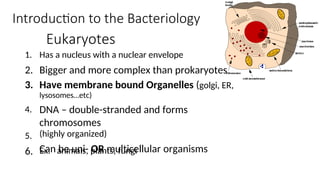
Has a nucleus with a nuclear envelope
Bigger and more complex than prokaryotes
Have membrane bound Organelles (golgi, ER,
lysosomes…etc)
DNA – double-stranded and forms
chromosomes
(highly organized)
Can be uni- OR multicellular organisms
4.
5.
6. Ex: animals, plants, fungi
Eukaryotes
somes)
d more
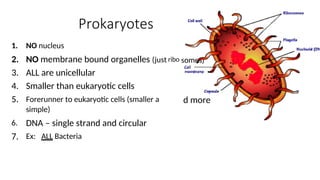
Prokaryotes
1.
2.
3.
4.
5.
NO nucleus
NO membrane bound organelles (just
ALL are unicellular
Smaller than eukaryotic cells
ribo
Forerunner to eukaryotic cells (smaller a
simple)
DNA – single strand and circular
6.
7. Ex: ALL Bacteria
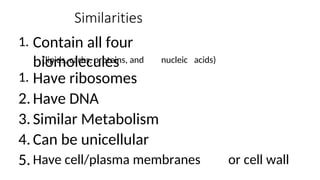
Similarities
Contain all four
biomolecules
1.
(lipids, carbs, proteins, and
Have ribosomes
Have DNA
Similar Metabolism
Can be unicellular
nucleic acids)
1.
2.
3.
4.
5. Have cell/plasma membranes or cell wall
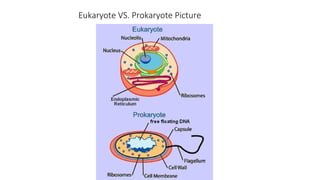
Eukaryote VS. Prokaryote Picture
General bacteriology
• Structure of the bacterial cell, nutrition and growth, metabolism (anaerobic,
aerobic conditions, fermentation), reproduction and genetics (genetic tranfer,
mutation), pathogenicity (notions of virulence, toxin)
• Bacterial ecology
• Role of the field, reference machanism of the host against the infection
(immunosuppression, opportunistic bacteria, nosocomial infection)
General bacteriology
• Bacteriology is the study of bacteria.
• Bacteria are prokaryotic organisms.
• Bacteria are microscopic single-celled organisms “unicellular” that
reproduce by binary fission.
• Most bacteria are capable of independent survival and growth, but
species. Chlamydia and Rickettsia can only survive as intracellular
organisms.
• Some bacteria can move freely in their environment while others are
stationary.
• Bacteria can be found almost every where on the earth. They can live in
variety of environments including a wide range of temperature, PH and
salt concentration.
• They can be beneficial or harmful by causing diseases.
General bacteriology
• The Bacteria are a group of single-cell microorganisms with
procaryotic cellular configuration.
• Bacteria are the oldest and simplest organisms, but they are
metabolically much more diverse than all other life-forms combined.
• Procaryotes are found in all of the habitats where eucaryotes live.
General bacteriology
• Bacteria are unicellular microorganisms.. Size (0.2umDiameter, 0.2-
10um Length) having a variety of shapes ..Growth patterns & metabolic
characteristics allowing their classification.
• Major bacteria cell shapes are arranged: Coccus/cocci, Bacillus/bacilli
or Rods, Coccobacilli, Spiral forms- spirochetes, Vibrios
• Individual cells may be arranged in pairs or clusters or chains.. Their
morphologies are useful for the identification & classification of
bacterial Genera and Species.. colored by Gram-stain or other stains
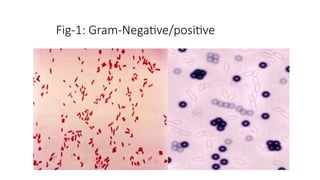
Fig-1: Gram-Negative/positive
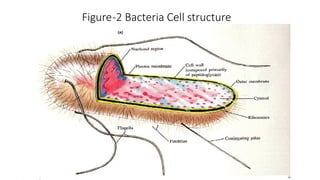
Figure-2 Bacteria Cell structure
Bacterial Cell structures-1
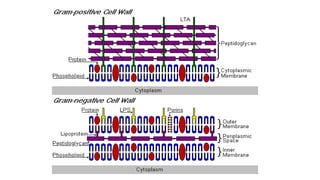
• Cell wall structures: A rigid cell wall, composed of many peptidoglycan
layers .. outer membrane, A periplasmic space, a cytoplasmic
membrane lacking sterols, Cytoplasma ..70S ribosomes, mesomes,
storage granules -Lipids, glycogen, polysaccharides, sulfar, phosphate ..
Others storage compounds.
• Bacterial genome.. One single supper coiled DNA chromosome,
plasmids(>1).
• Flagella: Organs of motility, composed of flagellins (polymer proteins)
long filament.. length up to 20 um (Figure 2).. Attachment..
Nutrition..Single polar flagellum (monotrichous).. Several polar
flagella at one, each end of the cell or covering the entire cell surface
(peritrichious).. antigenic determinants (H-antigen)..observed during
bacterial infection.
Bacterial Cell structures-2
• Fibmriae.. Pili: Small surface appendages (protein).. Few
numbers Pili.. Sex function /Large Numbers
fimbriae..specific functions .. Attachment/Adhesion to host
epithelial cells/colonization & antigenic determinants.
• Capsules: surface layer of cell wall.. a slime layer composed
mostly of high molecular weight polysaccharides.. provide
resistance to phagocytosis.. avoid the killing effects of
lysosomal enzymes, and serve as antigenic determinants..
(K-antigen).. Major virulence factor in certain bacteria
• Virulence factor.. Any bacterial part/product Associated
with pathogenic potential.. causing human/animal
infection/disease.
Bacterial Cell wall Structures-1
• Bacterial cell wall contains a special polymer called
Peptidoglycan. Its basic structure is a carbohydrate
backbone of alternating units of N-acetyl glucosamine
and N-acetyl muramic acid.
• These are cross-linked with oligopeptides.. contain both
D- and L-amino acids.
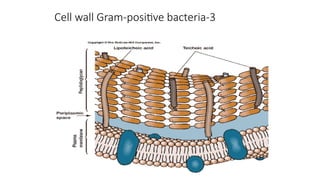
• Teichoic acid-Lipoteichoic acids: found only in Gram-
positive bacteria.
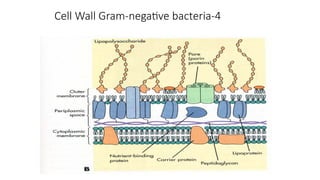
• Lipopolysaccharides: Lipopolysaccharides (LPS) found
only in Gram-negative bacteria.
Cell wall Gram-positive bacteria-3
Cell Wall Gram-negative bacteria-4
Bacterial Cell wall Structures-2
oLPS structures are composed of lipid A, which binds to the outer
membrane.. Endotoxic portion of the molecule.. Causing Toxic
Shock.. High Fever, Sepsis
oThe polysaccharide moiety appears on the cell surface, serving as
an antigenic determinant O antigen- Host cells develop during
bacterial Infection..Anti-O AB
oCell wall is the basis for classification of bacteria into Gram-
positive & Gram-negative by Gram-stain
o Cell membrane: A phosolipid bilayer responsible for transport of
ions, nutrients and waste across the membrane.. Control the cell
plasma contents
Gram-Stain
A- Gram-positive bacteria have a thick layer of peptidoglycan,
Many sheets.. external to the cytoplasmic membrane..
Lipoteichoic acids.. stained Blue.. Staphyloccocus,
Streptocooci, Bacillus..Protoplasts..L-form..Lysozyme
effect..Loss Most Cell wall, Burst +Lysis
B- Gram-negative bacteria contain lipopolysaccharide (LPS)
attached to the outer membrane... source of the O-antigen
and endotoxin reaction.. Stained Purpel/Red.. Enteric
bacteria group.. Esch. coli, Klebsiella, Salmmonella
Pseudomonas, * Spheroplasts
Spore-Forming Bacteria
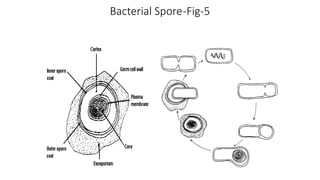
oENDOSPORE FORMATION: The process of sporulation begins
when vegetative (actively growing cells) exhaust their source of
nutrients .. begin of forming endospores.. Common in nature
(Figure 4).
oSpore forming Bacteria are very resistant to lysozyme, heat,
radiation, drying and can remain dormant for hundreds of years in
nature.. Once conditions are again favorable for growth, the spores
can germinate and return to the vegetative state.
oAerobic Bacillus group & Anaerobic Clostridium.. develop
Endospore formation.. Both are widely distributed in
nature ..intestinal -human and animals.
Bacterial Spore-Fig-5
Growth & Nutrition-1
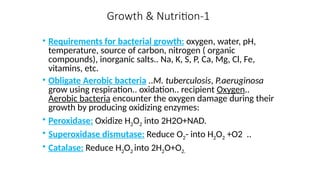
• Requirements for bacterial growth: oxygen, water, pH,
temperature, source of carbon, nitrogen ( organic
compounds), inorganic salts.. Na, K, S, P, Ca, Mg, Cl, Fe,
vitamins, etc.
• Obligate Aerobic bacteria ..M. tuberculosis, P.aeruginosa
grow using respiration.. oxidation.. recipient Oxygen..
Aerobic bacteria encounter the oxygen damage during their
growth by producing oxidizing enzymes:
• Peroxidase: Oxidize H2O2 into 2H2O+NAD.
• Superoxidase dismutase: Reduce O2- into H2O2 +O2 ..
• Catalase: Reduce H2O2 into 2H2O+O2.
Growth & Nutrition-2
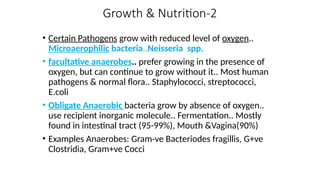
• Certain Pathogens grow with reduced level of oxygen..
Microaerophilic bacteria..Neisseria spp.
• facultative anaerobes.. prefer growing in the presence of
oxygen, but can continue to grow without it.. Most human
pathogens & normal flora.. Staphylococci, streptococci,
E.coli
• Obligate Anaerobic bacteria grow by absence of oxygen..
use recipient inorganic molecule.. Fermentation.. Mostly
found in intestinal tract (95-99%), Mouth &Vagina(90%)
• Examples Anaerobes: Gram-ve Bacteriodes fragillis, G+ve
Clostridia, Gram+ve Cocci
Growth & Nutrition-3
• Bacteria classified by the source of their energy oxidation-
reduction process into two groups:
• Heterotrophs: derive energy from breaking down complex
organic compounds.. protein, sugar, fats.. human tissues.. All
commensals-pathogens
• Autotrophs: fix carbon dioxide to make their own food
source.. using light energy photoautotrophic, or oxidation of
nitrogen, sulfur, other elements chemoautotrophic.. sulfur &
nitrogen fixing bacteria.. Environment.
• Saprophytic bacteria/ Nonpathogenic.. take energy by
fermentation/respiration.. found in nature.. in decaying
material.. soil, water..vegetations..circulation of minerals.
4/
• Culture Media: Nutrients (carbohydrates & proteins, blood,
minerals) Source.. Water..Broth medium, Solid medium/
Blood agar, Petri dishes/Plate, Growth/Culture (Fig 5)
• Neutrophilic bacteria.. Grow best pH (7-7.2) Most human-
animal commensales & pathogens
• Acidophilic Bacteria < 5 pH.. Lactobacilli
• Mesophilic Bacteria (20-40C)..Most human commensal &
pathogens.
• Psychrophilic bacteria(<10C), Thermophiles bacteria (>
60C)..Common in hot spring water
• Counting bacteria growth: Plate counts, Turbidity, Dry
weight using solid culture agar
Bacterial growth-1
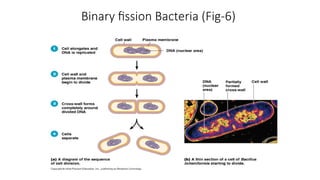
• Bacterial growth is the division of one bacterial cell into 2
identical daughter cells..4,8.16.. binary fission..Generation
time ( 15-25 min), most human commensal & pathogens..
Each produce one colony 103
-109
cells ( Fig-4).
• Bacterial Strain originated from a single cell.
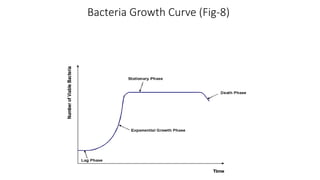
• Baterial Growth Curve: 4 phases of visible growth...Lag, Log,
Stationary, death/ decline.
• Measurement of bacterial growth followed by:
• A) Growth/enumeration of cells by direct cell counting in
nutrient broth.. microscopic or counting viable cells/ colony
forming unit.. Plate counts/ Electronic counting..using solid
culture media..nutrient agar
Binary fission Bacteria (Fig-6)
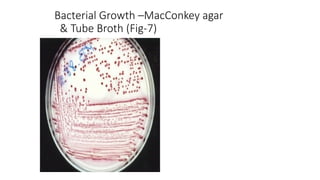
Bacterial Growth –MacConkey agar
& Tube Broth (Fig-7)
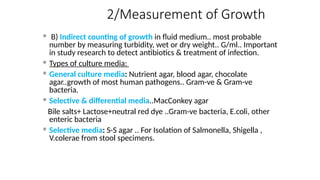
2/Measurement of Growth
 B) Indirect counting of growth in fluid medium.. most probable
number by measuring turbidity, wet or dry weight.. G/ml.. Important
in study research to detect antibiotics & treatment of infection.
 Types of culture media:
 General culture media: Nutrient agar, blood agar, chocolate
agar..growth of most human pathogens.. Gram-ve & Gram-ve
bacteria.
 Selective & differential media..MacConkey agar
Bile salts+ Lactose+neutral red dye ..Gram-ve bacteria, E.coli, other
enteric bacteria
 Selective media: S-S agar .. For Isolation of Salmonella, Shigella ,
V.colerae from stool specimens.
Bacteria Growth Curve (Fig-8)
Presentation of the bacterial systematic
Study of the main species or bacterial proups pathogenic for man or
likely to be (history, habitat and epidemiology, fill pathogen,
bacteriological charcters, diagnosis, treatment and prophylaxis)
• Staphylococci
• Streptococci
• Pneumococci
• gonococcus
Bacteriological techniques
• Basic techniques (microscopic examinations, insulation and identification),
• Different types of levy in clinical bacteriology (technical and transport)
• Methods of sterilization and preparation of media of cultures
Procedures of the sending of samples and of
bacterial strains
Techniques of conventional identifications

Bacteriology knowing the bacterial cell.pptx

  • 1.
    Microbiology 1: Bacteriology Dr.DIA MOUNDO Christian Franck M.D., General practitionner Level 1 Medical and Biomedical sciences
  • 2.
    Introduction to theBacteriology  The microbial world is composed of commensally and pathogenic Microbes/ Microorganisms.. Bacteria, Fungi (Yeast/ Moulds), Algae, Protozoa/ Parasites and viruses.  Microbiology is concerned with the study of these microbes.. Mostly are beneficial.. Few species cause harmful effects ..disease in human & animals.  Microorganisms are unicellular cell.. too small to be seen with the naked eye.. recognized by light microscope .. Bacteria, fungi & Parasites ..their sizes above > 0.1 um • Cell – Basic unit of living things.
  • 3.
    Introduction to theBacteriology • Microbiology has many areas of specialization including Bacteriology, Mycology (fungi), Virology, Medical microbiology, Immunology, Food microbiology, Biotechnology, Microbial genetics ..Industry.. Agriculture Veterinary. • Two fundamentally different types of cells are classified in the microbial world, Prokaryotic .. Eukaryotic cells. • Eukaryotic cells have a "true" nucleus.. Prokaryotic cells have a naked nucleus.. composed of a single DNA Chromosome.. not enclosed within a nuclear membrane.
  • 4.
    Introduction to theBacteriology 1. 2. 3. Has a nucleus with a nuclear envelope Bigger and more complex than prokaryotes Have membrane bound Organelles (golgi, ER, lysosomes…etc) DNA – double-stranded and forms chromosomes (highly organized) Can be uni- OR multicellular organisms 4. 5. 6. Ex: animals, plants, fungi Eukaryotes
  • 5.
    somes) d more Prokaryotes 1. 2. 3. 4. 5. NO nucleus NOmembrane bound organelles (just ALL are unicellular Smaller than eukaryotic cells ribo Forerunner to eukaryotic cells (smaller a simple) DNA – single strand and circular 6. 7. Ex: ALL Bacteria
  • 6.
    Similarities Contain all four biomolecules 1. (lipids,carbs, proteins, and Have ribosomes Have DNA Similar Metabolism Can be unicellular nucleic acids) 1. 2. 3. 4. 5. Have cell/plasma membranes or cell wall
  • 7.
  • 8.
    General bacteriology • Structureof the bacterial cell, nutrition and growth, metabolism (anaerobic, aerobic conditions, fermentation), reproduction and genetics (genetic tranfer, mutation), pathogenicity (notions of virulence, toxin) • Bacterial ecology • Role of the field, reference machanism of the host against the infection (immunosuppression, opportunistic bacteria, nosocomial infection)
  • 9.
    General bacteriology • Bacteriologyis the study of bacteria. • Bacteria are prokaryotic organisms. • Bacteria are microscopic single-celled organisms “unicellular” that reproduce by binary fission. • Most bacteria are capable of independent survival and growth, but species. Chlamydia and Rickettsia can only survive as intracellular organisms. • Some bacteria can move freely in their environment while others are stationary. • Bacteria can be found almost every where on the earth. They can live in variety of environments including a wide range of temperature, PH and salt concentration. • They can be beneficial or harmful by causing diseases.
  • 10.
    General bacteriology • TheBacteria are a group of single-cell microorganisms with procaryotic cellular configuration. • Bacteria are the oldest and simplest organisms, but they are metabolically much more diverse than all other life-forms combined. • Procaryotes are found in all of the habitats where eucaryotes live.
  • 11.
    General bacteriology • Bacteriaare unicellular microorganisms.. Size (0.2umDiameter, 0.2- 10um Length) having a variety of shapes ..Growth patterns & metabolic characteristics allowing their classification. • Major bacteria cell shapes are arranged: Coccus/cocci, Bacillus/bacilli or Rods, Coccobacilli, Spiral forms- spirochetes, Vibrios • Individual cells may be arranged in pairs or clusters or chains.. Their morphologies are useful for the identification & classification of bacterial Genera and Species.. colored by Gram-stain or other stains
  • 12.
  • 13.
  • 14.
    Bacterial Cell structures-1 •Cell wall structures: A rigid cell wall, composed of many peptidoglycan layers .. outer membrane, A periplasmic space, a cytoplasmic membrane lacking sterols, Cytoplasma ..70S ribosomes, mesomes, storage granules -Lipids, glycogen, polysaccharides, sulfar, phosphate .. Others storage compounds. • Bacterial genome.. One single supper coiled DNA chromosome, plasmids(>1). • Flagella: Organs of motility, composed of flagellins (polymer proteins) long filament.. length up to 20 um (Figure 2).. Attachment.. Nutrition..Single polar flagellum (monotrichous).. Several polar flagella at one, each end of the cell or covering the entire cell surface (peritrichious).. antigenic determinants (H-antigen)..observed during bacterial infection.
  • 15.
    Bacterial Cell structures-2 •Fibmriae.. Pili: Small surface appendages (protein).. Few numbers Pili.. Sex function /Large Numbers fimbriae..specific functions .. Attachment/Adhesion to host epithelial cells/colonization & antigenic determinants. • Capsules: surface layer of cell wall.. a slime layer composed mostly of high molecular weight polysaccharides.. provide resistance to phagocytosis.. avoid the killing effects of lysosomal enzymes, and serve as antigenic determinants.. (K-antigen).. Major virulence factor in certain bacteria • Virulence factor.. Any bacterial part/product Associated with pathogenic potential.. causing human/animal infection/disease.
  • 16.
    Bacterial Cell wallStructures-1 • Bacterial cell wall contains a special polymer called Peptidoglycan. Its basic structure is a carbohydrate backbone of alternating units of N-acetyl glucosamine and N-acetyl muramic acid. • These are cross-linked with oligopeptides.. contain both D- and L-amino acids. • Teichoic acid-Lipoteichoic acids: found only in Gram- positive bacteria. • Lipopolysaccharides: Lipopolysaccharides (LPS) found only in Gram-negative bacteria.
  • 18.
  • 19.
  • 20.
    Bacterial Cell wallStructures-2 oLPS structures are composed of lipid A, which binds to the outer membrane.. Endotoxic portion of the molecule.. Causing Toxic Shock.. High Fever, Sepsis oThe polysaccharide moiety appears on the cell surface, serving as an antigenic determinant O antigen- Host cells develop during bacterial Infection..Anti-O AB oCell wall is the basis for classification of bacteria into Gram- positive & Gram-negative by Gram-stain o Cell membrane: A phosolipid bilayer responsible for transport of ions, nutrients and waste across the membrane.. Control the cell plasma contents
  • 21.
    Gram-Stain A- Gram-positive bacteriahave a thick layer of peptidoglycan, Many sheets.. external to the cytoplasmic membrane.. Lipoteichoic acids.. stained Blue.. Staphyloccocus, Streptocooci, Bacillus..Protoplasts..L-form..Lysozyme effect..Loss Most Cell wall, Burst +Lysis B- Gram-negative bacteria contain lipopolysaccharide (LPS) attached to the outer membrane... source of the O-antigen and endotoxin reaction.. Stained Purpel/Red.. Enteric bacteria group.. Esch. coli, Klebsiella, Salmmonella Pseudomonas, * Spheroplasts
  • 22.
    Spore-Forming Bacteria oENDOSPORE FORMATION:The process of sporulation begins when vegetative (actively growing cells) exhaust their source of nutrients .. begin of forming endospores.. Common in nature (Figure 4). oSpore forming Bacteria are very resistant to lysozyme, heat, radiation, drying and can remain dormant for hundreds of years in nature.. Once conditions are again favorable for growth, the spores can germinate and return to the vegetative state. oAerobic Bacillus group & Anaerobic Clostridium.. develop Endospore formation.. Both are widely distributed in nature ..intestinal -human and animals.
  • 23.
  • 24.
    Growth & Nutrition-1 •Requirements for bacterial growth: oxygen, water, pH, temperature, source of carbon, nitrogen ( organic compounds), inorganic salts.. Na, K, S, P, Ca, Mg, Cl, Fe, vitamins, etc. • Obligate Aerobic bacteria ..M. tuberculosis, P.aeruginosa grow using respiration.. oxidation.. recipient Oxygen.. Aerobic bacteria encounter the oxygen damage during their growth by producing oxidizing enzymes: • Peroxidase: Oxidize H2O2 into 2H2O+NAD. • Superoxidase dismutase: Reduce O2- into H2O2 +O2 .. • Catalase: Reduce H2O2 into 2H2O+O2.
  • 25.
    Growth & Nutrition-2 •Certain Pathogens grow with reduced level of oxygen.. Microaerophilic bacteria..Neisseria spp. • facultative anaerobes.. prefer growing in the presence of oxygen, but can continue to grow without it.. Most human pathogens & normal flora.. Staphylococci, streptococci, E.coli • Obligate Anaerobic bacteria grow by absence of oxygen.. use recipient inorganic molecule.. Fermentation.. Mostly found in intestinal tract (95-99%), Mouth &Vagina(90%) • Examples Anaerobes: Gram-ve Bacteriodes fragillis, G+ve Clostridia, Gram+ve Cocci
  • 26.
    Growth & Nutrition-3 •Bacteria classified by the source of their energy oxidation- reduction process into two groups: • Heterotrophs: derive energy from breaking down complex organic compounds.. protein, sugar, fats.. human tissues.. All commensals-pathogens • Autotrophs: fix carbon dioxide to make their own food source.. using light energy photoautotrophic, or oxidation of nitrogen, sulfur, other elements chemoautotrophic.. sulfur & nitrogen fixing bacteria.. Environment. • Saprophytic bacteria/ Nonpathogenic.. take energy by fermentation/respiration.. found in nature.. in decaying material.. soil, water..vegetations..circulation of minerals.
  • 27.
    4/ • Culture Media:Nutrients (carbohydrates & proteins, blood, minerals) Source.. Water..Broth medium, Solid medium/ Blood agar, Petri dishes/Plate, Growth/Culture (Fig 5) • Neutrophilic bacteria.. Grow best pH (7-7.2) Most human- animal commensales & pathogens • Acidophilic Bacteria < 5 pH.. Lactobacilli • Mesophilic Bacteria (20-40C)..Most human commensal & pathogens. • Psychrophilic bacteria(<10C), Thermophiles bacteria (> 60C)..Common in hot spring water • Counting bacteria growth: Plate counts, Turbidity, Dry weight using solid culture agar
  • 28.
    Bacterial growth-1 • Bacterialgrowth is the division of one bacterial cell into 2 identical daughter cells..4,8.16.. binary fission..Generation time ( 15-25 min), most human commensal & pathogens.. Each produce one colony 103 -109 cells ( Fig-4). • Bacterial Strain originated from a single cell. • Baterial Growth Curve: 4 phases of visible growth...Lag, Log, Stationary, death/ decline. • Measurement of bacterial growth followed by: • A) Growth/enumeration of cells by direct cell counting in nutrient broth.. microscopic or counting viable cells/ colony forming unit.. Plate counts/ Electronic counting..using solid culture media..nutrient agar
  • 29.
  • 30.
    Bacterial Growth –MacConkeyagar & Tube Broth (Fig-7)
  • 31.
    2/Measurement of Growth B) Indirect counting of growth in fluid medium.. most probable number by measuring turbidity, wet or dry weight.. G/ml.. Important in study research to detect antibiotics & treatment of infection.  Types of culture media:  General culture media: Nutrient agar, blood agar, chocolate agar..growth of most human pathogens.. Gram-ve & Gram-ve bacteria.  Selective & differential media..MacConkey agar Bile salts+ Lactose+neutral red dye ..Gram-ve bacteria, E.coli, other enteric bacteria  Selective media: S-S agar .. For Isolation of Salmonella, Shigella , V.colerae from stool specimens.
  • 32.
  • 33.
    Presentation of thebacterial systematic
  • 34.
    Study of themain species or bacterial proups pathogenic for man or likely to be (history, habitat and epidemiology, fill pathogen, bacteriological charcters, diagnosis, treatment and prophylaxis) • Staphylococci • Streptococci • Pneumococci • gonococcus
  • 35.
    Bacteriological techniques • Basictechniques (microscopic examinations, insulation and identification), • Different types of levy in clinical bacteriology (technical and transport) • Methods of sterilization and preparation of media of cultures
  • 36.
    Procedures of thesending of samples and of bacterial strains
  • 37.