Treatment Options for the Chronic Stable Angina Jubilia Balderas-De Guzman, MD DDVMH
Agenda Overview Epidemiology Definition, symptoms Usual treatment of angina Trimetazidine:  a metabolic agent for the treatment of angina Review of pathogenesis of chest pain Mechanism of Action Clinical Trials Indications and Contraindications Dosage and Administration Precautions and Side Effects Summary
Overview Epidemiology of Ischemic Heart Disease US >12M have ischemic heart disease >6M experience angina >7M have sustained myocardial ischemia
Overview Epidemiology of Ischemic Heart Disease Pinoy Health Incidence Report of Angina 12.5% have angina CVD account for 76% of 100,000 death annually making it the leading cause of mortality among Filipinos
Overview Myocardial “ischemia” an imbalance between myocardial oxygen supply and myocardial metabolic demand
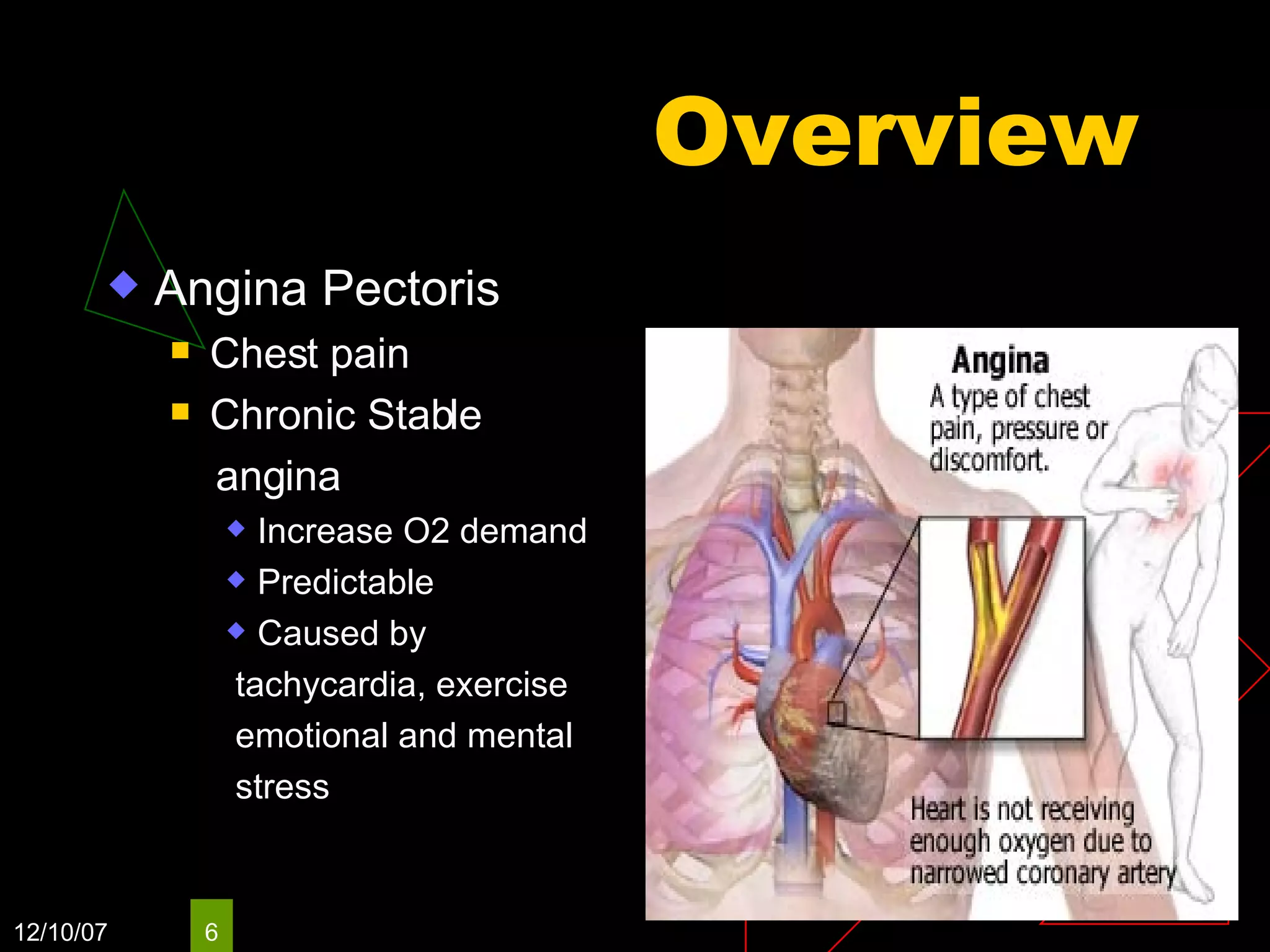
Overview Angina Pectoris Chest pain Chronic Stable  angina Increase O2 demand Predictable Caused by  tachycardia, exercise emotional and mental stress
Treatment Usual Intervention Classic hemodynamic agents Beta blockers Most effective in reducing cardiac work and myocardial consumption Decrease heart rate and aorticm pressure, depress myocardial contractility Calcium Channel blockers With prominent coronary vasodilating capacity Negative chronotropic and inotropic activity
Treatment Usual Intervention Classic hemodynamic agents Nitrates Causes systemic vasodilation Decreases myocardial wall tension and oxygen requirements by dilating epicardial arteries ASA
Treatment options Metabolic agents Trimetazidine Ranolazine Improves blood flow by and indirect action on calcium overload Nicorandil Potassium channel activator, relaxes smooth mm cells and produce reduction of the afterload Ivabradine Cardiotonic agent and acts by reducing heart rate
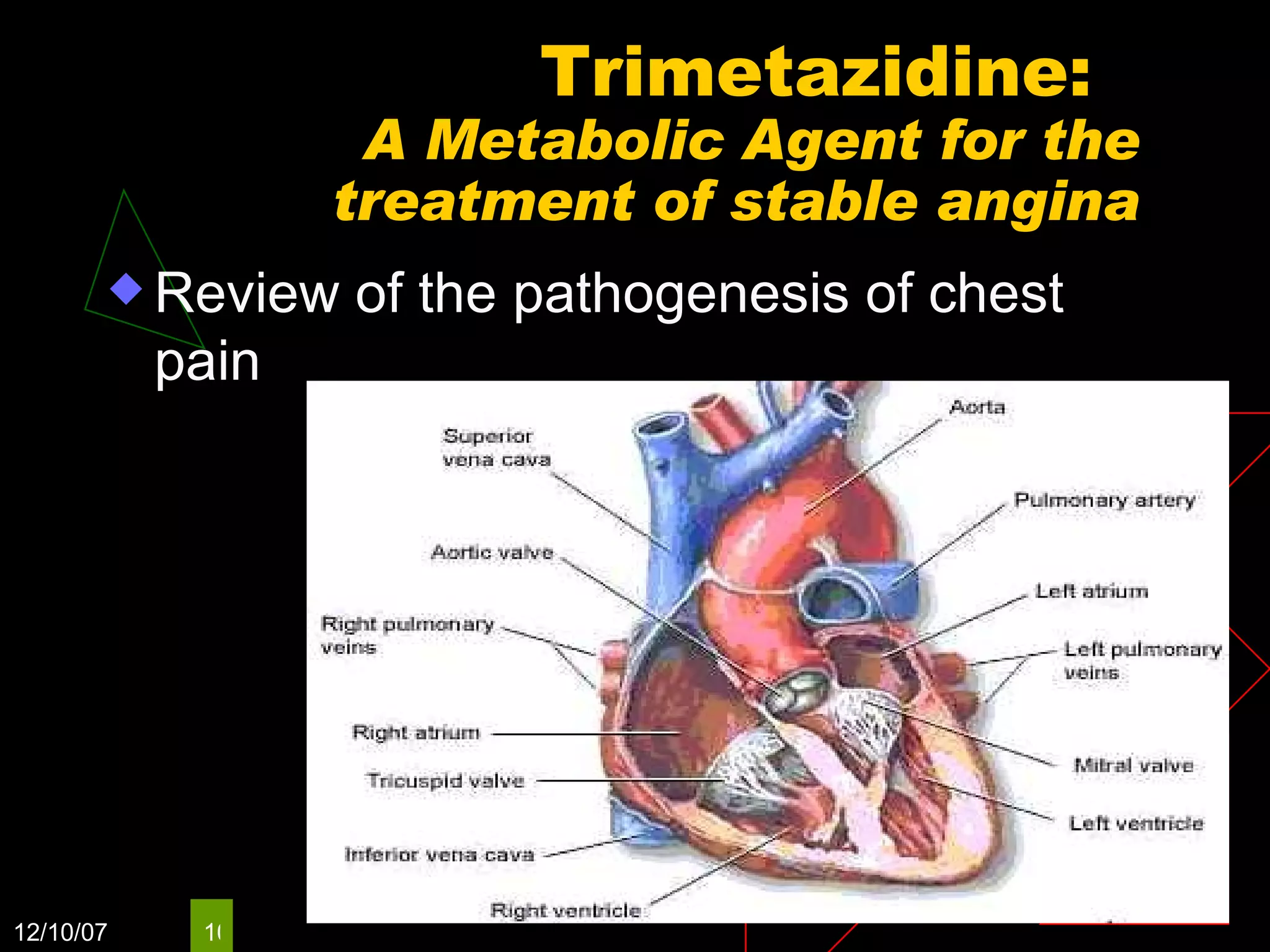
Trimetazidine:  A Metabolic Agent for the treatment of stable angina Review of the pathogenesis of chest pain
Trimetazidine:  A Review of the  Pathogenesis of Chest Pain   ATP which is the energy that drives myocardial contractility is derived from 2 pathways: Glycolytic metabolism Glycolysis Glucose oxidation Fatty acid metabolism
Trimetazidine:  A Review of the Pathogenesis of Chest Pain ATP which is the energy that drives myocardial contractility is derived from 2 pathways: Glycolytic metabolism Glycolysis Glucose oxidation-  product is Acetyl CoA Fatty acid oxidation- is the other source of Acetyl coA
Trimetazidine:    A Review of the Pathogenesis of Chest Pain Acetyl co A enters the Kreb’s cycle and provides reduced NAD and FAD for the electron transport chain In the presence of oxygen, the electron transport chain will facilitate the phosphorylation of ADP to ATP in a process termed oxidative phosphorylation.
Trimetazidine:    A Review of the Pathogenesis of Chest Pain In the normal myocardium,  Fatty acid is a major source of ATP production in the heart Acetyl CoA from FA oxidation competes with glucose oxidation as a source of acetyl CoA for the Kreb’s cycle.  The reduced FAD and NAD from beta oxidation further inhibits glucose oxidation and glycolysis
Trimetazidine:    A Review of the Pathogenesis of Chest Pain However Fatty acids require more oxygen than glucose to produce an equivalent amount of ATP, and thus may not be an efficient source of ATP in ischemic heart The rate of glucose oxidation becomes lower than glycolytic rates.  This leads to an accumulation of lactate and can cause an increase in intracellular calcium, which requires more ATP to re-establish ionic homeostasis
Trimetazidine:    A Review of the Pathogenesis of Chest Pain Ischemic myocardium: The contribution of anaerobic glycolysis to ATP production becomes more important If the heart relies on fatty acid beta oxidation, cardiac efficiency decreases further Optimize energy metabolism in the ischemic heart Inhibiting FA oxidation which will indirectly stimulate glucose utilization Stimulate glucose oxidation directly
Trimetazidine:  Mechanism of Action Newer antianginal agent Inhibits mitochondrial 3-ketoacyl coA thiolase (3-KAT) This shifts substrate utilization from FA to glucose metabolism By decreasing the intracellular concentrations of protons, trimetazidine prevents calcium and sodium overload It protects the heart from the destructiive effects of fatty acid accumulation and increased protons
Limits intracellular acidosis Stabilizes ionic membranes Prevents free radicals Trimetazidine:  Mechanism of Action
The therapeutic value of a cardioprotective agent in patients with severe ischemic cardiomyopathy.  Brottier et al  European Heart Journal 1990 11:207-12 Improvement of ejection fraction by more than 9% among patients with severe ischemic cardiomyopathy given trimetazidine 20mg 3x a day for 6 months Trimetazidine and left ventricular ischemic dysfunction: an overview of clinical evidence.  Chierchia et al.  European Heart J Suppl (2001) Improves resting ventricular function in patients with IHD and various degrees of contractile impairment Improves contractile response to moderate inotropic stimulation as well as functional capacity as assessed by cardiopulmonary testing Trimetazidine:  C linical Trials
Metabolic therapy in the treatment of ischemic heart disease:  the pharmacology of trimertzidine.  Stanley WC, Marzilli M .  Fundam Clin Pharmacol.  2003 Apr;17(2):133-45 Significantly improved symptom-limited exercise perfocrmance in chronic stable angina patients when used either as monotherapy or in combination with beta blockers and Ca channel antagonists Excellent alternative for classic hemodynamic changes Unique in its ability to reduce symptoms of angina when used in patients resistant to hemodynamic treatment Trimetazidine:  C linical Trials
Clinical Benefits of a metabolic approach in  the management of CAD .  Marzilli M   Cardio Thoracic Department, University of Pisa, Italy.  Rev Port Cardiol.  2000 Nov;19 Suppl 5:V25-30 Exerts its beneficial effects by increasing cell tolerance to ischaemia and  improving functional recovery at the time reperfusion.  Trimetazidine lowered the frequency of ischaemic attacks and prolonged the time   to ishaemia during exercises as compared to Ca2 + channel antagonists with CHF.  Trimetazidine is expected to especially benefit diabetic patients in whom metabolic alteration contribute to the pathogenesis of ischaemia by improving energy metabolism and restoring membrane homeostasis   Trimetazidine:  C linical Trials
Clinical Benefits of a metabolic approach in  the management of CAD .  Marzilli M .  Cardio Thoracic Department, University of Pisa, Italy.  Rev Port Cardiol.  2000 Nov;19 Suppl 5:V25-30 Trimetazidine + Propranolol was found superior to nitrates in reducing ischaemic  attacks. ·          Trimetazidine lowered the frequency of ischaemic attacks and prolonged the time to ishaemia during exercises as compared to Ca2 + channel antagonists. ·          Trimetazidine has been shown to improve left ventricular dysfunction in patients  with CHF.  ·          Trimetazidine is expected to especially benefit diabetic patients in whom metabolic alteration contribute to the pathogenesis of ischaemia by improving energy metabolism and restoring membrane homeostasis.   Trimetazidine:  C linical Trials
Effects of metabolic modulation by trimetazidine on left ventricular function and phosphocreatinine/adenosine triphosphate ratio in opatients with heart failure.  Gabrielle Fragasso et al. European Heart Journal March, 2006            Trimetazidine improves functional class and LV function in patients with heart failure.  These effects are associated to the observed trimetazidine-induced increase in PCr/ATP ratio, indicating a preservation of myocardial high energy phosphate levels Trimetazidine:  C linical Trials
Metabolic therapy for the diabetic patients with ischaemic heart disease   Rosano GM, Vitale C, Volterrani M, Fini M   Department of Medical Sciences, IRCCS San Raffaele, Rome, Italy  Coron Artery Dis.  2005 Nov;16 Suppl 1:S17-21 ·           Trimetazidine should always be considered for the treatment of diabetic patients with ischaemic heart disease with or without left ventricular dysfunction because of its effect on cardiac metabolism at rest, its effects on myocardial ischaemia and left ventricular function. Trimetazidine:  C linical Trials
Angina Pectoris or ischemic heart disease Myocardial infarction as sequelae Trimetazidine:  Indications and Contraindications
Trimetazidine 20 mg/tab 3x a day after meals Trimetazidine:  Dosage Administration
Pregnancy and lactation Children Impaired renal and hepatic function Hypersensitivity reactions Trimetazidine:  Precautions and Contraindications
Headache Vertigo Nausea Gastrointestinal discomfort Trimetazidine:  Side Effects
Summary Trimetazidine, a new antianginal drug that selectively inhibits fatty acid beta oxidation and is devoid of any direct hemodynamic effects It improves myocardial glucose utilization, by facilitating cells to derive energy from glucose more than from fatty acids, thus needing less oxygen Unique in its ability to decrease symptoms of angina when used in patients resistant to hemodynamic treatment
Summary In numerous trials, trimetazidine has been tested as an antianginal agent, both as monotherapy or when used as an alternative and/or combined with “classical “ anti-ischemic compunds It does not decrease HR or BP and is not contraindicated in any medical condition.  Adverse effects are mild and tolerable It promotes preservation of membrane structures and cellular function It is expected to benefit mostly diabetic patients in whom metabolic alterations contribute to the pathogenesisi of ischemia by improving energyenergy metabolism and restoring membrane homeostatsis
Next Steps Large clinical trials are needed to evaluate hard endpoints using these anti-anginal agents
Thank you!!

Treatment Options For The Chronic Stable Angina

  • 1.
    Treatment Options forthe Chronic Stable Angina Jubilia Balderas-De Guzman, MD DDVMH
  • 2.
    Agenda Overview EpidemiologyDefinition, symptoms Usual treatment of angina Trimetazidine: a metabolic agent for the treatment of angina Review of pathogenesis of chest pain Mechanism of Action Clinical Trials Indications and Contraindications Dosage and Administration Precautions and Side Effects Summary
  • 3.
    Overview Epidemiology ofIschemic Heart Disease US >12M have ischemic heart disease >6M experience angina >7M have sustained myocardial ischemia
  • 4.
    Overview Epidemiology ofIschemic Heart Disease Pinoy Health Incidence Report of Angina 12.5% have angina CVD account for 76% of 100,000 death annually making it the leading cause of mortality among Filipinos
  • 5.
    Overview Myocardial “ischemia”an imbalance between myocardial oxygen supply and myocardial metabolic demand
  • 6.
    Overview Angina PectorisChest pain Chronic Stable angina Increase O2 demand Predictable Caused by tachycardia, exercise emotional and mental stress
  • 7.
    Treatment Usual InterventionClassic hemodynamic agents Beta blockers Most effective in reducing cardiac work and myocardial consumption Decrease heart rate and aorticm pressure, depress myocardial contractility Calcium Channel blockers With prominent coronary vasodilating capacity Negative chronotropic and inotropic activity
  • 8.
    Treatment Usual InterventionClassic hemodynamic agents Nitrates Causes systemic vasodilation Decreases myocardial wall tension and oxygen requirements by dilating epicardial arteries ASA
  • 9.
    Treatment options Metabolicagents Trimetazidine Ranolazine Improves blood flow by and indirect action on calcium overload Nicorandil Potassium channel activator, relaxes smooth mm cells and produce reduction of the afterload Ivabradine Cardiotonic agent and acts by reducing heart rate
  • 10.
    Trimetazidine: AMetabolic Agent for the treatment of stable angina Review of the pathogenesis of chest pain
  • 11.
    Trimetazidine: AReview of the Pathogenesis of Chest Pain ATP which is the energy that drives myocardial contractility is derived from 2 pathways: Glycolytic metabolism Glycolysis Glucose oxidation Fatty acid metabolism
  • 12.
    Trimetazidine: AReview of the Pathogenesis of Chest Pain ATP which is the energy that drives myocardial contractility is derived from 2 pathways: Glycolytic metabolism Glycolysis Glucose oxidation- product is Acetyl CoA Fatty acid oxidation- is the other source of Acetyl coA
  • 13.
    Trimetazidine: A Review of the Pathogenesis of Chest Pain Acetyl co A enters the Kreb’s cycle and provides reduced NAD and FAD for the electron transport chain In the presence of oxygen, the electron transport chain will facilitate the phosphorylation of ADP to ATP in a process termed oxidative phosphorylation.
  • 14.
    Trimetazidine: A Review of the Pathogenesis of Chest Pain In the normal myocardium, Fatty acid is a major source of ATP production in the heart Acetyl CoA from FA oxidation competes with glucose oxidation as a source of acetyl CoA for the Kreb’s cycle. The reduced FAD and NAD from beta oxidation further inhibits glucose oxidation and glycolysis
  • 15.
    Trimetazidine: A Review of the Pathogenesis of Chest Pain However Fatty acids require more oxygen than glucose to produce an equivalent amount of ATP, and thus may not be an efficient source of ATP in ischemic heart The rate of glucose oxidation becomes lower than glycolytic rates. This leads to an accumulation of lactate and can cause an increase in intracellular calcium, which requires more ATP to re-establish ionic homeostasis
  • 16.
    Trimetazidine: A Review of the Pathogenesis of Chest Pain Ischemic myocardium: The contribution of anaerobic glycolysis to ATP production becomes more important If the heart relies on fatty acid beta oxidation, cardiac efficiency decreases further Optimize energy metabolism in the ischemic heart Inhibiting FA oxidation which will indirectly stimulate glucose utilization Stimulate glucose oxidation directly
  • 17.
    Trimetazidine: Mechanismof Action Newer antianginal agent Inhibits mitochondrial 3-ketoacyl coA thiolase (3-KAT) This shifts substrate utilization from FA to glucose metabolism By decreasing the intracellular concentrations of protons, trimetazidine prevents calcium and sodium overload It protects the heart from the destructiive effects of fatty acid accumulation and increased protons
  • 18.
    Limits intracellular acidosisStabilizes ionic membranes Prevents free radicals Trimetazidine: Mechanism of Action
  • 19.
    The therapeutic valueof a cardioprotective agent in patients with severe ischemic cardiomyopathy. Brottier et al European Heart Journal 1990 11:207-12 Improvement of ejection fraction by more than 9% among patients with severe ischemic cardiomyopathy given trimetazidine 20mg 3x a day for 6 months Trimetazidine and left ventricular ischemic dysfunction: an overview of clinical evidence. Chierchia et al. European Heart J Suppl (2001) Improves resting ventricular function in patients with IHD and various degrees of contractile impairment Improves contractile response to moderate inotropic stimulation as well as functional capacity as assessed by cardiopulmonary testing Trimetazidine: C linical Trials
  • 20.
    Metabolic therapy inthe treatment of ischemic heart disease: the pharmacology of trimertzidine. Stanley WC, Marzilli M . Fundam Clin Pharmacol. 2003 Apr;17(2):133-45 Significantly improved symptom-limited exercise perfocrmance in chronic stable angina patients when used either as monotherapy or in combination with beta blockers and Ca channel antagonists Excellent alternative for classic hemodynamic changes Unique in its ability to reduce symptoms of angina when used in patients resistant to hemodynamic treatment Trimetazidine: C linical Trials
  • 21.
    Clinical Benefits ofa metabolic approach in the management of CAD . Marzilli M Cardio Thoracic Department, University of Pisa, Italy. Rev Port Cardiol. 2000 Nov;19 Suppl 5:V25-30 Exerts its beneficial effects by increasing cell tolerance to ischaemia and improving functional recovery at the time reperfusion. Trimetazidine lowered the frequency of ischaemic attacks and prolonged the time to ishaemia during exercises as compared to Ca2 + channel antagonists with CHF. Trimetazidine is expected to especially benefit diabetic patients in whom metabolic alteration contribute to the pathogenesis of ischaemia by improving energy metabolism and restoring membrane homeostasis   Trimetazidine: C linical Trials
  • 22.
    Clinical Benefits ofa metabolic approach in the management of CAD . Marzilli M . Cardio Thoracic Department, University of Pisa, Italy. Rev Port Cardiol. 2000 Nov;19 Suppl 5:V25-30 Trimetazidine + Propranolol was found superior to nitrates in reducing ischaemic attacks. ·         Trimetazidine lowered the frequency of ischaemic attacks and prolonged the time to ishaemia during exercises as compared to Ca2 + channel antagonists. ·         Trimetazidine has been shown to improve left ventricular dysfunction in patients with CHF. ·         Trimetazidine is expected to especially benefit diabetic patients in whom metabolic alteration contribute to the pathogenesis of ischaemia by improving energy metabolism and restoring membrane homeostasis.   Trimetazidine: C linical Trials
  • 23.
    Effects of metabolicmodulation by trimetazidine on left ventricular function and phosphocreatinine/adenosine triphosphate ratio in opatients with heart failure. Gabrielle Fragasso et al. European Heart Journal March, 2006         Trimetazidine improves functional class and LV function in patients with heart failure. These effects are associated to the observed trimetazidine-induced increase in PCr/ATP ratio, indicating a preservation of myocardial high energy phosphate levels Trimetazidine: C linical Trials
  • 24.
    Metabolic therapy forthe diabetic patients with ischaemic heart disease Rosano GM, Vitale C, Volterrani M, Fini M Department of Medical Sciences, IRCCS San Raffaele, Rome, Italy Coron Artery Dis. 2005 Nov;16 Suppl 1:S17-21 ·         Trimetazidine should always be considered for the treatment of diabetic patients with ischaemic heart disease with or without left ventricular dysfunction because of its effect on cardiac metabolism at rest, its effects on myocardial ischaemia and left ventricular function. Trimetazidine: C linical Trials
  • 25.
    Angina Pectoris orischemic heart disease Myocardial infarction as sequelae Trimetazidine: Indications and Contraindications
  • 26.
    Trimetazidine 20 mg/tab3x a day after meals Trimetazidine: Dosage Administration
  • 27.
    Pregnancy and lactationChildren Impaired renal and hepatic function Hypersensitivity reactions Trimetazidine: Precautions and Contraindications
  • 28.
    Headache Vertigo NauseaGastrointestinal discomfort Trimetazidine: Side Effects
  • 29.
    Summary Trimetazidine, anew antianginal drug that selectively inhibits fatty acid beta oxidation and is devoid of any direct hemodynamic effects It improves myocardial glucose utilization, by facilitating cells to derive energy from glucose more than from fatty acids, thus needing less oxygen Unique in its ability to decrease symptoms of angina when used in patients resistant to hemodynamic treatment
  • 30.
    Summary In numeroustrials, trimetazidine has been tested as an antianginal agent, both as monotherapy or when used as an alternative and/or combined with “classical “ anti-ischemic compunds It does not decrease HR or BP and is not contraindicated in any medical condition. Adverse effects are mild and tolerable It promotes preservation of membrane structures and cellular function It is expected to benefit mostly diabetic patients in whom metabolic alterations contribute to the pathogenesisi of ischemia by improving energyenergy metabolism and restoring membrane homeostatsis
  • 31.
    Next Steps Largeclinical trials are needed to evaluate hard endpoints using these anti-anginal agents
  • 32.