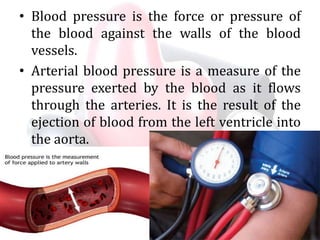
• Blood pressure is the force or pressure of
the blood against the walls of the blood
vessels.
• Arterial blood pressure is a measure of the
pressure exerted by the blood as it flows
through the arteries. It is the result of the
ejection of blood from the left ventricle into
the aorta.
• Blood pressure is mentioned in terms of
systolic blood pressure over diastolic blood
pressure.
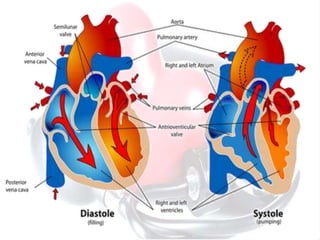
• Systolic blood pressure is the highest
pressure attained in arteries during systole
and diastolic blood pressure is the lowest
arterial pressure during diastole
• The systolic pressure is the pressure as a
result of contraction of the ventricles. When
the left ventricle contracts and pushes blood
into the aorta the pressure produced within
the arterial system is called the systolic
blood pressure.
• In adults it is about 120 mmHg.
• The diastolic pressure is the pressure when
the ventricles are at rest.
• When complete cardiac relaxation occurs
and the heart is resting after the ejection of
blood, the pressure within the arteries is
called diastolic blood pressure.
• In an adult it is about 80 mmHg.
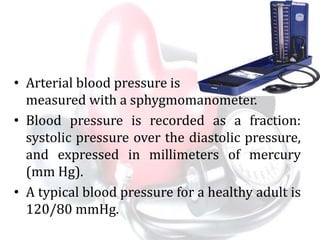
• Arterial blood pressure is
measured with a sphygmomanometer.
• Blood pressure is recorded as a fraction:
systolic pressure over the diastolic pressure,
and expressed in millimeters of mercury
(mm Hg).
• A typical blood pressure for a healthy adult is
120/80 mmHg.
Pulse pressure
• The difference between systolic and diastolic
blood pressures is the pulse pressure.
• A normal pulse pressure is about 40 mmHg.
Factors Affecting Blood Pressure
• Age: The pressure rises with age, reaching a peak at
the onset of puberty, and then tends to decline.
• Exercise: Physical activity increases the cardiac
output and hence the blood pressure.
• Stress: Stimulation of the sympathetic nervous
system increases cardiac output and
vasoconstriction of the arterioles, thus increasing
the blood pressure.
• Race: African Americans tend to have higher blood
pressures than European Americans. The exact
reasons are unclear.
• Sex: Females have lower blood pressures than
males due to hormonal variations. After
menopause, women have higher blood
pressures.
• Medications: Many medications, including
caffeine, may increase or decrease the blood
pressure.
• Obesity: Predispose to hypertension.
• Positions: Sitting, standing or lying down
position cause slight variation in BP.
• Diurnal variations (time of day): Pressure is
lowest early in the morning, when the
metabolic rate is lowest, then rises throughout
the day and peaks in the late afternoon or
evening.
• Medical conditions: Any condition affecting
the cardiac output, blood volume, blood
viscosity, and/or compliance of the arteries has
a direct effect on the blood pressure.
• Temperature: Because of increased metabolic
rate, fever can increase blood pressure.
However, external heat causes vasodilation and
decreased blood pressure. Cold causes
vasoconstriction and elevates blood pressure.
Regulation of blood pressure
1. Regulation by cardio vascular center
2. Neural regulation
3. Hormonal regulation
4. Auto regulation
1. Regulation by cardiovascular center
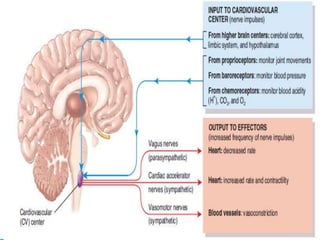
The cardiovascular (CV) center in the medulla
oblongata controls neural, hormonal, and local negative
feedback systems that regulate blood pressure.
Groups of neurons within the CV center regulate
heart rate, contractility (force of contraction) of the
ventricles, and blood vessel diameter. Some neurons
stimulate the heart (cardiostimulatory center); others
inhibit the heart (cardioinhibitory center).
Some neurons control blood vessel diameter by
causing constriction (vasoconstrictor center) or dilation
(vasodilator center) which is referred as the vasomotor
center. All group of neurons in the CV center neurons
communicate one another and function together.
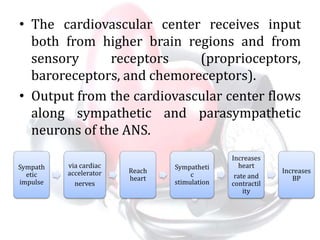
• The cardiovascular center receives input
both from higher brain regions and from
sensory receptors (proprioceptors,
baroreceptors, and chemoreceptors).
• Output from the cardiovascular center flows
along sympathetic and parasympathetic
neurons of the ANS.
Sympath
etic
impulse
via cardiac
accelerator
nerves
Reach
heart
Sympatheti
c
stimulation
Increases
heart
rate and
contractil
ity
Increases
BP
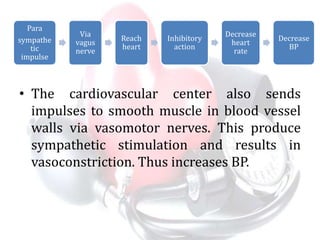
• The cardiovascular center also sends
impulses to smooth muscle in blood vessel
walls via vasomotor nerves. This produce
sympathetic stimulation and results in
vasoconstriction. Thus increases BP.
Para
sympathe
tic
impulse
Via
vagus
nerve
Reach
heart
Inhibitory
action
Decrease
heart
rate
Decrease
BP
2. Neural regulation
• The nervous system regulation of BP is a negative
feed back mechanism via baroreceptor reflexes and
chemoreceptor reflexes.
i. Baroreceptor reflexes
Baroreceptors are pressure-sensitive sensory
receptors, located in the aorta, internal carotid arteries
and other large arteries in the neck and chest. They
send impulses to the cardiovascular center to help
regulate blood pressure.
The two most important baroreceptor reflexes
are the carotid sinus reflex and the aortic reflex.
• Baroreceptors in the wall of the carotid
sinuses initiate the carotid sinus reflex
helps to regulate blood pressure in the
brain. Nerve impulses from the carotid sinus
reach the cardiovascular center via
glossopharyngeal nerves.
• Baroreceptors in the wall of the aorta
initiate the aortic reflex, which regulates
systemic blood pressure. Nerve impulses
from aortic baroreceptors reach the
cardiovascular center via vagus (X) nerves.
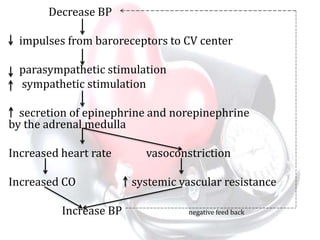
Decrease BP
impulses from baroreceptors to CV center
parasympathetic stimulation
sympathetic stimulation
secretion of epinephrine and norepinephrine
by the adrenal medulla
Increased heart rate vasoconstriction
Increased CO systemic vascular resistance
Increase BP negative feed back
ii. Chemoreceptor Reflexes
Chemoreceptors are sensory receptors that
monitor the chemical composition of blood
located close to the baroreceptors of the carotid
sinus and arch of the aorta. Chemoreceptors
detect changes in blood level of O2, CO2, and H+.
Hypoxia (lowered O2 availability), acidosis
(an increase in H+ concentration) or hypercapnia
(excess CO2) stimulates the chemoreceptors to
send impulses to the cardiovascular center.
In response, the CV center increases
sympathetic stimulation to arterioles and veins,
producing vasoconstriction and increases blood
pressure.
3. Hormonal regulation
Hormonal regulation of BP is done by
i. Renin–angiotensin–aldosterone system
ii. Epinephrine and norepinephrine
iii. Antidiuretic hormone (ADH)
iv. Atrial natriuretic peptide
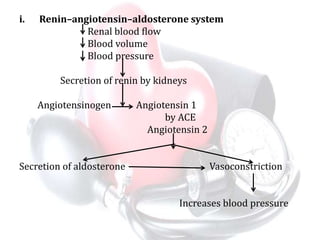
i. Renin–angiotensin–aldosterone system
Renal blood flow
Blood volume
Blood pressure
Secretion of renin by kidneys
Angiotensinogen Angiotensin 1
by ACE
Angiotensin 2
Secretion of aldosterone Vasoconstriction
Increases blood pressure
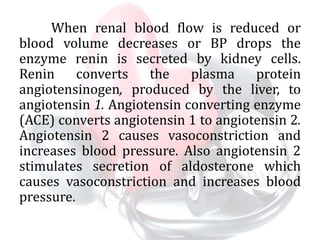
When renal blood flow is reduced or
blood volume decreases or BP drops the
enzyme renin is secreted by kidney cells.
Renin converts the plasma protein
angiotensinogen, produced by the liver, to
angiotensin 1. Angiotensin converting enzyme
(ACE) converts angiotensin 1 to angiotensin 2.
Angiotensin 2 causes vasoconstriction and
increases blood pressure. Also angiotensin 2
stimulates secretion of aldosterone which
causes vasoconstriction and increases blood
pressure.
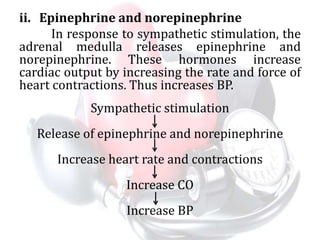
ii. Epinephrine and norepinephrine
In response to sympathetic stimulation, the
adrenal medulla releases epinephrine and
norepinephrine. These hormones increase
cardiac output by increasing the rate and force of
heart contractions. Thus increases BP.
Sympathetic stimulation
Release of epinephrine and norepinephrine
Increase heart rate and contractions
Increase CO
Increase BP
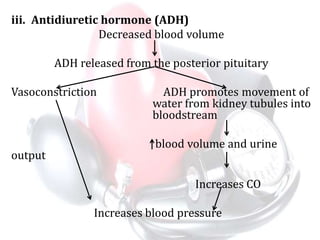
iii. Antidiuretic hormone (ADH)
Decreased blood volume
ADH released from the posterior pituitary
Vasoconstriction ADH promotes movement of
water from kidney tubules into
bloodstream
blood volume and urine
output
Increases CO
Increases blood pressure
iv. Atrial natriuretic peptide
Atrial natriuretic peptide (ANP) is
released by cells in the atria of the heart. ANP
lowers blood pressure by causing vasodilation
and by promoting the loss of salt and water in
the urine, which reduces blood volume.
4. Auto regulation
• The ability of a tissue to automatically adjust
its blood flow to match its metabolic demands
is called autoregulation.
• In heart autoregulation is an important
contributor to increased blood flow through
the tissue.
• Stimuli that cause autoregulatory changes in
blood flow are;
– Physical changes: Warming promotes vasodilation,
and cooling causes vasoconstriction.
– Vasodilating and vasoconstricting chemicals
THANK YOU

Blood pressure

  • 2.
    • Blood pressureis the force or pressure of the blood against the walls of the blood vessels. • Arterial blood pressure is a measure of the pressure exerted by the blood as it flows through the arteries. It is the result of the ejection of blood from the left ventricle into the aorta.
  • 3.
    • Blood pressureis mentioned in terms of systolic blood pressure over diastolic blood pressure. • Systolic blood pressure is the highest pressure attained in arteries during systole and diastolic blood pressure is the lowest arterial pressure during diastole
  • 5.
    • The systolicpressure is the pressure as a result of contraction of the ventricles. When the left ventricle contracts and pushes blood into the aorta the pressure produced within the arterial system is called the systolic blood pressure. • In adults it is about 120 mmHg.
  • 6.
    • The diastolicpressure is the pressure when the ventricles are at rest. • When complete cardiac relaxation occurs and the heart is resting after the ejection of blood, the pressure within the arteries is called diastolic blood pressure. • In an adult it is about 80 mmHg.
  • 7.
    • Arterial bloodpressure is measured with a sphygmomanometer. • Blood pressure is recorded as a fraction: systolic pressure over the diastolic pressure, and expressed in millimeters of mercury (mm Hg). • A typical blood pressure for a healthy adult is 120/80 mmHg.
  • 8.
    Pulse pressure • Thedifference between systolic and diastolic blood pressures is the pulse pressure. • A normal pulse pressure is about 40 mmHg.
  • 9.
    Factors Affecting BloodPressure • Age: The pressure rises with age, reaching a peak at the onset of puberty, and then tends to decline. • Exercise: Physical activity increases the cardiac output and hence the blood pressure. • Stress: Stimulation of the sympathetic nervous system increases cardiac output and vasoconstriction of the arterioles, thus increasing the blood pressure. • Race: African Americans tend to have higher blood pressures than European Americans. The exact reasons are unclear.
  • 10.
    • Sex: Femaleshave lower blood pressures than males due to hormonal variations. After menopause, women have higher blood pressures. • Medications: Many medications, including caffeine, may increase or decrease the blood pressure. • Obesity: Predispose to hypertension. • Positions: Sitting, standing or lying down position cause slight variation in BP. • Diurnal variations (time of day): Pressure is lowest early in the morning, when the metabolic rate is lowest, then rises throughout the day and peaks in the late afternoon or evening.
  • 11.
    • Medical conditions:Any condition affecting the cardiac output, blood volume, blood viscosity, and/or compliance of the arteries has a direct effect on the blood pressure. • Temperature: Because of increased metabolic rate, fever can increase blood pressure. However, external heat causes vasodilation and decreased blood pressure. Cold causes vasoconstriction and elevates blood pressure.
  • 12.
    Regulation of bloodpressure 1. Regulation by cardio vascular center 2. Neural regulation 3. Hormonal regulation 4. Auto regulation
  • 13.
    1. Regulation bycardiovascular center The cardiovascular (CV) center in the medulla oblongata controls neural, hormonal, and local negative feedback systems that regulate blood pressure. Groups of neurons within the CV center regulate heart rate, contractility (force of contraction) of the ventricles, and blood vessel diameter. Some neurons stimulate the heart (cardiostimulatory center); others inhibit the heart (cardioinhibitory center). Some neurons control blood vessel diameter by causing constriction (vasoconstrictor center) or dilation (vasodilator center) which is referred as the vasomotor center. All group of neurons in the CV center neurons communicate one another and function together.
  • 15.
    • The cardiovascularcenter receives input both from higher brain regions and from sensory receptors (proprioceptors, baroreceptors, and chemoreceptors). • Output from the cardiovascular center flows along sympathetic and parasympathetic neurons of the ANS. Sympath etic impulse via cardiac accelerator nerves Reach heart Sympatheti c stimulation Increases heart rate and contractil ity Increases BP
  • 16.
    • The cardiovascularcenter also sends impulses to smooth muscle in blood vessel walls via vasomotor nerves. This produce sympathetic stimulation and results in vasoconstriction. Thus increases BP. Para sympathe tic impulse Via vagus nerve Reach heart Inhibitory action Decrease heart rate Decrease BP
  • 17.
    2. Neural regulation •The nervous system regulation of BP is a negative feed back mechanism via baroreceptor reflexes and chemoreceptor reflexes. i. Baroreceptor reflexes Baroreceptors are pressure-sensitive sensory receptors, located in the aorta, internal carotid arteries and other large arteries in the neck and chest. They send impulses to the cardiovascular center to help regulate blood pressure. The two most important baroreceptor reflexes are the carotid sinus reflex and the aortic reflex.
  • 18.
    • Baroreceptors inthe wall of the carotid sinuses initiate the carotid sinus reflex helps to regulate blood pressure in the brain. Nerve impulses from the carotid sinus reach the cardiovascular center via glossopharyngeal nerves. • Baroreceptors in the wall of the aorta initiate the aortic reflex, which regulates systemic blood pressure. Nerve impulses from aortic baroreceptors reach the cardiovascular center via vagus (X) nerves.
  • 19.
    Decrease BP impulses frombaroreceptors to CV center parasympathetic stimulation sympathetic stimulation secretion of epinephrine and norepinephrine by the adrenal medulla Increased heart rate vasoconstriction Increased CO systemic vascular resistance Increase BP negative feed back
  • 20.
    ii. Chemoreceptor Reflexes Chemoreceptorsare sensory receptors that monitor the chemical composition of blood located close to the baroreceptors of the carotid sinus and arch of the aorta. Chemoreceptors detect changes in blood level of O2, CO2, and H+. Hypoxia (lowered O2 availability), acidosis (an increase in H+ concentration) or hypercapnia (excess CO2) stimulates the chemoreceptors to send impulses to the cardiovascular center. In response, the CV center increases sympathetic stimulation to arterioles and veins, producing vasoconstriction and increases blood pressure.
  • 21.
    3. Hormonal regulation Hormonalregulation of BP is done by i. Renin–angiotensin–aldosterone system ii. Epinephrine and norepinephrine iii. Antidiuretic hormone (ADH) iv. Atrial natriuretic peptide
  • 22.
    i. Renin–angiotensin–aldosterone system Renalblood flow Blood volume Blood pressure Secretion of renin by kidneys Angiotensinogen Angiotensin 1 by ACE Angiotensin 2 Secretion of aldosterone Vasoconstriction Increases blood pressure
  • 23.
    When renal bloodflow is reduced or blood volume decreases or BP drops the enzyme renin is secreted by kidney cells. Renin converts the plasma protein angiotensinogen, produced by the liver, to angiotensin 1. Angiotensin converting enzyme (ACE) converts angiotensin 1 to angiotensin 2. Angiotensin 2 causes vasoconstriction and increases blood pressure. Also angiotensin 2 stimulates secretion of aldosterone which causes vasoconstriction and increases blood pressure.
  • 24.
    ii. Epinephrine andnorepinephrine In response to sympathetic stimulation, the adrenal medulla releases epinephrine and norepinephrine. These hormones increase cardiac output by increasing the rate and force of heart contractions. Thus increases BP. Sympathetic stimulation Release of epinephrine and norepinephrine Increase heart rate and contractions Increase CO Increase BP
  • 25.
    iii. Antidiuretic hormone(ADH) Decreased blood volume ADH released from the posterior pituitary Vasoconstriction ADH promotes movement of water from kidney tubules into bloodstream blood volume and urine output Increases CO Increases blood pressure
  • 26.
    iv. Atrial natriureticpeptide Atrial natriuretic peptide (ANP) is released by cells in the atria of the heart. ANP lowers blood pressure by causing vasodilation and by promoting the loss of salt and water in the urine, which reduces blood volume.
  • 27.
    4. Auto regulation •The ability of a tissue to automatically adjust its blood flow to match its metabolic demands is called autoregulation. • In heart autoregulation is an important contributor to increased blood flow through the tissue. • Stimuli that cause autoregulatory changes in blood flow are; – Physical changes: Warming promotes vasodilation, and cooling causes vasoconstriction. – Vasodilating and vasoconstricting chemicals
  • 28.