Mechanism of Regulation of Body
Temperature
Presented By
Abdul Majid Siddiqui
Learning objectives
The know the normal body temperature.
To understand the factors affecting body temperature.
To understand the mechanism of heat production.
To understand the mechanism of heat loss.
To understand the Role of Hypothalamus in temperature
mechanism.
Applied aspect
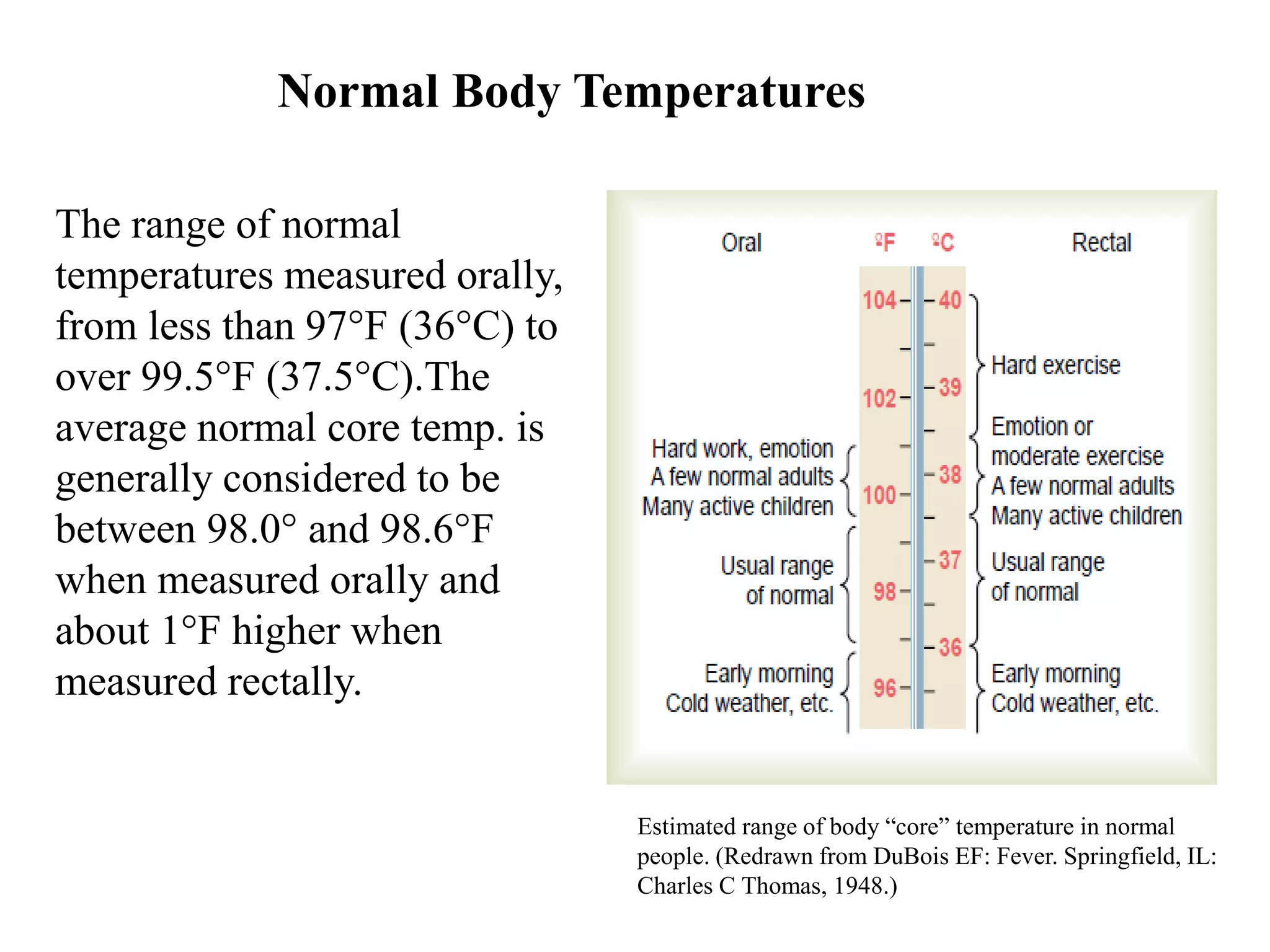
The range of normal
temperatures measured orally,
from less than 97°F (36°C) to
over 99.5°F (37.5°C).The
average normal core temp. is
generally considered to be
between 98.0° and 98.6°F
when measured orally and
about 1°F higher when
measured rectally.
Estimated range of body “core” temperature in normal
people. (Redrawn from DuBois EF: Fever. Springfield, IL:
Charles C Thomas, 1948.)
Normal Body Temperatures
Factors Affecting Body Temperature
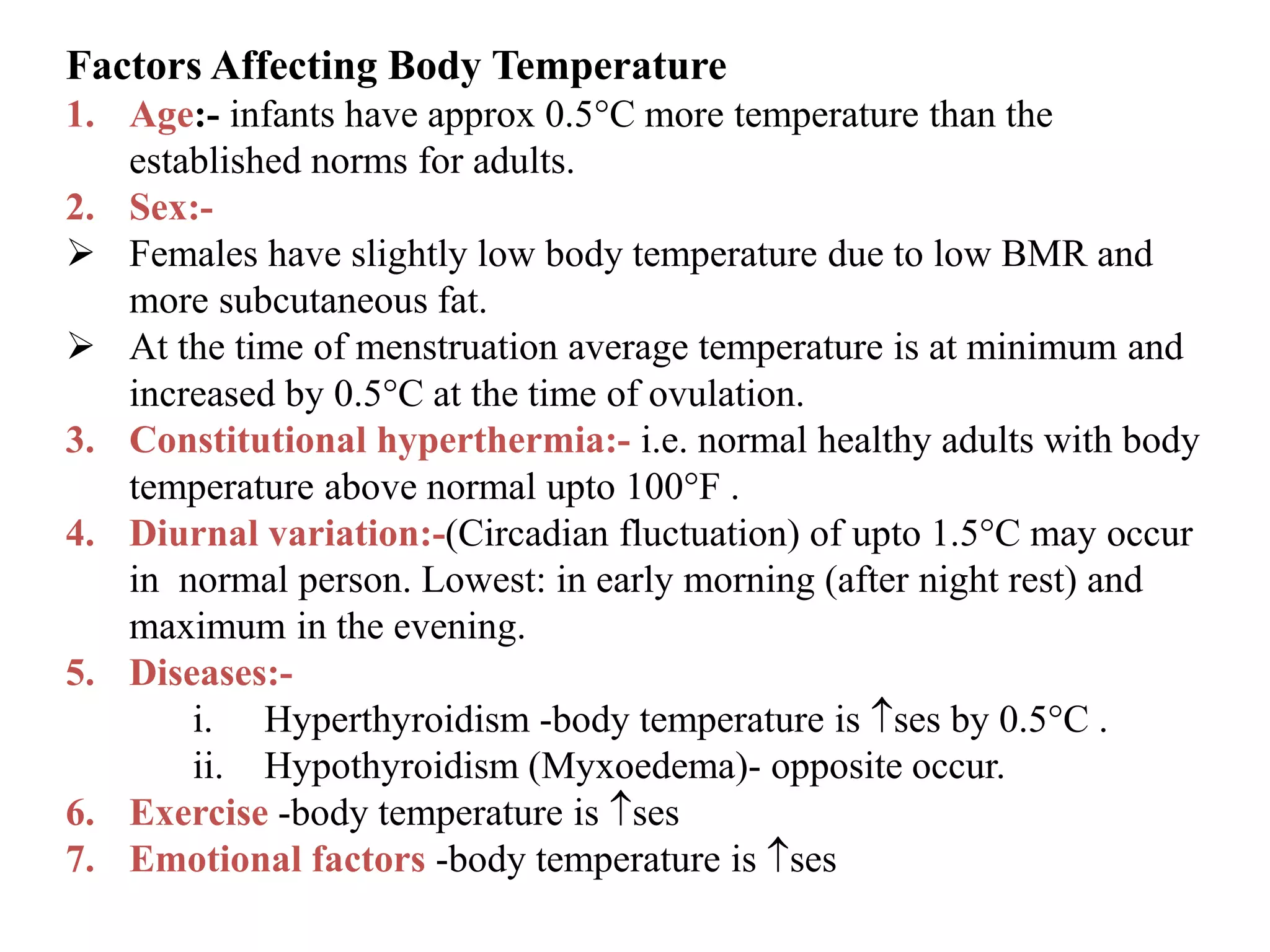
1. Age:- infants have approx 0.5C more temperature than the
established norms for adults.
2. Sex:-
 Females have slightly low body temperature due to low BMR and
more subcutaneous fat.
 At the time of menstruation average temperature is at minimum and
increased by 0.5C at the time of ovulation.
3. Constitutional hyperthermia:- i.e. normal healthy adults with body
temperature above normal upto 100F .
4. Diurnal variation:-(Circadian fluctuation) of upto 1.5C may occur
in normal person. Lowest: in early morning (after night rest) and
maximum in the evening.
5. Diseases:-
i. Hyperthyroidism -body temperature is ses by 0.5C .
ii. Hypothyroidism (Myxoedema)- opposite occur.
6. Exercise -body temperature is ses
7. Emotional factors -body temperature is ses
Factors Increasing
Heat Production
1.Metabolic activities of the body in:
skeletal muscle, liver, heart
2. Specific dynamic action of food
3. Heat gained from the surroundings hot
environment by:-
Direct and reflected radiation.
4. Endocrine mechanisms-Epinepherine,
norepinepherine and T4
5.Brown fat (in infants)
5. Exercise
6. Shivering
7. Increased food intake
Heat Loss
1. To the surrounding by
Radiation; conduction; and
convection.
2. By water evaporation
Sweating; INsesnsible water
loss; respiration.
3. By Excretion Urine; faeces
4. Cutaneous Vasodilatation
5. Decreased Clotting
6. Increase Air movements
Balance between factors increasing heat production and heat loss
BODY HEAT PRODUCTION AND LOSS
In health, body temperature is always fairly close to normal level by maintaining
a balance between heat production and heat loss
Mechanism of heat loss from body
Regulation of Body Temperature—Role of the Hypothalamus
The temperature of the body is regulated almost entirely by nervous
feedback mechanisms, and almost all these operate through temperature-
regulating centers located in the hypothalamus.
Role of the Anterior Hypothalamic-Preoptic Area in Thermostatic
Detection of Temperature
When atmospheric temperature is high
When the preoptic area is heated, the skin all over the body immediately
breaks out in a profuse sweat, while the skin blood vessels over the entire
body become greatly dilated.
This is an immediate reaction to cause the body to lose heat, thereby
helping to return the body temperature toward the normal level.
When atmospheric temperature is low
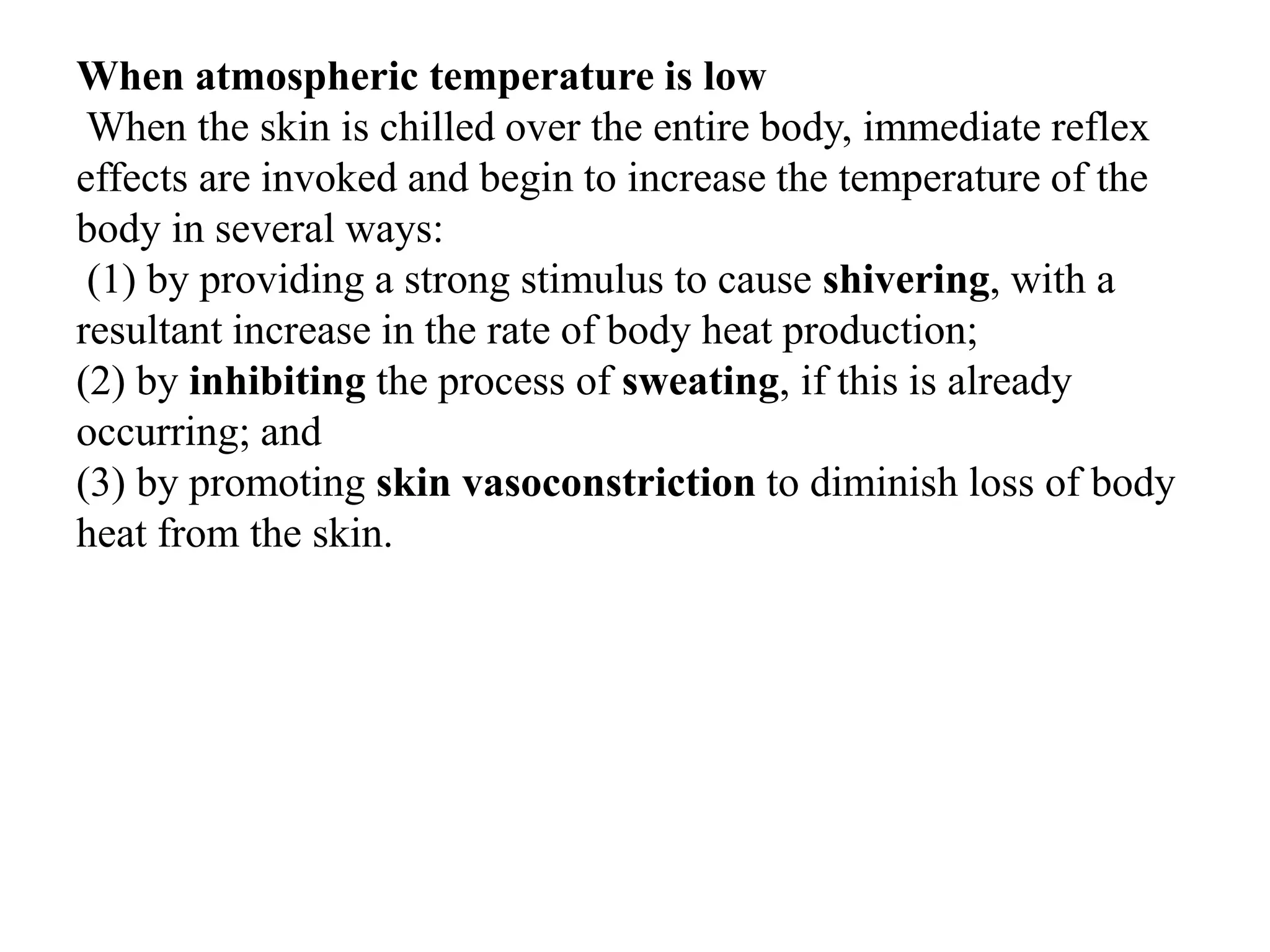
When the skin is chilled over the entire body, immediate reflex
effects are invoked and begin to increase the temperature of the
body in several ways:
(1) by providing a strong stimulus to cause shivering, with a
resultant increase in the rate of body heat production;
(2) by inhibiting the process of sweating, if this is already
occurring; and
(3) by promoting skin vasoconstriction to diminish loss of body
heat from the skin.
Concept of a “Set-Point” for Temperature Control
It is clear that at a critical body core temperature of about 37°C (98.6°F),
drastic changes occur in the rates of both heat loss and heat production.
At temperatures above this level, the rate of heat loss is greater than that
of heat production, so the body temperature falls and approaches the 37°C
level.
 At temperatures below this level, the rate of heat production is greater
than that of heat loss, so the body temperature rises and again approaches
the 37°C level.
This crucial temperature level is called the “set-point” of the
temperature control mechanism.
That is, all the temperature control mechanisms continually attempt to
bring the body temperature back to this set-point level.
Abnormalities of Body Temperature Regulation
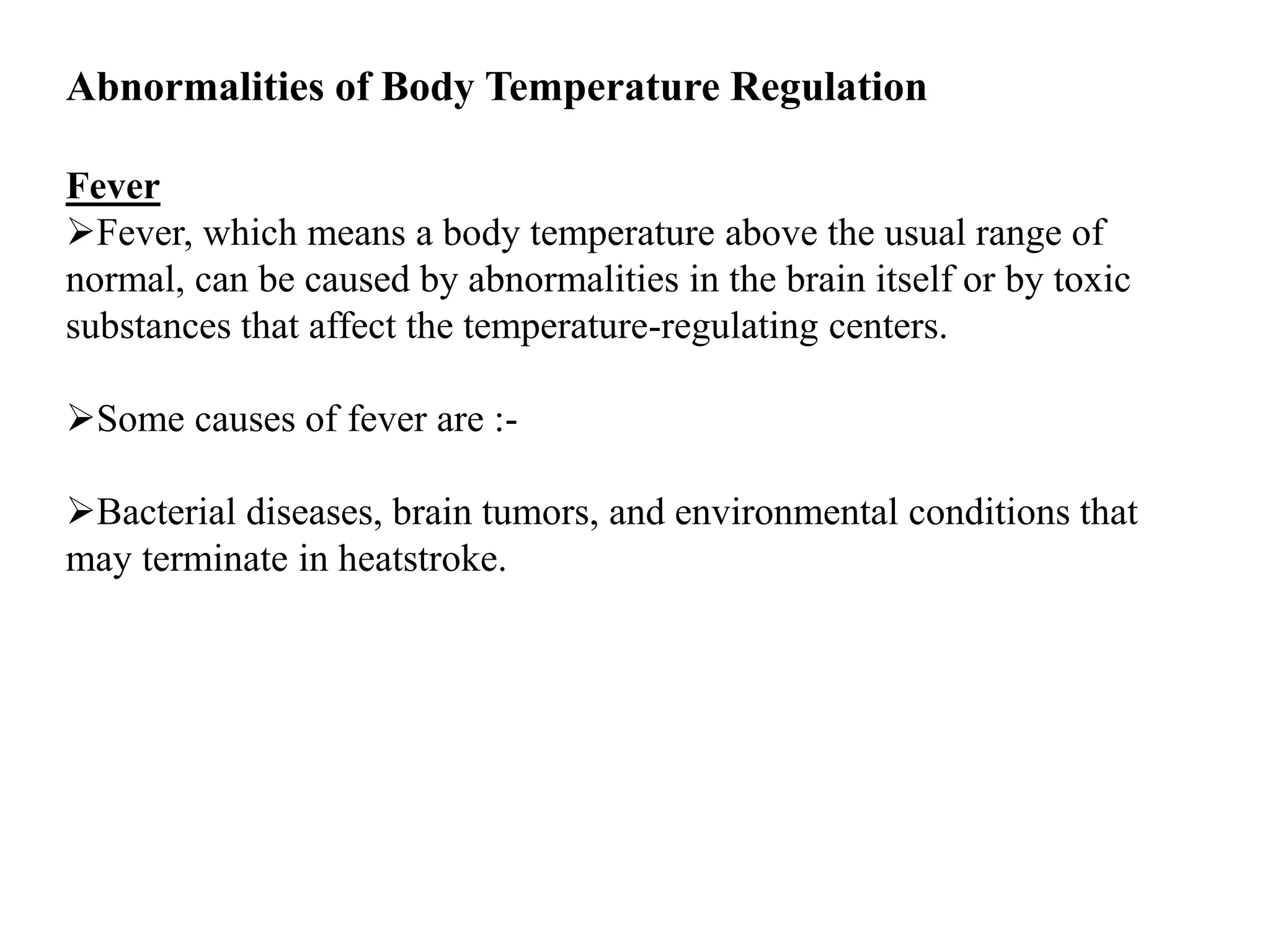
Fever
Fever, which means a body temperature above the usual range of
normal, can be caused by abnormalities in the brain itself or by toxic
substances that affect the temperature-regulating centers.
Some causes of fever are :-
Bacterial diseases, brain tumors, and environmental conditions that
may terminate in heatstroke.
Mechanism of Action of Pyrogens in Causing Fever
When bacteria or breakdown products of bacteria are present in
the tissues or in the blood they are phagocytized by the blood
leukocytes, by tissue macrophages,
All these cells digest the bacterial products and then release the
substance interleukin-1—also called leukocyte pyrogen into the
body fluids.
The interleukin-1, on reaching the hypothalamus, immediately
activates the processes to produce fever, sometimes increasing the
body temperature a noticeable amount in only 8 to 10 minutes.
Infection, inflammation, tissue damage, etc
Activation of cell of mononuclear
phagocyte system (monocyte,
macrophage, kupffer cell etc)
Activation of preoptic area of
hypothalamus
Increased production of
prostaglandins like PGE2 locally
Release of Pyrogens
Release of cytokines
Raises thermostat set
point in hypothalamus
Increased heat production
and decreased heat loss
Mechanism of genesis of Fever
Fever
Stimulation of Organum Vasculosum
of Lamina Terminalis (OVLT)
Heat Stroke:-
High core temperature and the development of serious neurologic
disturbances with a loss of consciousness, and frequently, convulsions
characterize the most severe and dangerous heat disorder.
Heatstroke occurs in two forms-
I. Classical and
II. Exertional.
In the classical form, the primary factor is environmental heat stress that
overwhelms an impaired thermoregulatory system.
In exertional heatstroke, the primary factor is high metabolic heat
production (typically, soldiers and athletes)
The traditional diagnostic criteria of heatstroke—coma, hot dry skin,
and rectal temperature above 41.3°C (106°F)—are characteristic of the
classical form.
Frostbite.
When the body is exposed to extremely low temperatures,
surface areas can freeze; the freezing is called frostbite.
This occurs especially in the lobes of the ears and in the digits
of the hands and feet.
If the freeze has been sufficient to cause extensive formation of
ice crystals in the cells, permanent damage usually results, such
as permanent circulatory impairment as well as local tissue
damage.
Often gangrene follows thawing, and the frostbitten areas must
be removed surgically.
Mechanism of body temperature

Mechanism of body temperature

  • 1.
    Mechanism of Regulationof Body Temperature Presented By Abdul Majid Siddiqui
  • 2.
    Learning objectives The knowthe normal body temperature. To understand the factors affecting body temperature. To understand the mechanism of heat production. To understand the mechanism of heat loss. To understand the Role of Hypothalamus in temperature mechanism. Applied aspect
  • 3.
    The range ofnormal temperatures measured orally, from less than 97°F (36°C) to over 99.5°F (37.5°C).The average normal core temp. is generally considered to be between 98.0° and 98.6°F when measured orally and about 1°F higher when measured rectally. Estimated range of body “core” temperature in normal people. (Redrawn from DuBois EF: Fever. Springfield, IL: Charles C Thomas, 1948.) Normal Body Temperatures
  • 4.
    Factors Affecting BodyTemperature 1. Age:- infants have approx 0.5C more temperature than the established norms for adults. 2. Sex:-  Females have slightly low body temperature due to low BMR and more subcutaneous fat.  At the time of menstruation average temperature is at minimum and increased by 0.5C at the time of ovulation. 3. Constitutional hyperthermia:- i.e. normal healthy adults with body temperature above normal upto 100F . 4. Diurnal variation:-(Circadian fluctuation) of upto 1.5C may occur in normal person. Lowest: in early morning (after night rest) and maximum in the evening. 5. Diseases:- i. Hyperthyroidism -body temperature is ses by 0.5C . ii. Hypothyroidism (Myxoedema)- opposite occur. 6. Exercise -body temperature is ses 7. Emotional factors -body temperature is ses
  • 5.
    Factors Increasing Heat Production 1.Metabolicactivities of the body in: skeletal muscle, liver, heart 2. Specific dynamic action of food 3. Heat gained from the surroundings hot environment by:- Direct and reflected radiation. 4. Endocrine mechanisms-Epinepherine, norepinepherine and T4 5.Brown fat (in infants) 5. Exercise 6. Shivering 7. Increased food intake Heat Loss 1. To the surrounding by Radiation; conduction; and convection. 2. By water evaporation Sweating; INsesnsible water loss; respiration. 3. By Excretion Urine; faeces 4. Cutaneous Vasodilatation 5. Decreased Clotting 6. Increase Air movements Balance between factors increasing heat production and heat loss BODY HEAT PRODUCTION AND LOSS In health, body temperature is always fairly close to normal level by maintaining a balance between heat production and heat loss
  • 6.
    Mechanism of heatloss from body
  • 7.
    Regulation of BodyTemperature—Role of the Hypothalamus The temperature of the body is regulated almost entirely by nervous feedback mechanisms, and almost all these operate through temperature- regulating centers located in the hypothalamus. Role of the Anterior Hypothalamic-Preoptic Area in Thermostatic Detection of Temperature When atmospheric temperature is high When the preoptic area is heated, the skin all over the body immediately breaks out in a profuse sweat, while the skin blood vessels over the entire body become greatly dilated. This is an immediate reaction to cause the body to lose heat, thereby helping to return the body temperature toward the normal level.
  • 8.
    When atmospheric temperatureis low When the skin is chilled over the entire body, immediate reflex effects are invoked and begin to increase the temperature of the body in several ways: (1) by providing a strong stimulus to cause shivering, with a resultant increase in the rate of body heat production; (2) by inhibiting the process of sweating, if this is already occurring; and (3) by promoting skin vasoconstriction to diminish loss of body heat from the skin.
  • 9.
    Concept of a“Set-Point” for Temperature Control It is clear that at a critical body core temperature of about 37°C (98.6°F), drastic changes occur in the rates of both heat loss and heat production. At temperatures above this level, the rate of heat loss is greater than that of heat production, so the body temperature falls and approaches the 37°C level.  At temperatures below this level, the rate of heat production is greater than that of heat loss, so the body temperature rises and again approaches the 37°C level. This crucial temperature level is called the “set-point” of the temperature control mechanism. That is, all the temperature control mechanisms continually attempt to bring the body temperature back to this set-point level.
  • 10.
    Abnormalities of BodyTemperature Regulation Fever Fever, which means a body temperature above the usual range of normal, can be caused by abnormalities in the brain itself or by toxic substances that affect the temperature-regulating centers. Some causes of fever are :- Bacterial diseases, brain tumors, and environmental conditions that may terminate in heatstroke.
  • 11.
    Mechanism of Actionof Pyrogens in Causing Fever When bacteria or breakdown products of bacteria are present in the tissues or in the blood they are phagocytized by the blood leukocytes, by tissue macrophages, All these cells digest the bacterial products and then release the substance interleukin-1—also called leukocyte pyrogen into the body fluids. The interleukin-1, on reaching the hypothalamus, immediately activates the processes to produce fever, sometimes increasing the body temperature a noticeable amount in only 8 to 10 minutes.
  • 12.
    Infection, inflammation, tissuedamage, etc Activation of cell of mononuclear phagocyte system (monocyte, macrophage, kupffer cell etc) Activation of preoptic area of hypothalamus Increased production of prostaglandins like PGE2 locally Release of Pyrogens Release of cytokines Raises thermostat set point in hypothalamus Increased heat production and decreased heat loss Mechanism of genesis of Fever Fever Stimulation of Organum Vasculosum of Lamina Terminalis (OVLT)
  • 13.
    Heat Stroke:- High coretemperature and the development of serious neurologic disturbances with a loss of consciousness, and frequently, convulsions characterize the most severe and dangerous heat disorder. Heatstroke occurs in two forms- I. Classical and II. Exertional. In the classical form, the primary factor is environmental heat stress that overwhelms an impaired thermoregulatory system. In exertional heatstroke, the primary factor is high metabolic heat production (typically, soldiers and athletes) The traditional diagnostic criteria of heatstroke—coma, hot dry skin, and rectal temperature above 41.3°C (106°F)—are characteristic of the classical form.
  • 14.
    Frostbite. When the bodyis exposed to extremely low temperatures, surface areas can freeze; the freezing is called frostbite. This occurs especially in the lobes of the ears and in the digits of the hands and feet. If the freeze has been sufficient to cause extensive formation of ice crystals in the cells, permanent damage usually results, such as permanent circulatory impairment as well as local tissue damage. Often gangrene follows thawing, and the frostbitten areas must be removed surgically.