






A Novel Approach in the Treatment of Acute Diarrhea  ARBEL MONDONEDO,MD,FPCP, FPSG,FPSDE
Fluid and electrolyte balance and diarrhea Burden of diarrhea and its management Racecadotril – an intestinal antisecretory agent Clinical trials Safety and tolerability profile Conclusions PRESENTATION OUTLINE INTRODUCTION
FLUID AND ELECTROLYTE BALANCE IN THE INTESTINES
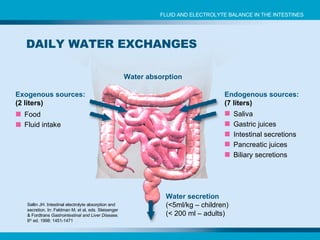
DAILY WATER EXCHANGES Sellin JH. Intestinal electrolyte absorption and secretion. In: Feldman M, et al, eds. Sleisenger & Fordtrans  Gastrointestinal and Liver Disease . 6 th  ed. 1998: 1451-1471 FLUID AND ELECTROLYTE BALANCE IN THE INTESTINES Food Fluid intake Water absorption Water secretion (<5ml/kg – children) (< 200 ml – adults) Exogenous sources: (2 liters) Endogenous sources: (7 liters) Saliva Gastric juices Intestinal secretions Pancreatic juices Biliary secretions
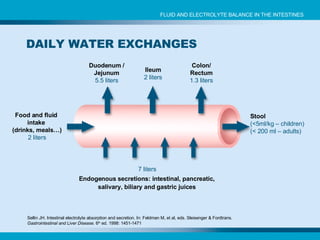
Duodenum / Jejunum 5.5 liters Endogenous secretions: intestinal, pancreatic, salivary, biliary and gastric juices 7 liters Sellin JH. Intestinal electrolyte absorption and secretion. In: Feldman M, et al, eds. Sleisenger & Fordtrans.  Gastrointestinal and Liver Disease . 6 th  ed. 1998: 1451-1471 Ileum 2 liters Colon/ Rectum 1.3 liters Stool (<5ml/kg – children) (< 200 ml – adults) Food and fluid  intake  (drinks, meals…) 2 liters FLUID AND ELECTROLYTE BALANCE IN THE INTESTINES DAILY WATER EXCHANGES
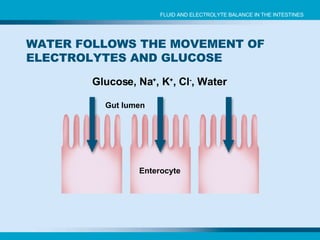
Glucose, Na + , K + , Cl - , Water WATER FOLLOWS THE MOVEMENT OF ELECTROLYTES AND GLUCOSE Gut lumen   Enterocyte FLUID AND ELECTROLYTE BALANCE IN THE INTESTINES
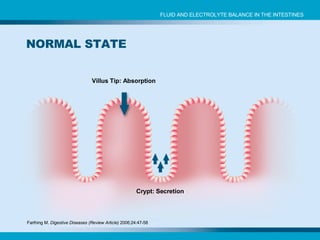
Crypt: Secretion Villus Tip: Absorption Farthing M.  Digestive Diseases (Review Article)  2006;24:47-58 NORMAL STATE FLUID AND ELECTROLYTE BALANCE IN THE INTESTINES
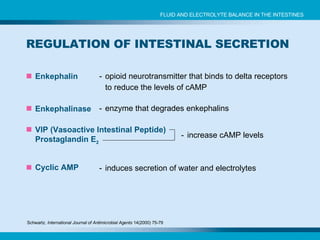
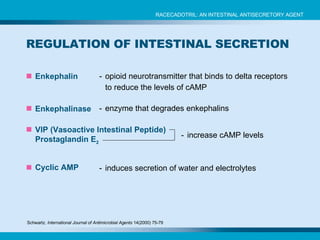
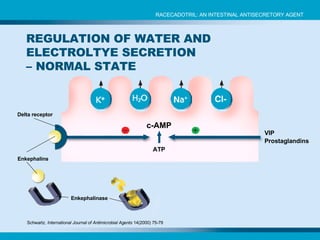
REGULATION OF INTESTINAL SECRETION  Enkephalin - opioid neurotransmitter that binds to delta receptors to reduce the levels of cAMP Schwartz.  International Journal of Antimicrobial Agents  14(2000) 75-79 VIP (Vasoactive Intestinal Peptide) Prostaglandin E 2 - increase cAMP levels Cyclic AMP - induces secretion of water and electrolytes Enkephalinase - enzyme that degrades enkephalins FLUID AND ELECTROLYTE BALANCE IN THE INTESTINES
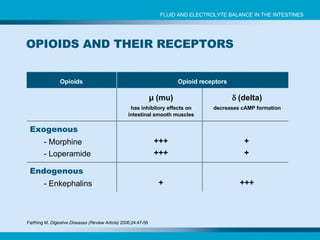
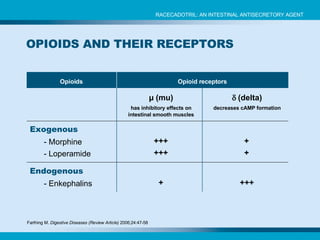
OPIOIDS AND THEIR RECEPTORS Exogenous - Morphine - Loperamide µ (mu) has inhibitory effects on intestinal smooth muscles  (delta) decreases cAMP formation +++ +++ + + Endogenous - Enkephalins + +++ Farthing M.  Digestive Diseases (Review Article)  2006;24:47-58 Opioids Opioid receptors FLUID AND ELECTROLYTE BALANCE IN THE INTESTINES
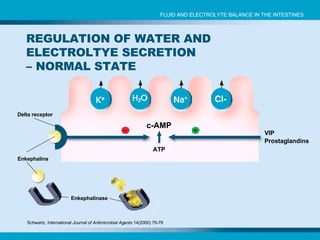
c-AMP ATP VIP Prostaglandins Schwartz.  International Journal of Antimicrobial Agents  14(2000) 75-79 Enkephalins REGULATION OF WATER AND ELECTROLTYE SECRETION – NORMAL STATE  Enkephalinase Delta receptor FLUID AND ELECTROLYTE BALANCE IN THE INTESTINES
DIARRHEA
Passage of abnormally liquid or unformed stools at an increased frequency Stool weight > 200 grams / day DIARRHEA 1,2 1.  Harrison’s Principles of Internal Medicine 17 th  Edition. Volume 1 2.  The Treatment of Diarrhea: A manual for physicians and other senior health workers, Department of Child and Adolescent Health and  Development, World Health Organization 2005 Consistency of the stools is more important than the number of stools. Frequent passing of formed stools is NOT diarrhea. DIARRHEA
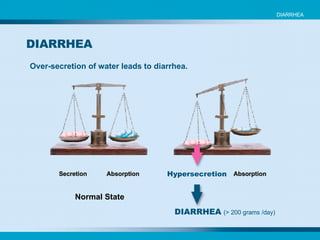
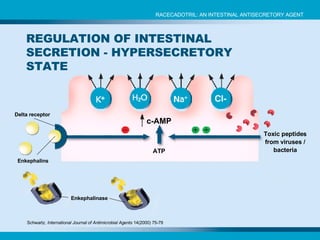
Over-secretion of water leads to diarrhea. Hypersecretion DIARRHEA   (> 200 grams /day) Secretion Absorption Absorption Normal State DIARRHEA DIARRHEA
Acute diarrhea   -  < 2 weeks duration -  more than 90% are caused by infectious agents -  often accompanied by vomiting, fever, and abdominal pain Persistent diarrhea   2 to 4 weeks duration Chronic diarrhea   > 4 weeks duration needs further evaluation to exclude serious underlying pathology usually non-infectious in origin ACUTE, PERSISTENT, AND CHRONIC DIARRHEA  DIARRHEA Harrison’s Principles of Internal Medicine 17 th  Edition. Volume 1
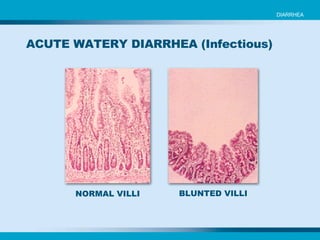
Bacteria: - ETEC -  V. cholerae, V. parahaemolyticus - Aeromonas, Plesiomonas, Shigella, Salmonella , EHEC Viruses: - Rotavirus - Enteric adenovirus (types 40 & 41) - SRSVs Protozoa: - C. parvum, G. intestinalis Duration: < 14 days; lasts several hours or days ACUTE WATERY DIARRHEA (Infectious) 1,2   1. Farthing M.  Digestive Diseases (Review Article)  2006;24:47-58 2. The Treatment of Diarrhea: A manual for physicians and other senior health workers, Department of Child and Adolescent  Health and Development, World Health Organization 2005 DIARRHEA
NORMAL VILLI BLUNTED VILLI ACUTE WATERY DIARRHEA (Infectious)  DIARRHEA
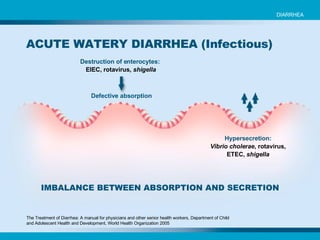
Destruction of enterocytes:   EIEC, rotavirus,  shigella Defective absorption Hypersecretion: Vibrio cholerae , rotavirus, ETEC,  shigella IMBALANCE BETWEEN ABSORPTION AND SECRETION The Treatment of Diarrhea: A manual for physicians and other senior health workers, Department of Child and Adolescent Health and Development, World Health Organization 2005 ACUTE WATERY DIARRHEA (Infectious)  DIARRHEA
BURDEN OF DIARRHEA
More than 1 billion people suffer one or more episodes of acute diarrhea each year. Because of poor sanitation and more limited access to health care, acute infectious diarrhea remains one of the most common causes of mortality in developing countries, particularly among children. BURDEN OF DIARRHEA DIARRHEA IN DEVELOPING COUNTRIES Harrison’s Principles of Internal Medicine 17 th  Edition. Volume 1
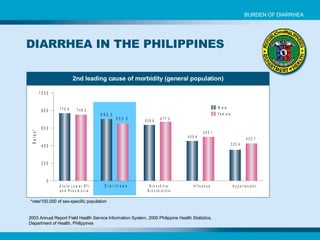
DIARRHEA IN THE PHILIPPINES *rate/100,000 of sex-specific population 2003 Annual Report Field Health Service Information System, 2000 Philippine Health Statistics,  Department of Health, Philippines 2nd leading cause of morbidity (general population) BURDEN OF DIARRHEA
MANAGEMENT OF DIARRHEA
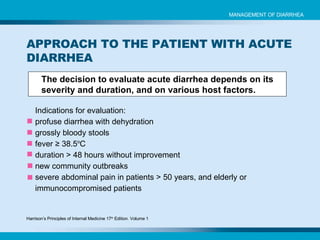
The decision to evaluate acute diarrhea depends on its severity and duration, and on various host factors. APPROACH TO THE PATIENT WITH ACUTE DIARRHEA Indications for evaluation: profuse diarrhea with dehydration grossly bloody stools fever ≥ 38.5 o C duration > 48 hours without improvement new community outbreaks severe abdominal pain in patients > 50 years, and elderly or immunocompromised patients MANAGEMENT OF DIARRHEA Harrison’s Principles of Internal Medicine 17 th  Edition. Volume 1
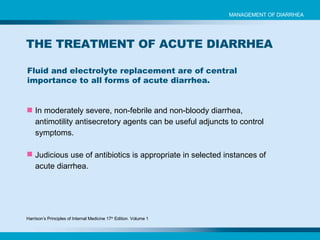
Fluid and electrolyte replacement are of central importance to all forms of acute diarrhea. MANAGEMENT OF DIARRHEA THE TREATMENT OF ACUTE DIARRHEA In moderately severe, non-febrile and non-bloody diarrhea, antimotility antisecretory agents can be useful adjuncts to control symptoms. Judicious use of antibiotics is appropriate in selected instances of acute diarrhea. Harrison’s Principles of Internal Medicine 17 th  Edition. Volume 1
UNMET MEDICAL NEEDS IN THE TREATMENT OF ACUTE DIARRHEA
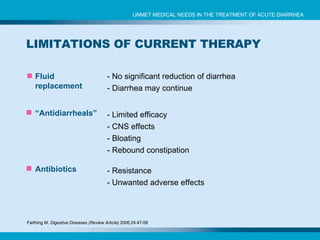
LIMITATIONS OF CURRENT THERAPY Fluid replacement - No significant reduction of diarrhea - Diarrhea may continue “ Antidiarrheals” - Limited efficacy - CNS effects - Bloating - Rebound constipation Antibiotics - Resistance - Unwanted adverse effects Farthing M.  Digestive Diseases (Review Article)  2006;24:47-58 UNMET MEDICAL NEEDS IN THE TREATMENT OF ACUTE DIARRHEA
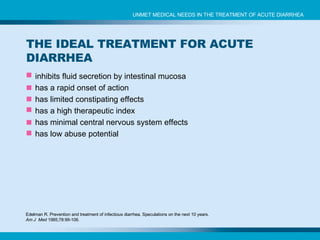
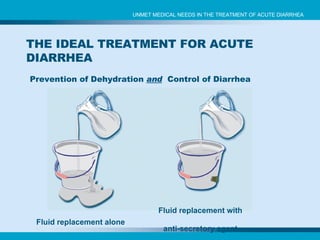
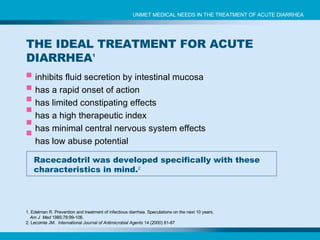
inhibits fluid secretion by intestinal mucosa has a rapid onset of action has limited  constipating effects  has a high therapeutic index has  minimal central nervous system effects has  low abuse potential Edelman R. Prevention and treatment of infectious diarrhea. Speculations on the next 10 years.  Am J  Med  1985;78:99-106. UNMET MEDICAL NEEDS IN THE TREATMENT OF ACUTE DIARRHEA THE IDEAL TREATMENT FOR ACUTE DIARRHEA
Prevention of Dehydration  and   Control of Diarrhea Fluid replacement alone Fluid replacement with anti-secretory agent UNMET MEDICAL NEEDS IN THE TREATMENT OF ACUTE DIARRHEA THE IDEAL TREATMENT FOR ACUTE DIARRHEA
inhibits fluid secretion by intestinal mucosa has a rapid onset of action has limited  constipating effects  has a high therapeutic index has  minimal central nervous system effects has  low abuse potential Racecadotril was developed specifically with these characteristics in mind. 2 1. Edelman R. Prevention and treatment of infectious diarrhea. Speculations on the next 10 years.  Am J  Med  1985;78:99-106. 2. Lecomte JM.  International Journal of Antimicrobial Agents  14 (2000) 81-87 THE IDEAL TREATMENT FOR ACUTE DIARRHEA 1 UNMET MEDICAL NEEDS IN THE TREATMENT OF ACUTE DIARRHEA
RACECADOTRIL: AN INTESTINAL ANTISECRETORY AGENT
REGULATION OF INTESTINAL SECRETION  Enkephalin - opioid neurotransmitter that binds to delta receptors to reduce the levels of cAMP Schwartz.  International Journal of Antimicrobial Agents  14(2000) 75-79 VIP (Vasoactive Intestinal Peptide) Prostaglandin E 2 - increase cAMP levels Cyclic AMP - induces secretion of water and electrolytes Enkephalinase - enzyme that degrades enkephalins RACECADOTRIL: AN INTESTINAL ANTISECRETORY AGENT
OPIOIDS AND THEIR RECEPTORS Exogenous - Morphine - Loperamide µ (mu) has inhibitory effects on intestinal smooth muscles  (delta) decreases cAMP formation +++ +++ + + Endogenous - Enkephalins + +++ Farthing M.  Digestive Diseases (Review Article)  2006;24:47-58 Opioids Opioid receptors RACECADOTRIL: AN INTESTINAL ANTISECRETORY AGENT
c-AMP ATP VIP Prostaglandins Schwartz.  International Journal of Antimicrobial Agents  14(2000) 75-79 Enkephalins REGULATION OF WATER AND ELECTROLTYE SECRETION – NORMAL STATE  Enkephalinase Delta receptor RACECADOTRIL: AN INTESTINAL ANTISECRETORY AGENT
c-AMP ATP Schwartz.  International Journal of Antimicrobial Agents  14(2000) 75-79 Enkephalins Enkephalinase Delta receptor Toxic peptides from viruses / bacteria REGULATION OF INTESTINAL SECRETION - HYPERSECRETORY STATE RACECADOTRIL: AN INTESTINAL ANTISECRETORY AGENT
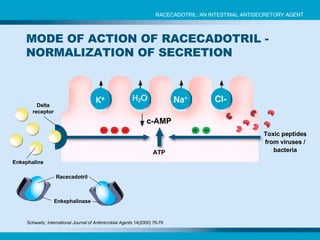
c-AMP ATP Schwartz.  International Journal of Antimicrobial Agents  14(2000) 75-79 Enkephalins Enkephalinase Delta receptor Toxic peptides from viruses / bacteria Racecadotril MODE OF ACTION OF RACECADOTRIL - NORMALIZATION OF SECRETION RACECADOTRIL: AN INTESTINAL ANTISECRETORY AGENT
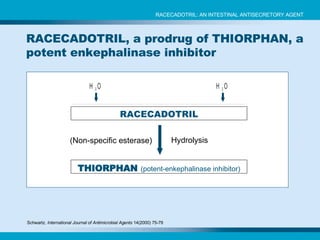
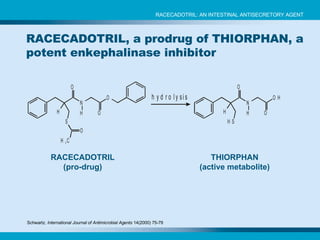
RACECADOTRIL, a prodrug of THIORPHAN, a potent enkephalinase inhibitor Schwartz.  International Journal of Antimicrobial Agents  14(2000) 75-79 RACECADOTRIL: AN INTESTINAL ANTISECRETORY AGENT RACECADOTRIL THIORPHAN  (potent-enkephalinase inhibitor) (Non-specific esterase) Hydrolysis
RACECADOTRIL (pro-drug) THIORPHAN (active metabolite) Schwartz.  International Journal of Antimicrobial Agents  14(2000) 75-79 RACECADOTRIL: AN INTESTINAL ANTISECRETORY AGENT RACECADOTRIL, a prodrug of THIORPHAN, a potent enkephalinase inhibitor
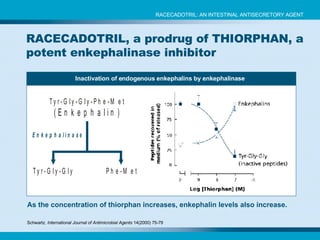
As the concentration of thiorphan increases, enkephalin levels also increase. Inactivation of endogenous enkephalins by enkephalinase Schwartz.  International Journal of Antimicrobial Agents  14(2000) 75-79 RACECADOTRIL: AN INTESTINAL ANTISECRETORY AGENT RACECADOTRIL, a prodrug of THIORPHAN, a potent enkephalinase inhibitor
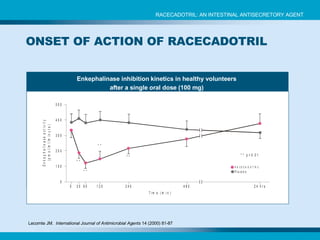
Enkephalinase inhibition kinetics in healthy volunteers  after a single oral dose (100 mg)  Lecomte JM.  International Journal of Antimicrobial Agents  14 (2000) 81-87 ONSET OF ACTION OF RACECADOTRIL RACECADOTRIL: AN INTESTINAL ANTISECRETORY AGENT
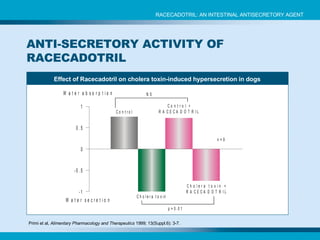
ANTI-SECRETORY ACTIVITY OF RACECADOTRIL Primi et al,  Alimentary Pharmacology and Therapeutics  1999; 13(Suppl.6): 3-7. RACECADOTRIL: AN INTESTINAL ANTISECRETORY AGENT Effect of Racecadotril on cholera toxin-induced hypersecretion in dogs
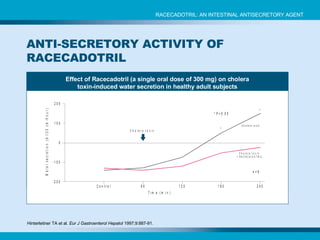
Hinterleitner TA et al.  Eur J Gastroenterol Hepatol  1997;9:887-91. Effect of Racecadotril (a single oral dose of 300 mg) on cholera toxin-induced water secretion in healthy adult subjects ANTI-SECRETORY ACTIVITY OF RACECADOTRIL RACECADOTRIL: AN INTESTINAL ANTISECRETORY AGENT
CLINICAL TRIALS
INFANTS AND CHILDREN Eduardo Salazar-Lindo, M.D. et al. The New England Journal of Medicine  2000; 343:463-467 RACECADOTRIL IN THE TREATMENT OF ACUTE WATERY DIARRHEA IN CHILDREN
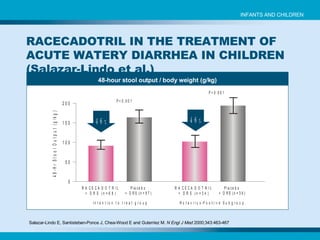
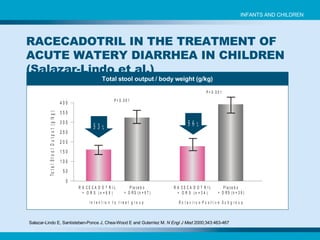
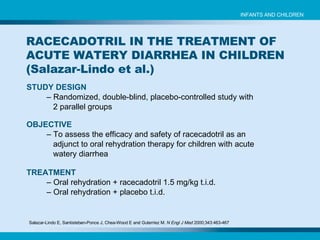
STUDY DESIGN   –  Randomized, double-blind, placebo-controlled study with 2 parallel groups OBJECTIVE   –  To assess the efficacy and safety of racecadotril as an adjunct to oral rehydration therapy  for children with acute watery diarrhea RACECADOTRIL IN THE TREATMENT OF ACUTE WATERY DIARRHEA IN CHILDREN (Salazar-Lindo et al.) TREATMENT   –  Oral rehydration + racecadotril 1.5 mg/kg t.i.d.   –  Oral rehydration + placebo t.i.d. Salazar-Lindo E, Santisteban-Ponce J, Chea-Wood E and Guterriez M.  N Engl J Med  2000;343:463-467   INFANTS AND CHILDREN
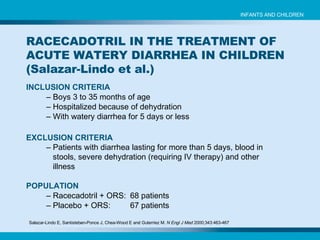
POPULATION   –  Racecadotril + ORS: 68 patients  –   Placebo + ORS: 67 patients  EXCLUSION CRITERIA –  Patients with diarrhea lasting for more than 5 days, blood in stools, severe  dehydration (requiring IV therapy) and other illness INCLUSION CRITERIA   –  Boys 3 to 35 months of age –  Hospitalized because of dehydration –  With watery diarrhea for 5 days or less Salazar-Lindo E, Santisteban-Ponce J, Chea-Wood E and Guterriez M.  N Engl J Med  2000;343:463-467   RACECADOTRIL IN THE TREATMENT OF ACUTE WATERY DIARRHEA IN CHILDREN (Salazar-Lindo et al.) INFANTS AND CHILDREN
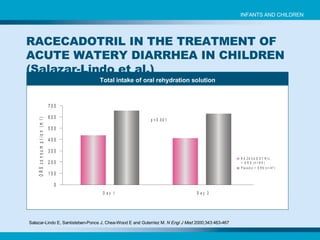
EVALUATION CRITERIA  Primary end point :  48-hour stool output (measured in grams) Other end points : –   Total stool output –  Duration of diarrhea –  Total ORS intake Number of adverse events Salazar-Lindo E, Santisteban-Ponce J, Chea-Wood E and Guterriez M.  N Engl J Med  2000;343:463-467   RACECADOTRIL IN THE TREATMENT OF ACUTE WATERY DIARRHEA IN CHILDREN (Salazar-Lindo et al.) INFANTS AND CHILDREN
Characteristics of population at inclusion Age [months]  13 12  Weight [kg] 9.0 8.7 Duration of diarrhea before inclusion [hrs]  47.4 51.5 Stool number in the last  24 hours  8.6 9.7 Stool consistency [no. of boys] Loose 16 14 Watery  52 53 Characteristic Racecadotril + ORS   Placebo + ORS [ n = 68] [n = 67]  Salazar-Lindo E, Santisteban-Ponce J, Chea-Wood E and Guterriez M.  N Engl J Med  2000;343:463-467   RACECADOTRIL IN THE TREATMENT OF ACUTE WATERY DIARRHEA IN CHILDREN (Salazar-Lindo et al.) INFANTS AND CHILDREN
48-hour stool output / body weight (g/kg) Salazar-Lindo E, Santisteban-Ponce J, Chea-Wood E and Guterriez M.  N Engl J Med  2000;343:463-467   RACECADOTRIL IN THE TREATMENT OF ACUTE WATERY DIARRHEA IN CHILDREN (Salazar-Lindo et al.) INFANTS AND CHILDREN
Total stool output / body weight (g/kg) Salazar-Lindo E, Santisteban-Ponce J, Chea-Wood E and Guterriez M.  N Engl J Med  2000;343:463-467   RACECADOTRIL IN THE TREATMENT OF ACUTE WATERY DIARRHEA IN CHILDREN (Salazar-Lindo et al.) INFANTS AND CHILDREN
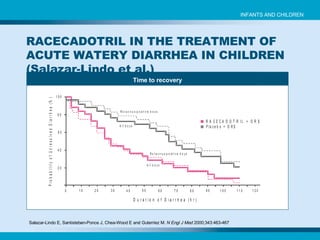
Time to recovery Salazar-Lindo E, Santisteban-Ponce J, Chea-Wood E and Guterriez M.  N Engl J Med  2000;343:463-467   RACECADOTRIL IN THE TREATMENT OF ACUTE WATERY DIARRHEA IN CHILDREN (Salazar-Lindo et al.) INFANTS AND CHILDREN
Total intake of oral rehydration solution Salazar-Lindo E, Santisteban-Ponce J, Chea-Wood E and Guterriez M.  N Engl J Med  2000;343:463-467   RACECADOTRIL IN THE TREATMENT OF ACUTE WATERY DIARRHEA IN CHILDREN (Salazar-Lindo et al.) INFANTS AND CHILDREN
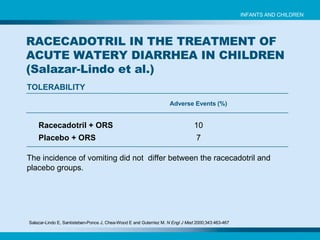
TOLERABILITY Adverse Events (%) Racecadotril + ORS  10 Placebo + ORS   7 The incidence of vomiting did not  differ between the racecadotril and placebo groups. Salazar-Lindo E, Santisteban-Ponce J, Chea-Wood E and Guterriez M.  N Engl J Med  2000;343:463-467   RACECADOTRIL IN THE TREATMENT OF ACUTE WATERY DIARRHEA IN CHILDREN (Salazar-Lindo et al.) INFANTS AND CHILDREN
Salazar-Lindo E, Santisteban-Ponce J, Chea-Wood E and Guterriez M.  N Engl J Med  2000;343:463-467   CONCLUSION The results of this study provide evidence that racecadotril, as an adjunct to oral rehydration solution, is   effective and well tolerated in reducing the duration and severity of acute watery diarrhea   in hospitalized infants and children. The antidiarrheal effect is obtained more rapidly than with oral rehydration alone,  particularly in infants with rotavirus infection. RACECADOTRIL IN THE TREATMENT OF ACUTE WATERY DIARRHEA IN CHILDREN (Salazar-Lindo et al.) INFANTS AND CHILDREN
Jean Pierre Cézard et al. Gastroenterology  2001; 120:799-805 EFFICACY AND TOLERABILITY OF RACECADOTRIL IN ACUTE DIARRHEA IN CHILDREN INFANTS AND CHILDREN
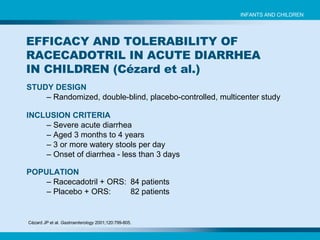
EFFICACY AND TOLERABILITY OF RACECADOTRIL IN ACUTE DIARRHEA IN CHILDREN ( Cézard et al.) INFANTS AND CHILDREN STUDY DESIGN   –  Randomized, double-blind, placebo-controlled, multicenter study INCLUSION CRITERIA   –  Severe acute diarrhea –  Aged 3 months to 4 years  –  3 or more watery stools per day –  Onset of diarrhea - less than 3 days   POPULATION   –  Racecadotril + ORS: 84 patients  –   Placebo + ORS: 82 patients  Cézard JP et al.  Gastroenterology  2001;120:799-805.
EVALUATION CRITERIA  –  Stool output during the first 48 hrs (primary end point)  –  Stool output during the first 24 hrs   –  Dehydration status at 24 hrs (Urine Na +  / K +  ratio)  –  Duration of diarrhea –  Number and characteristics of stools TREATMENT   –  Oral rehydration + racecadotril 1.5 mg/kg t.i.d.   –  Oral rehydration + placebo t.i.d. Cézard JP et al.  Gastroenterology  2001;120:799-805.   EFFICACY AND TOLERABILITY OF RACECADOTRIL IN ACUTE DIARRHEA IN CHILDREN ( Cézard et al.) INFANTS AND CHILDREN
Characteristics of population at inclusion CHARACTERISTIC Racecadotril + ORS   Placebo + ORS   [n = 84]   [n = 82] Age [months]  12.0 ± 0.9 13.6 ± 1.0 Sex: [M / F]   51 / 38 50 / 33 Height [m]   0.73 ± 0.01 0.75 ± 0.01 Weight [kg]   8.54 ± 0.25 9.27 ± 0.25 Stool number [n]   6.0 ± 0.3 6.5 ± 0.4 Duration of diarrhea [days]   2.0 ± 0.2 1.9 ± 0.1 Patients with Rotavirus  [n] 32 35 Patients with Adenovirus [n] 3 4 Mean  +  SEM Cézard JP et al.  Gastroenterology  2001;120:799-805.   EFFICACY AND TOLERABILITY OF RACECADOTRIL IN ACUTE DIARRHEA IN CHILDREN ( Cézard et al.) INFANTS AND CHILDREN
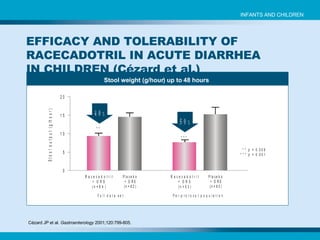
Stool weight (g/hour) up to 48 hours  Cézard JP et al.  Gastroenterology  2001;120:799-805.   EFFICACY AND TOLERABILITY OF RACECADOTRIL IN ACUTE DIARRHEA IN CHILDREN ( Cézard et al.) INFANTS AND CHILDREN
Time to recovery in rotavirus-positive patients Cézard JP et al.  Gastroenterology  2001;120:799-805.   EFFICACY AND TOLERABILITY OF RACECADOTRIL IN ACUTE DIARRHEA IN CHILDREN ( Cézard et al.) INFANTS AND CHILDREN Duration of diarrhea   [median, hours]  Racecadotril [n = 32] Placebo [n = 35] P 6.9 36 0.02
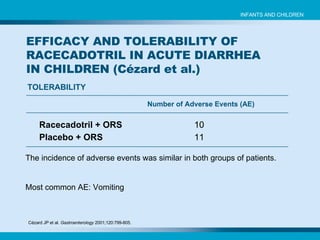
TOLERABILITY Number of Adverse Events (AE) Racecadotril + ORS  10 Placebo + ORS   11 The incidence of adverse events was similar in both groups of patients. Most common AE: Vomiting Cézard JP et al.  Gastroenterology  2001;120:799-805.   EFFICACY AND TOLERABILITY OF RACECADOTRIL IN ACUTE DIARRHEA IN CHILDREN ( Cézard et al.) INFANTS AND CHILDREN
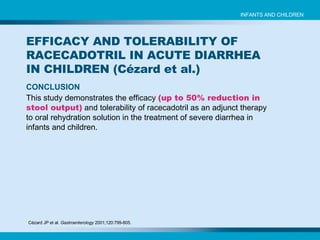
Cézard JP et al.  Gastroenterology  2001;120:799-805.   CONCLUSION This study demonstrates the efficacy  (up to 50% reduction in stool output)  and tolerability of racecadotril as an adjunct therapy to oral rehydration solution in the treatment of severe diarrhea in infants and children. EFFICACY AND TOLERABILITY OF RACECADOTRIL IN ACUTE DIARRHEA IN CHILDREN ( Cézard et al.) INFANTS AND CHILDREN
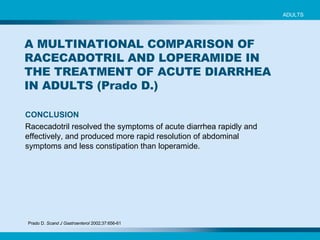
ADULTS A MULTINATIONAL COMPARISON OF RACECADOTRIL AND LOPERAMIDE IN THE TREATMENT OF ACUTE DIARRHEA IN ADULTS David Prado for the Global Adult Racecadotril Study Group Scandinavian Journal of Gastroenterology 2002
A MULTINATIONAL COMPARISON OF RACECADOTRIL AND LOPERAMIDE IN THE TREATMENT OF ACUTE DIARRHEA IN ADULTS (Prado D.) STUDY DESIGN   –  Multicenter (21 centers in 14 countries)  –   Parallel groups   –   Ambulatory patients   Prado D.  Scand J Gastroenterol  2002;37:656-61   INCLUSION CRITERIA   –  3 or more watery stools, with no visible blood, in the last 24 hours   –  onset of diarrhea of presumed infectious origin, of at least 24 hours and less than 5 days ADULTS
TREATMENT   –  Racecadotril: 100 mg, 3 times daily / Loperamide: 2 mg, 3 times daily   ADULTS ANALYZED POPULATION   –  Racecadotril: 461 patients  /  Loperamide: 454 patients   Prado D.  Scand J Gastroenterol  2002;37:656-61   A MULTINATIONAL COMPARISON OF RACECADOTRIL AND LOPERAMIDE IN THE TREATMENT OF ACUTE DIARRHEA IN ADULTS (Prado D.)
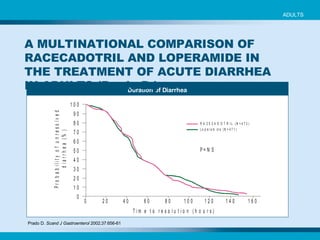
ADULTS EVALUATION CRITERIA   Main criterion : –  Duration of diarrhea until resolution, i.e 12 hours with no stools or 2 consecutive normal stools Secondary criteria : –  Duration of abdominal distension and abdominal pain –  Associated symptoms –  Overall clinical response (success or failure)   Prado D.  Scand J Gastroenterol  2002;37:656-61   A MULTINATIONAL COMPARISON OF RACECADOTRIL AND LOPERAMIDE IN THE TREATMENT OF ACUTE DIARRHEA IN ADULTS (Prado D.)
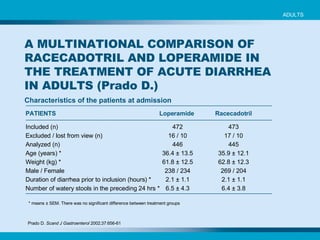
Characteristics of the patients at admission Included (n) 472 473 Excluded / lost from view (n) 16 / 10 17 / 10 Analyzed (n) 446 445 Age (years) * 36.4 ± 13.5 35.9 ± 12.1 Weight (kg) * 61.8 ± 12.5 62.8 ± 12.3 Male / Female 238 / 234 269 / 204 Duration of diarrhea prior to inclusion (hours) * 2.1 ± 1.1 2.1 ± 1.1 Number of watery stools in the preceding 24 hrs * 6.5 ± 4.3 6.4 ± 3.8 * means ± SEM. There was no significant difference between treatment groups  PATIENTS Loperamide  Racecadotril ADULTS Prado D.  Scand J Gastroenterol  2002;37:656-61   A MULTINATIONAL COMPARISON OF RACECADOTRIL AND LOPERAMIDE IN THE TREATMENT OF ACUTE DIARRHEA IN ADULTS (Prado D.)
Duration of Diarrhea ADULTS A MULTINATIONAL COMPARISON OF RACECADOTRIL AND LOPERAMIDE IN THE TREATMENT OF ACUTE DIARRHEA IN ADULTS (Prado D.) Prado D.  Scand J Gastroenterol  2002;37:656-61
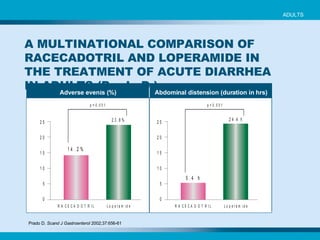
ADULTS Prado D.  Scand J Gastroenterol  2002;37:656-61   Adverse events (%) Abdominal distension (duration in hrs) A MULTINATIONAL COMPARISON OF RACECADOTRIL AND LOPERAMIDE IN THE TREATMENT OF ACUTE DIARRHEA IN ADULTS (Prado D.)
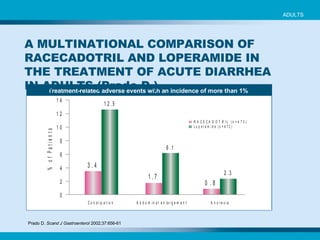
Treatment-related adverse events with an incidence of more than 1% Prado D.  Scand J Gastroenterol  2002;37:656-61   ADULTS A MULTINATIONAL COMPARISON OF RACECADOTRIL AND LOPERAMIDE IN THE TREATMENT OF ACUTE DIARRHEA IN ADULTS (Prado D.)
ADULTS CONCLUSION   Racecadotril resolved the symptoms of acute diarrhea rapidly and effectively, and produced more rapid resolution of abdominal symptoms and less constipation than loperamide. Prado D.  Scand J Gastroenterol  2002;37:656-61   A MULTINATIONAL COMPARISON OF RACECADOTRIL AND LOPERAMIDE IN THE TREATMENT OF ACUTE DIARRHEA IN ADULTS (Prado D.)
RACECADOTRIL’S SAFETY AND TOLERABILITY PROFILE
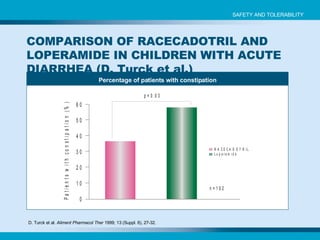
COMPARISON OF RACECADOTRIL AND LOPERAMIDE IN CHILDREN WITH ACUTE DIARRHEA (D. Turck et al.) D. Turck et al.  Aliment Pharmacol Ther  1999; 13 (Suppl. 6), 27-32. Percentage of patients with constipation SAFETY AND TOLERABILITY
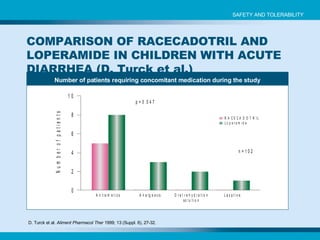
Number of patients requiring concomitant medication during the study D. Turck et al.  Aliment Pharmacol Ther  1999; 13 (Suppl. 6), 27-32. COMPARISON OF RACECADOTRIL AND LOPERAMIDE IN CHILDREN WITH ACUTE DIARRHEA (D. Turck et al.) SAFETY AND TOLERABILITY
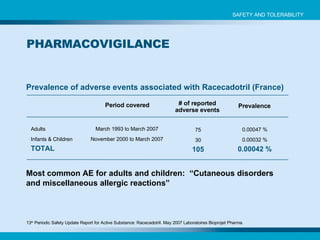
PHARMACOVIGILANCE 13 th  Periodic Safety Update Report for Active Substance: Racecadotril. May 2007 Laboratoires Bioprojet Pharma.  Adults Infants & Children TOTAL Period covered # of reported adverse events Prevalence  March 1993 to March 2007 November 2000 to March 2007 75 30 105 0.00047 % 0.00032 % 0.00042 % Prevalence of adverse events associated with Racecadotril (France) Most common AE for adults and children:  “Cutaneous disorders and miscellaneous allergic reactions” SAFETY AND TOLERABILITY
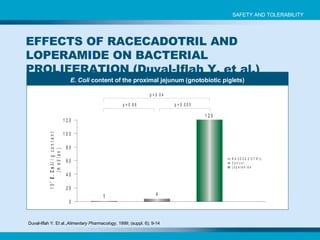
E. Coli  content of the proximal jejunum (gnotobiotic piglets) Duval-Iflah Y. Et al., Alimentary Pharmacology , 1999; (suppl. 6); 9-14   EFFECTS OF RACECADOTRIL AND LOPERAMIDE ON BACTERIAL PROLIFERATION ( Duval-Iflah Y. et al.) SAFETY AND TOLERABILITY
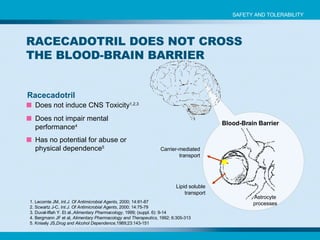
1. Lecomte JM,  Int.J. Of Antimicrobial Agents , 2000; 14:81-87 2. Scwartz J-C,  Int.J. Of Antimicrobial Agents , 2000; 14:75-79 3. Duval-Iflah Y. Et al., Alimentary Pharmacology , 1999; (suppl. 6): 9-14 4. Bergmann  JF et al,  Alimentary Pharmacology and Therapeutics , 1992; 6:305-313 5. Knisely JS, Drug and Alcohol Dependence ,1989;23:143-151 Blood-Brain Barrier Astrocyte processes Lipid soluble transport Carrier-mediated transport Does not induce CNS Toxicity 1,2,3 Racecadotril RACECADOTRIL DOES NOT CROSS THE BLOOD-BRAIN BARRIER Does not impair mental performance 4 Has no potential for abuse or physical dependence 5 SAFETY AND TOLERABILITY
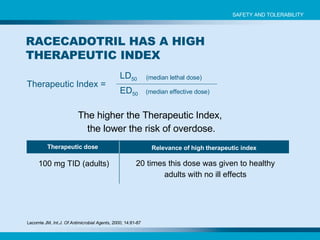
Therapeutic Index =  LD 50 ED 50 Lecomte JM,  Int.J. Of Antimicrobial Agents , 2000; 14:81-87 100 mg TID (adults) 20 times this dose was given to healthy adults with no ill effects Therapeutic dose Relevance of high therapeutic index The higher the Therapeutic Index,  the lower the risk of overdose. RACECADOTRIL HAS A HIGH THERAPEUTIC INDEX (median lethal dose) (median effective dose) SAFETY AND TOLERABILITY
SUMMARY AND CONCLUSIONS
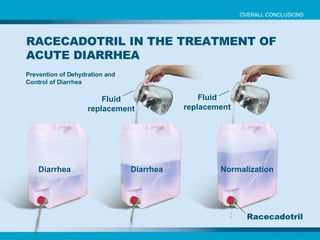
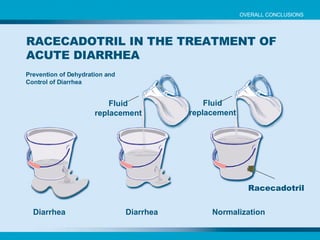
Prevention of Dehydration and Control of Diarrhea Normalization Diarrhea  OVERALL CONCLUSIONS RACECADOTRIL IN THE TREATMENT OF ACUTE DIARRHEA Diarrhea Fluid replacement Racecadotril Fluid replacement
Normalization Diarrhea  Diarrhea Racecadotril Prevention of Dehydration and Control of Diarrhea OVERALL CONCLUSIONS RACECADOTRIL IN THE TREATMENT OF ACUTE DIARRHEA Fluid replacement Fluid replacement
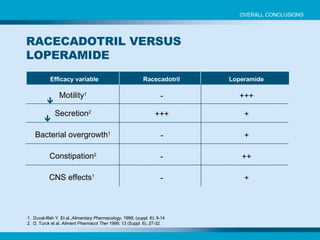
Loperamide Racecadotril Efficacy variable Motility 1 Secretion 2 Bacterial overgrowth 1 CNS effects 1   Constipation 2 - +++ - - - +++ + + + ++ RACECADOTRIL VERSUS LOPERAMIDE 1. Duval-Iflah Y. Et al., Alimentary Pharmacology , 1999; (suppl. 6); 9-14  2. D. Turck et al.  Aliment Pharmacol Ther  1999; 13 (Suppl. 6), 27-32.   OVERALL CONCLUSIONS
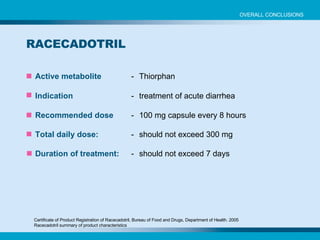
Active metabolite - Thiorphan Indication - treatment of acute diarrhea Recommended dose - 100 mg capsule every 8 hours Total daily dose: - should not exceed 300 mg Duration of treatment: - should not exceed 7 days Certificate of Product Registration of Racecadotril, Bureau of Food and Drugs, Department of Health. 2005 Racecadotril summary of product characteristics RACECADOTRIL OVERALL CONCLUSIONS
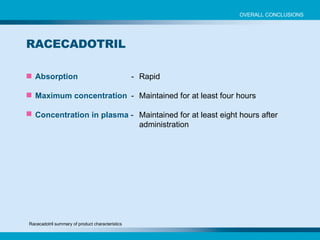
Absorption - Rapid Maximum concentration - Maintained for at least four hours Concentration in plasma  - Maintained for at least eight hours after  administration RACECADOTRIL OVERALL CONCLUSIONS Racecadotril summary of product characteristics
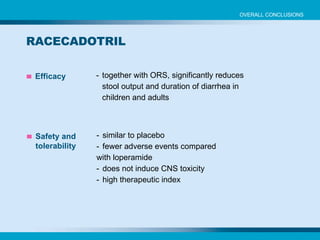
Efficacy - together with ORS, significantly reduces stool output and duration of diarrhea in  children and adults Safety and tolerability - similar to placebo - fewer adverse events compared  with loperamide - does not induce CNS toxicity - high therapeutic index RACECADOTRIL OVERALL CONCLUSIONS
Racecadotril:  A Novel Approach in the Treatment of Acute Diarrhea

Hidrasec Bongs Lecture

  • 1.
    A Novel Approachin the Treatment of Acute Diarrhea ARBEL MONDONEDO,MD,FPCP, FPSG,FPSDE
  • 2.
    Fluid and electrolytebalance and diarrhea Burden of diarrhea and its management Racecadotril – an intestinal antisecretory agent Clinical trials Safety and tolerability profile Conclusions PRESENTATION OUTLINE INTRODUCTION
  • 3.
    FLUID AND ELECTROLYTEBALANCE IN THE INTESTINES
  • 4.
    DAILY WATER EXCHANGESSellin JH. Intestinal electrolyte absorption and secretion. In: Feldman M, et al, eds. Sleisenger & Fordtrans Gastrointestinal and Liver Disease . 6 th ed. 1998: 1451-1471 FLUID AND ELECTROLYTE BALANCE IN THE INTESTINES Food Fluid intake Water absorption Water secretion (<5ml/kg – children) (< 200 ml – adults) Exogenous sources: (2 liters) Endogenous sources: (7 liters) Saliva Gastric juices Intestinal secretions Pancreatic juices Biliary secretions
  • 5.
    Duodenum / Jejunum5.5 liters Endogenous secretions: intestinal, pancreatic, salivary, biliary and gastric juices 7 liters Sellin JH. Intestinal electrolyte absorption and secretion. In: Feldman M, et al, eds. Sleisenger & Fordtrans. Gastrointestinal and Liver Disease . 6 th ed. 1998: 1451-1471 Ileum 2 liters Colon/ Rectum 1.3 liters Stool (<5ml/kg – children) (< 200 ml – adults) Food and fluid intake (drinks, meals…) 2 liters FLUID AND ELECTROLYTE BALANCE IN THE INTESTINES DAILY WATER EXCHANGES
  • 6.
    Glucose, Na +, K + , Cl - , Water WATER FOLLOWS THE MOVEMENT OF ELECTROLYTES AND GLUCOSE Gut lumen Enterocyte FLUID AND ELECTROLYTE BALANCE IN THE INTESTINES
  • 7.
    Crypt: Secretion VillusTip: Absorption Farthing M. Digestive Diseases (Review Article) 2006;24:47-58 NORMAL STATE FLUID AND ELECTROLYTE BALANCE IN THE INTESTINES
  • 8.
    REGULATION OF INTESTINALSECRETION Enkephalin - opioid neurotransmitter that binds to delta receptors to reduce the levels of cAMP Schwartz. International Journal of Antimicrobial Agents 14(2000) 75-79 VIP (Vasoactive Intestinal Peptide) Prostaglandin E 2 - increase cAMP levels Cyclic AMP - induces secretion of water and electrolytes Enkephalinase - enzyme that degrades enkephalins FLUID AND ELECTROLYTE BALANCE IN THE INTESTINES
  • 9.
    OPIOIDS AND THEIRRECEPTORS Exogenous - Morphine - Loperamide µ (mu) has inhibitory effects on intestinal smooth muscles  (delta) decreases cAMP formation +++ +++ + + Endogenous - Enkephalins + +++ Farthing M. Digestive Diseases (Review Article) 2006;24:47-58 Opioids Opioid receptors FLUID AND ELECTROLYTE BALANCE IN THE INTESTINES
  • 10.
    c-AMP ATP VIPProstaglandins Schwartz. International Journal of Antimicrobial Agents 14(2000) 75-79 Enkephalins REGULATION OF WATER AND ELECTROLTYE SECRETION – NORMAL STATE Enkephalinase Delta receptor FLUID AND ELECTROLYTE BALANCE IN THE INTESTINES
  • 11.
  • 12.
    Passage of abnormallyliquid or unformed stools at an increased frequency Stool weight > 200 grams / day DIARRHEA 1,2 1. Harrison’s Principles of Internal Medicine 17 th Edition. Volume 1 2. The Treatment of Diarrhea: A manual for physicians and other senior health workers, Department of Child and Adolescent Health and Development, World Health Organization 2005 Consistency of the stools is more important than the number of stools. Frequent passing of formed stools is NOT diarrhea. DIARRHEA
  • 13.
    Over-secretion of waterleads to diarrhea. Hypersecretion DIARRHEA (> 200 grams /day) Secretion Absorption Absorption Normal State DIARRHEA DIARRHEA
  • 14.
    Acute diarrhea - < 2 weeks duration - more than 90% are caused by infectious agents - often accompanied by vomiting, fever, and abdominal pain Persistent diarrhea 2 to 4 weeks duration Chronic diarrhea > 4 weeks duration needs further evaluation to exclude serious underlying pathology usually non-infectious in origin ACUTE, PERSISTENT, AND CHRONIC DIARRHEA DIARRHEA Harrison’s Principles of Internal Medicine 17 th Edition. Volume 1
  • 15.
    Bacteria: - ETEC- V. cholerae, V. parahaemolyticus - Aeromonas, Plesiomonas, Shigella, Salmonella , EHEC Viruses: - Rotavirus - Enteric adenovirus (types 40 & 41) - SRSVs Protozoa: - C. parvum, G. intestinalis Duration: < 14 days; lasts several hours or days ACUTE WATERY DIARRHEA (Infectious) 1,2 1. Farthing M. Digestive Diseases (Review Article) 2006;24:47-58 2. The Treatment of Diarrhea: A manual for physicians and other senior health workers, Department of Child and Adolescent Health and Development, World Health Organization 2005 DIARRHEA
  • 16.
    NORMAL VILLI BLUNTEDVILLI ACUTE WATERY DIARRHEA (Infectious) DIARRHEA
  • 17.
    Destruction of enterocytes: EIEC, rotavirus, shigella Defective absorption Hypersecretion: Vibrio cholerae , rotavirus, ETEC, shigella IMBALANCE BETWEEN ABSORPTION AND SECRETION The Treatment of Diarrhea: A manual for physicians and other senior health workers, Department of Child and Adolescent Health and Development, World Health Organization 2005 ACUTE WATERY DIARRHEA (Infectious) DIARRHEA
  • 18.
  • 19.
    More than 1billion people suffer one or more episodes of acute diarrhea each year. Because of poor sanitation and more limited access to health care, acute infectious diarrhea remains one of the most common causes of mortality in developing countries, particularly among children. BURDEN OF DIARRHEA DIARRHEA IN DEVELOPING COUNTRIES Harrison’s Principles of Internal Medicine 17 th Edition. Volume 1
  • 20.
    DIARRHEA IN THEPHILIPPINES *rate/100,000 of sex-specific population 2003 Annual Report Field Health Service Information System, 2000 Philippine Health Statistics, Department of Health, Philippines 2nd leading cause of morbidity (general population) BURDEN OF DIARRHEA
  • 21.
  • 22.
    The decision toevaluate acute diarrhea depends on its severity and duration, and on various host factors. APPROACH TO THE PATIENT WITH ACUTE DIARRHEA Indications for evaluation: profuse diarrhea with dehydration grossly bloody stools fever ≥ 38.5 o C duration > 48 hours without improvement new community outbreaks severe abdominal pain in patients > 50 years, and elderly or immunocompromised patients MANAGEMENT OF DIARRHEA Harrison’s Principles of Internal Medicine 17 th Edition. Volume 1
  • 23.
    Fluid and electrolytereplacement are of central importance to all forms of acute diarrhea. MANAGEMENT OF DIARRHEA THE TREATMENT OF ACUTE DIARRHEA In moderately severe, non-febrile and non-bloody diarrhea, antimotility antisecretory agents can be useful adjuncts to control symptoms. Judicious use of antibiotics is appropriate in selected instances of acute diarrhea. Harrison’s Principles of Internal Medicine 17 th Edition. Volume 1
  • 24.
    UNMET MEDICAL NEEDSIN THE TREATMENT OF ACUTE DIARRHEA
  • 25.
    LIMITATIONS OF CURRENTTHERAPY Fluid replacement - No significant reduction of diarrhea - Diarrhea may continue “ Antidiarrheals” - Limited efficacy - CNS effects - Bloating - Rebound constipation Antibiotics - Resistance - Unwanted adverse effects Farthing M. Digestive Diseases (Review Article) 2006;24:47-58 UNMET MEDICAL NEEDS IN THE TREATMENT OF ACUTE DIARRHEA
  • 26.
    inhibits fluid secretionby intestinal mucosa has a rapid onset of action has limited constipating effects has a high therapeutic index has minimal central nervous system effects has low abuse potential Edelman R. Prevention and treatment of infectious diarrhea. Speculations on the next 10 years. Am J Med 1985;78:99-106. UNMET MEDICAL NEEDS IN THE TREATMENT OF ACUTE DIARRHEA THE IDEAL TREATMENT FOR ACUTE DIARRHEA
  • 27.
    Prevention of Dehydration and Control of Diarrhea Fluid replacement alone Fluid replacement with anti-secretory agent UNMET MEDICAL NEEDS IN THE TREATMENT OF ACUTE DIARRHEA THE IDEAL TREATMENT FOR ACUTE DIARRHEA
  • 28.
    inhibits fluid secretionby intestinal mucosa has a rapid onset of action has limited constipating effects has a high therapeutic index has minimal central nervous system effects has low abuse potential Racecadotril was developed specifically with these characteristics in mind. 2 1. Edelman R. Prevention and treatment of infectious diarrhea. Speculations on the next 10 years. Am J Med 1985;78:99-106. 2. Lecomte JM. International Journal of Antimicrobial Agents 14 (2000) 81-87 THE IDEAL TREATMENT FOR ACUTE DIARRHEA 1 UNMET MEDICAL NEEDS IN THE TREATMENT OF ACUTE DIARRHEA
  • 29.
    RACECADOTRIL: AN INTESTINALANTISECRETORY AGENT
  • 30.
    REGULATION OF INTESTINALSECRETION Enkephalin - opioid neurotransmitter that binds to delta receptors to reduce the levels of cAMP Schwartz. International Journal of Antimicrobial Agents 14(2000) 75-79 VIP (Vasoactive Intestinal Peptide) Prostaglandin E 2 - increase cAMP levels Cyclic AMP - induces secretion of water and electrolytes Enkephalinase - enzyme that degrades enkephalins RACECADOTRIL: AN INTESTINAL ANTISECRETORY AGENT
  • 31.
    OPIOIDS AND THEIRRECEPTORS Exogenous - Morphine - Loperamide µ (mu) has inhibitory effects on intestinal smooth muscles  (delta) decreases cAMP formation +++ +++ + + Endogenous - Enkephalins + +++ Farthing M. Digestive Diseases (Review Article) 2006;24:47-58 Opioids Opioid receptors RACECADOTRIL: AN INTESTINAL ANTISECRETORY AGENT
  • 32.
    c-AMP ATP VIPProstaglandins Schwartz. International Journal of Antimicrobial Agents 14(2000) 75-79 Enkephalins REGULATION OF WATER AND ELECTROLTYE SECRETION – NORMAL STATE Enkephalinase Delta receptor RACECADOTRIL: AN INTESTINAL ANTISECRETORY AGENT
  • 33.
    c-AMP ATP Schwartz. International Journal of Antimicrobial Agents 14(2000) 75-79 Enkephalins Enkephalinase Delta receptor Toxic peptides from viruses / bacteria REGULATION OF INTESTINAL SECRETION - HYPERSECRETORY STATE RACECADOTRIL: AN INTESTINAL ANTISECRETORY AGENT
  • 34.
    c-AMP ATP Schwartz. International Journal of Antimicrobial Agents 14(2000) 75-79 Enkephalins Enkephalinase Delta receptor Toxic peptides from viruses / bacteria Racecadotril MODE OF ACTION OF RACECADOTRIL - NORMALIZATION OF SECRETION RACECADOTRIL: AN INTESTINAL ANTISECRETORY AGENT
  • 35.
    RACECADOTRIL, a prodrugof THIORPHAN, a potent enkephalinase inhibitor Schwartz. International Journal of Antimicrobial Agents 14(2000) 75-79 RACECADOTRIL: AN INTESTINAL ANTISECRETORY AGENT RACECADOTRIL THIORPHAN (potent-enkephalinase inhibitor) (Non-specific esterase) Hydrolysis
  • 36.
    RACECADOTRIL (pro-drug) THIORPHAN(active metabolite) Schwartz. International Journal of Antimicrobial Agents 14(2000) 75-79 RACECADOTRIL: AN INTESTINAL ANTISECRETORY AGENT RACECADOTRIL, a prodrug of THIORPHAN, a potent enkephalinase inhibitor
  • 37.
    As the concentrationof thiorphan increases, enkephalin levels also increase. Inactivation of endogenous enkephalins by enkephalinase Schwartz. International Journal of Antimicrobial Agents 14(2000) 75-79 RACECADOTRIL: AN INTESTINAL ANTISECRETORY AGENT RACECADOTRIL, a prodrug of THIORPHAN, a potent enkephalinase inhibitor
  • 38.
    Enkephalinase inhibition kineticsin healthy volunteers after a single oral dose (100 mg) Lecomte JM. International Journal of Antimicrobial Agents 14 (2000) 81-87 ONSET OF ACTION OF RACECADOTRIL RACECADOTRIL: AN INTESTINAL ANTISECRETORY AGENT
  • 39.
    ANTI-SECRETORY ACTIVITY OFRACECADOTRIL Primi et al, Alimentary Pharmacology and Therapeutics 1999; 13(Suppl.6): 3-7. RACECADOTRIL: AN INTESTINAL ANTISECRETORY AGENT Effect of Racecadotril on cholera toxin-induced hypersecretion in dogs
  • 40.
    Hinterleitner TA etal. Eur J Gastroenterol Hepatol 1997;9:887-91. Effect of Racecadotril (a single oral dose of 300 mg) on cholera toxin-induced water secretion in healthy adult subjects ANTI-SECRETORY ACTIVITY OF RACECADOTRIL RACECADOTRIL: AN INTESTINAL ANTISECRETORY AGENT
  • 41.
  • 42.
    INFANTS AND CHILDRENEduardo Salazar-Lindo, M.D. et al. The New England Journal of Medicine 2000; 343:463-467 RACECADOTRIL IN THE TREATMENT OF ACUTE WATERY DIARRHEA IN CHILDREN
  • 43.
    STUDY DESIGN – Randomized, double-blind, placebo-controlled study with 2 parallel groups OBJECTIVE – To assess the efficacy and safety of racecadotril as an adjunct to oral rehydration therapy for children with acute watery diarrhea RACECADOTRIL IN THE TREATMENT OF ACUTE WATERY DIARRHEA IN CHILDREN (Salazar-Lindo et al.) TREATMENT – Oral rehydration + racecadotril 1.5 mg/kg t.i.d. – Oral rehydration + placebo t.i.d. Salazar-Lindo E, Santisteban-Ponce J, Chea-Wood E and Guterriez M. N Engl J Med 2000;343:463-467 INFANTS AND CHILDREN
  • 44.
    POPULATION – Racecadotril + ORS: 68 patients – Placebo + ORS: 67 patients EXCLUSION CRITERIA – Patients with diarrhea lasting for more than 5 days, blood in stools, severe dehydration (requiring IV therapy) and other illness INCLUSION CRITERIA – Boys 3 to 35 months of age – Hospitalized because of dehydration – With watery diarrhea for 5 days or less Salazar-Lindo E, Santisteban-Ponce J, Chea-Wood E and Guterriez M. N Engl J Med 2000;343:463-467 RACECADOTRIL IN THE TREATMENT OF ACUTE WATERY DIARRHEA IN CHILDREN (Salazar-Lindo et al.) INFANTS AND CHILDREN
  • 45.
    EVALUATION CRITERIA Primary end point : 48-hour stool output (measured in grams) Other end points : – Total stool output – Duration of diarrhea – Total ORS intake Number of adverse events Salazar-Lindo E, Santisteban-Ponce J, Chea-Wood E and Guterriez M. N Engl J Med 2000;343:463-467 RACECADOTRIL IN THE TREATMENT OF ACUTE WATERY DIARRHEA IN CHILDREN (Salazar-Lindo et al.) INFANTS AND CHILDREN
  • 46.
    Characteristics of populationat inclusion Age [months] 13 12 Weight [kg] 9.0 8.7 Duration of diarrhea before inclusion [hrs] 47.4 51.5 Stool number in the last 24 hours 8.6 9.7 Stool consistency [no. of boys] Loose 16 14 Watery 52 53 Characteristic Racecadotril + ORS Placebo + ORS [ n = 68] [n = 67] Salazar-Lindo E, Santisteban-Ponce J, Chea-Wood E and Guterriez M. N Engl J Med 2000;343:463-467 RACECADOTRIL IN THE TREATMENT OF ACUTE WATERY DIARRHEA IN CHILDREN (Salazar-Lindo et al.) INFANTS AND CHILDREN
  • 47.
    48-hour stool output/ body weight (g/kg) Salazar-Lindo E, Santisteban-Ponce J, Chea-Wood E and Guterriez M. N Engl J Med 2000;343:463-467 RACECADOTRIL IN THE TREATMENT OF ACUTE WATERY DIARRHEA IN CHILDREN (Salazar-Lindo et al.) INFANTS AND CHILDREN
  • 48.
    Total stool output/ body weight (g/kg) Salazar-Lindo E, Santisteban-Ponce J, Chea-Wood E and Guterriez M. N Engl J Med 2000;343:463-467 RACECADOTRIL IN THE TREATMENT OF ACUTE WATERY DIARRHEA IN CHILDREN (Salazar-Lindo et al.) INFANTS AND CHILDREN
  • 49.
    Time to recoverySalazar-Lindo E, Santisteban-Ponce J, Chea-Wood E and Guterriez M. N Engl J Med 2000;343:463-467 RACECADOTRIL IN THE TREATMENT OF ACUTE WATERY DIARRHEA IN CHILDREN (Salazar-Lindo et al.) INFANTS AND CHILDREN
  • 50.
    Total intake oforal rehydration solution Salazar-Lindo E, Santisteban-Ponce J, Chea-Wood E and Guterriez M. N Engl J Med 2000;343:463-467 RACECADOTRIL IN THE TREATMENT OF ACUTE WATERY DIARRHEA IN CHILDREN (Salazar-Lindo et al.) INFANTS AND CHILDREN
  • 51.
    TOLERABILITY Adverse Events(%) Racecadotril + ORS 10 Placebo + ORS 7 The incidence of vomiting did not differ between the racecadotril and placebo groups. Salazar-Lindo E, Santisteban-Ponce J, Chea-Wood E and Guterriez M. N Engl J Med 2000;343:463-467 RACECADOTRIL IN THE TREATMENT OF ACUTE WATERY DIARRHEA IN CHILDREN (Salazar-Lindo et al.) INFANTS AND CHILDREN
  • 52.
    Salazar-Lindo E, Santisteban-PonceJ, Chea-Wood E and Guterriez M. N Engl J Med 2000;343:463-467 CONCLUSION The results of this study provide evidence that racecadotril, as an adjunct to oral rehydration solution, is effective and well tolerated in reducing the duration and severity of acute watery diarrhea in hospitalized infants and children. The antidiarrheal effect is obtained more rapidly than with oral rehydration alone, particularly in infants with rotavirus infection. RACECADOTRIL IN THE TREATMENT OF ACUTE WATERY DIARRHEA IN CHILDREN (Salazar-Lindo et al.) INFANTS AND CHILDREN
  • 53.
    Jean Pierre Cézardet al. Gastroenterology 2001; 120:799-805 EFFICACY AND TOLERABILITY OF RACECADOTRIL IN ACUTE DIARRHEA IN CHILDREN INFANTS AND CHILDREN
  • 54.
    EFFICACY AND TOLERABILITYOF RACECADOTRIL IN ACUTE DIARRHEA IN CHILDREN ( Cézard et al.) INFANTS AND CHILDREN STUDY DESIGN – Randomized, double-blind, placebo-controlled, multicenter study INCLUSION CRITERIA – Severe acute diarrhea – Aged 3 months to 4 years – 3 or more watery stools per day – Onset of diarrhea - less than 3 days POPULATION – Racecadotril + ORS: 84 patients – Placebo + ORS: 82 patients Cézard JP et al. Gastroenterology 2001;120:799-805.
  • 55.
    EVALUATION CRITERIA – Stool output during the first 48 hrs (primary end point) – Stool output during the first 24 hrs – Dehydration status at 24 hrs (Urine Na + / K + ratio) – Duration of diarrhea – Number and characteristics of stools TREATMENT – Oral rehydration + racecadotril 1.5 mg/kg t.i.d. – Oral rehydration + placebo t.i.d. Cézard JP et al. Gastroenterology 2001;120:799-805. EFFICACY AND TOLERABILITY OF RACECADOTRIL IN ACUTE DIARRHEA IN CHILDREN ( Cézard et al.) INFANTS AND CHILDREN
  • 56.
    Characteristics of populationat inclusion CHARACTERISTIC Racecadotril + ORS Placebo + ORS [n = 84] [n = 82] Age [months] 12.0 ± 0.9 13.6 ± 1.0 Sex: [M / F] 51 / 38 50 / 33 Height [m] 0.73 ± 0.01 0.75 ± 0.01 Weight [kg] 8.54 ± 0.25 9.27 ± 0.25 Stool number [n] 6.0 ± 0.3 6.5 ± 0.4 Duration of diarrhea [days] 2.0 ± 0.2 1.9 ± 0.1 Patients with Rotavirus [n] 32 35 Patients with Adenovirus [n] 3 4 Mean + SEM Cézard JP et al. Gastroenterology 2001;120:799-805. EFFICACY AND TOLERABILITY OF RACECADOTRIL IN ACUTE DIARRHEA IN CHILDREN ( Cézard et al.) INFANTS AND CHILDREN
  • 57.
    Stool weight (g/hour)up to 48 hours Cézard JP et al. Gastroenterology 2001;120:799-805. EFFICACY AND TOLERABILITY OF RACECADOTRIL IN ACUTE DIARRHEA IN CHILDREN ( Cézard et al.) INFANTS AND CHILDREN
  • 58.
    Time to recoveryin rotavirus-positive patients Cézard JP et al. Gastroenterology 2001;120:799-805. EFFICACY AND TOLERABILITY OF RACECADOTRIL IN ACUTE DIARRHEA IN CHILDREN ( Cézard et al.) INFANTS AND CHILDREN Duration of diarrhea [median, hours] Racecadotril [n = 32] Placebo [n = 35] P 6.9 36 0.02
  • 59.
    TOLERABILITY Number ofAdverse Events (AE) Racecadotril + ORS 10 Placebo + ORS 11 The incidence of adverse events was similar in both groups of patients. Most common AE: Vomiting Cézard JP et al. Gastroenterology 2001;120:799-805. EFFICACY AND TOLERABILITY OF RACECADOTRIL IN ACUTE DIARRHEA IN CHILDREN ( Cézard et al.) INFANTS AND CHILDREN
  • 60.
    Cézard JP etal. Gastroenterology 2001;120:799-805. CONCLUSION This study demonstrates the efficacy (up to 50% reduction in stool output) and tolerability of racecadotril as an adjunct therapy to oral rehydration solution in the treatment of severe diarrhea in infants and children. EFFICACY AND TOLERABILITY OF RACECADOTRIL IN ACUTE DIARRHEA IN CHILDREN ( Cézard et al.) INFANTS AND CHILDREN
  • 61.
    ADULTS A MULTINATIONALCOMPARISON OF RACECADOTRIL AND LOPERAMIDE IN THE TREATMENT OF ACUTE DIARRHEA IN ADULTS David Prado for the Global Adult Racecadotril Study Group Scandinavian Journal of Gastroenterology 2002
  • 62.
    A MULTINATIONAL COMPARISONOF RACECADOTRIL AND LOPERAMIDE IN THE TREATMENT OF ACUTE DIARRHEA IN ADULTS (Prado D.) STUDY DESIGN – Multicenter (21 centers in 14 countries) – Parallel groups – Ambulatory patients Prado D. Scand J Gastroenterol 2002;37:656-61 INCLUSION CRITERIA – 3 or more watery stools, with no visible blood, in the last 24 hours – onset of diarrhea of presumed infectious origin, of at least 24 hours and less than 5 days ADULTS
  • 63.
    TREATMENT – Racecadotril: 100 mg, 3 times daily / Loperamide: 2 mg, 3 times daily ADULTS ANALYZED POPULATION – Racecadotril: 461 patients / Loperamide: 454 patients Prado D. Scand J Gastroenterol 2002;37:656-61 A MULTINATIONAL COMPARISON OF RACECADOTRIL AND LOPERAMIDE IN THE TREATMENT OF ACUTE DIARRHEA IN ADULTS (Prado D.)
  • 64.
    ADULTS EVALUATION CRITERIA Main criterion : – Duration of diarrhea until resolution, i.e 12 hours with no stools or 2 consecutive normal stools Secondary criteria : – Duration of abdominal distension and abdominal pain – Associated symptoms – Overall clinical response (success or failure) Prado D. Scand J Gastroenterol 2002;37:656-61 A MULTINATIONAL COMPARISON OF RACECADOTRIL AND LOPERAMIDE IN THE TREATMENT OF ACUTE DIARRHEA IN ADULTS (Prado D.)
  • 65.
    Characteristics of thepatients at admission Included (n) 472 473 Excluded / lost from view (n) 16 / 10 17 / 10 Analyzed (n) 446 445 Age (years) * 36.4 ± 13.5 35.9 ± 12.1 Weight (kg) * 61.8 ± 12.5 62.8 ± 12.3 Male / Female 238 / 234 269 / 204 Duration of diarrhea prior to inclusion (hours) * 2.1 ± 1.1 2.1 ± 1.1 Number of watery stools in the preceding 24 hrs * 6.5 ± 4.3 6.4 ± 3.8 * means ± SEM. There was no significant difference between treatment groups PATIENTS Loperamide Racecadotril ADULTS Prado D. Scand J Gastroenterol 2002;37:656-61 A MULTINATIONAL COMPARISON OF RACECADOTRIL AND LOPERAMIDE IN THE TREATMENT OF ACUTE DIARRHEA IN ADULTS (Prado D.)
  • 66.
    Duration of DiarrheaADULTS A MULTINATIONAL COMPARISON OF RACECADOTRIL AND LOPERAMIDE IN THE TREATMENT OF ACUTE DIARRHEA IN ADULTS (Prado D.) Prado D. Scand J Gastroenterol 2002;37:656-61
  • 67.
    ADULTS Prado D. Scand J Gastroenterol 2002;37:656-61 Adverse events (%) Abdominal distension (duration in hrs) A MULTINATIONAL COMPARISON OF RACECADOTRIL AND LOPERAMIDE IN THE TREATMENT OF ACUTE DIARRHEA IN ADULTS (Prado D.)
  • 68.
    Treatment-related adverse eventswith an incidence of more than 1% Prado D. Scand J Gastroenterol 2002;37:656-61 ADULTS A MULTINATIONAL COMPARISON OF RACECADOTRIL AND LOPERAMIDE IN THE TREATMENT OF ACUTE DIARRHEA IN ADULTS (Prado D.)
  • 69.
    ADULTS CONCLUSION Racecadotril resolved the symptoms of acute diarrhea rapidly and effectively, and produced more rapid resolution of abdominal symptoms and less constipation than loperamide. Prado D. Scand J Gastroenterol 2002;37:656-61 A MULTINATIONAL COMPARISON OF RACECADOTRIL AND LOPERAMIDE IN THE TREATMENT OF ACUTE DIARRHEA IN ADULTS (Prado D.)
  • 70.
    RACECADOTRIL’S SAFETY ANDTOLERABILITY PROFILE
  • 71.
    COMPARISON OF RACECADOTRILAND LOPERAMIDE IN CHILDREN WITH ACUTE DIARRHEA (D. Turck et al.) D. Turck et al. Aliment Pharmacol Ther 1999; 13 (Suppl. 6), 27-32. Percentage of patients with constipation SAFETY AND TOLERABILITY
  • 72.
    Number of patientsrequiring concomitant medication during the study D. Turck et al. Aliment Pharmacol Ther 1999; 13 (Suppl. 6), 27-32. COMPARISON OF RACECADOTRIL AND LOPERAMIDE IN CHILDREN WITH ACUTE DIARRHEA (D. Turck et al.) SAFETY AND TOLERABILITY
  • 73.
    PHARMACOVIGILANCE 13 th Periodic Safety Update Report for Active Substance: Racecadotril. May 2007 Laboratoires Bioprojet Pharma. Adults Infants & Children TOTAL Period covered # of reported adverse events Prevalence March 1993 to March 2007 November 2000 to March 2007 75 30 105 0.00047 % 0.00032 % 0.00042 % Prevalence of adverse events associated with Racecadotril (France) Most common AE for adults and children: “Cutaneous disorders and miscellaneous allergic reactions” SAFETY AND TOLERABILITY
  • 74.
    E. Coli content of the proximal jejunum (gnotobiotic piglets) Duval-Iflah Y. Et al., Alimentary Pharmacology , 1999; (suppl. 6); 9-14 EFFECTS OF RACECADOTRIL AND LOPERAMIDE ON BACTERIAL PROLIFERATION ( Duval-Iflah Y. et al.) SAFETY AND TOLERABILITY
  • 75.
    1. Lecomte JM, Int.J. Of Antimicrobial Agents , 2000; 14:81-87 2. Scwartz J-C, Int.J. Of Antimicrobial Agents , 2000; 14:75-79 3. Duval-Iflah Y. Et al., Alimentary Pharmacology , 1999; (suppl. 6): 9-14 4. Bergmann JF et al, Alimentary Pharmacology and Therapeutics , 1992; 6:305-313 5. Knisely JS, Drug and Alcohol Dependence ,1989;23:143-151 Blood-Brain Barrier Astrocyte processes Lipid soluble transport Carrier-mediated transport Does not induce CNS Toxicity 1,2,3 Racecadotril RACECADOTRIL DOES NOT CROSS THE BLOOD-BRAIN BARRIER Does not impair mental performance 4 Has no potential for abuse or physical dependence 5 SAFETY AND TOLERABILITY
  • 76.
    Therapeutic Index = LD 50 ED 50 Lecomte JM, Int.J. Of Antimicrobial Agents , 2000; 14:81-87 100 mg TID (adults) 20 times this dose was given to healthy adults with no ill effects Therapeutic dose Relevance of high therapeutic index The higher the Therapeutic Index, the lower the risk of overdose. RACECADOTRIL HAS A HIGH THERAPEUTIC INDEX (median lethal dose) (median effective dose) SAFETY AND TOLERABILITY
  • 77.
  • 78.
    Prevention of Dehydrationand Control of Diarrhea Normalization Diarrhea OVERALL CONCLUSIONS RACECADOTRIL IN THE TREATMENT OF ACUTE DIARRHEA Diarrhea Fluid replacement Racecadotril Fluid replacement
  • 79.
    Normalization Diarrhea Diarrhea Racecadotril Prevention of Dehydration and Control of Diarrhea OVERALL CONCLUSIONS RACECADOTRIL IN THE TREATMENT OF ACUTE DIARRHEA Fluid replacement Fluid replacement
  • 80.
    Loperamide Racecadotril Efficacyvariable Motility 1 Secretion 2 Bacterial overgrowth 1 CNS effects 1 Constipation 2 - +++ - - - +++ + + + ++ RACECADOTRIL VERSUS LOPERAMIDE 1. Duval-Iflah Y. Et al., Alimentary Pharmacology , 1999; (suppl. 6); 9-14 2. D. Turck et al. Aliment Pharmacol Ther 1999; 13 (Suppl. 6), 27-32.   OVERALL CONCLUSIONS
  • 81.
    Active metabolite -Thiorphan Indication - treatment of acute diarrhea Recommended dose - 100 mg capsule every 8 hours Total daily dose: - should not exceed 300 mg Duration of treatment: - should not exceed 7 days Certificate of Product Registration of Racecadotril, Bureau of Food and Drugs, Department of Health. 2005 Racecadotril summary of product characteristics RACECADOTRIL OVERALL CONCLUSIONS
  • 82.
    Absorption - RapidMaximum concentration - Maintained for at least four hours Concentration in plasma - Maintained for at least eight hours after administration RACECADOTRIL OVERALL CONCLUSIONS Racecadotril summary of product characteristics
  • 83.
    Efficacy - togetherwith ORS, significantly reduces stool output and duration of diarrhea in children and adults Safety and tolerability - similar to placebo - fewer adverse events compared with loperamide - does not induce CNS toxicity - high therapeutic index RACECADOTRIL OVERALL CONCLUSIONS
  • 84.
    Racecadotril: ANovel Approach in the Treatment of Acute Diarrhea

Editor's Notes

  • #2 This slide set is prepared for the Scientific and Interactive Meetings (SIM) to be conducted for Racecadotril (Hidrasec). The title of this module is “A Novel Approach in the Treatment of Acute Diarrhea”.