BLUNT TRAUMA ABDOMEN  (OPERATIVE v/s CONSERVATIVE MANAGEMENT) Dr.Anil Haripriya
INTRODUCTION Motor vehicle accidents are responsible for 75% of all blunt trauma abdominal injuries More common in elderly due to less resilience. Blunt injuries causes solid organ trauma (spleen, liver and kidneys) more often than hollow viscera. Multi organ injury and multiple system injury are also more common in blunt injury than in other types.
MECHANISMS OF INJURY CRUSHING Direct application of a blunt force to the abdomen  SHEARING Sudden decelerations apply a shearing force across organs with fixed attachments BURSTING Raised intraluminal pressure by abdominal compression accurately in hollow organs can lead to rupture  PENETRATION Disruption of bony areas by blunt trauma may generate bony spicules that can cause secondary penetrating injury
PRESENTATION Varies widely from haemodynamic stability with minimal abdominal signs to complete cardiovascular collapse and may change from one to the other with alarming rapidity
INITIAL ASSESSMENT Whether the patient is haemodynamically stable    unstable FIRST PRIORITIES PROTOCOL :  Brief clinical examination to evaluate ABC along with cardiovascular status with blood pressure and pulse measurement . Accordingly, resuscitation and management of shock by  maintenance of ABC  IV fluids nasogastric tube insertion  Catheterization
SECOND PRIORITIES PROTOCOL Physical examination Base line investigations Four quadrant tap Diagnostic peritoneal lavage (DPL) Ultrasound – FAST (focus assessment with sonography for trauma)  Abdominal CT scan  Diagnostic laparoscopy  Laparotomy
HISTORY AND PHYSICAL EXAMINATION HISTORY  : To know injury mechanism (mode of injury) –  to anticipate injury patterns and raise the index of suspicion for occult injury  Events preceding the injury  General principles : -  Serial examinations by the same    examiner improves sensitivity  - Spinal cord injury masks clinical  findings  - Tenderness blunted by intoxicants
PHYSICAL EXAMINATION General Examination  :  relating to hemodynamic stability Abdominal findings : Inspection  :  for abdominal distension  for contusions or abrasions lap belt ecchymosis – mesenteric, bowel, and lumbar spine injuries  periumblical (Cullen sign) and flank (Grey Turner Sign) ecchymosis – retroperitoneal haematoma
- Palpation  :  for tenderness, guarding and/or rigidity, rebound tenderness – hemoperitoneum  Percussion  :   Dullness/ shifting dullness – intrabdominal collection  Auscultation  :   +/- nce of bowel sounds PHYSICAL EXAMINATION cont.
The classical ‘seatbelt’ sign. The bruising on the left breast is from the shoulder belt and the low bruising to the abdominal wall is from the lapbelt.
Rectal findings Check for gross blood - pelvic fracture  Determine prostate position – high riding prostate – urethral injury  Assess sphincter tone – neurologic status  Distal pulses Assess for absence or asymmetry Assessment of other associated injuries i.e. multiple fractures, spinal injuries etc. PHYSICAL EXAMINATION cont..
DIAGNOSTIC STRATEGY  INVESTIGATIONS  –  Aim   To identify  To decide When  (those with injury)  (which ones   (how quickly   need laparotomy)  this must be  undertaken)
DIAGNOSTIC STRATEGY  cont.. BASIC DATA   Complete haemogram with hematocrit, ABG, Electrocardiogram Renal function tests Urine analysis –  +nce of hematuria – genito urinary injury  -nce of hematuria – does not rule out it  Serum amylase / lipase or liver enzymes -   se -suspicion of intraabdominal injuries
DIAGNOSTIC STRATEGY cont… Chest radiograph  –  Pneumothorax/hemothorax Raised left/right hemidiaphragm – perisplenic/hepatic hematoma. Lower ribs fracture –  liver/spleen injury. Abdominal contents in the chest –  ruptured hemidiaphragm Abdominal radiographs  – Pneumoperitoneum – perforation of hollow viscus Ground glass appearance – massive hemoperitoneum
DIAGNOSTIC STRATEGY Abd. Radiograph cont… Dilated gut loops- retroperitoneal hematoma or injury Retroperitoneal air outlining the right kidney – duodenal injury  Double wall sign – air inside and outside the bowel Distortion or enlargement of outlines of viscera – hematoma in relation to respective organs
DIAGNOSTIC STRATEGY cont… Abd. Radiograph cont… Medial displacement of stomach – splenic hematoma Obliteration of Psoas shadow – retroperitoneal bleeding Pelvic bone fracture – bladder/urethral/rectal injury Fracture vertebra – ureter injury / retroperitoneal hematoma
INDICATIONS FOR FURTHER TESTING Unexplained haemorrhagic shock  Major chest or pelvic injuries  Abdominal tenderness  Diminished pain response due to  Intoxication  Depressed level of consciousness  Distracting pain Paralysis Inability to perform serial examination
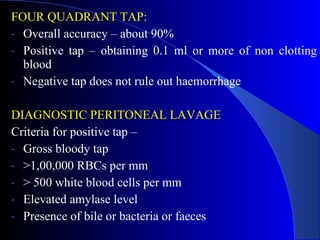
FOUR QUADRANT TAP: Overall accuracy – about 90%  Positive tap – obtaining 0.1 ml or more of non clotting blood  Negative tap does not rule out haemorrhage DIAGNOSTIC PERITONEAL LAVAGE Criteria for positive tap –  Gross bloody tap  >1,00,000 RBCs per mm > 500 white blood cells per mm Elevated amylase level Presence of bile or bacteria or faeces
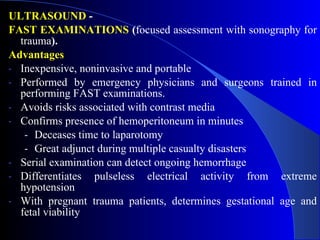
ULTRASOUND  - FAST EXAMINATIONS  ( focused assessment with sonography for trauma ). Advantages Inexpensive, noninvasive and portable  Performed by emergency physicians and surgeons trained in performing FAST examinations. Avoids risks associated with contrast media  Confirms presence of hemoperitoneum in minutes Deceases time to laparotomy Great adjunct during multiple casualty disasters Serial examination can detect ongoing hemorrhage  Differentiates pulseless electrical activity from extreme hypotension With pregnant trauma patients, determines gestational age and fetal viability
Disadvantages - A minimum of 70 ml of intraperitoneal fluid for positive study. Accuracy is dependent on operator / interpreter skill and is decreased with prior abdominal surgery.  Technically difficult with – obese, ileus or subcutaenous emphysema is present  Does not define exact cause of hemoperitoneum  Sensitivity is low for small-bowel and pancreatic injury Sensitivity – 69%-99% Specificity – 86%-98%
Technique - Four basic transducer positions used to find abdominal fluid. Subxiphoied – hemopericardium Right upper abdominal quadrant - fluid in Morrison’s pouch Left upper abdominal quardant –  fluid in perisplenic space  Suprapubic – fluid in Douglas pouch
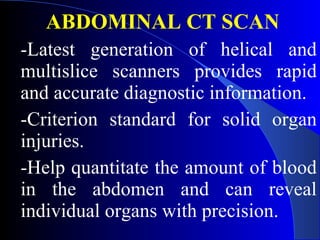
ABDOMINAL CT SCAN -Latest generation of helical and multislice scanners provides rapid and accurate diagnostic information.  -Criterion standard for solid organ injuries. -Help quantitate the amount of blood in the abdomen and can reveal individual organs with precision.
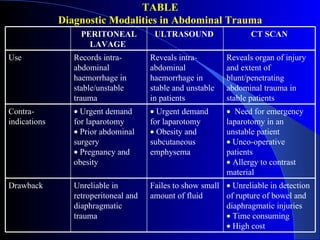
TABLE Diagnostic Modalities in Abdominal Trauma   PERITONEAL LAVAGE  ULTRASOUND  CT SCAN Use Records intra-abdominal haemorrhage in stable/unstable trauma Reveals intra-abdominal haemorrhage in stable and unstable in patients Reveals organ of injury and extent of blunt/penetrating abdominal trauma in stable patients Contra-indications   Urgent demand for laparotomy   Prior abdominal surgery  Pregnancy and obesity  Urgent demand for laparotomy     Obesity and subcutaneous emphysema     Need for emergency laparotomy in an unstable patient     Unco-operative patients   Allergy to contrast material  Drawback Unreliable in retroperitoneal and diaphragmatic trauma Failes to show small amount of fluid    Unreliable in detection of rupture of bowel and diaphragmatic injuries    Time consuming     High cost
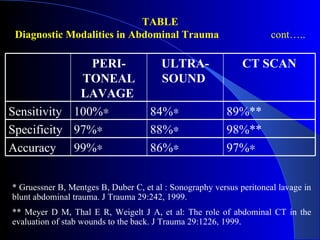
TABLE Diagnostic Modalities in Abdominal Trauma cont….. * Gruessner B, Mentges B, Duber C, et al : Sonography versus peritoneal lavage in blunt abdominal trauma. J Trauma 29:242, 1999. ** Meyer D M, Thal E R, Weigelt J A, et al: The role of abdominal CT in the evaluation of stab wounds to the back. J Trauma 29:1226, 1999. PERI-TONEAL LAVAGE  ULTRA-SOUND  CT SCAN Sensitivity  100%  84%  89%** Specificity  97%  88%  98%** Accuracy  99%  86%  97% 
LAPAROSCOPY Advantages extent of organ injuries and determines the need for laparotomy Defines which intraabdominal injuries may be safely managed nonsurgically More sensitive than DPL or CT in uncovering Diaphragmatic injuries Hollow viscus injuries Surgery can be done in same sitting  With laparoscope with minimal trauma  Open surgery  Sampling for HPR can be taken
Disadvantages: pneumoperitoneum may elevate ICP  General anesthesia usually necessary Patient must be hemodynamically stable Complications: bleeding or injury Gas embolism and pneumoperitoneum LAPAROSCOPY  cont…
LAPAROTOMY INDICATIONS Absolute criteria Peritonitis (gross blood, bile or faeces) Pneumoperitoneum or pneumoretroperitoneum Evidence of diaphragmatic defect Gross blood from stomach or rectum Abdominal distension with hypotension Positive diagnostic test for an injury requiring operative repair
NON OPERATIVE INJURY MANAGEMENT General considerations criteria for non operative management Patient hemodynamically stable after initial resuscitation Continuous patient monitoring for 48 hrs Surgical team immediately available Adequate ICU support and transfusion services available Absence of peritonitis Normal sensorium
NON OPERATIVE INJURY MANAGEMENT - Angioembolization may be alternative to surgical intervention - All patients with solid organ injury managed nonoperatively require admission for observation, serial hematocrit measurement, and repeat imaging
ORGAN INJURIES SOLID ORGANS - Solid organs most commonly injured in blunt traumas In decreasing incidence of injury  Spleen, liver, kidneys, intraperitoneal small bowel, bladder, colon, diaphragm, pancreas and duodenum
HOLLOW VISCERA : duodenum commonly injured  Small bowel injured at relatively fixed areas (duodenojejunal flexure and ileocaecal junction) by shearing force Colon relatively protected.  Gaseous distension of caecum – most vulnerable part as fixed. Stomach rarely injured – compression cause esophagogastric junction bursting
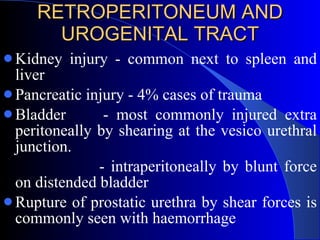
RETROPERITONEUM AND UROGENITAL TRACT Kidney injury - common next to spleen and liver Pancreatic injury - 4% cases of trauma Bladder  - most commonly injured extra peritoneally by shearing at the vesico urethral junction. - intraperitoneally by blunt force on distended bladder Rupture of prostatic urethra by shear forces is commonly seen with haemorrhage
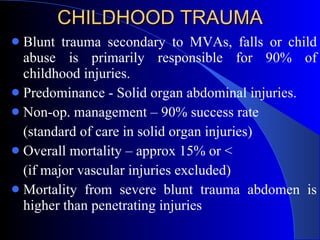
CHILDHOOD TRAUMA Blunt trauma secondary to MVAs, falls or child abuse is primarily responsible for 90% of childhood injuries.  Predominance - Solid organ abdominal injuries. Non-op. management – 90% success rate  (standard of care in solid organ injuries) Overall mortality – approx 15% or < (if major vascular injuries excluded) Mortality from severe blunt trauma abdomen is higher than penetrating injuries
CHILDHOOD TRAUMA  cont… General Principles - Understanding anatomic and physiologic characteristics unique to children. Dose according to bodyweight  Resuscitation - maintenance of ABC (golden hour) IV fluids – intraosseus (if needed) Nasogastric tube insertion Catheterization  Normothermia maintenance
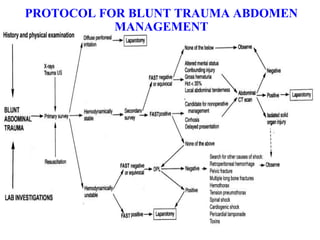
PROTOCOL FOR BLUNT TRAUMA ABDOMEN MANAGEMENT
RECENT TECHNIQUES TRAUMA LAPAROTOMY DAMAGE CONTROL LAPAROTOMY Aim : Control of haemorrhage and limitation of contamination by rapid and temporary means  Technique : Abdominal packing for visceral bleeding  Vascular shunting – major vessel injury  Control of contamination – by stapling guns  Gastrointestinal perforation or pancreatic leakage – by soft clamps or nylon ties
TEMPORARY CLOSURE OF THE ABDOMEN Indication – - Permanent closure not possible due to need for observation – to avoid second look surgery. Techniques - By row of towel clips – quickest method of closure and re-opening  Continuous nylon suture With fascia left wide open in both  Emptied and opened out intravenous fluid bag (‘Bogata bag’) Sutured or stapled to the skin  “ Opsite” covered abdominal pack
Temporary closure of the abdomen using two Opsite sheets.
NEWER TECHNOLOGIES  ROBOTICS – Robot assisted surgeries  (eg. In microsurgical techniques – eliminate hand tremors) Trainer robots - (eg. Eagle trauma patient simulator) INFORMATION TEHCNOLOGY Establishment of city emergency medical system (EMS) with personal status monitor (PSM), vehicle status monitor (VSM), global positioning satellite (GPS), and wireless local area network (LAN).
CONCLUSION Controversies regarding management still exist b/c of varied presentation. Close supervision with sophisticated infrastructure and quick action significantly reduces mortality. Establishment of trauma centres with persons of different specialties working together as a team.
THANK YOU

Blunt trauma abdomen

  • 1.
    BLUNT TRAUMA ABDOMEN (OPERATIVE v/s CONSERVATIVE MANAGEMENT) Dr.Anil Haripriya
  • 2.
    INTRODUCTION Motor vehicleaccidents are responsible for 75% of all blunt trauma abdominal injuries More common in elderly due to less resilience. Blunt injuries causes solid organ trauma (spleen, liver and kidneys) more often than hollow viscera. Multi organ injury and multiple system injury are also more common in blunt injury than in other types.
  • 3.
    MECHANISMS OF INJURYCRUSHING Direct application of a blunt force to the abdomen SHEARING Sudden decelerations apply a shearing force across organs with fixed attachments BURSTING Raised intraluminal pressure by abdominal compression accurately in hollow organs can lead to rupture PENETRATION Disruption of bony areas by blunt trauma may generate bony spicules that can cause secondary penetrating injury
  • 4.
    PRESENTATION Varies widelyfrom haemodynamic stability with minimal abdominal signs to complete cardiovascular collapse and may change from one to the other with alarming rapidity
  • 5.
    INITIAL ASSESSMENT Whetherthe patient is haemodynamically stable unstable FIRST PRIORITIES PROTOCOL : Brief clinical examination to evaluate ABC along with cardiovascular status with blood pressure and pulse measurement . Accordingly, resuscitation and management of shock by maintenance of ABC IV fluids nasogastric tube insertion Catheterization
  • 6.
    SECOND PRIORITIES PROTOCOLPhysical examination Base line investigations Four quadrant tap Diagnostic peritoneal lavage (DPL) Ultrasound – FAST (focus assessment with sonography for trauma) Abdominal CT scan Diagnostic laparoscopy Laparotomy
  • 7.
    HISTORY AND PHYSICALEXAMINATION HISTORY : To know injury mechanism (mode of injury) – to anticipate injury patterns and raise the index of suspicion for occult injury Events preceding the injury General principles : - Serial examinations by the same examiner improves sensitivity - Spinal cord injury masks clinical findings - Tenderness blunted by intoxicants
  • 8.
    PHYSICAL EXAMINATION GeneralExamination : relating to hemodynamic stability Abdominal findings : Inspection : for abdominal distension for contusions or abrasions lap belt ecchymosis – mesenteric, bowel, and lumbar spine injuries periumblical (Cullen sign) and flank (Grey Turner Sign) ecchymosis – retroperitoneal haematoma
  • 9.
    - Palpation : for tenderness, guarding and/or rigidity, rebound tenderness – hemoperitoneum Percussion : Dullness/ shifting dullness – intrabdominal collection Auscultation : +/- nce of bowel sounds PHYSICAL EXAMINATION cont.
  • 10.
    The classical ‘seatbelt’sign. The bruising on the left breast is from the shoulder belt and the low bruising to the abdominal wall is from the lapbelt.
  • 11.
    Rectal findings Checkfor gross blood - pelvic fracture Determine prostate position – high riding prostate – urethral injury Assess sphincter tone – neurologic status Distal pulses Assess for absence or asymmetry Assessment of other associated injuries i.e. multiple fractures, spinal injuries etc. PHYSICAL EXAMINATION cont..
  • 12.
    DIAGNOSTIC STRATEGY INVESTIGATIONS – Aim To identify To decide When (those with injury) (which ones (how quickly need laparotomy) this must be undertaken)
  • 13.
    DIAGNOSTIC STRATEGY cont.. BASIC DATA Complete haemogram with hematocrit, ABG, Electrocardiogram Renal function tests Urine analysis – +nce of hematuria – genito urinary injury -nce of hematuria – does not rule out it Serum amylase / lipase or liver enzymes -  se -suspicion of intraabdominal injuries
  • 14.
    DIAGNOSTIC STRATEGY cont…Chest radiograph – Pneumothorax/hemothorax Raised left/right hemidiaphragm – perisplenic/hepatic hematoma. Lower ribs fracture – liver/spleen injury. Abdominal contents in the chest – ruptured hemidiaphragm Abdominal radiographs – Pneumoperitoneum – perforation of hollow viscus Ground glass appearance – massive hemoperitoneum
  • 15.
    DIAGNOSTIC STRATEGY Abd.Radiograph cont… Dilated gut loops- retroperitoneal hematoma or injury Retroperitoneal air outlining the right kidney – duodenal injury Double wall sign – air inside and outside the bowel Distortion or enlargement of outlines of viscera – hematoma in relation to respective organs
  • 16.
    DIAGNOSTIC STRATEGY cont…Abd. Radiograph cont… Medial displacement of stomach – splenic hematoma Obliteration of Psoas shadow – retroperitoneal bleeding Pelvic bone fracture – bladder/urethral/rectal injury Fracture vertebra – ureter injury / retroperitoneal hematoma
  • 17.
    INDICATIONS FOR FURTHERTESTING Unexplained haemorrhagic shock Major chest or pelvic injuries Abdominal tenderness Diminished pain response due to Intoxication Depressed level of consciousness Distracting pain Paralysis Inability to perform serial examination
  • 18.
    FOUR QUADRANT TAP:Overall accuracy – about 90% Positive tap – obtaining 0.1 ml or more of non clotting blood Negative tap does not rule out haemorrhage DIAGNOSTIC PERITONEAL LAVAGE Criteria for positive tap – Gross bloody tap >1,00,000 RBCs per mm > 500 white blood cells per mm Elevated amylase level Presence of bile or bacteria or faeces
  • 19.
    ULTRASOUND -FAST EXAMINATIONS ( focused assessment with sonography for trauma ). Advantages Inexpensive, noninvasive and portable Performed by emergency physicians and surgeons trained in performing FAST examinations. Avoids risks associated with contrast media Confirms presence of hemoperitoneum in minutes Deceases time to laparotomy Great adjunct during multiple casualty disasters Serial examination can detect ongoing hemorrhage Differentiates pulseless electrical activity from extreme hypotension With pregnant trauma patients, determines gestational age and fetal viability
  • 20.
    Disadvantages - Aminimum of 70 ml of intraperitoneal fluid for positive study. Accuracy is dependent on operator / interpreter skill and is decreased with prior abdominal surgery. Technically difficult with – obese, ileus or subcutaenous emphysema is present Does not define exact cause of hemoperitoneum Sensitivity is low for small-bowel and pancreatic injury Sensitivity – 69%-99% Specificity – 86%-98%
  • 21.
    Technique - Fourbasic transducer positions used to find abdominal fluid. Subxiphoied – hemopericardium Right upper abdominal quadrant - fluid in Morrison’s pouch Left upper abdominal quardant – fluid in perisplenic space Suprapubic – fluid in Douglas pouch
  • 22.
    ABDOMINAL CT SCAN-Latest generation of helical and multislice scanners provides rapid and accurate diagnostic information. -Criterion standard for solid organ injuries. -Help quantitate the amount of blood in the abdomen and can reveal individual organs with precision.
  • 23.
    TABLE Diagnostic Modalitiesin Abdominal Trauma   PERITONEAL LAVAGE ULTRASOUND CT SCAN Use Records intra-abdominal haemorrhage in stable/unstable trauma Reveals intra-abdominal haemorrhage in stable and unstable in patients Reveals organ of injury and extent of blunt/penetrating abdominal trauma in stable patients Contra-indications  Urgent demand for laparotomy  Prior abdominal surgery  Pregnancy and obesity  Urgent demand for laparotomy  Obesity and subcutaneous emphysema  Need for emergency laparotomy in an unstable patient    Unco-operative patients  Allergy to contrast material Drawback Unreliable in retroperitoneal and diaphragmatic trauma Failes to show small amount of fluid  Unreliable in detection of rupture of bowel and diaphragmatic injuries    Time consuming    High cost
  • 24.
    TABLE Diagnostic Modalitiesin Abdominal Trauma cont….. * Gruessner B, Mentges B, Duber C, et al : Sonography versus peritoneal lavage in blunt abdominal trauma. J Trauma 29:242, 1999. ** Meyer D M, Thal E R, Weigelt J A, et al: The role of abdominal CT in the evaluation of stab wounds to the back. J Trauma 29:1226, 1999. PERI-TONEAL LAVAGE ULTRA-SOUND CT SCAN Sensitivity 100%  84%  89%** Specificity 97%  88%  98%** Accuracy 99%  86%  97% 
  • 25.
    LAPAROSCOPY Advantages extentof organ injuries and determines the need for laparotomy Defines which intraabdominal injuries may be safely managed nonsurgically More sensitive than DPL or CT in uncovering Diaphragmatic injuries Hollow viscus injuries Surgery can be done in same sitting With laparoscope with minimal trauma Open surgery Sampling for HPR can be taken
  • 26.
    Disadvantages: pneumoperitoneum mayelevate ICP General anesthesia usually necessary Patient must be hemodynamically stable Complications: bleeding or injury Gas embolism and pneumoperitoneum LAPAROSCOPY cont…
  • 27.
    LAPAROTOMY INDICATIONS Absolutecriteria Peritonitis (gross blood, bile or faeces) Pneumoperitoneum or pneumoretroperitoneum Evidence of diaphragmatic defect Gross blood from stomach or rectum Abdominal distension with hypotension Positive diagnostic test for an injury requiring operative repair
  • 28.
    NON OPERATIVE INJURYMANAGEMENT General considerations criteria for non operative management Patient hemodynamically stable after initial resuscitation Continuous patient monitoring for 48 hrs Surgical team immediately available Adequate ICU support and transfusion services available Absence of peritonitis Normal sensorium
  • 29.
    NON OPERATIVE INJURYMANAGEMENT - Angioembolization may be alternative to surgical intervention - All patients with solid organ injury managed nonoperatively require admission for observation, serial hematocrit measurement, and repeat imaging
  • 30.
    ORGAN INJURIES SOLIDORGANS - Solid organs most commonly injured in blunt traumas In decreasing incidence of injury Spleen, liver, kidneys, intraperitoneal small bowel, bladder, colon, diaphragm, pancreas and duodenum
  • 31.
    HOLLOW VISCERA :duodenum commonly injured Small bowel injured at relatively fixed areas (duodenojejunal flexure and ileocaecal junction) by shearing force Colon relatively protected. Gaseous distension of caecum – most vulnerable part as fixed. Stomach rarely injured – compression cause esophagogastric junction bursting
  • 32.
    RETROPERITONEUM AND UROGENITALTRACT Kidney injury - common next to spleen and liver Pancreatic injury - 4% cases of trauma Bladder - most commonly injured extra peritoneally by shearing at the vesico urethral junction. - intraperitoneally by blunt force on distended bladder Rupture of prostatic urethra by shear forces is commonly seen with haemorrhage
  • 33.
    CHILDHOOD TRAUMA Blunttrauma secondary to MVAs, falls or child abuse is primarily responsible for 90% of childhood injuries. Predominance - Solid organ abdominal injuries. Non-op. management – 90% success rate (standard of care in solid organ injuries) Overall mortality – approx 15% or < (if major vascular injuries excluded) Mortality from severe blunt trauma abdomen is higher than penetrating injuries
  • 34.
    CHILDHOOD TRAUMA cont… General Principles - Understanding anatomic and physiologic characteristics unique to children. Dose according to bodyweight Resuscitation - maintenance of ABC (golden hour) IV fluids – intraosseus (if needed) Nasogastric tube insertion Catheterization Normothermia maintenance
  • 35.
    PROTOCOL FOR BLUNTTRAUMA ABDOMEN MANAGEMENT
  • 36.
    RECENT TECHNIQUES TRAUMALAPAROTOMY DAMAGE CONTROL LAPAROTOMY Aim : Control of haemorrhage and limitation of contamination by rapid and temporary means Technique : Abdominal packing for visceral bleeding Vascular shunting – major vessel injury Control of contamination – by stapling guns Gastrointestinal perforation or pancreatic leakage – by soft clamps or nylon ties
  • 37.
    TEMPORARY CLOSURE OFTHE ABDOMEN Indication – - Permanent closure not possible due to need for observation – to avoid second look surgery. Techniques - By row of towel clips – quickest method of closure and re-opening Continuous nylon suture With fascia left wide open in both Emptied and opened out intravenous fluid bag (‘Bogata bag’) Sutured or stapled to the skin “ Opsite” covered abdominal pack
  • 38.
    Temporary closure ofthe abdomen using two Opsite sheets.
  • 39.
    NEWER TECHNOLOGIES ROBOTICS – Robot assisted surgeries (eg. In microsurgical techniques – eliminate hand tremors) Trainer robots - (eg. Eagle trauma patient simulator) INFORMATION TEHCNOLOGY Establishment of city emergency medical system (EMS) with personal status monitor (PSM), vehicle status monitor (VSM), global positioning satellite (GPS), and wireless local area network (LAN).
  • 40.
    CONCLUSION Controversies regardingmanagement still exist b/c of varied presentation. Close supervision with sophisticated infrastructure and quick action significantly reduces mortality. Establishment of trauma centres with persons of different specialties working together as a team.
  • 41.