By
Professor of General Surgery
Faculty of Medicine Ain Shams University
Abdominal Trauma
Abdominal injury is a contributing factor in 20
% of trauma related deaths either: - early from
exsanguinating hemorrhage or late from bowel
injury, subsequent sepsis or multiple organ
failure.
Abdominal injury frequently occurs as part of
multiple injuries, therefore, priority
consideration issues become paramount in its
management and represents a challenging
dilemma for the surgeons.
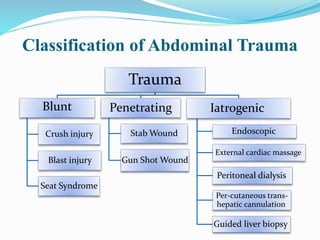
Classification of Abdominal Trauma
Trauma
Blunt
Crush injury
Blast injury
Seat Syndrome
Penetrating
Stab Wound
Gun Shot Wound
Iatrogenic
Endoscopic
External cardiac massage
Peritoneal dialysis
Per-cutaneous trans-
hepatic cannulation
Guided liver biopsy
Clinical presentation
 It varies widely, as abdominal injury may be isolated or
part of multisystem trauma. In addition the presentation
may be complicated by the patient’s level of
consciousness, hemodynamic status and other discharging
injuries.
 Abdominal signs vary : from acute abdomen with frank
peritonitis or marked distention, through the subtle seat
belt sign, to a minimal abdominal tenderness, often bound
with intra-peritoneal bleeding.
 Thus physical assessment may add scanty information and
its vital to have a high index of suspicion and a low
threshold for directed investigation.
Management of Abdominal Trauma
Diagnosis : -
1. A.M.P.L.E. History taking.
2. Initial resuscitation and ABC Trauma
protocol .
3. Secondary survey with follows thorough
physical assessment.
4. Appropriately directed investigations.
1. History taking
A : Allergy
M: Medicine
P: Previous illness and operations
L: Last meal
E: Events preceding injury and relevant
info from the scene of accident: - steer
wheel compression, seat belt, vehicle
damage…..etc.
2. Resuscitation
The ABC of emergency with airway,
breathing, and circulation including
primary survey for abdomen as a source
of occult bleeding.
Blood samples are drawn for basic study
for later comparison and for blood typing
and cross matching and ABG.
3. Secondary survey
 The key objective of physical diagnosis of
abdominal injury is to identify the need for
operation rather than the precise determination of
organ injury.
 Physical examination should proceed in an orderly
fashion and patient should be evaluated for: -
A. Penetrating wounds: -
Marked with radio-opaque clips and subsequent x-
ray to delineate the path of bullet or knife giving
idea about the possible organs injured.
B. Blunt trauma: -
 Abrasion, seat belt sign, ecchymosis, are warning of
significant intra abdominal injury.
 Posterior ecchymosis raises the possibility of
retroperitoneal injury.
 Patient respiratory pattern:
• Halted labored in diaphragmatic irritation.
• Left shoulder pain (kher’s sign) in splenic
hemorrhage.
 Palpation: trying to elicit signs.
 Inspection of perineum and urethral meatus for
blood pelvic fracture.
Insertion of indwelling Foly’s catheter. Urine sample
sent for analysis and monitor of UOP. Yet it should be
delayed if suspected urethral injury until ruling it out.
P/R : -
• Integrity of the rectum, injured by fracture pelvic.
• Position of the prostate, indicates urethral injury.
• Gross or occult blood, laceration and bleeding
• Sphincter tone, relaxed in spinal injury.
NGT: - acute gastric dilatation and assessment of
presence of blood.
4. Appropriately directed Investigations
A. Baseline labs + blood typing and cross match.
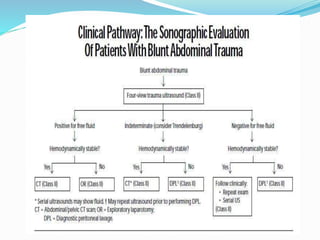
B. FAST
C. DPL
D. CT
E. Laparoscopy
A- Baseline labs
 They add little value in ruling out the need for surgical
intervention yet they are mainly used for later on
comparison.
1. HB : - quantity of blood to replace.
2. HCT : - confirm massive Hg (6-12 hrs).
3. WBCs : - indicate sepsis or reactive leucocytosis.
4. Serum createnin: - pre-renal shut down.
5. Glucose and electrolytes: - proper fluid resuscitation.
6. Amylase: - gut injury or pancreas (non-specific).
7. Urine analysis: - if RBCs >30 – 50 /mm, radiographic
evaluation of kidneys and urinary bladder is a must.
B- FAST (Focused Abdominal Sonographic Testing)
 It is a standard approach to abdominal trauma which
aims at identifying free fluid in peritoneal cavity rather
than specific inquiries and it includes assessment of: -
1. Right upper Quadrant.
2. Left upper Quadrant.
3. Pelvis
4. Pericardial window to assess for pericardial effusion.
 Sensitivity is 93%. Specificity is 98%.
 Applications: -
1. Mainly in blunt trauma.
2. Limited value in penetrating trauma as the least amount of
blood detected by sonar is 100 cc, which restrict its
sensitivity.
B- FAST (cont.)
 Advantages: -
1. Fast and non-invasive.
2. Bedside.
3. Portable
 Disadvantages: -
1. Operator dependent.
2. Limited by surgical emphysema and obesity.
It must be clear that in a hemodynamically stable
patient a positive FAST per se doesn’t indicate the
need for surgical exploration.
C- Diagnostic peritoneal lavage (DPL)
 It has been the golden standard for the investigation of
blunt abdominal injury for more than 30 years. Its
accuracy is 97.3%. False-positive rate is 1.4%. False-
negative rate is 1.3%.
 DPL is considered positive if: -
1. Return of 10 ml of non-clotting blood on insertion.
2. Lavage count of 100 000 red cells per mm (RCC).
3. 500 white cells per mm.
4. Amylase greater than 200 IU.
5. Presence of bile, faeces, bacteria.
C- Diagnostic peritoneal lavage (DPL) (cont.)
 Indications: -
1. Unconscious trauma patient with signs of abdominal
injury.
2. Patient with suspected intra-abdominal injury and
equivocal physical findings.
3. Patients with muitple injuries and unexplained
shock.
4. Patients with spinal cord injury.
5. Intoxicated patients in whome abdominal injury is
suspected.
C- Diagnostic peritoneal lavage (DPL) (cont.)
 Disadvantages: -
The most frequent criticism is the rate of non-
therapeutic laparotomy performed for positive cell
count due to the balance between false-negative results
and over sensitivity. Its various estimation is 10 - 15 %.
It does not allow conservation management in the presence
of blood in the abdominal cavity, but CT may be used as
an adjunct in the stable patients.
C- Diagnostic peritoneal lavage (DPL) (cont.)
 Contraindications: -
1. Patients with previous abdominal operations.
2. Pregnancy.
3. Morbid obesity.
4. Patients with frank surgical abdomen.
 Complications: -
1. Gut perforation.
2. Hemorrhage.
3. Infection.
D- Computed Tomography
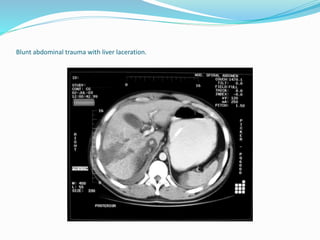
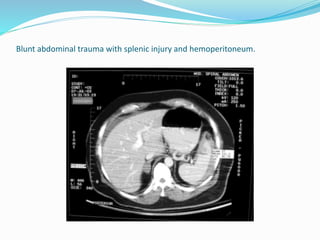
It is strictly off-limits to unstable patients.
However, in patients who are
cardiovasculary normal following
resuscitation CT is the investigation of
choice especially the spiral CT with IV
contrast.
It can comment also on retroperitoneal
structures.
Blunt abdominal trauma. Right kidney injury with blood in perirenal space. Injury resulted from
high-speed motor vehicle collision
Blunt abdominal trauma with liver laceration.
Blunt abdominal trauma with splenic injury and hemoperitoneum.
E- laparoscopy
It is relatively a new investigation wit
an evolving role. It is 97% accurate in
blunt abdominal trauma.
Disadvantages:-
1. Availability and cost.
2. Requires GA
3. Insensitivity to hollow viscus
perforation.
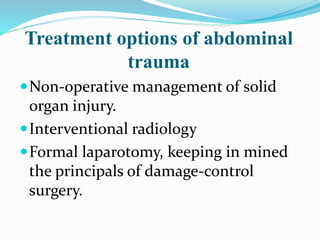
Treatment options of abdominal
trauma
Non-operative management of solid
organ injury.
Interventional radiology
Formal laparotomy, keeping in mined
the principals of damage-control
surgery.
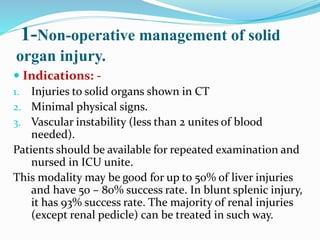
1-Non-operative management of solid
organ injury.
 Indications: -
1. Injuries to solid organs shown in CT
2. Minimal physical signs.
3. Vascular instability (less than 2 unites of blood
needed).
Patients should be available for repeated examination and
nursed in ICU unite.
This modality may be good for up to 50% of liver injuries
and have 50 – 80% success rate. In blunt splenic injury,
it has 93% success rate. The majority of renal injuries
(except renal pedicle) can be treated in such way.
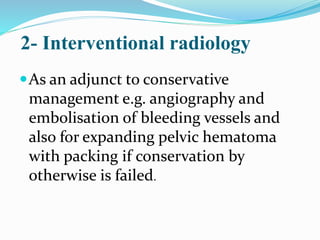
2- Interventional radiology
As an adjunct to conservative
management e.g. angiography and
embolisation of bleeding vessels and
also for expanding pelvic hematoma
with packing if conservation by
otherwise is failed.
3-Laparotomy
Indications: -
1. Unstable patients with signs of intra-
abdominal trauma.
2. Positive DPL or FAST in unstable patients.
3. Positive finding in CT unsuitable for non-
operative management.
4. Peritoneal penetrating stab wound.
5. Gunshot wound to the abdomen.
6. Evisceration or retained foreign body.
The principals of damage control
surgery are: -
1. Control hemorrhage, hypothermia and
acidosis with the least possible procedures
2. Prevention of contamination by rapid
closure of source of sepsis.
3. Avoid further injury.
4. Avoid abdominal compartment syndrom.
Abdominal compartment syndrome
 It is due to massive intestinal edema often
following laparotomy for major trauma with
prolonged shock, as a result of crystalloid
resuscitations, capillary lesions, activated
inflammatory mediators, and reperfusion
injury combined with retro-peritoneal
hematomas and intra-abdominal packing.
 Intra-abdominal pressure may rise to a level
more than 25 cm h2o leading to significant
cardiovascular, and respiratory, renal and
cerebral dysfunction.
Abdominal compartment syndrome (cont.)
 Cardiovascular dysfunction: -
Fall in the cardiac output due mainly to compression of the inferior
vena cava and reduction in venous return to the heart.
 Respiratory dysfunction: -
Split the diaphragm and rise in peak airway pressure and intra-
thoracic pressure that subsequently reduce venous return to the
heart.
 Renal dysfunction: -
Oliguria and anuria probably due to compression of the renal vein
and renal parenchyma.
 Cerebral dysfunction: -
The rise in intra-abdominal and intra-thoracic pressure lead to rise
in central venous pressure which prevent adequate venous
drainage from the brain and rise of the intra-cranial pressure
and worsening of intra-cerebral edema.
Diagnosis of Abdominal Compartment
Syndrome
 Diagnosis can be confirmed by measuring the
intra-abdominal pressure either through a foly’s
catheter in the bladder or a naso-gastric tube
in the stomach.
 It is possible to connect a pressure transducer to
a foly’s catheter. The normal intra-abdominal
pressure is zero or sub-atmospheric. A pressure
of over 25 cm H2O is suggestive and over 30 cm
H2O is diagnostic of abdominal compartment
syndrome.
Management of Abdominal Compartment
Syndrome
 The easiest method to control the open
abdomen is to use a silo-bag closure. A
three-liter plastic irrigation bag is emptied
and cut open so it lies flat. The edges are
trimmed and sutured to the skin away from
the skin edges using a continuous 1 silk
suture. It is useful to place a sterile
absorbent drape inside the abdomen to soak
up some of the fluid and ease control of the
laparotomy.
Management of Abdominal Compartment
Syndrome (cont.)
An alternative technique is “vacuum
pack” technique:
The 3 liter bag is opened and placed into the
abdomen to protect the gut contents under the
sheath. Two large caliber suction drains are
placed over this , and a large adherent
steridrape is placed over the whole abdomen.
The suction catheters are connected to a high-
displacement suction to provide control of fluid
loss and create the “vacuum pack” effect.
Sudden release of the abdominal
compartment syndrome may lead to an
ischemia-reperfusion injury causing
acidosis, vasodilatation, cardiac
dysfunction and arrest. Prior to release,
patient should be pre-loaded with
crystalloid solution. Mannitol and
vasodilators such as dobutamine or
phosphodiesterase inhibitors may have
a place here.
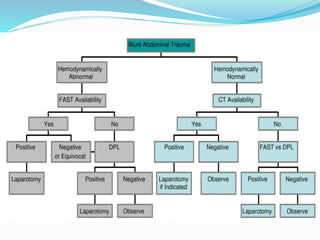
Abdominal trauma, an outlined management

Abdominal trauma, an outlined management

  • 1.
    By Professor of GeneralSurgery Faculty of Medicine Ain Shams University
  • 2.
    Abdominal Trauma Abdominal injuryis a contributing factor in 20 % of trauma related deaths either: - early from exsanguinating hemorrhage or late from bowel injury, subsequent sepsis or multiple organ failure. Abdominal injury frequently occurs as part of multiple injuries, therefore, priority consideration issues become paramount in its management and represents a challenging dilemma for the surgeons.
  • 3.
    Classification of AbdominalTrauma Trauma Blunt Crush injury Blast injury Seat Syndrome Penetrating Stab Wound Gun Shot Wound Iatrogenic Endoscopic External cardiac massage Peritoneal dialysis Per-cutaneous trans- hepatic cannulation Guided liver biopsy
  • 4.
    Clinical presentation  Itvaries widely, as abdominal injury may be isolated or part of multisystem trauma. In addition the presentation may be complicated by the patient’s level of consciousness, hemodynamic status and other discharging injuries.  Abdominal signs vary : from acute abdomen with frank peritonitis or marked distention, through the subtle seat belt sign, to a minimal abdominal tenderness, often bound with intra-peritoneal bleeding.  Thus physical assessment may add scanty information and its vital to have a high index of suspicion and a low threshold for directed investigation.
  • 5.
    Management of AbdominalTrauma Diagnosis : - 1. A.M.P.L.E. History taking. 2. Initial resuscitation and ABC Trauma protocol . 3. Secondary survey with follows thorough physical assessment. 4. Appropriately directed investigations.
  • 6.
    1. History taking A: Allergy M: Medicine P: Previous illness and operations L: Last meal E: Events preceding injury and relevant info from the scene of accident: - steer wheel compression, seat belt, vehicle damage…..etc.
  • 7.
    2. Resuscitation The ABCof emergency with airway, breathing, and circulation including primary survey for abdomen as a source of occult bleeding. Blood samples are drawn for basic study for later comparison and for blood typing and cross matching and ABG.
  • 8.
    3. Secondary survey The key objective of physical diagnosis of abdominal injury is to identify the need for operation rather than the precise determination of organ injury.  Physical examination should proceed in an orderly fashion and patient should be evaluated for: - A. Penetrating wounds: - Marked with radio-opaque clips and subsequent x- ray to delineate the path of bullet or knife giving idea about the possible organs injured.
  • 9.
    B. Blunt trauma:-  Abrasion, seat belt sign, ecchymosis, are warning of significant intra abdominal injury.  Posterior ecchymosis raises the possibility of retroperitoneal injury.  Patient respiratory pattern: • Halted labored in diaphragmatic irritation. • Left shoulder pain (kher’s sign) in splenic hemorrhage.  Palpation: trying to elicit signs.  Inspection of perineum and urethral meatus for blood pelvic fracture.
  • 10.
    Insertion of indwellingFoly’s catheter. Urine sample sent for analysis and monitor of UOP. Yet it should be delayed if suspected urethral injury until ruling it out. P/R : - • Integrity of the rectum, injured by fracture pelvic. • Position of the prostate, indicates urethral injury. • Gross or occult blood, laceration and bleeding • Sphincter tone, relaxed in spinal injury. NGT: - acute gastric dilatation and assessment of presence of blood.
  • 11.
    4. Appropriately directedInvestigations A. Baseline labs + blood typing and cross match. B. FAST C. DPL D. CT E. Laparoscopy
  • 12.
    A- Baseline labs They add little value in ruling out the need for surgical intervention yet they are mainly used for later on comparison. 1. HB : - quantity of blood to replace. 2. HCT : - confirm massive Hg (6-12 hrs). 3. WBCs : - indicate sepsis or reactive leucocytosis. 4. Serum createnin: - pre-renal shut down. 5. Glucose and electrolytes: - proper fluid resuscitation. 6. Amylase: - gut injury or pancreas (non-specific). 7. Urine analysis: - if RBCs >30 – 50 /mm, radiographic evaluation of kidneys and urinary bladder is a must.
  • 13.
    B- FAST (FocusedAbdominal Sonographic Testing)  It is a standard approach to abdominal trauma which aims at identifying free fluid in peritoneal cavity rather than specific inquiries and it includes assessment of: - 1. Right upper Quadrant. 2. Left upper Quadrant. 3. Pelvis 4. Pericardial window to assess for pericardial effusion.  Sensitivity is 93%. Specificity is 98%.  Applications: - 1. Mainly in blunt trauma. 2. Limited value in penetrating trauma as the least amount of blood detected by sonar is 100 cc, which restrict its sensitivity.
  • 14.
    B- FAST (cont.) Advantages: - 1. Fast and non-invasive. 2. Bedside. 3. Portable  Disadvantages: - 1. Operator dependent. 2. Limited by surgical emphysema and obesity. It must be clear that in a hemodynamically stable patient a positive FAST per se doesn’t indicate the need for surgical exploration.
  • 16.
    C- Diagnostic peritoneallavage (DPL)  It has been the golden standard for the investigation of blunt abdominal injury for more than 30 years. Its accuracy is 97.3%. False-positive rate is 1.4%. False- negative rate is 1.3%.  DPL is considered positive if: - 1. Return of 10 ml of non-clotting blood on insertion. 2. Lavage count of 100 000 red cells per mm (RCC). 3. 500 white cells per mm. 4. Amylase greater than 200 IU. 5. Presence of bile, faeces, bacteria.
  • 17.
    C- Diagnostic peritoneallavage (DPL) (cont.)  Indications: - 1. Unconscious trauma patient with signs of abdominal injury. 2. Patient with suspected intra-abdominal injury and equivocal physical findings. 3. Patients with muitple injuries and unexplained shock. 4. Patients with spinal cord injury. 5. Intoxicated patients in whome abdominal injury is suspected.

  • 18.
    C- Diagnostic peritoneallavage (DPL) (cont.)  Disadvantages: - The most frequent criticism is the rate of non- therapeutic laparotomy performed for positive cell count due to the balance between false-negative results and over sensitivity. Its various estimation is 10 - 15 %. It does not allow conservation management in the presence of blood in the abdominal cavity, but CT may be used as an adjunct in the stable patients.
  • 19.
    C- Diagnostic peritoneallavage (DPL) (cont.)  Contraindications: - 1. Patients with previous abdominal operations. 2. Pregnancy. 3. Morbid obesity. 4. Patients with frank surgical abdomen.  Complications: - 1. Gut perforation. 2. Hemorrhage. 3. Infection.
  • 20.
    D- Computed Tomography Itis strictly off-limits to unstable patients. However, in patients who are cardiovasculary normal following resuscitation CT is the investigation of choice especially the spiral CT with IV contrast. It can comment also on retroperitoneal structures.
  • 21.
    Blunt abdominal trauma.Right kidney injury with blood in perirenal space. Injury resulted from high-speed motor vehicle collision
  • 22.
    Blunt abdominal traumawith liver laceration.
  • 23.
    Blunt abdominal traumawith splenic injury and hemoperitoneum.
  • 24.
    E- laparoscopy It isrelatively a new investigation wit an evolving role. It is 97% accurate in blunt abdominal trauma. Disadvantages:- 1. Availability and cost. 2. Requires GA 3. Insensitivity to hollow viscus perforation.
  • 26.
    Treatment options ofabdominal trauma Non-operative management of solid organ injury. Interventional radiology Formal laparotomy, keeping in mined the principals of damage-control surgery.
  • 27.
    1-Non-operative management ofsolid organ injury.  Indications: - 1. Injuries to solid organs shown in CT 2. Minimal physical signs. 3. Vascular instability (less than 2 unites of blood needed). Patients should be available for repeated examination and nursed in ICU unite. This modality may be good for up to 50% of liver injuries and have 50 – 80% success rate. In blunt splenic injury, it has 93% success rate. The majority of renal injuries (except renal pedicle) can be treated in such way.
  • 28.
    2- Interventional radiology Asan adjunct to conservative management e.g. angiography and embolisation of bleeding vessels and also for expanding pelvic hematoma with packing if conservation by otherwise is failed.
  • 29.
    3-Laparotomy Indications: - 1. Unstablepatients with signs of intra- abdominal trauma. 2. Positive DPL or FAST in unstable patients. 3. Positive finding in CT unsuitable for non- operative management. 4. Peritoneal penetrating stab wound. 5. Gunshot wound to the abdomen. 6. Evisceration or retained foreign body.
  • 30.
    The principals ofdamage control surgery are: - 1. Control hemorrhage, hypothermia and acidosis with the least possible procedures 2. Prevention of contamination by rapid closure of source of sepsis. 3. Avoid further injury. 4. Avoid abdominal compartment syndrom.
  • 31.
    Abdominal compartment syndrome It is due to massive intestinal edema often following laparotomy for major trauma with prolonged shock, as a result of crystalloid resuscitations, capillary lesions, activated inflammatory mediators, and reperfusion injury combined with retro-peritoneal hematomas and intra-abdominal packing.  Intra-abdominal pressure may rise to a level more than 25 cm h2o leading to significant cardiovascular, and respiratory, renal and cerebral dysfunction.
  • 32.
    Abdominal compartment syndrome(cont.)  Cardiovascular dysfunction: - Fall in the cardiac output due mainly to compression of the inferior vena cava and reduction in venous return to the heart.  Respiratory dysfunction: - Split the diaphragm and rise in peak airway pressure and intra- thoracic pressure that subsequently reduce venous return to the heart.  Renal dysfunction: - Oliguria and anuria probably due to compression of the renal vein and renal parenchyma.  Cerebral dysfunction: - The rise in intra-abdominal and intra-thoracic pressure lead to rise in central venous pressure which prevent adequate venous drainage from the brain and rise of the intra-cranial pressure and worsening of intra-cerebral edema.
  • 33.
    Diagnosis of AbdominalCompartment Syndrome  Diagnosis can be confirmed by measuring the intra-abdominal pressure either through a foly’s catheter in the bladder or a naso-gastric tube in the stomach.  It is possible to connect a pressure transducer to a foly’s catheter. The normal intra-abdominal pressure is zero or sub-atmospheric. A pressure of over 25 cm H2O is suggestive and over 30 cm H2O is diagnostic of abdominal compartment syndrome.
  • 34.
    Management of AbdominalCompartment Syndrome  The easiest method to control the open abdomen is to use a silo-bag closure. A three-liter plastic irrigation bag is emptied and cut open so it lies flat. The edges are trimmed and sutured to the skin away from the skin edges using a continuous 1 silk suture. It is useful to place a sterile absorbent drape inside the abdomen to soak up some of the fluid and ease control of the laparotomy.
  • 35.
    Management of AbdominalCompartment Syndrome (cont.) An alternative technique is “vacuum pack” technique: The 3 liter bag is opened and placed into the abdomen to protect the gut contents under the sheath. Two large caliber suction drains are placed over this , and a large adherent steridrape is placed over the whole abdomen. The suction catheters are connected to a high- displacement suction to provide control of fluid loss and create the “vacuum pack” effect.
  • 36.
    Sudden release ofthe abdominal compartment syndrome may lead to an ischemia-reperfusion injury causing acidosis, vasodilatation, cardiac dysfunction and arrest. Prior to release, patient should be pre-loaded with crystalloid solution. Mannitol and vasodilators such as dobutamine or phosphodiesterase inhibitors may have a place here.