Bloom’s Taxonomya presentation by Sherry TauferEDUC  522 Professor Jeff McKendricks
A BIT OF HISTORY
Affective – emotional reactions; personal value impact3 Domains
Affective – emotional reactions; personal value impactPsychomotor – voluntary muscle control, ability to manipulate tools or instruments3 Domains
Affective – emotional reactions; personal value impactPsychomotor – voluntary muscle control, ability to manipulate tools or instrumentsCognitive – knowledge, comprehension and thinking skills3 Domains
Affective – emotional reactions; personal value impactPsychomotor – voluntary muscle control, ability to manipulate tools or instrumentsCognitive – knowledge, comprehension and thinking skills3 Domains“In real life, of course, behaviors from these three domains occur simultaneously.  While students are writing (psychomotor), they are also remembering or reasoning (cognitive), and they are likely to have some emotional response to the task as well (affective),” (Woolfolk, 2010).
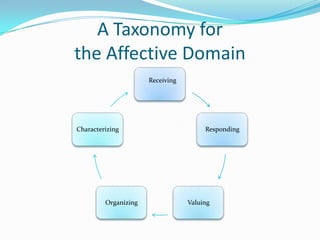
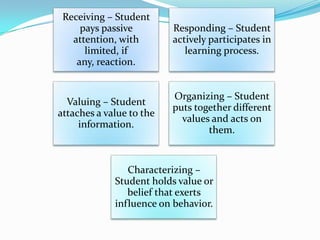
A Taxonomy for the Affective Domain
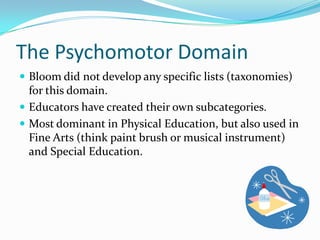
The Psychomotor DomainBloom did not develop any specific lists (taxonomies) for this domain.Educators have created their own subcategories.Most dominant in Physical Education, but also used in Fine Arts (think paint brush or musical instrument) and Special Education.
The Cognitive DomainThis is the taxonomy that we refer to as “Bloom’s Taxonomy”Revised by Lorin Anderson (a former student on Bloom’s) in the 1990’sRevision to add relevancy for the 21st Century.Subcategories changed from nouns to verbs.Top two subcategories are exchanged.The revised version also considers the dimension of knowledge.
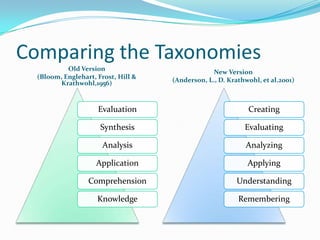
Comparing the TaxonomiesOld Version (Bloom, Englehart, Frost, Hill & Krathwohl,1956)New Version(Anderson, L., D. Krathwohl, et al.2001)
Remembering: can the student recall or remember the information?The Cognitive Domain (new version)
Remembering: can the student recall or remember the information?Understanding: can the student explain ideas or concepts?The Cognitive Domain (new version)
Remembering: can the student recall or remember the information?Understanding: can the student explain ideas or concepts?Applying: can the student use the information in a new way?The Cognitive Domain (new version)
Remembering: can the student recall or remember the information?Understanding: can the student explain ideas or concepts?Applying: can the student use the information in a new way?Analyzing: can the student distinguish between the different parts?The Cognitive Domain (new version)
Remembering: can the student recall or remember the information?Understanding: can the student explain ideas or concepts?Applying: can the student use the information in a new way?Analyzing: can the student distinguish between the different parts?Evaluating: can the student justify a stand or decision?The Cognitive Domain (new version)
Remembering: can the student recall or remember the information?Understanding: can the student explain ideas or concepts?Applying: can the student use the information in a new way?Analyzing: can the student distinguish between the different parts?Evaluating: can the student justify a stand or decision?Creating: can the student create new product or point of view?The Cognitive Domain (new version)
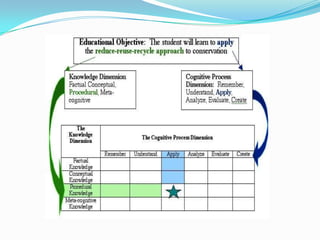
The Knowledge DimensionsFactual Knowledge – specific information, can be learned through memorization.Procedural Knowledge – how to do something, steps to completing a task.Conceptual Knowledge – relationships of information, the how and why.Metacognitive Knowledge – the thought process, how we learn.
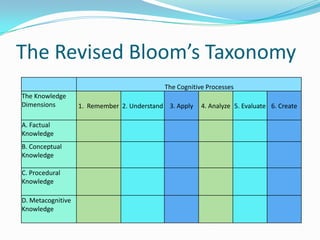
The Revised Bloom’s Taxonomy
“Learning objectives must fall under one of the four categories under the knowledge dimension, and under one of the six categories of the cognitive process dimension. Use the noun in the objective to determine what is being learned: factual, conceptual, procedural, or meta-cognitive knowledge. The verb used in the learning objective will determine which cognitive process dimension column the objective falls under: remember, understand, apply, analyze, evaluate, and create. Where the knowledge and cognitive process dimension intersect, is where the objective stands on the revised taxonomy table, (Cruz, E., 2003).”How to Use the Revised Bloom’s Taxonomy Chart
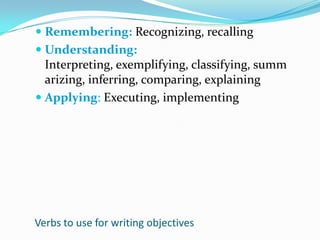
Remembering: Recognizing, recallingVerbs to use for writing objectives
Remembering: Recognizing, recallingUnderstanding: Interpreting, exemplifying, classifying, summarizing, inferring, comparing, explainingVerbs to use for writing objectives
Remembering: Recognizing, recallingUnderstanding: Interpreting, exemplifying, classifying, summarizing, inferring, comparing, explainingApplying: Executing, implementingVerbs to use for writing objectives
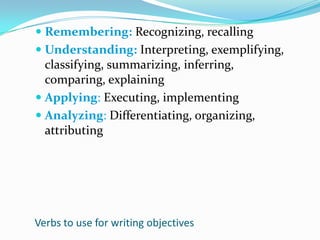
Remembering: Recognizing, recallingUnderstanding: Interpreting, exemplifying, classifying, summarizing, inferring, comparing, explainingApplying: Executing, implementingAnalyzing: Differentiating, organizing, attributingVerbs to use for writing objectives
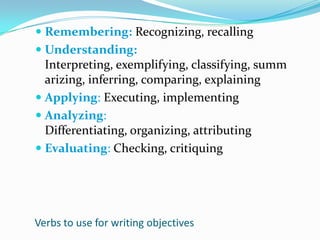
Remembering: Recognizing, recallingUnderstanding: Interpreting, exemplifying, classifying, summarizing, inferring, comparing, explainingApplying: Executing, implementingAnalyzing: Differentiating, organizing, attributingEvaluating: Checking, critiquingVerbs to use for writing objectives
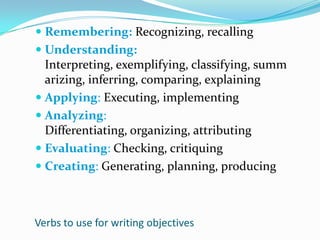
Remembering: Recognizing, recallingUnderstanding: Interpreting, exemplifying, classifying, summarizing, inferring, comparing, explainingApplying: Executing, implementingAnalyzing: Differentiating, organizing, attributingEvaluating: Checking, critiquingCreating: Generating, planning, producingVerbs to use for writing objectives
Cruz, E. (2003). Bloom's revised taxonomy. In  B. Hoffman (Ed.), Encyclopedia of Educational Technology. Retrieved April 19, 2009, from http://coe.sdsu.edu/eet/articles/bloomrev/start.htmOverbaugh, R.C., and Schultz, L., Old Dominion University, Bloom’s Taxonomy. Retrieved April 18, 2009 from http://www.odu.edu/educ/roverbau/Bloom/blooms_taxonomy.htmTaxonomy of Educational Objectives, Wikipedia. Retrieved April 18, 2009 from http://en.wikipedia.org/wiki/Bloom%27s_TaxonomyWoolfolk, A. (2010). Education Psychology (11th Edition ed.). Upper Saddle River, New Jersey: Merrill.Sources

Bloom S Taxonomy More details about the general structure

  • 1.
    Bloom’s Taxonomya presentationby Sherry TauferEDUC 522 Professor Jeff McKendricks
  • 2.
    A BIT OFHISTORY
  • 3.
    Affective – emotionalreactions; personal value impact3 Domains
  • 4.
    Affective – emotionalreactions; personal value impactPsychomotor – voluntary muscle control, ability to manipulate tools or instruments3 Domains
  • 5.
    Affective – emotionalreactions; personal value impactPsychomotor – voluntary muscle control, ability to manipulate tools or instrumentsCognitive – knowledge, comprehension and thinking skills3 Domains
  • 6.
    Affective – emotionalreactions; personal value impactPsychomotor – voluntary muscle control, ability to manipulate tools or instrumentsCognitive – knowledge, comprehension and thinking skills3 Domains“In real life, of course, behaviors from these three domains occur simultaneously. While students are writing (psychomotor), they are also remembering or reasoning (cognitive), and they are likely to have some emotional response to the task as well (affective),” (Woolfolk, 2010).
  • 7.
    A Taxonomy forthe Affective Domain
  • 9.
    The Psychomotor DomainBloomdid not develop any specific lists (taxonomies) for this domain.Educators have created their own subcategories.Most dominant in Physical Education, but also used in Fine Arts (think paint brush or musical instrument) and Special Education.
  • 10.
    The Cognitive DomainThisis the taxonomy that we refer to as “Bloom’s Taxonomy”Revised by Lorin Anderson (a former student on Bloom’s) in the 1990’sRevision to add relevancy for the 21st Century.Subcategories changed from nouns to verbs.Top two subcategories are exchanged.The revised version also considers the dimension of knowledge.
  • 11.
    Comparing the TaxonomiesOldVersion (Bloom, Englehart, Frost, Hill & Krathwohl,1956)New Version(Anderson, L., D. Krathwohl, et al.2001)
  • 12.
    Remembering: can thestudent recall or remember the information?The Cognitive Domain (new version)
  • 13.
    Remembering: can thestudent recall or remember the information?Understanding: can the student explain ideas or concepts?The Cognitive Domain (new version)
  • 14.
    Remembering: can thestudent recall or remember the information?Understanding: can the student explain ideas or concepts?Applying: can the student use the information in a new way?The Cognitive Domain (new version)
  • 15.
    Remembering: can thestudent recall or remember the information?Understanding: can the student explain ideas or concepts?Applying: can the student use the information in a new way?Analyzing: can the student distinguish between the different parts?The Cognitive Domain (new version)
  • 16.
    Remembering: can thestudent recall or remember the information?Understanding: can the student explain ideas or concepts?Applying: can the student use the information in a new way?Analyzing: can the student distinguish between the different parts?Evaluating: can the student justify a stand or decision?The Cognitive Domain (new version)
  • 17.
    Remembering: can thestudent recall or remember the information?Understanding: can the student explain ideas or concepts?Applying: can the student use the information in a new way?Analyzing: can the student distinguish between the different parts?Evaluating: can the student justify a stand or decision?Creating: can the student create new product or point of view?The Cognitive Domain (new version)
  • 18.
    The Knowledge DimensionsFactualKnowledge – specific information, can be learned through memorization.Procedural Knowledge – how to do something, steps to completing a task.Conceptual Knowledge – relationships of information, the how and why.Metacognitive Knowledge – the thought process, how we learn.
  • 19.
  • 20.
    “Learning objectives mustfall under one of the four categories under the knowledge dimension, and under one of the six categories of the cognitive process dimension. Use the noun in the objective to determine what is being learned: factual, conceptual, procedural, or meta-cognitive knowledge. The verb used in the learning objective will determine which cognitive process dimension column the objective falls under: remember, understand, apply, analyze, evaluate, and create. Where the knowledge and cognitive process dimension intersect, is where the objective stands on the revised taxonomy table, (Cruz, E., 2003).”How to Use the Revised Bloom’s Taxonomy Chart
  • 22.
    Remembering: Recognizing, recallingVerbsto use for writing objectives
  • 23.
    Remembering: Recognizing, recallingUnderstanding:Interpreting, exemplifying, classifying, summarizing, inferring, comparing, explainingVerbs to use for writing objectives
  • 24.
    Remembering: Recognizing, recallingUnderstanding:Interpreting, exemplifying, classifying, summarizing, inferring, comparing, explainingApplying: Executing, implementingVerbs to use for writing objectives
  • 25.
    Remembering: Recognizing, recallingUnderstanding:Interpreting, exemplifying, classifying, summarizing, inferring, comparing, explainingApplying: Executing, implementingAnalyzing: Differentiating, organizing, attributingVerbs to use for writing objectives
  • 26.
    Remembering: Recognizing, recallingUnderstanding:Interpreting, exemplifying, classifying, summarizing, inferring, comparing, explainingApplying: Executing, implementingAnalyzing: Differentiating, organizing, attributingEvaluating: Checking, critiquingVerbs to use for writing objectives
  • 27.
    Remembering: Recognizing, recallingUnderstanding:Interpreting, exemplifying, classifying, summarizing, inferring, comparing, explainingApplying: Executing, implementingAnalyzing: Differentiating, organizing, attributingEvaluating: Checking, critiquingCreating: Generating, planning, producingVerbs to use for writing objectives
  • 28.
    Cruz, E. (2003).Bloom's revised taxonomy. In  B. Hoffman (Ed.), Encyclopedia of Educational Technology. Retrieved April 19, 2009, from http://coe.sdsu.edu/eet/articles/bloomrev/start.htmOverbaugh, R.C., and Schultz, L., Old Dominion University, Bloom’s Taxonomy. Retrieved April 18, 2009 from http://www.odu.edu/educ/roverbau/Bloom/blooms_taxonomy.htmTaxonomy of Educational Objectives, Wikipedia. Retrieved April 18, 2009 from http://en.wikipedia.org/wiki/Bloom%27s_TaxonomyWoolfolk, A. (2010). Education Psychology (11th Edition ed.). Upper Saddle River, New Jersey: Merrill.Sources