BLOOM’S
TAXONOMY
Student: Guilherme L. Paschoalini
Group: 29 – 2 year
KURSK STATE MEDICAL UNIVERSITY
• comes from the Greek word
“taxis=arrangements” and “nomos=science”
• Science of arrangements
• means 'a set of classification principles', or
'structure', and
• Domain simply means 'category'.
TAXONOMY
2
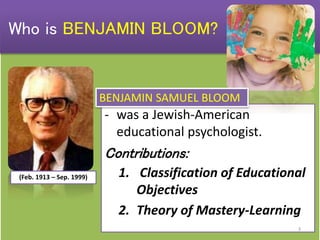
- was a Jewish-American
educational psychologist.
Contributions:
1. Classification of Educational
Objectives
2. Theory of Mastery-Learning
(Feb. 1913 – Sep. 1999)
Who is BENJAMIN BLOOM?
BENJAMIN SAMUEL BLOOM
3
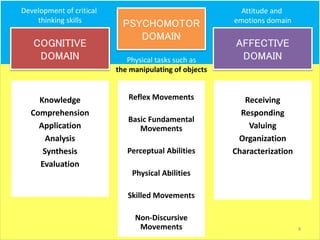
COGNITIVE
DOMAIN
Knowledge
Comprehension
Application
Analysis
Synthesis
Evaluation
PSYCHOMOTOR
DOMAIN
AFFECTIVE
DOMAIN
Reflex Movements
Basic Fundamental
Movements
Perceptual Abilities
Physical Abilities
Skilled Movements
Non-Discursive
Movements
Receiving
Responding
Valuing
Organization
Characterization
4
Attitude and
emotions domain
Physical tasks such as
the manipulating of objects
Development of critical
thinking skills
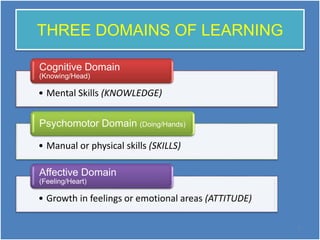
THREE DOMAINS OF LEARNING
• Mental Skills (KNOWLEDGE)
Cognitive Domain
(Knowing/Head)
• Manual or physical skills (SKILLS)
Psychomotor Domain (Doing/Hands)
• Growth in feelings or emotional areas (ATTITUDE)
Affective Domain
(Feeling/Heart)
5
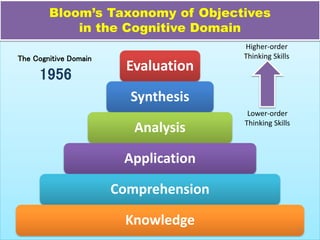
Bloom’s Taxonomy of Objectives
in the Cognitive Domain
Evaluation
Synthesis
Analysis
Application
Comprehension
Knowledge
The Cognitive Domain
1956
6
Lower-order
Thinking Skills
Higher-order
Thinking Skills
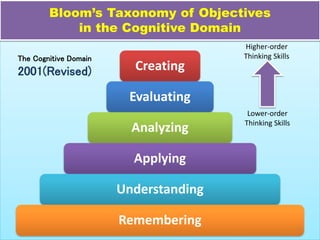
Bloom’s Taxonomy of Objectives
in the Cognitive Domain
Creating
Evaluating
Analyzing
Applying
Understanding
Remembering
The Cognitive Domain
2001(Revised)
7
Lower-order
Thinking Skills
Higher-order
Thinking Skills
8
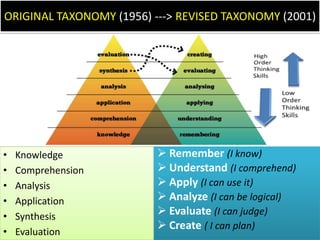
ORIGINAL TAXONOMY (1956) ---> REVISED TAXONOMY (2001)
• Knowledge
• Comprehension
• Analysis
• Application
• Synthesis
• Evaluation
 Remember (I know)
 Understand (I comprehend)
 Apply (I can use it)
 Analyze (I can be logical)
 Evaluate (I can judge)
 Create ( I can plan)
• REMEMBERING
- Recall previous learned information.
- Recalling relevant knowledge from long
term memory.
- Rote learning or memorization.
Bloom’s Revised Taxonomy
9
Jamaica C. Olazo || https://www.facebook.com/ja.maica.393
• UNDERSTANDING
- Comprehending the meaning,
translation, interpolation, and interpretation
of instructions and problems. State a problem
in one's own words.
- Construct meaning and explain.
Bloom’s Revised Taxonomy
U
N
D
E
R
S
T
A
N
D
I
N
10
Jamaica C. Olazo || https://www.facebook.com/ja.maica.393
• APPLYING
- Use a concept in a new situation or
unprompted use of abstraction.
- applies what was learned in the classroom
into novel situations.
- abstract ideas into practical
situations
Bloom’s Revised Taxonomy
A
P
P
L
Y
I
N
G
11
Jamaica C. Olazo || https://www.facebook.com/ja.maica.393
• ANALYZING
- Breaking the concept into parts and
understand how each part is related to one
another.
- Illustrate relationships to
one another.
Bloom’s Revised Taxonomy
A
N
A
L
Y
Z
I
N
G
12
Jamaica C. Olazo || https://www.facebook.com/ja.maica.393
• EVALUATING
- Making judgments based on a set of
guidelines and the value of ideas or
materials.
- Judge, criticize and assess information
using what you know to make
decisions and support your views.
Bloom’s Revised Taxonomy
E
V
A
L
U
A
T
I
N
G
13
Jamaica C. Olazo || https://www.facebook.com/ja.maica.393
• CREATING
- Builds a structure or pattern from
diverse elements. Put parts together to form
a whole, with emphasis on creating a new
meaning or structure.
- Putting information together in an
innovative way.
Bloom’s Revised Taxonomy
C
R
E
A
T
I
N
G
14
15
THANK YOU!

benjaminbloomtaxonomyksmu-160515225551.pdf

  • 1.
    BLOOM’S TAXONOMY Student: Guilherme L.Paschoalini Group: 29 – 2 year KURSK STATE MEDICAL UNIVERSITY
  • 2.
    • comes fromthe Greek word “taxis=arrangements” and “nomos=science” • Science of arrangements • means 'a set of classification principles', or 'structure', and • Domain simply means 'category'. TAXONOMY 2
  • 3.
    - was aJewish-American educational psychologist. Contributions: 1. Classification of Educational Objectives 2. Theory of Mastery-Learning (Feb. 1913 – Sep. 1999) Who is BENJAMIN BLOOM? BENJAMIN SAMUEL BLOOM 3
  • 4.
    COGNITIVE DOMAIN Knowledge Comprehension Application Analysis Synthesis Evaluation PSYCHOMOTOR DOMAIN AFFECTIVE DOMAIN Reflex Movements Basic Fundamental Movements PerceptualAbilities Physical Abilities Skilled Movements Non-Discursive Movements Receiving Responding Valuing Organization Characterization 4 Attitude and emotions domain Physical tasks such as the manipulating of objects Development of critical thinking skills
  • 5.
    THREE DOMAINS OFLEARNING • Mental Skills (KNOWLEDGE) Cognitive Domain (Knowing/Head) • Manual or physical skills (SKILLS) Psychomotor Domain (Doing/Hands) • Growth in feelings or emotional areas (ATTITUDE) Affective Domain (Feeling/Heart) 5
  • 6.
    Bloom’s Taxonomy ofObjectives in the Cognitive Domain Evaluation Synthesis Analysis Application Comprehension Knowledge The Cognitive Domain 1956 6 Lower-order Thinking Skills Higher-order Thinking Skills
  • 7.
    Bloom’s Taxonomy ofObjectives in the Cognitive Domain Creating Evaluating Analyzing Applying Understanding Remembering The Cognitive Domain 2001(Revised) 7 Lower-order Thinking Skills Higher-order Thinking Skills
  • 8.
    8 ORIGINAL TAXONOMY (1956)---> REVISED TAXONOMY (2001) • Knowledge • Comprehension • Analysis • Application • Synthesis • Evaluation  Remember (I know)  Understand (I comprehend)  Apply (I can use it)  Analyze (I can be logical)  Evaluate (I can judge)  Create ( I can plan)
  • 9.
    • REMEMBERING - Recallprevious learned information. - Recalling relevant knowledge from long term memory. - Rote learning or memorization. Bloom’s Revised Taxonomy 9 Jamaica C. Olazo || https://www.facebook.com/ja.maica.393
  • 10.
    • UNDERSTANDING - Comprehendingthe meaning, translation, interpolation, and interpretation of instructions and problems. State a problem in one's own words. - Construct meaning and explain. Bloom’s Revised Taxonomy U N D E R S T A N D I N 10 Jamaica C. Olazo || https://www.facebook.com/ja.maica.393
  • 11.
    • APPLYING - Usea concept in a new situation or unprompted use of abstraction. - applies what was learned in the classroom into novel situations. - abstract ideas into practical situations Bloom’s Revised Taxonomy A P P L Y I N G 11 Jamaica C. Olazo || https://www.facebook.com/ja.maica.393
  • 12.
    • ANALYZING - Breakingthe concept into parts and understand how each part is related to one another. - Illustrate relationships to one another. Bloom’s Revised Taxonomy A N A L Y Z I N G 12 Jamaica C. Olazo || https://www.facebook.com/ja.maica.393
  • 13.
    • EVALUATING - Makingjudgments based on a set of guidelines and the value of ideas or materials. - Judge, criticize and assess information using what you know to make decisions and support your views. Bloom’s Revised Taxonomy E V A L U A T I N G 13 Jamaica C. Olazo || https://www.facebook.com/ja.maica.393
  • 14.
    • CREATING - Buildsa structure or pattern from diverse elements. Put parts together to form a whole, with emphasis on creating a new meaning or structure. - Putting information together in an innovative way. Bloom’s Revised Taxonomy C R E A T I N G 14
  • 15.