By:Kayce Joy L. Saliendrez
 Pre-instruction-(prior knowledge) 
 During instruction-(students’ progress) 
 Post-instruction assessment –(mastery)
 Provides information about the lacking 
competencies such as knowledge and skill.
 Monitors student’s learning 
 Sets his teaching at a level that Challenges 
students metacognitive skills or high-level 
thinking
 Monitors whether the learner mastered the 
basic contents ,knowledge and skills required 
for the learner activity
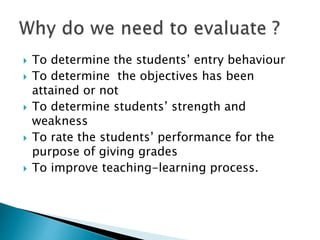
 To determine the students’ entry behaviour 
 To determine the objectives has been 
attained or not 
 To determine students’ strength and 
weakness 
 To rate the students’ performance for the 
purpose of giving grades 
 To improve teaching-learning process.
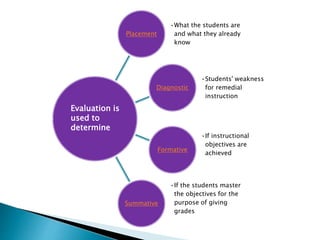
Placement 
•What the students are 
and what they already 
know 
Diagnostic 
•Students' weakness 
for remedial 
instruction 
Formative 
•If instructional 
objectives are 
achieved 
Summative 
•If the students master 
the objectives for the 
purpose of giving 
grades 
Evaluation is 
used to 
determine
 Placement 
 Diagnostic 
 Formative 
 Summative
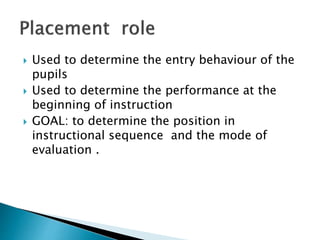
 Used to determine the entry behaviour of the 
pupils 
 Used to determine the performance at the 
beginning of instruction 
 GOAL: to determine the position in 
instructional sequence and the mode of 
evaluation .
 To determine the specific learning needs of 
the students . 
 Strength and weaknesses
Pre-tests (on content and abilities) 
Self-assessments (identifying skills and 
competencies) 
Discussion board responses (on content-specific 
prompts) 
Interviews (brief, private, 10-minute interview 
of each student)
 Assessment during the instruction 
 Helps detect which students need attention
Observations during in-class activities; of 
students’ non-verbal feedback during lecture 
Homework exercises as review for exams and 
class discussions) 
Reflections journals that are reviewed 
periodically during the semester 
Question and answer sessions, both formal— 
planned and informal—spontaneous
Conferences between the instructor and 
student at various points in the semester 
In-class activities where students informally 
present their results 
Student feedback collected by periodically 
answering specific question about the 
instruction and their self-evaluation of 
performance and progress
 To determine the mastery at the end of the 
course 
 Overall assessment 
 Achievement at the end 
 Used to primarily for assigning course grade
 Examinations (major, high-stakes exams) 
 Final examination (a truly summative 
assessment) 
 Term papers (drafts submitted throughout 
the semester would be a formative 
assessment) 
 Projects (project phases submitted at 
various completion points could be 
formatively assessed)
 Portfolios (could also be assessed during 
it’s development as a formative assessment) 
 Performances 
 Student evaluation of the course (teaching 
effectiveness) 
 Instructor self-evaluation
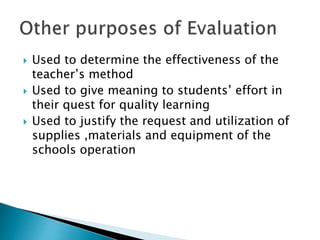
 Used to determine the effectiveness of the 
teacher’s method 
 Used to give meaning to students’ effort in 
their quest for quality learning 
 Used to justify the request and utilization of 
supplies ,materials and equipment of the 
schools operation
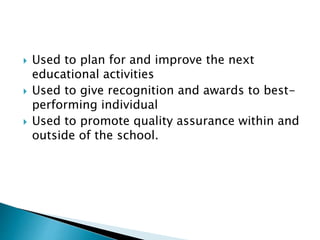
 Used to plan for and improve the next 
educational activities 
 Used to give recognition and awards to best-performing 
individual 
 Used to promote quality assurance within and 
outside of the school.
 https://www.azwestern.edu/academic_servic 
es/instruction/assessment/resources/downlo 
ads/formative%20and_summative_assessmen 
t.pdf retrieved on June 26,2014