Rh  specific red cell antigen  complex blood group system History of the Rh System 1939, Levine and Stetson  Ab in serum of mother of stillborn child; responsible for the death of fetus.
1940, Landsteiner and Weiner  reported on an antibody by guinea pigs and rabbits RBCs reacts with 85% of human subjects name Rh was retained for the human produced antibody. Anti-rhesus formed by the animals was renamed anti-LW (Landsteiner and Wiener). 1941, Levine  et al Erythroblastosis fetalis (HDN) linked with Anti-Rh
Nomenclature: The terminology used to describe the Rh system is derived from  4  sets of investigators. Two  of the terminologies based on the postulated  genetic mechanisms of the Rh system . 3 rd  terminology  the  presence or absence of a given antigen. 4 th   terminology International Society of Blood Transfusion (ISBT)   Working Party on Terminology for Red cell Surface antigens.
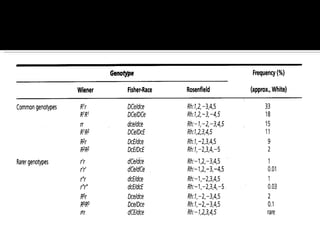
Fisher-Race (DCE terminology) Suggested 3 sets of closely linked alleles (D and d, C and c, E and e) Each gene (except d, which is an amorph) causes production of an Ag Inherited from parents in linked fashion as haplotypes
D, d, C, c, E, and e . ( d )  - is considered an amorph (silent allele) or the absence of D antigen. The phenotype (blood type observed during testing) of a given red cells is  define by the presence or absence of D, C, c, E, and e. C, c, E, e  represent actual  Ags   recognized by specific antibodies.
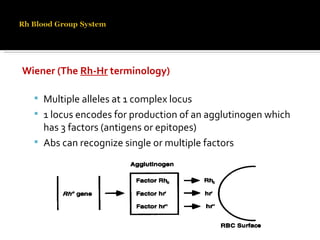
Wiener (The  Rh-Hr  terminology) Multiple alleles at 1 complex locus 1 locus encodes for production of an agglutinogen which has 3 factors (antigens or epitopes) Abs can recognize single or multiple factors
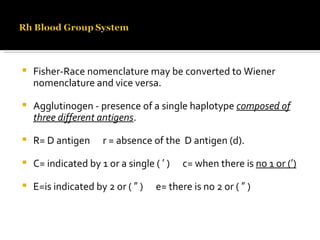
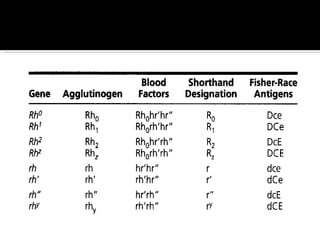
Fisher-Race nomenclature may be converted to Wiener nomenclature and vice versa. Agglutinogen - presence of a single haplotype  composed of three different antigens . R= D antigen  r = absence of the  D antigen (d). C= indicated by 1 or a single ( ′ )  c= when there is  no 1 or (′) E=is indicated by 2 or ( ″ )  e= there is no 2 or ( ″ )
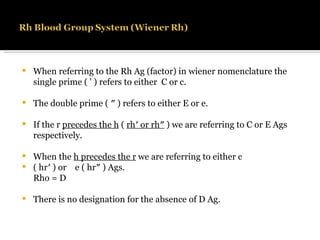
When referring to the Rh Ag (factor) in wiener nomenclature the single prime ( ' ) refers to either  C or c. The double prime ( ″ ) refers to either E or e. If the r  precedes the h  (  rh′ or rh″  ) we are referring to C or E Ags respectively. When the  h precedes the r  we are referring to either c  ( hr′ ) or  e ( hr″ ) Ags. Rho = D  There is no designation for the absence of D Ag.
 
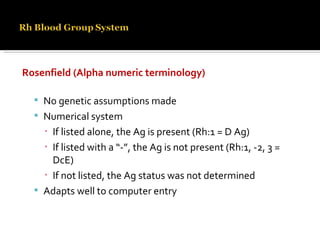
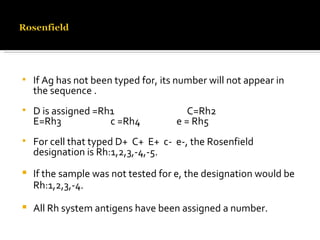
Rosenfield (Alpha numeric terminology) No genetic assumptions made Numerical system  If listed alone, the Ag is present (Rh:1 = D Ag) If listed with a “-”, the Ag is not present (Rh:1, -2, 3 = DcE) If not listed, the Ag status was not determined Adapts well to computer entry
If Ag has not been typed for, its number will not appear in the sequence . D is assigned =Rh1  C=Rh2 E=Rh3  c =Rh4  e = Rh5 For cell that typed D+  C+  E+  c-  e-, the Rosenfield designation is Rh:1,2,3,-4,-5. If the sample was not tested for e, the designation would be Rh:1,2,3,-4. All Rh system antigens have been assigned a number.
 
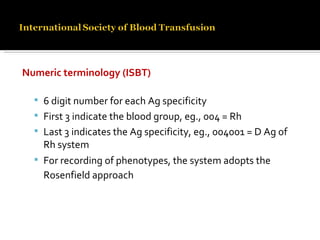
Numeric terminology (ISBT) 6 digit number for each Ag specificity First 3 indicate the blood group, eg., 004 = Rh Last 3 indicates the Ag specificity, eg., 004001 = D Ag of Rh system  For recording of phenotypes, the system adopts the Rosenfield approach
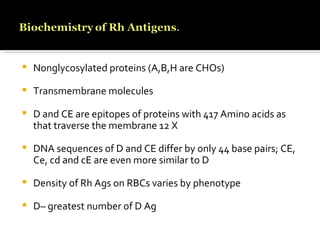
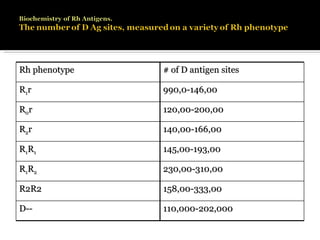
Nonglycosylated proteins (A,B,H are CHOs) Transmembrane molecules D and CE are epitopes of proteins with 417 Amino acids as that traverse the membrane 12 X  DNA sequences of D and CE differ by only 44 base pairs; CE, Ce, cd and cE are even more similar to D Density of Rh Ags on RBCs varies by phenotype D– greatest number of D Ag
# of D antigen sites Rh phenotype 990,0-146,00 R 1 r 120,00-200,00 R 0 r 140,00-166,00 R 2 r 145,00-193,00 R 1 R 1 230,00-310,00 R 1 R 2 158,00-333,00 R2R2 110,000-202,000 D--
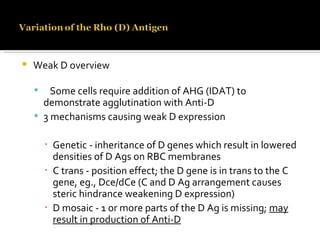
Weak D overview Some cells require addition of AHG (IDAT) to demonstrate agglutination with Anti-D 3 mechanisms causing weak D expression Genetic - inheritance of D genes which result in lowered densities of D Ags on RBC membranes C trans - position effect; the D gene is in trans to the C gene, eg., Dce/dCe (C and D Ag arrangement causes steric hindrance weakening D expression) D mosaic - 1 or more parts of the D Ag is missing;  may result in production of Anti-D
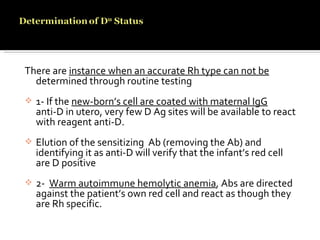
There are  instance when an accurate Rh type can not be  determined through routine testing 1- If the  new-born’s cell are coated with maternal IgG   anti-D in utero, very few D Ag sites will be available to react with reagent anti-D. Elution of the sensitizing  Ab (removing the Ab) and identifying it as anti-D will verify that the infant’s red cell are D positive 2-   Warm autoimmune hemolytic anemia , Abs are directed against the patient’s own red cell and react as though they are Rh specific.
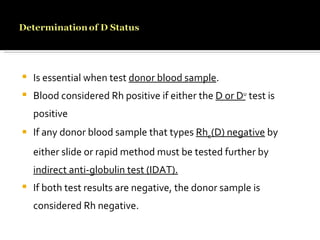
Is essential when test  donor blood sample . Blood considered Rh positive if either the  D or D u  test is positive If any donor blood sample that types  Rh o (D) negative  by either slide or rapid method must be tested further by  indirect anti-globulin test (IDAT). If both test results are negative, the donor sample is considered Rh negative.
Immune IgG Abs (IgG 1  and IgG 3  most important) React optimally at 37 o C or with AHG Order of immunogenicity: D > c > E > C > e  Do not bind complement (RBC destruction by Rh Abs is extravascular)  Exposure to less than  1 ml of Rh positive  red cells can stimulate Ab production in an Rh negative person
Anti-D reagents Saline-based  - Low protein (fewer false positives); long incubation times; cannot convert to weak D testing Protein-based - Faster, increased frequency of false positives; requires use of Rh control tube, converts to weak D testing Chemically modified - “Relaxed” form of Anti-D in low protein medium; few false positives; saline control performed; converts to weak D testing Blends of mAbs
Protocol Add Anti-D to “D” tube; Rh control to “C” tube Spin, read and record  If “D” is positive, cells are Rh positive If “D” is negative, continue testing Add 22% albumin and incubate for 20” at 37 o C Spin, read, and record Wash 3 X in saline Add AHG, spin, read, and record If “D” is positive after heat/albumin or AHG    cells are weak D positive; if negative, cells are Rh negative; “C” should always be negative Add check cells to neg. tubes; spin, read & record
Coomb’s cells (C.C) Control cellular used when AHG test is negative. To confirm that washing has been adequate and the anti-globulin reagent is reactive Control Cell A group  O Rh positive donor’s  sample is mixed with 1:10 dilution of reagent anti-D and allowed to incubate. After sensitization of RBC, they are washed with saline and suspended to a 50% RBC suspension These sensitized RBCs then used to confirm the anti-IgG activity of the AHG.
Coomb’s cells (C.C) They can be used to ensure that AHG test with neg results are not false neg because of inactivation of the AHG reagent. When AHG test is neg , they should be free AHG reagent in the test tube When the CC are added, the free AHG in the test should cause agglutination of the sensitized RBCs. This positive reaction is a mixed field in nature because; half of RBCs in the mixture lack  IgG  on their surface and are free cells  2 nd  half of RBCs have IgG (CC) and are agglutinated
Weak C (C w ) Not allelic to C and c (C and C w  usually seen together) 2% of whites; very rare in blacks Anti-C w  may be naturally occurring and shows dosage f (ce) When c & e are in cis, eg., dce/DCe Combination Ag Anti-f may be helpful in phenotyping
Ce/rhi When C and e in cis Compound Ag Ab helpful in phenotyping G Always found with C-positive RBCs; usually with D-positive cells Anti G appears to bind to D, C, and G  Many others
No Cc and/or Ee epitopes  DC-, Dc-, D-E, D--  Enhanced or exalted D Ag expression Rh null  (no Rh Ag expression at all) ---/--- (double bar rr) Or, because of independently inherited suppressor genes If exposed to  any  Rh Ags, make Abs to those and to Rh 29 (“pan” or “total” Rh) Causes a mild hemolytic anemia Rh mod  - weakened expression of all Rh Ags
Severe HDN Rh Ags are well developed in fetal cells Rh Abs can cross placenta Rh Immune Globulin IgG and Anti D Only for D Ag Severe transfusion reactions Highly immunogenic 1 st - 120 days; 2 nd  -2-7 days Extravascular destruction of RBCs
Symptoms: Fever, mild bilirubin elevation, decrease in Hgb and haptoglobin AHG positive

Rh lecture

  • 1.
  • 2.
    Rh specificred cell antigen complex blood group system History of the Rh System 1939, Levine and Stetson Ab in serum of mother of stillborn child; responsible for the death of fetus.
  • 3.
    1940, Landsteiner andWeiner reported on an antibody by guinea pigs and rabbits RBCs reacts with 85% of human subjects name Rh was retained for the human produced antibody. Anti-rhesus formed by the animals was renamed anti-LW (Landsteiner and Wiener). 1941, Levine et al Erythroblastosis fetalis (HDN) linked with Anti-Rh
  • 4.
    Nomenclature: The terminologyused to describe the Rh system is derived from 4 sets of investigators. Two of the terminologies based on the postulated genetic mechanisms of the Rh system . 3 rd terminology the presence or absence of a given antigen. 4 th terminology International Society of Blood Transfusion (ISBT) Working Party on Terminology for Red cell Surface antigens.
  • 5.
    Fisher-Race (DCE terminology)Suggested 3 sets of closely linked alleles (D and d, C and c, E and e) Each gene (except d, which is an amorph) causes production of an Ag Inherited from parents in linked fashion as haplotypes
  • 6.
    D, d, C,c, E, and e . ( d ) - is considered an amorph (silent allele) or the absence of D antigen. The phenotype (blood type observed during testing) of a given red cells is define by the presence or absence of D, C, c, E, and e. C, c, E, e represent actual Ags recognized by specific antibodies.
  • 7.
    Wiener (The Rh-Hr terminology) Multiple alleles at 1 complex locus 1 locus encodes for production of an agglutinogen which has 3 factors (antigens or epitopes) Abs can recognize single or multiple factors
  • 8.
    Fisher-Race nomenclature maybe converted to Wiener nomenclature and vice versa. Agglutinogen - presence of a single haplotype composed of three different antigens . R= D antigen r = absence of the D antigen (d). C= indicated by 1 or a single ( ′ ) c= when there is no 1 or (′) E=is indicated by 2 or ( ″ ) e= there is no 2 or ( ″ )
  • 9.
    When referring tothe Rh Ag (factor) in wiener nomenclature the single prime ( ' ) refers to either C or c. The double prime ( ″ ) refers to either E or e. If the r precedes the h ( rh′ or rh″ ) we are referring to C or E Ags respectively. When the h precedes the r we are referring to either c ( hr′ ) or e ( hr″ ) Ags. Rho = D There is no designation for the absence of D Ag.
  • 10.
  • 11.
    Rosenfield (Alpha numericterminology) No genetic assumptions made Numerical system If listed alone, the Ag is present (Rh:1 = D Ag) If listed with a “-”, the Ag is not present (Rh:1, -2, 3 = DcE) If not listed, the Ag status was not determined Adapts well to computer entry
  • 12.
    If Ag hasnot been typed for, its number will not appear in the sequence . D is assigned =Rh1 C=Rh2 E=Rh3 c =Rh4 e = Rh5 For cell that typed D+ C+ E+ c- e-, the Rosenfield designation is Rh:1,2,3,-4,-5. If the sample was not tested for e, the designation would be Rh:1,2,3,-4. All Rh system antigens have been assigned a number.
  • 13.
  • 14.
    Numeric terminology (ISBT)6 digit number for each Ag specificity First 3 indicate the blood group, eg., 004 = Rh Last 3 indicates the Ag specificity, eg., 004001 = D Ag of Rh system For recording of phenotypes, the system adopts the Rosenfield approach
  • 15.
    Nonglycosylated proteins (A,B,Hare CHOs) Transmembrane molecules D and CE are epitopes of proteins with 417 Amino acids as that traverse the membrane 12 X DNA sequences of D and CE differ by only 44 base pairs; CE, Ce, cd and cE are even more similar to D Density of Rh Ags on RBCs varies by phenotype D– greatest number of D Ag
  • 16.
    # of Dantigen sites Rh phenotype 990,0-146,00 R 1 r 120,00-200,00 R 0 r 140,00-166,00 R 2 r 145,00-193,00 R 1 R 1 230,00-310,00 R 1 R 2 158,00-333,00 R2R2 110,000-202,000 D--
  • 17.
    Weak D overviewSome cells require addition of AHG (IDAT) to demonstrate agglutination with Anti-D 3 mechanisms causing weak D expression Genetic - inheritance of D genes which result in lowered densities of D Ags on RBC membranes C trans - position effect; the D gene is in trans to the C gene, eg., Dce/dCe (C and D Ag arrangement causes steric hindrance weakening D expression) D mosaic - 1 or more parts of the D Ag is missing; may result in production of Anti-D
  • 18.
    There are instance when an accurate Rh type can not be determined through routine testing 1- If the new-born’s cell are coated with maternal IgG anti-D in utero, very few D Ag sites will be available to react with reagent anti-D. Elution of the sensitizing Ab (removing the Ab) and identifying it as anti-D will verify that the infant’s red cell are D positive 2- Warm autoimmune hemolytic anemia , Abs are directed against the patient’s own red cell and react as though they are Rh specific.
  • 19.
    Is essential whentest donor blood sample . Blood considered Rh positive if either the D or D u test is positive If any donor blood sample that types Rh o (D) negative by either slide or rapid method must be tested further by indirect anti-globulin test (IDAT). If both test results are negative, the donor sample is considered Rh negative.
  • 20.
    Immune IgG Abs(IgG 1 and IgG 3 most important) React optimally at 37 o C or with AHG Order of immunogenicity: D > c > E > C > e Do not bind complement (RBC destruction by Rh Abs is extravascular) Exposure to less than 1 ml of Rh positive red cells can stimulate Ab production in an Rh negative person
  • 21.
    Anti-D reagents Saline-based - Low protein (fewer false positives); long incubation times; cannot convert to weak D testing Protein-based - Faster, increased frequency of false positives; requires use of Rh control tube, converts to weak D testing Chemically modified - “Relaxed” form of Anti-D in low protein medium; few false positives; saline control performed; converts to weak D testing Blends of mAbs
  • 22.
    Protocol Add Anti-Dto “D” tube; Rh control to “C” tube Spin, read and record If “D” is positive, cells are Rh positive If “D” is negative, continue testing Add 22% albumin and incubate for 20” at 37 o C Spin, read, and record Wash 3 X in saline Add AHG, spin, read, and record If “D” is positive after heat/albumin or AHG  cells are weak D positive; if negative, cells are Rh negative; “C” should always be negative Add check cells to neg. tubes; spin, read & record
  • 23.
    Coomb’s cells (C.C)Control cellular used when AHG test is negative. To confirm that washing has been adequate and the anti-globulin reagent is reactive Control Cell A group O Rh positive donor’s sample is mixed with 1:10 dilution of reagent anti-D and allowed to incubate. After sensitization of RBC, they are washed with saline and suspended to a 50% RBC suspension These sensitized RBCs then used to confirm the anti-IgG activity of the AHG.
  • 24.
    Coomb’s cells (C.C)They can be used to ensure that AHG test with neg results are not false neg because of inactivation of the AHG reagent. When AHG test is neg , they should be free AHG reagent in the test tube When the CC are added, the free AHG in the test should cause agglutination of the sensitized RBCs. This positive reaction is a mixed field in nature because; half of RBCs in the mixture lack IgG on their surface and are free cells 2 nd half of RBCs have IgG (CC) and are agglutinated
  • 25.
    Weak C (Cw ) Not allelic to C and c (C and C w usually seen together) 2% of whites; very rare in blacks Anti-C w may be naturally occurring and shows dosage f (ce) When c & e are in cis, eg., dce/DCe Combination Ag Anti-f may be helpful in phenotyping
  • 26.
    Ce/rhi When Cand e in cis Compound Ag Ab helpful in phenotyping G Always found with C-positive RBCs; usually with D-positive cells Anti G appears to bind to D, C, and G Many others
  • 27.
    No Cc and/orEe epitopes DC-, Dc-, D-E, D-- Enhanced or exalted D Ag expression Rh null (no Rh Ag expression at all) ---/--- (double bar rr) Or, because of independently inherited suppressor genes If exposed to any Rh Ags, make Abs to those and to Rh 29 (“pan” or “total” Rh) Causes a mild hemolytic anemia Rh mod - weakened expression of all Rh Ags
  • 28.
    Severe HDN RhAgs are well developed in fetal cells Rh Abs can cross placenta Rh Immune Globulin IgG and Anti D Only for D Ag Severe transfusion reactions Highly immunogenic 1 st - 120 days; 2 nd -2-7 days Extravascular destruction of RBCs
  • 29.
    Symptoms: Fever, mildbilirubin elevation, decrease in Hgb and haptoglobin AHG positive

Editor's Notes

  • #3 Most extensive blood group..with more than 50 different antigenic specificities.. With ABO discovery there were still a lot of casualties in transfusion medicine.. Subsequently an antibody was isolated from the mother’s serum that react both at 37°C and 20 °C with the father’s red cells. It was postulated that the fetus and the father possessed a common factor that the mother lacked . While the mother carry the fetus, the mother was exposed to this factor and subsequently built up an antibody that reacted against the transfused red cells from the father and resulted in hemolytic transfusion reaction
  • #4 Rhesus monkey RBCS reacts with humans..they named it rh. . Landsteiner and Wiener reported on an antibody by guinea pigs and rabbits when they were transfused with rhesus monkey red cells.
  • #6 Co-dominant..DCE because C is in between d and e locus.
  • #7 Five letter designations.. C/c and E/e are antithetical (e.g., can‟t have both C and c or E and e from same chromosome) 2) Eight potential combinations based on presence of genes for above antigens (ie, “DCe”, “dce”, etc.)
  • #8 Wiener believed that, the gene responsible for defining Rh actually produced an agglutinogen (a substance that stimulates the production of an agglutinin , thereby acting as an antigen ) that contained a series of blood factors. The agglutinogen may be considered the phenotypic expression of the haplotype. Each factor is an antigen recognized by an antibody . Antibody can recognize a single or multiple factors ( Ag )
  • #9 Believed that main Rh genes (for presence or absence of D, for C or c and for E or e) inherited as one genetically linked group, or “haplotype.” 3) Shorthand names to the haplotypes; nomenclature is still in use and is essential to know (though theory of how these are inherited has been disproven).
  • #11 Only four of the above combinations occur with significant frequency: R1, R2, R0 and r. (~97% of blacks and whites use only these four). • R0 most common in blacks, least common in whites. • r is always second in frequency. • R1 always comes before R2. Whites: R1 > r > R2 > R0 Blacks: R0 > r > R1 > R2 R1 > R2 > r and R0. Asians
  • #12 In 1960s Rosenfield proposed a system that assigns a number to each antigen of Rh system in order of its discovery or recognized relationship to the Rh system. This system has no genetic basis but simply demonstrates the presence or absence of the Ags on the red cells.
  • #15 You have until 53 in your book..
  • #16 Ag production..two theories: wiener single gene single antigen with many factors Ficher race 3 different genes Integral part of RBC membrane (Rh null people have mild hemolytic anemia) Commonly encountered most is R2R2 Two genes, RHD and RHCE (chromosome 1) code for two main Rh proteins (RHD and RHCE) 2) D type determined by presence/absence of RHD 3) One protein gives both C/c and E/e antigens; combination determined by which alleles of RHCE are present (CE, Ce, cE, or ce) RHAG- chromosome 6 –coexpressor very similar to Rh proteins forms complex with the rh polypeptides
  • #18 When Rh-positive red cell samples are typed for the D Ag. It is expected that they will react strongly with anti-D reagent. However, with certain red cells the testing must be carried through the AHG phase to demonstrate the presence of the D Ag. Red cells carrying the weaker D Ag have been referred to as having the D u type. Genetic - The D Ag expressed appear to be complete but few in number. Inheritance of these gene can be tracked from one generation to the next and seen most frequently in black . C transThe Rh Ag on the red cell is normal , but the steric arrangement of the C Ag in relationship to the D Ag appears to interfere with expression of the D Ag. Mosaic- One or more parts of the D Ag are missing Wiener and Unger postulated that the complete D (Rho) Ag had four parts designated Rh A , Rh B , Rh C , Rh D , a lowercase superscript of a, b, c, and d is used to indicate when the corresponding portion (s) of the mosaic is missing. Example, Rh b means the B portion is absent. People with weak D are considered Rh+ and receive Rh+ blood (except mosaics)
  • #21 Rh Abs do not bind complement. For complement to be fixed, two IgG molecules must attach in close a proximity on the red cell surface. Red cell destruction due to Rh Abs is primarily extra-vascular. This type of hemolysis classically characterizes a delayed hemolytic transfusion reaction. Produced after exposure of the individual’s immune system to foreign red cells, either through transfusion or pregnancy. Rh Abs often persists in the circulation for years Rh Abs are considered clinically significant , therefore, Ag negative blood must be provided to any patient with a history of Rh Ab sensitization.