Blood Grouping
Mr. Harshad Khade
MSc. Medical Technology (OTA)
Symbiosis International university, Pune.
Introduction
• A blood group also called a Blood Type.
• Classification of blood is based on the presence or absence
of inherited antigenic substances on the surface of red blood
cells (RBCs).
• These antigens may be proteins, carbohydrates,
glycoproteins, or glycolipids, depending on the blood group
system.
ABO System
ABO Blood Grouping System
• An Individual’s blood is commonly classified in to one of the four
main groups(A, B, AB, and O).
• The surface of an individual’s red blood cells contains a number
of proteins known as Antigens that are unique for each person.
• Many blood antigens have been identified, but the antigens A, B,
and Rh are the most important in determining blood group or
type. Because antigens promote agglutination or clumping of
blood cells, they also known as Agglutinogens.
• ABO blood group system is the most important blood type
system (or blood group system) in human blood transfusion.
• ABO blood types are also present in some other animals for
example rodents and apes such as chimpanzees, bonobos
and gorillas
• Determination of ABO blood groups depends upon the
immunological reaction between antigen and antibody.
• Antigens are also called agglutinogens because of their
capacity to cause agglutination of RBCs.
ABO Basics
• Based on the presence or absence of antigen A and antigen B,
blood is divided into four groups:‘A, B, AB and ‘O’ group.
• Blood having antigen A belongs to ‘A’ group.This blood has β-
antibody in the Blood with antigen B and α-antibody belongs to ‘B’
group.
• If both the antigens are present, blood group is called ‘AB’ group
and serum of this group does not contain any antibody.
• If both antigens are absent, the blood group is called ‘O’ group
and both α and β antibodies are present in the serum.
Blood
group
Antigens on the
RBC
Antibodies in the
Blood
Donate
To
Receive
From
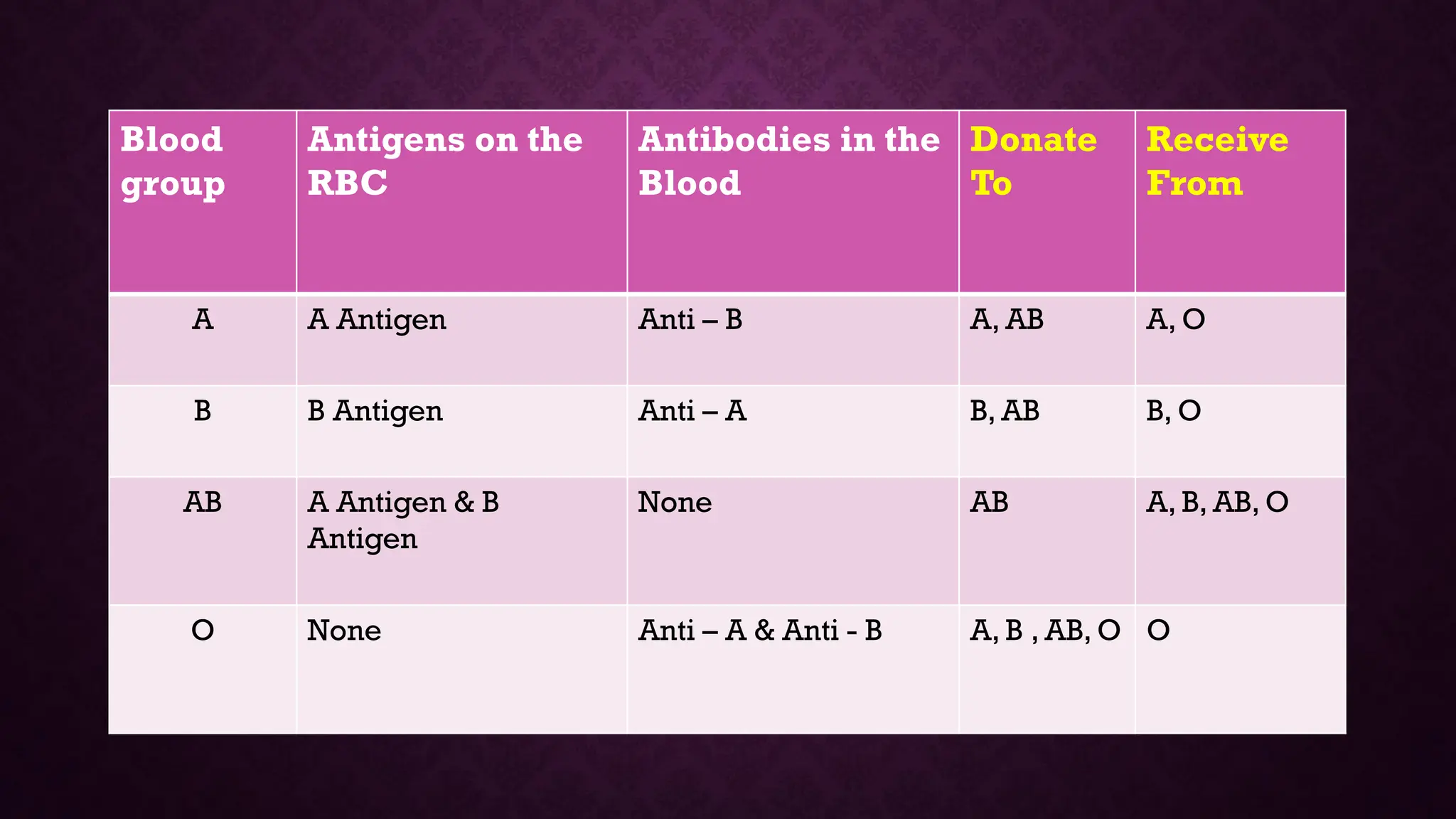
A A Antigen Anti – B A, AB A, O
B B Antigen Anti – A B, AB B, O
AB A Antigen & B
Antigen
None AB A, B, AB, O
O None Anti – A & Anti - B A, B , AB, O O
Principle Of Blood Grouping
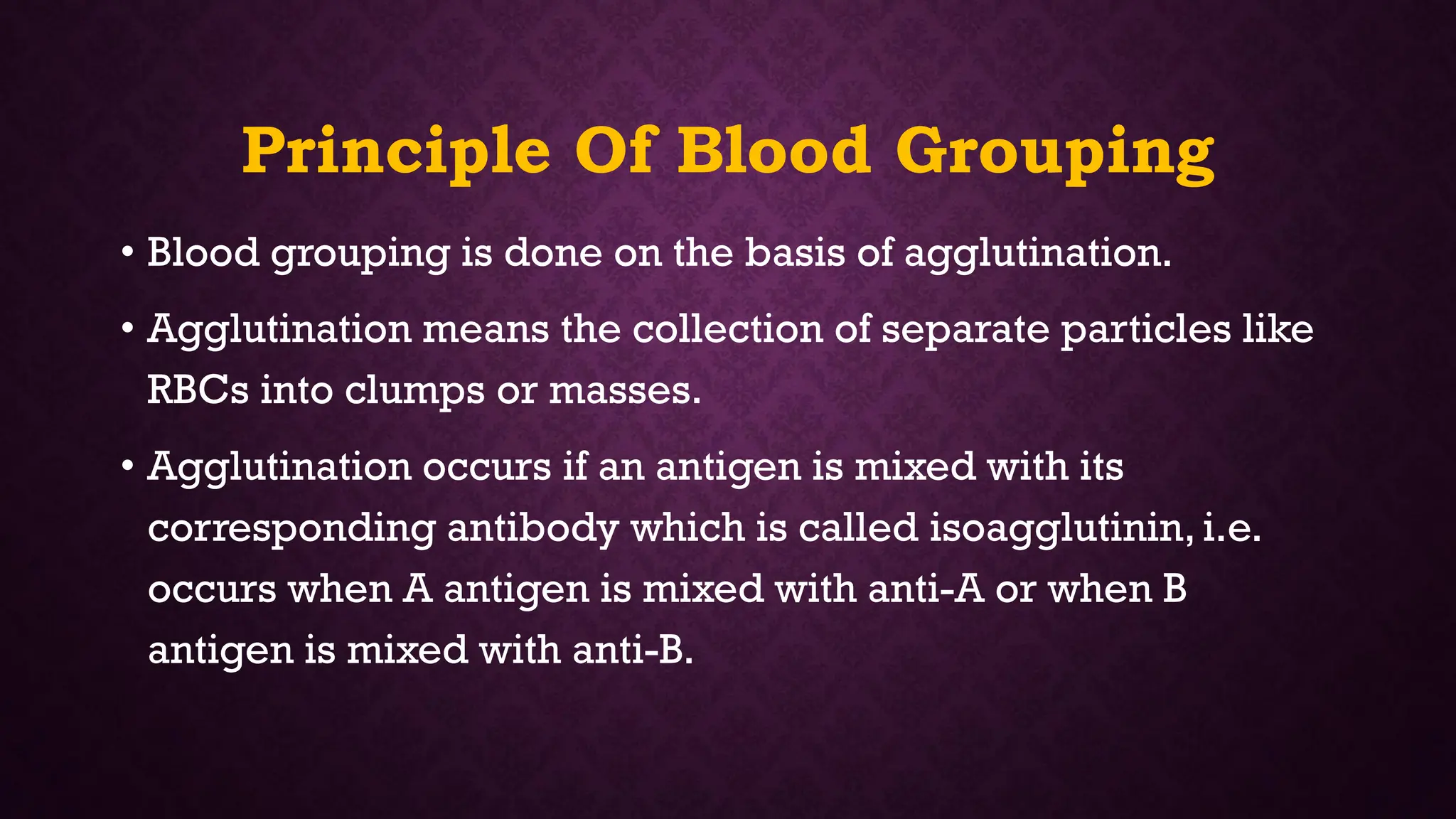
• Blood grouping is done on the basis of agglutination.
• Agglutination means the collection of separate particles like
RBCs into clumps or masses.
• Agglutination occurs if an antigen is mixed with its
corresponding antibody which is called isoagglutinin, i.e.
occurs when A antigen is mixed with anti-A or when B
antigen is mixed with anti-B.
Importance Of ABO Grouping In
Blood Transfusion
• During blood transfusion, only compatible blood must be used.
• The one who gives blood is called the ‘donor’ and the one who
receives the blood is called ‘recipient’.
• While transfusing the blood, antigen of the donor and the
antibody of the recipient are considered.
• The antibody of the donor and antigen of the recipient are
ignored mostly.
• Thus, RBC of ‘O’ group has no antigen and so agglutination
does not occur with any other group of blood. So,‘O’ group
blood can be given to any blood group persons and the
people with this blood group are called ‘universal donors’.
• Plasma of AB group blood has no antibody.This does not
cause agglutination of RBC from any other group of blood.
• People with AB group can receive blood from any blood
group persons. So, people with this blood group are called
‘universal recipients’.
• In mismatched transfusion, the transfusion reactions occur
between donor’s RBC and recipient’s plasma. So, if the
donor’s plasma contains agglutinins against recipient’s RBC,
agglutination does not occur because these antibodies are
diluted in the recipient’s blood.
Transfusion Reaction
Due To ABO Incompatibility
• Transfusion reactions are the adverse reactions in the body,
which occur due to transfusion error that involves transfusion
of incompatible (mismatched) blood.
• The reactions may be mild causing only fever and hives (skin
disorder characterized by itching) or may be severe leading
to renal failure, shock and death.
Rh Blood Group System
The Rhesus System
• The red blood cell membrane antigen important here is the
Rhesus (Rh) antigen, or Rhesus factor.
• About 85% of people have this antigen; they are Rhesus positive
(Rh+) and not therefore make anti-Rhesus antibodies.
• The remaining 15% have no Rhesus antigen (they are Rhesus
negative, or Rh-) Rh- individuals are capable of making anti
Rhesus antibodies, but are stimulated to do so only in certain
circumstances, e.g. in pregnancy, or as the result of an
incompatible blood transfusion.
Rhesus (RH) Factor
• The Rh factor is an inherited antigen in human blood.
• Blood that contains the Rh factor is known as Rh-positive, when it
is not present the blood is said to be Rh-negative.
• Rh blood does not naturally contain Rh antibodies.
• If Rh-positive blood is injected into an Rh-negative person, the
recipient develops Rh antibodies.
• Subsequent transfusion with Rh-positive blood may cause serious
reactions with clumping and hemolysis of red blood cells
Blood Type Can Give To Can Receive From
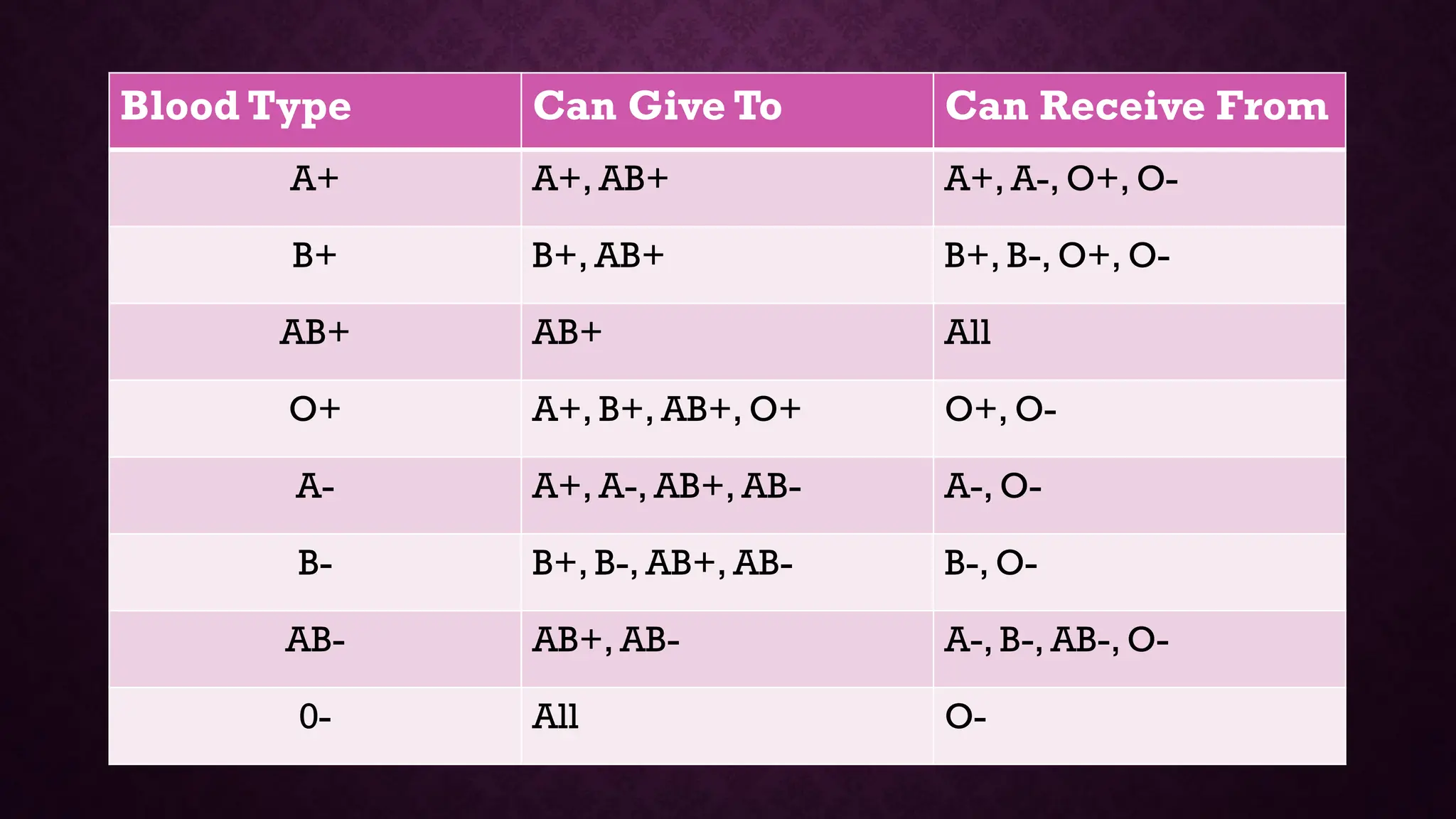
A+ A+, AB+ A+, A-, O+, O-
B+ B+, AB+ B+, B-, O+, O-
AB+ AB+ All
O+ A+, B+, AB+, O+ O+, O-
A- A+, A-, AB+, AB- A-, O-
B- B+, B-, AB+, AB- B-, O-
AB- AB+, AB- A-, B-, AB-, O-
0- All O-
Rh Blood Group System
• The Rh blood group system is one of thirty
• five current human blood group systems.
• It is the most important blood group system after ABO.
• Rh blood group system consists of 50 defined blood-group
antigens, among them there are six common types of Rh
antigens.
• Each of which is called an Rh factor.These types are
designated C,D, E, c, d, and e
• The type D antigen is widely prevalent in the population and
considerably more antigenic than the other Rh antigens.
• Anyone who has this type of antigen is said to be Rh positive,
whereas a person who does not have type D antigen is said
to be Rh negative.
• This antigen was discovered by Karl Landsteiner and
Alexander Wiener in 1940.
• It was first discovered in Rhesus macaque and hence the
name 'Rh factor’.
Other Blood Group System
• Thirty-five major blood group systems were recognized by the
International Society of Blood Transfusion (ISBT) in October 2012.
• In addition to the ABO antigens and Rhesus antigens, many other
antigens are expressed on the red blood cell surface membrane.
• An individual can be AB Rh D positive, and at the same time M
and N positive (MNS system), K positive (Kell system), and Le a or
Le b positive (Lewis system). Many of the blood group systems
were named after the patients in whom the corresponding
antibodies were initially encountered.
Other Blood Groups Include
Auberger groups
Diego group
Bombay group
Duffy group
Lutheran group
P group
Kell group
I group
Kidd group
Sulter Xg group
“
”
Thank You
(+91) 8087788417

bloodgrouping and types and variations 20

  • 1.
    Blood Grouping Mr. HarshadKhade MSc. Medical Technology (OTA) Symbiosis International university, Pune.
  • 3.
    Introduction • A bloodgroup also called a Blood Type. • Classification of blood is based on the presence or absence of inherited antigenic substances on the surface of red blood cells (RBCs). • These antigens may be proteins, carbohydrates, glycoproteins, or glycolipids, depending on the blood group system.
  • 4.
  • 5.
    ABO Blood GroupingSystem • An Individual’s blood is commonly classified in to one of the four main groups(A, B, AB, and O). • The surface of an individual’s red blood cells contains a number of proteins known as Antigens that are unique for each person. • Many blood antigens have been identified, but the antigens A, B, and Rh are the most important in determining blood group or type. Because antigens promote agglutination or clumping of blood cells, they also known as Agglutinogens.
  • 6.
    • ABO bloodgroup system is the most important blood type system (or blood group system) in human blood transfusion. • ABO blood types are also present in some other animals for example rodents and apes such as chimpanzees, bonobos and gorillas • Determination of ABO blood groups depends upon the immunological reaction between antigen and antibody. • Antigens are also called agglutinogens because of their capacity to cause agglutination of RBCs.
  • 7.
    ABO Basics • Basedon the presence or absence of antigen A and antigen B, blood is divided into four groups:‘A, B, AB and ‘O’ group. • Blood having antigen A belongs to ‘A’ group.This blood has β- antibody in the Blood with antigen B and α-antibody belongs to ‘B’ group. • If both the antigens are present, blood group is called ‘AB’ group and serum of this group does not contain any antibody. • If both antigens are absent, the blood group is called ‘O’ group and both α and β antibodies are present in the serum.
  • 8.
    Blood group Antigens on the RBC Antibodiesin the Blood Donate To Receive From A A Antigen Anti – B A, AB A, O B B Antigen Anti – A B, AB B, O AB A Antigen & B Antigen None AB A, B, AB, O O None Anti – A & Anti - B A, B , AB, O O
  • 9.
    Principle Of BloodGrouping • Blood grouping is done on the basis of agglutination. • Agglutination means the collection of separate particles like RBCs into clumps or masses. • Agglutination occurs if an antigen is mixed with its corresponding antibody which is called isoagglutinin, i.e. occurs when A antigen is mixed with anti-A or when B antigen is mixed with anti-B.
  • 10.
    Importance Of ABOGrouping In Blood Transfusion • During blood transfusion, only compatible blood must be used. • The one who gives blood is called the ‘donor’ and the one who receives the blood is called ‘recipient’. • While transfusing the blood, antigen of the donor and the antibody of the recipient are considered. • The antibody of the donor and antigen of the recipient are ignored mostly.
  • 11.
    • Thus, RBCof ‘O’ group has no antigen and so agglutination does not occur with any other group of blood. So,‘O’ group blood can be given to any blood group persons and the people with this blood group are called ‘universal donors’. • Plasma of AB group blood has no antibody.This does not cause agglutination of RBC from any other group of blood.
  • 12.
    • People withAB group can receive blood from any blood group persons. So, people with this blood group are called ‘universal recipients’. • In mismatched transfusion, the transfusion reactions occur between donor’s RBC and recipient’s plasma. So, if the donor’s plasma contains agglutinins against recipient’s RBC, agglutination does not occur because these antibodies are diluted in the recipient’s blood.
  • 13.
    Transfusion Reaction Due ToABO Incompatibility • Transfusion reactions are the adverse reactions in the body, which occur due to transfusion error that involves transfusion of incompatible (mismatched) blood. • The reactions may be mild causing only fever and hives (skin disorder characterized by itching) or may be severe leading to renal failure, shock and death.
  • 14.
  • 15.
    The Rhesus System •The red blood cell membrane antigen important here is the Rhesus (Rh) antigen, or Rhesus factor. • About 85% of people have this antigen; they are Rhesus positive (Rh+) and not therefore make anti-Rhesus antibodies. • The remaining 15% have no Rhesus antigen (they are Rhesus negative, or Rh-) Rh- individuals are capable of making anti Rhesus antibodies, but are stimulated to do so only in certain circumstances, e.g. in pregnancy, or as the result of an incompatible blood transfusion.
  • 16.
    Rhesus (RH) Factor •The Rh factor is an inherited antigen in human blood. • Blood that contains the Rh factor is known as Rh-positive, when it is not present the blood is said to be Rh-negative. • Rh blood does not naturally contain Rh antibodies. • If Rh-positive blood is injected into an Rh-negative person, the recipient develops Rh antibodies. • Subsequent transfusion with Rh-positive blood may cause serious reactions with clumping and hemolysis of red blood cells
  • 17.
    Blood Type CanGive To Can Receive From A+ A+, AB+ A+, A-, O+, O- B+ B+, AB+ B+, B-, O+, O- AB+ AB+ All O+ A+, B+, AB+, O+ O+, O- A- A+, A-, AB+, AB- A-, O- B- B+, B-, AB+, AB- B-, O- AB- AB+, AB- A-, B-, AB-, O- 0- All O-
  • 18.
    Rh Blood GroupSystem • The Rh blood group system is one of thirty • five current human blood group systems. • It is the most important blood group system after ABO. • Rh blood group system consists of 50 defined blood-group antigens, among them there are six common types of Rh antigens. • Each of which is called an Rh factor.These types are designated C,D, E, c, d, and e
  • 19.
    • The typeD antigen is widely prevalent in the population and considerably more antigenic than the other Rh antigens. • Anyone who has this type of antigen is said to be Rh positive, whereas a person who does not have type D antigen is said to be Rh negative. • This antigen was discovered by Karl Landsteiner and Alexander Wiener in 1940. • It was first discovered in Rhesus macaque and hence the name 'Rh factor’.
  • 20.
    Other Blood GroupSystem • Thirty-five major blood group systems were recognized by the International Society of Blood Transfusion (ISBT) in October 2012. • In addition to the ABO antigens and Rhesus antigens, many other antigens are expressed on the red blood cell surface membrane. • An individual can be AB Rh D positive, and at the same time M and N positive (MNS system), K positive (Kell system), and Le a or Le b positive (Lewis system). Many of the blood group systems were named after the patients in whom the corresponding antibodies were initially encountered.
  • 21.
    Other Blood GroupsInclude Auberger groups Diego group Bombay group Duffy group Lutheran group P group Kell group I group Kidd group Sulter Xg group
  • 22.