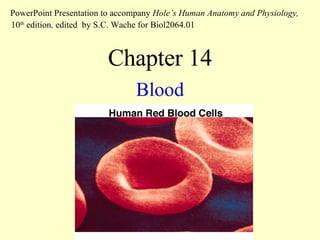
Chapter 14 Blood PowerPoint Presentation to accompany  Hole’s Human Anatomy and Physiology,  10 th  edition ,  edited   by S.C. Wache for Biol2064.01
You are responsible for the content of the following  figures and topics:  Fig. 14.1 – Blood.  Fig. 14.2 - hematocrit or Percent packed RBC volume. Fig. 14.5 - Blood originates from red bone marrow.  Fig. 14.3 - Blood cells.  WBC develop into 3 branches. Fig. 14.14 - WBC can pass through the simple epithelia of vessels by diapedesis,  RBC cannot. Fig. 14.16 - Blood composition. Read TB, p.527, on hemostasis.  Fig. 14. 19, Tab. 14.10 - Damaged tissues trigger the extrinsic mechanism. Read TB, p.533, on antigens and antibodies of blood groups. Fig. 14.21, 14.22 – Key-and-Lock interaction of Antigens and Antibodies. Tab. 14.13 - Study the antibodies each blood type carries in their plasma.  Tab. 14.14 - Permissible Donor Blood Types. Fig. 14.23 - incompatibility with the Rh antigen also called antigen D.
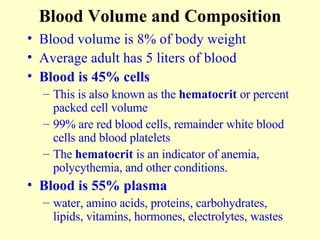
Blood Volume and Composition Blood volume is 8% of body weight Average adult has 5 liters of blood Blood is 45% cells  This is also known as the  hematocrit  or percent packed cell volume 99% are red blood cells, remainder white blood cells and blood platelets The  hematocrit  is an indicator of anemia, polycythemia, and other conditions. Blood is 55% plasma water, amino acids, proteins, carbohydrates, lipids, vitamins, hormones, electrolytes, wastes
Fig. 14.3
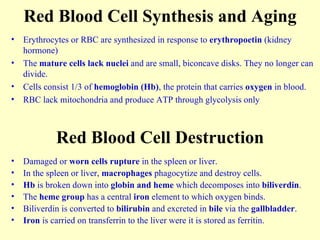
Red Blood Cell Synthesis and Aging Erythrocytes or RBC are synthesized in response to  erythropoetin  (kidney hormone) The  mature cells lack nuclei  and are small, biconcave disks. They no longer can divide. Cells consist 1/3 of  hemoglobin (Hb) , the protein that carries  oxygen  in blood. RBC lack mitochondria and produce ATP through glycolysis only Red Blood Cell Destruction Damaged or  worn cells rupture  in the spleen or liver. In the spleen or liver,  macrophages  phagocytize and destroy cells. Hb  is broken down into  globin and heme  which decomposes into  biliverdin .  The  heme group  has a central  iron  element to which oxygen binds. Biliverdin is converted to  bilirubin  and excreted in  bile  via the  gallbladder . Iron  is carried on transferrin to the liver were it is stored as ferritin.
Fig. 14.8 Note  that, in muscle,  myoglobin   (Mb) binds oxygen. Mb consists  of only 1 protein chain. Note  the  4 protein chains   that make up 1 molecule of Hb.
Erythropoiesis – RBC production Red blood cells (RBC) are called erythrocytes. They are produced in  red bone marrow. Average life span is 120 days. When  oxygen concentrations in the blood are low , erythropoietin is released from the  kidney . Erythropoietin operates in a negative feedback mechanism to maintain RBC  homeostasis . Required Dietary Factors  Vitamin B12   - required for DNA synthesis   - intrinsic factor necessary for absorption Folic acid   -  required for DNA synthesis Iron   -  required for hemoglobin synthesis Vitamin C   - increases absorption of iron
Fig. 14.6
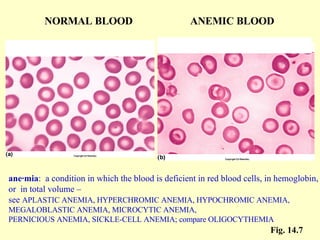
Fig. 14.7 NORMAL BLOOD   ANEMIC BLOOD ane·mia :  a condition in which the blood is deficient in red blood cells, in hemoglobin, or  in total volume –  see  APLASTIC ANEMIA, HYPERCHROMIC ANEMIA, HYPOCHROMIC ANEMIA, MEGALOBLASTIC ANEMIA, MICROCYTIC ANEMIA,  PERNICIOUS ANEMIA, SICKLE-CELL ANEMIA; compare OLIGOCYTHEMIA
White Blood Cells White Blood Cells (WBC) are called  leukocytes . They protect against disease. Granulocytes:  granular cytoplasm; neutrophils, eosinophils, basophils Agranulocytes:  lack cytoplasmic granules; monocytes, lymphocytes Blood Platelets Thrombocytes Arise from  megakaryocytes  in the red bone marrow Platelets are small and lack a nucleus Help repair broken blood vessels Release  serotonin
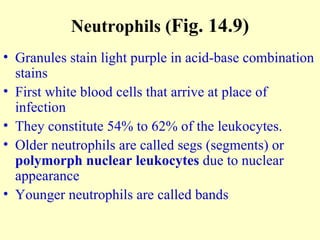
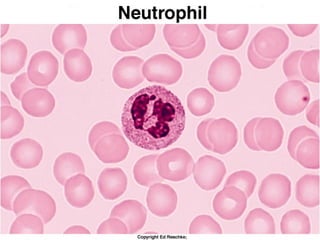
Neutrophils ( Fig. 14.9) Granules stain light purple in acid-base combination stains First white blood cells that arrive at place of infection They constitute 54% to 62% of the leukocytes. Older neutrophils are called segs (segments) or  polymorph nuclear leukocytes  due to nuclear appearance Younger neutrophils are called bands
 
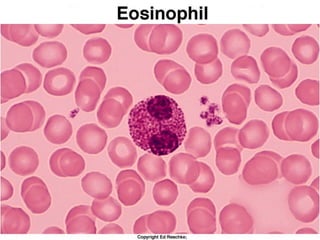
Eosinophils (Fig. 14.10) Contain coarse deep red staining granules Nucleus has two lobes Active during moderate allergic reactions Defend against parasitic worm infection Constitute 1%  to 3% of leukocytes
 
Basophils (Fig. 14.11) Granules stain deep blue in basic stain Nuclei have two lobes Migrate to damaged tissue Release  histamine  to promote inflammation and  heparin  to inhibit blood clotting Constitute less than 1% of leukocytes
 
Agranulocytes (Figs. 14.12, 14.13) Monocytes:   largest cells; leave bloodstream and become macrophages; 3% to 9% of the leukocytes Lymphocytes:  T cells and B cells; important in immunity and antibody production; 35% to 33% of leukocytes
Movement of Leukocytes through Epithelia Protect against infection: phagocytize bacteria; produce proteins that destroy foreign particles Diapedesis:  leukocytes can squeeze between cells and leave the circulation Fig. 14.14
Infection
Blood Plasma 92% water,  Plasma proteins, Gases and nutrients nitrogen containing molecules other than proteins: amino acids, urea, uric acid, creatine, creatinine Plasma  electrolytes : sodium (Na + ), potassium (K + ), calcium (Ca ++) , magnesium (Mg ++ ), chloride (CL - ), bicarbonate, phosphate, sulfate Plasma Proteins Albumins : 60%; maintain osmotic pressure, bind and transport molecules  Globulins : 36%; alpha, beta, gamma-globulins Fibrinogen : 4%; primary role in blood clotting Blood Gases and Nutrients Blood gases: oxygen and carbon dioxide Nutrients:  amino acids, simple sugars, nucleotides, lipids;  lipids include triglycerides, phospholipids, cholesterol transported as lipoproteins (chylomicrons, VLDL, LDL, HDL)
Fig. 14.16
Hemostasis – Platelet Plug Formation Stoppage of bleeding to prevent blood loss Blood vessel spasm: vasospasm due to smooth muscle contraction; direct stimulation of vessel wall and pain reflexes Blood Coagulation: Fibrinogen  Fibrin Complex cascade of events Utilizes clotting factors Vitamin K  and  calcium  is necessary for clotting factors Major event is conversion of soluble plasma protein fibrinogen to insoluble treads of fibrin Two ways to stop blood flow: hemostasis and coagulation
Fig. 14.17
Fig. 14.19
Extrinsic Clotting Mechanism Triggered when blood contacts damaged blood vessel wall or tissue  outside blood vessels;  damaged tissue releases  thromboplastin. Thromboplastin activates clotting cascade involving reactions that require calcium and leading to the release of  prothrombin. Prothrombin is converted into  thrombin. Thrombin converts  fibrinogen to fibrin Fibrin threads stick to exposed damaged blood vessels. Meshwork traps blood cells and platelets. This produces a  blood clot . The amount of prothrombin activator is proportional to the degree of tissue damage. Blood clotting is self-initiating,  a positive feedback system . Intrinsic Clotting Mechanism All components found within blood , not outside the vessel !!! Activation of  Hageman Factor  initiates intrinsic clotting Cascade of activation in the presence of calcium produces prothrombin activator Prothrombin and fibrin are formed as in the extrinsic pathway
Clot Physiology Blood flow keeps thrombin concentration low, that is,  as blood thickens and blood flow decreases, thus increases the risk of thrombus formation Thrombus:  a stationary clot abnormally forming in a vessel Embolus : a dislodged clot carried by the bloodstream;  Embolism  occurs when the embolus blocks blood flow Fate of Blood Clots  When blood clots dry out and retract inward they pull torn vessel ends together. Serum is squeezed out. Platelet-derived growth factor (PDGF) repairs vessel walls. Plasminogen is absorbed by fibrin.  Plasminogen activator  converts  plasminogen to plasmin .  Plasmin digests the clot . Prevention of Coagulation Prostacyclin  from endothelial cells inhibits platelet aggregation. Antithrombin  inactivates thrombin. Heparin  from basophils interferes with the formation of prothrombin activator. Note:   Plasminogen activator is used together with blood thinners after a stroke !
Antigens and Antibodies Blood cell compatibility is based on clumping or  agglutination Transfusion reaction : a reaction between red blood cell  antigens = agglutinogens  and protein  antibodies = agglutinins  in the plasma leading to agglutination and hemolysis  and blockage of blood flow ! Antigens include those of the ABO group and the Rh group ag·glu·ti·na·tion:  a reaction in which particles (such as RBC or bacteria);  that are  suspended in a liquid, collect into clumps especially in response to antiserum added in  a serological blood test, that is, as a serological response to a specific antibody. agglutination test:  any of several tests based on the ability of a specific serum to cause  agglutination of a suitable system and used in the diagnosis of infections, the  identification of microorganisms, and in  blood typing   Agglutination is observed on a blood slide. Note-   he·mo·ly·sis:  lysis of red blood cells with liberation of hemoglobin.
Fig. 14.22 Donor RBCs:  They carry  the antigen A. The donor  is Blood Type A. Patient Blood:  The patient is blood type B  and has naturally occurring antibodies  called Anti-A. Patient blood after wrong transfusion:  The patient blood agglutinates and  hemolyses. The patient dies.
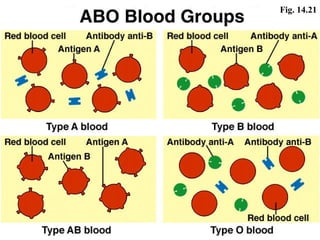
Fig. 14.21
ABO blood groups are based on RBC membrane antigens A and B. Four possible combinations Type A contains antigen A Type B contains antigen B Type AB contains antigens A and B Type O contains no antigens
ABO Blood Group Anti-A and anti-B antibodies are produced when an antigen is absent from the cell membrane Type A plasma contains anti-B antibodies Type B plasma contains anti-A antibodies Type AB plasma contains anti-A and anti-B antibodies,  universal recipient Type O plasma contains no antibodies,  universal donor
Rh Blood Group (Fig. 14.23) Rh positive  indicates presence of antigen D, one of the Rh antigens Rh negative  indicates absence of Antigen D Rh antigens, like A and B antigens are inherited and present from birth Anti-D antibodies are not produced until after an individual is sensitized to antigen D
 

Chapter 14 - Blood

  • 1.
    Chapter 14 BloodPowerPoint Presentation to accompany Hole’s Human Anatomy and Physiology, 10 th edition , edited by S.C. Wache for Biol2064.01
  • 2.
    You are responsiblefor the content of the following figures and topics: Fig. 14.1 – Blood. Fig. 14.2 - hematocrit or Percent packed RBC volume. Fig. 14.5 - Blood originates from red bone marrow. Fig. 14.3 - Blood cells. WBC develop into 3 branches. Fig. 14.14 - WBC can pass through the simple epithelia of vessels by diapedesis, RBC cannot. Fig. 14.16 - Blood composition. Read TB, p.527, on hemostasis. Fig. 14. 19, Tab. 14.10 - Damaged tissues trigger the extrinsic mechanism. Read TB, p.533, on antigens and antibodies of blood groups. Fig. 14.21, 14.22 – Key-and-Lock interaction of Antigens and Antibodies. Tab. 14.13 - Study the antibodies each blood type carries in their plasma. Tab. 14.14 - Permissible Donor Blood Types. Fig. 14.23 - incompatibility with the Rh antigen also called antigen D.
  • 3.
    Blood Volume andComposition Blood volume is 8% of body weight Average adult has 5 liters of blood Blood is 45% cells This is also known as the hematocrit or percent packed cell volume 99% are red blood cells, remainder white blood cells and blood platelets The hematocrit is an indicator of anemia, polycythemia, and other conditions. Blood is 55% plasma water, amino acids, proteins, carbohydrates, lipids, vitamins, hormones, electrolytes, wastes
  • 4.
  • 5.
    Red Blood CellSynthesis and Aging Erythrocytes or RBC are synthesized in response to erythropoetin (kidney hormone) The mature cells lack nuclei and are small, biconcave disks. They no longer can divide. Cells consist 1/3 of hemoglobin (Hb) , the protein that carries oxygen in blood. RBC lack mitochondria and produce ATP through glycolysis only Red Blood Cell Destruction Damaged or worn cells rupture in the spleen or liver. In the spleen or liver, macrophages phagocytize and destroy cells. Hb is broken down into globin and heme which decomposes into biliverdin . The heme group has a central iron element to which oxygen binds. Biliverdin is converted to bilirubin and excreted in bile via the gallbladder . Iron is carried on transferrin to the liver were it is stored as ferritin.
  • 6.
    Fig. 14.8 Note that, in muscle, myoglobin (Mb) binds oxygen. Mb consists of only 1 protein chain. Note the 4 protein chains that make up 1 molecule of Hb.
  • 7.
    Erythropoiesis – RBCproduction Red blood cells (RBC) are called erythrocytes. They are produced in red bone marrow. Average life span is 120 days. When oxygen concentrations in the blood are low , erythropoietin is released from the kidney . Erythropoietin operates in a negative feedback mechanism to maintain RBC homeostasis . Required Dietary Factors Vitamin B12 - required for DNA synthesis - intrinsic factor necessary for absorption Folic acid - required for DNA synthesis Iron - required for hemoglobin synthesis Vitamin C - increases absorption of iron
  • 8.
  • 9.
    Fig. 14.7 NORMALBLOOD ANEMIC BLOOD ane·mia : a condition in which the blood is deficient in red blood cells, in hemoglobin, or in total volume – see APLASTIC ANEMIA, HYPERCHROMIC ANEMIA, HYPOCHROMIC ANEMIA, MEGALOBLASTIC ANEMIA, MICROCYTIC ANEMIA, PERNICIOUS ANEMIA, SICKLE-CELL ANEMIA; compare OLIGOCYTHEMIA
  • 10.
    White Blood CellsWhite Blood Cells (WBC) are called leukocytes . They protect against disease. Granulocytes: granular cytoplasm; neutrophils, eosinophils, basophils Agranulocytes: lack cytoplasmic granules; monocytes, lymphocytes Blood Platelets Thrombocytes Arise from megakaryocytes in the red bone marrow Platelets are small and lack a nucleus Help repair broken blood vessels Release serotonin
  • 11.
    Neutrophils ( Fig.14.9) Granules stain light purple in acid-base combination stains First white blood cells that arrive at place of infection They constitute 54% to 62% of the leukocytes. Older neutrophils are called segs (segments) or polymorph nuclear leukocytes due to nuclear appearance Younger neutrophils are called bands
  • 12.
  • 13.
    Eosinophils (Fig. 14.10)Contain coarse deep red staining granules Nucleus has two lobes Active during moderate allergic reactions Defend against parasitic worm infection Constitute 1% to 3% of leukocytes
  • 14.
  • 15.
    Basophils (Fig. 14.11)Granules stain deep blue in basic stain Nuclei have two lobes Migrate to damaged tissue Release histamine to promote inflammation and heparin to inhibit blood clotting Constitute less than 1% of leukocytes
  • 16.
  • 17.
    Agranulocytes (Figs. 14.12,14.13) Monocytes: largest cells; leave bloodstream and become macrophages; 3% to 9% of the leukocytes Lymphocytes: T cells and B cells; important in immunity and antibody production; 35% to 33% of leukocytes
  • 18.
    Movement of Leukocytesthrough Epithelia Protect against infection: phagocytize bacteria; produce proteins that destroy foreign particles Diapedesis: leukocytes can squeeze between cells and leave the circulation Fig. 14.14
  • 19.
  • 20.
    Blood Plasma 92%water, Plasma proteins, Gases and nutrients nitrogen containing molecules other than proteins: amino acids, urea, uric acid, creatine, creatinine Plasma electrolytes : sodium (Na + ), potassium (K + ), calcium (Ca ++) , magnesium (Mg ++ ), chloride (CL - ), bicarbonate, phosphate, sulfate Plasma Proteins Albumins : 60%; maintain osmotic pressure, bind and transport molecules Globulins : 36%; alpha, beta, gamma-globulins Fibrinogen : 4%; primary role in blood clotting Blood Gases and Nutrients Blood gases: oxygen and carbon dioxide Nutrients: amino acids, simple sugars, nucleotides, lipids; lipids include triglycerides, phospholipids, cholesterol transported as lipoproteins (chylomicrons, VLDL, LDL, HDL)
  • 21.
  • 22.
    Hemostasis – PlateletPlug Formation Stoppage of bleeding to prevent blood loss Blood vessel spasm: vasospasm due to smooth muscle contraction; direct stimulation of vessel wall and pain reflexes Blood Coagulation: Fibrinogen Fibrin Complex cascade of events Utilizes clotting factors Vitamin K and calcium is necessary for clotting factors Major event is conversion of soluble plasma protein fibrinogen to insoluble treads of fibrin Two ways to stop blood flow: hemostasis and coagulation
  • 23.
  • 24.
  • 25.
    Extrinsic Clotting MechanismTriggered when blood contacts damaged blood vessel wall or tissue outside blood vessels; damaged tissue releases thromboplastin. Thromboplastin activates clotting cascade involving reactions that require calcium and leading to the release of prothrombin. Prothrombin is converted into thrombin. Thrombin converts fibrinogen to fibrin Fibrin threads stick to exposed damaged blood vessels. Meshwork traps blood cells and platelets. This produces a blood clot . The amount of prothrombin activator is proportional to the degree of tissue damage. Blood clotting is self-initiating, a positive feedback system . Intrinsic Clotting Mechanism All components found within blood , not outside the vessel !!! Activation of Hageman Factor initiates intrinsic clotting Cascade of activation in the presence of calcium produces prothrombin activator Prothrombin and fibrin are formed as in the extrinsic pathway
  • 26.
    Clot Physiology Bloodflow keeps thrombin concentration low, that is, as blood thickens and blood flow decreases, thus increases the risk of thrombus formation Thrombus: a stationary clot abnormally forming in a vessel Embolus : a dislodged clot carried by the bloodstream; Embolism occurs when the embolus blocks blood flow Fate of Blood Clots When blood clots dry out and retract inward they pull torn vessel ends together. Serum is squeezed out. Platelet-derived growth factor (PDGF) repairs vessel walls. Plasminogen is absorbed by fibrin. Plasminogen activator converts plasminogen to plasmin . Plasmin digests the clot . Prevention of Coagulation Prostacyclin from endothelial cells inhibits platelet aggregation. Antithrombin inactivates thrombin. Heparin from basophils interferes with the formation of prothrombin activator. Note: Plasminogen activator is used together with blood thinners after a stroke !
  • 27.
    Antigens and AntibodiesBlood cell compatibility is based on clumping or agglutination Transfusion reaction : a reaction between red blood cell antigens = agglutinogens and protein antibodies = agglutinins in the plasma leading to agglutination and hemolysis and blockage of blood flow ! Antigens include those of the ABO group and the Rh group ag·glu·ti·na·tion: a reaction in which particles (such as RBC or bacteria); that are suspended in a liquid, collect into clumps especially in response to antiserum added in a serological blood test, that is, as a serological response to a specific antibody. agglutination test: any of several tests based on the ability of a specific serum to cause agglutination of a suitable system and used in the diagnosis of infections, the identification of microorganisms, and in blood typing Agglutination is observed on a blood slide. Note- he·mo·ly·sis: lysis of red blood cells with liberation of hemoglobin.
  • 28.
    Fig. 14.22 DonorRBCs: They carry the antigen A. The donor is Blood Type A. Patient Blood: The patient is blood type B and has naturally occurring antibodies called Anti-A. Patient blood after wrong transfusion: The patient blood agglutinates and hemolyses. The patient dies.
  • 29.
  • 30.
    ABO blood groupsare based on RBC membrane antigens A and B. Four possible combinations Type A contains antigen A Type B contains antigen B Type AB contains antigens A and B Type O contains no antigens
  • 31.
    ABO Blood GroupAnti-A and anti-B antibodies are produced when an antigen is absent from the cell membrane Type A plasma contains anti-B antibodies Type B plasma contains anti-A antibodies Type AB plasma contains anti-A and anti-B antibodies, universal recipient Type O plasma contains no antibodies, universal donor
  • 32.
    Rh Blood Group(Fig. 14.23) Rh positive indicates presence of antigen D, one of the Rh antigens Rh negative indicates absence of Antigen D Rh antigens, like A and B antigens are inherited and present from birth Anti-D antibodies are not produced until after an individual is sensitized to antigen D
  • 33.