Blood
Groups.
Gmers Medical College,
Valsad
1st MBBS
Roll No: 21-30
Batch: C
Mentor: Dr. Divyesh Sir
Blood
Groups.
Annepaka eliya raju
Tutor
Mamata medical college
•The differences in human blood are due to the
presence or absence of certain protein molecules
called antigens and antibodies.
•The antigens are located on the surface of the
RBCs and the antibodies are in the blood
plasma.
•Individuals have different types and
combinations of these molecules.
•The blood group you belong to depends on what
you have inherited from your parents.
What are the different blood groups?
• There are more than 20 genetically determined
blood group systems known today
•Eg. ABO System,Rh-System MNS System, Kell
System, Lewis System
• The AB0 and Rhesus (Rh) systems are the
most important ones used for blood transfusions.
• Not all blood groups are compatible with each
other. Mixing incompatible blood groups leads to
blood clumping or agglutination, which is
dangerous for individuals.
What are the different blood groups?
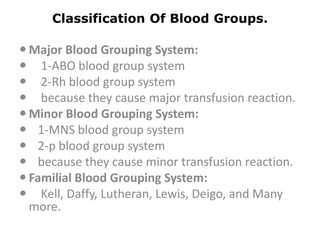
Classification Of Blood Groups.
 Major Blood Grouping System:
 1-ABO blood group system
 2-Rh blood group system
 because they cause major transfusion reaction.
 Minor Blood Grouping System:
 1-MNS blood group system
 2-p blood group system
 because they cause minor transfusion reaction.
 Familial Blood Grouping System:
 Kell, Daffy, Lutheran, Lewis, Deigo, and Many
more.
According to the ABO blood
typing system there are four
different kinds of blood types:
A, B, AB or O (null).
ABO blood grouping system
Landsteiner Law
• It was given by Karl Landsteiner in
1900.
• It states that ; If an agglutinogen is
present on the RBC of an individual,
the corresponding agglutinin must be
absent in the plasma of that
individual and vice-versa.
• This law is only applicable to ABO
blood grouping system.
Blood group A
If you belong to the blood
group A, you have A
antigens on the surface of
your RBCs and B
antibodies in your blood
plasma.
Blood group B
If you belong to the blood
group B, you have B
antigens on the surface of
your RBCs and A
antibodies in your blood
plasma.
AB0 blood grouping system
Blood group AB
If you belong to the blood group
AB, you have both A and B
antigens on the surface of your
RBCs and no A or B antibodies
at all in your blood plasma.
Blood group O
If you belong to the blood group O
(null), you have neither A or B
antigens on the surface of your RBCs
but you have both A and B antibodies
in your blood plasma.
Blood
Group
Antigens Antibodies Can give
blood to
Can
receive
blood from
AB A and B None AB AB, A, B, O
A A B A and AB A and O
B B A B and AB B and O
O None A and B AB, A, B, O O
Blood group O is called
"universal donor"
because it has no antigens
on RBC.
Blood group AB are called
"universal receivers“
because it has no anti-
bodies in the plasma.
The Rhesus (Rh) System
Landsteiner and Weiner in 1940 discovered other
antigens in human R.B.Cs and named rhesus antigens
or Rh-antigen because the same antigens are present in
monkey.
One of the basic difference between ABO and Rh
systems is that the Rh antibodies are not natural i.e.
they are not present at birth but are synthesised in Rh
negative persons in response to the presence of
Rh+antigen.
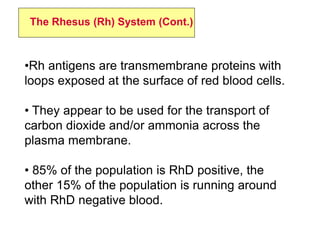
The Rhesus (Rh) System (Cont.)
•Rh antigens are transmembrane proteins with
loops exposed at the surface of red blood cells.
• They appear to be used for the transport of
carbon dioxide and/or ammonia across the
plasma membrane.
• 85% of the population is RhD positive, the
other 15% of the population is running around
with RhD negative blood.
• A person with Rh- blood develop Rh antibodies in the
blood plasma if he or she receives blood from a
person with Rh+ blood. If such a person is given Rh+
blood, its anti-Rh antibodies react with the donor’s Rh
antigens and aggulate the blood.
•A person with Rh+ blood can receive blood from a
person with Rh- blood without any problems.
Why is an Rh incompatibility so dangerous
when ABO incompatibility is not during
pregnancy?
Incompatibility is seen between Rh- woman and her foetus. Rh-
woman when married to Rh+ man bears Rh+ foetus. Although
the foetal and maternal blood do not come in direct contact due
to placental barrier, some foetal R.B.C’s manage to enter the
maternal blood stream. The Rh antigen on their surface induces
formation of anti-Rh antibodies. These antibodies then cross the
placenta and enter the foetus blood circulation and cause a
blood disorder known as erythroblastosis foetalis. The
reaction of Rh-woman against her Rh+offspring becomes
progressively more severe with each subsequent pregnancy.
Mis-Matched Blood Transfusion
•The individuals of different blood groups are perfectly normal but
the incompatibility is expressed during blood transfusion.
•The antibodies of recipients blood reacts against the antigens of
donor’s blood and cause the clumping of R.B.Cs known as
agglutination.
•The agglutination can cause serious consequences and may
prove fatal.
•That is why doctor make careful tests to determine what blood
must safely be used in transfusion.
•The anti- bodies in the plasma must not combine with the
antigens on the surface of the red blood cells, or else
agglutination occurs.
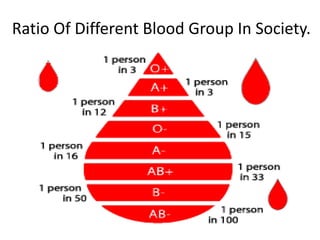
Ratio Of Different Blood Group In Society.
Thank You

Blood groups

  • 1.
    Blood Groups. Gmers Medical College, Valsad 1stMBBS Roll No: 21-30 Batch: C Mentor: Dr. Divyesh Sir Blood Groups. Annepaka eliya raju Tutor Mamata medical college
  • 2.
    •The differences inhuman blood are due to the presence or absence of certain protein molecules called antigens and antibodies. •The antigens are located on the surface of the RBCs and the antibodies are in the blood plasma. •Individuals have different types and combinations of these molecules. •The blood group you belong to depends on what you have inherited from your parents. What are the different blood groups?
  • 3.
    • There aremore than 20 genetically determined blood group systems known today •Eg. ABO System,Rh-System MNS System, Kell System, Lewis System • The AB0 and Rhesus (Rh) systems are the most important ones used for blood transfusions. • Not all blood groups are compatible with each other. Mixing incompatible blood groups leads to blood clumping or agglutination, which is dangerous for individuals. What are the different blood groups?
  • 4.
    Classification Of BloodGroups.  Major Blood Grouping System:  1-ABO blood group system  2-Rh blood group system  because they cause major transfusion reaction.  Minor Blood Grouping System:  1-MNS blood group system  2-p blood group system  because they cause minor transfusion reaction.  Familial Blood Grouping System:  Kell, Daffy, Lutheran, Lewis, Deigo, and Many more.
  • 5.
    According to theABO blood typing system there are four different kinds of blood types: A, B, AB or O (null). ABO blood grouping system
  • 6.
    Landsteiner Law • Itwas given by Karl Landsteiner in 1900. • It states that ; If an agglutinogen is present on the RBC of an individual, the corresponding agglutinin must be absent in the plasma of that individual and vice-versa. • This law is only applicable to ABO blood grouping system.
  • 8.
    Blood group A Ifyou belong to the blood group A, you have A antigens on the surface of your RBCs and B antibodies in your blood plasma. Blood group B If you belong to the blood group B, you have B antigens on the surface of your RBCs and A antibodies in your blood plasma. AB0 blood grouping system
  • 9.
    Blood group AB Ifyou belong to the blood group AB, you have both A and B antigens on the surface of your RBCs and no A or B antibodies at all in your blood plasma. Blood group O If you belong to the blood group O (null), you have neither A or B antigens on the surface of your RBCs but you have both A and B antibodies in your blood plasma.
  • 10.
    Blood Group Antigens Antibodies Cangive blood to Can receive blood from AB A and B None AB AB, A, B, O A A B A and AB A and O B B A B and AB B and O O None A and B AB, A, B, O O
  • 11.
    Blood group Ois called "universal donor" because it has no antigens on RBC. Blood group AB are called "universal receivers“ because it has no anti- bodies in the plasma.
  • 12.
  • 13.
    Landsteiner and Weinerin 1940 discovered other antigens in human R.B.Cs and named rhesus antigens or Rh-antigen because the same antigens are present in monkey. One of the basic difference between ABO and Rh systems is that the Rh antibodies are not natural i.e. they are not present at birth but are synthesised in Rh negative persons in response to the presence of Rh+antigen. The Rhesus (Rh) System (Cont.)
  • 14.
    The Rhesus (Rh)System (Cont.) •Rh antigens are transmembrane proteins with loops exposed at the surface of red blood cells. • They appear to be used for the transport of carbon dioxide and/or ammonia across the plasma membrane. • 85% of the population is RhD positive, the other 15% of the population is running around with RhD negative blood.
  • 15.
    • A personwith Rh- blood develop Rh antibodies in the blood plasma if he or she receives blood from a person with Rh+ blood. If such a person is given Rh+ blood, its anti-Rh antibodies react with the donor’s Rh antigens and aggulate the blood. •A person with Rh+ blood can receive blood from a person with Rh- blood without any problems.
  • 16.
    Why is anRh incompatibility so dangerous when ABO incompatibility is not during pregnancy? Incompatibility is seen between Rh- woman and her foetus. Rh- woman when married to Rh+ man bears Rh+ foetus. Although the foetal and maternal blood do not come in direct contact due to placental barrier, some foetal R.B.C’s manage to enter the maternal blood stream. The Rh antigen on their surface induces formation of anti-Rh antibodies. These antibodies then cross the placenta and enter the foetus blood circulation and cause a blood disorder known as erythroblastosis foetalis. The reaction of Rh-woman against her Rh+offspring becomes progressively more severe with each subsequent pregnancy.
  • 17.
    Mis-Matched Blood Transfusion •Theindividuals of different blood groups are perfectly normal but the incompatibility is expressed during blood transfusion. •The antibodies of recipients blood reacts against the antigens of donor’s blood and cause the clumping of R.B.Cs known as agglutination. •The agglutination can cause serious consequences and may prove fatal. •That is why doctor make careful tests to determine what blood must safely be used in transfusion. •The anti- bodies in the plasma must not combine with the antigens on the surface of the red blood cells, or else agglutination occurs.
  • 18.
    Ratio Of DifferentBlood Group In Society.
  • 19.