BLOOD GROUPS
WHAT IS BLOOD GROUP?
•Blood groups are complex chemical systems found on the
surface of blood cells. The two main blood group system in
transfusion practice are ABO and Rh(D) type.
•The outer layer of RBCs membrane contain certain antigens
which are chemically glycoprotein and called agglutinogens.
•According to the presence of these antigens, human blood can
be classified into many groups.
•Most of these antigens are weak and are mainly of importance
in genetic study.
ABO SYSTEM
This system includes 2 types of antigens A and B Agglutinoge
-ns. According to the presence of A and B antigens there are
4 groups of human blood :
1. Group A (about 41%) : when only type A antigen is present.
2. Group B (about 9%) : when only type B antigen is present.
3. Group AB (about 3%): when both types A and B antigens
are present.
4. Group O (about 47%): when both types A and B antigens
are absent.
ANTIGENS IN PLASMA
• Plasma contain certain antibodies against the red cells
agglutinogens called Agglutinins which are of 2 types :
i. Anti-A (or Alpha) agglutinins.
ii. Anti-B (or Beta ) agglutinins.
BLOOD
GROUP
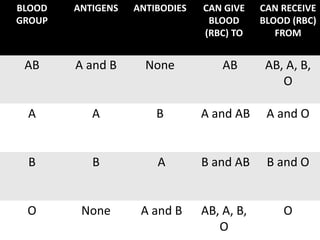
ANTIGENS ANTIBODIES CAN GIVE
BLOOD
(RBC) TO
CAN RECEIVE
BLOOD (RBC)
FROM
AB A and B None AB AB, A, B,
O
A A B A and AB A and O
B B A B and AB B and O
O None A and B AB, A, B,
O
O
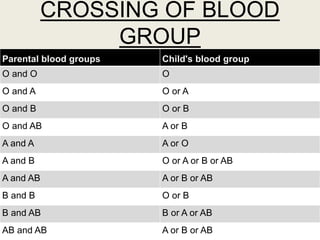
CROSSING OF BLOOD
GROUP
Parental blood groups Child's blood group
O and O O
O and A O or A
O and B O or B
O and AB A or B
A and A A or O
A and B O or A or B or AB
A and AB A or B or AB
B and B O or B
B and AB B or A or AB
AB and AB A or B or AB
Blood Agglutination and
Coagulation
• Agglutination means clumping of RBCs together due
to antigen-antibody reaction (ABO incompatibility).
Agglutination causes RBCs to undergo clumping.
• Blood coagulation or clotting, is the process of
converting blood into a semisolid jelly-like substance.
Blood clot starts when there is an injury to the body.
RHESUS SYSTEM (Rh
FACTOR)
•This is system of agglutinogens normally present in the red
cells. Rh factor, also called Rhesus factor, is a type of protein
found on the outside of red blood cells. The protein is
genetically inherited (passed down from your parents).
•The majority of people, about 85%, are Rh-positive and
remaining 15% are Rh-negative.
•There are 6 varieties known as(dominant C , D and E) antigens
and (recessive c , d and e ) antigens.
•Antigen D has the strongest antigenic effect So :
a. If D antigen is present → Rh +ve.
b. If D antigen is absent → Rh –ve.
Blood is further classified as being either "Rh positive" (meaning it has
Rh factor) or "Rh negative" (without Rh factor).
So, there are eight possible blood types:
1. O negative: This blood type doesn't have A or B markers, and it
doesn't have Rh factor.
2. O positive: This blood type doesn't have A or B markers, but it does
have Rh factor. O positive blood is one of the two most common
blood types (the other being A positive).
3. A negative: This blood type has A marker only.
4. A positive: This blood type has A marker and Rh factor, but not B
marker. Along with O positive, it's one of the two most common
blood types.
5. B negative: This blood type has B marker only.
6. B positive: This blood type has B marker and Rh factor, but not A
marker.
7. AB negative: This blood type has A and B markers, but not Rh factor.
8. AB positive: This blood type has all three types of markers — A, B,
and Rh factor.
Determination of ABO system
• Mix one drop of blood with 1 ml of isotonic saline in a
test tube.
• Put 2 separate drops of the diluted blood on a glass
slide.
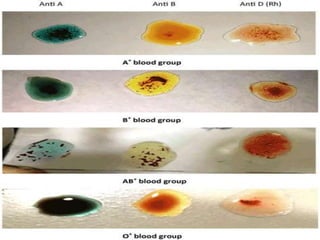
• Add one drop of anti-A serum (blue colored) to one
blood drop and one drop of anti-B (yellow colored) to
the other drop.
• Mix the blood with anti-A and anti-B sera gently using
the blunt end of two separate pins.
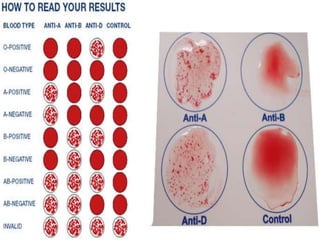
After 2 minutes examine for agglutination :
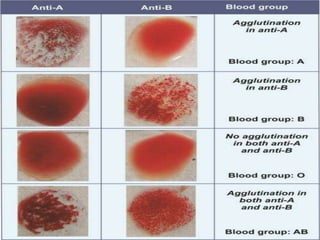
i.) If agglutination occurs with anti-A serum only, the blood
group is type.
ii.) If agglutination occurs with anti-B serum only, the blood
group is type B.
iii.) If agglutination occurs with both anti-A and anti-B sera, the
blood group is type AB.
iv.) If no agglutination occurs with either anti-A or anti-B, the
blood group is type O.
Put 2 drops of diluted blood on a glass slide.
i. Add one drop of anti-D serum to the blood and mix gently
with the blunt end of a pin.
ii. Examine for agglutination :
If agglutination occurs , the blood group is Rh +ve.
If no agglutination occurs , the blood group is Rh –ve.
THANK YOU

Blood group ppt

  • 1.
  • 2.
    WHAT IS BLOODGROUP? •Blood groups are complex chemical systems found on the surface of blood cells. The two main blood group system in transfusion practice are ABO and Rh(D) type. •The outer layer of RBCs membrane contain certain antigens which are chemically glycoprotein and called agglutinogens. •According to the presence of these antigens, human blood can be classified into many groups. •Most of these antigens are weak and are mainly of importance in genetic study.
  • 3.
    ABO SYSTEM This systemincludes 2 types of antigens A and B Agglutinoge -ns. According to the presence of A and B antigens there are 4 groups of human blood : 1. Group A (about 41%) : when only type A antigen is present. 2. Group B (about 9%) : when only type B antigen is present. 3. Group AB (about 3%): when both types A and B antigens are present. 4. Group O (about 47%): when both types A and B antigens are absent.
  • 4.
    ANTIGENS IN PLASMA •Plasma contain certain antibodies against the red cells agglutinogens called Agglutinins which are of 2 types : i. Anti-A (or Alpha) agglutinins. ii. Anti-B (or Beta ) agglutinins.
  • 5.
    BLOOD GROUP ANTIGENS ANTIBODIES CANGIVE BLOOD (RBC) TO CAN RECEIVE BLOOD (RBC) FROM AB A and B None AB AB, A, B, O A A B A and AB A and O B B A B and AB B and O O None A and B AB, A, B, O O
  • 7.
    CROSSING OF BLOOD GROUP Parentalblood groups Child's blood group O and O O O and A O or A O and B O or B O and AB A or B A and A A or O A and B O or A or B or AB A and AB A or B or AB B and B O or B B and AB B or A or AB AB and AB A or B or AB
  • 8.
    Blood Agglutination and Coagulation •Agglutination means clumping of RBCs together due to antigen-antibody reaction (ABO incompatibility). Agglutination causes RBCs to undergo clumping. • Blood coagulation or clotting, is the process of converting blood into a semisolid jelly-like substance. Blood clot starts when there is an injury to the body.
  • 9.
    RHESUS SYSTEM (Rh FACTOR) •Thisis system of agglutinogens normally present in the red cells. Rh factor, also called Rhesus factor, is a type of protein found on the outside of red blood cells. The protein is genetically inherited (passed down from your parents). •The majority of people, about 85%, are Rh-positive and remaining 15% are Rh-negative. •There are 6 varieties known as(dominant C , D and E) antigens and (recessive c , d and e ) antigens. •Antigen D has the strongest antigenic effect So : a. If D antigen is present → Rh +ve. b. If D antigen is absent → Rh –ve.
  • 10.
    Blood is furtherclassified as being either "Rh positive" (meaning it has Rh factor) or "Rh negative" (without Rh factor). So, there are eight possible blood types: 1. O negative: This blood type doesn't have A or B markers, and it doesn't have Rh factor. 2. O positive: This blood type doesn't have A or B markers, but it does have Rh factor. O positive blood is one of the two most common blood types (the other being A positive). 3. A negative: This blood type has A marker only. 4. A positive: This blood type has A marker and Rh factor, but not B marker. Along with O positive, it's one of the two most common blood types. 5. B negative: This blood type has B marker only. 6. B positive: This blood type has B marker and Rh factor, but not A marker. 7. AB negative: This blood type has A and B markers, but not Rh factor. 8. AB positive: This blood type has all three types of markers — A, B, and Rh factor.
  • 12.
    Determination of ABOsystem • Mix one drop of blood with 1 ml of isotonic saline in a test tube. • Put 2 separate drops of the diluted blood on a glass slide. • Add one drop of anti-A serum (blue colored) to one blood drop and one drop of anti-B (yellow colored) to the other drop. • Mix the blood with anti-A and anti-B sera gently using the blunt end of two separate pins.
  • 13.
    After 2 minutesexamine for agglutination : i.) If agglutination occurs with anti-A serum only, the blood group is type. ii.) If agglutination occurs with anti-B serum only, the blood group is type B. iii.) If agglutination occurs with both anti-A and anti-B sera, the blood group is type AB. iv.) If no agglutination occurs with either anti-A or anti-B, the blood group is type O. Put 2 drops of diluted blood on a glass slide. i. Add one drop of anti-D serum to the blood and mix gently with the blunt end of a pin. ii. Examine for agglutination : If agglutination occurs , the blood group is Rh +ve. If no agglutination occurs , the blood group is Rh –ve.
  • 15.