BLOOD
GROUPING
Dr.Janani Mathialagan,
1st year postgraduate,
Pathology
OBJECTIVES
– Importance of blood grouping
– Landsteiner’s law
– Typing techniques
– Slide method
– Tube method
– Cross-matching
NEED FOR BLOOD
GROUPING
– BLOOD TRANSFUSION
– HEMOLYTIC DISEASE OF NEWBORN
– PATERNITY DISPUTES
– MEDICOLEGAL USE
– SUSCEPTIBILITY TO VARIOUS DISEASES
– ROUTINE HEALTH CHECKUP
LANDSTEINER’S LAW
– If an antigen is present on a patient’s red blood cells, the corresponding
antibody will not be present in the patient’s plasma under normal
conditions.
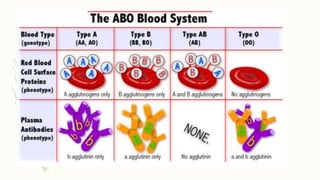
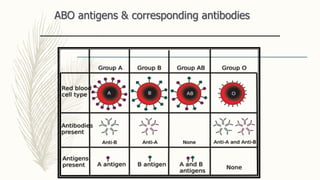
Reciprocal relationship between ABO
antigens and antibodies
Antigens on
RBCs
Antibody in plasma /
serum
Blood
group
A Anti-B A
B Anti-A B
AB None AB
None Anti-A, Anti-B O
ABO antigens & corresponding antibodies
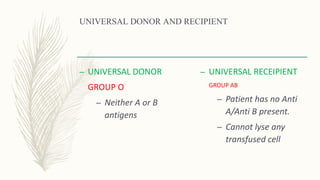
UNIVERSAL DONOR AND RECIPIENT
– UNIVERSAL DONOR
GROUP O
– Neither A or B
antigens
– UNIVERSAL RECEIPIENT
GROUP AB
– Patient has no Anti
A/Anti B present.
– Cannot lyse any
transfused cell
ABO TYPING TECHNIQUES
– Slide test
– Tube technique
– Microplate
– Gel system
SLIDE GROUPING
ADVANTAGES:
– Preliminary typing tests
– Use during camps
DISADVANTAGES:
– Not routine test
– Less sensitive
– Drying of reaction giving to false positive results
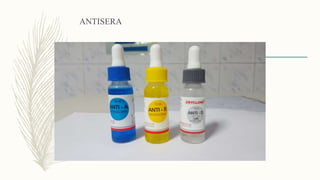
ANTISERA
SLIDE GROUPING
– Test should be done at room temperature or lower
– Tubes, slides should be dry and labeled properly
– Antisera should always be added before adding cells
– Results should be recorded immediately after observation
– Hemolysis is interpreted as positive result
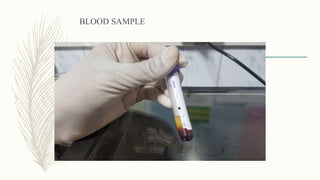
BLOOD SAMPLE
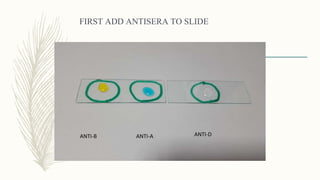
FIRST ADD ANTISERA TO SLIDE
ANTI-B ANTI-A ANTI-D
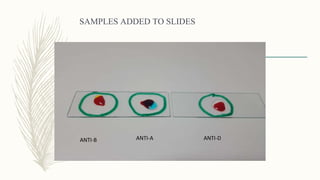
SAMPLES ADDED TO SLIDES
ANTI-B ANTI-A ANTI-D
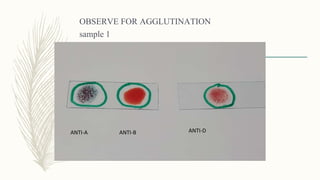
OBSERVE FOR AGGLUTINATION
sample 1
ANTI-A ANTI-B ANTI-D
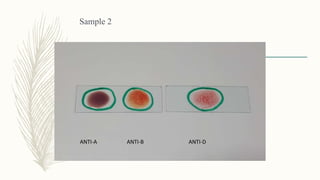
Sample 2
ANTI-A ANTI-B ANTI-D
Test Tube Method
Recommended method (Gold standard)
– Allows longer incubation of antigen and antibody
mixture without drying
– Tubes can be centrifuged to enhance reaction
– Can detect weaker antigen / antibody
Two steps in ABO grouping
Cell grouping (Forward grouping)
– Tests the patients red cells with known Anti-A & Anti-
B to determine the antigen expressed
Serum grouping (Reverse grouping)
– Test the patients serum with known A & B cells to
determine the presence of antibody
CELL GROUPING ( Forward grouping)
– Prepare 2-5% suspension of test sample in normal saline
– Set three tubes , label them as A,B, D
– Add two drops of anti A , anti-B, anti D in three different tubes
– Add one drop of 2-5% cell suspension (Ratio of 2:1)
– Mix contents well and centrifuge at 1500 rpm for 1 minute
– Observe for hemolysis
– Gently disperse cell button and check for agglutination
– Confirm negative results under microscope
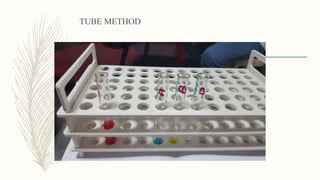
TUBE METHOD
SAMPLE ADDED
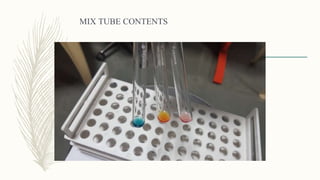
MIX TUBE CONTENTS
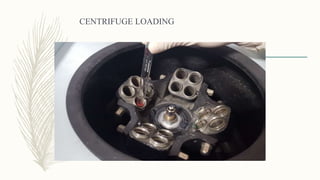
CENTRIFUGE LOADING
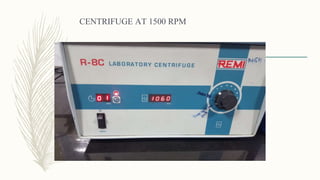
CENTRIFUGE AT 1500 RPM
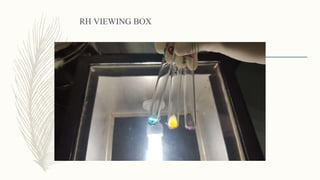
RH VIEWING BOX
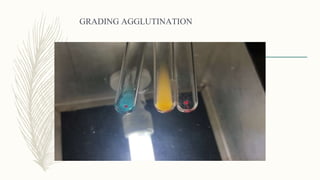
GRADING AGGLUTINATION
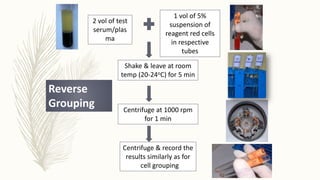
SERUM GROUPING ( REVERSE GROUPING)
– Prepare 2-5% suspension of pooled cells A,B,O
– Label three tubes A cells, B cells and O cells
– Place two drops of serum in each tube
– Add one drop of cell suspension ( A cell to A tube, B cell to B tube and one drop of
O cell to O tube
– Centrifuge tubes at 1500 rpm for 1 minute
– Gently disperse for agglutination
– Negative results check by microscope
2 vol of test
serum/plas
ma
1 vol of 5%
suspension of
reagent red cells
in respective
tubes
Reverse
Grouping Centrifuge at 1000 rpm
for 1 min
Centrifuge & record the
results similarly as for
cell grouping
Shake & leave at room
temp (20-24oC) for 5 min
GRADING OF AGGLUTINATION
CROSS MATCHING
– A pre-requisite for blood transfusion
– Purpose: to avoid reactions of mismatched transfusion
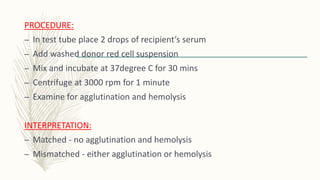
PROCEDURE:
– In test tube place 2 drops of recipient’s serum
– Add washed donor red cell suspension
– Mix and incubate at 37degree C for 30 mins
– Centrifuge at 3000 rpm for 1 minute
– Examine for agglutination and hemolysis
INTERPRETATION:
– Matched - no agglutination and hemolysis
– Mismatched - either agglutination or hemolysis

Blood grouping

  • 1.
  • 2.
    OBJECTIVES – Importance ofblood grouping – Landsteiner’s law – Typing techniques – Slide method – Tube method – Cross-matching
  • 3.
    NEED FOR BLOOD GROUPING –BLOOD TRANSFUSION – HEMOLYTIC DISEASE OF NEWBORN – PATERNITY DISPUTES – MEDICOLEGAL USE – SUSCEPTIBILITY TO VARIOUS DISEASES – ROUTINE HEALTH CHECKUP
  • 4.
    LANDSTEINER’S LAW – Ifan antigen is present on a patient’s red blood cells, the corresponding antibody will not be present in the patient’s plasma under normal conditions.
  • 5.
    Reciprocal relationship betweenABO antigens and antibodies Antigens on RBCs Antibody in plasma / serum Blood group A Anti-B A B Anti-A B AB None AB None Anti-A, Anti-B O
  • 7.
    ABO antigens &corresponding antibodies
  • 8.
    UNIVERSAL DONOR ANDRECIPIENT – UNIVERSAL DONOR GROUP O – Neither A or B antigens – UNIVERSAL RECEIPIENT GROUP AB – Patient has no Anti A/Anti B present. – Cannot lyse any transfused cell
  • 9.
    ABO TYPING TECHNIQUES –Slide test – Tube technique – Microplate – Gel system
  • 10.
    SLIDE GROUPING ADVANTAGES: – Preliminarytyping tests – Use during camps DISADVANTAGES: – Not routine test – Less sensitive – Drying of reaction giving to false positive results
  • 11.
  • 12.
    SLIDE GROUPING – Testshould be done at room temperature or lower – Tubes, slides should be dry and labeled properly – Antisera should always be added before adding cells – Results should be recorded immediately after observation – Hemolysis is interpreted as positive result
  • 13.
  • 14.
    FIRST ADD ANTISERATO SLIDE ANTI-B ANTI-A ANTI-D
  • 15.
    SAMPLES ADDED TOSLIDES ANTI-B ANTI-A ANTI-D
  • 16.
    OBSERVE FOR AGGLUTINATION sample1 ANTI-A ANTI-B ANTI-D
  • 17.
  • 18.
    Test Tube Method Recommendedmethod (Gold standard) – Allows longer incubation of antigen and antibody mixture without drying – Tubes can be centrifuged to enhance reaction – Can detect weaker antigen / antibody Two steps in ABO grouping Cell grouping (Forward grouping) – Tests the patients red cells with known Anti-A & Anti- B to determine the antigen expressed Serum grouping (Reverse grouping) – Test the patients serum with known A & B cells to determine the presence of antibody
  • 19.
    CELL GROUPING (Forward grouping) – Prepare 2-5% suspension of test sample in normal saline – Set three tubes , label them as A,B, D – Add two drops of anti A , anti-B, anti D in three different tubes – Add one drop of 2-5% cell suspension (Ratio of 2:1) – Mix contents well and centrifuge at 1500 rpm for 1 minute – Observe for hemolysis – Gently disperse cell button and check for agglutination – Confirm negative results under microscope
  • 20.
  • 21.
  • 22.
  • 23.
  • 24.
  • 25.
  • 26.
  • 27.
    SERUM GROUPING (REVERSE GROUPING) – Prepare 2-5% suspension of pooled cells A,B,O – Label three tubes A cells, B cells and O cells – Place two drops of serum in each tube – Add one drop of cell suspension ( A cell to A tube, B cell to B tube and one drop of O cell to O tube – Centrifuge tubes at 1500 rpm for 1 minute – Gently disperse for agglutination – Negative results check by microscope
  • 28.
    2 vol oftest serum/plas ma 1 vol of 5% suspension of reagent red cells in respective tubes Reverse Grouping Centrifuge at 1000 rpm for 1 min Centrifuge & record the results similarly as for cell grouping Shake & leave at room temp (20-24oC) for 5 min
  • 29.
  • 30.
    CROSS MATCHING – Apre-requisite for blood transfusion – Purpose: to avoid reactions of mismatched transfusion
  • 31.
    PROCEDURE: – In testtube place 2 drops of recipient’s serum – Add washed donor red cell suspension – Mix and incubate at 37degree C for 30 mins – Centrifuge at 3000 rpm for 1 minute – Examine for agglutination and hemolysis INTERPRETATION: – Matched - no agglutination and hemolysis – Mismatched - either agglutination or hemolysis

Editor's Notes

  • #13 To ensure that serum is added to the test tube it should always be added first to the test tube or slide. If red cells are added first, it would be difficult to know if serum was added or not. This may result in wrong results.
  • #29 Take 2 volumes of serum or plasma in a clean labelled test tubes for A cell, B cell and O cells Add 5% red cell suspension in respective tubes Incubate at room temperature for 5 min Centrifuge at 1000 RPM for 1 min Look for agglutination