Dr. Sandeep singh
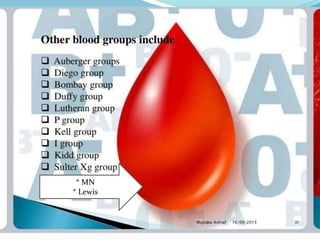
* MN
* Lewis
WHY IS BLOOD GROUPING
IMPORTANT ?
 ABO Blood group typing is the most
important test in assuring a safe blood.
For example, a patient who is blood group B has
naturally occurring Anti-A antibodies in the blood.
If this (blood group B) patient receives blood
group A blood, the Anti-A antibodies in the blood
of the patient will cause the blood group A blood
cells to clump intravenously which is life
threatening.
Pregnant women and blood grouping
 Blood typing is particularly important for pregnant women,
where the father of the baby has the RhD positive blood
group and the mother of the baby has the RhD negative blood
group. If the baby has the RhD positive blood group, it may
cause medical complications.
 To investigate in case of paternity dispute.
 To identify the persons in forensic cases.
 For tissue matching in organ transplantation.
 Research purposes
AIM
 Understanding clinical significance in ABO & Rh
blood group systems.
 Understanding practical aspects of ABO & Rh
blood grouping.
HUMAN BLOOD GROUPS
o The blood groups are defined by the presence or
absence of a specific antigen (protein / glycoprotein)
on the external surface of a red blood cell.
o These antigens are
• Unique to the individual
• Recognized as foreign if transfused into another
individual
• Promote agglutination of red cells if combine with
antibody
• More than 30 such antigen systems discovered
o Presence or absence of these antigens is used to
classify blood groups
o Major blood groups –ABO & Rh
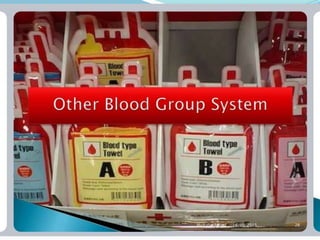
o Minor blood groups –MN, li, P, Lewis, Duffy, Kidd, Kell
, Lutheran etc
ABO BLOOD GROUPS
 Most well known & clinically important blood group
system.
 It was the first to be identified and is the most significant
for transfusion practice
 It is the ONLY system that the reciprocal antibodies are
consistently and predictably present in the sera of people
who have had no exposure to human red cells
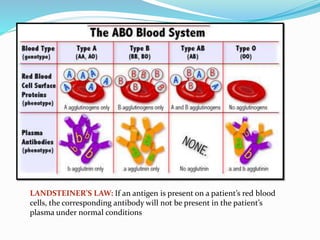
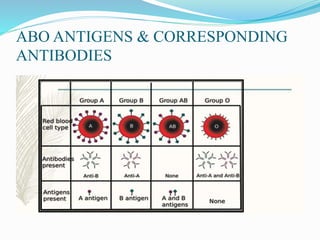
 ABO blood group consist of
 Two antigens (A & B) on the surface of the RBCs
 Two antibodies in the plasma (anti-A & anti-B)
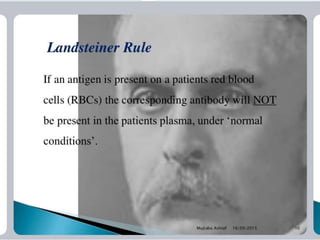
LANDSTEINER’S LAW: If an antigen is present on a patient’s red blood
cells, the corresponding antibody will not be present in the patient’s
plasma under normal conditions
ABO ANTIGENS & CORRESPONDING
ANTIBODIES
PRINCIPLE OF BLOOD
GROUPING
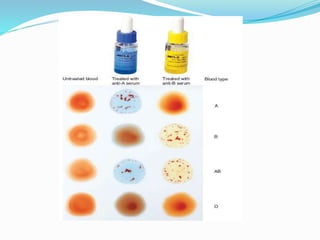
 Blood grouping is done on the basis of
agglutination.
 Agglutination means the collection of separate
particles like RBCs into clumps or masses.
 Agglutination occurs if an antigen is mixed with its
corresponding antibody which is called
isoagglutinin, i.e. occurs when A antigen is mixed
with anti-A or when B antigen is mixed with anti-
B.
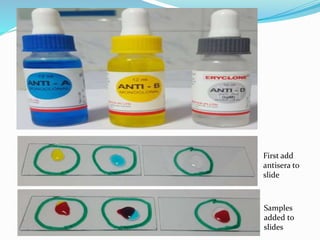
SLIDE GROUPING METHOD
 Test should be done at room temperature
 Tubes, slides should be dry & labelled properly
 Antisera should always be added before adding
cells
 Results should be recorded immediately after
observation
 Hemolysis is interpreted as positive result
First add
antisera to
slide
Samples
added to
slides
ABO BLOOD GROUPING
PROCEDURE
Materials
 Anti-coagulated blood samples, Anti-A, Anti-B,
Glass slides, Sticks.
Procedure: Glass Slide Method
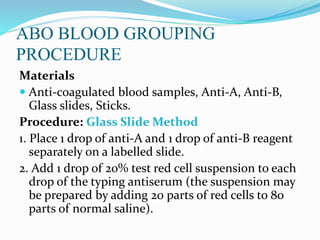
1. Place 1 drop of anti-A and 1 drop of anti-B reagent
separately on a labelled slide.
2. Add 1 drop of 20% test red cell suspension to each
drop of the typing antiserum (the suspension may
be prepared by adding 20 parts of red cells to 80
parts of normal saline).
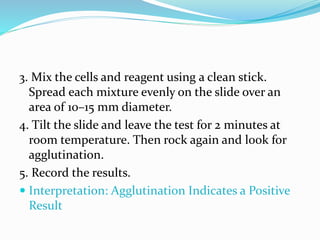
3. Mix the cells and reagent using a clean stick.
Spread each mixture evenly on the slide over an
area of 10–15 mm diameter.
4. Tilt the slide and leave the test for 2 minutes at
room temperature. Then rock again and look for
agglutination.
5. Record the results.
 Interpretation: Agglutination Indicates a Positive
Result
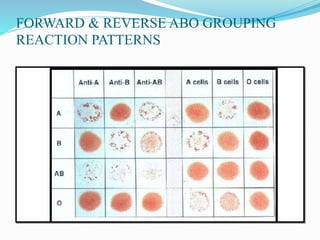
FORWARD & REVERSE ABO GROUPING
REACTION PATTERNS
TEST TUBE METHOD
 Recommended method (Gold standard)
 Allows longer incubation of antigen and antibody
mixture without drying
 Tubes can be centrifuged to enhance reaction
 Can detect weaker antigen / antibody
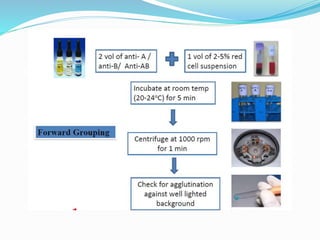
Two steps in ABO grouping
 Cell grouping (Forward grouping): Tests the
patients red cells with known Anti-A & Anti-B to
determine the antigen expressed
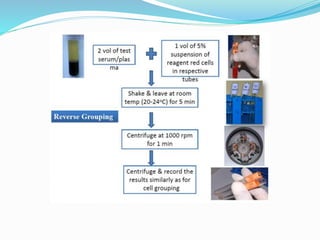
 Serum grouping (Reverse grouping): Test the
patients serum with known A & B cells to
determine the presence of antibody
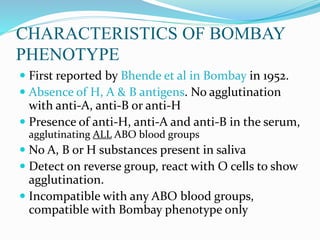
CHARACTERISTICS OF BOMBAY
PHENOTYPE
 First reported by Bhende et al in Bombay in 1952.
 Absence of H, A & B antigens. No agglutination
with anti-A, anti-B or anti-H
 Presence of anti-H, anti-A and anti-B in the serum,
agglutinating ALL ABO blood groups
 No A, B or H substances present in saliva
 Detect on reverse group, react with O cells to show
agglutination.
 Incompatible with any ABO blood groups,
compatible with Bombay phenotype only
RH BLOOD GROUPING
PROCEDURE
Materials
 Anti-coagulated blood samples, Anti-D anti-sera, Glass
slides, Sticks.
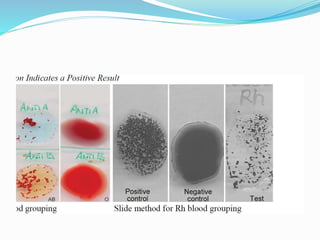
Procedure: Glass Slide Method
1. Take three slides and label as positive control, negative
control and Test
2. Place 1 drop of anti-D (monoclonal) reagent to each slide
3. Add 1 drop of 20% test red cell suspension to each drop
of the typing anti-serum. (The suspension may be
prepared by adding 20 parts of red cells to 80 parts of
normal saline).
4. Mix the cells and reagent using a clean stick.
Spread each mixture evenly on the slide over an
area of 10–15 mm diameter.
5. Place the slides on a view box surface (lighted), tilt
gently and continuously for two minutes.
6. Observe for agglutination and record the results.
All negative results must be confirmed under
microscope.
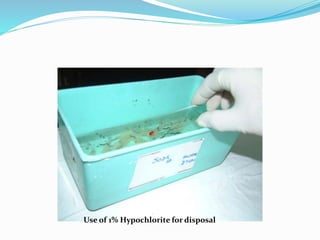
Use of 1% Hypochlorite for disposal
TUBE TECHNIQUE FOR RH
TYPING
 Prepare 5% washed red cell suspension of test
sample.
 Take two clean test tubes and label tubes 1 as
“test” and tube 2 as “control”.
 Place 1 drop of anti-D in tube 1 & Place 1 drop of
22% bovine albumin / control in tube 2.
 Add 1 drop of 5% test cell suspension to each tube.
 Mix well, centrifuge at 1000 rpm for 1 min.
 Re suspend cell button & look for agglutination
 Control tube should show no agglutination
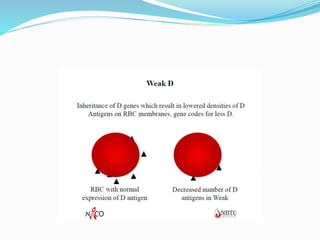
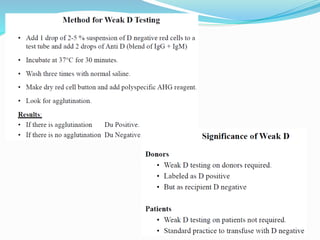
 For all RhD negative test on blood donor, Du test
recommended
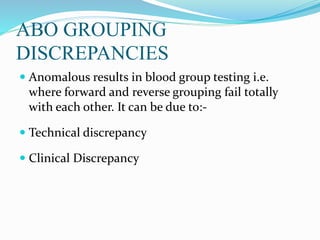
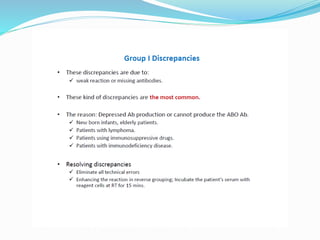
ABO GROUPING
DISCREPANCIES
 Anomalous results in blood group testing i.e.
where forward and reverse grouping fail totally
with each other. It can be due to:-
 Technical discrepancy
 Clinical Discrepancy
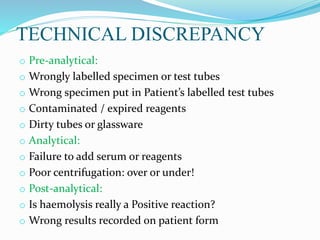
TECHNICAL DISCREPANCY
o Pre-analytical:
o Wrongly labelled specimen or test tubes
o Wrong specimen put in Patient’s labelled test tubes
o Contaminated / expired reagents
o Dirty tubes or glassware
o Analytical:
o Failure to add serum or reagents
o Poor centrifugation: over or under!
o Post-analytical:
o Is haemolysis really a Positive reaction?
o Wrong results recorded on patient form
Thank you

ABO Blood Group System.pptx

  • 1.
  • 11.
  • 12.
    WHY IS BLOODGROUPING IMPORTANT ?  ABO Blood group typing is the most important test in assuring a safe blood. For example, a patient who is blood group B has naturally occurring Anti-A antibodies in the blood. If this (blood group B) patient receives blood group A blood, the Anti-A antibodies in the blood of the patient will cause the blood group A blood cells to clump intravenously which is life threatening.
  • 13.
    Pregnant women andblood grouping  Blood typing is particularly important for pregnant women, where the father of the baby has the RhD positive blood group and the mother of the baby has the RhD negative blood group. If the baby has the RhD positive blood group, it may cause medical complications.  To investigate in case of paternity dispute.  To identify the persons in forensic cases.  For tissue matching in organ transplantation.  Research purposes
  • 14.
    AIM  Understanding clinicalsignificance in ABO & Rh blood group systems.  Understanding practical aspects of ABO & Rh blood grouping.
  • 15.
    HUMAN BLOOD GROUPS oThe blood groups are defined by the presence or absence of a specific antigen (protein / glycoprotein) on the external surface of a red blood cell. o These antigens are • Unique to the individual • Recognized as foreign if transfused into another individual • Promote agglutination of red cells if combine with antibody • More than 30 such antigen systems discovered
  • 16.
    o Presence orabsence of these antigens is used to classify blood groups o Major blood groups –ABO & Rh o Minor blood groups –MN, li, P, Lewis, Duffy, Kidd, Kell , Lutheran etc
  • 17.
    ABO BLOOD GROUPS Most well known & clinically important blood group system.  It was the first to be identified and is the most significant for transfusion practice  It is the ONLY system that the reciprocal antibodies are consistently and predictably present in the sera of people who have had no exposure to human red cells  ABO blood group consist of  Two antigens (A & B) on the surface of the RBCs  Two antibodies in the plasma (anti-A & anti-B)
  • 18.
    LANDSTEINER’S LAW: Ifan antigen is present on a patient’s red blood cells, the corresponding antibody will not be present in the patient’s plasma under normal conditions
  • 19.
    ABO ANTIGENS &CORRESPONDING ANTIBODIES
  • 20.
    PRINCIPLE OF BLOOD GROUPING Blood grouping is done on the basis of agglutination.  Agglutination means the collection of separate particles like RBCs into clumps or masses.  Agglutination occurs if an antigen is mixed with its corresponding antibody which is called isoagglutinin, i.e. occurs when A antigen is mixed with anti-A or when B antigen is mixed with anti- B.
  • 21.
    SLIDE GROUPING METHOD Test should be done at room temperature  Tubes, slides should be dry & labelled properly  Antisera should always be added before adding cells  Results should be recorded immediately after observation  Hemolysis is interpreted as positive result
  • 22.
  • 23.
    ABO BLOOD GROUPING PROCEDURE Materials Anti-coagulated blood samples, Anti-A, Anti-B, Glass slides, Sticks. Procedure: Glass Slide Method 1. Place 1 drop of anti-A and 1 drop of anti-B reagent separately on a labelled slide. 2. Add 1 drop of 20% test red cell suspension to each drop of the typing antiserum (the suspension may be prepared by adding 20 parts of red cells to 80 parts of normal saline).
  • 24.
    3. Mix thecells and reagent using a clean stick. Spread each mixture evenly on the slide over an area of 10–15 mm diameter. 4. Tilt the slide and leave the test for 2 minutes at room temperature. Then rock again and look for agglutination. 5. Record the results.  Interpretation: Agglutination Indicates a Positive Result
  • 26.
    FORWARD & REVERSEABO GROUPING REACTION PATTERNS
  • 27.
    TEST TUBE METHOD Recommended method (Gold standard)  Allows longer incubation of antigen and antibody mixture without drying  Tubes can be centrifuged to enhance reaction  Can detect weaker antigen / antibody
  • 28.
    Two steps inABO grouping  Cell grouping (Forward grouping): Tests the patients red cells with known Anti-A & Anti-B to determine the antigen expressed  Serum grouping (Reverse grouping): Test the patients serum with known A & B cells to determine the presence of antibody
  • 33.
    CHARACTERISTICS OF BOMBAY PHENOTYPE First reported by Bhende et al in Bombay in 1952.  Absence of H, A & B antigens. No agglutination with anti-A, anti-B or anti-H  Presence of anti-H, anti-A and anti-B in the serum, agglutinating ALL ABO blood groups  No A, B or H substances present in saliva  Detect on reverse group, react with O cells to show agglutination.  Incompatible with any ABO blood groups, compatible with Bombay phenotype only
  • 34.
    RH BLOOD GROUPING PROCEDURE Materials Anti-coagulated blood samples, Anti-D anti-sera, Glass slides, Sticks. Procedure: Glass Slide Method 1. Take three slides and label as positive control, negative control and Test 2. Place 1 drop of anti-D (monoclonal) reagent to each slide 3. Add 1 drop of 20% test red cell suspension to each drop of the typing anti-serum. (The suspension may be prepared by adding 20 parts of red cells to 80 parts of normal saline).
  • 35.
    4. Mix thecells and reagent using a clean stick. Spread each mixture evenly on the slide over an area of 10–15 mm diameter. 5. Place the slides on a view box surface (lighted), tilt gently and continuously for two minutes. 6. Observe for agglutination and record the results. All negative results must be confirmed under microscope.
  • 37.
    Use of 1%Hypochlorite for disposal
  • 38.
    TUBE TECHNIQUE FORRH TYPING  Prepare 5% washed red cell suspension of test sample.  Take two clean test tubes and label tubes 1 as “test” and tube 2 as “control”.  Place 1 drop of anti-D in tube 1 & Place 1 drop of 22% bovine albumin / control in tube 2.  Add 1 drop of 5% test cell suspension to each tube.
  • 39.
     Mix well,centrifuge at 1000 rpm for 1 min.  Re suspend cell button & look for agglutination  Control tube should show no agglutination  For all RhD negative test on blood donor, Du test recommended
  • 42.
    ABO GROUPING DISCREPANCIES  Anomalousresults in blood group testing i.e. where forward and reverse grouping fail totally with each other. It can be due to:-  Technical discrepancy  Clinical Discrepancy
  • 43.
    TECHNICAL DISCREPANCY o Pre-analytical: oWrongly labelled specimen or test tubes o Wrong specimen put in Patient’s labelled test tubes o Contaminated / expired reagents o Dirty tubes or glassware o Analytical: o Failure to add serum or reagents o Poor centrifugation: over or under! o Post-analytical: o Is haemolysis really a Positive reaction? o Wrong results recorded on patient form
  • 47.