 What is coomb’s test ?
 Principle of the antiglobulin test.
 Types of antiglobulin tests.
 Reagents.
 Interpretation of antiglobulin tests.
 Positive antiglobulin test.
 Negative antiglobulin test.
 Role of coombs control check cells (CCC).
 Preparation of coomb’s control check cells.
 False positives and negatives.
 Direct antiglobulin testing.
 Indirect antiglobulin testing.
 Controls.
The antiglobulin test, which is also referred to as the anti-human globulin
test(AHG) or the Coombs test, is the cornerstone of detecting clinically
significant unexpected antibodies that have coated cells either in vivo or in
vitro.
OR
The anti-humanglobulin test is a test using anti-humanglobulin(AHG) reagents to
detect the presence of humanglobulin on sensitized RBCs.
 Red cells coated with complement or IgG antibodies do not agglutinate directly
when centrifuged. These cells are said to be sensitized with IgG or
complement.
 In order for agglutination to occur an additional antibody, which reacts with the
Fc portion of the IgG antibody, or with the C3b or C3d component of
complement, must be added to the system.
 This will form a "bridge" between the antibodies or complement coating the red
cells, causing agglutination.
Represents the anti-globulin reagent
that binds with the fc portion of the IgG
antibody attached to the red blood cells.
Represents the anti-globulin reagent
that binds with the complement
attached to the red blood cells.
There are two types of antiglobulin tests
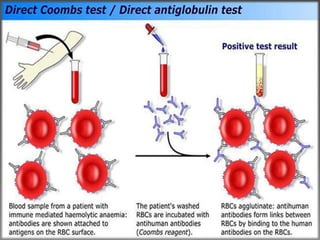
 Direct Antiglobulin Test (DAT) - Detects antibodies or complement coating
patient's cells in vivo.
 Indirect Antiglobulin Test (IAT) - Uses a 37oC incubation step so
antibodies in serum can react with antigens on cells in vitro, After washing
the cells antiglobulin reagent is used to detect antibody coating of cells.
Production Methods of Anti-Human globulin (AHG or Coombs) Reagent:
 May be made by injecting rabbits with purified human IgG or C3, then
harvesting the antibodies produced by the rabbit.
 Monoclonal technology may be used to make monoclonal antiglobulin
reagent
Specificity types:
 Polyspecific Anti-human Globulin: blend of Anti-IgG & Anti-C3b, -C3d
 Monospecific reagents:Anti-IgG alone or Anti-C3b,-C3d alone
Note:
Reagent does not contain antibodies to IgM. Information about IgM coating
of cells comes from the presence of C3 coating the cells since IgM is a
strong complement activator.
Whether the cells have been coated, or sensitized, in vivo or in vitro the final
interpretation is based on the following:
Positive antiglobuin test
Negative antiglobulin test
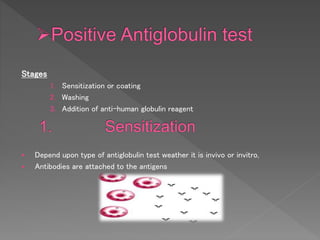
Stages
1. Sensitization or coating
2. Washing
3. Addition of anti-human globulin reagent
 Depend upon type of antiglobulin test weather it is invivo or invitro,
 Antibodies are attached to the antigens
 Only antibody attached to the cells remain
 Wash cells three times with saline to remove unbound antibody
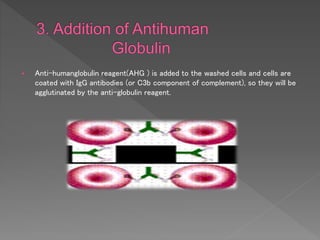
 Anti-humanglobulin reagent(AHG ) is added to the washed cells and cells are
coated with IgG antibodies (or C3b component of complement), so they will be
agglutinated by the anti-globulin reagent.
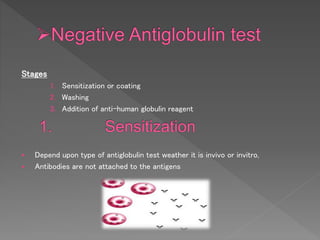
Stages
1. Sensitization or coating
2. Washing
3. Addition of anti-human globulin reagent
 Depend upon type of antiglobulin test weather it is invivo or invitro,
 Antibodies are not attached to the antigens
 Wash cells three times with saline to remove unbound antibody
 Anti-humanglobulin reagent(AHG ) is added to the washed cells but the
cells are not coated with IgG antibodies (or C3b component of
complement),so they will not agglutinated by the anti-globulin reagent.
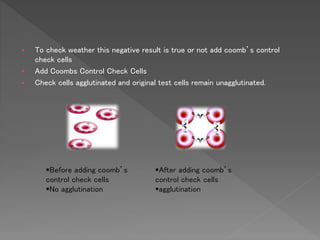
 To check weather this negative result is true or not add coomb’s control
check cells
 Add Coombs Control Check Cells
 Check cells agglutinated and original test cells remain unagglutinated.
After adding coomb’s
control check cells
agglutination
Before adding coomb’s
control check cells
No agglutination
 CCC are cells coated with IgG antibody
 Will react with antibodies in Coombs serum still "floating around" in the tube.
 Agglutination will now result
 Agglutination following addition of CCC verifies negative result
 Wash the group O positive cells three times in saline.
 Add an equal volume of anti-D IgG antibodies to the packed cells.
 Incubate at 37˚C for 30 minutes.
 Wash the cells four times.
 Suspend in saline to a 3-5% suspension
 Take 1 volume of the 3-5 % suspension ,add 2 volumes of the Coomb’s reagent
mix gently and centrifuge the tube. The agglutination reaction should be(+++). If
this reaction is too strong or too weak, these cells will not properly control the
anti-human globulin test.
 These sensitized cells can be stored for 48 hours.
False-negative reactions can occur when antigen-antibody reactions have
occurred but WASHING IS INADEQUATE and free antibody remains when the
anti-human globulin is added.
 Anti-human globulin (Coombs) antibody prefers to react first with free
antibody and then with antibody-coated cells
 If the free antibody has already reacted with the anti-human globulin, no
free Coombs serum to react with Coombs Control Check Cells (CCC)
 False negatives that are detected by negative Coombs control cells includes
 inadequate cell washing
 delay in adding antiglobulin reagent after the washing step
 presence of small fibrin clots among the cells
 inactive, or forgotten, antiglobulin reagent
 Inadequate cell washing will lead to unbound antibody remaining in the red cell
suspension that are available to neutralize the AHG (Coombs serum) so it will
not react with red cells bound with antibody.
 Delay in adding Coombs serum after washing step will lead to antibody eluting
off, detaching from, cell while cells are sitting in saline. Now free antibody
present in the saline neutralizes the AHG, Coombs, serum so it will not be able
to react with the cells bound with antibody.
 Small fibrin clot among the cells that were not washed away will have
immunoglobulins and complement present. The antibodies and complement in
the fibrin clot neutralizes AHG, Coombs, serum leading to a negative test.
 Inactive AHG (Coombs serum) or the failure to add AHG (Coombs serum) will
also be detected by a negative reaction when adding Coombs Control Check
Cells.
 There are also false negatives NOT detected by negative Coombs Control
Cells that include:
 Too heavy cell suspension
 Delay during cell washing procedure, which can lead to antibody eluting off
cells while they are sitting in saline and then the antibody is washed away
during the remaining washes
 Improper centrifugation can either lead to lost of cells during the washing
or the need to shake too hard during resuspension.
False positive reactions can also occurred when performing this test. These would
not be detected by the use of Coombs Control Check Cells.
 Reasons for a false positive reaction could be the following:
 Using improper sample (clotted cells instead of EDTA for Direct
Antiglobulin Test, DAT)
 Spontaneous agglutination (cells heavily coated with IgM)
 Non-specific agglutination ("sticky cells")
All of these reactions would be the result of cells appearing to agglutinate, or
actually agglutinating. Using a clotted tube for the DAT may allow complement
to become activated in the test tube since calcium ions are free to be part of
the complement cascade.
purpose
• The DAT is a diagnostic
procedure used to demonstrate in
vivo coating of RBCs with
antibody and or complement.
conditions
• Autoimmune hemolytic anemia
• Drug induced hemolysis
• Hemolytic disease of the newborn
(DAT is performed on newborn
baby)
• Hemolytic transfusion reaction.
 Add 1 drop of patient cells from EDTA tube to tube
 Wash these drops of blood 3-4X to remove plasma antibodies and make a 3%
cell suspension.
 Add a drop of 3% cell suspension to a clean, labeled tube.
 Add drop of Polyspecific AHG (Coombs serum) to the tube.
 Centrifuge the tubes at 3400rpm for 15-20 seconds. Remove the tubes and
observe in a good light source for agglutination
 If test is positive with polyspecific reagent, set up again using monospecific
reagents to see if it is antibody or complement or both coating the cells.
 False pos. possible if red top tube used to collect sample
Whenever positive DAT is obtained, obtain the following information on the patient:
 Diagnosis (particularly autoimmune hemolytic anemia, hemolytic disease of
the newborn and transfusion reactions)
 Medications
 Recent transfusion history of both red cell and plasma components
 Other lab values that may indicate red cell destruction (hematocrit,
bilirubin, LDH)
purpose
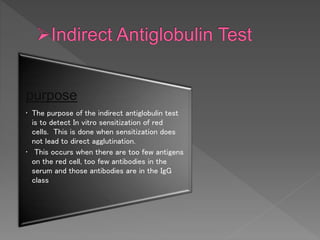
• The purpose of the indirect antiglobulin test
is to detect In vitro sensitization of red
cells. This is done when sensitization does
not lead to direct agglutination.
• This occurs when there are too few antigens
on the red cell, too few antibodies in the
serum and those antibodies are in the IgG
class
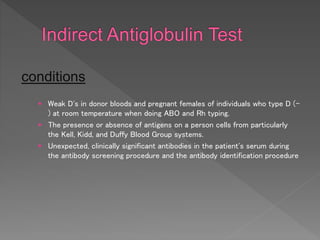
conditions
 Weak D's in donor bloods and pregnant females of individuals who type D (-
) at room temperature when doing ABO and Rh typing.
 The presence or absence of antigens on a person cells from particularly
the Kell, Kidd, and Duffy Blood Group systems.
 Unexpected, clinically significant antibodies in the patient's serum during
the antibody screening procedure and the antibody identification procedure
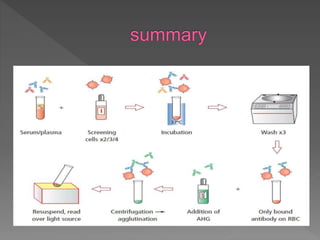
 Place2-3 drops of the test serum in a tube. Serum should be fresh for
detecting complement components and complement binding antibodies ,
otherwise, fresh AB serum should be added to it.
 Add 1 drop of 3-5% suspension of washed O Rh(D) positive red cells to the
serum in the tube.
 Mix and incubate at 37°C for 30-40 minutes.
 Centrifuge at 1000rpm for 1 minutes.
 Gently shake the tube to dislodge the button and examine for agglutination,
using optical aid. Record the result
 To all negative tests add one drop of IgG – sensitized red blood cells (check
cells). Gently mix, centrifuge for 15 seconds. Resuspend the cell button
 Record the result.
 Auto control should be kept with IAT.
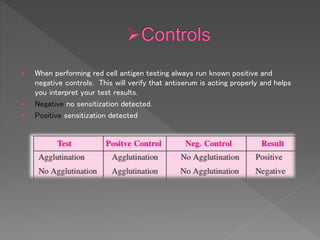
 When performing red cell antigen testing always run known positive and
negative controls. This will verify that antiserum is acting properly and helps
you interpret your test results.
 Negative no sensitization detected.
 Positive sensitization detected
coombs test

coombs test

  • 2.
     What iscoomb’s test ?  Principle of the antiglobulin test.  Types of antiglobulin tests.  Reagents.  Interpretation of antiglobulin tests.  Positive antiglobulin test.  Negative antiglobulin test.  Role of coombs control check cells (CCC).  Preparation of coomb’s control check cells.  False positives and negatives.  Direct antiglobulin testing.  Indirect antiglobulin testing.  Controls.
  • 3.
    The antiglobulin test,which is also referred to as the anti-human globulin test(AHG) or the Coombs test, is the cornerstone of detecting clinically significant unexpected antibodies that have coated cells either in vivo or in vitro. OR The anti-humanglobulin test is a test using anti-humanglobulin(AHG) reagents to detect the presence of humanglobulin on sensitized RBCs.
  • 4.
     Red cellscoated with complement or IgG antibodies do not agglutinate directly when centrifuged. These cells are said to be sensitized with IgG or complement.  In order for agglutination to occur an additional antibody, which reacts with the Fc portion of the IgG antibody, or with the C3b or C3d component of complement, must be added to the system.  This will form a "bridge" between the antibodies or complement coating the red cells, causing agglutination.
  • 5.
    Represents the anti-globulinreagent that binds with the fc portion of the IgG antibody attached to the red blood cells. Represents the anti-globulin reagent that binds with the complement attached to the red blood cells.
  • 6.
    There are twotypes of antiglobulin tests  Direct Antiglobulin Test (DAT) - Detects antibodies or complement coating patient's cells in vivo.  Indirect Antiglobulin Test (IAT) - Uses a 37oC incubation step so antibodies in serum can react with antigens on cells in vitro, After washing the cells antiglobulin reagent is used to detect antibody coating of cells.
  • 7.
    Production Methods ofAnti-Human globulin (AHG or Coombs) Reagent:  May be made by injecting rabbits with purified human IgG or C3, then harvesting the antibodies produced by the rabbit.  Monoclonal technology may be used to make monoclonal antiglobulin reagent Specificity types:  Polyspecific Anti-human Globulin: blend of Anti-IgG & Anti-C3b, -C3d  Monospecific reagents:Anti-IgG alone or Anti-C3b,-C3d alone Note: Reagent does not contain antibodies to IgM. Information about IgM coating of cells comes from the presence of C3 coating the cells since IgM is a strong complement activator.
  • 8.
    Whether the cellshave been coated, or sensitized, in vivo or in vitro the final interpretation is based on the following: Positive antiglobuin test Negative antiglobulin test
  • 9.
    Stages 1. Sensitization orcoating 2. Washing 3. Addition of anti-human globulin reagent  Depend upon type of antiglobulin test weather it is invivo or invitro,  Antibodies are attached to the antigens
  • 10.
     Only antibodyattached to the cells remain  Wash cells three times with saline to remove unbound antibody
  • 11.
     Anti-humanglobulin reagent(AHG) is added to the washed cells and cells are coated with IgG antibodies (or C3b component of complement), so they will be agglutinated by the anti-globulin reagent.
  • 12.
    Stages 1. Sensitization orcoating 2. Washing 3. Addition of anti-human globulin reagent  Depend upon type of antiglobulin test weather it is invivo or invitro,  Antibodies are not attached to the antigens
  • 13.
     Wash cellsthree times with saline to remove unbound antibody  Anti-humanglobulin reagent(AHG ) is added to the washed cells but the cells are not coated with IgG antibodies (or C3b component of complement),so they will not agglutinated by the anti-globulin reagent.
  • 14.
     To checkweather this negative result is true or not add coomb’s control check cells  Add Coombs Control Check Cells  Check cells agglutinated and original test cells remain unagglutinated. After adding coomb’s control check cells agglutination Before adding coomb’s control check cells No agglutination
  • 15.
     CCC arecells coated with IgG antibody  Will react with antibodies in Coombs serum still "floating around" in the tube.  Agglutination will now result  Agglutination following addition of CCC verifies negative result
  • 16.
     Wash thegroup O positive cells three times in saline.  Add an equal volume of anti-D IgG antibodies to the packed cells.  Incubate at 37˚C for 30 minutes.  Wash the cells four times.  Suspend in saline to a 3-5% suspension  Take 1 volume of the 3-5 % suspension ,add 2 volumes of the Coomb’s reagent mix gently and centrifuge the tube. The agglutination reaction should be(+++). If this reaction is too strong or too weak, these cells will not properly control the anti-human globulin test.  These sensitized cells can be stored for 48 hours.
  • 17.
    False-negative reactions canoccur when antigen-antibody reactions have occurred but WASHING IS INADEQUATE and free antibody remains when the anti-human globulin is added.  Anti-human globulin (Coombs) antibody prefers to react first with free antibody and then with antibody-coated cells  If the free antibody has already reacted with the anti-human globulin, no free Coombs serum to react with Coombs Control Check Cells (CCC)  False negatives that are detected by negative Coombs control cells includes  inadequate cell washing  delay in adding antiglobulin reagent after the washing step  presence of small fibrin clots among the cells  inactive, or forgotten, antiglobulin reagent
  • 18.
     Inadequate cellwashing will lead to unbound antibody remaining in the red cell suspension that are available to neutralize the AHG (Coombs serum) so it will not react with red cells bound with antibody.  Delay in adding Coombs serum after washing step will lead to antibody eluting off, detaching from, cell while cells are sitting in saline. Now free antibody present in the saline neutralizes the AHG, Coombs, serum so it will not be able to react with the cells bound with antibody.  Small fibrin clot among the cells that were not washed away will have immunoglobulins and complement present. The antibodies and complement in the fibrin clot neutralizes AHG, Coombs, serum leading to a negative test.  Inactive AHG (Coombs serum) or the failure to add AHG (Coombs serum) will also be detected by a negative reaction when adding Coombs Control Check Cells.
  • 19.
     There arealso false negatives NOT detected by negative Coombs Control Cells that include:  Too heavy cell suspension  Delay during cell washing procedure, which can lead to antibody eluting off cells while they are sitting in saline and then the antibody is washed away during the remaining washes  Improper centrifugation can either lead to lost of cells during the washing or the need to shake too hard during resuspension.
  • 20.
    False positive reactionscan also occurred when performing this test. These would not be detected by the use of Coombs Control Check Cells.  Reasons for a false positive reaction could be the following:  Using improper sample (clotted cells instead of EDTA for Direct Antiglobulin Test, DAT)  Spontaneous agglutination (cells heavily coated with IgM)  Non-specific agglutination ("sticky cells") All of these reactions would be the result of cells appearing to agglutinate, or actually agglutinating. Using a clotted tube for the DAT may allow complement to become activated in the test tube since calcium ions are free to be part of the complement cascade.
  • 21.
    purpose • The DATis a diagnostic procedure used to demonstrate in vivo coating of RBCs with antibody and or complement. conditions • Autoimmune hemolytic anemia • Drug induced hemolysis • Hemolytic disease of the newborn (DAT is performed on newborn baby) • Hemolytic transfusion reaction.
  • 22.
     Add 1drop of patient cells from EDTA tube to tube  Wash these drops of blood 3-4X to remove plasma antibodies and make a 3% cell suspension.  Add a drop of 3% cell suspension to a clean, labeled tube.  Add drop of Polyspecific AHG (Coombs serum) to the tube.  Centrifuge the tubes at 3400rpm for 15-20 seconds. Remove the tubes and observe in a good light source for agglutination  If test is positive with polyspecific reagent, set up again using monospecific reagents to see if it is antibody or complement or both coating the cells.  False pos. possible if red top tube used to collect sample Whenever positive DAT is obtained, obtain the following information on the patient:  Diagnosis (particularly autoimmune hemolytic anemia, hemolytic disease of the newborn and transfusion reactions)  Medications  Recent transfusion history of both red cell and plasma components  Other lab values that may indicate red cell destruction (hematocrit, bilirubin, LDH)
  • 24.
    purpose • The purposeof the indirect antiglobulin test is to detect In vitro sensitization of red cells. This is done when sensitization does not lead to direct agglutination. • This occurs when there are too few antigens on the red cell, too few antibodies in the serum and those antibodies are in the IgG class
  • 25.
    conditions  Weak D'sin donor bloods and pregnant females of individuals who type D (- ) at room temperature when doing ABO and Rh typing.  The presence or absence of antigens on a person cells from particularly the Kell, Kidd, and Duffy Blood Group systems.  Unexpected, clinically significant antibodies in the patient's serum during the antibody screening procedure and the antibody identification procedure
  • 26.
     Place2-3 dropsof the test serum in a tube. Serum should be fresh for detecting complement components and complement binding antibodies , otherwise, fresh AB serum should be added to it.  Add 1 drop of 3-5% suspension of washed O Rh(D) positive red cells to the serum in the tube.  Mix and incubate at 37°C for 30-40 minutes.  Centrifuge at 1000rpm for 1 minutes.  Gently shake the tube to dislodge the button and examine for agglutination, using optical aid. Record the result  To all negative tests add one drop of IgG – sensitized red blood cells (check cells). Gently mix, centrifuge for 15 seconds. Resuspend the cell button  Record the result.  Auto control should be kept with IAT.
  • 28.
     When performingred cell antigen testing always run known positive and negative controls. This will verify that antiserum is acting properly and helps you interpret your test results.  Negative no sensitization detected.  Positive sensitization detected