DR. ANINDITA SAHA
 Blood grouping is based on type of antigen
present on the red blood cells.
 There are more than 300 blood group
systems but ABO and Rh(Rhesus) are of
importance from clinical point of view.
 Other blood group systems are MNS ,
Lutheran , Kell , Lewis , Duffy , Kidd etc.
 Discovered by Karl Landsteiner in 1900.
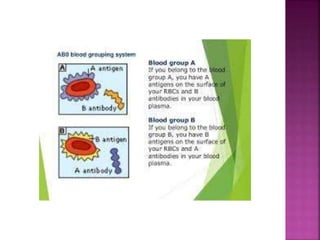
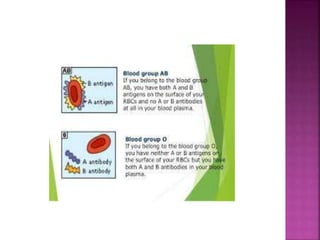
 The red cells contain different types of
Antigen(Agglutinogen) while plasma
contains antibody(Agglutinins)
 Genes that control the system are present
on chromosome 9
LANDSTEINER’S LAW
If an antigen(Ag) is present on a patient’s RBC,
the corresponding antibody(Ab) should not be
present in patient’s plasma under normal
condition
Methods of blood grouping:
1)Slide method
2)Tube method
Tube method – better method
but takes longer
Sample in tube with antiserum ---
incubate it --- centrifuge it ---examine it
macroscopically and microscopically for
agglutination.
REQUIREMENTS:
1)3 slides
2)Antisera A , B
3) Blood samples
PROCEDURE:
1) Take 2 clean slides and mark them 1, 2 .
2) Put one drop of antisera A on slide 1 ,
one drop of antisera B on slide 2.
3) Add one drop of blood to each and mix
well with stick
4) Wait for 5 min and observe.
OBSERVATION:
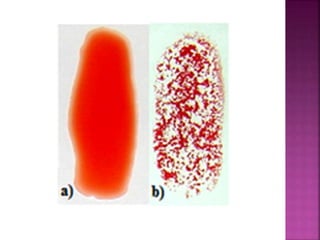
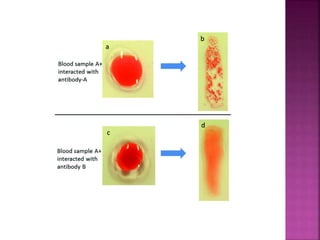
 If any agglutination occurs it is visible
with naked eyes as dark reddish clumps of
different sizes.
 If agglutination is minimal it can be
confirmed by examining it under
microscope.
INTERPRETATION:
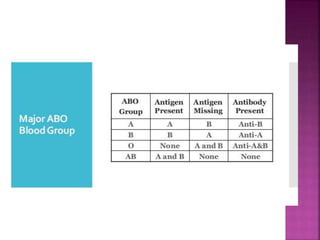
1)Agglutination with antisera A not with
antisera B – group A
2)Agglutination with antisera B not with
antisera A – group B.
3)Agglutination with both
antisera A and B – group AB
4)No agglutination in any slide – group O
Universal donor – blood group O as no
Ag so no agglutination.
Universal recepient – blood group AB
as both A and B Ags present so
agglutination occurs in both as no
Abs present in serum.
BOMBAY blood group:
Very rare.
H is the precursor of A & B antigen.
These people lack H, alongwith A and B
antigen but plasma contains anti A,
anti B and anti H
Bombay phenotype are individuals who
lack H gene(genotype h)
Rh TYPING
HISTORY:
1939 – Levine and Stetson defined
D antigen(Rh factor)
1949 – Landsteiner and Weiner
discovered anti Rh (named after
Rhesus monkey)
Rh TYPING
Rh blood group system is second in
significance after ABO system.
Genes that control the system are
present on chromosome 1
Consists of over 50 related Ags.
Important genes are D,C,E,c,e.
All Rh antigen are controlled by 2 genes –
RHD gene– determines expression of D
RHCE – encodes for C,c and E,e.
 RhD is a strong antigen (immunogenic) and
other antigen are less antigenic than D and
are of less clinical significance.
 Therefore , in practice Rh negative and Rh
positive depends on presence of D antigen on
the surface of red cells which is detected by
strong anti-D serum.
 Occasionally, Anti - D,C,E,c,e may develop
in case of pregnancy or transfusion.
Rh positive
There is presence of D antigen.
These individuals constitute 80% of
population.
Rh negative:
There is absence of D antigen.These
individuals constitute 17% of
population.
Cc and Ee antigen:
These are weak antigens and
therefore risk of sensitisation is less
than that of D antigen.
Rh antibody:
 Unlike ABO system there is no
naturally occuring antibodies against
Rh antigens in Rh negative
individuals.
Immune Abs:
 Rh Abs develop against Rh Ag after
exposure to Rh Ags following
transfusion or pregnancy.
 But can be detected by enzyme
treatment or coomb
test(antiglobulin test)
SIGNIFICANCE:
Rh incompartibility results in
haemolytic tranfusion reaction.
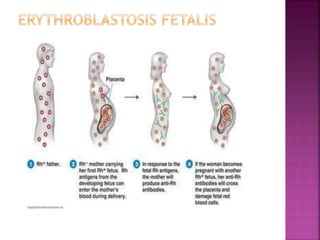
Haemolytic disease of newborn.
TECHNIQUES:
1) slide method
2)Tube method
SLIDE METHOD:
 Place one drop of anti D on slide.
 Add one drop of blood and mix
well with stick
 Wait for 5 min and observe.
RESULT:
 Agglutination indicates Rh positive
blood samples.
IMPORTANCE OF BLOOD
GROUPING AND Rh TYPING:
In blood transfusion
Haemolytic disease of newborn.
Paternity dispute
Medicolegal issues
Immunology,genetics,anthropology
Susceptibility to various
disease(blood group O – peptic ulcer
Blood group A – gastric ulcer)
Also known as compatibility testing.
It is the most important test before
a blood transfusion is given.
The primary purpose of cross
matching is to detect ABO
incompatibilities between donor and
recipient.
This is carried out to prevent
transfusion reactions by detecting
Abs in recipient’s serum.
Two main functions of cross
matching test:
1)It is a confirm ABO compatibility
between donor and recipient.
2)It may detect presence of
irregular Ab in patient’s serum that
will react with donor RBCs.
Cross matching test can be
1) major
2) minor
MAJOR CROSS MATCH TEST:
Mixing the patient’s plasma with
donor RBCs.
MINOR CROSS MATCH TEST:
 mixing the donor’s plasma with
patient’s RBCs.
It is completely eliminated in most
blood banks recipient cells are
combined with donor plasma
 Compatibility at Room Temperature –
PROCEDURE:
 Take 1 drop of receipient’s serum/plasma
in a small test tube.
 Add 5% saline suspension of donor’s RBC
 Mix the two.
 Incubate at room temp.
 Centrifuge.
 Check for agglutination or haemolysis.
 Take 1 drop of receipient’s serum in a small test tube.
 Add 5% saline suspension of donor’s RBC to receipient’s
serum/plasma.
 Mix the two.
 Incubate at 37°C.
 Centrifuge.
 Check for agglutination or haemolysis.
 RESULT : Agglutination or haemolysis absent – match
Agglutination or haemolysis present-mismatch
LASTLY do the
INDIRECT ANTIGLOBULIN TEST/
COOMBS TEST
Specific Test Types:
1) saline cross match - detects IgM Abs
2) albumin technique - detects IgG Abs
3) enzyme technique - detects IgG and
some IgM Abs.
4) antiglobulin test or coomb test –
detects IgG Abs.
SCREENING TESTS BEFORE BT:
Malaria
Syphilis
HBV
HCV
HIV
THANK YOU

Blood grouping and crosss matching

  • 1.
  • 2.
     Blood groupingis based on type of antigen present on the red blood cells.  There are more than 300 blood group systems but ABO and Rh(Rhesus) are of importance from clinical point of view.  Other blood group systems are MNS , Lutheran , Kell , Lewis , Duffy , Kidd etc.
  • 3.
     Discovered byKarl Landsteiner in 1900.  The red cells contain different types of Antigen(Agglutinogen) while plasma contains antibody(Agglutinins)  Genes that control the system are present on chromosome 9
  • 4.
    LANDSTEINER’S LAW If anantigen(Ag) is present on a patient’s RBC, the corresponding antibody(Ab) should not be present in patient’s plasma under normal condition
  • 8.
    Methods of bloodgrouping: 1)Slide method 2)Tube method
  • 9.
    Tube method –better method but takes longer Sample in tube with antiserum --- incubate it --- centrifuge it ---examine it macroscopically and microscopically for agglutination.
  • 10.
  • 11.
    PROCEDURE: 1) Take 2clean slides and mark them 1, 2 . 2) Put one drop of antisera A on slide 1 , one drop of antisera B on slide 2. 3) Add one drop of blood to each and mix well with stick 4) Wait for 5 min and observe.
  • 12.
    OBSERVATION:  If anyagglutination occurs it is visible with naked eyes as dark reddish clumps of different sizes.  If agglutination is minimal it can be confirmed by examining it under microscope.
  • 14.
    INTERPRETATION: 1)Agglutination with antiseraA not with antisera B – group A 2)Agglutination with antisera B not with antisera A – group B. 3)Agglutination with both antisera A and B – group AB 4)No agglutination in any slide – group O
  • 16.
    Universal donor –blood group O as no Ag so no agglutination. Universal recepient – blood group AB as both A and B Ags present so agglutination occurs in both as no Abs present in serum.
  • 17.
    BOMBAY blood group: Veryrare. H is the precursor of A & B antigen. These people lack H, alongwith A and B antigen but plasma contains anti A, anti B and anti H Bombay phenotype are individuals who lack H gene(genotype h)
  • 18.
    Rh TYPING HISTORY: 1939 –Levine and Stetson defined D antigen(Rh factor) 1949 – Landsteiner and Weiner discovered anti Rh (named after Rhesus monkey)
  • 19.
    Rh TYPING Rh bloodgroup system is second in significance after ABO system. Genes that control the system are present on chromosome 1 Consists of over 50 related Ags. Important genes are D,C,E,c,e.
  • 20.
    All Rh antigenare controlled by 2 genes – RHD gene– determines expression of D RHCE – encodes for C,c and E,e.
  • 21.
     RhD isa strong antigen (immunogenic) and other antigen are less antigenic than D and are of less clinical significance.  Therefore , in practice Rh negative and Rh positive depends on presence of D antigen on the surface of red cells which is detected by strong anti-D serum.  Occasionally, Anti - D,C,E,c,e may develop in case of pregnancy or transfusion.
  • 22.
    Rh positive There ispresence of D antigen. These individuals constitute 80% of population.
  • 23.
    Rh negative: There isabsence of D antigen.These individuals constitute 17% of population. Cc and Ee antigen: These are weak antigens and therefore risk of sensitisation is less than that of D antigen.
  • 24.
    Rh antibody:  UnlikeABO system there is no naturally occuring antibodies against Rh antigens in Rh negative individuals. Immune Abs:  Rh Abs develop against Rh Ag after exposure to Rh Ags following transfusion or pregnancy.  But can be detected by enzyme treatment or coomb test(antiglobulin test)
  • 25.
    SIGNIFICANCE: Rh incompartibility resultsin haemolytic tranfusion reaction. Haemolytic disease of newborn.
  • 27.
  • 28.
    SLIDE METHOD:  Placeone drop of anti D on slide.  Add one drop of blood and mix well with stick  Wait for 5 min and observe. RESULT:  Agglutination indicates Rh positive blood samples.
  • 29.
    IMPORTANCE OF BLOOD GROUPINGAND Rh TYPING: In blood transfusion Haemolytic disease of newborn. Paternity dispute Medicolegal issues Immunology,genetics,anthropology Susceptibility to various disease(blood group O – peptic ulcer Blood group A – gastric ulcer)
  • 30.
    Also known ascompatibility testing. It is the most important test before a blood transfusion is given. The primary purpose of cross matching is to detect ABO incompatibilities between donor and recipient. This is carried out to prevent transfusion reactions by detecting Abs in recipient’s serum.
  • 31.
    Two main functionsof cross matching test: 1)It is a confirm ABO compatibility between donor and recipient. 2)It may detect presence of irregular Ab in patient’s serum that will react with donor RBCs.
  • 32.
    Cross matching testcan be 1) major 2) minor MAJOR CROSS MATCH TEST: Mixing the patient’s plasma with donor RBCs.
  • 33.
    MINOR CROSS MATCHTEST:  mixing the donor’s plasma with patient’s RBCs. It is completely eliminated in most blood banks recipient cells are combined with donor plasma
  • 34.
     Compatibility atRoom Temperature – PROCEDURE:  Take 1 drop of receipient’s serum/plasma in a small test tube.  Add 5% saline suspension of donor’s RBC  Mix the two.  Incubate at room temp.  Centrifuge.  Check for agglutination or haemolysis.
  • 35.
     Take 1drop of receipient’s serum in a small test tube.  Add 5% saline suspension of donor’s RBC to receipient’s serum/plasma.  Mix the two.  Incubate at 37°C.  Centrifuge.  Check for agglutination or haemolysis.  RESULT : Agglutination or haemolysis absent – match Agglutination or haemolysis present-mismatch
  • 36.
    LASTLY do the INDIRECTANTIGLOBULIN TEST/ COOMBS TEST
  • 37.
    Specific Test Types: 1)saline cross match - detects IgM Abs 2) albumin technique - detects IgG Abs 3) enzyme technique - detects IgG and some IgM Abs. 4) antiglobulin test or coomb test – detects IgG Abs.
  • 38.
    SCREENING TESTS BEFOREBT: Malaria Syphilis HBV HCV HIV
  • 39.