TELEPATHOLOGY
Presenter : Dr.Janani Mathialagan
1st year Post-graduate
Pathology
Overview:
Definition
3 systems
Dynamic
Static
Virtual
Hybrid
Advantages and disadvantages
Telepathology in India
Summary
 What is Telepathology ?
 Practice whereby pathologists render diagnoses from a distance by
viewing electronically transmitted images rather than by examination
of glass slides by themselves using a light microscope.
 Images can be transmitted via
 Ordinary telephone lines
 High speed digital lines
 Satellites
 Internet
Background
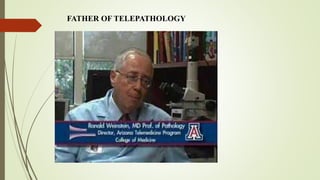
• Ronald S Weinstein coined the term – Telepathology in the year
1986
• Today- fourth-generation telepathology systems, so-called virtual
slide telepathology systems, being used for education applications
FATHER OF TELEPATHOLOGY
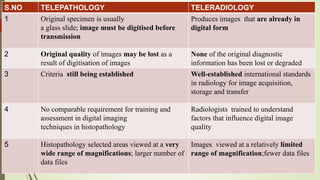
S.NO TELEPATHOLOGY TELERADIOLOGY
1 Original specimen is usually
a glass slide; image must be digitised before
transmission
Produces images that are already in
digital form
2 Original quality of images may be lost as a
result of digitisation of images
None of the original diagnostic
information has been lost or degraded
3 Criteria still being established Well-established international standards
in radiology for image acquisition,
storage and transfer
4 No comparable requirement for training and
assessment in digital imaging
techniques in histopathology
Radiologists trained to understand
factors that influence digital image
quality
5 Histopathology selected areas viewed at a very
wide range of magnifications; larger number of
data files
Images viewed at a relatively limited
range of magnification;fewer data files
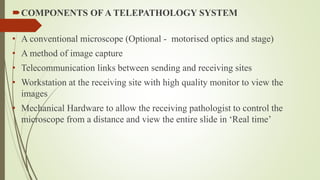
COMPONENTS OF A TELEPATHOLOGY SYSTEM
• A conventional microscope (Optional - motorised optics and stage)
• A method of image capture
• Telecommunication links between sending and receiving sites
• Workstation at the receiving site with high quality monitor to view the
images
• Mechanical Hardware to allow the receiving pathologist to control the
microscope from a distance and view the entire slide in ‘Real time’
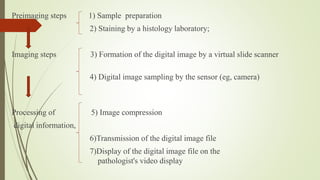
Preimaging steps 1) Sample preparation
2) Staining by a histology laboratory;
Imaging steps 3) Formation of the digital image by a virtual slide scanner
4) Digital image sampling by the sensor (eg, camera)
Processing of 5) Image compression
digital information,
6)Transmission of the digital image file
7)Display of the digital image file on the
pathologist's video display
THREE SYSTEMS ARE CURRENTLY
AVAILABLE:
Dynamic
Static
Virtual
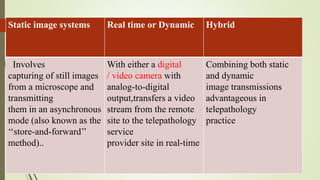
Static image systems Real time or Dynamic Hybrid
Involves
capturing of still images
from a microscope and
transmitting
them in an asynchronous
mode (also known as the
‘‘store-and-forward’’
method)..
With either a digital
/ video camera with
analog-to-digital
output,transfers a video
stream from the remote
site to the telepathology
service
provider site in real-time
Combining both static
and dynamic
image transmissions
advantageous in
telepathology
practice
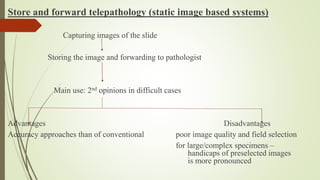
Store and forward telepathology (static image based systems)
Capturing images of the slide
Storing the image and forwarding to pathologist
Main use: 2nd opinions in difficult cases
Advantages Disadvantages
Accuracy approaches than of conventional poor image quality and field selection
for large/complex specimens –
handicaps of preselected images
is more pronounced
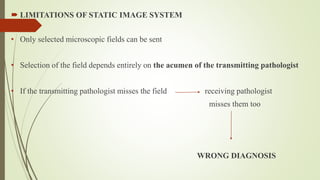
 LIMITATIONS OF STATIC IMAGE SYSTEM
• Only selected microscopic fields can be sent
• Selection of the field depends entirely on the acumen of the transmitting pathologist
• If the transmitting pathologist misses the field receiving pathologist
misses them too
WRONG DIAGNOSIS
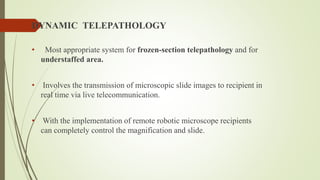
DYNAMIC TELEPATHOLOGY
• Most appropriate system for frozen-section telepathology and for
understaffed area.
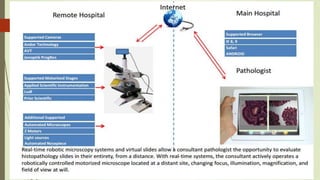
• Involves the transmission of microscopic slide images to recipient in
real time via live telecommunication.
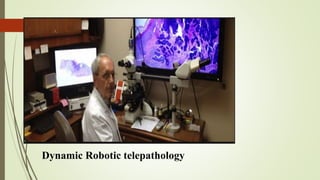
• With the implementation of remote robotic microscope recipients
can completely control the magnification and slide.
Dynamic Robotic telepathology
DISADVANTAGES:
1) Expensive and not easy to maintain.
Usually fitted with
a) charge coupled device (CCD) video camera
b) high-resolution video monitors,
c) proprietary software
d)high performance hardware (computer).
2) Needs a stable and broad-bandwidth
telecommunication link between the sender and the recipient
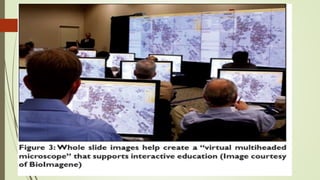
 WHOLE SLIDE IMAGING
• Also known as ‘Virtual microscopy’/ Wide field microscopy
• Virtual slides - digitized slides where examination can be done in
different magnifications
• No need of having multiple images
• Image acquisition of an entire microscopic slide done at all
magnifications available on the microscope.
• The software drives the motorized stage to acquire all fields of
view in tiles and then seamlessly stitches the fields into a single
image.
DISADVANTAGE:
• These virtual slides have extremely large file size, sometimes
exceeding 1.5 GB
• Hence cannot be transferred easily with the present network
bandwidth limitations.
• Therefore stored in 'virtual slide boxes' where database storage
can be done on a central server.
• The fourth generation telepathology imaging systems use miniature
microscope arrays (MMAs)
• The output from about 100 miniaturized microscopes is
simultaneously captured by 100 individual digital images.
• The result is a virtual slide that can be produced in minutes.
• Such systems promise to transform histopathological laboratories in
the very near future.
Advantages:
• More interactive
• Easy to share
• Help generate teaching sets
( virtual slide boxes) that can include
- wide case range
- rare cases that do not fade, break or disappear
Comparison between the various modes of telepathology:
• Compared with the 68.8% to 95.0% accuracy involved with static images,
previous studies have reported that the dynamic pathology method can
achieve 86.0 to 96.4% diagnostic accuracy.
• Diagnostic accuracy is at least 3% to 5% higher with dynamic than static
imaging.
• The Diagnostic accuracy from direct glass slide examination has been found
to range between 94% and 97%.
Reasons why low-resolution dynamic telepathology has higher
diagnostic accuracy than static telepathology:
(1) Dynamic telepathology transfers more image
information to the pathologist who is performing the
diagnosis
(2) Provides the pathologist with a better relation of different
views from the microscope (virtual microscopy)
 HYBRID TELEPATHOLOGY
Simultaneous transmission of both real-time microscopy and static
images
• 2 major components located at the
1) remote site and
2) service provider site (receiving site)
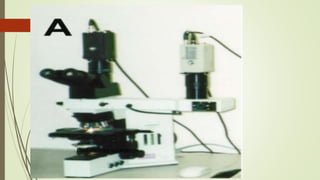
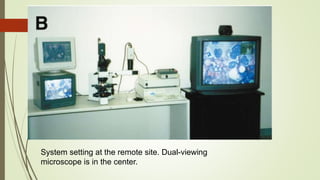
• At the remote site- Dual viewing Light microscope
Digital photo camera and
Video camera
• Images from the digital camera are captured by the computer
projected on the screen
• A color video monitor connected with the digital processor,
from which real-time images of the glass slides can be
previewed
• Both are transmitted to the telelmedicine unit.
( equipped with Table microphones and an additional pair of
CCD cameras for videoconferencing)
Hardware Equipment at Receiving Site
• Equipments with the same protocol capability needs to be
installed on the computer.
• Personal computer with large display or two monitors is
recommended.
• One monitor for real-time video and the other for still images.
• Real-time video and audio conferencing between the remote and
receiving sites are available.
TELEMEDICINE UNIT
 Use of telecommunication and information technology to
provide clinical healthcare from a distance.
 Eliminates distance barrier
 Improves access to medical services not available in distant
rural communities
 Operation Specifications
• Consultations initiated from either the remote site or the receiving site
via the telemedicine unit.
Telepathologist at the receiving site
Direct communication
Telepathologist at the remote site
• Orders from the telepathologist at the receiving site can be performed at
the remote site.
Dual-viewing microscope
System setting at the remote site. Dual-viewing
microscope is in the center.
Benefits of telepathology
1) Expert opinion can be rapidly obtained
• Allows a pathologist rapidly to seek the opinion of a second
pathologist
• No need for irreplaceable blocks or slides to leave the
department
• A ‘live’ telepathology consultation allows pathologist and
clinician to consider the case at the same time
2 ) Provision of an urgent (intra-operative) diagnostic service
in the absence of a local pathologist
• The distant pathologist is usually provided with
- remote control of a local microscope
- live streaming of image (a variant of dynamic method) – 2nd
pathologist who is handling the slide in person is instructed by the
pathologist in the receiving end.
• More recently, development of virtual slide technology - an
alternative way to deliver the same type of service.
3) Image analysis
• Many aspects of routine pathology require semi-quantitative
assessments such as tumour grade, degree of dysplasia, severity of
inflammation or fibrosis.
• These assessments are subjective and poorly reproducible
• Attempts are made to improve these assessments by applying various
techniques of image analysis to digital images.
4) Education and training
• Virtual slide technology - potential to allow many pathologists to view
rare and educational cases
• Viewing images and cases online significantly reduces the time and cost
of travelling
• Valuable in the undergraduate curriculum,
 Challenges:
1) Quality issues
There is no defined criteria in telepathology
Such standards might include:
- image resolution
- colour depth that should be captured
- speed with which images should be transferred
- necessary qualities of any viewing station to ensure that the
captured is not degraded
2) Legal issues
• Several legal issues that arise when a telepathology service is
used from outside national boundaries.
For example in European union –
• The registration of the reporting pathologist must be recognised
by the regulatory body of the EU member state -An essential
requirement in order to maintain proper standards of reporting.
3) Patient confidentiality
• Expert advice on data protection is needed if patient -
identifiable or potentially identifiable information is being
transmitted
4) Training in telepathology skills
• Skill at diagnosis using a microscope does not immediately
and automatically translate into skill at using a telepathology
system
• Investment in training needed
• As telepathology systems become more widespread, assessment
and revalidation procedures will increasingly have to
incorporate the evaluation of knowledge and skills specific to
telepathology.
5) Deskilling
• Telepathology - great potential as a tool for training and education,
• However, a particular category of specimen is routinely
allocated to reporting by a distant pathologist
Long-term result
loss of relevant local expertise.
• Particularly important problem in relation to the training of new
pathologists, who must see all relevant specimen types.
6) Discrepancy reporting and audit
• When a telepathology system is being introduced, essential that a
representative proportion of cases are ‘double reported’ by conventional
and telepathology system to ensure diagnostic accuracy.
• The proportion of cases subjected to such double reporting may be
reduced as experience is gained
7) Back up plan
• Laboratories must have procedures to maintain activity in the
event of equipment failure.
• There must be procedures in place to ensure sufficiently rapid repair
or replacement of sophisticated equipment
• The laboratory must remain prepared to revert to
‘conventional’diagnostic methods.
Telepathology in INDIA
 Not lagging far behind.
 The first exposure was provided at a symposium organized in the 50th
Annual Conference of the Indian Association of Pathologists and
Microbiologists in Mumbai in 2001 - named Telepathology: Today
and Tomorrow.
Telepathology is yet to permeate into everyday activities for
pathologists in India
1) Lack of agreement on a preferred technology
2) Lack of standardised criteria acceptable to the pathology
community
3) One major drawback in rural India -sub-optimal preparation of
slides.
4) Absence of a rapport between the sending pathologist and the
consultant pathologist.
5) Resistance from senior histopathologists in India for the promotion
of telepathology.
Summary
• The methods of telepathology have potential to improve several aspects of
pathology practice, for the benefit of patient care.
• Need to agree accreditation standards for the use of telepathology, in
relation to its mode of use, image quality, training and communications
• Proficiency at diagnosis using a conventional microscope does not necessarily
indicate proficiency at diagnosis using telepathology.
• Pathologists should ensure that they have verified that they have the abilities and
equipment required to make accurate diagnoses either by convention or digital
microscopy. (Double reporting)
REFERENCES
1)Telepathology: Guidance from The Royal College of Pathologists, October 2013
.Author- Professor James Lowe, Chair of the Specialty Advisory Committee on
Cellular Pathology
2)Washington manula of surgical pathology 2nd edition
3) Asaranti Kar, Tushar Kar, Priyadarshini Biswal, Kaumudee Pattanaik, Pallavi
Bhuyan, Rajashree Mallick, B. N. Mohanty . Use of Telemedicine in Postgraduate
Pathology Education . International Journal of Clinical Medicine, 2013;7 : 304-08
Thank you

Telepathology

  • 1.
    TELEPATHOLOGY Presenter : Dr.JananiMathialagan 1st year Post-graduate Pathology
  • 2.
  • 3.
     What isTelepathology ?  Practice whereby pathologists render diagnoses from a distance by viewing electronically transmitted images rather than by examination of glass slides by themselves using a light microscope.  Images can be transmitted via  Ordinary telephone lines  High speed digital lines  Satellites  Internet
  • 4.
    Background • Ronald SWeinstein coined the term – Telepathology in the year 1986 • Today- fourth-generation telepathology systems, so-called virtual slide telepathology systems, being used for education applications
  • 5.
  • 6.
    S.NO TELEPATHOLOGY TELERADIOLOGY 1Original specimen is usually a glass slide; image must be digitised before transmission Produces images that are already in digital form 2 Original quality of images may be lost as a result of digitisation of images None of the original diagnostic information has been lost or degraded 3 Criteria still being established Well-established international standards in radiology for image acquisition, storage and transfer 4 No comparable requirement for training and assessment in digital imaging techniques in histopathology Radiologists trained to understand factors that influence digital image quality 5 Histopathology selected areas viewed at a very wide range of magnifications; larger number of data files Images viewed at a relatively limited range of magnification;fewer data files
  • 7.
    COMPONENTS OF ATELEPATHOLOGY SYSTEM • A conventional microscope (Optional - motorised optics and stage) • A method of image capture • Telecommunication links between sending and receiving sites • Workstation at the receiving site with high quality monitor to view the images • Mechanical Hardware to allow the receiving pathologist to control the microscope from a distance and view the entire slide in ‘Real time’
  • 8.
    Preimaging steps 1)Sample preparation 2) Staining by a histology laboratory; Imaging steps 3) Formation of the digital image by a virtual slide scanner 4) Digital image sampling by the sensor (eg, camera) Processing of 5) Image compression digital information, 6)Transmission of the digital image file 7)Display of the digital image file on the pathologist's video display
  • 9.
    THREE SYSTEMS ARECURRENTLY AVAILABLE: Dynamic Static Virtual
  • 10.
    Static image systemsReal time or Dynamic Hybrid Involves capturing of still images from a microscope and transmitting them in an asynchronous mode (also known as the ‘‘store-and-forward’’ method).. With either a digital / video camera with analog-to-digital output,transfers a video stream from the remote site to the telepathology service provider site in real-time Combining both static and dynamic image transmissions advantageous in telepathology practice
  • 11.
    Store and forwardtelepathology (static image based systems) Capturing images of the slide Storing the image and forwarding to pathologist Main use: 2nd opinions in difficult cases Advantages Disadvantages Accuracy approaches than of conventional poor image quality and field selection for large/complex specimens – handicaps of preselected images is more pronounced
  • 12.
     LIMITATIONS OFSTATIC IMAGE SYSTEM • Only selected microscopic fields can be sent • Selection of the field depends entirely on the acumen of the transmitting pathologist • If the transmitting pathologist misses the field receiving pathologist misses them too WRONG DIAGNOSIS
  • 13.
    DYNAMIC TELEPATHOLOGY • Mostappropriate system for frozen-section telepathology and for understaffed area. • Involves the transmission of microscopic slide images to recipient in real time via live telecommunication. • With the implementation of remote robotic microscope recipients can completely control the magnification and slide.
  • 15.
  • 16.
    DISADVANTAGES: 1) Expensive andnot easy to maintain. Usually fitted with a) charge coupled device (CCD) video camera b) high-resolution video monitors, c) proprietary software d)high performance hardware (computer). 2) Needs a stable and broad-bandwidth telecommunication link between the sender and the recipient
  • 17.
     WHOLE SLIDEIMAGING • Also known as ‘Virtual microscopy’/ Wide field microscopy • Virtual slides - digitized slides where examination can be done in different magnifications • No need of having multiple images • Image acquisition of an entire microscopic slide done at all magnifications available on the microscope. • The software drives the motorized stage to acquire all fields of view in tiles and then seamlessly stitches the fields into a single image.
  • 18.
    DISADVANTAGE: • These virtualslides have extremely large file size, sometimes exceeding 1.5 GB • Hence cannot be transferred easily with the present network bandwidth limitations. • Therefore stored in 'virtual slide boxes' where database storage can be done on a central server.
  • 19.
    • The fourthgeneration telepathology imaging systems use miniature microscope arrays (MMAs) • The output from about 100 miniaturized microscopes is simultaneously captured by 100 individual digital images. • The result is a virtual slide that can be produced in minutes. • Such systems promise to transform histopathological laboratories in the very near future.
  • 20.
    Advantages: • More interactive •Easy to share • Help generate teaching sets ( virtual slide boxes) that can include - wide case range - rare cases that do not fade, break or disappear
  • 22.
    Comparison between thevarious modes of telepathology: • Compared with the 68.8% to 95.0% accuracy involved with static images, previous studies have reported that the dynamic pathology method can achieve 86.0 to 96.4% diagnostic accuracy. • Diagnostic accuracy is at least 3% to 5% higher with dynamic than static imaging. • The Diagnostic accuracy from direct glass slide examination has been found to range between 94% and 97%.
  • 23.
    Reasons why low-resolutiondynamic telepathology has higher diagnostic accuracy than static telepathology: (1) Dynamic telepathology transfers more image information to the pathologist who is performing the diagnosis (2) Provides the pathologist with a better relation of different views from the microscope (virtual microscopy)
  • 24.
     HYBRID TELEPATHOLOGY Simultaneoustransmission of both real-time microscopy and static images • 2 major components located at the 1) remote site and 2) service provider site (receiving site)
  • 25.
    • At theremote site- Dual viewing Light microscope Digital photo camera and Video camera
  • 26.
    • Images fromthe digital camera are captured by the computer projected on the screen • A color video monitor connected with the digital processor, from which real-time images of the glass slides can be previewed • Both are transmitted to the telelmedicine unit. ( equipped with Table microphones and an additional pair of CCD cameras for videoconferencing)
  • 27.
    Hardware Equipment atReceiving Site • Equipments with the same protocol capability needs to be installed on the computer. • Personal computer with large display or two monitors is recommended. • One monitor for real-time video and the other for still images. • Real-time video and audio conferencing between the remote and receiving sites are available.
  • 28.
    TELEMEDICINE UNIT  Useof telecommunication and information technology to provide clinical healthcare from a distance.  Eliminates distance barrier  Improves access to medical services not available in distant rural communities
  • 29.
     Operation Specifications •Consultations initiated from either the remote site or the receiving site via the telemedicine unit. Telepathologist at the receiving site Direct communication Telepathologist at the remote site • Orders from the telepathologist at the receiving site can be performed at the remote site.
  • 30.
  • 31.
    System setting atthe remote site. Dual-viewing microscope is in the center.
  • 32.
    Benefits of telepathology 1)Expert opinion can be rapidly obtained • Allows a pathologist rapidly to seek the opinion of a second pathologist • No need for irreplaceable blocks or slides to leave the department • A ‘live’ telepathology consultation allows pathologist and clinician to consider the case at the same time
  • 33.
    2 ) Provisionof an urgent (intra-operative) diagnostic service in the absence of a local pathologist • The distant pathologist is usually provided with - remote control of a local microscope - live streaming of image (a variant of dynamic method) – 2nd pathologist who is handling the slide in person is instructed by the pathologist in the receiving end. • More recently, development of virtual slide technology - an alternative way to deliver the same type of service.
  • 34.
    3) Image analysis •Many aspects of routine pathology require semi-quantitative assessments such as tumour grade, degree of dysplasia, severity of inflammation or fibrosis. • These assessments are subjective and poorly reproducible • Attempts are made to improve these assessments by applying various techniques of image analysis to digital images.
  • 35.
    4) Education andtraining • Virtual slide technology - potential to allow many pathologists to view rare and educational cases • Viewing images and cases online significantly reduces the time and cost of travelling • Valuable in the undergraduate curriculum,
  • 36.
     Challenges: 1) Qualityissues There is no defined criteria in telepathology Such standards might include: - image resolution - colour depth that should be captured - speed with which images should be transferred - necessary qualities of any viewing station to ensure that the captured is not degraded
  • 37.
    2) Legal issues •Several legal issues that arise when a telepathology service is used from outside national boundaries. For example in European union – • The registration of the reporting pathologist must be recognised by the regulatory body of the EU member state -An essential requirement in order to maintain proper standards of reporting.
  • 38.
    3) Patient confidentiality •Expert advice on data protection is needed if patient - identifiable or potentially identifiable information is being transmitted
  • 39.
    4) Training intelepathology skills • Skill at diagnosis using a microscope does not immediately and automatically translate into skill at using a telepathology system • Investment in training needed • As telepathology systems become more widespread, assessment and revalidation procedures will increasingly have to incorporate the evaluation of knowledge and skills specific to telepathology.
  • 40.
    5) Deskilling • Telepathology- great potential as a tool for training and education, • However, a particular category of specimen is routinely allocated to reporting by a distant pathologist Long-term result loss of relevant local expertise. • Particularly important problem in relation to the training of new pathologists, who must see all relevant specimen types.
  • 41.
    6) Discrepancy reportingand audit • When a telepathology system is being introduced, essential that a representative proportion of cases are ‘double reported’ by conventional and telepathology system to ensure diagnostic accuracy. • The proportion of cases subjected to such double reporting may be reduced as experience is gained
  • 42.
    7) Back upplan • Laboratories must have procedures to maintain activity in the event of equipment failure. • There must be procedures in place to ensure sufficiently rapid repair or replacement of sophisticated equipment • The laboratory must remain prepared to revert to ‘conventional’diagnostic methods.
  • 43.
    Telepathology in INDIA Not lagging far behind.  The first exposure was provided at a symposium organized in the 50th Annual Conference of the Indian Association of Pathologists and Microbiologists in Mumbai in 2001 - named Telepathology: Today and Tomorrow.
  • 44.
    Telepathology is yetto permeate into everyday activities for pathologists in India 1) Lack of agreement on a preferred technology 2) Lack of standardised criteria acceptable to the pathology community 3) One major drawback in rural India -sub-optimal preparation of slides. 4) Absence of a rapport between the sending pathologist and the consultant pathologist. 5) Resistance from senior histopathologists in India for the promotion of telepathology.
  • 45.
    Summary • The methodsof telepathology have potential to improve several aspects of pathology practice, for the benefit of patient care. • Need to agree accreditation standards for the use of telepathology, in relation to its mode of use, image quality, training and communications • Proficiency at diagnosis using a conventional microscope does not necessarily indicate proficiency at diagnosis using telepathology. • Pathologists should ensure that they have verified that they have the abilities and equipment required to make accurate diagnoses either by convention or digital microscopy. (Double reporting)
  • 46.
    REFERENCES 1)Telepathology: Guidance fromThe Royal College of Pathologists, October 2013 .Author- Professor James Lowe, Chair of the Specialty Advisory Committee on Cellular Pathology 2)Washington manula of surgical pathology 2nd edition 3) Asaranti Kar, Tushar Kar, Priyadarshini Biswal, Kaumudee Pattanaik, Pallavi Bhuyan, Rajashree Mallick, B. N. Mohanty . Use of Telemedicine in Postgraduate Pathology Education . International Journal of Clinical Medicine, 2013;7 : 304-08
  • 47.

Editor's Notes

  • #35 notably northern Scandinavia
  • #36 with the potential to introduce students to the value of microscopy in a structured way, without the need to maintain large numbers of optical microscopes
  • #37 for image capture, storage, transmission or viewing. , because they will change with technological developments and with the different uses of telepathology.
  • #38 where a hospital, health authority or other organisation purchases a telepathology service.
  • #42 as these will be influenced by the skill and experience of practitioners, quality of equipment and case mix.
  • #43 such as a slide scanner, a large computer server and high bandwidth network links),
  • #44  Since then a number of symposia and workshops held in different parts of the country have contributed to popularize this tool both at the national and the state level
  • #45 n spite of recent Government initiatives to improve the telecommunication facilities, and the necessity that is obviously there. Images for remote diagnosis, after all, can only be as good as the original slides. A relative reason for the failure of telepathology consultation and the inability of experts to come to a conclusive diagnosis, apart from sub-optimal images, is the This could possibly be because of a negative preconception about telepathology. Reassurance of potential users is necessary because these perceived problems are human, rather than technological.