THE MENSTRUAL
CYCLE
PRESENTED BY
MUSTAFA SAMIR ALJAROUDI
MOHAMMAD ALZIYADI
MOHAMMAD ALALI
Overview:
 The menstrual cycle starts on the first day of the menstrual period, and
ends with the start of the following period.
 It is made up of four phases, during which hormones change to prepare
women for pregnancy each month.
 It is natural to experience some discomfort during the menstrual cycle
 There are several methods and guidelines to relieve pain before and
during a menstrual period.
Structure of the female reproductive
system
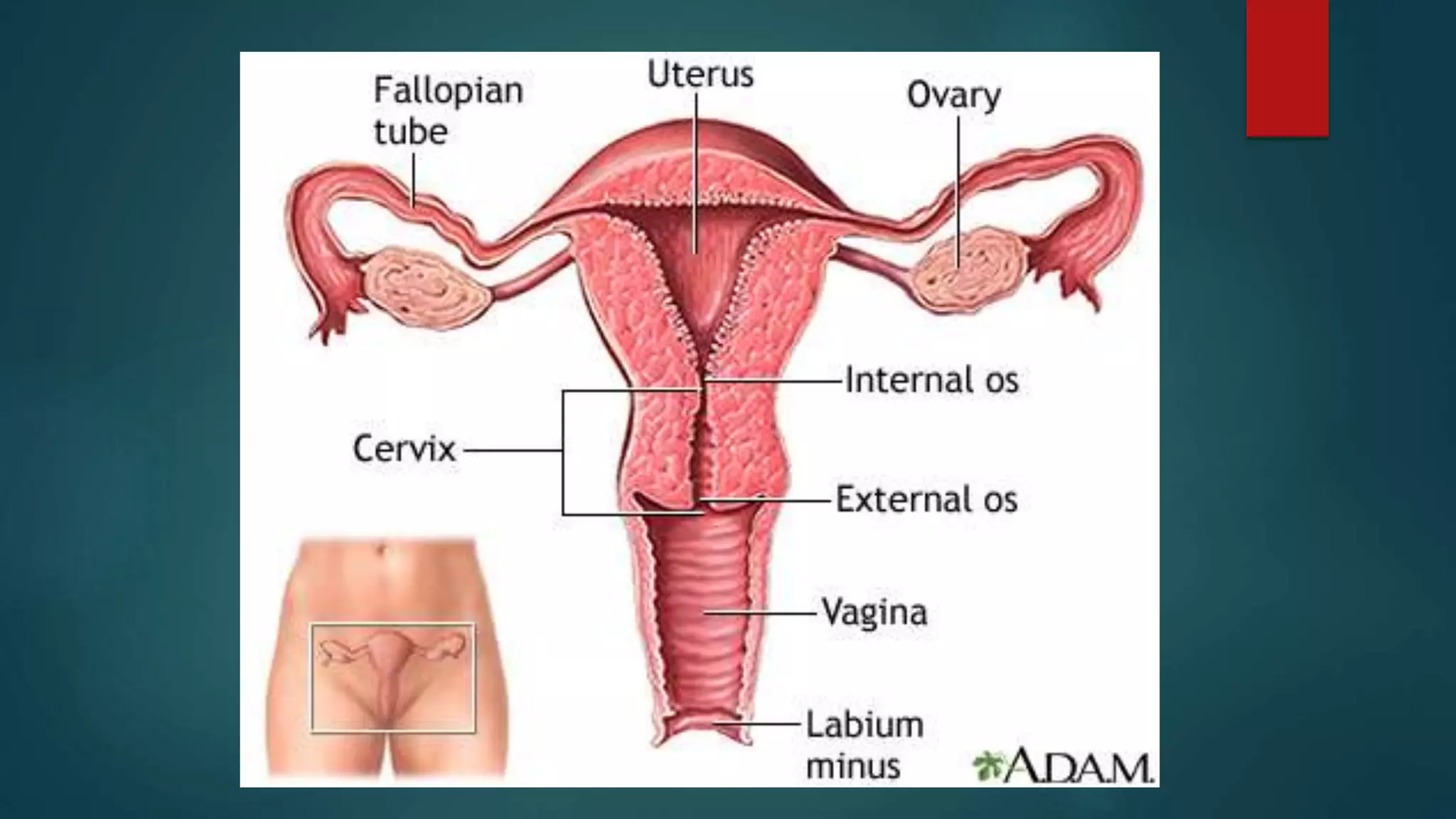
 The vagina: A canal connecting between the uterus and the external
reproductive organs.
 The uterus: A hallow pear-shaped organ where the fetus grows during
pregnancy. It is separated from the vagina by a narrow canal called: the
cervix
 Fallopian tubes: Narrow canals connected to the upper part of the uterus.
Through them, the eggs travel from the ovaries to the uterus, and inside
them, the egg meets the sperm (fertilization). Then, the fertilized egg
travels through the tubes to the uterus where it can stick to the uterine
wall and form an embryo.
 Ovaries: Small oval-shaped glands located on the sides of the uterus.
Eggs form inside the ovaries that also produce female hormones
Menstrual cycle
 A menstrual cycle consists of natural changes that occur in a woman’s
body every month in preparation for pregnancy
 Menstruation starts at puberty and ends at menopause.
 The cycle lasts an average of 28 days but may vary between 20 and 40
days. The first day of a cycle is the first day of a menstrual period and the
last day is that of the following period
First menstrual period
 The menstrual cycle often begins at puberty between the ages of 8 and
15 (average age of 12). It usually starts two years after breasts and pubic
hair start to develop.
Menstrual cycle phases
 The menstrual cycle consists of four phases:
1-Menstruation.
2- the follicular phase.
3-Ovulation.
4-luteal phase.
Menstruation
 Menstruation is the vaginal discharge of the internal lining of
the uterine wall, along with other secretions from the body. It
usually lasts three to seven days but this could change to
more or less days from month to month and depending on
each woman
Hormone Control of Cycle
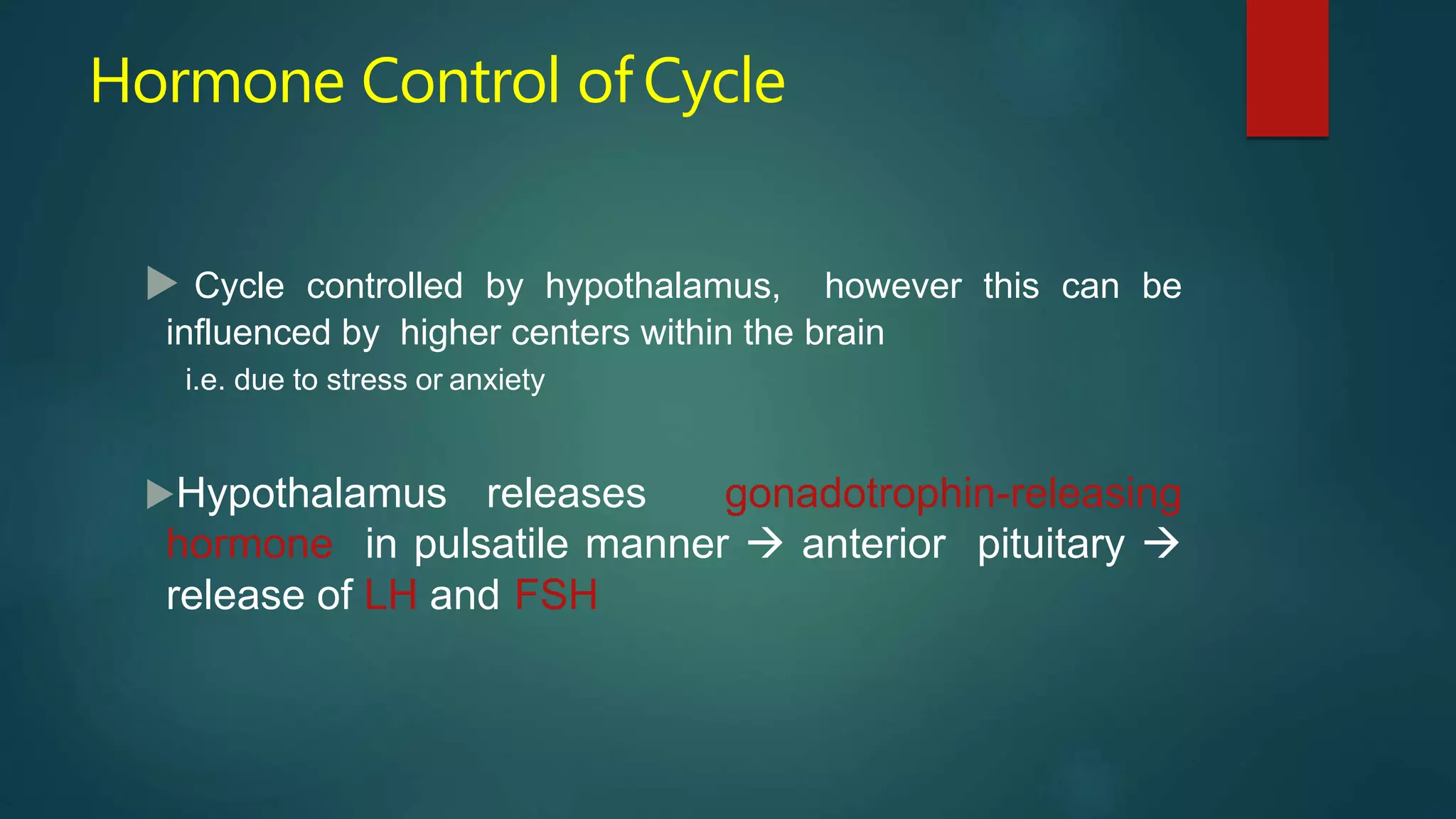
 Cycle controlled by hypothalamus, however this can be
influenced by higher centers within the brain
i.e. due to stress or anxiety
Hypothalamus releases gonadotrophin-releasing
hormone in pulsatile manner  anterior pituitary 
release of LH and FSH
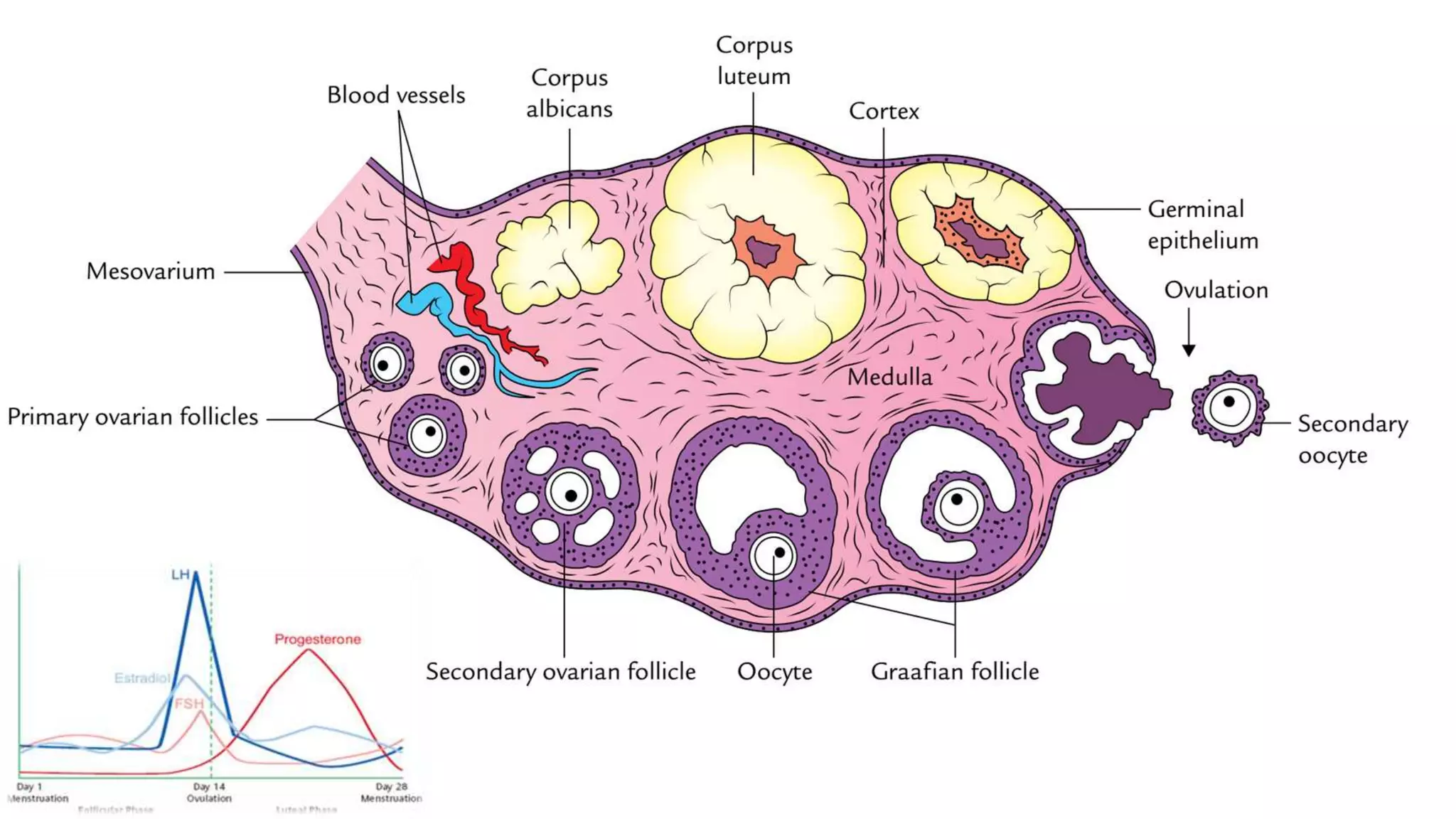
Follicular stimulating hormone (FSH) – glycoprotein
Stimulates follicular maturation during follicular phase
Stimulates steroid hormone secretion – oestrogen
Luteinizing Hormone (LH) – glycoprotein
Stimulates steroid hormone secretion – oestrogen
Ovulation – mid-cycle surge of LH
Progesterone production by corpus luteum
FollicularPhase
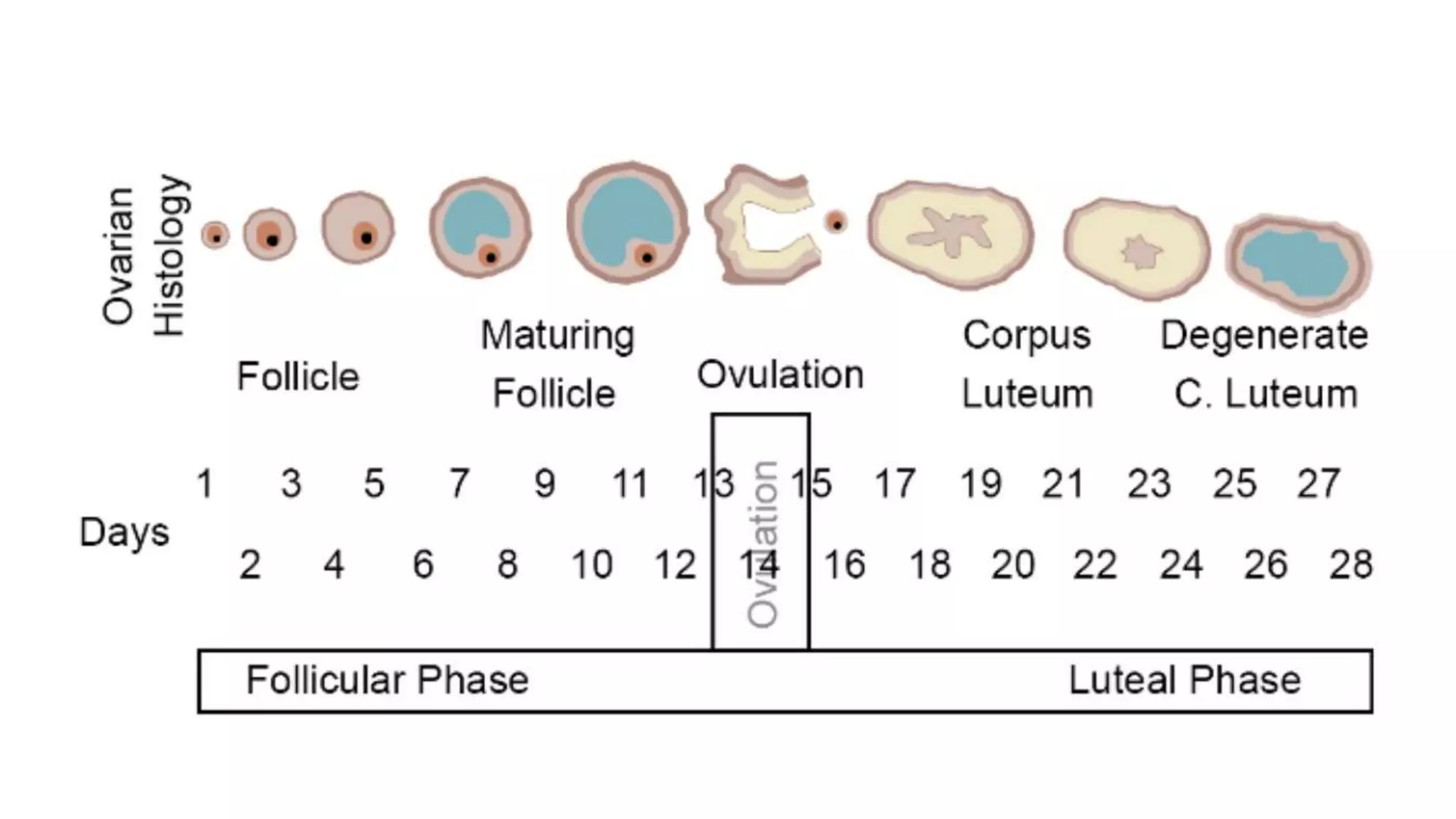
oThe follicular phase starts on the first day of
menstruation and ends with ovulation
opituitary gland (situated at the base of the brain) releases
a follicle stimulating hormone. This hormone produces 10
to 20 follicles in the ovary and each follicle houses an
immature egg
Days 1-8
FSH and LH relatively high levels
o Stimulate development of 10-20 follicles
o Results in full maturation of a single dominant follicle – appearing in
mid- follicular phase
o Remainder undergo atresia
o Oestrogen levels start to rise as follicular development occurs
 Days 9-14
oFollicle increases in size
oTransforming primary follicle to secondary follicle
oRise in oestrogen by granulosa cells, associated with
follicular maturation
o Inhibin produced by granulosa cells restricting number of
follicles maturing
Ovulation
Day 14
 rapid enlargement of follicle and rupture of the follicle with
extrusion of the oocyte
 Rise in oestrogen  mid-cycle surge of LH and to a lesser
extent FSH  ovulation
 Immediately before ovulation there is a drop in oestrogen and
an increase in progesterone
Ovulation follows within 18 hours of mid- cycle surge of LH
If not enough of a LH surge – then no ovulation occurs –
anovulatory
LutealPhase
Days 15-28
 remainder of the follicle retained in the ovary
 corpus luteum formation -the major source of sex hormones-
oestrogen and progesterone
 This leads to marked increase in progesterone and estrogen
If conception and implantation occur:
Corpus luteum doesn’t regress – maintained by gonadotrophins
secreted by trophoblasts
If conception doesn’t occur successfully:
Corpus luteum regresses and menstruation occurs
Drops in steroid sex hormones  leads to a rise in gonadotrophin levels
(FH and LSH)  initiate next cycle
Common issues accompanying the
menstrual cycle
 Cramps:
 Many women experience stomach spasms during the first
few days of their cycle. They occur because of chemicals in
the body that cause the uterine muscles to contract to help
shed the uterine lining.
 Dysmenorrhea (painful periods)
 It is the most common menstruation problem. The pain
from one woman to the other. There are two types of
dysmenorrhea
 Primary dysmenorrhea:
 It is a very common condition that occurs because of the contraction in
uterine muscles. It typically occurs during adolescence and fades away with
age.
 Started menstruating before the age of 11
 Have heavy and long periods;
 Secondary dysmenorrhea:
 It is the pain resulting from physical problems. The pain becomes worse
with age
 The most common health issues that may cause it are:
- Endometriosis;
- Uterine fibroids.
- Ovarian cysts.
 Excessive bleeding:
 Excessive bleeding may occur due to the following causes:
 Ovulation issues: An imbalance of hormones during ovulation may lead
the excessive formation of an internal uterine lining, which in turn
increases the amount of blood shed during menstruation.
 Thyroid disorders
 Uterine fibroids: They are muscle tissues that form on the uterine wall and
are usually benign.
 Benign tumors
 Some medications
 Problems conceiving (e.g. miscarriage, ectopic pregnancy)
 Bleeding disorders (e.g. haemophilia)
 Obesity
 Use of an intrauterine device (IUD)
Summary
 The menstrual cycle is complex and controlled by many
different glands and the hormones that these glands produce
 The four phases of the menstrual cycle are menstruation, the
follicular phase, ovulation and the luteal phase.
Summary
 Common menstrual problems include heavy or painful periods and
premenstrual syndrome (PMS).
 Knowing when in the menstrual cycle a woman is most likely to conceive
can increase the chance of pregnancy.
Reference:
 https://www.moh.gov.sa/en/HealthAwareness/EducationalContent/wh/Pa
ges/012.aspx
 Oxford Handbook of Obstetrics and Gynecology 3rd Edition
Thank you

The menstrual cycle 15.02.2021

  • 1.
    THE MENSTRUAL CYCLE PRESENTED BY MUSTAFASAMIR ALJAROUDI MOHAMMAD ALZIYADI MOHAMMAD ALALI
  • 2.
    Overview:  The menstrualcycle starts on the first day of the menstrual period, and ends with the start of the following period.  It is made up of four phases, during which hormones change to prepare women for pregnancy each month.  It is natural to experience some discomfort during the menstrual cycle  There are several methods and guidelines to relieve pain before and during a menstrual period.
  • 4.
    Structure of thefemale reproductive system  The vagina: A canal connecting between the uterus and the external reproductive organs.  The uterus: A hallow pear-shaped organ where the fetus grows during pregnancy. It is separated from the vagina by a narrow canal called: the cervix
  • 5.
     Fallopian tubes:Narrow canals connected to the upper part of the uterus. Through them, the eggs travel from the ovaries to the uterus, and inside them, the egg meets the sperm (fertilization). Then, the fertilized egg travels through the tubes to the uterus where it can stick to the uterine wall and form an embryo.  Ovaries: Small oval-shaped glands located on the sides of the uterus. Eggs form inside the ovaries that also produce female hormones
  • 6.
    Menstrual cycle  Amenstrual cycle consists of natural changes that occur in a woman’s body every month in preparation for pregnancy  Menstruation starts at puberty and ends at menopause.  The cycle lasts an average of 28 days but may vary between 20 and 40 days. The first day of a cycle is the first day of a menstrual period and the last day is that of the following period
  • 7.
    First menstrual period The menstrual cycle often begins at puberty between the ages of 8 and 15 (average age of 12). It usually starts two years after breasts and pubic hair start to develop.
  • 8.
    Menstrual cycle phases The menstrual cycle consists of four phases: 1-Menstruation. 2- the follicular phase. 3-Ovulation. 4-luteal phase.
  • 9.
    Menstruation  Menstruation isthe vaginal discharge of the internal lining of the uterine wall, along with other secretions from the body. It usually lasts three to seven days but this could change to more or less days from month to month and depending on each woman
  • 10.
    Hormone Control ofCycle  Cycle controlled by hypothalamus, however this can be influenced by higher centers within the brain i.e. due to stress or anxiety Hypothalamus releases gonadotrophin-releasing hormone in pulsatile manner  anterior pituitary  release of LH and FSH
  • 11.
    Follicular stimulating hormone(FSH) – glycoprotein Stimulates follicular maturation during follicular phase Stimulates steroid hormone secretion – oestrogen Luteinizing Hormone (LH) – glycoprotein Stimulates steroid hormone secretion – oestrogen Ovulation – mid-cycle surge of LH Progesterone production by corpus luteum
  • 15.
    FollicularPhase oThe follicular phasestarts on the first day of menstruation and ends with ovulation opituitary gland (situated at the base of the brain) releases a follicle stimulating hormone. This hormone produces 10 to 20 follicles in the ovary and each follicle houses an immature egg
  • 16.
    Days 1-8 FSH andLH relatively high levels o Stimulate development of 10-20 follicles o Results in full maturation of a single dominant follicle – appearing in mid- follicular phase o Remainder undergo atresia o Oestrogen levels start to rise as follicular development occurs
  • 17.
     Days 9-14 oFollicleincreases in size oTransforming primary follicle to secondary follicle oRise in oestrogen by granulosa cells, associated with follicular maturation o Inhibin produced by granulosa cells restricting number of follicles maturing
  • 18.
    Ovulation Day 14  rapidenlargement of follicle and rupture of the follicle with extrusion of the oocyte  Rise in oestrogen  mid-cycle surge of LH and to a lesser extent FSH  ovulation  Immediately before ovulation there is a drop in oestrogen and an increase in progesterone Ovulation follows within 18 hours of mid- cycle surge of LH If not enough of a LH surge – then no ovulation occurs – anovulatory
  • 19.
    LutealPhase Days 15-28  remainderof the follicle retained in the ovary  corpus luteum formation -the major source of sex hormones- oestrogen and progesterone  This leads to marked increase in progesterone and estrogen
  • 20.
    If conception andimplantation occur: Corpus luteum doesn’t regress – maintained by gonadotrophins secreted by trophoblasts If conception doesn’t occur successfully: Corpus luteum regresses and menstruation occurs Drops in steroid sex hormones  leads to a rise in gonadotrophin levels (FH and LSH)  initiate next cycle
  • 21.
    Common issues accompanyingthe menstrual cycle  Cramps:  Many women experience stomach spasms during the first few days of their cycle. They occur because of chemicals in the body that cause the uterine muscles to contract to help shed the uterine lining.
  • 22.
     Dysmenorrhea (painfulperiods)  It is the most common menstruation problem. The pain from one woman to the other. There are two types of dysmenorrhea
  • 23.
     Primary dysmenorrhea: It is a very common condition that occurs because of the contraction in uterine muscles. It typically occurs during adolescence and fades away with age.  Started menstruating before the age of 11  Have heavy and long periods;
  • 24.
     Secondary dysmenorrhea: It is the pain resulting from physical problems. The pain becomes worse with age  The most common health issues that may cause it are: - Endometriosis; - Uterine fibroids. - Ovarian cysts.
  • 25.
     Excessive bleeding: Excessive bleeding may occur due to the following causes:  Ovulation issues: An imbalance of hormones during ovulation may lead the excessive formation of an internal uterine lining, which in turn increases the amount of blood shed during menstruation.  Thyroid disorders  Uterine fibroids: They are muscle tissues that form on the uterine wall and are usually benign.
  • 26.
     Benign tumors Some medications  Problems conceiving (e.g. miscarriage, ectopic pregnancy)  Bleeding disorders (e.g. haemophilia)  Obesity  Use of an intrauterine device (IUD)
  • 27.
    Summary  The menstrualcycle is complex and controlled by many different glands and the hormones that these glands produce  The four phases of the menstrual cycle are menstruation, the follicular phase, ovulation and the luteal phase.
  • 28.
    Summary  Common menstrualproblems include heavy or painful periods and premenstrual syndrome (PMS).  Knowing when in the menstrual cycle a woman is most likely to conceive can increase the chance of pregnancy.
  • 30.
  • 31.