FAMILY PLANNING
Introduction
• Also known as Contraception
• Limiting of family size or prevention of
unwanted and unintended pregnancy
• There are about 1.2 billion women of
reproductive age world wide
• About 114 million acts of sexual intercourse
per day worldwide
• IMAGINE WHAT WILL HAPPEN without
CONTRACEPTION?!
Nigeria burden
• High total fertility rate (TFR) of 5.7 (NDHS
2008).
• High population
• High annual population growth rate of 3.2%.
• At this growth rate the Nigerian population
should double in only 22 years!
• Unfortunately, Low Contraceptive prevalence
14.6% for any method and 9.7% for modern
methods(NDHS,2008)
Classes of contraceptive users
• Single ladies including adolescents, unstable
relationships,coital exposure unpredictable
• Married women or ladies in stable
relationships desirous of child spacing services
• Couples with completed family sizes
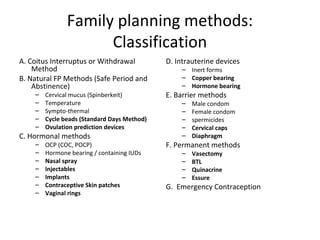
Family planning methods:
Classification
A. Coitus Interruptus or Withdrawal
Method
B. Natural FP Methods (Safe Period and
Abstinence)
–
–
–
–
–

– Inert forms
– Copper bearing
– Hormone bearing

Cervical mucus (Spinberkeit)
Temperature
Sympto-thermal
Cycle beads (Standard Days Method)
Ovulation prediction devices

E. Barrier methods

OCP (COC, POCP)
Hormone bearing / containing IUDs
Nasal spray
Injectables
Implants
Contraceptive Skin patches
Vaginal rings

F. Permanent methods

C. Hormonal methods
–
–
–
–
–
–
–

D. Intrauterine devices

–
–
–
–
–
–
–
–
–

Male condom
Female condom
spermicides
Cervical caps
Diaphragm
Vasectomy
BTL
Quinacrine
Essure

G. Emergency Contraception
A: Abstinence and Withdrawal (Coitus
Interruptus) Methods
• Abstinence (many wives a modification?)
• Withdrawal?
B: Natural Family Planning (NFP)
Methods:
• Fertility Awareness Based Methods (FAM),
• Lactational Amenorrhoea Method (LAM)
• Standard Days Method (SDM)
• Ovulation Prediction Tests (OPT)
Natural Family Planning (NFP) & Fertility
Awareness-Based Methods (FAM)
• Use of physical signs, symptoms, and cycle
data to determine when ovulation occurs
• Spouses abstain from intercourse during the
at-risk fertile days
• Or use other methods to avoid pregnancy
– Condom, Emergency Contraception
Effectiveness of NFP (FAM, LAM, SDM, OPT)
• The success of the Natural Family Planning
methods depends on:
– the accuracy of the method in identifying the
woman’s actual fertile days
– Couples’ ability to correctly identify the fertile
time
– Couple’s ability to follow the rules of the method
they are using
Methods of Determining High-Risk Fertile Days
• The basal body temperature (BBT) method
• The calendar/rhythm method
• The cervical mucus method (CMM) or Billings
ovulation method.
• The sympto-thermal method (STM)
• Cycle beads
• Ovulation prediction tests
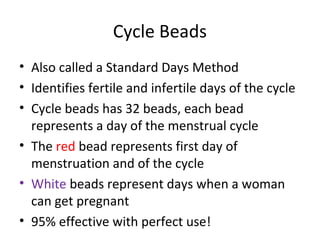
Cycle Beads
• Also called a Standard Days Method
• Identifies fertile and infertile days of the cycle
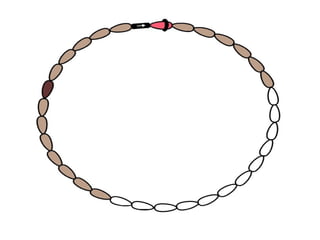
• Cycle beads has 32 beads, each bead
represents a day of the menstrual cycle
• The red bead represents first day of
menstruation and of the cycle
• White beads represent days when a woman
can get pregnant
• 95% effective with perfect use!
Breastfeeding, Lactation Amenorrhea
Method (LAM)
• Breastfeeding delays return of fertility
postpartum
• However, LAM is a contraceptive method
based on exclusive breastfeeding
• LAM is an effective method only under
specific conditions:
– Woman breastfeeding exclusively
– The woman is amenorrhoeic
– The infant less than 6 months old
C. Hormonal Contraception
Mechanism of action:
•Suppress ovulation (90 to 95% of time)
•Causes thickening of cervical mucus, which
impedes sperm penetration and entry into the
upper reproductive tract
•Causes endometrial atrophy
•May slow down tubal motility
1. The Oral Contraceptive Pill
• 2 types:
• Combined OCP (COCP) – estrogen &
progesterone
• Progesterone only pills (POP)
COCP
• Dose of oestrogen in the COCPs
ranges from 15 to 50 μg.
Trend towards lower dosages with most being
low dose containing 30-35 μg
• Lower doses (15 μg ethinylestradiol)
associated with similar efficacy as 30 μg pills,
less cardiovascular risks and poorer cycle
control with higher incidence of breakthrough
bleeding
2: Injectable Contraceptives
Types: Progestin-Only
– Depo Medroxy Progesterone Acetate (DMPA) 150
mg
• Microcrystalline suspension
• 3 monthly

– Norethisterone Enanthate (Net-En) 200 mg
• In oil
• 2 monthly
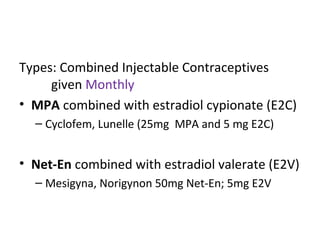
Types: Combined Injectable Contraceptives
given Monthly
• MPA combined with estradiol cypionate (E2C)
– Cyclofem, Lunelle (25mg MPA and 5 mg E2C)

• Net-En combined with estradiol valerate (E2V)
– Mesigyna, Norigynon 50mg Net-En; 5mg E2V
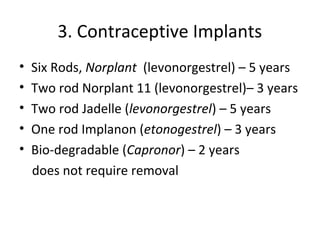
3. Contraceptive Implants
•
•
•
•
•

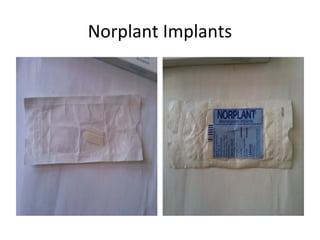
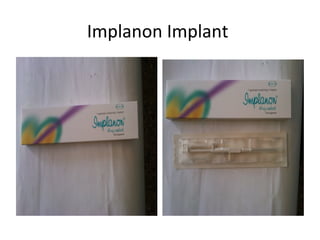
Six Rods, Norplant (levonorgestrel) – 5 years
Two rod Norplant 11 (levonorgestrel)– 3 years
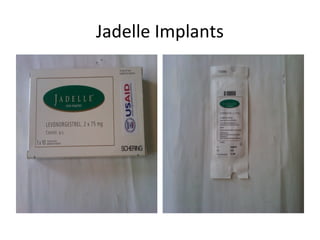
Two rod Jadelle (levonorgestrel) – 5 years
One rod Implanon (etonogestrel) – 3 years
Bio-degradable (Capronor) – 2 years
does not require removal
Norplant Implants
Jadelle Implants
Implanon Implant
4: Intra-Uterine Devices Bearing or
Containing Hormones
• Hormone bearing IUDs have lower pregnancy
rates and fewer side effects
• Hormone containing IUDs may actually also
reduce risk of PID
• The levonorgestrel IUD has a preventive effect
against the occurrence of ectopic pregnancy
Intrauterine System
• The IUS (Intrauterine System) releases
levonorgestrel (a progestin),
– Levo-Nova (registered in Finland)
– Mirena (registered in the UK and Canada)

• Other Uses:
– Treatment of Menorrhagia
– In HRT

• Introduced in 1990
Progestasert
• Contained progesterone that was released at
a rate of 65 micrograms per day.
• Was replaced annually, though approved for
18 months of use in France.
• Failure rate: 2% per year
• Introduced in 1976 and discontinued in 2001
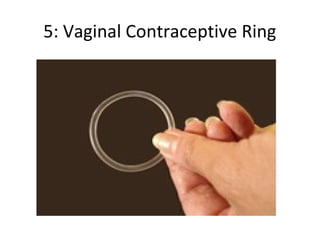
5: Vaginal Contraceptive Ring
Combined contraceptive vaginal
ccring
• Releases 15μgEE and 120μg etonorgestrel/day
(Nuvaring,
Organon)
• Ring consists of soft ethylene-vinyl-acetate
(EVA) copolymer
• last for 3 weeks
• Efficacy similar to COCPs but incidence of
irregular bleeding only about one-eight of
that reported for COCPs
How the Ring is Used
• A new vaginal ring needs to be inserted every
month.
• Once inserted, the Ring is worn for 3
consecutive weeks before it is removed for 1
week.
• During the week that the Ring is not worn,
menstruation occurs.
• Each ring provides a month’s contraception
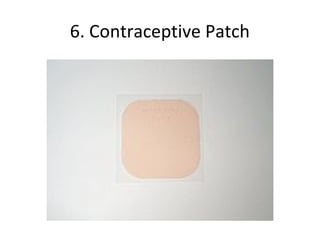
6. Contraceptive Patch
The Contraceptive Patch
• Trans-dermal contraceptive system
• Square, flexible, extended-release matrix
patch system
• Contains norelgestromin (NGMN) and ethinyl
estradiol (EE) for use in a weekly dosing
schedule
• Product launched: April 2002
Benefits of the Patch
•
•
•
•
•

Female-controlled
Prompt contraceptive reversibility
Allows for spontaneity
Highly efficacious contraceptive
High rates of compliance across age groups
Method of use
• A woman applies her first patch onto her
– upper outer arm,
– buttocks,

abdomen
thigh

• Applied weekly
• The day of application is known from that point as patch
change day.
Method of use
• On the 4th patch change day, the patch is
removed and not replaced.
• The woman waits 7 days without a patch in
place, and on the next patch change day she
applies a new patch (a new cycle)
D: Intrauterine Devices
Types:
•Chemically inert devices- composed of a
nonabsorbable material, most often
polyethylene, and impregnated with barium
sulfate for radiopacity.
• Chemically active devices have continuous
elution of copper or a progestational agent.
Only chemically active IUDs are available
currently in most parts of the world.
….IntrauterineDevices
Intrauterine device
• Most available ones have a plastic frame with
copper wire wound round the stem or copper
sleeves on the end of the arms.
• Amount of copper : 250-375mm2.
• One IUD is frameless (GyneFix) and consists
of six copper beads on a nylon thread.
Intrauterine Devices
• Devices containing 250 mm2 are licensed for 3
years, the T-Safe Cu 380A for 8 years and the
remainder for 5 years.
• IUDs containing 380mm2
Copper have failure rate of 1 per 100 women
in the first year of use.
Contraindications
• Current RTI or PID
• History of malignant trophoblastic disease or
Endometrial cancer
• Pelvic Tuberculosis
Side effects
• There may be heavier and prolonged bleeding
during the first 3 to 6 months of use.
• Dysmenorrhoea
• Uterine perforation
• Expulsion
• Ectopic pregnancy
As regards risks of ectopic preg
• Contraceptive effect decreases the absolute
number of ectopic pregnancies by half,
compared with women not using
contraception
• When contraceptive failure occurs, pregnancy
is still more likely to be ectopic
Mechanism of Action of IUDs
• Inflammatory reaction in the endometrium
leading to phagocytosis of sperms
• Copper ions are also spermicidal, inhibiting
sperm motility and inhibiting acrosomal enzyme
activation so that sperms rarely reach the tubes
• Progestogen impregnated IUDs cause thickening
of the cervical mucus: changes the uterotubal
fluid that hinders sperm migration; and some
anovulatory effects (5-15%) of treatment cycles.
Hormone Containing IUDs
• Progestasert: Contains pure Progesterone
– Meant for 1 year
– Not easily available
• Levonova: levonorgestrel IUD (Mirena)
– May actually reduce menstrual loss
– Lasts for 5 and up to 7 years
NB: Hormone containing IUDs may actually also reduce risk of
PID
– The levonorgestrel IUD has a preventive effect against the
occurrence of ectopic pregnancy
E: Barrier Methods of Contraception
– Male condom
– Female condom
– Diaphragm
– Cervical Cap
– Spermicides
•
•
•
•

Aerosols
Sponges
Tablets
Gels , etc.
Male Condoms
• Made from latex rubber. Less commonly,
polyurethane or the cecum of lambs
• Provide effective contraception
• Provides protection against RTIs
• Failure rate as low as 3 or 4 per 100 coupleyears of exposure
Condition max. effectiveness
• Use with every coital act.
• Placed before contact of the penis with the
vagina.
• Withdrawal with the penis still erect
• Holding the base of the during withdrawal
• Use of an intravaginal spermicide or a condom
lubricated with spermicide
Non allergic condoms
• Made of synthetic thermoplastic elastomer
such as polyurethane
• Effective against sexually transmitted diseases
• Have an significantly higher breakage and
slippage rate than latex condoms
Female condoms
• Prevent pregnancy and sexually transmitted
diseases
• Made of polyurethrane
• Has higher slippage rate than male
polyurethrane condom
• Pregnancy rate higher than with the male
condom
F. Permanent methods of
Contraception
Considered irreversible

Considered irreversible

• Male

• Female

– Easier
– Cheaper
– Complications less

– More costly
– More technical
– More complications
Male Permanent Methods
Vasectomy:
•Through a small incision in the
scrotum, the lumen of the vas deferens is
disrupted to block the passage of sperm from
the testes
•Cheaper, less complications, lower failure rate
•Sterility is not immediate.
Vasectomy
• Complete expulsion of sperm takes about 3
months or 20 ejaculations
• Recommend that semen should be analyzed
until two consecutive sperm counts are zero.
• failure rate for vasectomy is much less than 1
percent
Female Permanent Methods
Bilateral Tubal Ligation
• Laparotomy
• Laparoscopy
• Clips, Yoon Rings,
• Minilaparotomy under local anaesthesia
• Quinacrine
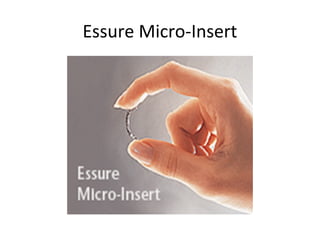
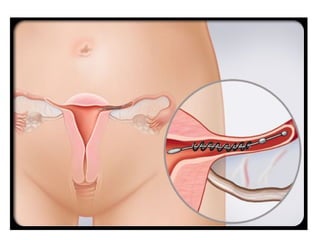
• Essure
Essure Micro-Insert
G. Emergency contraception
• Yuzpe Regimen
– High Dose Combined Pills
– Low Dose Combined Pills

• Progestin Only (High Dose)
– Postinor
– Provera

• IUD: Inserted within 5 days of Coitus
• Mifepristone (RU 486)
• The Yuzpe regimen, a combination of
100 μg ethinyloestradiol and 0.5mg LNG taken
twice with the two doses separated by 12 h
• Progestin only : LNG 1.5 mg ,single dose
within 72 h of intercourse
0.75 mg levonorgestrel taken twice 12 h apart
starting within 72 h of intercourse.
Mechanism of Action of OCPs in Emergency
Contraception

• If taken before ovulation, ECPs disrupt
normal follicular development and
maturation,
• Block LH surge, and inhibit ovulation,
• May also create deficient luteal phase,
• May affect tubal transport of sperm or
ova
Mechanism of Action of IUD in Emergency
Contraception
• IUD in EC
– Causes endometrial changes that inhibit ovulation
– Copper ions released appear to be directly
embryotoxic
– Rarely, may act as contraceptive, if inserted days
before ovulation
Emergency Contraception with Mifepristone
(RU-486)
An anti-progestogen: Single dose of 10mg to
25mg (China) mifepristone (RU-486), taken
within 5 days of unprotected intercourse.
Effectiveness: Prevent over 98% of pregnancies
Mechanism of Action

• Blocks action of progesterone by binding to its
receptors
• Stops ovulation if given in follicular phase
(contraceptive)
• Slows endometrial maturation in luteal phase
(interceptive)
THANK YOU!

Family planning

  • 1.
  • 2.
    Introduction • Also knownas Contraception • Limiting of family size or prevention of unwanted and unintended pregnancy • There are about 1.2 billion women of reproductive age world wide • About 114 million acts of sexual intercourse per day worldwide • IMAGINE WHAT WILL HAPPEN without CONTRACEPTION?!
  • 3.
    Nigeria burden • Hightotal fertility rate (TFR) of 5.7 (NDHS 2008). • High population • High annual population growth rate of 3.2%. • At this growth rate the Nigerian population should double in only 22 years! • Unfortunately, Low Contraceptive prevalence 14.6% for any method and 9.7% for modern methods(NDHS,2008)
  • 4.
    Classes of contraceptiveusers • Single ladies including adolescents, unstable relationships,coital exposure unpredictable • Married women or ladies in stable relationships desirous of child spacing services • Couples with completed family sizes
  • 5.
    Family planning methods: Classification A.Coitus Interruptus or Withdrawal Method B. Natural FP Methods (Safe Period and Abstinence) – – – – – – Inert forms – Copper bearing – Hormone bearing Cervical mucus (Spinberkeit) Temperature Sympto-thermal Cycle beads (Standard Days Method) Ovulation prediction devices E. Barrier methods OCP (COC, POCP) Hormone bearing / containing IUDs Nasal spray Injectables Implants Contraceptive Skin patches Vaginal rings F. Permanent methods C. Hormonal methods – – – – – – – D. Intrauterine devices – – – – – – – – – Male condom Female condom spermicides Cervical caps Diaphragm Vasectomy BTL Quinacrine Essure G. Emergency Contraception
  • 6.
    A: Abstinence andWithdrawal (Coitus Interruptus) Methods • Abstinence (many wives a modification?) • Withdrawal?
  • 7.
    B: Natural FamilyPlanning (NFP) Methods: • Fertility Awareness Based Methods (FAM), • Lactational Amenorrhoea Method (LAM) • Standard Days Method (SDM) • Ovulation Prediction Tests (OPT)
  • 8.
    Natural Family Planning(NFP) & Fertility Awareness-Based Methods (FAM) • Use of physical signs, symptoms, and cycle data to determine when ovulation occurs • Spouses abstain from intercourse during the at-risk fertile days • Or use other methods to avoid pregnancy – Condom, Emergency Contraception
  • 9.
    Effectiveness of NFP(FAM, LAM, SDM, OPT) • The success of the Natural Family Planning methods depends on: – the accuracy of the method in identifying the woman’s actual fertile days – Couples’ ability to correctly identify the fertile time – Couple’s ability to follow the rules of the method they are using
  • 10.
    Methods of DeterminingHigh-Risk Fertile Days • The basal body temperature (BBT) method • The calendar/rhythm method • The cervical mucus method (CMM) or Billings ovulation method. • The sympto-thermal method (STM) • Cycle beads • Ovulation prediction tests
  • 11.
    Cycle Beads • Alsocalled a Standard Days Method • Identifies fertile and infertile days of the cycle • Cycle beads has 32 beads, each bead represents a day of the menstrual cycle • The red bead represents first day of menstruation and of the cycle • White beads represent days when a woman can get pregnant • 95% effective with perfect use!
  • 13.
    Breastfeeding, Lactation Amenorrhea Method(LAM) • Breastfeeding delays return of fertility postpartum • However, LAM is a contraceptive method based on exclusive breastfeeding • LAM is an effective method only under specific conditions: – Woman breastfeeding exclusively – The woman is amenorrhoeic – The infant less than 6 months old
  • 14.
    C. Hormonal Contraception Mechanismof action: •Suppress ovulation (90 to 95% of time) •Causes thickening of cervical mucus, which impedes sperm penetration and entry into the upper reproductive tract •Causes endometrial atrophy •May slow down tubal motility
  • 15.
    1. The OralContraceptive Pill • 2 types: • Combined OCP (COCP) – estrogen & progesterone • Progesterone only pills (POP)
  • 16.
    COCP • Dose ofoestrogen in the COCPs ranges from 15 to 50 μg. Trend towards lower dosages with most being low dose containing 30-35 μg • Lower doses (15 μg ethinylestradiol) associated with similar efficacy as 30 μg pills, less cardiovascular risks and poorer cycle control with higher incidence of breakthrough bleeding
  • 17.
    2: Injectable Contraceptives Types:Progestin-Only – Depo Medroxy Progesterone Acetate (DMPA) 150 mg • Microcrystalline suspension • 3 monthly – Norethisterone Enanthate (Net-En) 200 mg • In oil • 2 monthly
  • 18.
    Types: Combined InjectableContraceptives given Monthly • MPA combined with estradiol cypionate (E2C) – Cyclofem, Lunelle (25mg MPA and 5 mg E2C) • Net-En combined with estradiol valerate (E2V) – Mesigyna, Norigynon 50mg Net-En; 5mg E2V
  • 19.
    3. Contraceptive Implants • • • • • SixRods, Norplant (levonorgestrel) – 5 years Two rod Norplant 11 (levonorgestrel)– 3 years Two rod Jadelle (levonorgestrel) – 5 years One rod Implanon (etonogestrel) – 3 years Bio-degradable (Capronor) – 2 years does not require removal
  • 20.
  • 21.
  • 22.
  • 23.
    4: Intra-Uterine DevicesBearing or Containing Hormones • Hormone bearing IUDs have lower pregnancy rates and fewer side effects • Hormone containing IUDs may actually also reduce risk of PID • The levonorgestrel IUD has a preventive effect against the occurrence of ectopic pregnancy
  • 24.
    Intrauterine System • TheIUS (Intrauterine System) releases levonorgestrel (a progestin), – Levo-Nova (registered in Finland) – Mirena (registered in the UK and Canada) • Other Uses: – Treatment of Menorrhagia – In HRT • Introduced in 1990
  • 25.
    Progestasert • Contained progesteronethat was released at a rate of 65 micrograms per day. • Was replaced annually, though approved for 18 months of use in France. • Failure rate: 2% per year • Introduced in 1976 and discontinued in 2001
  • 26.
  • 27.
    Combined contraceptive vaginal ccring •Releases 15μgEE and 120μg etonorgestrel/day (Nuvaring, Organon) • Ring consists of soft ethylene-vinyl-acetate (EVA) copolymer • last for 3 weeks • Efficacy similar to COCPs but incidence of irregular bleeding only about one-eight of that reported for COCPs
  • 28.
    How the Ringis Used • A new vaginal ring needs to be inserted every month. • Once inserted, the Ring is worn for 3 consecutive weeks before it is removed for 1 week. • During the week that the Ring is not worn, menstruation occurs. • Each ring provides a month’s contraception
  • 29.
  • 30.
    The Contraceptive Patch •Trans-dermal contraceptive system • Square, flexible, extended-release matrix patch system • Contains norelgestromin (NGMN) and ethinyl estradiol (EE) for use in a weekly dosing schedule • Product launched: April 2002
  • 31.
    Benefits of thePatch • • • • • Female-controlled Prompt contraceptive reversibility Allows for spontaneity Highly efficacious contraceptive High rates of compliance across age groups
  • 32.
    Method of use •A woman applies her first patch onto her – upper outer arm, – buttocks, abdomen thigh • Applied weekly • The day of application is known from that point as patch change day.
  • 33.
    Method of use •On the 4th patch change day, the patch is removed and not replaced. • The woman waits 7 days without a patch in place, and on the next patch change day she applies a new patch (a new cycle)
  • 34.
    D: Intrauterine Devices Types: •Chemicallyinert devices- composed of a nonabsorbable material, most often polyethylene, and impregnated with barium sulfate for radiopacity. • Chemically active devices have continuous elution of copper or a progestational agent. Only chemically active IUDs are available currently in most parts of the world.
  • 35.
    ….IntrauterineDevices Intrauterine device • Mostavailable ones have a plastic frame with copper wire wound round the stem or copper sleeves on the end of the arms. • Amount of copper : 250-375mm2. • One IUD is frameless (GyneFix) and consists of six copper beads on a nylon thread.
  • 36.
    Intrauterine Devices • Devicescontaining 250 mm2 are licensed for 3 years, the T-Safe Cu 380A for 8 years and the remainder for 5 years. • IUDs containing 380mm2 Copper have failure rate of 1 per 100 women in the first year of use.
  • 37.
    Contraindications • Current RTIor PID • History of malignant trophoblastic disease or Endometrial cancer • Pelvic Tuberculosis
  • 38.
    Side effects • Theremay be heavier and prolonged bleeding during the first 3 to 6 months of use. • Dysmenorrhoea • Uterine perforation • Expulsion • Ectopic pregnancy
  • 39.
    As regards risksof ectopic preg • Contraceptive effect decreases the absolute number of ectopic pregnancies by half, compared with women not using contraception • When contraceptive failure occurs, pregnancy is still more likely to be ectopic
  • 40.
    Mechanism of Actionof IUDs • Inflammatory reaction in the endometrium leading to phagocytosis of sperms • Copper ions are also spermicidal, inhibiting sperm motility and inhibiting acrosomal enzyme activation so that sperms rarely reach the tubes • Progestogen impregnated IUDs cause thickening of the cervical mucus: changes the uterotubal fluid that hinders sperm migration; and some anovulatory effects (5-15%) of treatment cycles.
  • 41.
    Hormone Containing IUDs •Progestasert: Contains pure Progesterone – Meant for 1 year – Not easily available • Levonova: levonorgestrel IUD (Mirena) – May actually reduce menstrual loss – Lasts for 5 and up to 7 years NB: Hormone containing IUDs may actually also reduce risk of PID – The levonorgestrel IUD has a preventive effect against the occurrence of ectopic pregnancy
  • 42.
    E: Barrier Methodsof Contraception – Male condom – Female condom – Diaphragm – Cervical Cap – Spermicides • • • • Aerosols Sponges Tablets Gels , etc.
  • 43.
    Male Condoms • Madefrom latex rubber. Less commonly, polyurethane or the cecum of lambs • Provide effective contraception • Provides protection against RTIs • Failure rate as low as 3 or 4 per 100 coupleyears of exposure
  • 44.
    Condition max. effectiveness •Use with every coital act. • Placed before contact of the penis with the vagina. • Withdrawal with the penis still erect • Holding the base of the during withdrawal • Use of an intravaginal spermicide or a condom lubricated with spermicide
  • 45.
    Non allergic condoms •Made of synthetic thermoplastic elastomer such as polyurethane • Effective against sexually transmitted diseases • Have an significantly higher breakage and slippage rate than latex condoms
  • 46.
    Female condoms • Preventpregnancy and sexually transmitted diseases • Made of polyurethrane • Has higher slippage rate than male polyurethrane condom • Pregnancy rate higher than with the male condom
  • 47.
    F. Permanent methodsof Contraception Considered irreversible Considered irreversible • Male • Female – Easier – Cheaper – Complications less – More costly – More technical – More complications
  • 48.
    Male Permanent Methods Vasectomy: •Througha small incision in the scrotum, the lumen of the vas deferens is disrupted to block the passage of sperm from the testes •Cheaper, less complications, lower failure rate •Sterility is not immediate.
  • 49.
    Vasectomy • Complete expulsionof sperm takes about 3 months or 20 ejaculations • Recommend that semen should be analyzed until two consecutive sperm counts are zero. • failure rate for vasectomy is much less than 1 percent
  • 50.
    Female Permanent Methods BilateralTubal Ligation • Laparotomy • Laparoscopy • Clips, Yoon Rings, • Minilaparotomy under local anaesthesia • Quinacrine • Essure
  • 51.
  • 53.
    G. Emergency contraception •Yuzpe Regimen – High Dose Combined Pills – Low Dose Combined Pills • Progestin Only (High Dose) – Postinor – Provera • IUD: Inserted within 5 days of Coitus • Mifepristone (RU 486)
  • 54.
    • The Yuzperegimen, a combination of 100 μg ethinyloestradiol and 0.5mg LNG taken twice with the two doses separated by 12 h • Progestin only : LNG 1.5 mg ,single dose within 72 h of intercourse 0.75 mg levonorgestrel taken twice 12 h apart starting within 72 h of intercourse.
  • 55.
    Mechanism of Actionof OCPs in Emergency Contraception • If taken before ovulation, ECPs disrupt normal follicular development and maturation, • Block LH surge, and inhibit ovulation, • May also create deficient luteal phase, • May affect tubal transport of sperm or ova
  • 56.
    Mechanism of Actionof IUD in Emergency Contraception • IUD in EC – Causes endometrial changes that inhibit ovulation – Copper ions released appear to be directly embryotoxic – Rarely, may act as contraceptive, if inserted days before ovulation
  • 57.
    Emergency Contraception withMifepristone (RU-486) An anti-progestogen: Single dose of 10mg to 25mg (China) mifepristone (RU-486), taken within 5 days of unprotected intercourse. Effectiveness: Prevent over 98% of pregnancies Mechanism of Action • Blocks action of progesterone by binding to its receptors • Stops ovulation if given in follicular phase (contraceptive) • Slows endometrial maturation in luteal phase (interceptive)
  • 58.