The Reproductive System
Anatomy of the Male and Female
Reproductive Systems
By: Dr. Shahbaz Ahmad PT
DPT [UIPT][UOL]
MS-MSK-PT [UIPT][UOL]
LECTURER [LIHS][LCPS]
Introduction
• Sexual reproduction produces new individuals
– Gametes (sperm & egg) formed by testes and ovaries
– Fertilization produces one cell (a zygote)with one set of
chromosomes from each parent
– Creates genetic variation
• Gonads produce gametes & secrete sex hormones
• Reproductive systems
– Gonads, ducts, glands & supporting structures
– Gynecology is study of female reproductive system
– Urology is study of urinary & male reproductive system
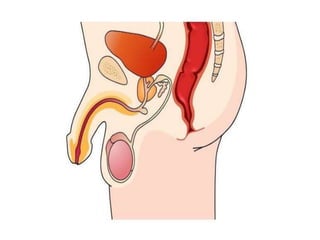
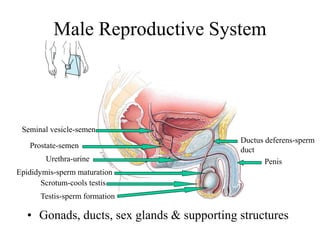
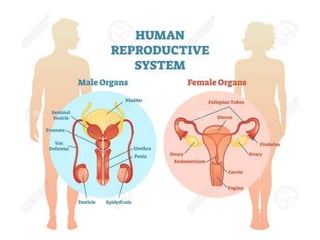
Male Reproductive System
• Gonads, ducts, sex glands & supporting structures
Penis
Ductus deferens-sperm
duct
Testis-sperm formation
Epididymis-sperm maturation
Scrotum-cools testis
Prostate-semen
Seminal vesicle-semen
Urethra-urine
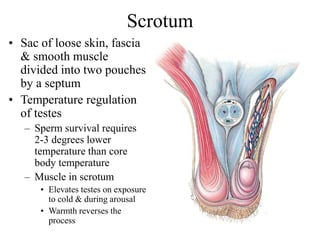
Scrotum
• Sac of loose skin, fascia
& smooth muscle
divided into two pouches
by a septum
• Temperature regulation
of testes
– Sperm survival requires
2-3 degrees lower
temperature than core
body temperature
– Muscle in scrotum
• Elevates testes on exposure
to cold & during arousal
• Warmth reverses the
process
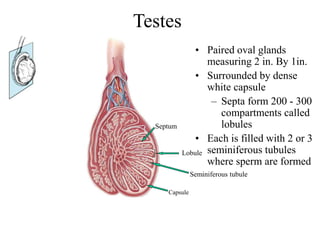
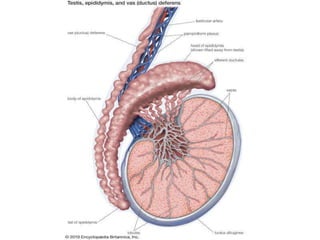
Testes
• Paired oval glands
measuring 2 in. By 1in.
• Surrounded by dense
white capsule
– Septa form 200 - 300
compartments called
lobules
• Each is filled with 2 or 3
seminiferous tubules
where sperm are formed
Seminiferous tubule
Lobule
Septum
Capsule
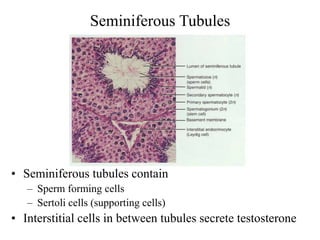
Seminiferous Tubules
• Seminiferous tubules contain
– Sperm forming cells
– Sertoli cells (supporting cells)
• Interstitial cells in between tubules secrete testosterone
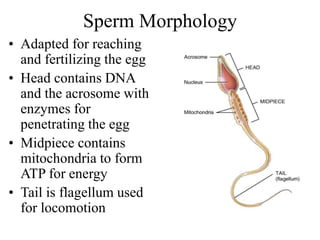
Sperm Morphology
• Adapted for reaching
and fertilizing the egg
• Head contains DNA
and the acrosome with
enzymes for
penetrating the egg
• Midpiece contains
mitochondria to form
ATP for energy
• Tail is flagellum used
for locomotion
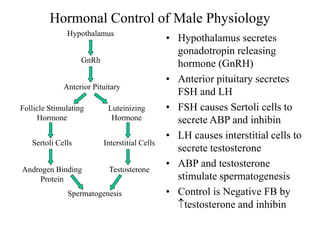
Hormonal Control of Male Physiology
• Hypothalamus secretes
gonadotropin releasing
hormone (GnRH)
• Anterior pituitary secretes
FSH and LH
• FSH causes Sertoli cells to
secrete ABP and inhibin
• LH causes interstitial cells to
secrete testosterone
• ABP and testosterone
stimulate spermatogenesis
• Control is Negative FB by
testosterone and inhibin
Hypothalamus
GnRh
Anterior Pituitary
Follicle Stimulating
Hormone
Luteinizing
Hormone
Sertoli Cells Interstitial Cells
TestosteroneAndrogen Binding
Protein
Spermatogenesis
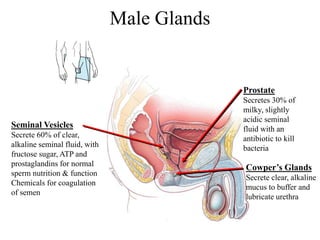
Male Glands
Seminal Vesicles
Secrete 60% of clear,
alkaline seminal fluid, with
fructose sugar, ATP and
prostaglandins for normal
sperm nutrition & function
Chemicals for coagulation
of semen
Prostate
Secretes 30% of
milky, slightly
acidic seminal
fluid with an
antibiotic to kill
bacteria
Cowper’s Glands
Secrete clear, alkaline
mucus to buffer and
lubricate urethra
Semen
• Mixture of sperms and seminal fluid
• 60% from seminal vesicles, 30% from prostate
• Slightly alkaline, milky appearance and sticky
• Contains nutrients, clotting proteins & an
antibiotic to protect the sperms
• Typical ejaculate is 2.5 to 5 ml in volume
• Normal sperm count is 50 to 150 millions/mL
– Actions of many sperm are needed for one to enter
– If less than 20 millions/mL sterile
Erection
• Sexual stimulation
• Parasympathetic nervous system reflex
• Dilation of the arterioles supplying the penis
• Blood enters the penis compressing the veins so
that the blood is trapped
• Blood sinuses of penis engorge with blood
• Erection
Emission and Ejaculation
• Emission
– Muscle contractions close sphincter at base of bladder
– Fluids propelled through ductus deferens, seminal
vesicles, & ejaculatory ducts into bulb of penis
– Prostatic fluid secreted into urethra
• Ejaculation
– Sympathetic nervous system reflex
– Skeletal muscles squeeze semen out through urethra
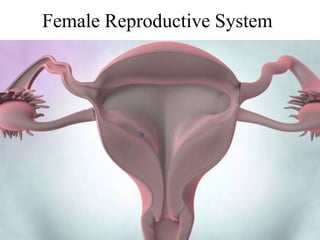
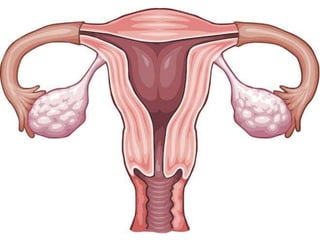
Female Reproductive System
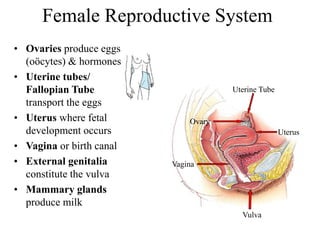
• Ovaries produce eggs
(oöcytes) & hormones
• Uterine tubes/
Fallopian Tube
transport the eggs
• Uterus where fetal
development occurs
• Vagina or birth canal
• External genitalia
constitute the vulva
• Mammary glands
produce milk
OvaryOvary
Uterine Tube
Uterus
Vagina
Vulva
The Ovary
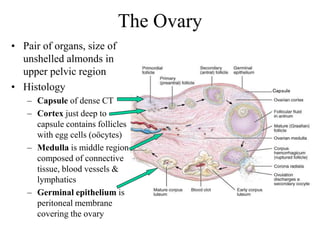
• Pair of organs, size of
unshelled almonds in
upper pelvic region
• Histology
– Capsule of dense CT
– Cortex just deep to
capsule contains follicles
with egg cells (oöcytes)
– Medulla is middle region
composed of connective
tissue, blood vessels &
lymphatics
– Germinal epithelium is
peritoneal membrane
covering the ovary
CapsuleCapsule
Ovarian Follicles
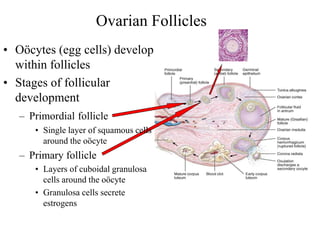
• Oöcytes (egg cells) develop
within follicles
• Stages of follicular
development
– Primordial follicle
• Single layer of squamous cells
around the oöcyte
– Primary follicle
• Layers of cuboidal granulosa
cells around the oöcyte
• Granulosa cells secrete
estrogens
Ovarian Follicles
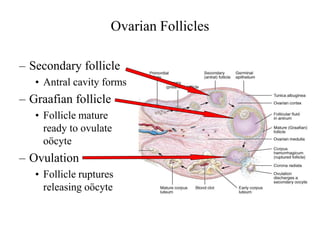
– Secondary follicle
• Antral cavity forms
– Graafian follicle
• Follicle mature
ready to ovulate
oöcyte
– Ovulation
• Follicle ruptures
releasing oöcyte
Corpus Luteum
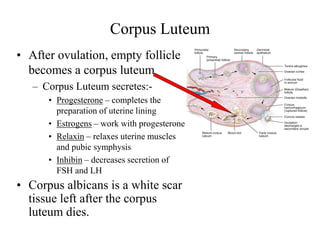
• After ovulation, empty follicle
becomes a corpus luteum
– Corpus Luteum secretes:-
• Progesterone – completes the
preparation of uterine lining
• Estrogens – work with progesterone
• Relaxin – relaxes uterine muscles
and pubic symphysis
• Inhibin – decreases secretion of
FSH and LH
• Corpus albicans is a white scar
tissue left after the corpus
luteum dies.
Uterine or Fallopian Tubes
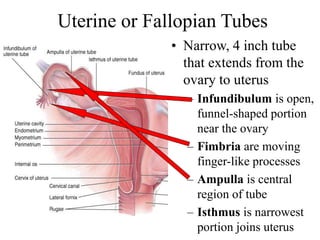
• Narrow, 4 inch tube
that extends from the
ovary to uterus
– Infundibulum is open,
funnel-shaped portion
near the ovary
– Fimbria are moving
finger-like processes
– Ampulla is central
region of tube
– Isthmus is narrowest
portion joins uterus
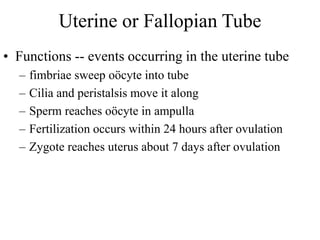
Uterine or Fallopian Tube
• Functions -- events occurring in the uterine tube
– fimbriae sweep oöcyte into tube
– Cilia and peristalsis move it along
– Sperm reaches oöcyte in ampulla
– Fertilization occurs within 24 hours after ovulation
– Zygote reaches uterus about 7 days after ovulation
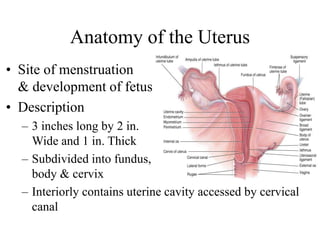
Anatomy of the Uterus
• Site of menstruation
& development of fetus
• Description
– 3 inches long by 2 in.
Wide and 1 in. Thick
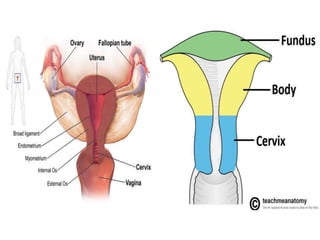
– Subdivided into fundus,
body & cervix
– Interiorly contains uterine cavity accessed by cervical
canal
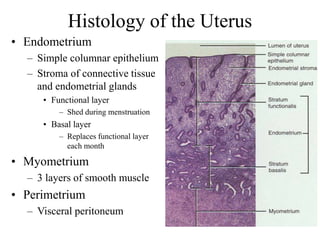
Histology of the Uterus
• Endometrium
– Simple columnar epithelium
– Stroma of connective tissue
and endometrial glands
• Functional layer
– Shed during menstruation
• Basal layer
– Replaces functional layer
each month
• Myometrium
– 3 layers of smooth muscle
• Perimetrium
– Visceral peritoneum
Vagina
• Passageway for birth, menstrual flow and
intercourse
• Description
– 4 inch long fibromuscular organ ending at cervix
– Lies between urinary bladder and rectum
– Orifice partially closed with membrane (hymen)
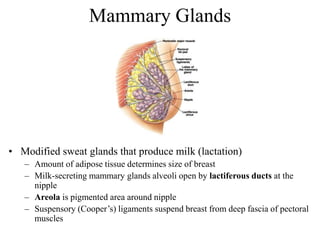
Mammary Glands
• Modified sweat glands that produce milk (lactation)
– Amount of adipose tissue determines size of breast
– Milk-secreting mammary glands alveoli open by lactiferous ducts at the
nipple
– Areola is pigmented area around nipple
– Suspensory (Cooper’s) ligaments suspend breast from deep fascia of pectoral
muscles
Physiology of the Breast
• Milk production and secretion
– Estrogens develop the ducts system in the breasts
– Progestrone develop the milk-secreting glands
which are called alveoli
– Prolactin stimulate milk synthesis in the alveoli
– Oxytocin stimulate milk ejection from the alveoli
Thank You

Sexual reproductive system

  • 2.
    The Reproductive System Anatomyof the Male and Female Reproductive Systems By: Dr. Shahbaz Ahmad PT DPT [UIPT][UOL] MS-MSK-PT [UIPT][UOL] LECTURER [LIHS][LCPS]
  • 3.
    Introduction • Sexual reproductionproduces new individuals – Gametes (sperm & egg) formed by testes and ovaries – Fertilization produces one cell (a zygote)with one set of chromosomes from each parent – Creates genetic variation • Gonads produce gametes & secrete sex hormones • Reproductive systems – Gonads, ducts, glands & supporting structures – Gynecology is study of female reproductive system – Urology is study of urinary & male reproductive system
  • 5.
    Male Reproductive System •Gonads, ducts, sex glands & supporting structures Penis Ductus deferens-sperm duct Testis-sperm formation Epididymis-sperm maturation Scrotum-cools testis Prostate-semen Seminal vesicle-semen Urethra-urine
  • 6.
    Scrotum • Sac ofloose skin, fascia & smooth muscle divided into two pouches by a septum • Temperature regulation of testes – Sperm survival requires 2-3 degrees lower temperature than core body temperature – Muscle in scrotum • Elevates testes on exposure to cold & during arousal • Warmth reverses the process
  • 7.
    Testes • Paired ovalglands measuring 2 in. By 1in. • Surrounded by dense white capsule – Septa form 200 - 300 compartments called lobules • Each is filled with 2 or 3 seminiferous tubules where sperm are formed Seminiferous tubule Lobule Septum Capsule
  • 9.
    Seminiferous Tubules • Seminiferoustubules contain – Sperm forming cells – Sertoli cells (supporting cells) • Interstitial cells in between tubules secrete testosterone
  • 10.
    Sperm Morphology • Adaptedfor reaching and fertilizing the egg • Head contains DNA and the acrosome with enzymes for penetrating the egg • Midpiece contains mitochondria to form ATP for energy • Tail is flagellum used for locomotion
  • 11.
    Hormonal Control ofMale Physiology • Hypothalamus secretes gonadotropin releasing hormone (GnRH) • Anterior pituitary secretes FSH and LH • FSH causes Sertoli cells to secrete ABP and inhibin • LH causes interstitial cells to secrete testosterone • ABP and testosterone stimulate spermatogenesis • Control is Negative FB by testosterone and inhibin Hypothalamus GnRh Anterior Pituitary Follicle Stimulating Hormone Luteinizing Hormone Sertoli Cells Interstitial Cells TestosteroneAndrogen Binding Protein Spermatogenesis
  • 12.
    Male Glands Seminal Vesicles Secrete60% of clear, alkaline seminal fluid, with fructose sugar, ATP and prostaglandins for normal sperm nutrition & function Chemicals for coagulation of semen Prostate Secretes 30% of milky, slightly acidic seminal fluid with an antibiotic to kill bacteria Cowper’s Glands Secrete clear, alkaline mucus to buffer and lubricate urethra
  • 13.
    Semen • Mixture ofsperms and seminal fluid • 60% from seminal vesicles, 30% from prostate • Slightly alkaline, milky appearance and sticky • Contains nutrients, clotting proteins & an antibiotic to protect the sperms • Typical ejaculate is 2.5 to 5 ml in volume • Normal sperm count is 50 to 150 millions/mL – Actions of many sperm are needed for one to enter – If less than 20 millions/mL sterile
  • 14.
    Erection • Sexual stimulation •Parasympathetic nervous system reflex • Dilation of the arterioles supplying the penis • Blood enters the penis compressing the veins so that the blood is trapped • Blood sinuses of penis engorge with blood • Erection
  • 15.
    Emission and Ejaculation •Emission – Muscle contractions close sphincter at base of bladder – Fluids propelled through ductus deferens, seminal vesicles, & ejaculatory ducts into bulb of penis – Prostatic fluid secreted into urethra • Ejaculation – Sympathetic nervous system reflex – Skeletal muscles squeeze semen out through urethra
  • 16.
  • 17.
    Female Reproductive System •Ovaries produce eggs (oöcytes) & hormones • Uterine tubes/ Fallopian Tube transport the eggs • Uterus where fetal development occurs • Vagina or birth canal • External genitalia constitute the vulva • Mammary glands produce milk OvaryOvary Uterine Tube Uterus Vagina Vulva
  • 19.
    The Ovary • Pairof organs, size of unshelled almonds in upper pelvic region • Histology – Capsule of dense CT – Cortex just deep to capsule contains follicles with egg cells (oöcytes) – Medulla is middle region composed of connective tissue, blood vessels & lymphatics – Germinal epithelium is peritoneal membrane covering the ovary CapsuleCapsule
  • 20.
    Ovarian Follicles • Oöcytes(egg cells) develop within follicles • Stages of follicular development – Primordial follicle • Single layer of squamous cells around the oöcyte – Primary follicle • Layers of cuboidal granulosa cells around the oöcyte • Granulosa cells secrete estrogens
  • 21.
    Ovarian Follicles – Secondaryfollicle • Antral cavity forms – Graafian follicle • Follicle mature ready to ovulate oöcyte – Ovulation • Follicle ruptures releasing oöcyte
  • 22.
    Corpus Luteum • Afterovulation, empty follicle becomes a corpus luteum – Corpus Luteum secretes:- • Progesterone – completes the preparation of uterine lining • Estrogens – work with progesterone • Relaxin – relaxes uterine muscles and pubic symphysis • Inhibin – decreases secretion of FSH and LH • Corpus albicans is a white scar tissue left after the corpus luteum dies.
  • 23.
    Uterine or FallopianTubes • Narrow, 4 inch tube that extends from the ovary to uterus – Infundibulum is open, funnel-shaped portion near the ovary – Fimbria are moving finger-like processes – Ampulla is central region of tube – Isthmus is narrowest portion joins uterus
  • 24.
    Uterine or FallopianTube • Functions -- events occurring in the uterine tube – fimbriae sweep oöcyte into tube – Cilia and peristalsis move it along – Sperm reaches oöcyte in ampulla – Fertilization occurs within 24 hours after ovulation – Zygote reaches uterus about 7 days after ovulation
  • 25.
    Anatomy of theUterus • Site of menstruation & development of fetus • Description – 3 inches long by 2 in. Wide and 1 in. Thick – Subdivided into fundus, body & cervix – Interiorly contains uterine cavity accessed by cervical canal
  • 27.
    Histology of theUterus • Endometrium – Simple columnar epithelium – Stroma of connective tissue and endometrial glands • Functional layer – Shed during menstruation • Basal layer – Replaces functional layer each month • Myometrium – 3 layers of smooth muscle • Perimetrium – Visceral peritoneum
  • 28.
    Vagina • Passageway forbirth, menstrual flow and intercourse • Description – 4 inch long fibromuscular organ ending at cervix – Lies between urinary bladder and rectum – Orifice partially closed with membrane (hymen)
  • 29.
    Mammary Glands • Modifiedsweat glands that produce milk (lactation) – Amount of adipose tissue determines size of breast – Milk-secreting mammary glands alveoli open by lactiferous ducts at the nipple – Areola is pigmented area around nipple – Suspensory (Cooper’s) ligaments suspend breast from deep fascia of pectoral muscles
  • 30.
    Physiology of theBreast • Milk production and secretion – Estrogens develop the ducts system in the breasts – Progestrone develop the milk-secreting glands which are called alveoli – Prolactin stimulate milk synthesis in the alveoli – Oxytocin stimulate milk ejection from the alveoli
  • 31.