Contraceptive Methods
Preventing Pregnancy
Natural Methods
Use of body awareness to prevent pregnancy
• ABSTINENCE- refraining from sexual activity
and/or intercourse.
• FERTILITY AWARENESS- abstinence during
ovulation.
• These do NOT work- Coitus Interuptus
(withdrawal), Douching, Breastfeeding.
Mechanical (Barrier) Methods:
Use of a physical barrier to prevent
the union of the sperm and ovum.
CONDOM:
thin latex sheath placed over penis to
collect semen
PROS:
•Protection against STI’s
•Over the counter
•Cheap & affordable
CONS:
•Irritation & allergic
reactions
•Doesn’t protect against
all types of STI’s
FEMALE CONDOM:
thin latex sheath placed at the opening of
the vagina to collect semen.
PROS:
•Protection against STI’s
•Over the counter
•Cheap & affordable
•Female can protect
herself, not rely on male
CONS:
•Irritation & allergic
reactions
•Doesn’t protect against
all types of STI’s
•Messy, compared to
male condom
•More expensive than
male condom
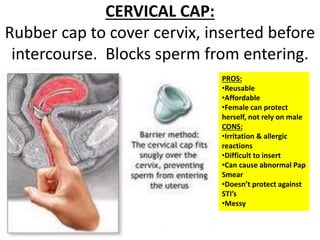
CERVICAL CAP:
Rubber cap to cover cervix, inserted before
intercourse. Blocks sperm from entering.
PROS:
•Reusable
•Affordable
•Female can protect
herself, not rely on male
CONS:
•Irritation & allergic
reactions
•Difficult to insert
•Can cause abnormal Pap
Smear
•Doesn’t protect against
STI’s
•Messy
DIAPHRAGM:
Rubber cap inserted into vagina before
intercourse. Blocks sperm from entering.
PROS:
•Reusable
•Affordable
•More effective and less
irritation than cervical
cap
•Female can protect
herself, not rely on male
CONS:
•Irritation & allergic
reactions
•Can cause UTI
•Doesn’t protect against
STI’s
•Messy
I.U.D:
Plastic or copper device placed in uterus by
doctor to disrupt uterine environment.
PROS:
•Very effective (99%)
•Long term use (can
leave in for years)
•Female can protect
herself, not rely on male
CONS:
•Can cause infertility,
PID, ectopic pregnancy
•Doesn’t protect against
STI’s
•Must be removed by
doctor
Chemical Methods:
Use of a chemical (hormone) to
alter bodily functions to prevent
pregnancy.
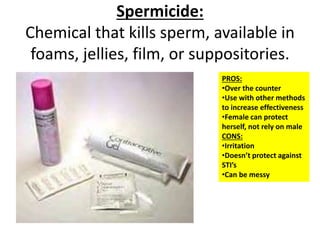
Spermicide:
Chemical that kills sperm, available in
foams, jellies, film, or suppositories.
PROS:
•Over the counter
•Use with other methods
to increase effectiveness
•Female can protect
herself, not rely on male
CONS:
•Irritation
•Doesn’t protect against
STI’s
•Can be messy
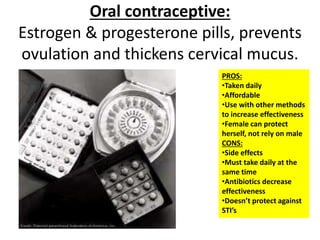
Oral contraceptive:
Estrogen & progesterone pills, prevents
ovulation and thickens cervical mucus.
PROS:
•Taken daily
•Affordable
•Use with other methods
to increase effectiveness
•Female can protect
herself, not rely on male
CONS:
•Side effects
•Must take daily at the
same time
•Antibiotics decrease
effectiveness
•Doesn’t protect against
STI’s
Oral contraceptive (“mini-pill”):
Pill with no estrogen, prevents ovulation
and thickens cervical mucus.
PROS:
•Taken daily
•Less side effects than regular pill
•Affordable
•Use with other methods to
increase effectiveness
•Female can protect herself, not
rely on male
CONS:
•Less effective than regular pill
•Must take daily at the same time
•Antibiotics decrease effectiveness
•Doesn’t protect against STI’s
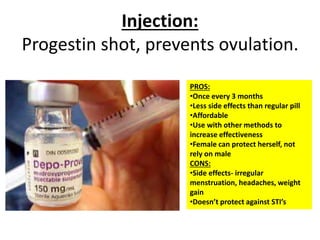
Injection:
Progestin shot, prevents ovulation.
PROS:
•Once every 3 months
•Less side effects than regular pill
•Affordable
•Use with other methods to
increase effectiveness
•Female can protect herself, not
rely on male
CONS:
•Side effects- irregular
menstruation, headaches, weight
gain
•Doesn’t protect against STI’s
Vaginal ring:
Progestin filled ring, inserted in vagina and
left in for 3 weeks. No ring for 1 wk.
PROS:
•No pill to remember
•Less side effects than regular pill
•Can remove if there are side
effects
•Use with other methods to
increase effectiveness
•Female can protect herself, not
rely on male
CONS:
•Must insert into vagina
•Doesn’t protect against STI’s
•Side effects are possible
Patch:
Estrogen and progestin hormone patch- put a
new patch on each week for 3 wks, no patch for
a week (menstruation).
PROS:
•No pill to remember
•Nothing to insert into vagina
•Use with other methods to
increase effectiveness
•Female can protect herself, not
rely on male
CONS:
•Side effects
•Patch may become loose
•Irritation at patch site
•Doesn’t protect against STI’s
Emergency Contraception:
High dose hormone pills to prevent ovulation
PROS:
•Can be used up to 72 hours after
sexual intercourse
CONS:
•Can be expensive, need
prescription
•Doesn’t protect against STI’s
•Major side effects- headaches,
vomiting
Vasectomy:
permanent sterilization for males
Tubal ligation:
permanent sterilization for females

Contraceptive methods

  • 1.
  • 2.
    Natural Methods Use ofbody awareness to prevent pregnancy • ABSTINENCE- refraining from sexual activity and/or intercourse. • FERTILITY AWARENESS- abstinence during ovulation. • These do NOT work- Coitus Interuptus (withdrawal), Douching, Breastfeeding.
  • 3.
    Mechanical (Barrier) Methods: Useof a physical barrier to prevent the union of the sperm and ovum.
  • 4.
    CONDOM: thin latex sheathplaced over penis to collect semen PROS: •Protection against STI’s •Over the counter •Cheap & affordable CONS: •Irritation & allergic reactions •Doesn’t protect against all types of STI’s
  • 5.
    FEMALE CONDOM: thin latexsheath placed at the opening of the vagina to collect semen. PROS: •Protection against STI’s •Over the counter •Cheap & affordable •Female can protect herself, not rely on male CONS: •Irritation & allergic reactions •Doesn’t protect against all types of STI’s •Messy, compared to male condom •More expensive than male condom
  • 6.
    CERVICAL CAP: Rubber capto cover cervix, inserted before intercourse. Blocks sperm from entering. PROS: •Reusable •Affordable •Female can protect herself, not rely on male CONS: •Irritation & allergic reactions •Difficult to insert •Can cause abnormal Pap Smear •Doesn’t protect against STI’s •Messy
  • 7.
    DIAPHRAGM: Rubber cap insertedinto vagina before intercourse. Blocks sperm from entering. PROS: •Reusable •Affordable •More effective and less irritation than cervical cap •Female can protect herself, not rely on male CONS: •Irritation & allergic reactions •Can cause UTI •Doesn’t protect against STI’s •Messy
  • 8.
    I.U.D: Plastic or copperdevice placed in uterus by doctor to disrupt uterine environment. PROS: •Very effective (99%) •Long term use (can leave in for years) •Female can protect herself, not rely on male CONS: •Can cause infertility, PID, ectopic pregnancy •Doesn’t protect against STI’s •Must be removed by doctor
  • 9.
    Chemical Methods: Use ofa chemical (hormone) to alter bodily functions to prevent pregnancy.
  • 10.
    Spermicide: Chemical that killssperm, available in foams, jellies, film, or suppositories. PROS: •Over the counter •Use with other methods to increase effectiveness •Female can protect herself, not rely on male CONS: •Irritation •Doesn’t protect against STI’s •Can be messy
  • 11.
    Oral contraceptive: Estrogen &progesterone pills, prevents ovulation and thickens cervical mucus. PROS: •Taken daily •Affordable •Use with other methods to increase effectiveness •Female can protect herself, not rely on male CONS: •Side effects •Must take daily at the same time •Antibiotics decrease effectiveness •Doesn’t protect against STI’s
  • 12.
    Oral contraceptive (“mini-pill”): Pillwith no estrogen, prevents ovulation and thickens cervical mucus. PROS: •Taken daily •Less side effects than regular pill •Affordable •Use with other methods to increase effectiveness •Female can protect herself, not rely on male CONS: •Less effective than regular pill •Must take daily at the same time •Antibiotics decrease effectiveness •Doesn’t protect against STI’s
  • 13.
    Injection: Progestin shot, preventsovulation. PROS: •Once every 3 months •Less side effects than regular pill •Affordable •Use with other methods to increase effectiveness •Female can protect herself, not rely on male CONS: •Side effects- irregular menstruation, headaches, weight gain •Doesn’t protect against STI’s
  • 14.
    Vaginal ring: Progestin filledring, inserted in vagina and left in for 3 weeks. No ring for 1 wk. PROS: •No pill to remember •Less side effects than regular pill •Can remove if there are side effects •Use with other methods to increase effectiveness •Female can protect herself, not rely on male CONS: •Must insert into vagina •Doesn’t protect against STI’s •Side effects are possible
  • 15.
    Patch: Estrogen and progestinhormone patch- put a new patch on each week for 3 wks, no patch for a week (menstruation). PROS: •No pill to remember •Nothing to insert into vagina •Use with other methods to increase effectiveness •Female can protect herself, not rely on male CONS: •Side effects •Patch may become loose •Irritation at patch site •Doesn’t protect against STI’s
  • 16.
    Emergency Contraception: High dosehormone pills to prevent ovulation PROS: •Can be used up to 72 hours after sexual intercourse CONS: •Can be expensive, need prescription •Doesn’t protect against STI’s •Major side effects- headaches, vomiting
  • 17.
  • 18.