PREPARED BY:
AINIE- RIZA H.
RIGONAN
FEMALE
REPRODUCTIVE
SYSTEM
The female reproductive system is made up of
internal organs and external structures. Its
function is to enable reproduction of the
species. Sexual maturation is the process that
this system undergoes in order to carry out its
role in the process of pregnancy and birth.
The reproductive organ in female are those
which concerned with copulation, fertilization,
growth and development of fetus and its
subsequent exit to the outer world.
INTRODUCTION
Produce sex hormones
Estrogen, Progesterone
Produce egg (ova or oocytes)
Support & protect developing embryo
Give birth to new baby
ROLES OF FEMALE REPRODUCTIVE
SYSTEM
4
FEMALE: LATERAL VIEW
The female reproductive organs can
be subdivided into:
a) External genitalia or Vulva
b) Internal genitalia
c) Accessory reproductive organs.
FEMALE REPRODUCTIVE SYSTEM
EXTERNAL GENITILIA
The vulva refers to those parts that are outwardly
visible.
The vulva includes:
• Mons pubis
• Labia majora
• Labia minora
• Clitoris
• Urethral opening
• Vaginal opening
• Perineum
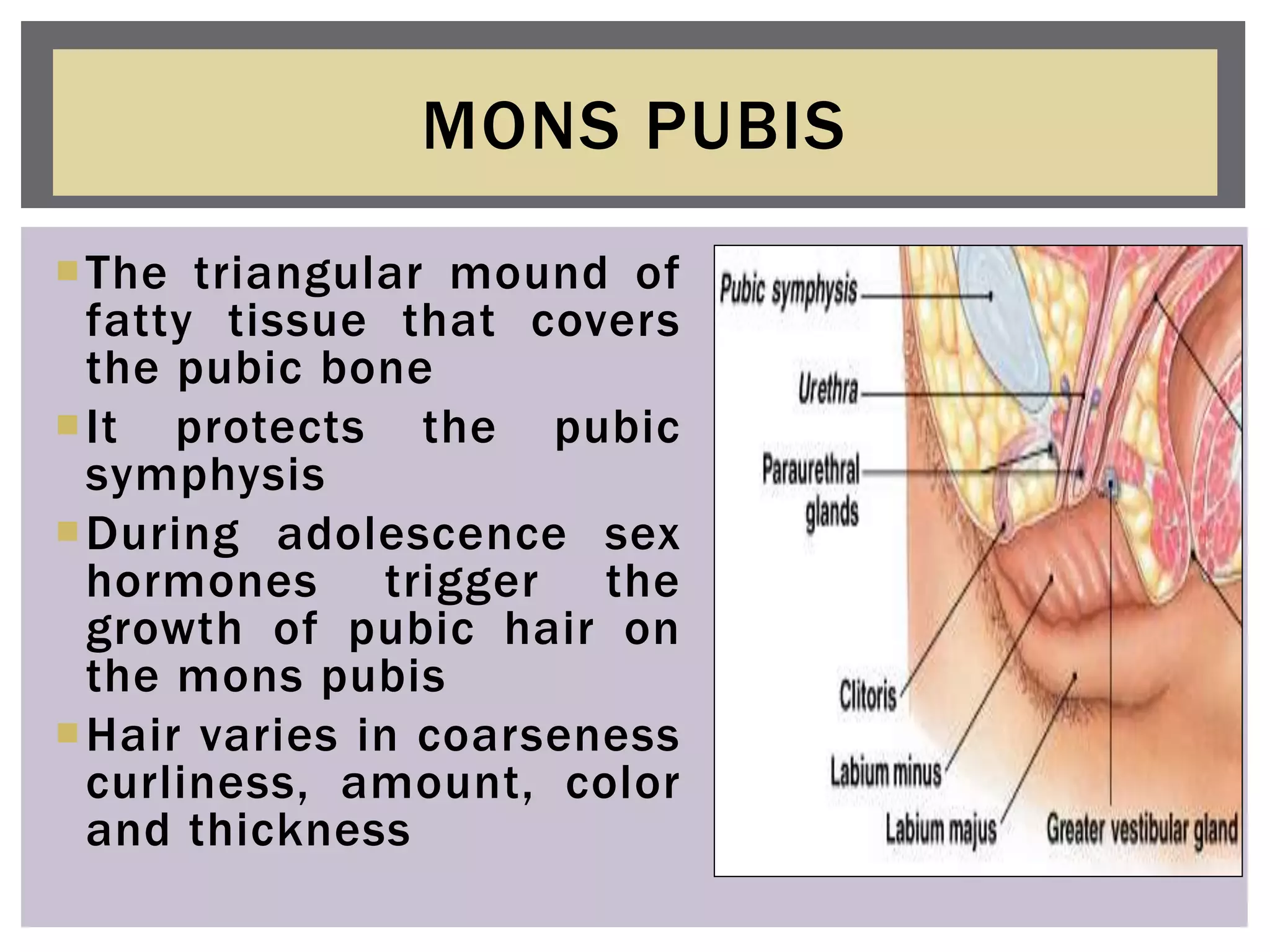
The triangular mound of
fatty tissue that covers
the pubic bone
It protects the pubic
symphysis
During adolescence sex
hormones trigger the
growth of pubic hair on
the mons pubis
Hair varies in coarseness
curliness, amount, color
and thickness
MONS PUBIS
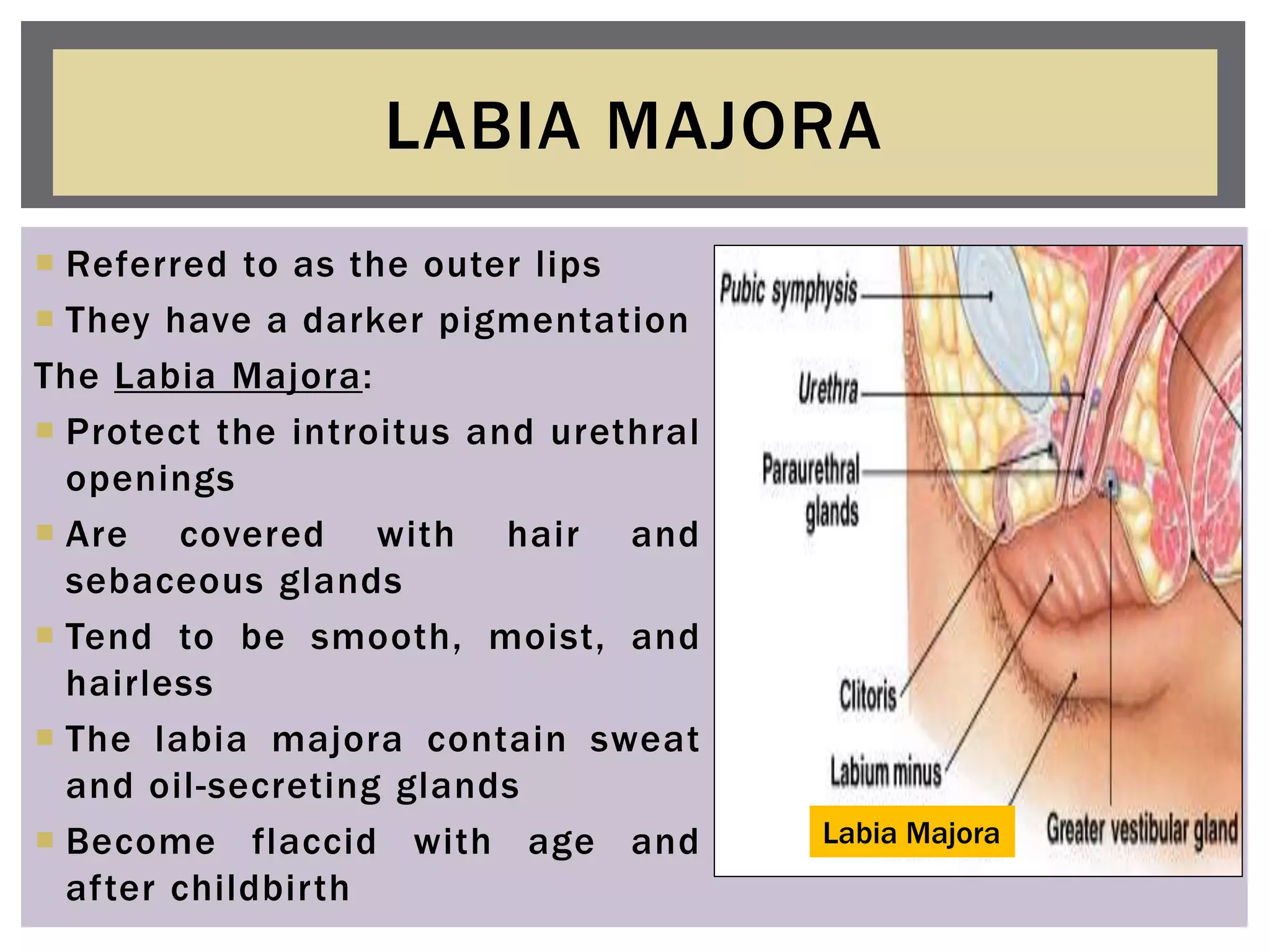
 Referred to as the outer lips
 They have a darker pigmentation
The Labia Majora:
 Protect the introitus and urethral
openings
 Are covered with hair and
sebaceous glands
 Tend to be smooth, moist, and
hairless
 The labia majora contain sweat
and oil-secreting glands
 Become flaccid with age and
after childbirth
LABIA MAJORA
Labia Majora
 Referred to as the “inner
lips”
 Made up of erectile,
connective tissue that
darkens and swells during
sexual arousal
 Located inside the labia
majora
 They are more sensitive
and responsive to touch
than the labia majora
 The labia minora tightens
during intercourse
LABIA MINORA
Labia Minora
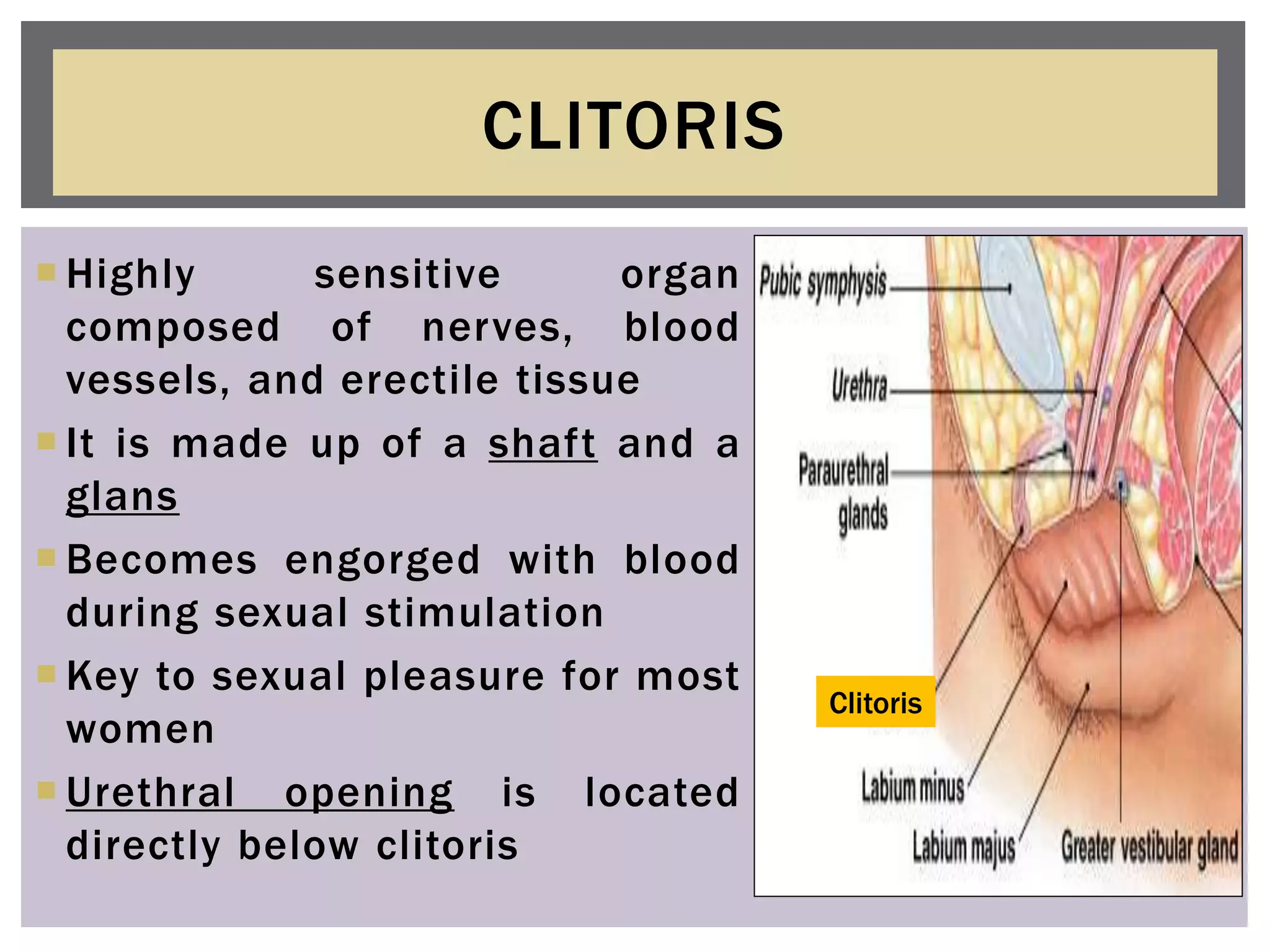
 Highly sensitive organ
composed of nerves, blood
vessels, and erectile tissue
 It is made up of a shaft and a
glans
 Becomes engorged with blood
during sexual stimulation
 Key to sexual pleasure for most
women
 Urethral opening is located
directly below clitoris
CLITORIS
Clitoris
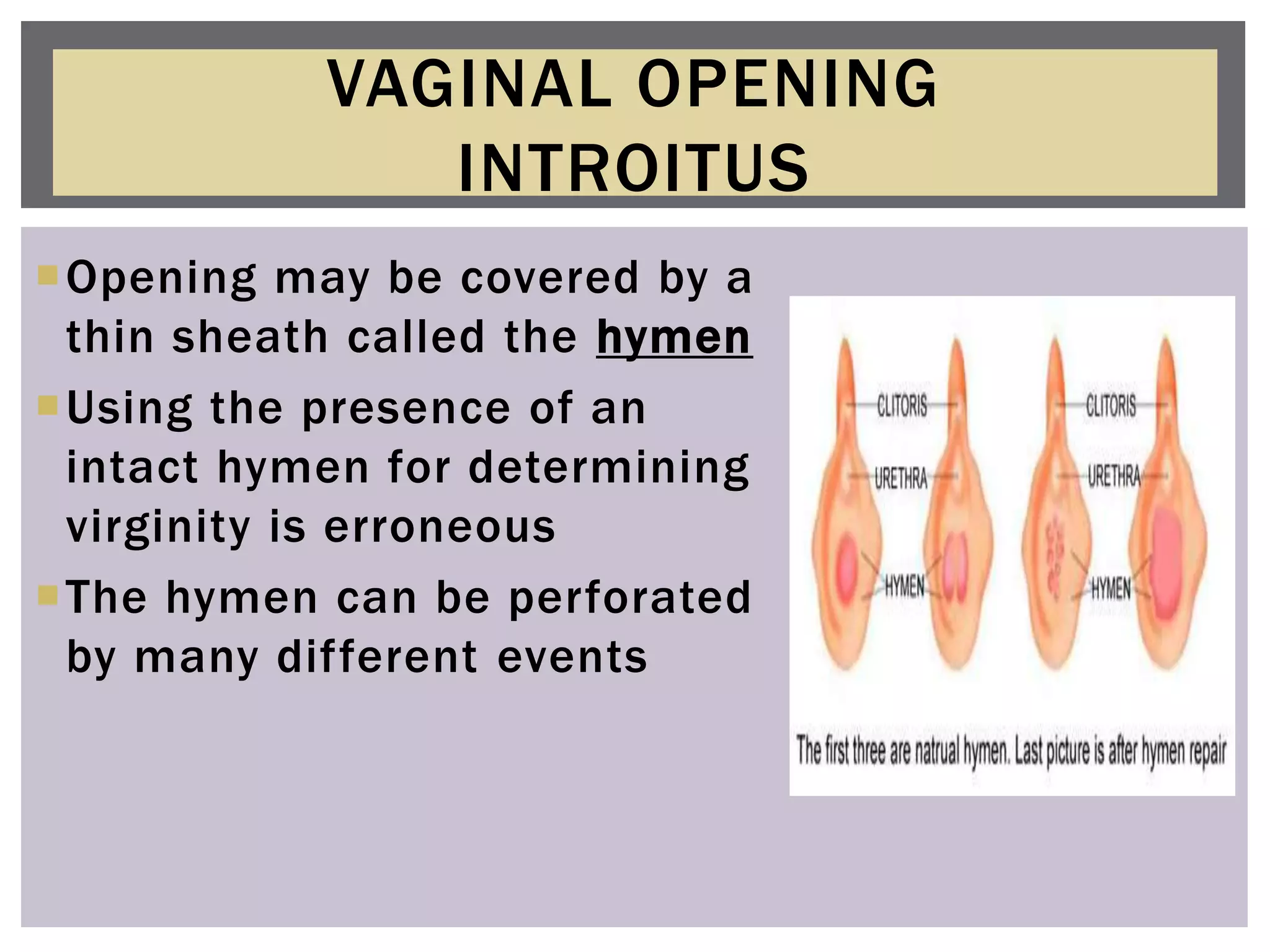
Opening may be covered by a
thin sheath called the hymen
Using the presence of an
intact hymen for determining
virginity is erroneous
The hymen can be perforated
by many different events
VAGINAL OPENING
INTROITUS
The muscle and tissue located between the
vaginal opening and anal canal
It supports and surrounds the lower parts of
the urinary and digestive tracts
The perineum contains an abundance of nerve
endings that make it sensitive to touch
An episiotomy is an incision of the perineum
used during childbirth for widening the vaginal
opening
PERINEUM
THE INTERNAL GENITALIA CONSISTS OF
THE:
VAGINA
CERVIX
UTERUS
FALLOPIAN TUBES
OVARIES
INTERNAL GENITALIA
The vagina connects the cervix
to the external genitals
It is located between the
bladder and rectum
It functions :
As a passageway for the
menstrual flow
For uterine secretions to pass
down through the introitus
As the birth canal during labor
VAGINA
Vagina
 The cervix connects the
uterus to the vagina
 The cervical opening to the
vagina is small
 This acts as a safety
precaution against foreign
bodies entering the uterus
 During childbirth, the cervix
dilates to accommodate the
passage of the fetus
 This dilation is a sign that
labor has begun
CERVIX
Cervix
 Commonly referred to as the womb
 A pear shaped organ about the size
of a clenched fist
 It is made up of the endometrium,
myometrium and perimetrium
 Consists of blood-enriched tissue
that sloughs off each month during
menstrual cycle
 The powerful muscles of the uterus
expand to accommodate a growing
fetus and push it through the birth
canal
UTERUS
Serve as a pathway for the
ovum to the uterus
Are the site of fertilization
by the male sperm
Often referred to as the
oviducts or uterine tubes
Fertilized egg takes
approximately 6 to 10 days
to travel through the
fallopian tube to implant in
the uterine lining
FALLOPIAN TUBES
Fallopian
Tube
 The female gonads or sex glands
 They develop and expel an ovum each
month
 A woman is born with approximately
400,000 immature eggs called follicles
 During a lifetime a woman release at
400 to 500 fully matured eggs for
fertilization
 The follicles in the ovaries produce the
female sex hormones, progesterone and
estrogen
 These hormones prepare the uterus for
implantation of the fertilized egg
OVARIES
Ovary
 Any area can be arousing depending
on the type of stimulation and the
perceptions of the recipient
 Breasts (mammary glands) –
modified sweat glands that produce
milk; fatty tissue, 15 to 20 lobes,
and milk-producing glands (alveoli)
Nipple, areola
 Sucking stimulates pituitary gland
to release prolactin (begin milk
synthesis) and oxytocin (release of
milk)
OTHER SEX ORGANS
MENSTRUATION
• Menarch, the onset of menstruation signals the
bodily changes that transform a female body
• Average age is 12.8
• Amount of bleeding varies from woman to woman
• Expulsion of blood clots
• Blood color can vary from bright red to dark maroon
• Usually occurs every 25 to 32 days
• Women can experience fluid retention, cramping,
mood swings, weight gain, breast tenderness,
diarrhea, and constipation
Female reproduction system

Female reproduction system

  • 1.
    PREPARED BY: AINIE- RIZAH. RIGONAN FEMALE REPRODUCTIVE SYSTEM
  • 2.
    The female reproductivesystem is made up of internal organs and external structures. Its function is to enable reproduction of the species. Sexual maturation is the process that this system undergoes in order to carry out its role in the process of pregnancy and birth. The reproductive organ in female are those which concerned with copulation, fertilization, growth and development of fetus and its subsequent exit to the outer world. INTRODUCTION
  • 3.
    Produce sex hormones Estrogen,Progesterone Produce egg (ova or oocytes) Support & protect developing embryo Give birth to new baby ROLES OF FEMALE REPRODUCTIVE SYSTEM
  • 4.
  • 5.
    The female reproductiveorgans can be subdivided into: a) External genitalia or Vulva b) Internal genitalia c) Accessory reproductive organs. FEMALE REPRODUCTIVE SYSTEM
  • 6.
    EXTERNAL GENITILIA The vulvarefers to those parts that are outwardly visible. The vulva includes: • Mons pubis • Labia majora • Labia minora • Clitoris • Urethral opening • Vaginal opening • Perineum
  • 7.
    The triangular moundof fatty tissue that covers the pubic bone It protects the pubic symphysis During adolescence sex hormones trigger the growth of pubic hair on the mons pubis Hair varies in coarseness curliness, amount, color and thickness MONS PUBIS
  • 8.
     Referred toas the outer lips  They have a darker pigmentation The Labia Majora:  Protect the introitus and urethral openings  Are covered with hair and sebaceous glands  Tend to be smooth, moist, and hairless  The labia majora contain sweat and oil-secreting glands  Become flaccid with age and after childbirth LABIA MAJORA Labia Majora
  • 9.
     Referred toas the “inner lips”  Made up of erectile, connective tissue that darkens and swells during sexual arousal  Located inside the labia majora  They are more sensitive and responsive to touch than the labia majora  The labia minora tightens during intercourse LABIA MINORA Labia Minora
  • 10.
     Highly sensitiveorgan composed of nerves, blood vessels, and erectile tissue  It is made up of a shaft and a glans  Becomes engorged with blood during sexual stimulation  Key to sexual pleasure for most women  Urethral opening is located directly below clitoris CLITORIS Clitoris
  • 11.
    Opening may becovered by a thin sheath called the hymen Using the presence of an intact hymen for determining virginity is erroneous The hymen can be perforated by many different events VAGINAL OPENING INTROITUS
  • 12.
    The muscle andtissue located between the vaginal opening and anal canal It supports and surrounds the lower parts of the urinary and digestive tracts The perineum contains an abundance of nerve endings that make it sensitive to touch An episiotomy is an incision of the perineum used during childbirth for widening the vaginal opening PERINEUM
  • 13.
    THE INTERNAL GENITALIACONSISTS OF THE: VAGINA CERVIX UTERUS FALLOPIAN TUBES OVARIES INTERNAL GENITALIA
  • 14.
    The vagina connectsthe cervix to the external genitals It is located between the bladder and rectum It functions : As a passageway for the menstrual flow For uterine secretions to pass down through the introitus As the birth canal during labor VAGINA Vagina
  • 15.
     The cervixconnects the uterus to the vagina  The cervical opening to the vagina is small  This acts as a safety precaution against foreign bodies entering the uterus  During childbirth, the cervix dilates to accommodate the passage of the fetus  This dilation is a sign that labor has begun CERVIX Cervix
  • 16.
     Commonly referredto as the womb  A pear shaped organ about the size of a clenched fist  It is made up of the endometrium, myometrium and perimetrium  Consists of blood-enriched tissue that sloughs off each month during menstrual cycle  The powerful muscles of the uterus expand to accommodate a growing fetus and push it through the birth canal UTERUS
  • 17.
    Serve as apathway for the ovum to the uterus Are the site of fertilization by the male sperm Often referred to as the oviducts or uterine tubes Fertilized egg takes approximately 6 to 10 days to travel through the fallopian tube to implant in the uterine lining FALLOPIAN TUBES Fallopian Tube
  • 18.
     The femalegonads or sex glands  They develop and expel an ovum each month  A woman is born with approximately 400,000 immature eggs called follicles  During a lifetime a woman release at 400 to 500 fully matured eggs for fertilization  The follicles in the ovaries produce the female sex hormones, progesterone and estrogen  These hormones prepare the uterus for implantation of the fertilized egg OVARIES Ovary
  • 19.
     Any areacan be arousing depending on the type of stimulation and the perceptions of the recipient  Breasts (mammary glands) – modified sweat glands that produce milk; fatty tissue, 15 to 20 lobes, and milk-producing glands (alveoli) Nipple, areola  Sucking stimulates pituitary gland to release prolactin (begin milk synthesis) and oxytocin (release of milk) OTHER SEX ORGANS
  • 20.
    MENSTRUATION • Menarch, theonset of menstruation signals the bodily changes that transform a female body • Average age is 12.8 • Amount of bleeding varies from woman to woman • Expulsion of blood clots • Blood color can vary from bright red to dark maroon • Usually occurs every 25 to 32 days • Women can experience fluid retention, cramping, mood swings, weight gain, breast tenderness, diarrhea, and constipation