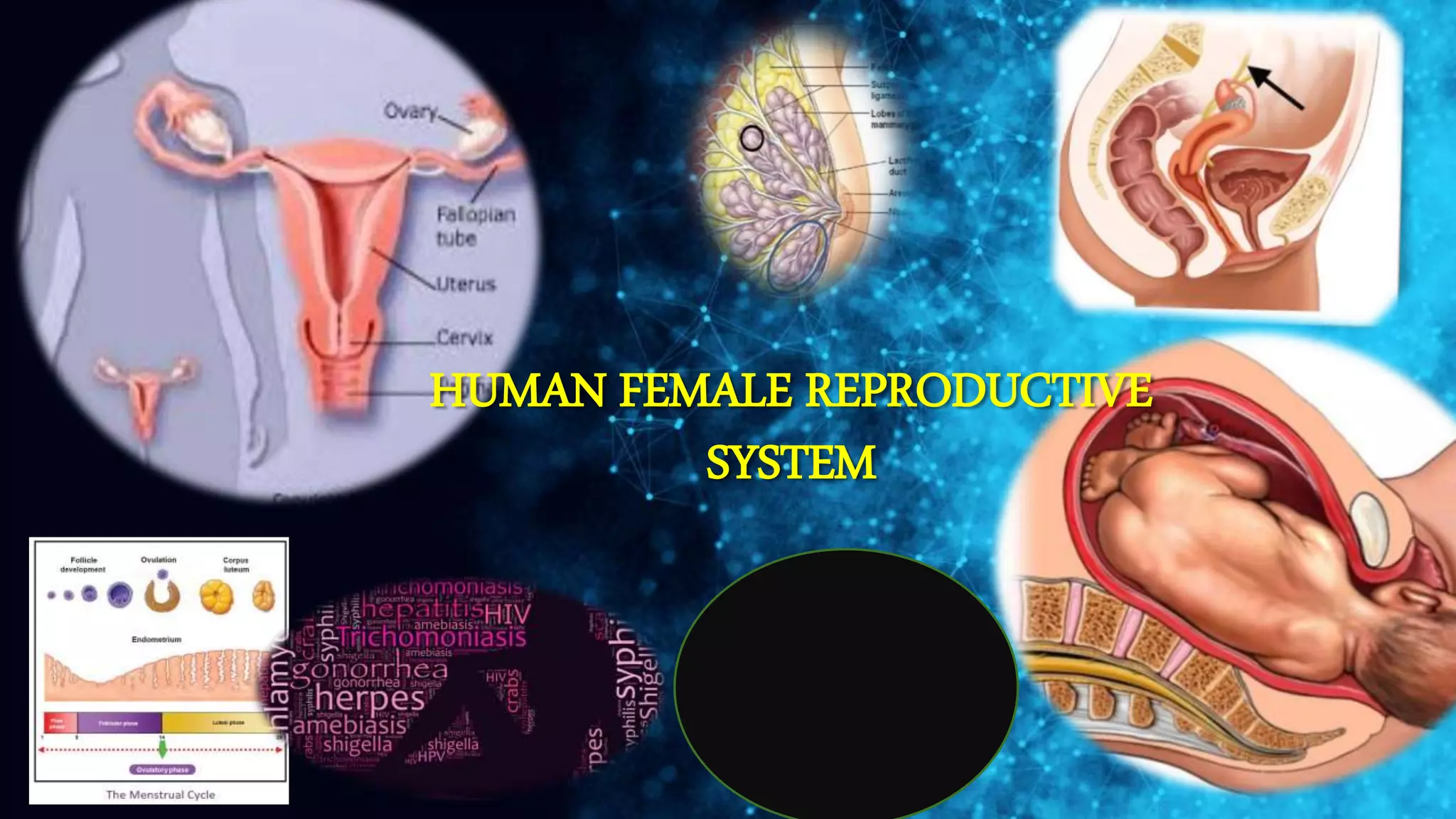
HUMAN FEMALE REPRODUCTIVE
SYSTEM
CONTENTS
INTRODUCTION
IMPORTANCE OF SYSTEM
ORGANS ASSOCIATED WITH SYSTEM
PHYSIOLOGY ( WORKING) OF THE SYSTEM
NORMAL VALUES
PATHOLOGICAL CHANGES
CONCULUSION
REFRENCES
IMPORTANCE OF SYSTEM:
 The primary function of the female reproductive system is to produce the female egg
cells which are essential for reproduction.
It is important to know that the entire system is designed for transporting the ova to
the exact fertilization site.
The female reproductive system is responsible for producing female sex hormones
which maintain the reproductive cycle.
INTRODUCTION
• Sexual life in females
• FIRST PERIOD
• It Extends From Birth To Puberty
• SECOUND PERIOD
• From Menarche To Menopause
• THIRD PERIOD
• From Menopause To Rest Of The Life
PUBERTY
• Puberty is the period of the time when secondary sexual characters begin to devolop
• In females puberty starts at the age of 12
• when First menses appears that is considered to be puberty
• Changes occurred are
• Development of pubic hair
• Development of axillary hair
• Development of breast
• Development of sexual organs
• Change in voice
• Increased levels of hormones
ORGANS ASSOCIATED WITH SYSTEM
 Female Reproductive system in the
EXTERNAL
GENITALIA
INTERNAL
GENITALLIA
MAMMARY GLAND
EXTERNAL
GENITALIA
 VULVA CONSISTS OF
 MONS PUBIS
LABIA MAJORA
LABIA MINORA
CLITORIS
VESTIBULE
BULB OF VESTIBULE
THE GREATER VESTIBULAR GLAND
Organs involved in the system
INTERNAL GENITALIA
THE INTERNAL ORGANS INVOLVES
OVARIES(2)
UTERINETUBES(2)
UTERUS
VAGINA
ORGANS INVOVED IN THE SYSTEM
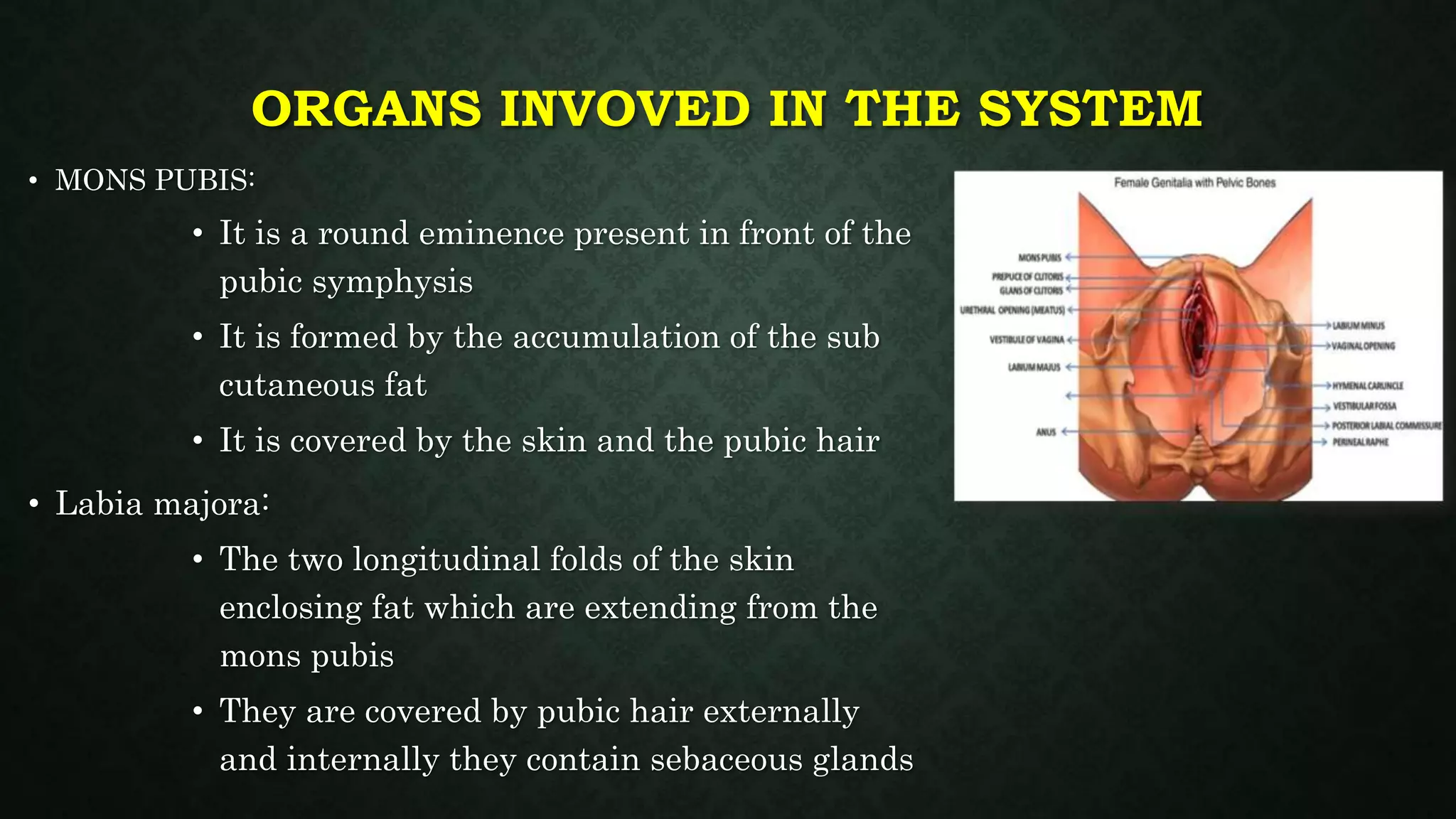
• MONS PUBIS:
• It is a round eminence present in front of the
pubic symphysis
• It is formed by the accumulation of the sub
cutaneous fat
• It is covered by the skin and the pubic hair
• Labia majora:
• The two longitudinal folds of the skin
enclosing fat which are extending from the
mons pubis
• They are covered by pubic hair externally
and internally they contain sebaceous glands
• Labia minora
• Medial to the labia majora there are two
small folds of the skin called as labia
minora
• Labia minora is devoid of the pubic hair
and fat.
• There are having numerous of the
sebaceous glands
• Clitoris:
• It is the small cylindrical mass of the
erectile tissues and the nerves located in
the anterior junction of the labia majora
• It corresponds to the penis of the males
• VESTIBULE
• The cleft between the labia majora is
called as the vestibule
• It mainly contains the
• Hymen
• Vaginal orifice
• external urethral orifice
• Openings of the several ducts
• Hymen :
• Thin mucous layer which partially
occludes the vaginal opening.
• Vaginal orifice :
• It is the opening of vagina from the exterior
INTERNAL GENITAL ORGANS
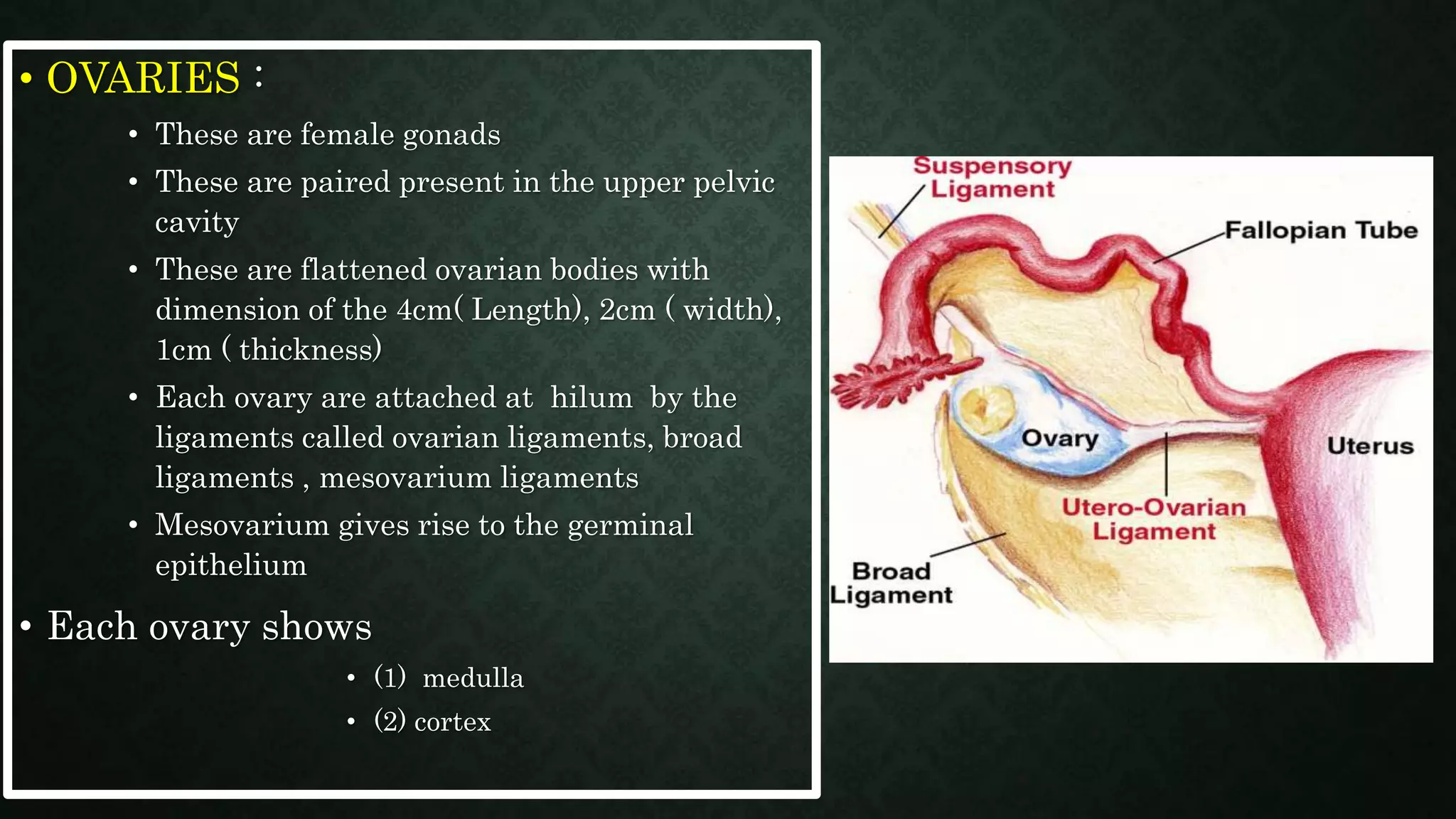
• OVARIES :
• These are female gonads
• These are paired present in the upper pelvic
cavity
• These are flattened ovarian bodies with
dimension of the 4cm( Length), 2cm ( width),
1cm ( thickness)
• Each ovary are attached at hilum by the
ligaments called ovarian ligaments, broad
ligaments , mesovarium ligaments
• Mesovarium gives rise to the germinal
epithelium
• Each ovary shows
• (1) medulla
• (2) cortex
• Each ovary consists of the :
• Germinal epithelium
• Tunica albuginea
• Stroma
• Ovarian follicles
• Graafian follicle
• Corpus luteum
• Interstitial cells
FUNCTIONS OF THE OVARIES:
Ovaries produces ova the female gamete by the
OOGENESIS
Ovaries produces the hormones like
ESTROGEN
PROGESTROGEN
RELAXIN
INHIBIN
OOGENESIS
• At the 7th or 8th month
of the intrauterine life
about 6 primordial
follicles are found in
the ovary
• But the time of the
birth there are only 1
million are seen
• At the time of the
puberty there are
3,00,000 to 4,00,000
OVARIAN HORMONES
• ESTROGEN :
• It is secreted by the theca interna cells of the ovarian
follicles
• The secretions of estrogen is predominant in the later
stage of follicular phase before ovulation.
• Function:
• promote cellular development
• Growth of ovarian follicles
• Increase in the spontaneous activity of uterine
muscles and sensitivity to oxytocin
• Increase the activity of cilia
• Reduces the PH of the vagina causing more acidity
• Development of breast
• Estrogen increases osteoblastic activity
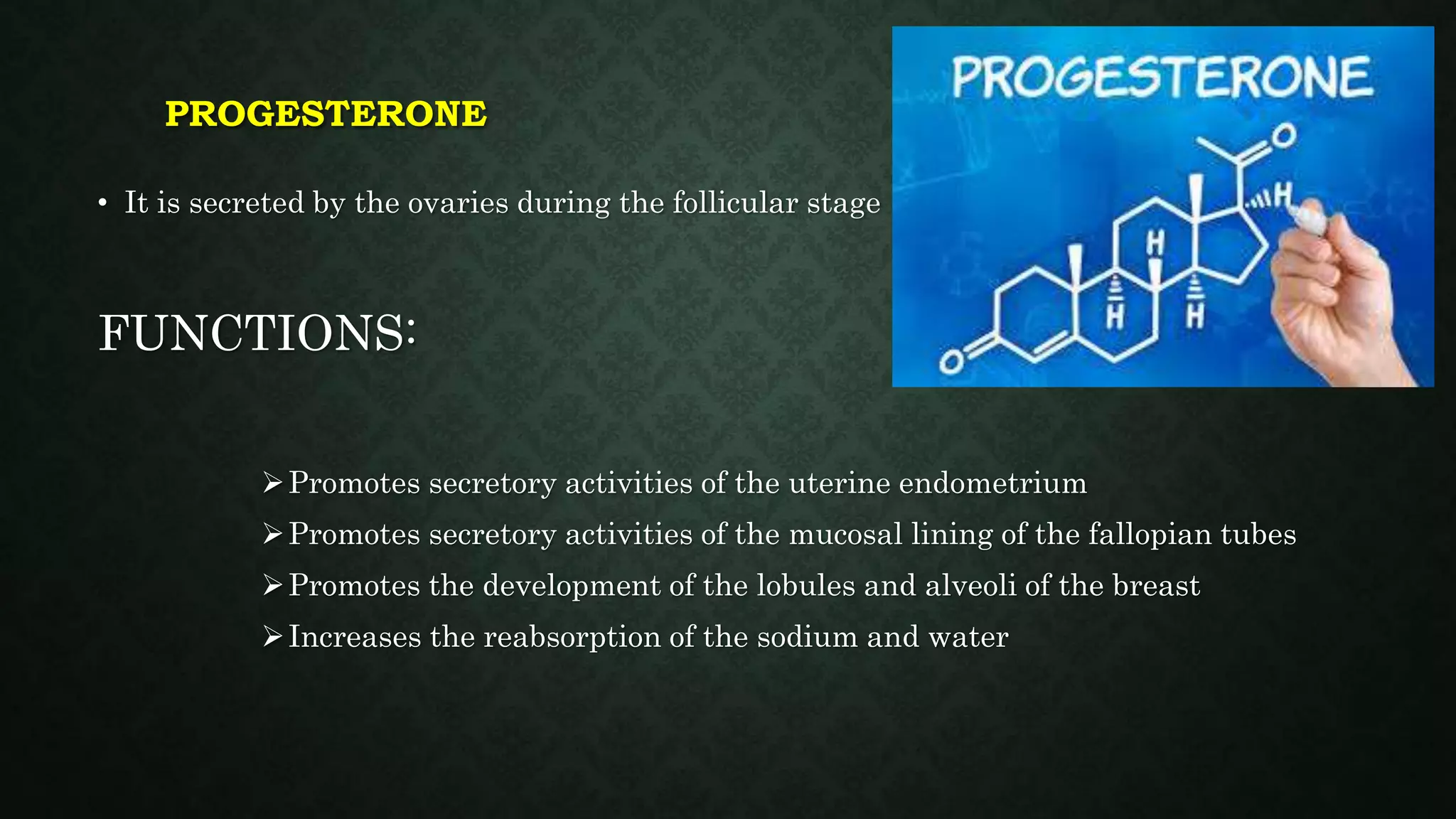
PROGESTERONE
• It is secreted by the ovaries during the follicular stage
FUNCTIONS:
Promotes secretory activities of the uterine endometrium
Promotes secretory activities of the mucosal lining of the fallopian tubes
Promotes the development of the lobules and alveoli of the breast
Increases the reabsorption of the sodium and water
UTERINE TUBES
• Also called fallopian tubes
• They are two in number attached on either
side of the uterus
• Uterine tubes extend laterally from uterus to
ovaries
• Each uterine tube has been divided into
• Infundibulu
m
• Ampulla
• Isthmus
HISTOLOGY:
• MUCOSA
• MUSCULARIS
• SEROSA
• Mucosa is the innermost layer contains of ciliated
columnar epithelium
• Helps to move the secondary oocyte along tube
• Muscularis helps in the peristaltic movement
• Serosa lines the outer most layer
FALLOPIAN TUBES
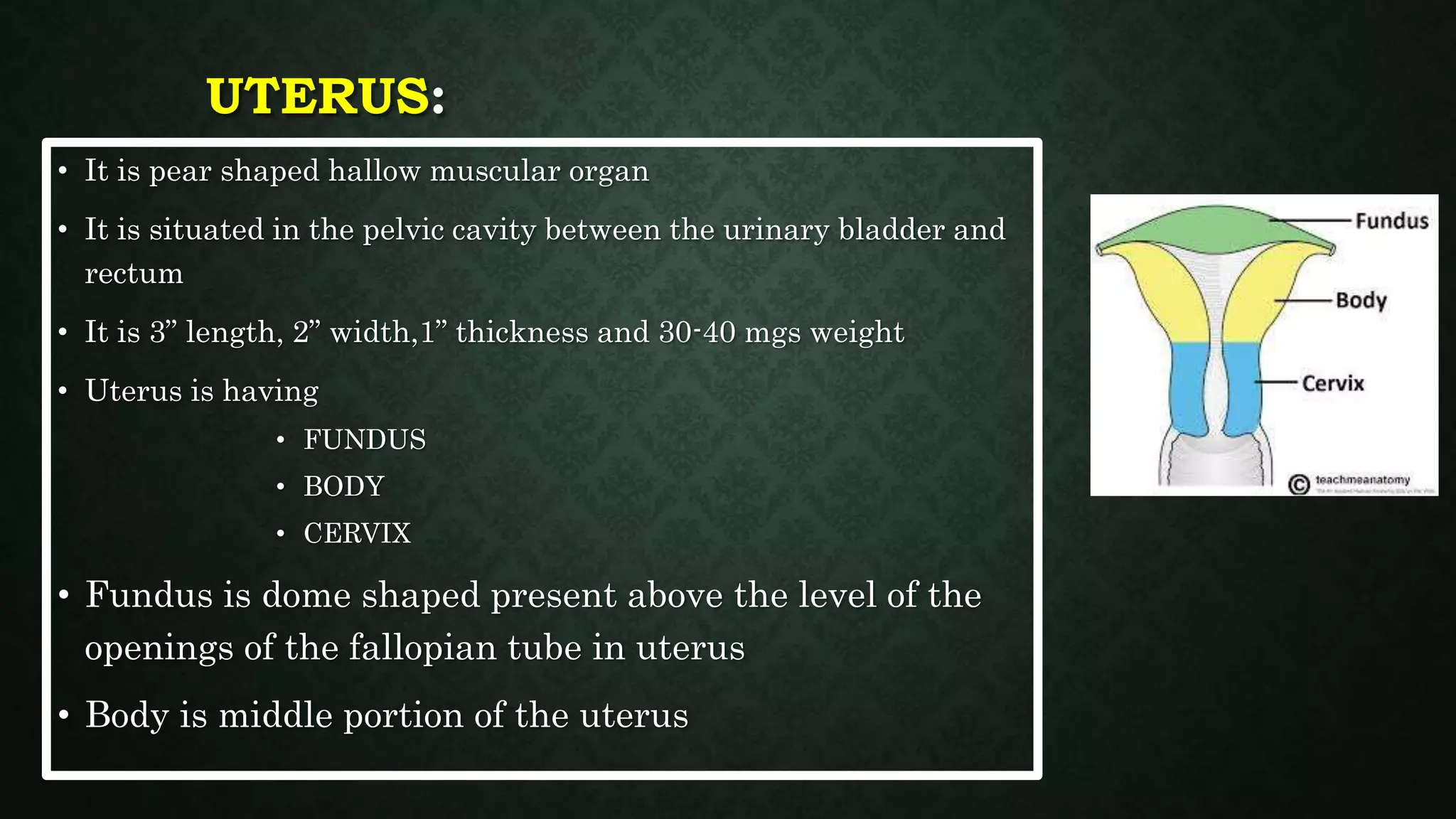
UTERUS:
• It is pear shaped hallow muscular organ
• It is situated in the pelvic cavity between the urinary bladder and
rectum
• It is 3” length, 2” width,1” thickness and 30-40 mgs weight
• Uterus is having
• FUNDUS
• BODY
• CERVIX
• Fundus is dome shaped present above the level of the
openings of the fallopian tube in uterus
• Body is middle portion of the uterus
• CERVIX :
• Inferior narrow portions of the
uterus
• It has two openings on either
sides
• Opens into uterus by internal os
• Opens into vagina by means of
external os
• Narrow canal is called as cervical
canal
WALL OF UTERUS:
• The wall of uterus is composed of
• Perimetrium
• Myometrium
• Endometrium
• Perimetrium is the outer most layer of the uterus
• Myometrium is middle layer made up of the smooth
muscle
• Endometrium is the inner most layer which is
highly vascular
• Stratum functionalis
• Stratum basalis
FUNCTIONS
• Serves as the pathway for the sperms to
reach the fallopian tube
• Uterus is site of menstruation
• Site of implantation of the fertilised egg
• Site of development of foetus during
pregnancy
• to provide blood supply to the ovaries
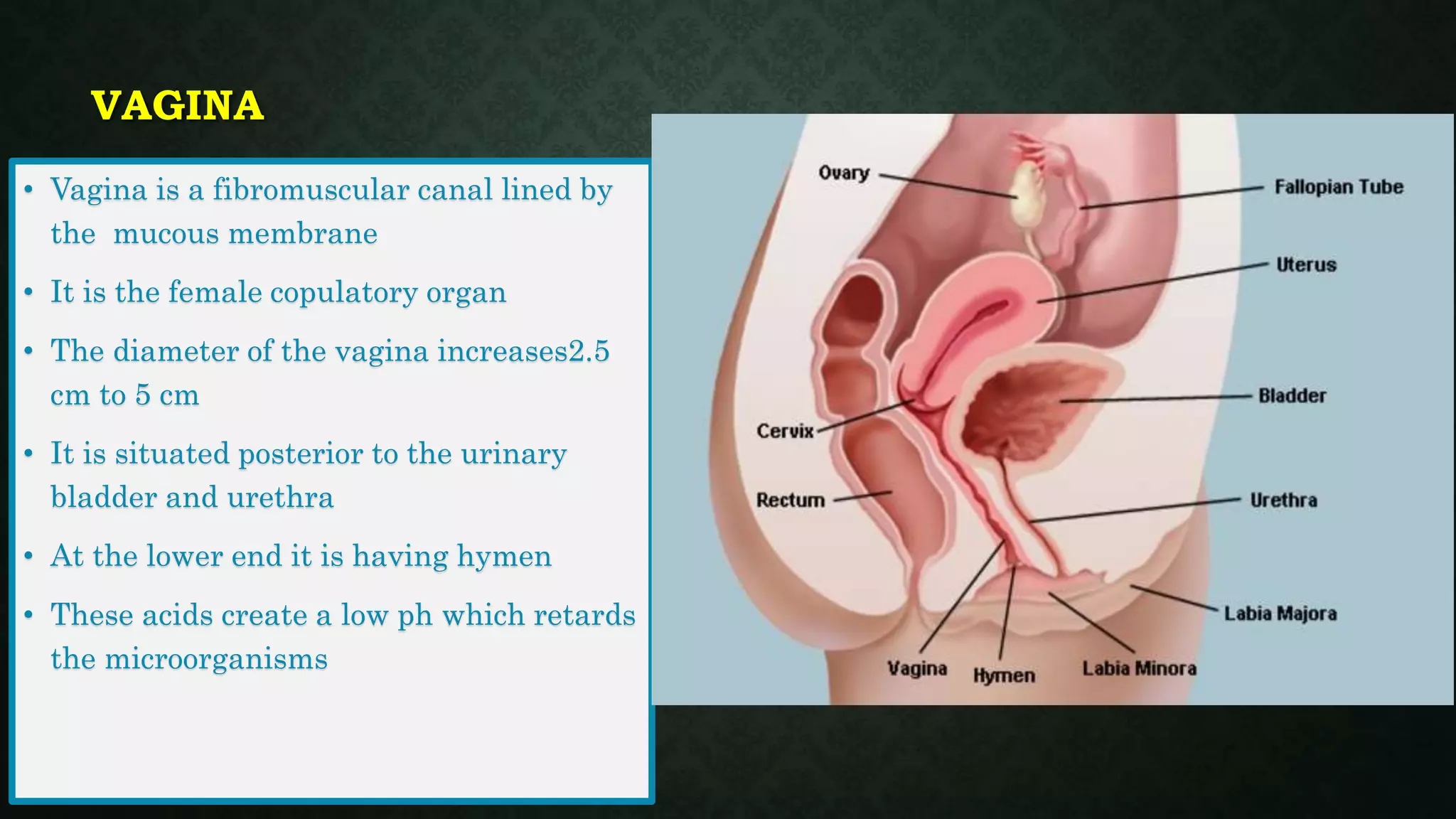
VAGINA
• Vagina is a fibromuscular canal lined by
the mucous membrane
• It is the female copulatory organ
• The diameter of the vagina increases2.5
cm to 5 cm
• It is situated posterior to the urinary
bladder and urethra
• At the lower end it is having hymen
• These acids create a low ph which retards
the microorganisms
FUNCTIONS
• It receives semen from the penis
during sexual intercourse
• Serves as a passage way for the
menstrual flow
• Serves as a passage way for baby
during child birth
• It secretes mucous for the lubrication
MAMMARY GLAND
• These are the modified sweet glands produces the milk
• These are present in both sexes but developed in females
• These are 2 in number present in pectoral regions
• These contain lobules alveoli
alveoli secondary tubules
secondary tubules mammary
glands
Mammary glands lactiferous
sinus
lactiferous sinus lactiferous
ducts
lactiferous ducts nipple
MENSTRUAL CYCLE
• The menstrual cycle is the regular natural change that occurs
in the female reproductive system
• The menstrual cycle starts with the first day of the period and
ends when the next period begins
• Hormone signals are sent back and forth between the brain and
the ovaries, causing changes to the sacs in the ovaries that
contain eggs (follicles) and the uterus
• The first part of the cycle prepares an egg to be released from
the ovary and builds the lining of the uterus
• The second part of the cycle prepares the uterus and body to
accept a fertilized egg, or to start the next cycle if pregnancy
doesn’t happen
• There are three phases
• Menstrual PHASE– first 5 days
• PRE OVULATORY PHASE 6th to 13th
day
• OVULATION – 14TH day
• POST OVULATORY PHASE
PREGNANCY
• It is sequence of events
• Fertilisation
• Implantation
• Growth of
embryo
• Fatal growth
• Delivery
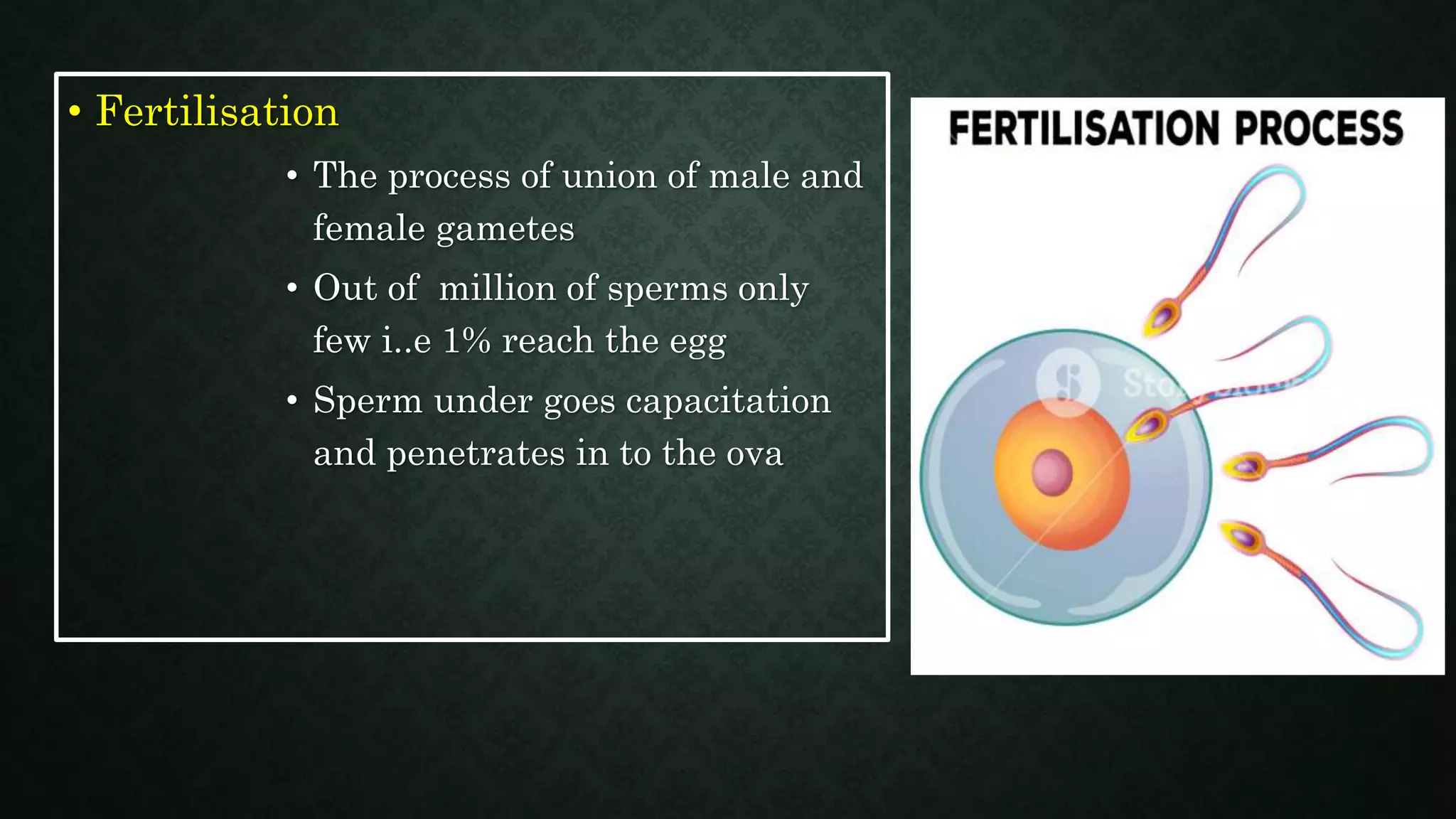
• Fertilisation
• The process of union of male and
female gametes
• Out of million of sperms only
few i..e 1% reach the egg
• Sperm under goes capacitation
and penetrates in to the ova
IMPLANTATION
• In humans, implantation is the stage of
pregnancy at which the embryo adheres to
the wall of the uterus.
• At this stage of prenatal development, the
conceptus is called a blastocyst. It is by this
adhesion that the
• Embryo receives oxygen and nutrients from
the mother to be able to grow
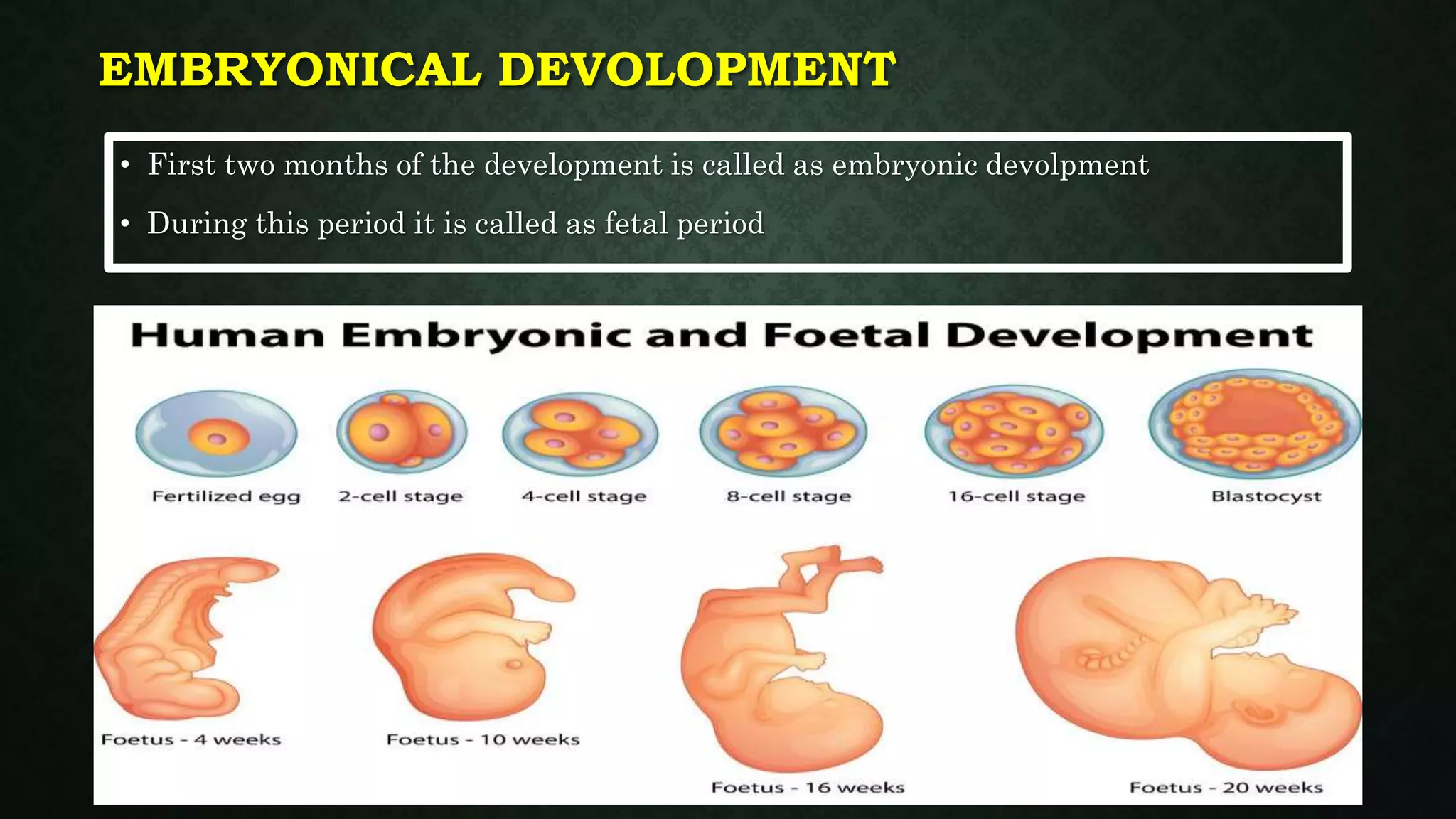
EMBRYONICAL DEVOLOPMENT
• First two months of the development is called as embryonic devolpment
• During this period it is called as fetal period
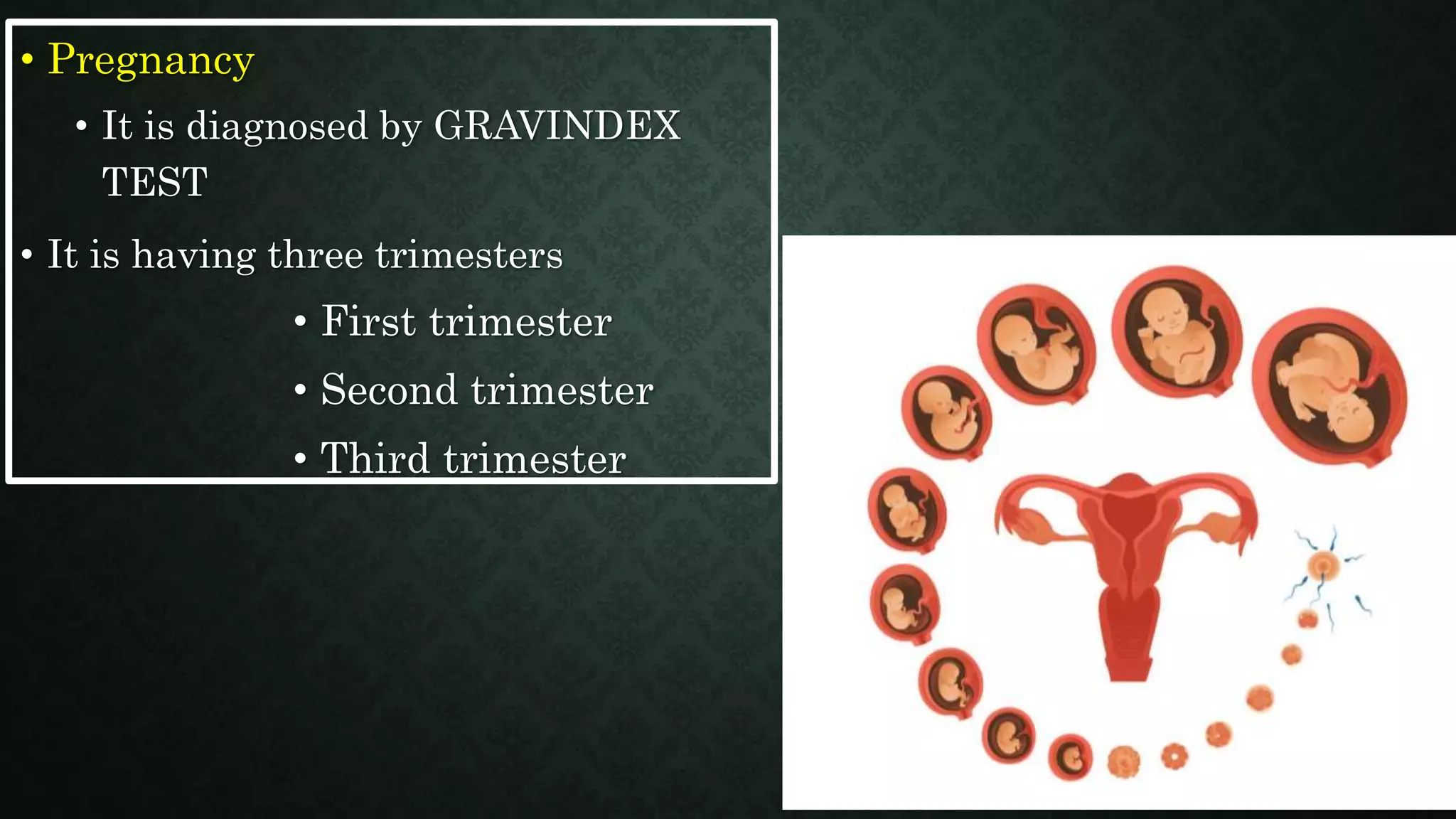
• Pregnancy
• It is diagnosed by GRAVINDEX
TEST
• It is having three trimesters
• First trimester
• Second trimester
• Third trimester
• Amenorrhoea
• Morning sickness
• Salivation and changes in
disposition
• Irritability of bladder
SECOND TRIMESTER
• Pigmentation
• Changes in the shape and size of the uterus
• Intermittent uterine contractions
• Active fetal growth
• Palpation of fetal parts
THIRD TRIMESTER
• Pain less uterine contractions
• Fetal movements are easily known
• Uterine cavity enlarges
LABOUR
• STAGE OF DILATION
• STAGE OF EXPULSION
• STAGE OF PLACENTA
PATHO PHYSIOLOGICAL CHANGES
Polycystic ovary syndrome
• Polycystic ovary syndrome, widely known as PCOS, is an endocrine system disorder that
affects women in their reproductive years. Small fluid-filled sacs develop on the ovaries. It
is also known as or Stein-Leventhal syndrome
• symptoms
• irregular menses
• excess androgen levels
• sleep disturbances
• high stress levels
• high blood pressure
• skin tags
• infertility
• DIAGNOSIS:
• if women have at least two of three main symptoms — high androgen levels,
irregular periods, and cysts in the ovaries. A pelvic exam, blood tests, and
ultrasound can confirm the diagnosis.
• TREATMENT:
• Maintain a healthy weight. Weight loss can reduce insulin and androgen
levels and may restore ovulation.
• Limit carbohydrates. Low-fat, high-carbohydrate diets might increase
insulin levels.
SOME OF THE CANCERS
• Cervical cancer :A malignant tumour of the cervix , the lowermost part of the uterus.
• Ovarian cancer :A cancer that begins in the female organs that produces eggs.
• Uterine cancer :A type of cancer that begins in the uterus.
• Vaginal cancer :It occurs in the cells that line the surface of vagina.
• Vulva cancer :A type of cancer thar occurs on the outer surface area of female.
• Breast cancer : A cancer that forms in the cells of the breast
Cervical cancer
Ovarian cancer Uterine cancer Vaginal cancer
Vulva cancer
BREAST CANCER
DISEASE ORGANISM
HIV HUMAN DEFICENCY VIRUS
CHLAMYDIA CHLAMYDIA TRACHOMATIS
CRABS/PUBLIC LICE PUBIC LOUSE
GENTIAL HERPES HERPS SIMPLEX VIRUS
GENTIAL WARTS HUMAN PAPILLOMA VIRUS
GONORRHOEA NEISSERIA GONORRHOEA
HEPATITIS A,B,C. HEPATITIS A,B,C VIRUS
SCABIES SARCOPTES SCABIEI
SYPHILIS TREPONEMA
REFERENCES
• From hand book of anatomy by A. CHANDHRA SEKHAR
• From text book of anatomy by sembulingam
Human female reproductive system

Human female reproductive system

  • 1.
  • 2.
    CONTENTS INTRODUCTION IMPORTANCE OF SYSTEM ORGANSASSOCIATED WITH SYSTEM PHYSIOLOGY ( WORKING) OF THE SYSTEM NORMAL VALUES PATHOLOGICAL CHANGES CONCULUSION REFRENCES
  • 3.
    IMPORTANCE OF SYSTEM: The primary function of the female reproductive system is to produce the female egg cells which are essential for reproduction. It is important to know that the entire system is designed for transporting the ova to the exact fertilization site. The female reproductive system is responsible for producing female sex hormones which maintain the reproductive cycle.
  • 4.
    INTRODUCTION • Sexual lifein females • FIRST PERIOD • It Extends From Birth To Puberty • SECOUND PERIOD • From Menarche To Menopause • THIRD PERIOD • From Menopause To Rest Of The Life
  • 5.
    PUBERTY • Puberty isthe period of the time when secondary sexual characters begin to devolop • In females puberty starts at the age of 12 • when First menses appears that is considered to be puberty • Changes occurred are • Development of pubic hair • Development of axillary hair • Development of breast • Development of sexual organs • Change in voice • Increased levels of hormones
  • 6.
    ORGANS ASSOCIATED WITHSYSTEM  Female Reproductive system in the EXTERNAL GENITALIA INTERNAL GENITALLIA MAMMARY GLAND
  • 7.
    EXTERNAL GENITALIA  VULVA CONSISTSOF  MONS PUBIS LABIA MAJORA LABIA MINORA CLITORIS VESTIBULE BULB OF VESTIBULE THE GREATER VESTIBULAR GLAND Organs involved in the system
  • 8.
    INTERNAL GENITALIA THE INTERNALORGANS INVOLVES OVARIES(2) UTERINETUBES(2) UTERUS VAGINA
  • 9.
    ORGANS INVOVED INTHE SYSTEM • MONS PUBIS: • It is a round eminence present in front of the pubic symphysis • It is formed by the accumulation of the sub cutaneous fat • It is covered by the skin and the pubic hair • Labia majora: • The two longitudinal folds of the skin enclosing fat which are extending from the mons pubis • They are covered by pubic hair externally and internally they contain sebaceous glands
  • 10.
    • Labia minora •Medial to the labia majora there are two small folds of the skin called as labia minora • Labia minora is devoid of the pubic hair and fat. • There are having numerous of the sebaceous glands • Clitoris: • It is the small cylindrical mass of the erectile tissues and the nerves located in the anterior junction of the labia majora • It corresponds to the penis of the males
  • 11.
    • VESTIBULE • Thecleft between the labia majora is called as the vestibule • It mainly contains the • Hymen • Vaginal orifice • external urethral orifice • Openings of the several ducts • Hymen : • Thin mucous layer which partially occludes the vaginal opening. • Vaginal orifice : • It is the opening of vagina from the exterior
  • 12.
  • 13.
    • OVARIES : •These are female gonads • These are paired present in the upper pelvic cavity • These are flattened ovarian bodies with dimension of the 4cm( Length), 2cm ( width), 1cm ( thickness) • Each ovary are attached at hilum by the ligaments called ovarian ligaments, broad ligaments , mesovarium ligaments • Mesovarium gives rise to the germinal epithelium • Each ovary shows • (1) medulla • (2) cortex
  • 14.
    • Each ovaryconsists of the : • Germinal epithelium • Tunica albuginea • Stroma • Ovarian follicles • Graafian follicle • Corpus luteum • Interstitial cells
  • 15.
    FUNCTIONS OF THEOVARIES: Ovaries produces ova the female gamete by the OOGENESIS Ovaries produces the hormones like ESTROGEN PROGESTROGEN RELAXIN INHIBIN
  • 16.
    OOGENESIS • At the7th or 8th month of the intrauterine life about 6 primordial follicles are found in the ovary • But the time of the birth there are only 1 million are seen • At the time of the puberty there are 3,00,000 to 4,00,000
  • 17.
    OVARIAN HORMONES • ESTROGEN: • It is secreted by the theca interna cells of the ovarian follicles • The secretions of estrogen is predominant in the later stage of follicular phase before ovulation. • Function: • promote cellular development • Growth of ovarian follicles • Increase in the spontaneous activity of uterine muscles and sensitivity to oxytocin • Increase the activity of cilia • Reduces the PH of the vagina causing more acidity • Development of breast • Estrogen increases osteoblastic activity
  • 18.
    PROGESTERONE • It issecreted by the ovaries during the follicular stage FUNCTIONS: Promotes secretory activities of the uterine endometrium Promotes secretory activities of the mucosal lining of the fallopian tubes Promotes the development of the lobules and alveoli of the breast Increases the reabsorption of the sodium and water
  • 19.
    UTERINE TUBES • Alsocalled fallopian tubes • They are two in number attached on either side of the uterus • Uterine tubes extend laterally from uterus to ovaries • Each uterine tube has been divided into • Infundibulu m • Ampulla • Isthmus
  • 20.
    HISTOLOGY: • MUCOSA • MUSCULARIS •SEROSA • Mucosa is the innermost layer contains of ciliated columnar epithelium • Helps to move the secondary oocyte along tube • Muscularis helps in the peristaltic movement • Serosa lines the outer most layer
  • 21.
  • 22.
    UTERUS: • It ispear shaped hallow muscular organ • It is situated in the pelvic cavity between the urinary bladder and rectum • It is 3” length, 2” width,1” thickness and 30-40 mgs weight • Uterus is having • FUNDUS • BODY • CERVIX • Fundus is dome shaped present above the level of the openings of the fallopian tube in uterus • Body is middle portion of the uterus
  • 23.
    • CERVIX : •Inferior narrow portions of the uterus • It has two openings on either sides • Opens into uterus by internal os • Opens into vagina by means of external os • Narrow canal is called as cervical canal
  • 24.
    WALL OF UTERUS: •The wall of uterus is composed of • Perimetrium • Myometrium • Endometrium • Perimetrium is the outer most layer of the uterus • Myometrium is middle layer made up of the smooth muscle • Endometrium is the inner most layer which is highly vascular • Stratum functionalis • Stratum basalis
  • 25.
    FUNCTIONS • Serves asthe pathway for the sperms to reach the fallopian tube • Uterus is site of menstruation • Site of implantation of the fertilised egg • Site of development of foetus during pregnancy • to provide blood supply to the ovaries
  • 26.
    VAGINA • Vagina isa fibromuscular canal lined by the mucous membrane • It is the female copulatory organ • The diameter of the vagina increases2.5 cm to 5 cm • It is situated posterior to the urinary bladder and urethra • At the lower end it is having hymen • These acids create a low ph which retards the microorganisms
  • 27.
    FUNCTIONS • It receivessemen from the penis during sexual intercourse • Serves as a passage way for the menstrual flow • Serves as a passage way for baby during child birth • It secretes mucous for the lubrication
  • 28.
    MAMMARY GLAND • Theseare the modified sweet glands produces the milk • These are present in both sexes but developed in females • These are 2 in number present in pectoral regions • These contain lobules alveoli alveoli secondary tubules secondary tubules mammary glands Mammary glands lactiferous sinus lactiferous sinus lactiferous ducts lactiferous ducts nipple
  • 29.
    MENSTRUAL CYCLE • Themenstrual cycle is the regular natural change that occurs in the female reproductive system • The menstrual cycle starts with the first day of the period and ends when the next period begins • Hormone signals are sent back and forth between the brain and the ovaries, causing changes to the sacs in the ovaries that contain eggs (follicles) and the uterus • The first part of the cycle prepares an egg to be released from the ovary and builds the lining of the uterus • The second part of the cycle prepares the uterus and body to accept a fertilized egg, or to start the next cycle if pregnancy doesn’t happen
  • 30.
    • There arethree phases • Menstrual PHASE– first 5 days • PRE OVULATORY PHASE 6th to 13th day • OVULATION – 14TH day • POST OVULATORY PHASE
  • 31.
    PREGNANCY • It issequence of events • Fertilisation • Implantation • Growth of embryo • Fatal growth • Delivery
  • 32.
    • Fertilisation • Theprocess of union of male and female gametes • Out of million of sperms only few i..e 1% reach the egg • Sperm under goes capacitation and penetrates in to the ova
  • 33.
    IMPLANTATION • In humans,implantation is the stage of pregnancy at which the embryo adheres to the wall of the uterus. • At this stage of prenatal development, the conceptus is called a blastocyst. It is by this adhesion that the • Embryo receives oxygen and nutrients from the mother to be able to grow
  • 34.
    EMBRYONICAL DEVOLOPMENT • Firsttwo months of the development is called as embryonic devolpment • During this period it is called as fetal period
  • 35.
    • Pregnancy • Itis diagnosed by GRAVINDEX TEST • It is having three trimesters • First trimester • Second trimester • Third trimester
  • 36.
    • Amenorrhoea • Morningsickness • Salivation and changes in disposition • Irritability of bladder
  • 37.
    SECOND TRIMESTER • Pigmentation •Changes in the shape and size of the uterus • Intermittent uterine contractions • Active fetal growth • Palpation of fetal parts
  • 38.
    THIRD TRIMESTER • Painless uterine contractions • Fetal movements are easily known • Uterine cavity enlarges
  • 40.
    LABOUR • STAGE OFDILATION • STAGE OF EXPULSION • STAGE OF PLACENTA
  • 42.
    PATHO PHYSIOLOGICAL CHANGES Polycysticovary syndrome • Polycystic ovary syndrome, widely known as PCOS, is an endocrine system disorder that affects women in their reproductive years. Small fluid-filled sacs develop on the ovaries. It is also known as or Stein-Leventhal syndrome • symptoms • irregular menses • excess androgen levels • sleep disturbances • high stress levels • high blood pressure • skin tags • infertility
  • 43.
    • DIAGNOSIS: • ifwomen have at least two of three main symptoms — high androgen levels, irregular periods, and cysts in the ovaries. A pelvic exam, blood tests, and ultrasound can confirm the diagnosis. • TREATMENT: • Maintain a healthy weight. Weight loss can reduce insulin and androgen levels and may restore ovulation. • Limit carbohydrates. Low-fat, high-carbohydrate diets might increase insulin levels.
  • 44.
    SOME OF THECANCERS • Cervical cancer :A malignant tumour of the cervix , the lowermost part of the uterus. • Ovarian cancer :A cancer that begins in the female organs that produces eggs. • Uterine cancer :A type of cancer that begins in the uterus. • Vaginal cancer :It occurs in the cells that line the surface of vagina. • Vulva cancer :A type of cancer thar occurs on the outer surface area of female. • Breast cancer : A cancer that forms in the cells of the breast
  • 45.
    Cervical cancer Ovarian cancerUterine cancer Vaginal cancer
  • 46.
  • 48.
    DISEASE ORGANISM HIV HUMANDEFICENCY VIRUS CHLAMYDIA CHLAMYDIA TRACHOMATIS CRABS/PUBLIC LICE PUBIC LOUSE GENTIAL HERPES HERPS SIMPLEX VIRUS GENTIAL WARTS HUMAN PAPILLOMA VIRUS GONORRHOEA NEISSERIA GONORRHOEA HEPATITIS A,B,C. HEPATITIS A,B,C VIRUS SCABIES SARCOPTES SCABIEI SYPHILIS TREPONEMA
  • 50.
    REFERENCES • From handbook of anatomy by A. CHANDHRA SEKHAR • From text book of anatomy by sembulingam