Ms.Anu Sebastian: B.Pharm; M.Pharm
Assistant Professor,
Dept. Of Pharmacology
Nirmala College Of Pharmacy
Muvattupuzha,Ernakulam,Kerala
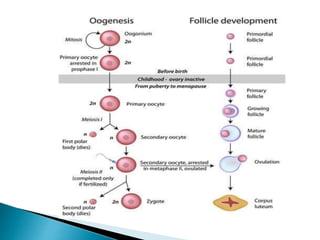
 The formation of gametes in the ovaries is termed as oogenesis. It
begins in females before birth.
 During early fetal development ,Primordial germ cells migrate from
the yolk sac to the ovaries.
 These germ cells differentiate within the ovaries into oogonia.
 Oogonia are diploid(2n) stem cells that divide mitotically to produce
millions of germ cells.
 Most of these germ cells degenerate in a process known as atresia.
 Remaining oogonia undergo meosis- I to form primary oocyte; but
cell division stops at Prophase-I in meosis-I
 At birth, approx. 200,000 to 2000,000 primary oocytes remain in each
ovary. Of these , about 40,000 are still present at puberty, and around
400 will mature & ovulate during a woman’s entire lifespan.
 Each month after puberty gonadotropins(FSH & LH) secreted by the
anterior pituitary further stimulate the development of several
primordial follicles.
 A few primordial follicles start to grow, developing into primary
follicles.
 Primary follicle consists of a primary oocyte that is surrounded in a
later stage of development by several layers of cuboidal & low-
cuboidal columnar cells called granulosa cells.
 The outermost granulosa cells are covered by basement membrane.
 It forms a clear glycoprotein layer called the Zona pellucida between
the primary oocyte & the granulosa cells.
 The stromal cells surrounding the basement membrane begin to form
an organized layer called the theca folliculi.
 A primary follicle develops into a secondary follicle.
 In a secondary follicle,the theca differentiates into two layers:
 (1)The theca interna: a highly vascularized internal layer of stromal
cells & collagen fibres.
 (2)The theca externa: an outer layer of stromal cells & Collagen
fibres.
 In addition, the granulosa cells begin to secrete follicular fluid, which
builds up in a cavity called the antrum in the center of the secondary
follicle.
 The innermost layer of granulosa cells becomes firmly attached to the Zona
pellucida & is now called the corona radiata.
 The secondary follicle eventually becomes larger, turning into a
mature(Graafian )follicle.
 This follicle just before ovulation, the diploid primary oocyte completes
meiosis – I, producing two haploid(n) cells of unequal size-each with 23
chromosomes;The smaller cell produced by meiosis –I ,called the first
polar body , consists of a packet of discarded nuclear material.
 The larger cell, known as the secondary oocyte , receives most of
the cytoplasm.
 Once a secondary oocyte is formed, it begins meiosis- II but then
stops in metaphase.
 The mature (graafian) follicle soon ruptures & releases its secondary
oocyte, a process known as ovulation.
 At ovulation, the secondary oocyte is expelled into the pelvic cavity
together with the first polar body 7 corona radiate.
 If fertilization does not occur, the cells degenerate.
 If sperms are present in the uterine tube & one penetrats the
secondary oocyte, meiosis –II resumes
 The secondary oocyte splits into two haploid cells, again of
unequal size.
 The larger cell is he ovum, or mature egg ; the smaller one
is the second polar body.
 The nuclei of the sperm cell & the ovum then unite,
forming a diploid Zygote.
 If the first polar body undergoes another division to produce
two polar bodies, then the primary oocyte ultimately gives
rise to three haploid polar bodies, which all degenerate & a
single haploid ovum.
THANK YOU

Oogenesis PART 7

  • 1.
    Ms.Anu Sebastian: B.Pharm;M.Pharm Assistant Professor, Dept. Of Pharmacology Nirmala College Of Pharmacy Muvattupuzha,Ernakulam,Kerala
  • 2.
     The formationof gametes in the ovaries is termed as oogenesis. It begins in females before birth.  During early fetal development ,Primordial germ cells migrate from the yolk sac to the ovaries.  These germ cells differentiate within the ovaries into oogonia.  Oogonia are diploid(2n) stem cells that divide mitotically to produce millions of germ cells.  Most of these germ cells degenerate in a process known as atresia.  Remaining oogonia undergo meosis- I to form primary oocyte; but cell division stops at Prophase-I in meosis-I
  • 3.
     At birth,approx. 200,000 to 2000,000 primary oocytes remain in each ovary. Of these , about 40,000 are still present at puberty, and around 400 will mature & ovulate during a woman’s entire lifespan.  Each month after puberty gonadotropins(FSH & LH) secreted by the anterior pituitary further stimulate the development of several primordial follicles.  A few primordial follicles start to grow, developing into primary follicles.  Primary follicle consists of a primary oocyte that is surrounded in a later stage of development by several layers of cuboidal & low- cuboidal columnar cells called granulosa cells.
  • 4.
     The outermostgranulosa cells are covered by basement membrane.  It forms a clear glycoprotein layer called the Zona pellucida between the primary oocyte & the granulosa cells.  The stromal cells surrounding the basement membrane begin to form an organized layer called the theca folliculi.  A primary follicle develops into a secondary follicle.  In a secondary follicle,the theca differentiates into two layers:  (1)The theca interna: a highly vascularized internal layer of stromal cells & collagen fibres.  (2)The theca externa: an outer layer of stromal cells & Collagen fibres.
  • 5.
     In addition,the granulosa cells begin to secrete follicular fluid, which builds up in a cavity called the antrum in the center of the secondary follicle.  The innermost layer of granulosa cells becomes firmly attached to the Zona pellucida & is now called the corona radiata.  The secondary follicle eventually becomes larger, turning into a mature(Graafian )follicle.  This follicle just before ovulation, the diploid primary oocyte completes meiosis – I, producing two haploid(n) cells of unequal size-each with 23 chromosomes;The smaller cell produced by meiosis –I ,called the first polar body , consists of a packet of discarded nuclear material.
  • 6.
     The largercell, known as the secondary oocyte , receives most of the cytoplasm.  Once a secondary oocyte is formed, it begins meiosis- II but then stops in metaphase.  The mature (graafian) follicle soon ruptures & releases its secondary oocyte, a process known as ovulation.  At ovulation, the secondary oocyte is expelled into the pelvic cavity together with the first polar body 7 corona radiate.  If fertilization does not occur, the cells degenerate.  If sperms are present in the uterine tube & one penetrats the secondary oocyte, meiosis –II resumes
  • 7.
     The secondaryoocyte splits into two haploid cells, again of unequal size.  The larger cell is he ovum, or mature egg ; the smaller one is the second polar body.  The nuclei of the sperm cell & the ovum then unite, forming a diploid Zygote.  If the first polar body undergoes another division to produce two polar bodies, then the primary oocyte ultimately gives rise to three haploid polar bodies, which all degenerate & a single haploid ovum.
  • 9.