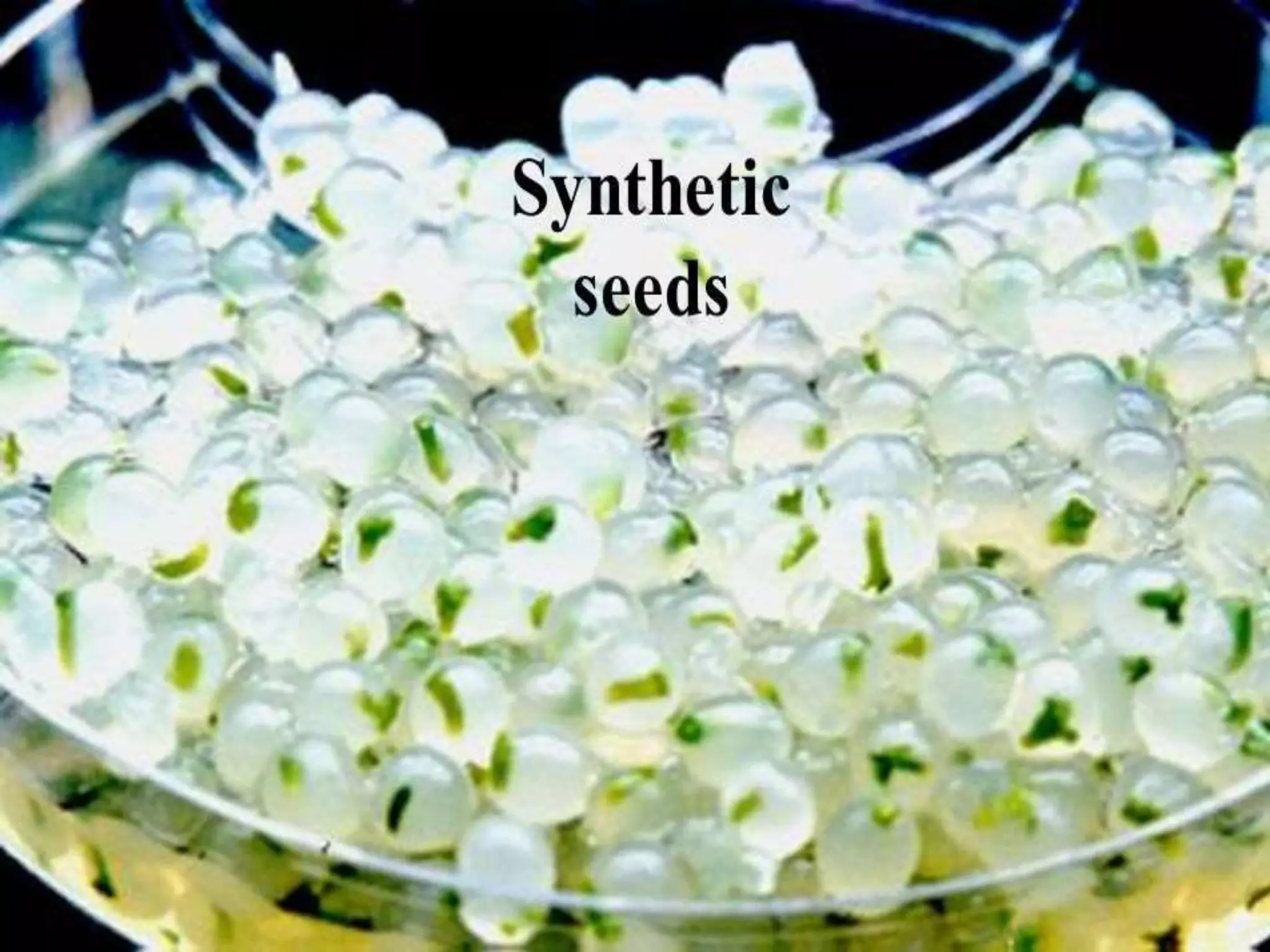
WHAT IS ARTIFICIAL SEED..?
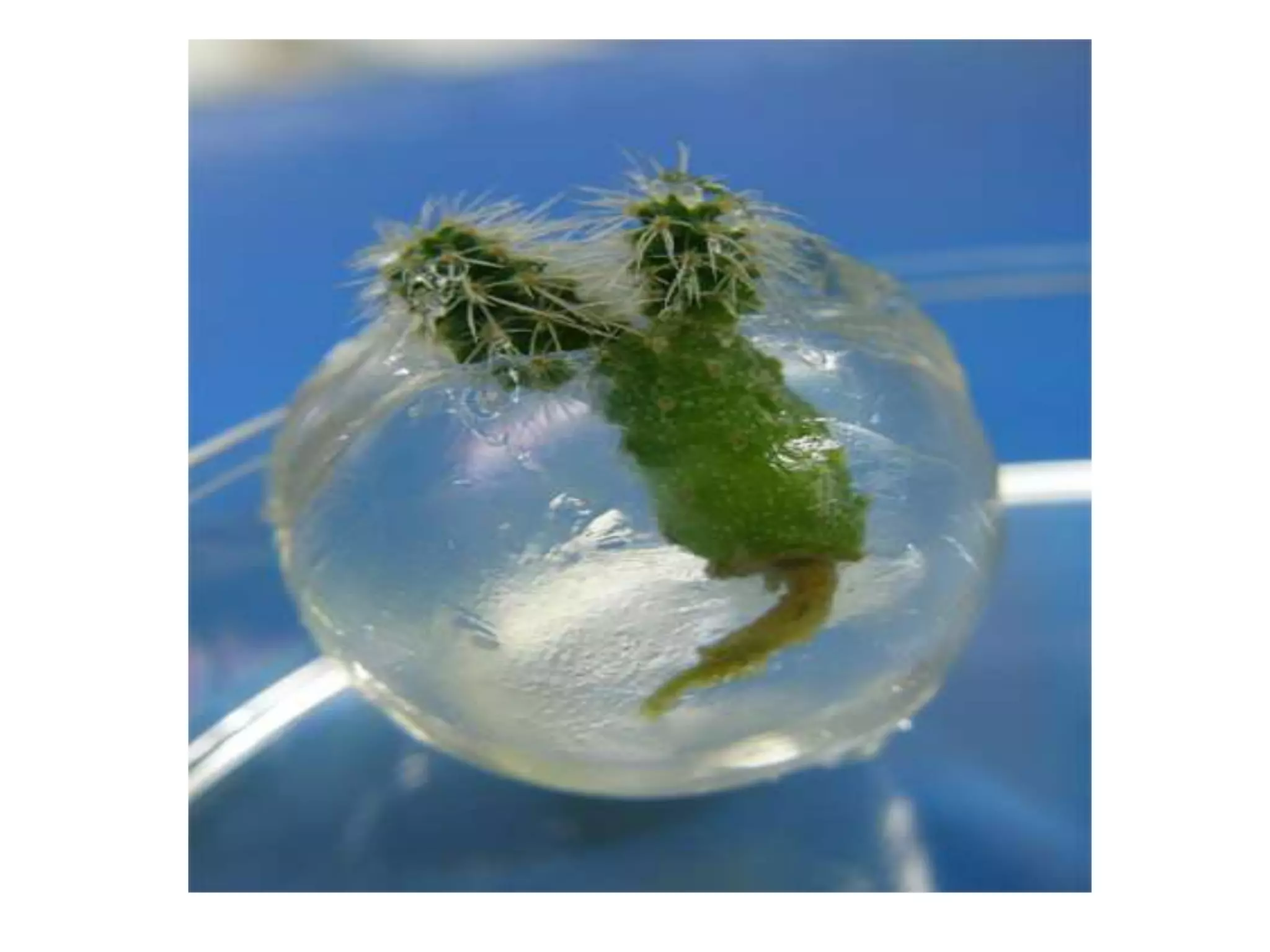
• Artificial seed can be defined as artificial
encapsulation of somatic embryos, shoot bud
or aggregates of cell of any tissues which has
the ability to form a plant in in-vitro or ex-vivo
condition.
• Artificial seed have also been often referred to
as synthetic seed.
HISTORY
• Artificial seeds were first introduced in 1970’s as a
novel analogue to the plant seeds.
• The production of artificial seeds is useful for plants
which do not produce viable seeds. It represents a
method to propagate these plants.
• Artificial seeds are small sized and these provides
further advantages in storage, handling and
shipping.
• The term, “EMBLING” is used for the plants
originated from synthetic seed.
• The use of synthetic varieties for commercial
cultivation was first suggested in Maize (Hays &
Garber, 1919).
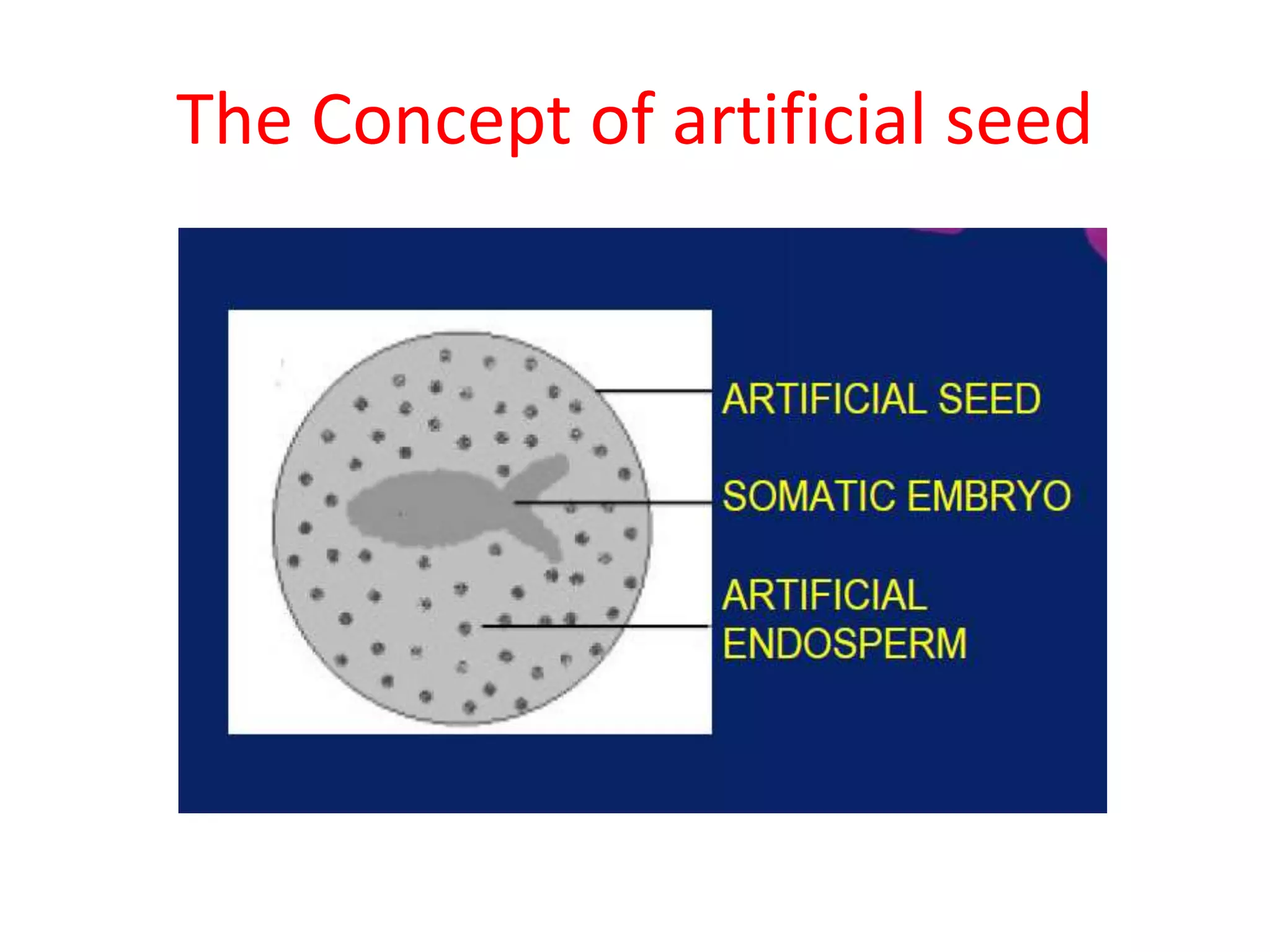
The Concept of artificial seed
BASED ON THE TECHNIQUES TWO TYPES OF
ARTIFICIAL SEEDS ARE PRODUCED
1. DESICCATED SYNTHETIC SEEDS- Desiccated
synthetic seeds are produced nacked or
polyoxyethylene glycol encapsulated somatic
embryos. This type of synthetic seeds is
produced in desiccation tolerant species plant.
2. HYDRATED SYNTHETIC SEEDS- Hydrated
synthetic seeds are produced by encapsulating
the somatic embryos in hydrogels like sodium
alginate, potassium alginate, carrageenan,
sodium pectate or sodium alginate with
gelatine.
NEED FOR ARTIFICIAL PRODUCTION
TECHNOLOGY
• Development of micro propagation technique will ensure
abundant supply of desired plant species.
• Development of artificial seed production technology is currently
considered as an effective and efficient method of propagation in
several commercially important agronomic and horticultural
crops.
• These artificial seed would also be a channel for new plant lines
produced through biotechnological advances to be delivered
directly to greenhouse and field.
• High volume propagation potential of somatic embryos combined
with formation of synthetic seeds for low-cost delivery would
open new vistas for clonal propagation in several commercially
important crop species.
BASIC REQUIREMENT FOR THE PRODUCTION OF
ARTIFICIAL SEEDS.
• One pre-requisite for the application of synthetic seed technology
in micropropagation is the production of high quality,
1. Vigorous Somatic Embryos that can produce plants with
frequencies comparable to natural seeds.
2. Inexpensive production of large numbers of high quality somatic
embryos with synchronous maturation.
3. Encapsulation and coating systems, though important for delivery
of somatic embryos, are not the limiting factors for the
development of synthetic seeds.
4. Commercialization of synthetic seeds.
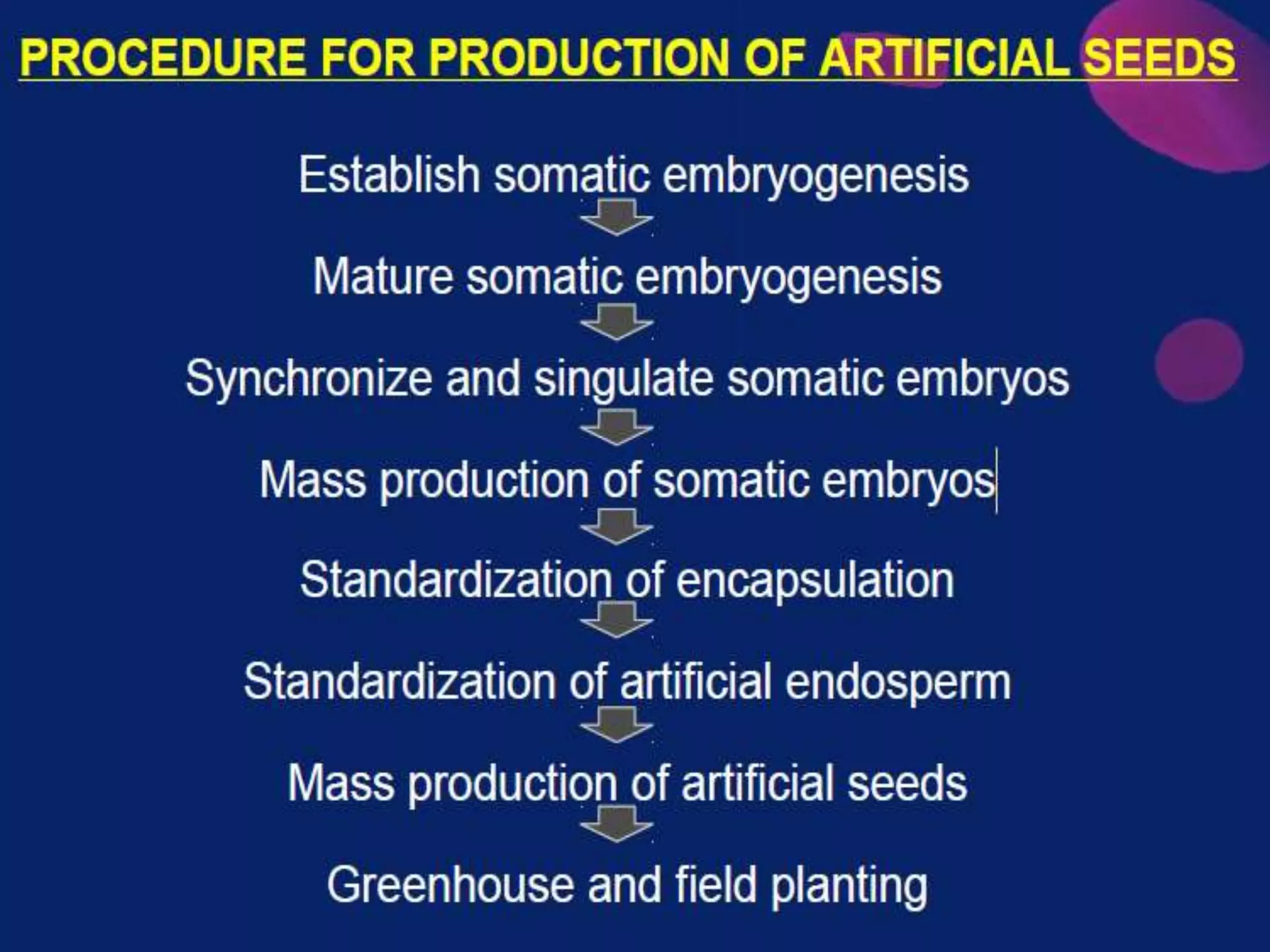
PROCEDURE FOR PRODUCTION OF
ARTIFICIAL SEEDS
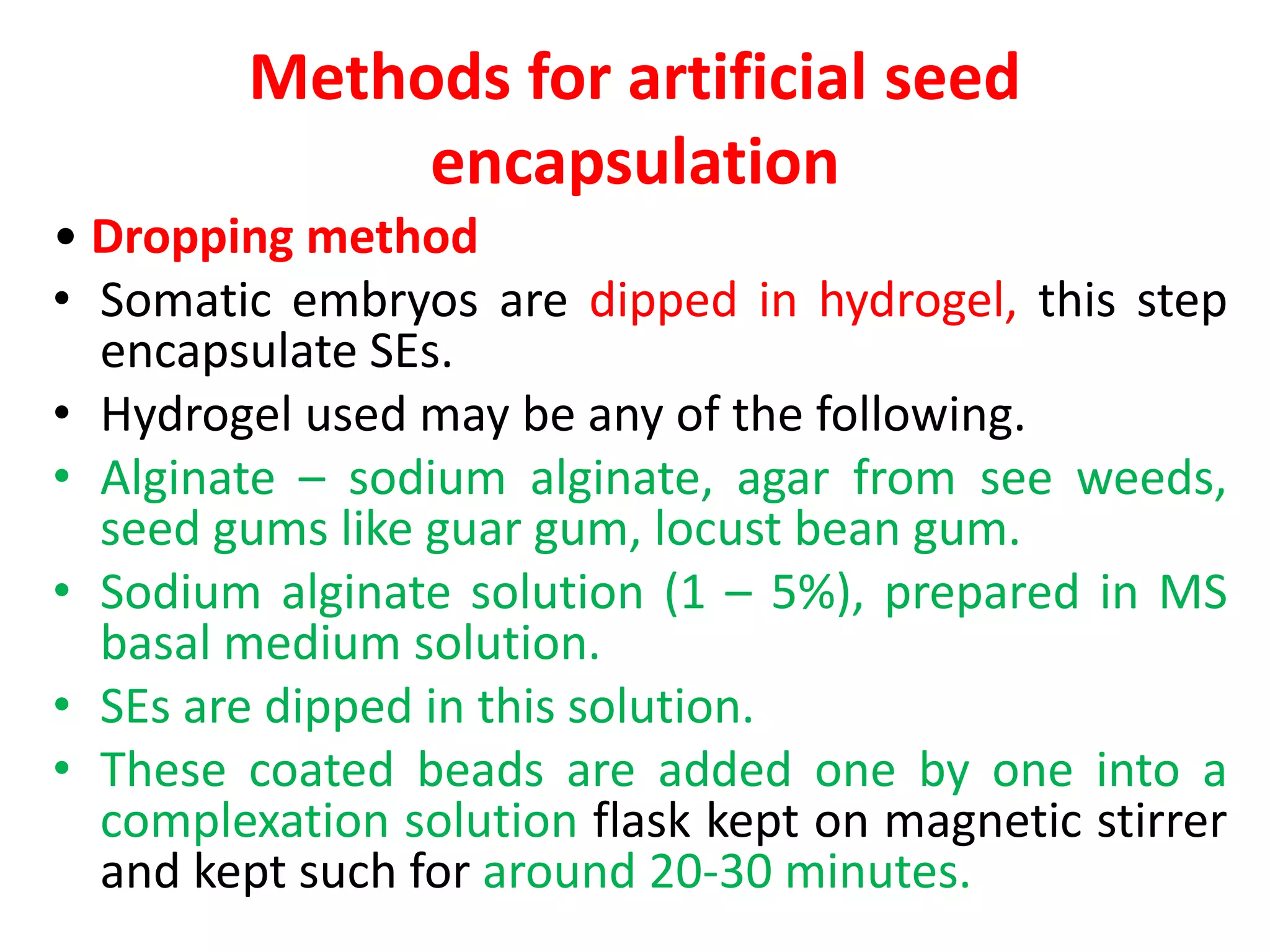
Methods for artificial seed
encapsulation
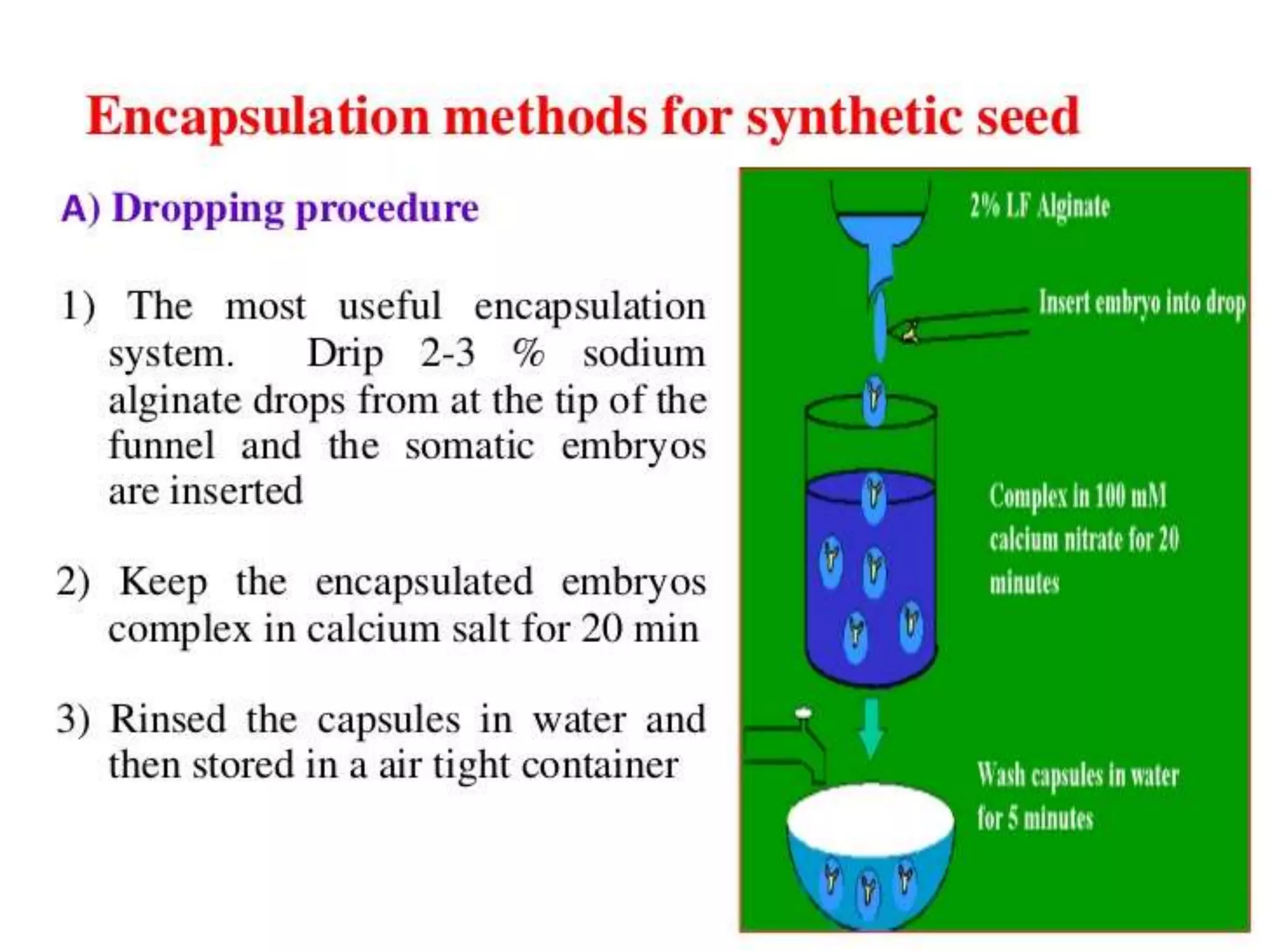
• Dropping method
• Somatic embryos are dipped in hydrogel, this step
encapsulate SEs.
• Hydrogel used may be any of the following.
• Alginate – sodium alginate, agar from see weeds,
seed gums like guar gum, locust bean gum.
• Sodium alginate solution (1 – 5%), prepared in MS
basal medium solution.
• SEs are dipped in this solution.
• These coated beads are added one by one into a
complexation solution flask kept on magnetic stirrer
and kept such for around 20-30 minutes.
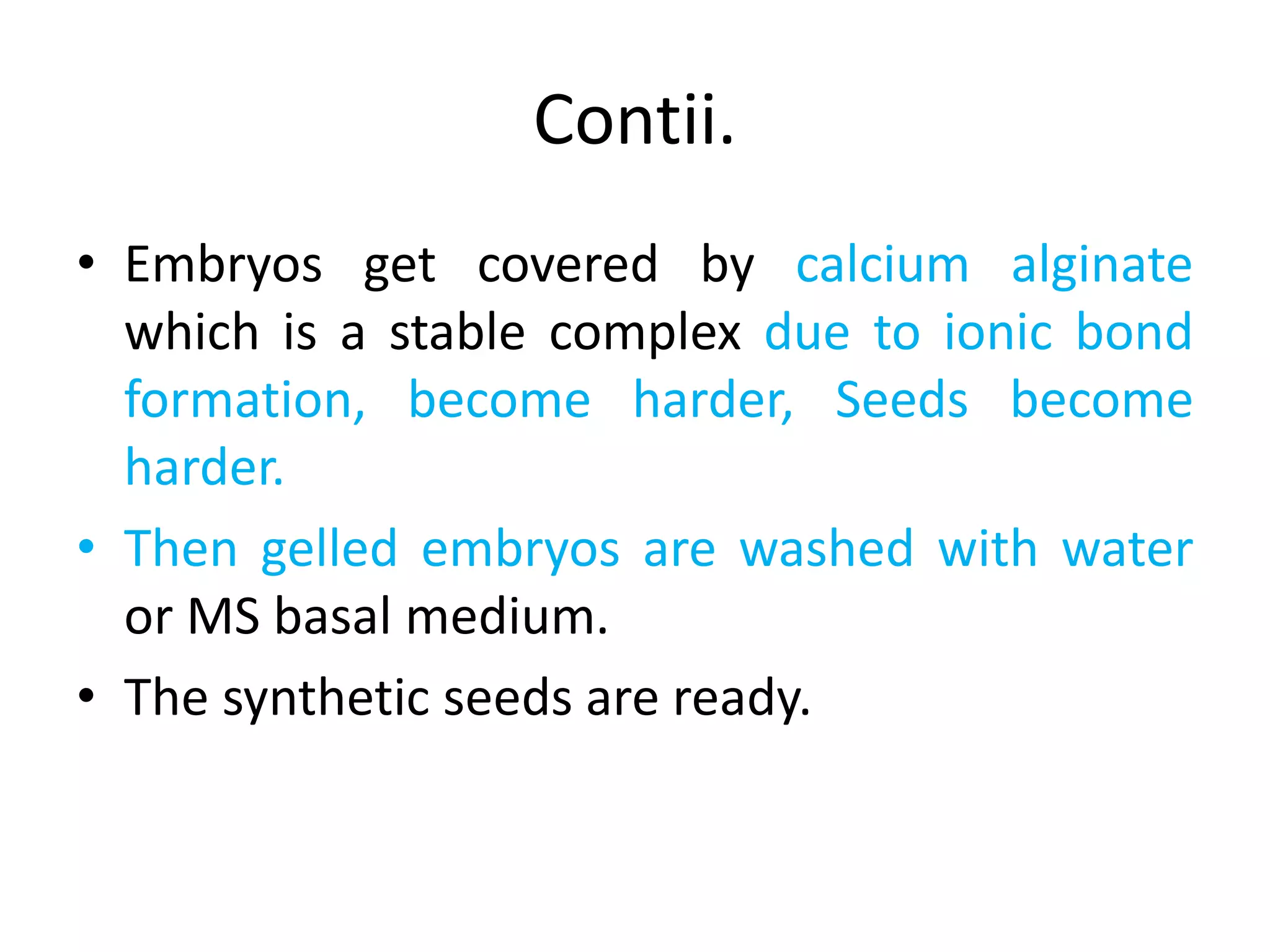
Contii.
• Embryos get covered by calcium alginate
which is a stable complex due to ionic bond
formation, become harder, Seeds become
harder.
• Then gelled embryos are washed with water
or MS basal medium.
• The synthetic seeds are ready.
Molding method
• This method follows simple procedure of
mixing of embryos with temperature
dependent gel (e.g. gel rite, agar).
• Cells get coated with the gel at lowering of the
temperature.
ARTIFICIAL ENDOSPERM
• Somatic embryos lack seed coat (testa) and
endosperm that provide protection and nutrition for
zygotic embryos in developing seeds.
• To augment these deficiencies, addition of nutrients
and growth regulators to the encapsulation matrix is
desired, which serves as an artificial endosperm.
• These addition results in increase efficiency of
germination and viability of encapsulated somatic
embryos.
• These synthetic seeds can be stored for a longer
period of time even upto 6 months without losing
viabilty, especially when stored at 40°c.
ADDITION OF ADJUVANTS TO THE MATRIX
• To prevent the embryo from desiccation (state of
extreme dryness) and mechanical injury, a
number of useful materials such as nutrients,
fungicides, pesticides, antibiotics and
microorganisms (eg. rhizobia) may be
incorporated into the encapsulation matrix.
• Incorporation of activated charcoal improves the
conversion and vigour of the encapsulated
somatic embryos and retains nutrients within the
hydrogel capsule and slowly releases them to the
growing embryo.
POTENTIAL USES OF ARTIFICIAL SEEDS
• Reduced costs of transplants(Cost effective)
• Direct greenhouse and field delivery of:
Elite, Select Genotypes
Large-scale mono cultures.
Carriers for adjuvant such as microorganisms,
plant growth regulators, pesticides,
fungicides, nutrients and antibiotics.
Can be conceivably handled as seed using
conventional planting equipment.
it can be produced throughout the year.
Conservation of germplasm
Large production of identical embryos in short
period of time.

Artificial seed

  • 2.
    WHAT IS ARTIFICIALSEED..? • Artificial seed can be defined as artificial encapsulation of somatic embryos, shoot bud or aggregates of cell of any tissues which has the ability to form a plant in in-vitro or ex-vivo condition. • Artificial seed have also been often referred to as synthetic seed.
  • 3.
    HISTORY • Artificial seedswere first introduced in 1970’s as a novel analogue to the plant seeds. • The production of artificial seeds is useful for plants which do not produce viable seeds. It represents a method to propagate these plants. • Artificial seeds are small sized and these provides further advantages in storage, handling and shipping. • The term, “EMBLING” is used for the plants originated from synthetic seed. • The use of synthetic varieties for commercial cultivation was first suggested in Maize (Hays & Garber, 1919).
  • 4.
    The Concept ofartificial seed
  • 6.
    BASED ON THETECHNIQUES TWO TYPES OF ARTIFICIAL SEEDS ARE PRODUCED 1. DESICCATED SYNTHETIC SEEDS- Desiccated synthetic seeds are produced nacked or polyoxyethylene glycol encapsulated somatic embryos. This type of synthetic seeds is produced in desiccation tolerant species plant. 2. HYDRATED SYNTHETIC SEEDS- Hydrated synthetic seeds are produced by encapsulating the somatic embryos in hydrogels like sodium alginate, potassium alginate, carrageenan, sodium pectate or sodium alginate with gelatine.
  • 7.
    NEED FOR ARTIFICIALPRODUCTION TECHNOLOGY • Development of micro propagation technique will ensure abundant supply of desired plant species. • Development of artificial seed production technology is currently considered as an effective and efficient method of propagation in several commercially important agronomic and horticultural crops. • These artificial seed would also be a channel for new plant lines produced through biotechnological advances to be delivered directly to greenhouse and field. • High volume propagation potential of somatic embryos combined with formation of synthetic seeds for low-cost delivery would open new vistas for clonal propagation in several commercially important crop species.
  • 8.
    BASIC REQUIREMENT FORTHE PRODUCTION OF ARTIFICIAL SEEDS. • One pre-requisite for the application of synthetic seed technology in micropropagation is the production of high quality, 1. Vigorous Somatic Embryos that can produce plants with frequencies comparable to natural seeds. 2. Inexpensive production of large numbers of high quality somatic embryos with synchronous maturation. 3. Encapsulation and coating systems, though important for delivery of somatic embryos, are not the limiting factors for the development of synthetic seeds. 4. Commercialization of synthetic seeds.
  • 9.
    PROCEDURE FOR PRODUCTIONOF ARTIFICIAL SEEDS
  • 10.
    Methods for artificialseed encapsulation • Dropping method • Somatic embryos are dipped in hydrogel, this step encapsulate SEs. • Hydrogel used may be any of the following. • Alginate – sodium alginate, agar from see weeds, seed gums like guar gum, locust bean gum. • Sodium alginate solution (1 – 5%), prepared in MS basal medium solution. • SEs are dipped in this solution. • These coated beads are added one by one into a complexation solution flask kept on magnetic stirrer and kept such for around 20-30 minutes.
  • 11.
    Contii. • Embryos getcovered by calcium alginate which is a stable complex due to ionic bond formation, become harder, Seeds become harder. • Then gelled embryos are washed with water or MS basal medium. • The synthetic seeds are ready.
  • 13.
    Molding method • Thismethod follows simple procedure of mixing of embryos with temperature dependent gel (e.g. gel rite, agar). • Cells get coated with the gel at lowering of the temperature.
  • 14.
    ARTIFICIAL ENDOSPERM • Somaticembryos lack seed coat (testa) and endosperm that provide protection and nutrition for zygotic embryos in developing seeds. • To augment these deficiencies, addition of nutrients and growth regulators to the encapsulation matrix is desired, which serves as an artificial endosperm. • These addition results in increase efficiency of germination and viability of encapsulated somatic embryos. • These synthetic seeds can be stored for a longer period of time even upto 6 months without losing viabilty, especially when stored at 40°c.
  • 15.
    ADDITION OF ADJUVANTSTO THE MATRIX • To prevent the embryo from desiccation (state of extreme dryness) and mechanical injury, a number of useful materials such as nutrients, fungicides, pesticides, antibiotics and microorganisms (eg. rhizobia) may be incorporated into the encapsulation matrix. • Incorporation of activated charcoal improves the conversion and vigour of the encapsulated somatic embryos and retains nutrients within the hydrogel capsule and slowly releases them to the growing embryo.
  • 16.
    POTENTIAL USES OFARTIFICIAL SEEDS • Reduced costs of transplants(Cost effective) • Direct greenhouse and field delivery of: Elite, Select Genotypes Large-scale mono cultures. Carriers for adjuvant such as microorganisms, plant growth regulators, pesticides, fungicides, nutrients and antibiotics.
  • 17.
    Can be conceivablyhandled as seed using conventional planting equipment. it can be produced throughout the year. Conservation of germplasm Large production of identical embryos in short period of time.