ATTRA                                     Transgenic Crops
    A Publication of ATTRA - National Sustainable Agriculture Information Service • 1-800-346-9140 • www.attra.ncat.org

By Jeff Schahczenski                          Transgenic Crops describes the basics of genetic modification for agricultural purposes and a brief his-
and Katherine Adam                           tory of the technology and the governing policies surrounding it. This publication offers a brief overview
NCAT Program                                 of the main agricultural crops that have been genetically modified, the characteristics they express, and
Specialists                                  the market roles they play. Unintended consequences, economic considerations, and safety concerns
© 2006 NCAT                                  surrounding the cultivation and dissemination of transgenic crops are also discussed. Biopharmaceuti-
                                             cal aspects of transgenic crops are also briefly addressed. Economic, legal, and management concerns
                                             associated with these types of crops are addressed, as well as political and regulatory aspects. Implica-
                                             tions of transgenic technologies for sustainable agriculture are briefly addressed along with concluding
                                             remarks. References and resources follow the narrative.

Contents

Introduction ..................... 1
What Are Transgenic
Crops? ................................. 3
Unintended Effects........ 5
Commercial Transgenic
Crops and Their Traits ... 6
Issues Facing Farmers
and Ranchers ................... 9
Crop Yield, Costs, and
Profitability ........................13
Organic Industry .......... 17
Influence on Public
Research .......................... 17
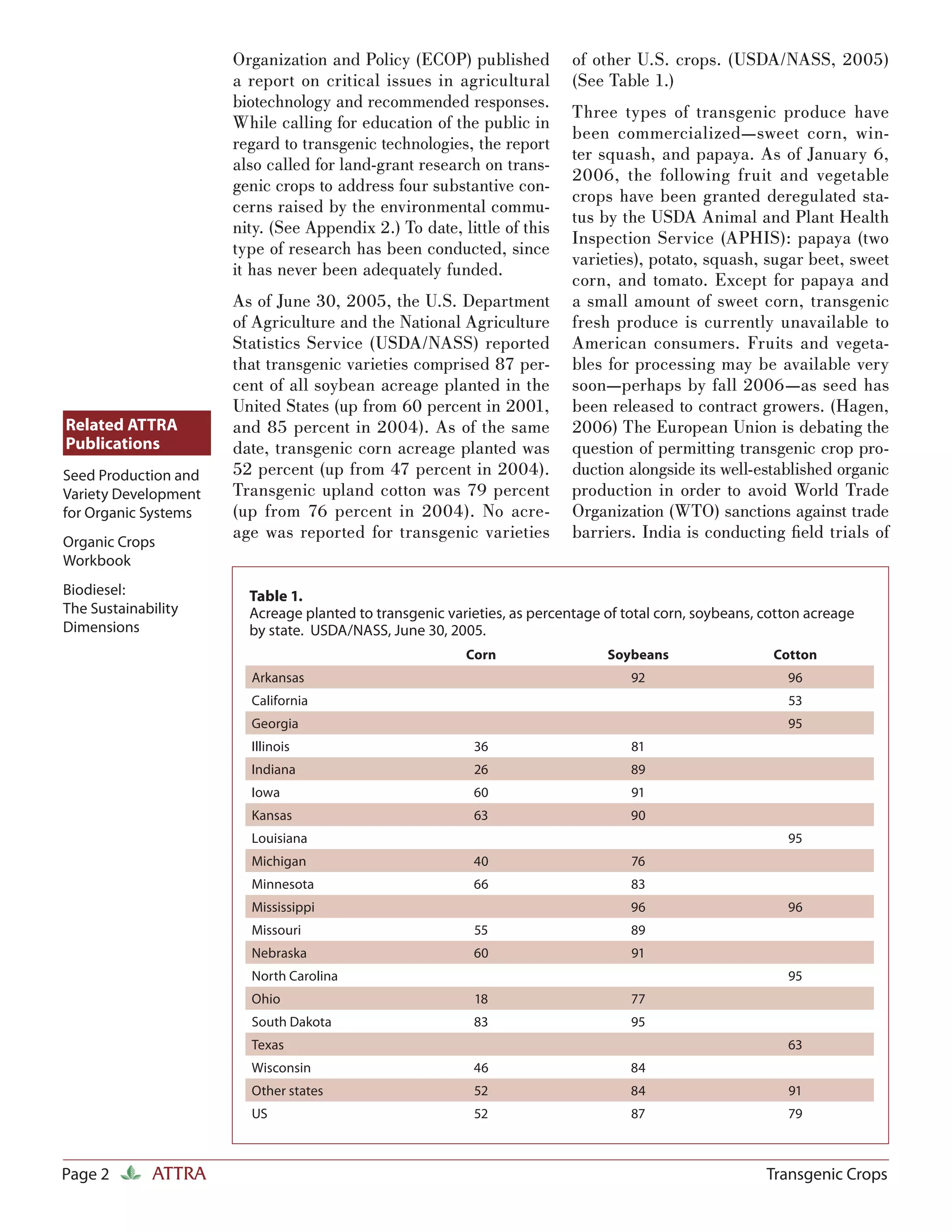
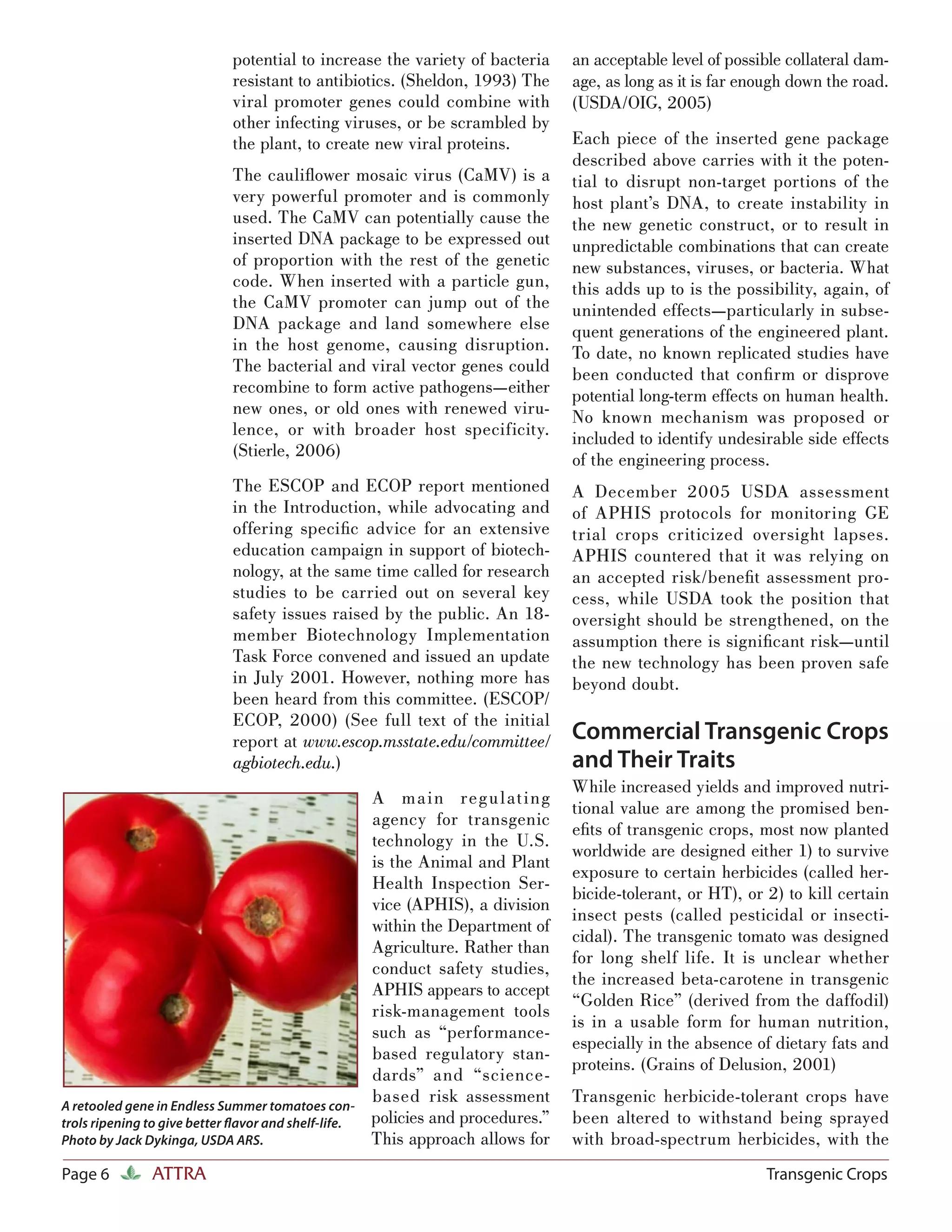
Industry Concentration                       To increase the genetic diversity of U.S. corn, the Germplasm Enhancement for Maize (GEM) project seeks to
and Farmers’ Right to                        combine exotic germplasm, such as this unusually colored and shaped maize from Latin America, with domestic
Save Seed ........................ 18        corn lines. Photo by Keith Weller, USDA ARS.
Regulation of Transgenic
Crops and Apportion-
ment of Liability ........... 19
Conclusion ...................... 22         Introduction                                           researchers, and certain nonprofit organi-
References ...................... 23                                                                zations. Particularly vocal are groups that
                                             The ability to transfer genetic material
Appendices .................... 26                                                                  represent the interests of civil society.
                                             between two unlike species for agricul-
                                             tural purposes and crop production is the              The quantifiable facts surrounding geneti-
                                             subject of this publication. Development of            cally modified foods seem less in dispute than
                                             the science and methods to produce trans-              the growing number of implications. These
                                             genic crops began around 1983 as part of a             often take form in ethical arguments, which
ATTRA—National Sustainable                   broader technological movement to modify               some supporters of transgenic crops write off
Agriculture Information Service
is managed by the National Cen-              organisms for economic, medical, military,             as a defense of cultural artifacts. Yet the
ter for Appropriate Technology
(NCAT) and is funded under a
                                             and other general human ends.                          new capacities brought about by transgenic
grant from the United States                                                                        foods in particular reveal a general lack of
                                             Implications surrounding the modification
Department of Agriculture’s
                                                                                                    research into these many implications.
Rural Business-Cooperative Ser-
vice. Visit the NCAT Web site
                                             of life carry significant and complex ethi-
(www.ncat.org/agri.                          cal issues. The capacity to produce trans-             For instance, in 2001, the Experiment Sta-
html) for more informa-
tion on our sustainable
                                             genic crops causes great controversy among             tion Committee on Organization and Policy
agriculture projects.                        government agencies, business consortia,               (ESCOP) and the Extension Committee on
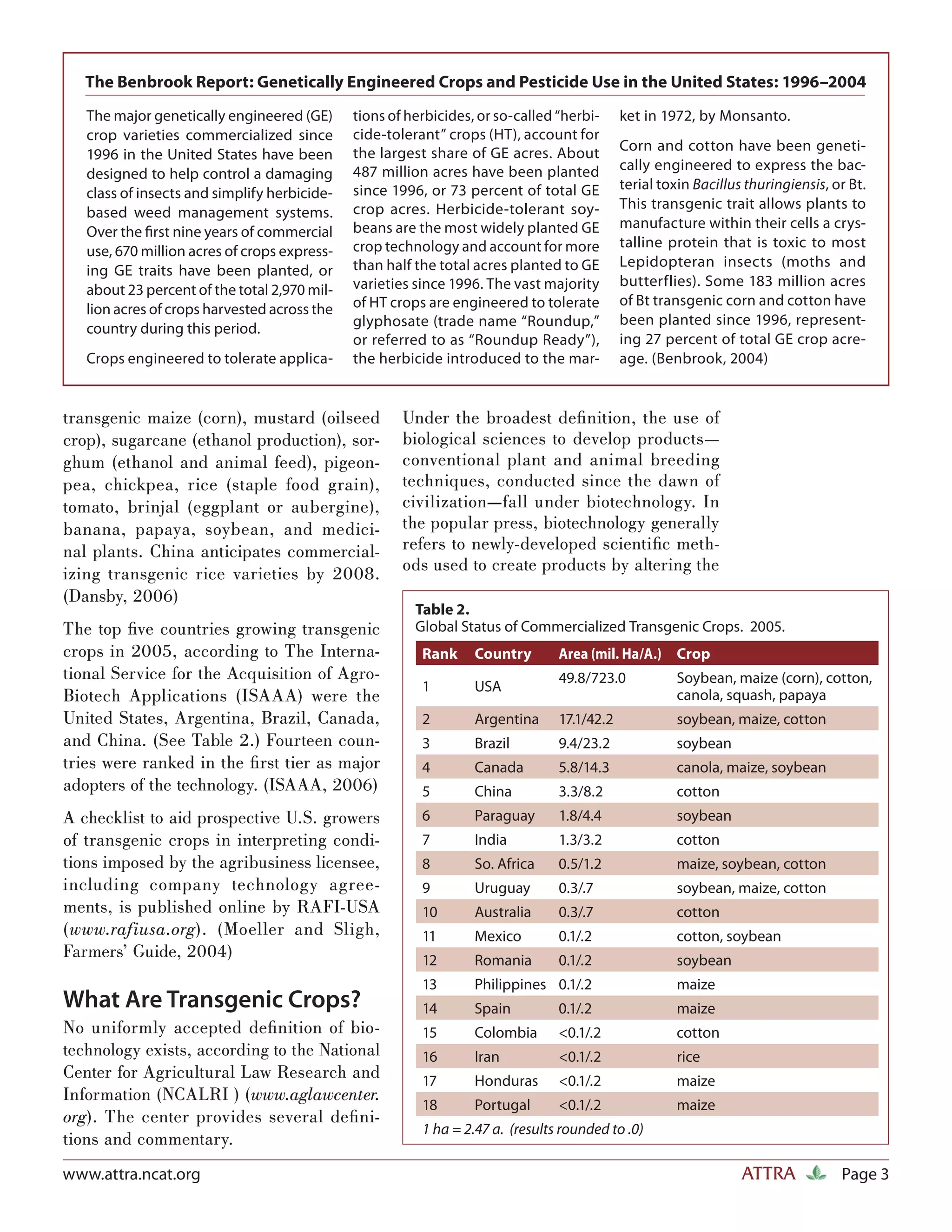
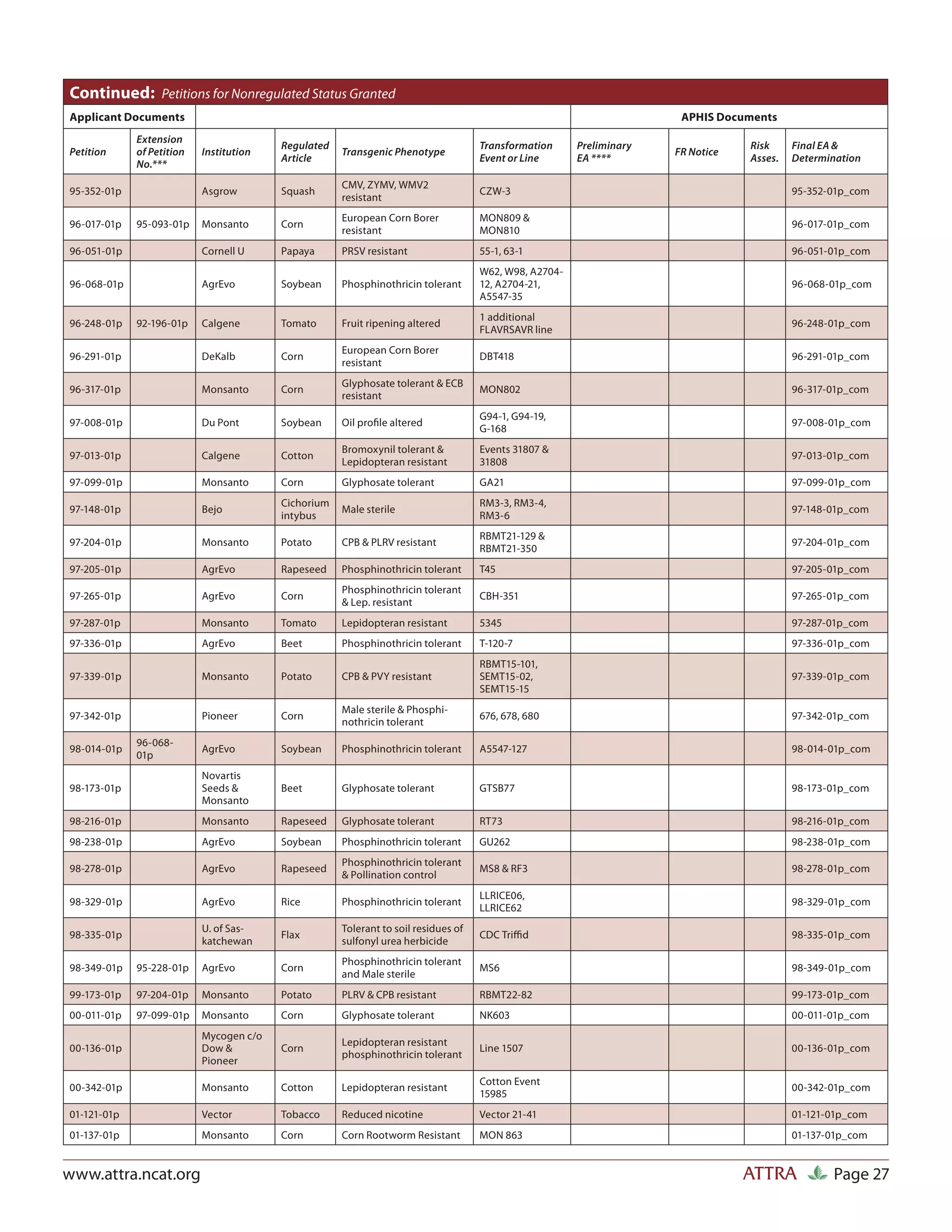
Organization and Policy (ECOP) published            of other U.S. crops. (USDA/NASS, 2005)
                      a report on critical issues in agricultural         (See Table 1.)
                      biotechnology and recommended responses.
                                                                          Three types of transgenic produce have
                      While calling for education of the public in
                                                                          been commercialized—sweet corn, win-
                      regard to transgenic technologies, the report
                                                                          ter squash, and papaya. As of January 6,
                      also called for land-grant research on trans-
                                                                          2006, the following fruit and vegetable
                      genic crops to address four substantive con-
                                                                          crops have been granted deregulated sta-
                      cerns raised by the environmental commu-
                                                                          tus by the USDA Animal and Plant Health
                      nity. (See Appendix 2.) To date, little of this
                                                                          Inspection Service (APHIS): papaya (two
                      type of research has been conducted, since
                                                                          varieties), potato, squash, sugar beet, sweet
                      it has never been adequately funded.
                                                                          corn, and tomato. Except for papaya and
                      As of June 30, 2005, the U.S. Department            a small amount of sweet corn, transgenic
                      of Agriculture and the National Agriculture         fresh produce is currently unavailable to
                      Statistics Service (USDA/NASS) reported             American consumers. Fruits and vegeta-
                      that transgenic varieties comprised 87 per-         bles for processing may be available very
                      cent of all soybean acreage planted in the          soon—perhaps by fall 2006—as seed has
                      United States (up from 60 percent in 2001,          been released to contract growers. (Hagen,
Related ATTRA         and 85 percent in 2004). As of the same             2006) The European Union is debating the
Publications          date, transgenic corn acreage planted was           question of permitting transgenic crop pro-
Seed Production and   52 percent (up from 47 percent in 2004).            duction alongside its well-established organic
Variety Development   Transgenic upland cotton was 79 percent             production in order to avoid World Trade
for Organic Systems   (up from 76 percent in 2004). No acre-              Organization (WTO) sanctions against trade
Organic Crops
                      age was reported for transgenic varieties           barriers. India is conducting field trials of
Workbook
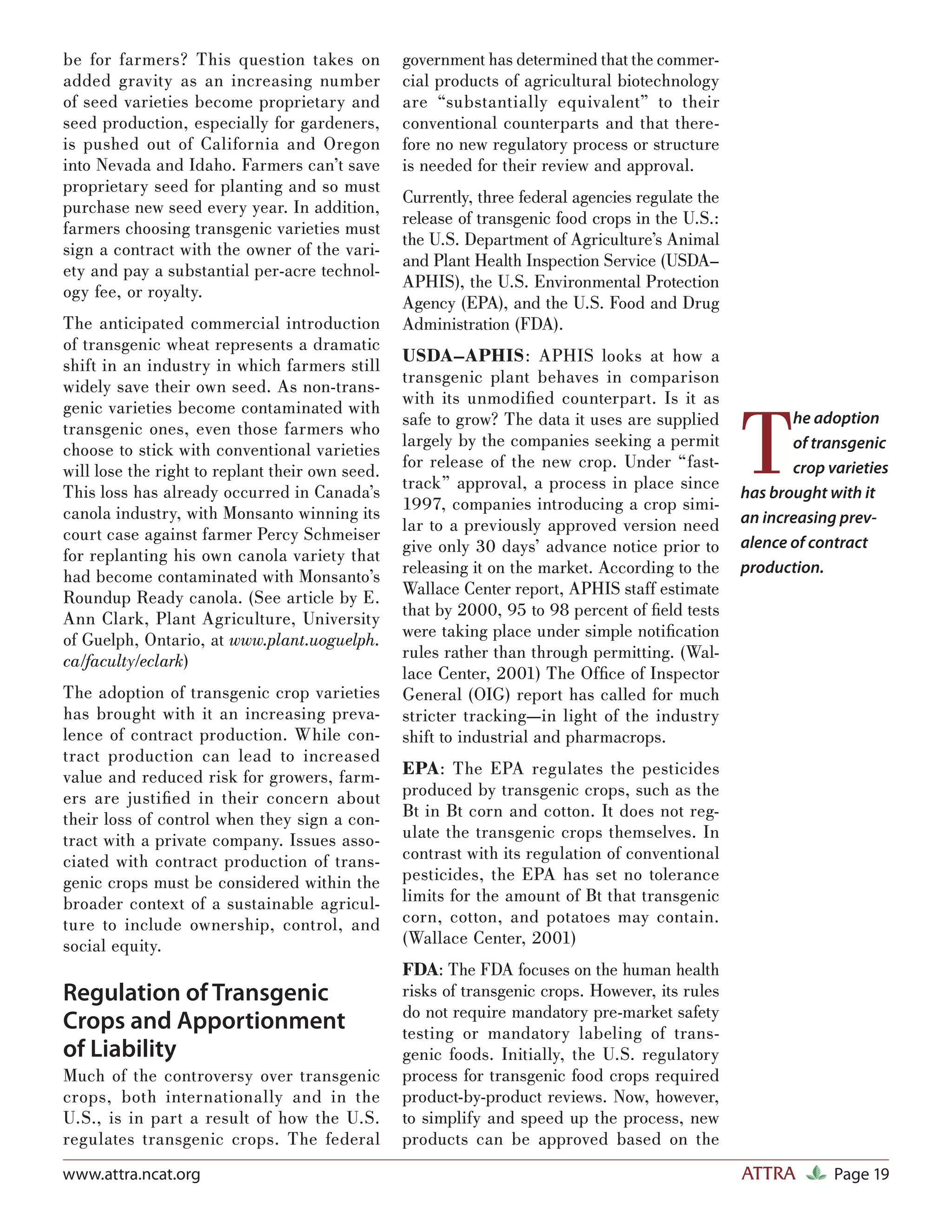
Biodiesel:              Table 1.
The Sustainability      Acreage planted to transgenic varieties, as percentage of total corn, soybeans, cotton acreage
Dimensions              by state. USDA/NASS, June 30, 2005.
                                                         Corn                  Soybeans                  Cotton
                        Arkansas                                                   92                      96
                        California                                                                         53
                        Georgia                                                                            95
                        Illinois                          36                       81
                        Indiana                           26                       89
                        Iowa                              60                       91
                        Kansas                            63                       90
                        Louisiana                                                                          95
                        Michigan                          40                       76
                        Minnesota                         66                       83
                        Mississippi                                                96                      96
                        Missouri                          55                       89
                        Nebraska                          60                       91
                        North Carolina                                                                     95
                        Ohio                              18                       77
                        South Dakota                      83                       95
                        Texas                                                                              63
                        Wisconsin                         46                       84
                        Other states                      52                       84                      91
                        US                                52                       87                      79


Page 2       ATTRA                                                                                      Transgenic Crops
The Benbrook Report: Genetically Engineered Crops and Pesticide Use in the United States: 1996–2004
   The major genetically engineered (GE)      tions of herbicides, or so-called “herbi-     ket in 1972, by Monsanto.
   crop varieties commercialized since        cide-tolerant” crops (HT), account for
                                              the largest share of GE acres. About          Corn and cotton have been geneti-
   1996 in the United States have been
                                              487 million acres have been planted           cally engineered to express the bac-
   designed to help control a damaging
                                              since 1996, or 73 percent of total GE         terial toxin Bacillus thuringiensis, or Bt.
   class of insects and simplify herbicide-
                                              crop acres. Herbicide-tolerant soy-           This transgenic trait allows plants to
   based weed management systems.
                                              beans are the most widely planted GE          manufacture within their cells a crys-
   Over the first nine years of commercial
                                              crop technology and account for more          talline protein that is toxic to most
   use, 670 million acres of crops express-
                                              than half the total acres planted to GE       Lepidopteran insects (moths and
   ing GE traits have been planted, or
                                              varieties since 1996. The vast majority       butterflies). Some 183 million acres
   about 23 percent of the total 2,970 mil-
                                              of HT crops are engineered to tolerate        of Bt transgenic corn and cotton have
   lion acres of crops harvested across the
                                              glyphosate (trade name “Roundup,”             been planted since 1996, represent-
   country during this period.
                                              or referred to as “Roundup Ready”),           ing 27 percent of total GE crop acre-
   Crops engineered to tolerate applica-      the herbicide introduced to the mar-          age. (Benbrook, 2004)


transgenic maize (corn), mustard (oilseed             Under the broadest defi nition, the use of
crop), sugarcane (ethanol production), sor-           biological sciences to develop products—
ghum (ethanol and animal feed), pigeon-               conventional plant and animal breeding
pea, chickpea, rice (staple food grain),              techniques, conducted since the dawn of
tomato, brinjal (eggplant or aubergine),              civilization—fall under biotechnology. In
banana, papaya, soybean, and medici-                  the popular press, biotechnology generally
nal plants. China anticipates commercial-             refers to newly-developed scientific meth-
izing transgenic rice varieties by 2008.              ods used to create products by altering the
(Dansby, 2006)
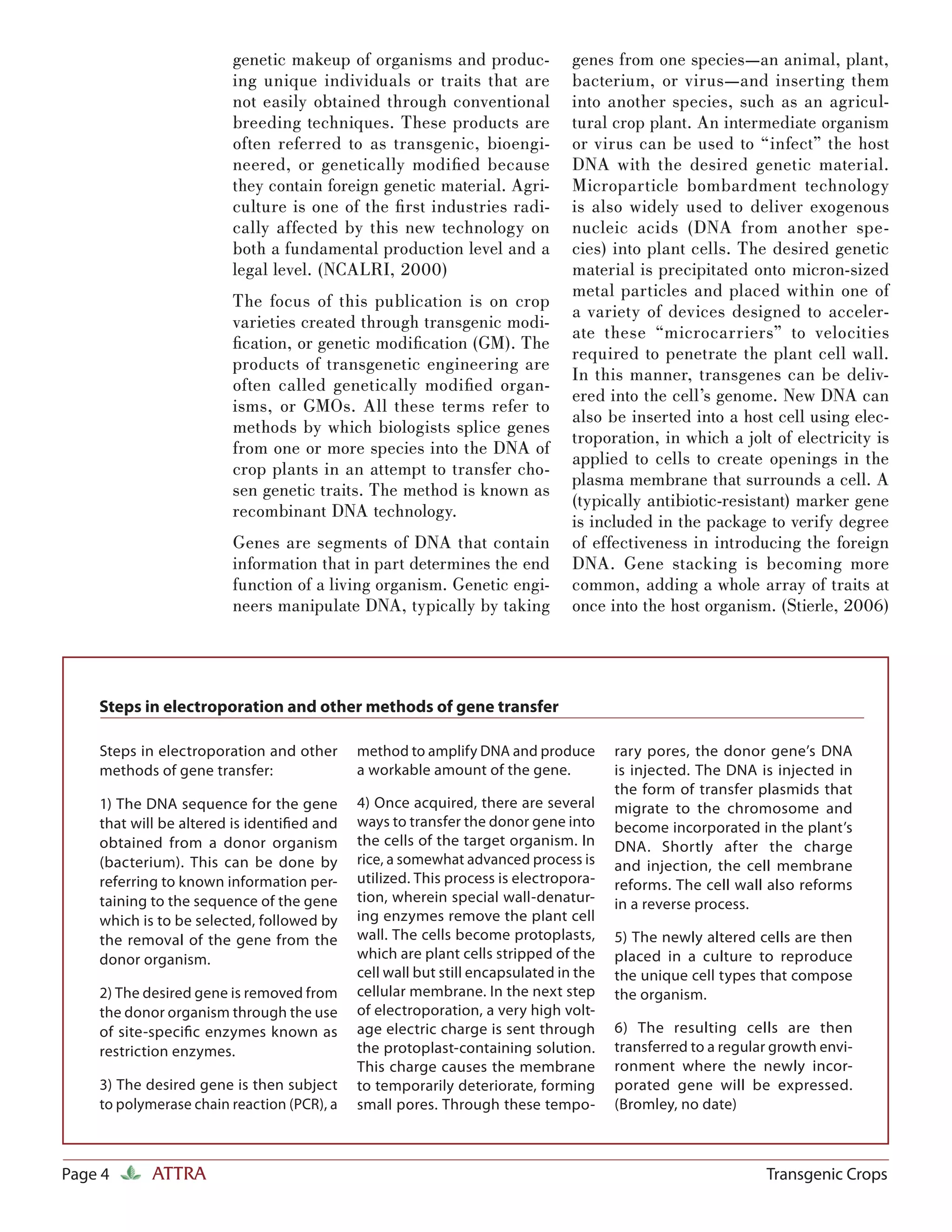
                                                        Table 2.
The top five countries growing transgenic                Global Status of Commercialized Transgenic Crops. 2005.
crops in 2005, according to The Interna-                 Rank     Country       Area (mil. Ha/A.) Crop
tional Service for the Acquisition of Agro-                                     49.8/723.0           Soybean, maize (corn), cotton,
                                                         1        USA
Biotech Applications (ISAAA) were the                                                                canola, squash, papaya
United States, Argentina, Brazil, Canada,                2        Argentina     17.1/42.2            soybean, maize, cotton
and China. (See Table 2.) Fourteen coun-                 3        Brazil        9.4/23.2             soybean
tries were ranked in the fi rst tier as major             4        Canada        5.8/14.3             canola, maize, soybean
adopters of the technology. (ISAAA, 2006)                5        China         3.3/8.2              cotton
A checklist to aid prospective U.S. growers              6        Paraguay      1.8/4.4              soybean
of transgenic crops in interpreting condi-               7        India         1.3/3.2              cotton
tions imposed by the agribusiness licensee,              8        So. Africa    0.5/1.2              maize, soybean, cotton
including company technology agree-                      9        Uruguay       0.3/.7               soybean, maize, cotton
ments, is published online by RAFI-USA                   10       Australia     0.3/.7               cotton
(www.rafiusa.org). (Moeller and Sligh,                   11       Mexico        0.1/.2               cotton, soybean
Farmers’ Guide, 2004)                                    12       Romania       0.1/.2               soybean
                                                         13       Philippines 0.1/.2                 maize
What Are Transgenic Crops?                               14       Spain         0.1/.2               maize
No uniformly accepted defi nition of bio-                 15       Colombia      <0.1/.2              cotton
technology exists, according to the National             16       Iran          <0.1/.2              rice
Center for Agricultural Law Research and                 17       Honduras      <0.1/.2              maize
Information (NCALRI ) (www.aglawcenter.
                                                         18       Portugal      <0.1/.2              maize
org). The center provides several defi ni-
                                                         1 ha = 2.47 a. (results rounded to .0)
tions and commentary.
www.attra.ncat.org                                                                                               ATTRA            Page 3
genetic makeup of organisms and produc-                genes from one species—an animal, plant,
                        ing unique individuals or traits that are              bacterium, or virus—and inserting them
                        not easily obtained through conventional               into another species, such as an agricul-
                        breeding techniques. These products are                tural crop plant. An intermediate organism
                        often referred to as transgenic, bioengi-              or virus can be used to “infect” the host
                        neered, or genetically modified because                 DNA with the desired genetic material.
                        they contain foreign genetic material. Agri-           Microparticle bombardment technology
                        culture is one of the fi rst industries radi-           is also widely used to deliver exogenous
                        cally affected by this new technology on               nucleic acids (DNA from another spe-
                        both a fundamental production level and a              cies) into plant cells. The desired genetic
                        legal level. (NCALRI, 2000)                            material is precipitated onto micron-sized
                                                                               metal particles and placed within one of
                        The focus of this publication is on crop
                                                                               a variety of devices designed to acceler-
                        varieties created through transgenic modi-
                                                                               ate these “microcarriers” to velocities
                        fication, or genetic modification (GM). The
                                                                               required to penetrate the plant cell wall.
                        products of transgenetic engineering are
                                                                               In this manner, transgenes can be deliv-
                        often called genetically modified organ-
                                                                               ered into the cell’s genome. New DNA can
                        isms, or GMOs. All these terms refer to
                                                                               also be inserted into a host cell using elec-
                        methods by which biologists splice genes
                                                                               troporation, in which a jolt of electricity is
                        from one or more species into the DNA of
                                                                               applied to cells to create openings in the
                        crop plants in an attempt to transfer cho-
                                                                               plasma membrane that surrounds a cell. A
                        sen genetic traits. The method is known as
                                                                               (typically antibiotic-resistant) marker gene
                        recombinant DNA technology.
                                                                               is included in the package to verify degree
                        Genes are segments of DNA that contain                 of effectiveness in introducing the foreign
                        information that in part determines the end            DNA. Gene stacking is becoming more
                        function of a living organism. Genetic engi-           common, adding a whole array of traits at
                        neers manipulate DNA, typically by taking              once into the host organism. (Stierle, 2006)


    Steps in electroporation and other methods of gene transfer

    Steps in electroporation and other      method to amplify DNA and produce         rary pores, the donor gene’s DNA
    methods of gene transfer:               a workable amount of the gene.            is injected. The DNA is injected in
                                                                                      the form of transfer plasmids that
    1) The DNA sequence for the gene        4) Once acquired, there are several       migrate to the chromosome and
    that will be altered is identified and   ways to transfer the donor gene into      become incorporated in the plant’s
    obtained from a donor organism          the cells of the target organism. In      DNA. Shortly after the charge
    (bacterium). This can be done by        rice, a somewhat advanced process is      and injection, the cell membrane
    referring to known information per-     utilized. This process is electropora-    reforms. The cell wall also reforms
    taining to the sequence of the gene     tion, wherein special wall-denatur-       in a reverse process.
    which is to be selected, followed by    ing enzymes remove the plant cell
    the removal of the gene from the        wall. The cells become protoplasts,       5) The newly altered cells are then
    donor organism.                         which are plant cells stripped of the     placed in a culture to reproduce
                                            cell wall but still encapsulated in the   the unique cell types that compose
    2) The desired gene is removed from     cellular membrane. In the next step       the organism.
    the donor organism through the use      of electroporation, a very high volt-
    of site-specific enzymes known as        age electric charge is sent through       6) The resulting cells are then
    restriction enzymes.                    the protoplast-containing solution.       transferred to a regular growth envi-
                                            This charge causes the membrane           ronment where the newly incor-
    3) The desired gene is then subject     to temporarily deteriorate, forming       porated gene will be expressed.
    to polymerase chain reaction (PCR), a   small pores. Through these tempo-         (Bromley, no date)


Page 4      ATTRA                                                                                            Transgenic Crops
The whole process can be illustrated by          from being able to precisely control the
its application in the engineering of trans-     traits the host plant will express and to
genic rice, using electroporation.               guarantee genetic stability in subsequent
                                                 generations. (Ryan and Ho, 2001) This
With the advent of genetic engineering of
                                                 potential for instability can lead to unpre-
plants around 1983, it appeared that trans-
                                                 dictable and undesirable effects, examples
genic manipulation might benefit and even
                                                 of which include plant infertility, produc-
revolutionize agriculture. The transfer of
                                                 tion of toxins and allergens, and reduc-
desirable genetic traits across species bar-
                                                 tions in yield and plant fitness. The trans-
riers offered potential promises to solve
                                                 genic seed industry consistently counters
problems in the management of agricultural
                                                 that since genes from no known allergens
crops, provide new possibilities to improve
                                                 are incorporated, adequate care has been
human and animal health, and provide a
                                                 taken to guard against this contingency.
new revenue stream for farmers through
                                                 (USDA/OIG, 2005)
contract production of pharmaceutical and
industrial crops. (ESCOP/ECOP, 2000)             Transgenetic engineers who rely on the sim-
                                                 ple model of gene expression—the position


                                                                                                  P
Potential environmental benefits included
                                                 that one gene equals one effect—harbor                  otential for
reduced toxic pesticide use, improved
                                                 an outdated interpretation of genetic the-
weed control resulting in less tillage and                                                               instability
                                                 ory, and one that could have serious impli-
soil erosion, and water conservation. Fur-                                                               can lead to
                                                 cations. Pleiotrophy is the understanding
thermore, the new technology promised                                                             unpredictable and
                                                 that one gene may control multiple traits
increased yields.
                                                 in an organism. Pleiotrophy multiplies the       undesirable effects.
Transgenic crops were also patentable.           uncertainty surrounding transgenic crops.
Technology agreements or engineering             A gene identified as controlling a desirable
would insure that seed could not be saved        trait may in fact control multiple traits in a
over for planting the next year. The develop-    variety of ways. Pleitrophy is common, and
er’s intellectual property rights were thereby   the interactions of genes with each other
protected, which offered the potential to        and with the environment add complex-
increase profits and theoretically garner a       ity. To accurately predict the effects of new
monopoly over the transgenic seed supply.        genetic combinations is nearly impossible.
                                                 The introduction of a novel life form into an
Unintended Effects                                ecology can trigger effects perhaps too great
                                                 to be understood during our time. While it
Current methods of gene transfer are not
                                                 is true most mutations don’t survive, those
precise. While scientists can control with
                                                 that do can profoundly affect human and
relative exactness the “trait gene” (or its
                                                 other life forms.
synthesized analog) to be inserted into a
host plant genome, they cannot entirely          For instance, transgenic soy strains appear
control its location, nor the number of cop-     to exhibit unintended effects. Field obser-
ies that get inserted. Location of genetic       vations reported to the University of Geor-
material is important because it controls        gia (New Scientist, 1999) and University
the expression of biological traits, just        of Missouri (UM press release, 2001)
as genes themselves do. Also, inserted           noted physiological problems affecting
DNA frequently contains multiple stacked         yields. Research published by Univer-
genes for different traits (eight in the New     sity of Arkansas scientists in 2000 noted
Leaf potato), increasing chances of unde-        that glysophate disrupts the nitrogen
sirable interactions.                            fi xation process in Roundup Ready soy.
                                                 (King et al., 2001)
A common and unpredictable occurrence
is “silencing” of either the inserted genetic    The current marker and promoter genes of
material or adjacent native genes. Pres-         choice also may create new hazards. The
ent scientific knowledge is still a long way      antibiotic-resistant marker genes carry the
www.attra.ncat.org                                                                                ATTRA        Page 5
potential to increase the variety of bacteria        an acceptable level of possible collateral dam-
                             resistant to antibiotics. (Sheldon, 1993) The        age, as long as it is far enough down the road.
                             viral promoter genes could combine with              (USDA/OIG, 2005)
                             other infecting viruses, or be scrambled by
                             the plant, to create new viral proteins.             Each piece of the inserted gene package
                                                                                  described above carries with it the poten-
                             The cauliflower mosaic virus (CaMV) is a              tial to disrupt non-target portions of the
                             very powerful promoter and is commonly               host plant’s DNA, to create instability in
                             used. The CaMV can potentially cause the             the new genetic construct, or to result in
                             inserted DNA package to be expressed out             unpredictable combinations that can create
                             of proportion with the rest of the genetic           new substances, viruses, or bacteria. What
                             code. When inserted with a particle gun,             this adds up to is the possibility, again, of
                             the CaMV promoter can jump out of the                unintended effects—particularly in subse-
                             DNA package and land somewhere else                  quent generations of the engineered plant.
                             in the host genome, causing disruption.              To date, no known replicated studies have
                             The bacterial and viral vector genes could           been conducted that confi rm or disprove
                             recombine to form active pathogens—either            potential long-term effects on human health.
                             new ones, or old ones with renewed viru-             No known mechanism was proposed or
                             lence, or with broader host specificity.             included to identify undesirable side effects
                             (Stierle, 2006)                                      of the engineering process.
                             The ESCOP and ECOP report mentioned                  A December 2005 USDA assessment
                             in the Introduction, while advocating and            of APHIS protocols for monitoring GE
                             offering specific advice for an extensive             trial crops criticized oversight lapses.
                             education campaign in support of biotech-            APHIS countered that it was relying on
                             nology, at the same time called for research         an accepted risk/benefit assessment pro-
                             studies to be carried out on several key             cess, while USDA took the position that
                             safety issues raised by the public. An 18-           oversight should be strengthened, on the
                             member Biotechnology Implementation                  assumption there is significant risk—until
                             Task Force convened and issued an update             the new technology has been proven safe
                             in July 2001. However, nothing more has              beyond doubt.
                             been heard from this committee. (ESCOP/
                             ECOP, 2000) (See full text of the initial
                             report at www.escop.msstate.edu/committee/           Commercial Transgenic Crops
                             agbiotech.edu.)                                      and Their Traits
                                                                                  While increased yields and improved nutri-
                                                      A ma i n reg u lat i ng
                                                                                  tional value are among the promised ben-
                                                      agency for transgenic
                                                                                  efits of transgenic crops, most now planted
                                                      technology in the U.S.
                                                                                  worldwide are designed either 1) to survive
                                                      is the Animal and Plant
                                                                                  exposure to certain herbicides (called her-
                                                      Health Inspection Ser-
                                                                                  bicide-tolerant, or HT), or 2) to kill certain
                                                      vice (APHIS), a division
                                                                                  insect pests (called pesticidal or insecti-
                                                      within the Department of
                                                                                  cidal). The transgenic tomato was designed
                                                      Agriculture. Rather than
                                                                                  for long shelf life. It is unclear whether
                                                      conduct safety studies,
                                                                                  the increased beta-carotene in transgenic
                                                      APHIS appears to accept
                                                                                  “Golden Rice” (derived from the daffodil)
                                                      risk-management tools
                                                                                  is in a usable form for human nutrition,
                                                      such as “performance-
                                                                                  especially in the absence of dietary fats and
                                                      based regulatory stan-
                                                                                  proteins. (Grains of Delusion, 2001)
                                                      dards” and “science-
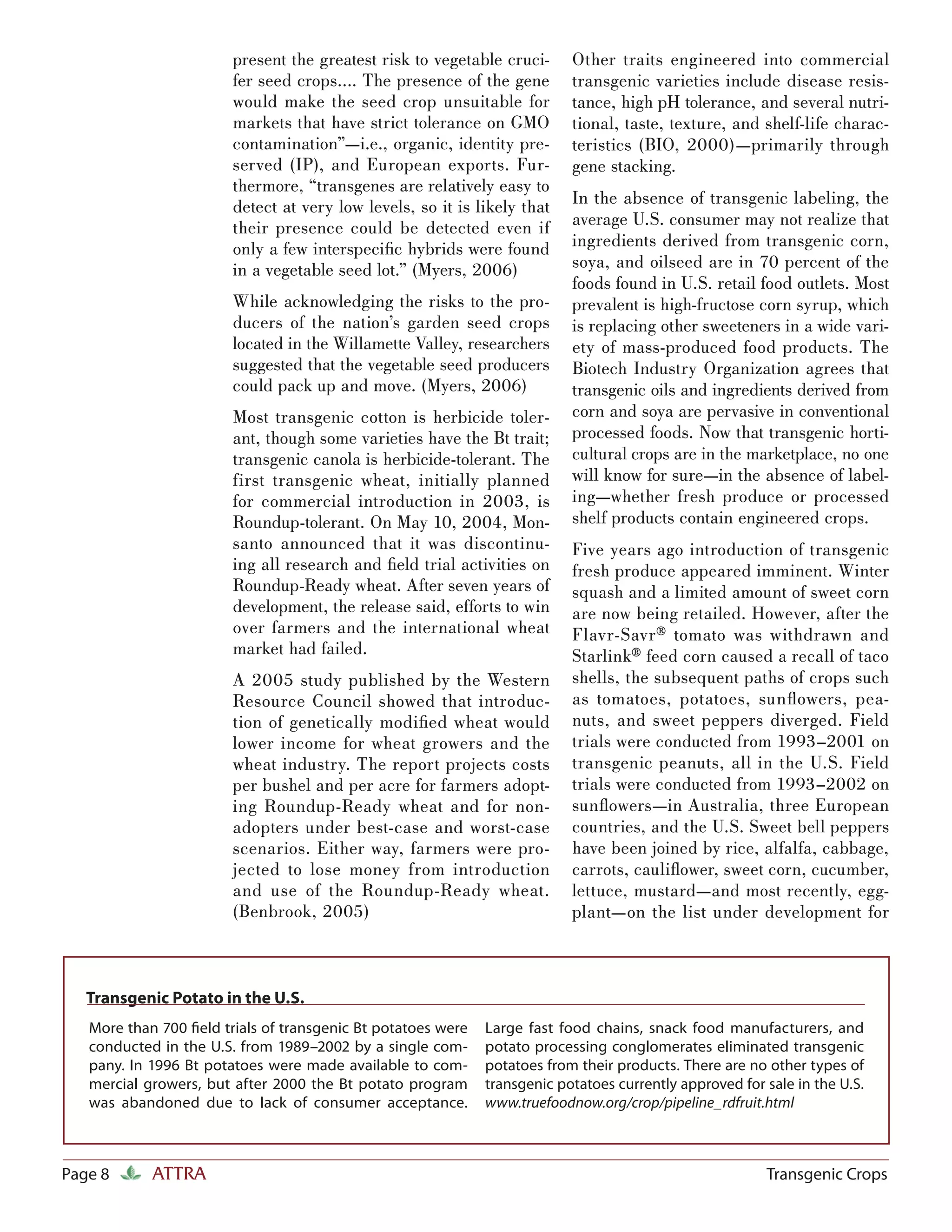
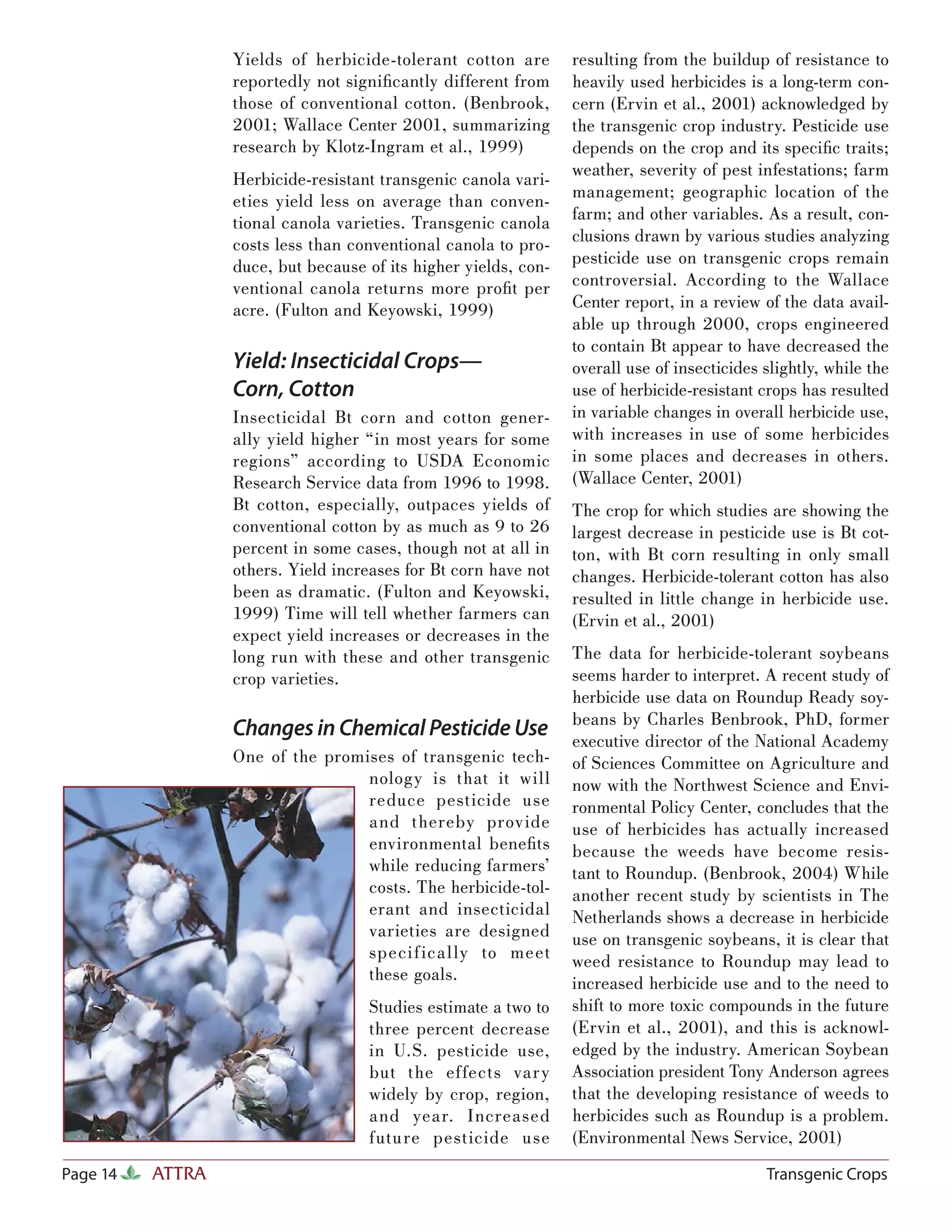
A retooled gene in Endless Summer tomatoes con-
                                                      based risk assessment       Transgenic herbicide-tolerant crops have
trols ripening to give better flavor and shelf-life.   policies and procedures.”   been altered to withstand being sprayed
Photo by Jack Dykinga, USDA ARS.                      This approach allows for    with broad-spectrum herbicides, with the
Page 6         ATTRA                                                                                          Transgenic Crops
idea that one application will take care of         One other large-acreage North American
most types of weeds without killing the crop.       transgenic crop is canola (a low erucic acid
Insecticidal crops contain genes of the soil        form of European rapeseed). Canola is
bacterium Bacillus thuringiensis (Bt). These        a major oilseed crop in Canada, but only
Bt genes cause the plants to produce a              a minor crop in the U.S. However, until
chemical toxic to the European corn borer,          recently, it was thought that acreage of
the cotton bollworm, and other caterpillars.        both canola and rapeseed would increase
(Caterpillars are the larvae of insects in the      in the near future in the Pacific Northwest.
Lepidoptera order, which includes moths             On May 9, 2006, a proposed large produc-
and butterfl ies.)                                   tion facility at Gray’s Harbor, Washington,
                                                    announced that it would produce biodiesel
As of 2005, about 87 percent of world trans-
                                                    from Asian palm oil, thus bypassing the
genic acreage was in the U.S. (See Table
                                                    “seed crushing hassles” of canola/rapeseed.
2.) Herbicide-tolerant crops accounted for
                                                    (Montana Department of Environmental
about three quarters of the acreage planted,
                                                    Quality, 2006)
worldwide, to genetically engineered crops
in 2005. Pesticidal crops, or a combination         Proposals to plant substantial acreages of
of pesticidal and herbicide-tolerant crops,         canola and rapeseed (Brassica napus, B.
accounted for most of the remaining acre-           rapa)—much of it transgenic varieties—in
age. Acreage devoted to crops with stacked          Oregon’s Willamette Valley to produce raw
genes intended to express a variety of traits       material for biodiesel production caused
is increasing. (USDA/NASS, 2005)                    considerable concern among small-acre-
                                                    age vegetable seed producers. A prelimi-
With an overwhelming amount of U.S. com-
                                                    nary 2006 Oregon State University Exten-
modity program crop acreage devoted to
                                                    sion study predicted a high potential for
transgenic versions, seed for conventional
                                                    gene flow between B. napus canola and
varieties is becoming scarce for those who
                                                    other B. napus crops (rutabaga and Sibe-
choose not to plant transgenic crops. Tra-
                                                    rian kale). Likewise, B. rapa rapeseed
ditional seed scarcity can affect farmers
                                                    holds the potential for gene flow with its
who wish to return to non-transgenic corn,
                                                    closely related vegetable crops (Chinese
soya, or cotton. (Holden, 2002) Cotton seed
                                                    cabbage, pai-tsai, mizuna, Chinese mus-
is controlled by two large suppliers work-
                                                    tard, broccoli raab, and turnip). Potential
ing with a large public research institution.
                                                    for crossbreeding between the two oilseed
Development of the non-transgenic organic/
                                                    crop types was rated high, as well. Poten-
specialty cotton sector, which accounts for
                                                    tial of crossbreeding with wild (Raphanus
the 37 percent non-transgenic cotton acre-
                                                    raphanistrum) and cultivated (R. sativum)
age in Texas (Table 1), has been ham-
                                                    forms of radish was considered low. More
pered by concerns about cross-pollination
                                                    study was called for regarding outcrossing
and boll-weevil control. Soybeans and corn
                                                    of canola with B. oleracea vegetables (cab-
(often planted in rotation in the Upper Mid-
                                                    bage, cauliflower, Brussels sprouts, kohl-
west) cover the most transgenic acres. There
                                                    rabi, collards, and kale).
may be some new evidence that field work-
ers working with Bt cotton are developing           Oregon Extension concluded that “genet-
allergic reactions. (Bernstein et al., 1999)        ically modified canola [and rapeseed]

  Table 3.
  Percentages of U.S. 2005 crop acreage planted to insecticidal, herbicidal, and stacked-gene varieties.

                                        Insect resistant             Herbicide resistant              Stacked-gene
   Soy                                         0                              87                             0
   Corn                                        26                             17                             9
   Cotton                                      18                             27                            34


www.attra.ncat.org                                                                                         ATTRA     Page 7
present the greatest risk to vegetable cruci-      Other traits engineered into commercial
                        fer seed crops…. The presence of the gene          transgenic varieties include disease resis-
                        would make the seed crop unsuitable for            tance, high pH tolerance, and several nutri-
                        markets that have strict tolerance on GMO          tional, taste, texture, and shelf-life charac-
                        contamination”—i.e., organic, identity pre-        teristics (BIO, 2000)—primarily through
                        served (IP), and European exports. Fur-            gene stacking.
                        thermore, “transgenes are relatively easy to
                        detect at very low levels, so it is likely that    In the absence of transgenic labeling, the
                        their presence could be detected even if           average U.S. consumer may not realize that
                        only a few interspecific hybrids were found         ingredients derived from transgenic corn,
                        in a vegetable seed lot.” (Myers, 2006)            soya, and oilseed are in 70 percent of the
                                                                           foods found in U.S. retail food outlets. Most
                        While acknowledging the risks to the pro-          prevalent is high-fructose corn syrup, which
                        ducers of the nation’s garden seed crops           is replacing other sweeteners in a wide vari-
                        located in the Willamette Valley, researchers      ety of mass-produced food products. The
                        suggested that the vegetable seed producers        Biotech Industry Organization agrees that
                        could pack up and move. (Myers, 2006)              transgenic oils and ingredients derived from
                        Most transgenic cotton is herbicide toler-         corn and soya are pervasive in conventional
                        ant, though some varieties have the Bt trait;      processed foods. Now that transgenic horti-
                        transgenic canola is herbicide-tolerant. The       cultural crops are in the marketplace, no one
                        first transgenic wheat, initially planned          will know for sure—in the absence of label-
                        for commercial introduction in 2003, is            ing—whether fresh produce or processed
                        Roundup-tolerant. On May 10, 2004, Mon-            shelf products contain engineered crops.
                        santo announced that it was discontinu-            Five years ago introduction of transgenic
                        ing all research and field trial activities on      fresh produce appeared imminent. Winter
                        Roundup-Ready wheat. After seven years of          squash and a limited amount of sweet corn
                        development, the release said, efforts to win      are now being retailed. However, after the
                        over farmers and the international wheat           Flavr-Savr® tomato was withdrawn and
                        market had failed.                                 Starlink® feed corn caused a recall of taco
                        A 2005 study published by the Western              shells, the subsequent paths of crops such
                        Resource Council showed that introduc-             as tomatoes, potatoes, sunfl owers, pea-
                        tion of genetically modified wheat would            nuts, and sweet peppers diverged. Field
                        lower income for wheat growers and the             trials were conducted from 1993–2001 on
                        wheat industry. The report projects costs          transgenic peanuts, all in the U.S. Field
                        per bushel and per acre for farmers adopt-         trials were conducted from 1993–2002 on
                        ing Roundup-Ready wheat and for non-               sunflowers—in Australia, three European
                        adopters under best-case and worst-case            countries, and the U.S. Sweet bell peppers
                        scenarios. Either way, farmers were pro-           have been joined by rice, alfalfa, cabbage,
                        jected to lose money from introduction             carrots, cauliflower, sweet corn, cucumber,
                        and use of the Roundup-Ready wheat.                lettuce, mustard—and most recently, egg-
                        (Benbrook, 2005)                                   plant—on the list under development for


   Transgenic Potato in the U.S.
   More than 700 field trials of transgenic Bt potatoes were   Large fast food chains, snack food manufacturers, and
   conducted in the U.S. from 1989–2002 by a single com-      potato processing conglomerates eliminated transgenic
   pany. In 1996 Bt potatoes were made available to com-      potatoes from their products. There are no other types of
   mercial growers, but after 2000 the Bt potato program      transgenic potatoes currently approved for sale in the U.S.
   was abandoned due to lack of consumer acceptance.          www.truefoodnow.org/crop/pipeline_rdfruit.html


Page 8      ATTRA                                                                                        Transgenic Crops
commercial release. Transgenic fruits for
which field trials are currently underway
(some in the U.S.) are apples, cherries,              Unresolved Issues of Concern
cranberries, grapefruit, kiwi, pears, per-            Unresolved issues in transgenic agriculture:
simmons, pineapple, plum, and strawber-
ries. Transgenic papaya, raised in Hawaii,                 •   Food safety
has been commercialized for several                        •   Farm management
years, and plum has recently been dereg-
                                                           •   Crop yield, costs, and profitability
ulated by APHIS. (Plum is, of course, the
source of prunes.)                                         •   Marketing and trade

One variety of transgenic f lax was                        •   Organic industry impacts
approved in the U.S. in 1999, but trans-                   •   Influence on public research
genic fl ax is reportedly not being grown                   •   Industry concentration and farmers’ right to save seed
because of consumer resistance and mar-
ket rejection. Flax seed oil and fl ax seed                 •   Regulation of transgenic crops and apportionment
                                                               of liability
are popular nutraceutical products. (www.
truefoodnow.org/crop/pipeline_rdfruit.html)
Transgenic rice trials in Missouri were halted   commercial transgenic crops and their
by public protests. So far Iran is the only      traits, see the APHIS list (Appendix 1).
known country producing transgenic rice for
                                                 Many disturbing unanswered questions
human consumption. (See Table 2.)
                                                 remain about transgenic crops and their
Despite indications in 2002 that lack of         potential benefits, costs, and risks. In
public acceptance of transgenic food would       fact, according to an independent sur-
cause transgenic fi rms to change course,         vey of research data on transgenic crops,
it has turned out that transnational corpo-      conducted by the Winrock Foundation’s
rations have changed tactics—conducting          Henry A. Wallace Center for Agricultural
trials overseas, keeping U.S. trials strictly    and Environmental Policy, “The varieties
secret (perhaps even from regulatory over-       and uses of genetically altered crops have
sight by APHIS). The companies also              grown much more rapidly than our ability
lobby industry groups, such as the wheat         to understand them.” This study reveals
boards, and seek to develop indirect mar-        that only four percent of total federal agri-
kets such as processing aids and minor           cultural biotech funding is dedicated to
ingredients. Transgenic processing aids—         environmental assessment. (Wallace Center
enzymes and ingredients used to improve          Report, 2001)
the color, fl avor, texture, and aroma of         It should also be noted that there is even
manufactured foods—and preservatives,            less research dedicated to human and ani-
stabilizers, vitamin additives, and a vast       mal health impacts of the technology.
number of minor ingredients are currently
being derived from transgenic corn or soy.
(Non-GMO Source, 2002)
                                                 Issues Facing Farmers
                                                 and Ranchers
The industry currently takes the position        Since 2001 ecological risks of transgenic
that the public has been consuming highly        crops have become evident.
processed, transgenic foods for several
years and that this large-scale experiment
with the American food supply has been a         Flow to Neighboring Crops and
success. Corn, oilseeds, cotton, and wheat       to Related Wild Species
are the North American crops with the            Gene flow from transgenic fields into con-
most acreage and profit potential. For a          ventional crops and related wild plants
more complete list of current and future         has occurred. This issue is of special
www.attra.ncat.org                                                                                   ATTRA          Page 9
Pharmacrops

    After the year 2000, reorganizations    crops engineered for biopharmaceuti-     exact figure is not known because
    in the agrichemical/pharmaceuti-        cal production include soybeans, rice,   the USDA classifies these field trials
    cal industry led to a new emphasis      barley, wheat, canola, and tobacco.      as “confidential business informa-
    on development of bioengineered                                                  tion.” The December 2005 Office of
    products for enhancement of human       Kentucky farmers report that trans-      Inspector General (OIG) report criti-
    and animal health. Between 1999         genic tobacco has become the long-       cized the regulatory agency charged
    and 2002, 315 trials of pharmaceuti-    sought replacement crop after the        with monitoring company field tri-
    cal crops were conducted in the U.S.,   tobacco buyout. Some was being tri-      als for lax reporting and inadequate
    and such trials are ongoing. Corn is    aled as a source of an AIDS medica-      monitoring, especially of “high-risk
    by far the most popular pharmacrop,     tion. As of 2001, biopharm field trials   pharmaceutical and industrial crops”
    accounting for more than two-thirds     had been conducted on at least 900       and called for “science-based risk
    of the biopharm plantings. Other        acres, probably closer to 1,600. The     assessment.” (USDA/OIG, 2005)


                        concern to farmers because of the potential           The Biotechnology Industry counters that
                        to cause herbicide resistance. For example,           resistant weeds can be controlled by “other
                        in western Canada, three different herbi-             herbicides.” Research done at Iowa State
                        cide-resistant canola varieties have cross-           University’s Leopold Center found that
                        pollinated to create canola plants that are           the increased cost negates any advantage
                        resistant to all three types of herbicide.            to the farmer of using transgenic seed.
                        This new triple resistance has turned                 (Benbrook, 2001)
                        volunteer canola into a significant weed               Because of potential effects on pest man-
                        problem. (Ellstrand, 2001)                            agement, crop marketability, and liability,
                        Gene flow from transgenic crops to wild rel-           more research needs to be done to deter-
                        atives causes wild plants to acquire traits           mine the conditions under which gene
                        that improve their fitness, turning them              flow from transgenic plants is likely to be
                        into “super weeds.” For example, jointed              significant.
                        goatgrass—a weedy relative of wheat—
                        can acquire the herbicide-tolerant trait of           Pesticide Resistance in
                        Roundup Ready wheat, and can therefore                Insect Pests
                        thrive in crop fields unless applications of           Bacillus thuringiensis, or Bt, has been
                        other herbicides are made. Frank Young                widely used as a microbial spray because
                        and his colleagues at Washington State                it is toxic only to caterpillars. In fact, it is a
                        University found that imidazolone-resistant           pest management tool that organic farmers
                        wheat (not a transgenic variety) outcrossed           partially depend on—one of the few insec-
                        to goatgrass in one season. (Stierle, 2006)           ticides acceptable under organic rules.
                        Other traits that wild plants could acquire           Unlike the commercial insecticide spray,
                        from transgenic plants that will increase             the Bt engineered into transgenic crop
                        their weediness are insect and virus resis-           plants is reproduced in all, or nearly all, the
                        tance. (Ervin et al., 2001) Alfalfa, a popu-          cells of every plant, not just applied on the
                        lar hay crop, can easily cross with black             plant surface for a temporary toxic effect.
                        medic, an invasive species prevalent in               As a result, the possibility that transgenic
                        the western U.S. The Federal Register of              Bt crops will accelerate development of
                        June 27, 2005, announced that genetically             pest resistance to Bt is of serious concern.
                        modified alfalfa was unrestricted and that             Such resistance would remove this valuable
                        seed has been released for sale to farmers.           and environmentally benign tool from the
                        (Moore, 2005; Non-GMO Source, 2005)                   pest control toolbox of farmers and forest
Page 10     ATTRA                                                                                           Transgenic Crops
managers. For more on Bt pest resistance,        studies to be toxic to ladybird beetles,
see Pest Management at the Crossroads,           lacewings, and monarch butterf lies.
www.pmac.net/ge.htm.                             (Ervin et al., 2001) The extent to which
                                                 these beneficials are affected in the field
Antibiotic Resistance                            is a matter of further study. Second,
As described in the earlier section on           because the insecticidal properties of
how gene transfer is accomplished, the           Bt crops function even in the absence of
use of antibiotic-resistant marker genes         an economic threshold of pests, Bt crops
for the delivery of a gene package into          potentially can reduce pest populations to
a recipient plant carries the danger of          the point that predator species are nega-
spreading antibiotic-resistant bacteria.         tively affected. (www.pmac.net/ge.htm)
The implications for creation of antibi-
otic-resistant diseases are disturbing.          Reduced Crop Genetic Diversity
Research is needed on antibiotic resis-          As fewer and larger fi rms dominate the
tance management in transgenic crops.            rapidly merging seed and biotechnology
(ESCOP/ECOP, 2000) The European                  market, transgenic crops may continue the


                                                                                                      T
Commission’s new rules governing trans-          trend toward simplifi cation of cropping                      ransgenic
genic crops stipulated phasing out anti-
                                                 systems by reducing the number and type                      crops may
biotic-resistant marker genes by the end
                                                 of crops planted. In addition, seed-saving,
of 2004. Because of potential effects on                                                                      continue the
                                                 which promotes genetic diversity, is dis-
pest management, crop marketability,                                                                  trend toward simpli-
                                                 couraged. In Europe, seed-saving tradi-
and liability, more research needs to be                                                              fication of cropping
done to determine the conditions under           tionally practiced by a majority of farmers
                                                 has been heavily restricted through reg-             systems by reducing
which gene fl ow from transgenic plants
is likely to be significant. By the end of        istration requirements and subsidy pay-              the number and type
2005 no such research was underway and           ments. To be certified, seed must exhibit             of crops planted.
implementation of the EU rule has been           “distinctiveness, uniformity, and stabil-
complicated by imminent publication of a         ity,” called “DUS registration.” (Toledo,
WTO ruling against EU trade restrictions         2002) A traditional landrace can be held
on transgenic crops. The ruling is certain       uncertifi able (and effectively outlawed by
to be appealed. (Kiplinger, 2006)                billings for royalties and denial of subsidy
                                                 payments) by being declared insufficiently
Effects on Beneficial Organisms                    distinct from a variety described in the
                                                 EU Catalogue of Common Varieties. In an
Evidence continues to increase that trans-       interview, Nancy Arrowsmith, founder of
genic crops—either directly or through
                                                 Arche Noah, (Arrowsmith, 1987) noted
practices linked to production—are det-
                                                 that traditional European landraces and
rimental to beneficial organisms. New
                                                 seed-saving practices are being squeezed
studies show that Bt crops exude Bt in
                                                 out in Common Market countries.
concentrations high enough to be toxic
to some benefi cial soil organisms. Uni-             Seed legislation is quite restrictive. In order
versity of Arkansas agronomists found               to be distributed, seeds have to be regis-
impaired “root development, nodulation,             tered. There has to be extensive testing—
                                                    up to seven years—and the registration fee
and nitrogen fi xation” in Roundup-Ready
                                                    is quite high. [Germany, Switzerland,] and
soy. (King et al., 2001) Disruption of ben-         all of the countries that belong to the Com-
efi cial soil organisms can interfere with           mon Market have adopted what they call the
plant uptake of phosphorus, an essential            Common Catalogue. Only the vegetable vari-
plant nutrient. (Massey, 2000) Benefi -              eties listed in this Catalogue can be sold.
cial insects that prey on insect pests can          In Austria [Arrowsmith’s home] many vari-
be affected by insecticidal crops in two            eties are protected. … In the catalogue it
ways. First, the Bt in transgenic insecticidal      will say that these cannot be reproduced in
crops has been shown in some laboratory             any way.

www.attra.ncat.org                                                                                    ATTRA       Page 11
Outlawing landraces by legislative fi at         the need to apply pesticides for caterpillar
                        (most recently in Iraq) was thwarted in         pests like the European corn borer or the
                        the U.S. by organizations like the Seed         cotton bollworm, though they still have to
                        Savers Exchange, which mobilized sup-           contend with other crop pests.
                        port for strong protection of the rights of
                                                                        While these crops offer simplified pest
                        seed savers in Plant Variety Patent leg-
                                                                        control features, they may complicate
                        islation passed in the late 1980s. Tradi-
                                                                        other areas of farm management. Farm-
                        tional open-pollinated varieties are still
                                                                        ers who grow both transgenic and conven-
                        vulnerable to genetic contamination by
                                                                        tional varieties of the same crop will need
                        cross-pollination.
                                                                        to segregate the two during all produc-
                        Following is a brief discussion of some of      tion, harvesting, storage, and transporta-
                        the remaining risk issues.                      tion phases if they sell into differentiated
                                                                        markets or plan to save their own seed
                        Food Safety                                     from the conventional crops. See the com-
                                                                        plete regulations for organic handling at
                        Food safety issues, except as they impact
                                                                        www.ams.usda.gov/NOP.
                        domestic marketing and exports, are beyond


T
        o minimize      the scope of this publication. Five years ago   To minimize the risk of gene flow from
        the risk of     the major publicized concerns were environ-     transgenic to adjacent conventional crop
        gene flow        mental. Since then, the environmental com-      fields, federal regulations require buf-
                        munity has stalled some transgenic crops.       fer strips of conventional varieties around
from transgenic to
                        Food safety concerns include:                   transgenic fields. Different transgenic crops
adjacent conven-                                                        require different buffer widths. Because the
                            • Possibility of toxins in food
tional crop fields,                                                      buffer strips must be managed convention-
federal regulations         • Possibility of new pathogens              ally, producers have to be willing to main-
require buffer strips        • Reduced nutritional value                 tain two different farming systems on their
                                                                        transgenic fields. Crops harvested from the
of conventional vari-       • Introduction of human allergens
                                                                        buffer strips must be handled and marketed
eties around trans-         • Transfer of antibiotic resistance         as though they are transgenic.
genic fields.                  to humans
                                                                        Planted refuges—where pest species can
                            • Unexpected immune-system and              live outside fields of insecticidal and her-
                              genetic effects from the introduc-        bicide-tolerant transgenic crops—are also
                              tion of novel compounds                   required to slow the development of weed
                        It is in part because of these concerns that    and insect pest resistance to Bt and broad-
                        domestic consumer demand for organically        spectrum herbicides. These refuges allow
                        grown crops continues to increase. There are    some individuals in the pest population to
                        other marketing problems that reflect reli-      survive and carry on the traits of pesticide
                        gious dietary and general religious (some-      susceptibility. Requirements governing the
                        times dismissed as “cultural”) sensibilities,   size of refuges differ according to the type
                        as well as ethical/philosophical concerns.      of transgenic crop grown, but a 2006 report
                                                                        in AgBioForum, based on a survey of Indi-
                        Farm Management Issues                          ana farmers, states the requirements are
                                                                        misunderstood by farmers and routinely
                        The most widely planted transgenic crops
                                                                        ignored. For some crops they are unwork-
                        on the market today can simplify short-term
                                                                        able. (Alexander and Van Melior, 2005)
                        pest management for farmers and ranchers.
                        In the case of herbicide-tolerant crops, ini-   Farmers growing herbicide-tolerant crops
                        tially farmers hoped to use a single broad-     need to be aware that volunteer crop plants
                        spectrum herbicide for all their crop weeds.    the following year will be herbicide resistant.
                        It has turned out that they need more than      Such resistance makes no-till or direct-seed
                        one application in most seasons. By planting    systems difficult because volunteers can’t be
                        insecticidal crops, farmers can eliminate       controlled with the same herbicide used on
Page 12     ATTRA                                                                                   Transgenic Crops
the rest of the crop. In a no-till system that   separate sections below. Liability is
relies on the same broad-spectrum herbi-         discussed under regulation.
cide that the volunteer plants are resistant
to, these plants will contaminate the har-       Crop Yield, Costs, and Profitability
vest of a following conventional variety of      Some farmers will get higher yields with a
the same crop—a situation farmers tend           particular transgenic crop variety than with
to avoid for two reasons. First, the con-        their conventional varieties, and some will
tamination means a following conventional        get lower yields. Yield variability is related
crop will have to be sold on the transgenic      to many factors, including choice of the con-
market. This leads to the second reason.         ventional analog of the transgenic variety,
If farmers grow and market a transgenic          making it very difficult to analyze how any
crop for which they do not have a technol-       one feature impacts yield. Costs of various
ogy agreement and did not pay royalty fees,      inputs are also constantly changing; and
they may face aggressive collection by the       the ability of farmers to adjust to changing
company that owns the transgenic variety.        costs, particularly rapid changes, is limited
Hundreds of U.S. farmers have already            and affects profitability.


                                                                                                  F
been charged with “theft” of a company’s                                                                 armers
patented seed as a result of contamination       However, some yield, cost, and profit-
                                                 ability trends do appear to be emerging                 growing
in the field. (Altieri, 2000)
                                                 from the growing body of research data for              transgenic
Farmers growing insecticidal crops need to       transgenic crops. As noted in the Wallace        crops need to com-
recognize that insect pressure is difficult       Center report, Roundup Ready soybeans            municate with their
to predict and may not warrant the plant-        were designed simply to resist a particular
ing of an insecticidal variety every year.                                                        neighbors to avoid
                                                 chemical herbicide, not to increase yields.
In a year when pest pressure is low, the                                                          contaminating
                                                 In contrast, Bt corn and cotton, by resist-
transgenic seed becomes expensive insur-         ing insect pests, may result in higher yields    neighboring fields
ance against the threat of insect damage.        from reduced pest pressure. (Wallace             and to ensure
(Hillyer, 1999)                                  Center, 2001)                                    that buffers are
Farmers growing transgenic crops need to                                                          adequate.
communicate with their neighbors to avoid        Yield: Herbicide Tolerant Crops—
contaminating neighboring fields and to           Soybeans, Cotton, Canola
ensure that buffers are adequate. In Maine,
                                                 Herbicide-tolerant soybeans appear to
farmers growing transgenic crops are now
                                                 suffer what’s referred to as “yield drag.”
required by law to be listed with the state
                                                 Again, in some areas and on some farms
agriculture department, to help identify
                                                 this tendency of Roundup Ready soybean
possible sources of cross-contamination
                                                 varieties to yield less than their compara-
when it occurs. The law also “requires man-
                                                 ble, conventional counterparts varies, but
ufacturers or seed dealers of genetically
                                                 overall, they appear to average yields that
engineered plants, plant parts, or seeds to
                                                 are five to ten percent lower per acre. As
provide written instructions to all growers
                                                 described earlier, impaired root develop-
on how to plant, grow, and harvest the crops
                                                 ment, nodulation, and nitrogen fi xation
to minimize potential cross-contamination
                                                 likely account for this yield drag. Drought
of non-genetically engineered crops or wild
                                                 conditions worsen the effects. The bacte-
plant populations.” (AgBioTech, 2001)
                                                 rium that facilitates nodulation and nitro-
Farm management issues common to                 gen fi xation in the root zone is apparently
all transgenic crops include yield, cost,        sensitive to both Roundup and drought.
price, profitability, management flexibil-         University of Missouri scientists reported
ity, sustainability, market acceptance, and      problems with germination of Roundup
liability. Yield and profitability, as well      Ready soybeans in the 2001 crop year.
as market acceptance, are discussed in           (UM press release, 2001)
www.attra.ncat.org                                                                                ATTRA       Page 13
Yields of herbicide-tolerant cotton are        resulting from the buildup of resistance to
                  reportedly not significantly different from     heavily used herbicides is a long-term con-
                  those of conventional cotton. (Benbrook,       cern (Ervin et al., 2001) acknowledged by
                  2001; Wallace Center 2001, summarizing         the transgenic crop industry. Pesticide use
                  research by Klotz-Ingram et al., 1999)         depends on the crop and its specific traits;
                                                                 weather, severity of pest infestations; farm
                  Herbicide-resistant transgenic canola vari-
                                                                 management; geographic location of the
                  eties yield less on average than conven-
                  tional canola varieties. Transgenic canola     farm; and other variables. As a result, con-
                  costs less than conventional canola to pro-    clusions drawn by various studies analyzing
                  duce, but because of its higher yields, con-   pesticide use on transgenic crops remain
                  ventional canola returns more profit per        controversial. According to the Wallace
                  acre. (Fulton and Keyowski, 1999)              Center report, in a review of the data avail-
                                                                 able up through 2000, crops engineered
                                                                 to contain Bt appear to have decreased the
                  Yield: Insecticidal Crops—                     overall use of insecticides slightly, while the
                  Corn, Cotton                                   use of herbicide-resistant crops has resulted
                  Insecticidal Bt corn and cotton gener-         in variable changes in overall herbicide use,
                  ally yield higher “in most years for some      with increases in use of some herbicides
                  regions” according to USDA Economic            in some places and decreases in others.
                  Research Service data from 1996 to 1998.       (Wallace Center, 2001)
                  Bt cotton, especially, outpaces yields of      The crop for which studies are showing the
                  conventional cotton by as much as 9 to 26      largest decrease in pesticide use is Bt cot-
                  percent in some cases, though not at all in    ton, with Bt corn resulting in only small
                  others. Yield increases for Bt corn have not   changes. Herbicide-tolerant cotton has also
                  been as dramatic. (Fulton and Keyowski,        resulted in little change in herbicide use.
                  1999) Time will tell whether farmers can       (Ervin et al., 2001)
                  expect yield increases or decreases in the
                  long run with these and other transgenic       The data for herbicide-tolerant soybeans
                  crop varieties.                                seems harder to interpret. A recent study of
                                                                 herbicide use data on Roundup Ready soy-
                                                                 beans by Charles Benbrook, PhD, former
                  Changes in Chemical Pesticide Use              executive director of the National Academy
                  One of the promises of transgenic tech-        of Sciences Committee on Agriculture and
                                  nology is that it will         now with the Northwest Science and Envi-
                                  reduce pesticide use           ronmental Policy Center, concludes that the
                                  and thereby provide            use of herbicides has actually increased
                                  environmental benefits          because the weeds have become resis-
                                  while reducing farmers’        tant to Roundup. (Benbrook, 2004) While
                                  costs. The herbicide-tol-      another recent study by scientists in The
                                  erant and insecticidal         Netherlands shows a decrease in herbicide
                                  varieties are designed         use on transgenic soybeans, it is clear that
                                  speci f ica l ly to meet       weed resistance to Roundup may lead to
                                  these goals.                   increased herbicide use and to the need to
                                    Studies estimate a two to    shift to more toxic compounds in the future
                                    three percent decrease       (Ervin et al., 2001), and this is acknowl-
                                    in U.S. pesticide use,       edged by the industry. American Soybean
                                    but the effects var y        Association president Tony Anderson agrees
                                    widely by crop, region,      that the developing resistance of weeds to
                                    and year. Increased          herbicides such as Roundup is a problem.
                                    future pesticide use         (Environmental News Service, 2001)
Page 14   ATTRA                                                                              Transgenic Crops
The Wallace Center report emphasizes the        Marketing and Trade
importance of ongoing monitoring of pes-
                                                Buyer acceptance is a significant marketing
ticide use data. If farmers abandon inte-
                                                issue for farmers raising transgenic crops.
grated pest management, which utilizes a        Farmers need to know before they plant
variety of pesticide and cultural control       what their particular markets will or won’t
methods, in favor of the simplified control      accept. Since most grain handlers can-
offered by herbicide-resistant and insec-       not effectively segregate transgenic from
ticidal transgenic crops, then early fi nd-      non-transgenic crops in the same facility,
ings of reduced pesticide quantities and        many companies are channeling transgenic
toxicity may not hold over the long run.        crops into particular warehouses. Farmers
Refer to chapter one of the Wallace Center      need to know which ones and how far away
report (Wallace Center, 2001) for USDA          those are.
pesticide use data comparisons between
t ransgenic and convent iona l crops,           Many foreign markets have tended to be
broken down by crop.                            more leery of transgenic products than
                                                domestic markets, although this may
                                                change. World Trade Organization (WTO)


                                                                                                 B
Profitability
                                                directives can force dropping of trade bar-              razil,
Farmers need to consider all the factors        riers, but consumer acceptance cannot be                 Argentina,
that determine profitability. No single fac-     forced (when choice is possible). Africa is a
tor can tell the whole story. Transgenic crop                                                            and China
                                                special case, as authority to accept or reject
seeds tend to be more costly, and farm-                                                          rank among the
                                                transgenic products was retained by gov-
ers have the added expense of a substan-        ernments, and several have banned GMOs           top five countries
tial per-acre fee charged by the owners of      in any form—even relief grain shipments.         in acreage of trans-
transgenic varieties. These costs have to be    India has now developed its own transgenic       genic soybeans.
considered along with input cost changes—       industry and is producing transgenic cotton,
whether herbicide or insecticide use and        while actively resisting attempts by others to
costs go down, go up, or stay the same.         patent its indigenous crop genetics. Brazil,
Market price is another factor. Prices for      Argentina, and China rank among the top
some transgenic crops in some markets are       five countries in acreage of transgenic soy-
lower than prices for comparable conven-        beans, maize, and cotton. Even two Euro-
tional crops, though rarely they are higher.    pean countries—Spain and Romania—are
Farmers need to watch the markets. Some         producing transgenic crops for animal feed.
buyers will pay a premium for a non-trans-      (See Table 2.)
genic product, though as transgenic seeds
fi nd their way into conventional transpor-      Eighty-six countries and the European
tation, storage, and processing steams,         Union have agreed on implementation steps
these premiums may disappear along with         for the UN’s Cartagena Protocol on Bio-
confidence that “GMO-free” products are          safety, which came into force in September
in fact truly free of engineered genes.         2003. A rigorous system for handling, trans-
Future availability of conventional seed        porting, packing, and identifying transgenic
is another issue. Once farmers try trans-       crops was part of the agreement. All bulk
genic crops, they have reported becom-          shipments of genetically engineered crops
ing locked into the technology, as alternate    intended for food, animal feed, or process-
conventional seed supplies dry up. Also         ing are to be labeled “May Contain LMOs,”
the potential liability of transgenic plants    (Living Modified Organisms) according to
                                                the UNEP. Major producers of transgenic
coming up in a conventional planting the
                                                crops, including Canada, Argentina, and
next year is important to farmers. Trans-
                                                the U.S., did not sign the protocol. (Agence
genic seed suppliers aggressively pursue
                                                France Presse, 2004)
legal cases against any farmer using
transgenic seed without having a signed         Trade in transgenic livestock feed is more
technology agreement.                           liberal than trade in transgenic human food.
www.attra.ncat.org                                                                               ATTRA        Page 15
The rapid and widespread dissemination of        conventional crop varieties, it is impossible
                         the Cry9C Bt transgene (StarLink), which         for them and the farmers that supply them
                         is not approved for human consumption            to serve these food markets.
                         but was detected in tacos, shows how eas-
                                                                          Twenty percent of corn and 35 percent
                         ily transgenic material can spread from
                                                                          of soybeans produced in the U.S. are
                         animal feed to human food products. The
                                                                          exported (USDA/AMS, 2006), and more
                         widespread publicity has resulted in even
                                                                          than 80 percent of these crops are used
                         further resistance on the part of buyers to
                                                                          in animal feed. Few, if any, animal feed-
                         purchasing transgenic products for human
                                                                          ing trials were carried out before trans-
                         food. According to a report in Britain’s The
                                                                          genic crops were released. In 2005, grain
                         Guardian, “No new transgenic crops have
                                                                          exports were down 5 percent overall from
                         been approved by the European Union (EU)
                                                                          the previous year and 26 percent at Gulf
                         since April 1998, and a defacto moratorium
                                                                          Coast ports (due to the hurricanes).
                         on further approvals has been in place since
                         June 1999.” (Osborn, 2001) However, trials       In contrast, in a dramatic increase
                         of food crops already approved continued,        from 2001, 45 percent of U.S. wheat is
                         and the European Union officially lifted          exported. (USDA/AMS, 2006) Exports to


I
     f approved, the     its moratorium on the introduction of new        countries that are resistant to buying trans-
     new regulations     transgenic crops in 2004, although dur-          genic food—particularly Japan and Euro-
     will complicate     ing the debate over labeling and traceabil-      pean nations—are dropping, but being
                         ity regulations the moratorium remained in       supplanted by increased demand from
the export of U.S.
                         effect. (Evans, 2001)                            Nigeria and Iraq. (USDA/AMS, 2006)
farm products to                                                          Because wheat producers are so dependent
                         Under the proposed new EU requirements,
the EU because the                                                        on exports, they have vigorously resisted
                         “all foods and animal feed derived from
U.S. does not require                                                     introduction of the fi rst transgenic wheat,
                         GMOs have to be labeled and, in the case
traceability or label-                                                    originally slated for 2003, now on hold.
                         of processed goods, records have to be kept
                                                                          The Japanese milling industry has made it
ing of transgenic        throughout the production chain allowing
                                                                          clear that it does not want transgenic prod-
crops.                   the GMO to be traced back to the farm.”
                                                                          ucts. As a result, Monsanto promised not
                         (Evans, 2001) If approved, the new regula-
                                                                          to introduce Roundup Ready wheat until
                         tions will complicate the export of U.S. farm
                                                                          Japan gave its approval. (Hord, 2001)
                         products to the EU because the U.S. does
                                                                          North Dakota and Montana considered
                         not require traceability or labeling of trans-
                                                                          legislation that would place a state mora-
                         genic crops. Spain and Romania rank in
                                                                          torium on the introduction of transgenic
                         the top 14 countries growing biotech crops.
                                                                          wheat. Recent federal regulation, under
                         Both grow transgenic animal feed crops.
                                                                          the Homeland Security Act, would nullify
                         Portugal, Germany, France, and the Czech
                                                                          any such local or state food laws.
                         Republic grow small amounts of feed corn
                         (maize)—less than 10,000 hectares (24,700        In addition to national and international
                         acres), probably much less.                      policies on the use and importation of
                                                                          transgenic crops, processors and retail-
                         While the U.S. does not require manda-
                                                                          ers in many countries have set their own
                         tory labeling of processed food containing
                                                                          corporate policies. Major retail chains in
                         transgenic ingredients, the EU, Russia,
                                                                          Europe and the U.S. have declared their
                         Japan, South Korea, Taiwan, Australia,
                                                                          commitment to avoiding the purchase of
                         New Zealand, and Ecuador do have such
                                                                          transgenic products, both feed and food.
                         requirements, as of 2001. (Schrade and
                                                                          But, in the absence of labeling, most have
                         Raabe, 2001) The degree to which the
                                                                          been willing to accept a pervasive pres-
                         Cartagena protocol (Agence France Presse,
                                                                          ence of transgenic corn, soy, and canola in
                         2004) will be implemented by other signato-
                                                                          processed products.
                         ries (see above) is unknown. Because many
                         domestic merchandisers of agricultural com-      Although European Union rules effectively
                         modities do not segregate transgenic from        barring U.S. corn imports have been recently
Page 16      ATTRA                                                                                   Transgenic Crops
relaxed, since 1997 the European Union              agricultural products fell below imports, for
ban has cost American farmers access to a           the fi rst time in 20 years.
$200 million annual market (Shadid, 2001)
and the U.S. government billions in agricul-        Influence on Public Research
tural price supports.                               While transgenic crop varieties are gener-
                                                    ally the property of private corporations,
Organic Industry                                    those corporations often contract with pub-
Organic farmers face even bigger marketing          lic-sector agricultural research institutions
and trade risks, since their buyers expect          for some of their development work. In fact,
no transgenic contamination. Currently,             private investment in agricultural research,
organic production is process-oriented, not         including germplasm development, has sur-
testing oriented—except for exports. The            passed public investment in recent years.
organic industry has a system for segrega-          (ESCOP/ECOP, 2000) With this shift in
tion, but recent tests for transgenic material      funding priorities, the following ques-
in organic products demonstrate that it is          tions become important: Is the private sec-
not immune to contamination from conven-            tor unduly influencing the public research
tional systems. (Callahan, 2001) New tech-          agenda? Are corporations directing public
nologies can reliably detect minute amounts         research in socially questionable directions
of transgenic material. (See Seed testing,          while research on, for instance, sustainable
below.) Published reports from Europe and           agriculture wanes? Are the outcomes of cor-
the U.S. confi rm a high degree of accuracy          porate-funded transgenic research and devel-
for detection methods. (Non-GMO Source,             opment by our public institutions equitable
2004) European export markets organic               across the food and agricultural sectors? Is
farmers might have enjoyed, and those that          equity even a consideration of our public
producers of non-GE conventional crops              institutions when they accept this work?
could have built upon, have proven unsta-           When intellectual property rights (pat-
ble in the presence of possible transgenic          ents) apply to living organisms, mak-
contamination. In 2005 U.S. exports of              ing them private property, the free flow of


   Seed testing for genetically modified traits
   Selecting the appropriate test for seed will ultimately        fulfill your needs. Five years ago, the Society of Commercial
   depend on the end use of the results. Are you looking for      Seed Technologists (SCST) created an accreditation pro-
   the absence or presence of a trait, or do you need quanti-     gram for technologists in these four areas. The program
   tative data? The best approach to testing for genetically      ensures that the technologist is proficient in both the the-
   modified traits is to understand the ultimate use of the       ory and practical application of the genetic purity tests
   tests and then to talk with the laboratory or technologist     currently utilized by the seed industry. Using a laboratory
   that will be performing the test. The technologist will be     with a certified or registered genetic technologist ensures
   able to describe the four types of tests commonly used         that GM tests are conducted by an experienced person. The
   by the seed industry to test for traits:                       SCST Genetic Technology Committee and working groups
                                                                  are extremely active in providing training and education
   • Herbicide bioassay                                           to keep members up-to-date in this rapidly evolving area
   • Immunoassay (ELISA, lateral flow strips)                     of seed testing.

   • Electrophoresis (PAGE, IEF, starch-gel)                      Hall, Anita, executive director, Society of Commercial Seed
   • Polymerase chain reaction (PCR)                              Technologists, Inc. www.seedworld.com/sw/index.cfm/
                                                                  powergrid/rfah=|cfap=/CFID/4091662/CFTOKEN/68435952/
   The technologist can help you select the test that will best   fuseaction/showArticle/articleID/6542


www.attra.ncat.org                                                                                        ATTRA          Page 17
scientific information that has histori-        products that can be commercialized by
                  cally characterized public agricultural         large agribusiness or agri-chemical inter-
                  research is inhibited. What are the impli-      ests and that farmers must purchase every
                  cations for the future of agriculture and       year. This research orientation only perpet-
                  society of the secrecy that now surrounds       uates the cost-price squeeze that continues
                  so much of what was formerly shared pub-        to drive so many out of farming.
                  lic knowledge? For a brief history of intel-
                  lectual property rights as they apply to        Industry Concentration and
                  living organisms, see: www.escop.msstate.edu/
                  committee/agbiotec.pdf                          Farmers’ Right to Save Seed
                                                                  The broadening of intellectual property
                  These and other questions need to be            rights in 1980 to cover living organisms,
                  addressed by citizens and their public insti-   including genes, has resulted in a flurry of
                  tutions. These issues are of particular con-    mergers and acquisitions in the seed and
                  cern to farmers and consumers who would         biotech industries. According to the Wal-
                  benefit from research into alternative tech-     lace Center report, “Relatively few fi rms
                  nologies that are less costly (in every way),   control the vast majority of commercial
                  less risky, and more equitable. Equity          transgenic crop technologies.”
                  requires that the economic benefits and
                  risks of technology be fairly distributed       These fi rms have strategically developed
                  among technology providers, farmers, mer-       linkages among the biotechnology, seed,
                  chants, and consumers.                          and agri-chemical sectors to capture as
                                                                  much market value as possible. However,
                  For long-term sustainability, farmers need      these tightly controlled linkages of prod-
                  research that focuses on farms as systems,      uct sectors raise serious issues of market
                  with internal elements whose relationships      access, product innovation, and the flow
                  can be adjusted to achieve farm manage-         of public benefits from transgenic crops.
                  ment goals. (Union of Concerned Scientists,     (Wallace Center, 2001)
                  2000) In contrast, transgenic crop research
                  so far has focused on products that com-        Unlike Plant Variety Protection—which
                  plement toxic chemical approaches to con-       does not allow for the patenting of individ-
                  trol of individual pest species. These are      ual genes, but only of crop varieties—Intel-
                                                                  lectual Property Rights prohibit farmers
                                                                  from saving seed and undertaking their
                                                                  own breeding programs, and prohibit plant
                                                                  breeders from using the material to cre-
                                                                  ate new generations of varieties adapted
                                                                  to specific regions or growing conditions.
                                                                  (Guebert, 2001) The Intellectual Prop-
                                                                  erty Rights have recently been upheld by
                                                                  the U.S. Supreme Court, which relied on a
                                                                  1795 General Patents statute.
                                                                  By 2000, agri-chemical giants DuPont and
                                                                  Monsanto together owned 73 percent of the
                                                                  corn seed producers in the U.S. (Massey,
                                                                  2000) Although some have recently been
                                                                  divested, this kind of corporate control
                                                                  and concentration raises the question of
                                                                  whether there remains enough compe-
                                                                  tition in the seed industry for seed pric-
                                                                  ing to remain competitive. As additional
                                                                  concentration occurs, how affordable will
                                                                  seed—all seed, not just transgenic seed—
Page 18   ATTRA                                                                              Transgenic Crops
be for farmers? This question takes on           government has determined that the commer-
added gravity as an increasing number            cial products of agricultural biotechnology
of seed varieties become proprietary and         are “substantially equivalent” to their
seed production, especially for gardeners,       conventional counterparts and that there-
is pushed out of California and Oregon           fore no new regulatory process or structure
into Nevada and Idaho. Farmers can’t save        is needed for their review and approval.
proprietary seed for planting and so must
                                                 Currently, three federal agencies regulate the
purchase new seed every year. In addition,
                                                 release of transgenic food crops in the U.S.:
farmers choosing transgenic varieties must
                                                 the U.S. Department of Agriculture’s Animal
sign a contract with the owner of the vari-
                                                 and Plant Health Inspection Service (USDA–
ety and pay a substantial per-acre technol-
                                                 APHIS), the U.S. Environmental Protection
ogy fee, or royalty.
                                                 Agency (EPA), and the U.S. Food and Drug
The anticipated commercial introduction          Administration (FDA).
of transgenic wheat represents a dramatic
                                                 USDA–APHIS: APHIS looks at how a
shift in an industry in which farmers still
                                                 transgenic plant behaves in comparison
widely save their own seed. As non-trans-
                                                 with its unmodified counterpart. Is it as


                                                                                                  T
genic varieties become contaminated with
                                                 safe to grow? The data it uses are supplied             he adoption
transgenic ones, even those farmers who
                                                 largely by the companies seeking a permit               of transgenic
choose to stick with conventional varieties
                                                 for release of the new crop. Under “fast-
will lose the right to replant their own seed.                                                           crop varieties
This loss has already occurred in Canada’s       track” approval, a process in place since
                                                                                                  has brought with it
canola industry, with Monsanto winning its       1997, companies introducing a crop simi-
                                                 lar to a previously approved version need        an increasing prev-
court case against farmer Percy Schmeiser
for replanting his own canola variety that       give only 30 days’ advance notice prior to       alence of contract
had become contaminated with Monsanto’s          releasing it on the market. According to the     production.
Roundup Ready canola. (See article by E.         Wallace Center report, APHIS staff estimate
Ann Clark, Plant Agriculture, University         that by 2000, 95 to 98 percent of field tests
of Guelph, Ontario, at www.plant.uoguelph.       were taking place under simple notification
ca/faculty/eclark)                               rules rather than through permitting. (Wal-
                                                 lace Center, 2001) The Office of Inspector
The adoption of transgenic crop varieties        General (OIG) report has called for much
has brought with it an increasing preva-         stricter tracking—in light of the industry
lence of contract production. While con-         shift to industrial and pharmacrops.
tract production can lead to increased
value and reduced risk for growers, farm-        EPA: The EPA regulates the pesticides
ers are justified in their concern about          produced by transgenic crops, such as the
their loss of control when they sign a con-      Bt in Bt corn and cotton. It does not reg-
tract with a private company. Issues asso-       ulate the transgenic crops themselves. In
ciated with contract production of trans-        contrast with its regulation of conventional
genic crops must be considered within the        pesticides, the EPA has set no tolerance
broader context of a sustainable agricul-        limits for the amount of Bt that transgenic
ture to include ownership, control, and          corn, cotton, and potatoes may contain.
social equity.                                   (Wallace Center, 2001)
                                                 FDA: The FDA focuses on the human health
Regulation of Transgenic                         risks of transgenic crops. However, its rules
                                                 do not require mandatory pre-market safety
Crops and Apportionment                          testing or mandatory labeling of trans-
of Liability                                     genic foods. Initially, the U.S. regulatory
Much of the controversy over transgenic          process for transgenic food crops required
crops, both internationally and in the           product-by-product reviews. Now, however,
U.S., is in part a result of how the U.S.        to simplify and speed up the process, new
regulates transgenic crops. The federal          products can be approved based on the
www.attra.ncat.org                                                                                ATTRA        Page 19
experience gained in reviewing earlier prod-              product may carry significant risk until it
                         ucts. According to the Wallace Center report,             can be proven safe. The science used by the
                         the implication is that “some crops might be              two approaches is not fundamentally differ-
                         approved, or disapproved, without actual                  ent. The difference is in the level of risk the
                         field testing.” (Wallace Center, 2001) The                 different societies and political systems are
                         regulatory process, in fact, may not answer               willing to accept. (ESCOP/ECOP, 2000)
                         most questions about the environmental and
                         human health risks of commercial production               Liability
                         of these crops. (Advisory on Committee on
                                                                                   Farmers who choose not to grow transgenic
                         Biotechnology, 2003)
                                                                                   varieties risk fi nding transgenic plants in
                         Central to the policy of substantial equiva-              their fields anyway, as a result of cross-pol-
                         lence is the assumption that only the end                 lination via wind, insects, and birds bring-
                         product of transgenic technology is of con-               ing in pollen from transgenic crops planted
                         cern—not the process of genetic modi-                     miles away. Besides pollen, sources of con-
                         fication. Canada has adopted a similar                    tamination include contaminated seed and
                         approach. Europe and other U.S. trading                   seed brought in by passing trucks or wild-
                         partners, however, have taken a more con-                 life. Those farmers whose conventional or
                         servative approach. They focus on the pro-                organic crops are contaminated, regard-
                         cess of genetic modification—the source                    less of the route, risk lawsuits fi led against
                         of many of the environmental and human                    them by the companies that own the pro-
                         health risks of greatest concern.                         prietary rights to seed the farmer didn’t
                                                                                   buy. Likewise, farmers who grow trans-
                         How these different approaches play out in
                                                                                   genic crops risk being sued by neighbors
                         reality can be summed up simply. The U.S.
                                                                                   and buyers whose non-transgenic crops
                         and Canada assume a product is safe until
                                                                                   become contaminated.
                         it is proven to carry significant risk; the
                         European Union, which follows the “pre-                   Because contamination by transgenic mate-
                         cautionary principle,” assumes the same                   rial has become so prevalent in such a short


    Precautionary Principle

    The principle of precaution was devel-    the 2000 international Cartagena Bio-        3. Recognize the limits of scientific
    oped specifically for issues involv-       safety Protocol on the transfer of ‘liv-     knowledge and don’t expect a full and
    ing ethics and risk. It is described by   ing modified organisms’] … There is           conclusive understanding of potential
    Katherine Barrett, project director       growing consensus that the precau-           consequences before taking precau-
    with the Science and Environmental        tionary principle has reached the sta-       tionary action, especially when the
    Health Network, as: “… a process for      tus of international customary law.”         potential consequences are long-
    decision-making under conditions of       (Barrett, 2000)                              term, unconfined, and broad-scale.
    uncertainty. The principle states that
    when there is reason to believe that      The primary elements of the precau-          4. Shift the burden of proof to the
    our actions will result in significant     tionary principle are identified by
                                                                                           developers of potentially hazardous
    harm, we should take active mea-          Barrett as:
                                                                                           technologies.
    sures to prevent such harm, even if
    cause-and-effect relationships have        1. Avoid harms to the environment
    not been proven conclusively…. It has     that are “irreversible, persistent, bioac-   5. Finally, some versions of the pre-
    been invoked in many international        cumulative, or otherwise serious.”           cautionary principle include analysis
    laws, treaties, and declarations on a                                                  of the costs and benefits of precau-
    range of environmental issues includ-     2. “Anticipate and prevent potential         tionary action, though cost-benefit
    ing climate change, marine dump-          harms at the source,” rather than rely-      analysis “is not a sufficiently robust
    ing of pollutants, and general efforts     ing on reactive measures of mitiga-          decisionmaking framework to stand
    towards sustainability—[including         tion, clean-up, or compensation.             alone.” (Barrett, 2000)


Page 20     ATTRA                                                                                                 Transgenic Crops
time, all farmers in areas of transgenic crop      companies, grain handlers, processors, and
production are at risk. Insurance, the most        retailers is needed before farmers can rest
common recourse for minimizing potential           assured that transgenic crops won’t result
losses because of liability, is not available      in lawsuits against them. For farmers who
to the nation’s farmers for this risk because      have adopted transgenic technology—and
insurance companies do not have enough             for those who have not—in the words of
experience for gauging potential losses.           Brian Leahy, executive director of Califor-
                                                   nia Certified Organic Farmers, “This tech-
Most of the farmers who have been accused
                                                   nology does not respect property rights.”
by transgenic seed companies of illegally
                                                   (Shadid, 2001)
growing and harvesting their proprietary
transgenic varieties have paid fi nes to the        In essence, farmers who grow transgenic
companies rather than go to court to defend        crops on some of their fields, and farmers
themselves. One Canadian grower of non-            who grow none, risk bearing tremendous
transgenic canola, Percy Schmeiser, did go         liability. This situation won’t change until
to court against Monsanto, and lost. The           farmers either gain legal protection or stop
initial ruling required him to pay Monsanto        growing transgenic crops entirely.


                                                                                                          T
the approximately U.S. $85,000 value of                                                                            his
his crop and $13,000 in punitive damages.
                                                                                                      “
                                                   Implications for Sustainable                                    technology
The amount was eventually reduced, upon
appeal. This farmer’s case has implications
                                                   Agriculture                                                     does not
for other farmers, especially those who tra-       In contrast to the ecological approach of sus-         respect property
ditionally save their own seed for planting        tainable agriculture, “the current generation          rights.”
the next year’s crop.                              of transgenic crops follows a pest management          –Brian Leahy, CCOF
                                                   model like that employed for chemical pesti-
In another example, a Texas organic farm’s         cides—through interventions that are toxic to
corn, assumed to be GE-free, was pur-              pests,” the Wallace Center report points out.
chased by a processor who made it into             This “single-tool” approach is likely to fail in
organic tortilla chips. Only after the prod-       the long run because pests will successfully
uct had been sold and shipped to European          develop resistance that allows them to thrive.
retailers was it discovered to be contami-         (Wallace Center, 2001)
nated with transgenic corn. The processor
had to recall its product at a cost of over        Standard plant-breeding methods can
$150,000. The processor chose not to sue           potentially solve many of the same problems
the organic farmer, but could have. (Shadid,       in agriculture that genetic engineers are
2001) The retailer, in turn, apparently did        working on, though there are areas in which
not sue the processor. Had it done so, the lia-    genetic engineering can enhance traditional
bility for the retailer’s loss could have fallen   plant breeding. Armed with the map of an
on both the processor and the farmer.              organism’s genetic code, scientists can test
                                                   which genes are in a plant to select more
Until laws or legal precedent clarify the          easily which ones to cross-breed. “Before
extent of farmer liability, farmers would          we knew where the genes were, we were still
do well to avoid making assumptions or             breeding in the dark,” according to Steven
claims about the purity of their non-trans-        Briggs, head of genomics for Syngenta, a
genic products. (Some export crops, as well        Swiss biotechnology giant, as quoted in the
as Identity Preserved crops, are now being         New York Times. (Pollack, 2001)
tested before shipping.) Furthermore, pro-
ducers of transgenic crops need to take all
possible precautions against spreading pol-
                                                   Gauging a Technology’s Impact
len and seed to their own and others’ non-         on Agricultural Sustainability
transgenic fields and markets. A full risk          The sustainability of any agricultural tech-
assessment and legal clarification of the dis-      nology can be gauged in part by answer-
tribution of liability among farmers, seed         ing a series of questions that emerge from
www.attra.ncat.org                                                                                    ATTRA          Page 21
the principles of sustainable agriculture.        For almost fi fty years, we lulled ourselves into
                  Farmers and ranchers can ask themselves           believing that, in discovering the molecular
                  these questions in the context of their own       basis of genetic information, we had found
                                                                    the “secret of life”; we were confident that if
                  operations to help determine whether adop-        we could only decode the message in DNA’s
                  tion of the technology will move them away        sequence of nucleotides, we would under-
                  from, or toward, increased sustainability.        stand the “program” that makes an organism
                                                                    what it is.
                   1. Does the technology increase genetic
                      diversity?                                 Recent scientific discoveries no longer sup-
                                                                 port this theory. Outdated as it has become,
                   2. Does it maintain a positive balance of     the view that each genetic message comes
                      pests and predators?                       from a distinct gene continues to drive
                   3. Does it protect or enhance soil biota?     promises of feeding the world and curing
                                                                 incurable diseases—a view Keller calls a
                   4. Does it decrease the quantity or con-      now “utterly fantastic premise.” Keller, a
                      centration of toxins released into the     professor of History and Philosophy of Sci-
                      environment?                               ence at Massachusetts Institute of Technol-
                   5. Does it decrease soil erosion?             ogy, insists that the most recent scientific
                                                                 understanding of genetics has more to tell
                   6. Does it protect non-target organisms?      us about biological organization than about
                   7. Does it help protect natural habitats?     how to modify individual traits. In fact, the
                                                                 new leading-edge biotechnology will strive
                   8. Does it reduce pest populations and
                                                                 to capture the benefits of genetic engineer-
                      viability?
                                                                 ing without the costs, risks, and potential
                   9. Does it increase farmers’ yields?          genetic instability.
                      Decrease farmers’ costs?
                                                                 Molecular biologists and breeders are
                  10. Does it increase farmers’ market con-      beginning to utilize the emerging knowledge
                      trol? Management flexibility? Time?         of gene location and function to guide them
                                                                 in the application of conventional and inno-
                  11. Does it provide benefits to consumers?
                                                                 vative breeding techniques that do not rely
                      Will consumers accept it?
                                                                 on a transgene with promoter and marker
                  12. Does it help citizens globally gain        genes. (AgBioTech, 2001) This is good news
                      better access to food?                     for sustainable agriculture, which is based
                                                                 on understanding how natural systems work
                  13. Does it protect the public’s access to
                                                                 in order to fit human enterprises into them.
                      information and improve public trust
                                                                 According to Fred Kirschenmann, organic
                      in agriculture?
                                                                 farmer and former director of Iowa State
                  If the answer to any of the above questions    University’s Leopold Center for Sustainable
                  is no, a cautious approach to the adoption     Agriculture, “The real benefit of genetics
                  of the technology in question would seem in    seems to be derived not from the manipula-
                  the interest of agricultural sustainability.   tion of a few genes, but from our enhanced
                                                                 understanding of how nature works.”
                  Conclusion                                     (Kirschenmann, 2001)
                  Evelyn Fox Keller, author of The Century       Regardless of the future direction of trans-
                  of the Gene (Fox, Keller, 2000) describes      genic technology, one thing remains certain:
                  the scientific understanding of genetics that   Many of the unresolved issues for farmers,
                  originated with the discovery of DNA in        ranchers, and the general public will not
                  1953, and on which the current generation      be settled through the use of biological or
                  of transgenic crops is still based:            natural sciences alone.


Page 22   ATTRA                                                                                Transgenic Crops
References
Advisory Committee on Biotechnology & 21st Century         Benbrook, C. 2005. Harvest at risk? Impacts of
Agriculture (AC21). 2003. Summary: First Plenary           Roundup Ready Wheat in the Northern Great Plains.
Meeting of AC21. June 16–17. 21 p. www.usda.gov/           Western Organization of Resource Councils.
agencies/biotech/nc21/meetings/mtg_ june03/mtgsum-         www.worc.org
mary_ june03.html
                                                           Bernstein, I. et al., 1999. Immune responses in farm
AgBioTech InfoNet. 2001. Maine GE cross contamina-         workers after exposure to Bacillus thuringiensis pesti-
tion bill signed into law. June 4. www.biotech-info.net    cides. Environmental Health Perspectives. Vol. 107. p.
and www.biotech-info.net/new_era.html                      575–582.
   AgBioTech InfoNet is a Web site that covers all
   aspects of the application of biotechnology and         Biotechnology Industry Organization (BIO). 2000.
   genetic engineering in agricultural production, food,   Guide to Biotechnology Ag Produce on the Market,
   processing, and marketing. AgBioTech is sponsored       and On the Market in 6 Years. www.bio.org/aboutbio/
   by a consortium of scientific, environmental, and        guide2000/guide_agproducts.html
   consumer organizations.                                 Also, 2006, www.bio.org

Agence France Presse. 2004. Victory over US claimed        Bromley, Mike. No date. Genetically Modified Rice.
as rules agreed on GM exports. February 27.                www.geocities.com/xhcaulfieldx.Method.html
www.tradeobservatory.org/showFile.php?id=12731             Callahan, Patricia. 2001. Genetic draft affects more
Alexander, Corinne E., and Thuy Van Melior. 2005.          than biology: US farmers stand to lose millions.
Determinants of corn rootworm resistant corn adoption      Boston Globe. April 4.
in Indiana. AgBioForum. Vol. 8, No. 4., p. 9–10.           Dansby, Angela. 2006. China & India: The next seed
  Includes extensive references.                           super powers? Seed World. February.
Altieri, Miguel A. 2000. The ecological impacts of         Duffy, Michael. 2001. Who benefits from
transgenic crops on agroecosystem health. Ecosystem        biotechnology? American Seed Trade Association
Health. Vol. 6. p. 13–23.                                  Meeting. December.
Arrowsmith, Nancy. 1987. Nancy Arrowsmith—                 Ellstrand, Norman C. 2001. When transgenes wander,
personal interview [by Kent Whealey] at Heritage           should we worry? Plant Physiology. Vol. 125.
Farm, Decorah, IA. July 31. Harvest Edition. Seed          p. 1543–1545.
Savers Exchange. p. 79–92 (quotation, p. 85).
                                                           Environment News Service (ENS). 2001. Herbicide
Barrett, Katherine. 2000. Risk and precaution in           resistant weeds spring up in bioengineered soy fields.
agricultural biotechnology: A role for science and         May 4.
scientists. Inquiry in Action, the newsletter of the
Consortium for Sustainable Agriculture Research            Ervin, David E., Sandra S. Batie, Chantal Line
and Education. No. 4647. Spring–Summer. p. 16–19.          Carpentier, and Rick Welsh. 2001. Public research
 Center for Integrated Agricultural Systems, University    for U.S. biosafety regulation of transgenic crops. Paper
 of Wisconsin–Madison, 1450 Linden Drive, Madison,         prepared for Biotechnology, Science and Modern Agri-
 WI 53706.                                                 culture: A New Industry at the Dawn of the Century.
                                                           5th International Conference organized by the Inter-
Benbrook, Charles. 2001. When does it pay to plant         national Consortium on Agricultural Biotechnology
Bt corn? Farm-level economic impacts of Bt corn,
                                                           Research (ICABR), Ravello, Italy, June 15–18. p. 1.
1996–2001. www.iatp.org
                                                           Evans, David. 2001. EU presents tough rules on gene
Benbrook, C. 2004. Excerpt: Executive Summary:
                                                           labels, tracing. Reuters. July 24.
Genetically Engineered Crops and Pesticide Use in
the United States: The First Nine Years. October 25.       ESCOP, ECOP (Experiment Station and Extension
www.biotech-info.net                                       Committees on Organization and Policy). 2000.


www.attra.ncat.org                                                                            ATTRA        Page 23
Agricultural Biotechnology: Critical Issues and Recom-    Feb. 10. www.rachel.org
mended Responses from the Land-Grant Universities.          Environmental Research Foundation, Annapolis, MD.
20 p. www.escop.msstate.edu/committee/agbiotec.pdf
                                                          Moeller, David E. (FLAG), and Michael Sligh
Fox Keller, Evelyn. 2000. The Century of the Gene.        (RAFI-USA). Karen R. Krub (FLAG) (ed.). 2004.
Harvard University Press. 192 p.                          Farmers’ Guide to GMOs. 51 p. www.rafiusa.org
Fulton, M., and L. Keyowski. 1999. The producer             See especially p. 5–6.
benefits of herbicide-resistant canola. University of      Montana Department of Environmental Quality. 2006.
Saskatchewan. AgBioForum. Vol. 2, No. 2. p. 85–93.        Biodiesel production in the Northwest. Staff e-mail to
Grains of Delusion. 2001. Jointly published by            NCAT program staff. May 6.
BIOTHAI (Thailand)f; CEDAC (Cambodia), DRCSC                Note: Oil Palm(Elaeis guineensis) produces
(India), GRAIN< MASIPAG (Philippines), PAN-                 610 gal/acre; Rapeseed/canola (Brassica napus),
Indonesia, and UBINIG (Bangladesh). February.               122 gal/acre. Source: ATTRA’s Biodiesel: The
www.grain.org/publications/delusion-en-cfin                  Sustainability Dimensions.

Guebert, Alan. 2001. Supreme Court blesses plant          Moore, Tam. 2005. Monsanto fee doubles cost
patents: Bye-bye bin-run seed. The Land (Minnesota).      of alfalfa seed. Capital Press [agriculture weekly].
December 21. p. 3.                                        Salem, Oegon. August 5. p. 5.

Hagen, Katie. 2006. Biotech fruits, vegetables and        Myers, James R. 2006. Outcrossing Potential for
flowers. What’s on the market. Seed World. February.       Brassica Species and Implciations for Vegetable
p. 12.                                                    Crucifer Seed Crops of Growing Oilseed Brassicas in
                                                          the Willamette Valley. Special Report 1064. January.
Hillyer, Gregg. 1999. Biotechnology offers U.S.           Oregon State University Extension, Corvallis, OR.
farmers promises and problems. AgBioForum. Vol. 2,        www.pacificbiomass.org/documents/OilSeed/
No. 2. p. 99–102.                                         BrassicaOutcrossingPotentialOR.pdf
Holden, Patrick. 2002. Report: Seeds of Doubt:            NCALRI. 2000. Biotechnology: Overview. The
North American farmers’ experiences of GM Crops.          National Center for Agricultural Law Research and
Soil Association, Bristol, UK. p. 58.                     Information. Fayetteville, Arkansas. www.national
Hord, Bill. 2001. Wheat industry is cautious on           aglawcenter.org/readingrooms/biotechnology
biotech introduction. World Herald. May 29.               New Scientist. 1999. Splitting headache. November
www.AgriBiz.com                                           20, No. 2213.
International Service for the Acuisition on Agro-Bio-     Non-GMO Source
tech Applications (ISAAA) , ISAAA AmericCenter.            2002. Manufacturers face GMO challenges with
417 Bradfield Hall, Cornell University, Ithaca, NY          minor ingredients. September. (Ken Roseboro).
King, C., L. Purcell, and E. Vories. 2001. Plant            2004. Genetic ID Augsburg receives perfect scores
growth and nitrogenase activity of glyphosate-tolerant      in ISTA proficiency test.August. p. 15.
soybeans in response to foliar application. Agronomy
                                                            2005. GMO news: GM alfalfa seed now on sale in
J. Vol. 93. p. 179–186. Abstract: www.biotech-info.net/
                                                            U.S. October. p. 12.
king_abstract.pdf
                                                          Osborn, Andrew. 2001. GM multinationals are thrown
Kiplinger editors. 2006. WTO ruling will help
                                                          a lifeline with new regulations. The Guardian
exports. The Kiplinger Agriculture Letter. February
                                                          (Britain). Feb. 15.
17. p. 2.
                                                          Pest Management at the Crossroads
Kirschenmann, Fred. 2001. A common ground to dis-
                                                          www.pmac.net/ge.htm
cuss genetics. Leopold Letter. Vol. 13, No. 2. Summer.
                                                           See for more information on Bt effects on beneficial
p. 6. www.leopold.iastate.edu
                                                           insects and on pest resistance. This site is sponsored,
Massey, Rachel. 2000. Sustainability and ag biotech.       designed, and managed by Benbrook Consulting Service
Rachel’s Environment and Health News. No. 686,             (BCS) for biointensive Integrated Pest Management.
Page 24     ATTRA                                                                                Transgenic Crops
Pollack, Andrew. 2001. Mapping genes may help
breed better food, bypassing genetic engineering.
New York Times. March 7.
Ryan, Angela, and Mae-Wan Ho. 2001. Europe’s
New Rules Could Sink All GMOs. A report from the
Institute of Science in Society. London. August 28.
www.i-sis.org.uk/EU_Directive.php
Schrade, Ann, and Steve Raabe. 2001. States join
global fight over biotech labeling. Denver Post. May 29.
Shadid, Anthony. 2001. Genetic drift affects more
than biology; U.S. farmers stand to lose millions.
Boston Globe. April 4.
Sheldon, Albert (FDA microbiologist) to James
Maryanski, FDA Biotechnology Coordinator. 1993.
Internal memo: Use of Kanamycin resistance markets
in tomatoes. March 30. www.biointegrity.org
Stierle, Andrea. Personal communication.
May 9, 2006.
Toledo, Alvaro. 2002. Excerpt: Saving the seed:
Europe’s challenge. South Bulletin. No. 35. May 15.
p. 17–20; p. 18.
www.southcentre.org/info/southbulletin/bulletin35
Union of Concerned Scientists. 2000. Biotechnology
and Sustainable Agriculture. www.ucsusa.org
United States Department of Agriculture,
Office of Inspector General (Southwest Region)(USDA/
OIG-A/506-8-Te). 2005. Audit Report: Animal and
Plant Health Inspection Service [APHIS] Controls
Over Issuance of Genetically Engineered Organism
Release Permits. Audit 50601-B-Te. December.
Washington, DC. 63 p.
  See p. 56.
USDA/AMS. 2006. Grain Transportation Report.
Feb. 2. p. 1, 13. www.ams.usda.gov/tmdtsh/grain
USDA/NASS. 2005. Biotechnology varieties.
Acreage, 06.30.05. USDA, p. 22–24 (of 46).
http://usda.mannlib.cornell.edu/reports/nassr/field/
pcp-bba.acrg0605.txt
University of Missouri press release. 2001. Bad news
beans—A year of challenges confronts soybean grow-
ers. July 27. http://agebb.missouri.edu/news/queries/
showcur.idc?story_num+1272&iln=419
Wallace Center for Agricultural and Environmen-
tal Policy. Winrock International. 2001. Transgenic
Crops: An Environmental Assessment. Policy Studies
Report No. 15. p. 52.
www.attra.ncat.org                                        ATTRA   Page 25
Appendices
Appendix 1
Petitions of Nonregulated Status Granted or Pending
by APHIS as of 3 February 2006
www.aphis.usda.gov/brs/not_reg.html

  Abbreviations:                                                                   PRSV-papaya ringspot virus
  CMV-cucumber mosaic virus                                                        PVY-potato virus Y
  CPB-colorado potato beetle                                                       WMV2- watermelon mosaic virus 2
  PLRV- potato leafroll virus                                                      ZYMV-zucchini yellow mosaic virus


Petitions for Nonregulated Status Granted
Applicant Documents                                                                                                      APHIS Documents

             Extension
                                           Regulated                               Transformation       Preliminary                  Risk     Final EA &
Petition     of Petition   Institution                 Transgenic Phenotype                                             FR Notice
                                           Article                                 Event or Line        EA ****                      Asses.   Determination
             No.***

                                                                                                                        92-196-
92-196-01p                 Calgene         Tomato      Fruit ripening altered      FLAVR SAVR           92-196-01p_ea                         92-196-01p_com
                                                                                                                        01p_fr
                                                                                                                        92-204-
92-204-01p                 Upjohn          Squash      WMV2 & ZYMV resistant       ZW-20                92-204-01p_ea                         92-204-01p_com
                                                                                                                        01p_fr
                                                                                                                        93-196-
93-196-01p                 Calgene         Cotton      Bromoxynil tolerant         BXN                  93-196-01p                            93-196-01p_com
                                                                                                                        01p_fr
93-258-01p                 Monsanto        Soybean     Glyphosate tolerant         40-3-2               93-258-01p      93-258-01p            93-258-01p_com
                                                                                   pCGN3828-
94-090-01p                 Calgene         Rapeseed    Oil profile altered                               94-090-01p      94-090-01p            94-090-01p_com
                                                                                   212/86- 18 & 23
                                                                                                                        94-227-
94-227-01p   92-196-01p    Calgene         Tomato      Fruit ripening altered      Line N73 1436-111    94-227-01p                            94-227-01p_com
                                                                                                                        01p_fr
                           DNA Plant                                                                                    94-228-
94-228-01p                                 Tomato      Fruit ripening altered      1345-4               94-228-01p_ea                         94-228-01p_com
                           Tech                                                                                         01p_fr
                                                                                   9 additional FLA-
94-230-01p   92-196-01p    Calgene         Tomato      Fruit ripening altered                           94-230-01p      94-230-01p            94-230-01p_com
                                                                                   VRSAVR lines
                                                                                   BT6, BT10, BT12,
                                                                                                                        94-257-
94-257-01p                 Monsanto        Potato      Coleopteran resistant       BT16, BT17, BT18,    94-257-01p_ea                         94-257-01p_com
                                                                                                                        01p_fr
                                                                                   BT23
                           Zeneca &                    Fruit polygalacturonase
94-290-01p                                 Tomato                                  B, Da, F             94-290-01p      94-290-01p            94-290-01p_com
                           Petoseed                    level decreased
94-308-01p                 Monsanto        Cotton      Lepidopteran resistant      531, 757, 1076       94-308-01p      94-308-01p            94-308-01p_com
94-319-01p                 Ciba Seeds      Corn        Lepidopteran resistant      Event 176            94-319-01p      94-319-01p            94-319-01p_com
94-357-01p                 AgrEvo          Corn        Phosphinothricin tolerant   T14, T25             94-357-01p      94-357-01p            94-357-01p_com
                                                                                   20 additional FLA-
95-030-01p   92-196-01p    Calgene         Tomato      Fruit ripening altered                           95-030-01p      95-030-01p            95-030-01p_com
                                                                                   VRSAVR lines
95-045-01p                 Monsanto        Cotton      Glyphosate tolerant         1445, 1698                                                 95-045-01p_com
95-053-01p                 Monsanto        Tomato      Fruit ripening altered      8338                                                       95-053-01p_com
95-093-01p                 Monsanto        Corn        Lepidopteran resistant      MON 80100                                                  95-093-01p_com
95-145-01p                 DeKalb          Corn        Phosphinothricin tolerant   B16                                                        95-145-01p_com
                                                                                   2 additional FLA-
95-179-01p   92-196-01p    Calgene         Tomato      Fruit ripening altered                                                                 95-179-01p_com
                                                                                   VRSAVR lines
                                                       European Corn Borer
95-195-01p                 Northrup King   Corn                                    Bt11                                                       95-195-01p_com
                                                       resistant
                           Plant Genetic
95-228-01p                                 Corn        Male sterile                MS3                                                        95-228-01p_com
                           Systems
95-256-01p                 Du Pont         Cotton      Sulfonylurea tolerant       19-51a                                                     95-256-01p_com
95-324-01p                 Agritope        Tomato      Fruit ripening altered      35 1 N                                                     95-324-01p_com
                                                                                   SBT02-5 & -7,
95-338-01p                 Monsanto        Potato      CPB resistant               ATBT04-6 &-27,                                             95-338-01p_com
                                                                                   -30, -31, -36


Page 26         ATTRA                                                                                                                   Transgenic Crops
Continued: Petitions for Nonregulated Status Granted
Applicant Documents                                                                                                   APHIS Documents
             Extension
                                         Regulated                                  Transformation     Preliminary               Risk     Final EA &
Petition     of Petition   Institution               Transgenic Phenotype                                            FR Notice
                                         Article                                    Event or Line      EA ****                   Asses.   Determination
             No.***
                                                     CMV, ZYMV, WMV2
95-352-01p                 Asgrow        Squash                                     CZW-3                                                 95-352-01p_com
                                                     resistant
                                                     European Corn Borer            MON809 &
96-017-01p   95-093-01p    Monsanto      Corn                                                                                             96-017-01p_com
                                                     resistant                      MON810
96-051-01p                 Cornell U     Papaya      PRSV resistant                 55-1, 63-1                                            96-051-01p_com
                                                                                    W62, W98, A2704-
96-068-01p                 AgrEvo        Soybean     Phosphinothricin tolerant      12, A2704-21,                                         96-068-01p_com
                                                                                    A5547-35
                                                                                    1 additional
96-248-01p   92-196-01p    Calgene       Tomato      Fruit ripening altered                                                               96-248-01p_com
                                                                                    FLAVRSAVR line
                                                     European Corn Borer
96-291-01p                 DeKalb        Corn                                       DBT418                                                96-291-01p_com
                                                     resistant
                                                     Glyphosate tolerant & ECB
96-317-01p                 Monsanto      Corn                                       MON802                                                96-317-01p_com
                                                     resistant
                                                                                    G94-1, G94-19,
97-008-01p                 Du Pont       Soybean     Oil profile altered                                                                   97-008-01p_com
                                                                                    G-168
                                                     Bromoxynil tolerant &          Events 31807 &
97-013-01p                 Calgene       Cotton                                                                                           97-013-01p_com
                                                     Lepidopteran resistant         31808
97-099-01p                 Monsanto      Corn        Glyphosate tolerant            GA21                                                  97-099-01p_com
                                         Cichorium                                  RM3-3, RM3-4,
97-148-01p                 Bejo                      Male sterile                                                                         97-148-01p_com
                                         intybus                                    RM3-6
                                                                                    RBMT21-129 &
97-204-01p                 Monsanto      Potato      CPB & PLRV resistant                                                                 97-204-01p_com
                                                                                    RBMT21-350
97-205-01p                 AgrEvo        Rapeseed    Phosphinothricin tolerant      T45                                                   97-205-01p_com
                                                     Phosphinothricin tolerant
97-265-01p                 AgrEvo        Corn                                       CBH-351                                               97-265-01p_com
                                                     & Lep. resistant
97-287-01p                 Monsanto      Tomato      Lepidopteran resistant         5345                                                  97-287-01p_com
97-336-01p                 AgrEvo        Beet        Phosphinothricin tolerant      T-120-7                                               97-336-01p_com
                                                                                    RBMT15-101,
97-339-01p                 Monsanto      Potato      CPB & PVY resistant            SEMT15-02,                                            97-339-01p_com
                                                                                    SEMT15-15
                                                     Male sterile & Phosphi-
97-342-01p                 Pioneer       Corn                                       676, 678, 680                                         97-342-01p_com
                                                     nothricin tolerant
             96-068-
98-014-01p                 AgrEvo        Soybean     Phosphinothricin tolerant      A5547-127                                             98-014-01p_com
             01p
                           Novartis
98-173-01p                 Seeds &       Beet        Glyphosate tolerant            GTSB77                                                98-173-01p_com
                           Monsanto
98-216-01p                 Monsanto      Rapeseed    Glyphosate tolerant            RT73                                                  98-216-01p_com
98-238-01p                 AgrEvo        Soybean     Phosphinothricin tolerant      GU262                                                 98-238-01p_com
                                                     Phosphinothricin tolerant
98-278-01p                 AgrEvo        Rapeseed                                   MS8 & RF3                                             98-278-01p_com
                                                     & Pollination control
                                                                                    LLRICE06,
98-329-01p                 AgrEvo        Rice        Phosphinothricin tolerant                                                            98-329-01p_com
                                                                                    LLRICE62
                           U. of Sas-                Tolerant to soil residues of
98-335-01p                               Flax                                       CDC Triffid                                             98-335-01p_com
                           katchewan                 sulfonyl urea herbicide
                                                     Phosphinothricin tolerant
98-349-01p   95-228-01p    AgrEvo        Corn                                       MS6                                                   98-349-01p_com
                                                     and Male sterile
99-173-01p   97-204-01p    Monsanto      Potato      PLRV & CPB resistant           RBMT22-82                                             99-173-01p_com
00-011-01p   97-099-01p    Monsanto      Corn        Glyphosate tolerant            NK603                                                 00-011-01p_com
                           Mycogen c/o
                                                     Lepidopteran resistant
00-136-01p                 Dow &         Corn                                       Line 1507                                             00-136-01p_com
                                                     phosphinothricin tolerant
                           Pioneer
                                                                                    Cotton Event
00-342-01p                 Monsanto      Cotton      Lepidopteran resistant                                                               00-342-01p_com
                                                                                    15985
01-121-01p                 Vector        Tobacco     Reduced nicotine               Vector 21-41                                          01-121-01p_com
01-137-01p                 Monsanto      Corn        Corn Rootworm Resistant        MON 863                                               01-137-01p_com


www.attra.ncat.org                                                                                                               ATTRA           Page 27
Continued: Petitions for Nonregulated Status Granted
 Applicant Documents                                                                                                                         APHIS Documents
                Extension
                                                 Regulated                                      Transformation       Preliminary EA                        Risk      Final EA &
 Petition       of Petition    Institution                     Transgenic Phenotype                                                      FR Notice
                                                 Article                                        Event or Line        ****                                  Asses.    Determination
                No.***
                                                               Phosphinothricin tolerant
 01-206-01p     98-278-01p     Aventis           Rapeseed                                       MS1 & RF1/RF2                                                        01-206-01p_com
                                                               & pollination control
 01-206-02p     97-205-01p     Aventis           Rapeseed      Phosphinothricin tolerant        Topas 19/2                                                           01-206-02p_com
 01-324-01p     98-216-01p     Monsanto          Rapeseed      Glyphosate tolerant              RT200                                                                01-324-01p_com
 02-042-01p                    Aventis           Cotton        Phosphinothericin tolerant       LLCotton25                                                           02-042-01p_com
                               Mycogen/                                                                                                  03-036-01p
 03-036-01p                                      Cotton        Lepidopteran Resistant           281-24-236           03-036-01p_pea                                  03-036-01p_com
                               Dow                                                                                                       _fr_pc_pet
                               Mycogen/                                                                                                  03-036-02p
 03-036-02p                                      Cotton        Lepidopteran Resistant           3006-210-23          03-036-02p_pea                                  03-036-02p_com
                               Dow                                                                                                       _fr_pc_pet
                                                                                                                                         03-155-01p_
 03-155-01p                    Syngenta          Cotton        Lepidopteran Resistant           COT 102              03-155-01p_pea                                  03-155-01p_com
                                                                                                                                         fr_pc_pet
                                                                                                                                                           03-
                                                                                                Glufosinate Tol-                         03-181-01p_       181-
 03-181-01p     00-136-01p     Dow               Corn          Lepidopteran Resistant                                TC-6275                                         03-181-01p_com
                                                                                                erant                                    pea               01p_fr_
                                                                                                                                                           pc_pet
                                                 Sugar                                                                                   03-323-01p_
 03-323-01p                    Monsanto                        Glyphosate Tolerant              H7-1                 03-323-01p_pea                                  03-323-01p_com
                                                 Beet                                                                                    fr_pc_pet
                                                                                                                                         03-353-01p_
 03-353-01p                    Dow               Corn          Corn Rootworm Resistant          59122                03-353-01p_pea                                  03-353-01p_com
                                                                                                                                         fr_pc_pet
                                                                                                                                         04-086-01p
 04-086-01p                    Monsanto          Cotton        Glyphosate Tolerant              MON 88913            04-086-01p_pea                                  04-086-01p_com
                                                                                                                                         fr_pc_pet
                               Monsanto &
                                                                                                                                         04-110-01p
 04-110-01p                    Forage Genet-     Alfalfa       Glyphosate Tolerant              J101, J163           04-110-01p_pea                                  04-110-01p_com
                                                                                                                                         _fr2_pc_pet
                               ics
                                                                                                                                         04-125-01p
 04-125-01p                    Monsanto          Corn          Corn Rootworm Resistant          88017                04-125-01p_pea                                  04-125-01p_com
                                                                                                                                         _fr_pc_pet
                                                                                                                                         04-229-01p
 04-229-01p                    Monsanto          Corn          High Lysine                      LY038                04-229-01p_pea                                  04-229-01p_com
                                                                                                                                         _fr_pc_pet


 Petitions for Nonregulated Status Pending
 Applicant Documents                                                                                                                     APHIS Documents

                Extension
                                               Regulated                                    Transformation         Preliminary                                          Final EA &
 Petition       of Petition   Institution                    Transgenic Phenotype                                                FR Notice            Risk Asses.
                                               Article                                      Event or Line          EA ****                                              Determination
                No.***

                              Monsanto         Creeping                                                                          03-104-01p_fr_
 03-104-01p                                                  Glyphosate Tolerant            ASR368                                                    03-104-01p_ra
                              & Scotts         bentgrass                                                                         pc_pet
 04-264-01p                   ARS              Plum          Plum Pox Resistant            C5                                    92-204-01p_fr
                              University                     Papaya Ringspot Virus
 04-337-01p                                    Papaya                                       X17-2                                93-196-01p_fr
                              of Florida                     Resistant
 04-362-01p                   Syngenta         Corn          Corn Rootworm Protected        MIR604                               93-258-01p
                                                             Thermostable alpha-
 05-280-01p                   Syngenta         Corn                                         3272                                 94-090-01p
                                                             amylase


*** Extension of Petition Number:                                                                **** Preliminary EA:
Under 7CFR 340.6(e) a person may request that APHIS extend a determination                       The Environmental Assessment initially available for Public comment prior to
of non-regulated status to other organisms based on their similarity of the previ-               finalization.
ously deregulated article. This column lists the previously granted petition of that
degregulated article.


Page 28            ATTRA                                                                                                                                      Transgenic Crops
Appendix 2                                                     • about the validity of industry claims that genet-
Excerpt: Agricultural Biotechnology: Critical Issues and         ically engineered varieties can help improve
Recommended Responses from the Land-Grant Univer-                environmental quality by reducing the use of
sities—A report to the Experiment Station Committee              chemical pesticides.
on Organization and Policy (ESCOP) and the Extension
                                                               • that the development of resistance to introduced
Committee on Organization and Policy (ECOP) January
                                                                 genetic material will undermine the efficacy of
21, 2000. www.escop.msstate.edu/committee/agbiotec.pdf
                                                                 widely used pest control products; and
Environment (p. 8)
Public discussions have raised a number of concerns            • that the use of marker genes will accelerate the
about potential environmental effects of the use of              spread of antibiotic resistance.
crops derived from agricultural biotechnology. Among       The Land-Grant University (LGU) system can help
the most prominent are concerns                            inform discussions of these issues through research
    • that the flow of genetic material from genetically    and education. In particular, research is sorely
      engineered crops to weed species will improve        needed on all these topics because the current
      weed fitness.                                         information base is inadequate.


Notes


www.attra.ncat.org                                                                           ATTRA        Page 29
Notes


Page 30   ATTRA   Transgenic Crops
Notes


www.attra.ncat.org   ATTRA   Page 31
Transgenic Crops
                  By Jeff Schahczenski and Katherine Adam
                  NCAT Program Specialists
                  © 2006 NCAT
                  Paul Driscoll, Editor
                  Amy Smith, Production
                  This publication is available on the Web at:
                  www.attra.ncat.org/attra-pub/geneticeng.html
                  or
                  www.attra.ncat.org/attra-pub/PDF/geneticeng.pdf
                  IP189
                  Slot 172
                  Version 121506


Page 32   ATTRA

Transgenic Crops

  • 1.
    ATTRA Transgenic Crops A Publication of ATTRA - National Sustainable Agriculture Information Service • 1-800-346-9140 • www.attra.ncat.org By Jeff Schahczenski Transgenic Crops describes the basics of genetic modification for agricultural purposes and a brief his- and Katherine Adam tory of the technology and the governing policies surrounding it. This publication offers a brief overview NCAT Program of the main agricultural crops that have been genetically modified, the characteristics they express, and Specialists the market roles they play. Unintended consequences, economic considerations, and safety concerns © 2006 NCAT surrounding the cultivation and dissemination of transgenic crops are also discussed. Biopharmaceuti- cal aspects of transgenic crops are also briefly addressed. Economic, legal, and management concerns associated with these types of crops are addressed, as well as political and regulatory aspects. Implica- tions of transgenic technologies for sustainable agriculture are briefly addressed along with concluding remarks. References and resources follow the narrative. Contents Introduction ..................... 1 What Are Transgenic Crops? ................................. 3 Unintended Effects........ 5 Commercial Transgenic Crops and Their Traits ... 6 Issues Facing Farmers and Ranchers ................... 9 Crop Yield, Costs, and Profitability ........................13 Organic Industry .......... 17 Influence on Public Research .......................... 17 Industry Concentration To increase the genetic diversity of U.S. corn, the Germplasm Enhancement for Maize (GEM) project seeks to and Farmers’ Right to combine exotic germplasm, such as this unusually colored and shaped maize from Latin America, with domestic Save Seed ........................ 18 corn lines. Photo by Keith Weller, USDA ARS. Regulation of Transgenic Crops and Apportion- ment of Liability ........... 19 Conclusion ...................... 22 Introduction researchers, and certain nonprofit organi- References ...................... 23 zations. Particularly vocal are groups that The ability to transfer genetic material Appendices .................... 26 represent the interests of civil society. between two unlike species for agricul- tural purposes and crop production is the The quantifiable facts surrounding geneti- subject of this publication. Development of cally modified foods seem less in dispute than the science and methods to produce trans- the growing number of implications. These genic crops began around 1983 as part of a often take form in ethical arguments, which ATTRA—National Sustainable broader technological movement to modify some supporters of transgenic crops write off Agriculture Information Service is managed by the National Cen- organisms for economic, medical, military, as a defense of cultural artifacts. Yet the ter for Appropriate Technology (NCAT) and is funded under a and other general human ends. new capacities brought about by transgenic grant from the United States foods in particular reveal a general lack of Implications surrounding the modification Department of Agriculture’s research into these many implications. Rural Business-Cooperative Ser- vice. Visit the NCAT Web site of life carry significant and complex ethi- (www.ncat.org/agri. cal issues. The capacity to produce trans- For instance, in 2001, the Experiment Sta- html) for more informa- tion on our sustainable genic crops causes great controversy among tion Committee on Organization and Policy agriculture projects. government agencies, business consortia, (ESCOP) and the Extension Committee on
  • 2.
    Organization and Policy(ECOP) published of other U.S. crops. (USDA/NASS, 2005) a report on critical issues in agricultural (See Table 1.) biotechnology and recommended responses. Three types of transgenic produce have While calling for education of the public in been commercialized—sweet corn, win- regard to transgenic technologies, the report ter squash, and papaya. As of January 6, also called for land-grant research on trans- 2006, the following fruit and vegetable genic crops to address four substantive con- crops have been granted deregulated sta- cerns raised by the environmental commu- tus by the USDA Animal and Plant Health nity. (See Appendix 2.) To date, little of this Inspection Service (APHIS): papaya (two type of research has been conducted, since varieties), potato, squash, sugar beet, sweet it has never been adequately funded. corn, and tomato. Except for papaya and As of June 30, 2005, the U.S. Department a small amount of sweet corn, transgenic of Agriculture and the National Agriculture fresh produce is currently unavailable to Statistics Service (USDA/NASS) reported American consumers. Fruits and vegeta- that transgenic varieties comprised 87 per- bles for processing may be available very cent of all soybean acreage planted in the soon—perhaps by fall 2006—as seed has United States (up from 60 percent in 2001, been released to contract growers. (Hagen, Related ATTRA and 85 percent in 2004). As of the same 2006) The European Union is debating the Publications date, transgenic corn acreage planted was question of permitting transgenic crop pro- Seed Production and 52 percent (up from 47 percent in 2004). duction alongside its well-established organic Variety Development Transgenic upland cotton was 79 percent production in order to avoid World Trade for Organic Systems (up from 76 percent in 2004). No acre- Organization (WTO) sanctions against trade Organic Crops age was reported for transgenic varieties barriers. India is conducting field trials of Workbook Biodiesel: Table 1. The Sustainability Acreage planted to transgenic varieties, as percentage of total corn, soybeans, cotton acreage Dimensions by state. USDA/NASS, June 30, 2005. Corn Soybeans Cotton Arkansas 92 96 California 53 Georgia 95 Illinois 36 81 Indiana 26 89 Iowa 60 91 Kansas 63 90 Louisiana 95 Michigan 40 76 Minnesota 66 83 Mississippi 96 96 Missouri 55 89 Nebraska 60 91 North Carolina 95 Ohio 18 77 South Dakota 83 95 Texas 63 Wisconsin 46 84 Other states 52 84 91 US 52 87 79 Page 2 ATTRA Transgenic Crops
  • 3.
    The Benbrook Report:Genetically Engineered Crops and Pesticide Use in the United States: 1996–2004 The major genetically engineered (GE) tions of herbicides, or so-called “herbi- ket in 1972, by Monsanto. crop varieties commercialized since cide-tolerant” crops (HT), account for the largest share of GE acres. About Corn and cotton have been geneti- 1996 in the United States have been 487 million acres have been planted cally engineered to express the bac- designed to help control a damaging since 1996, or 73 percent of total GE terial toxin Bacillus thuringiensis, or Bt. class of insects and simplify herbicide- crop acres. Herbicide-tolerant soy- This transgenic trait allows plants to based weed management systems. beans are the most widely planted GE manufacture within their cells a crys- Over the first nine years of commercial crop technology and account for more talline protein that is toxic to most use, 670 million acres of crops express- than half the total acres planted to GE Lepidopteran insects (moths and ing GE traits have been planted, or varieties since 1996. The vast majority butterflies). Some 183 million acres about 23 percent of the total 2,970 mil- of HT crops are engineered to tolerate of Bt transgenic corn and cotton have lion acres of crops harvested across the glyphosate (trade name “Roundup,” been planted since 1996, represent- country during this period. or referred to as “Roundup Ready”), ing 27 percent of total GE crop acre- Crops engineered to tolerate applica- the herbicide introduced to the mar- age. (Benbrook, 2004) transgenic maize (corn), mustard (oilseed Under the broadest defi nition, the use of crop), sugarcane (ethanol production), sor- biological sciences to develop products— ghum (ethanol and animal feed), pigeon- conventional plant and animal breeding pea, chickpea, rice (staple food grain), techniques, conducted since the dawn of tomato, brinjal (eggplant or aubergine), civilization—fall under biotechnology. In banana, papaya, soybean, and medici- the popular press, biotechnology generally nal plants. China anticipates commercial- refers to newly-developed scientific meth- izing transgenic rice varieties by 2008. ods used to create products by altering the (Dansby, 2006) Table 2. The top five countries growing transgenic Global Status of Commercialized Transgenic Crops. 2005. crops in 2005, according to The Interna- Rank Country Area (mil. Ha/A.) Crop tional Service for the Acquisition of Agro- 49.8/723.0 Soybean, maize (corn), cotton, 1 USA Biotech Applications (ISAAA) were the canola, squash, papaya United States, Argentina, Brazil, Canada, 2 Argentina 17.1/42.2 soybean, maize, cotton and China. (See Table 2.) Fourteen coun- 3 Brazil 9.4/23.2 soybean tries were ranked in the fi rst tier as major 4 Canada 5.8/14.3 canola, maize, soybean adopters of the technology. (ISAAA, 2006) 5 China 3.3/8.2 cotton A checklist to aid prospective U.S. growers 6 Paraguay 1.8/4.4 soybean of transgenic crops in interpreting condi- 7 India 1.3/3.2 cotton tions imposed by the agribusiness licensee, 8 So. Africa 0.5/1.2 maize, soybean, cotton including company technology agree- 9 Uruguay 0.3/.7 soybean, maize, cotton ments, is published online by RAFI-USA 10 Australia 0.3/.7 cotton (www.rafiusa.org). (Moeller and Sligh, 11 Mexico 0.1/.2 cotton, soybean Farmers’ Guide, 2004) 12 Romania 0.1/.2 soybean 13 Philippines 0.1/.2 maize What Are Transgenic Crops? 14 Spain 0.1/.2 maize No uniformly accepted defi nition of bio- 15 Colombia <0.1/.2 cotton technology exists, according to the National 16 Iran <0.1/.2 rice Center for Agricultural Law Research and 17 Honduras <0.1/.2 maize Information (NCALRI ) (www.aglawcenter. 18 Portugal <0.1/.2 maize org). The center provides several defi ni- 1 ha = 2.47 a. (results rounded to .0) tions and commentary. www.attra.ncat.org ATTRA Page 3
  • 4.
    genetic makeup oforganisms and produc- genes from one species—an animal, plant, ing unique individuals or traits that are bacterium, or virus—and inserting them not easily obtained through conventional into another species, such as an agricul- breeding techniques. These products are tural crop plant. An intermediate organism often referred to as transgenic, bioengi- or virus can be used to “infect” the host neered, or genetically modified because DNA with the desired genetic material. they contain foreign genetic material. Agri- Microparticle bombardment technology culture is one of the fi rst industries radi- is also widely used to deliver exogenous cally affected by this new technology on nucleic acids (DNA from another spe- both a fundamental production level and a cies) into plant cells. The desired genetic legal level. (NCALRI, 2000) material is precipitated onto micron-sized metal particles and placed within one of The focus of this publication is on crop a variety of devices designed to acceler- varieties created through transgenic modi- ate these “microcarriers” to velocities fication, or genetic modification (GM). The required to penetrate the plant cell wall. products of transgenetic engineering are In this manner, transgenes can be deliv- often called genetically modified organ- ered into the cell’s genome. New DNA can isms, or GMOs. All these terms refer to also be inserted into a host cell using elec- methods by which biologists splice genes troporation, in which a jolt of electricity is from one or more species into the DNA of applied to cells to create openings in the crop plants in an attempt to transfer cho- plasma membrane that surrounds a cell. A sen genetic traits. The method is known as (typically antibiotic-resistant) marker gene recombinant DNA technology. is included in the package to verify degree Genes are segments of DNA that contain of effectiveness in introducing the foreign information that in part determines the end DNA. Gene stacking is becoming more function of a living organism. Genetic engi- common, adding a whole array of traits at neers manipulate DNA, typically by taking once into the host organism. (Stierle, 2006) Steps in electroporation and other methods of gene transfer Steps in electroporation and other method to amplify DNA and produce rary pores, the donor gene’s DNA methods of gene transfer: a workable amount of the gene. is injected. The DNA is injected in the form of transfer plasmids that 1) The DNA sequence for the gene 4) Once acquired, there are several migrate to the chromosome and that will be altered is identified and ways to transfer the donor gene into become incorporated in the plant’s obtained from a donor organism the cells of the target organism. In DNA. Shortly after the charge (bacterium). This can be done by rice, a somewhat advanced process is and injection, the cell membrane referring to known information per- utilized. This process is electropora- reforms. The cell wall also reforms taining to the sequence of the gene tion, wherein special wall-denatur- in a reverse process. which is to be selected, followed by ing enzymes remove the plant cell the removal of the gene from the wall. The cells become protoplasts, 5) The newly altered cells are then donor organism. which are plant cells stripped of the placed in a culture to reproduce cell wall but still encapsulated in the the unique cell types that compose 2) The desired gene is removed from cellular membrane. In the next step the organism. the donor organism through the use of electroporation, a very high volt- of site-specific enzymes known as age electric charge is sent through 6) The resulting cells are then restriction enzymes. the protoplast-containing solution. transferred to a regular growth envi- This charge causes the membrane ronment where the newly incor- 3) The desired gene is then subject to temporarily deteriorate, forming porated gene will be expressed. to polymerase chain reaction (PCR), a small pores. Through these tempo- (Bromley, no date) Page 4 ATTRA Transgenic Crops
  • 5.
    The whole processcan be illustrated by from being able to precisely control the its application in the engineering of trans- traits the host plant will express and to genic rice, using electroporation. guarantee genetic stability in subsequent generations. (Ryan and Ho, 2001) This With the advent of genetic engineering of potential for instability can lead to unpre- plants around 1983, it appeared that trans- dictable and undesirable effects, examples genic manipulation might benefit and even of which include plant infertility, produc- revolutionize agriculture. The transfer of tion of toxins and allergens, and reduc- desirable genetic traits across species bar- tions in yield and plant fitness. The trans- riers offered potential promises to solve genic seed industry consistently counters problems in the management of agricultural that since genes from no known allergens crops, provide new possibilities to improve are incorporated, adequate care has been human and animal health, and provide a taken to guard against this contingency. new revenue stream for farmers through (USDA/OIG, 2005) contract production of pharmaceutical and industrial crops. (ESCOP/ECOP, 2000) Transgenetic engineers who rely on the sim- ple model of gene expression—the position P Potential environmental benefits included that one gene equals one effect—harbor otential for reduced toxic pesticide use, improved an outdated interpretation of genetic the- weed control resulting in less tillage and instability ory, and one that could have serious impli- soil erosion, and water conservation. Fur- can lead to cations. Pleiotrophy is the understanding thermore, the new technology promised unpredictable and that one gene may control multiple traits increased yields. in an organism. Pleiotrophy multiplies the undesirable effects. Transgenic crops were also patentable. uncertainty surrounding transgenic crops. Technology agreements or engineering A gene identified as controlling a desirable would insure that seed could not be saved trait may in fact control multiple traits in a over for planting the next year. The develop- variety of ways. Pleitrophy is common, and er’s intellectual property rights were thereby the interactions of genes with each other protected, which offered the potential to and with the environment add complex- increase profits and theoretically garner a ity. To accurately predict the effects of new monopoly over the transgenic seed supply. genetic combinations is nearly impossible. The introduction of a novel life form into an Unintended Effects ecology can trigger effects perhaps too great to be understood during our time. While it Current methods of gene transfer are not is true most mutations don’t survive, those precise. While scientists can control with that do can profoundly affect human and relative exactness the “trait gene” (or its other life forms. synthesized analog) to be inserted into a host plant genome, they cannot entirely For instance, transgenic soy strains appear control its location, nor the number of cop- to exhibit unintended effects. Field obser- ies that get inserted. Location of genetic vations reported to the University of Geor- material is important because it controls gia (New Scientist, 1999) and University the expression of biological traits, just of Missouri (UM press release, 2001) as genes themselves do. Also, inserted noted physiological problems affecting DNA frequently contains multiple stacked yields. Research published by Univer- genes for different traits (eight in the New sity of Arkansas scientists in 2000 noted Leaf potato), increasing chances of unde- that glysophate disrupts the nitrogen sirable interactions. fi xation process in Roundup Ready soy. (King et al., 2001) A common and unpredictable occurrence is “silencing” of either the inserted genetic The current marker and promoter genes of material or adjacent native genes. Pres- choice also may create new hazards. The ent scientific knowledge is still a long way antibiotic-resistant marker genes carry the www.attra.ncat.org ATTRA Page 5
  • 6.
    potential to increasethe variety of bacteria an acceptable level of possible collateral dam- resistant to antibiotics. (Sheldon, 1993) The age, as long as it is far enough down the road. viral promoter genes could combine with (USDA/OIG, 2005) other infecting viruses, or be scrambled by the plant, to create new viral proteins. Each piece of the inserted gene package described above carries with it the poten- The cauliflower mosaic virus (CaMV) is a tial to disrupt non-target portions of the very powerful promoter and is commonly host plant’s DNA, to create instability in used. The CaMV can potentially cause the the new genetic construct, or to result in inserted DNA package to be expressed out unpredictable combinations that can create of proportion with the rest of the genetic new substances, viruses, or bacteria. What code. When inserted with a particle gun, this adds up to is the possibility, again, of the CaMV promoter can jump out of the unintended effects—particularly in subse- DNA package and land somewhere else quent generations of the engineered plant. in the host genome, causing disruption. To date, no known replicated studies have The bacterial and viral vector genes could been conducted that confi rm or disprove recombine to form active pathogens—either potential long-term effects on human health. new ones, or old ones with renewed viru- No known mechanism was proposed or lence, or with broader host specificity. included to identify undesirable side effects (Stierle, 2006) of the engineering process. The ESCOP and ECOP report mentioned A December 2005 USDA assessment in the Introduction, while advocating and of APHIS protocols for monitoring GE offering specific advice for an extensive trial crops criticized oversight lapses. education campaign in support of biotech- APHIS countered that it was relying on nology, at the same time called for research an accepted risk/benefit assessment pro- studies to be carried out on several key cess, while USDA took the position that safety issues raised by the public. An 18- oversight should be strengthened, on the member Biotechnology Implementation assumption there is significant risk—until Task Force convened and issued an update the new technology has been proven safe in July 2001. However, nothing more has beyond doubt. been heard from this committee. (ESCOP/ ECOP, 2000) (See full text of the initial report at www.escop.msstate.edu/committee/ Commercial Transgenic Crops agbiotech.edu.) and Their Traits While increased yields and improved nutri- A ma i n reg u lat i ng tional value are among the promised ben- agency for transgenic efits of transgenic crops, most now planted technology in the U.S. worldwide are designed either 1) to survive is the Animal and Plant exposure to certain herbicides (called her- Health Inspection Ser- bicide-tolerant, or HT), or 2) to kill certain vice (APHIS), a division insect pests (called pesticidal or insecti- within the Department of cidal). The transgenic tomato was designed Agriculture. Rather than for long shelf life. It is unclear whether conduct safety studies, the increased beta-carotene in transgenic APHIS appears to accept “Golden Rice” (derived from the daffodil) risk-management tools is in a usable form for human nutrition, such as “performance- especially in the absence of dietary fats and based regulatory stan- proteins. (Grains of Delusion, 2001) dards” and “science- A retooled gene in Endless Summer tomatoes con- based risk assessment Transgenic herbicide-tolerant crops have trols ripening to give better flavor and shelf-life. policies and procedures.” been altered to withstand being sprayed Photo by Jack Dykinga, USDA ARS. This approach allows for with broad-spectrum herbicides, with the Page 6 ATTRA Transgenic Crops
  • 7.
    idea that oneapplication will take care of One other large-acreage North American most types of weeds without killing the crop. transgenic crop is canola (a low erucic acid Insecticidal crops contain genes of the soil form of European rapeseed). Canola is bacterium Bacillus thuringiensis (Bt). These a major oilseed crop in Canada, but only Bt genes cause the plants to produce a a minor crop in the U.S. However, until chemical toxic to the European corn borer, recently, it was thought that acreage of the cotton bollworm, and other caterpillars. both canola and rapeseed would increase (Caterpillars are the larvae of insects in the in the near future in the Pacific Northwest. Lepidoptera order, which includes moths On May 9, 2006, a proposed large produc- and butterfl ies.) tion facility at Gray’s Harbor, Washington, announced that it would produce biodiesel As of 2005, about 87 percent of world trans- from Asian palm oil, thus bypassing the genic acreage was in the U.S. (See Table “seed crushing hassles” of canola/rapeseed. 2.) Herbicide-tolerant crops accounted for (Montana Department of Environmental about three quarters of the acreage planted, Quality, 2006) worldwide, to genetically engineered crops in 2005. Pesticidal crops, or a combination Proposals to plant substantial acreages of of pesticidal and herbicide-tolerant crops, canola and rapeseed (Brassica napus, B. accounted for most of the remaining acre- rapa)—much of it transgenic varieties—in age. Acreage devoted to crops with stacked Oregon’s Willamette Valley to produce raw genes intended to express a variety of traits material for biodiesel production caused is increasing. (USDA/NASS, 2005) considerable concern among small-acre- age vegetable seed producers. A prelimi- With an overwhelming amount of U.S. com- nary 2006 Oregon State University Exten- modity program crop acreage devoted to sion study predicted a high potential for transgenic versions, seed for conventional gene flow between B. napus canola and varieties is becoming scarce for those who other B. napus crops (rutabaga and Sibe- choose not to plant transgenic crops. Tra- rian kale). Likewise, B. rapa rapeseed ditional seed scarcity can affect farmers holds the potential for gene flow with its who wish to return to non-transgenic corn, closely related vegetable crops (Chinese soya, or cotton. (Holden, 2002) Cotton seed cabbage, pai-tsai, mizuna, Chinese mus- is controlled by two large suppliers work- tard, broccoli raab, and turnip). Potential ing with a large public research institution. for crossbreeding between the two oilseed Development of the non-transgenic organic/ crop types was rated high, as well. Poten- specialty cotton sector, which accounts for tial of crossbreeding with wild (Raphanus the 37 percent non-transgenic cotton acre- raphanistrum) and cultivated (R. sativum) age in Texas (Table 1), has been ham- forms of radish was considered low. More pered by concerns about cross-pollination study was called for regarding outcrossing and boll-weevil control. Soybeans and corn of canola with B. oleracea vegetables (cab- (often planted in rotation in the Upper Mid- bage, cauliflower, Brussels sprouts, kohl- west) cover the most transgenic acres. There rabi, collards, and kale). may be some new evidence that field work- ers working with Bt cotton are developing Oregon Extension concluded that “genet- allergic reactions. (Bernstein et al., 1999) ically modified canola [and rapeseed] Table 3. Percentages of U.S. 2005 crop acreage planted to insecticidal, herbicidal, and stacked-gene varieties. Insect resistant Herbicide resistant Stacked-gene Soy 0 87 0 Corn 26 17 9 Cotton 18 27 34 www.attra.ncat.org ATTRA Page 7
  • 8.
    present the greatestrisk to vegetable cruci- Other traits engineered into commercial fer seed crops…. The presence of the gene transgenic varieties include disease resis- would make the seed crop unsuitable for tance, high pH tolerance, and several nutri- markets that have strict tolerance on GMO tional, taste, texture, and shelf-life charac- contamination”—i.e., organic, identity pre- teristics (BIO, 2000)—primarily through served (IP), and European exports. Fur- gene stacking. thermore, “transgenes are relatively easy to detect at very low levels, so it is likely that In the absence of transgenic labeling, the their presence could be detected even if average U.S. consumer may not realize that only a few interspecific hybrids were found ingredients derived from transgenic corn, in a vegetable seed lot.” (Myers, 2006) soya, and oilseed are in 70 percent of the foods found in U.S. retail food outlets. Most While acknowledging the risks to the pro- prevalent is high-fructose corn syrup, which ducers of the nation’s garden seed crops is replacing other sweeteners in a wide vari- located in the Willamette Valley, researchers ety of mass-produced food products. The suggested that the vegetable seed producers Biotech Industry Organization agrees that could pack up and move. (Myers, 2006) transgenic oils and ingredients derived from Most transgenic cotton is herbicide toler- corn and soya are pervasive in conventional ant, though some varieties have the Bt trait; processed foods. Now that transgenic horti- transgenic canola is herbicide-tolerant. The cultural crops are in the marketplace, no one first transgenic wheat, initially planned will know for sure—in the absence of label- for commercial introduction in 2003, is ing—whether fresh produce or processed Roundup-tolerant. On May 10, 2004, Mon- shelf products contain engineered crops. santo announced that it was discontinu- Five years ago introduction of transgenic ing all research and field trial activities on fresh produce appeared imminent. Winter Roundup-Ready wheat. After seven years of squash and a limited amount of sweet corn development, the release said, efforts to win are now being retailed. However, after the over farmers and the international wheat Flavr-Savr® tomato was withdrawn and market had failed. Starlink® feed corn caused a recall of taco A 2005 study published by the Western shells, the subsequent paths of crops such Resource Council showed that introduc- as tomatoes, potatoes, sunfl owers, pea- tion of genetically modified wheat would nuts, and sweet peppers diverged. Field lower income for wheat growers and the trials were conducted from 1993–2001 on wheat industry. The report projects costs transgenic peanuts, all in the U.S. Field per bushel and per acre for farmers adopt- trials were conducted from 1993–2002 on ing Roundup-Ready wheat and for non- sunflowers—in Australia, three European adopters under best-case and worst-case countries, and the U.S. Sweet bell peppers scenarios. Either way, farmers were pro- have been joined by rice, alfalfa, cabbage, jected to lose money from introduction carrots, cauliflower, sweet corn, cucumber, and use of the Roundup-Ready wheat. lettuce, mustard—and most recently, egg- (Benbrook, 2005) plant—on the list under development for Transgenic Potato in the U.S. More than 700 field trials of transgenic Bt potatoes were Large fast food chains, snack food manufacturers, and conducted in the U.S. from 1989–2002 by a single com- potato processing conglomerates eliminated transgenic pany. In 1996 Bt potatoes were made available to com- potatoes from their products. There are no other types of mercial growers, but after 2000 the Bt potato program transgenic potatoes currently approved for sale in the U.S. was abandoned due to lack of consumer acceptance. www.truefoodnow.org/crop/pipeline_rdfruit.html Page 8 ATTRA Transgenic Crops
  • 9.
    commercial release. Transgenicfruits for which field trials are currently underway (some in the U.S.) are apples, cherries, Unresolved Issues of Concern cranberries, grapefruit, kiwi, pears, per- Unresolved issues in transgenic agriculture: simmons, pineapple, plum, and strawber- ries. Transgenic papaya, raised in Hawaii, • Food safety has been commercialized for several • Farm management years, and plum has recently been dereg- • Crop yield, costs, and profitability ulated by APHIS. (Plum is, of course, the source of prunes.) • Marketing and trade One variety of transgenic f lax was • Organic industry impacts approved in the U.S. in 1999, but trans- • Influence on public research genic fl ax is reportedly not being grown • Industry concentration and farmers’ right to save seed because of consumer resistance and mar- ket rejection. Flax seed oil and fl ax seed • Regulation of transgenic crops and apportionment of liability are popular nutraceutical products. (www. truefoodnow.org/crop/pipeline_rdfruit.html) Transgenic rice trials in Missouri were halted commercial transgenic crops and their by public protests. So far Iran is the only traits, see the APHIS list (Appendix 1). known country producing transgenic rice for Many disturbing unanswered questions human consumption. (See Table 2.) remain about transgenic crops and their Despite indications in 2002 that lack of potential benefits, costs, and risks. In public acceptance of transgenic food would fact, according to an independent sur- cause transgenic fi rms to change course, vey of research data on transgenic crops, it has turned out that transnational corpo- conducted by the Winrock Foundation’s rations have changed tactics—conducting Henry A. Wallace Center for Agricultural trials overseas, keeping U.S. trials strictly and Environmental Policy, “The varieties secret (perhaps even from regulatory over- and uses of genetically altered crops have sight by APHIS). The companies also grown much more rapidly than our ability lobby industry groups, such as the wheat to understand them.” This study reveals boards, and seek to develop indirect mar- that only four percent of total federal agri- kets such as processing aids and minor cultural biotech funding is dedicated to ingredients. Transgenic processing aids— environmental assessment. (Wallace Center enzymes and ingredients used to improve Report, 2001) the color, fl avor, texture, and aroma of It should also be noted that there is even manufactured foods—and preservatives, less research dedicated to human and ani- stabilizers, vitamin additives, and a vast mal health impacts of the technology. number of minor ingredients are currently being derived from transgenic corn or soy. (Non-GMO Source, 2002) Issues Facing Farmers and Ranchers The industry currently takes the position Since 2001 ecological risks of transgenic that the public has been consuming highly crops have become evident. processed, transgenic foods for several years and that this large-scale experiment with the American food supply has been a Flow to Neighboring Crops and success. Corn, oilseeds, cotton, and wheat to Related Wild Species are the North American crops with the Gene flow from transgenic fields into con- most acreage and profit potential. For a ventional crops and related wild plants more complete list of current and future has occurred. This issue is of special www.attra.ncat.org ATTRA Page 9
  • 10.
    Pharmacrops After the year 2000, reorganizations crops engineered for biopharmaceuti- exact figure is not known because in the agrichemical/pharmaceuti- cal production include soybeans, rice, the USDA classifies these field trials cal industry led to a new emphasis barley, wheat, canola, and tobacco. as “confidential business informa- on development of bioengineered tion.” The December 2005 Office of products for enhancement of human Kentucky farmers report that trans- Inspector General (OIG) report criti- and animal health. Between 1999 genic tobacco has become the long- cized the regulatory agency charged and 2002, 315 trials of pharmaceuti- sought replacement crop after the with monitoring company field tri- cal crops were conducted in the U.S., tobacco buyout. Some was being tri- als for lax reporting and inadequate and such trials are ongoing. Corn is aled as a source of an AIDS medica- monitoring, especially of “high-risk by far the most popular pharmacrop, tion. As of 2001, biopharm field trials pharmaceutical and industrial crops” accounting for more than two-thirds had been conducted on at least 900 and called for “science-based risk of the biopharm plantings. Other acres, probably closer to 1,600. The assessment.” (USDA/OIG, 2005) concern to farmers because of the potential The Biotechnology Industry counters that to cause herbicide resistance. For example, resistant weeds can be controlled by “other in western Canada, three different herbi- herbicides.” Research done at Iowa State cide-resistant canola varieties have cross- University’s Leopold Center found that pollinated to create canola plants that are the increased cost negates any advantage resistant to all three types of herbicide. to the farmer of using transgenic seed. This new triple resistance has turned (Benbrook, 2001) volunteer canola into a significant weed Because of potential effects on pest man- problem. (Ellstrand, 2001) agement, crop marketability, and liability, Gene flow from transgenic crops to wild rel- more research needs to be done to deter- atives causes wild plants to acquire traits mine the conditions under which gene that improve their fitness, turning them flow from transgenic plants is likely to be into “super weeds.” For example, jointed significant. goatgrass—a weedy relative of wheat— can acquire the herbicide-tolerant trait of Pesticide Resistance in Roundup Ready wheat, and can therefore Insect Pests thrive in crop fields unless applications of Bacillus thuringiensis, or Bt, has been other herbicides are made. Frank Young widely used as a microbial spray because and his colleagues at Washington State it is toxic only to caterpillars. In fact, it is a University found that imidazolone-resistant pest management tool that organic farmers wheat (not a transgenic variety) outcrossed partially depend on—one of the few insec- to goatgrass in one season. (Stierle, 2006) ticides acceptable under organic rules. Other traits that wild plants could acquire Unlike the commercial insecticide spray, from transgenic plants that will increase the Bt engineered into transgenic crop their weediness are insect and virus resis- plants is reproduced in all, or nearly all, the tance. (Ervin et al., 2001) Alfalfa, a popu- cells of every plant, not just applied on the lar hay crop, can easily cross with black plant surface for a temporary toxic effect. medic, an invasive species prevalent in As a result, the possibility that transgenic the western U.S. The Federal Register of Bt crops will accelerate development of June 27, 2005, announced that genetically pest resistance to Bt is of serious concern. modified alfalfa was unrestricted and that Such resistance would remove this valuable seed has been released for sale to farmers. and environmentally benign tool from the (Moore, 2005; Non-GMO Source, 2005) pest control toolbox of farmers and forest Page 10 ATTRA Transgenic Crops
  • 11.
    managers. For moreon Bt pest resistance, studies to be toxic to ladybird beetles, see Pest Management at the Crossroads, lacewings, and monarch butterf lies. www.pmac.net/ge.htm. (Ervin et al., 2001) The extent to which these beneficials are affected in the field Antibiotic Resistance is a matter of further study. Second, As described in the earlier section on because the insecticidal properties of how gene transfer is accomplished, the Bt crops function even in the absence of use of antibiotic-resistant marker genes an economic threshold of pests, Bt crops for the delivery of a gene package into potentially can reduce pest populations to a recipient plant carries the danger of the point that predator species are nega- spreading antibiotic-resistant bacteria. tively affected. (www.pmac.net/ge.htm) The implications for creation of antibi- otic-resistant diseases are disturbing. Reduced Crop Genetic Diversity Research is needed on antibiotic resis- As fewer and larger fi rms dominate the tance management in transgenic crops. rapidly merging seed and biotechnology (ESCOP/ECOP, 2000) The European market, transgenic crops may continue the T Commission’s new rules governing trans- trend toward simplifi cation of cropping ransgenic genic crops stipulated phasing out anti- systems by reducing the number and type crops may biotic-resistant marker genes by the end of crops planted. In addition, seed-saving, of 2004. Because of potential effects on continue the which promotes genetic diversity, is dis- pest management, crop marketability, trend toward simpli- couraged. In Europe, seed-saving tradi- and liability, more research needs to be fication of cropping done to determine the conditions under tionally practiced by a majority of farmers has been heavily restricted through reg- systems by reducing which gene fl ow from transgenic plants is likely to be significant. By the end of istration requirements and subsidy pay- the number and type 2005 no such research was underway and ments. To be certified, seed must exhibit of crops planted. implementation of the EU rule has been “distinctiveness, uniformity, and stabil- complicated by imminent publication of a ity,” called “DUS registration.” (Toledo, WTO ruling against EU trade restrictions 2002) A traditional landrace can be held on transgenic crops. The ruling is certain uncertifi able (and effectively outlawed by to be appealed. (Kiplinger, 2006) billings for royalties and denial of subsidy payments) by being declared insufficiently Effects on Beneficial Organisms distinct from a variety described in the EU Catalogue of Common Varieties. In an Evidence continues to increase that trans- interview, Nancy Arrowsmith, founder of genic crops—either directly or through Arche Noah, (Arrowsmith, 1987) noted practices linked to production—are det- that traditional European landraces and rimental to beneficial organisms. New seed-saving practices are being squeezed studies show that Bt crops exude Bt in out in Common Market countries. concentrations high enough to be toxic to some benefi cial soil organisms. Uni- Seed legislation is quite restrictive. In order versity of Arkansas agronomists found to be distributed, seeds have to be regis- impaired “root development, nodulation, tered. There has to be extensive testing— up to seven years—and the registration fee and nitrogen fi xation” in Roundup-Ready is quite high. [Germany, Switzerland,] and soy. (King et al., 2001) Disruption of ben- all of the countries that belong to the Com- efi cial soil organisms can interfere with mon Market have adopted what they call the plant uptake of phosphorus, an essential Common Catalogue. Only the vegetable vari- plant nutrient. (Massey, 2000) Benefi - eties listed in this Catalogue can be sold. cial insects that prey on insect pests can In Austria [Arrowsmith’s home] many vari- be affected by insecticidal crops in two eties are protected. … In the catalogue it ways. First, the Bt in transgenic insecticidal will say that these cannot be reproduced in crops has been shown in some laboratory any way. www.attra.ncat.org ATTRA Page 11
  • 12.
    Outlawing landraces bylegislative fi at the need to apply pesticides for caterpillar (most recently in Iraq) was thwarted in pests like the European corn borer or the the U.S. by organizations like the Seed cotton bollworm, though they still have to Savers Exchange, which mobilized sup- contend with other crop pests. port for strong protection of the rights of While these crops offer simplified pest seed savers in Plant Variety Patent leg- control features, they may complicate islation passed in the late 1980s. Tradi- other areas of farm management. Farm- tional open-pollinated varieties are still ers who grow both transgenic and conven- vulnerable to genetic contamination by tional varieties of the same crop will need cross-pollination. to segregate the two during all produc- Following is a brief discussion of some of tion, harvesting, storage, and transporta- the remaining risk issues. tion phases if they sell into differentiated markets or plan to save their own seed Food Safety from the conventional crops. See the com- plete regulations for organic handling at Food safety issues, except as they impact www.ams.usda.gov/NOP. domestic marketing and exports, are beyond T o minimize the scope of this publication. Five years ago To minimize the risk of gene flow from the risk of the major publicized concerns were environ- transgenic to adjacent conventional crop gene flow mental. Since then, the environmental com- fields, federal regulations require buf- munity has stalled some transgenic crops. fer strips of conventional varieties around from transgenic to Food safety concerns include: transgenic fields. Different transgenic crops adjacent conven- require different buffer widths. Because the • Possibility of toxins in food tional crop fields, buffer strips must be managed convention- federal regulations • Possibility of new pathogens ally, producers have to be willing to main- require buffer strips • Reduced nutritional value tain two different farming systems on their transgenic fields. Crops harvested from the of conventional vari- • Introduction of human allergens buffer strips must be handled and marketed eties around trans- • Transfer of antibiotic resistance as though they are transgenic. genic fields. to humans Planted refuges—where pest species can • Unexpected immune-system and live outside fields of insecticidal and her- genetic effects from the introduc- bicide-tolerant transgenic crops—are also tion of novel compounds required to slow the development of weed It is in part because of these concerns that and insect pest resistance to Bt and broad- domestic consumer demand for organically spectrum herbicides. These refuges allow grown crops continues to increase. There are some individuals in the pest population to other marketing problems that reflect reli- survive and carry on the traits of pesticide gious dietary and general religious (some- susceptibility. Requirements governing the times dismissed as “cultural”) sensibilities, size of refuges differ according to the type as well as ethical/philosophical concerns. of transgenic crop grown, but a 2006 report in AgBioForum, based on a survey of Indi- Farm Management Issues ana farmers, states the requirements are misunderstood by farmers and routinely The most widely planted transgenic crops ignored. For some crops they are unwork- on the market today can simplify short-term able. (Alexander and Van Melior, 2005) pest management for farmers and ranchers. In the case of herbicide-tolerant crops, ini- Farmers growing herbicide-tolerant crops tially farmers hoped to use a single broad- need to be aware that volunteer crop plants spectrum herbicide for all their crop weeds. the following year will be herbicide resistant. It has turned out that they need more than Such resistance makes no-till or direct-seed one application in most seasons. By planting systems difficult because volunteers can’t be insecticidal crops, farmers can eliminate controlled with the same herbicide used on Page 12 ATTRA Transgenic Crops
  • 13.
    the rest ofthe crop. In a no-till system that separate sections below. Liability is relies on the same broad-spectrum herbi- discussed under regulation. cide that the volunteer plants are resistant to, these plants will contaminate the har- Crop Yield, Costs, and Profitability vest of a following conventional variety of Some farmers will get higher yields with a the same crop—a situation farmers tend particular transgenic crop variety than with to avoid for two reasons. First, the con- their conventional varieties, and some will tamination means a following conventional get lower yields. Yield variability is related crop will have to be sold on the transgenic to many factors, including choice of the con- market. This leads to the second reason. ventional analog of the transgenic variety, If farmers grow and market a transgenic making it very difficult to analyze how any crop for which they do not have a technol- one feature impacts yield. Costs of various ogy agreement and did not pay royalty fees, inputs are also constantly changing; and they may face aggressive collection by the the ability of farmers to adjust to changing company that owns the transgenic variety. costs, particularly rapid changes, is limited Hundreds of U.S. farmers have already and affects profitability. F been charged with “theft” of a company’s armers patented seed as a result of contamination However, some yield, cost, and profit- ability trends do appear to be emerging growing in the field. (Altieri, 2000) from the growing body of research data for transgenic Farmers growing insecticidal crops need to transgenic crops. As noted in the Wallace crops need to com- recognize that insect pressure is difficult Center report, Roundup Ready soybeans municate with their to predict and may not warrant the plant- were designed simply to resist a particular ing of an insecticidal variety every year. neighbors to avoid chemical herbicide, not to increase yields. In a year when pest pressure is low, the contaminating In contrast, Bt corn and cotton, by resist- transgenic seed becomes expensive insur- ing insect pests, may result in higher yields neighboring fields ance against the threat of insect damage. from reduced pest pressure. (Wallace and to ensure (Hillyer, 1999) Center, 2001) that buffers are Farmers growing transgenic crops need to adequate. communicate with their neighbors to avoid Yield: Herbicide Tolerant Crops— contaminating neighboring fields and to Soybeans, Cotton, Canola ensure that buffers are adequate. In Maine, Herbicide-tolerant soybeans appear to farmers growing transgenic crops are now suffer what’s referred to as “yield drag.” required by law to be listed with the state Again, in some areas and on some farms agriculture department, to help identify this tendency of Roundup Ready soybean possible sources of cross-contamination varieties to yield less than their compara- when it occurs. The law also “requires man- ble, conventional counterparts varies, but ufacturers or seed dealers of genetically overall, they appear to average yields that engineered plants, plant parts, or seeds to are five to ten percent lower per acre. As provide written instructions to all growers described earlier, impaired root develop- on how to plant, grow, and harvest the crops ment, nodulation, and nitrogen fi xation to minimize potential cross-contamination likely account for this yield drag. Drought of non-genetically engineered crops or wild conditions worsen the effects. The bacte- plant populations.” (AgBioTech, 2001) rium that facilitates nodulation and nitro- Farm management issues common to gen fi xation in the root zone is apparently all transgenic crops include yield, cost, sensitive to both Roundup and drought. price, profitability, management flexibil- University of Missouri scientists reported ity, sustainability, market acceptance, and problems with germination of Roundup liability. Yield and profitability, as well Ready soybeans in the 2001 crop year. as market acceptance, are discussed in (UM press release, 2001) www.attra.ncat.org ATTRA Page 13
  • 14.
    Yields of herbicide-tolerantcotton are resulting from the buildup of resistance to reportedly not significantly different from heavily used herbicides is a long-term con- those of conventional cotton. (Benbrook, cern (Ervin et al., 2001) acknowledged by 2001; Wallace Center 2001, summarizing the transgenic crop industry. Pesticide use research by Klotz-Ingram et al., 1999) depends on the crop and its specific traits; weather, severity of pest infestations; farm Herbicide-resistant transgenic canola vari- management; geographic location of the eties yield less on average than conven- tional canola varieties. Transgenic canola farm; and other variables. As a result, con- costs less than conventional canola to pro- clusions drawn by various studies analyzing duce, but because of its higher yields, con- pesticide use on transgenic crops remain ventional canola returns more profit per controversial. According to the Wallace acre. (Fulton and Keyowski, 1999) Center report, in a review of the data avail- able up through 2000, crops engineered to contain Bt appear to have decreased the Yield: Insecticidal Crops— overall use of insecticides slightly, while the Corn, Cotton use of herbicide-resistant crops has resulted Insecticidal Bt corn and cotton gener- in variable changes in overall herbicide use, ally yield higher “in most years for some with increases in use of some herbicides regions” according to USDA Economic in some places and decreases in others. Research Service data from 1996 to 1998. (Wallace Center, 2001) Bt cotton, especially, outpaces yields of The crop for which studies are showing the conventional cotton by as much as 9 to 26 largest decrease in pesticide use is Bt cot- percent in some cases, though not at all in ton, with Bt corn resulting in only small others. Yield increases for Bt corn have not changes. Herbicide-tolerant cotton has also been as dramatic. (Fulton and Keyowski, resulted in little change in herbicide use. 1999) Time will tell whether farmers can (Ervin et al., 2001) expect yield increases or decreases in the long run with these and other transgenic The data for herbicide-tolerant soybeans crop varieties. seems harder to interpret. A recent study of herbicide use data on Roundup Ready soy- beans by Charles Benbrook, PhD, former Changes in Chemical Pesticide Use executive director of the National Academy One of the promises of transgenic tech- of Sciences Committee on Agriculture and nology is that it will now with the Northwest Science and Envi- reduce pesticide use ronmental Policy Center, concludes that the and thereby provide use of herbicides has actually increased environmental benefits because the weeds have become resis- while reducing farmers’ tant to Roundup. (Benbrook, 2004) While costs. The herbicide-tol- another recent study by scientists in The erant and insecticidal Netherlands shows a decrease in herbicide varieties are designed use on transgenic soybeans, it is clear that speci f ica l ly to meet weed resistance to Roundup may lead to these goals. increased herbicide use and to the need to Studies estimate a two to shift to more toxic compounds in the future three percent decrease (Ervin et al., 2001), and this is acknowl- in U.S. pesticide use, edged by the industry. American Soybean but the effects var y Association president Tony Anderson agrees widely by crop, region, that the developing resistance of weeds to and year. Increased herbicides such as Roundup is a problem. future pesticide use (Environmental News Service, 2001) Page 14 ATTRA Transgenic Crops
  • 15.
    The Wallace Centerreport emphasizes the Marketing and Trade importance of ongoing monitoring of pes- Buyer acceptance is a significant marketing ticide use data. If farmers abandon inte- issue for farmers raising transgenic crops. grated pest management, which utilizes a Farmers need to know before they plant variety of pesticide and cultural control what their particular markets will or won’t methods, in favor of the simplified control accept. Since most grain handlers can- offered by herbicide-resistant and insec- not effectively segregate transgenic from ticidal transgenic crops, then early fi nd- non-transgenic crops in the same facility, ings of reduced pesticide quantities and many companies are channeling transgenic toxicity may not hold over the long run. crops into particular warehouses. Farmers Refer to chapter one of the Wallace Center need to know which ones and how far away report (Wallace Center, 2001) for USDA those are. pesticide use data comparisons between t ransgenic and convent iona l crops, Many foreign markets have tended to be broken down by crop. more leery of transgenic products than domestic markets, although this may change. World Trade Organization (WTO) B Profitability directives can force dropping of trade bar- razil, Farmers need to consider all the factors riers, but consumer acceptance cannot be Argentina, that determine profitability. No single fac- forced (when choice is possible). Africa is a tor can tell the whole story. Transgenic crop and China special case, as authority to accept or reject seeds tend to be more costly, and farm- rank among the transgenic products was retained by gov- ers have the added expense of a substan- ernments, and several have banned GMOs top five countries tial per-acre fee charged by the owners of in any form—even relief grain shipments. in acreage of trans- transgenic varieties. These costs have to be India has now developed its own transgenic genic soybeans. considered along with input cost changes— industry and is producing transgenic cotton, whether herbicide or insecticide use and while actively resisting attempts by others to costs go down, go up, or stay the same. patent its indigenous crop genetics. Brazil, Market price is another factor. Prices for Argentina, and China rank among the top some transgenic crops in some markets are five countries in acreage of transgenic soy- lower than prices for comparable conven- beans, maize, and cotton. Even two Euro- tional crops, though rarely they are higher. pean countries—Spain and Romania—are Farmers need to watch the markets. Some producing transgenic crops for animal feed. buyers will pay a premium for a non-trans- (See Table 2.) genic product, though as transgenic seeds fi nd their way into conventional transpor- Eighty-six countries and the European tation, storage, and processing steams, Union have agreed on implementation steps these premiums may disappear along with for the UN’s Cartagena Protocol on Bio- confidence that “GMO-free” products are safety, which came into force in September in fact truly free of engineered genes. 2003. A rigorous system for handling, trans- Future availability of conventional seed porting, packing, and identifying transgenic is another issue. Once farmers try trans- crops was part of the agreement. All bulk genic crops, they have reported becom- shipments of genetically engineered crops ing locked into the technology, as alternate intended for food, animal feed, or process- conventional seed supplies dry up. Also ing are to be labeled “May Contain LMOs,” the potential liability of transgenic plants (Living Modified Organisms) according to the UNEP. Major producers of transgenic coming up in a conventional planting the crops, including Canada, Argentina, and next year is important to farmers. Trans- the U.S., did not sign the protocol. (Agence genic seed suppliers aggressively pursue France Presse, 2004) legal cases against any farmer using transgenic seed without having a signed Trade in transgenic livestock feed is more technology agreement. liberal than trade in transgenic human food. www.attra.ncat.org ATTRA Page 15
  • 16.
    The rapid andwidespread dissemination of conventional crop varieties, it is impossible the Cry9C Bt transgene (StarLink), which for them and the farmers that supply them is not approved for human consumption to serve these food markets. but was detected in tacos, shows how eas- Twenty percent of corn and 35 percent ily transgenic material can spread from of soybeans produced in the U.S. are animal feed to human food products. The exported (USDA/AMS, 2006), and more widespread publicity has resulted in even than 80 percent of these crops are used further resistance on the part of buyers to in animal feed. Few, if any, animal feed- purchasing transgenic products for human ing trials were carried out before trans- food. According to a report in Britain’s The genic crops were released. In 2005, grain Guardian, “No new transgenic crops have exports were down 5 percent overall from been approved by the European Union (EU) the previous year and 26 percent at Gulf since April 1998, and a defacto moratorium Coast ports (due to the hurricanes). on further approvals has been in place since June 1999.” (Osborn, 2001) However, trials In contrast, in a dramatic increase of food crops already approved continued, from 2001, 45 percent of U.S. wheat is and the European Union officially lifted exported. (USDA/AMS, 2006) Exports to I f approved, the its moratorium on the introduction of new countries that are resistant to buying trans- new regulations transgenic crops in 2004, although dur- genic food—particularly Japan and Euro- will complicate ing the debate over labeling and traceabil- pean nations—are dropping, but being ity regulations the moratorium remained in supplanted by increased demand from the export of U.S. effect. (Evans, 2001) Nigeria and Iraq. (USDA/AMS, 2006) farm products to Because wheat producers are so dependent Under the proposed new EU requirements, the EU because the on exports, they have vigorously resisted “all foods and animal feed derived from U.S. does not require introduction of the fi rst transgenic wheat, GMOs have to be labeled and, in the case traceability or label- originally slated for 2003, now on hold. of processed goods, records have to be kept The Japanese milling industry has made it ing of transgenic throughout the production chain allowing clear that it does not want transgenic prod- crops. the GMO to be traced back to the farm.” ucts. As a result, Monsanto promised not (Evans, 2001) If approved, the new regula- to introduce Roundup Ready wheat until tions will complicate the export of U.S. farm Japan gave its approval. (Hord, 2001) products to the EU because the U.S. does North Dakota and Montana considered not require traceability or labeling of trans- legislation that would place a state mora- genic crops. Spain and Romania rank in torium on the introduction of transgenic the top 14 countries growing biotech crops. wheat. Recent federal regulation, under Both grow transgenic animal feed crops. the Homeland Security Act, would nullify Portugal, Germany, France, and the Czech any such local or state food laws. Republic grow small amounts of feed corn (maize)—less than 10,000 hectares (24,700 In addition to national and international acres), probably much less. policies on the use and importation of transgenic crops, processors and retail- While the U.S. does not require manda- ers in many countries have set their own tory labeling of processed food containing corporate policies. Major retail chains in transgenic ingredients, the EU, Russia, Europe and the U.S. have declared their Japan, South Korea, Taiwan, Australia, commitment to avoiding the purchase of New Zealand, and Ecuador do have such transgenic products, both feed and food. requirements, as of 2001. (Schrade and But, in the absence of labeling, most have Raabe, 2001) The degree to which the been willing to accept a pervasive pres- Cartagena protocol (Agence France Presse, ence of transgenic corn, soy, and canola in 2004) will be implemented by other signato- processed products. ries (see above) is unknown. Because many domestic merchandisers of agricultural com- Although European Union rules effectively modities do not segregate transgenic from barring U.S. corn imports have been recently Page 16 ATTRA Transgenic Crops
  • 17.
    relaxed, since 1997the European Union agricultural products fell below imports, for ban has cost American farmers access to a the fi rst time in 20 years. $200 million annual market (Shadid, 2001) and the U.S. government billions in agricul- Influence on Public Research tural price supports. While transgenic crop varieties are gener- ally the property of private corporations, Organic Industry those corporations often contract with pub- Organic farmers face even bigger marketing lic-sector agricultural research institutions and trade risks, since their buyers expect for some of their development work. In fact, no transgenic contamination. Currently, private investment in agricultural research, organic production is process-oriented, not including germplasm development, has sur- testing oriented—except for exports. The passed public investment in recent years. organic industry has a system for segrega- (ESCOP/ECOP, 2000) With this shift in tion, but recent tests for transgenic material funding priorities, the following ques- in organic products demonstrate that it is tions become important: Is the private sec- not immune to contamination from conven- tor unduly influencing the public research tional systems. (Callahan, 2001) New tech- agenda? Are corporations directing public nologies can reliably detect minute amounts research in socially questionable directions of transgenic material. (See Seed testing, while research on, for instance, sustainable below.) Published reports from Europe and agriculture wanes? Are the outcomes of cor- the U.S. confi rm a high degree of accuracy porate-funded transgenic research and devel- for detection methods. (Non-GMO Source, opment by our public institutions equitable 2004) European export markets organic across the food and agricultural sectors? Is farmers might have enjoyed, and those that equity even a consideration of our public producers of non-GE conventional crops institutions when they accept this work? could have built upon, have proven unsta- When intellectual property rights (pat- ble in the presence of possible transgenic ents) apply to living organisms, mak- contamination. In 2005 U.S. exports of ing them private property, the free flow of Seed testing for genetically modified traits Selecting the appropriate test for seed will ultimately fulfill your needs. Five years ago, the Society of Commercial depend on the end use of the results. Are you looking for Seed Technologists (SCST) created an accreditation pro- the absence or presence of a trait, or do you need quanti- gram for technologists in these four areas. The program tative data? The best approach to testing for genetically ensures that the technologist is proficient in both the the- modified traits is to understand the ultimate use of the ory and practical application of the genetic purity tests tests and then to talk with the laboratory or technologist currently utilized by the seed industry. Using a laboratory that will be performing the test. The technologist will be with a certified or registered genetic technologist ensures able to describe the four types of tests commonly used that GM tests are conducted by an experienced person. The by the seed industry to test for traits: SCST Genetic Technology Committee and working groups are extremely active in providing training and education • Herbicide bioassay to keep members up-to-date in this rapidly evolving area • Immunoassay (ELISA, lateral flow strips) of seed testing. • Electrophoresis (PAGE, IEF, starch-gel) Hall, Anita, executive director, Society of Commercial Seed • Polymerase chain reaction (PCR) Technologists, Inc. www.seedworld.com/sw/index.cfm/ powergrid/rfah=|cfap=/CFID/4091662/CFTOKEN/68435952/ The technologist can help you select the test that will best fuseaction/showArticle/articleID/6542 www.attra.ncat.org ATTRA Page 17
  • 18.
    scientific information thathas histori- products that can be commercialized by cally characterized public agricultural large agribusiness or agri-chemical inter- research is inhibited. What are the impli- ests and that farmers must purchase every cations for the future of agriculture and year. This research orientation only perpet- society of the secrecy that now surrounds uates the cost-price squeeze that continues so much of what was formerly shared pub- to drive so many out of farming. lic knowledge? For a brief history of intel- lectual property rights as they apply to Industry Concentration and living organisms, see: www.escop.msstate.edu/ committee/agbiotec.pdf Farmers’ Right to Save Seed The broadening of intellectual property These and other questions need to be rights in 1980 to cover living organisms, addressed by citizens and their public insti- including genes, has resulted in a flurry of tutions. These issues are of particular con- mergers and acquisitions in the seed and cern to farmers and consumers who would biotech industries. According to the Wal- benefit from research into alternative tech- lace Center report, “Relatively few fi rms nologies that are less costly (in every way), control the vast majority of commercial less risky, and more equitable. Equity transgenic crop technologies.” requires that the economic benefits and risks of technology be fairly distributed These fi rms have strategically developed among technology providers, farmers, mer- linkages among the biotechnology, seed, chants, and consumers. and agri-chemical sectors to capture as much market value as possible. However, For long-term sustainability, farmers need these tightly controlled linkages of prod- research that focuses on farms as systems, uct sectors raise serious issues of market with internal elements whose relationships access, product innovation, and the flow can be adjusted to achieve farm manage- of public benefits from transgenic crops. ment goals. (Union of Concerned Scientists, (Wallace Center, 2001) 2000) In contrast, transgenic crop research so far has focused on products that com- Unlike Plant Variety Protection—which plement toxic chemical approaches to con- does not allow for the patenting of individ- trol of individual pest species. These are ual genes, but only of crop varieties—Intel- lectual Property Rights prohibit farmers from saving seed and undertaking their own breeding programs, and prohibit plant breeders from using the material to cre- ate new generations of varieties adapted to specific regions or growing conditions. (Guebert, 2001) The Intellectual Prop- erty Rights have recently been upheld by the U.S. Supreme Court, which relied on a 1795 General Patents statute. By 2000, agri-chemical giants DuPont and Monsanto together owned 73 percent of the corn seed producers in the U.S. (Massey, 2000) Although some have recently been divested, this kind of corporate control and concentration raises the question of whether there remains enough compe- tition in the seed industry for seed pric- ing to remain competitive. As additional concentration occurs, how affordable will seed—all seed, not just transgenic seed— Page 18 ATTRA Transgenic Crops
  • 19.
    be for farmers?This question takes on government has determined that the commer- added gravity as an increasing number cial products of agricultural biotechnology of seed varieties become proprietary and are “substantially equivalent” to their seed production, especially for gardeners, conventional counterparts and that there- is pushed out of California and Oregon fore no new regulatory process or structure into Nevada and Idaho. Farmers can’t save is needed for their review and approval. proprietary seed for planting and so must Currently, three federal agencies regulate the purchase new seed every year. In addition, release of transgenic food crops in the U.S.: farmers choosing transgenic varieties must the U.S. Department of Agriculture’s Animal sign a contract with the owner of the vari- and Plant Health Inspection Service (USDA– ety and pay a substantial per-acre technol- APHIS), the U.S. Environmental Protection ogy fee, or royalty. Agency (EPA), and the U.S. Food and Drug The anticipated commercial introduction Administration (FDA). of transgenic wheat represents a dramatic USDA–APHIS: APHIS looks at how a shift in an industry in which farmers still transgenic plant behaves in comparison widely save their own seed. As non-trans- with its unmodified counterpart. Is it as T genic varieties become contaminated with safe to grow? The data it uses are supplied he adoption transgenic ones, even those farmers who largely by the companies seeking a permit of transgenic choose to stick with conventional varieties for release of the new crop. Under “fast- will lose the right to replant their own seed. crop varieties This loss has already occurred in Canada’s track” approval, a process in place since has brought with it canola industry, with Monsanto winning its 1997, companies introducing a crop simi- lar to a previously approved version need an increasing prev- court case against farmer Percy Schmeiser for replanting his own canola variety that give only 30 days’ advance notice prior to alence of contract had become contaminated with Monsanto’s releasing it on the market. According to the production. Roundup Ready canola. (See article by E. Wallace Center report, APHIS staff estimate Ann Clark, Plant Agriculture, University that by 2000, 95 to 98 percent of field tests of Guelph, Ontario, at www.plant.uoguelph. were taking place under simple notification ca/faculty/eclark) rules rather than through permitting. (Wal- lace Center, 2001) The Office of Inspector The adoption of transgenic crop varieties General (OIG) report has called for much has brought with it an increasing preva- stricter tracking—in light of the industry lence of contract production. While con- shift to industrial and pharmacrops. tract production can lead to increased value and reduced risk for growers, farm- EPA: The EPA regulates the pesticides ers are justified in their concern about produced by transgenic crops, such as the their loss of control when they sign a con- Bt in Bt corn and cotton. It does not reg- tract with a private company. Issues asso- ulate the transgenic crops themselves. In ciated with contract production of trans- contrast with its regulation of conventional genic crops must be considered within the pesticides, the EPA has set no tolerance broader context of a sustainable agricul- limits for the amount of Bt that transgenic ture to include ownership, control, and corn, cotton, and potatoes may contain. social equity. (Wallace Center, 2001) FDA: The FDA focuses on the human health Regulation of Transgenic risks of transgenic crops. However, its rules do not require mandatory pre-market safety Crops and Apportionment testing or mandatory labeling of trans- of Liability genic foods. Initially, the U.S. regulatory Much of the controversy over transgenic process for transgenic food crops required crops, both internationally and in the product-by-product reviews. Now, however, U.S., is in part a result of how the U.S. to simplify and speed up the process, new regulates transgenic crops. The federal products can be approved based on the www.attra.ncat.org ATTRA Page 19
  • 20.
    experience gained inreviewing earlier prod- product may carry significant risk until it ucts. According to the Wallace Center report, can be proven safe. The science used by the the implication is that “some crops might be two approaches is not fundamentally differ- approved, or disapproved, without actual ent. The difference is in the level of risk the field testing.” (Wallace Center, 2001) The different societies and political systems are regulatory process, in fact, may not answer willing to accept. (ESCOP/ECOP, 2000) most questions about the environmental and human health risks of commercial production Liability of these crops. (Advisory on Committee on Farmers who choose not to grow transgenic Biotechnology, 2003) varieties risk fi nding transgenic plants in Central to the policy of substantial equiva- their fields anyway, as a result of cross-pol- lence is the assumption that only the end lination via wind, insects, and birds bring- product of transgenic technology is of con- ing in pollen from transgenic crops planted cern—not the process of genetic modi- miles away. Besides pollen, sources of con- fication. Canada has adopted a similar tamination include contaminated seed and approach. Europe and other U.S. trading seed brought in by passing trucks or wild- partners, however, have taken a more con- life. Those farmers whose conventional or servative approach. They focus on the pro- organic crops are contaminated, regard- cess of genetic modification—the source less of the route, risk lawsuits fi led against of many of the environmental and human them by the companies that own the pro- health risks of greatest concern. prietary rights to seed the farmer didn’t buy. Likewise, farmers who grow trans- How these different approaches play out in genic crops risk being sued by neighbors reality can be summed up simply. The U.S. and buyers whose non-transgenic crops and Canada assume a product is safe until become contaminated. it is proven to carry significant risk; the European Union, which follows the “pre- Because contamination by transgenic mate- cautionary principle,” assumes the same rial has become so prevalent in such a short Precautionary Principle The principle of precaution was devel- the 2000 international Cartagena Bio- 3. Recognize the limits of scientific oped specifically for issues involv- safety Protocol on the transfer of ‘liv- knowledge and don’t expect a full and ing ethics and risk. It is described by ing modified organisms’] … There is conclusive understanding of potential Katherine Barrett, project director growing consensus that the precau- consequences before taking precau- with the Science and Environmental tionary principle has reached the sta- tionary action, especially when the Health Network, as: “… a process for tus of international customary law.” potential consequences are long- decision-making under conditions of (Barrett, 2000) term, unconfined, and broad-scale. uncertainty. The principle states that when there is reason to believe that The primary elements of the precau- 4. Shift the burden of proof to the our actions will result in significant tionary principle are identified by developers of potentially hazardous harm, we should take active mea- Barrett as: technologies. sures to prevent such harm, even if cause-and-effect relationships have 1. Avoid harms to the environment not been proven conclusively…. It has that are “irreversible, persistent, bioac- 5. Finally, some versions of the pre- been invoked in many international cumulative, or otherwise serious.” cautionary principle include analysis laws, treaties, and declarations on a of the costs and benefits of precau- range of environmental issues includ- 2. “Anticipate and prevent potential tionary action, though cost-benefit ing climate change, marine dump- harms at the source,” rather than rely- analysis “is not a sufficiently robust ing of pollutants, and general efforts ing on reactive measures of mitiga- decisionmaking framework to stand towards sustainability—[including tion, clean-up, or compensation. alone.” (Barrett, 2000) Page 20 ATTRA Transgenic Crops
  • 21.
    time, all farmersin areas of transgenic crop companies, grain handlers, processors, and production are at risk. Insurance, the most retailers is needed before farmers can rest common recourse for minimizing potential assured that transgenic crops won’t result losses because of liability, is not available in lawsuits against them. For farmers who to the nation’s farmers for this risk because have adopted transgenic technology—and insurance companies do not have enough for those who have not—in the words of experience for gauging potential losses. Brian Leahy, executive director of Califor- nia Certified Organic Farmers, “This tech- Most of the farmers who have been accused nology does not respect property rights.” by transgenic seed companies of illegally (Shadid, 2001) growing and harvesting their proprietary transgenic varieties have paid fi nes to the In essence, farmers who grow transgenic companies rather than go to court to defend crops on some of their fields, and farmers themselves. One Canadian grower of non- who grow none, risk bearing tremendous transgenic canola, Percy Schmeiser, did go liability. This situation won’t change until to court against Monsanto, and lost. The farmers either gain legal protection or stop initial ruling required him to pay Monsanto growing transgenic crops entirely. T the approximately U.S. $85,000 value of his his crop and $13,000 in punitive damages. “ Implications for Sustainable technology The amount was eventually reduced, upon appeal. This farmer’s case has implications Agriculture does not for other farmers, especially those who tra- In contrast to the ecological approach of sus- respect property ditionally save their own seed for planting tainable agriculture, “the current generation rights.” the next year’s crop. of transgenic crops follows a pest management –Brian Leahy, CCOF model like that employed for chemical pesti- In another example, a Texas organic farm’s cides—through interventions that are toxic to corn, assumed to be GE-free, was pur- pests,” the Wallace Center report points out. chased by a processor who made it into This “single-tool” approach is likely to fail in organic tortilla chips. Only after the prod- the long run because pests will successfully uct had been sold and shipped to European develop resistance that allows them to thrive. retailers was it discovered to be contami- (Wallace Center, 2001) nated with transgenic corn. The processor had to recall its product at a cost of over Standard plant-breeding methods can $150,000. The processor chose not to sue potentially solve many of the same problems the organic farmer, but could have. (Shadid, in agriculture that genetic engineers are 2001) The retailer, in turn, apparently did working on, though there are areas in which not sue the processor. Had it done so, the lia- genetic engineering can enhance traditional bility for the retailer’s loss could have fallen plant breeding. Armed with the map of an on both the processor and the farmer. organism’s genetic code, scientists can test which genes are in a plant to select more Until laws or legal precedent clarify the easily which ones to cross-breed. “Before extent of farmer liability, farmers would we knew where the genes were, we were still do well to avoid making assumptions or breeding in the dark,” according to Steven claims about the purity of their non-trans- Briggs, head of genomics for Syngenta, a genic products. (Some export crops, as well Swiss biotechnology giant, as quoted in the as Identity Preserved crops, are now being New York Times. (Pollack, 2001) tested before shipping.) Furthermore, pro- ducers of transgenic crops need to take all possible precautions against spreading pol- Gauging a Technology’s Impact len and seed to their own and others’ non- on Agricultural Sustainability transgenic fields and markets. A full risk The sustainability of any agricultural tech- assessment and legal clarification of the dis- nology can be gauged in part by answer- tribution of liability among farmers, seed ing a series of questions that emerge from www.attra.ncat.org ATTRA Page 21
  • 22.
    the principles ofsustainable agriculture. For almost fi fty years, we lulled ourselves into Farmers and ranchers can ask themselves believing that, in discovering the molecular these questions in the context of their own basis of genetic information, we had found the “secret of life”; we were confident that if operations to help determine whether adop- we could only decode the message in DNA’s tion of the technology will move them away sequence of nucleotides, we would under- from, or toward, increased sustainability. stand the “program” that makes an organism what it is. 1. Does the technology increase genetic diversity? Recent scientific discoveries no longer sup- port this theory. Outdated as it has become, 2. Does it maintain a positive balance of the view that each genetic message comes pests and predators? from a distinct gene continues to drive 3. Does it protect or enhance soil biota? promises of feeding the world and curing incurable diseases—a view Keller calls a 4. Does it decrease the quantity or con- now “utterly fantastic premise.” Keller, a centration of toxins released into the professor of History and Philosophy of Sci- environment? ence at Massachusetts Institute of Technol- 5. Does it decrease soil erosion? ogy, insists that the most recent scientific understanding of genetics has more to tell 6. Does it protect non-target organisms? us about biological organization than about 7. Does it help protect natural habitats? how to modify individual traits. In fact, the new leading-edge biotechnology will strive 8. Does it reduce pest populations and to capture the benefits of genetic engineer- viability? ing without the costs, risks, and potential 9. Does it increase farmers’ yields? genetic instability. Decrease farmers’ costs? Molecular biologists and breeders are 10. Does it increase farmers’ market con- beginning to utilize the emerging knowledge trol? Management flexibility? Time? of gene location and function to guide them in the application of conventional and inno- 11. Does it provide benefits to consumers? vative breeding techniques that do not rely Will consumers accept it? on a transgene with promoter and marker 12. Does it help citizens globally gain genes. (AgBioTech, 2001) This is good news better access to food? for sustainable agriculture, which is based on understanding how natural systems work 13. Does it protect the public’s access to in order to fit human enterprises into them. information and improve public trust According to Fred Kirschenmann, organic in agriculture? farmer and former director of Iowa State If the answer to any of the above questions University’s Leopold Center for Sustainable is no, a cautious approach to the adoption Agriculture, “The real benefit of genetics of the technology in question would seem in seems to be derived not from the manipula- the interest of agricultural sustainability. tion of a few genes, but from our enhanced understanding of how nature works.” Conclusion (Kirschenmann, 2001) Evelyn Fox Keller, author of The Century Regardless of the future direction of trans- of the Gene (Fox, Keller, 2000) describes genic technology, one thing remains certain: the scientific understanding of genetics that Many of the unresolved issues for farmers, originated with the discovery of DNA in ranchers, and the general public will not 1953, and on which the current generation be settled through the use of biological or of transgenic crops is still based: natural sciences alone. Page 22 ATTRA Transgenic Crops
  • 23.
    References Advisory Committee onBiotechnology & 21st Century Benbrook, C. 2005. Harvest at risk? Impacts of Agriculture (AC21). 2003. Summary: First Plenary Roundup Ready Wheat in the Northern Great Plains. Meeting of AC21. June 16–17. 21 p. www.usda.gov/ Western Organization of Resource Councils. agencies/biotech/nc21/meetings/mtg_ june03/mtgsum- www.worc.org mary_ june03.html Bernstein, I. et al., 1999. Immune responses in farm AgBioTech InfoNet. 2001. Maine GE cross contamina- workers after exposure to Bacillus thuringiensis pesti- tion bill signed into law. June 4. www.biotech-info.net cides. Environmental Health Perspectives. Vol. 107. p. and www.biotech-info.net/new_era.html 575–582. AgBioTech InfoNet is a Web site that covers all aspects of the application of biotechnology and Biotechnology Industry Organization (BIO). 2000. genetic engineering in agricultural production, food, Guide to Biotechnology Ag Produce on the Market, processing, and marketing. AgBioTech is sponsored and On the Market in 6 Years. www.bio.org/aboutbio/ by a consortium of scientific, environmental, and guide2000/guide_agproducts.html consumer organizations. Also, 2006, www.bio.org Agence France Presse. 2004. Victory over US claimed Bromley, Mike. No date. Genetically Modified Rice. as rules agreed on GM exports. February 27. www.geocities.com/xhcaulfieldx.Method.html www.tradeobservatory.org/showFile.php?id=12731 Callahan, Patricia. 2001. Genetic draft affects more Alexander, Corinne E., and Thuy Van Melior. 2005. than biology: US farmers stand to lose millions. Determinants of corn rootworm resistant corn adoption Boston Globe. April 4. in Indiana. AgBioForum. Vol. 8, No. 4., p. 9–10. Dansby, Angela. 2006. China & India: The next seed Includes extensive references. super powers? Seed World. February. Altieri, Miguel A. 2000. The ecological impacts of Duffy, Michael. 2001. Who benefits from transgenic crops on agroecosystem health. Ecosystem biotechnology? American Seed Trade Association Health. Vol. 6. p. 13–23. Meeting. December. Arrowsmith, Nancy. 1987. Nancy Arrowsmith— Ellstrand, Norman C. 2001. When transgenes wander, personal interview [by Kent Whealey] at Heritage should we worry? Plant Physiology. Vol. 125. Farm, Decorah, IA. July 31. Harvest Edition. Seed p. 1543–1545. Savers Exchange. p. 79–92 (quotation, p. 85). Environment News Service (ENS). 2001. Herbicide Barrett, Katherine. 2000. Risk and precaution in resistant weeds spring up in bioengineered soy fields. agricultural biotechnology: A role for science and May 4. scientists. Inquiry in Action, the newsletter of the Consortium for Sustainable Agriculture Research Ervin, David E., Sandra S. Batie, Chantal Line and Education. No. 4647. Spring–Summer. p. 16–19. Carpentier, and Rick Welsh. 2001. Public research Center for Integrated Agricultural Systems, University for U.S. biosafety regulation of transgenic crops. Paper of Wisconsin–Madison, 1450 Linden Drive, Madison, prepared for Biotechnology, Science and Modern Agri- WI 53706. culture: A New Industry at the Dawn of the Century. 5th International Conference organized by the Inter- Benbrook, Charles. 2001. When does it pay to plant national Consortium on Agricultural Biotechnology Bt corn? Farm-level economic impacts of Bt corn, Research (ICABR), Ravello, Italy, June 15–18. p. 1. 1996–2001. www.iatp.org Evans, David. 2001. EU presents tough rules on gene Benbrook, C. 2004. Excerpt: Executive Summary: labels, tracing. Reuters. July 24. Genetically Engineered Crops and Pesticide Use in the United States: The First Nine Years. October 25. ESCOP, ECOP (Experiment Station and Extension www.biotech-info.net Committees on Organization and Policy). 2000. www.attra.ncat.org ATTRA Page 23
  • 24.
    Agricultural Biotechnology: CriticalIssues and Recom- Feb. 10. www.rachel.org mended Responses from the Land-Grant Universities. Environmental Research Foundation, Annapolis, MD. 20 p. www.escop.msstate.edu/committee/agbiotec.pdf Moeller, David E. (FLAG), and Michael Sligh Fox Keller, Evelyn. 2000. The Century of the Gene. (RAFI-USA). Karen R. Krub (FLAG) (ed.). 2004. Harvard University Press. 192 p. Farmers’ Guide to GMOs. 51 p. www.rafiusa.org Fulton, M., and L. Keyowski. 1999. The producer See especially p. 5–6. benefits of herbicide-resistant canola. University of Montana Department of Environmental Quality. 2006. Saskatchewan. AgBioForum. Vol. 2, No. 2. p. 85–93. Biodiesel production in the Northwest. Staff e-mail to Grains of Delusion. 2001. Jointly published by NCAT program staff. May 6. BIOTHAI (Thailand)f; CEDAC (Cambodia), DRCSC Note: Oil Palm(Elaeis guineensis) produces (India), GRAIN< MASIPAG (Philippines), PAN- 610 gal/acre; Rapeseed/canola (Brassica napus), Indonesia, and UBINIG (Bangladesh). February. 122 gal/acre. Source: ATTRA’s Biodiesel: The www.grain.org/publications/delusion-en-cfin Sustainability Dimensions. Guebert, Alan. 2001. Supreme Court blesses plant Moore, Tam. 2005. Monsanto fee doubles cost patents: Bye-bye bin-run seed. The Land (Minnesota). of alfalfa seed. Capital Press [agriculture weekly]. December 21. p. 3. Salem, Oegon. August 5. p. 5. Hagen, Katie. 2006. Biotech fruits, vegetables and Myers, James R. 2006. Outcrossing Potential for flowers. What’s on the market. Seed World. February. Brassica Species and Implciations for Vegetable p. 12. Crucifer Seed Crops of Growing Oilseed Brassicas in the Willamette Valley. Special Report 1064. January. Hillyer, Gregg. 1999. Biotechnology offers U.S. Oregon State University Extension, Corvallis, OR. farmers promises and problems. AgBioForum. Vol. 2, www.pacificbiomass.org/documents/OilSeed/ No. 2. p. 99–102. BrassicaOutcrossingPotentialOR.pdf Holden, Patrick. 2002. Report: Seeds of Doubt: NCALRI. 2000. Biotechnology: Overview. The North American farmers’ experiences of GM Crops. National Center for Agricultural Law Research and Soil Association, Bristol, UK. p. 58. Information. Fayetteville, Arkansas. www.national Hord, Bill. 2001. Wheat industry is cautious on aglawcenter.org/readingrooms/biotechnology biotech introduction. World Herald. May 29. New Scientist. 1999. Splitting headache. November www.AgriBiz.com 20, No. 2213. International Service for the Acuisition on Agro-Bio- Non-GMO Source tech Applications (ISAAA) , ISAAA AmericCenter. 2002. Manufacturers face GMO challenges with 417 Bradfield Hall, Cornell University, Ithaca, NY minor ingredients. September. (Ken Roseboro). King, C., L. Purcell, and E. Vories. 2001. Plant 2004. Genetic ID Augsburg receives perfect scores growth and nitrogenase activity of glyphosate-tolerant in ISTA proficiency test.August. p. 15. soybeans in response to foliar application. Agronomy 2005. GMO news: GM alfalfa seed now on sale in J. Vol. 93. p. 179–186. Abstract: www.biotech-info.net/ U.S. October. p. 12. king_abstract.pdf Osborn, Andrew. 2001. GM multinationals are thrown Kiplinger editors. 2006. WTO ruling will help a lifeline with new regulations. The Guardian exports. The Kiplinger Agriculture Letter. February (Britain). Feb. 15. 17. p. 2. Pest Management at the Crossroads Kirschenmann, Fred. 2001. A common ground to dis- www.pmac.net/ge.htm cuss genetics. Leopold Letter. Vol. 13, No. 2. Summer. See for more information on Bt effects on beneficial p. 6. www.leopold.iastate.edu insects and on pest resistance. This site is sponsored, Massey, Rachel. 2000. Sustainability and ag biotech. designed, and managed by Benbrook Consulting Service Rachel’s Environment and Health News. No. 686, (BCS) for biointensive Integrated Pest Management. Page 24 ATTRA Transgenic Crops
  • 25.
    Pollack, Andrew. 2001.Mapping genes may help breed better food, bypassing genetic engineering. New York Times. March 7. Ryan, Angela, and Mae-Wan Ho. 2001. Europe’s New Rules Could Sink All GMOs. A report from the Institute of Science in Society. London. August 28. www.i-sis.org.uk/EU_Directive.php Schrade, Ann, and Steve Raabe. 2001. States join global fight over biotech labeling. Denver Post. May 29. Shadid, Anthony. 2001. Genetic drift affects more than biology; U.S. farmers stand to lose millions. Boston Globe. April 4. Sheldon, Albert (FDA microbiologist) to James Maryanski, FDA Biotechnology Coordinator. 1993. Internal memo: Use of Kanamycin resistance markets in tomatoes. March 30. www.biointegrity.org Stierle, Andrea. Personal communication. May 9, 2006. Toledo, Alvaro. 2002. Excerpt: Saving the seed: Europe’s challenge. South Bulletin. No. 35. May 15. p. 17–20; p. 18. www.southcentre.org/info/southbulletin/bulletin35 Union of Concerned Scientists. 2000. Biotechnology and Sustainable Agriculture. www.ucsusa.org United States Department of Agriculture, Office of Inspector General (Southwest Region)(USDA/ OIG-A/506-8-Te). 2005. Audit Report: Animal and Plant Health Inspection Service [APHIS] Controls Over Issuance of Genetically Engineered Organism Release Permits. Audit 50601-B-Te. December. Washington, DC. 63 p. See p. 56. USDA/AMS. 2006. Grain Transportation Report. Feb. 2. p. 1, 13. www.ams.usda.gov/tmdtsh/grain USDA/NASS. 2005. Biotechnology varieties. Acreage, 06.30.05. USDA, p. 22–24 (of 46). http://usda.mannlib.cornell.edu/reports/nassr/field/ pcp-bba.acrg0605.txt University of Missouri press release. 2001. Bad news beans—A year of challenges confronts soybean grow- ers. July 27. http://agebb.missouri.edu/news/queries/ showcur.idc?story_num+1272&iln=419 Wallace Center for Agricultural and Environmen- tal Policy. Winrock International. 2001. Transgenic Crops: An Environmental Assessment. Policy Studies Report No. 15. p. 52. www.attra.ncat.org ATTRA Page 25
  • 26.
    Appendices Appendix 1 Petitions ofNonregulated Status Granted or Pending by APHIS as of 3 February 2006 www.aphis.usda.gov/brs/not_reg.html Abbreviations: PRSV-papaya ringspot virus CMV-cucumber mosaic virus PVY-potato virus Y CPB-colorado potato beetle WMV2- watermelon mosaic virus 2 PLRV- potato leafroll virus ZYMV-zucchini yellow mosaic virus Petitions for Nonregulated Status Granted Applicant Documents APHIS Documents Extension Regulated Transformation Preliminary Risk Final EA & Petition of Petition Institution Transgenic Phenotype FR Notice Article Event or Line EA **** Asses. Determination No.*** 92-196- 92-196-01p Calgene Tomato Fruit ripening altered FLAVR SAVR 92-196-01p_ea 92-196-01p_com 01p_fr 92-204- 92-204-01p Upjohn Squash WMV2 & ZYMV resistant ZW-20 92-204-01p_ea 92-204-01p_com 01p_fr 93-196- 93-196-01p Calgene Cotton Bromoxynil tolerant BXN 93-196-01p 93-196-01p_com 01p_fr 93-258-01p Monsanto Soybean Glyphosate tolerant 40-3-2 93-258-01p 93-258-01p 93-258-01p_com pCGN3828- 94-090-01p Calgene Rapeseed Oil profile altered 94-090-01p 94-090-01p 94-090-01p_com 212/86- 18 & 23 94-227- 94-227-01p 92-196-01p Calgene Tomato Fruit ripening altered Line N73 1436-111 94-227-01p 94-227-01p_com 01p_fr DNA Plant 94-228- 94-228-01p Tomato Fruit ripening altered 1345-4 94-228-01p_ea 94-228-01p_com Tech 01p_fr 9 additional FLA- 94-230-01p 92-196-01p Calgene Tomato Fruit ripening altered 94-230-01p 94-230-01p 94-230-01p_com VRSAVR lines BT6, BT10, BT12, 94-257- 94-257-01p Monsanto Potato Coleopteran resistant BT16, BT17, BT18, 94-257-01p_ea 94-257-01p_com 01p_fr BT23 Zeneca & Fruit polygalacturonase 94-290-01p Tomato B, Da, F 94-290-01p 94-290-01p 94-290-01p_com Petoseed level decreased 94-308-01p Monsanto Cotton Lepidopteran resistant 531, 757, 1076 94-308-01p 94-308-01p 94-308-01p_com 94-319-01p Ciba Seeds Corn Lepidopteran resistant Event 176 94-319-01p 94-319-01p 94-319-01p_com 94-357-01p AgrEvo Corn Phosphinothricin tolerant T14, T25 94-357-01p 94-357-01p 94-357-01p_com 20 additional FLA- 95-030-01p 92-196-01p Calgene Tomato Fruit ripening altered 95-030-01p 95-030-01p 95-030-01p_com VRSAVR lines 95-045-01p Monsanto Cotton Glyphosate tolerant 1445, 1698 95-045-01p_com 95-053-01p Monsanto Tomato Fruit ripening altered 8338 95-053-01p_com 95-093-01p Monsanto Corn Lepidopteran resistant MON 80100 95-093-01p_com 95-145-01p DeKalb Corn Phosphinothricin tolerant B16 95-145-01p_com 2 additional FLA- 95-179-01p 92-196-01p Calgene Tomato Fruit ripening altered 95-179-01p_com VRSAVR lines European Corn Borer 95-195-01p Northrup King Corn Bt11 95-195-01p_com resistant Plant Genetic 95-228-01p Corn Male sterile MS3 95-228-01p_com Systems 95-256-01p Du Pont Cotton Sulfonylurea tolerant 19-51a 95-256-01p_com 95-324-01p Agritope Tomato Fruit ripening altered 35 1 N 95-324-01p_com SBT02-5 & -7, 95-338-01p Monsanto Potato CPB resistant ATBT04-6 &-27, 95-338-01p_com -30, -31, -36 Page 26 ATTRA Transgenic Crops
  • 27.
    Continued: Petitions forNonregulated Status Granted Applicant Documents APHIS Documents Extension Regulated Transformation Preliminary Risk Final EA & Petition of Petition Institution Transgenic Phenotype FR Notice Article Event or Line EA **** Asses. Determination No.*** CMV, ZYMV, WMV2 95-352-01p Asgrow Squash CZW-3 95-352-01p_com resistant European Corn Borer MON809 & 96-017-01p 95-093-01p Monsanto Corn 96-017-01p_com resistant MON810 96-051-01p Cornell U Papaya PRSV resistant 55-1, 63-1 96-051-01p_com W62, W98, A2704- 96-068-01p AgrEvo Soybean Phosphinothricin tolerant 12, A2704-21, 96-068-01p_com A5547-35 1 additional 96-248-01p 92-196-01p Calgene Tomato Fruit ripening altered 96-248-01p_com FLAVRSAVR line European Corn Borer 96-291-01p DeKalb Corn DBT418 96-291-01p_com resistant Glyphosate tolerant & ECB 96-317-01p Monsanto Corn MON802 96-317-01p_com resistant G94-1, G94-19, 97-008-01p Du Pont Soybean Oil profile altered 97-008-01p_com G-168 Bromoxynil tolerant & Events 31807 & 97-013-01p Calgene Cotton 97-013-01p_com Lepidopteran resistant 31808 97-099-01p Monsanto Corn Glyphosate tolerant GA21 97-099-01p_com Cichorium RM3-3, RM3-4, 97-148-01p Bejo Male sterile 97-148-01p_com intybus RM3-6 RBMT21-129 & 97-204-01p Monsanto Potato CPB & PLRV resistant 97-204-01p_com RBMT21-350 97-205-01p AgrEvo Rapeseed Phosphinothricin tolerant T45 97-205-01p_com Phosphinothricin tolerant 97-265-01p AgrEvo Corn CBH-351 97-265-01p_com & Lep. resistant 97-287-01p Monsanto Tomato Lepidopteran resistant 5345 97-287-01p_com 97-336-01p AgrEvo Beet Phosphinothricin tolerant T-120-7 97-336-01p_com RBMT15-101, 97-339-01p Monsanto Potato CPB & PVY resistant SEMT15-02, 97-339-01p_com SEMT15-15 Male sterile & Phosphi- 97-342-01p Pioneer Corn 676, 678, 680 97-342-01p_com nothricin tolerant 96-068- 98-014-01p AgrEvo Soybean Phosphinothricin tolerant A5547-127 98-014-01p_com 01p Novartis 98-173-01p Seeds & Beet Glyphosate tolerant GTSB77 98-173-01p_com Monsanto 98-216-01p Monsanto Rapeseed Glyphosate tolerant RT73 98-216-01p_com 98-238-01p AgrEvo Soybean Phosphinothricin tolerant GU262 98-238-01p_com Phosphinothricin tolerant 98-278-01p AgrEvo Rapeseed MS8 & RF3 98-278-01p_com & Pollination control LLRICE06, 98-329-01p AgrEvo Rice Phosphinothricin tolerant 98-329-01p_com LLRICE62 U. of Sas- Tolerant to soil residues of 98-335-01p Flax CDC Triffid 98-335-01p_com katchewan sulfonyl urea herbicide Phosphinothricin tolerant 98-349-01p 95-228-01p AgrEvo Corn MS6 98-349-01p_com and Male sterile 99-173-01p 97-204-01p Monsanto Potato PLRV & CPB resistant RBMT22-82 99-173-01p_com 00-011-01p 97-099-01p Monsanto Corn Glyphosate tolerant NK603 00-011-01p_com Mycogen c/o Lepidopteran resistant 00-136-01p Dow & Corn Line 1507 00-136-01p_com phosphinothricin tolerant Pioneer Cotton Event 00-342-01p Monsanto Cotton Lepidopteran resistant 00-342-01p_com 15985 01-121-01p Vector Tobacco Reduced nicotine Vector 21-41 01-121-01p_com 01-137-01p Monsanto Corn Corn Rootworm Resistant MON 863 01-137-01p_com www.attra.ncat.org ATTRA Page 27
  • 28.
    Continued: Petitions forNonregulated Status Granted Applicant Documents APHIS Documents Extension Regulated Transformation Preliminary EA Risk Final EA & Petition of Petition Institution Transgenic Phenotype FR Notice Article Event or Line **** Asses. Determination No.*** Phosphinothricin tolerant 01-206-01p 98-278-01p Aventis Rapeseed MS1 & RF1/RF2 01-206-01p_com & pollination control 01-206-02p 97-205-01p Aventis Rapeseed Phosphinothricin tolerant Topas 19/2 01-206-02p_com 01-324-01p 98-216-01p Monsanto Rapeseed Glyphosate tolerant RT200 01-324-01p_com 02-042-01p Aventis Cotton Phosphinothericin tolerant LLCotton25 02-042-01p_com Mycogen/ 03-036-01p 03-036-01p Cotton Lepidopteran Resistant 281-24-236 03-036-01p_pea 03-036-01p_com Dow _fr_pc_pet Mycogen/ 03-036-02p 03-036-02p Cotton Lepidopteran Resistant 3006-210-23 03-036-02p_pea 03-036-02p_com Dow _fr_pc_pet 03-155-01p_ 03-155-01p Syngenta Cotton Lepidopteran Resistant COT 102 03-155-01p_pea 03-155-01p_com fr_pc_pet 03- Glufosinate Tol- 03-181-01p_ 181- 03-181-01p 00-136-01p Dow Corn Lepidopteran Resistant TC-6275 03-181-01p_com erant pea 01p_fr_ pc_pet Sugar 03-323-01p_ 03-323-01p Monsanto Glyphosate Tolerant H7-1 03-323-01p_pea 03-323-01p_com Beet fr_pc_pet 03-353-01p_ 03-353-01p Dow Corn Corn Rootworm Resistant 59122 03-353-01p_pea 03-353-01p_com fr_pc_pet 04-086-01p 04-086-01p Monsanto Cotton Glyphosate Tolerant MON 88913 04-086-01p_pea 04-086-01p_com fr_pc_pet Monsanto & 04-110-01p 04-110-01p Forage Genet- Alfalfa Glyphosate Tolerant J101, J163 04-110-01p_pea 04-110-01p_com _fr2_pc_pet ics 04-125-01p 04-125-01p Monsanto Corn Corn Rootworm Resistant 88017 04-125-01p_pea 04-125-01p_com _fr_pc_pet 04-229-01p 04-229-01p Monsanto Corn High Lysine LY038 04-229-01p_pea 04-229-01p_com _fr_pc_pet Petitions for Nonregulated Status Pending Applicant Documents APHIS Documents Extension Regulated Transformation Preliminary Final EA & Petition of Petition Institution Transgenic Phenotype FR Notice Risk Asses. Article Event or Line EA **** Determination No.*** Monsanto Creeping 03-104-01p_fr_ 03-104-01p Glyphosate Tolerant ASR368 03-104-01p_ra & Scotts bentgrass pc_pet 04-264-01p ARS Plum Plum Pox Resistant C5 92-204-01p_fr University Papaya Ringspot Virus 04-337-01p Papaya X17-2 93-196-01p_fr of Florida Resistant 04-362-01p Syngenta Corn Corn Rootworm Protected MIR604 93-258-01p Thermostable alpha- 05-280-01p Syngenta Corn 3272 94-090-01p amylase *** Extension of Petition Number: **** Preliminary EA: Under 7CFR 340.6(e) a person may request that APHIS extend a determination The Environmental Assessment initially available for Public comment prior to of non-regulated status to other organisms based on their similarity of the previ- finalization. ously deregulated article. This column lists the previously granted petition of that degregulated article. Page 28 ATTRA Transgenic Crops
  • 29.
    Appendix 2 • about the validity of industry claims that genet- Excerpt: Agricultural Biotechnology: Critical Issues and ically engineered varieties can help improve Recommended Responses from the Land-Grant Univer- environmental quality by reducing the use of sities—A report to the Experiment Station Committee chemical pesticides. on Organization and Policy (ESCOP) and the Extension • that the development of resistance to introduced Committee on Organization and Policy (ECOP) January genetic material will undermine the efficacy of 21, 2000. www.escop.msstate.edu/committee/agbiotec.pdf widely used pest control products; and Environment (p. 8) Public discussions have raised a number of concerns • that the use of marker genes will accelerate the about potential environmental effects of the use of spread of antibiotic resistance. crops derived from agricultural biotechnology. Among The Land-Grant University (LGU) system can help the most prominent are concerns inform discussions of these issues through research • that the flow of genetic material from genetically and education. In particular, research is sorely engineered crops to weed species will improve needed on all these topics because the current weed fitness. information base is inadequate. Notes www.attra.ncat.org ATTRA Page 29
  • 30.
    Notes Page 30 ATTRA Transgenic Crops
  • 31.
  • 32.
    Transgenic Crops By Jeff Schahczenski and Katherine Adam NCAT Program Specialists © 2006 NCAT Paul Driscoll, Editor Amy Smith, Production This publication is available on the Web at: www.attra.ncat.org/attra-pub/geneticeng.html or www.attra.ncat.org/attra-pub/PDF/geneticeng.pdf IP189 Slot 172 Version 121506 Page 32 ATTRA