Genetic engineering for biotic stress tolerance in
plants
Ekatpure Sachin Chandrakant
Dept. of Plant Biotechnology
PhD Research Scholar
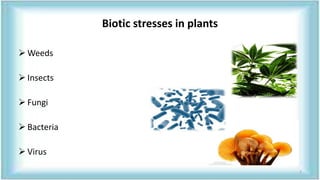
Biotic stresses in plants
 Weeds
 Insects
 Fungi
 Bacteria
 Virus
2
Genetic engineering for herbicide resistance
3
Genetic engineering for herbicide resistance
• First major achievement from genetic engineering in plants
• Glyphosate, glufosinate, sulfonylureas etc. have been successfully
developed
• Commercially cultivated in USA and other countries
4
Contd.
• Three approaches:
 Incorporating Insensitive EPSPS
 Over expression of target molecules
 Incorporating molecules which can degrade the herbicides
5
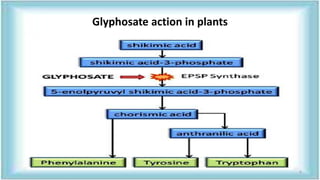
Glyphosate action in plants
6
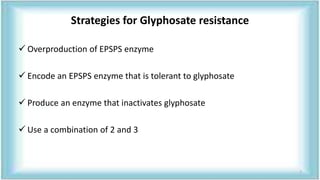
Strategies for Glyphosate resistance
 Overproduction of EPSPS enzyme
 Encode an EPSPS enzyme that is tolerant to glyphosate
 Produce an enzyme that inactivates glyphosate
 Use a combination of 2 and 3
7
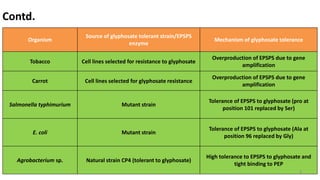
Organism
Source of glyphosate tolerant strain/EPSPS
enzyme
Mechanism of glyphosate tolerance
Tobacco Cell lines selected for resistance to glyphosate
Overproduction of EPSPS due to gene
amplification
Carrot Cell lines selected for glyphosate resistance
Overproduction of EPSPS due to gene
amplification
Salmonella typhimurium Mutant strain
Tolerance of EPSPS to glyphosate (pro at
position 101 replaced by Ser)
E. coli Mutant strain
Tolerance of EPSPS to glyphosate (Ala at
position 96 replaced by Gly)
Agrobacterium sp. Natural strain CP4 (tolerant to glyphosate)
High tolerance to EPSPS to glyphosate and
tight binding to PEP
Contd.
8
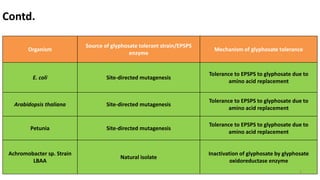
Organism
Source of glyphosate tolerant strain/EPSPS
enzyme
Mechanism of glyphosate tolerance
E. coli Site-directed mutagenesis
Tolerance to EPSPS to glyphosate due to
amino acid replacement
Arabidopsis thaliana Site-directed mutagenesis
Tolerance to EPSPS to glyphosate due to
amino acid replacement
Petunia Site-directed mutagenesis
Tolerance to EPSPS to glyphosate due to
amino acid replacement
Achromobacter sp. Strain
LBAA
Natural isolate
Inactivation of glyphosate by glyphosate
oxidoreductase enzyme
Contd.
9
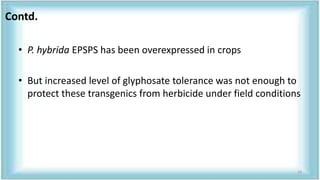
• P. hybrida EPSPS has been overexpressed in crops
• But increased level of glyphosate tolerance was not enough to
protect these transgenics from herbicide under field conditions
Contd.
10
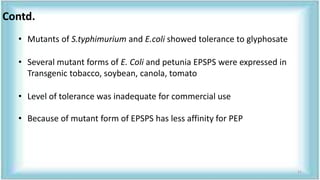
• Mutants of S.typhimurium and E.coli showed tolerance to glyphosate
• Several mutant forms of E. Coli and petunia EPSPS were expressed in
Transgenic tobacco, soybean, canola, tomato
• Level of tolerance was inadequate for commercial use
• Because of mutant form of EPSPS has less affinity for PEP
Contd.
11
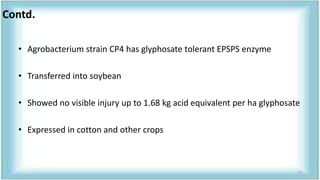
• Agrobacterium strain CP4 has glyphosate tolerant EPSPS enzyme
• Transferred into soybean
• Showed no visible injury up to 1.68 kg acid equivalent per ha glyphosate
• Expressed in cotton and other crops
Contd.
12
• Glyphosate is extensively and rapidly metabolised by GOX
• The gene encoding GOX isolated from Achromobacter sp. LBAA and expressed
in transgenic plants
• Provided excellent tolerance to glyphosate in vegetative and reproductive
stage
• Gene GOX has expressed in combination with Agrobacterium sp. CP4 EPSPS
gene
Contd.
13
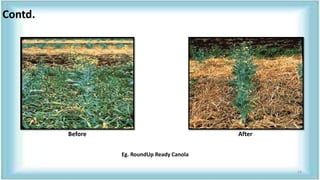
Before After
Eg. RoundUp Ready Canola
Contd.
14
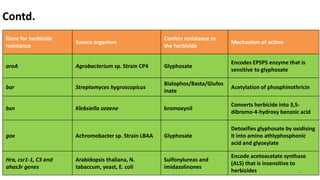
Gene for herbicide
resistance
Source organism
Confers resistance to
the herbicide
Mechanism of action
aroA Agrobacterium sp. Strain CP4 Glyphosate
Encodes EPSPS enzyme that is
sensitive to glyphosate
bar Streptomyces hygroscopicus
Bialophos/Basta/Glufos
inate
Acetylation of phosphinothricin
bxn Klebsiella ozaene bromoxynil
Converts herbicide into 3,5-
dibromo-4-hydroxy benzoic acid
gox Achromobacter sp. Strain LBAA Glyphosate
Detoxifies glyphosate by oxidising
it into amino athlyphosphonic
acid and glyoxylate
Hra, csr1-1, C3 and
ahas3r genes
Arabidopsis thaliana, N.
tabaccum, yeast, E. coli
Sulfonylureas and
imidazolinones
Encode acetoacetate synthase
(ALS) that is insensitive to
herbicides
Contd.
15
Contd.
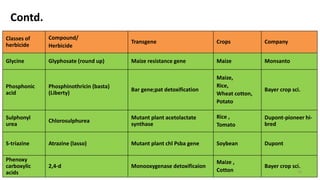
Classes of
herbicide
Compound/
Herbicide
Transgene Crops Company
Glycine Glyphosate (round up) Maize resistance gene Maize Monsanto
Phosphonic
acid
Phosphinothricin (basta)
(Liberty)
Bar gene;pat detoxification
Maize,
Rice,
Wheat cotton,
Potato
Bayer crop sci.
Sulphonyl
urea
Chlorosulphurea
Mutant plant acetolactate
synthase
Rice ,
Tomato
Dupont-pioneer hi-
bred
S-triazine Atrazine (lasso) Mutant plant chl Psba gene Soybean Dupont
Phenoxy
carboxylic
acids
2,4-d Monooxygenase detoxificaion
Maize ,
Cotton
Bayer crop sci.
16
Limitations
• Transgenic food product may allergy to human
• Affect the soil flora
• Developing super weeds
• Affect natural germplasm
17
Genetic engineering for insect resistance
18
• Approaches:
 Incorporating delta endotoxin sequence from Bacillus thuringiensis
 Incorporating plant derived genes like lectins, proteinase inhibitors etc.
Contd.
19
• Bacillus thuringiensis (Bt) is a Gram-positive, aerobic, sporulating
bacterium
• Synthesizes crystalline proteins during sporulation
• Crystalline proteins are highly insecticidal at very low concentrations
• Crystalline structure of the inclusion is made up of protoxin subunits,
called delta-endotoxins
• Proteins are non-toxic to mammals and other organisms
Bacillus thuringiensis
20
• cry gene of B. thuringiensis produces protein, which forms crystalline
inclusions in bacterial spores
• Responsible for insecticidal activities of bacterial strains
• Cry gene I to VI: based on insecticidal activity
Contd.
21
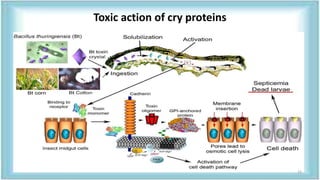
• Delta-endotoxins are solubilized in the insect midgut and are activated
by gut proteases by a combination of alkaline pH (7.5 to 8.5)
• Cleave the protein into a smaller polypeptide, the toxin
• Toxin binds to the surface of epithelial cells in the midgut, inducing
lesions that destroy the cells
• Lead to the death of the insect
Contd.
22
Toxic action of cry proteins
23
Expression of cry genes in plants
• cryIA genes transferred to tobacco, potato and tomato
• First report on response of transgenic tobacco plants to insect Manduca
sexta and Heliothis virescens
• Field trials with transgenic tobacco has revealed plants are resistant to
M. sexta and H. virescens
• Plants with moderate resistance in greenhouse proved highly resistant
to insect attacks in field
24
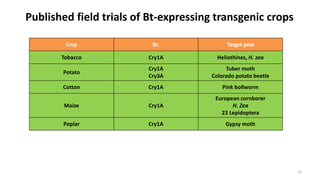
Published field trials of Bt-expressing transgenic crops
Crop Bt. Target pest
Tobacco Cry1A Heliothines, H. zea
Potato
Cry1A
Cry3A
Tuber moth
Colorado potato beetle
Cotton Cry1A Pink bollworm
Maize Cry1A
European cornborer
H. Zea
23 Lepidoptera
Poplar Cry1A Gypsy moth
25
Limitations
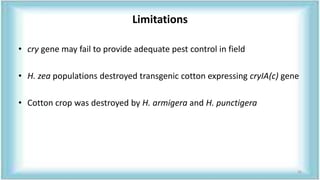
• cry gene may fail to provide adequate pest control in field
• H. zea populations destroyed transgenic cotton expressing cryIA(c) gene
• Cotton crop was destroyed by H. armigera and H. punctigera
26
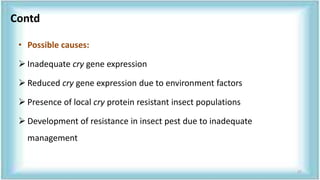
• Possible causes:
 Inadequate cry gene expression
 Reduced cry gene expression due to environment factors
 Presence of local cry protein resistant insect populations
 Development of resistance in insect pest due to inadequate
management
Contd
27
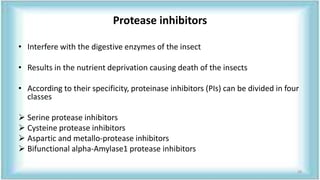
Protease inhibitors
• Interfere with the digestive enzymes of the insect
• Results in the nutrient deprivation causing death of the insects
• According to their specificity, proteinase inhibitors (PIs) can be divided in four
classes
 Serine protease inhibitors
 Cysteine protease inhibitors
 Aspartic and metallo-protease inhibitors
 Bifunctional alpha-Amylase1 protease inhibitors
28
• Serine and cysteine-proteinase inhibitors inhibits mainly lepidopteran
and coleopteran
• Most active inhibitor identified is cowpea trypsin inhibitor (CpTI)
• Transferred into at least ten other plant species
• Protein is an effective antimetabolite against a range of field and storage
pests
Contd.
29
• CpTI-transformed tobacco, field-tested and caused significant larval
mortality of cotton bollworm
• Serine proteinase inhibitors resulted in up to 100% mortality of first-
instar cotton leaf worms when expressed in tobacco
Contd.
30
alpha-Amylase inhibitors
• Insect larvae secrete a gut enzyme alpha- amylase to digest starch
• Blocking the activity of this enzyme by α-amylase inhibitor, the
larvae can be starved and killed
• α-Amylase inhibitor gene isolated from bean has been successfully
transferred and expressed in tobacco
• Provides resistance against Coleoptera
31
Lectins
• Lectins are carbohydrate-binding proteins found in many plant tissues
• Abundant in the seeds and storage tissues of some plant species
• Involves specific binding of lectin to glycoconjugates located in the
midgut of the insect
• Tobacco plants expressing a pea lectin were shown to be toxic to the
Lepidoptera Heliothis virescens
32
Insect chitinases
• Chitin is an insoluble structural polysaccharide that occurs in the
exoskeletal and gut lining of insects
• It is believed to protect the insect against water loss and abrasive agents
• Larvae feeding on the transgenic plants exhibited several growth
aberrations and died prematurely
33
Other insect-resistance genes from plants
• Tryptophan decarboxylase from periwinkle was expressed in tobacco
• Induced synthesis of tryptamine and tryptamine-based alkaloids
• Pupal emergence of whitefly decreased as a result of feeding on such
plants
34
Genetic engineering for fugal and bacterial
resistance
35
• Hosts and pathogens show gene-for-gene relationship
• Two types:
 Incompatible reaction
 Compatible reaction
Contd.
36
Incompatible reaction
• Found in biotrophic pathogens (obligate parasites)
• Smuts, rusts
• Alleles for resistance in host and those for avirulence in pathogen produce
specific compounds, which recognise each other
• When these specific compounds interact, produce resistant response in host
37
Contd.
• Associated with hypersensitive reaction
• Triggered by certain unique molecules, called elicitors, of pathogen
origin
• Elicitors are recognised by receptor-like molecules present in resistant
plants
• Initiates several biochemical reactions
38
Contd.
 Produce active oxygen species
 Phytoalexin biosynthesis
 Cell wall reinforcement
 Release of hydrolytic enzymes/inhibitory poteins
 Results in rapid cell death
39
Compatible reaction
• Alleles for susceptibility in host and those for virulence in pathogen
produce specific compounds, which interact with each other to produce
susceptible response
• Lack of interaction between products of genes specifies resistance
response in host
• Found in heterotrophic pathogens
40
Strategies for resistance
 Genes encoding insensitive target enzymes
 Genes specifying toxin inactivation
 Expression of antibacterial peptides
 Expression of bacterial lyzozymes
 Genes specifying programmed cell death
 RNAi targeting pathogen/parasitic genes
41
Contd.
 Expression of heterologous phytoalexins
 Genes encoding ribosome inactivating proteins
 Expression of heterologous thionins
 Ectopic expression of pathogenesis related proteins
 Ectopic expression of chitinase
 Modification of host proteins required for infection by pathogen
42
Genetic engineering for virus resistance
43
Contd.
• Coat protein gene
• cDNA of satellite RNA
• Defective viral genome
• Antisense RNA approach
• Ribozyme-mediated approach
44
Contd.
• Based on strategies on genes derived from pathogenic viruses
themselves
• Pathogen-derived resistance: disease resistance generated by employing
pathogen genes
45
Coat protein gene
• Transgenic plants having virus coat protein gene linked to strong
promoter
• Tobacco, tomato, alfalfa, sugarbeet, potato etc.
• First plant: 1986: tobacco, coat protein from TMV strain U1
• Expression of virus coat protein gene: confers resistance to concerned
virus and gives a measure of resistance to other related virus
46
Contd.
• Effectiveness of coat protein: affected by amount of coat protein
produced in transgenic plants and by concentration of virus inoculum
• Resistance is due to blocking of process of uncoating of virus particles,
which is necessary for viral genome replication as well as expression
47
GM released for commercial cultivation using CPMR
• Tomato resistant to TMV
• Tomato mosaic virus (ToMV) and cucumber mosaic virus (CMV)
• Cucumber resistant to CMV
• Squash resistant to zucchini yellow mosaic virus (ZYMV) watermelon
mosaic virus (WMV2)
48
Contd.
• Cantaloupe resistant to ZYMV, WMV2 and CMV
• Potato resistant to PVX, potato virus Y (PVY) and potato leaf roll virus (PLRV)
• Papaya resistant to papaya ringspot virus, PRSV
• Pea early browning virus, potato virus Y and cucumber mosaic virus
49
Other viral genes
• Other than coat protein
• Done for potyviruses
• Genes used: potyvirus genome-linked proteins (VPg)
• VPg-protinases (Nla)
• RNA-dependent RNA polymerases (Nlb)
• Cylindrical inclusion proteins (Cl)
• Do not confer resistance to heterologus potyviruses (no broad-range
protection)
50
cDNA of satellite RNA
• Some RNA virus have small RNA molecules: satellites
• Depend on viral genomes for their replication
• Not necessary for viral functions
• Satellites either decrease or increase severity of disease produced by
virus carrying it
51
Contd.
• cDNA copies of satellites that reduce disease severity have been
integrated into host genomes
• Expression of satellite has been shown to reduce disease symptoms as
well as virus accumulation
52
Defective viral genome
• Defective or deleted genomes of some RNA and DNA viruses disrupt
replication of complete genomes of those viruses with which they are
associated
• African cassava mosaic virus ( ACMV): two single stranded DNA
molecules A- and B-DNAs
53
Contd.
• In addition, 50% deleted B-DNA I also found associated
• Tobacco plants containing deleted B-DNA integrated in their genomes
showed reduced systemic spread when infected with ACMV
54
Antisense RNA approach
• Produced by inverting cDNA copy of mRNA with respect to promoter in
an expression vector
• Yields full-length complementary copy of m RNA sequence
• Interact with mRNA molecules by base-pairing to form double stranded
RNA
• Tobacco: CMV
55
Ribozyme mediated approach
• RNA molecules that exhibit enzyme activities
• Hybrid RNA consisting of tobacco ringspot virus (TobRV) satellite RNA
endoribonuclease catalytic sequences linked to antisense RNA specific
of specific genes against they are targeted
56
Contd.
• Strategy consists of:
 Producing ribozyme specific to part of target virus genome
 To produce cDNA of this ribozyme
 To integrate it into host plant genome
57
Development of RT-PCR based method for selection of potato
virus Y in tobacco and potato
• Top four leaves of two-month old green house grown tobacco plants of
Havana 425 variety were mechanically infected with PVY
• Progressing from basal to apical direction first leaf was harvested after 1
week
• Second leaf after 2 weeks
• Third leaf after 3 weeks
• Fourth leaf after 4 weeks of infection
58
Contd.
• Leaf was used for double antibody sandwich (DAS) ELISA test, NASH and
RT-PCR
• Potato plants cv. Kufri Jyoti from an infected field were also collected
• Tubers were subjected to methods of PVY detection
• ELISA was found to be effective in detecting PVY in mechanically
infected tobacco plants maintained in green house
59
Contd.
• Nucleic Acid Spot Hybridization (NASH) was found equally effective as
ELISA in detecting PVY level in mechanically infected and green house
maintained tobacco plants
• Cloned coat protein gene of PVY was used as a probe
• RT-PCR was found to be highly efficient method of detection
60
Contd.
• RT-PCR consists of RT reaction at 60⁰C for 30 minute
• Initial denaturation: 94⁰C for 1 minute
• Followed by 94 ⁰C for 30 sec, 54 ⁰C for 1 minute and 72 ⁰C for 1 minute
• 30 cycles
• RT-PCR was found to be more sensitive than ELISA and NASH
61
Contd.
• RT-PCR based protocol was developed and compared to NASH and
ELISA
• Results clearly showed that all the three protocols can detect virus
• RT-PCR based protocol was more efficient and sensitive in detecting PVY
from field samples
62
Contd.
• RT-PCR could detect presence of very small amount of infection in field
samples which was not detected by ELISA or NASH
• Also helps to correctly identify resistant plants in population
63
Corrections
Virus resistant plants
 Coat protein mediated
• Papaya resistant to papaya ringspot virus, PRSV
• Variety Rainbow, yielded 112,000 kg/ha marketable fruits, compared to
5,600 kg/ha from non-transgenic lines
65
Contd.
• CP gene of Potato mosaic virus (PMV) strain N605 provides resistance in
transgenic potato plants against this strain and also to related strain
0803
• Transgenic clones C2, C3, C4, C5, C6 and PT-6 of plum transformed with
coat protein (CP) gene of Plum pox virus (PPV)
66
Contd
• Mutant replicases from Cucumber mosaic virus (CMV) subgroup I
conferred high levels of resistance in tobacco plants to all subgroup I
CMV strains
67
Viral movement proteins (MPs)
• Mutant MPs from PMV show resistance to several TMVs, Cauliflower
mosaic virus (CaMV) and other viruses
• Nicotiana occidentalis plants expressing movement protein (P50) and
partially functional deletion mutants (DeltaA and DeltaC) of Apple
chlorotic leaf spot virus (ACLSV) showed resistance to Grapevine berry
inner necrosis virus (GINV)
68
RNA silencing
• Pepper mild mottle virus (PMMoV) and Plum pox virus (PPV)
• Tomato plants expressing a single, small chimeric hairpin RNA
comprised of 4Ngene segments (150-nt) of topsoviruses [TSWV, GRSV,
tomato chlorotic spot virus (TCSV) and watermelon silver mottle virus
(WSMoV) display broad-spectrum resistance against topsoviruses
69
Contd.
• Used single transgene with viral fragments from Watermelon silver
mottle virus (WSMoV), Cucumber mosaic virus (CMV), Cucumber green
mottle mosaic virus (CGMMV) and Watermelon mosaic virus (WMV)
and transformed into watermelon
• Exposed to CMV, CGMMV and WMV
70
Contd
• Sweet potato feathery mottle virus (SPFMV), Sweet potato chlorotic
stunt virus(SPCSV), Sweet potato virus G (SPVG) and Sweet potato mild
mottle virus (SPMMV)
• Coat protein gene segments from each of the four viruses mentioned
were used to induce gene silencing in transgenic sweet potato
71
Potassium transport gene enhances resistance to
soybean mosaic virus
• Altering the level of potassium can reduce the spread of viral diseases
• Potassium transporters are leading targets for breeding for virus
resistance including soybean mosaic virus (SMV)
• Gene GmAKT2 was significantly induced by SMV inoculation in resistant
varieties
72
Contd.
• Overexpression of GmAKT2 enhanced SMV resistance in soybean
• Manipulation of potassium transporter expression is a novel molecular
approach for enhancing SMV resistance
73
Insect resistance
Contd.
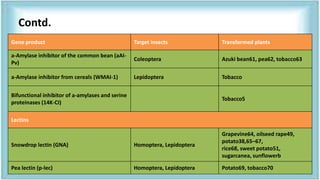
75
Gene product Target insects Transformed plants
a-Amylase inhibitor of the common bean (aAI-
Pv)
Coleoptera Azuki bean61, pea62, tobacco63
a-Amylase inhibitor from cereals (WMAI-1) Lepidoptera Tobacco
Bifunctional inhibitor of a-amylases and serine
proteinases (14K-CI)
Tobacco5
Lectins
Snowdrop lectin (GNA) Homoptera, Lepidoptera
Grapevine64, oilseed rape49,
potato38,65–67,
rice68, sweet potato51,
sugarcanea, sunflowerb
Pea lectin (p-lec) Homoptera, Lepidoptera Potato69, tobacco70
Contd.
76
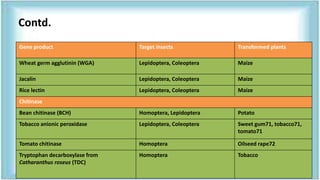
Gene product Target insects Transformed plants
Wheat germ agglutinin (WGA) Lepidoptera, Coleoptera Maize
Jacalin Lepidoptera, Coleoptera Maize
Rice lectin Lepidoptera, Coleoptera Maize
Chitinase
Bean chitinase (BCH) Homoptera, Lepidoptera Potato
Tobacco anionic peroxidase Lepidoptera, Coleoptera Sweet gum71, tobacco71,
tomato71
Tomato chitinase Homoptera Oilseed rape72
Tryptophan decarboxylase from
Catharanthus roseus (TDC)
Homoptera Tobacco
alpha-amylase inhibitors
• Introduction and expression of the bean a-AI gene in pea confers
resistance to the bruchid beetles
77
Lectins
• Engineered plants showed resistance against brown plant hopper
(Nilaparvata lugens) and green leaf hopper (Nephotettix virescens)
• Wheat germ agglutinin, pea lectin and rice lectin have been expressed
in plants like tobacco, maize, and potato mainly against aphids
• Chickpea: garlic lectin gene (asaf): Aphids
78
Contd.
• Snowdrop lectin (Galanthus nivalis agglutinin) expressing plants are
resistant to solitary bee Osmia bicornis
79
Genetic engineering for biotic stress tolerance

Genetic engineering for biotic stress tolerance

  • 1.
    Genetic engineering forbiotic stress tolerance in plants Ekatpure Sachin Chandrakant Dept. of Plant Biotechnology PhD Research Scholar
  • 2.
    Biotic stresses inplants  Weeds  Insects  Fungi  Bacteria  Virus 2
  • 3.
    Genetic engineering forherbicide resistance 3
  • 4.
    Genetic engineering forherbicide resistance • First major achievement from genetic engineering in plants • Glyphosate, glufosinate, sulfonylureas etc. have been successfully developed • Commercially cultivated in USA and other countries 4
  • 5.
    Contd. • Three approaches: Incorporating Insensitive EPSPS  Over expression of target molecules  Incorporating molecules which can degrade the herbicides 5
  • 6.
  • 7.
    Strategies for Glyphosateresistance  Overproduction of EPSPS enzyme  Encode an EPSPS enzyme that is tolerant to glyphosate  Produce an enzyme that inactivates glyphosate  Use a combination of 2 and 3 7
  • 8.
    Organism Source of glyphosatetolerant strain/EPSPS enzyme Mechanism of glyphosate tolerance Tobacco Cell lines selected for resistance to glyphosate Overproduction of EPSPS due to gene amplification Carrot Cell lines selected for glyphosate resistance Overproduction of EPSPS due to gene amplification Salmonella typhimurium Mutant strain Tolerance of EPSPS to glyphosate (pro at position 101 replaced by Ser) E. coli Mutant strain Tolerance of EPSPS to glyphosate (Ala at position 96 replaced by Gly) Agrobacterium sp. Natural strain CP4 (tolerant to glyphosate) High tolerance to EPSPS to glyphosate and tight binding to PEP Contd. 8
  • 9.
    Organism Source of glyphosatetolerant strain/EPSPS enzyme Mechanism of glyphosate tolerance E. coli Site-directed mutagenesis Tolerance to EPSPS to glyphosate due to amino acid replacement Arabidopsis thaliana Site-directed mutagenesis Tolerance to EPSPS to glyphosate due to amino acid replacement Petunia Site-directed mutagenesis Tolerance to EPSPS to glyphosate due to amino acid replacement Achromobacter sp. Strain LBAA Natural isolate Inactivation of glyphosate by glyphosate oxidoreductase enzyme Contd. 9
  • 10.
    • P. hybridaEPSPS has been overexpressed in crops • But increased level of glyphosate tolerance was not enough to protect these transgenics from herbicide under field conditions Contd. 10
  • 11.
    • Mutants ofS.typhimurium and E.coli showed tolerance to glyphosate • Several mutant forms of E. Coli and petunia EPSPS were expressed in Transgenic tobacco, soybean, canola, tomato • Level of tolerance was inadequate for commercial use • Because of mutant form of EPSPS has less affinity for PEP Contd. 11
  • 12.
    • Agrobacterium strainCP4 has glyphosate tolerant EPSPS enzyme • Transferred into soybean • Showed no visible injury up to 1.68 kg acid equivalent per ha glyphosate • Expressed in cotton and other crops Contd. 12
  • 13.
    • Glyphosate isextensively and rapidly metabolised by GOX • The gene encoding GOX isolated from Achromobacter sp. LBAA and expressed in transgenic plants • Provided excellent tolerance to glyphosate in vegetative and reproductive stage • Gene GOX has expressed in combination with Agrobacterium sp. CP4 EPSPS gene Contd. 13
  • 14.
    Before After Eg. RoundUpReady Canola Contd. 14
  • 15.
    Gene for herbicide resistance Sourceorganism Confers resistance to the herbicide Mechanism of action aroA Agrobacterium sp. Strain CP4 Glyphosate Encodes EPSPS enzyme that is sensitive to glyphosate bar Streptomyces hygroscopicus Bialophos/Basta/Glufos inate Acetylation of phosphinothricin bxn Klebsiella ozaene bromoxynil Converts herbicide into 3,5- dibromo-4-hydroxy benzoic acid gox Achromobacter sp. Strain LBAA Glyphosate Detoxifies glyphosate by oxidising it into amino athlyphosphonic acid and glyoxylate Hra, csr1-1, C3 and ahas3r genes Arabidopsis thaliana, N. tabaccum, yeast, E. coli Sulfonylureas and imidazolinones Encode acetoacetate synthase (ALS) that is insensitive to herbicides Contd. 15
  • 16.
    Contd. Classes of herbicide Compound/ Herbicide Transgene CropsCompany Glycine Glyphosate (round up) Maize resistance gene Maize Monsanto Phosphonic acid Phosphinothricin (basta) (Liberty) Bar gene;pat detoxification Maize, Rice, Wheat cotton, Potato Bayer crop sci. Sulphonyl urea Chlorosulphurea Mutant plant acetolactate synthase Rice , Tomato Dupont-pioneer hi- bred S-triazine Atrazine (lasso) Mutant plant chl Psba gene Soybean Dupont Phenoxy carboxylic acids 2,4-d Monooxygenase detoxificaion Maize , Cotton Bayer crop sci. 16
  • 17.
    Limitations • Transgenic foodproduct may allergy to human • Affect the soil flora • Developing super weeds • Affect natural germplasm 17
  • 18.
    Genetic engineering forinsect resistance 18
  • 19.
    • Approaches:  Incorporatingdelta endotoxin sequence from Bacillus thuringiensis  Incorporating plant derived genes like lectins, proteinase inhibitors etc. Contd. 19
  • 20.
    • Bacillus thuringiensis(Bt) is a Gram-positive, aerobic, sporulating bacterium • Synthesizes crystalline proteins during sporulation • Crystalline proteins are highly insecticidal at very low concentrations • Crystalline structure of the inclusion is made up of protoxin subunits, called delta-endotoxins • Proteins are non-toxic to mammals and other organisms Bacillus thuringiensis 20
  • 21.
    • cry geneof B. thuringiensis produces protein, which forms crystalline inclusions in bacterial spores • Responsible for insecticidal activities of bacterial strains • Cry gene I to VI: based on insecticidal activity Contd. 21
  • 22.
    • Delta-endotoxins aresolubilized in the insect midgut and are activated by gut proteases by a combination of alkaline pH (7.5 to 8.5) • Cleave the protein into a smaller polypeptide, the toxin • Toxin binds to the surface of epithelial cells in the midgut, inducing lesions that destroy the cells • Lead to the death of the insect Contd. 22
  • 23.
    Toxic action ofcry proteins 23
  • 24.
    Expression of crygenes in plants • cryIA genes transferred to tobacco, potato and tomato • First report on response of transgenic tobacco plants to insect Manduca sexta and Heliothis virescens • Field trials with transgenic tobacco has revealed plants are resistant to M. sexta and H. virescens • Plants with moderate resistance in greenhouse proved highly resistant to insect attacks in field 24
  • 25.
    Published field trialsof Bt-expressing transgenic crops Crop Bt. Target pest Tobacco Cry1A Heliothines, H. zea Potato Cry1A Cry3A Tuber moth Colorado potato beetle Cotton Cry1A Pink bollworm Maize Cry1A European cornborer H. Zea 23 Lepidoptera Poplar Cry1A Gypsy moth 25
  • 26.
    Limitations • cry genemay fail to provide adequate pest control in field • H. zea populations destroyed transgenic cotton expressing cryIA(c) gene • Cotton crop was destroyed by H. armigera and H. punctigera 26
  • 27.
    • Possible causes: Inadequate cry gene expression  Reduced cry gene expression due to environment factors  Presence of local cry protein resistant insect populations  Development of resistance in insect pest due to inadequate management Contd 27
  • 28.
    Protease inhibitors • Interferewith the digestive enzymes of the insect • Results in the nutrient deprivation causing death of the insects • According to their specificity, proteinase inhibitors (PIs) can be divided in four classes  Serine protease inhibitors  Cysteine protease inhibitors  Aspartic and metallo-protease inhibitors  Bifunctional alpha-Amylase1 protease inhibitors 28
  • 29.
    • Serine andcysteine-proteinase inhibitors inhibits mainly lepidopteran and coleopteran • Most active inhibitor identified is cowpea trypsin inhibitor (CpTI) • Transferred into at least ten other plant species • Protein is an effective antimetabolite against a range of field and storage pests Contd. 29
  • 30.
    • CpTI-transformed tobacco,field-tested and caused significant larval mortality of cotton bollworm • Serine proteinase inhibitors resulted in up to 100% mortality of first- instar cotton leaf worms when expressed in tobacco Contd. 30
  • 31.
    alpha-Amylase inhibitors • Insectlarvae secrete a gut enzyme alpha- amylase to digest starch • Blocking the activity of this enzyme by α-amylase inhibitor, the larvae can be starved and killed • α-Amylase inhibitor gene isolated from bean has been successfully transferred and expressed in tobacco • Provides resistance against Coleoptera 31
  • 32.
    Lectins • Lectins arecarbohydrate-binding proteins found in many plant tissues • Abundant in the seeds and storage tissues of some plant species • Involves specific binding of lectin to glycoconjugates located in the midgut of the insect • Tobacco plants expressing a pea lectin were shown to be toxic to the Lepidoptera Heliothis virescens 32
  • 33.
    Insect chitinases • Chitinis an insoluble structural polysaccharide that occurs in the exoskeletal and gut lining of insects • It is believed to protect the insect against water loss and abrasive agents • Larvae feeding on the transgenic plants exhibited several growth aberrations and died prematurely 33
  • 34.
    Other insect-resistance genesfrom plants • Tryptophan decarboxylase from periwinkle was expressed in tobacco • Induced synthesis of tryptamine and tryptamine-based alkaloids • Pupal emergence of whitefly decreased as a result of feeding on such plants 34
  • 35.
    Genetic engineering forfugal and bacterial resistance 35
  • 36.
    • Hosts andpathogens show gene-for-gene relationship • Two types:  Incompatible reaction  Compatible reaction Contd. 36
  • 37.
    Incompatible reaction • Foundin biotrophic pathogens (obligate parasites) • Smuts, rusts • Alleles for resistance in host and those for avirulence in pathogen produce specific compounds, which recognise each other • When these specific compounds interact, produce resistant response in host 37
  • 38.
    Contd. • Associated withhypersensitive reaction • Triggered by certain unique molecules, called elicitors, of pathogen origin • Elicitors are recognised by receptor-like molecules present in resistant plants • Initiates several biochemical reactions 38
  • 39.
    Contd.  Produce activeoxygen species  Phytoalexin biosynthesis  Cell wall reinforcement  Release of hydrolytic enzymes/inhibitory poteins  Results in rapid cell death 39
  • 40.
    Compatible reaction • Allelesfor susceptibility in host and those for virulence in pathogen produce specific compounds, which interact with each other to produce susceptible response • Lack of interaction between products of genes specifies resistance response in host • Found in heterotrophic pathogens 40
  • 41.
    Strategies for resistance Genes encoding insensitive target enzymes  Genes specifying toxin inactivation  Expression of antibacterial peptides  Expression of bacterial lyzozymes  Genes specifying programmed cell death  RNAi targeting pathogen/parasitic genes 41
  • 42.
    Contd.  Expression ofheterologous phytoalexins  Genes encoding ribosome inactivating proteins  Expression of heterologous thionins  Ectopic expression of pathogenesis related proteins  Ectopic expression of chitinase  Modification of host proteins required for infection by pathogen 42
  • 43.
    Genetic engineering forvirus resistance 43
  • 44.
    Contd. • Coat proteingene • cDNA of satellite RNA • Defective viral genome • Antisense RNA approach • Ribozyme-mediated approach 44
  • 45.
    Contd. • Based onstrategies on genes derived from pathogenic viruses themselves • Pathogen-derived resistance: disease resistance generated by employing pathogen genes 45
  • 46.
    Coat protein gene •Transgenic plants having virus coat protein gene linked to strong promoter • Tobacco, tomato, alfalfa, sugarbeet, potato etc. • First plant: 1986: tobacco, coat protein from TMV strain U1 • Expression of virus coat protein gene: confers resistance to concerned virus and gives a measure of resistance to other related virus 46
  • 47.
    Contd. • Effectiveness ofcoat protein: affected by amount of coat protein produced in transgenic plants and by concentration of virus inoculum • Resistance is due to blocking of process of uncoating of virus particles, which is necessary for viral genome replication as well as expression 47
  • 48.
    GM released forcommercial cultivation using CPMR • Tomato resistant to TMV • Tomato mosaic virus (ToMV) and cucumber mosaic virus (CMV) • Cucumber resistant to CMV • Squash resistant to zucchini yellow mosaic virus (ZYMV) watermelon mosaic virus (WMV2) 48
  • 49.
    Contd. • Cantaloupe resistantto ZYMV, WMV2 and CMV • Potato resistant to PVX, potato virus Y (PVY) and potato leaf roll virus (PLRV) • Papaya resistant to papaya ringspot virus, PRSV • Pea early browning virus, potato virus Y and cucumber mosaic virus 49
  • 50.
    Other viral genes •Other than coat protein • Done for potyviruses • Genes used: potyvirus genome-linked proteins (VPg) • VPg-protinases (Nla) • RNA-dependent RNA polymerases (Nlb) • Cylindrical inclusion proteins (Cl) • Do not confer resistance to heterologus potyviruses (no broad-range protection) 50
  • 51.
    cDNA of satelliteRNA • Some RNA virus have small RNA molecules: satellites • Depend on viral genomes for their replication • Not necessary for viral functions • Satellites either decrease or increase severity of disease produced by virus carrying it 51
  • 52.
    Contd. • cDNA copiesof satellites that reduce disease severity have been integrated into host genomes • Expression of satellite has been shown to reduce disease symptoms as well as virus accumulation 52
  • 53.
    Defective viral genome •Defective or deleted genomes of some RNA and DNA viruses disrupt replication of complete genomes of those viruses with which they are associated • African cassava mosaic virus ( ACMV): two single stranded DNA molecules A- and B-DNAs 53
  • 54.
    Contd. • In addition,50% deleted B-DNA I also found associated • Tobacco plants containing deleted B-DNA integrated in their genomes showed reduced systemic spread when infected with ACMV 54
  • 55.
    Antisense RNA approach •Produced by inverting cDNA copy of mRNA with respect to promoter in an expression vector • Yields full-length complementary copy of m RNA sequence • Interact with mRNA molecules by base-pairing to form double stranded RNA • Tobacco: CMV 55
  • 56.
    Ribozyme mediated approach •RNA molecules that exhibit enzyme activities • Hybrid RNA consisting of tobacco ringspot virus (TobRV) satellite RNA endoribonuclease catalytic sequences linked to antisense RNA specific of specific genes against they are targeted 56
  • 57.
    Contd. • Strategy consistsof:  Producing ribozyme specific to part of target virus genome  To produce cDNA of this ribozyme  To integrate it into host plant genome 57
  • 58.
    Development of RT-PCRbased method for selection of potato virus Y in tobacco and potato • Top four leaves of two-month old green house grown tobacco plants of Havana 425 variety were mechanically infected with PVY • Progressing from basal to apical direction first leaf was harvested after 1 week • Second leaf after 2 weeks • Third leaf after 3 weeks • Fourth leaf after 4 weeks of infection 58
  • 59.
    Contd. • Leaf wasused for double antibody sandwich (DAS) ELISA test, NASH and RT-PCR • Potato plants cv. Kufri Jyoti from an infected field were also collected • Tubers were subjected to methods of PVY detection • ELISA was found to be effective in detecting PVY in mechanically infected tobacco plants maintained in green house 59
  • 60.
    Contd. • Nucleic AcidSpot Hybridization (NASH) was found equally effective as ELISA in detecting PVY level in mechanically infected and green house maintained tobacco plants • Cloned coat protein gene of PVY was used as a probe • RT-PCR was found to be highly efficient method of detection 60
  • 61.
    Contd. • RT-PCR consistsof RT reaction at 60⁰C for 30 minute • Initial denaturation: 94⁰C for 1 minute • Followed by 94 ⁰C for 30 sec, 54 ⁰C for 1 minute and 72 ⁰C for 1 minute • 30 cycles • RT-PCR was found to be more sensitive than ELISA and NASH 61
  • 62.
    Contd. • RT-PCR basedprotocol was developed and compared to NASH and ELISA • Results clearly showed that all the three protocols can detect virus • RT-PCR based protocol was more efficient and sensitive in detecting PVY from field samples 62
  • 63.
    Contd. • RT-PCR coulddetect presence of very small amount of infection in field samples which was not detected by ELISA or NASH • Also helps to correctly identify resistant plants in population 63
  • 64.
  • 65.
    Virus resistant plants Coat protein mediated • Papaya resistant to papaya ringspot virus, PRSV • Variety Rainbow, yielded 112,000 kg/ha marketable fruits, compared to 5,600 kg/ha from non-transgenic lines 65
  • 66.
    Contd. • CP geneof Potato mosaic virus (PMV) strain N605 provides resistance in transgenic potato plants against this strain and also to related strain 0803 • Transgenic clones C2, C3, C4, C5, C6 and PT-6 of plum transformed with coat protein (CP) gene of Plum pox virus (PPV) 66
  • 67.
    Contd • Mutant replicasesfrom Cucumber mosaic virus (CMV) subgroup I conferred high levels of resistance in tobacco plants to all subgroup I CMV strains 67
  • 68.
    Viral movement proteins(MPs) • Mutant MPs from PMV show resistance to several TMVs, Cauliflower mosaic virus (CaMV) and other viruses • Nicotiana occidentalis plants expressing movement protein (P50) and partially functional deletion mutants (DeltaA and DeltaC) of Apple chlorotic leaf spot virus (ACLSV) showed resistance to Grapevine berry inner necrosis virus (GINV) 68
  • 69.
    RNA silencing • Peppermild mottle virus (PMMoV) and Plum pox virus (PPV) • Tomato plants expressing a single, small chimeric hairpin RNA comprised of 4Ngene segments (150-nt) of topsoviruses [TSWV, GRSV, tomato chlorotic spot virus (TCSV) and watermelon silver mottle virus (WSMoV) display broad-spectrum resistance against topsoviruses 69
  • 70.
    Contd. • Used singletransgene with viral fragments from Watermelon silver mottle virus (WSMoV), Cucumber mosaic virus (CMV), Cucumber green mottle mosaic virus (CGMMV) and Watermelon mosaic virus (WMV) and transformed into watermelon • Exposed to CMV, CGMMV and WMV 70
  • 71.
    Contd • Sweet potatofeathery mottle virus (SPFMV), Sweet potato chlorotic stunt virus(SPCSV), Sweet potato virus G (SPVG) and Sweet potato mild mottle virus (SPMMV) • Coat protein gene segments from each of the four viruses mentioned were used to induce gene silencing in transgenic sweet potato 71
  • 72.
    Potassium transport geneenhances resistance to soybean mosaic virus • Altering the level of potassium can reduce the spread of viral diseases • Potassium transporters are leading targets for breeding for virus resistance including soybean mosaic virus (SMV) • Gene GmAKT2 was significantly induced by SMV inoculation in resistant varieties 72
  • 73.
    Contd. • Overexpression ofGmAKT2 enhanced SMV resistance in soybean • Manipulation of potassium transporter expression is a novel molecular approach for enhancing SMV resistance 73
  • 74.
  • 75.
    Contd. 75 Gene product Targetinsects Transformed plants a-Amylase inhibitor of the common bean (aAI- Pv) Coleoptera Azuki bean61, pea62, tobacco63 a-Amylase inhibitor from cereals (WMAI-1) Lepidoptera Tobacco Bifunctional inhibitor of a-amylases and serine proteinases (14K-CI) Tobacco5 Lectins Snowdrop lectin (GNA) Homoptera, Lepidoptera Grapevine64, oilseed rape49, potato38,65–67, rice68, sweet potato51, sugarcanea, sunflowerb Pea lectin (p-lec) Homoptera, Lepidoptera Potato69, tobacco70
  • 76.
    Contd. 76 Gene product Targetinsects Transformed plants Wheat germ agglutinin (WGA) Lepidoptera, Coleoptera Maize Jacalin Lepidoptera, Coleoptera Maize Rice lectin Lepidoptera, Coleoptera Maize Chitinase Bean chitinase (BCH) Homoptera, Lepidoptera Potato Tobacco anionic peroxidase Lepidoptera, Coleoptera Sweet gum71, tobacco71, tomato71 Tomato chitinase Homoptera Oilseed rape72 Tryptophan decarboxylase from Catharanthus roseus (TDC) Homoptera Tobacco
  • 77.
    alpha-amylase inhibitors • Introductionand expression of the bean a-AI gene in pea confers resistance to the bruchid beetles 77
  • 78.
    Lectins • Engineered plantsshowed resistance against brown plant hopper (Nilaparvata lugens) and green leaf hopper (Nephotettix virescens) • Wheat germ agglutinin, pea lectin and rice lectin have been expressed in plants like tobacco, maize, and potato mainly against aphids • Chickpea: garlic lectin gene (asaf): Aphids 78
  • 79.
    Contd. • Snowdrop lectin(Galanthus nivalis agglutinin) expressing plants are resistant to solitary bee Osmia bicornis 79