1
2
Epigenetics mediated gene
regulation in plants
Centre for Plant Biotechnology and Molecular
Biology
Kerala Agricultural University
 Epigenetics – meaning and definition
 Mechanisms
 Implications
 Applications
 Conclusions
3
 Changes in gene expression that occur by a
mechanism other than change to the DNA sequence
 Gene-regulatory information that is not expressed in
DNA sequences but transmitted from one generation
(of cells or organisms) to the next
 Coined by C. H. Waddington in 1942
 Epigenetics means ‘above’ or ‘on top of genetics’
4
What Does “Epigenetics” Mean?
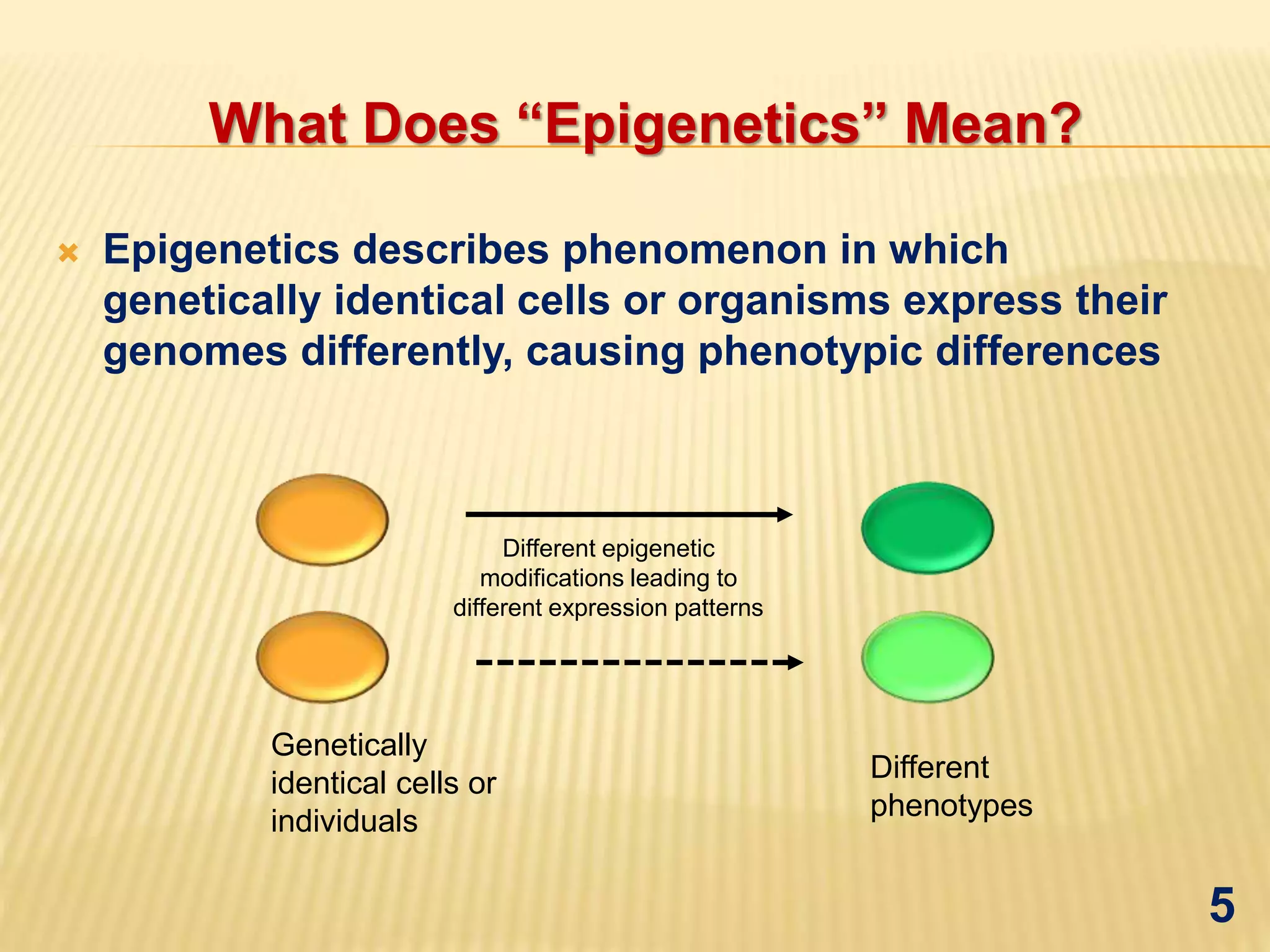
 Epigenetics describes phenomenon in which
genetically identical cells or organisms express their
genomes differently, causing phenotypic differences
5
Genetically
identical cells or
individuals
Different epigenetic
modifications leading to
different expression patterns
Different
phenotypes
Molecular epigenetic mechanism
 Development of multicellular organisms occurs due to cells
differentiation by various programs of gene expression
 Cells have own epigenetic signatures like
1. Genotype
2. Developmental history
3. Environmental influences and it is ultimately reflected in the
phenotype of the cells and the organism
6
7
cytosine 5-methylcytosine
DNA can be covalently
modified by cytosine
methylation.
TTCGCCGACTAA
Methyl-
cytosine
.... DNA Methylation
 DNA methylation in mammals mainly occurs on the
cytosine nucleotide in a CpG site
 In plants the cytosine can be methylated at CpG, CpHpG,
and CpHpH sites, where H represents any nucleotide
 DRM2, MET1, and CMT3: DNA methylases in plants
 CMT3 protein is unique to the plant kingdom
8
.... DNA Methylation
9
 Role in prokaryotes, as defence mechanism
•Escape from the restriction enzymes
•Protection from bacteriophages
 In eukaryotes, it controls the mechanism of transposable
elements in the genome
Classes of methyl transferase
 De novo class: Enzymes that create new methylation
mark on DNA
Eg. DNMT3a and DNMT3b
 Maintainance class: Recognizes the methylation
marks on the parental strand of DNA and transfers new
methylation to the daughter strands after DNA
replication
Eg. DNMT1
10
11
12
(http://atlasgeneticsoncology.org/Educ/HeterochromEng.html)
2. Histone modification
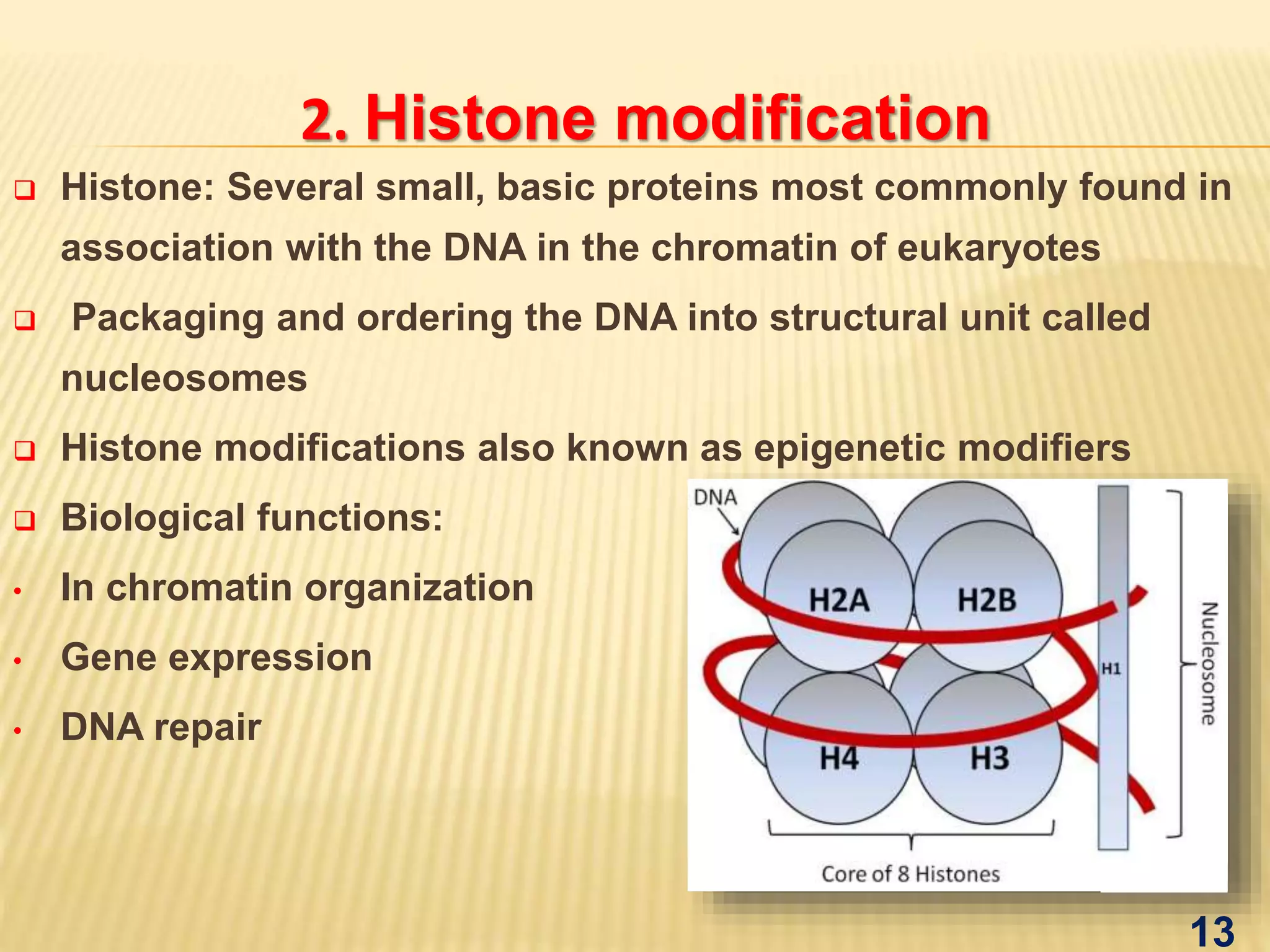
 Histone: Several small, basic proteins most commonly found in
association with the DNA in the chromatin of eukaryotes
 Packaging and ordering the DNA into structural unit called
nucleosomes
 Histone modifications also known as epigenetic modifiers
 Biological functions:
• In chromatin organization
• Gene expression
• DNA repair
13
 Writers: enzymes that add a mark
 Erasers: enzymes that remove a mark
 Readers: proteins that bind to and “interpret” the mark
14(Tarakhovsky,. Nature Immunology, 2010)
Writers' introduce histone marks (circles), 'erasers' take them out and 'readers'
can recognize a particular form of histone modification.
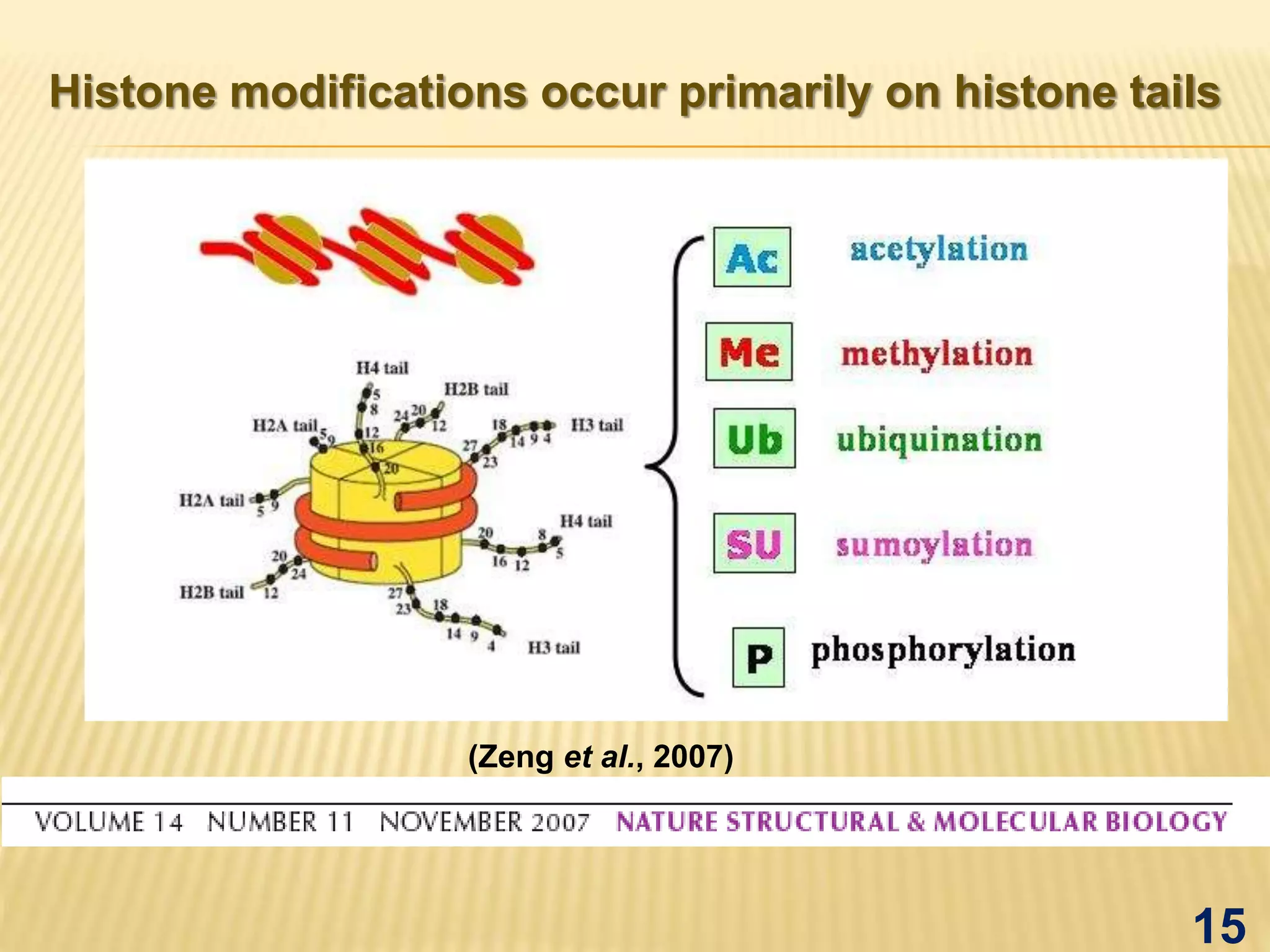
Histone modifications occur primarily on histone tails
15
(Zeng et al., 2007)
Histone Modifications and Modifiers
Residue on the
histone tail
Type of modification Modifying enzyme
Lysine Acetylation HAT, KAT
Deacetylation HDAC
Lysine Methylation, HMT, KMT
Demethylation HDM, KDM
Lysine Unbiquitylation Ub ligase
Deubiquitylation Ub protease
Serine/
Threonine
Phosphorylation Kinase
Dephosphorylation Phosphatase
Arginine Methylation PRMT
Demethylation Deiminase
16
HAT – Histone Acetylase KAT- Lysine Acetyl Transferase HDAC –Histone de- acetylase HMT-
Histone methyl transferase KMT- Lysine methyl transferase HDM-Histone de –methyl transferase
KDM – Lysine de-methyl transferase PRMT- Protein Arginine methyl transferase
 Do not bind to DNA themselves
Can be recruited by:
 Histone modifications (through chromodomains,
bromodomains, etc.)
 Transcription factors
 DNA damage
 Act as transcriptional co-regulators
 Enhance activities of transcriptional repressors or activators
 Co-repressor: eg. HDACs
 Co-activator: eg. HATs
17
General roles of histone modifications
18
(Moggs and Orphanides, Toxicological Sciences, 2004)
During DNA DamageIn Gene Regulation
(Wade , Hum. Mol. Genet. 2001)
HDAC
 Also called post transcriptional gene silencing (PTGS)
 Is a biological process in which RNA molecules inhibit
gene action
 Andrew Fire and Craig C. Mello shared the Nobel Prize
in Physiology or Medicine - 2006
19
20
(Long et al., 2011, Genetics, 189, 1093–1102)
Methods for studying epigenetic modifications
• DNA methylation– Bisulfite sequencing
• Methylation Sensitive Amplification Polymorphism
(MSAP)
• Histone modification
• Chromatin immunoprecipitation (ChIP)
• DNA adenosine methylation identification (DamID)
• RNAi – Deep sequencing
21
Bisulfite treatment differentiates cytosine and
methylcytosine
22
Bisulfite
treatment
TTCGCCGACTAA
No
treatment
TTCGCCGACTAA
TTCGCCGAuTAA
TTCGCCGACTAA TTCGCCGATTAA
Methyl-
cytosine
After bisulfite treatment,
unmethylated Cs are
read as T and so differ in
the treated and
untreated samples.
By contrast, methyl-C is
read as C and is the
same as the reference
sequence.
What is Stress?
 Any external factor that exerts disadvantageous
influence on organisms
Strategies to minimize stress influence:
 Tolerance, Resistance, Avoidance or Escape
 Physiological alteration in metabolic pathways
 Modification in gene expression pattern
23
24
Plant materials and genotyping
Drought
tolerant
DK151
Drought
susceptible
IR64
1. Case study
Drought stress
treatment
Irrigated control Recovery
Irrigation was held at
55 d after transplanting
The stress was
maintained until leaves
of the treated plants
rolled completely and
their leaf relative water
content reached 70–
75%.
Field was irrigated at
weekly intervals
Stressed plants were
recovered by
rewatering
25
Tissue sample for DNA isolation: Root and Leaf tissue collected from the drought-
stressed, well-watered, and recovered plants
Analysis of DNA Methylation-Sensitive Amplified
Polymorphisms (MSAPS)
 Double enzyme combinations:
• EcoRI/MspI and EcoRI/ HpaII, used to digest the DNA samples
 PCR is used to selectively amplify the DNA fragments
 A set of 26 randomly selected differentially amplified
fragments were isolated, re-amplified, and purified cloned
with TA-cloning vector
 The sequences obtained were analysed by NCBI BLAST
(http://blast.ncbi.nlm.nih.gov/Blast.cgi)
26
type I Represents the band presence for both enzyme
combinations
type II Band presence only for EcoRI/HpaII
type III Band presence for EcoRI/MspI
type IV Represents the band absence for both enzyme
combinations
27
Analysis of MSAP
28
DNA methylation changes in leaves and roots of DK 151 and IR 64
Conclusion of experiment
 Drought - induced genome-wide changes in DNA
methylation/ demethylation.
 Large difference - DNA methylation/ demethylation
sites between drought tolerance DK151 and drought
sensitive IR64
 Resistant – Highly methylated, retained methylation
on stress
 Susceptible – Less methylated, lesser retention of
methylation
29
MORPHOLOGICAL AND MOLECULAR
ANALYSIS OF GENETIC STABILITY IN
MICROPROPAGATED BANANA
(MUSSA SPP.) VAR. NENDAN
30
2. Case study
m- Marker DNA (100 bp), 1- Mother plant, 2- SC 3rd, 3- SC 6th, 4- SC 8th, 5- SC10th,
6- SC 12th, 7- SC 14th, 8- SC16th 31
Subculture no. Hemi methylation
(%)
Internal full-
methylation
(%)
Total methylation
(%)
Mp 3.00 6.30 9.3
Sc3 3.20 9.20 12.4
Sc6 3.20 6.15 9.15
Sc8 3.42 9.36 12.78
Sc10 10.68 14.84 25.52
Sc12 16.89 26.79 43.68
Sc14 18.12 28.33 46.45
Sc16 18.27 30.43 48.7
32
 Initial culture shows less methylation
 High variation occurs after 10th subculture and
onwards >48%
 Advantage of MSAP is direct identification of
methylated sequence in the genome
33
34
A. Better understanding on the physiological mechanisms
 Epigenetic variation can causes heritable variation
 DNA methylation majorly involve in plant defence against herbivorous
and pathogens
 Heritable variation in plant growth responses to jasmonic acid and
salicylic acid
(Latzel et al., 2012)
B. Improving Plant Stress Tolerance
35
 Stress tolerance can be improved by the controlling
transposable elements
 Plant phenotypic variation, improve long-term plant adaptation
to environmental challenges and, thus, increase productivity.
(Mirouze and Paszkowski, 2011)
36
C. Evolutionary studies/ epigenetic diversity studies
 Variation of ecologically important plant traits, root
allocation, drought tolerance and nutrient plasticity
 Rapid evolution based on epigenetic variation alone should
thus be possible
(Zhang et.al., 2012)
D. Epigenetic mechanisms, yield, and heterosis
 Hybrids are in general, less methylated than their parental
inbreds
 Heterotic hybrids are less methylated than related nonheterotic
hybrids
 Low-yielding inbreds are more methylated
37
F. Transient expression of transgene
 Single copy transgene into hypomethylated region
 Careful design of transgene construct
 Analysis of transformants at the molecular level
38
 Plant genomes have a distinct range of target sites
 Ability to detect trait loci
 To identify additional significant QTL associated with
important agronomic traits
(Long et al., 2011)
E. Epigenetic QTL mapping
39(Long et al., 2011, Genetics 189: 1093–1102)
CONCLUSIONS
 Epigenetics involves DNA methylation, histone
modification and RNAi
 DNA methylation effectively down-regulates/ up-
regulates gene activity by addition of a methyl group to
the five-carbon of a cytosine base
 Epigenetic changes can be studied by
• Bisulfite treatment, MSAP
• DNA adenine methylase identification
• Chromatin immunoprecipitation
• Deep sequencing for RNAi
40
.... CONCLUSIONS
 Various application are:
• Better understanding of physiological mechanisms
• Improvement of plant stress tolerance
• Improvement of yield and heterosis
• Evolutionary and diversity studies
• QTL mapping
 Disadvantage – Transient expression of transgene
41
42

Epigenetics mediated gene regulation in plants

  • 1.
  • 2.
    2 Epigenetics mediated gene regulationin plants Centre for Plant Biotechnology and Molecular Biology Kerala Agricultural University
  • 3.
     Epigenetics –meaning and definition  Mechanisms  Implications  Applications  Conclusions 3
  • 4.
     Changes ingene expression that occur by a mechanism other than change to the DNA sequence  Gene-regulatory information that is not expressed in DNA sequences but transmitted from one generation (of cells or organisms) to the next  Coined by C. H. Waddington in 1942  Epigenetics means ‘above’ or ‘on top of genetics’ 4
  • 5.
    What Does “Epigenetics”Mean?  Epigenetics describes phenomenon in which genetically identical cells or organisms express their genomes differently, causing phenotypic differences 5 Genetically identical cells or individuals Different epigenetic modifications leading to different expression patterns Different phenotypes
  • 6.
    Molecular epigenetic mechanism Development of multicellular organisms occurs due to cells differentiation by various programs of gene expression  Cells have own epigenetic signatures like 1. Genotype 2. Developmental history 3. Environmental influences and it is ultimately reflected in the phenotype of the cells and the organism 6
  • 7.
    7 cytosine 5-methylcytosine DNA canbe covalently modified by cytosine methylation. TTCGCCGACTAA Methyl- cytosine
  • 8.
    .... DNA Methylation DNA methylation in mammals mainly occurs on the cytosine nucleotide in a CpG site  In plants the cytosine can be methylated at CpG, CpHpG, and CpHpH sites, where H represents any nucleotide  DRM2, MET1, and CMT3: DNA methylases in plants  CMT3 protein is unique to the plant kingdom 8
  • 9.
    .... DNA Methylation 9 Role in prokaryotes, as defence mechanism •Escape from the restriction enzymes •Protection from bacteriophages  In eukaryotes, it controls the mechanism of transposable elements in the genome
  • 10.
    Classes of methyltransferase  De novo class: Enzymes that create new methylation mark on DNA Eg. DNMT3a and DNMT3b  Maintainance class: Recognizes the methylation marks on the parental strand of DNA and transfers new methylation to the daughter strands after DNA replication Eg. DNMT1 10
  • 11.
  • 12.
  • 13.
    2. Histone modification Histone: Several small, basic proteins most commonly found in association with the DNA in the chromatin of eukaryotes  Packaging and ordering the DNA into structural unit called nucleosomes  Histone modifications also known as epigenetic modifiers  Biological functions: • In chromatin organization • Gene expression • DNA repair 13
  • 14.
     Writers: enzymesthat add a mark  Erasers: enzymes that remove a mark  Readers: proteins that bind to and “interpret” the mark 14(Tarakhovsky,. Nature Immunology, 2010) Writers' introduce histone marks (circles), 'erasers' take them out and 'readers' can recognize a particular form of histone modification.
  • 15.
    Histone modifications occurprimarily on histone tails 15 (Zeng et al., 2007)
  • 16.
    Histone Modifications andModifiers Residue on the histone tail Type of modification Modifying enzyme Lysine Acetylation HAT, KAT Deacetylation HDAC Lysine Methylation, HMT, KMT Demethylation HDM, KDM Lysine Unbiquitylation Ub ligase Deubiquitylation Ub protease Serine/ Threonine Phosphorylation Kinase Dephosphorylation Phosphatase Arginine Methylation PRMT Demethylation Deiminase 16 HAT – Histone Acetylase KAT- Lysine Acetyl Transferase HDAC –Histone de- acetylase HMT- Histone methyl transferase KMT- Lysine methyl transferase HDM-Histone de –methyl transferase KDM – Lysine de-methyl transferase PRMT- Protein Arginine methyl transferase
  • 17.
     Do notbind to DNA themselves Can be recruited by:  Histone modifications (through chromodomains, bromodomains, etc.)  Transcription factors  DNA damage  Act as transcriptional co-regulators  Enhance activities of transcriptional repressors or activators  Co-repressor: eg. HDACs  Co-activator: eg. HATs 17
  • 18.
    General roles ofhistone modifications 18 (Moggs and Orphanides, Toxicological Sciences, 2004) During DNA DamageIn Gene Regulation (Wade , Hum. Mol. Genet. 2001) HDAC
  • 19.
     Also calledpost transcriptional gene silencing (PTGS)  Is a biological process in which RNA molecules inhibit gene action  Andrew Fire and Craig C. Mello shared the Nobel Prize in Physiology or Medicine - 2006 19
  • 20.
    20 (Long et al.,2011, Genetics, 189, 1093–1102)
  • 21.
    Methods for studyingepigenetic modifications • DNA methylation– Bisulfite sequencing • Methylation Sensitive Amplification Polymorphism (MSAP) • Histone modification • Chromatin immunoprecipitation (ChIP) • DNA adenosine methylation identification (DamID) • RNAi – Deep sequencing 21
  • 22.
    Bisulfite treatment differentiatescytosine and methylcytosine 22 Bisulfite treatment TTCGCCGACTAA No treatment TTCGCCGACTAA TTCGCCGAuTAA TTCGCCGACTAA TTCGCCGATTAA Methyl- cytosine After bisulfite treatment, unmethylated Cs are read as T and so differ in the treated and untreated samples. By contrast, methyl-C is read as C and is the same as the reference sequence.
  • 23.
    What is Stress? Any external factor that exerts disadvantageous influence on organisms Strategies to minimize stress influence:  Tolerance, Resistance, Avoidance or Escape  Physiological alteration in metabolic pathways  Modification in gene expression pattern 23
  • 24.
    24 Plant materials andgenotyping Drought tolerant DK151 Drought susceptible IR64 1. Case study
  • 25.
    Drought stress treatment Irrigated controlRecovery Irrigation was held at 55 d after transplanting The stress was maintained until leaves of the treated plants rolled completely and their leaf relative water content reached 70– 75%. Field was irrigated at weekly intervals Stressed plants were recovered by rewatering 25 Tissue sample for DNA isolation: Root and Leaf tissue collected from the drought- stressed, well-watered, and recovered plants
  • 26.
    Analysis of DNAMethylation-Sensitive Amplified Polymorphisms (MSAPS)  Double enzyme combinations: • EcoRI/MspI and EcoRI/ HpaII, used to digest the DNA samples  PCR is used to selectively amplify the DNA fragments  A set of 26 randomly selected differentially amplified fragments were isolated, re-amplified, and purified cloned with TA-cloning vector  The sequences obtained were analysed by NCBI BLAST (http://blast.ncbi.nlm.nih.gov/Blast.cgi) 26
  • 27.
    type I Representsthe band presence for both enzyme combinations type II Band presence only for EcoRI/HpaII type III Band presence for EcoRI/MspI type IV Represents the band absence for both enzyme combinations 27
  • 28.
    Analysis of MSAP 28 DNAmethylation changes in leaves and roots of DK 151 and IR 64
  • 29.
    Conclusion of experiment Drought - induced genome-wide changes in DNA methylation/ demethylation.  Large difference - DNA methylation/ demethylation sites between drought tolerance DK151 and drought sensitive IR64  Resistant – Highly methylated, retained methylation on stress  Susceptible – Less methylated, lesser retention of methylation 29
  • 30.
    MORPHOLOGICAL AND MOLECULAR ANALYSISOF GENETIC STABILITY IN MICROPROPAGATED BANANA (MUSSA SPP.) VAR. NENDAN 30 2. Case study
  • 31.
    m- Marker DNA(100 bp), 1- Mother plant, 2- SC 3rd, 3- SC 6th, 4- SC 8th, 5- SC10th, 6- SC 12th, 7- SC 14th, 8- SC16th 31
  • 32.
    Subculture no. Hemimethylation (%) Internal full- methylation (%) Total methylation (%) Mp 3.00 6.30 9.3 Sc3 3.20 9.20 12.4 Sc6 3.20 6.15 9.15 Sc8 3.42 9.36 12.78 Sc10 10.68 14.84 25.52 Sc12 16.89 26.79 43.68 Sc14 18.12 28.33 46.45 Sc16 18.27 30.43 48.7 32
  • 33.
     Initial cultureshows less methylation  High variation occurs after 10th subculture and onwards >48%  Advantage of MSAP is direct identification of methylated sequence in the genome 33
  • 34.
    34 A. Better understandingon the physiological mechanisms  Epigenetic variation can causes heritable variation  DNA methylation majorly involve in plant defence against herbivorous and pathogens  Heritable variation in plant growth responses to jasmonic acid and salicylic acid (Latzel et al., 2012)
  • 35.
    B. Improving PlantStress Tolerance 35  Stress tolerance can be improved by the controlling transposable elements  Plant phenotypic variation, improve long-term plant adaptation to environmental challenges and, thus, increase productivity. (Mirouze and Paszkowski, 2011)
  • 36.
    36 C. Evolutionary studies/epigenetic diversity studies  Variation of ecologically important plant traits, root allocation, drought tolerance and nutrient plasticity  Rapid evolution based on epigenetic variation alone should thus be possible (Zhang et.al., 2012)
  • 37.
    D. Epigenetic mechanisms,yield, and heterosis  Hybrids are in general, less methylated than their parental inbreds  Heterotic hybrids are less methylated than related nonheterotic hybrids  Low-yielding inbreds are more methylated 37
  • 38.
    F. Transient expressionof transgene  Single copy transgene into hypomethylated region  Careful design of transgene construct  Analysis of transformants at the molecular level 38  Plant genomes have a distinct range of target sites  Ability to detect trait loci  To identify additional significant QTL associated with important agronomic traits (Long et al., 2011) E. Epigenetic QTL mapping
  • 39.
    39(Long et al.,2011, Genetics 189: 1093–1102)
  • 40.
    CONCLUSIONS  Epigenetics involvesDNA methylation, histone modification and RNAi  DNA methylation effectively down-regulates/ up- regulates gene activity by addition of a methyl group to the five-carbon of a cytosine base  Epigenetic changes can be studied by • Bisulfite treatment, MSAP • DNA adenine methylase identification • Chromatin immunoprecipitation • Deep sequencing for RNAi 40
  • 41.
    .... CONCLUSIONS  Variousapplication are: • Better understanding of physiological mechanisms • Improvement of plant stress tolerance • Improvement of yield and heterosis • Evolutionary and diversity studies • QTL mapping  Disadvantage – Transient expression of transgene 41
  • 42.