
October 11, 2018 Dept.Of Plant Biotechnology 1
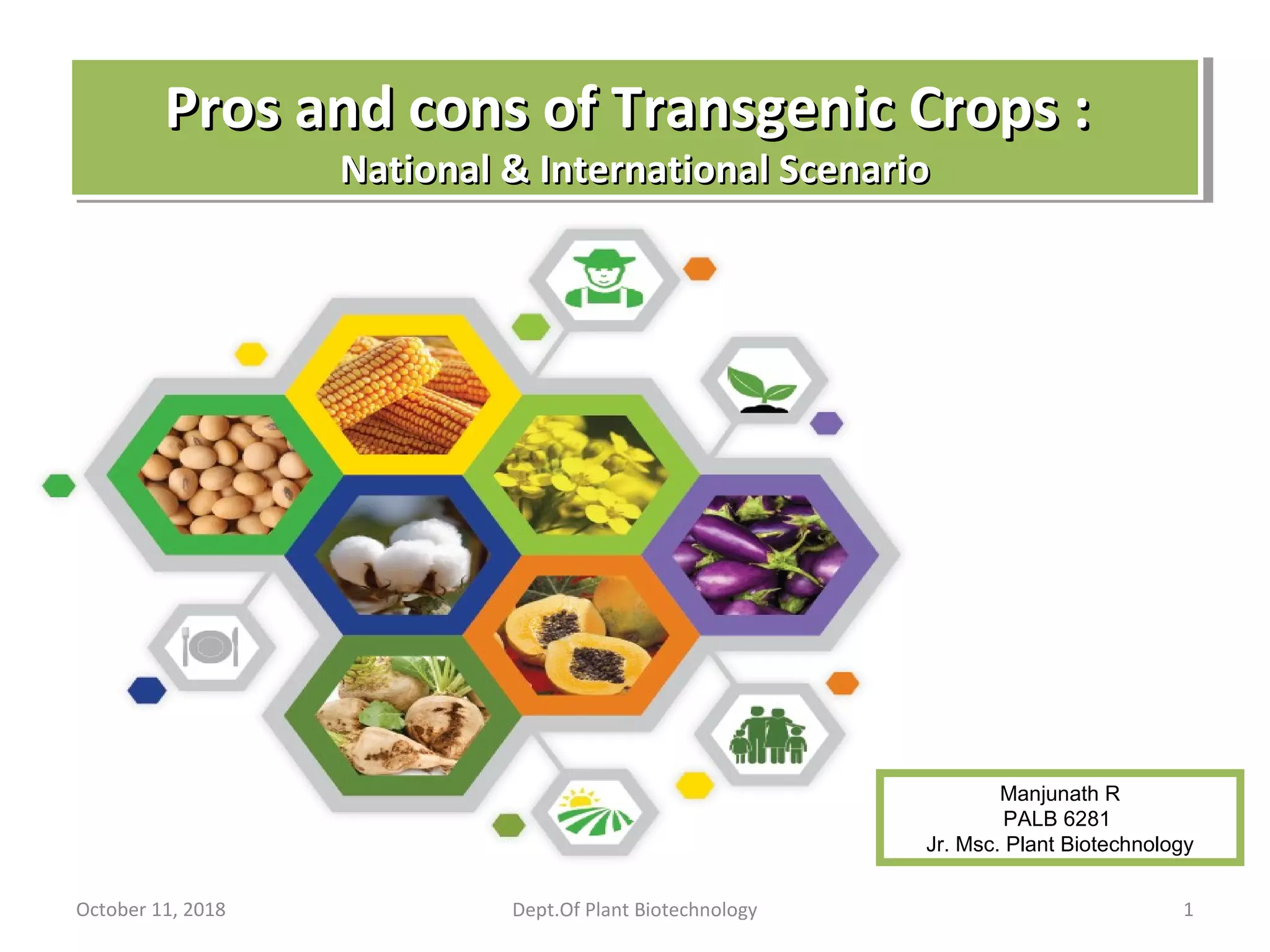
Pros and cons of Transgenic Crops :Pros and cons of Transgenic Crops :
National & International ScenarioNational & International Scenario
Pros and cons of Transgenic Crops :Pros and cons of Transgenic Crops :
National & International ScenarioNational & International Scenario
Manjunath R
PALB 6281
Jr. Msc. Plant Biotechnology
October 11, 2018 2Dept.Of Plant Biotechnology
GMO Crop – Potential Benefits
GreenpeaceGreenpeace
Indian ScenarioIndian Scenario
International ScenarioInternational Scenario
GMO Crop ControversiesGMO Crop Controversies
ReferenceReference
ConclusionConclusion
3October 11, 2018 Dept.Of Plant Biotechnology
October 11, 2018 4Dept.Of Plant Biotechnology
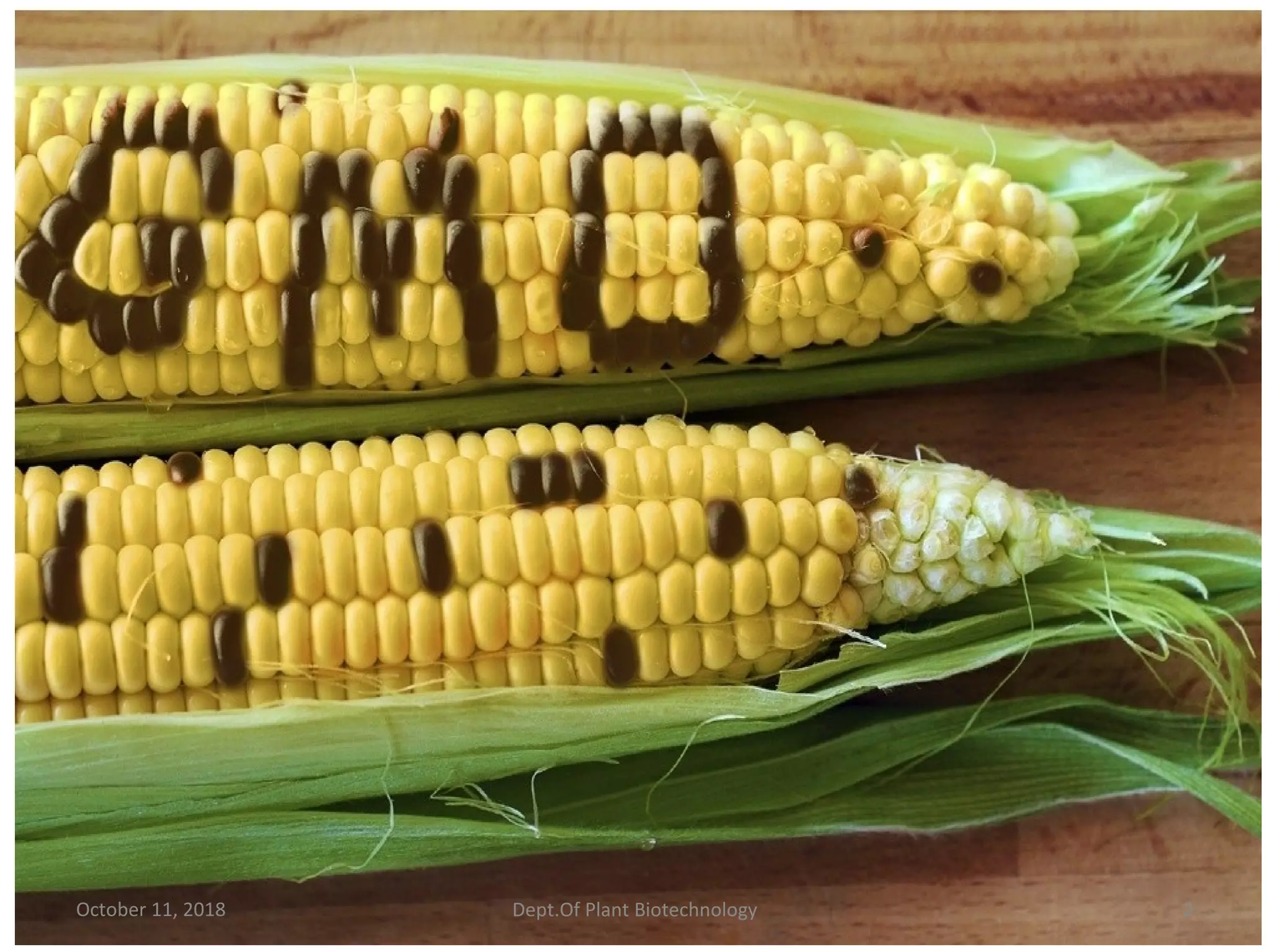
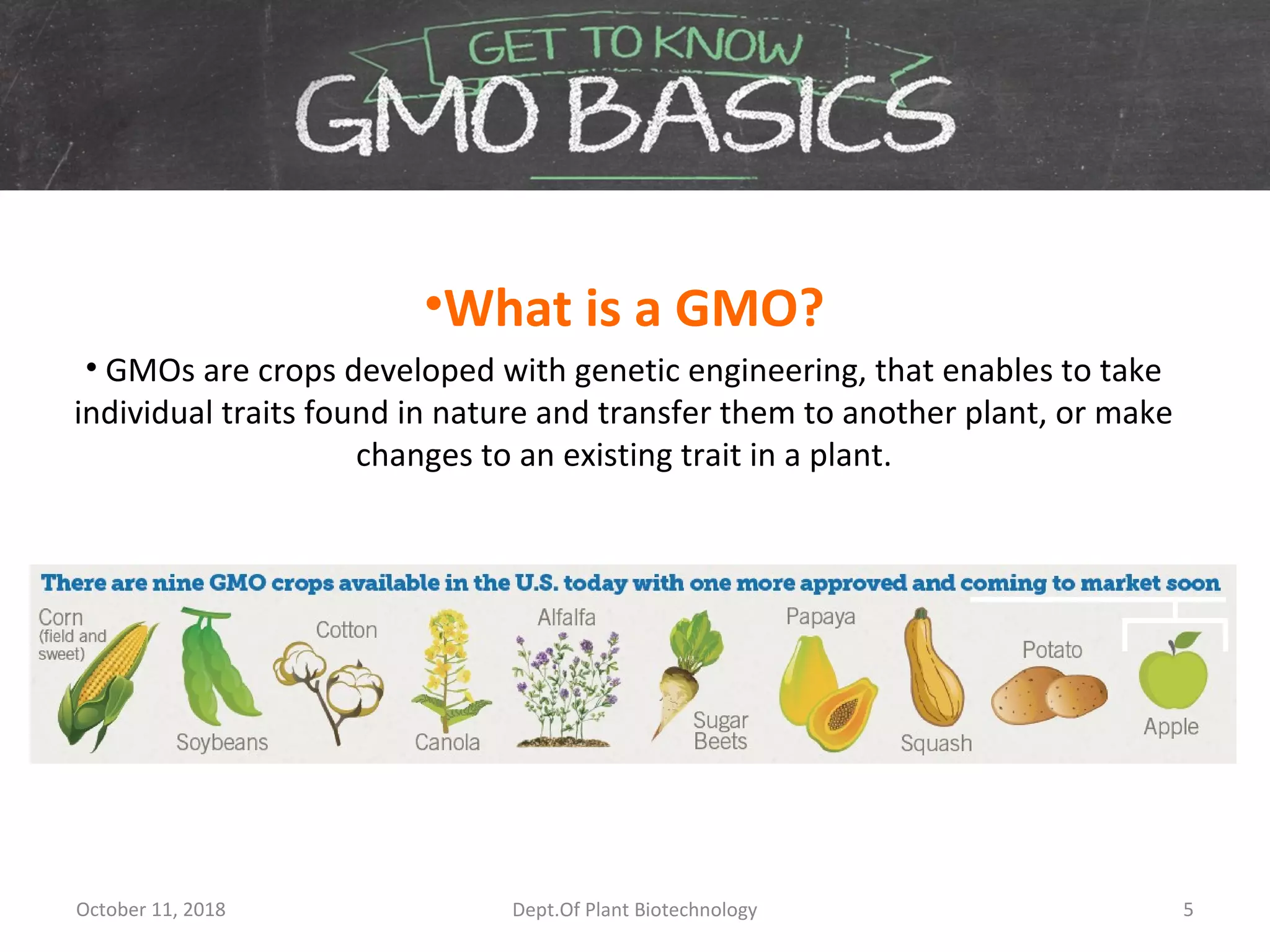
•What is a GMO?
• GMOs are crops developed with genetic engineering, that enables to take
individual traits found in nature and transfer them to another plant, or make
changes to an existing trait in a plant.
October 11, 2018 5Dept.Of Plant Biotechnology
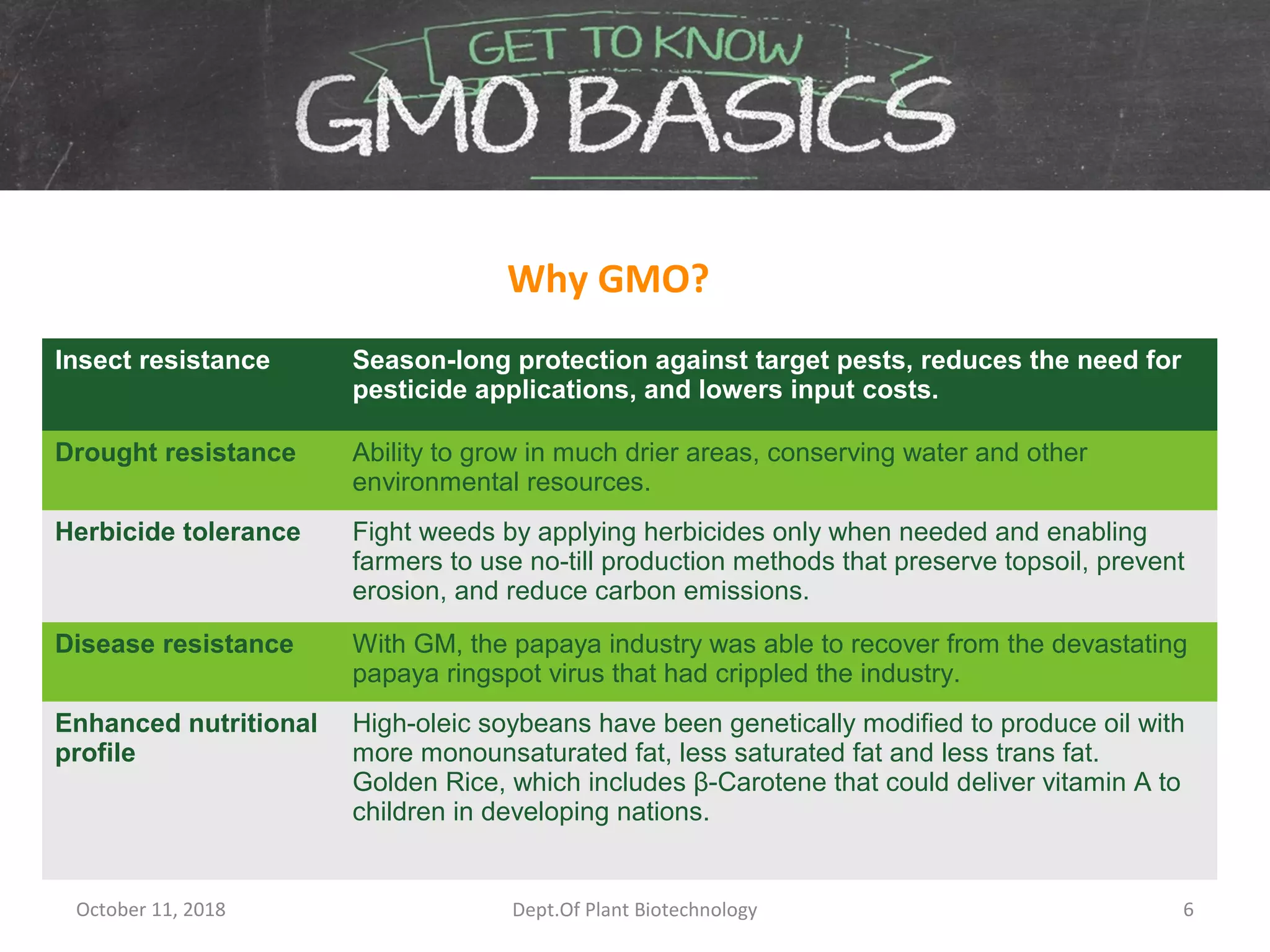
Insect resistance Season-long protection against target pests, reduces the need for
pesticide applications, and lowers input costs.
Drought resistance Ability to grow in much drier areas, conserving water and other
environmental resources.
Herbicide tolerance Fight weeds by applying herbicides only when needed and enabling
farmers to use no-till production methods that preserve topsoil, prevent
erosion, and reduce carbon emissions.
Disease resistance With GM, the papaya industry was able to recover from the devastating
papaya ringspot virus that had crippled the industry.
Enhanced nutritional
profile
High-oleic soybeans have been genetically modified to produce oil with
more monounsaturated fat, less saturated fat and less trans fat.
Golden Rice, which includes β-Carotene that could deliver vitamin A to
children in developing nations.
Why GMO?
October 11, 2018 6Dept.Of Plant Biotechnology
October 11, 2018 Dept.Of Plant Biotechnology 7
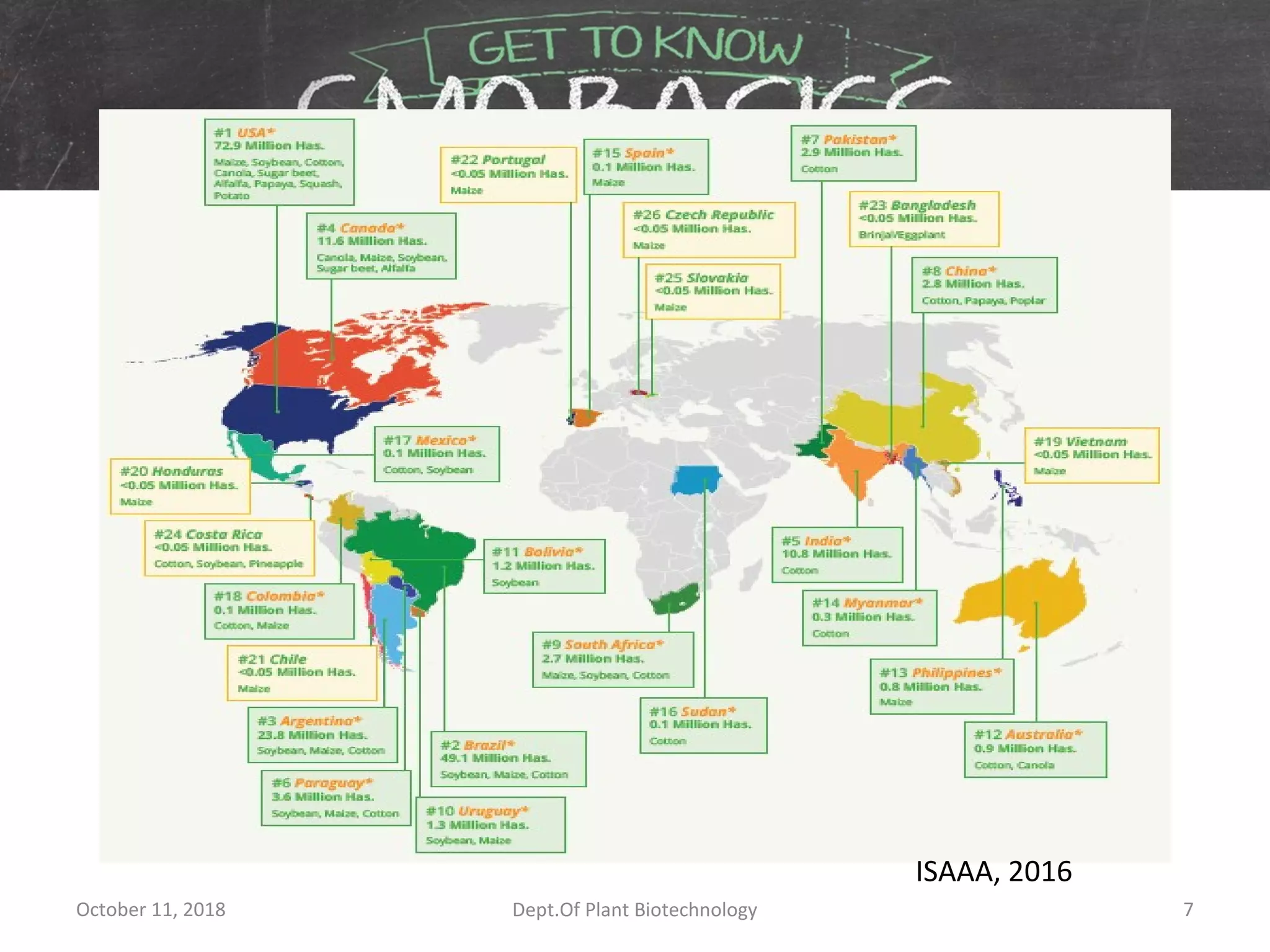
Who grows GMOs?
ISAAA, 2016
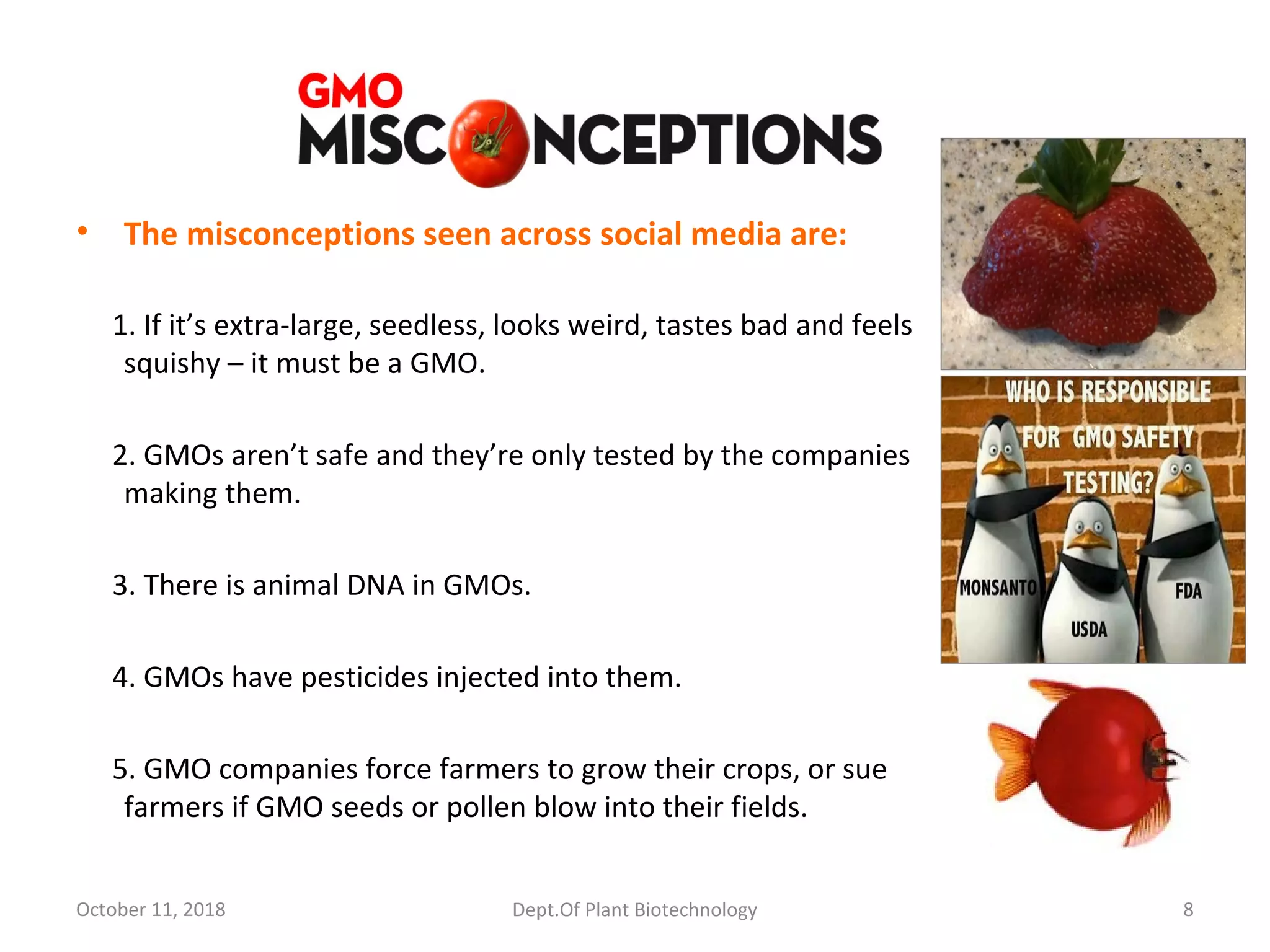
• The misconceptions seen across social media are:
1. If it’s extra-large, seedless, looks weird, tastes bad and feels
squishy – it must be a GMO.
2. GMOs aren’t safe and they’re only tested by the companies
making them.
3. There is animal DNA in GMOs.
4. GMOs have pesticides injected into them.
5. GMO companies force farmers to grow their crops, or sue
farmers if GMO seeds or pollen blow into their fields.
October 11, 2018 8Dept.Of Plant Biotechnology
• GMO Safety: Safe to Eat
• GMOs available today are as safe as their non-GMO counterparts.
• They do not cause new allergies, cancer, infertility, ADHD, autism or
any other diseases or conditions.
• The safety of GMOs has been affirmed by:
October 11, 2018 9Dept.Of Plant Biotechnology
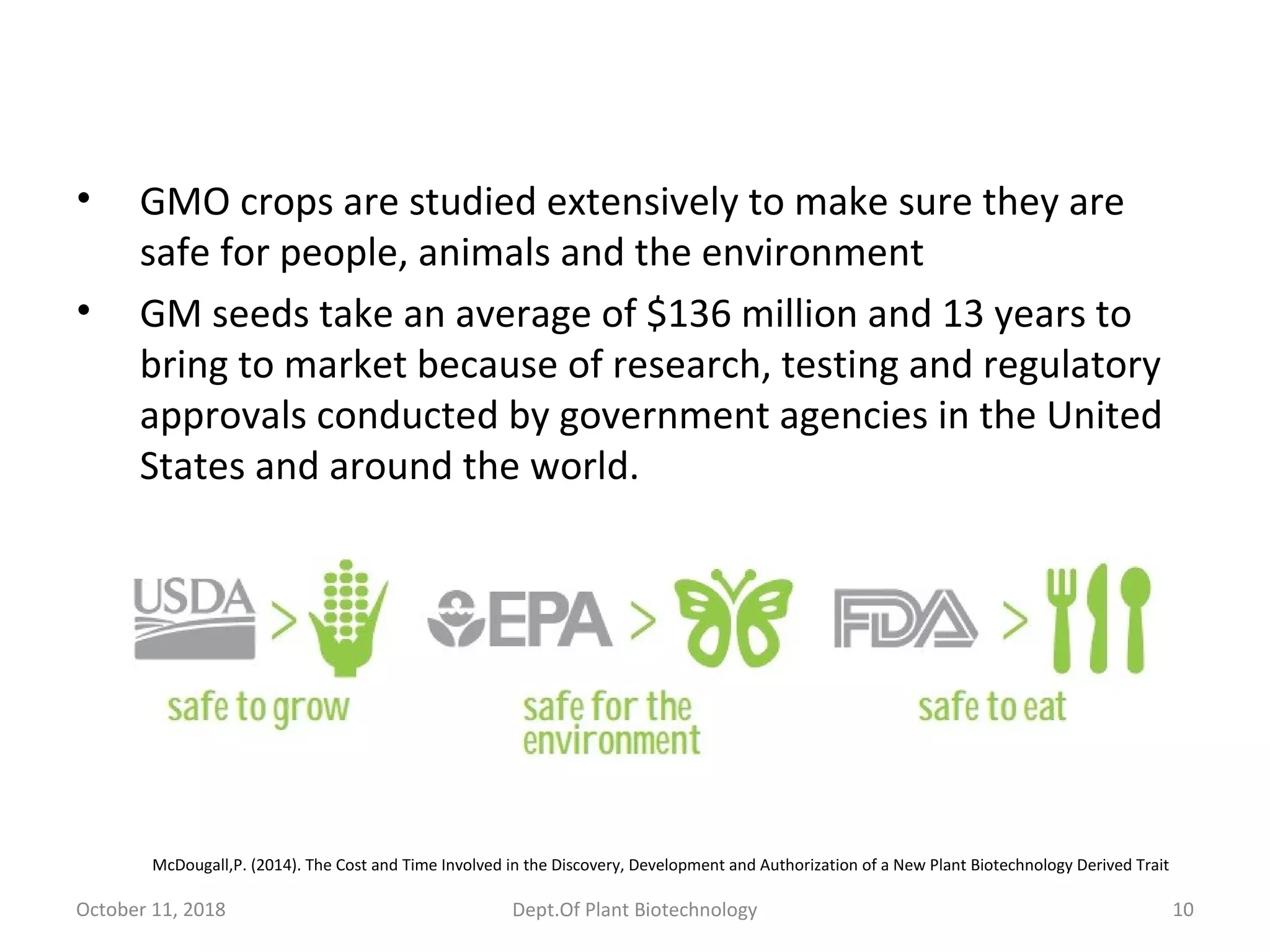
• GMO crops are studied extensively to make sure they are
safe for people, animals and the environment
• GM seeds take an average of $136 million and 13 years to
bring to market because of research, testing and regulatory
approvals conducted by government agencies in the United
States and around the world.
McDougall,P. (2014). The Cost and Time Involved in the Discovery, Development and Authorization of a New Plant Biotechnology Derived Trait
October 11, 2018 10Dept.Of Plant Biotechnology
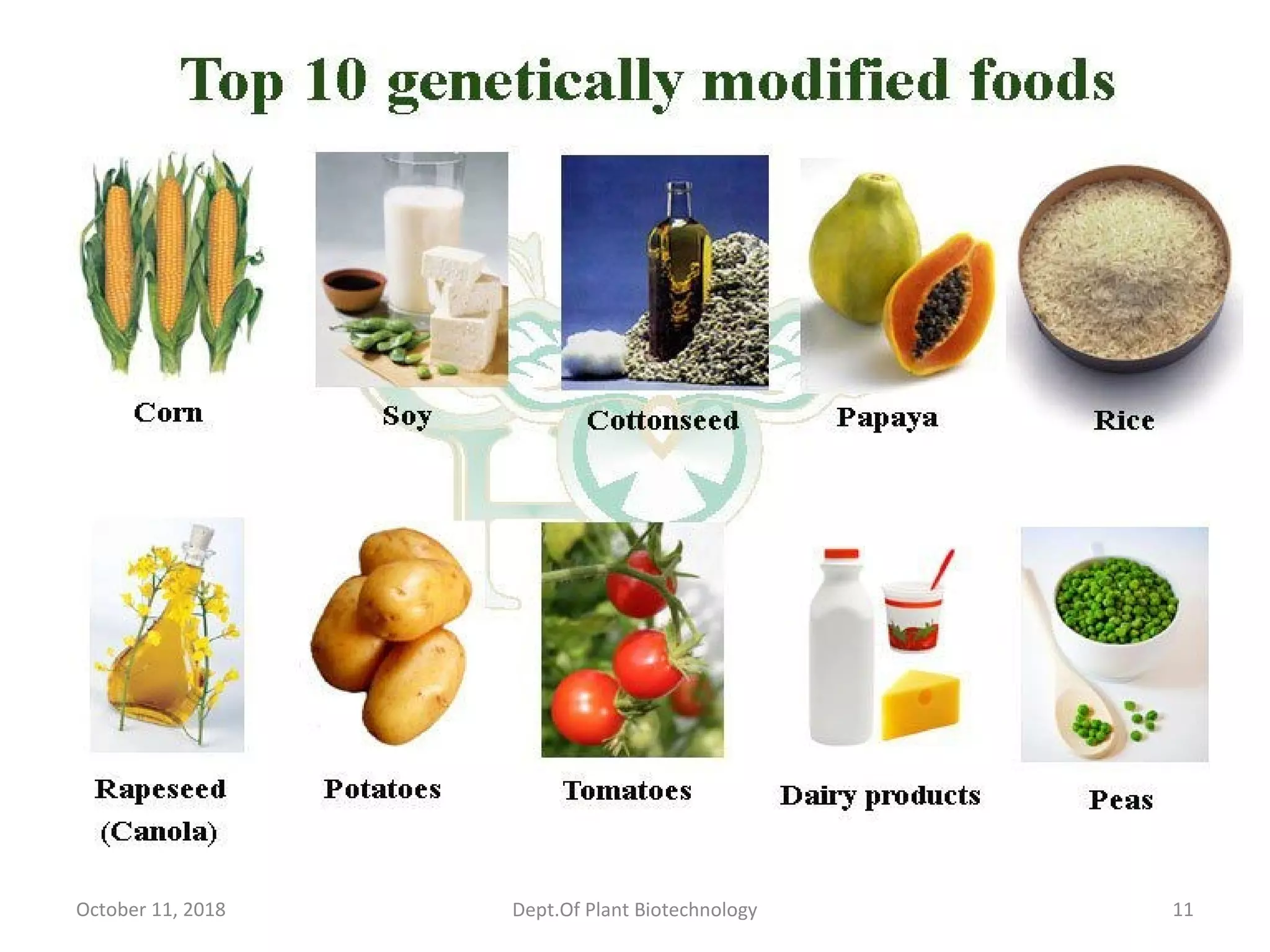
October 11, 2018 11Dept.Of Plant Biotechnology
NutritionNutrition enrichmentenrichment
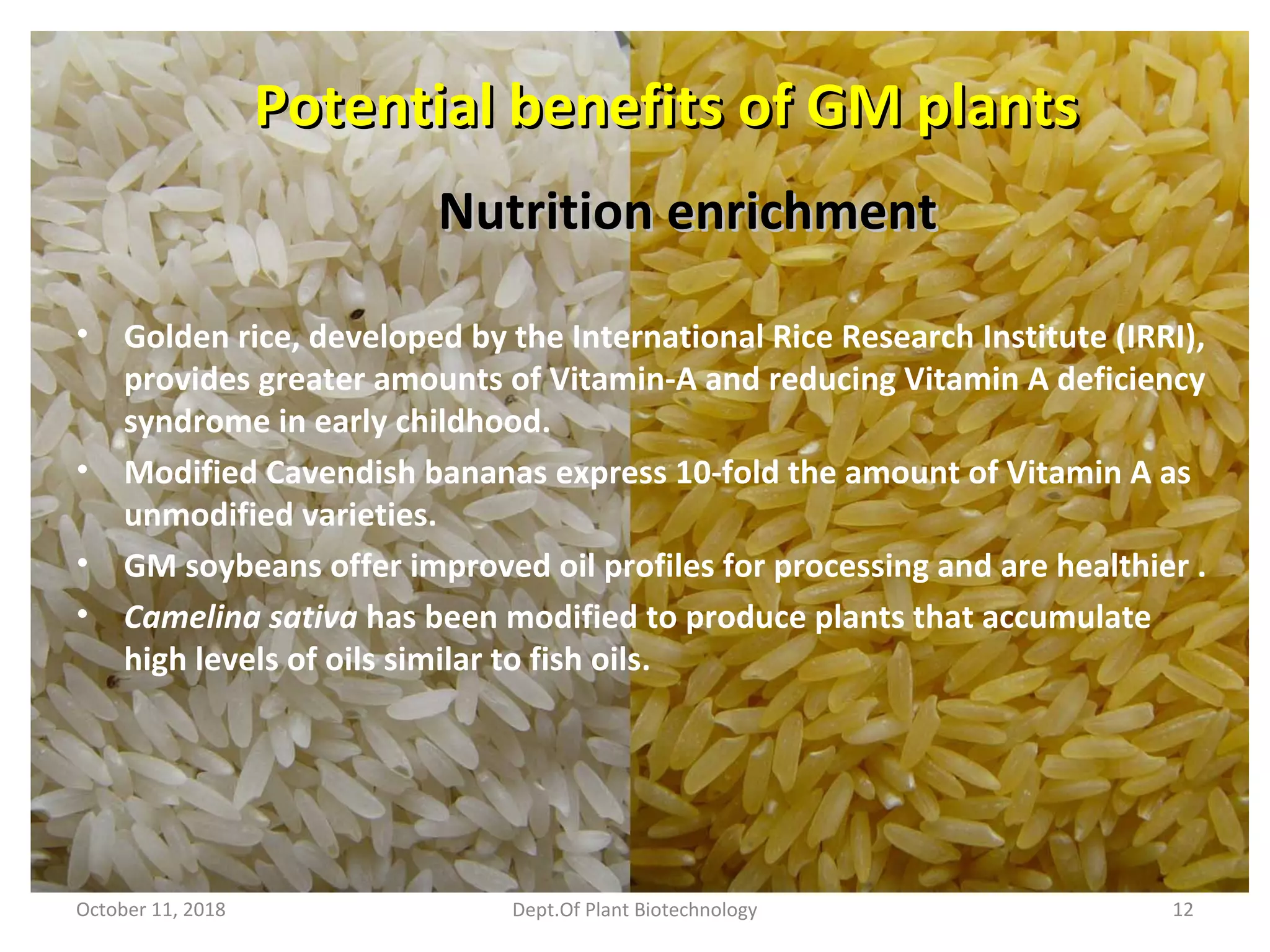
• Golden rice, developed by the International Rice Research Institute (IRRI),
provides greater amounts of Vitamin-A and reducing Vitamin A deficiency
syndrome in early childhood.
• Modified Cavendish bananas express 10-fold the amount of Vitamin A as
unmodified varieties.
• GM soybeans offer improved oil profiles for processing and are healthier .
• Camelina sativa has been modified to produce plants that accumulate
high levels of oils similar to fish oils.
October 11, 2018 Dept.Of Plant Biotechnology 12
Potential benefits of GM plantsPotential benefits of GM plants
October 11, 2018 13Dept.Of Plant Biotechnology
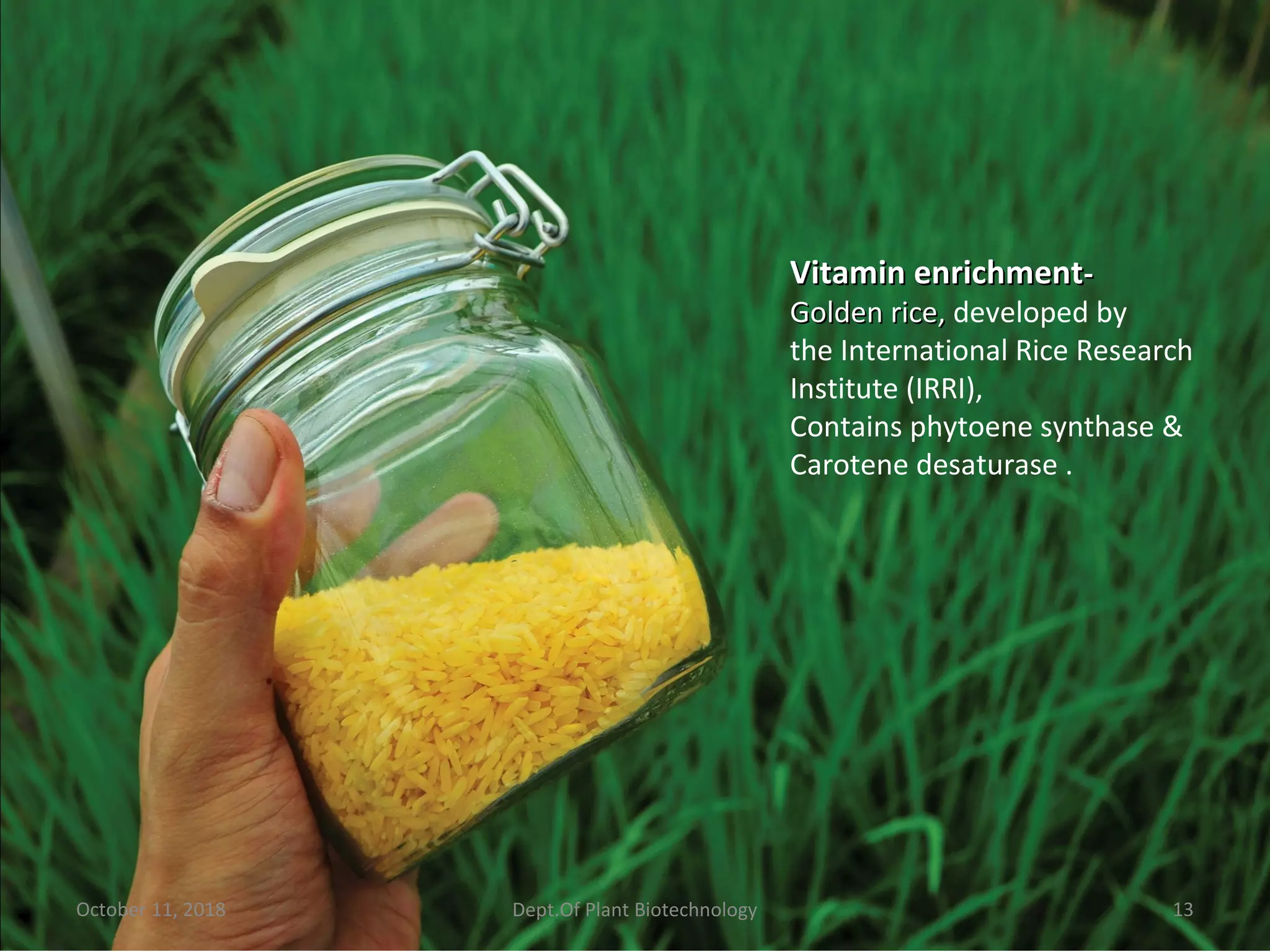
Vitamin enrichmentVitamin enrichment--
Golden rice,Golden rice, developed by
the International Rice Research
Institute (IRRI),
Contains phytoene synthase &
Carotene desaturase .
Shelf Life
• The first GM approved for sale in the U.S. was the Flavr Savr tomato, which
had a longer shelf life.
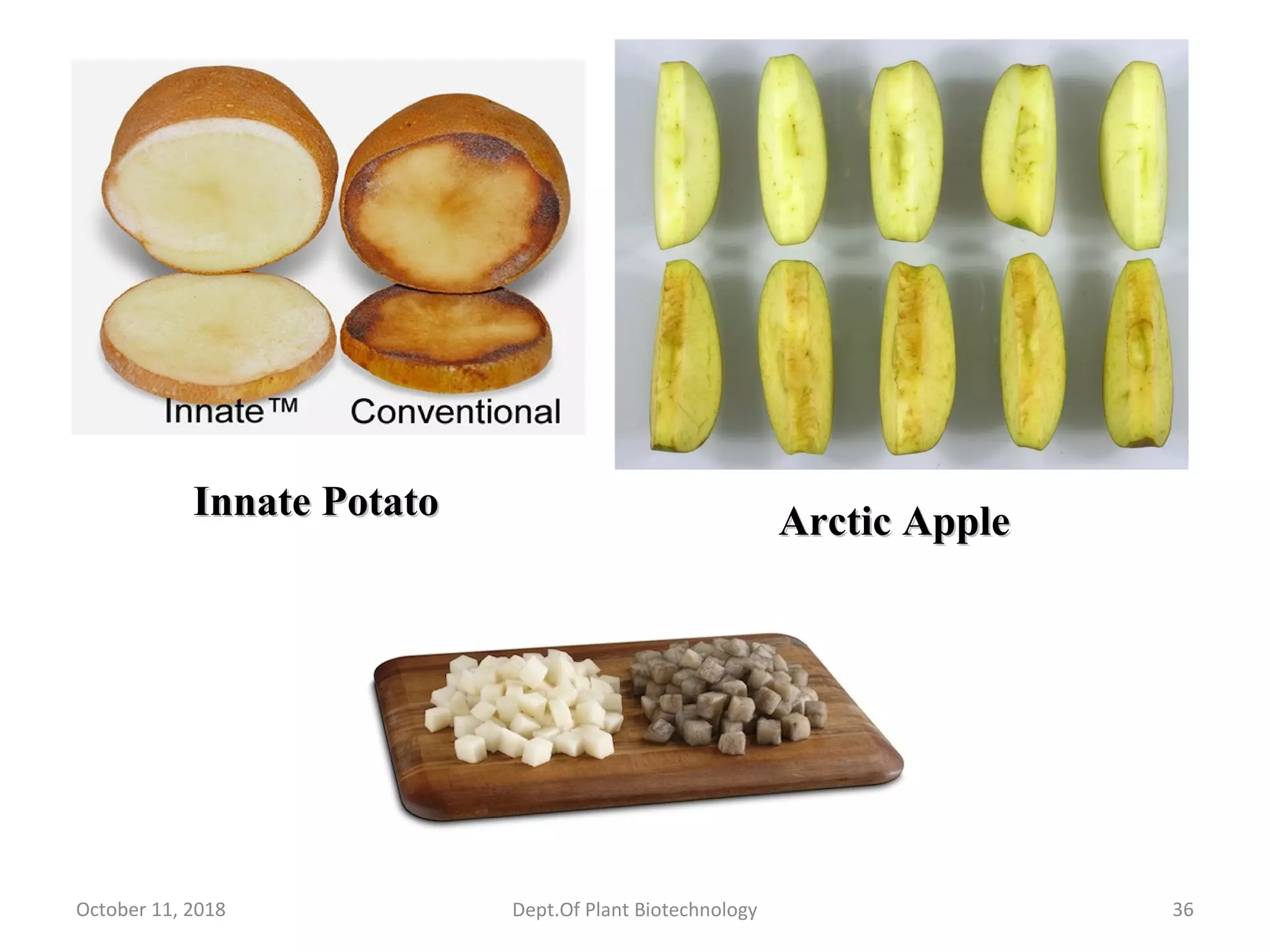
• An apple has been genetically modified to resist browning, known as the Non-
browning Arctic apple, awaiting regulatory approval in the US and Canada.
• The apple produces less Polyphenol oxidase, a chemical that manifests the
browning.
Toxin reduction
• A genetically modified cassava under development offers lower cyanogen
glucosides and enhanced protein and other nutrients, called Bio-Cassava.
• In November 2014, the USDA approved a potato, developed by J.R. Simplot
Company that prevents bruising and produces less acryl amide. The
modifications prevent natural, harmful proteins from being made via RNA
interference. Acrylamide has been linked to some cancers.
October 11, 2018 Dept.Of Plant Biotechnology 14
Pathogen resistance
• Tobacco, Corn, Rice, Cotton crops have been engineered to express genes
encoding for insecticidal proteins from Bacillus thuringiensis (Bt).
• Papaya, potatoes, and squash have been engineered to resist viral
pathogens such as cucumber mosaic virus(CMV) .
• As of 2015, trials were underway on genetically modified oranges that can
resist citrus greening disease.
• In response to a papaya ring spot virus (PRV) virus resistant papayas were
developed by incorporating PRV DNA.
October 11, 2018 Dept.Of Plant Biotechnology 15
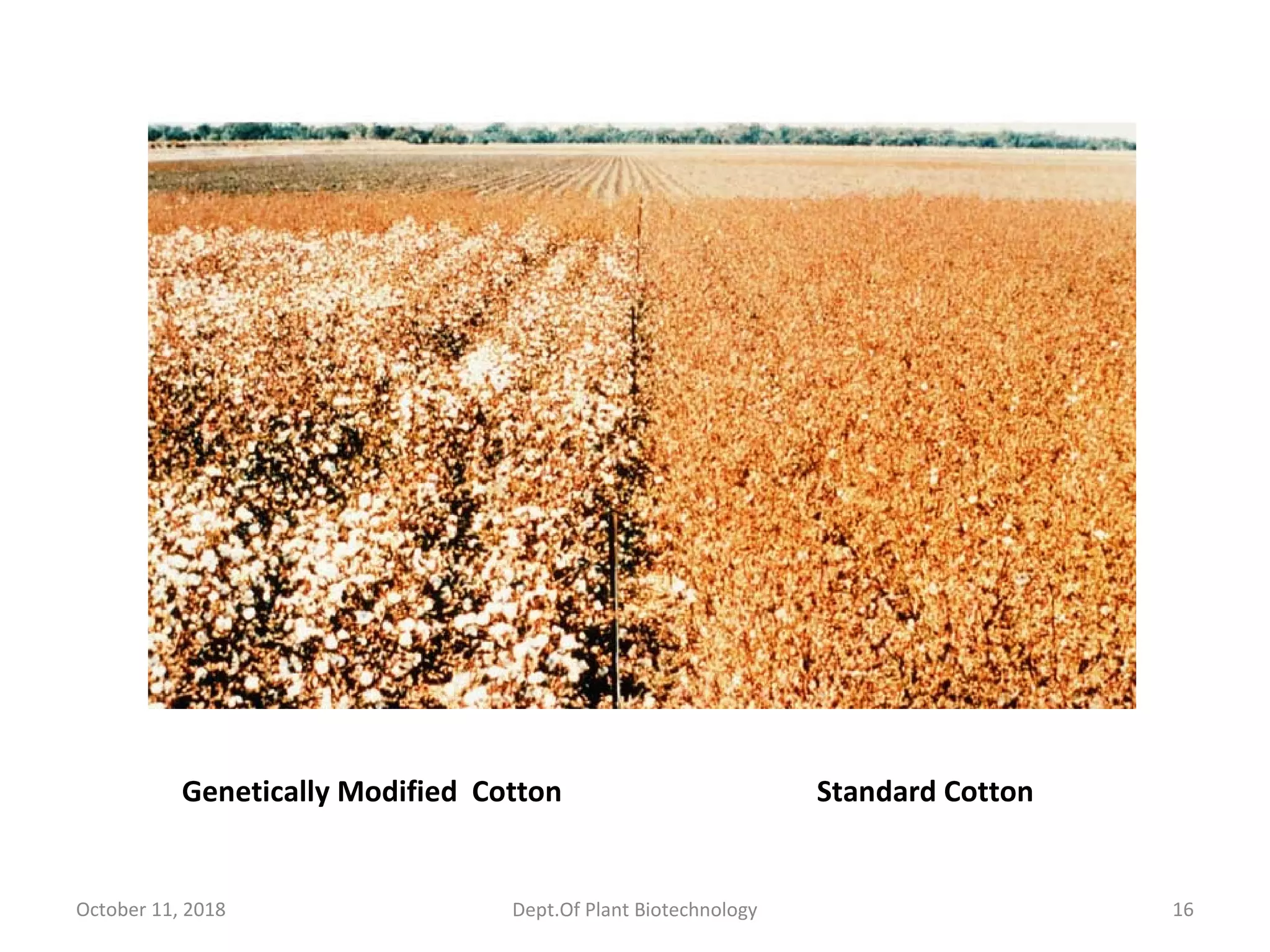
Genetically Modified Cotton Standard Cotton
October 11, 2018 16Dept.Of Plant Biotechnology
Stress Resistance
• Plants engineered to tolerate non biological stress such as drought, frost,
high soil salinity, and nitrogen starvation .
• In 2011, Monsanto’s Drought Gard-maize became the first drought-
resistant GM crop to receive US marketing approval.
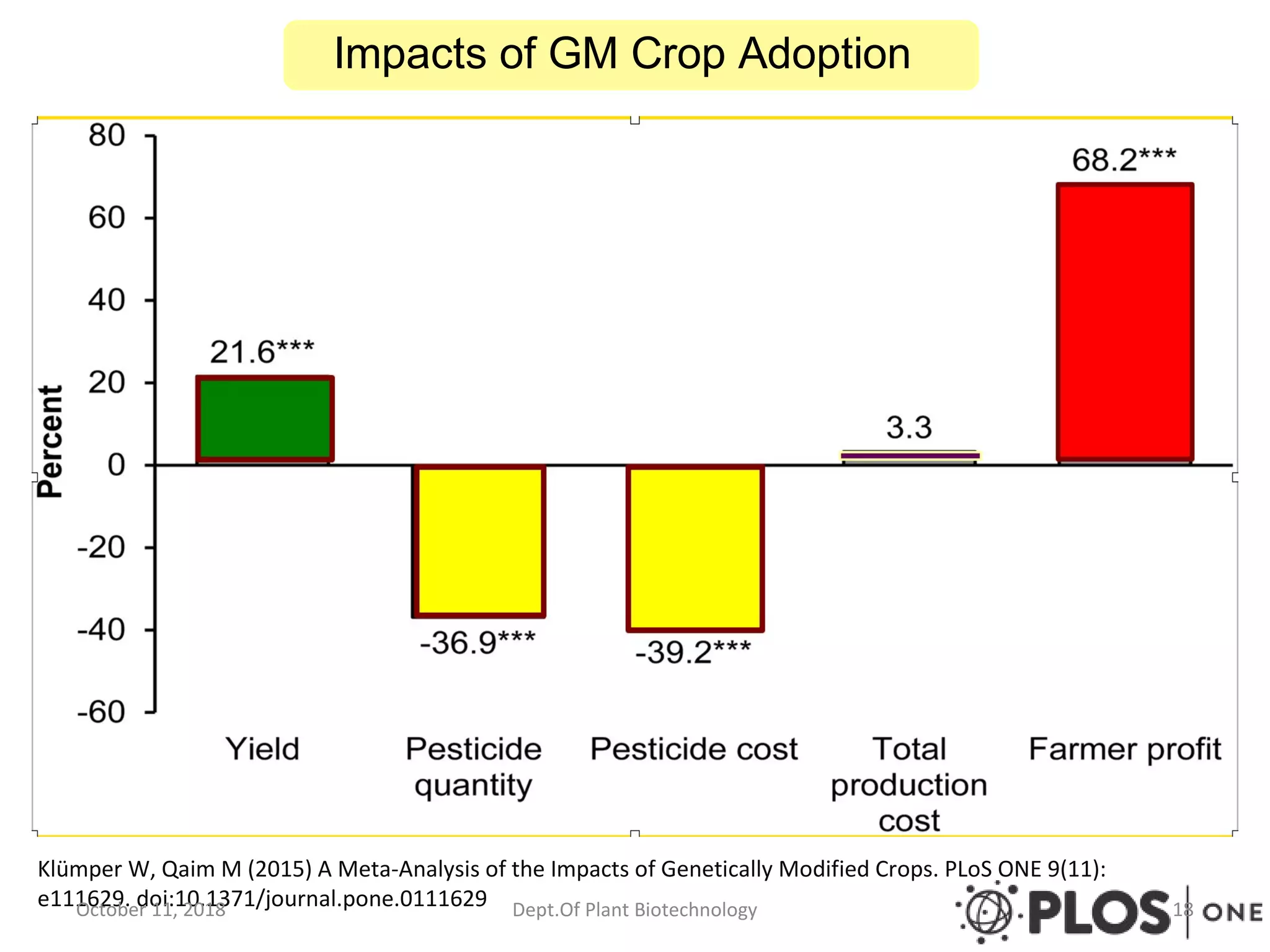
Yield
• Herbicide-tolerant crops have lower production costs, while for insect-
resistant crops the reduced pesticide use was offset by higher seed prices,
leaving overall production costs about the same.
• Yields increased 9% for herbicide tolerance and 25% for insect resistance.
Farmers who adopted GM crops made 69% higher profits than those who
did not.
October 11, 2018 Dept.Of Plant Biotechnology 17
http://www.ers.usda.gov/briefing/biotechnology.
Impacts of GM Crop Adoption
Klümper W, Qaim M (2015) A Meta-Analysis of the Impacts of Genetically Modified Crops. PLoS ONE 9(11):
e111629. doi:10.1371/journal.pone.0111629October 11, 2018 18Dept.Of Plant Biotechnology
October 11, 2018 Dept.Of Plant Biotechnology 19
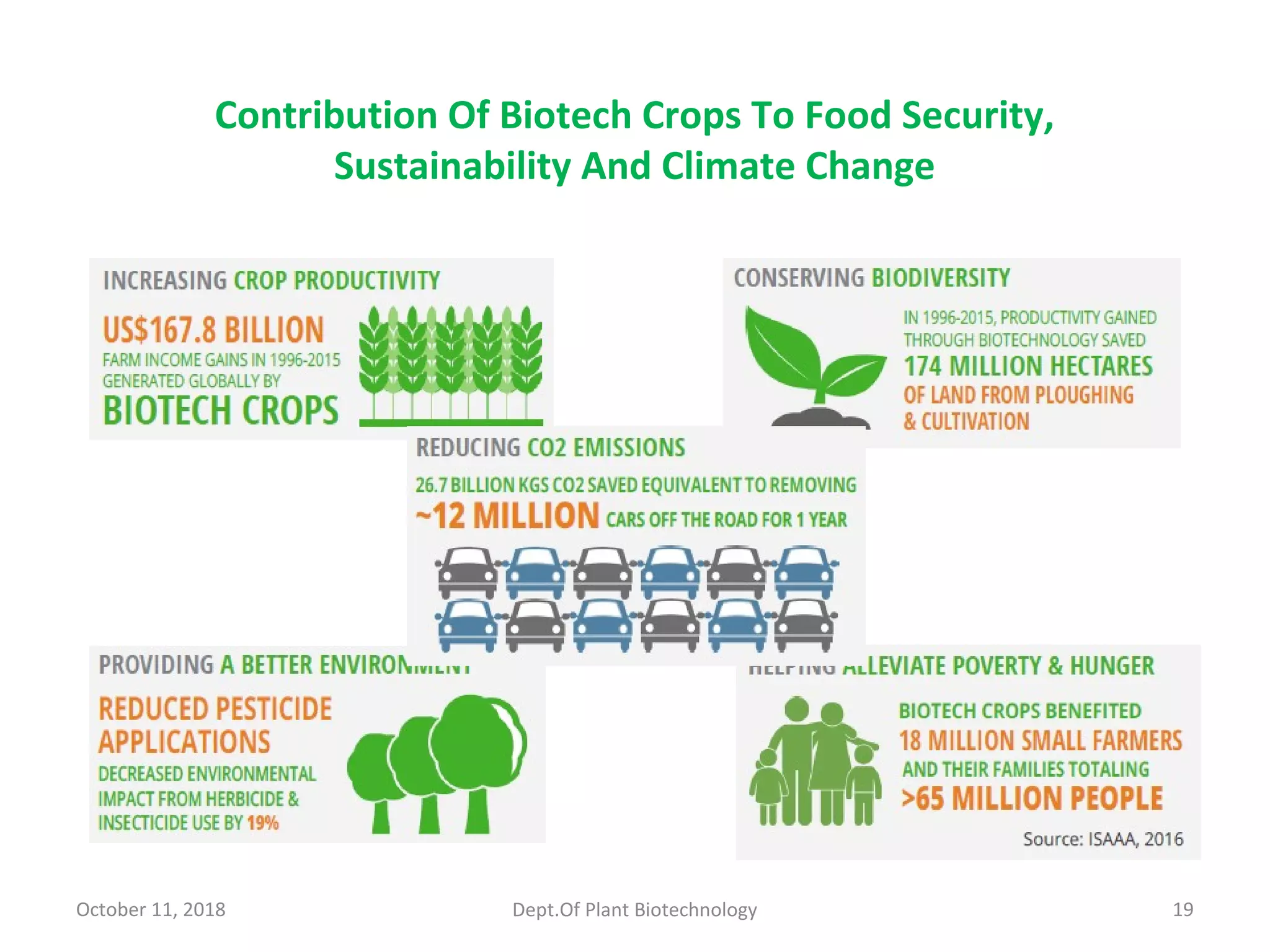
Contribution Of Biotech Crops To Food Security,
Sustainability And Climate Change
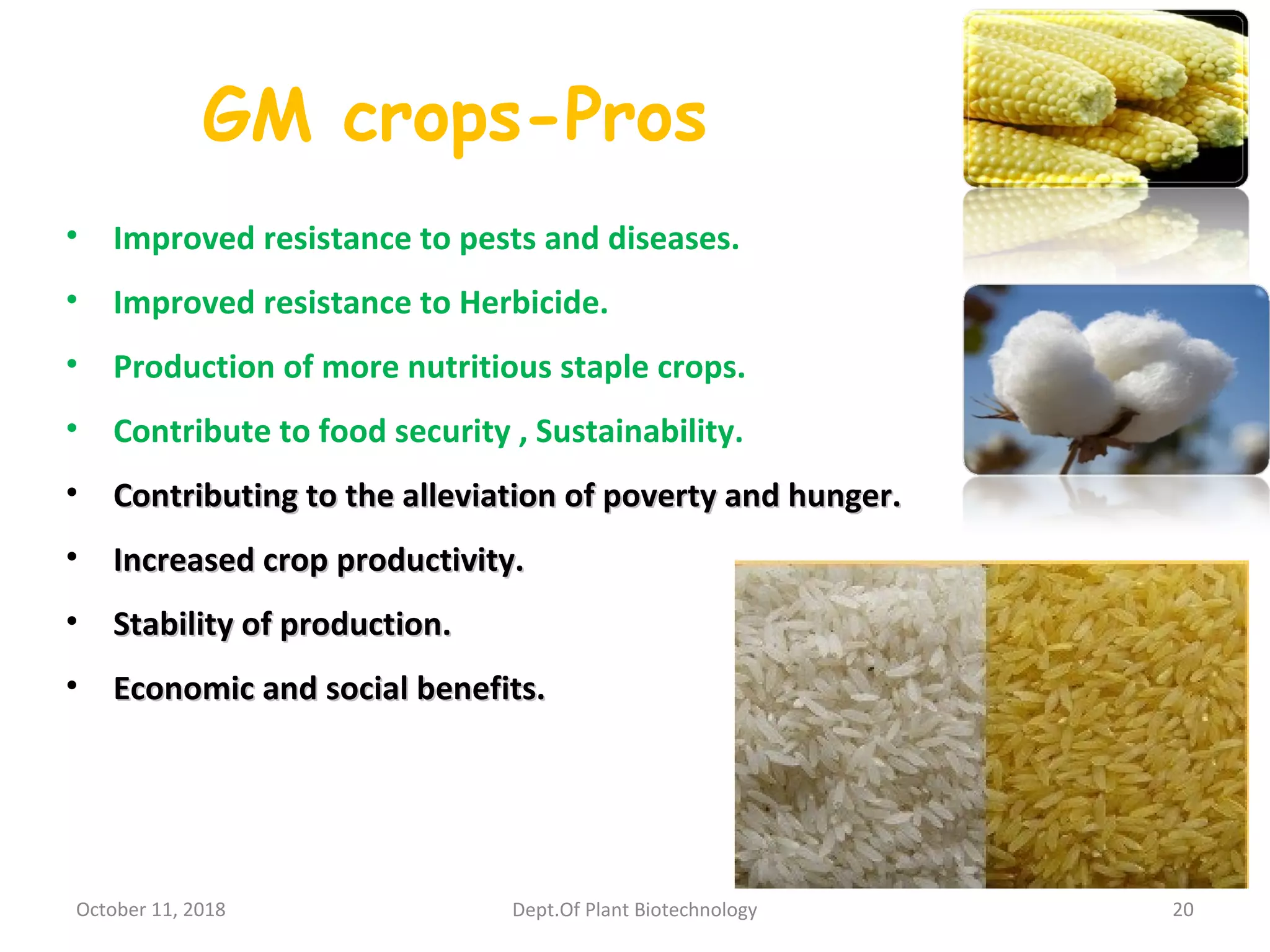
GM crops-Pros
• Improved resistance to pests and diseases.
• Improved resistance to Herbicide.
• Production of more nutritious staple crops.
• Contribute to food security , Sustainability.
• Contributing to the alleviation of poverty and hunger.Contributing to the alleviation of poverty and hunger.
• Increased crop productivity.Increased crop productivity.
• Stability of production.Stability of production.
• Economic and social benefits.Economic and social benefits.
October 11, 2018 20Dept.Of Plant Biotechnology
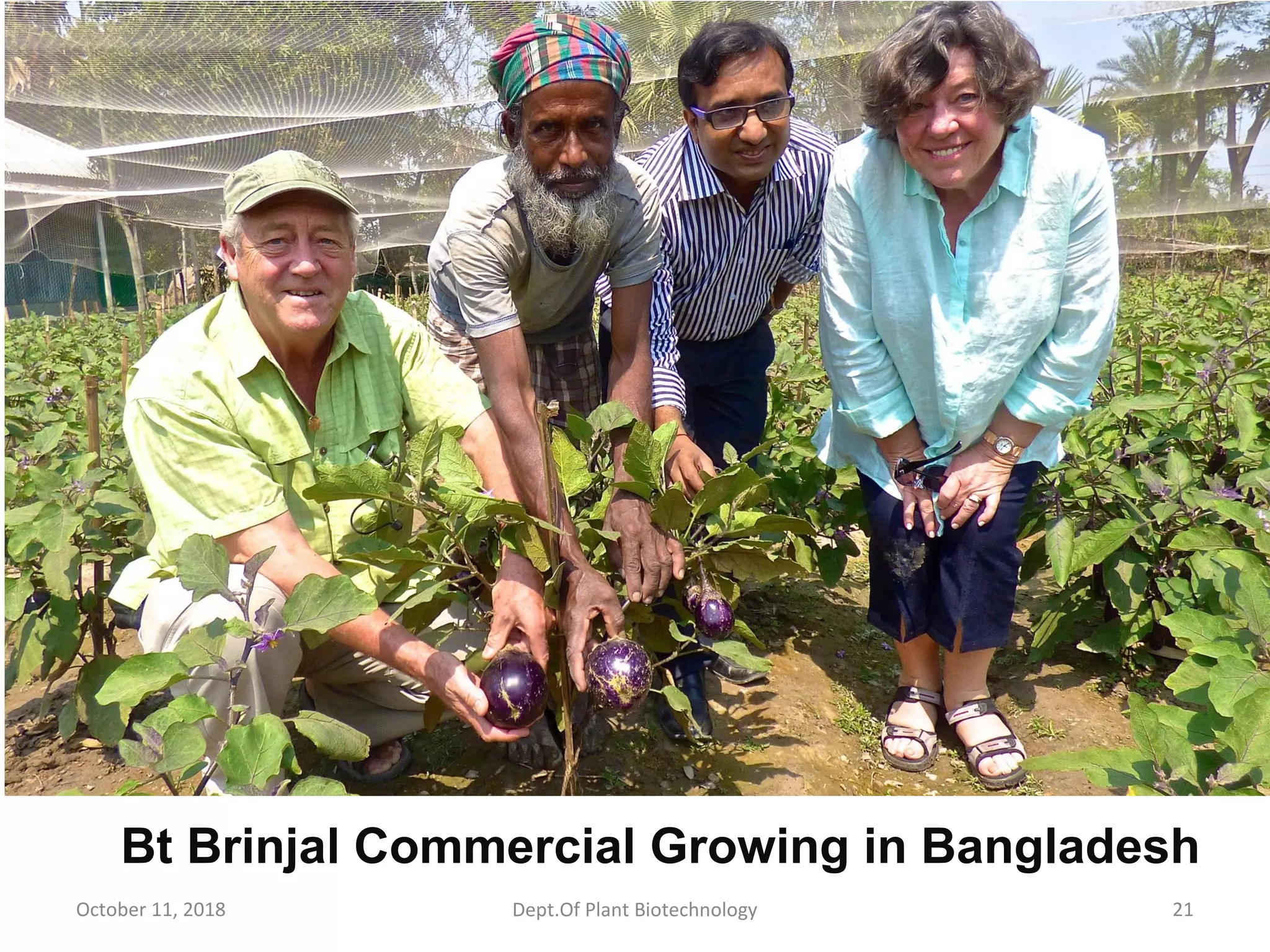
Bt Brinjal Commercial Growing in Bangladesh
October 11, 2018 21Dept.Of Plant Biotechnology
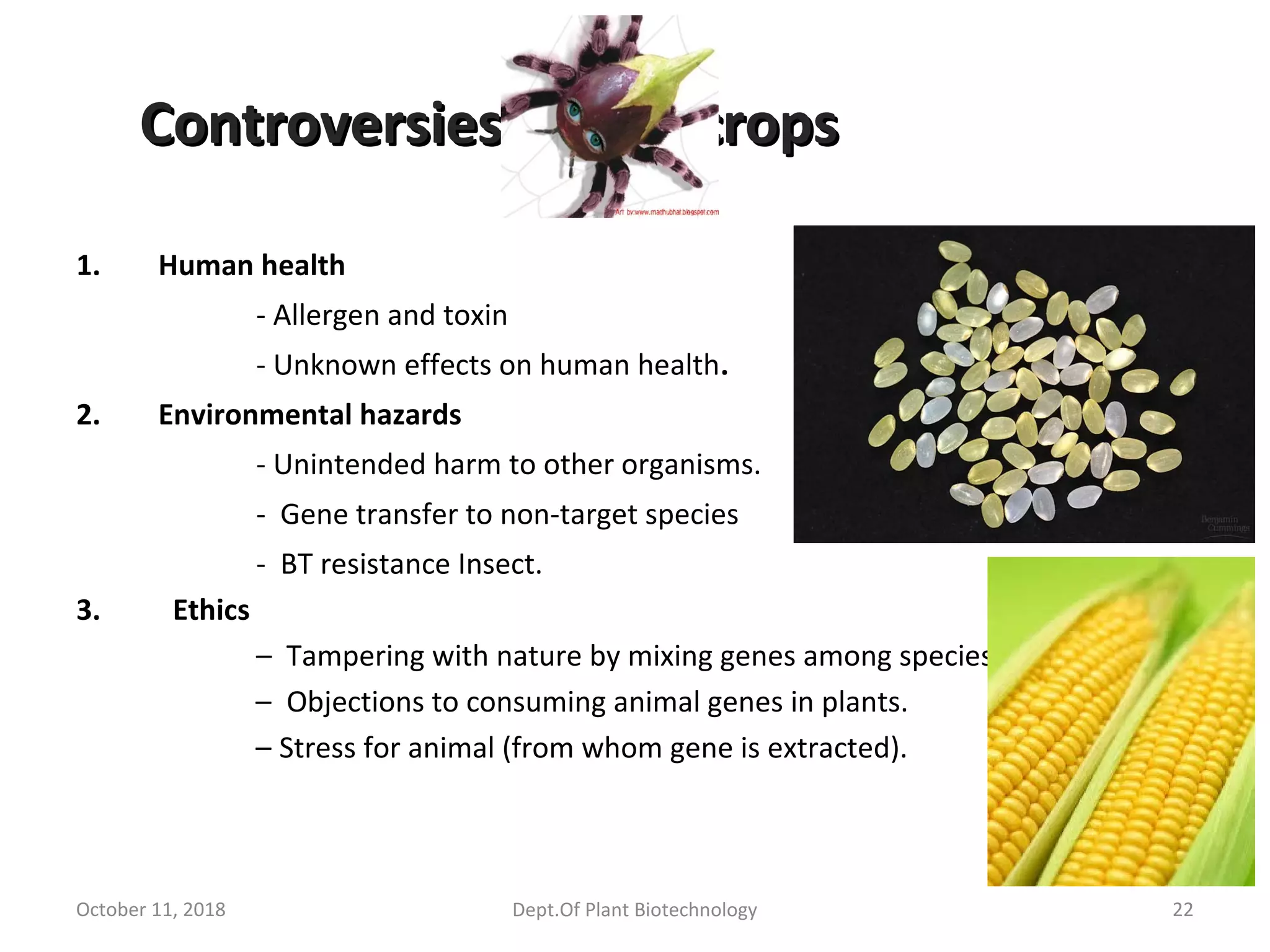
Controversies of GM cropsControversies of GM crops
1. Human health
- Allergen and toxin
- Unknown effects on human health.
2. Environmental hazards
- Unintended harm to other organisms.
- Gene transfer to non-target species
- BT resistance Insect.
3. Ethics
– Tampering with nature by mixing genes among species .
– Objections to consuming animal genes in plants.
– Stress for animal (from whom gene is extracted).
October 11, 2018 22Dept.Of Plant Biotechnology
Cont..
4. Access and intellectual property
– Domination of world food production by companies.
– Increasing dependence on industrialized nations by developing countries.
– Bio piracy, or foreign exploitation of natural resources .
5. Labelling
– Mandatory in India (2013), not mandatory in some countries
(e.g. United States).
– Mixing GM crops with non-GM products confounds labeling attempts.
6. Society
– New advances may be skewed to interests of rich countries.
October 11, 2018 Dept.Of Plant Biotechnology 23
Parsai G. Centre makes labelling of GM foods mandatory. [Online] Available from http://www.thehindu.com/news/national/article
3551679.ece. [Accessed October, 2013].
October 11, 2018 24Dept.Of Plant Biotechnology
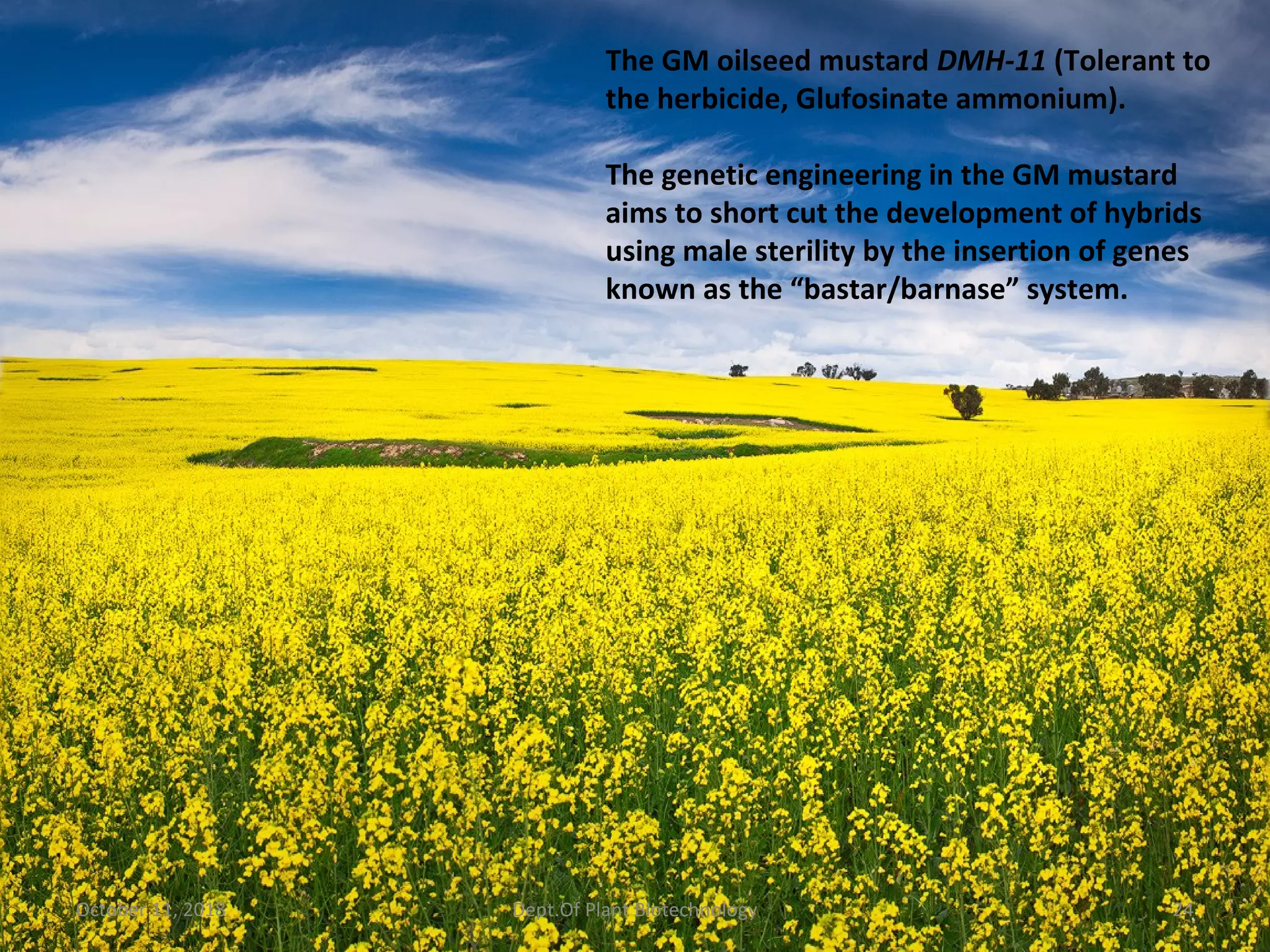
The GM oilseed mustard DMH-11 (Tolerant to
the herbicide, Glufosinate ammonium).
The genetic engineering in the GM mustard
aims to short cut the development of hybrids
using male sterility by the insertion of genes
known as the “bastar/barnase” system.
October 11, 2018 Dept.Of Plant Biotechnology 25
Environmental hazardsEnvironmental hazards
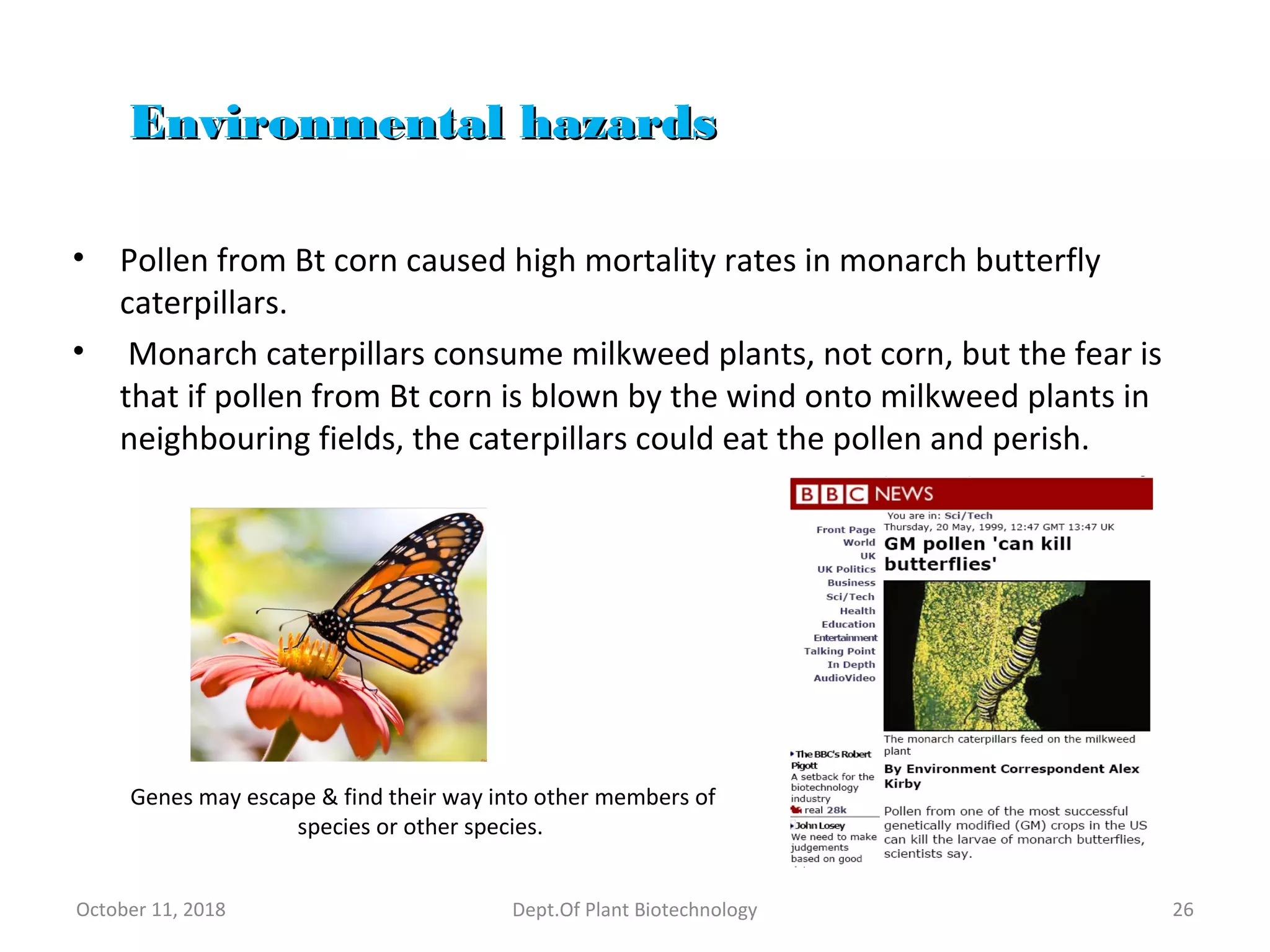
• Pollen from Bt corn caused high mortality rates in monarch butterfly
caterpillars.
• Monarch caterpillars consume milkweed plants, not corn, but the fear is
that if pollen from Bt corn is blown by the wind onto milkweed plants in
neighbouring fields, the caterpillars could eat the pollen and perish.
October 11, 2018 Dept.Of Plant Biotechnology 26
Genes may escape & find their way into other members of
species or other species.
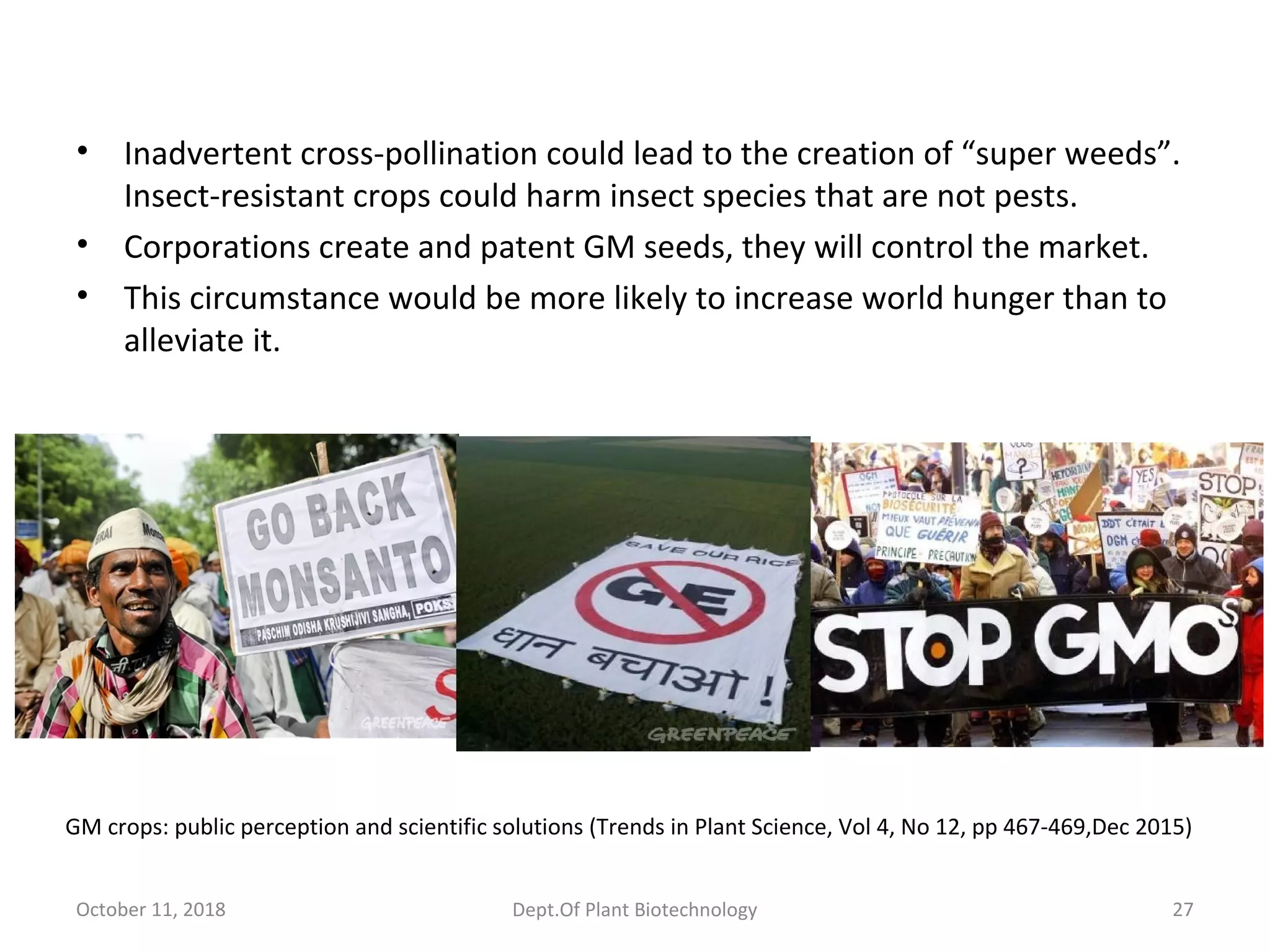
• Inadvertent cross-pollination could lead to the creation of “super weeds”.
Insect-resistant crops could harm insect species that are not pests.
• Corporations create and patent GM seeds, they will control the market.
• This circumstance would be more likely to increase world hunger than to
alleviate it.
October 11, 2018 27Dept.Of Plant Biotechnology
GM crops: public perception and scientific solutions (Trends in Plant Science, Vol 4, No 12, pp 467-469,Dec 2015)
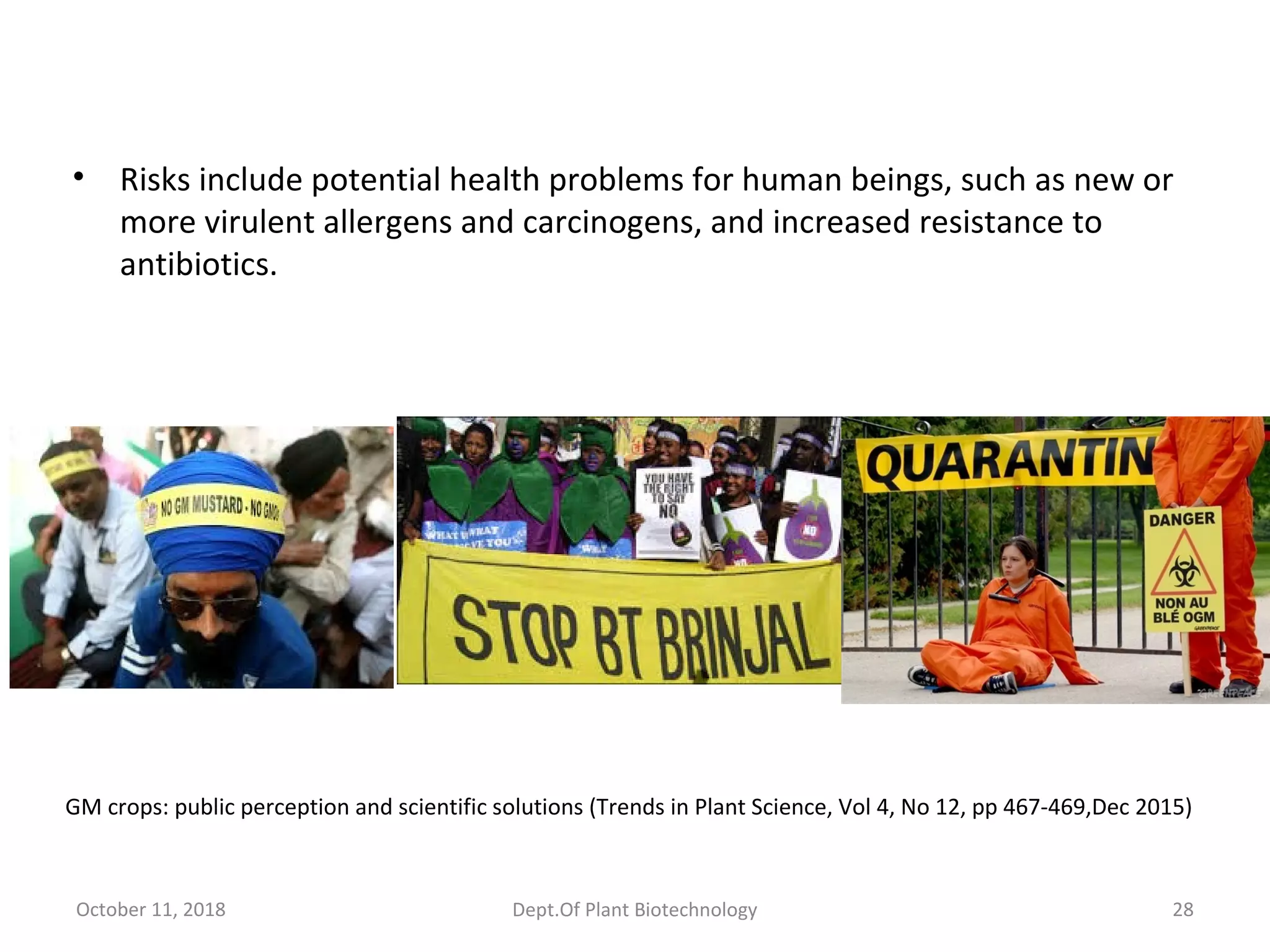
• Risks include potential health problems for human beings, such as new or
more virulent allergens and carcinogens, and increased resistance to
antibiotics.
October 11, 2018 28Dept.Of Plant Biotechnology
GM crops: public perception and scientific solutions (Trends in Plant Science, Vol 4, No 12, pp 467-469,Dec 2015)
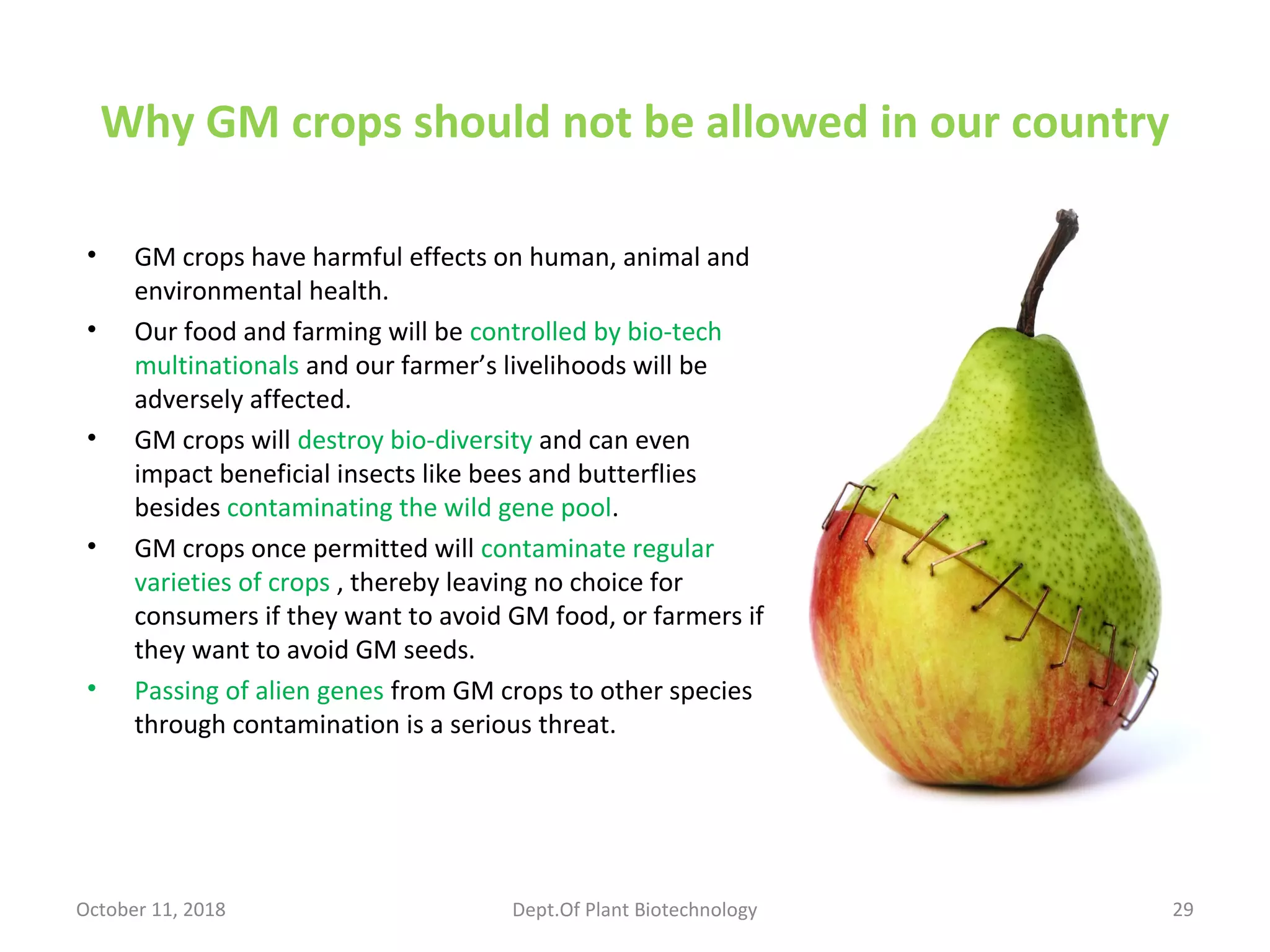
Why GM crops should not be allowed in our country
• GM crops have harmful effects on human, animal and
environmental health.
• Our food and farming will be controlled by bio-tech
multinationals and our farmer’s livelihoods will be
adversely affected.
• GM crops will destroy bio-diversity and can even
impact beneficial insects like bees and butterflies
besides contaminating the wild gene pool.
• GM crops once permitted will contaminate regular
varieties of crops , thereby leaving no choice for
consumers if they want to avoid GM food, or farmers if
they want to avoid GM seeds.
• Passing of alien genes from GM crops to other species
through contamination is a serious threat.
October 11, 2018 Dept.Of Plant Biotechnology 29
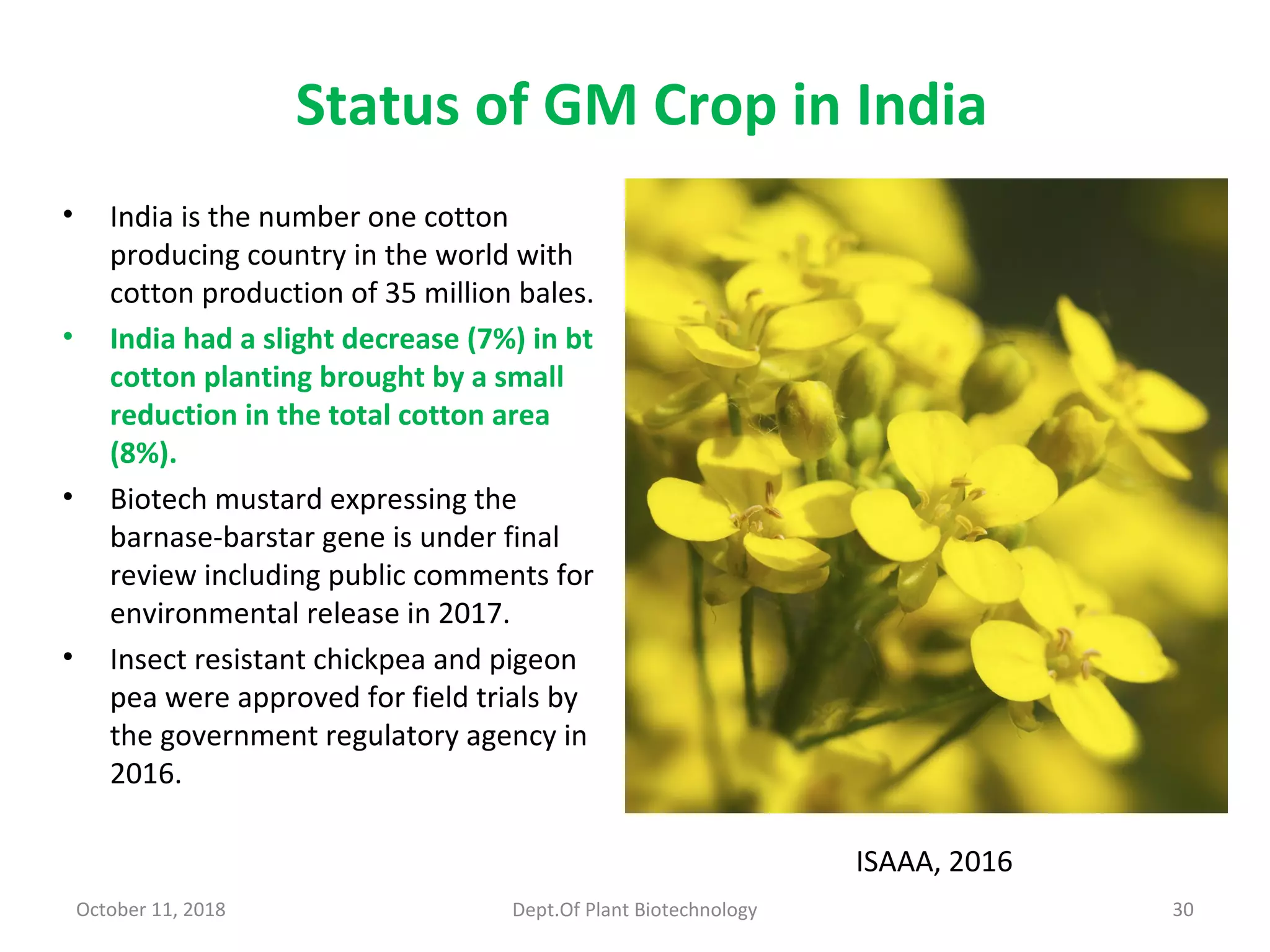
Status of GM Crop in India
• India is the number one cotton
producing country in the world with
cotton production of 35 million bales.
• India had a slight decrease (7%) in bt
cotton planting brought by a small
reduction in the total cotton area
(8%).
• Biotech mustard expressing the
barnase-barstar gene is under final
review including public comments for
environmental release in 2017.
• Insect resistant chickpea and pigeon
pea were approved for field trials by
the government regulatory agency in
2016.
October 11, 2018 Dept.Of Plant Biotechnology 30
ISAAA, 2016
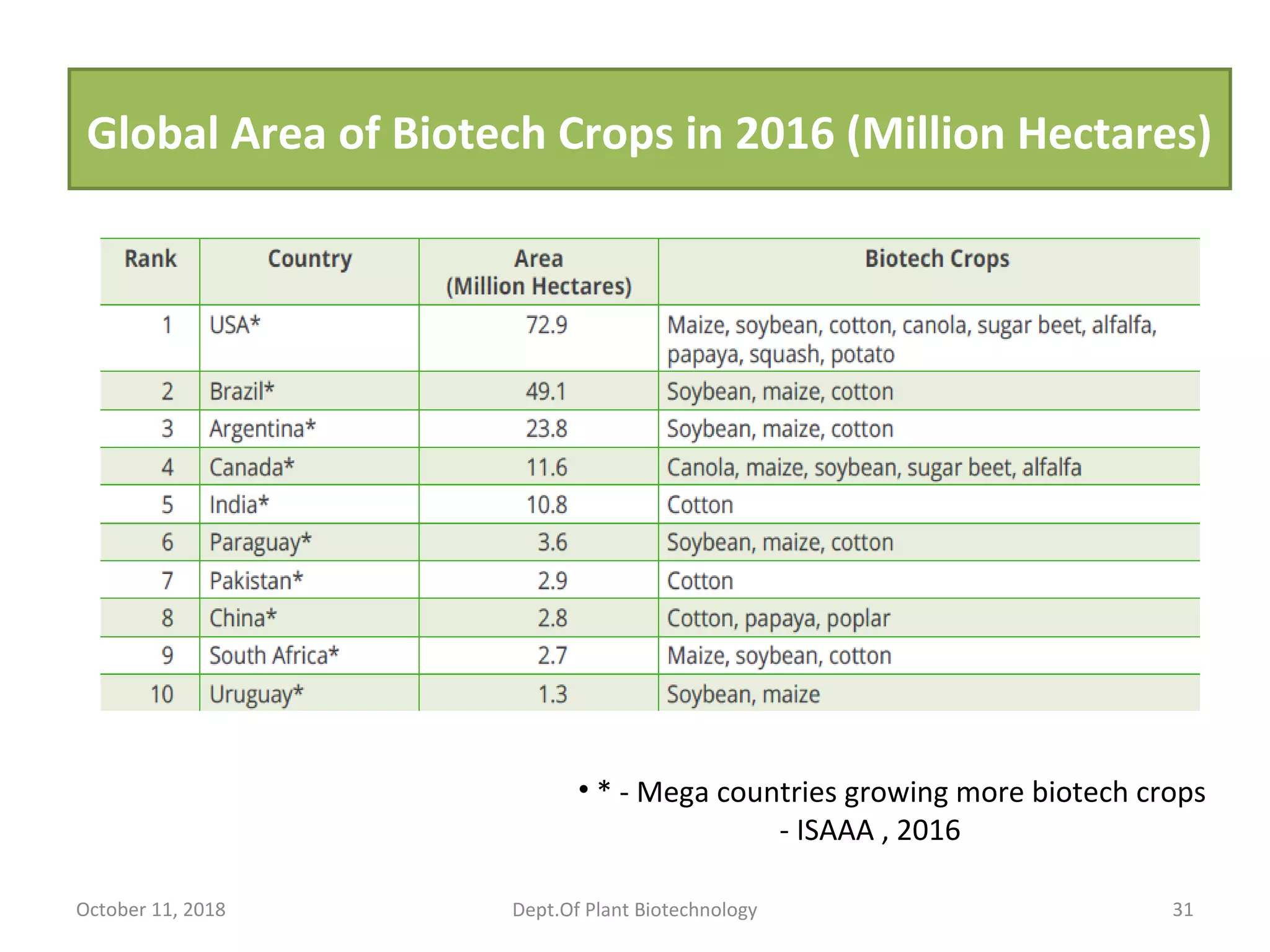
Global Area of Biotech Crops in 2016 (Million Hectares)
October 11, 2018 Dept.Of Plant Biotechnology 31
• * - Mega countries growing more biotech crops
- ISAAA , 2016
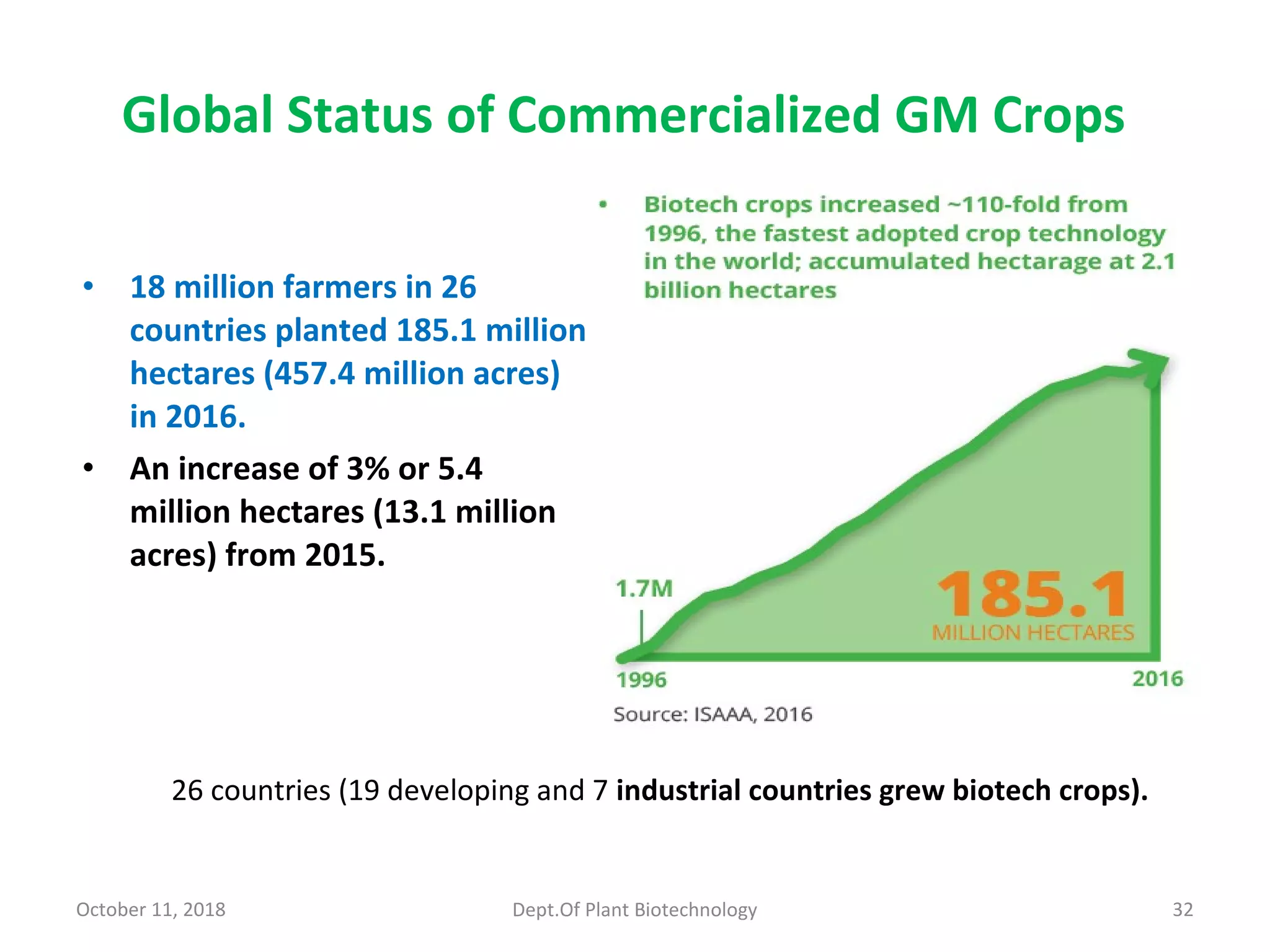
• 18 million farmers in 26
countries planted 185.1 million
hectares (457.4 million acres)
in 2016.
• An increase of 3% or 5.4
million hectares (13.1 million
acres) from 2015.
October 11, 2018 Dept.Of Plant Biotechnology 32
26 countries (19 developing and 7 industrial countries grew biotech crops).
Global Status of Commercialized GM Crops
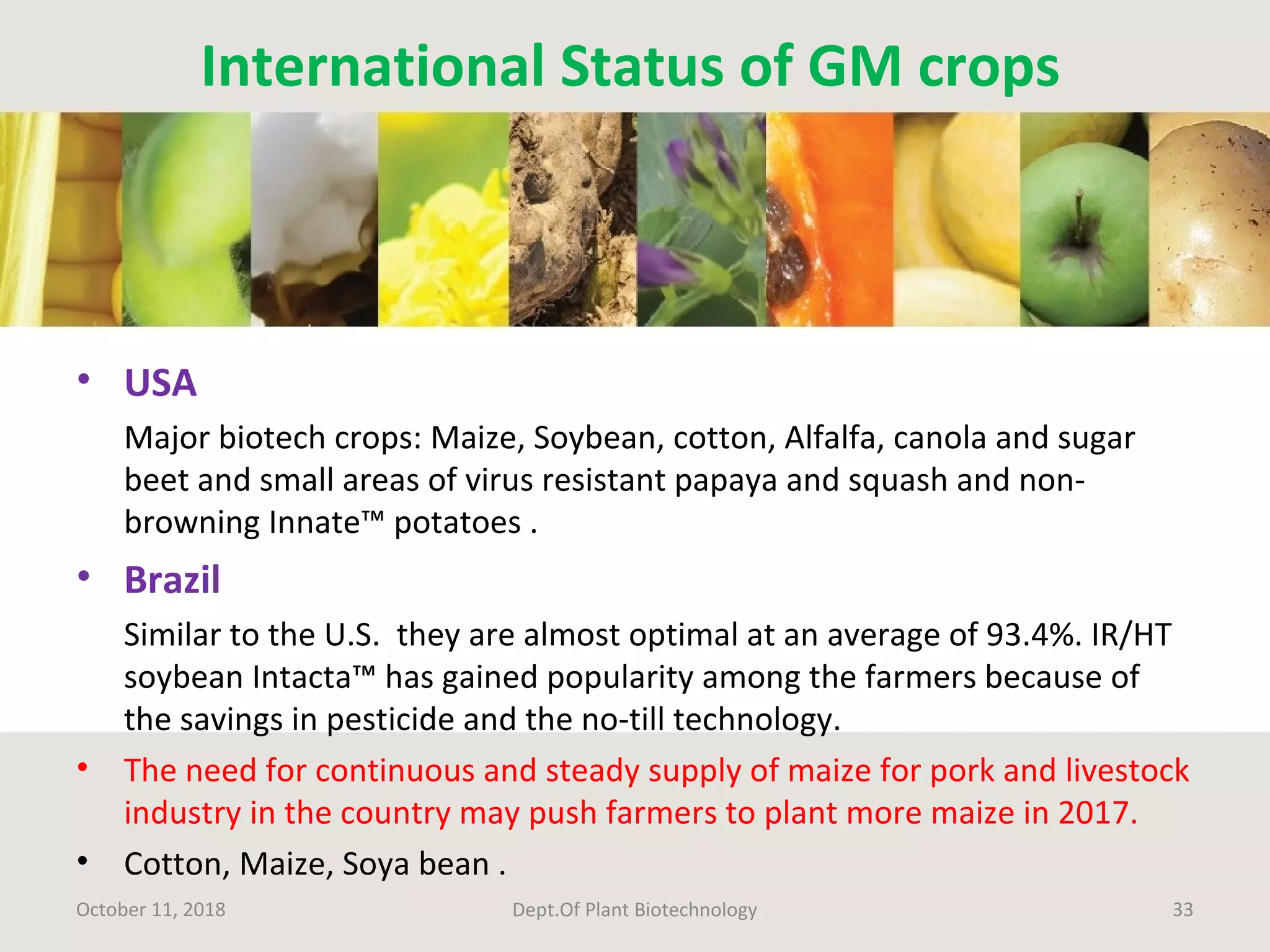
International Status of GM crops
• USA
Major biotech crops: Maize, Soybean, cotton, Alfalfa, canola and sugar
beet and small areas of virus resistant papaya and squash and non-
browning Innate™ potatoes .
• Brazil
Similar to the U.S. they are almost optimal at an average of 93.4%. IR/HT
soybean Intacta™ has gained popularity among the farmers because of
the savings in pesticide and the no-till technology.
• The need for continuous and steady supply of maize for pork and livestock
industry in the country may push farmers to plant more maize in 2017.
• Cotton, Maize, Soya bean .
October 11, 2018 Dept.Of Plant Biotechnology 33
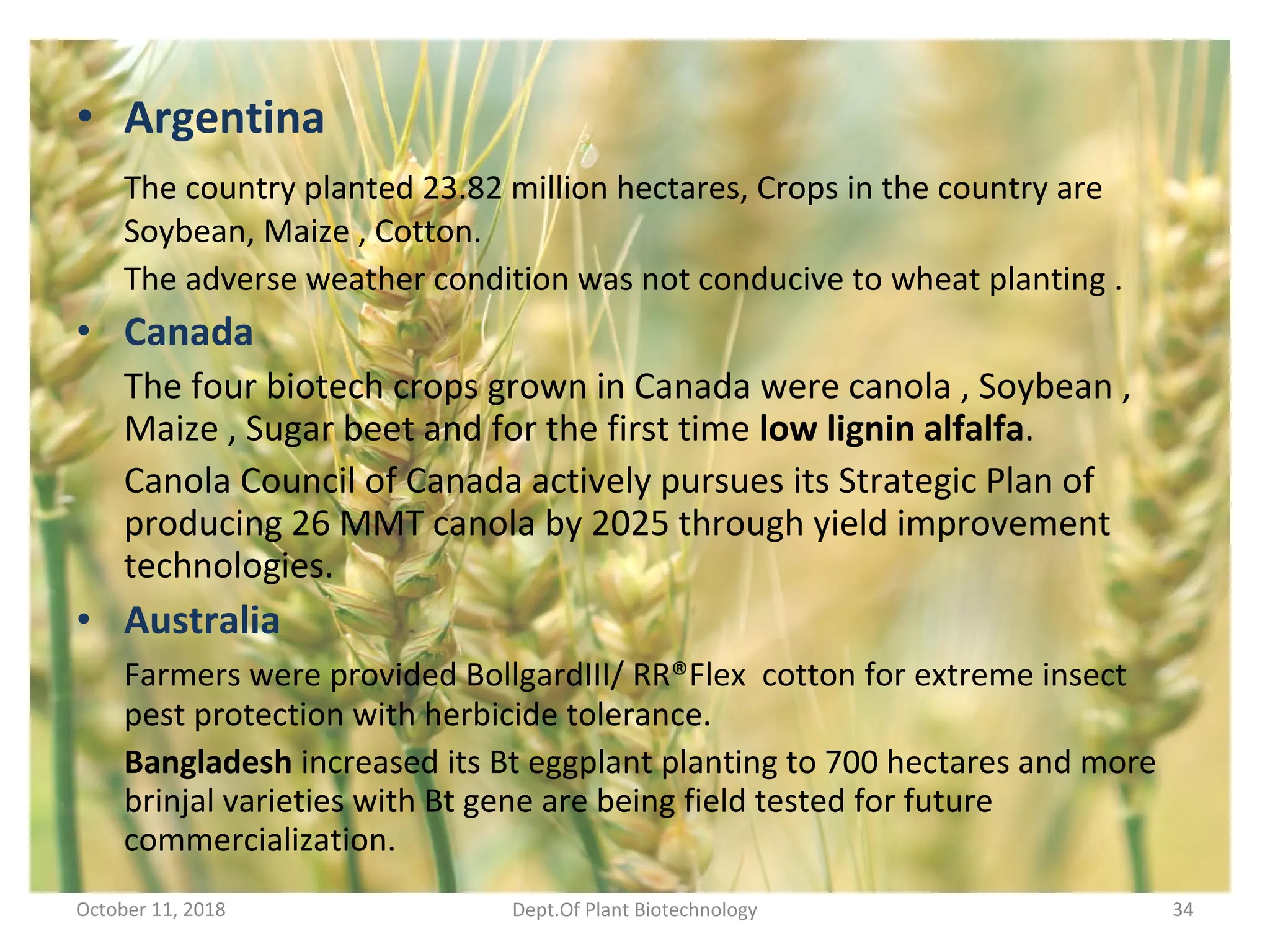
• Argentina
The country planted 23.82 million hectares, Crops in the country are
Soybean, Maize , Cotton.
The adverse weather condition was not conducive to wheat planting .
• Canada
The four biotech crops grown in Canada were canola , Soybean ,
Maize , Sugar beet and for the first time low lignin alfalfa.
Canola Council of Canada actively pursues its Strategic Plan of
producing 26 MMT canola by 2025 through yield improvement
technologies.
• Australia
Farmers were provided BollgardIII/ RR®Flex cotton for extreme insect
pest protection with herbicide tolerance.
Bangladesh increased its Bt eggplant planting to 700 hectares and more
brinjal varieties with Bt gene are being field tested for future
commercialization.
October 11, 2018 Dept.Of Plant Biotechnology 34
BIOTECH CROPS: A GAME CHANGER
• The first generation of biotech crops targeted input traits of herbicide
tolerance, insect resistance and virus resistance where farmers and food
producers benefited economic gains .
• The second generation biotech crops include stacks of these traits, as well
as drought tolerance – one of the problems related to climate change.
Adoption of IR/HT soybean (Intacta™) and corn rootworm stacks for maize
have been phenomenal with an economic benefit .
• It is noteworthy that Innate™ potato series have been commercialized
successfully in the USA, with 2,500 hectares of potatoes and 70,000 non-
browning apple trees .
October 11, 2018 Dept.Of Plant Biotechnology 35
October 11, 2018 Dept.Of Plant Biotechnology 36
Arctic AppleArctic AppleInnate PotatoInnate Potato
October 11, 2018 37Dept.Of Plant Biotechnology
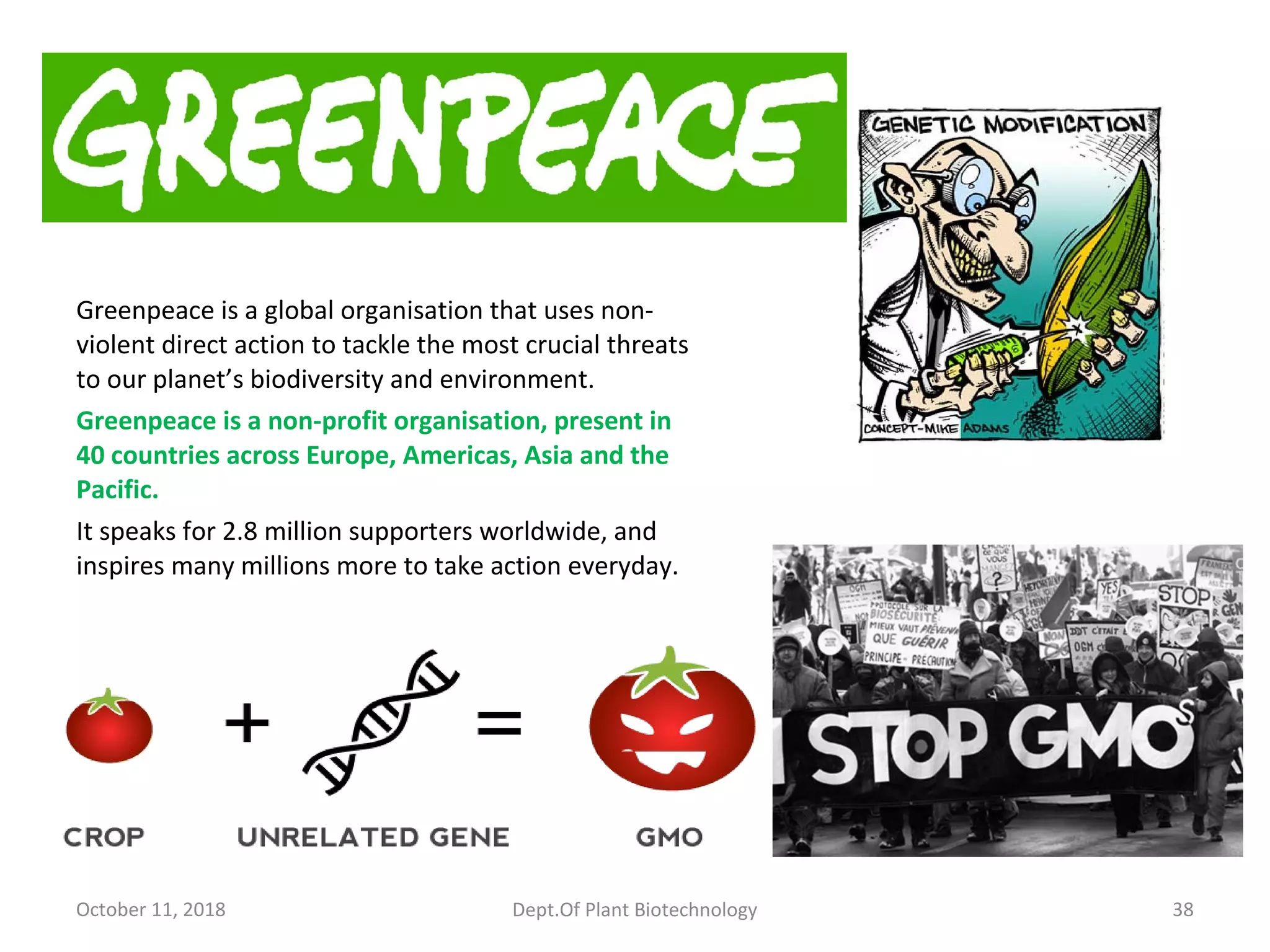
Greenpeace is a global organisation that uses non-
violent direct action to tackle the most crucial threats
to our planet’s biodiversity and environment.
Greenpeace is a non-profit organisation, present in
40 countries across Europe, Americas, Asia and the
Pacific.
It speaks for 2.8 million supporters worldwide, and
inspires many millions more to take action everyday.
October 11, 2018 Dept.Of Plant Biotechnology 38
October 11, 2018 39Dept.Of Plant Biotechnology
Indian Scenario
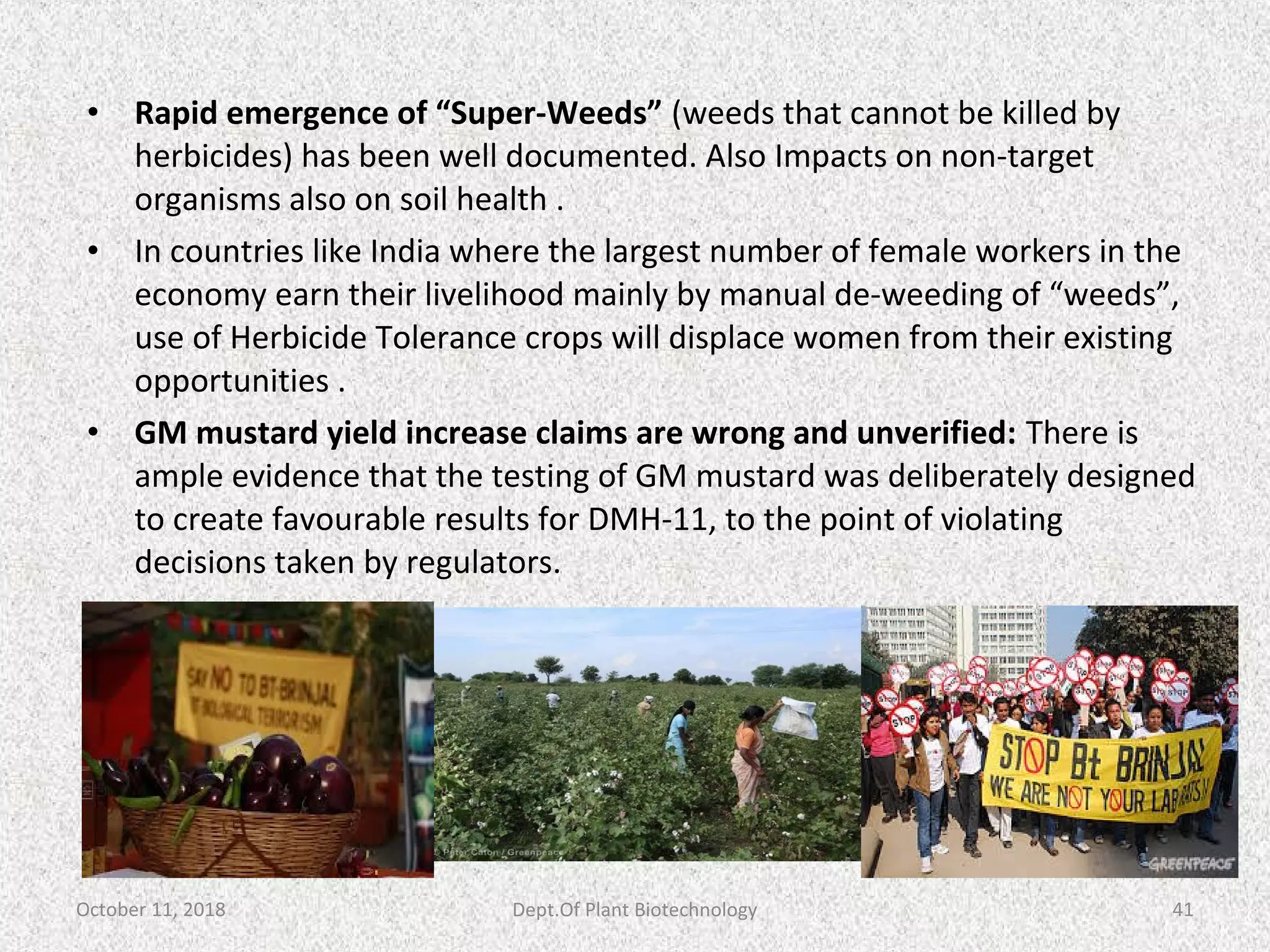
GMO?GMO? OMG!OMG! No, Not Again..!No, Not Again..!
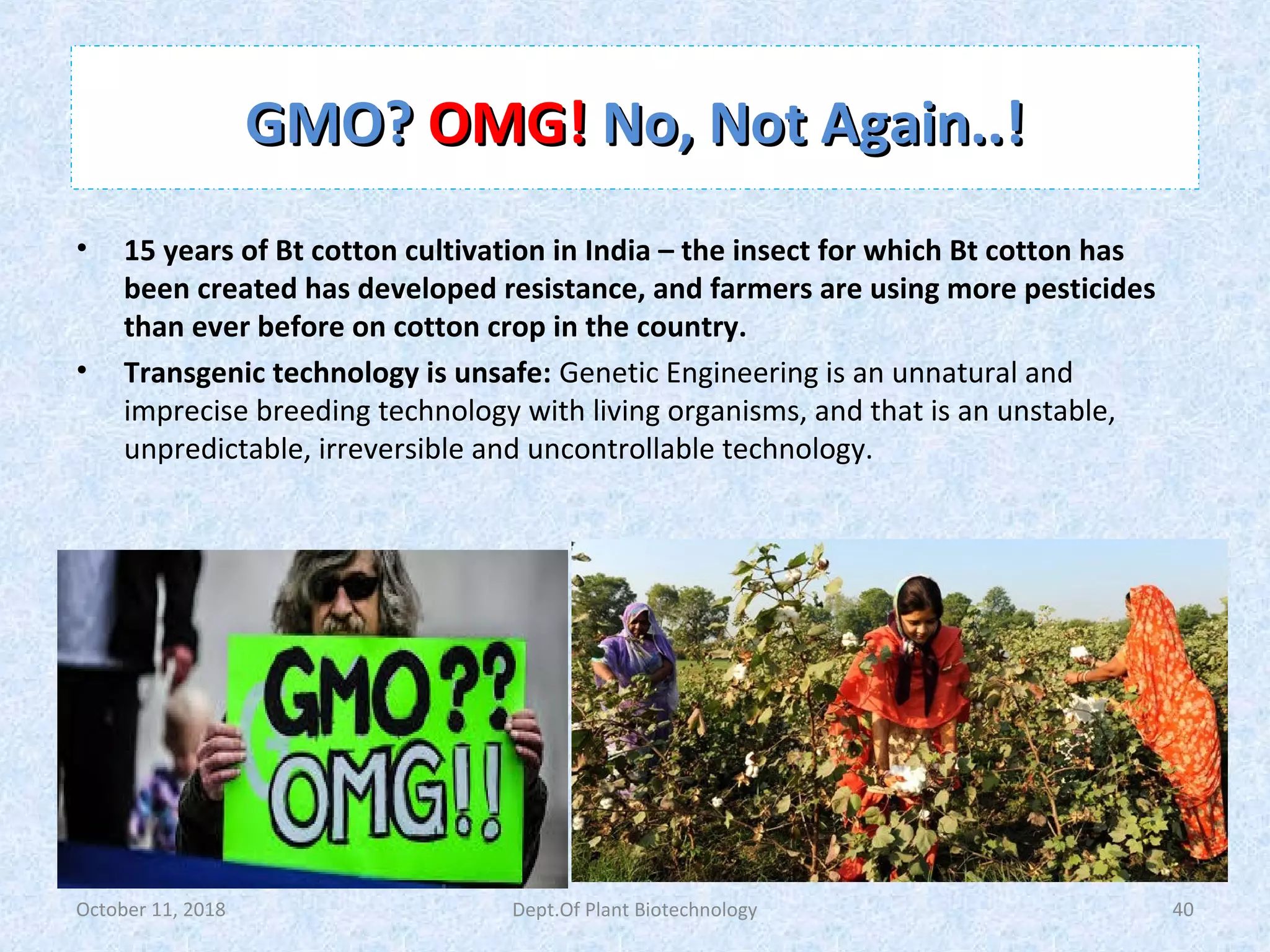
• 15 years of Bt cotton cultivation in India – the insect for which Bt cotton has
been created has developed resistance, and farmers are using more pesticides
than ever before on cotton crop in the country.
• Transgenic technology is unsafe: Genetic Engineering is an unnatural and
imprecise breeding technology with living organisms, and that is an unstable,
unpredictable, irreversible and uncontrollable technology.
October 11, 2018 40Dept.Of Plant Biotechnology
• Rapid emergence of “Super-Weeds” (weeds that cannot be killed by
herbicides) has been well documented. Also Impacts on non-target
organisms also on soil health .
• In countries like India where the largest number of female workers in the
economy earn their livelihood mainly by manual de-weeding of “weeds”,
use of Herbicide Tolerance crops will displace women from their existing
opportunities .
• GM mustard yield increase claims are wrong and unverified: There is
ample evidence that the testing of GM mustard was deliberately designed
to create favourable results for DMH-11, to the point of violating
decisions taken by regulators.
October 11, 2018 41Dept.Of Plant Biotechnology
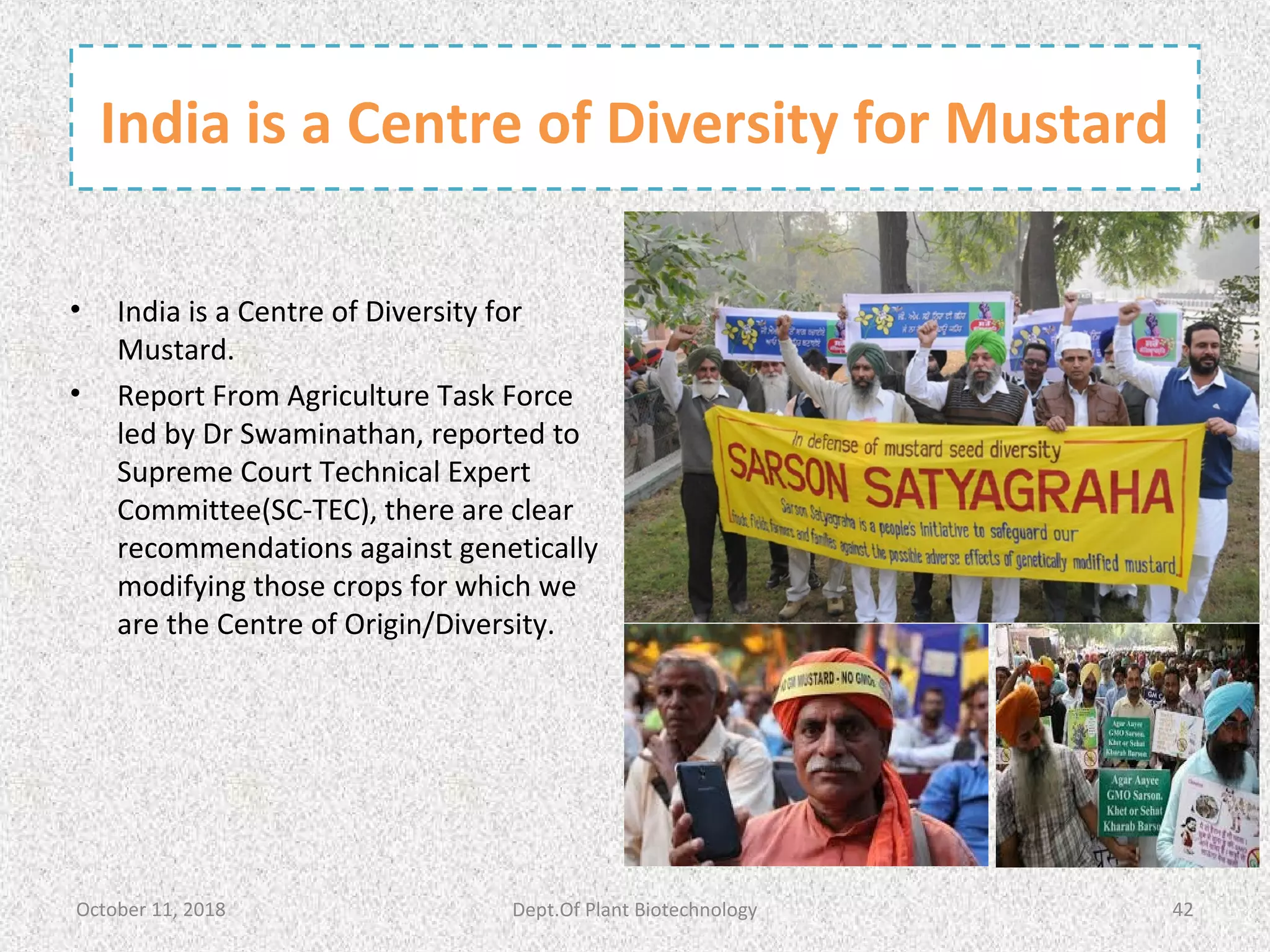
India is a Centre of Diversity for Mustard
• India is a Centre of Diversity for
Mustard.
• Report From Agriculture Task Force
led by Dr Swaminathan, reported to
Supreme Court Technical Expert
Committee(SC-TEC), there are clear
recommendations against genetically
modifying those crops for which we
are the Centre of Origin/Diversity.
October 11, 2018 42Dept.Of Plant Biotechnology
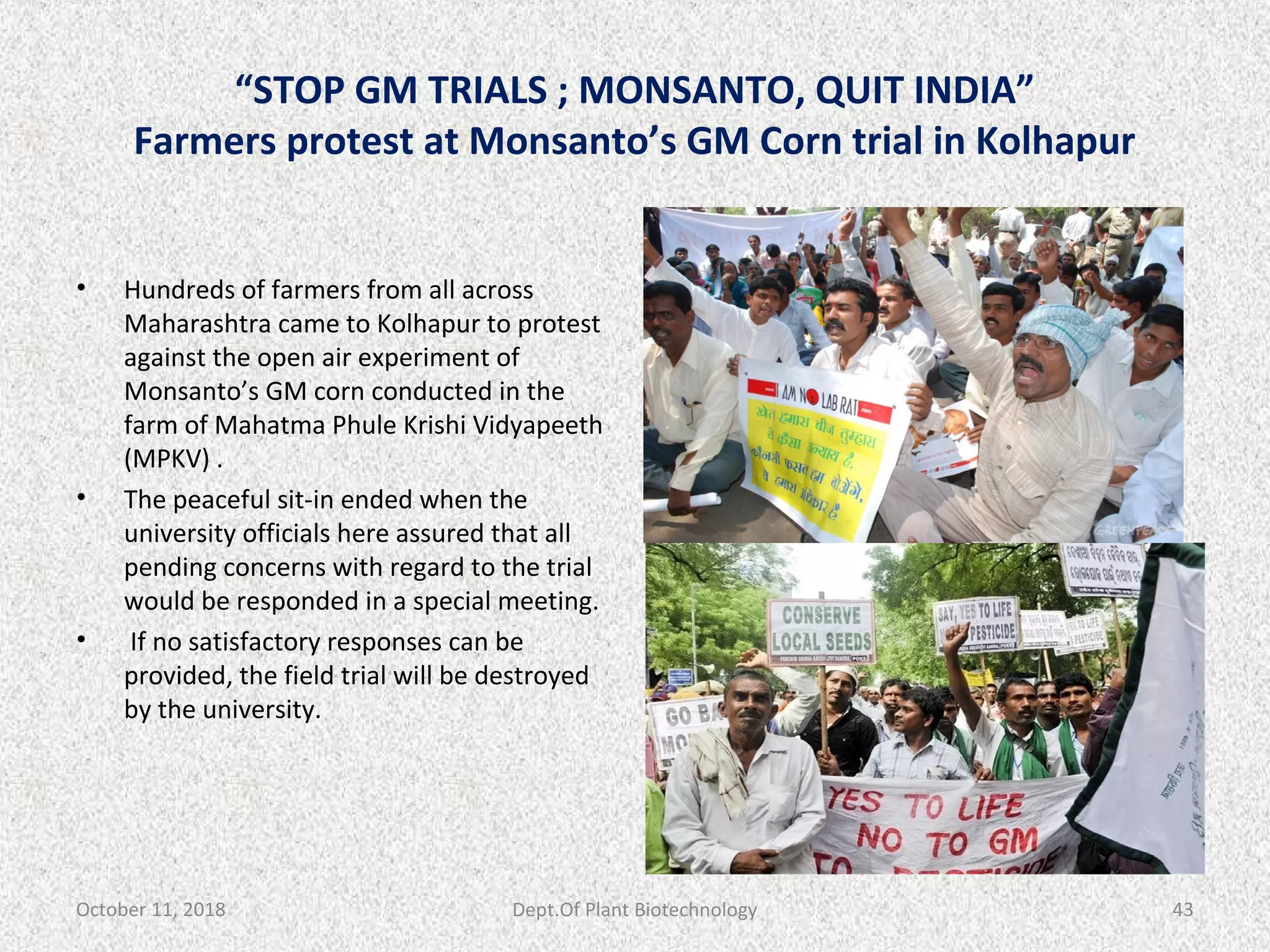
“STOP GM TRIALS ; MONSANTO, QUIT INDIA”
Farmers protest at Monsanto’s GM Corn trial in Kolhapur
• Hundreds of farmers from all across
Maharashtra came to Kolhapur to protest
against the open air experiment of
Monsanto’s GM corn conducted in the
farm of Mahatma Phule Krishi Vidyapeeth
(MPKV) .
• The peaceful sit-in ended when the
university officials here assured that all
pending concerns with regard to the trial
would be responded in a special meeting.
• If no satisfactory responses can be
provided, the field trial will be destroyed
by the university.
October 11, 2018 43Dept.Of Plant Biotechnology
October 11, 2018 44Dept.Of Plant Biotechnology
Protest by Farmer communities in Front of Mahatma
Phule krishi vidyapeeth
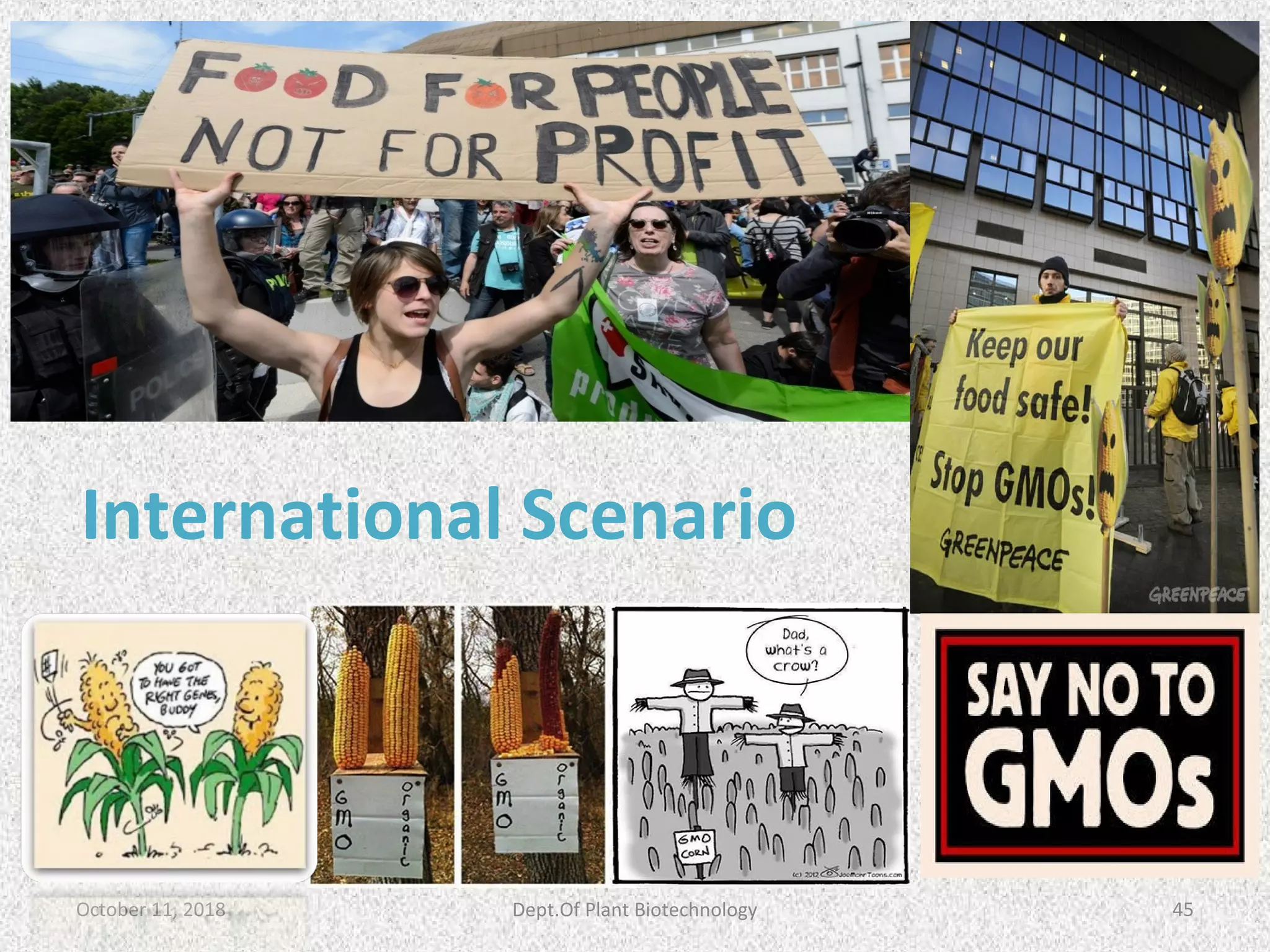
International Scenario
October 11, 2018 Dept.Of Plant Biotechnology 45
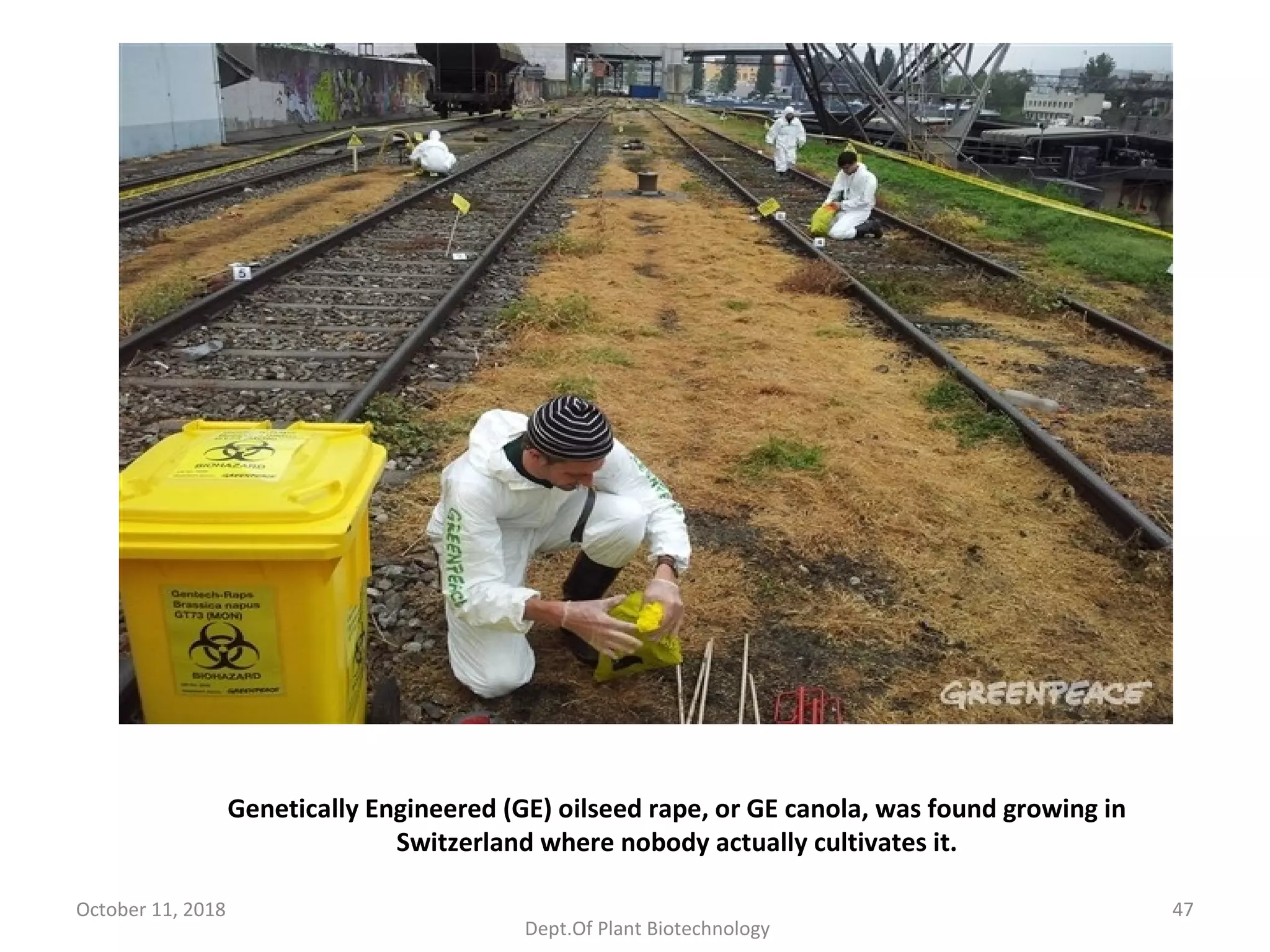
Illegal GE canola found growing in Swiss port area
• Switzerland has in fact had a Genetically Engineered (GE) ban in place
since 2005 and the import of GE crops in foodstuffs and animal feed is
prohibited.
• Switzerland tested 136 canola plants and found 29 positive for GE, all of
which were Monsanto´s herbicide-tolerant canola, GT73 (also called
RT73).
October 11, 2018 46Dept.Of Plant Biotechnology
Genetically Engineered (GE) oilseed rape, or GE canola, was found growing in
Switzerland where nobody actually cultivates it.
October 11, 2018 47
Dept.Of Plant Biotechnology
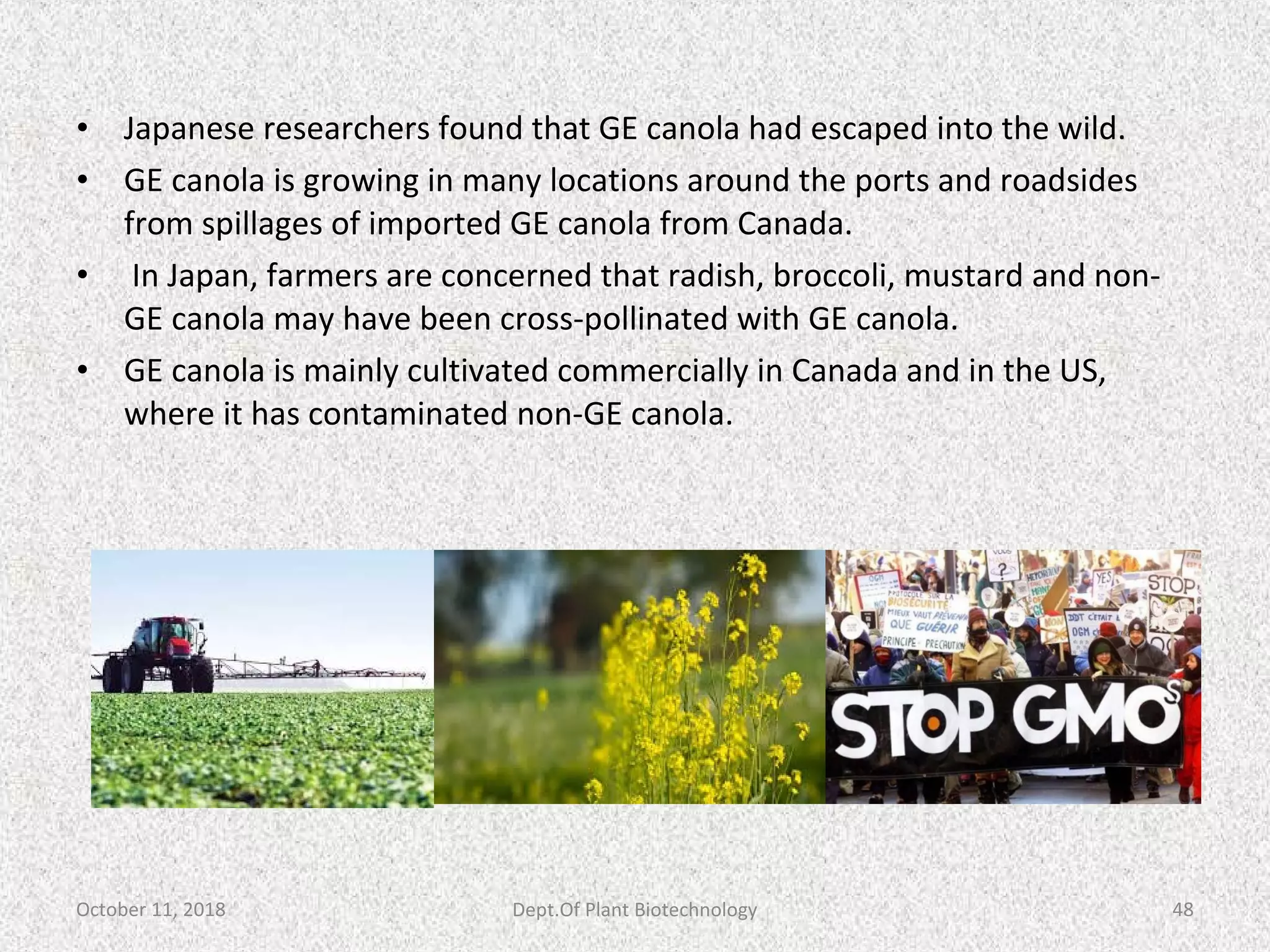
• Japanese researchers found that GE canola had escaped into the wild.
• GE canola is growing in many locations around the ports and roadsides
from spillages of imported GE canola from Canada.
• In Japan, farmers are concerned that radish, broccoli, mustard and non-
GE canola may have been cross-pollinated with GE canola.
• GE canola is mainly cultivated commercially in Canada and in the US,
where it has contaminated non-GE canola.
October 11, 2018 48Dept.Of Plant Biotechnology
GREENPEACE CALLS FOR ACTION TO SOLVE (VAD) WITH MEASURES SUCH AS SUPPLEMENTATION (I.E.
PILLS), FOOD FORTIFICATION AND IMPROVED USE AND ACCESS TO NATURAL SOURCES OF PRO-VITAMIN A
(SUCH AS RED PALM OIL).
A DIET RICH IN VITAMIN A AND OTHER MICRO-NUTRIENTS IS A LUXURY FOR MILLIONS OF POOR, NOT
BECAUSE SUCH FOODS ARE NOT AVAILABLE IN THEIR COUNTRIES, BUT BECAUSE THEY CANNOT AFFORD
THEM OR HAVE NO ACCESS TO THEM.
THIS IS A PROBLEM THAT 'GOLDEN RICE' WOULD NOT SOLVE.
GOLDEN RICEGOLDEN RICE
October 11, 2018 Dept.Of Plant Biotechnology 49
"The False Promise of Genetically Engineered rice,” http://www.greenpeace.org/~geneng
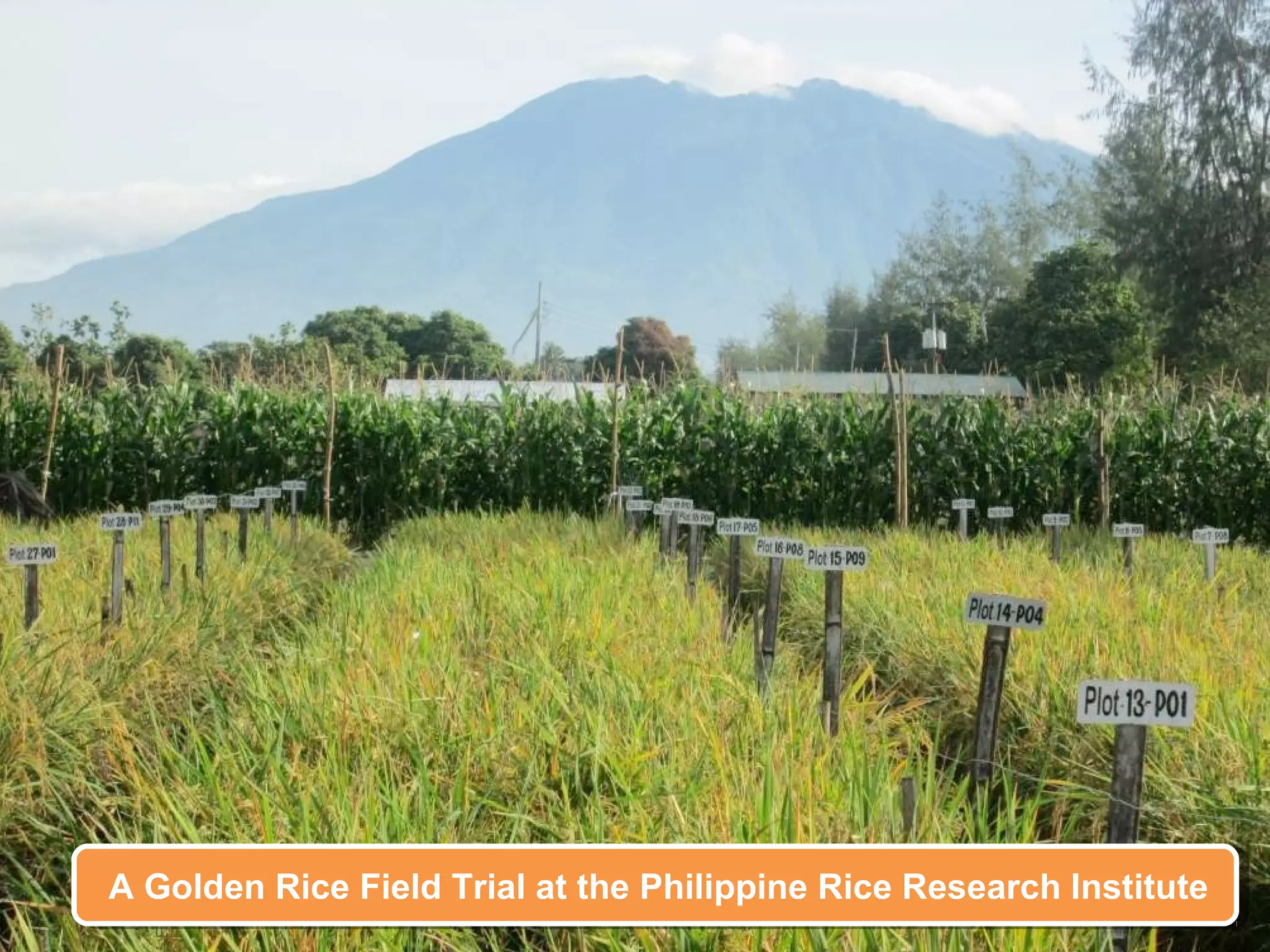
A Golden Rice Field Trial at the Philippine Rice Research Institute
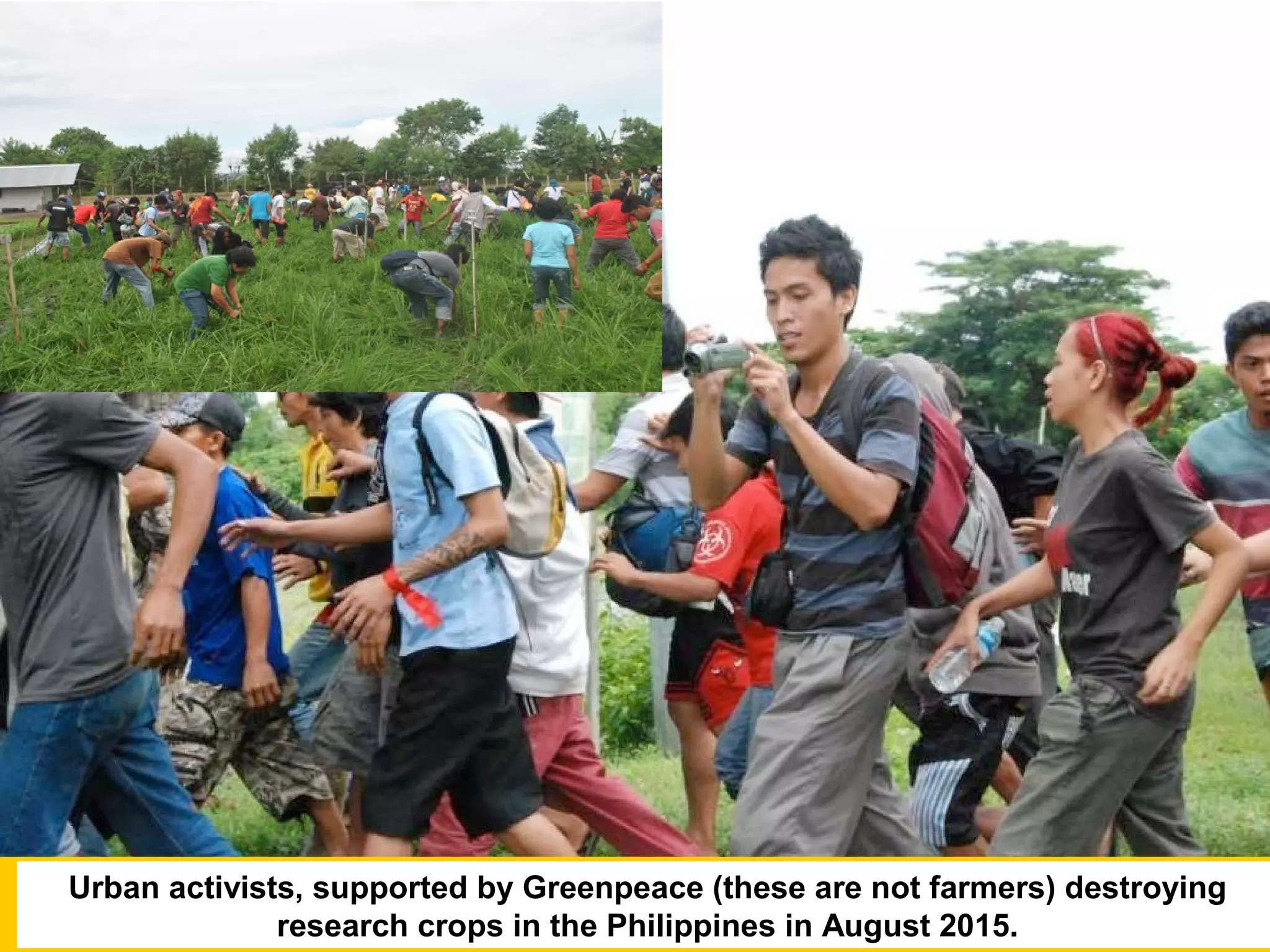
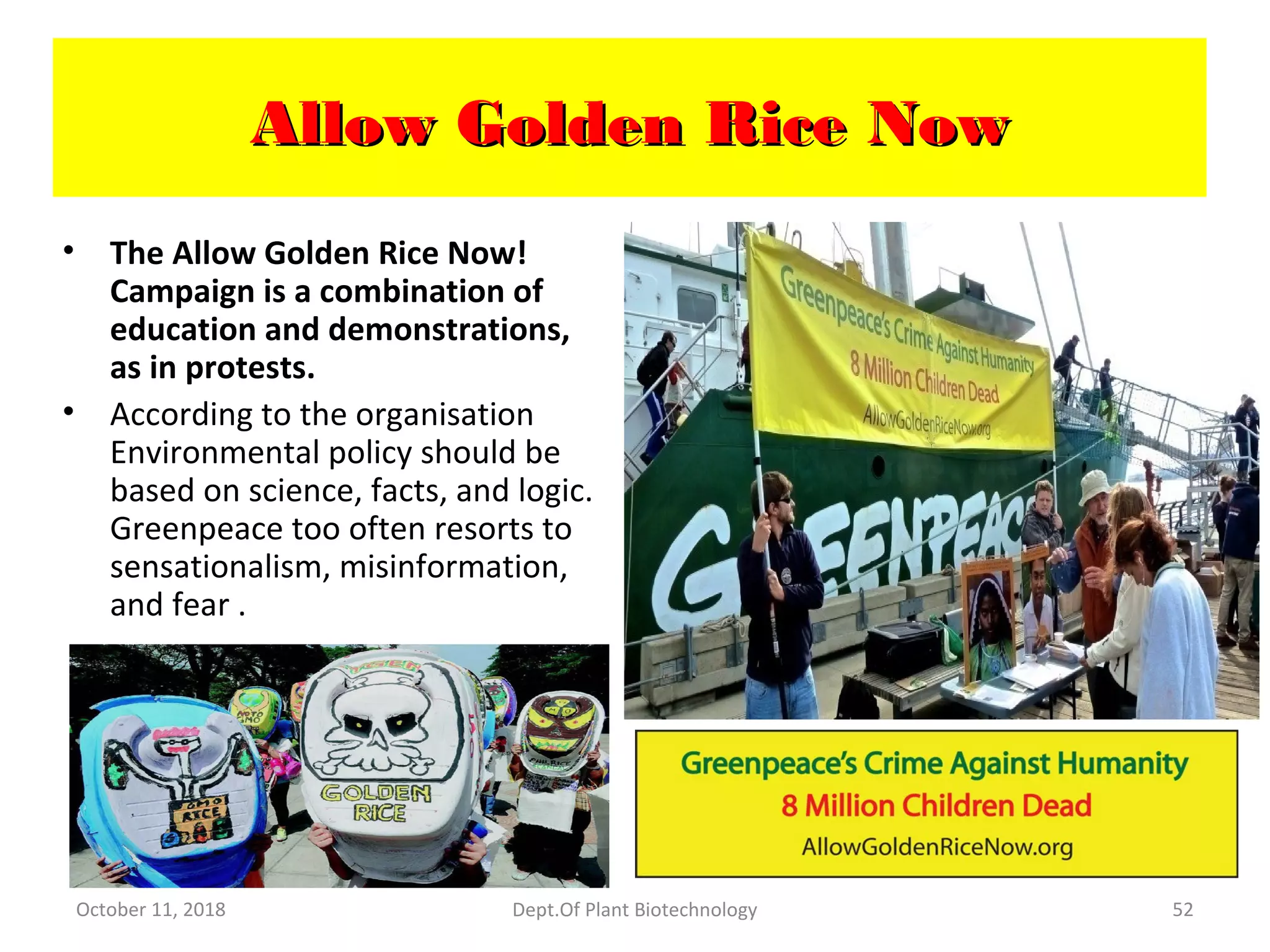
22Urban activists, supported by Greenpeace (these are not farmers) destroying
research crops in the Philippines in August 2015.
Allow Golden Rice NowAllow Golden Rice Now
• The Allow Golden Rice Now!
Campaign is a combination of
education and demonstrations,
as in protests.
• According to the organisation
Environmental policy should be
based on science, facts, and logic.
Greenpeace too often resorts to
sensationalism, misinformation,
and fear .
October 11, 2018 Dept.Of Plant Biotechnology 52
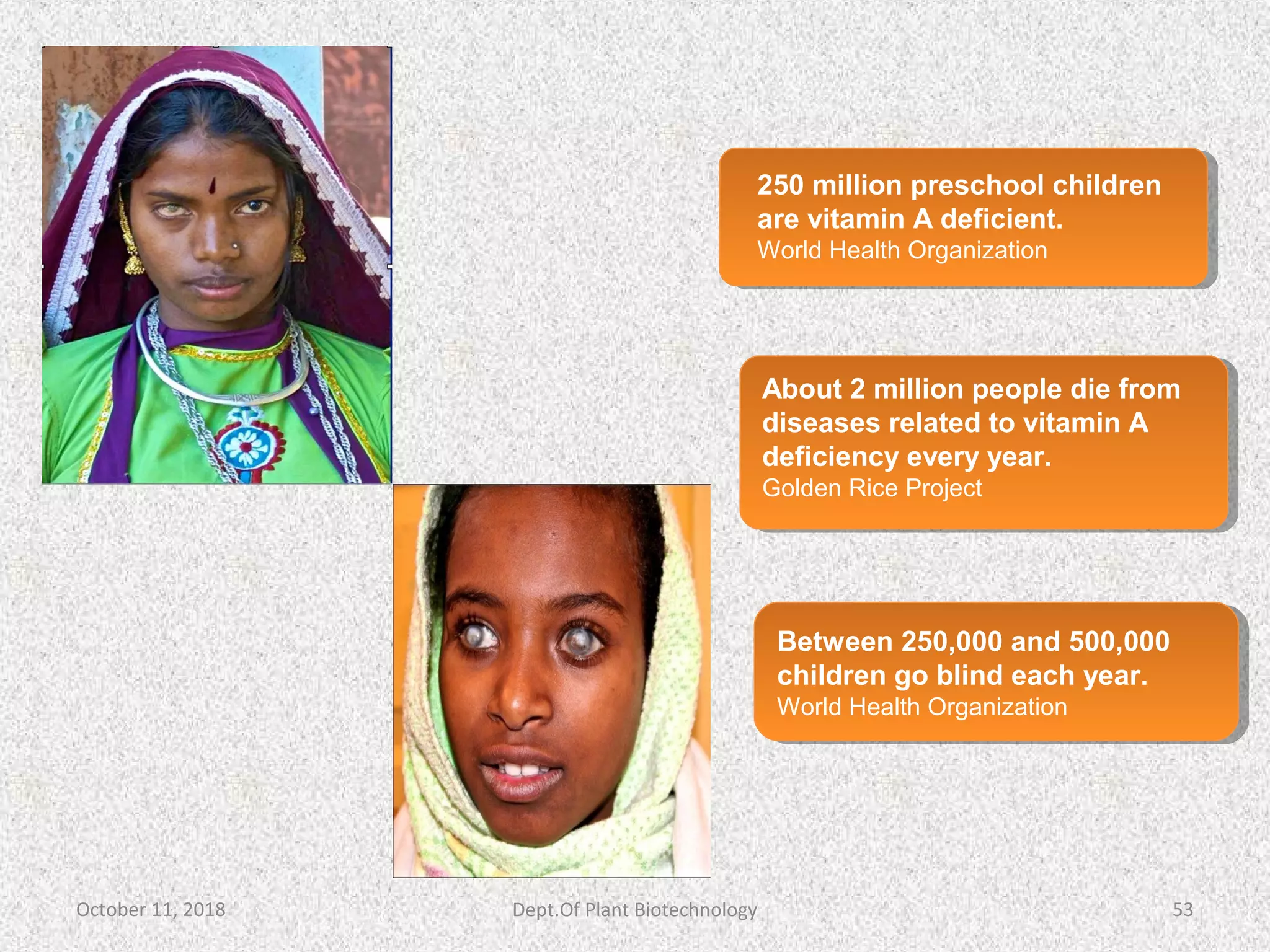
250 million preschool children
are vitamin A deficient.
World Health Organization
About 2 million people die from
diseases related to vitamin A
deficiency every year.
Golden Rice Project
Between 250,000 and 500,000
children go blind each year.
World Health Organization
October 11, 2018 53Dept.Of Plant Biotechnology
Allow Golden Rice Now!
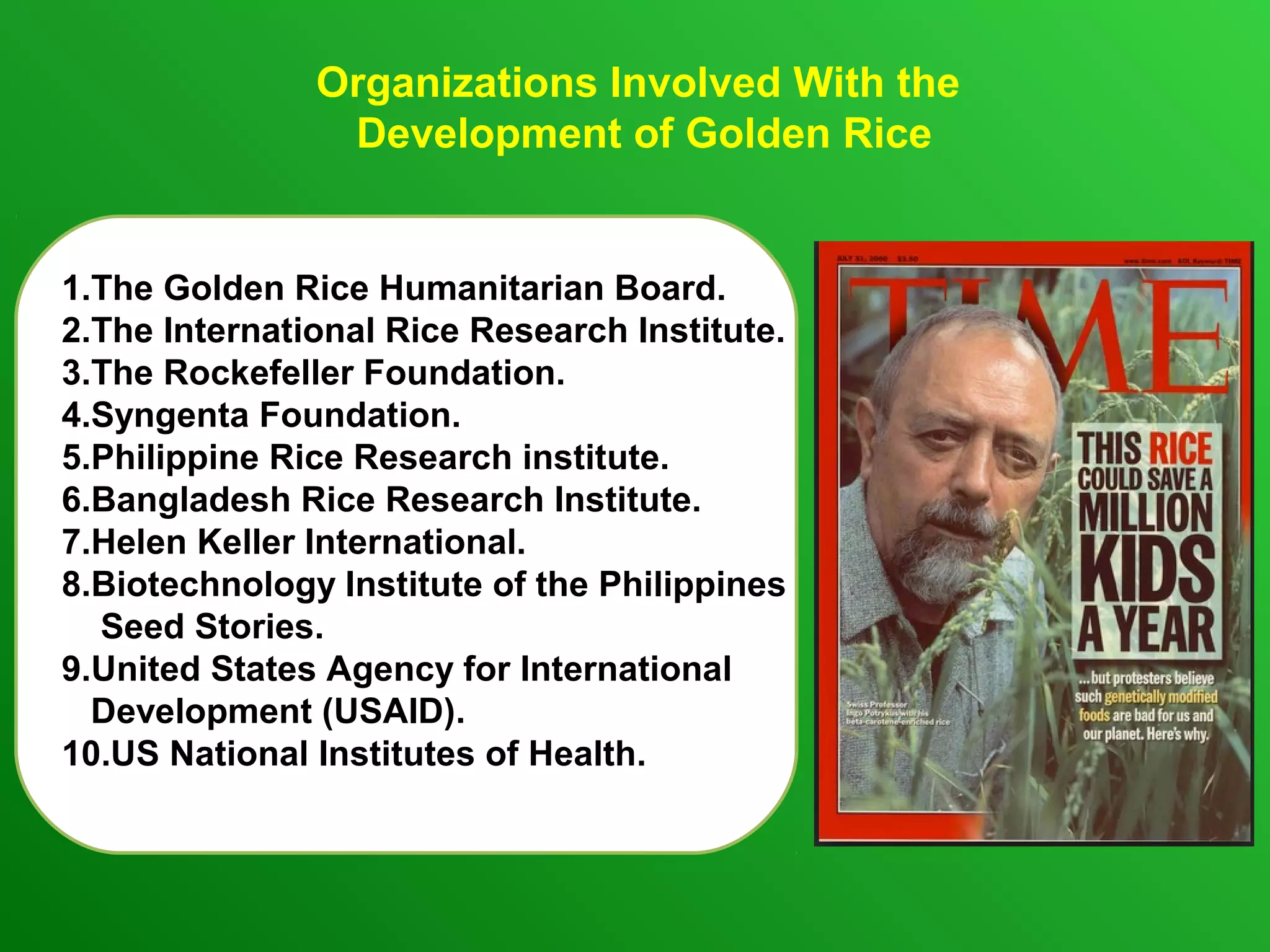
Organizations Involved With the
Development of Golden Rice
1.The Golden Rice Humanitarian Board.
2.The International Rice Research Institute.
3.The Rockefeller Foundation.
4.Syngenta Foundation.
5.Philippine Rice Research institute.
6.Bangladesh Rice Research Institute.
7.Helen Keller International.
8.Biotechnology Institute of the Philippines
Seed Stories.
9.United States Agency for International
Development (USAID).
10.US National Institutes of Health.
Mayan people join action to keep honey GEMayan people join action to keep honey GE
freefree
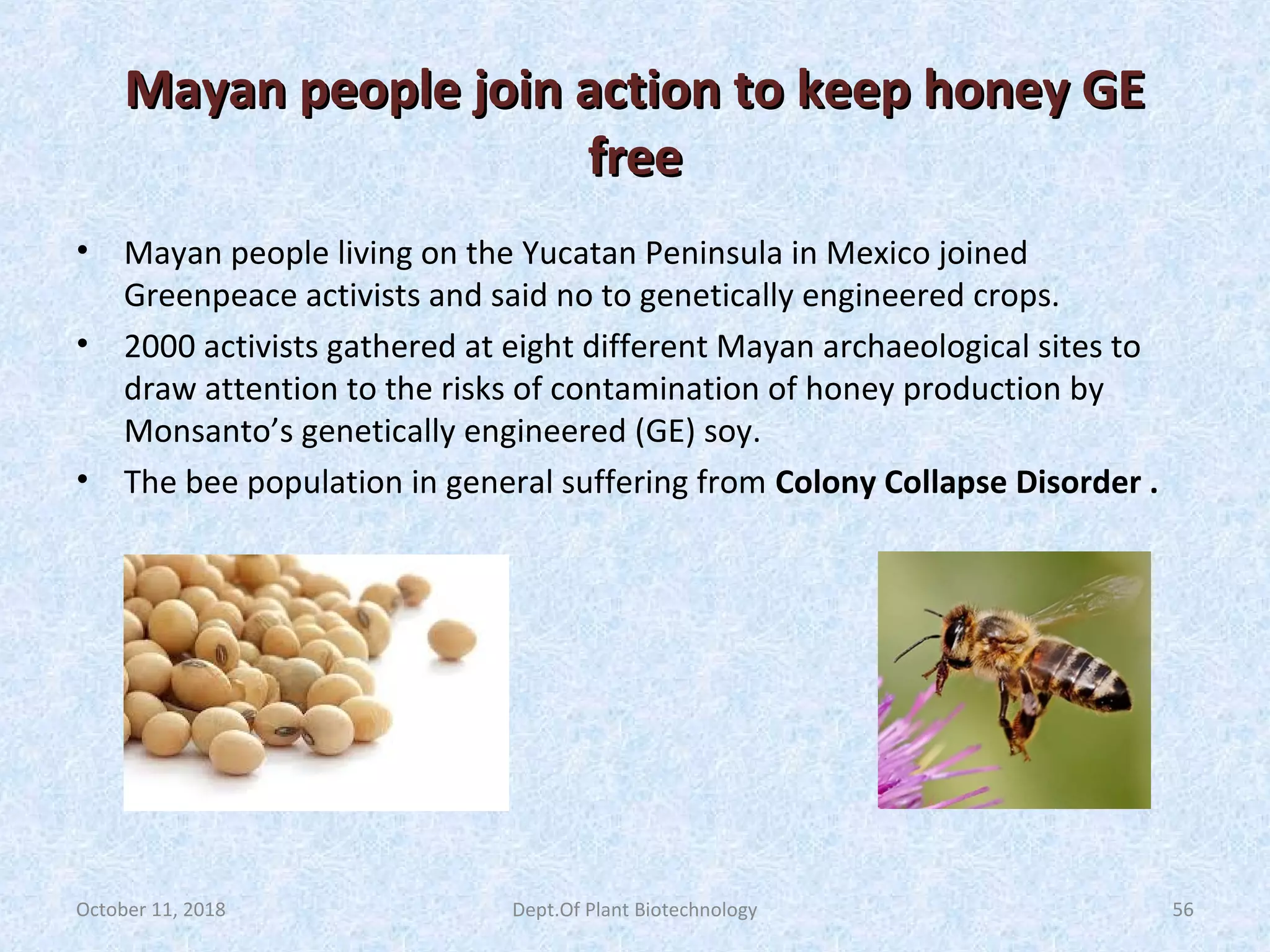
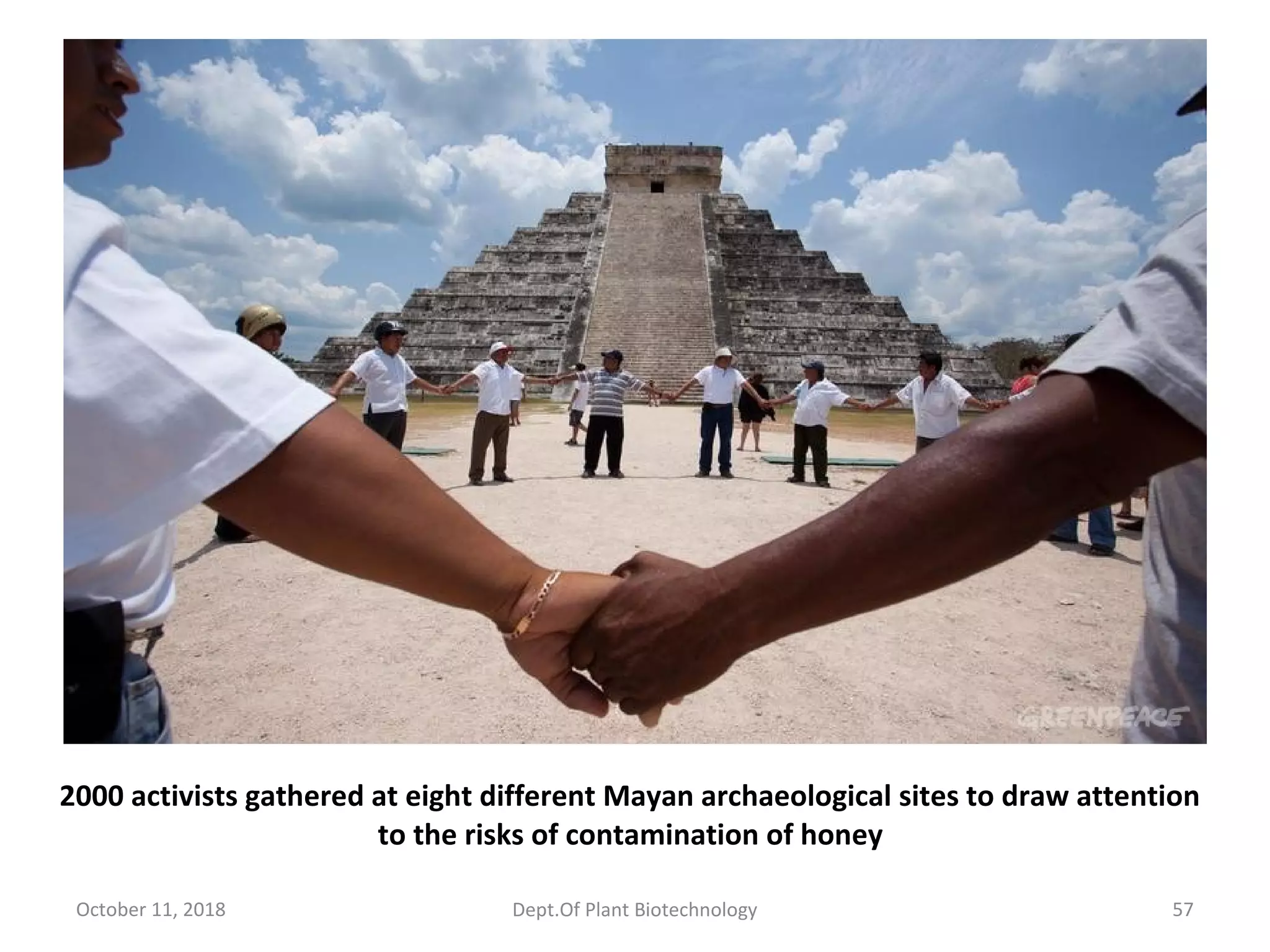
• Mayan people living on the Yucatan Peninsula in Mexico joined
Greenpeace activists and said no to genetically engineered crops.
• 2000 activists gathered at eight different Mayan archaeological sites to
draw attention to the risks of contamination of honey production by
Monsanto’s genetically engineered (GE) soy.
• The bee population in general suffering from Colony Collapse Disorder .
October 11, 2018 56Dept.Of Plant Biotechnology
2000 activists gathered at eight different Mayan archaeological sites to draw attention
to the risks of contamination of honey
October 11, 2018 Dept.Of Plant Biotechnology 57
Thai fruit exports worldwide under threat from
GMO papaya
• BANGKOK, Thailand — 7 July 2015 –
Greenpeace activists dumped
papayas at the Thailand’s Department
of Agriculture.
• In a protest against the government’s
disregard for consumer and
environmental protection caused by
the spread of illegal genetically
engineered (GE) papaya in Thailand.
• Scientific evidence confirmed that
Experimental Station was the source
of contamination.
October 11, 2018 58Dept.Of Plant Biotechnology
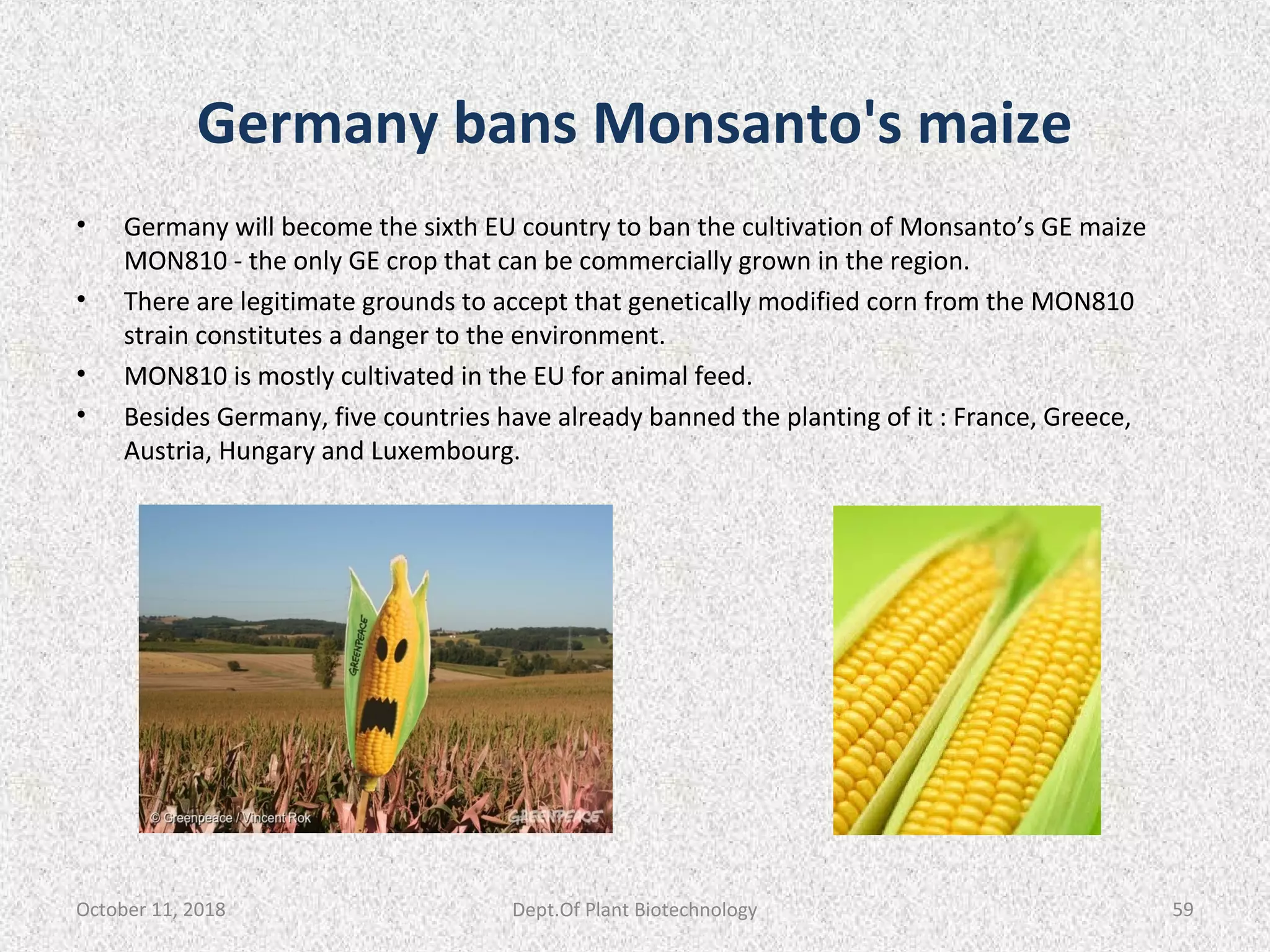
Germany bans Monsanto's maize
• Germany will become the sixth EU country to ban the cultivation of Monsanto’s GE maize
MON810 - the only GE crop that can be commercially grown in the region.
• There are legitimate grounds to accept that genetically modified corn from the MON810
strain constitutes a danger to the environment.
• MON810 is mostly cultivated in the EU for animal feed.
• Besides Germany, five countries have already banned the planting of it : France, Greece,
Austria, Hungary and Luxembourg.
October 11, 2018 59Dept.Of Plant Biotechnology
October 11, 2018 60Dept.Of Plant Biotechnology
October 11, 2018 61Dept.Of Plant Biotechnology
ConclusionConclusion
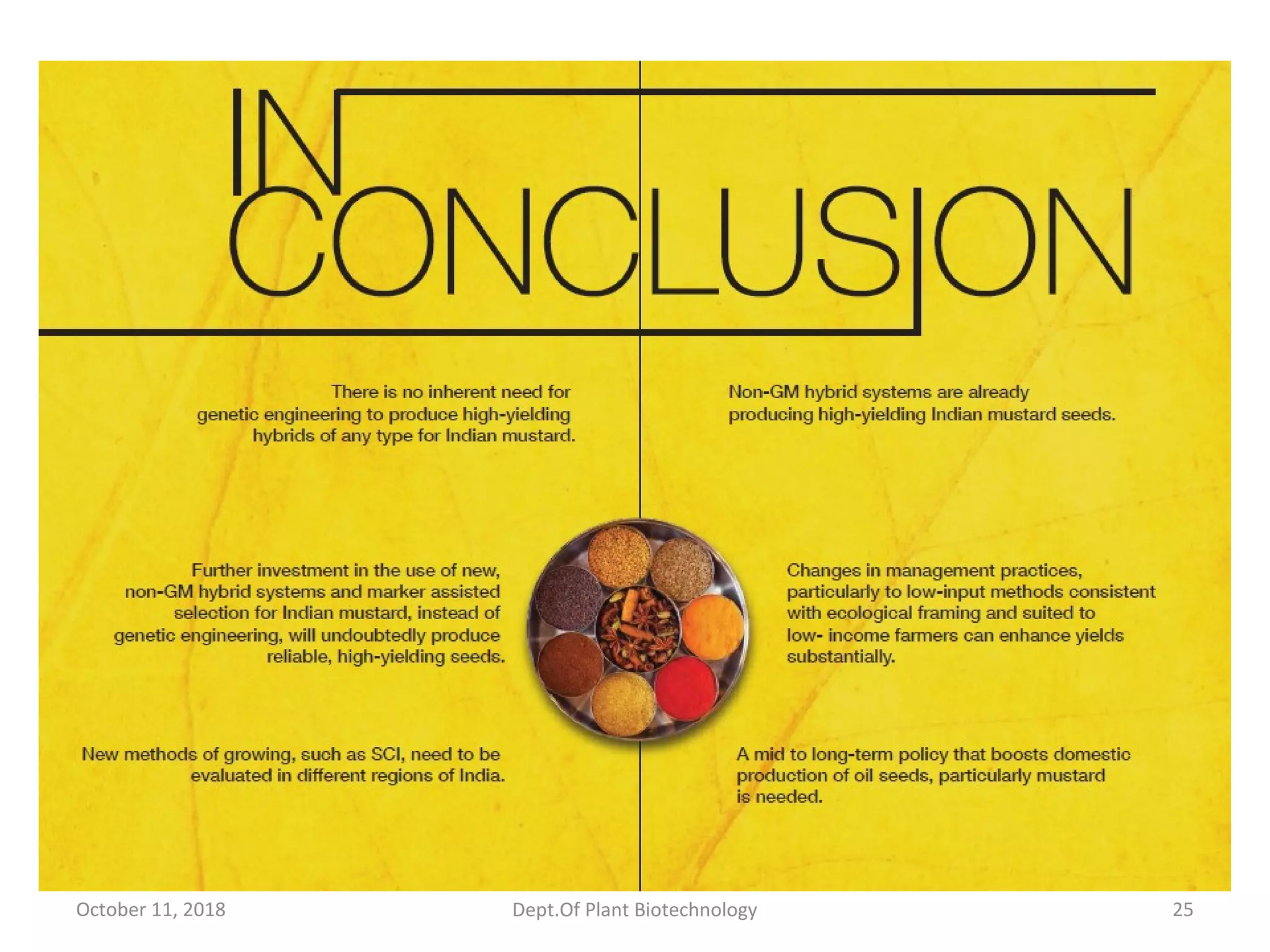
• Genetically-modified foods have the potential to solve many of the world's hunger
and malnutrition problems, and also protect and preserve the environment by
increasing yield and reducing chemical pesticides and herbicides.
• Yet there are many challenges ahead for governments, especially in the areas of
safety testing, regulation, international policy and food labeling.
• However, we must proceed with caution to avoid causing unintended harm to
human health and the environment as a result of our enthusiasm for this powerful
technology.
October 11, 2018 Dept.Of Plant Biotechnology 62
ReferencesReferences
• Google search & Newspaper articles on GM crops.
• ISAAA. 2016. Global Status of Commercialized Biotech/GM Crops: 2016. ISAAA
Brief No. 52. ISAAA: Ithaca, NY.
• Manas Ranjan Panda, Research Asst. DLAP (OUAT),Phulbani ,Odisha review
(2016).
• www.Greenpeace.org
• Whitman DB. (2015). Genetically modified foods: harmful or helpful. [Online]
Available from www.csa.com/discoveryguides/gmfood/ overview.php.
[Accessed October, 2012].
• ISAAA 2013 Annual Report Executive Summary, Global Status of Commercialized
Biotech/GM Crops: 2013 ISAAA Brief 46-2013, Retrieved 6 August 2014.
• Ian Berry, “Pesticides Make a Comeback,” The Wall Street Journal, May 21, 2013.
• GM crops: public perception and scientific solutions (Trends in Plant Science, Vol
4, No 12, pp 467-469,Dec 2015).
October 11, 2018 63Dept.Of Plant Biotechnology
October 11, 2018 64Dept.Of Plant Biotechnology
Thank You..!!

Pros and cons of Transgenic crops current scenario

  • 1.
    October 11, 2018Dept.Of Plant Biotechnology 1 Pros and cons of Transgenic Crops :Pros and cons of Transgenic Crops : National & International ScenarioNational & International Scenario Pros and cons of Transgenic Crops :Pros and cons of Transgenic Crops : National & International ScenarioNational & International Scenario Manjunath R PALB 6281 Jr. Msc. Plant Biotechnology
  • 2.
    October 11, 20182Dept.Of Plant Biotechnology
  • 3.
    GMO Crop –Potential Benefits GreenpeaceGreenpeace Indian ScenarioIndian Scenario International ScenarioInternational Scenario GMO Crop ControversiesGMO Crop Controversies ReferenceReference ConclusionConclusion 3October 11, 2018 Dept.Of Plant Biotechnology
  • 4.
    October 11, 20184Dept.Of Plant Biotechnology
  • 5.
    •What is aGMO? • GMOs are crops developed with genetic engineering, that enables to take individual traits found in nature and transfer them to another plant, or make changes to an existing trait in a plant. October 11, 2018 5Dept.Of Plant Biotechnology
  • 6.
    Insect resistance Season-longprotection against target pests, reduces the need for pesticide applications, and lowers input costs. Drought resistance Ability to grow in much drier areas, conserving water and other environmental resources. Herbicide tolerance Fight weeds by applying herbicides only when needed and enabling farmers to use no-till production methods that preserve topsoil, prevent erosion, and reduce carbon emissions. Disease resistance With GM, the papaya industry was able to recover from the devastating papaya ringspot virus that had crippled the industry. Enhanced nutritional profile High-oleic soybeans have been genetically modified to produce oil with more monounsaturated fat, less saturated fat and less trans fat. Golden Rice, which includes β-Carotene that could deliver vitamin A to children in developing nations. Why GMO? October 11, 2018 6Dept.Of Plant Biotechnology
  • 7.
    October 11, 2018Dept.Of Plant Biotechnology 7 Who grows GMOs? ISAAA, 2016
  • 8.
    • The misconceptionsseen across social media are: 1. If it’s extra-large, seedless, looks weird, tastes bad and feels squishy – it must be a GMO. 2. GMOs aren’t safe and they’re only tested by the companies making them. 3. There is animal DNA in GMOs. 4. GMOs have pesticides injected into them. 5. GMO companies force farmers to grow their crops, or sue farmers if GMO seeds or pollen blow into their fields. October 11, 2018 8Dept.Of Plant Biotechnology
  • 9.
    • GMO Safety:Safe to Eat • GMOs available today are as safe as their non-GMO counterparts. • They do not cause new allergies, cancer, infertility, ADHD, autism or any other diseases or conditions. • The safety of GMOs has been affirmed by: October 11, 2018 9Dept.Of Plant Biotechnology
  • 10.
    • GMO cropsare studied extensively to make sure they are safe for people, animals and the environment • GM seeds take an average of $136 million and 13 years to bring to market because of research, testing and regulatory approvals conducted by government agencies in the United States and around the world. McDougall,P. (2014). The Cost and Time Involved in the Discovery, Development and Authorization of a New Plant Biotechnology Derived Trait October 11, 2018 10Dept.Of Plant Biotechnology
  • 11.
    October 11, 201811Dept.Of Plant Biotechnology
  • 12.
    NutritionNutrition enrichmentenrichment • Goldenrice, developed by the International Rice Research Institute (IRRI), provides greater amounts of Vitamin-A and reducing Vitamin A deficiency syndrome in early childhood. • Modified Cavendish bananas express 10-fold the amount of Vitamin A as unmodified varieties. • GM soybeans offer improved oil profiles for processing and are healthier . • Camelina sativa has been modified to produce plants that accumulate high levels of oils similar to fish oils. October 11, 2018 Dept.Of Plant Biotechnology 12 Potential benefits of GM plantsPotential benefits of GM plants
  • 13.
    October 11, 201813Dept.Of Plant Biotechnology Vitamin enrichmentVitamin enrichment-- Golden rice,Golden rice, developed by the International Rice Research Institute (IRRI), Contains phytoene synthase & Carotene desaturase .
  • 14.
    Shelf Life • Thefirst GM approved for sale in the U.S. was the Flavr Savr tomato, which had a longer shelf life. • An apple has been genetically modified to resist browning, known as the Non- browning Arctic apple, awaiting regulatory approval in the US and Canada. • The apple produces less Polyphenol oxidase, a chemical that manifests the browning. Toxin reduction • A genetically modified cassava under development offers lower cyanogen glucosides and enhanced protein and other nutrients, called Bio-Cassava. • In November 2014, the USDA approved a potato, developed by J.R. Simplot Company that prevents bruising and produces less acryl amide. The modifications prevent natural, harmful proteins from being made via RNA interference. Acrylamide has been linked to some cancers. October 11, 2018 Dept.Of Plant Biotechnology 14
  • 15.
    Pathogen resistance • Tobacco,Corn, Rice, Cotton crops have been engineered to express genes encoding for insecticidal proteins from Bacillus thuringiensis (Bt). • Papaya, potatoes, and squash have been engineered to resist viral pathogens such as cucumber mosaic virus(CMV) . • As of 2015, trials were underway on genetically modified oranges that can resist citrus greening disease. • In response to a papaya ring spot virus (PRV) virus resistant papayas were developed by incorporating PRV DNA. October 11, 2018 Dept.Of Plant Biotechnology 15
  • 16.
    Genetically Modified CottonStandard Cotton October 11, 2018 16Dept.Of Plant Biotechnology
  • 17.
    Stress Resistance • Plantsengineered to tolerate non biological stress such as drought, frost, high soil salinity, and nitrogen starvation . • In 2011, Monsanto’s Drought Gard-maize became the first drought- resistant GM crop to receive US marketing approval. Yield • Herbicide-tolerant crops have lower production costs, while for insect- resistant crops the reduced pesticide use was offset by higher seed prices, leaving overall production costs about the same. • Yields increased 9% for herbicide tolerance and 25% for insect resistance. Farmers who adopted GM crops made 69% higher profits than those who did not. October 11, 2018 Dept.Of Plant Biotechnology 17 http://www.ers.usda.gov/briefing/biotechnology.
  • 18.
    Impacts of GMCrop Adoption Klümper W, Qaim M (2015) A Meta-Analysis of the Impacts of Genetically Modified Crops. PLoS ONE 9(11): e111629. doi:10.1371/journal.pone.0111629October 11, 2018 18Dept.Of Plant Biotechnology
  • 19.
    October 11, 2018Dept.Of Plant Biotechnology 19 Contribution Of Biotech Crops To Food Security, Sustainability And Climate Change
  • 20.
    GM crops-Pros • Improvedresistance to pests and diseases. • Improved resistance to Herbicide. • Production of more nutritious staple crops. • Contribute to food security , Sustainability. • Contributing to the alleviation of poverty and hunger.Contributing to the alleviation of poverty and hunger. • Increased crop productivity.Increased crop productivity. • Stability of production.Stability of production. • Economic and social benefits.Economic and social benefits. October 11, 2018 20Dept.Of Plant Biotechnology
  • 21.
    Bt Brinjal CommercialGrowing in Bangladesh October 11, 2018 21Dept.Of Plant Biotechnology
  • 22.
    Controversies of GMcropsControversies of GM crops 1. Human health - Allergen and toxin - Unknown effects on human health. 2. Environmental hazards - Unintended harm to other organisms. - Gene transfer to non-target species - BT resistance Insect. 3. Ethics – Tampering with nature by mixing genes among species . – Objections to consuming animal genes in plants. – Stress for animal (from whom gene is extracted). October 11, 2018 22Dept.Of Plant Biotechnology
  • 23.
    Cont.. 4. Access andintellectual property – Domination of world food production by companies. – Increasing dependence on industrialized nations by developing countries. – Bio piracy, or foreign exploitation of natural resources . 5. Labelling – Mandatory in India (2013), not mandatory in some countries (e.g. United States). – Mixing GM crops with non-GM products confounds labeling attempts. 6. Society – New advances may be skewed to interests of rich countries. October 11, 2018 Dept.Of Plant Biotechnology 23 Parsai G. Centre makes labelling of GM foods mandatory. [Online] Available from http://www.thehindu.com/news/national/article 3551679.ece. [Accessed October, 2013].
  • 24.
    October 11, 201824Dept.Of Plant Biotechnology The GM oilseed mustard DMH-11 (Tolerant to the herbicide, Glufosinate ammonium). The genetic engineering in the GM mustard aims to short cut the development of hybrids using male sterility by the insertion of genes known as the “bastar/barnase” system.
  • 25.
    October 11, 2018Dept.Of Plant Biotechnology 25
  • 26.
    Environmental hazardsEnvironmental hazards •Pollen from Bt corn caused high mortality rates in monarch butterfly caterpillars. • Monarch caterpillars consume milkweed plants, not corn, but the fear is that if pollen from Bt corn is blown by the wind onto milkweed plants in neighbouring fields, the caterpillars could eat the pollen and perish. October 11, 2018 Dept.Of Plant Biotechnology 26 Genes may escape & find their way into other members of species or other species.
  • 27.
    • Inadvertent cross-pollinationcould lead to the creation of “super weeds”. Insect-resistant crops could harm insect species that are not pests. • Corporations create and patent GM seeds, they will control the market. • This circumstance would be more likely to increase world hunger than to alleviate it. October 11, 2018 27Dept.Of Plant Biotechnology GM crops: public perception and scientific solutions (Trends in Plant Science, Vol 4, No 12, pp 467-469,Dec 2015)
  • 28.
    • Risks includepotential health problems for human beings, such as new or more virulent allergens and carcinogens, and increased resistance to antibiotics. October 11, 2018 28Dept.Of Plant Biotechnology GM crops: public perception and scientific solutions (Trends in Plant Science, Vol 4, No 12, pp 467-469,Dec 2015)
  • 29.
    Why GM cropsshould not be allowed in our country • GM crops have harmful effects on human, animal and environmental health. • Our food and farming will be controlled by bio-tech multinationals and our farmer’s livelihoods will be adversely affected. • GM crops will destroy bio-diversity and can even impact beneficial insects like bees and butterflies besides contaminating the wild gene pool. • GM crops once permitted will contaminate regular varieties of crops , thereby leaving no choice for consumers if they want to avoid GM food, or farmers if they want to avoid GM seeds. • Passing of alien genes from GM crops to other species through contamination is a serious threat. October 11, 2018 Dept.Of Plant Biotechnology 29
  • 30.
    Status of GMCrop in India • India is the number one cotton producing country in the world with cotton production of 35 million bales. • India had a slight decrease (7%) in bt cotton planting brought by a small reduction in the total cotton area (8%). • Biotech mustard expressing the barnase-barstar gene is under final review including public comments for environmental release in 2017. • Insect resistant chickpea and pigeon pea were approved for field trials by the government regulatory agency in 2016. October 11, 2018 Dept.Of Plant Biotechnology 30 ISAAA, 2016
  • 31.
    Global Area ofBiotech Crops in 2016 (Million Hectares) October 11, 2018 Dept.Of Plant Biotechnology 31 • * - Mega countries growing more biotech crops - ISAAA , 2016
  • 32.
    • 18 millionfarmers in 26 countries planted 185.1 million hectares (457.4 million acres) in 2016. • An increase of 3% or 5.4 million hectares (13.1 million acres) from 2015. October 11, 2018 Dept.Of Plant Biotechnology 32 26 countries (19 developing and 7 industrial countries grew biotech crops). Global Status of Commercialized GM Crops
  • 33.
    International Status ofGM crops • USA Major biotech crops: Maize, Soybean, cotton, Alfalfa, canola and sugar beet and small areas of virus resistant papaya and squash and non- browning Innate™ potatoes . • Brazil Similar to the U.S. they are almost optimal at an average of 93.4%. IR/HT soybean Intacta™ has gained popularity among the farmers because of the savings in pesticide and the no-till technology. • The need for continuous and steady supply of maize for pork and livestock industry in the country may push farmers to plant more maize in 2017. • Cotton, Maize, Soya bean . October 11, 2018 Dept.Of Plant Biotechnology 33
  • 34.
    • Argentina The countryplanted 23.82 million hectares, Crops in the country are Soybean, Maize , Cotton. The adverse weather condition was not conducive to wheat planting . • Canada The four biotech crops grown in Canada were canola , Soybean , Maize , Sugar beet and for the first time low lignin alfalfa. Canola Council of Canada actively pursues its Strategic Plan of producing 26 MMT canola by 2025 through yield improvement technologies. • Australia Farmers were provided BollgardIII/ RR®Flex cotton for extreme insect pest protection with herbicide tolerance. Bangladesh increased its Bt eggplant planting to 700 hectares and more brinjal varieties with Bt gene are being field tested for future commercialization. October 11, 2018 Dept.Of Plant Biotechnology 34
  • 35.
    BIOTECH CROPS: AGAME CHANGER • The first generation of biotech crops targeted input traits of herbicide tolerance, insect resistance and virus resistance where farmers and food producers benefited economic gains . • The second generation biotech crops include stacks of these traits, as well as drought tolerance – one of the problems related to climate change. Adoption of IR/HT soybean (Intacta™) and corn rootworm stacks for maize have been phenomenal with an economic benefit . • It is noteworthy that Innate™ potato series have been commercialized successfully in the USA, with 2,500 hectares of potatoes and 70,000 non- browning apple trees . October 11, 2018 Dept.Of Plant Biotechnology 35
  • 36.
    October 11, 2018Dept.Of Plant Biotechnology 36 Arctic AppleArctic AppleInnate PotatoInnate Potato
  • 37.
    October 11, 201837Dept.Of Plant Biotechnology
  • 38.
    Greenpeace is aglobal organisation that uses non- violent direct action to tackle the most crucial threats to our planet’s biodiversity and environment. Greenpeace is a non-profit organisation, present in 40 countries across Europe, Americas, Asia and the Pacific. It speaks for 2.8 million supporters worldwide, and inspires many millions more to take action everyday. October 11, 2018 Dept.Of Plant Biotechnology 38
  • 39.
    October 11, 201839Dept.Of Plant Biotechnology Indian Scenario
  • 40.
    GMO?GMO? OMG!OMG! No,Not Again..!No, Not Again..! • 15 years of Bt cotton cultivation in India – the insect for which Bt cotton has been created has developed resistance, and farmers are using more pesticides than ever before on cotton crop in the country. • Transgenic technology is unsafe: Genetic Engineering is an unnatural and imprecise breeding technology with living organisms, and that is an unstable, unpredictable, irreversible and uncontrollable technology. October 11, 2018 40Dept.Of Plant Biotechnology
  • 41.
    • Rapid emergenceof “Super-Weeds” (weeds that cannot be killed by herbicides) has been well documented. Also Impacts on non-target organisms also on soil health . • In countries like India where the largest number of female workers in the economy earn their livelihood mainly by manual de-weeding of “weeds”, use of Herbicide Tolerance crops will displace women from their existing opportunities . • GM mustard yield increase claims are wrong and unverified: There is ample evidence that the testing of GM mustard was deliberately designed to create favourable results for DMH-11, to the point of violating decisions taken by regulators. October 11, 2018 41Dept.Of Plant Biotechnology
  • 42.
    India is aCentre of Diversity for Mustard • India is a Centre of Diversity for Mustard. • Report From Agriculture Task Force led by Dr Swaminathan, reported to Supreme Court Technical Expert Committee(SC-TEC), there are clear recommendations against genetically modifying those crops for which we are the Centre of Origin/Diversity. October 11, 2018 42Dept.Of Plant Biotechnology
  • 43.
    “STOP GM TRIALS; MONSANTO, QUIT INDIA” Farmers protest at Monsanto’s GM Corn trial in Kolhapur • Hundreds of farmers from all across Maharashtra came to Kolhapur to protest against the open air experiment of Monsanto’s GM corn conducted in the farm of Mahatma Phule Krishi Vidyapeeth (MPKV) . • The peaceful sit-in ended when the university officials here assured that all pending concerns with regard to the trial would be responded in a special meeting. • If no satisfactory responses can be provided, the field trial will be destroyed by the university. October 11, 2018 43Dept.Of Plant Biotechnology
  • 44.
    October 11, 201844Dept.Of Plant Biotechnology Protest by Farmer communities in Front of Mahatma Phule krishi vidyapeeth
  • 45.
    International Scenario October 11,2018 Dept.Of Plant Biotechnology 45
  • 46.
    Illegal GE canolafound growing in Swiss port area • Switzerland has in fact had a Genetically Engineered (GE) ban in place since 2005 and the import of GE crops in foodstuffs and animal feed is prohibited. • Switzerland tested 136 canola plants and found 29 positive for GE, all of which were Monsanto´s herbicide-tolerant canola, GT73 (also called RT73). October 11, 2018 46Dept.Of Plant Biotechnology
  • 47.
    Genetically Engineered (GE)oilseed rape, or GE canola, was found growing in Switzerland where nobody actually cultivates it. October 11, 2018 47 Dept.Of Plant Biotechnology
  • 48.
    • Japanese researchersfound that GE canola had escaped into the wild. • GE canola is growing in many locations around the ports and roadsides from spillages of imported GE canola from Canada. • In Japan, farmers are concerned that radish, broccoli, mustard and non- GE canola may have been cross-pollinated with GE canola. • GE canola is mainly cultivated commercially in Canada and in the US, where it has contaminated non-GE canola. October 11, 2018 48Dept.Of Plant Biotechnology
  • 49.
    GREENPEACE CALLS FORACTION TO SOLVE (VAD) WITH MEASURES SUCH AS SUPPLEMENTATION (I.E. PILLS), FOOD FORTIFICATION AND IMPROVED USE AND ACCESS TO NATURAL SOURCES OF PRO-VITAMIN A (SUCH AS RED PALM OIL). A DIET RICH IN VITAMIN A AND OTHER MICRO-NUTRIENTS IS A LUXURY FOR MILLIONS OF POOR, NOT BECAUSE SUCH FOODS ARE NOT AVAILABLE IN THEIR COUNTRIES, BUT BECAUSE THEY CANNOT AFFORD THEM OR HAVE NO ACCESS TO THEM. THIS IS A PROBLEM THAT 'GOLDEN RICE' WOULD NOT SOLVE. GOLDEN RICEGOLDEN RICE October 11, 2018 Dept.Of Plant Biotechnology 49 "The False Promise of Genetically Engineered rice,” http://www.greenpeace.org/~geneng
  • 50.
    A Golden RiceField Trial at the Philippine Rice Research Institute
  • 51.
    22Urban activists, supportedby Greenpeace (these are not farmers) destroying research crops in the Philippines in August 2015.
  • 52.
    Allow Golden RiceNowAllow Golden Rice Now • The Allow Golden Rice Now! Campaign is a combination of education and demonstrations, as in protests. • According to the organisation Environmental policy should be based on science, facts, and logic. Greenpeace too often resorts to sensationalism, misinformation, and fear . October 11, 2018 Dept.Of Plant Biotechnology 52
  • 53.
    250 million preschoolchildren are vitamin A deficient. World Health Organization About 2 million people die from diseases related to vitamin A deficiency every year. Golden Rice Project Between 250,000 and 500,000 children go blind each year. World Health Organization October 11, 2018 53Dept.Of Plant Biotechnology
  • 54.
  • 55.
    Organizations Involved Withthe Development of Golden Rice 1.The Golden Rice Humanitarian Board. 2.The International Rice Research Institute. 3.The Rockefeller Foundation. 4.Syngenta Foundation. 5.Philippine Rice Research institute. 6.Bangladesh Rice Research Institute. 7.Helen Keller International. 8.Biotechnology Institute of the Philippines Seed Stories. 9.United States Agency for International Development (USAID). 10.US National Institutes of Health.
  • 56.
    Mayan people joinaction to keep honey GEMayan people join action to keep honey GE freefree • Mayan people living on the Yucatan Peninsula in Mexico joined Greenpeace activists and said no to genetically engineered crops. • 2000 activists gathered at eight different Mayan archaeological sites to draw attention to the risks of contamination of honey production by Monsanto’s genetically engineered (GE) soy. • The bee population in general suffering from Colony Collapse Disorder . October 11, 2018 56Dept.Of Plant Biotechnology
  • 57.
    2000 activists gatheredat eight different Mayan archaeological sites to draw attention to the risks of contamination of honey October 11, 2018 Dept.Of Plant Biotechnology 57
  • 58.
    Thai fruit exportsworldwide under threat from GMO papaya • BANGKOK, Thailand — 7 July 2015 – Greenpeace activists dumped papayas at the Thailand’s Department of Agriculture. • In a protest against the government’s disregard for consumer and environmental protection caused by the spread of illegal genetically engineered (GE) papaya in Thailand. • Scientific evidence confirmed that Experimental Station was the source of contamination. October 11, 2018 58Dept.Of Plant Biotechnology
  • 59.
    Germany bans Monsanto'smaize • Germany will become the sixth EU country to ban the cultivation of Monsanto’s GE maize MON810 - the only GE crop that can be commercially grown in the region. • There are legitimate grounds to accept that genetically modified corn from the MON810 strain constitutes a danger to the environment. • MON810 is mostly cultivated in the EU for animal feed. • Besides Germany, five countries have already banned the planting of it : France, Greece, Austria, Hungary and Luxembourg. October 11, 2018 59Dept.Of Plant Biotechnology
  • 60.
    October 11, 201860Dept.Of Plant Biotechnology
  • 61.
    October 11, 201861Dept.Of Plant Biotechnology
  • 62.
    ConclusionConclusion • Genetically-modified foodshave the potential to solve many of the world's hunger and malnutrition problems, and also protect and preserve the environment by increasing yield and reducing chemical pesticides and herbicides. • Yet there are many challenges ahead for governments, especially in the areas of safety testing, regulation, international policy and food labeling. • However, we must proceed with caution to avoid causing unintended harm to human health and the environment as a result of our enthusiasm for this powerful technology. October 11, 2018 Dept.Of Plant Biotechnology 62
  • 63.
    ReferencesReferences • Google search& Newspaper articles on GM crops. • ISAAA. 2016. Global Status of Commercialized Biotech/GM Crops: 2016. ISAAA Brief No. 52. ISAAA: Ithaca, NY. • Manas Ranjan Panda, Research Asst. DLAP (OUAT),Phulbani ,Odisha review (2016). • www.Greenpeace.org • Whitman DB. (2015). Genetically modified foods: harmful or helpful. [Online] Available from www.csa.com/discoveryguides/gmfood/ overview.php. [Accessed October, 2012]. • ISAAA 2013 Annual Report Executive Summary, Global Status of Commercialized Biotech/GM Crops: 2013 ISAAA Brief 46-2013, Retrieved 6 August 2014. • Ian Berry, “Pesticides Make a Comeback,” The Wall Street Journal, May 21, 2013. • GM crops: public perception and scientific solutions (Trends in Plant Science, Vol 4, No 12, pp 467-469,Dec 2015). October 11, 2018 63Dept.Of Plant Biotechnology
  • 64.
    October 11, 201864Dept.Of Plant Biotechnology Thank You..!!