What are GM’s?
Whatare GM’s?
are a result of technology that has
are a result of technology that has
altered the DNA of living organisms
altered the DNA of living organisms
(animals, plants or bacteria)
(animals, plants or bacteria)
Other terms that mean the same thing:
Other terms that mean the same thing:
Genetically engineered
Genetically engineered
Transgenic
Transgenic
Recombinant DNA (rDNA) technology
Recombinant DNA (rDNA) technology
3.
How does thisdiffer from Mendel
How does this differ from Mendel
and his peas?
and his peas?
GM vs. Selective breading
GM vs. Selective breading
Selective breading
Selective breading
-slow
-slow
-imprecise
-imprecise
-modification of genes that naturally occur in the organism
-modification of genes that naturally occur in the organism
GM
GM
-very fast
-very fast
-precise
-precise
-can introduce genes into an organism that would not
-can introduce genes into an organism that would not
occur naturally!
occur naturally!
4.
Why do it?
Whydo it?
Rice
Rice- not high in essential nutrients
- not high in essential nutrients
Modification:
Modification:
+ daffodil genes and a bacterium = beta-
+ daffodil genes and a bacterium = beta-
carotene content drastically increased
carotene content drastically increased
+ genes from a french bean = double the
+ genes from a french bean = double the
iron content.
iron content.
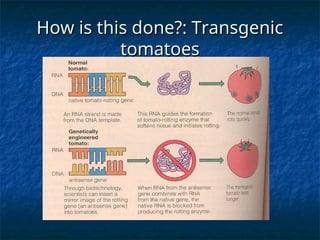
Tomatoes- Introduce genes to increase
Tomatoes- Introduce genes to increase
shelf life.
shelf life.
5.
How is thisdone?: Transgenic
How is this done?: Transgenic
tomatoes
tomatoes
6.
Other applications
Other applications
Potato - modified to produce a beetle killing
Potato - modified to produce a beetle killing
toxin
toxin
Yellow squash – modified to contain to viral
Yellow squash – modified to contain to viral
genes that resistant the most common viral
genes that resistant the most common viral
diseases
diseases
Develop foods that contain vaccines and
Develop foods that contain vaccines and
antibodies that offer valuable protection
antibodies that offer valuable protection
against diseases such as cholera, hepatitis,
against diseases such as cholera, hepatitis,
and malaria
and malaria
Canola – modified to resist one type of
Canola – modified to resist one type of
herbicide or pesticide
herbicide or pesticide
7.
A Local Example
ALocal Example:
:
: GM Canola
: GM Canola
Canadian-Australian Relations
Canadian-Australian Relations
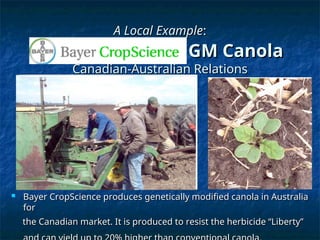
Bayer CropScience produces genetically modified canola in Australia
Bayer CropScience produces genetically modified canola in Australia
for
for
the Canadian market. It is produced to resist the herbicide “Liberty”
the Canadian market. It is produced to resist the herbicide “Liberty”
8.
Benefits of GeneticEngineering
Benefits of Genetic Engineering
and Modifying
and Modifying
1.
1. Higher yielding crops, more efficient use of
Higher yielding crops, more efficient use of
land
land
2. Can save money and promote higher profits
2. Can save money and promote higher profits
3. Longer shelf life, less waste
3. Longer shelf life, less waste
Example// Tomatoes from genetically
Example// Tomatoes from genetically
modified seeds stay fresh
modified seeds stay fresh
longer.
longer.
4. Enhanced taste and quality
4. Enhanced taste and quality
5. Reduced maturation time
5. Reduced maturation time
9.
Benefits of GeneticEngineering
Benefits of Genetic Engineering
and Modifying
and Modifying
6. Increased and improved nutrients and stress tolerance
6. Increased and improved nutrients and stress tolerance
- A single gene genetically engineered into cauliflower can increase
- A single gene genetically engineered into cauliflower can increase
production of beta-carotene 100 times.
production of beta-carotene 100 times.
- A gene can be implanted into a soybean upgrading the soy
- A gene can be implanted into a soybean upgrading the soy
protein
protein
to a quality equal to that of milk.
to a quality equal to that of milk.
- Corn can be modified to contain its two limiting amino acids,
- Corn can be modified to contain its two limiting amino acids,
lysine or tryptophan
lysine or tryptophan
7. Improved resistance to disease or illness
7. Improved resistance to disease or illness
- Foods can be enhanced with phytochemicals that help maintain
- Foods can be enhanced with phytochemicals that help maintain
health and reduce the risks of chronic disease.
health and reduce the risks of chronic disease.
8. Improved crop resistance to disease, pests, weeds and herbicides
8. Improved crop resistance to disease, pests, weeds and herbicides
9. New products and growing techniques
9. New products and growing techniques
- “Individuals allergic to milk may be able to buy milk that has been
- “Individuals allergic to milk may be able to buy milk that has been
treated with the lactase enzyme” (Whiney, 2002).
treated with the lactase enzyme” (Whiney, 2002).
- Creating decaffeinated coffee beans are in a process of research.
- Creating decaffeinated coffee beans are in a process of research.
10.
Benefits of GeneticEngineering
Benefits of Genetic Engineering
and Modifying
and Modifying
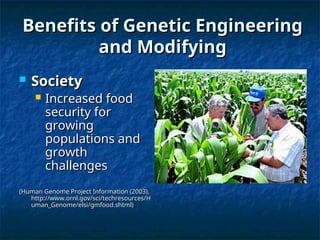
Society
Society
Increased food
Increased food
security for
security for
growing
growing
populations and
populations and
growth
growth
challenges
challenges
(Human Genome Project Information (2003),
(Human Genome Project Information (2003),
http://www.ornl.gov/sci/techresources/H
http://www.ornl.gov/sci/techresources/H
uman_Genome/elsi/gmfood.shtml)
uman_Genome/elsi/gmfood.shtml)
11.
Who Uses thistechnology
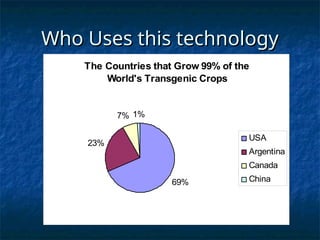
Who Uses this technology
The Countries that Grow 99% of the
World's Transgenic Crops
69%
23%
7% 1%
USA
Argentina
Canada
China
12.
Risks associated withGenetic
Risks associated with Genetic
Modification
Modification
1.
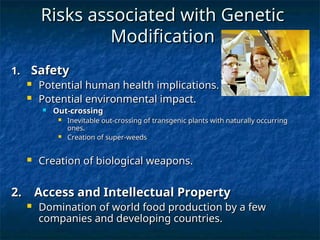
1. Safety
Safety
Potential human health implications.
Potential human health implications.
Potential environmental impact.
Potential environmental impact.
Out-crossing
Out-crossing
Inevitable out-crossing of transgenic plants with naturally occurring
Inevitable out-crossing of transgenic plants with naturally occurring
ones.
ones.
Creation of super-weeds
Creation of super-weeds
Creation of biological weapons.
Creation of biological weapons.
2. Access and Intellectual Property
2. Access and Intellectual Property
Domination of world food production by a few
Domination of world food production by a few
companies and developing countries.
companies and developing countries.
13.
Risks associated withGenetic
Risks associated with Genetic
Modification – cont.
Modification – cont.
3. Ethics
3. Ethics
“
“Playing God”
Playing God”
Tampering with nature by mixing genes among species.
Tampering with nature by mixing genes among species.
4. Labeling
4. Labeling
Not mandatory in some countries (e.g., Canada and the United
Not mandatory in some countries (e.g., Canada and the United
States).
States).
Mixing GM crops with non-GM confounds labeling attempts.
Mixing GM crops with non-GM confounds labeling attempts.
5. Society
5. Society
New advances may be skewed to the interests of rich countries.
New advances may be skewed to the interests of rich countries.
(Human Genome Project Information (2003),
(Human Genome Project Information (2003),
http://www.ornl.gov/sci/techresources/Human_Genome/elsi/gmfood.shtml)
http://www.ornl.gov/sci/techresources/Human_Genome/elsi/gmfood.shtml)
14.
Risks with GMcontinued:
Risks with GM continued:
Biodiversity
Biodiversity
Addition of Bt gene into plants including corn,
Addition of Bt gene into plants including corn,
potatoes and cotton to increase resistance to plants
potatoes and cotton to increase resistance to plants
Bt gene obtained from
Bt gene obtained from Bacillus thuringiensis (a
Bacillus thuringiensis (a soil
soil
bacterium that produces a natural insecticide)
bacterium that produces a natural insecticide)
Problem: plants producing Bt toxin are releasing
Problem: plants producing Bt toxin are releasing
toxin in pollen
toxin in pollen
Draper, D. (2002).
Draper, D. (2002). Our Environment: A Canadian Perspective 2nd Ed
Our Environment: A Canadian Perspective 2nd Ed. Scarborough: Thompson
. Scarborough: Thompson
Canada Lmt.
Canada Lmt.
15.
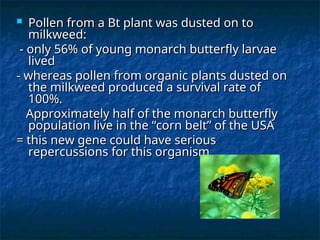
Pollen froma Bt plant was dusted on to
Pollen from a Bt plant was dusted on to
milkweed:
milkweed:
- only 56% of young monarch butterfly larvae
- only 56% of young monarch butterfly larvae
lived
lived
- whereas pollen from organic plants dusted on
- whereas pollen from organic plants dusted on
the milkweed produced a survival rate of
the milkweed produced a survival rate of
100%.
100%.
Approximately half of the monarch butterfly
Approximately half of the monarch butterfly
population live in the “corn belt” of the USA
population live in the “corn belt” of the USA
= this new gene could have serious
= this new gene could have serious
repercussions for this organism
repercussions for this organism
16.
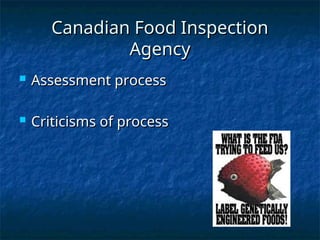
Canadian Food Inspection
CanadianFood Inspection
Agency
Agency
Genetically modified foods are currently
Genetically modified foods are currently
regulated by the CFIA
regulated by the CFIA
works collaboratively with Environment
works collaboratively with Environment
Canada, Health Canada, and Fisheries and
Canada, Health Canada, and Fisheries and
Oceans
Oceans
Goal: to ensure that products of biotechnology
Goal: to ensure that products of biotechnology
are considered safe to human and animal
are considered safe to human and animal
health and the environment.
health and the environment.
According to the CFIA, the assessment process
According to the CFIA, the assessment process
for GE foods is very rigorous
for GE foods is very rigorous
17.
Canadian Food Inspection
CanadianFood Inspection
Agency
Agency
Assessment process
Assessment process
Criticisms of process
Criticisms of process
Literature Cited:
Literature Cited:
1. Canadian Food Inspection Agency. Novel Foods Retrieved April 1, 2002, from the World Wide
Web: http://www.inspection.gc.ca/english/plaveg/pbo/pbobbve.shtml
2. Canadian Food Inspection Agency.(2000) Plant Health and production division, plant biosafety
office on Regulatory directive 2000-07: Guidelines for the environmental release of plants with
novel traits within confined field trails in Canada. Retrieved April 4, 2002, from the World Wide Web:
http://www.inspection.gc.ca/english/plaveg/pbo/dir/dir0007e.shtml
3. Draper, D. (1998). Our Environment: A Canadian Perspective 1st Ed. Scarborough: Thompson
Canada Lmt.
4. Draper, D. (2002). Our Environment: A Canadian Perspective 2nd Ed. Scarborough: Thompson
Canada Lmt.
5. Jones, L. (1999, February 27). Genetically modified foods. British Medical Journal. [Journal,
Online]. Retrieved April 1, 2002, from the World Wide Web:
http://www.findarticles.com/cf_0m0999/7183_318/5417903/print.jhtml
6. Health Canada. Retrieved April 1, 2002, from the World Wide Web: http://www.hc-sc.gc.ca/food-
aliment/mh-dm/ofb-bba/nfi-ani/e_novel_foods_and_ingredient.html
7. Health Canada. A Bureau of Food Policy Integration (Food Directorate) Response to: Food Safety
of GM Crops in Canada: toxicity and allergenicity: Retrieved April 5, 2002 from the World Wide Web:
http://www.hc-sc.gc.ca/food-aliment/mh-dm/ofb-bba/nfi-ani/e_health_canada_response_gmo.html
8. McCalla, D.R. (2000). Why we should proceed cautiously with plant biotechnology? Retrieved
April 4, 2002, from the World Wide Web: http://www.canadians.org/ge-alert/
9. Mitchell, B.C. (1997). Resource and Environmental Management 2nd Ed. Harlow: Pearson
Education Lmt.
10. Reason Online. Retrieved April 1, 2002, from the World Wide Web: http://reason.com/bi/bi-
gmf.shtm
12. Steiner, M. (2000, May 9) Petition to the Auditor General: By the Sierra Legal Defense Fund.
Retrieved April 6, 2002, from the World Wide Web:
http://www.sierralegal.org/m%5Farchive/2000/pr00%5F05%5F09b.htm
13. Sizer, F., Whitney, E. (1997). Nutrition Concepts and Controversies 7
13. Sizer, F., Whitney, E. (1997). Nutrition Concepts and Controversies 7th
th
Edition. Waltsworth
Edition. Waltsworth
publishing Company: Belmont Ca.
publishing Company: Belmont Ca.
14. Whitney, E.N., Rolfes, S.R. (2002). Understanding Nutrition. 9
14. Whitney, E.N., Rolfes, S.R. (2002). Understanding Nutrition. 9th
th
Ed. Wadsworth Group: Belmont
Ed. Wadsworth Group: Belmont
Ca.
Ca.

![Literature Cited:
Literature Cited:
1. Canadian Food Inspection Agency. Novel Foods Retrieved April 1, 2002, from the World Wide
Web: http://www.inspection.gc.ca/english/plaveg/pbo/pbobbve.shtml
2. Canadian Food Inspection Agency.(2000) Plant Health and production division, plant biosafety
office on Regulatory directive 2000-07: Guidelines for the environmental release of plants with
novel traits within confined field trails in Canada. Retrieved April 4, 2002, from the World Wide Web:
http://www.inspection.gc.ca/english/plaveg/pbo/dir/dir0007e.shtml
3. Draper, D. (1998). Our Environment: A Canadian Perspective 1st Ed. Scarborough: Thompson
Canada Lmt.
4. Draper, D. (2002). Our Environment: A Canadian Perspective 2nd Ed. Scarborough: Thompson
Canada Lmt.
5. Jones, L. (1999, February 27). Genetically modified foods. British Medical Journal. [Journal,
Online]. Retrieved April 1, 2002, from the World Wide Web:
http://www.findarticles.com/cf_0m0999/7183_318/5417903/print.jhtml
6. Health Canada. Retrieved April 1, 2002, from the World Wide Web: http://www.hc-sc.gc.ca/food-
aliment/mh-dm/ofb-bba/nfi-ani/e_novel_foods_and_ingredient.html
7. Health Canada. A Bureau of Food Policy Integration (Food Directorate) Response to: Food Safety
of GM Crops in Canada: toxicity and allergenicity: Retrieved April 5, 2002 from the World Wide Web:
http://www.hc-sc.gc.ca/food-aliment/mh-dm/ofb-bba/nfi-ani/e_health_canada_response_gmo.html
8. McCalla, D.R. (2000). Why we should proceed cautiously with plant biotechnology? Retrieved
April 4, 2002, from the World Wide Web: http://www.canadians.org/ge-alert/
9. Mitchell, B.C. (1997). Resource and Environmental Management 2nd Ed. Harlow: Pearson
Education Lmt.
10. Reason Online. Retrieved April 1, 2002, from the World Wide Web: http://reason.com/bi/bi-
gmf.shtm
12. Steiner, M. (2000, May 9) Petition to the Auditor General: By the Sierra Legal Defense Fund.
Retrieved April 6, 2002, from the World Wide Web:
http://www.sierralegal.org/m%5Farchive/2000/pr00%5F05%5F09b.htm
13. Sizer, F., Whitney, E. (1997). Nutrition Concepts and Controversies 7
13. Sizer, F., Whitney, E. (1997). Nutrition Concepts and Controversies 7th
th
Edition. Waltsworth
Edition. Waltsworth
publishing Company: Belmont Ca.
publishing Company: Belmont Ca.
14. Whitney, E.N., Rolfes, S.R. (2002). Understanding Nutrition. 9
14. Whitney, E.N., Rolfes, S.R. (2002). Understanding Nutrition. 9th
th
Ed. Wadsworth Group: Belmont
Ed. Wadsworth Group: Belmont
Ca.
Ca.](https://image.slidesharecdn.com/2-250511234959-4a397078/85/2-3-Genetically-Modified-Organisms-1-ppt-19-320.jpg)


