FINGERPRINT
BIOMETRICS
  ESD PRESENTATION
       GROUP 2
BIOMETRICS
• Biometrics (or biometric authentication refers
  to the identification of humans by their
  characteristics or traits. Biometrics is used in
  computer science as a form of identification
  and access control. It is also used to identify
  individuals in groups that are under
  surveillance
TYPES OF BIOMETRICS
•   DNA MATCHING
•   EAR
•   EYES-IRIS RECOGNITION
•   VOICE RECOGNITION
•   FACE
•   FINGERPRINT RECOGNITION
•   FINGER GEOMETRY RECOGNITION
•   SO ON….
WHY FINGERPRINTS
• Very high accuracy.
• Is the most economical biometric PC user
  authentication technique.
• it is one of the most developed biometrics
• Easy to use.
• Small storage space required for the biometric
  template, reducing the size of the database
  memory required
• It is standardized.
IT’S AN EMBEDDED SYSTEM!!!!!
BASIC ELEMENTS OF A TYPICAL
  FINGERPRINT BIOMETRIC SYSTEM
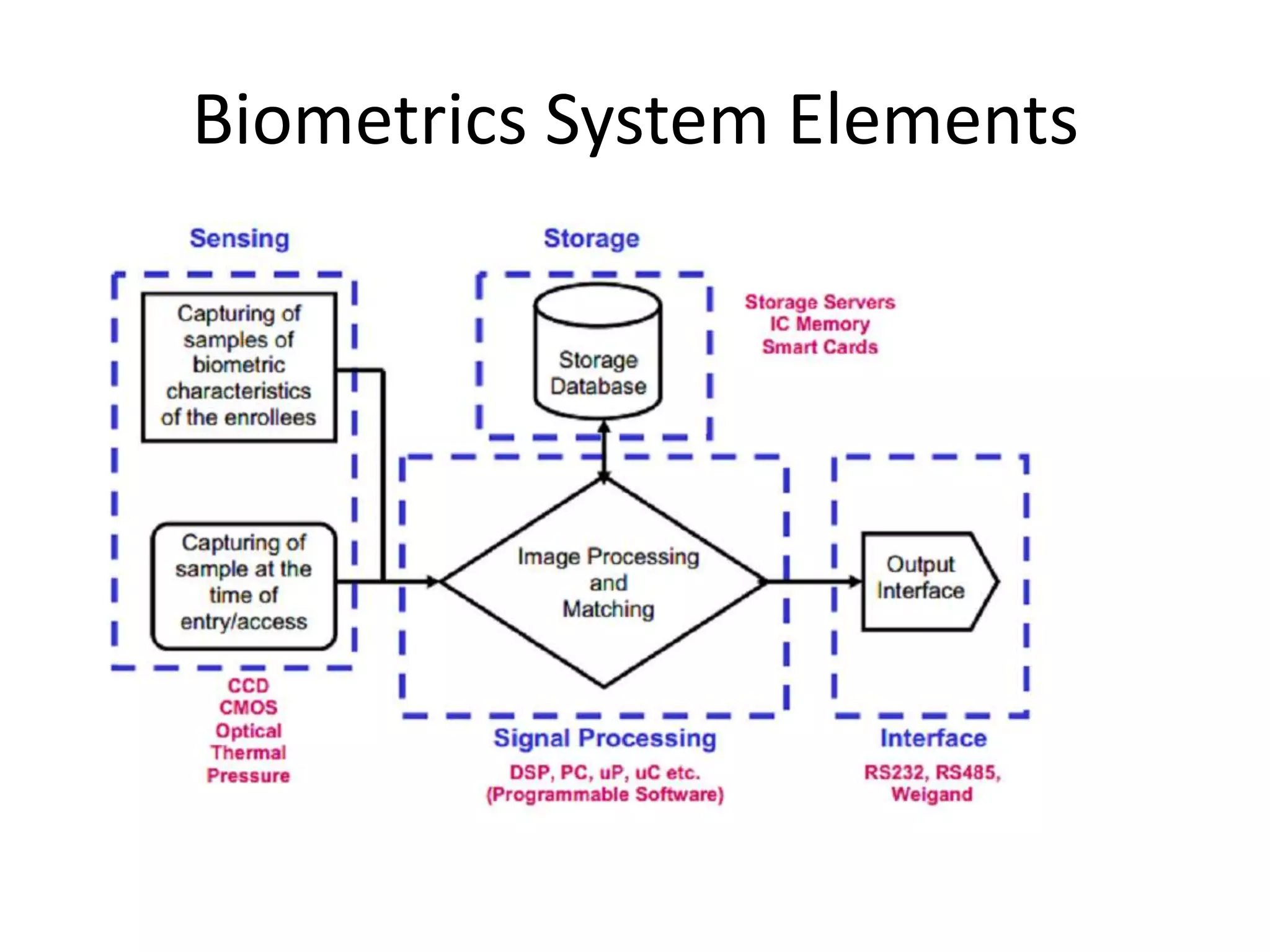
• Sensing

• Processing

• Storage

• Interface
Biometrics System Elements
THE SENSOR
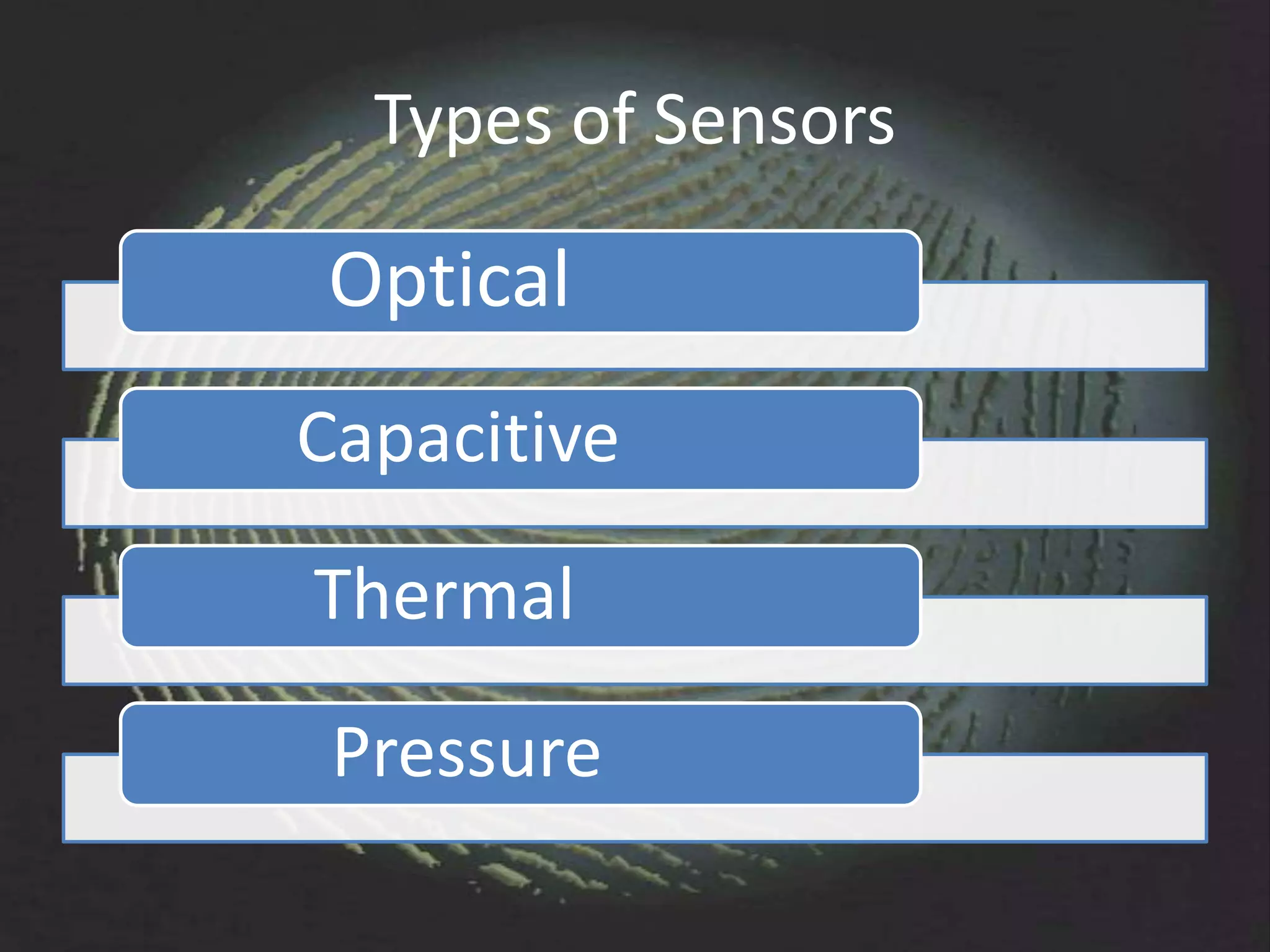
Types of Sensors

Optical
Capacitive

Thermal

 Pressure
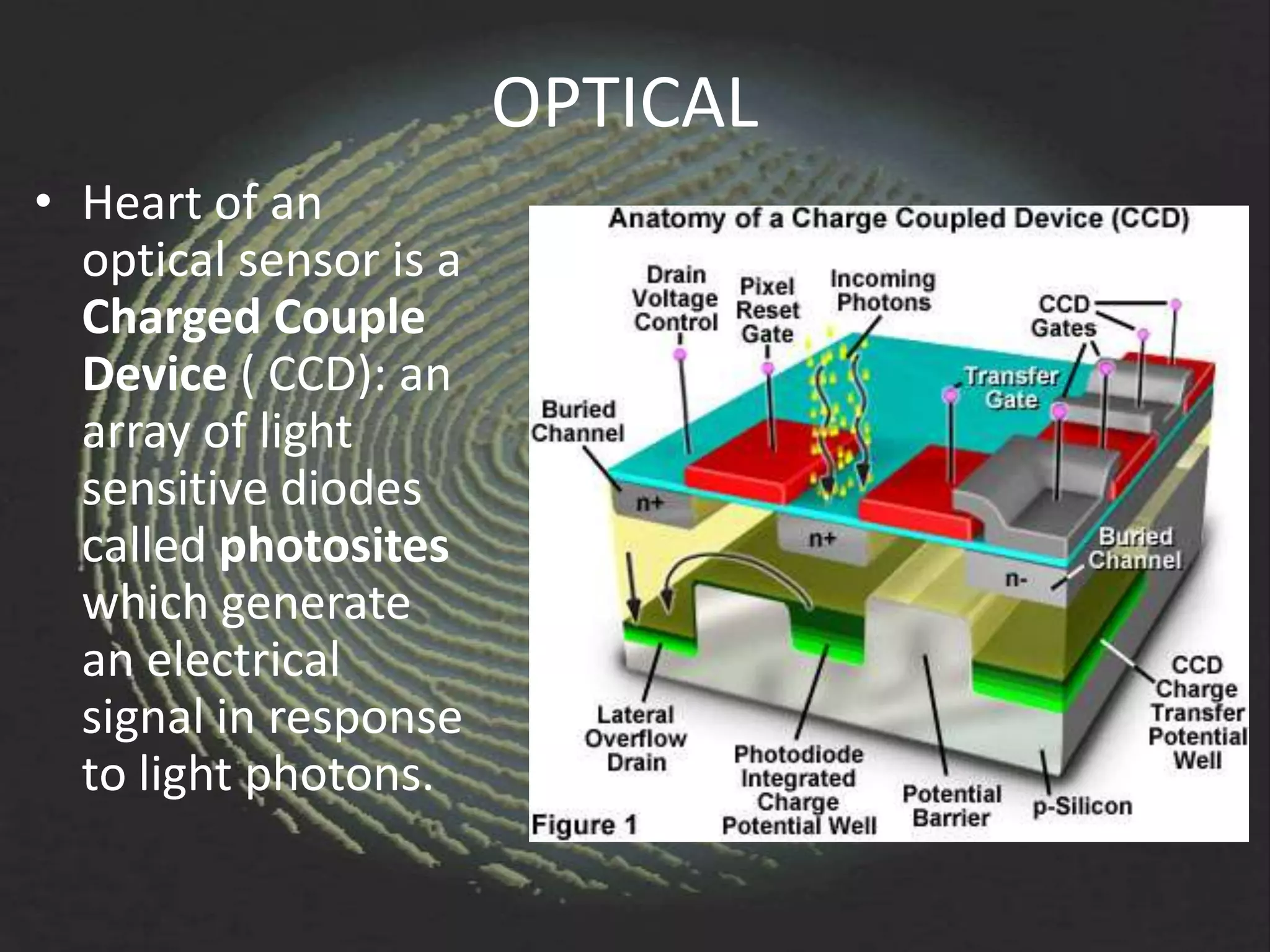
OPTICAL
• Heart of an
  optical sensor is a
  Charged Couple
  Device ( CCD): an
  array of light
  sensitive diodes
  called photosites
  which generate
  an electrical
  signal in response
  to light photons.
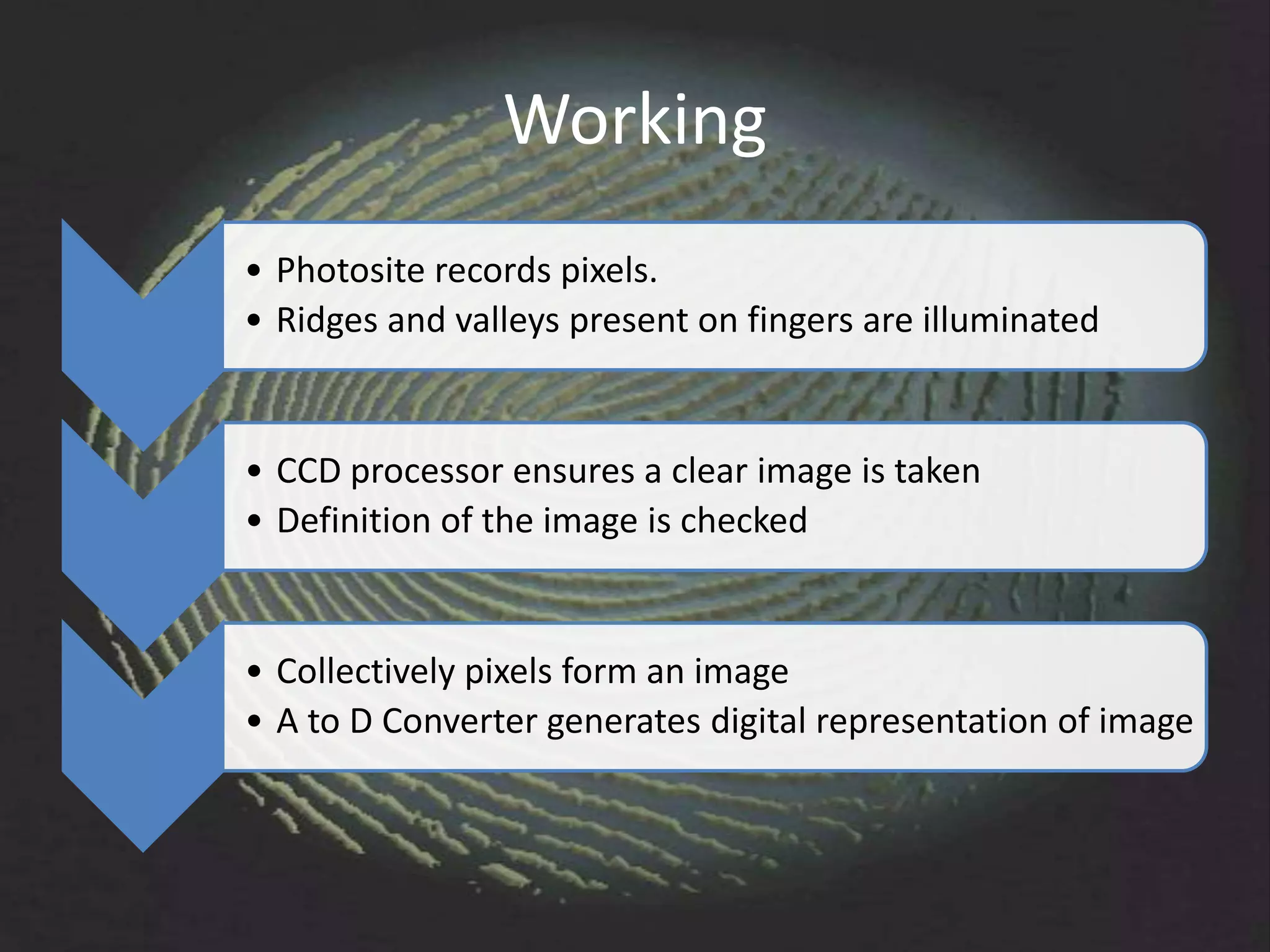
Working
• Photosite records pixels.
• Ridges and valleys present on fingers are illuminated


• CCD processor ensures a clear image is taken
• Definition of the image is checked


• Collectively pixels form an image
• A to D Converter generates digital representation of image
How capacitive touch
      works
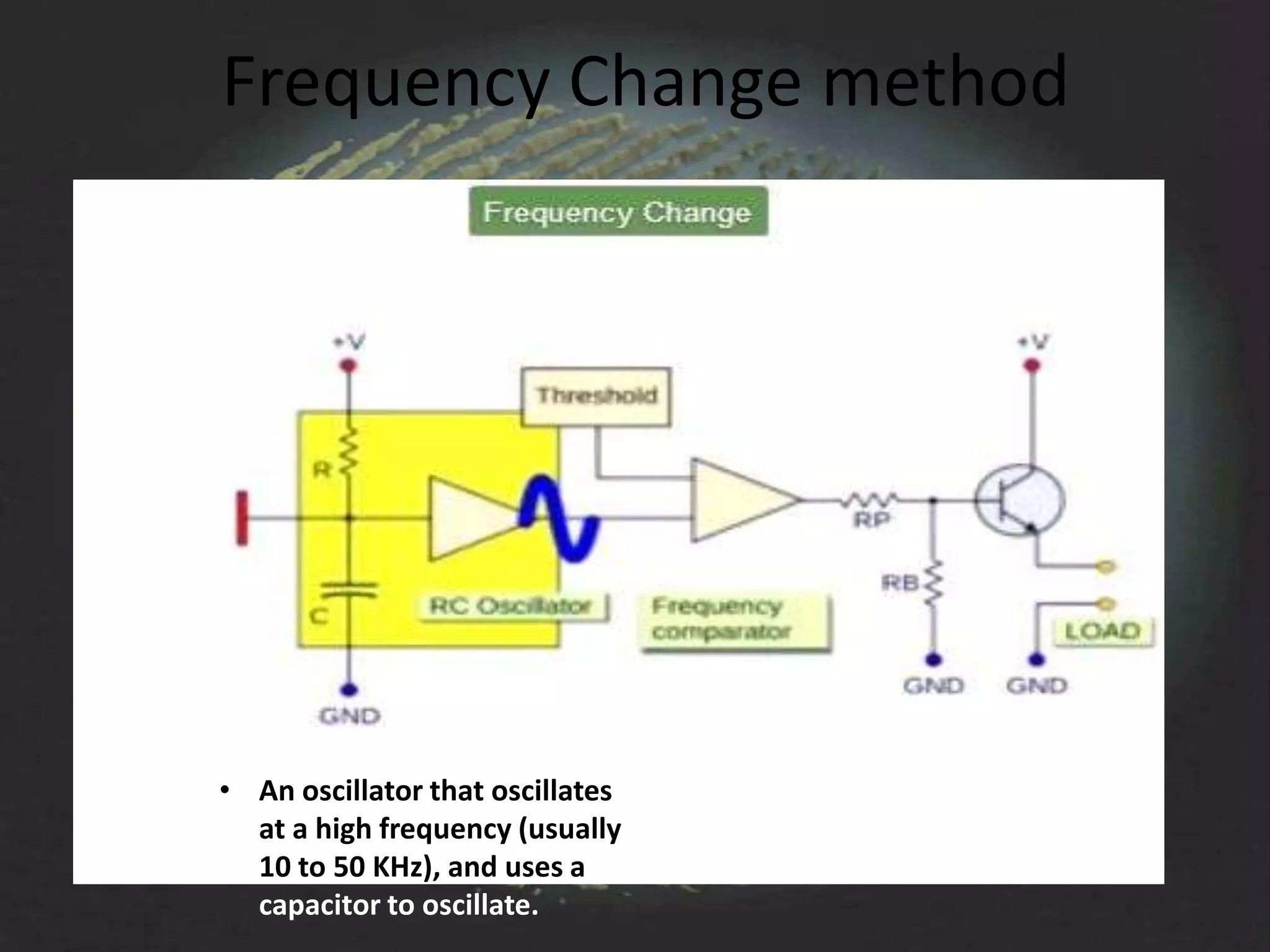
Frequency Change method


• An oscillator that oscillates
  at a high frequency (usually
  10 to 50 KHz), and uses a
  capacitor to oscillate.
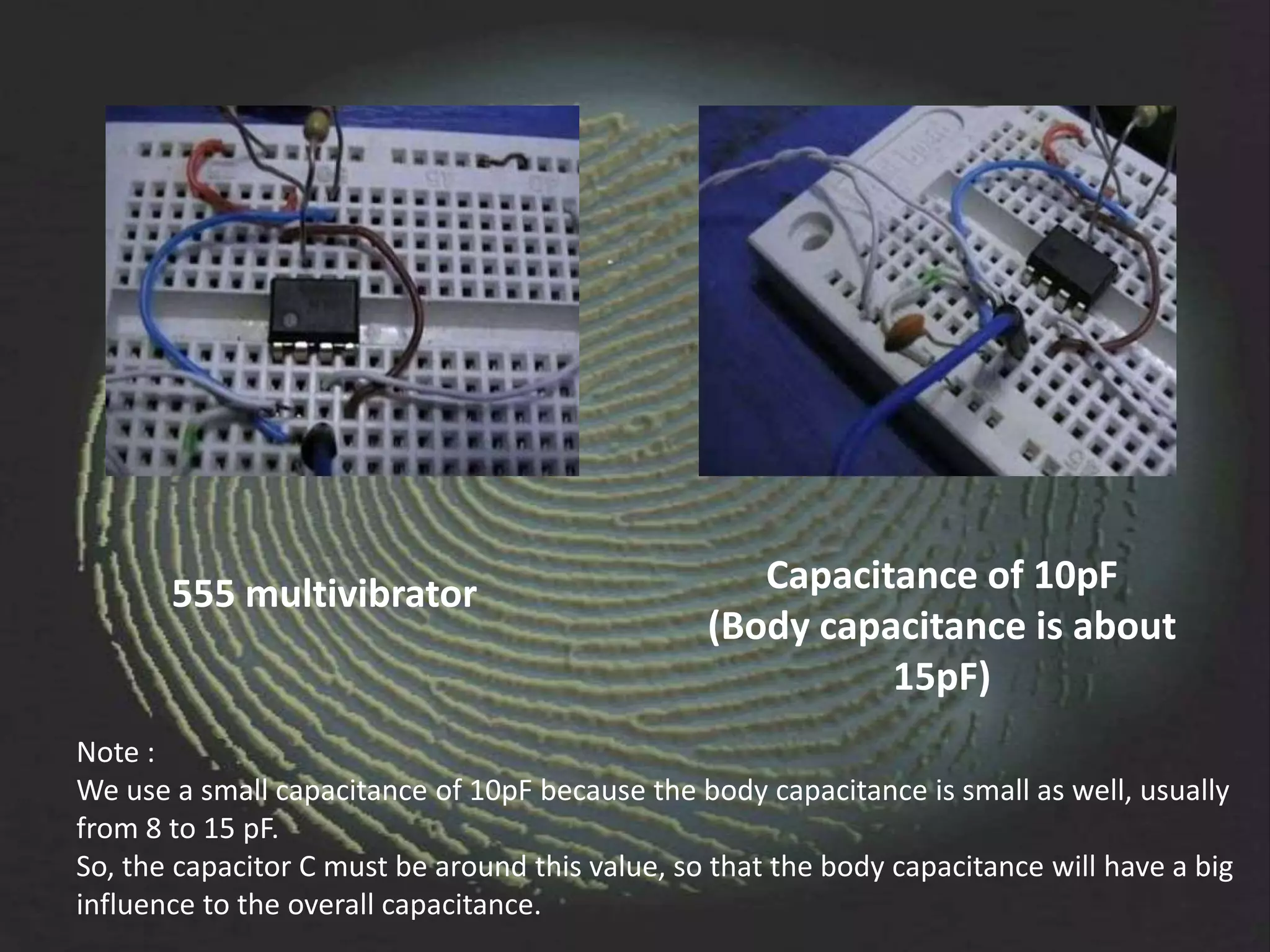
555 multivibrator                            Capacitance of 10pF
                                                 (Body capacitance is about
                                                           15pF)
Note :
We use a small capacitance of 10pF because the body capacitance is small as well, usually
from 8 to 15 pF.
So, the capacitor C must be around this value, so that the body capacitance will have a big
influence to the overall capacitance.
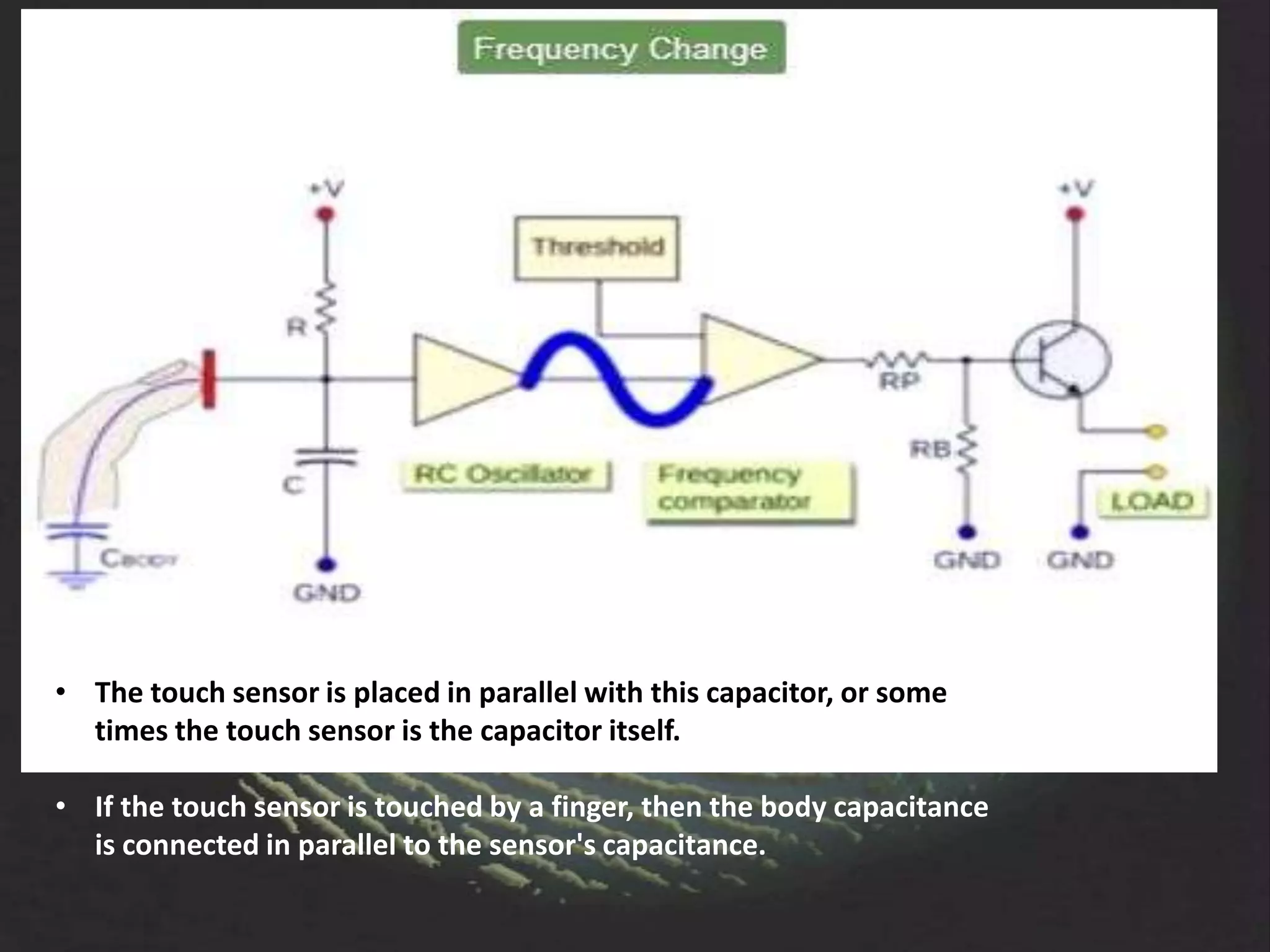
• The touch sensor is placed in parallel with this capacitor, or some
  times the touch sensor is the capacitor itself.
• If the touch sensor is touched by a finger, then the body capacitance
  is connected in parallel to the sensor's capacitance.
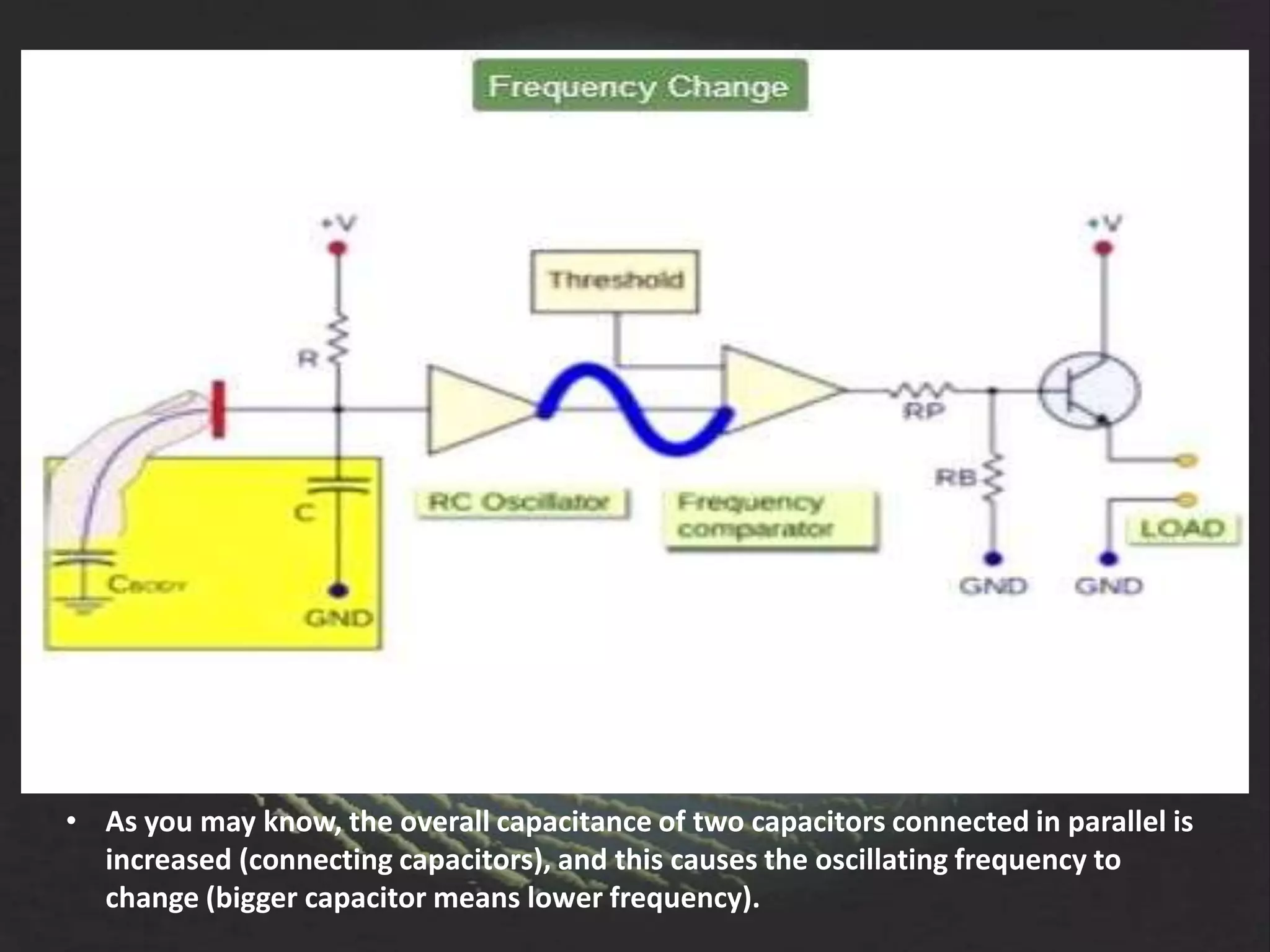
• As you may know, the overall capacitance of two capacitors connected in parallel is
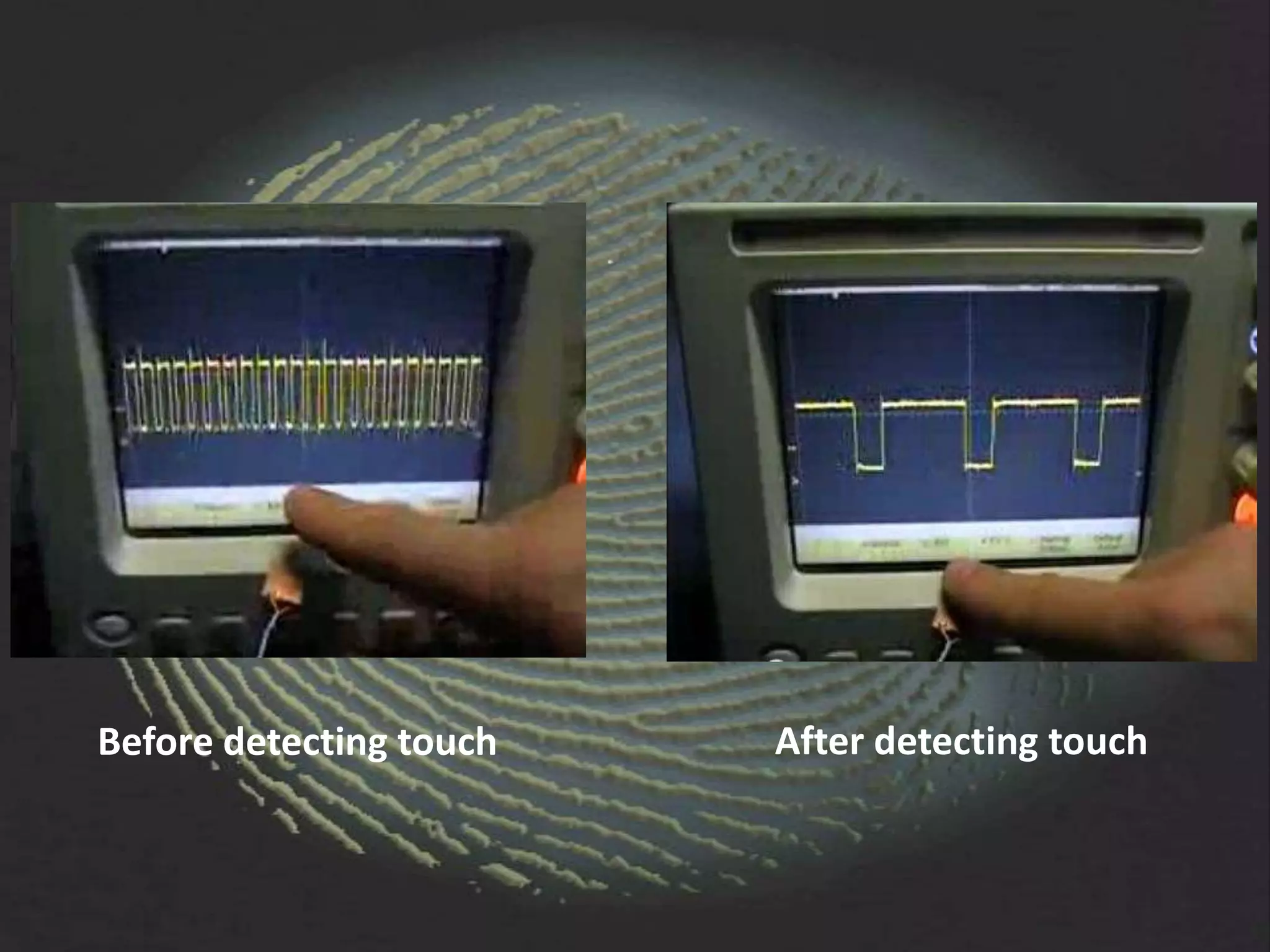
  increased (connecting capacitors), and this causes the oscillating frequency to
  change (bigger capacitor means lower frequency).
Before detecting touch   After detecting touch
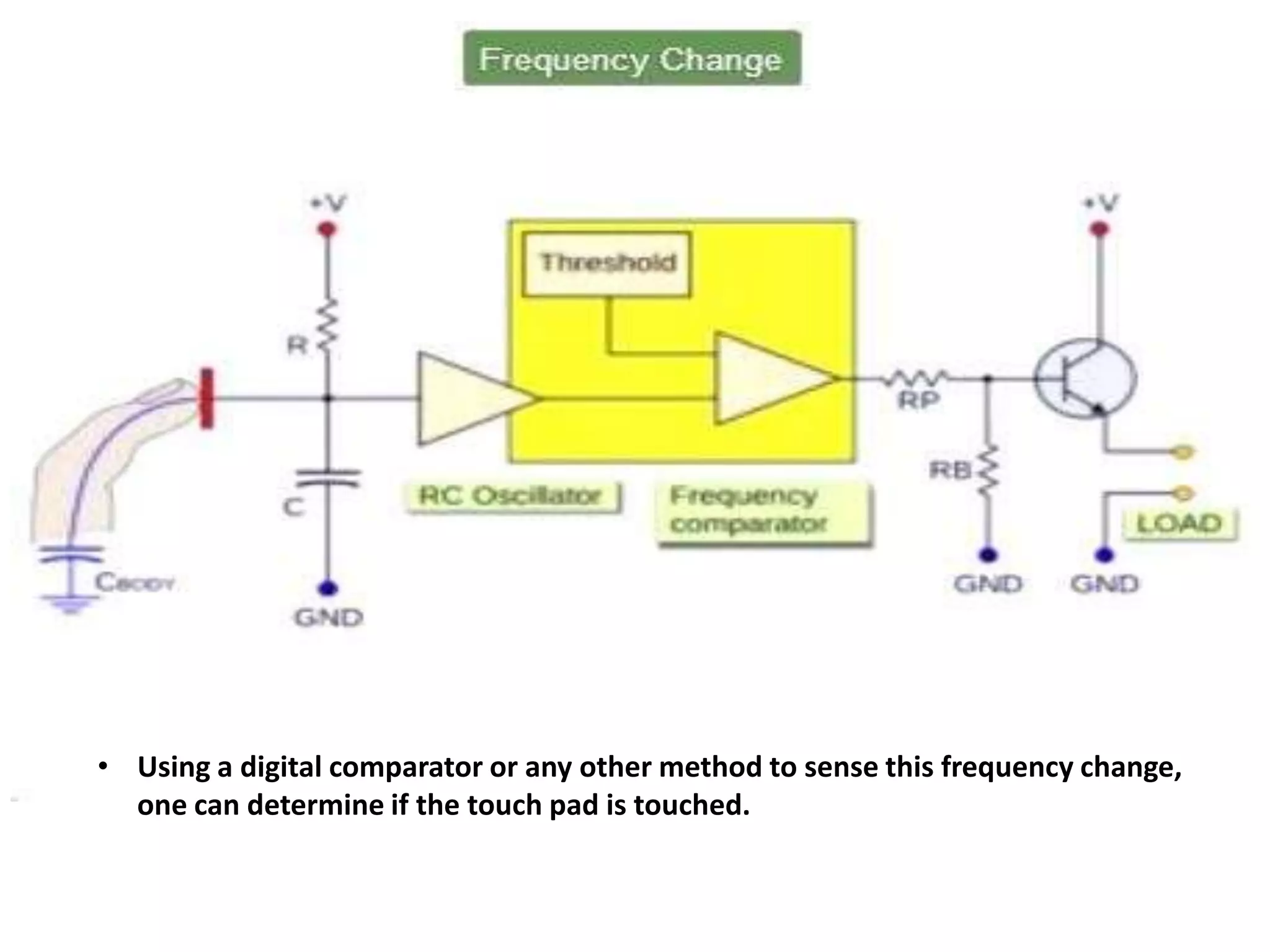
• Using a digital comparator or any other method to sense this frequency change,
  one can determine if the touch pad is touched.
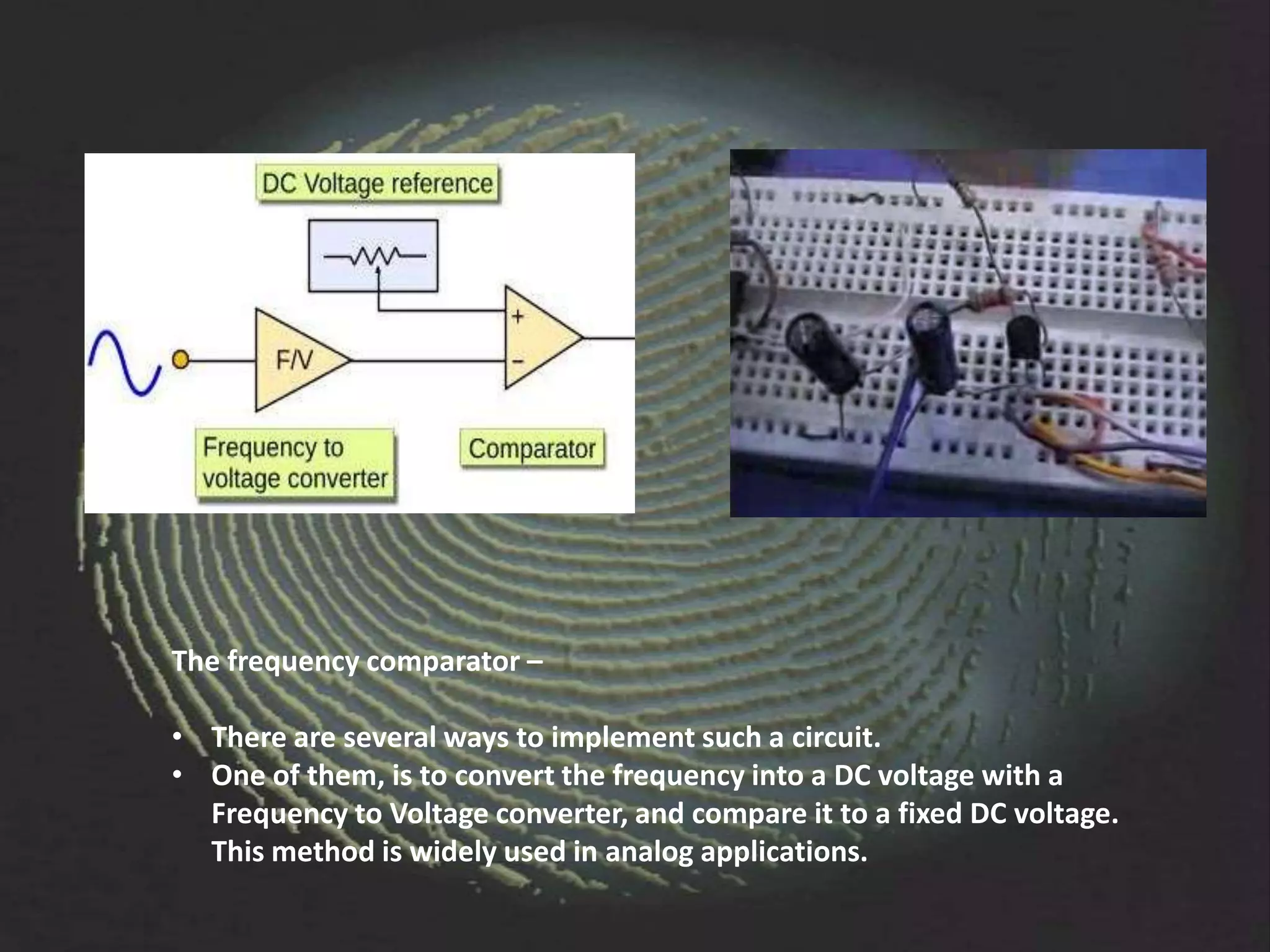
The frequency comparator –

• There are several ways to implement such a circuit.
• One of them, is to convert the frequency into a DC voltage with a
  Frequency to Voltage converter, and compare it to a fixed DC voltage.
  This method is widely used in analog applications.
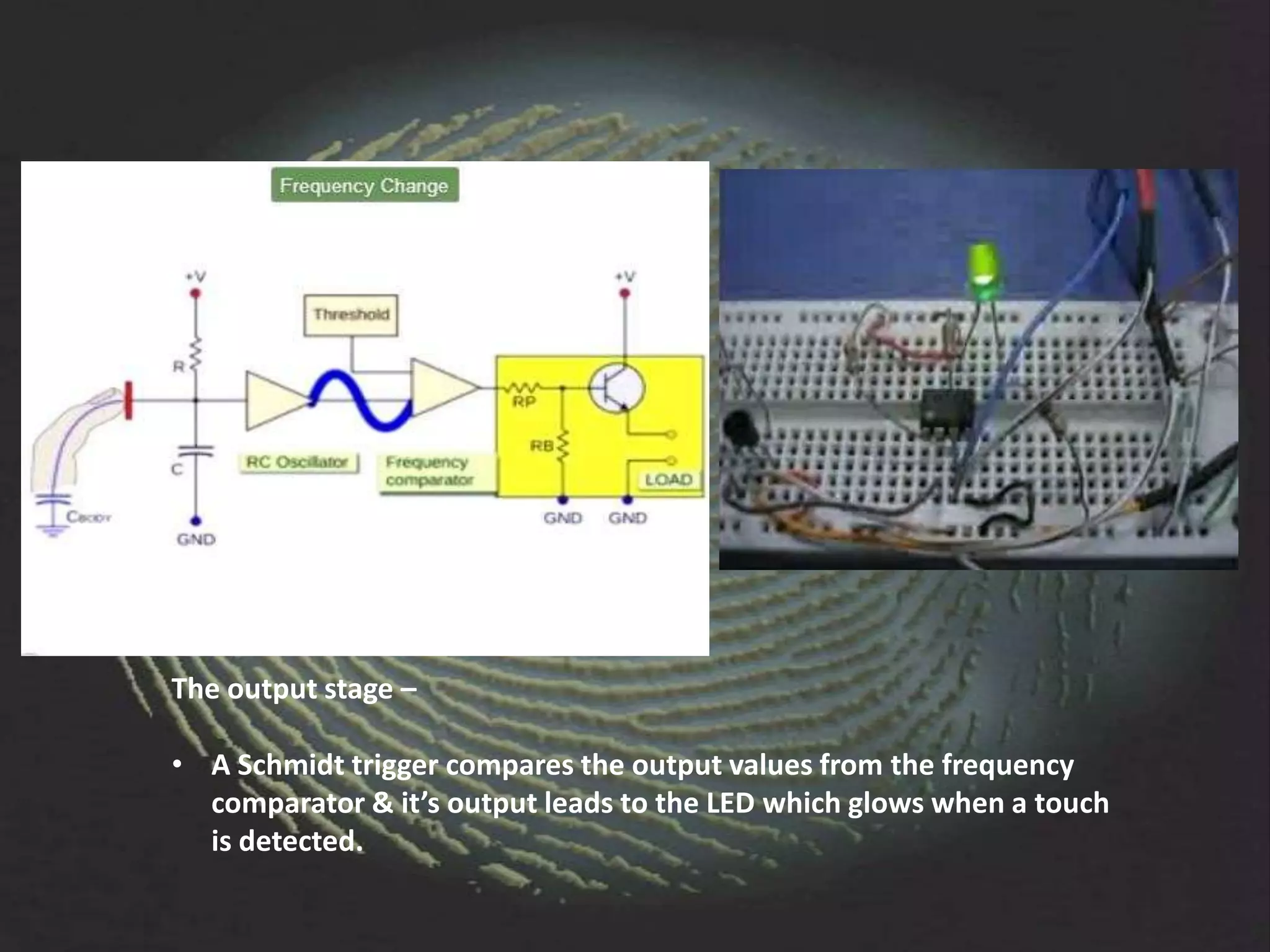
The output stage –

• A Schmidt trigger compares the output values from the frequency
  comparator & it’s output leads to the LED which glows when a touch
  is detected.
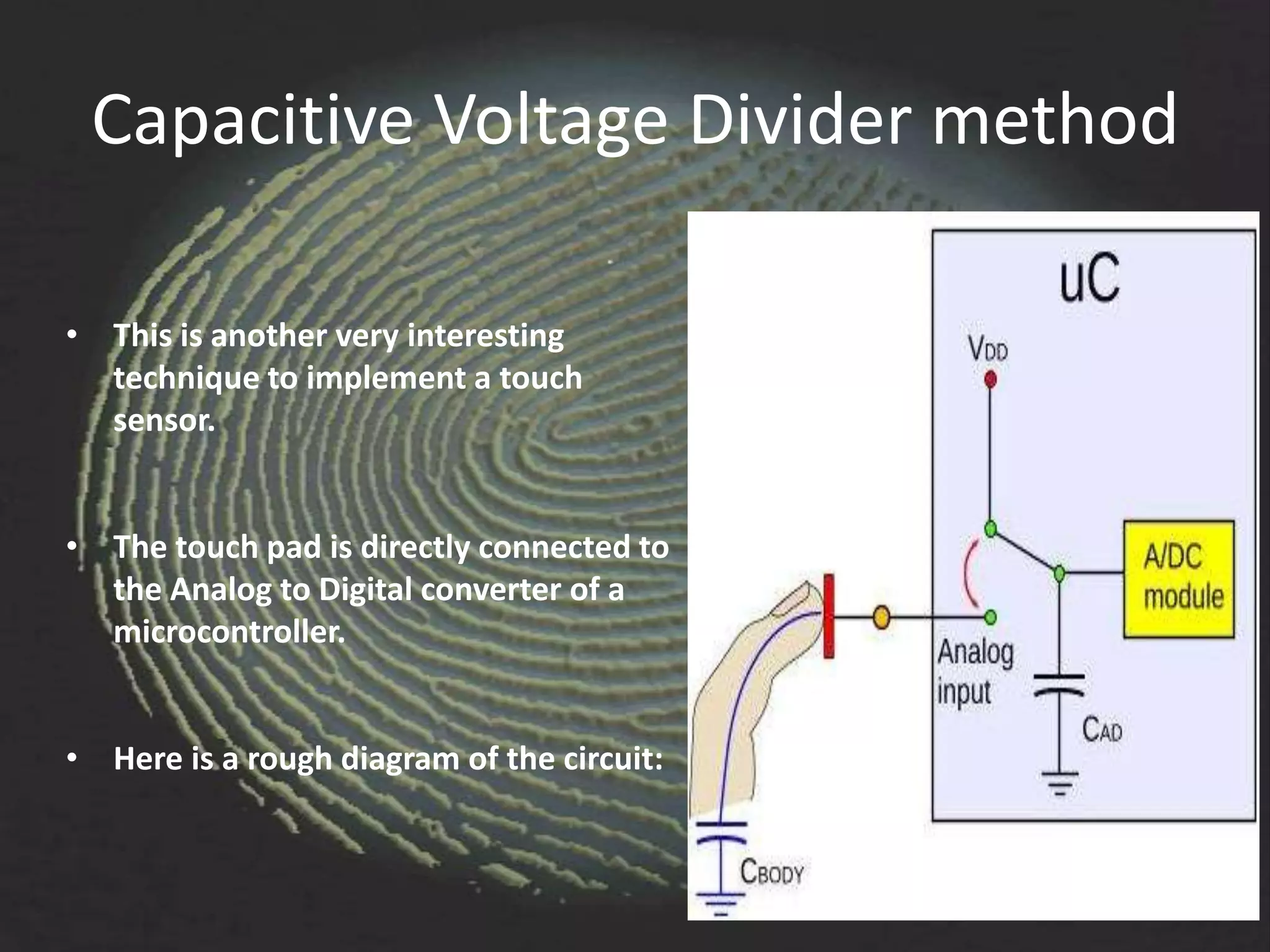
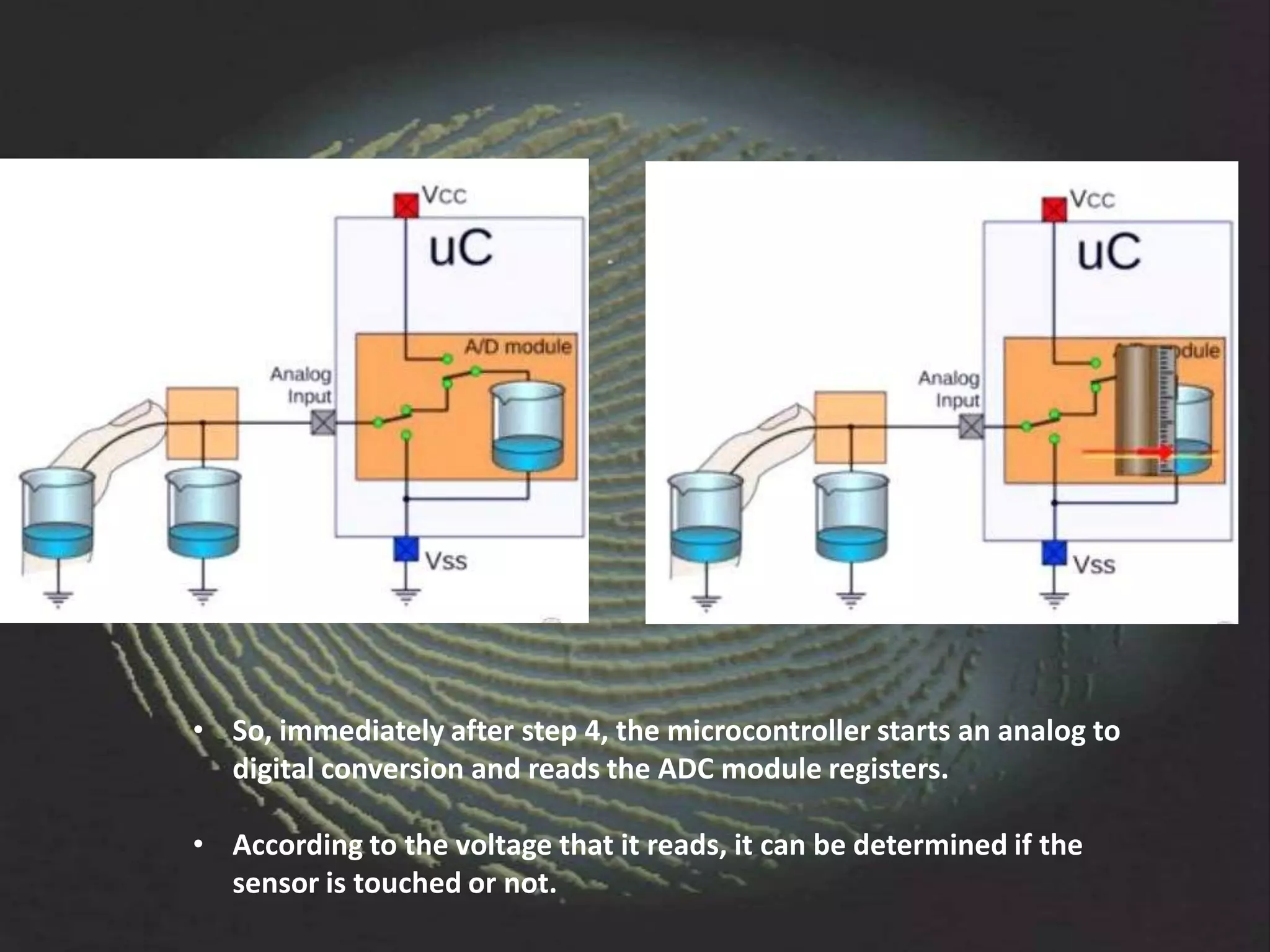
Capacitive Voltage Divider method

• This is another very interesting
  technique to implement a touch
  sensor.


• The touch pad is directly connected to
  the Analog to Digital converter of a
  microcontroller.


• Here is a rough diagram of the circuit:
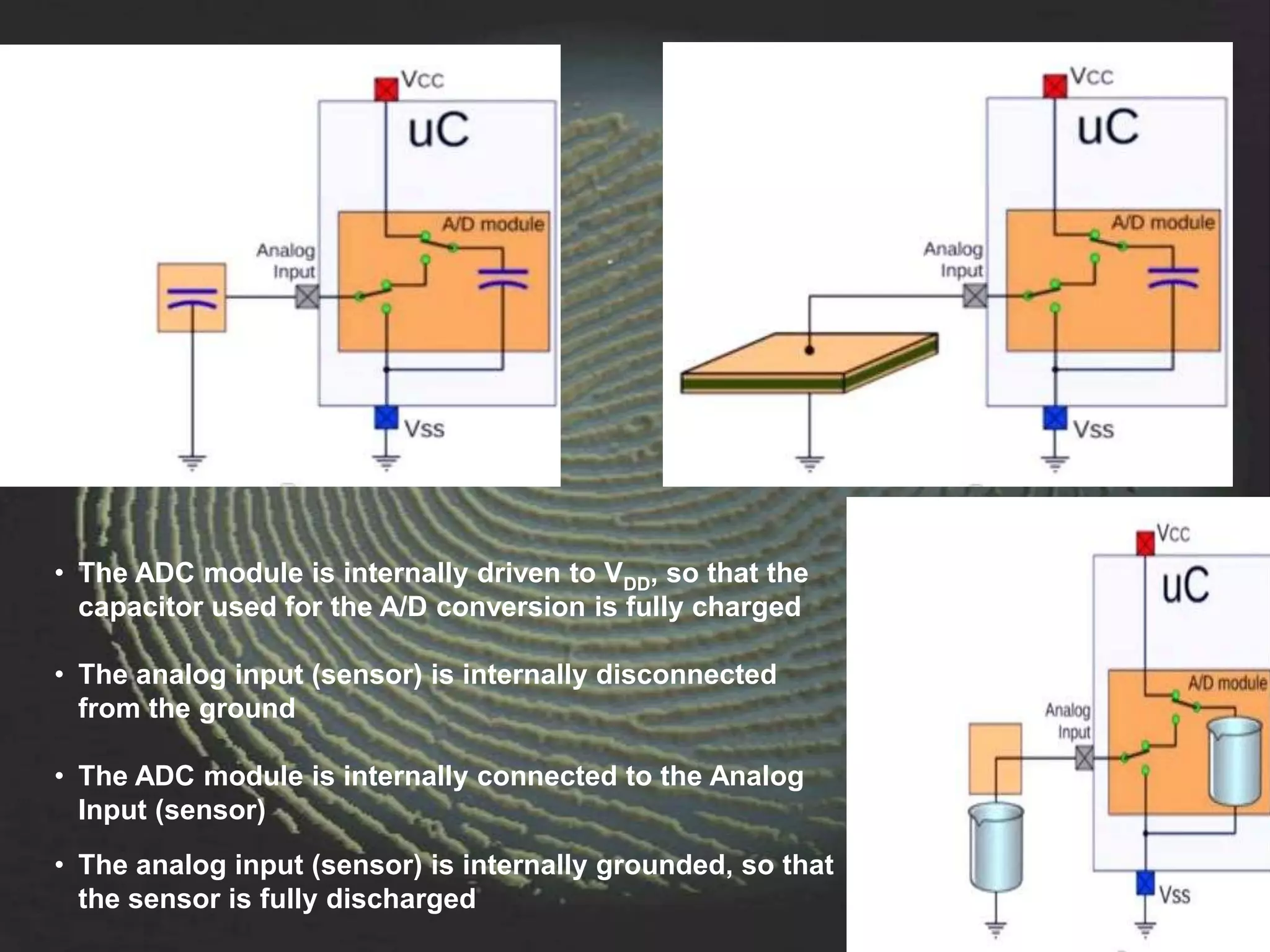
• The ADC module is internally driven to VDD, so that the
  capacitor used for the A/D conversion is fully charged

• The analog input (sensor) is internally disconnected
  from the ground

• The ADC module is internally connected to the Analog
  Input (sensor)
• The analog input (sensor) is internally grounded, so that
  the sensor is fully discharged
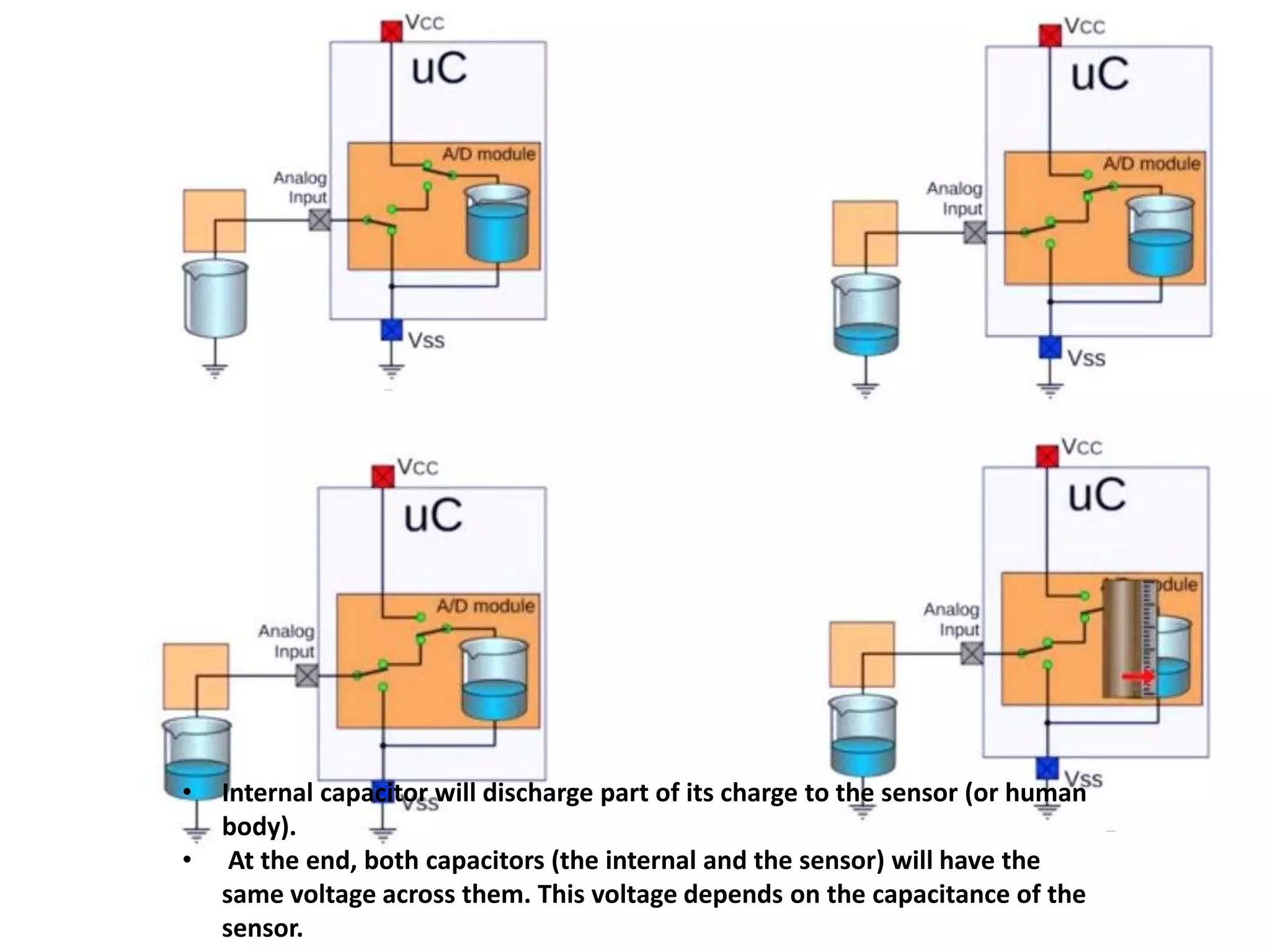
•   Internal capacitor will discharge part of its charge to the sensor (or human
    body).
•    At the end, both capacitors (the internal and the sensor) will have the
    same voltage across them. This voltage depends on the capacitance of the
    sensor.
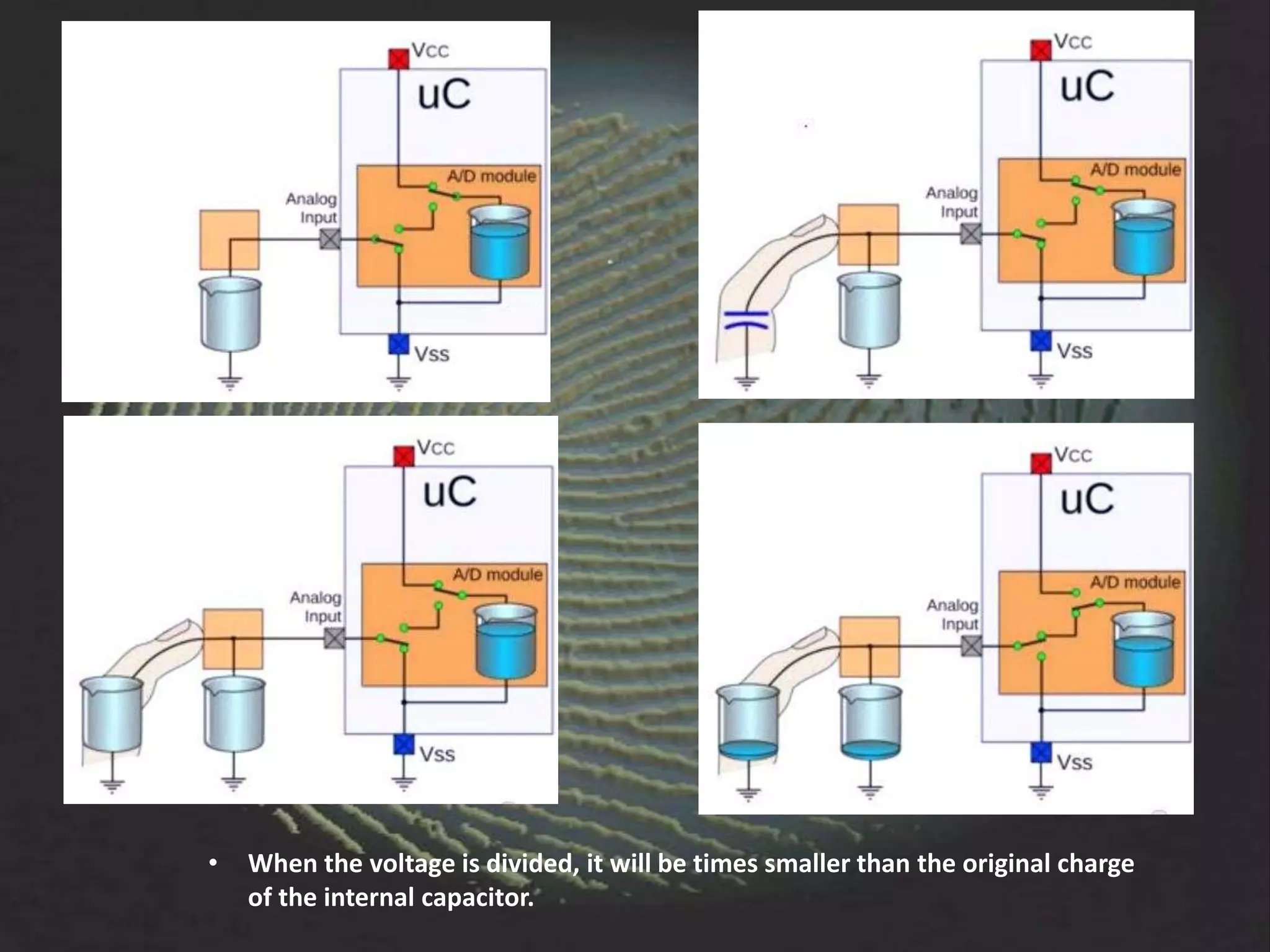
•   When the voltage is divided, it will be times smaller than the original charge
    of the internal capacitor.
• So, immediately after step 4, the microcontroller starts an analog to
  digital conversion and reads the ADC module registers.

• According to the voltage that it reads, it can be determined if the
  sensor is touched or not.
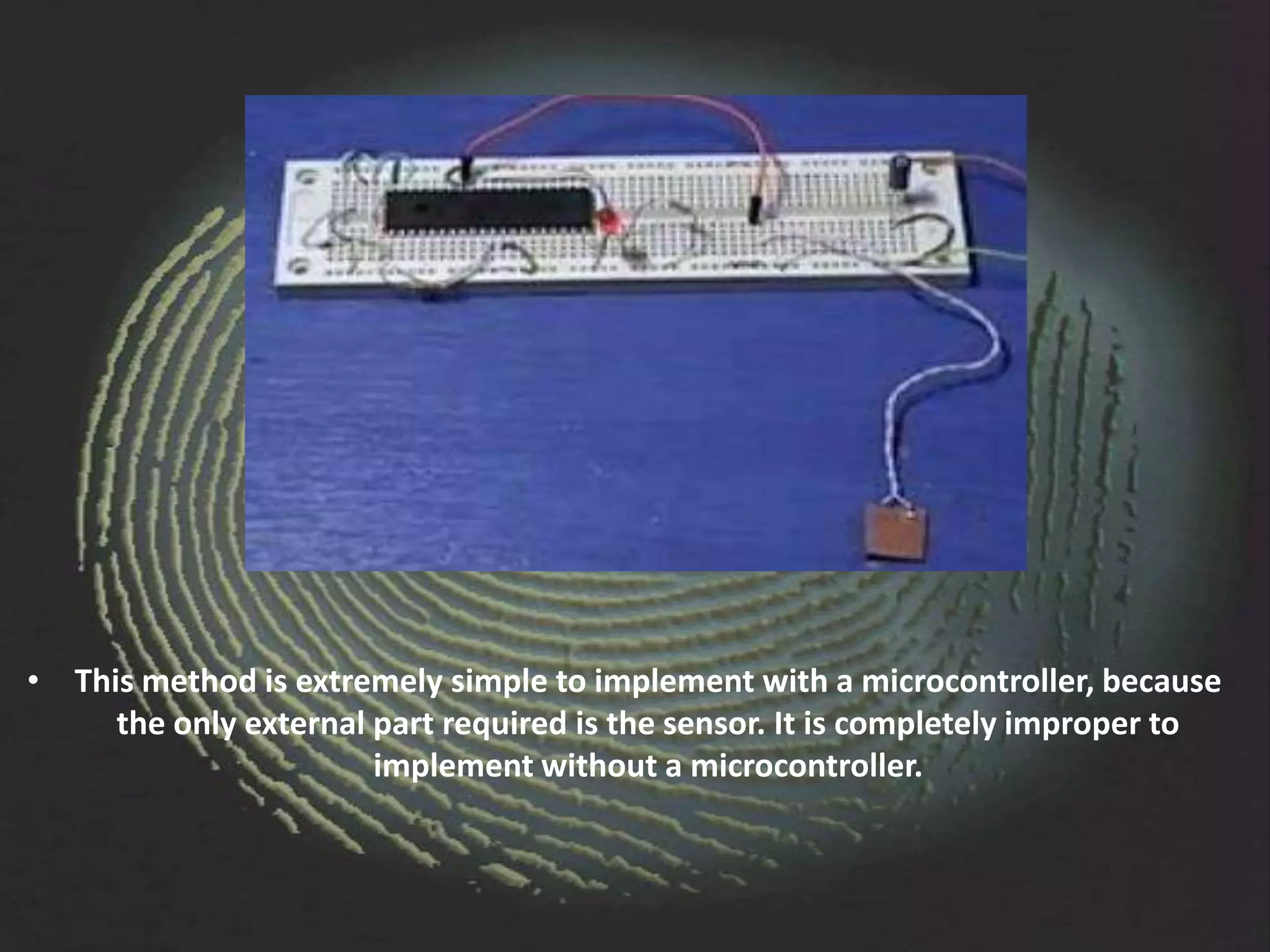
• This method is extremely simple to implement with a microcontroller, because
     the only external part required is the sensor. It is completely improper to
                       implement without a microcontroller.
THE PROCESSOR
WHY DSP OVER MC
• A programmable processor like the DSP can
  address all the processing needs of a biometric
  system while providing the most viable path to
  standards and feature upgrades.
• A DSP allows the product to be small and
  portable while maintaining power-efficient
  performance all at a low overall system cost.
• The DSP architecture is built to support complex
  mathematical algorithms that involve a significant
  amount of multiplication and addition.
• The DSP executes the multiply/add feature in a
  single cycle (compared to multiple cycles for RISC
  processors)
• In addition, the Harvard architecture of the DSP
  (multiple busses) allows instruction and operand
  fetches in the same cycle for increased speed of
  operation.
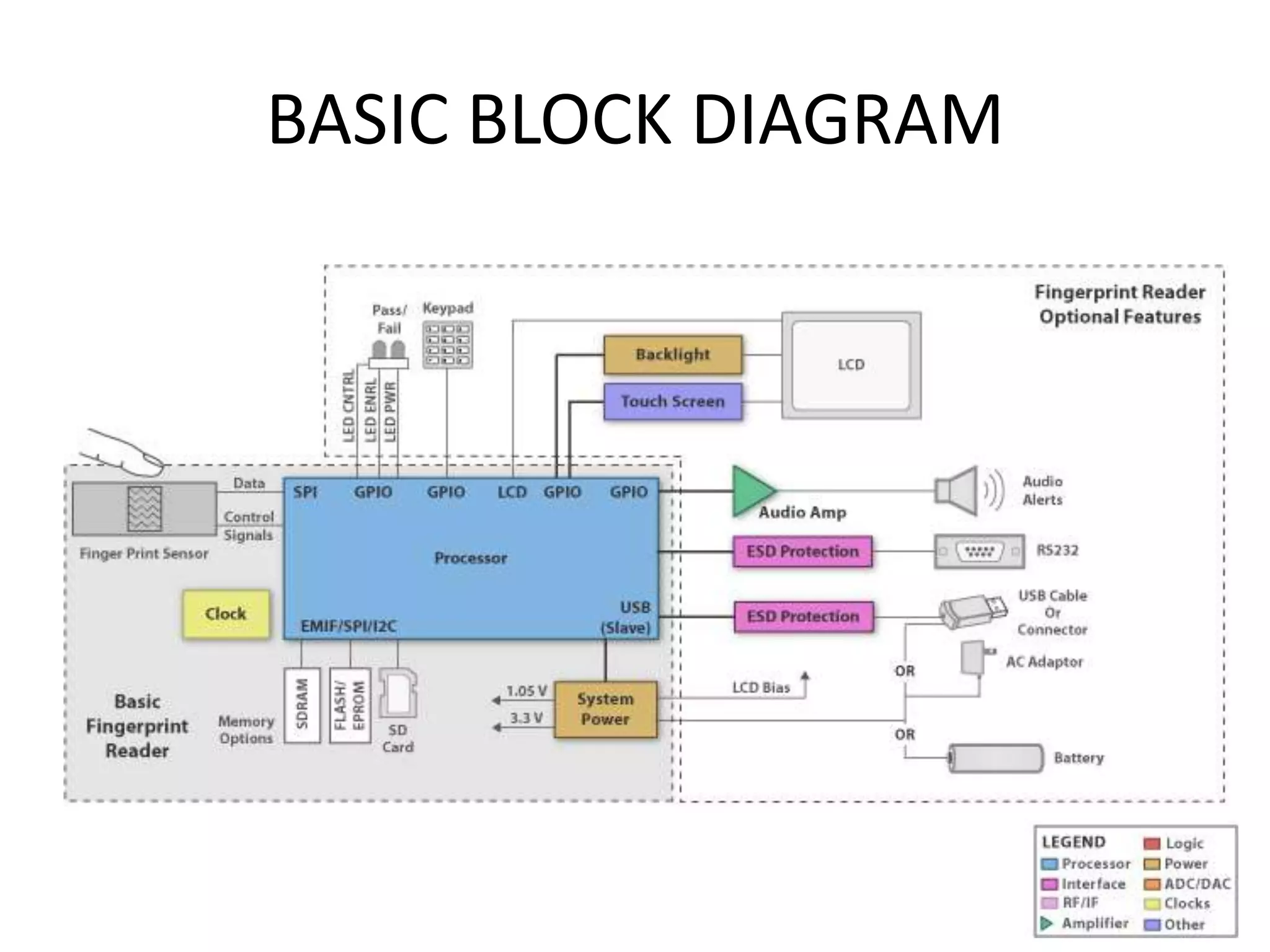
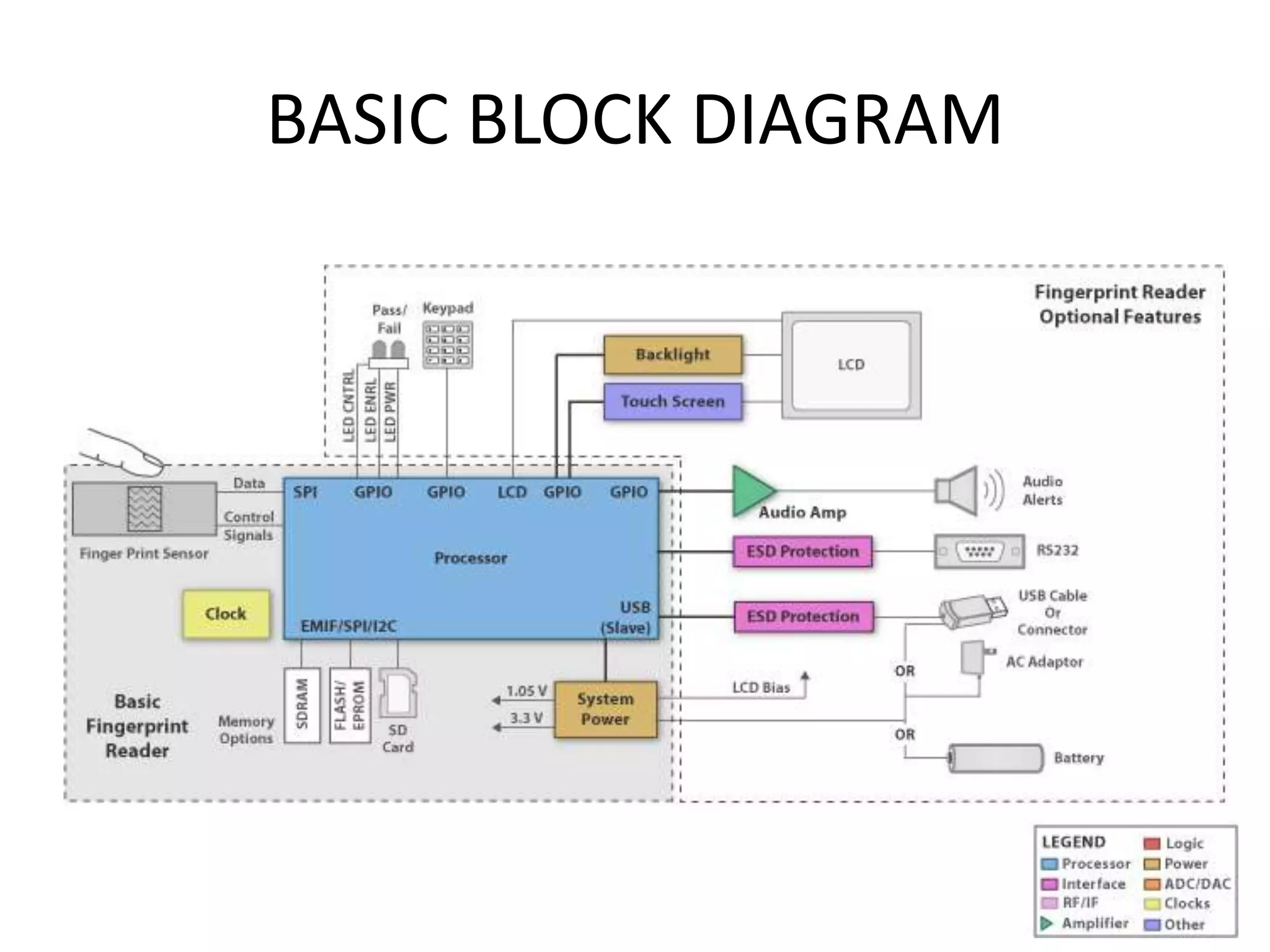
BASIC BLOCK DIAGRAM
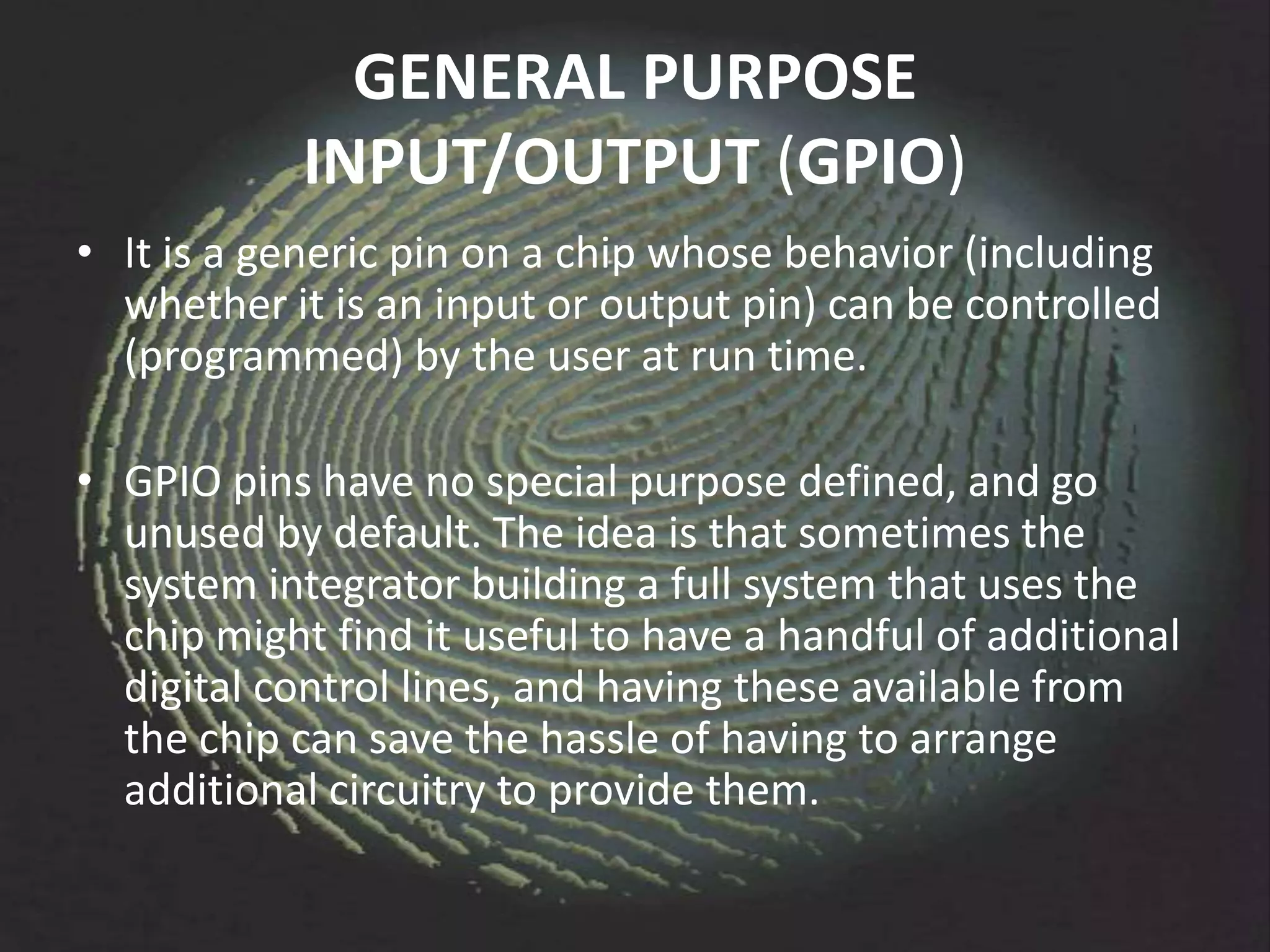
GENERAL PURPOSE
            INPUT/OUTPUT (GPIO)
• It is a generic pin on a chip whose behavior (including
  whether it is an input or output pin) can be controlled
  (programmed) by the user at run time.

• GPIO pins have no special purpose defined, and go
  unused by default. The idea is that sometimes the
  system integrator building a full system that uses the
  chip might find it useful to have a handful of additional
  digital control lines, and having these available from
  the chip can save the hassle of having to arrange
  additional circuitry to provide them.
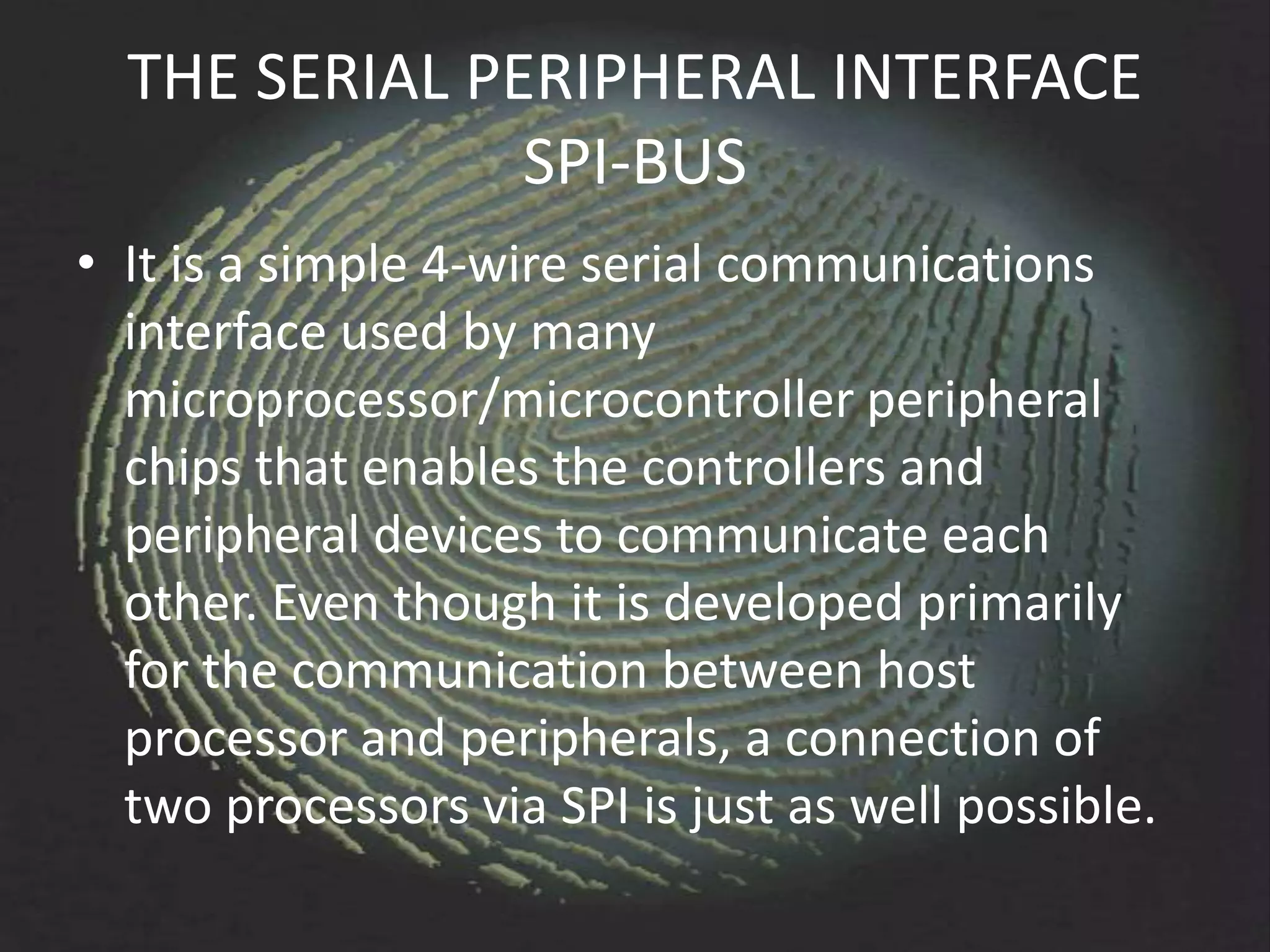
THE SERIAL PERIPHERAL INTERFACE
               SPI-BUS
• It is a simple 4-wire serial communications
  interface used by many
  microprocessor/microcontroller peripheral
  chips that enables the controllers and
  peripheral devices to communicate each
  other. Even though it is developed primarily
  for the communication between host
  processor and peripherals, a connection of
  two processors via SPI is just as well possible.
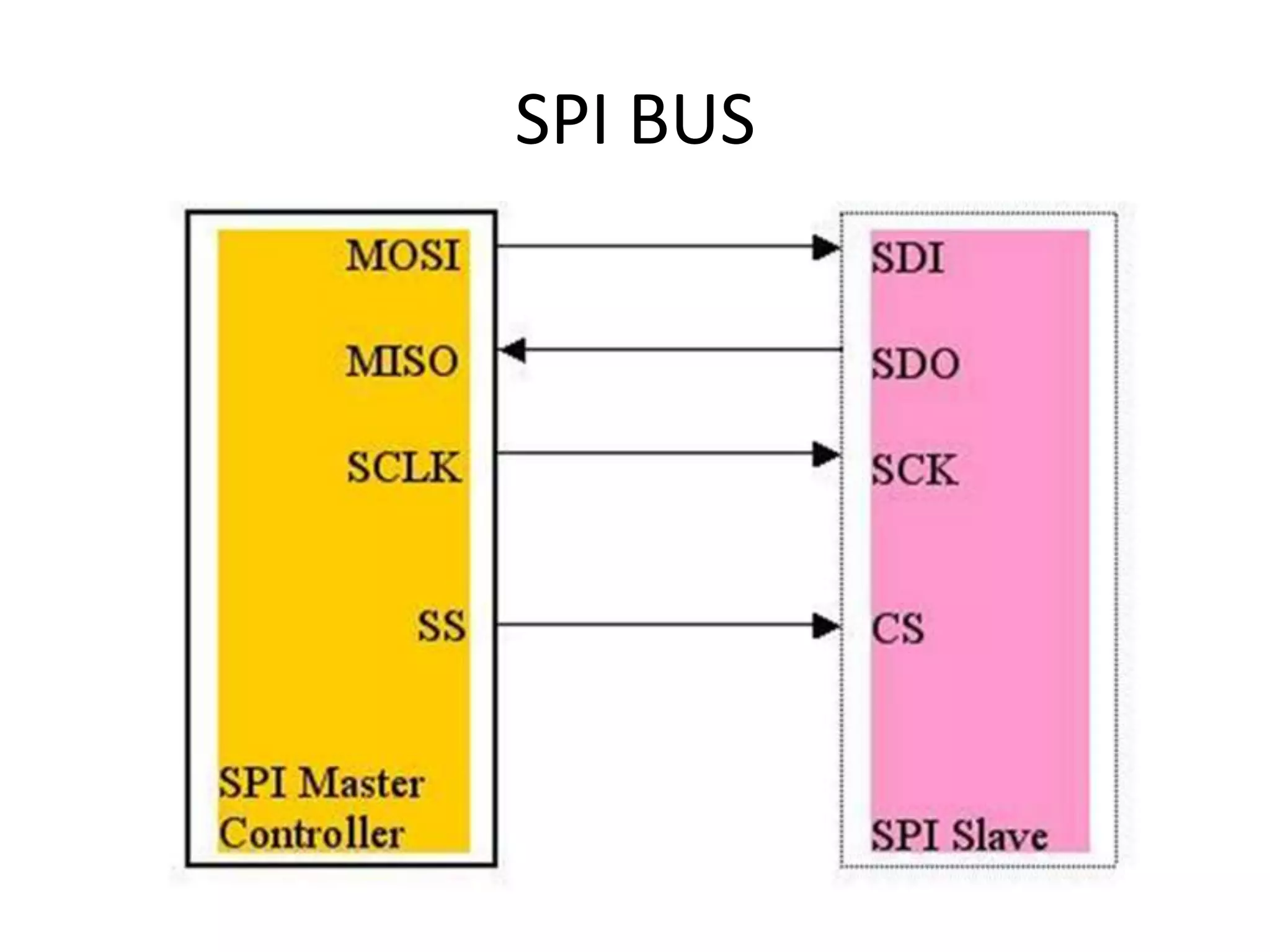
SPI BUS
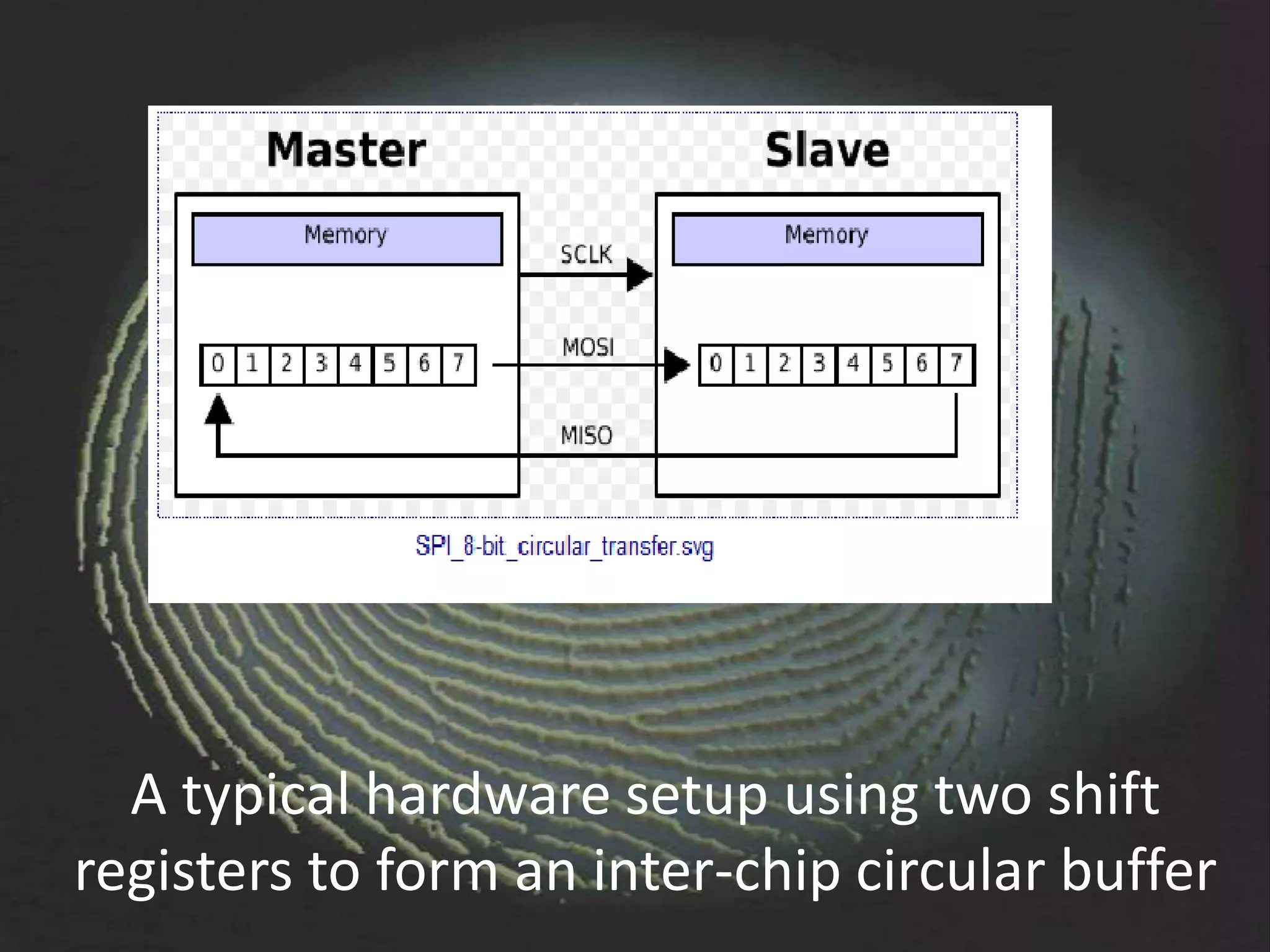
• An SPI protocol specifies 4 signal wires.
• Master Out Slave In (MOSI) - MOSI signal is generated by
  Master, recipient is the Slave.
• Master In Slave Out (MISO) - Slaves generate MISO
  signals and recipient is the Master.
• Serial Clock (SCLK or SCK) - SCLK signal is generated by
  the Master to synchronize data transfers between the
  master and the slave.
• Slave Select (SS) from master to Chip Select (CS) of slave -
  SS signal is generated by Master to select individual
  slave/peripheral devices. The SS/CS is an active low signal.
• The SPI bus, which operates at full duplex
  (means, signals carrying data can go in both
  directions simultaneously), is a synchronous
  type data link setup with a Master / Slave
  interface and can support up to 1 megabaud or
  10Mbps of speed. Both single-master and
  multi-master protocols are possible in SPI.
• To begin a communication, the bus master first
  configures the clock, using a frequency less than
  or equal to the maximum frequency the slave
  device supports. Such frequencies are commonly
  in the range of 1–100 MHz.
• During each SPI clock cycle, a full duplex data
  transmission occurs:
• the master sends a bit on the MOSI line; the slave
  reads it from that same line
• the slave sends a bit on the MISO line; the master
  reads it from that same line
A typical hardware setup using two shift
registers to form an inter-chip circular buffer
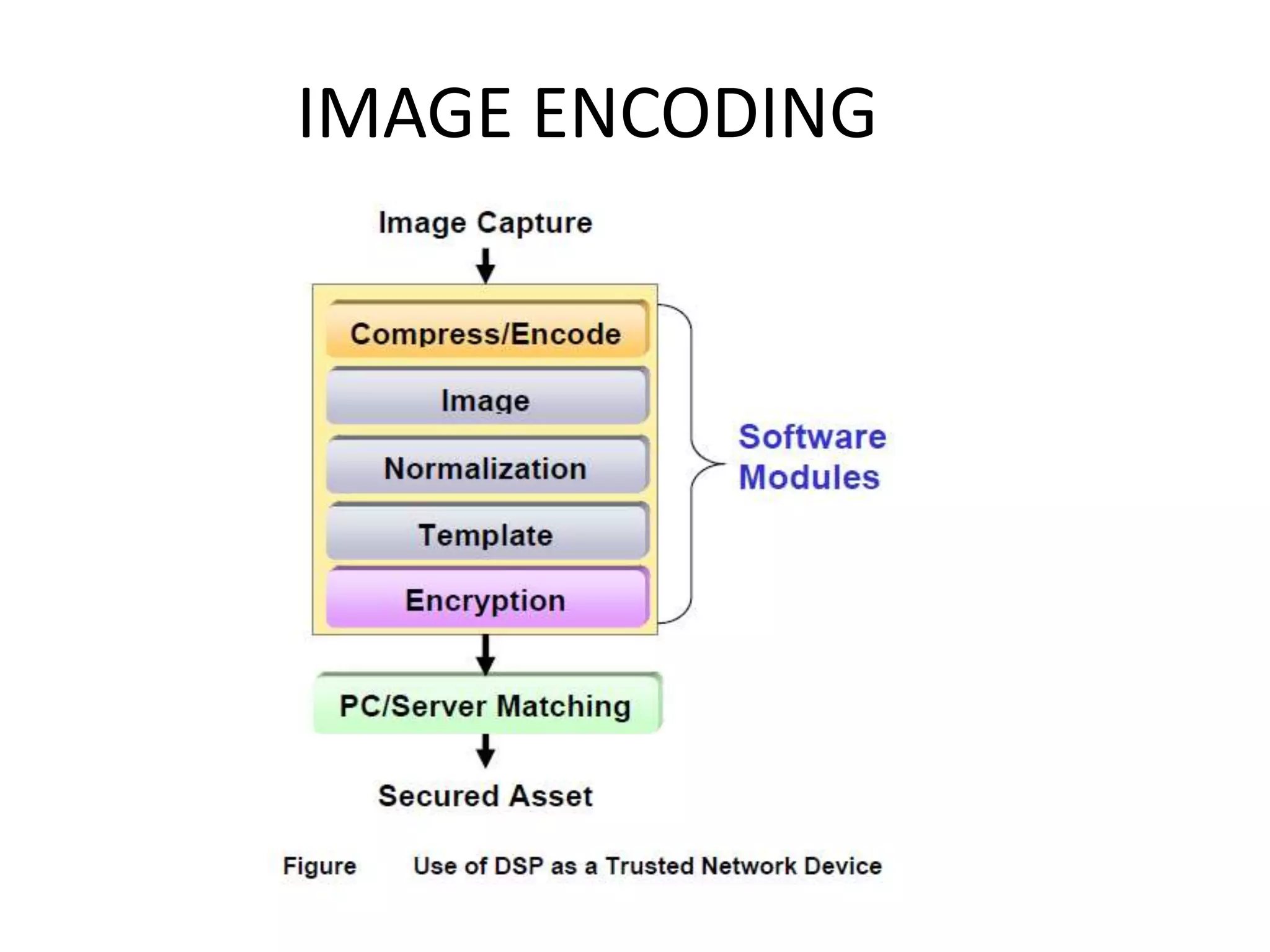
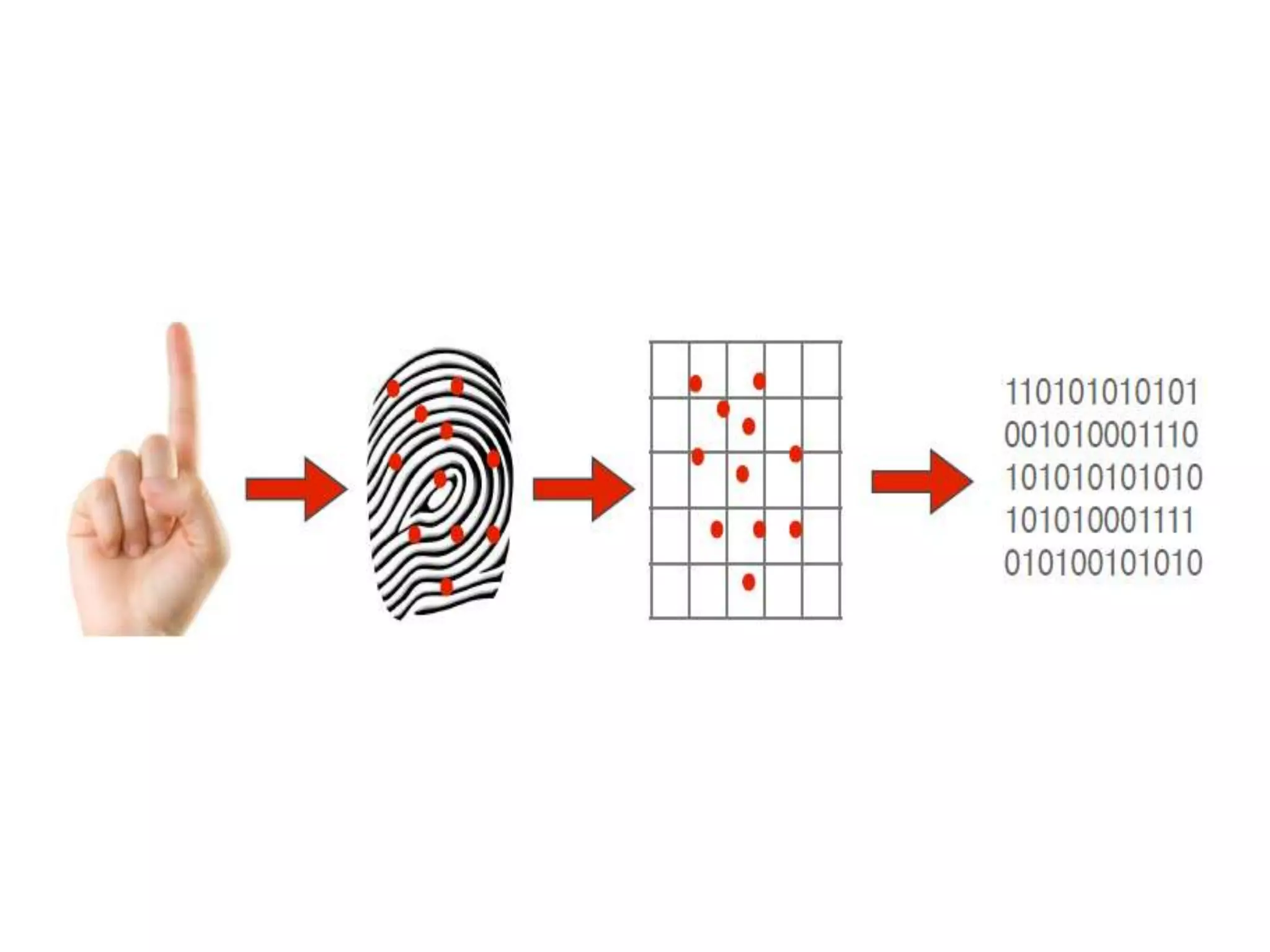
IMAGE ENCODING
STORAGE ELEMENT
• The function of the storage element is to
  store the enrolled template that is recalled to
  perform a match at the time of authentication.
• DSPs have varying sizes of internal RAM to
  address the image processing and template
  extraction processes of the various biometric
  algorithms, along with read-only memory (ROM)
  for storing the constant parts of the programming
  code.
LDO
• A low-dropout or LDO regulator is a DC linear
  voltage regulator which can operate with a
  very small input–output differential voltage.
• The advantages of a low dropout voltage
  include a lower minimum operating voltage,
  higher efficiency operation and lower heat
  dissipation.
COMPONENTS OF LDO
• The main components are a power FET and a
  differential amplifier (error amplifier).
• There are two inputs to the differential
  amplifiers.
• Low-dropout (LDO) regulators work in the
  same way as all linear voltage regulators.
• The main difference between LDO and non-
  LDO regulators is their schematic topology.
ESD PROTECTION
• Electrostatic discharge (ESD) is the sudden
  flow of electricity between two objects caused
  by contact, an electrical short or dielectric
  breakdown.
• . ESD can be caused by a buildup of static
  electricity by turbocharging, or by
  electrostatic induction.
CHARACTERISTICS OF THE PROTECTION

 Extremely fast response time
 Low clamping and operating voltages
 Capacity to handle high peak ESD currents
 Ability to remain undamaged by repetitive ESD
 strikes
 Minimal size
BASIC BLOCK DIAGRAM
FUTURE PROSPECTS
• Public Sector Application : eBorders, eID,
  and eGovernment.
• Commercial Application : Enterprise
  Security, Information Transactions,
  Financial Transactions.
• Technology Evolution : Secure Identity
  Core, Secure Mobility, Secure
  Credentials, and Secure Transactions.
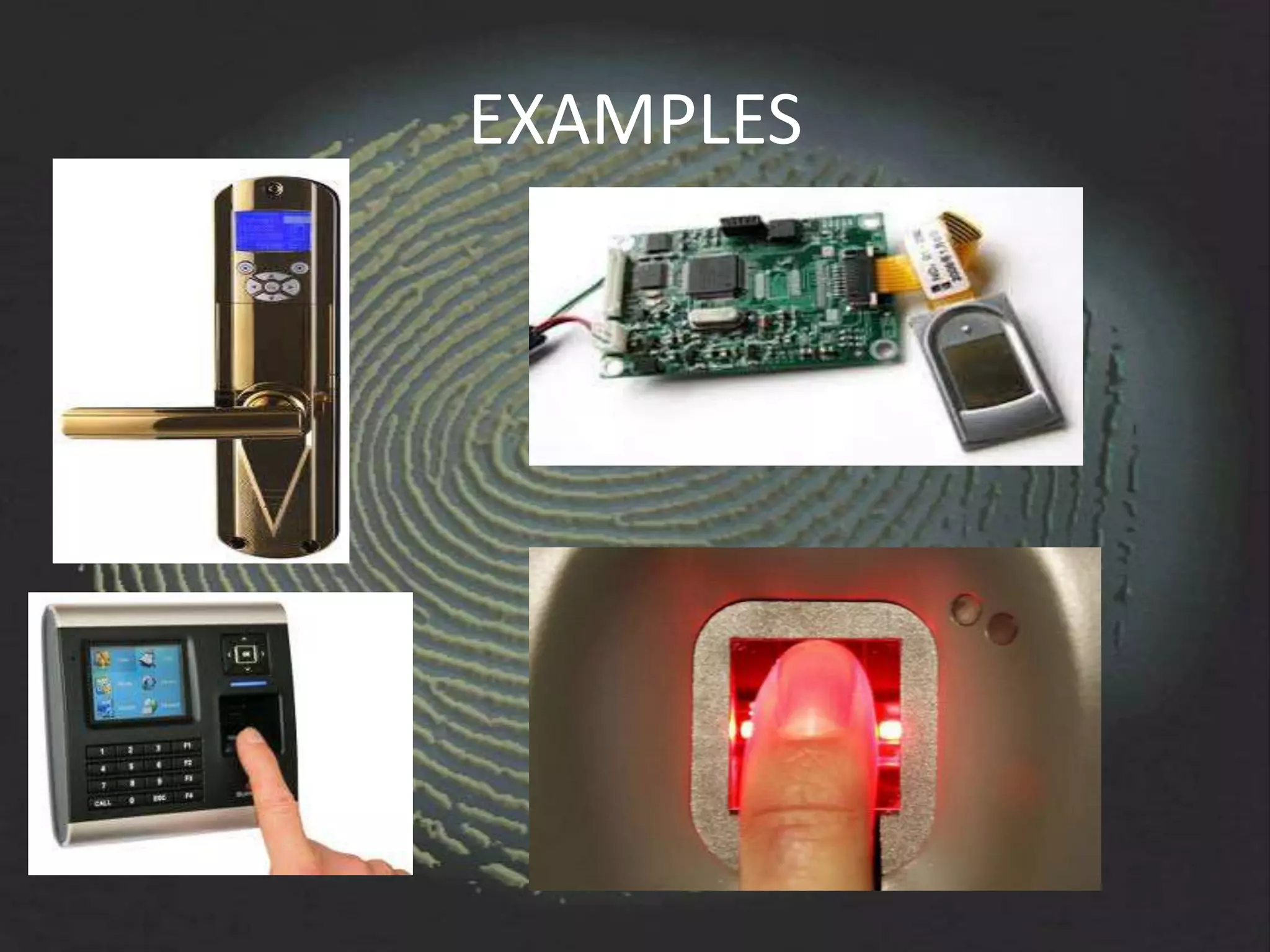
EXAMPLES

Fingerprint Biometrics

  • 1.
    FINGERPRINT BIOMETRICS ESDPRESENTATION GROUP 2
  • 2.
    BIOMETRICS • Biometrics (orbiometric authentication refers to the identification of humans by their characteristics or traits. Biometrics is used in computer science as a form of identification and access control. It is also used to identify individuals in groups that are under surveillance
  • 3.
    TYPES OF BIOMETRICS • DNA MATCHING • EAR • EYES-IRIS RECOGNITION • VOICE RECOGNITION • FACE • FINGERPRINT RECOGNITION • FINGER GEOMETRY RECOGNITION • SO ON….
  • 4.
    WHY FINGERPRINTS • Veryhigh accuracy. • Is the most economical biometric PC user authentication technique. • it is one of the most developed biometrics • Easy to use. • Small storage space required for the biometric template, reducing the size of the database memory required • It is standardized.
  • 5.
    IT’S AN EMBEDDEDSYSTEM!!!!!
  • 6.
    BASIC ELEMENTS OFA TYPICAL FINGERPRINT BIOMETRIC SYSTEM • Sensing • Processing • Storage • Interface
  • 7.
  • 8.
  • 9.
  • 10.
    OPTICAL • Heart ofan optical sensor is a Charged Couple Device ( CCD): an array of light sensitive diodes called photosites which generate an electrical signal in response to light photons.
  • 11.
    Working • Photosite recordspixels. • Ridges and valleys present on fingers are illuminated • CCD processor ensures a clear image is taken • Definition of the image is checked • Collectively pixels form an image • A to D Converter generates digital representation of image
  • 12.
  • 13.
    Frequency Change method •An oscillator that oscillates at a high frequency (usually 10 to 50 KHz), and uses a capacitor to oscillate.
  • 14.
    555 multivibrator Capacitance of 10pF (Body capacitance is about 15pF) Note : We use a small capacitance of 10pF because the body capacitance is small as well, usually from 8 to 15 pF. So, the capacitor C must be around this value, so that the body capacitance will have a big influence to the overall capacitance.
  • 15.
    • The touchsensor is placed in parallel with this capacitor, or some times the touch sensor is the capacitor itself. • If the touch sensor is touched by a finger, then the body capacitance is connected in parallel to the sensor's capacitance.
  • 16.
    • As youmay know, the overall capacitance of two capacitors connected in parallel is increased (connecting capacitors), and this causes the oscillating frequency to change (bigger capacitor means lower frequency).
  • 17.
    Before detecting touch After detecting touch
  • 18.
    • Using adigital comparator or any other method to sense this frequency change, one can determine if the touch pad is touched.
  • 19.
    The frequency comparator– • There are several ways to implement such a circuit. • One of them, is to convert the frequency into a DC voltage with a Frequency to Voltage converter, and compare it to a fixed DC voltage. This method is widely used in analog applications.
  • 20.
    The output stage– • A Schmidt trigger compares the output values from the frequency comparator & it’s output leads to the LED which glows when a touch is detected.
  • 21.
    Capacitive Voltage Dividermethod • This is another very interesting technique to implement a touch sensor. • The touch pad is directly connected to the Analog to Digital converter of a microcontroller. • Here is a rough diagram of the circuit:
  • 22.
    • The ADCmodule is internally driven to VDD, so that the capacitor used for the A/D conversion is fully charged • The analog input (sensor) is internally disconnected from the ground • The ADC module is internally connected to the Analog Input (sensor) • The analog input (sensor) is internally grounded, so that the sensor is fully discharged
  • 23.
    Internal capacitor will discharge part of its charge to the sensor (or human body). • At the end, both capacitors (the internal and the sensor) will have the same voltage across them. This voltage depends on the capacitance of the sensor.
  • 24.
    When the voltage is divided, it will be times smaller than the original charge of the internal capacitor.
  • 25.
    • So, immediatelyafter step 4, the microcontroller starts an analog to digital conversion and reads the ADC module registers. • According to the voltage that it reads, it can be determined if the sensor is touched or not.
  • 26.
    • This methodis extremely simple to implement with a microcontroller, because the only external part required is the sensor. It is completely improper to implement without a microcontroller.
  • 27.
  • 28.
    WHY DSP OVERMC • A programmable processor like the DSP can address all the processing needs of a biometric system while providing the most viable path to standards and feature upgrades. • A DSP allows the product to be small and portable while maintaining power-efficient performance all at a low overall system cost.
  • 29.
    • The DSParchitecture is built to support complex mathematical algorithms that involve a significant amount of multiplication and addition. • The DSP executes the multiply/add feature in a single cycle (compared to multiple cycles for RISC processors) • In addition, the Harvard architecture of the DSP (multiple busses) allows instruction and operand fetches in the same cycle for increased speed of operation.
  • 30.
  • 31.
    GENERAL PURPOSE INPUT/OUTPUT (GPIO) • It is a generic pin on a chip whose behavior (including whether it is an input or output pin) can be controlled (programmed) by the user at run time. • GPIO pins have no special purpose defined, and go unused by default. The idea is that sometimes the system integrator building a full system that uses the chip might find it useful to have a handful of additional digital control lines, and having these available from the chip can save the hassle of having to arrange additional circuitry to provide them.
  • 32.
    THE SERIAL PERIPHERALINTERFACE SPI-BUS • It is a simple 4-wire serial communications interface used by many microprocessor/microcontroller peripheral chips that enables the controllers and peripheral devices to communicate each other. Even though it is developed primarily for the communication between host processor and peripherals, a connection of two processors via SPI is just as well possible.
  • 33.
  • 34.
    • An SPIprotocol specifies 4 signal wires. • Master Out Slave In (MOSI) - MOSI signal is generated by Master, recipient is the Slave. • Master In Slave Out (MISO) - Slaves generate MISO signals and recipient is the Master. • Serial Clock (SCLK or SCK) - SCLK signal is generated by the Master to synchronize data transfers between the master and the slave. • Slave Select (SS) from master to Chip Select (CS) of slave - SS signal is generated by Master to select individual slave/peripheral devices. The SS/CS is an active low signal.
  • 35.
    • The SPIbus, which operates at full duplex (means, signals carrying data can go in both directions simultaneously), is a synchronous type data link setup with a Master / Slave interface and can support up to 1 megabaud or 10Mbps of speed. Both single-master and multi-master protocols are possible in SPI.
  • 36.
    • To begina communication, the bus master first configures the clock, using a frequency less than or equal to the maximum frequency the slave device supports. Such frequencies are commonly in the range of 1–100 MHz. • During each SPI clock cycle, a full duplex data transmission occurs: • the master sends a bit on the MOSI line; the slave reads it from that same line • the slave sends a bit on the MISO line; the master reads it from that same line
  • 37.
    A typical hardwaresetup using two shift registers to form an inter-chip circular buffer
  • 38.
  • 40.
    STORAGE ELEMENT • Thefunction of the storage element is to store the enrolled template that is recalled to perform a match at the time of authentication. • DSPs have varying sizes of internal RAM to address the image processing and template extraction processes of the various biometric algorithms, along with read-only memory (ROM) for storing the constant parts of the programming code.
  • 42.
    LDO • A low-dropoutor LDO regulator is a DC linear voltage regulator which can operate with a very small input–output differential voltage. • The advantages of a low dropout voltage include a lower minimum operating voltage, higher efficiency operation and lower heat dissipation.
  • 43.
    COMPONENTS OF LDO •The main components are a power FET and a differential amplifier (error amplifier). • There are two inputs to the differential amplifiers. • Low-dropout (LDO) regulators work in the same way as all linear voltage regulators. • The main difference between LDO and non- LDO regulators is their schematic topology.
  • 44.
    ESD PROTECTION • Electrostaticdischarge (ESD) is the sudden flow of electricity between two objects caused by contact, an electrical short or dielectric breakdown. • . ESD can be caused by a buildup of static electricity by turbocharging, or by electrostatic induction.
  • 45.
    CHARACTERISTICS OF THEPROTECTION Extremely fast response time Low clamping and operating voltages Capacity to handle high peak ESD currents Ability to remain undamaged by repetitive ESD strikes Minimal size
  • 46.
  • 47.
    FUTURE PROSPECTS • PublicSector Application : eBorders, eID, and eGovernment. • Commercial Application : Enterprise Security, Information Transactions, Financial Transactions. • Technology Evolution : Secure Identity Core, Secure Mobility, Secure Credentials, and Secure Transactions.
  • 48.

Editor's Notes

  • #10 rahulvatsa90@gmail.com