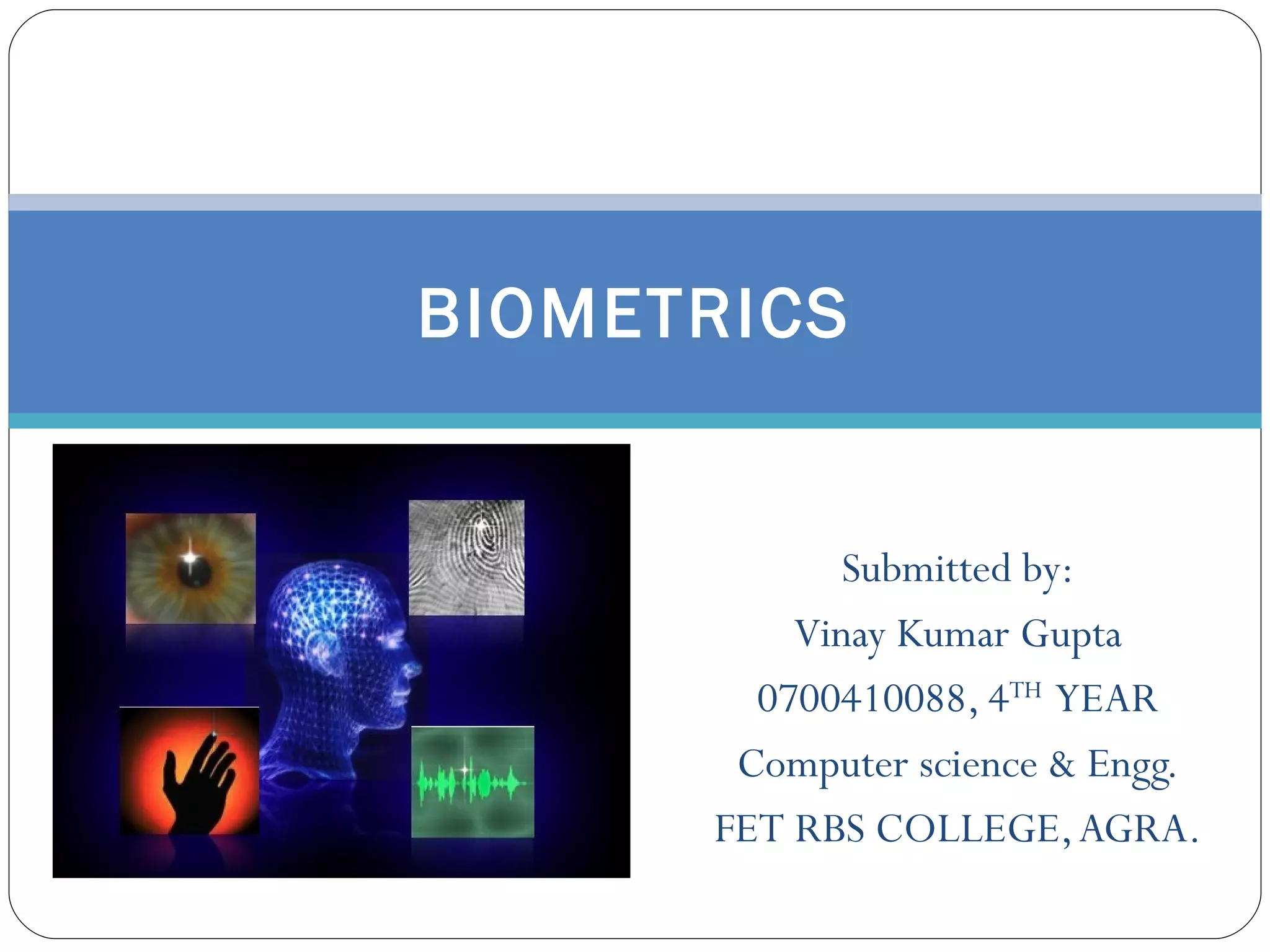
Submitted by: Vinay Kumar Gupta 0700410088, 4 TH   YEAR Computer science & Engg. FET RBS COLLEGE, AGRA. BIOMETRICS
WHAT IS BIOMETRICS? BIOMETRICS –   any automatically  measurable ,  robust  and  distinctive  physical characteristic or personal trait that can be used to identify an individual or verify the claimed identity of an individual.
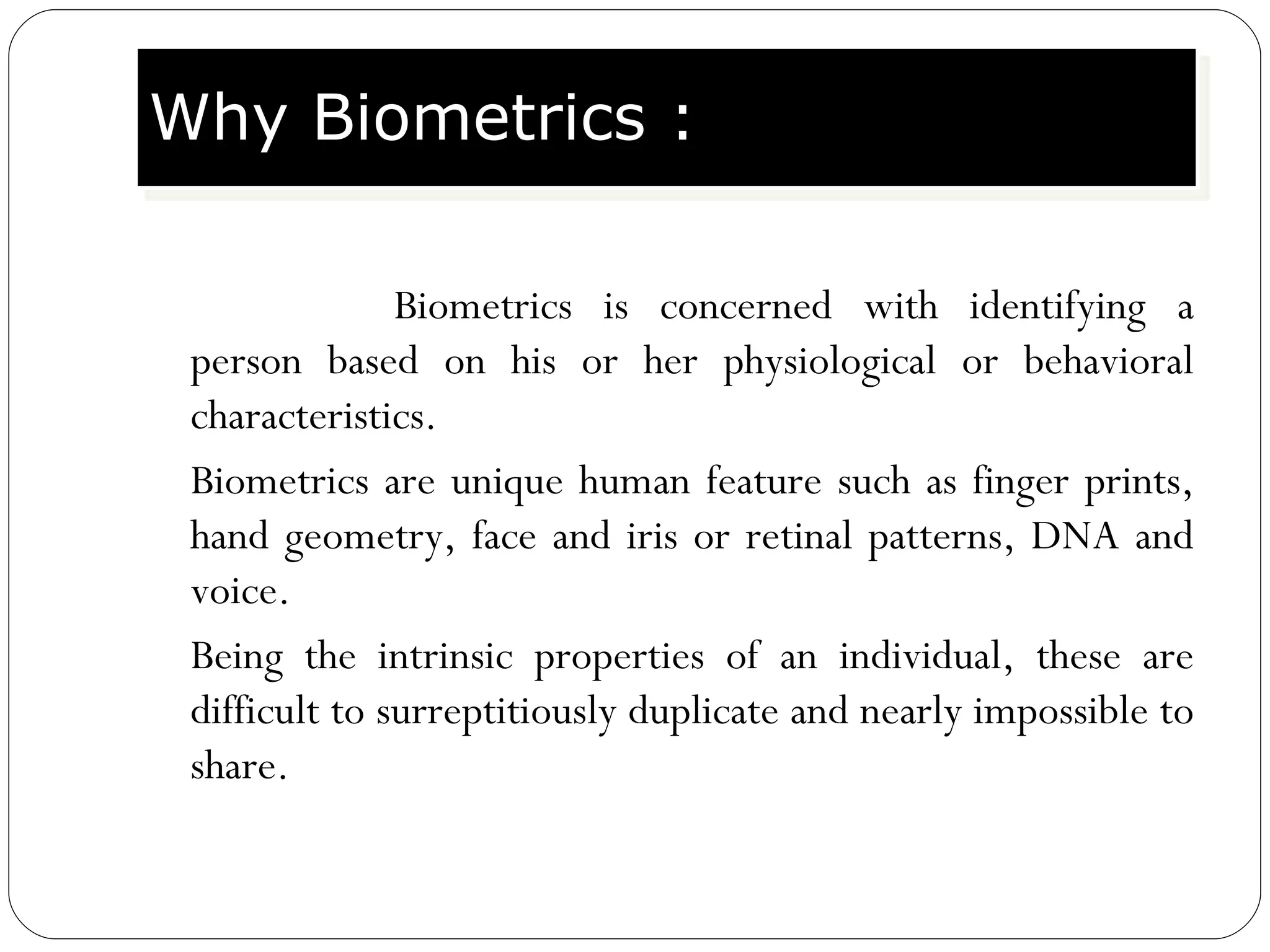
Biometrics is concerned with identifying a person based on his or her physiological or behavioral characteristics. Biometrics are unique human feature such as finger prints, hand geometry, face and iris or retinal patterns, DNA and voice. Being the intrinsic properties of an individual, these are difficult to surreptitiously duplicate and nearly impossible to share. Why Biometrics :
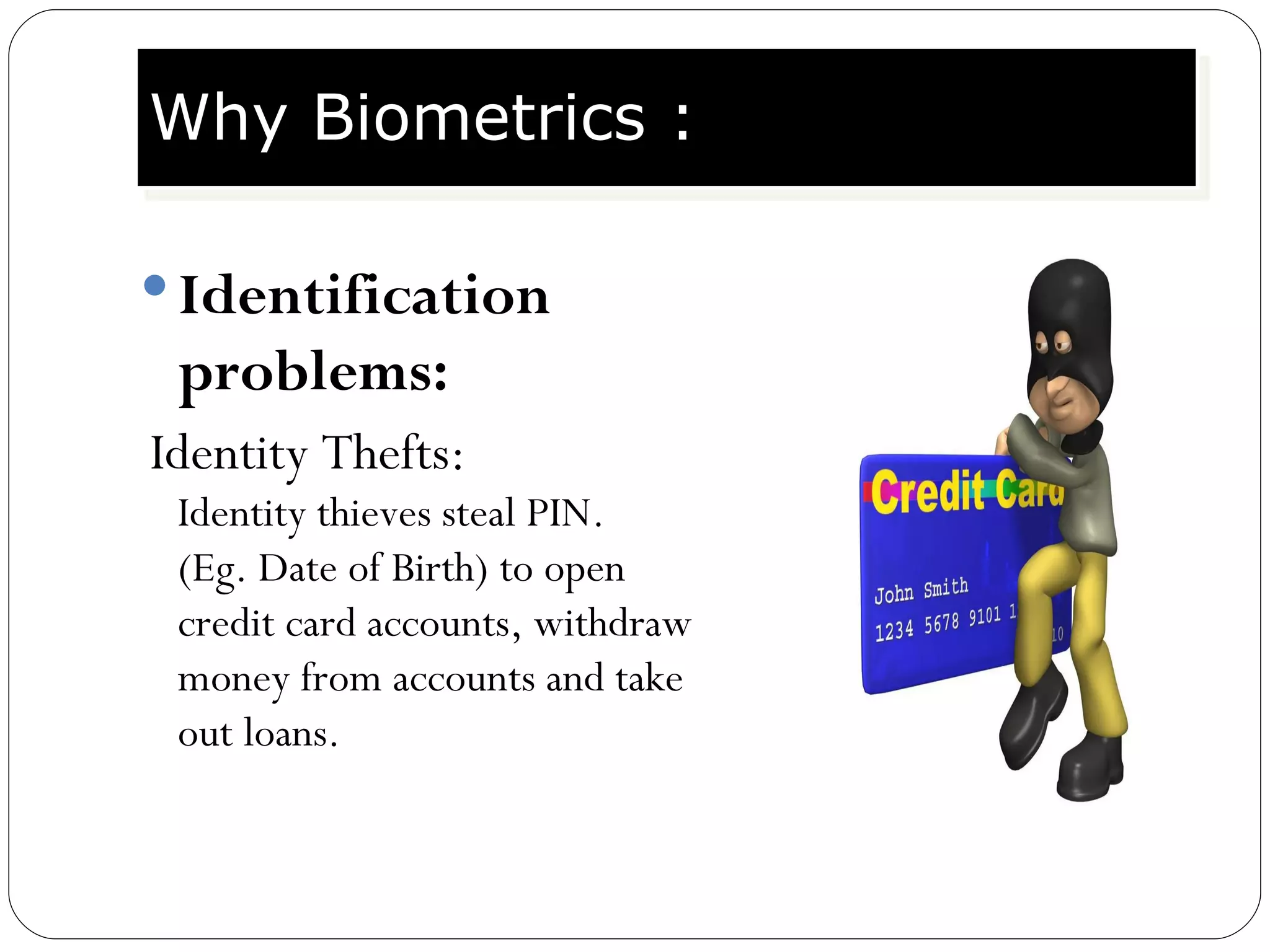
Identification problems: Identity Thefts:  Identity thieves steal PIN. (Eg. Date of Birth) to open credit card accounts, withdraw money from accounts and take out loans. Why Biometrics :
Too many Passwords to remember:   A heavy web user have an average of 21 passwords. [81% users have common passwords and 31% write their passwords down or store them in a file.] Why Biometrics :
: 1) IDENTFICATION -figure out “Who is X?” -accomplished by system performing  -A “one-to-many” search 2) VERIFICATION -answer the question “Is this X?” -accomplished by the system performing  -A “one-to-one” search Two main uses:
What is Authentication? Process by which someone or something is given a valid authenticity so that he can access a particular application or thing. E.g. Password and user ID for users. Providing PIN to identification card users. Giving gate pass to the employees of a company.
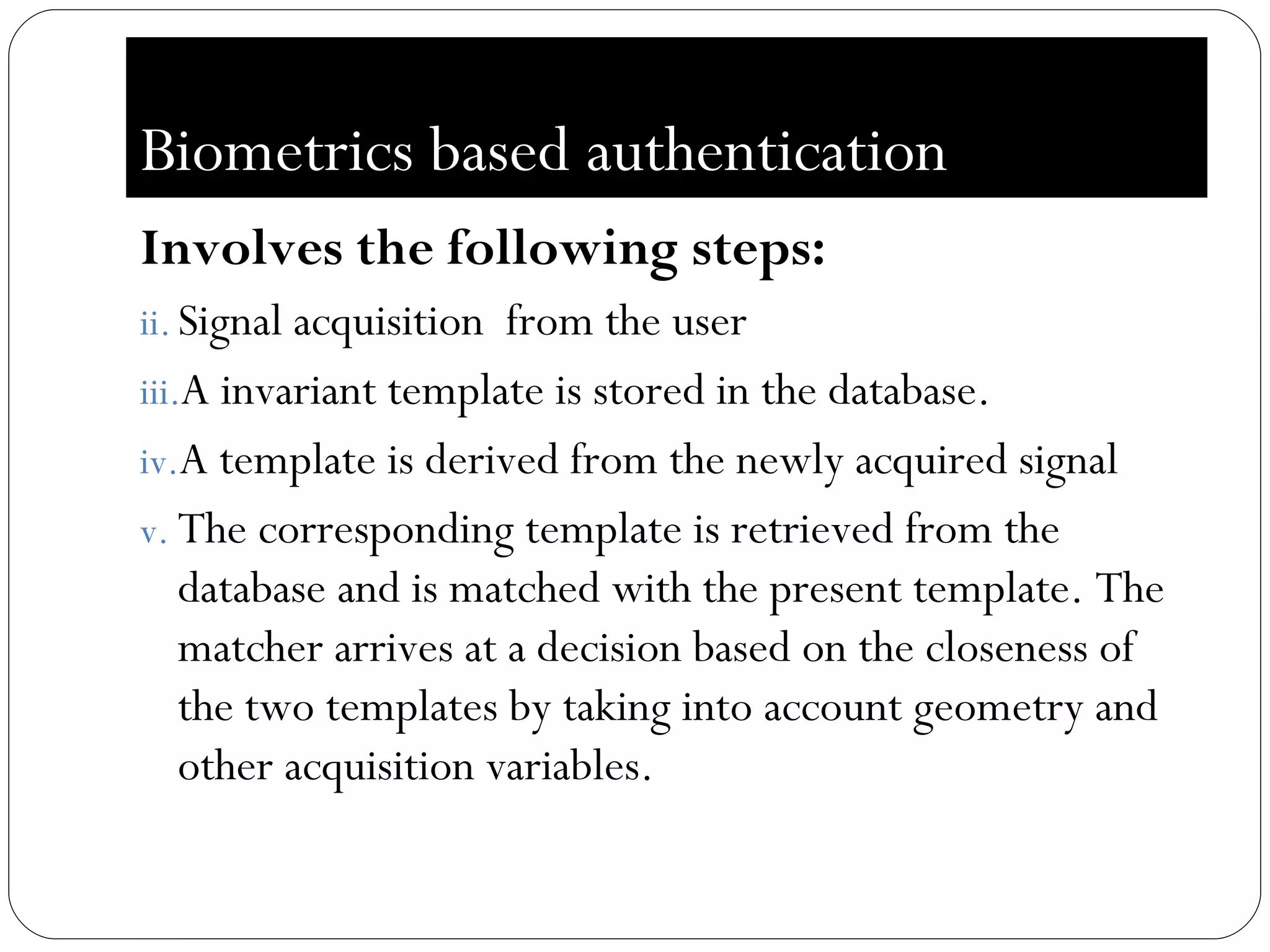
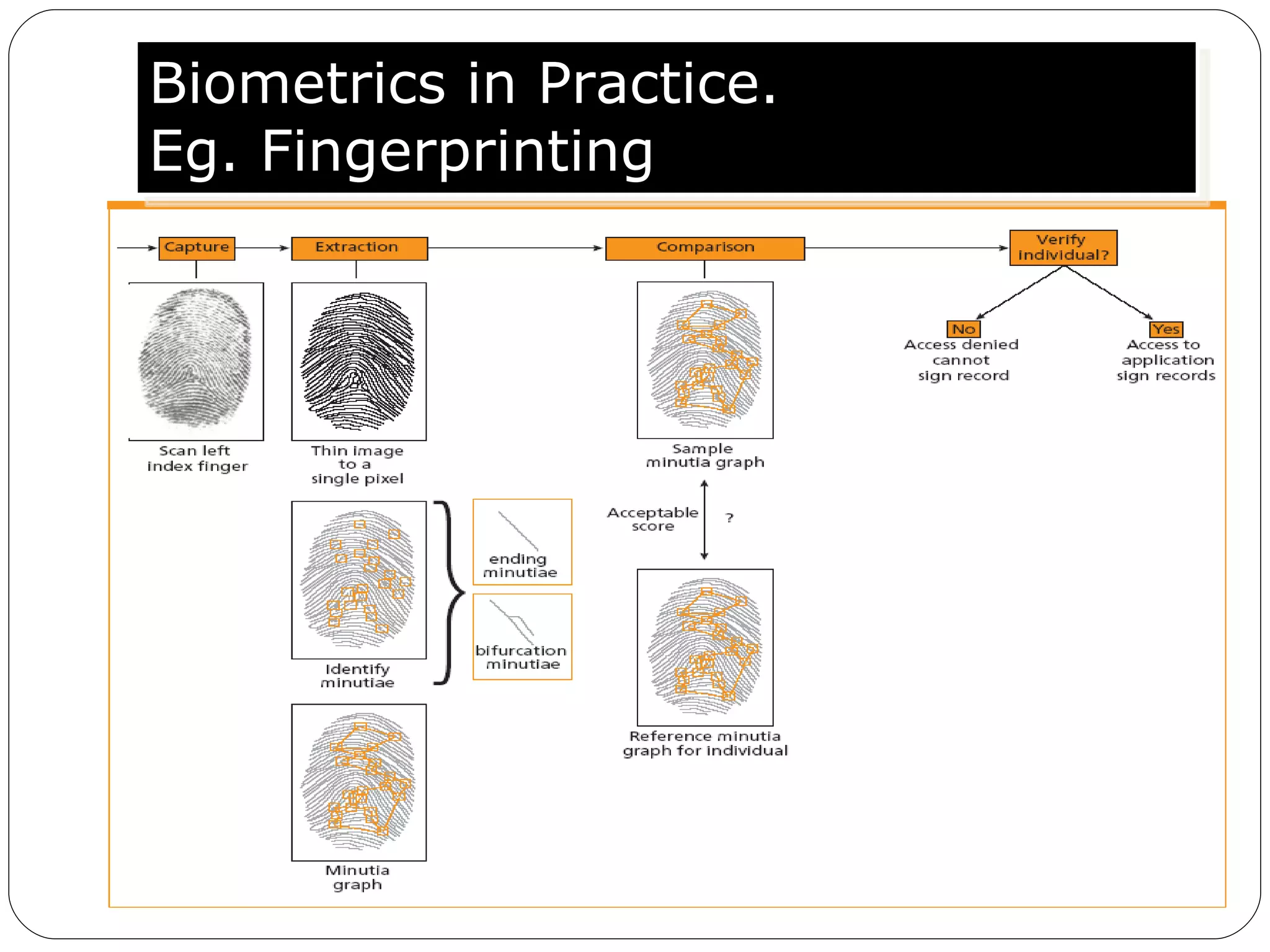
Biometrics based authentication Involves the following steps: Signal acquisition  from the user A invariant template is stored in the database. A template is derived from the newly acquired signal The corresponding template is retrieved from the database and is matched with the present template. The matcher arrives at a decision based on the closeness of the two templates by taking into account geometry and other acquisition variables.
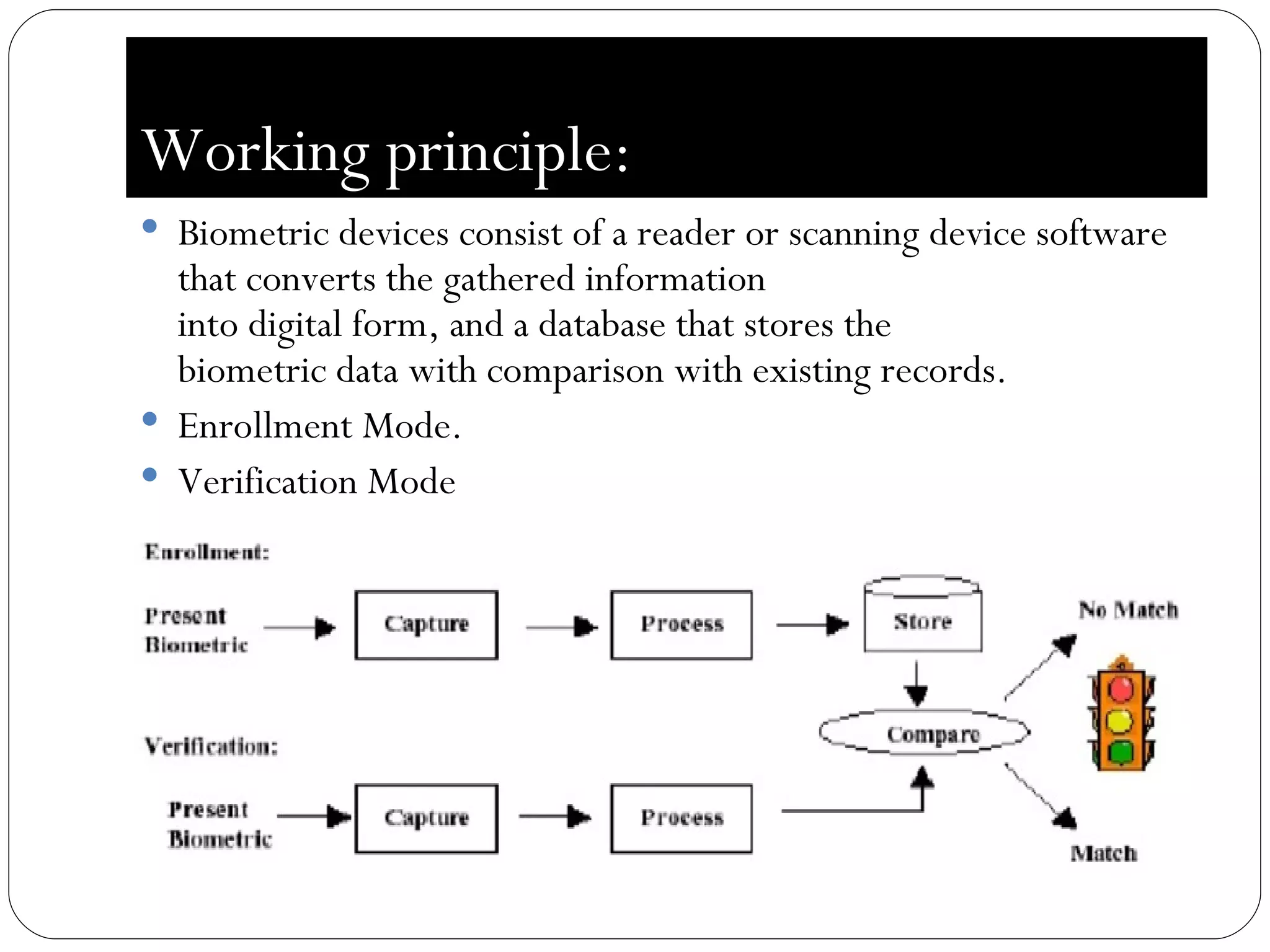
Working principle: Biometric devices consist of a reader or scanning device software that converts the gathered information into digital form, and a database that stores the biometric data with comparison with existing records. Enrollment Mode.  Verification Mode
Modes: Enrollment Mode:  A sample of the biometric trait is captured,  processed by a computer, and stored for later  Comparison. Verification Mode:  In this mode biometric system authenticates a  person’s claimed identity from their previously  enrolled pattern.
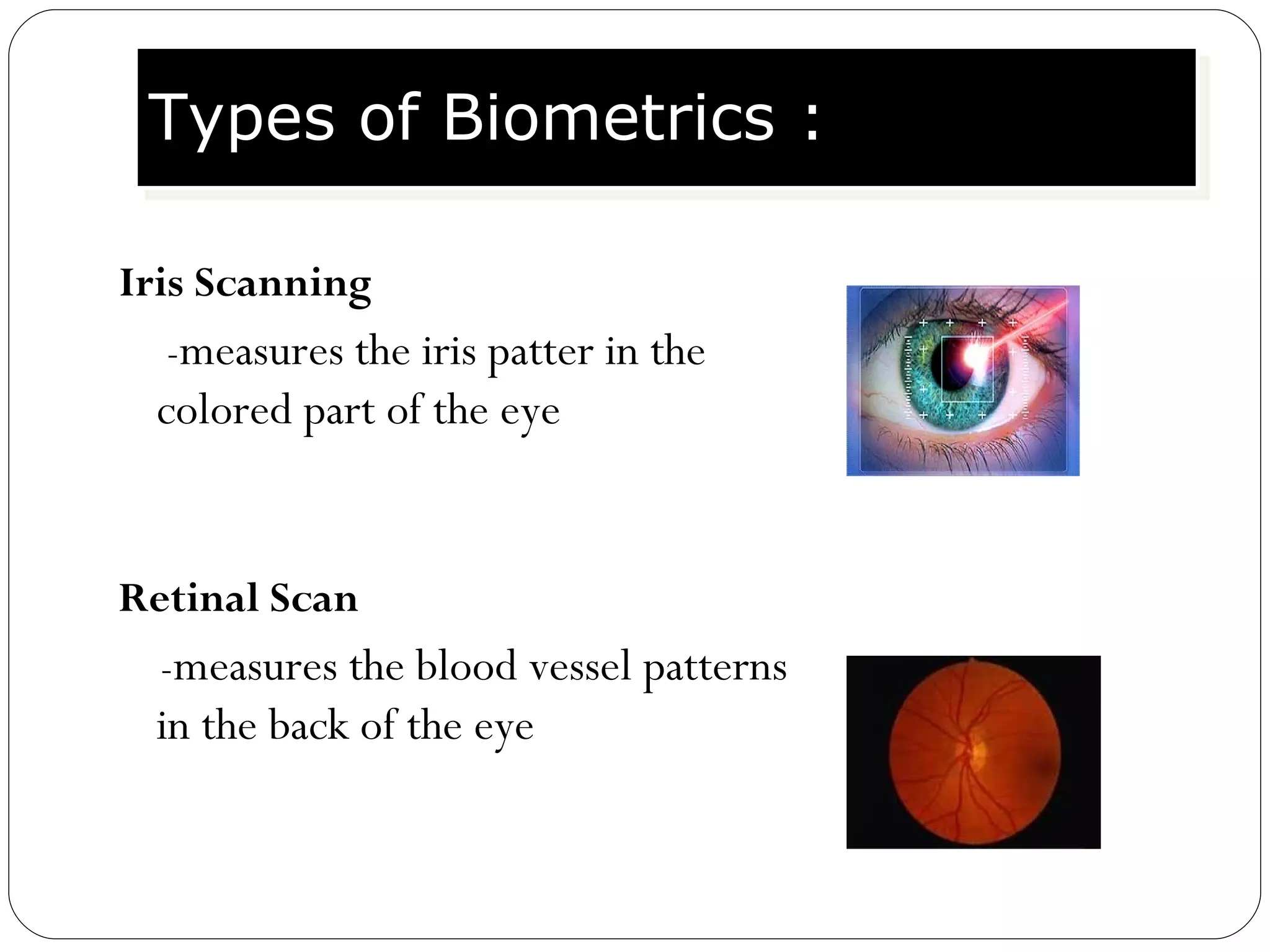
Iris Scanning - measures the iris patter in the colored part of the eye Retinal Scan - measures the blood vessel patterns in the back of the eye Types of Biometrics :
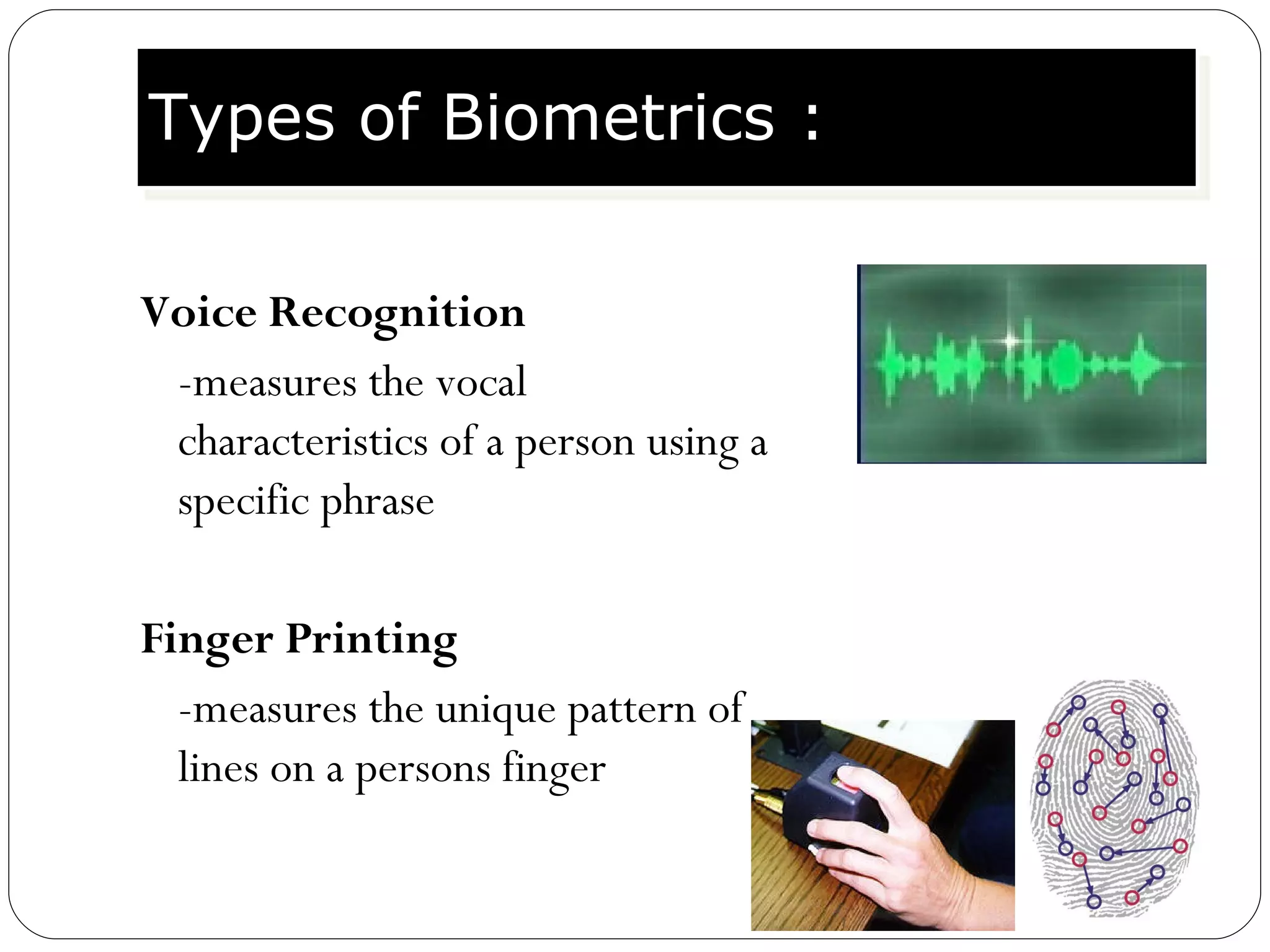
Voice Recognition -measures the vocal characteristics of a person using a specific phrase Finger Printing -measures the unique pattern of lines on a persons finger Types of Biometrics :
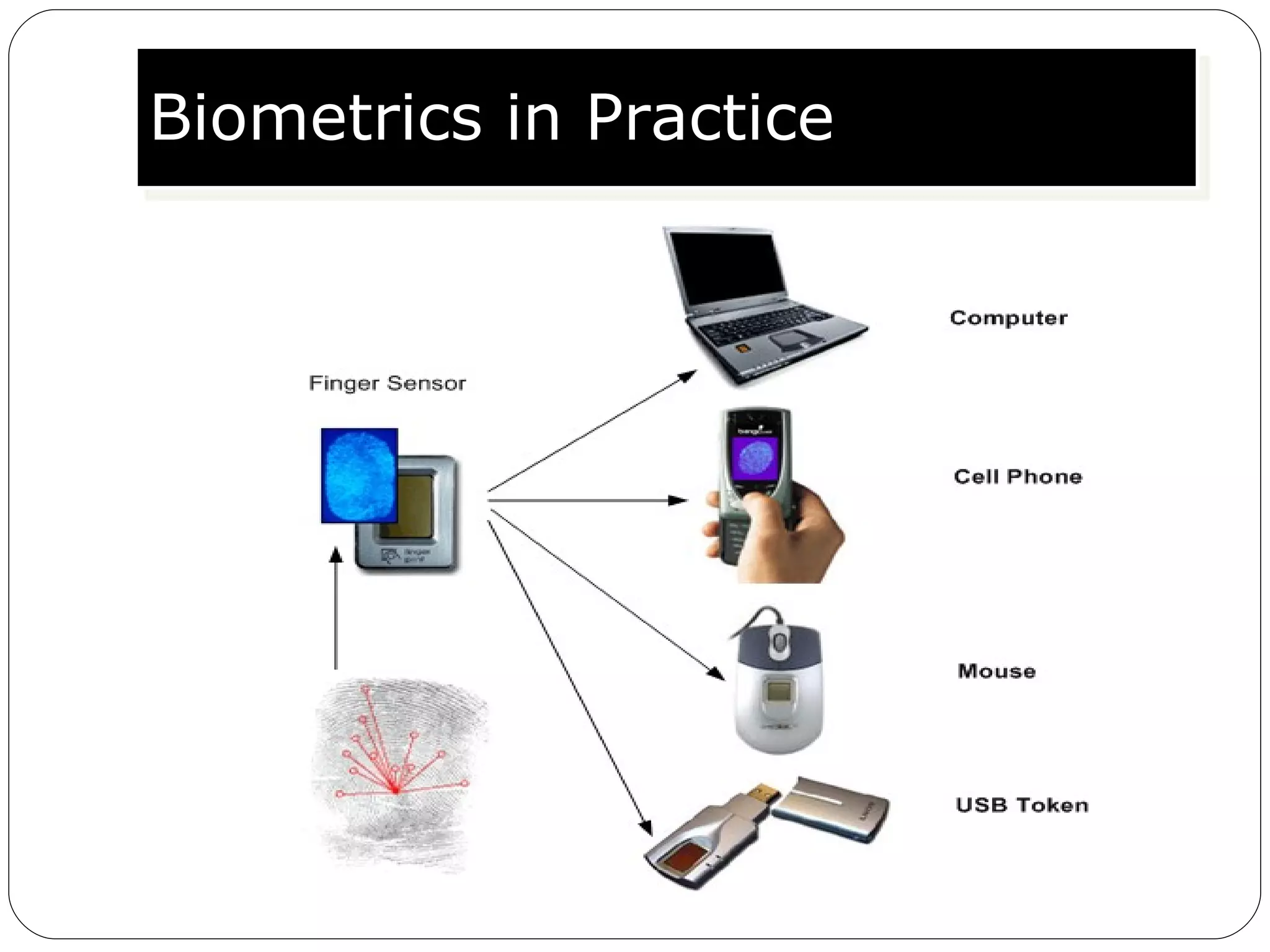
Biometrics in Practice
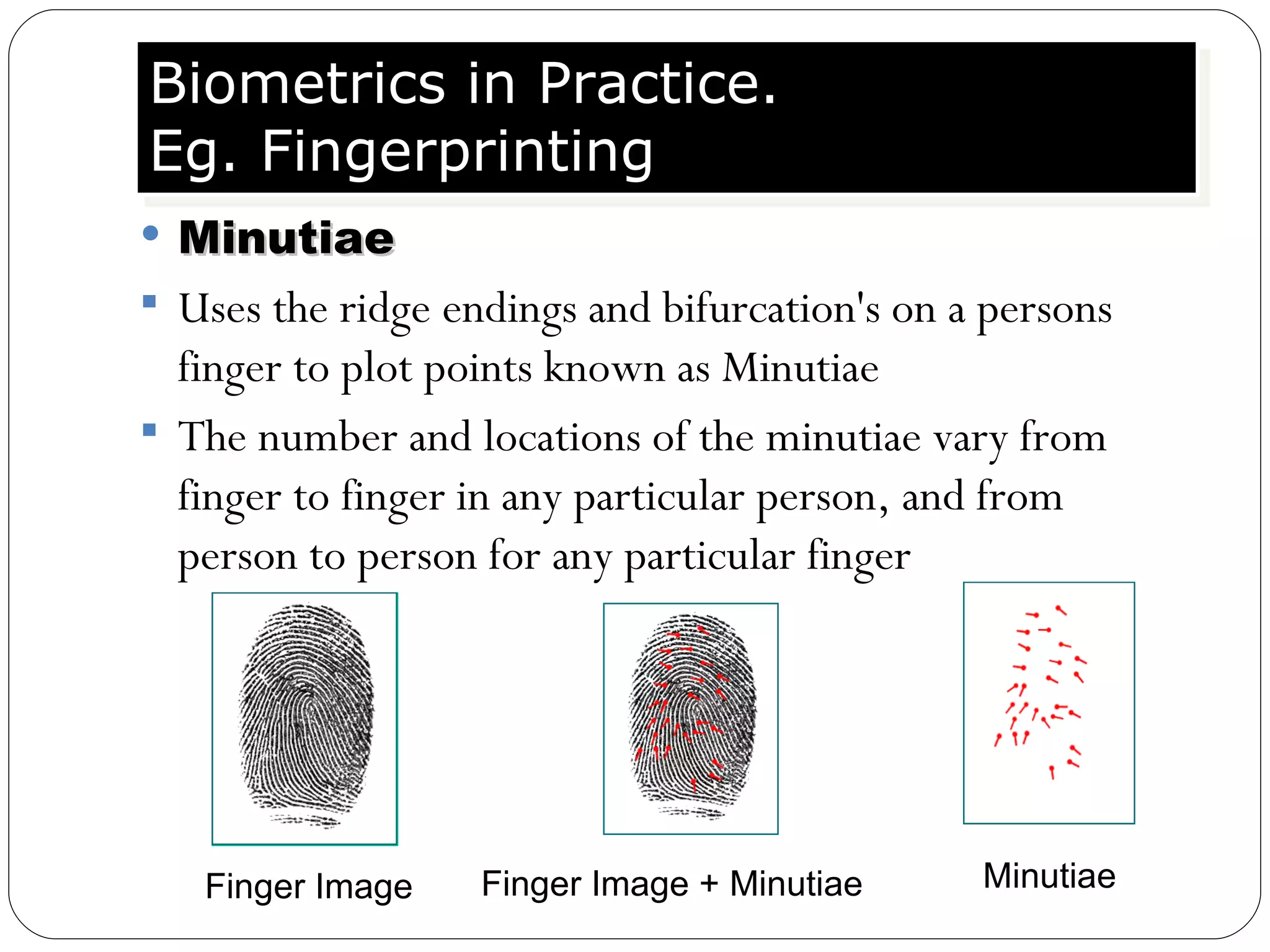
Minutiae Uses the ridge endings and bifurcation's on a persons finger to plot points known as Minutiae The number and locations of the minutiae vary from finger to finger in any particular person, and from person to person for any particular finger Biometrics in Practice. Eg. Fingerprinting Finger Image Finger Image + Minutiae Minutiae
Biometrics in Practice. Eg. Fingerprinting
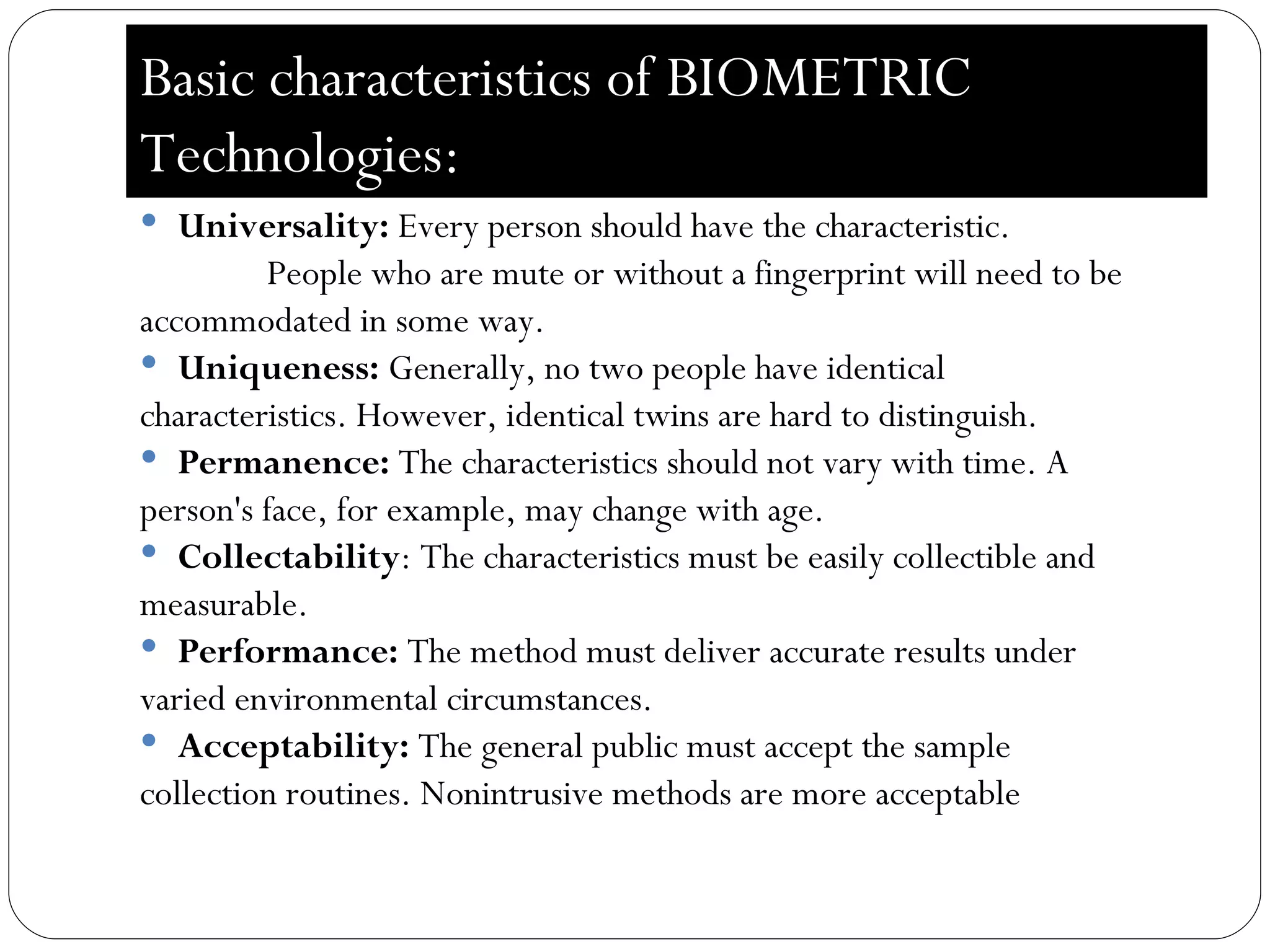
Basic characteristics of BIOMETRIC  Technologies:  Universality:  Every person should have the characteristic.  People who are mute or without a fingerprint will need to be  accommodated in some way.  Uniqueness:  Generally, no two people have identical  characteristics. However, identical twins are hard to distinguish.  Permanence:  The characteristics should not vary with time. A  person's face, for example, may change with age.  Collectability : The characteristics must be easily collectible and  measurable.  Performance:  The method must deliver accurate results under  varied environmental circumstances.  Acceptability:  The general public must accept the sample  collection routines. Nonintrusive methods are more acceptable
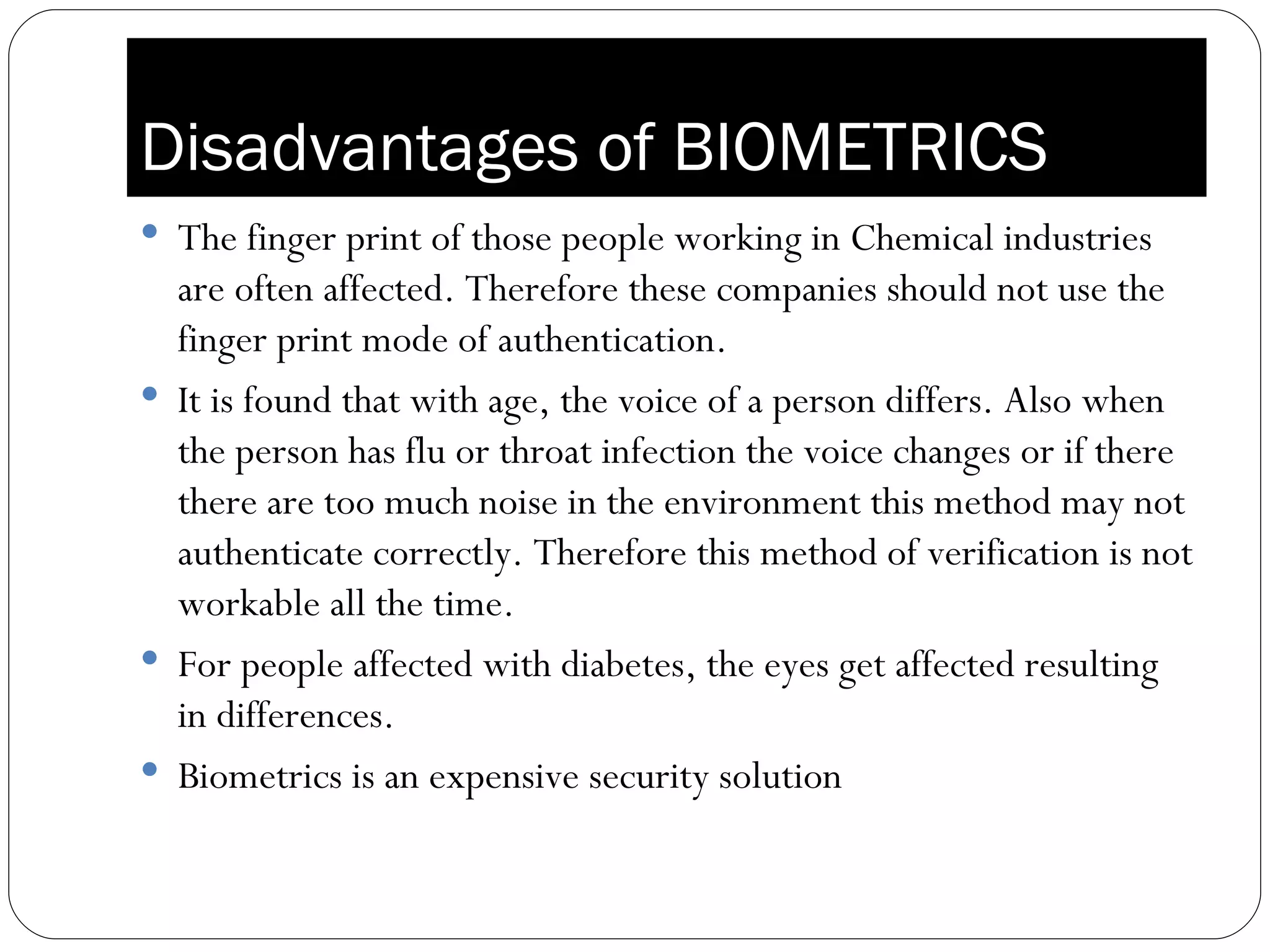
Disadvantages of BIOMETRICS The finger print of those people working in Chemical industries are often affected. Therefore these companies should not use the finger print mode of authentication. It is found that with age, the voice of a person differs. Also when the person has flu or throat infection the voice changes or if there there are too much noise in the environment this method may not authenticate correctly. Therefore this method of verification is not workable all the time. For people affected with diabetes, the eyes get affected resulting in differences.  Biometrics is an expensive security solution
“ Your body as password ” ? The Future… Challenges: Are biometric technologies ready for what is being expected of them?  Technical issues legal and privacy issues
Conclusion Biometrics-based authentication has many usability advantages over traditional systems such as passwords.  The greatest strength of biometrics, the fact that the biometrics does not change over time, is at the same time its greatest liability. Once a set of biometric data has been compromised, it is compromised forever.  Conclusion
Any Queries…  ?
Thank You!

Biometric

  • 1.
    Submitted by: VinayKumar Gupta 0700410088, 4 TH YEAR Computer science & Engg. FET RBS COLLEGE, AGRA. BIOMETRICS
  • 2.
    WHAT IS BIOMETRICS?BIOMETRICS – any automatically measurable , robust and distinctive physical characteristic or personal trait that can be used to identify an individual or verify the claimed identity of an individual.
  • 3.
    Biometrics is concernedwith identifying a person based on his or her physiological or behavioral characteristics. Biometrics are unique human feature such as finger prints, hand geometry, face and iris or retinal patterns, DNA and voice. Being the intrinsic properties of an individual, these are difficult to surreptitiously duplicate and nearly impossible to share. Why Biometrics :
  • 4.
    Identification problems: IdentityThefts: Identity thieves steal PIN. (Eg. Date of Birth) to open credit card accounts, withdraw money from accounts and take out loans. Why Biometrics :
  • 5.
    Too many Passwordsto remember: A heavy web user have an average of 21 passwords. [81% users have common passwords and 31% write their passwords down or store them in a file.] Why Biometrics :
  • 6.
    : 1) IDENTFICATION-figure out “Who is X?” -accomplished by system performing -A “one-to-many” search 2) VERIFICATION -answer the question “Is this X?” -accomplished by the system performing -A “one-to-one” search Two main uses:
  • 7.
    What is Authentication?Process by which someone or something is given a valid authenticity so that he can access a particular application or thing. E.g. Password and user ID for users. Providing PIN to identification card users. Giving gate pass to the employees of a company.
  • 8.
    Biometrics based authenticationInvolves the following steps: Signal acquisition from the user A invariant template is stored in the database. A template is derived from the newly acquired signal The corresponding template is retrieved from the database and is matched with the present template. The matcher arrives at a decision based on the closeness of the two templates by taking into account geometry and other acquisition variables.
  • 9.
    Working principle: Biometricdevices consist of a reader or scanning device software that converts the gathered information into digital form, and a database that stores the biometric data with comparison with existing records. Enrollment Mode. Verification Mode
  • 10.
    Modes: Enrollment Mode: A sample of the biometric trait is captured, processed by a computer, and stored for later Comparison. Verification Mode: In this mode biometric system authenticates a person’s claimed identity from their previously enrolled pattern.
  • 11.
    Iris Scanning -measures the iris patter in the colored part of the eye Retinal Scan - measures the blood vessel patterns in the back of the eye Types of Biometrics :
  • 12.
    Voice Recognition -measuresthe vocal characteristics of a person using a specific phrase Finger Printing -measures the unique pattern of lines on a persons finger Types of Biometrics :
  • 13.
  • 14.
    Minutiae Uses theridge endings and bifurcation's on a persons finger to plot points known as Minutiae The number and locations of the minutiae vary from finger to finger in any particular person, and from person to person for any particular finger Biometrics in Practice. Eg. Fingerprinting Finger Image Finger Image + Minutiae Minutiae
  • 15.
    Biometrics in Practice.Eg. Fingerprinting
  • 16.
    Basic characteristics ofBIOMETRIC Technologies: Universality: Every person should have the characteristic. People who are mute or without a fingerprint will need to be accommodated in some way. Uniqueness: Generally, no two people have identical characteristics. However, identical twins are hard to distinguish. Permanence: The characteristics should not vary with time. A person's face, for example, may change with age. Collectability : The characteristics must be easily collectible and measurable. Performance: The method must deliver accurate results under varied environmental circumstances. Acceptability: The general public must accept the sample collection routines. Nonintrusive methods are more acceptable
  • 17.
    Disadvantages of BIOMETRICSThe finger print of those people working in Chemical industries are often affected. Therefore these companies should not use the finger print mode of authentication. It is found that with age, the voice of a person differs. Also when the person has flu or throat infection the voice changes or if there there are too much noise in the environment this method may not authenticate correctly. Therefore this method of verification is not workable all the time. For people affected with diabetes, the eyes get affected resulting in differences. Biometrics is an expensive security solution
  • 18.
    “ Your bodyas password ” ? The Future… Challenges: Are biometric technologies ready for what is being expected of them? Technical issues legal and privacy issues
  • 19.
    Conclusion Biometrics-based authenticationhas many usability advantages over traditional systems such as passwords. The greatest strength of biometrics, the fact that the biometrics does not change over time, is at the same time its greatest liability. Once a set of biometric data has been compromised, it is compromised forever. Conclusion
  • 20.
  • 21.