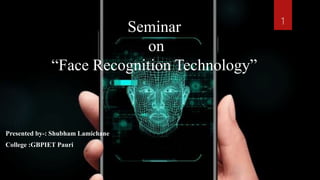
Seminar
on
“Face Recognition Technology”
Presented by-: Shubham Lamichane
College :GBPIET Pauri
1
Contents
1.Introduction
2.What are Biometrics
3.Why do we choose FRS over
other Biometrics
4.Difference between FRS and FDS
4.Face Recognition
6.How FRS works
7.Example
8.Application area
9.Few applications
10.Advantages
11.Disadvantages
12.Application in India
13.Growth rate
14.References
15.Conclusion
2
Introduction
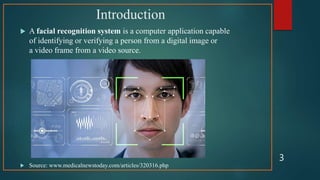
 A facial recognition system is a computer application capable
of identifying or verifying a person from a digital image or
a video frame from a video source.
 Source: www.medicalnewstoday.com/articles/320316.php
3
What are Biometrics?
 A biometrics is a unique, measurable characteristic of a human being that
can be used to automatically recognize an individual or verify an
individual identity.
Physiological Biometrics :
a. Finger-scan
b. Facial Recognition
c. Iris-scan
d. Retina-scan
e. Hand-scan
Behavioural Biometrics:
a. Signature
b. Voice 4
Why we choose face recognition over
other biometric ?
 There are number reasons to choose face recognition. This includes the
following :
 a. It requires no physical interaction on behalf of the user.
 b. It is accurate and allows for high enrolment and verification rates.
 c. It does not require an expert to interpret the comparison result.
 d. It can use your existing hardware infrastructure, existing cameras and
image capture devices will work with no problems.
 e. It is the only biometric that allow you to perform passive identification.
5
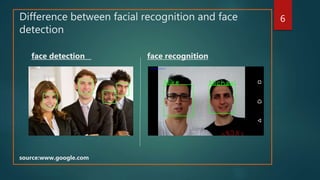
Difference between facial recognition and face
detection
face detection face recognition
source:www.google.com
6
FACE RECOGNITION
 A facial recognition system is a computer application capable
of identifying or verifying a person from a digital image or a video frame from
a video source
 For face recognition there are two types of comparisons
1. Verification(1:1 mapping)
This is where the system compares the given individual with who that
individual says they are and gives a yes or no decision.
2. Identification(1:N mapping)
This is where the system compares the given individual to all the Other
individuals in the database and gives a ranked list of matches.
7
All identification or authentication technologies operate
using the following four stages:
 1.Capture
 2.Extraction
 3.Comparision
 4.Match/Non
Match
8
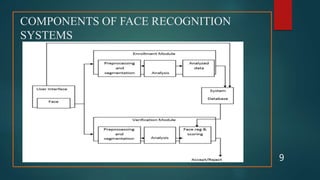
COMPONENTS OF FACE RECOGNITION
SYSTEMS
9
IMPLEMENTATION OF FACE RECOGNITION
TECHNOLOGY
 The implementation of face recognition technology includes the followingthree stages:
1. Data acquisition
2. Input processing
3. Face image classification and decision making
10
1.Data acquisition
The input can be recorded video of the speaker or a still image. A sample of 1 sec
duration consists of a 25 frame video sequence. More than one camera can be
used to produce a 3D representation of the face and to protect against the usageof
photographs to gain unauthorized access.
2. Input processing
A pre-processing module locates the eye position and takes care of the
surrounding lighting condition and colour variance. First the presence of facesor
face in a scene must be detected. Once the face is detected, it must be localized.
11
3.Face image classification and decision
making
A newly recorded pattern is pre-processed and compared with each face print stored
in the database. As comparisons are made, the system assigns a value to the
comparison using a scale of one to ten. If a score is above a predetermined threshold,
a match is declared.
12
HOW FACE RECOGNITION SYSTEMS
WORK
 If you look at the mirror, you can see that your face has certain
distinguishable landmarks.
 These are the peaks and valleys that make up the different facial features.
Software defines these landmarks as nodal points.
 There are about “80 nodal points” on a human face.
13
Nodal points
14
Here are few nodal points that are measured by the
faceit software.
 distance between the eyes
 width of the nose
 depth of the eye socket
 cheekbones
 jaw line
 chin
15
Face recognition algorithms:
 Principal component analysis
 3-D Face Recognition
 Support Vector machine
16
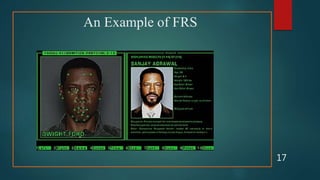
An Example of FRS
17
Application area
Enterprise Security Computer and physical access control
Government Events Criminal Terrorists screening; Surveillance
Immigration/Customs
Illegal immigrant detection; Passport/ ID Card
authentication
Casino Filtering suspicious gamblers /VIPs
Toy Intelligent robotic
Vehicle Safety alert system based on eyelid movement
18
Few Applications
 1.Facebook auto-tag feature
19
 2.Attendance management system:
20
 3.Criminal identification
21
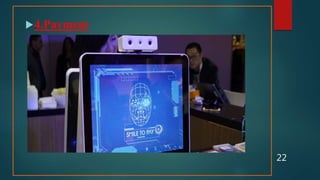
4.Payment
22
5.Face ID
23
Advantages
 There are many benefits to face recognition systems such as its
convenience and Social acceptability.
 Face recognition is easy to use and in many cases it can be
performed without a Person even knowing.
 Face recognition is also one of the most inexpensive biometric in
the market.
24
Disadvantages
 Face recognition systems can not tell the difference between
identical twins.
 the illumination problem, the pose problem, scale variability,
images taken years apart, glasses, moustaches, beards, low quality
image acquisition, partially occluded faces, etc.
 Privacy concern.
25
Application in India
 Face authentication will be
enabled by July to help people
facing any difficulty in the
authentication of their
fingerprints, which may be
worn out because of age or
hard work, or other factors,
said the UIDAI or Unique
Identification Authority of
India.
26
Growth Rate
 The global facial recognition market is expected to grow from USD 4.05
billion in 2017 to USD 7.76 billion by 2022, at a Compound Annual Growth
Rate (CAGR) of 13.9% during forecast period.
27
Conclusion
Face recognition technologies have been associated generally with very costly
top secure applications. Today the core technologies have evolved and the cost of
equipment is going down dramatically due to the integration and the increasing
processing power. Certain applications of face recognition technology are now
cost effective, reliable and highly accurate. As a result there are no technological
or financial barriers for stepping from the pilot project to widespread
deployment.
28
References
 www.prnewswire.com
 en.wikipedia.org
 www.ieee.com
 electronics.howstuffworks.com
 www.techclinch.com
29
30
31

Face recognition technology

  • 1.
    Seminar on “Face Recognition Technology” Presentedby-: Shubham Lamichane College :GBPIET Pauri 1
  • 2.
    Contents 1.Introduction 2.What are Biometrics 3.Whydo we choose FRS over other Biometrics 4.Difference between FRS and FDS 4.Face Recognition 6.How FRS works 7.Example 8.Application area 9.Few applications 10.Advantages 11.Disadvantages 12.Application in India 13.Growth rate 14.References 15.Conclusion 2
  • 3.
    Introduction  A facialrecognition system is a computer application capable of identifying or verifying a person from a digital image or a video frame from a video source.  Source: www.medicalnewstoday.com/articles/320316.php 3
  • 4.
    What are Biometrics? A biometrics is a unique, measurable characteristic of a human being that can be used to automatically recognize an individual or verify an individual identity. Physiological Biometrics : a. Finger-scan b. Facial Recognition c. Iris-scan d. Retina-scan e. Hand-scan Behavioural Biometrics: a. Signature b. Voice 4
  • 5.
    Why we chooseface recognition over other biometric ?  There are number reasons to choose face recognition. This includes the following :  a. It requires no physical interaction on behalf of the user.  b. It is accurate and allows for high enrolment and verification rates.  c. It does not require an expert to interpret the comparison result.  d. It can use your existing hardware infrastructure, existing cameras and image capture devices will work with no problems.  e. It is the only biometric that allow you to perform passive identification. 5
  • 6.
    Difference between facialrecognition and face detection face detection face recognition source:www.google.com 6
  • 7.
    FACE RECOGNITION  Afacial recognition system is a computer application capable of identifying or verifying a person from a digital image or a video frame from a video source  For face recognition there are two types of comparisons 1. Verification(1:1 mapping) This is where the system compares the given individual with who that individual says they are and gives a yes or no decision. 2. Identification(1:N mapping) This is where the system compares the given individual to all the Other individuals in the database and gives a ranked list of matches. 7
  • 8.
    All identification orauthentication technologies operate using the following four stages:  1.Capture  2.Extraction  3.Comparision  4.Match/Non Match 8
  • 9.
    COMPONENTS OF FACERECOGNITION SYSTEMS 9
  • 10.
    IMPLEMENTATION OF FACERECOGNITION TECHNOLOGY  The implementation of face recognition technology includes the followingthree stages: 1. Data acquisition 2. Input processing 3. Face image classification and decision making 10
  • 11.
    1.Data acquisition The inputcan be recorded video of the speaker or a still image. A sample of 1 sec duration consists of a 25 frame video sequence. More than one camera can be used to produce a 3D representation of the face and to protect against the usageof photographs to gain unauthorized access. 2. Input processing A pre-processing module locates the eye position and takes care of the surrounding lighting condition and colour variance. First the presence of facesor face in a scene must be detected. Once the face is detected, it must be localized. 11
  • 12.
    3.Face image classificationand decision making A newly recorded pattern is pre-processed and compared with each face print stored in the database. As comparisons are made, the system assigns a value to the comparison using a scale of one to ten. If a score is above a predetermined threshold, a match is declared. 12
  • 13.
    HOW FACE RECOGNITIONSYSTEMS WORK  If you look at the mirror, you can see that your face has certain distinguishable landmarks.  These are the peaks and valleys that make up the different facial features. Software defines these landmarks as nodal points.  There are about “80 nodal points” on a human face. 13
  • 14.
  • 15.
    Here are fewnodal points that are measured by the faceit software.  distance between the eyes  width of the nose  depth of the eye socket  cheekbones  jaw line  chin 15
  • 16.
    Face recognition algorithms: Principal component analysis  3-D Face Recognition  Support Vector machine 16
  • 17.
  • 18.
    Application area Enterprise SecurityComputer and physical access control Government Events Criminal Terrorists screening; Surveillance Immigration/Customs Illegal immigrant detection; Passport/ ID Card authentication Casino Filtering suspicious gamblers /VIPs Toy Intelligent robotic Vehicle Safety alert system based on eyelid movement 18
  • 19.
  • 20.
  • 21.
  • 22.
  • 23.
  • 24.
    Advantages  There aremany benefits to face recognition systems such as its convenience and Social acceptability.  Face recognition is easy to use and in many cases it can be performed without a Person even knowing.  Face recognition is also one of the most inexpensive biometric in the market. 24
  • 25.
    Disadvantages  Face recognitionsystems can not tell the difference between identical twins.  the illumination problem, the pose problem, scale variability, images taken years apart, glasses, moustaches, beards, low quality image acquisition, partially occluded faces, etc.  Privacy concern. 25
  • 26.
    Application in India Face authentication will be enabled by July to help people facing any difficulty in the authentication of their fingerprints, which may be worn out because of age or hard work, or other factors, said the UIDAI or Unique Identification Authority of India. 26
  • 27.
    Growth Rate  Theglobal facial recognition market is expected to grow from USD 4.05 billion in 2017 to USD 7.76 billion by 2022, at a Compound Annual Growth Rate (CAGR) of 13.9% during forecast period. 27
  • 28.
    Conclusion Face recognition technologieshave been associated generally with very costly top secure applications. Today the core technologies have evolved and the cost of equipment is going down dramatically due to the integration and the increasing processing power. Certain applications of face recognition technology are now cost effective, reliable and highly accurate. As a result there are no technological or financial barriers for stepping from the pilot project to widespread deployment. 28
  • 29.
    References  www.prnewswire.com  en.wikipedia.org www.ieee.com  electronics.howstuffworks.com  www.techclinch.com 29
  • 30.
  • 31.