+
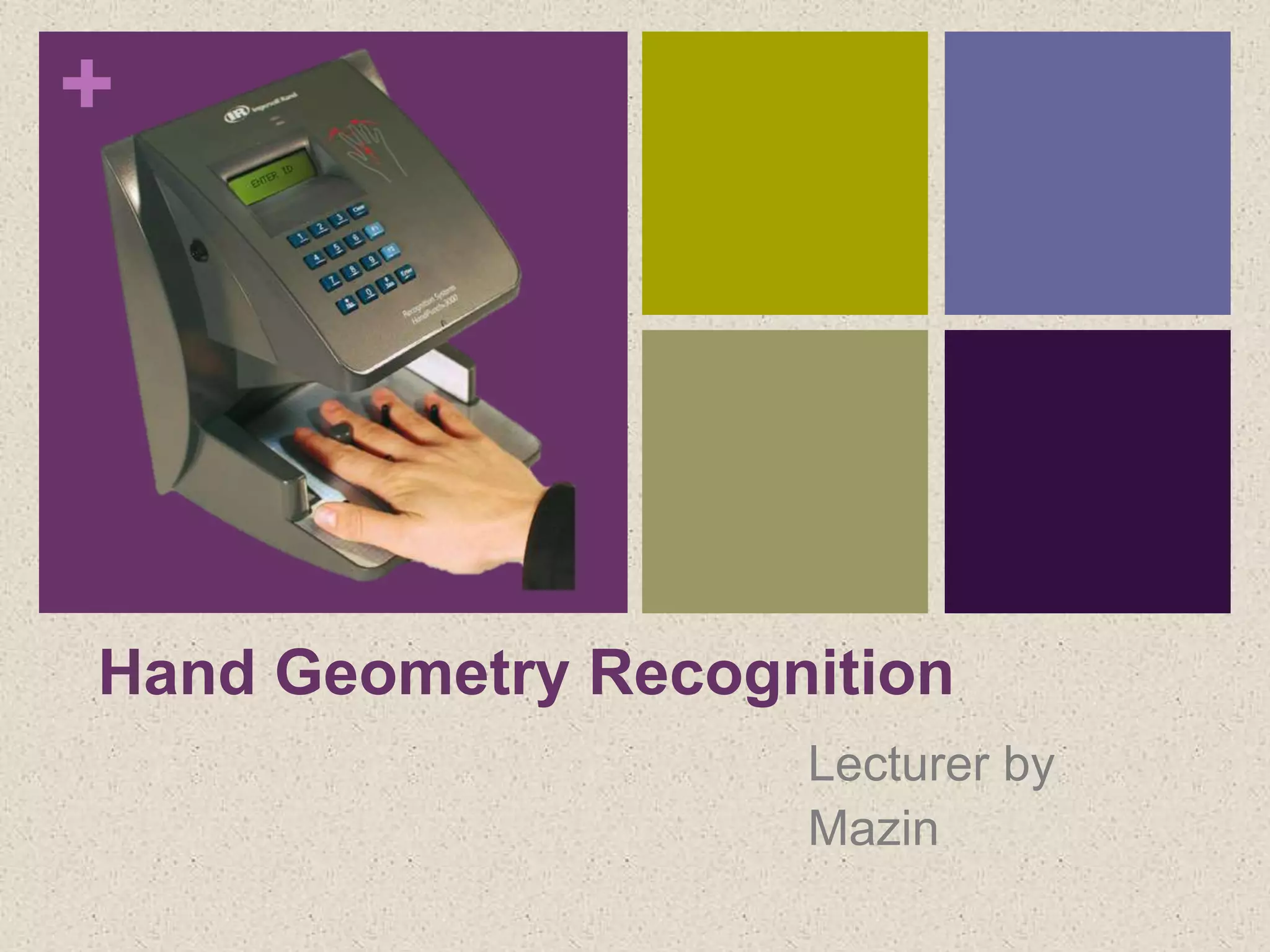
Hand Geometry Recognition
Lecturer by
Mazin
+
Outline
 Definition
 Evolution
 Properties
 Where used
 Applications
 Equipment
 How it works
 Enrollment
 Verification
1. Image Acquisition
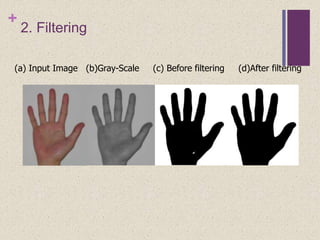
2. Filtering
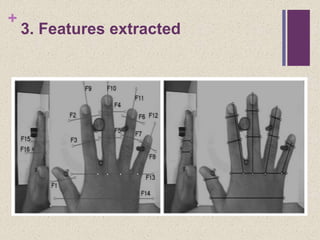
3. Features extracted
 Advantage and Limitations
 Comparison
+
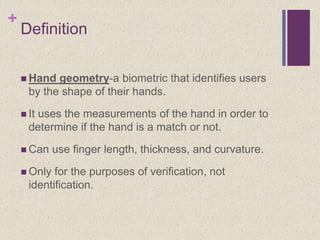
Definition
 Hand geometry-a biometric that identifies users
by the shape of their hands.
 It uses the measurements of the hand in order to
determine if the hand is a match or not.
 Can use finger length, thickness, and curvature.
 Only for the purposes of verification, not
identification.
+
Evolution
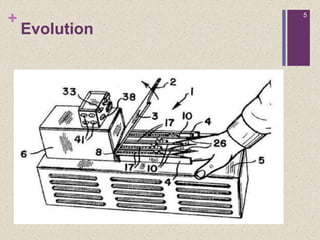
 First devices (1960s) were electromechanical. (Miller’s
“Identimation”) measures length of 4 fingers used in nuclear
weapon industry was retired in 1987
 In the mid-1980’s Sidlauskas developed electronic 3D profile
identification apparatus. capacity 20,000 users. processing time
is 1.2 sec. (1994). weight is 4.5 kg (1994). 9-byte
representation
 It is first mentioned in the early 70’s of the 20th century and it is
older than palm print which is part of dactiloscopy. The first
known use was for security checks in Wall Street.
+ 5
Evolution
+
Properties
 Hand geometry is widely used throughout the
world
 It is used for verification, not identification :
Suitable for medium and low security
applications
 The hand geometry system is coupled with ID
scanning to verify who is entering
 Can be employed in those applications which don't
require extreme security but where robustness
and low-cost are primary issues
+
February 13, 2004
7
Where used
 Access Control
 Used to access Health clubs, Day care centers,
Laboratories, Prisons, etc.
 Time & Attendance
 Application ranges from coal mines to clean rooms.
 Personal Identification
 Newark and Toronto airports; Food Services
systems at the University of Georgia
+ 8
Applications
• 70,000 HandReaders are installed throughout the world.
• The 1996 Olympic Games used HandReaders to protect access to
Olympic Village (65,000 people were enrolled; 1 million transactions
were handled over 28 days).
• Since 1991, at San Francisco Airport, HandReaders produced more
than 100 million verifications (180 doors and 18,000 employees).
• In the United Kingdom, Her majesty’s Prisons rely on the
HandReaders for prisoner and visitor tracing.
• Colleges (ex. University of Georgia) use HandReaders for on-
campus meal programs, safeguard access to dormitories and protect
their computer centers.
• Over 20,000 Owens Illinois employees punch in and out each day
using the HandReader.
• Krispy Cream Doughnuts uses HandReaders for tracking
employee hours at over 30 individual stores.
+
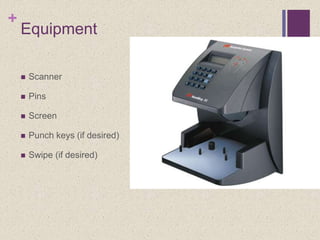
Equipment
 Scanner
 Pins
 Screen
 Punch keys (if desired)
 Swipe (if desired)
+
How it works
 In a broad sense, hand geometry readers measure a user's
hand along many dimensions and compare those
measurements to measurements stored in a file.
 This is done by using a series of algorithms to determine the
measurements of the hand.
+
February 11, 2004
11
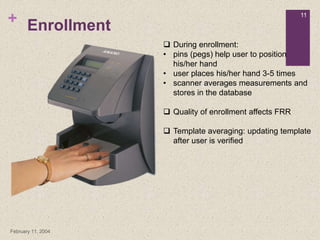
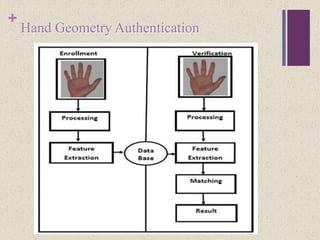
Enrollment
 During enrollment:
• pins (pegs) help user to position
his/her hand
• user places his/her hand 3-5 times
• scanner averages measurements and
stores in the database
 Quality of enrollment affects FRR
 Template averaging: updating template
after user is verified
+
February 11, 2004
12
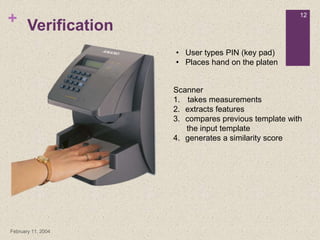
Verification
• User types PIN (key pad)
• Places hand on the platen
Scanner
1. takes measurements
2. extracts features
3. compares previous template with
the input template
4. generates a similarity score
+
Hand Geometry Authentication
+
Verification
 Assuming that there is already images of the hand
on file, these are the steps taken in hand geometry
1. Image Acquisition : Hand is placed on plate
with hand in right position between 6 pins
and an image is taken
2. Filtering : A median filter is applied to the image
3. Features extracted: Necessary features for
comparison are extracted
+
Verification
Make Matching:
 Difference between sample and template is
calculated for each feature
 Person with smallest “absolute difference” in
feature is identified
 repeated for all features
 Person with largest number of features is identified
as a match
Then Results are displayed
+
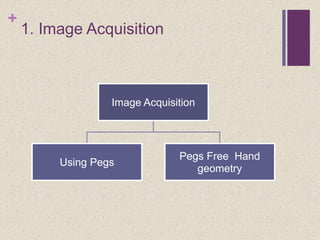
1. Image Acquisition
Image Acquisition
Using Pegs
Pegs Free Hand
geometry
+ 17
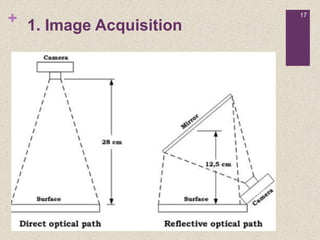
1. Image Acquisition
+
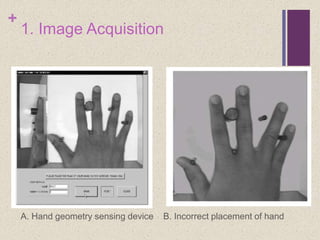
1. Image Acquisition
A. Hand geometry sensing device B. Incorrect placement of hand
+
1. Image Acquisition
 Many hand geometry systems have pegs guided hand
placement
 The image of the hand is captured using ordinary digital
camera taken in 8-bit grayscale, size 640x480 pixels.

 Length of the fingers, their width, thickness, curvature and
relative location of all mentioned features are different among
all people
 scanners usually use ordinary CCD camera, sometimes with
infrared light and reflectors that are being used for image
capturing
 document scanners are also commonly used for capturing
hand image
+
1. Image Acquisition
 place it on a semitransparent base to achieve better contrast
 document scanners use its technology only and the process is
something slower than one with the digital camera
 It is not interested in fingerprints, palm life lines or other ridges,
colors or even some scars on the hand surface
 The Lateral view of the Hand can also be captured by the
mirror placed in the side to measure heights.
 Dimensions: 8-1/2 inches square by 10 inches in height.
 During sampling process scanner prompts a person to put his
hand on the board, several times
 The hand injury can potentially have great impact on the
recognition system
+
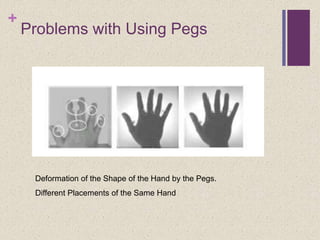
Problems with Using Pegs
Deformation of the Shape of the Hand by the Pegs.
Different Placements of the Same Hand
+
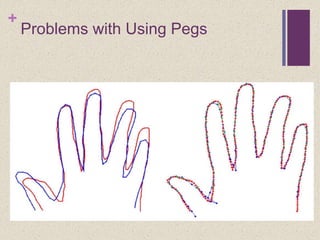
Problems with Using Pegs
+
2. Filtering
A. Binarize the Image.
B. Resizing n Rotation . Deviation of the hand are
corrected
C. Edge Detection Algorithm eg.Sobel Function
+
2. Filtering
(a) Input Image (b)Gray-Scale (c) Before filtering (d)After filtering
+
3. Features extracted
+ 3. Features extracted
+
3. Features extracted
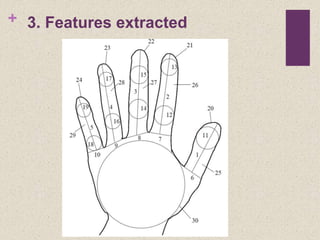
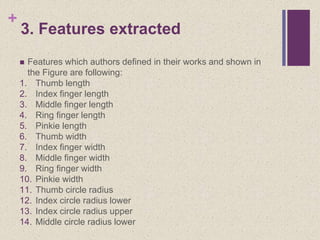
 Features which authors defined in their works and shown in
the Figure are following:
1. Thumb length
2. Index finger length
3. Middle finger length
4. Ring finger length
5. Pinkie length
6. Thumb width
7. Index finger width
8. Middle finger width
9. Ring finger width
10. Pinkie width
11. Thumb circle radius
12. Index circle radius lower
13. Index circle radius upper
14. Middle circle radius lower
+
3. Features extracted
15. Middle circle radius upper
16. Ring circle radius lower
17. Ring circle radius upper
18. Pinkie circle radius lower
19. Pinkie circle radius upper
20. Thumb perimeter
21. Index finger perimeter
22. Middle finger perimeter
23. Ring finger perimeter
24. Pinkie perimeter
25. Thumb area
26. Index finger area
27. Middle finger area
28. Ring finger area
29. Pinkie area
30. Largest inscribed circle radius
+
Commercial (Schlage)
+
Commercial (Schlage)
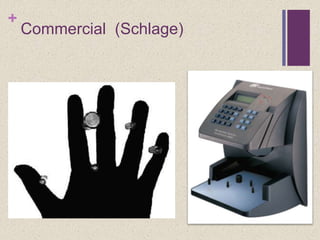
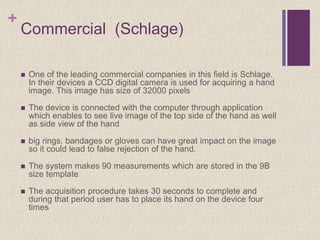
 One of the leading commercial companies in this field is Schlage.
In their devices a CCD digital camera is used for acquiring a hand
image. This image has size of 32000 pixels
 The device is connected with the computer through application
which enables to see live image of the top side of the hand as well
as side view of the hand
 big rings, bandages or gloves can have great impact on the image
so it could lead to false rejection of the hand.
 The system makes 90 measurements which are stored in the 9B
size template
 The acquisition procedure takes 30 seconds to complete and
during that period user has to place its hand on the device four
times
+
Performance Evaluation
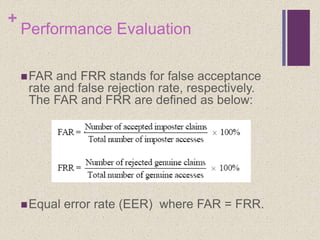
FAR and FRR stands for false acceptance
rate and false rejection rate, respectively.
The FAR and FRR are defined as below:
Equal error rate (EER) where FAR = FRR.
+
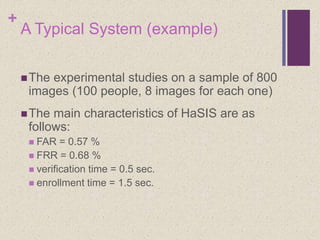
A Typical System (example)
The experimental studies on a sample of 800
images (100 people, 8 images for each one)
The main characteristics of HaSIS are as
follows:
 FAR = 0.57 %
 FRR = 0.68 %
 verification time = 0.5 sec.
 enrollment time = 1.5 sec.
+
February 11, 2004
33
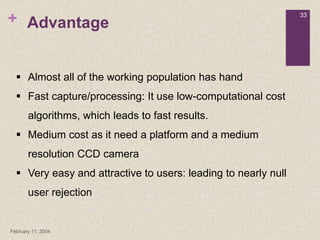
Advantage
 Almost all of the working population has hand
 Fast capture/processing: It use low-computational cost
algorithms, which leads to fast results.
 Medium cost as it need a platform and a medium
resolution CCD camera
 Very easy and attractive to users: leading to nearly null
user rejection
+
February 11, 2004
34
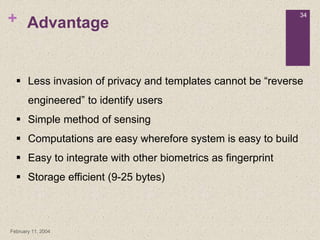
Advantage
 Less invasion of privacy and templates cannot be “reverse
engineered” to identify users
 Simple method of sensing
 Computations are easy wherefore system is easy to build
 Easy to integrate with other biometrics as fingerprint
 Storage efficient (9-25 bytes)
+
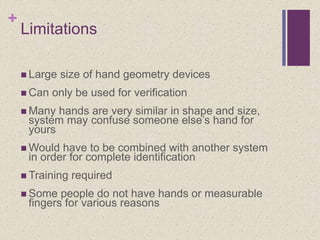
Limitations
 Large size of hand geometry devices
 Can only be used for verification
 Many hands are very similar in shape and size,
system may confuse someone else’s hand for
yours
 Would have to be combined with another system
in order for complete identification
 Training required
 Some people do not have hands or measurable
fingers for various reasons
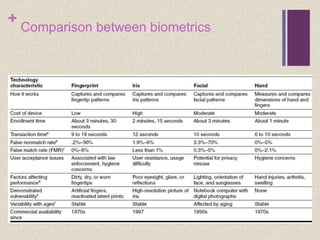
+ Comparison between biometrics
+
Thank you

Pattern recognition Hand Geometry

  • 1.
  • 2.
    + Outline  Definition  Evolution Properties  Where used  Applications  Equipment  How it works  Enrollment  Verification 1. Image Acquisition 2. Filtering 3. Features extracted  Advantage and Limitations  Comparison
  • 3.
    + Definition  Hand geometry-abiometric that identifies users by the shape of their hands.  It uses the measurements of the hand in order to determine if the hand is a match or not.  Can use finger length, thickness, and curvature.  Only for the purposes of verification, not identification.
  • 4.
    + Evolution  First devices(1960s) were electromechanical. (Miller’s “Identimation”) measures length of 4 fingers used in nuclear weapon industry was retired in 1987  In the mid-1980’s Sidlauskas developed electronic 3D profile identification apparatus. capacity 20,000 users. processing time is 1.2 sec. (1994). weight is 4.5 kg (1994). 9-byte representation  It is first mentioned in the early 70’s of the 20th century and it is older than palm print which is part of dactiloscopy. The first known use was for security checks in Wall Street.
  • 5.
  • 6.
    + Properties  Hand geometryis widely used throughout the world  It is used for verification, not identification : Suitable for medium and low security applications  The hand geometry system is coupled with ID scanning to verify who is entering  Can be employed in those applications which don't require extreme security but where robustness and low-cost are primary issues
  • 7.
    + February 13, 2004 7 Whereused  Access Control  Used to access Health clubs, Day care centers, Laboratories, Prisons, etc.  Time & Attendance  Application ranges from coal mines to clean rooms.  Personal Identification  Newark and Toronto airports; Food Services systems at the University of Georgia
  • 8.
    + 8 Applications • 70,000HandReaders are installed throughout the world. • The 1996 Olympic Games used HandReaders to protect access to Olympic Village (65,000 people were enrolled; 1 million transactions were handled over 28 days). • Since 1991, at San Francisco Airport, HandReaders produced more than 100 million verifications (180 doors and 18,000 employees). • In the United Kingdom, Her majesty’s Prisons rely on the HandReaders for prisoner and visitor tracing. • Colleges (ex. University of Georgia) use HandReaders for on- campus meal programs, safeguard access to dormitories and protect their computer centers. • Over 20,000 Owens Illinois employees punch in and out each day using the HandReader. • Krispy Cream Doughnuts uses HandReaders for tracking employee hours at over 30 individual stores.
  • 9.
    + Equipment  Scanner  Pins Screen  Punch keys (if desired)  Swipe (if desired)
  • 10.
    + How it works In a broad sense, hand geometry readers measure a user's hand along many dimensions and compare those measurements to measurements stored in a file.  This is done by using a series of algorithms to determine the measurements of the hand.
  • 11.
    + February 11, 2004 11 Enrollment During enrollment: • pins (pegs) help user to position his/her hand • user places his/her hand 3-5 times • scanner averages measurements and stores in the database  Quality of enrollment affects FRR  Template averaging: updating template after user is verified
  • 12.
    + February 11, 2004 12 Verification •User types PIN (key pad) • Places hand on the platen Scanner 1. takes measurements 2. extracts features 3. compares previous template with the input template 4. generates a similarity score
  • 13.
  • 14.
    + Verification  Assuming thatthere is already images of the hand on file, these are the steps taken in hand geometry 1. Image Acquisition : Hand is placed on plate with hand in right position between 6 pins and an image is taken 2. Filtering : A median filter is applied to the image 3. Features extracted: Necessary features for comparison are extracted
  • 15.
    + Verification Make Matching:  Differencebetween sample and template is calculated for each feature  Person with smallest “absolute difference” in feature is identified  repeated for all features  Person with largest number of features is identified as a match Then Results are displayed
  • 16.
    + 1. Image Acquisition ImageAcquisition Using Pegs Pegs Free Hand geometry
  • 17.
    + 17 1. ImageAcquisition
  • 18.
    + 1. Image Acquisition A.Hand geometry sensing device B. Incorrect placement of hand
  • 19.
    + 1. Image Acquisition Many hand geometry systems have pegs guided hand placement  The image of the hand is captured using ordinary digital camera taken in 8-bit grayscale, size 640x480 pixels.  Length of the fingers, their width, thickness, curvature and relative location of all mentioned features are different among all people  scanners usually use ordinary CCD camera, sometimes with infrared light and reflectors that are being used for image capturing  document scanners are also commonly used for capturing hand image
  • 20.
    + 1. Image Acquisition place it on a semitransparent base to achieve better contrast  document scanners use its technology only and the process is something slower than one with the digital camera  It is not interested in fingerprints, palm life lines or other ridges, colors or even some scars on the hand surface  The Lateral view of the Hand can also be captured by the mirror placed in the side to measure heights.  Dimensions: 8-1/2 inches square by 10 inches in height.  During sampling process scanner prompts a person to put his hand on the board, several times  The hand injury can potentially have great impact on the recognition system
  • 21.
    + Problems with UsingPegs Deformation of the Shape of the Hand by the Pegs. Different Placements of the Same Hand
  • 22.
  • 23.
    + 2. Filtering A. Binarizethe Image. B. Resizing n Rotation . Deviation of the hand are corrected C. Edge Detection Algorithm eg.Sobel Function
  • 24.
    + 2. Filtering (a) InputImage (b)Gray-Scale (c) Before filtering (d)After filtering
  • 25.
  • 26.
    + 3. Featuresextracted
  • 27.
    + 3. Features extracted Features which authors defined in their works and shown in the Figure are following: 1. Thumb length 2. Index finger length 3. Middle finger length 4. Ring finger length 5. Pinkie length 6. Thumb width 7. Index finger width 8. Middle finger width 9. Ring finger width 10. Pinkie width 11. Thumb circle radius 12. Index circle radius lower 13. Index circle radius upper 14. Middle circle radius lower
  • 28.
    + 3. Features extracted 15.Middle circle radius upper 16. Ring circle radius lower 17. Ring circle radius upper 18. Pinkie circle radius lower 19. Pinkie circle radius upper 20. Thumb perimeter 21. Index finger perimeter 22. Middle finger perimeter 23. Ring finger perimeter 24. Pinkie perimeter 25. Thumb area 26. Index finger area 27. Middle finger area 28. Ring finger area 29. Pinkie area 30. Largest inscribed circle radius
  • 29.
  • 30.
    + Commercial (Schlage)  Oneof the leading commercial companies in this field is Schlage. In their devices a CCD digital camera is used for acquiring a hand image. This image has size of 32000 pixels  The device is connected with the computer through application which enables to see live image of the top side of the hand as well as side view of the hand  big rings, bandages or gloves can have great impact on the image so it could lead to false rejection of the hand.  The system makes 90 measurements which are stored in the 9B size template  The acquisition procedure takes 30 seconds to complete and during that period user has to place its hand on the device four times
  • 31.
    + Performance Evaluation FAR andFRR stands for false acceptance rate and false rejection rate, respectively. The FAR and FRR are defined as below: Equal error rate (EER) where FAR = FRR.
  • 32.
    + A Typical System(example) The experimental studies on a sample of 800 images (100 people, 8 images for each one) The main characteristics of HaSIS are as follows:  FAR = 0.57 %  FRR = 0.68 %  verification time = 0.5 sec.  enrollment time = 1.5 sec.
  • 33.
    + February 11, 2004 33 Advantage Almost all of the working population has hand  Fast capture/processing: It use low-computational cost algorithms, which leads to fast results.  Medium cost as it need a platform and a medium resolution CCD camera  Very easy and attractive to users: leading to nearly null user rejection
  • 34.
    + February 11, 2004 34 Advantage Less invasion of privacy and templates cannot be “reverse engineered” to identify users  Simple method of sensing  Computations are easy wherefore system is easy to build  Easy to integrate with other biometrics as fingerprint  Storage efficient (9-25 bytes)
  • 35.
    + Limitations  Large sizeof hand geometry devices  Can only be used for verification  Many hands are very similar in shape and size, system may confuse someone else’s hand for yours  Would have to be combined with another system in order for complete identification  Training required  Some people do not have hands or measurable fingers for various reasons
  • 36.
  • 37.