BIOMEMBRANES
PREPARED BY:
AVINASH GOWDA H
M.Sc.(Agri) (Plant Mol. Biol. & Biotech.)
Dept. of Biotechnology
Junagadh Agricultural University
Junagadh Gujarat
Email: avinashgowda.gh@gmail.com
Mob: +91 9067840639
Introduction
• Membranes are the borders between different
regions of a cell.
• Where membranes exist, differing cell
environments can be maintained
• The plasma membrane borders the entire cell
separating the internal environment from the
external environment
Membrane Structure
 Lipids and proteins are the chief ingredients of
membrane
• Phospholipid is amphipathic, both a
hydrophobic and a hydrophilic region
• Membrane proteins are also amphipathic
 Phospholipid is arranged as a bilayer
• Hydrophilic heads exposed, hydrophobic
tailsprotected
 Proteins are embedded in the phospholipid
bilayer
 Not all membranes are identical
• Membranes with different functions differ in
their chemical composition and structure
 Fluid Mosaic Model best describes our
current understanding of membrane structure
• a mosaic of proteins bobbing in a fluid
bilayer of phospholipids
Fluidity
• Membranes are maintained by hydrophobic
interactions of the phospholipids resulting in the
alignment of the polar phosphate regions toward the
aqueous environment and the nonpolar regions’
hydrocarbon chains toward each other.
• Membranes are in motion with fast drifting lipids and
slower drifting proteins
• Membrane fluidity may be influenced by
presence/absence of unsaturated FA chains and
Cholesterol
• Fluidity of membranes is important for proper
function
Mosaic
• Combination of proteins makes membrane
unique
• Membrane proteins may be fluid or
anchored
• Proteins may penetrate the bilayer fully
(integral) or reside on the surfaces of
membranes (peripheral)
• Integral proteins typically have hydrophobic
regions that span the bilayer as a result of
nonpolar amino acids arranged as helices
• Anchored proteins strengthen membranes
Membrane Structure
Membranes consist of a phospholipid
bilayer combined with a variety of
proteins in a fluid mosaic
arrangement.
The surfaces of cell membranes are
hydrophilic (water-loving); the
interiors are hydrophobic.
Hydrophilic molecules tend to
interact with water and with each
other. Hydrophobic molecules avoid
interaction with water and tend to
interact with other hydrophobic
molecules.
Membrane lipids
Membrane lipids are a group of compounds (structurally similar to fats
and oils) which form the double-layered surface of all cells (lipid
bilayer). The three major classes of membrane lipids are phospholipids,
glycolipids, and cholesterol. Lipids are amphiphilic: they have one end
that is soluble in water ('polar') and an ending that is soluble in fat
('nonpolar'). By forming a double layer with the polar ends pointing
outwards and the nonpolar ends pointing inwards membrane lipids can
form a 'lipid bilayer' which keeps the watery interior of the cell separate
from the watery exterior. The arrangements of lipids and various proteins,
acting as receptors and channel pores in the membrane, control the entry
and exit of other molecules and ions as part of the cell's metabolism. In
order to perform physiological functions, membrane proteins are
facilitated to rotate and diffuse laterally in two dimensional expanse
of lipid bilayer by the presence of a shell of lipids closely attached to
protein surface, called annular lipid shell
Cell Membrane Proteins:
1) Transport Proteins: Regulate movement of
hydrophilic molecules through
membrane
A) Channel Proteins (e.g. Na+ channels)
B) Carrier Proteins (e.g. glucose transporter)
2) Receptor Proteins: Trigger cell activity when
molecule from outside environment binds to protein
3) Recognition Proteins:
• Allow cells to recognize / attach to one another
• Glycoproteins: Proteins with attached carbohydrate
groups
Membrane sugars
Plasma membranes also contain carbohydrates,
predominantly glycoproteins, but with some glycolipids
(cerebrosides and gangliosides). For the most part,
no glycosylation occurs on membranes within the cell; rather
generally glycosylation occurs on the extracellular surface of
the plasma membrane. The glycocalyx is an important feature
in all cells, especially epithelia with microvilli. Recent data
suggest the glycocalyx participates in cell
adhesion, lymphocyte homing, and many others.
The penultimate sugar is galactose and the terminal sugar
is sialic acid, as the sugar backbone is modified in the golgi
apparatus. Sialic acid carries a negative charge, providing an
external barrier to charged particles.
Cell membranes are selectively
permeable. Some solutes cross the
membrane freely, some cross with
assistance, and others do not cross at all.
A few lipophilic substances move freely
across the cell membrane by passive
diffusion. Most small molecules or ions
require the assistance of specific protein
carriers to transport them across the
membrane. Large molecules do not
cross intact cell membranes, except in
certain special cases.
Selective Permeability of Membranes
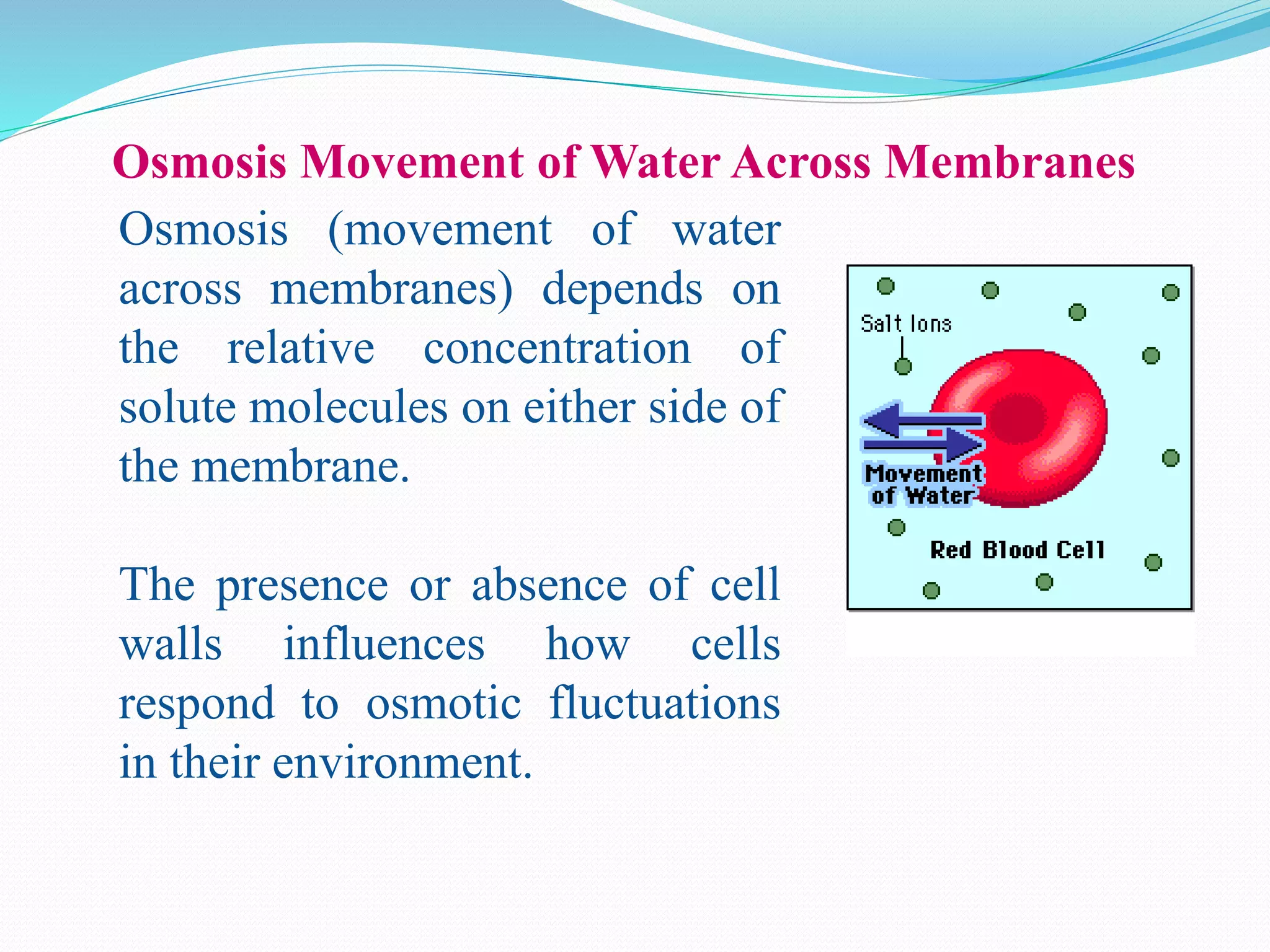
Osmosis (movement of water
across membranes) depends on
the relative concentration of
solute molecules on either side of
the membrane.
The presence or absence of cell
walls influences how cells
respond to osmotic fluctuations
in their environment.
Osmosis Movement of Water Across Membranes
Passive and Active Transport
Most biologically important solutes require protein carriers to cross cell
membranes, by a process of either passive or active transport.
.
Active transport uses energy to move a solute "uphill" against its gradient,
whereas in facilitated diffusion, a solute moves down its concentration gradient
and no energy input is required
Mechanisms of Active Transport
Active transport can occur as a direct result of ATP hydrolysis (ATP pump)
or by coupling the movement of one substance with that of another (symport
or antiport).
Active transport may move solutes into the cell or out of the cell, but energy
is always used to move the solute against its concentration gradient.
Biomembranes of cell

Biomembranes of cell

  • 1.
    BIOMEMBRANES PREPARED BY: AVINASH GOWDAH M.Sc.(Agri) (Plant Mol. Biol. & Biotech.) Dept. of Biotechnology Junagadh Agricultural University Junagadh Gujarat Email: avinashgowda.gh@gmail.com Mob: +91 9067840639
  • 2.
    Introduction • Membranes arethe borders between different regions of a cell. • Where membranes exist, differing cell environments can be maintained • The plasma membrane borders the entire cell separating the internal environment from the external environment
  • 4.
    Membrane Structure  Lipidsand proteins are the chief ingredients of membrane • Phospholipid is amphipathic, both a hydrophobic and a hydrophilic region • Membrane proteins are also amphipathic  Phospholipid is arranged as a bilayer • Hydrophilic heads exposed, hydrophobic tailsprotected  Proteins are embedded in the phospholipid bilayer
  • 5.
     Not allmembranes are identical • Membranes with different functions differ in their chemical composition and structure  Fluid Mosaic Model best describes our current understanding of membrane structure • a mosaic of proteins bobbing in a fluid bilayer of phospholipids
  • 6.
    Fluidity • Membranes aremaintained by hydrophobic interactions of the phospholipids resulting in the alignment of the polar phosphate regions toward the aqueous environment and the nonpolar regions’ hydrocarbon chains toward each other. • Membranes are in motion with fast drifting lipids and slower drifting proteins • Membrane fluidity may be influenced by presence/absence of unsaturated FA chains and Cholesterol • Fluidity of membranes is important for proper function
  • 7.
    Mosaic • Combination ofproteins makes membrane unique • Membrane proteins may be fluid or anchored • Proteins may penetrate the bilayer fully (integral) or reside on the surfaces of membranes (peripheral) • Integral proteins typically have hydrophobic regions that span the bilayer as a result of nonpolar amino acids arranged as helices • Anchored proteins strengthen membranes
  • 8.
    Membrane Structure Membranes consistof a phospholipid bilayer combined with a variety of proteins in a fluid mosaic arrangement. The surfaces of cell membranes are hydrophilic (water-loving); the interiors are hydrophobic. Hydrophilic molecules tend to interact with water and with each other. Hydrophobic molecules avoid interaction with water and tend to interact with other hydrophobic molecules.
  • 9.
    Membrane lipids Membrane lipidsare a group of compounds (structurally similar to fats and oils) which form the double-layered surface of all cells (lipid bilayer). The three major classes of membrane lipids are phospholipids, glycolipids, and cholesterol. Lipids are amphiphilic: they have one end that is soluble in water ('polar') and an ending that is soluble in fat ('nonpolar'). By forming a double layer with the polar ends pointing outwards and the nonpolar ends pointing inwards membrane lipids can form a 'lipid bilayer' which keeps the watery interior of the cell separate from the watery exterior. The arrangements of lipids and various proteins, acting as receptors and channel pores in the membrane, control the entry and exit of other molecules and ions as part of the cell's metabolism. In order to perform physiological functions, membrane proteins are facilitated to rotate and diffuse laterally in two dimensional expanse of lipid bilayer by the presence of a shell of lipids closely attached to protein surface, called annular lipid shell
  • 10.
    Cell Membrane Proteins: 1)Transport Proteins: Regulate movement of hydrophilic molecules through membrane A) Channel Proteins (e.g. Na+ channels) B) Carrier Proteins (e.g. glucose transporter) 2) Receptor Proteins: Trigger cell activity when molecule from outside environment binds to protein 3) Recognition Proteins: • Allow cells to recognize / attach to one another • Glycoproteins: Proteins with attached carbohydrate groups
  • 11.
    Membrane sugars Plasma membranesalso contain carbohydrates, predominantly glycoproteins, but with some glycolipids (cerebrosides and gangliosides). For the most part, no glycosylation occurs on membranes within the cell; rather generally glycosylation occurs on the extracellular surface of the plasma membrane. The glycocalyx is an important feature in all cells, especially epithelia with microvilli. Recent data suggest the glycocalyx participates in cell adhesion, lymphocyte homing, and many others. The penultimate sugar is galactose and the terminal sugar is sialic acid, as the sugar backbone is modified in the golgi apparatus. Sialic acid carries a negative charge, providing an external barrier to charged particles.
  • 12.
    Cell membranes areselectively permeable. Some solutes cross the membrane freely, some cross with assistance, and others do not cross at all. A few lipophilic substances move freely across the cell membrane by passive diffusion. Most small molecules or ions require the assistance of specific protein carriers to transport them across the membrane. Large molecules do not cross intact cell membranes, except in certain special cases. Selective Permeability of Membranes
  • 13.
    Osmosis (movement ofwater across membranes) depends on the relative concentration of solute molecules on either side of the membrane. The presence or absence of cell walls influences how cells respond to osmotic fluctuations in their environment. Osmosis Movement of Water Across Membranes
  • 14.
    Passive and ActiveTransport Most biologically important solutes require protein carriers to cross cell membranes, by a process of either passive or active transport. . Active transport uses energy to move a solute "uphill" against its gradient, whereas in facilitated diffusion, a solute moves down its concentration gradient and no energy input is required
  • 15.
    Mechanisms of ActiveTransport Active transport can occur as a direct result of ATP hydrolysis (ATP pump) or by coupling the movement of one substance with that of another (symport or antiport). Active transport may move solutes into the cell or out of the cell, but energy is always used to move the solute against its concentration gradient.