DIGITAL ASSIGNMENT
CELL BIOLOGY AND BIOCHEMISTRY
BY : MANSI GHATIYA
17BCB0012
CELL CYCLE AND CELL CONTROL
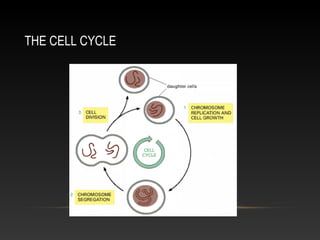
THE CELL CYCLE
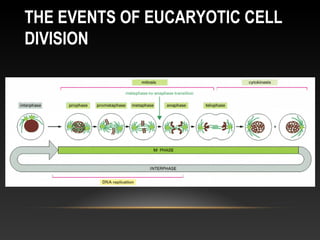
THE EVENTS OF EUCARYOTIC CELL
DIVISION
Cell cycle is of 2 types : 1) MITOSIS
2) MEIOSIS
MITosis takes the cell and Makes It Two (diploid).
Meiosis has to do with sex.
From the cell’s point of view :
- mITosis results in Identical Twins.
- mEioSis results in Egg and Sperm (haploid).
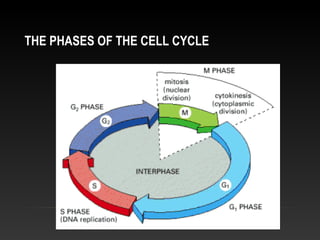
THE PHASES OF THE CELL CYCLE
G1 – post mitotic phase.
RNA and protiens are synthesized.
No DNA synthesized.
S – Synthetic Phase.
DNA is formed from purines and pyrimidines.
DNA content of nucleus is doubled.
G2 – Pre mitotic gap phase.
synthesis of RNA and protien
DNA synthesis stops.
M – Prophase , Metaphase , Anaphase , Telophase , Cytokinesis.
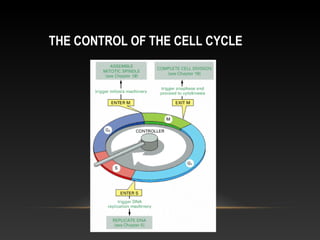
THE CONTROL OF THE CELL CYCLE
CONTROL OF THE CELL CYCLE
G1 phase events :
- G1 cyclins signals the cell to prepare the chromosomes (DNA) for
replication (occurs in S-phase)
S phase events :
-S-phase promoting factor (SPF) (the complex of S-cyclins + S-phase CDK)
prepares the cell to enter S phase and promote duplication of DNA (and its
centrioles)
-as DNA replication continues, one of the cyclins shared by G1 and S-phase
CDKs (cyclin E) is destroyed
G2 phase events :
M- cyclins begin to rise in the end of G2 phase to prepare the cell into
mitosis
M phase events - early stage :
• M-phase promoting factor (MPF) (the complex of M-cyclins + M-phase
CDK) initiates events leading the cell from prophase to the metaphase of
mitosis:
–assembly of the mitotic spindle
–breakdown of the nuclear envelope
–condensation of the chromosomes
Meiosis (particularly meiosis I, meiosis II - is essentially a mitosis) requires
special controls; some of them are similar to those in mitosis, e.g. APC and
MPF (maturation-promoting factor for its role in meiosis I and II of
developing oocyte
M phase events - late stage :
A-phase promoting complex (APC) is activated by M-phase promoting
factor and :
– destroys the M-phase cyclins by ubikvitination (conjugating them with
the protein ubiquitin which targets them for destruction by proteasomes)
– allows the sister chromatids at the metaphase plate to separate and move
to the poles during anaphase.
– turns on synthesis of G1 cyclins for the next turn of the cycle .
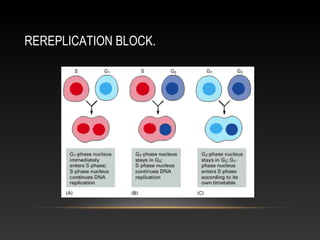
– degrades geminin, a protein that has kept the freshly-synthesized DNA in
S phase from being re-replicated before mitosis.
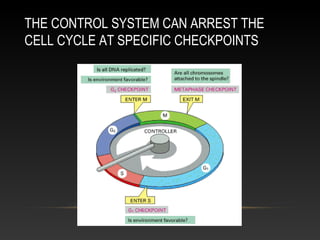
THE CONTROL SYSTEM CAN ARREST THE
CELL CYCLE AT SPECIFIC CHECKPOINTS
CHECKPOINTS GENERALLY OPERATE THROUGH
NEGATIVE INTRACELLULAR SIGNALS
• The Cell-Cycle Control System Is Based on Cyclically
Activated Protein Kinases
• Cdk Activity Can Be Suppressed Both by Inhibitory
Phosphorylation and by Inhibitory Proteins
• The Cell-Cycle Control System Depends on Cyclical
Proteolysis
• Cell-Cycle Control Also Depends on Transcriptional
Regulation
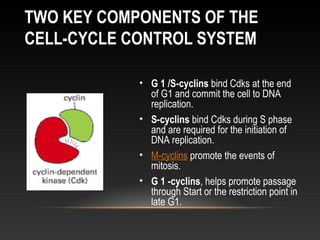
TWO KEY COMPONENTS OF THE
CELL-CYCLE CONTROL SYSTEM
• G 1 /S-cyclins bind Cdks at the end
of G1 and commit the cell to DNA
replication.
• S-cyclins bind Cdks during S phase
and are required for the initiation of
DNA replication.
• M-cyclins promote the events of
mitosis.
• G 1 -cyclins, helps promote passage
through Start or the restriction point in
late G1.
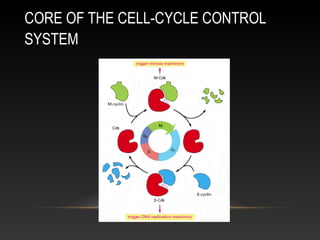
CORE OF THE CELL-CYCLE CONTROL
SYSTEM
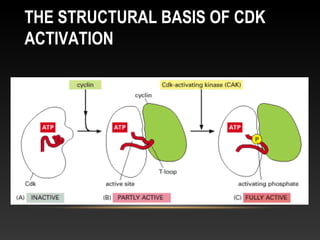
THE STRUCTURAL BASIS OF CDK
ACTIVATION
REREPLICATION BLOCK.
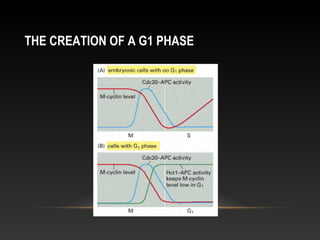
THE CREATION OF A G1 PHASE
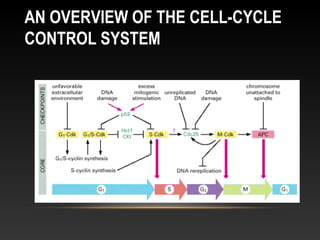
AN OVERVIEW OF THE CELL-CYCLE
CONTROL SYSTEM
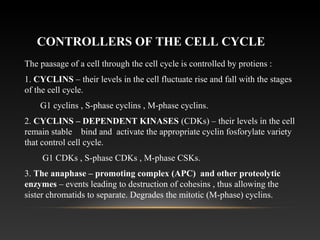
CONTROLLERS OF THE CELL CYCLE
The paasage of a cell through the cell cycle is controlled by protiens :
1. CYCLINS – their levels in the cell fluctuate rise and fall with the stages
of the cell cycle.
G1 cyclins , S-phase cyclins , M-phase cyclins.
2. CYCLINS – DEPENDENT KINASES (CDKs) – their levels in the cell
remain stable bind and activate the appropriate cyclin fosforylate variety
that control cell cycle.
G1 CDKs , S-phase CDKs , M-phase CSKs.
3. The anaphase – promoting complex (APC) and other proteolytic
enzymes – events leading to destruction of cohesins , thus allowing the
sister chromatids to separate. Degrades the mitotic (M-phase) cyclins.
THANKYOU

Cell Cycle and Control

  • 1.
    DIGITAL ASSIGNMENT CELL BIOLOGYAND BIOCHEMISTRY BY : MANSI GHATIYA 17BCB0012
  • 2.
    CELL CYCLE ANDCELL CONTROL
  • 3.
  • 4.
    THE EVENTS OFEUCARYOTIC CELL DIVISION
  • 5.
    Cell cycle isof 2 types : 1) MITOSIS 2) MEIOSIS MITosis takes the cell and Makes It Two (diploid). Meiosis has to do with sex. From the cell’s point of view : - mITosis results in Identical Twins. - mEioSis results in Egg and Sperm (haploid).
  • 6.
    THE PHASES OFTHE CELL CYCLE
  • 7.
    G1 – postmitotic phase. RNA and protiens are synthesized. No DNA synthesized. S – Synthetic Phase. DNA is formed from purines and pyrimidines. DNA content of nucleus is doubled. G2 – Pre mitotic gap phase. synthesis of RNA and protien DNA synthesis stops. M – Prophase , Metaphase , Anaphase , Telophase , Cytokinesis.
  • 8.
    THE CONTROL OFTHE CELL CYCLE
  • 9.
    CONTROL OF THECELL CYCLE G1 phase events : - G1 cyclins signals the cell to prepare the chromosomes (DNA) for replication (occurs in S-phase) S phase events : -S-phase promoting factor (SPF) (the complex of S-cyclins + S-phase CDK) prepares the cell to enter S phase and promote duplication of DNA (and its centrioles) -as DNA replication continues, one of the cyclins shared by G1 and S-phase CDKs (cyclin E) is destroyed G2 phase events : M- cyclins begin to rise in the end of G2 phase to prepare the cell into mitosis
  • 10.
    M phase events- early stage : • M-phase promoting factor (MPF) (the complex of M-cyclins + M-phase CDK) initiates events leading the cell from prophase to the metaphase of mitosis: –assembly of the mitotic spindle –breakdown of the nuclear envelope –condensation of the chromosomes Meiosis (particularly meiosis I, meiosis II - is essentially a mitosis) requires special controls; some of them are similar to those in mitosis, e.g. APC and MPF (maturation-promoting factor for its role in meiosis I and II of developing oocyte
  • 11.
    M phase events- late stage : A-phase promoting complex (APC) is activated by M-phase promoting factor and : – destroys the M-phase cyclins by ubikvitination (conjugating them with the protein ubiquitin which targets them for destruction by proteasomes) – allows the sister chromatids at the metaphase plate to separate and move to the poles during anaphase. – turns on synthesis of G1 cyclins for the next turn of the cycle . – degrades geminin, a protein that has kept the freshly-synthesized DNA in S phase from being re-replicated before mitosis.
  • 12.
    THE CONTROL SYSTEMCAN ARREST THE CELL CYCLE AT SPECIFIC CHECKPOINTS
  • 13.
    CHECKPOINTS GENERALLY OPERATETHROUGH NEGATIVE INTRACELLULAR SIGNALS • The Cell-Cycle Control System Is Based on Cyclically Activated Protein Kinases • Cdk Activity Can Be Suppressed Both by Inhibitory Phosphorylation and by Inhibitory Proteins • The Cell-Cycle Control System Depends on Cyclical Proteolysis • Cell-Cycle Control Also Depends on Transcriptional Regulation
  • 14.
    TWO KEY COMPONENTSOF THE CELL-CYCLE CONTROL SYSTEM • G 1 /S-cyclins bind Cdks at the end of G1 and commit the cell to DNA replication. • S-cyclins bind Cdks during S phase and are required for the initiation of DNA replication. • M-cyclins promote the events of mitosis. • G 1 -cyclins, helps promote passage through Start or the restriction point in late G1.
  • 15.
    CORE OF THECELL-CYCLE CONTROL SYSTEM
  • 16.
    THE STRUCTURAL BASISOF CDK ACTIVATION
  • 17.
  • 18.
    THE CREATION OFA G1 PHASE
  • 19.
    AN OVERVIEW OFTHE CELL-CYCLE CONTROL SYSTEM
  • 20.
    CONTROLLERS OF THECELL CYCLE The paasage of a cell through the cell cycle is controlled by protiens : 1. CYCLINS – their levels in the cell fluctuate rise and fall with the stages of the cell cycle. G1 cyclins , S-phase cyclins , M-phase cyclins. 2. CYCLINS – DEPENDENT KINASES (CDKs) – their levels in the cell remain stable bind and activate the appropriate cyclin fosforylate variety that control cell cycle. G1 CDKs , S-phase CDKs , M-phase CSKs. 3. The anaphase – promoting complex (APC) and other proteolytic enzymes – events leading to destruction of cohesins , thus allowing the sister chromatids to separate. Degrades the mitotic (M-phase) cyclins.
  • 21.