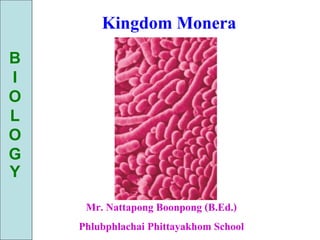
Kingdom Monera
B
I
O
L
O
G
Y

     Mr. Nattapong Boonpong (B.Ed.)
    Phlubphlachai Phittayakhom School
Prokaryotic Cells

• Comparing Prokaryotic and Eukaryotic
  Cells
  – Prokaryote comes from the Greek words
    for prenucleus.
  – Eukaryote comes from the Greek words
    for true nucleus.
Prokaryote             Eukaryote


• One circular         • Paired
  chromosome, not in     chromosomes, in
  a membrane             nuclear membrane
• No histones          • Histones
• No organelles        • Organelles
• Peptidoglycan cell   • Polysaccharide cell
  walls                  walls
• Binary fission       • Mitotic spindle
Glycocalyx

• Outside cell wall
• Usually sticky
• A capsule is neatly
  organized
• A slime layer is
  unorganized & loose
• Extracellular
  polysaccharide
  allows cell to attach
• Capsules prevent
  phagocytosis
Cell Wall
• Prevents osmotic lysis
• Made of peptidoglycan (in bacteria)
Peptidoglycan
• Polymer of disaccharide
  N-acetylglucosamine (NAG) & N-acetylmuramic acid
  (NAM)
• Linked by polypeptides
Peptidoglycan
Gram-positive cell walls   Gram-negative cell walls
 • Thick peptidoglycan      • Thin peptidoglycan
 • Teichoic acids           • No teichoic acids
 • In acid-fast cells,      • Outer membrane
   contains mycolic acid
Gram-Positive cell walls
• Teichoic acids:
   – Lipoteichoic acid links to plasma membrane
   – Wall teichoic acid links to peptidoglycan
• May regulate movement of cations
• Polysaccharides provide antigenic variation
Gram-Negative Outer Membrane

• Lipopolysaccharides, lipoproteins, phospholipids.
• Forms the periplasm between the outer membrane and
  the plasma membrane.
• Protection from phagocytes, complement, antibiotics.
• O polysaccharide antigen, e.g., E. coli O157:H7.
• Lipid A is an endotoxin.
• Porins (proteins) form channels through membrane
Gram-Negative Outer Membrane
Gram Stain Mechanism


• Crystal violet-iodine crystals form in cell
• Gram-positive
  – Alcohol dehydrates peptidoglycan
  – CV-I crystals do not leave
• Gram-negative
  – Alcohol dissolves outer membrane and leaves holes
    in peptidoglycan
  – CV-I washes out
A typical Cell Walls


• Mycoplasmas
   – Lack cell walls
   – Sterols in plasma membrane
• Archaea
   – Wall-less, or
   – Walls of pseudomurein (lack NAM and D amino acids)
Damage to Cell Walls


• Lysozyme digests disaccharide in peptidoglycan.
• Penicillin inhibits peptide bridges in peptidoglycan.
• Protoplast is a wall-less cell.
• Spheroplast is a wall-less Gram-positive cell.
• L forms are wall-less cells that swell into irregular
  shapes.
• Protoplasts and spheroplasts are susceptible to
  osmotic lysis.
Fimbriae & Pili

• Fimbriae allow
  attachment
• Pili are used to
  transfer DNA from
  one cell to another


         Fimbriae

200 nm
Flagella


• Outside cell wall
• Made of chains of
  flagellin
• Attached to a protein
  hook
• Anchored to the wall
  and membrane by
  the basal body
Flagella Arrangement
Motile Cells


• Rotate flagella to run or tumble
• Move toward or away from stimuli (taxis)
• Flagella proteins are H antigens
  (e.g., E. coli O157:H7)
Motile Cells
Plasma Membrane
Plasma Membrane

•   Phospholipid bilayer
•   Peripheral proteins
•   Integral proteins
•   Transmembrane proteins
Fluid Mosaic Model
• Membrane is as viscous as olive oil.
• Proteins move to function
• Phospholipids rotate and move
  laterally
• Some prokaryotes
   – Do have specialized membranes that perform
     metabolic functions
      0.2 m                    1 m


                  Respiratory
                  membrane


                                                Thylakoid
                                                membranes


     (a) Aerobic prokaryote     (b) Photosynthetic prokaryote
Nucleoid
• The typical prokaryotic genome
   – Is a ring of DNA that is not surrounded by a
      membrane and that is located in a nucleoid region
• Some species of bacteria
   – Also have smaller rings of DNA called plasmids

                  Chromosome


           1 m
Endospores


•   Resting cells
•   Resistant to desiccation, heat, chemicals
•   Bacillus, Clostridium
•   Sporulation: Endospore formation
•   Germination: Return to vegetative state
Endospores


        Endospore


                    0.3 m
Type of Bacteria: Shape

• Average size: 0.2 -1.0 µm  2 - 8 µm
• Basic shapes:
Type of Bacteria: Shape
Spheres (Coccus/Cocci)
Type of Bacteria: Shape
Rods (Bacillus/Bacilli)
Type of Bacteria: Shape
Spirals (Spirillum/Spirilli)
Type of Bacteria: Nutrition and metabolic adaptation

  • A great diversity of nutritional and metabolic
    adaptations have evolved in prokaryotes

  • Examples of all four models of nutrition are found
    among prokaryotes
     – Photoautotrophy
     – Chemoautotrophy
     – Photoheterotrophy
     – Chemoheterotrophy
Type of Bacteria: Nutrition and metabolic adaptation

 • Major nutritional modes in prokaryotes
Type of Bacteria: Metabolic Relationships to Oxygen


     • Obligate aerobes
       – Require oxygen

     • Facultative anaerobes
        – Can survive with or without oxygen

     • Obligate anaerobes
       – Are poisoned by oxygen
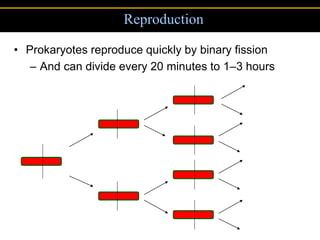
Reproduction

• Prokaryotes reproduce quickly by binary fission
   – And can divide every 20 minutes to 1–3 hours
Classification
• Subkingdom Archaebacteria
      - Euryarchaeota
      - Crenarchaeota
• Subkingdom Eubacteria
      - Proteobacteria
             -
             -
             -
             -
             -
      - Chlamydias
      - Spirochetes
      - Gram-positive bacteria
      - Cyanobacteria
Classification
Archaea

• Archaea share
  certaintraits with
  bacteria
   – And other traits
      with eukaryotes
Classification: Subkingdom Archaebacteria


Euryarchaeota (Methanophile & Halophile)

Crenarchaeota (Thermophile & Acidophile)
Archaea

• Some archaea
   – Live in extreme environments
• Extreme thermophiles
   – Thrive in very hot environments
Archaea
• Extreme halophiles
   – Live in high saline environments
Archaea
• Methanogens
  – Live in swamps and marshes
  – Produce methane as a waste product

• Hyperthermophiles
   – Pyrodictium
   – Sulfolobus
• Methanogens
   – Methanobacterium
• Extreme halophiles
   – Halobacterium
Microbial Diversity


• Bacteria size range
   – Thiomargarita
     (750 µm) to
     nanobacteria
     (0.02 µm) in
     rocks
Classification: Subkingdom Archaebacteria
Crenarchaeota (Thermophile & Acidophile)

   Pyrococcus abyssi (archaea)
      • 3,500 m deep in the Southeast Pacific.
      • Optimally at 103°C (217°F)
      • 200 atms
Classification: Subkingdom Archaebacteria
Crenarchaeota (Thermophile & Acidophile)


                P. furiosus (archaea)
                   • In the marine sand surrounding
                   sulfurous volcanoes.
                   • Optimally at 100°C (212°F)
                   • Highly resistant to radiation
                   • May possess an efficient
                   system for repairing DNA.
Classification: Subkingdom Eubacteria
Proteobacteria

      Rhizobium sp.
Classification: Subkingdom Eubacteria
Proteobacteria

      Helicobacter pylori
Classification: Subkingdom Eubacteria
Clamydias


 • Chlamydia trachomatis
       - May be transmitted to newborn's eyes
       - Painful urination and watery discharge
 • Mycoplasma hominis
 • Ureaplasma urealyticum
Nongonococcal Urethritis


• Chlamydia trachomatis
  – May be transmitted to newborn's eyes
  – Painful urination and watery discharge
• Mycoplasma hominis
• Ureaplasma urealyticum
Gonorrhea

• Neisseria gonorrhoeae
• Attaches to oral or urogenital mucosa by fimbriae
• Females may be asymptomatic; males have painful
  urination and pus discharge
• Treatment with antibiotics
• Untreated may result in
   – Endocarditis
   – Meningitis
   – Arthritis
   – Ophthalmia neonatorum
Gonorrhea
Classification: Subkingdom Eubacteria
Spirochete
Leptospirosis


• Leptospira interrogans
• Reservoir: Dogs and
  rats
• Transmitted by
  skin/mucosal contact
  from urine-
  contaminated water
• Diagnosis: Isolating
  bacteria or serological
  tests
Syphilis

• Treponema pallidum
• Invades mucosa or through skin breaks
Classification: Subkingdom Eubacteria
Gram-Positive Bacteria

         Lactobacillus sp.
         Streptomyces sp.
         Bacillus sp.
                B. subtilis
                B. megaterium
                B. anthracis
         Mycoplasma
Classification
     I. Cyanophyta Blue green algae (Cyanobacteria)
       Morphology
        • Non nuclear membrane
        •   Cell wall ; Cellulose & Pectin
        •   Non flagella
        •   Cyanophycean Starch
        •   Pigment : chlorophyll a , B - carotene , Flavicin &
                       phycobilin 2 type ; c - phycoerythrin & c - phycocyanin

                                                                ท้าให้มีสีน้าเงิน
I. Cyanophyta
    Habitat
   • น้้าจืด น้้าเค็ม ในดินที่ชื้นแฉะ
   • บางชนิดเป็น phycoplankton พบในน้้าจืดและทะเลสาบทั่วไป
   • Ex. Anabaena , Nostoc , Calothrix , Cylindrospermum , Tolypothrix
         Oscillatoria etc.
  การด้ารงชีวิต
   • Mutualism ; lichen :-
       • Gloeocapsa & Nostoc is phycobionts
       • Anabaena azollae & Azolla filiculoides
       • Blue green algae & Protozoa พวก rhizopod ที่เรียกว่า cyanellae
I. Cyanophyta
  Reproduction
   • Only asexual reproduction
          • Binary fission : Chroococcus , Anacystis , nidular
          • Fragmentation : Oscillatoria
          • Akinete : การสร้างจะถูกกระตุ้นด้วย glucose และถูกยับยั้งด้วย
                       KNO3 & NH4Cl
                     : เป็นโครงสร้างที่มีผนังหนา และมีอาหารสะสมภายใน
          • Heterocyst : ตรึง N2 ในอากาศ
                           Anabaena , Nostoc , Oscillatoria , Calothrix
Classification: Subkingdom Eubacteria
Cyanobacteria
        Anabaena azollae

        Nostoc sp.

        Oscillatoria sp.

        Calothrix sp.
Anacystis
Chroococcus
                             Calothrix


                Anabaena


 Oscillatoria               Nostoc
The End

Monera

  • 1.
    Kingdom Monera B I O L O G Y Mr. Nattapong Boonpong (B.Ed.) Phlubphlachai Phittayakhom School
  • 2.
    Prokaryotic Cells • ComparingProkaryotic and Eukaryotic Cells – Prokaryote comes from the Greek words for prenucleus. – Eukaryote comes from the Greek words for true nucleus.
  • 3.
    Prokaryote Eukaryote • One circular • Paired chromosome, not in chromosomes, in a membrane nuclear membrane • No histones • Histones • No organelles • Organelles • Peptidoglycan cell • Polysaccharide cell walls walls • Binary fission • Mitotic spindle
  • 4.
    Glycocalyx • Outside cellwall • Usually sticky • A capsule is neatly organized • A slime layer is unorganized & loose • Extracellular polysaccharide allows cell to attach • Capsules prevent phagocytosis
  • 5.
    Cell Wall • Preventsosmotic lysis • Made of peptidoglycan (in bacteria)
  • 6.
    Peptidoglycan • Polymer ofdisaccharide N-acetylglucosamine (NAG) & N-acetylmuramic acid (NAM) • Linked by polypeptides
  • 7.
  • 8.
    Gram-positive cell walls Gram-negative cell walls • Thick peptidoglycan • Thin peptidoglycan • Teichoic acids • No teichoic acids • In acid-fast cells, • Outer membrane contains mycolic acid
  • 9.
    Gram-Positive cell walls •Teichoic acids: – Lipoteichoic acid links to plasma membrane – Wall teichoic acid links to peptidoglycan • May regulate movement of cations • Polysaccharides provide antigenic variation
  • 10.
    Gram-Negative Outer Membrane •Lipopolysaccharides, lipoproteins, phospholipids. • Forms the periplasm between the outer membrane and the plasma membrane. • Protection from phagocytes, complement, antibiotics. • O polysaccharide antigen, e.g., E. coli O157:H7. • Lipid A is an endotoxin. • Porins (proteins) form channels through membrane
  • 11.
  • 12.
    Gram Stain Mechanism •Crystal violet-iodine crystals form in cell • Gram-positive – Alcohol dehydrates peptidoglycan – CV-I crystals do not leave • Gram-negative – Alcohol dissolves outer membrane and leaves holes in peptidoglycan – CV-I washes out
  • 13.
    A typical CellWalls • Mycoplasmas – Lack cell walls – Sterols in plasma membrane • Archaea – Wall-less, or – Walls of pseudomurein (lack NAM and D amino acids)
  • 14.
    Damage to CellWalls • Lysozyme digests disaccharide in peptidoglycan. • Penicillin inhibits peptide bridges in peptidoglycan. • Protoplast is a wall-less cell. • Spheroplast is a wall-less Gram-positive cell. • L forms are wall-less cells that swell into irregular shapes. • Protoplasts and spheroplasts are susceptible to osmotic lysis.
  • 15.
    Fimbriae & Pili •Fimbriae allow attachment • Pili are used to transfer DNA from one cell to another Fimbriae 200 nm
  • 16.
    Flagella • Outside cellwall • Made of chains of flagellin • Attached to a protein hook • Anchored to the wall and membrane by the basal body
  • 17.
  • 19.
    Motile Cells • Rotateflagella to run or tumble • Move toward or away from stimuli (taxis) • Flagella proteins are H antigens (e.g., E. coli O157:H7)
  • 20.
  • 21.
  • 22.
    Plasma Membrane • Phospholipid bilayer • Peripheral proteins • Integral proteins • Transmembrane proteins
  • 23.
    Fluid Mosaic Model •Membrane is as viscous as olive oil. • Proteins move to function • Phospholipids rotate and move laterally
  • 24.
    • Some prokaryotes – Do have specialized membranes that perform metabolic functions 0.2 m 1 m Respiratory membrane Thylakoid membranes (a) Aerobic prokaryote (b) Photosynthetic prokaryote
  • 25.
    Nucleoid • The typicalprokaryotic genome – Is a ring of DNA that is not surrounded by a membrane and that is located in a nucleoid region • Some species of bacteria – Also have smaller rings of DNA called plasmids Chromosome 1 m
  • 26.
    Endospores • Resting cells • Resistant to desiccation, heat, chemicals • Bacillus, Clostridium • Sporulation: Endospore formation • Germination: Return to vegetative state
  • 27.
    Endospores Endospore 0.3 m
  • 28.
    Type of Bacteria:Shape • Average size: 0.2 -1.0 µm  2 - 8 µm • Basic shapes:
  • 29.
    Type of Bacteria:Shape Spheres (Coccus/Cocci)
  • 30.
    Type of Bacteria:Shape Rods (Bacillus/Bacilli)
  • 31.
    Type of Bacteria:Shape Spirals (Spirillum/Spirilli)
  • 32.
    Type of Bacteria:Nutrition and metabolic adaptation • A great diversity of nutritional and metabolic adaptations have evolved in prokaryotes • Examples of all four models of nutrition are found among prokaryotes – Photoautotrophy – Chemoautotrophy – Photoheterotrophy – Chemoheterotrophy
  • 33.
    Type of Bacteria:Nutrition and metabolic adaptation • Major nutritional modes in prokaryotes
  • 34.
    Type of Bacteria:Metabolic Relationships to Oxygen • Obligate aerobes – Require oxygen • Facultative anaerobes – Can survive with or without oxygen • Obligate anaerobes – Are poisoned by oxygen
  • 35.
    Reproduction • Prokaryotes reproducequickly by binary fission – And can divide every 20 minutes to 1–3 hours
  • 36.
    Classification • Subkingdom Archaebacteria - Euryarchaeota - Crenarchaeota • Subkingdom Eubacteria - Proteobacteria - - - - - - Chlamydias - Spirochetes - Gram-positive bacteria - Cyanobacteria
  • 37.
  • 38.
    Archaea • Archaea share certaintraits with bacteria – And other traits with eukaryotes
  • 39.
    Classification: Subkingdom Archaebacteria Euryarchaeota(Methanophile & Halophile) Crenarchaeota (Thermophile & Acidophile)
  • 40.
    Archaea • Some archaea – Live in extreme environments • Extreme thermophiles – Thrive in very hot environments
  • 41.
    Archaea • Extreme halophiles – Live in high saline environments
  • 42.
    Archaea • Methanogens – Live in swamps and marshes – Produce methane as a waste product • Hyperthermophiles – Pyrodictium – Sulfolobus • Methanogens – Methanobacterium • Extreme halophiles – Halobacterium
  • 45.
    Microbial Diversity • Bacteriasize range – Thiomargarita (750 µm) to nanobacteria (0.02 µm) in rocks
  • 46.
    Classification: Subkingdom Archaebacteria Crenarchaeota(Thermophile & Acidophile) Pyrococcus abyssi (archaea) • 3,500 m deep in the Southeast Pacific. • Optimally at 103°C (217°F) • 200 atms
  • 47.
    Classification: Subkingdom Archaebacteria Crenarchaeota(Thermophile & Acidophile) P. furiosus (archaea) • In the marine sand surrounding sulfurous volcanoes. • Optimally at 100°C (212°F) • Highly resistant to radiation • May possess an efficient system for repairing DNA.
  • 48.
  • 49.
  • 50.
    Classification: Subkingdom Eubacteria Clamydias • Chlamydia trachomatis - May be transmitted to newborn's eyes - Painful urination and watery discharge • Mycoplasma hominis • Ureaplasma urealyticum
  • 51.
    Nongonococcal Urethritis • Chlamydiatrachomatis – May be transmitted to newborn's eyes – Painful urination and watery discharge • Mycoplasma hominis • Ureaplasma urealyticum
  • 52.
    Gonorrhea • Neisseria gonorrhoeae •Attaches to oral or urogenital mucosa by fimbriae • Females may be asymptomatic; males have painful urination and pus discharge • Treatment with antibiotics • Untreated may result in – Endocarditis – Meningitis – Arthritis – Ophthalmia neonatorum
  • 53.
  • 54.
  • 55.
    Leptospirosis • Leptospira interrogans •Reservoir: Dogs and rats • Transmitted by skin/mucosal contact from urine- contaminated water • Diagnosis: Isolating bacteria or serological tests
  • 56.
    Syphilis • Treponema pallidum •Invades mucosa or through skin breaks
  • 57.
    Classification: Subkingdom Eubacteria Gram-PositiveBacteria Lactobacillus sp. Streptomyces sp. Bacillus sp. B. subtilis B. megaterium B. anthracis Mycoplasma
  • 58.
    Classification I. Cyanophyta Blue green algae (Cyanobacteria) Morphology • Non nuclear membrane • Cell wall ; Cellulose & Pectin • Non flagella • Cyanophycean Starch • Pigment : chlorophyll a , B - carotene , Flavicin & phycobilin 2 type ; c - phycoerythrin & c - phycocyanin ท้าให้มีสีน้าเงิน
  • 59.
    I. Cyanophyta Habitat • น้้าจืด น้้าเค็ม ในดินที่ชื้นแฉะ • บางชนิดเป็น phycoplankton พบในน้้าจืดและทะเลสาบทั่วไป • Ex. Anabaena , Nostoc , Calothrix , Cylindrospermum , Tolypothrix Oscillatoria etc. การด้ารงชีวิต • Mutualism ; lichen :- • Gloeocapsa & Nostoc is phycobionts • Anabaena azollae & Azolla filiculoides • Blue green algae & Protozoa พวก rhizopod ที่เรียกว่า cyanellae
  • 60.
    I. Cyanophyta Reproduction • Only asexual reproduction • Binary fission : Chroococcus , Anacystis , nidular • Fragmentation : Oscillatoria • Akinete : การสร้างจะถูกกระตุ้นด้วย glucose และถูกยับยั้งด้วย KNO3 & NH4Cl : เป็นโครงสร้างที่มีผนังหนา และมีอาหารสะสมภายใน • Heterocyst : ตรึง N2 ในอากาศ Anabaena , Nostoc , Oscillatoria , Calothrix
  • 61.
    Classification: Subkingdom Eubacteria Cyanobacteria Anabaena azollae Nostoc sp. Oscillatoria sp. Calothrix sp.
  • 63.
    Anacystis Chroococcus Calothrix Anabaena Oscillatoria Nostoc
  • 64.