Kingdoms and Domains 18.3
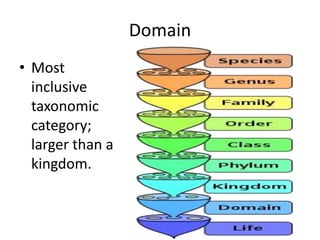
DomainMost inclusive taxonomic category; larger than a kingdom.
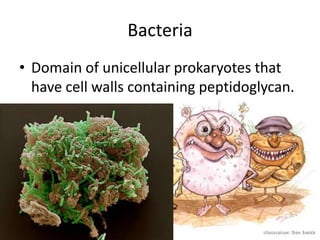
Bacteria Domain of unicellular prokaryotes that have cell walls containing peptidoglycan.
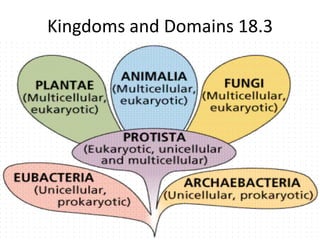
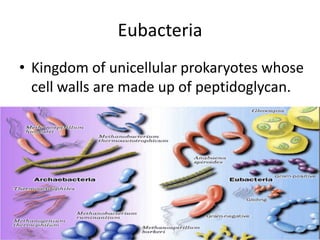
Eubacteria Kingdom of unicellular prokaryotes whose cell walls are made up of peptidoglycan.
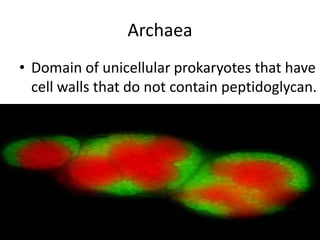
ArchaeaDomain of unicellular prokaryotes that have cell walls that do not contain peptidoglycan.
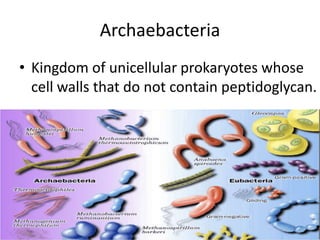
Archaebacteria Kingdom of unicellular prokaryotes whose cell walls that do not contain peptidoglycan.
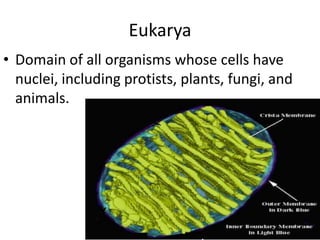
EukaryaDomain of all organisms whose cells have nuclei, including protists, plants, fungi, and animals.
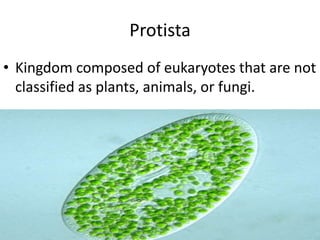
Protista Kingdom composed of eukaryotes that are not classified as plants, animals, or fungi.
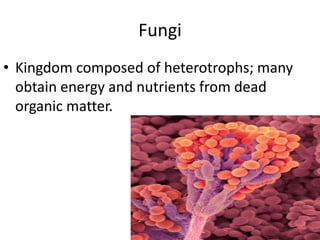
Fungi Kingdom composed of heterotrophs; many obtain energy and nutrients from dead organic matter.
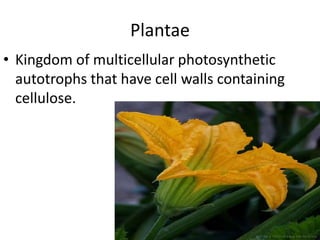
PlantaeKingdom of multicellular photosynthetic autotrophs that have cell walls containing cellulose.
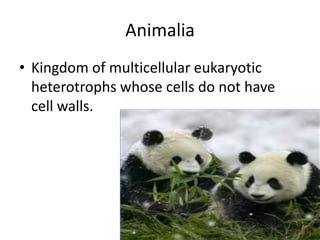
Animalia Kingdom of multicellular eukaryotic heterotrophs whose cells do not have cell walls.
Key ConceptWhat are the six kingdoms of life as they are now identified?The six-kingdom system of classification includes the kingdoms Eubacteria, Archaebacteria, Protista, Fungi, Plantae, and Animalia.
Key Concept What is the three-domain system of classification?The three domains are the domain Eukarya, Which is composed of protists, fungi, plants, and animals; the domain Bacteria, which corresponds to the kingdom Eubacteria; and the domain Archaea, which corresponds to the kingdom Archaebacteria.

Biology 18.3

  • 1.
  • 2.
    DomainMost inclusive taxonomiccategory; larger than a kingdom.
  • 3.
    Bacteria Domain ofunicellular prokaryotes that have cell walls containing peptidoglycan.
  • 4.
    Eubacteria Kingdom ofunicellular prokaryotes whose cell walls are made up of peptidoglycan.
  • 5.
    ArchaeaDomain of unicellularprokaryotes that have cell walls that do not contain peptidoglycan.
  • 6.
    Archaebacteria Kingdom ofunicellular prokaryotes whose cell walls that do not contain peptidoglycan.
  • 7.
    EukaryaDomain of allorganisms whose cells have nuclei, including protists, plants, fungi, and animals.
  • 8.
    Protista Kingdom composedof eukaryotes that are not classified as plants, animals, or fungi.
  • 9.
    Fungi Kingdom composedof heterotrophs; many obtain energy and nutrients from dead organic matter.
  • 10.
    PlantaeKingdom of multicellularphotosynthetic autotrophs that have cell walls containing cellulose.
  • 11.
    Animalia Kingdom ofmulticellular eukaryotic heterotrophs whose cells do not have cell walls.
  • 12.
    Key ConceptWhat arethe six kingdoms of life as they are now identified?The six-kingdom system of classification includes the kingdoms Eubacteria, Archaebacteria, Protista, Fungi, Plantae, and Animalia.
  • 13.
    Key Concept Whatis the three-domain system of classification?The three domains are the domain Eukarya, Which is composed of protists, fungi, plants, and animals; the domain Bacteria, which corresponds to the kingdom Eubacteria; and the domain Archaea, which corresponds to the kingdom Archaebacteria.