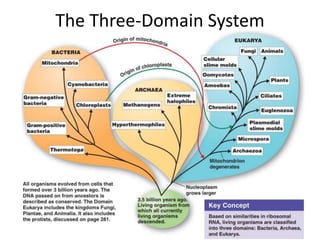
Figure 10.1
The Three-Domain System
• Broadest, most inclusive taxon
• Three domains
• Archaea and Eubacteria are unicellular
prokaryotes (no nucleus or membrane-
bound organelles)
• Eukarya are more complex and have a
nucleus and membrane-bound organelles
Domains
ARCHAEA
• Prokaryotes (NO NUCLEUS)
• Many live in HARSH environments
• Found in:
– Sewage Treatment Plants
– Thermal or Volcanic Vents
– Hot Springs or Geysers that are acid
– Very salty water (Dead Sea; Great Salt Lake)
5
ARCHAEAN
EUBACTERIA
• Prokaryotes (NO NUCLEUS)
• Some may cause DISEASE
– Strep throat, pneumonia, ect.
• Found in ALL HABITATS
• Important decomposers for environment
• Commercially important in making cottage
cheese, yogurt, buttermilk, etc.
8
Live in the intestines of animals
Domain Eukarya is Divided into
Four Kingdoms
• Protista (protozoans, algae…)
• Fungi (mushrooms, yeasts …)
• Plantae (multicellular plants)
• Animalia (multicellular animals)
Protista
•Most are unicellular
•Some are multicellular
•Some are autotrophic, while
others are heterotrophic
•Live in moist environments
•Lack complex organs
Kingdom Protista
• Ex: protozoa, algae, diatoms,
Fungi
• Multicellular, except yeast
• Absorptive heterotrophs (digest food outside
their body & then absorb it)
• Decomposers
• Cell walls made of chitin
• Do not move from place to place
Kingdom Fungi
• parasites or decomposers / molds, yeasts,
mushrooms…
Plantae
•ALL Multicellular
•Autotrophic
•Absorb sunlight to make
glucose – Photosynthesis
•Cell walls made of
cellulose
Kingdom Plantae
• seed plants, mosses, ferns
Animalia• Multicellular
• Ingestive heterotrophs (consume food and digest it
inside of their bodies)
• Move from place to place
• No cell wall
• Organ systems
Kingdom Animalia
• Reproduce
sexually
• There are fifteen
phyla of animals
• They range from
sponges to
chordates
20

Kingdoms