
FIVE KINGDOM
CLASSIFICATION
WORLD OF BIOLOGY
(BIOLOGY LEARNING PLATFORM)
EDUCATOR- ASIT KUMAR SAMAL
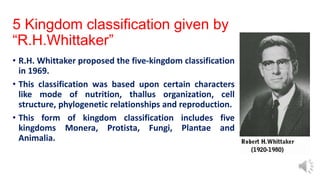
5 Kingdom classification given by
“R.H.Whittaker”
• R.H. Whittaker proposed the five-kingdom classification
in 1969.
• This classification was based upon certain characters
like mode of nutrition, thallus organization, cell
structure, phylogenetic relationships and reproduction.
• This form of kingdom classification includes five
kingdoms Monera, Protista, Fungi, Plantae and
Animalia.
Kingdom Monera
• Kingdom Monera mainly includes the bacteria.
• Bacteria occur everywhere and they are microscopic in nature.
• They are unicellular Prokaryotes.
• They do not have a well-defined nucleus and also lack cell organelles.
• Some organisms show the presence of cell wall while there are others
without a cell wall.
• Consequently, some organisms are autotrophic and others are
heterotrophic. The heterotrophic bacteria can be parasitic or saprophytic.
The autotrophic bacteria can be chemosynthetic or photosynthetic.
• Examples include Bacteria, Cyanobacteria, and Mycoplasma.
• Bacteria can be classified into four types based on their shape:
• Coccus (pl.: cocci) – spherical in shape
• Bacillus (pl.: bacilli) – rod-shaped
• Vibrium (pl.: vibrio) – comma-shaped bacteria
• Spirillum (pl.: spirilla) – spiral-shaped bacteria
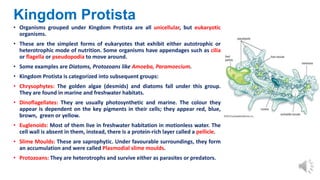
Kingdom Protista
• Organisms grouped under Kingdom Protista are all unicellular, but eukaryotic
organisms.
• These are the simplest forms of eukaryotes that exhibit either autotrophic or
heterotrophic mode of nutrition. Some organisms have appendages such as cilia
or flagella or pseudopodia to move around.
• Some examples are Diatoms, Protozoans like Amoeba, Paramoecium.
• Kingdom Protista is categorized into subsequent groups:
• Chrysophytes: The golden algae (desmids) and diatoms fall under this group.
They are found in marine and freshwater habitats.
• Dinoflagellates: They are usually photosynthetic and marine. The colour they
appear is dependent on the key pigments in their cells; they appear red, blue,
brown, green or yellow.
• Euglenoids: Most of them live in freshwater habitation in motionless water. The
cell wall is absent in them, instead, there is a protein-rich layer called a pellicle.
• Slime Moulds: These are saprophytic. Under favourable surroundings, they form
an accumulation and were called Plasmodial slime moulds.
• Protozoans: They are heterotrophs and survive either as parasites or predators.
Kingdom Fungi
• Heterotrophic, Multicellular and Eukaryotic
organisms are grouped under Kingdom Fungi.
• Their mode of nutrition is saprophytic as they use
decaying organic matter as food.
• They have cell walls, which are made up of a
substance called Chitin.
• Fungi also form a symbiotic association with some
blue-green algae.
• Yeast, Mushroom, Aspergillus are examples of
Fungi.
Kingdom Plantae
• These are Eukaryotic, Multicellular organisms with a
cell wall that is made up of cellulose.
• They are autotrophs and synthesize their own food
through the process of photosynthesis. This kingdom
includes all plants.
• Based on the body differentiation and presence or
absence of specialized vascular tissue, Kingdom
Plantae is divided into different divisions, namely
Thallophyta, Bryophyta, Pteridophyta, Gymnosperms,
and Angiosperms.
• Examples are Spirogyra, Ferns, Pines, and Mango
Plant etc.
Kingdom Animalia
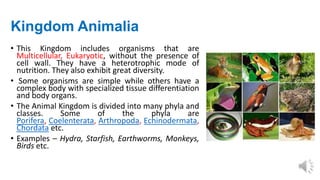
• This Kingdom includes organisms that are
Multicellular, Eukaryotic, without the presence of
cell wall. They have a heterotrophic mode of
nutrition. They also exhibit great diversity.
• Some organisms are simple while others have a
complex body with specialized tissue differentiation
and body organs.
• The Animal Kingdom is divided into many phyla and
classes. Some of the phyla are
Porifera, Coelenterata, Arthropoda, Echinodermata,
Chordata etc.
• Examples – Hydra, Starfish, Earthworms, Monkeys,
Birds etc.
THANK YOU

Five kingdom classification

  • 1.
    FIVE KINGDOM CLASSIFICATION WORLD OFBIOLOGY (BIOLOGY LEARNING PLATFORM) EDUCATOR- ASIT KUMAR SAMAL
  • 2.
    5 Kingdom classificationgiven by “R.H.Whittaker” • R.H. Whittaker proposed the five-kingdom classification in 1969. • This classification was based upon certain characters like mode of nutrition, thallus organization, cell structure, phylogenetic relationships and reproduction. • This form of kingdom classification includes five kingdoms Monera, Protista, Fungi, Plantae and Animalia.
  • 3.
    Kingdom Monera • KingdomMonera mainly includes the bacteria. • Bacteria occur everywhere and they are microscopic in nature. • They are unicellular Prokaryotes. • They do not have a well-defined nucleus and also lack cell organelles. • Some organisms show the presence of cell wall while there are others without a cell wall. • Consequently, some organisms are autotrophic and others are heterotrophic. The heterotrophic bacteria can be parasitic or saprophytic. The autotrophic bacteria can be chemosynthetic or photosynthetic. • Examples include Bacteria, Cyanobacteria, and Mycoplasma. • Bacteria can be classified into four types based on their shape: • Coccus (pl.: cocci) – spherical in shape • Bacillus (pl.: bacilli) – rod-shaped • Vibrium (pl.: vibrio) – comma-shaped bacteria • Spirillum (pl.: spirilla) – spiral-shaped bacteria
  • 4.
    Kingdom Protista • Organismsgrouped under Kingdom Protista are all unicellular, but eukaryotic organisms. • These are the simplest forms of eukaryotes that exhibit either autotrophic or heterotrophic mode of nutrition. Some organisms have appendages such as cilia or flagella or pseudopodia to move around. • Some examples are Diatoms, Protozoans like Amoeba, Paramoecium. • Kingdom Protista is categorized into subsequent groups: • Chrysophytes: The golden algae (desmids) and diatoms fall under this group. They are found in marine and freshwater habitats. • Dinoflagellates: They are usually photosynthetic and marine. The colour they appear is dependent on the key pigments in their cells; they appear red, blue, brown, green or yellow. • Euglenoids: Most of them live in freshwater habitation in motionless water. The cell wall is absent in them, instead, there is a protein-rich layer called a pellicle. • Slime Moulds: These are saprophytic. Under favourable surroundings, they form an accumulation and were called Plasmodial slime moulds. • Protozoans: They are heterotrophs and survive either as parasites or predators.
  • 5.
    Kingdom Fungi • Heterotrophic,Multicellular and Eukaryotic organisms are grouped under Kingdom Fungi. • Their mode of nutrition is saprophytic as they use decaying organic matter as food. • They have cell walls, which are made up of a substance called Chitin. • Fungi also form a symbiotic association with some blue-green algae. • Yeast, Mushroom, Aspergillus are examples of Fungi.
  • 6.
    Kingdom Plantae • Theseare Eukaryotic, Multicellular organisms with a cell wall that is made up of cellulose. • They are autotrophs and synthesize their own food through the process of photosynthesis. This kingdom includes all plants. • Based on the body differentiation and presence or absence of specialized vascular tissue, Kingdom Plantae is divided into different divisions, namely Thallophyta, Bryophyta, Pteridophyta, Gymnosperms, and Angiosperms. • Examples are Spirogyra, Ferns, Pines, and Mango Plant etc.
  • 7.
    Kingdom Animalia • ThisKingdom includes organisms that are Multicellular, Eukaryotic, without the presence of cell wall. They have a heterotrophic mode of nutrition. They also exhibit great diversity. • Some organisms are simple while others have a complex body with specialized tissue differentiation and body organs. • The Animal Kingdom is divided into many phyla and classes. Some of the phyla are Porifera, Coelenterata, Arthropoda, Echinodermata, Chordata etc. • Examples – Hydra, Starfish, Earthworms, Monkeys, Birds etc.
  • 8.