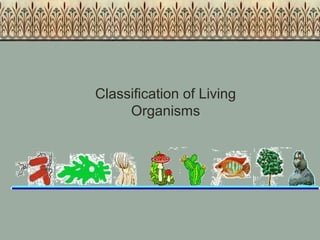
Classification of Living
Organisms
• As living things are constantly being
investigated, new attributes are
revealed that affect how organisms are
placed in a standard classification
system.
2
What is taxonomy?
• Taxonomy is the branch
of biology concerned
with the grouping and
naming of organisms
• Biologists who study
this are called
taxonomists
How did it start?
• People wanted to
organize their world
so they began
grouping, or
classifying everything
they saw.
Examples:
•Things that break down dead
materials
•Things that reproduce sexually
•Things that are single-celled
•Things that have cell walls
•Things that eat other organisms
•Things that have a nucleus
•Things that are multicellular
TPS:
What categories of living things do you remember?
Why classify?
• To help us see
relationships, similarities
and differences
• To help us organize all the
organisms we discover . . .
• To give every species a name
based on a standard method
so scientists from different
countries can talk about the
same animal without
confusion
Who is Carolus Linnaeus?
• Carolus Linnaeus was a
Swedish botanist
• Developed a 7-level (taxa)
classification system based
on similarities between
organisms
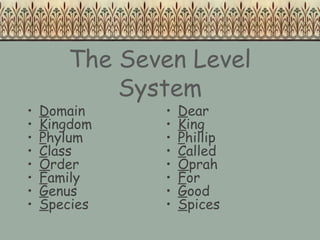
The Seven Level
System
• Domain
• Kingdom
• Phylum
• Class
• Order
• Family
• Genus
• Species
• Dear
• King
• Phillip
• Called
• Oprah
• For
• Good
• Spices
Domains
• Domains are the broadest taxonomic
classification of living organisms
• The three Domains:
Archaea
Bacteria
Eukarya
10
Domains are Divided into
Kingdoms
• Archaea----- Archaebacteria
• Bacteria ------ Eubacteria
• Eukarya ------- Protist
Fungi
Plantae
Animalia
11
How does it work?
• There are 6 broad
kingdoms
• Every living thing that
we know of fits into one
of the six kingdoms
• Each level gets more
specific as fewer
organisms fit into any
one group
Six Kingdoms of
Life
13
• The grouping of organisms into
KINGDOMS is based on 3 factors:
– 1. Cell Type (prokaryotic or eukaryotic)
– 2. Cell Number (unicellular or
multicellular)
– 3. Feeding Type (autotroph or
heterotroph)
14
1. Cell Type- The presence or absence of
cellular structures such as the nucleus,
mitochondria, or a cell wall
Prokaryotes or Eukaryotes
15
Prokaryotes – Bacteria!
• DO NOT HAVE:
– A nucleus
•Kingdom - Eubacteria
•Prokaryotic –
•Bacteria is unicellular
•Structured organelles – has
a cell wall
16
17
Eukaryotes
• DO HAVE:
• nucleus organized with a membrane
• other organelles
18
19
2nd
criteria for Kingdom Divisions:
Cell Number
•Unicellular- single celled organism –
protozoans, bacteria, some algae
•Multicellular- many celled organism
– cells start to
specialize/differentiate
20
• Unicellular • Multicellular
21
3rd
Criteria for Kingdom Divisions
Feeding Type - How the organisms get their
food
–Autotroph or Producer
Make their own food
–Heterotroph or Consumer
Must eat other organisms to survive
Includes decomposers – those that eat
dead matter!
22
6 Kingdoms
• Archaebacteria
• Eubacteria
• Protista
• Fungi
• Plantae
• Animalia
Prokaryotes
Eukaryotes
23
Domain - Archaea
• Kingdom- Archaebacteria
• Prokaryote
• Unicellular
• Autotrophs
• Has a cell wall and
produces asexually
• Ancient bacteria-
– Live in very harsh
environments
– extremophiles 24
Domain - Bacteria
• Kingdom – Eubacteria
• Prokaryotic
• Made up of one cell
• Bacteria can be an autotroph or
an heterotroph
• Bacteria has a cell wall and
produces asexually
• It is the eubacteria that most
people are talking about when
they say bacteria, because they
live in more neutral conditions. 25
Bacteria
• Bacteria are
unicellular
prokaryotes
26
Protists
• Protists include many widely
ranging microbes, including
slime molds, protozoa and
primitive algae.
• There are animal-like,
fungus-like, and plant-like
protists
• Some are beneficial
• Some protists can cause
diseases in humans
27
Domain- Eukarya
• Protista Kingdom
• Protists have a nucleus
• Most are unicellular
• Some protists have a cell wall and some
do not have a cell wall
• Protists produce sexually
28
Protists Nutrition
• Protists can be
autotrophs or
heterotrophs
29
Fungi Kingdom
• The Kingdom Fungi
includes some of the
most important
organisms.
• By breaking down
dead organic
material, they
continue the cycle of
nutrients through
ecosystems.
30
Fungi
• All fungi are
eukaryotic
• They may be
unicellular or
multicellular
• All fungi have a
cell wall
• Produces
sexually
Unicellular
(yeast)
Multicellular
31
Fungi
• Fungi can be very
helpful and
delicious
• Many antibacterial
drugs are derived
from fungi
• Fungi also causes a
number of plant
Penicillin
32
Ringworm
Fungi Nutrition
• All fungi are heterotrophs
- Saprophytes-get their
nutrients from dead organic
matter
- Parasites – absorb from a
host, eventually killing the
host
33
Plantae Kingdom
• All plants are
multicellular
• The are all
eukaryotes
with cell walls
• they are
autotrophs
• Plants
reproduce
sexually and
asexually
34
Animalia Kingdom
All animals are:
-Multicellular: they have a nucleus and
are lacking a cell wall -Heterotrophs
-Reproduce sexually
-Capable of movement at some point
in their lives.
35
CHECK YOUR WORK
MAKE CORRECTIONS/ADDITIONS AS NEEDED
At this point, your Characteristics of Kingdoms Comparison Matrix
is complete
36

Classification of living things

  • 1.
  • 2.
    • As livingthings are constantly being investigated, new attributes are revealed that affect how organisms are placed in a standard classification system. 2
  • 3.
    What is taxonomy? •Taxonomy is the branch of biology concerned with the grouping and naming of organisms • Biologists who study this are called taxonomists
  • 4.
    How did itstart? • People wanted to organize their world so they began grouping, or classifying everything they saw.
  • 5.
    Examples: •Things that breakdown dead materials •Things that reproduce sexually •Things that are single-celled •Things that have cell walls •Things that eat other organisms •Things that have a nucleus •Things that are multicellular TPS: What categories of living things do you remember?
  • 6.
    Why classify? • Tohelp us see relationships, similarities and differences • To help us organize all the organisms we discover . . .
  • 7.
    • To giveevery species a name based on a standard method so scientists from different countries can talk about the same animal without confusion
  • 8.
    Who is CarolusLinnaeus? • Carolus Linnaeus was a Swedish botanist • Developed a 7-level (taxa) classification system based on similarities between organisms
  • 9.
    The Seven Level System •Domain • Kingdom • Phylum • Class • Order • Family • Genus • Species • Dear • King • Phillip • Called • Oprah • For • Good • Spices
  • 10.
    Domains • Domains arethe broadest taxonomic classification of living organisms • The three Domains: Archaea Bacteria Eukarya 10
  • 11.
    Domains are Dividedinto Kingdoms • Archaea----- Archaebacteria • Bacteria ------ Eubacteria • Eukarya ------- Protist Fungi Plantae Animalia 11
  • 12.
    How does itwork? • There are 6 broad kingdoms • Every living thing that we know of fits into one of the six kingdoms • Each level gets more specific as fewer organisms fit into any one group
  • 13.
  • 14.
    • The groupingof organisms into KINGDOMS is based on 3 factors: – 1. Cell Type (prokaryotic or eukaryotic) – 2. Cell Number (unicellular or multicellular) – 3. Feeding Type (autotroph or heterotroph) 14
  • 15.
    1. Cell Type-The presence or absence of cellular structures such as the nucleus, mitochondria, or a cell wall Prokaryotes or Eukaryotes 15
  • 16.
    Prokaryotes – Bacteria! •DO NOT HAVE: – A nucleus •Kingdom - Eubacteria •Prokaryotic – •Bacteria is unicellular •Structured organelles – has a cell wall 16
  • 17.
  • 18.
    Eukaryotes • DO HAVE: •nucleus organized with a membrane • other organelles 18
  • 19.
  • 20.
    2nd criteria for KingdomDivisions: Cell Number •Unicellular- single celled organism – protozoans, bacteria, some algae •Multicellular- many celled organism – cells start to specialize/differentiate 20
  • 21.
    • Unicellular •Multicellular 21
  • 22.
    3rd Criteria for KingdomDivisions Feeding Type - How the organisms get their food –Autotroph or Producer Make their own food –Heterotroph or Consumer Must eat other organisms to survive Includes decomposers – those that eat dead matter! 22
  • 23.
    6 Kingdoms • Archaebacteria •Eubacteria • Protista • Fungi • Plantae • Animalia Prokaryotes Eukaryotes 23
  • 24.
    Domain - Archaea •Kingdom- Archaebacteria • Prokaryote • Unicellular • Autotrophs • Has a cell wall and produces asexually • Ancient bacteria- – Live in very harsh environments – extremophiles 24
  • 25.
    Domain - Bacteria •Kingdom – Eubacteria • Prokaryotic • Made up of one cell • Bacteria can be an autotroph or an heterotroph • Bacteria has a cell wall and produces asexually • It is the eubacteria that most people are talking about when they say bacteria, because they live in more neutral conditions. 25
  • 26.
  • 27.
    Protists • Protists includemany widely ranging microbes, including slime molds, protozoa and primitive algae. • There are animal-like, fungus-like, and plant-like protists • Some are beneficial • Some protists can cause diseases in humans 27
  • 28.
    Domain- Eukarya • ProtistaKingdom • Protists have a nucleus • Most are unicellular • Some protists have a cell wall and some do not have a cell wall • Protists produce sexually 28
  • 29.
    Protists Nutrition • Protistscan be autotrophs or heterotrophs 29
  • 30.
    Fungi Kingdom • TheKingdom Fungi includes some of the most important organisms. • By breaking down dead organic material, they continue the cycle of nutrients through ecosystems. 30
  • 31.
    Fungi • All fungiare eukaryotic • They may be unicellular or multicellular • All fungi have a cell wall • Produces sexually Unicellular (yeast) Multicellular 31
  • 32.
    Fungi • Fungi canbe very helpful and delicious • Many antibacterial drugs are derived from fungi • Fungi also causes a number of plant Penicillin 32 Ringworm
  • 33.
    Fungi Nutrition • Allfungi are heterotrophs - Saprophytes-get their nutrients from dead organic matter - Parasites – absorb from a host, eventually killing the host 33
  • 34.
    Plantae Kingdom • Allplants are multicellular • The are all eukaryotes with cell walls • they are autotrophs • Plants reproduce sexually and asexually 34
  • 35.
    Animalia Kingdom All animalsare: -Multicellular: they have a nucleus and are lacking a cell wall -Heterotrophs -Reproduce sexually -Capable of movement at some point in their lives. 35
  • 36.
    CHECK YOUR WORK MAKECORRECTIONS/ADDITIONS AS NEEDED At this point, your Characteristics of Kingdoms Comparison Matrix is complete 36