Living things II.
The five kingdoms.
Not finished…
The kingdom is the broadest category used in the system to
classify living things.
Today, living things are classified into five kingdoms: monera,
protoctista, fungi, plants and animals.
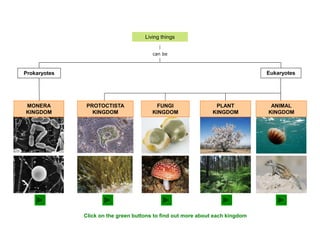
can be
Living things
MONERA
KINGDOM
EukaryotesProkaryotes
PROTOCTISTA
KINGDOM
FUNGI
KINGDOM
PLANT
KINGDOM
ANIMAL
KINGDOM
Click on the green buttons to find out more about each kingdom
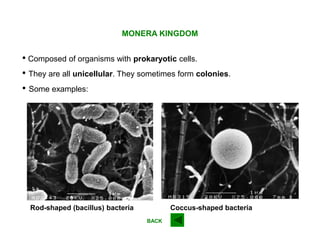
• They are all unicellular. They sometimes form colonies.
MONERA KINGDOM
• Composed of organisms with prokaryotic cells.
• Some examples:
Rod-shaped (bacillus) bacteria Coccus-shaped bacteria
BACK
• They can be unicellular, or multicellular with no tissues.
PROTOCTISTA KINGDOM
• Composed of organisms with eukaryotic cells.
• Some examples:
Amoebae Algae
BACK
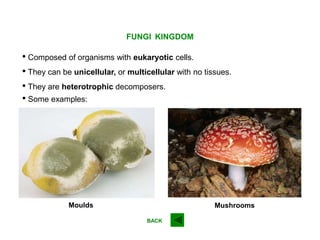
FUNGI KINGDOM
• They are heterotrophic decomposers.
Mushrooms
• They can be unicellular, or multicellular with no tissues.
• Composed of organisms with eukaryotic cells.
Moulds
• Some examples:
BACK
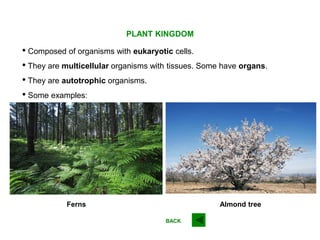
PLANT KINGDOM
Almond tree
• They are autotrophic organisms.
• They are multicellular organisms with tissues. Some have organs.
• Composed of organisms with eukaryotic cells.
Ferns
• Some examples:
BACK
ANIMAL KINGDOM
Squirrel
• They are heterotrophic organisms.
• They are multicellular organisms with tissues.
• Composed of organisms with eukaryotic cells.
Jellyfish
• Some examples:
• Most of them have organs and some even have systems.
BACK

The 5 kingdoms

  • 1.
    Living things II. Thefive kingdoms. Not finished…
  • 2.
    The kingdom isthe broadest category used in the system to classify living things. Today, living things are classified into five kingdoms: monera, protoctista, fungi, plants and animals.
  • 3.
  • 4.
    • They areall unicellular. They sometimes form colonies. MONERA KINGDOM • Composed of organisms with prokaryotic cells. • Some examples: Rod-shaped (bacillus) bacteria Coccus-shaped bacteria BACK
  • 5.
    • They canbe unicellular, or multicellular with no tissues. PROTOCTISTA KINGDOM • Composed of organisms with eukaryotic cells. • Some examples: Amoebae Algae BACK
  • 6.
    FUNGI KINGDOM • Theyare heterotrophic decomposers. Mushrooms • They can be unicellular, or multicellular with no tissues. • Composed of organisms with eukaryotic cells. Moulds • Some examples: BACK
  • 7.
    PLANT KINGDOM Almond tree •They are autotrophic organisms. • They are multicellular organisms with tissues. Some have organs. • Composed of organisms with eukaryotic cells. Ferns • Some examples: BACK
  • 8.
    ANIMAL KINGDOM Squirrel • Theyare heterotrophic organisms. • They are multicellular organisms with tissues. • Composed of organisms with eukaryotic cells. Jellyfish • Some examples: • Most of them have organs and some even have systems. BACK