Biological Sludge Digestion
Dr. Akepati S. Reddy
School of Energy and Environment
Thapar University, Patiala
Punjab (INDIA) – 147001
Handling of solids and bio-solids
Solid wastes are two types: primary and secondary wastes
Concerned with the secondary solid wastes generated by STPs and ETPs
• Screenings, grit, scum/oil and grease, primary sludge, chemical
sludge, and secondary sludge are generated by STPs & ETPs
• Handling of the primary and secondary sludges is concern here
Handling includes collection, treatment, storage, transportation
and disposal
• Emphasis is on treatment (specially biological stabilization or
digestion) of primary and secondary sludges
• Have greater biodegradable fraction (~65% in primary sludge and
~55% in secondary sludge
Primary and secondary sludges have very low consistency (varies
from 0.25 to 12%) and contain substances
• responsible for offensive character of untreated wastewater
• substances that can decompose & become offensive
Treatment of primary and secondary sludges (also known as bio-
solids) is mostly concerned with
• Removal of moisture/water by thickening, dewatering and
drying
• Stabilization of putrifiable/ degradable/ decomposable
constituents
– Physico-chemical – chemical treatment (alkaline stabilization),
incineration, heat treatment, etc.
– Biological – aerobic digestion, anaerobic digestion; composting,
vermi-composting, land farming, etc.
– Only aerobic and anaerobic digestion will be covered
– Composting, vermi-composting and land farming not covered
(included in solid waste management paper!)
Bio-solids are organic products and can be beneficially used after
processes such as stabilization and composting
Handling of solids and bio-solids
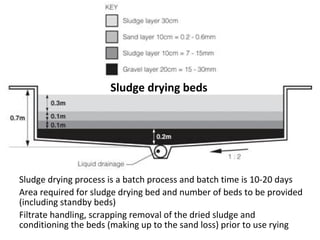
Sludge drying beds
Sludge drying process is a batch process and batch time is 10-20 days
Area required for sludge drying bed and number of beds to be provided
(including standby beds)
Filtrate handling, scrapping removal of the dried sludge and
conditioning the beds (making up to the sand loss) prior to use rying
Anaerobic Sludge Digestion
The stabilization process involves
• Hydrolysis
• Fermentation/ acidogenesis
• Methanogenesis
• Single phase anaerobic digestion
• Thermophillic anaerobic digestion
• Mesophillic anaerobic digestion
• Two stage anaerobic digestion
• Phased mesophillic and phased thermophillic
• Temperature phased
• Acid/gas phased
• Separate primary and secondary sludge digestion
Mesophillic anaerobic digestion
• Digesters have floating or fixed covers for biogas collection
• Usually SRT=HRT
• Feed is thickened and fed uniformly (continuously or on a 30
min to 2 hour cycles) for reducing the reactor volume
– for longer cycles (8 or 24 hours) withdrawal of sludge prior to feeding
can result in better pathogen kill
• Feed sludge is heated to achieve optimum digestion rates
• Mixing (by gas circulation/pumping/draft-tube mixers) and
recirculating a portion of digested sludge can improve
digestion
• Solids reduction of 45-50% is achieved
Anaerobic Sludge Digestion
Thermophillic anaerobic digestion
• Occurs at temperature 50-57C
• Digestion process is faster (generally 4 times faster)
• Advantages include increased solids destruction capability,
improved dewatering and increased pathogen destruction
• Disadvantages include higher energy requirement for heating,
poorer quality supernatant and less process stability
• As single stage very less used – mainly used as a first stage
(second phase is mesophilic digester)
Anaerobic Sludge Digestion
Two-phased anaerobic digestion (4 basic methods)
1. Staged mesophilic digestion (not much used):
– First stage is heated and equipped with mixing facilities
– Second stage is unheated and principally used for storage
• An open tank or lagoon (<10% of biogas from this)
• Supernatant withdrawal increases solids concentration
– Not much beneficial in volatile solids reduction or in gas
production
– May produce more stable, less odorous biosolids that are easier
to dewater
2. Staged thermophilic digestion
– Involves use of a larger reactor followed by one or more smaller
reactors specially to reduce pathogen count
Anaerobic Sludge Digestion
3. Temperature phased digestion:
– Operates in either of the two modes:
• thermophilic-mesophilic (more common)
• mesophilic-thermophilic
– Thermophillic stage has 3 to 5 day HRT and Mesophiliic
stage ~10 day HRT
– Incorporates the advantages and mitigates the
disadvantages of thermophilic digestion
• Improved stability and greater shock loads absorbing
capability
• Foaming is reduced and odorous compounds from
thermophillic stage are destructed in mesophillic stage
– Volatile suspended solids destruction efficiencies are 15-
25% greater than signle stage mesophilic digestion
Anaerobic Sludge Digestion
4. Acid/gas phased digestion (Two stage process)
• Stage-1:
– solubilization of particulate matter and formation of volatile
acids (>6000 mg/l) occur (hydrolysis and acidogenesis)
– Conducted at ≤6 pH and shorter SRT
• Stage-2:
– conducted at neutral pH and longer SRT at conditions suitable
for methanogenesis and maximum gas production
• Either of the stages can be mesophilic or thermophilic
• Advantages: greater VSS reduction (50-60%); foaming control
Separate (primary and secondary) sludge digestion
– Mixing of secondary sludge with the primary sludge can affect
dewatering and drying of digested sludge
– If biological phosphorus removal is practiced, biological sludge is
aerobically digested (not anaerobically)
Anaerobic Sludge Digestion
Factors influencing the anaerobic
stabilization process
• Temperature
– Mesophilic digestion (30-38°C)/thermophilic digestion
(50-57°C)
– Often phased digestion (mesophilic and thermophilic
in separate stages) is also used
– Temperature affects digestion rates (particularly
hydrolysis and methanogenesis), gas transfer rates &
sludge settling properties
– Maintaining stable operating temperature is important
(methanogens are sensitive - affected by changes
>1°C/day)
Factors influencing the anaerobic
stabilization process
– Alkalinity and pH
• The stabilization process produces alkalinity (ammonium
carbonate) and a well established digester has 2000 to 5000
mg/l of alkalinity
• Dissolved (not VFA) CO2 consumes alkalinity – CO2 level in
biogas indicates alkalinity required
• Addition of sodium bicarbonate, lime, or sodium carbonate
can supplement alkalinity of digester
– Presence of inhibitory substances
– Availability of nutrients and trace metals
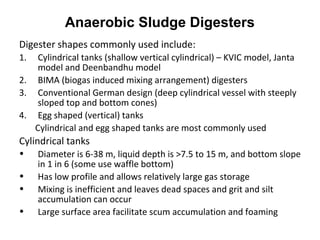
Digester shapes commonly used include:
1. Cylindrical tanks (shallow vertical cylindrical) – KVIC model, Janta
model and Deenbandhu model
2. BIMA (biogas induced mixing arrangement) digesters
3. Conventional German design (deep cylindrical vessel with steeply
sloped top and bottom cones)
4. Egg shaped (vertical) tanks
Cylindrical and egg shaped tanks are most commonly used
Cylindrical tanks
• Diameter is 6-38 m, liquid depth is >7.5 to 15 m, and bottom slope
in 1 in 6 (some use waffle bottom)
• Has low profile and allows relatively large gas storage
• Mixing is inefficient and leaves dead spaces and grit and silt
accumulation can occur
• Large surface area facilitate scum accumulation and foaming
Anaerobic Sludge Digesters
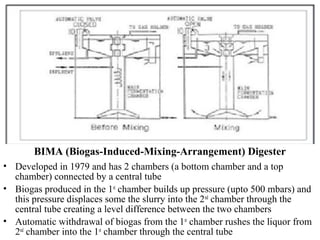
BIMA (Biogas-Induced-Mixing-Arrangement) Digester
• Developed in 1979 and has 2 chambers (a bottom chamber and a top
chamber) connected by a central tube
• Biogas produced in the 1st
chamber builds up pressure (upto 500 mbars) and
this pressure displaces some the slurry into the 2nd
chamber through the
central tube creating a level difference between the two chambers
• Automatic withdrawal of biogas from the 1st
chamber rushes the liquor from
2nd
chamber into the 1st
chamber through the central tube
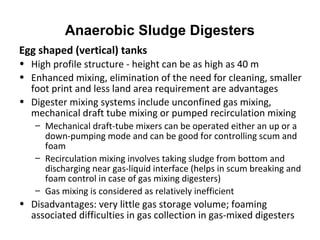
Egg shaped (vertical) tanks
• High profile structure - height can be as high as 40 m
• Enhanced mixing, elimination of the need for cleaning, smaller
foot print and less land area requirement are advantages
• Digester mixing systems include unconfined gas mixing,
mechanical draft tube mixing or pumped recirculation mixing
– Mechanical draft-tube mixers can be operated either an up or a
down-pumping mode and can be good for controlling scum and
foam
– Recirculation mixing involves taking sludge from bottom and
discharging near gas-liquid interface (helps in scum breaking and
foam control in case of gas mixing digesters)
– Gas mixing is considered as relatively inefficient
• Disadvantages: very little gas storage volume; foaming
associated difficulties in gas collection in gas-mixed digesters
Anaerobic Sludge Digesters
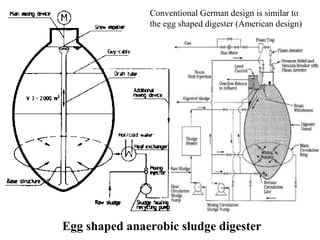
Egg shaped anaerobic sludge digester
Conventional German design is similar to
the egg shaped digester (American design)
Anaerobic sludge digestors
Digester covers - principal types for gas collection are
• Floating covers (KVIC model of gobar gas plants)
• Fixed covers (Janta and Dheenbandu models)
• Membrane covers (3 layered membrane used)
• Top high tensile UV-resistant geomembrane
• Middle layer 12.5 mm thick polyfoam insulation and flotation
• Base layer of high density polyethylene welded to the base
• Foam generation can create problems (clogging the gas outlet)
• Mixing of gas and air can result in explosive mixture
• gas piping and pressure-relief valves must include adequate
flame traps
• air entry is avoided during liquid volume changes
Mixing (which is important for optimal process performance) is
achieved by
• Gas injection systems
• Mechanical mixing systems
• Mechanical pumping systems
Combination systems (gas mixing & pumping) are also used
Mechanical mixing systems
• Single top mounted low speed turbine or mixer is used turbine
usually has impellers at different depths
Mechanical pumping systems
• Propeller type pumps mounted in internal/external draft tubes
• Axial flow centrifugal pumps and piping installed externally
Anaerobic Sludge Digestion: Mixing
Gas injection systems - (2 types: confined or unconfined)
• Unconfined systems: collect gas at top, compress and then
discharge at the bottom may be through diffusers
• Confined gas systems: collects gas at top, compresses and
discharges through confined tubes - 3 types: gas lifter, gas
lances and gas piston types
– Gas lifter type: has submerged gas pipes inserted into an eductor
tube or gas lifter - gas is released through the tubes for creating
lifting effect on sludge
– Cover mounted lances (gas is released at the bottom for creating
lifting effect on the sludge
– Gas piston: gas bubbles are intermittently released at the
bottom of cylindrical tube – rising bubbles act as piston and
push up sludge
Anaerobic Sludge Digestion: Mixing
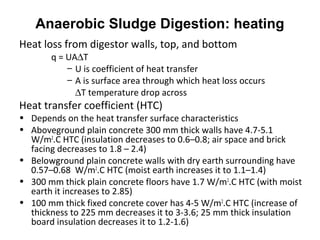
Heat loss from digestor walls, top, and bottom
q = UA∆T
– U is coefficient of heat transfer
– A is surface area through which heat loss occurs
∆T temperature drop across
Heat transfer coefficient (HTC)
• Depends on the heat transfer surface characteristics
• Aboveground plain concrete 300 mm thick walls have 4.7-5.1
W/m2
.C HTC (insulation decreases to 0.6–0.8; air space and brick
facing decreases to 1.8 – 2.4)
• Belowground plain concrete walls with dry earth surrounding have
0.57–0.68 W/m2
.C HTC (moist earth increases it to 1.1–1.4)
• 300 mm thick plain concrete floors have 1.7 W/m2
.C HTC (with moist
earth it increases to 2.85)
• 100 mm thick fixed concrete cover has 4-5 W/m2
.C HTC (increase of
thickness to 225 mm decreases it to 3-3.6; 25 mm thick insulation
board insulation decreases it to 1.2-1.6)
Anaerobic Sludge Digestion: heating
• External or internal heating systems can be used
• External heating systems
• Tube-in-tube, spiral plate or water bath heat exchangers are used
• Sludge and/or supernatant is pumped at high velocity through
tubes and hot water (of <68C) is circulated around on the outer
side and counter-current flow is maintained
• Heat transfer coefficient is taken as 0.9 to 1.6 kJ/m2
.C
• Internal heating systems
• Not recommended because of operational and maintenance
problems
• Mixing tubes equipped with hot water jackets are used
• Biogas generated can be burnt to supply the heat
• Can be burnt in internal combustion engines for cogenerating
electricity as well
• Natural gas or fuel oil may be used as auxiliary fuel
Anaerobic Sludge Digestion: heating
Based on SRT, Volumetric loading, Volatile solids destruction,
and Observed volume reduction
Loading factors
• Typical feed consistency is 4.7±1.6% (70% of the sludge
is volatile and specific gravity of the sludge is 1.02)
• Basis of design is volatile solids loading rate per unit
volume or per unit volatile solids of the digester
– Typical is 1.6 to 4.8 kg/m3.day (can be higher if primary
sludge if mixed with secondary sludge) - maximum
sustained loading over 2-week (or one month) period is
considered in the design
– Within the digester typical VSS level is 1.6%
– Upper limit for loading is determined by toxic materials
(ammonia) accumulation rate or by washout of methanogens
• Thickening of the feed sludge or the digesting sludge can
increase SRT and enhance digester performance
Design of Anaerobic Sludge Digester
• Estimating volatile solids destruction
Vd is percent volatile solids destructed
• Alkalinity and volatile fatty acids content are usually checked
as a measure of stability of the digestion process
• Quantity of methane gas generated can be calculated by
Vmethane is volume of methane in m3
at 0°C and 1 atmos
S0 and Se are expressed as bCOD (I kg of bCOD
theoretically generates 0.35 m3
of methane)
Px is net mass of cell biomass produced
Typical Y and kd values are 0.05 to 0.1 and 0.02 to 0.04
Design of Anaerobic Sludge Digester
9.18)ln(7.13 += desd SRTV
[ ]xeCH PSSQV 42.1)(35.0 04
−−=
SRTk
SSYQ
P
d
e
x
.1
)( 0
+
−
=
Anaerobic sludge digestion: biogas
• Biogas produced may have 60-70% even more CH4 by volume
• For a complete mix anaerobic digester SRT=HRT
• Typical SRT values are 10 to 20 days for 40 to 24C - SRT may be
decided while considering the peak HRT
• Biogas production rate is 0.75 to 1.12 m3
/kg of volatile solids
destroyed (high rate digesters produce about 2 volumes of
gas)
• Biogas contains 65-70% CH4, 25-30% CO2, and small amounts
of N2, H2, H2S, H2O and other gases – its SG is 0.86 of air
• Biogas often need cleaning in dry or wet scrubbers – if H2S is
>100 ppm installation of H2S removal equipment is needed
• Lower calorific value (LCV) of methane gas at STP (20°C and 1
atm) is 35,800 kJ/m3 (for biogas with 65% methane it is 22,440
kJ/m3 and for natural gas it is 37,300 kJ/m3)
Aerobic sludge digestion
Preferred primarily by small STPs and ETPs (<0.2 m3
/sec.)
Advantages of aerobic sludge digestion are
• Lower BOD in the supernatant liquor
• Odorless, humus like biologically stable end product is produced
• Stabilized sludge has more fertilizer value
• Suitable for nutrient rich bio-solids
• Lower capital cost and operational ease
Disadvantages include
• Higher power costs and recovery of no useful byproducts like
methane
• Produce sludge with poorer mechanical dewatering characteristics
The process should satisfy the following requirements
• Pathogen reduction (SRT should be > 40 days at 20C and > 60 days
at 15C)
• Volatile solids reduction
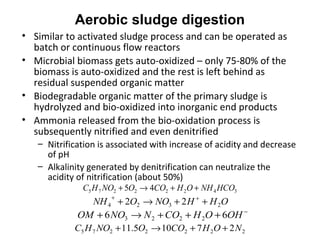
• Similar to activated sludge process and can be operated as
batch or continuous flow reactors
• Microbial biomass gets auto-oxidized – only 75-80% of the
biomass is auto-oxidized and the rest is left behind as
residual suspended organic matter
• Biodegradable organic matter of the primary sludge is
hydrolyzed and bio-oxidized into inorganic end products
• Ammonia released from the bio-oxidation process is
subsequently nitrified and even denitrified
– Nitrification is associated with increase of acidity and decrease
of pH
– Alkalinity generated by denitrification can neutralize the
acidity of nitrification (about 50%)
34222275 45 HCONHOHCOONOHC ++→+
OHHNOONH 2324 22 ++→+ ++
−
+++→+ OHOHCONNOOM 66 2223
2222275 27105.11 NOHCOONOHC ++→+
Aerobic sludge digestion
Factors considered in the design
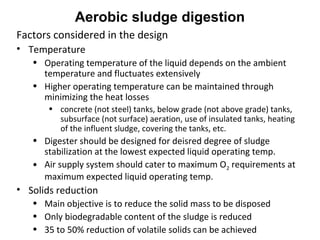
• Temperature
• Operating temperature of the liquid depends on the ambient
temperature and fluctuates extensively
• Higher operating temperature can be maintained through
minimizing the heat losses
• concrete (not steel) tanks, below grade (not above grade) tanks,
subsurface (not surface) aeration, use of insulated tanks, heating
of the influent sludge, covering the tanks, etc.
• Digester should be designed for deisred degree of sludge
stabilization at the lowest expected liquid operating temp.
• Air supply system should cater to maximum O2 requirements at
maximum expected liquid operating temp.
• Solids reduction
• Main objective is to reduce the solid mass to be disposed
• Only biodegradable content of the sludge is reduced
• 35 to 50% reduction of volatile solids can be achieved
Aerobic sludge digestion
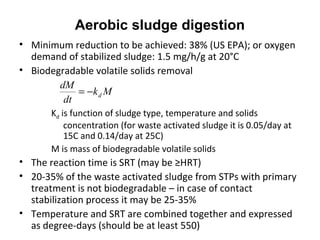
• Minimum reduction to be achieved: 38% (US EPA); or oxygen
demand of stabilized sludge: 1.5 mg/h/g at 20°C
• Biodegradable volatile solids removal
Kd is function of sludge type, temperature and solids
concentration (for waste activated sludge it is 0.05/day at
15C and 0.14/day at 25C)
M is mass of biodegradable volatile solids
• The reaction time is SRT (may be ≥HRT)
• 20-35% of the waste activated sludge from STPs with primary
treatment is not biodegradable – in case of contact
stabilization process it may be 25-35%
• Temperature and SRT are combined together and expressed
as degree-days (should be at least 550)
Mk
dt
dM
d−=
Aerobic sludge digestion
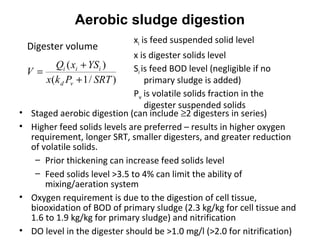
• Staged aerobic digestion (can include ≥2 digesters in series)
• Higher feed solids levels are preferred – results in higher oxygen
requirement, longer SRT, smaller digesters, and greater reduction
of volatile solids.
– Prior thickening can increase feed solids level
– Feed solids level >3.5 to 4% can limit the ability of
mixing/aeration system
• Oxygen requirement is due to the digestion of cell tissue,
biooxidation of BOD of primary sludge (2.3 kg/kg for cell tissue and
1.6 to 1.9 kg/kg for primary sludge) and nitrification
• DO level in the digester should be >1.0 mg/l (>2.0 for nitrification)
Aerobic sludge digestion
)/1(
)(
SRTPkx
YSxQ
V
vd
iii
+
+
=
Digester volume
xi is feed suspended solid level
x is digester solids level
Si is feed BOD level (negligible if no
primary sludge is added)
Pv is volatile solids fraction in the
digester suspended solids
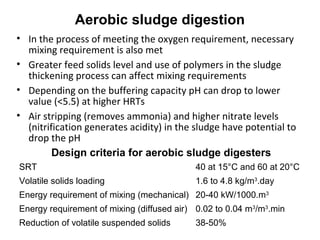
• In the process of meeting the oxygen requirement, necessary
mixing requirement is also met
• Greater feed solids level and use of polymers in the sludge
thickening process can affect mixing requirements
• Depending on the buffering capacity pH can drop to lower
value (<5.5) at higher HRTs
• Air stripping (removes ammonia) and higher nitrate levels
(nitrification generates acidity) in the sludge have potential to
drop the pH
Aerobic sludge digestion
SRT 40 at 15°C and 60 at 20°C
Volatile solids loading 1.6 to 4.8 kg/m3
.day
Energy requirement of mixing (mechanical) 20-40 kW/1000.m3
Energy requirement of mixing (diffused air) 0.02 to 0.04 m3
/m3
.min
Reduction of volatile suspended solids 38-50%
Design criteria for aerobic sludge digesters
• Aerobic thermophilic digestion is used as 1st
stage and
mesophilic anaerobic digestion is used as 2nd
stage
• Aerobic thermophilic digester
• HRT and temperature are 18 to 24 hours and 55 to 65°C
respectively
• 10 to 20% of volatile solids are liquefied and COD is reduced by
about 5%
• Foaming and odours are problems with this digester
• HRT of anaerobic mesophilic digestion stage is 10 days
• Advantages of duel process are
• Increased pathogen reduction, improved overall volatile solids
reduction and increased methane generation
• Stabilized sludge has less organic content & produce less odors
• Tank volume of digesters is reduced by 1/3rd
Duel digestion
• 2 or more reactors are used in series
• Digesters are insulated to conserve internal metabolic heat
(temperature upto 55°C is achieved)
• The digesters are operated to minimize heat loss
– Feed sludge is usually pre-thickened
– Oxygen transfer is achieved without loosing much heat
– Withdrawal and feeding of sludge is performed on a batch basis
(daily an hour or less time)
• Foam generation and foam layer helps in insulating the
digester and improving oxygen utilization
• ATAD systems operate under microaerobic conditions
• Nitrification do not occur
• Ammonia release increases alkalinity and rises pH to 8-9
• Advantages of ATAD: reduced HRT (5 or 6 days) and greater
reduction of pathogens
• Disadvantages: objectionable odours, poorly dewatering
Autothermal thermophilic aerobic
digestion (ATAD)
• High purity oxygen is used in lieu of air
• Digesters are usually closed tanks (one variant however uses
open tanks) with high purity oxygen above atmosphere
pressure
• Because of closed tanks operating temperature is usually
higher and hence have higher rates of volatile suspended
solids destruction
• Good for cold weather climates - digesters insensitivity to
changes in ambient air temperatures (higher metabolic
activity)
• Disadvantages include increased cost (generation of pure
oxygen) and need for neutralization (inhibited nitrification)
High purity oxygen digestion

Biological sludge digestion

  • 1.
    Biological Sludge Digestion Dr.Akepati S. Reddy School of Energy and Environment Thapar University, Patiala Punjab (INDIA) – 147001
  • 2.
    Handling of solidsand bio-solids Solid wastes are two types: primary and secondary wastes Concerned with the secondary solid wastes generated by STPs and ETPs • Screenings, grit, scum/oil and grease, primary sludge, chemical sludge, and secondary sludge are generated by STPs & ETPs • Handling of the primary and secondary sludges is concern here Handling includes collection, treatment, storage, transportation and disposal • Emphasis is on treatment (specially biological stabilization or digestion) of primary and secondary sludges • Have greater biodegradable fraction (~65% in primary sludge and ~55% in secondary sludge Primary and secondary sludges have very low consistency (varies from 0.25 to 12%) and contain substances • responsible for offensive character of untreated wastewater • substances that can decompose & become offensive
  • 3.
    Treatment of primaryand secondary sludges (also known as bio- solids) is mostly concerned with • Removal of moisture/water by thickening, dewatering and drying • Stabilization of putrifiable/ degradable/ decomposable constituents – Physico-chemical – chemical treatment (alkaline stabilization), incineration, heat treatment, etc. – Biological – aerobic digestion, anaerobic digestion; composting, vermi-composting, land farming, etc. – Only aerobic and anaerobic digestion will be covered – Composting, vermi-composting and land farming not covered (included in solid waste management paper!) Bio-solids are organic products and can be beneficially used after processes such as stabilization and composting Handling of solids and bio-solids
  • 4.
    Sludge drying beds Sludgedrying process is a batch process and batch time is 10-20 days Area required for sludge drying bed and number of beds to be provided (including standby beds) Filtrate handling, scrapping removal of the dried sludge and conditioning the beds (making up to the sand loss) prior to use rying
  • 5.
    Anaerobic Sludge Digestion Thestabilization process involves • Hydrolysis • Fermentation/ acidogenesis • Methanogenesis • Single phase anaerobic digestion • Thermophillic anaerobic digestion • Mesophillic anaerobic digestion • Two stage anaerobic digestion • Phased mesophillic and phased thermophillic • Temperature phased • Acid/gas phased • Separate primary and secondary sludge digestion
  • 6.
    Mesophillic anaerobic digestion •Digesters have floating or fixed covers for biogas collection • Usually SRT=HRT • Feed is thickened and fed uniformly (continuously or on a 30 min to 2 hour cycles) for reducing the reactor volume – for longer cycles (8 or 24 hours) withdrawal of sludge prior to feeding can result in better pathogen kill • Feed sludge is heated to achieve optimum digestion rates • Mixing (by gas circulation/pumping/draft-tube mixers) and recirculating a portion of digested sludge can improve digestion • Solids reduction of 45-50% is achieved Anaerobic Sludge Digestion
  • 7.
    Thermophillic anaerobic digestion •Occurs at temperature 50-57C • Digestion process is faster (generally 4 times faster) • Advantages include increased solids destruction capability, improved dewatering and increased pathogen destruction • Disadvantages include higher energy requirement for heating, poorer quality supernatant and less process stability • As single stage very less used – mainly used as a first stage (second phase is mesophilic digester) Anaerobic Sludge Digestion
  • 8.
    Two-phased anaerobic digestion(4 basic methods) 1. Staged mesophilic digestion (not much used): – First stage is heated and equipped with mixing facilities – Second stage is unheated and principally used for storage • An open tank or lagoon (<10% of biogas from this) • Supernatant withdrawal increases solids concentration – Not much beneficial in volatile solids reduction or in gas production – May produce more stable, less odorous biosolids that are easier to dewater 2. Staged thermophilic digestion – Involves use of a larger reactor followed by one or more smaller reactors specially to reduce pathogen count Anaerobic Sludge Digestion
  • 9.
    3. Temperature phaseddigestion: – Operates in either of the two modes: • thermophilic-mesophilic (more common) • mesophilic-thermophilic – Thermophillic stage has 3 to 5 day HRT and Mesophiliic stage ~10 day HRT – Incorporates the advantages and mitigates the disadvantages of thermophilic digestion • Improved stability and greater shock loads absorbing capability • Foaming is reduced and odorous compounds from thermophillic stage are destructed in mesophillic stage – Volatile suspended solids destruction efficiencies are 15- 25% greater than signle stage mesophilic digestion Anaerobic Sludge Digestion
  • 10.
    4. Acid/gas phaseddigestion (Two stage process) • Stage-1: – solubilization of particulate matter and formation of volatile acids (>6000 mg/l) occur (hydrolysis and acidogenesis) – Conducted at ≤6 pH and shorter SRT • Stage-2: – conducted at neutral pH and longer SRT at conditions suitable for methanogenesis and maximum gas production • Either of the stages can be mesophilic or thermophilic • Advantages: greater VSS reduction (50-60%); foaming control Separate (primary and secondary) sludge digestion – Mixing of secondary sludge with the primary sludge can affect dewatering and drying of digested sludge – If biological phosphorus removal is practiced, biological sludge is aerobically digested (not anaerobically) Anaerobic Sludge Digestion
  • 11.
    Factors influencing theanaerobic stabilization process • Temperature – Mesophilic digestion (30-38°C)/thermophilic digestion (50-57°C) – Often phased digestion (mesophilic and thermophilic in separate stages) is also used – Temperature affects digestion rates (particularly hydrolysis and methanogenesis), gas transfer rates & sludge settling properties – Maintaining stable operating temperature is important (methanogens are sensitive - affected by changes >1°C/day)
  • 12.
    Factors influencing theanaerobic stabilization process – Alkalinity and pH • The stabilization process produces alkalinity (ammonium carbonate) and a well established digester has 2000 to 5000 mg/l of alkalinity • Dissolved (not VFA) CO2 consumes alkalinity – CO2 level in biogas indicates alkalinity required • Addition of sodium bicarbonate, lime, or sodium carbonate can supplement alkalinity of digester – Presence of inhibitory substances – Availability of nutrients and trace metals
  • 13.
    Digester shapes commonlyused include: 1. Cylindrical tanks (shallow vertical cylindrical) – KVIC model, Janta model and Deenbandhu model 2. BIMA (biogas induced mixing arrangement) digesters 3. Conventional German design (deep cylindrical vessel with steeply sloped top and bottom cones) 4. Egg shaped (vertical) tanks Cylindrical and egg shaped tanks are most commonly used Cylindrical tanks • Diameter is 6-38 m, liquid depth is >7.5 to 15 m, and bottom slope in 1 in 6 (some use waffle bottom) • Has low profile and allows relatively large gas storage • Mixing is inefficient and leaves dead spaces and grit and silt accumulation can occur • Large surface area facilitate scum accumulation and foaming Anaerobic Sludge Digesters
  • 14.
    BIMA (Biogas-Induced-Mixing-Arrangement) Digester •Developed in 1979 and has 2 chambers (a bottom chamber and a top chamber) connected by a central tube • Biogas produced in the 1st chamber builds up pressure (upto 500 mbars) and this pressure displaces some the slurry into the 2nd chamber through the central tube creating a level difference between the two chambers • Automatic withdrawal of biogas from the 1st chamber rushes the liquor from 2nd chamber into the 1st chamber through the central tube
  • 15.
    Egg shaped (vertical)tanks • High profile structure - height can be as high as 40 m • Enhanced mixing, elimination of the need for cleaning, smaller foot print and less land area requirement are advantages • Digester mixing systems include unconfined gas mixing, mechanical draft tube mixing or pumped recirculation mixing – Mechanical draft-tube mixers can be operated either an up or a down-pumping mode and can be good for controlling scum and foam – Recirculation mixing involves taking sludge from bottom and discharging near gas-liquid interface (helps in scum breaking and foam control in case of gas mixing digesters) – Gas mixing is considered as relatively inefficient • Disadvantages: very little gas storage volume; foaming associated difficulties in gas collection in gas-mixed digesters Anaerobic Sludge Digesters
  • 16.
    Egg shaped anaerobicsludge digester Conventional German design is similar to the egg shaped digester (American design)
  • 17.
    Anaerobic sludge digestors Digestercovers - principal types for gas collection are • Floating covers (KVIC model of gobar gas plants) • Fixed covers (Janta and Dheenbandu models) • Membrane covers (3 layered membrane used) • Top high tensile UV-resistant geomembrane • Middle layer 12.5 mm thick polyfoam insulation and flotation • Base layer of high density polyethylene welded to the base • Foam generation can create problems (clogging the gas outlet) • Mixing of gas and air can result in explosive mixture • gas piping and pressure-relief valves must include adequate flame traps • air entry is avoided during liquid volume changes
  • 18.
    Mixing (which isimportant for optimal process performance) is achieved by • Gas injection systems • Mechanical mixing systems • Mechanical pumping systems Combination systems (gas mixing & pumping) are also used Mechanical mixing systems • Single top mounted low speed turbine or mixer is used turbine usually has impellers at different depths Mechanical pumping systems • Propeller type pumps mounted in internal/external draft tubes • Axial flow centrifugal pumps and piping installed externally Anaerobic Sludge Digestion: Mixing
  • 19.
    Gas injection systems- (2 types: confined or unconfined) • Unconfined systems: collect gas at top, compress and then discharge at the bottom may be through diffusers • Confined gas systems: collects gas at top, compresses and discharges through confined tubes - 3 types: gas lifter, gas lances and gas piston types – Gas lifter type: has submerged gas pipes inserted into an eductor tube or gas lifter - gas is released through the tubes for creating lifting effect on sludge – Cover mounted lances (gas is released at the bottom for creating lifting effect on the sludge – Gas piston: gas bubbles are intermittently released at the bottom of cylindrical tube – rising bubbles act as piston and push up sludge Anaerobic Sludge Digestion: Mixing
  • 20.
    Heat loss fromdigestor walls, top, and bottom q = UA∆T – U is coefficient of heat transfer – A is surface area through which heat loss occurs ∆T temperature drop across Heat transfer coefficient (HTC) • Depends on the heat transfer surface characteristics • Aboveground plain concrete 300 mm thick walls have 4.7-5.1 W/m2 .C HTC (insulation decreases to 0.6–0.8; air space and brick facing decreases to 1.8 – 2.4) • Belowground plain concrete walls with dry earth surrounding have 0.57–0.68 W/m2 .C HTC (moist earth increases it to 1.1–1.4) • 300 mm thick plain concrete floors have 1.7 W/m2 .C HTC (with moist earth it increases to 2.85) • 100 mm thick fixed concrete cover has 4-5 W/m2 .C HTC (increase of thickness to 225 mm decreases it to 3-3.6; 25 mm thick insulation board insulation decreases it to 1.2-1.6) Anaerobic Sludge Digestion: heating
  • 21.
    • External orinternal heating systems can be used • External heating systems • Tube-in-tube, spiral plate or water bath heat exchangers are used • Sludge and/or supernatant is pumped at high velocity through tubes and hot water (of <68C) is circulated around on the outer side and counter-current flow is maintained • Heat transfer coefficient is taken as 0.9 to 1.6 kJ/m2 .C • Internal heating systems • Not recommended because of operational and maintenance problems • Mixing tubes equipped with hot water jackets are used • Biogas generated can be burnt to supply the heat • Can be burnt in internal combustion engines for cogenerating electricity as well • Natural gas or fuel oil may be used as auxiliary fuel Anaerobic Sludge Digestion: heating
  • 22.
    Based on SRT,Volumetric loading, Volatile solids destruction, and Observed volume reduction Loading factors • Typical feed consistency is 4.7±1.6% (70% of the sludge is volatile and specific gravity of the sludge is 1.02) • Basis of design is volatile solids loading rate per unit volume or per unit volatile solids of the digester – Typical is 1.6 to 4.8 kg/m3.day (can be higher if primary sludge if mixed with secondary sludge) - maximum sustained loading over 2-week (or one month) period is considered in the design – Within the digester typical VSS level is 1.6% – Upper limit for loading is determined by toxic materials (ammonia) accumulation rate or by washout of methanogens • Thickening of the feed sludge or the digesting sludge can increase SRT and enhance digester performance Design of Anaerobic Sludge Digester
  • 23.
    • Estimating volatilesolids destruction Vd is percent volatile solids destructed • Alkalinity and volatile fatty acids content are usually checked as a measure of stability of the digestion process • Quantity of methane gas generated can be calculated by Vmethane is volume of methane in m3 at 0°C and 1 atmos S0 and Se are expressed as bCOD (I kg of bCOD theoretically generates 0.35 m3 of methane) Px is net mass of cell biomass produced Typical Y and kd values are 0.05 to 0.1 and 0.02 to 0.04 Design of Anaerobic Sludge Digester 9.18)ln(7.13 += desd SRTV [ ]xeCH PSSQV 42.1)(35.0 04 −−= SRTk SSYQ P d e x .1 )( 0 + − =
  • 24.
    Anaerobic sludge digestion:biogas • Biogas produced may have 60-70% even more CH4 by volume • For a complete mix anaerobic digester SRT=HRT • Typical SRT values are 10 to 20 days for 40 to 24C - SRT may be decided while considering the peak HRT • Biogas production rate is 0.75 to 1.12 m3 /kg of volatile solids destroyed (high rate digesters produce about 2 volumes of gas) • Biogas contains 65-70% CH4, 25-30% CO2, and small amounts of N2, H2, H2S, H2O and other gases – its SG is 0.86 of air • Biogas often need cleaning in dry or wet scrubbers – if H2S is >100 ppm installation of H2S removal equipment is needed • Lower calorific value (LCV) of methane gas at STP (20°C and 1 atm) is 35,800 kJ/m3 (for biogas with 65% methane it is 22,440 kJ/m3 and for natural gas it is 37,300 kJ/m3)
  • 25.
    Aerobic sludge digestion Preferredprimarily by small STPs and ETPs (<0.2 m3 /sec.) Advantages of aerobic sludge digestion are • Lower BOD in the supernatant liquor • Odorless, humus like biologically stable end product is produced • Stabilized sludge has more fertilizer value • Suitable for nutrient rich bio-solids • Lower capital cost and operational ease Disadvantages include • Higher power costs and recovery of no useful byproducts like methane • Produce sludge with poorer mechanical dewatering characteristics The process should satisfy the following requirements • Pathogen reduction (SRT should be > 40 days at 20C and > 60 days at 15C) • Volatile solids reduction
  • 26.
    • Similar toactivated sludge process and can be operated as batch or continuous flow reactors • Microbial biomass gets auto-oxidized – only 75-80% of the biomass is auto-oxidized and the rest is left behind as residual suspended organic matter • Biodegradable organic matter of the primary sludge is hydrolyzed and bio-oxidized into inorganic end products • Ammonia released from the bio-oxidation process is subsequently nitrified and even denitrified – Nitrification is associated with increase of acidity and decrease of pH – Alkalinity generated by denitrification can neutralize the acidity of nitrification (about 50%) 34222275 45 HCONHOHCOONOHC ++→+ OHHNOONH 2324 22 ++→+ ++ − +++→+ OHOHCONNOOM 66 2223 2222275 27105.11 NOHCOONOHC ++→+ Aerobic sludge digestion
  • 27.
    Factors considered inthe design • Temperature • Operating temperature of the liquid depends on the ambient temperature and fluctuates extensively • Higher operating temperature can be maintained through minimizing the heat losses • concrete (not steel) tanks, below grade (not above grade) tanks, subsurface (not surface) aeration, use of insulated tanks, heating of the influent sludge, covering the tanks, etc. • Digester should be designed for deisred degree of sludge stabilization at the lowest expected liquid operating temp. • Air supply system should cater to maximum O2 requirements at maximum expected liquid operating temp. • Solids reduction • Main objective is to reduce the solid mass to be disposed • Only biodegradable content of the sludge is reduced • 35 to 50% reduction of volatile solids can be achieved Aerobic sludge digestion
  • 28.
    • Minimum reductionto be achieved: 38% (US EPA); or oxygen demand of stabilized sludge: 1.5 mg/h/g at 20°C • Biodegradable volatile solids removal Kd is function of sludge type, temperature and solids concentration (for waste activated sludge it is 0.05/day at 15C and 0.14/day at 25C) M is mass of biodegradable volatile solids • The reaction time is SRT (may be ≥HRT) • 20-35% of the waste activated sludge from STPs with primary treatment is not biodegradable – in case of contact stabilization process it may be 25-35% • Temperature and SRT are combined together and expressed as degree-days (should be at least 550) Mk dt dM d−= Aerobic sludge digestion
  • 29.
    • Staged aerobicdigestion (can include ≥2 digesters in series) • Higher feed solids levels are preferred – results in higher oxygen requirement, longer SRT, smaller digesters, and greater reduction of volatile solids. – Prior thickening can increase feed solids level – Feed solids level >3.5 to 4% can limit the ability of mixing/aeration system • Oxygen requirement is due to the digestion of cell tissue, biooxidation of BOD of primary sludge (2.3 kg/kg for cell tissue and 1.6 to 1.9 kg/kg for primary sludge) and nitrification • DO level in the digester should be >1.0 mg/l (>2.0 for nitrification) Aerobic sludge digestion )/1( )( SRTPkx YSxQ V vd iii + + = Digester volume xi is feed suspended solid level x is digester solids level Si is feed BOD level (negligible if no primary sludge is added) Pv is volatile solids fraction in the digester suspended solids
  • 30.
    • In theprocess of meeting the oxygen requirement, necessary mixing requirement is also met • Greater feed solids level and use of polymers in the sludge thickening process can affect mixing requirements • Depending on the buffering capacity pH can drop to lower value (<5.5) at higher HRTs • Air stripping (removes ammonia) and higher nitrate levels (nitrification generates acidity) in the sludge have potential to drop the pH Aerobic sludge digestion SRT 40 at 15°C and 60 at 20°C Volatile solids loading 1.6 to 4.8 kg/m3 .day Energy requirement of mixing (mechanical) 20-40 kW/1000.m3 Energy requirement of mixing (diffused air) 0.02 to 0.04 m3 /m3 .min Reduction of volatile suspended solids 38-50% Design criteria for aerobic sludge digesters
  • 31.
    • Aerobic thermophilicdigestion is used as 1st stage and mesophilic anaerobic digestion is used as 2nd stage • Aerobic thermophilic digester • HRT and temperature are 18 to 24 hours and 55 to 65°C respectively • 10 to 20% of volatile solids are liquefied and COD is reduced by about 5% • Foaming and odours are problems with this digester • HRT of anaerobic mesophilic digestion stage is 10 days • Advantages of duel process are • Increased pathogen reduction, improved overall volatile solids reduction and increased methane generation • Stabilized sludge has less organic content & produce less odors • Tank volume of digesters is reduced by 1/3rd Duel digestion
  • 32.
    • 2 ormore reactors are used in series • Digesters are insulated to conserve internal metabolic heat (temperature upto 55°C is achieved) • The digesters are operated to minimize heat loss – Feed sludge is usually pre-thickened – Oxygen transfer is achieved without loosing much heat – Withdrawal and feeding of sludge is performed on a batch basis (daily an hour or less time) • Foam generation and foam layer helps in insulating the digester and improving oxygen utilization • ATAD systems operate under microaerobic conditions • Nitrification do not occur • Ammonia release increases alkalinity and rises pH to 8-9 • Advantages of ATAD: reduced HRT (5 or 6 days) and greater reduction of pathogens • Disadvantages: objectionable odours, poorly dewatering Autothermal thermophilic aerobic digestion (ATAD)
  • 33.
    • High purityoxygen is used in lieu of air • Digesters are usually closed tanks (one variant however uses open tanks) with high purity oxygen above atmosphere pressure • Because of closed tanks operating temperature is usually higher and hence have higher rates of volatile suspended solids destruction • Good for cold weather climates - digesters insensitivity to changes in ambient air temperatures (higher metabolic activity) • Disadvantages include increased cost (generation of pure oxygen) and need for neutralization (inhibited nitrification) High purity oxygen digestion