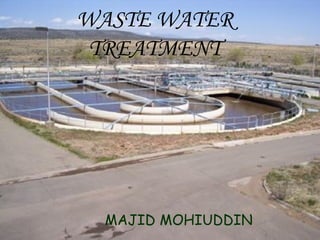
WASTE WATER TREATMENT MAJID MOHIUDDIN
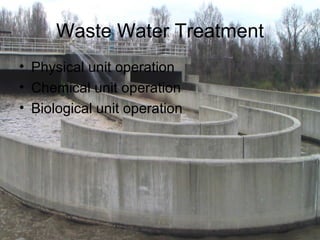
Waste Water Treatment Physical unit operation Chemical unit operation Biological unit operation
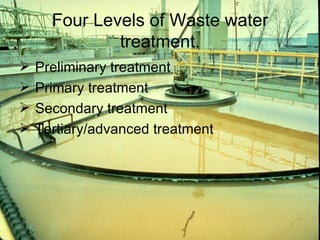
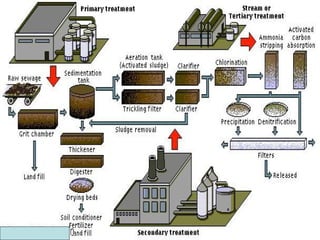
Four Levels of Waste water treatment. Preliminary treatment Primary treatment Secondary treatment Tertiary/advanced treatment
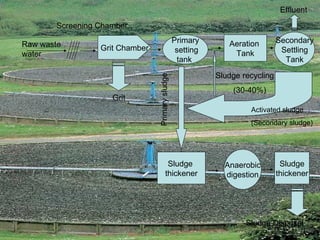
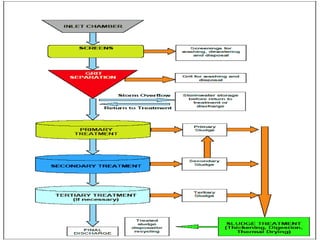
Raw waste water  Screening Chamber Grit Primary setting tank  Aeration  Tank Secondary Settling Tank Effluent Sludge  thickener Anaerobic digestion Sludge thickener Sludge Disposal Primary sludge Sludge recycling (30-40%) Activated sludge (Secondary sludge) Grit Chamber
 
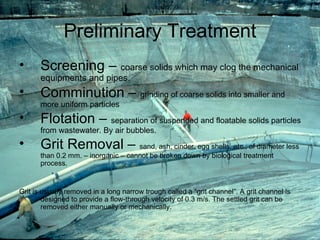
Preliminary Treatment Screening –  coarse solids which may clog the mechanical equipments and pipes. Comminution –  grinding of coarse solids into smaller and more uniform particles Flotation –  separation of suspended and floatable solids particles from wastewater. By air bubbles. Grit Removal –  sand, ash, cinder, egg shells, etc., of diameter less than 0.2 mm. – inorganic – cannot be broken down by biological treatment process.  Grit is usually removed in a long narrow trough called a “grit channel”. A grit channel is designed to provide a flow-through velocity of 0.3 m/s. The settled grit can be removed either manually or mechanically.
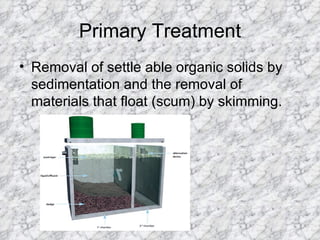
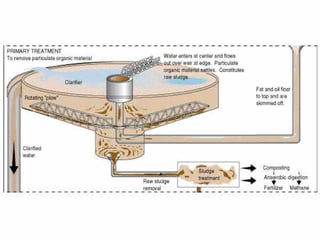
Primary Treatment Removal of settle able organic solids by sedimentation and the removal of materials that float (scum) by skimming.
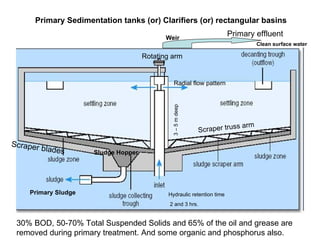
Primary Sedimentation tanks (or) Clarifiers (or) rectangular basins 3 – 5 m deep Hydraulic retention time 2 and 3 hrs. Radial flow pattern Scraper truss arm Rotating arm Scraper blades Sludge Hopper Primary Sludge Clean surface water Weir 30% BOD, 50-70% Total Suspended Solids and 65% of the oil and grease are removed during primary treatment. And some organic and phosphorus also. Primary effluent
 
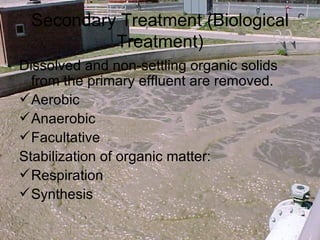
Secondary Treatment (Biological Treatment) Dissolved and non-settling organic solids from the primary effluent are removed. Aerobic Anaerobic Facultative Stabilization of organic matter: Respiration Synthesis
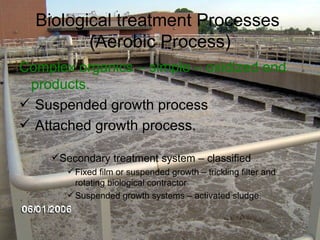
Biological treatment Processes  (Aerobic Process) Complex organics – simple – oxidized end products. Suspended growth process Attached growth process.  Secondary treatment system – classified Fixed film or suspended growth – trickling filter and rotating biological contractor Suspended growth systems – activated sludge.
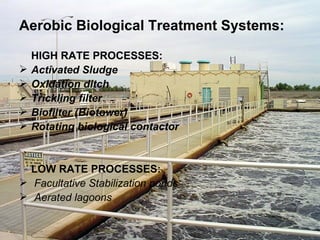
Aerobic Biological Treatment Systems: HIGH RATE PROCESSES: Activated Sludge Oxidation ditch Trickling filter Biofilter (Biotower) Rotating biological contactor LOW RATE PROCESSES: Facultative Stabilization ponds Aerated lagoons
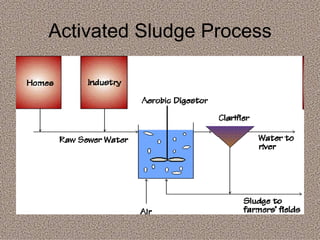
Activated Sludge Process
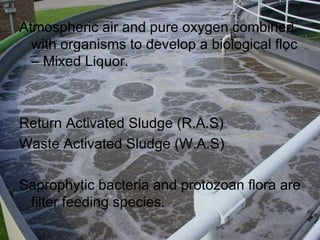
Atmospheric air and pure oxygen combined with organisms to develop a biological floc – Mixed Liquor. Return Activated Sludge (R.A.S) Waste Activated Sludge (W.A.S) Saprophytic bacteria and protozoan flora are filter feeding species.
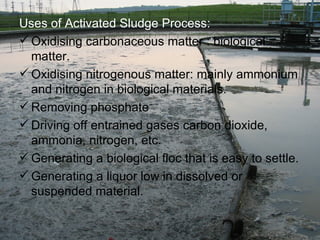
Uses of Activated Sludge Process: Oxidising carbonaceous matter : biological matter. Oxidising nitrogenous matter: mainly ammonium and nitrogen in biological materials. Removing phosphate Driving off entrained gases carbon dioxide, ammonia, nitrogen, etc. Generating a biological floc that is easy to settle. Generating a liquor low in dissolved or suspended material.
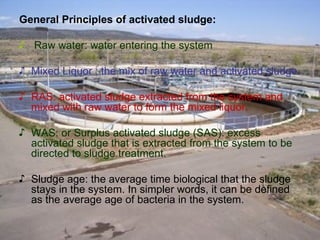
General Principles of activated sludge: Raw water: water entering the system Mixed Liquor : the mix of raw water and activated sludge. RAS: activated sludge extracted from the system and mixed with raw water to form the mixed liquor. WAS: or Surplus activated sludge (SAS): excess activated sludge that is extracted from the system to be directed to sludge treatment. Sludge age: the average time biological that the sludge stays in the system. In simpler words, it can be defined as the average age of bacteria in the system.
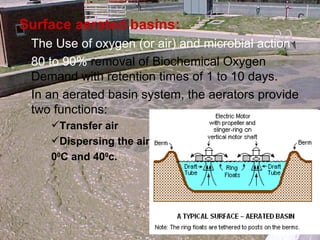
Surface aerated basins: The Use of oxygen (or air) and microbial action 80 to 90%  removal of Biochemical Oxygen Demand with retention times of 1 to 10 days. In an aerated basin system, the aerators provide two functions: Transfer air Dispersing the air 0 0 C and 40 0 c.
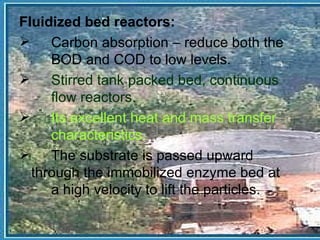
Fluidized bed reactors: Carbon absorption – reduce both the  BOD and COD to low levels. Stirred tank packed bed, continuous  flow reactors. Its excellent heat and mass transfer  characteristics. The substrate is passed upward  through the immobilized enzyme bed at  a high velocity to lift the particles.
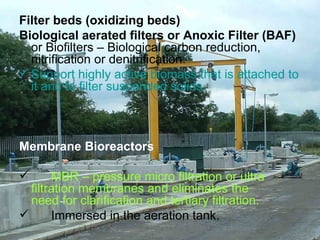
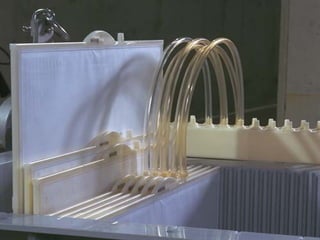
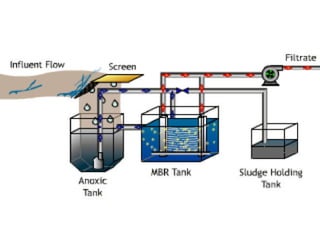
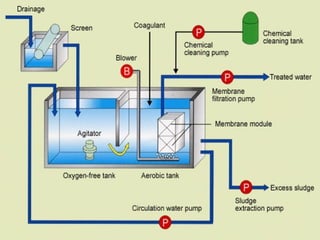
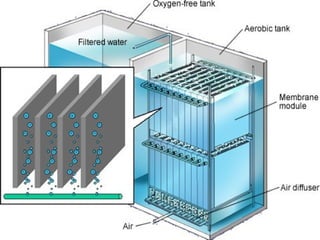
Filter beds (oxidizing beds) Biological aerated filters or Anoxic Filter (BAF)  or Biofilters – Biological carbon reduction, nitrification or denitrification. Support highly active biomass that is attached to it and to filter suspended solids. Membrane Bioreactors MBR – pressure micro filtration or ultra  filtration membranes and eliminates the  need for clarification and tertiary filtration. Immersed in the aeration tank.


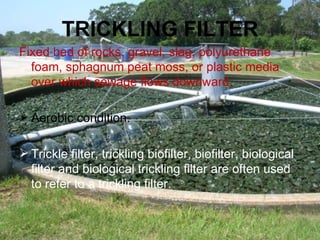
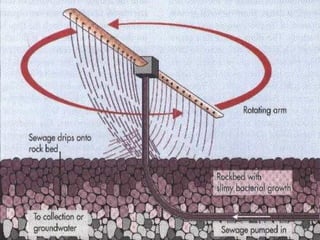
TRICKLING FILTER Fixed bed of rocks, gravel, slag, polyurethane foam, sphagnum peat moss, or plastic media over which sewage flows downward. Aerobic condition. Trickle filter, trickling biofilter, biofilter, biological filter and biological trickling filter are often used to refer to a trickling filter.
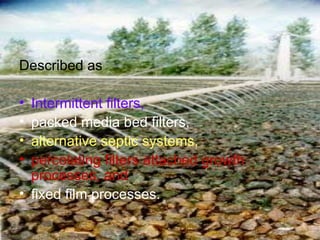
Described as  Intermittent filters, packed media bed filters, alternative septic systems,  percolating filters attached growth processes, and fixed film processes.
 
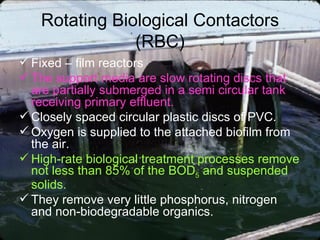
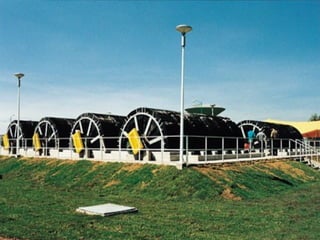
Rotating Biological Contactors (RBC) Fixed – film reactors  The support media are slow rotating discs that are partially submerged in a semi circular tank receiving primary effluent. Closely spaced circular plastic discs of PVC. Oxygen is supplied to the attached biofilm from the air. High-rate biological treatment processes remove not less than 85% of the BOD 5  and suspended solids. They remove very little phosphorus, nitrogen and non-biodegradable organics.
 
 
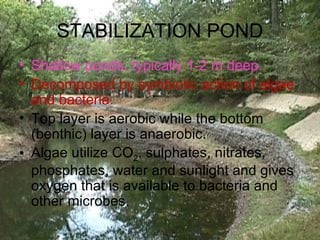
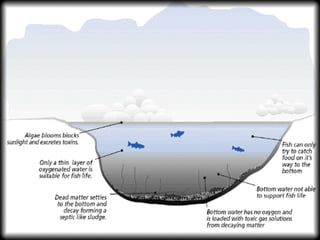
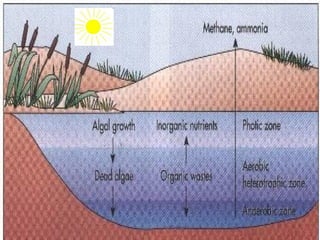
STABILIZATION POND Shallow ponds, typically 1-2 m deep. Decomposed by symbiotic action of algae and bacteria. Top layer is aerobic while the bottom (benthic) layer is anaerobic. Algae utilize CO 2 , sulphates, nitrates, phosphates, water and sunlight and gives oxygen that is available to bacteria and other microbes.
 
 
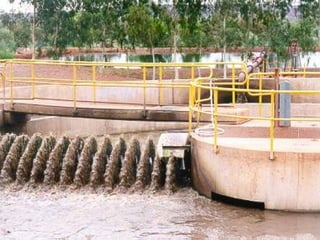
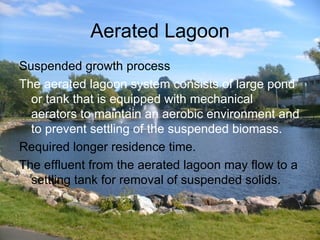
Aerated Lagoon Suspended growth process The aerated lagoon system consists of large pond or tank that is equipped with mechanical aerators to maintain an aerobic environment and to prevent settling of the suspended biomass. Required longer residence time. The effluent from the aerated lagoon may flow to a settling tank for removal of suspended solids.
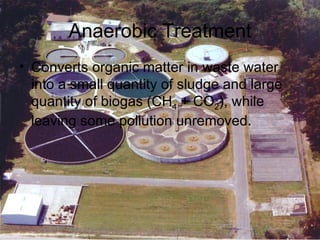
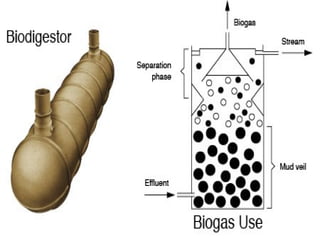
Anaerobic Treatment Converts organic matter in waste water into a small quantity of sludge and large quantity of biogas (CH 4  + CO 2 ), while leaving some pollution unremoved.
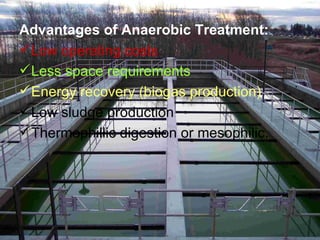
Advantages of Anaerobic Treatment: Low operating costs Less space requirements Energy recovery (biogas production) Low sludge production Thermophillic digestion or mesophilic.


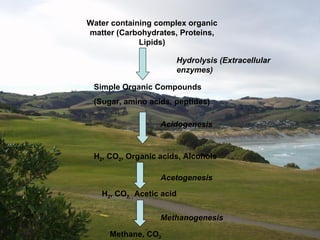
Water containing complex organic matter (Carbohydrates, Proteins, Lipids) Hydrolysis (Extracellular enzymes) Simple Organic Compounds (Sugar, amino acids, peptides) H 2 , CO 2 , Organic acids, Alcohols H 2 , CO 2, ,  Acetic acid Methane, CO 2 Methanogenesis Acetogenesis Acidogenesis
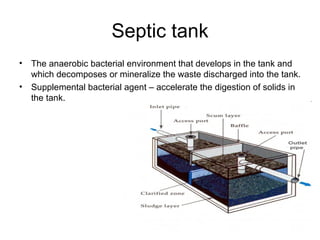
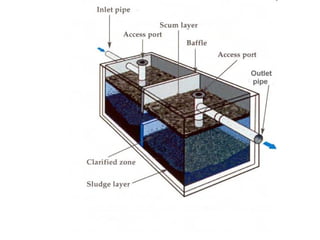
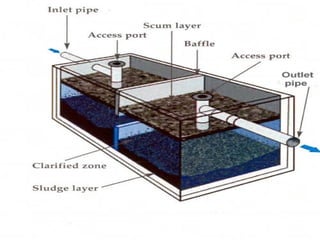
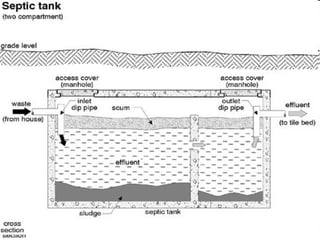
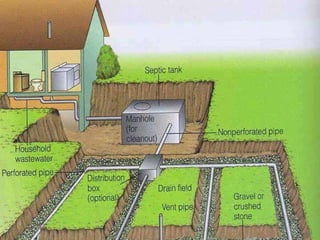
Septic tank The anaerobic bacterial environment that develops in the tank and which decomposes or mineralize the waste discharged into the tank. Supplemental bacterial agent – accelerate the digestion of solids in the tank.


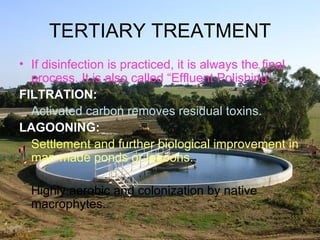
TERTIARY TREATMENT If disinfection is practiced, it is always the final process. It is also called “Effluent Polishing”. FILTRATION: Activated carbon removes residual toxins. LAGOONING: Settlement and further biological improvement in man-made ponds or lagoons. Highly aerobic and colonization by native macrophytes.
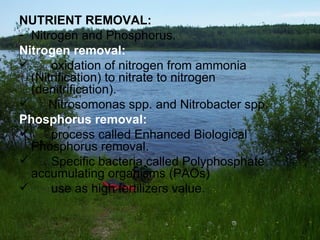
NUTRIENT REMOVAL: Nitrogen and Phosphorus. Nitrogen removal: oxidation of nitrogen from ammonia  (Nitrification) to nitrate to nitrogen  (denitrification). Nitrosomonas spp. and Nitrobacter spp. Phosphorus removal: process called Enhanced Biological  Phosphorus removal. Specific bacteria called Polyphosphate  accumulating organisms (PAOs) use as high fertilizers value.
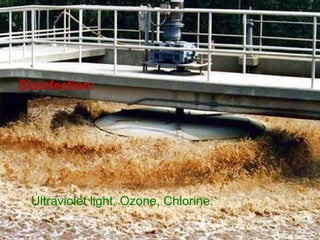
Disinfection: Ultraviolet light, Ozone, Chlorine.
 
Thank you MAJID MOHIUDDIN

Waste Water Treatment

  • 1.
    WASTE WATER TREATMENTMAJID MOHIUDDIN
  • 2.
    Waste Water TreatmentPhysical unit operation Chemical unit operation Biological unit operation
  • 3.
    Four Levels ofWaste water treatment. Preliminary treatment Primary treatment Secondary treatment Tertiary/advanced treatment
  • 4.
    Raw waste water Screening Chamber Grit Primary setting tank Aeration Tank Secondary Settling Tank Effluent Sludge thickener Anaerobic digestion Sludge thickener Sludge Disposal Primary sludge Sludge recycling (30-40%) Activated sludge (Secondary sludge) Grit Chamber
  • 5.
  • 6.
    Preliminary Treatment Screening– coarse solids which may clog the mechanical equipments and pipes. Comminution – grinding of coarse solids into smaller and more uniform particles Flotation – separation of suspended and floatable solids particles from wastewater. By air bubbles. Grit Removal – sand, ash, cinder, egg shells, etc., of diameter less than 0.2 mm. – inorganic – cannot be broken down by biological treatment process. Grit is usually removed in a long narrow trough called a “grit channel”. A grit channel is designed to provide a flow-through velocity of 0.3 m/s. The settled grit can be removed either manually or mechanically.
  • 7.
    Primary Treatment Removalof settle able organic solids by sedimentation and the removal of materials that float (scum) by skimming.
  • 8.
    Primary Sedimentation tanks(or) Clarifiers (or) rectangular basins 3 – 5 m deep Hydraulic retention time 2 and 3 hrs. Radial flow pattern Scraper truss arm Rotating arm Scraper blades Sludge Hopper Primary Sludge Clean surface water Weir 30% BOD, 50-70% Total Suspended Solids and 65% of the oil and grease are removed during primary treatment. And some organic and phosphorus also. Primary effluent
  • 9.
  • 10.
    Secondary Treatment (BiologicalTreatment) Dissolved and non-settling organic solids from the primary effluent are removed. Aerobic Anaerobic Facultative Stabilization of organic matter: Respiration Synthesis
  • 11.
    Biological treatment Processes (Aerobic Process) Complex organics – simple – oxidized end products. Suspended growth process Attached growth process. Secondary treatment system – classified Fixed film or suspended growth – trickling filter and rotating biological contractor Suspended growth systems – activated sludge.
  • 12.
    Aerobic Biological TreatmentSystems: HIGH RATE PROCESSES: Activated Sludge Oxidation ditch Trickling filter Biofilter (Biotower) Rotating biological contactor LOW RATE PROCESSES: Facultative Stabilization ponds Aerated lagoons
  • 13.
  • 14.
    Atmospheric air andpure oxygen combined with organisms to develop a biological floc – Mixed Liquor. Return Activated Sludge (R.A.S) Waste Activated Sludge (W.A.S) Saprophytic bacteria and protozoan flora are filter feeding species.
  • 15.
    Uses of ActivatedSludge Process: Oxidising carbonaceous matter : biological matter. Oxidising nitrogenous matter: mainly ammonium and nitrogen in biological materials. Removing phosphate Driving off entrained gases carbon dioxide, ammonia, nitrogen, etc. Generating a biological floc that is easy to settle. Generating a liquor low in dissolved or suspended material.
  • 16.
    General Principles ofactivated sludge: Raw water: water entering the system Mixed Liquor : the mix of raw water and activated sludge. RAS: activated sludge extracted from the system and mixed with raw water to form the mixed liquor. WAS: or Surplus activated sludge (SAS): excess activated sludge that is extracted from the system to be directed to sludge treatment. Sludge age: the average time biological that the sludge stays in the system. In simpler words, it can be defined as the average age of bacteria in the system.
  • 17.
    Surface aerated basins:The Use of oxygen (or air) and microbial action 80 to 90% removal of Biochemical Oxygen Demand with retention times of 1 to 10 days. In an aerated basin system, the aerators provide two functions: Transfer air Dispersing the air 0 0 C and 40 0 c.
  • 18.
    Fluidized bed reactors:Carbon absorption – reduce both the BOD and COD to low levels. Stirred tank packed bed, continuous flow reactors. Its excellent heat and mass transfer characteristics. The substrate is passed upward through the immobilized enzyme bed at a high velocity to lift the particles.
  • 19.
    Filter beds (oxidizingbeds) Biological aerated filters or Anoxic Filter (BAF) or Biofilters – Biological carbon reduction, nitrification or denitrification. Support highly active biomass that is attached to it and to filter suspended solids. Membrane Bioreactors MBR – pressure micro filtration or ultra filtration membranes and eliminates the need for clarification and tertiary filtration. Immersed in the aeration tank.
  • 20.
  • 21.
  • 22.
  • 23.
  • 24.
  • 25.
    TRICKLING FILTER Fixedbed of rocks, gravel, slag, polyurethane foam, sphagnum peat moss, or plastic media over which sewage flows downward. Aerobic condition. Trickle filter, trickling biofilter, biofilter, biological filter and biological trickling filter are often used to refer to a trickling filter.
  • 26.
    Described as Intermittent filters, packed media bed filters, alternative septic systems, percolating filters attached growth processes, and fixed film processes.
  • 27.
  • 28.
    Rotating Biological Contactors(RBC) Fixed – film reactors The support media are slow rotating discs that are partially submerged in a semi circular tank receiving primary effluent. Closely spaced circular plastic discs of PVC. Oxygen is supplied to the attached biofilm from the air. High-rate biological treatment processes remove not less than 85% of the BOD 5 and suspended solids. They remove very little phosphorus, nitrogen and non-biodegradable organics.
  • 29.
  • 30.
  • 31.
    STABILIZATION POND Shallowponds, typically 1-2 m deep. Decomposed by symbiotic action of algae and bacteria. Top layer is aerobic while the bottom (benthic) layer is anaerobic. Algae utilize CO 2 , sulphates, nitrates, phosphates, water and sunlight and gives oxygen that is available to bacteria and other microbes.
  • 32.
  • 33.
  • 34.
    Aerated Lagoon Suspendedgrowth process The aerated lagoon system consists of large pond or tank that is equipped with mechanical aerators to maintain an aerobic environment and to prevent settling of the suspended biomass. Required longer residence time. The effluent from the aerated lagoon may flow to a settling tank for removal of suspended solids.
  • 35.
    Anaerobic Treatment Convertsorganic matter in waste water into a small quantity of sludge and large quantity of biogas (CH 4 + CO 2 ), while leaving some pollution unremoved.
  • 36.
    Advantages of AnaerobicTreatment: Low operating costs Less space requirements Energy recovery (biogas production) Low sludge production Thermophillic digestion or mesophilic.
  • 37.
  • 38.
  • 39.
  • 40.
    Water containing complexorganic matter (Carbohydrates, Proteins, Lipids) Hydrolysis (Extracellular enzymes) Simple Organic Compounds (Sugar, amino acids, peptides) H 2 , CO 2 , Organic acids, Alcohols H 2 , CO 2, , Acetic acid Methane, CO 2 Methanogenesis Acetogenesis Acidogenesis
  • 41.
    Septic tank Theanaerobic bacterial environment that develops in the tank and which decomposes or mineralize the waste discharged into the tank. Supplemental bacterial agent – accelerate the digestion of solids in the tank.
  • 42.
  • 43.
  • 44.
  • 45.
  • 46.
    TERTIARY TREATMENT Ifdisinfection is practiced, it is always the final process. It is also called “Effluent Polishing”. FILTRATION: Activated carbon removes residual toxins. LAGOONING: Settlement and further biological improvement in man-made ponds or lagoons. Highly aerobic and colonization by native macrophytes.
  • 47.
    NUTRIENT REMOVAL: Nitrogenand Phosphorus. Nitrogen removal: oxidation of nitrogen from ammonia (Nitrification) to nitrate to nitrogen (denitrification). Nitrosomonas spp. and Nitrobacter spp. Phosphorus removal: process called Enhanced Biological Phosphorus removal. Specific bacteria called Polyphosphate accumulating organisms (PAOs) use as high fertilizers value.
  • 48.
  • 49.
  • 50.
    Thank you MAJIDMOHIUDDIN