Anaerobic Digester
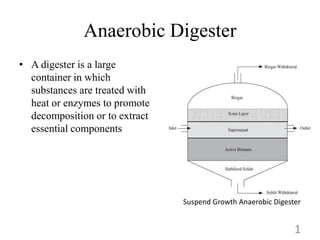
Suspend Growth Anaerobic Digester
• A digester is a large
container in which
substances are treated with
heat or enzymes to promote
decomposition or to extract
essential components
1
Anaerobic Digestion
• Anaerobic digestion is a naturally occurring process
of decomposition and decay
• Here, the organic matter is broken down to simpler
chemical compounds under anaerobic conditions
• Anaerobic digestions is
– Digestion of Organic Material
– In absence of Oxygen
– Forming end products of Methane and Carbon dioxide
2
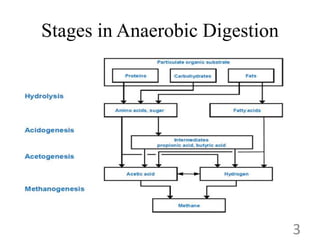
Stages in Anaerobic Digestion
3
Hydrolysis
• Large Organic Compounds are converted into simple
monomeric compounds
• It is accomplished through extracellular enzymes
• Example:
– Cellulose gets converted to starch using cellulases
– Casein gets converted to amino acids using Proteases
– Triglyceride gets converted to fatty acids using lipases
4
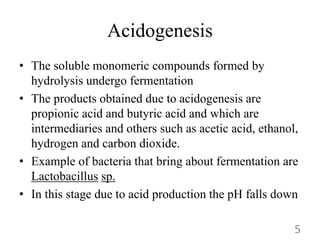
Acidogenesis
• The soluble monomeric compounds formed by
hydrolysis undergo fermentation
• The products obtained due to acidogenesis are
propionic acid and butyric acid and which are
intermediaries and others such as acetic acid, ethanol,
hydrogen and carbon dioxide.
• Example of bacteria that bring about fermentation are
Lactobacillus sp.
• In this stage due to acid production the pH falls down
5
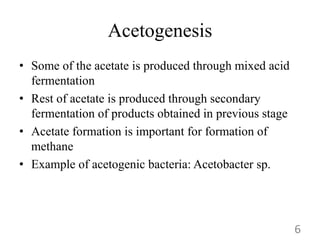
Acetogenesis
• Some of the acetate is produced through mixed acid
fermentation
• Rest of acetate is produced through secondary
fermentation of products obtained in previous stage
• Acetate formation is important for formation of
methane
• Example of acetogenic bacteria: Acetobacter sp.
6
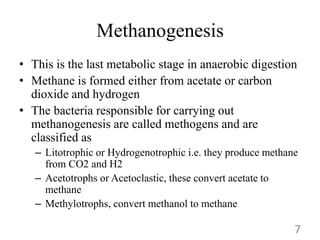
Methanogenesis
• This is the last metabolic stage in anaerobic digestion
• Methane is formed either from acetate or carbon
dioxide and hydrogen
• The bacteria responsible for carrying out
methanogenesis are called methogens and are
classified as
– Litotrophic or Hydrogenotrophic i.e. they produce methane
from CO2 and H2
– Acetotrophs or Acetoclastic, these convert acetate to
methane
– Methylotrophs, convert methanol to methane
7
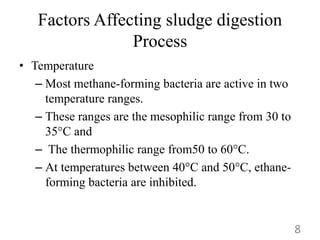
Factors Affecting sludge digestion
Process
• Temperature
– Most methane-forming bacteria are active in two
temperature ranges.
– These ranges are the mesophilic range from 30 to
35°C and
– The thermophilic range from50 to 60°C.
– At temperatures between 40°C and 50°C, ethane-
forming bacteria are inhibited.
8
Factors Affecting sludge digestion
Process
• pH value
– When the digester pH is 7.2 or lower, the presence of NH4
+
is favoured.
– When the digester pH is greater than 7.2, the presence of
NH3 is favoured.
– Dissolved ammonia gas or NH3is toxic to bacteria,
especially methane forming bacteria.
9
Factors Affecting sludge digestion
Process
• Nutrients
– Macronutrients
• The two main macronutrients are nitrogen and phosphorous
– Micronutrients
• Methane-forming bacteria possess several unique enzyme systems
• The need for several micronutrients, especially cobalt, iron, nickel,
and sulfide, is critical
10
Factors Affecting sludge digestion
Process
• Mixing
– Mixing enhances the digestion process by distributing
bacteria, substrate, and nutrients throughout the digester as
well as equalizing temperature.
– Methane-forming bacteria are very sensitive to rapid
mixing. If rapid mixing continuously washes out methane-
forming bacteria in the effluent
11
Factors Affecting sludge digestion
Process
• Seeding
– To seed an anaerobic digester with an adequate population
of facultative anaerobes and anaerobes including methane-
forming bacteria, a ratio of 1 :10 of secondary sludge to
primary sludge may be used
– Without seeding it may take a few months to get the tank
operational
– Proper seeding will help attain quick balance of reactions
12
Advantages of Anaerobic Digestors
• It produces methane and carbon dioxide which can be
collected and used as fuel
• Reduces the volatile content of sludge
• Liquid is more easily dewatered as liquid and solids
form separate layers
• Reduction in number of pathogens
13
Disadvantages
• Needs constant supervision
• Formation of explosive gases
• Not easily controllable
• Maintenance and cleaning is difficult
• It is a slow process
14

Anaerobic Digester

  • 1.
    Anaerobic Digester Suspend GrowthAnaerobic Digester • A digester is a large container in which substances are treated with heat or enzymes to promote decomposition or to extract essential components 1
  • 2.
    Anaerobic Digestion • Anaerobicdigestion is a naturally occurring process of decomposition and decay • Here, the organic matter is broken down to simpler chemical compounds under anaerobic conditions • Anaerobic digestions is – Digestion of Organic Material – In absence of Oxygen – Forming end products of Methane and Carbon dioxide 2
  • 3.
  • 4.
    Hydrolysis • Large OrganicCompounds are converted into simple monomeric compounds • It is accomplished through extracellular enzymes • Example: – Cellulose gets converted to starch using cellulases – Casein gets converted to amino acids using Proteases – Triglyceride gets converted to fatty acids using lipases 4
  • 5.
    Acidogenesis • The solublemonomeric compounds formed by hydrolysis undergo fermentation • The products obtained due to acidogenesis are propionic acid and butyric acid and which are intermediaries and others such as acetic acid, ethanol, hydrogen and carbon dioxide. • Example of bacteria that bring about fermentation are Lactobacillus sp. • In this stage due to acid production the pH falls down 5
  • 6.
    Acetogenesis • Some ofthe acetate is produced through mixed acid fermentation • Rest of acetate is produced through secondary fermentation of products obtained in previous stage • Acetate formation is important for formation of methane • Example of acetogenic bacteria: Acetobacter sp. 6
  • 7.
    Methanogenesis • This isthe last metabolic stage in anaerobic digestion • Methane is formed either from acetate or carbon dioxide and hydrogen • The bacteria responsible for carrying out methanogenesis are called methogens and are classified as – Litotrophic or Hydrogenotrophic i.e. they produce methane from CO2 and H2 – Acetotrophs or Acetoclastic, these convert acetate to methane – Methylotrophs, convert methanol to methane 7
  • 8.
    Factors Affecting sludgedigestion Process • Temperature – Most methane-forming bacteria are active in two temperature ranges. – These ranges are the mesophilic range from 30 to 35°C and – The thermophilic range from50 to 60°C. – At temperatures between 40°C and 50°C, ethane- forming bacteria are inhibited. 8
  • 9.
    Factors Affecting sludgedigestion Process • pH value – When the digester pH is 7.2 or lower, the presence of NH4 + is favoured. – When the digester pH is greater than 7.2, the presence of NH3 is favoured. – Dissolved ammonia gas or NH3is toxic to bacteria, especially methane forming bacteria. 9
  • 10.
    Factors Affecting sludgedigestion Process • Nutrients – Macronutrients • The two main macronutrients are nitrogen and phosphorous – Micronutrients • Methane-forming bacteria possess several unique enzyme systems • The need for several micronutrients, especially cobalt, iron, nickel, and sulfide, is critical 10
  • 11.
    Factors Affecting sludgedigestion Process • Mixing – Mixing enhances the digestion process by distributing bacteria, substrate, and nutrients throughout the digester as well as equalizing temperature. – Methane-forming bacteria are very sensitive to rapid mixing. If rapid mixing continuously washes out methane- forming bacteria in the effluent 11
  • 12.
    Factors Affecting sludgedigestion Process • Seeding – To seed an anaerobic digester with an adequate population of facultative anaerobes and anaerobes including methane- forming bacteria, a ratio of 1 :10 of secondary sludge to primary sludge may be used – Without seeding it may take a few months to get the tank operational – Proper seeding will help attain quick balance of reactions 12
  • 13.
    Advantages of AnaerobicDigestors • It produces methane and carbon dioxide which can be collected and used as fuel • Reduces the volatile content of sludge • Liquid is more easily dewatered as liquid and solids form separate layers • Reduction in number of pathogens 13
  • 14.
    Disadvantages • Needs constantsupervision • Formation of explosive gases • Not easily controllable • Maintenance and cleaning is difficult • It is a slow process 14