BIOFILTRATION FOR CONTROL OF
AIR POLLUTION
Given by-Ashish kumar yadav
M.Tech 1st year
Roll No. 3140912
Department of Civil Engineering
NIT Kurukhshetra
Biofiltration
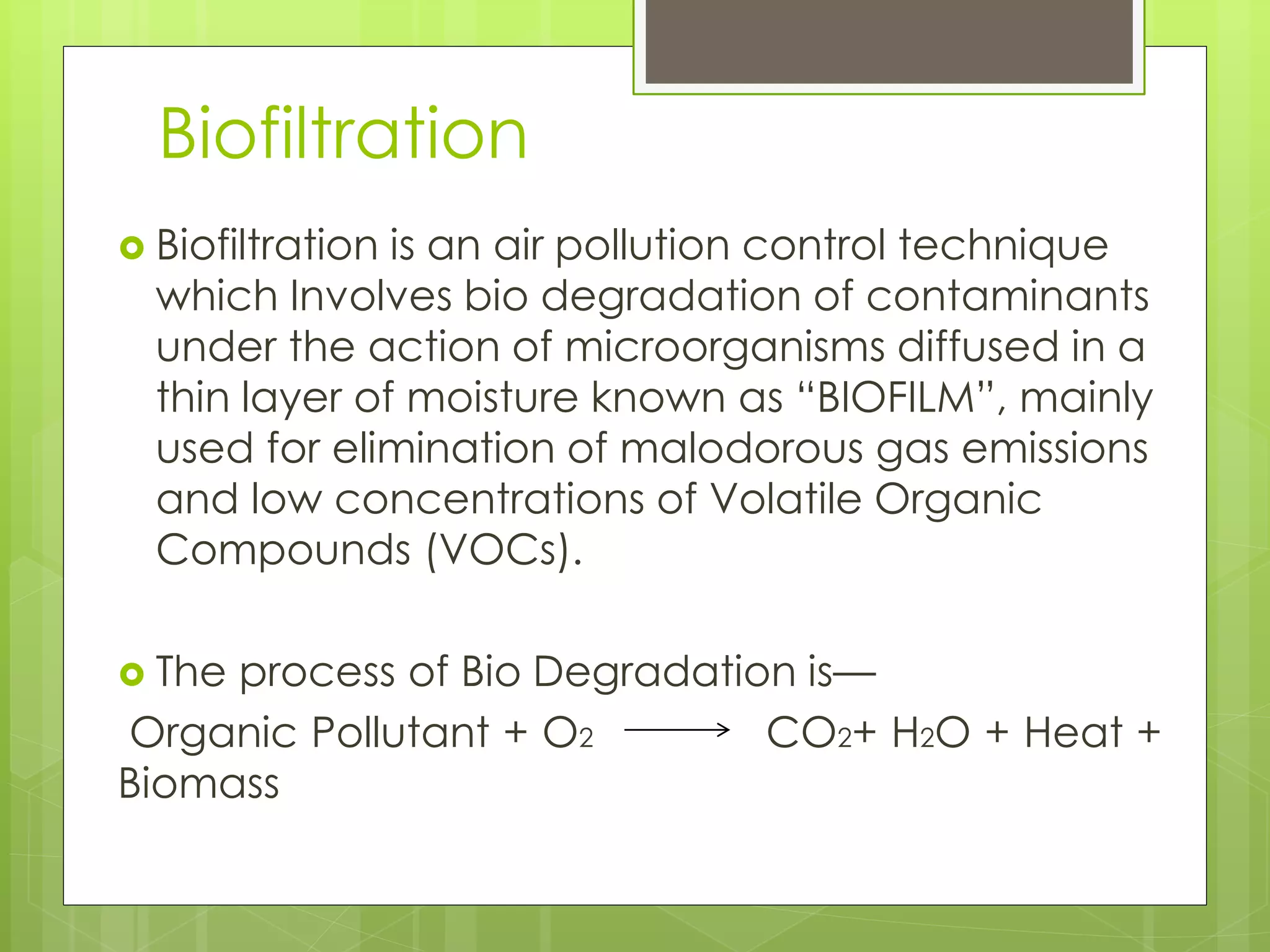
 Biofiltration is an air pollution control technique
which Involves bio degradation of contaminants
under the action of microorganisms diffused in a
thin layer of moisture known as “BIOFILM”, mainly
used for elimination of malodorous gas emissions
and low concentrations of Volatile Organic
Compounds (VOCs).
 The process of Bio Degradation is—
Organic Pollutant + O2 CO2+ H2O + Heat +
Biomass
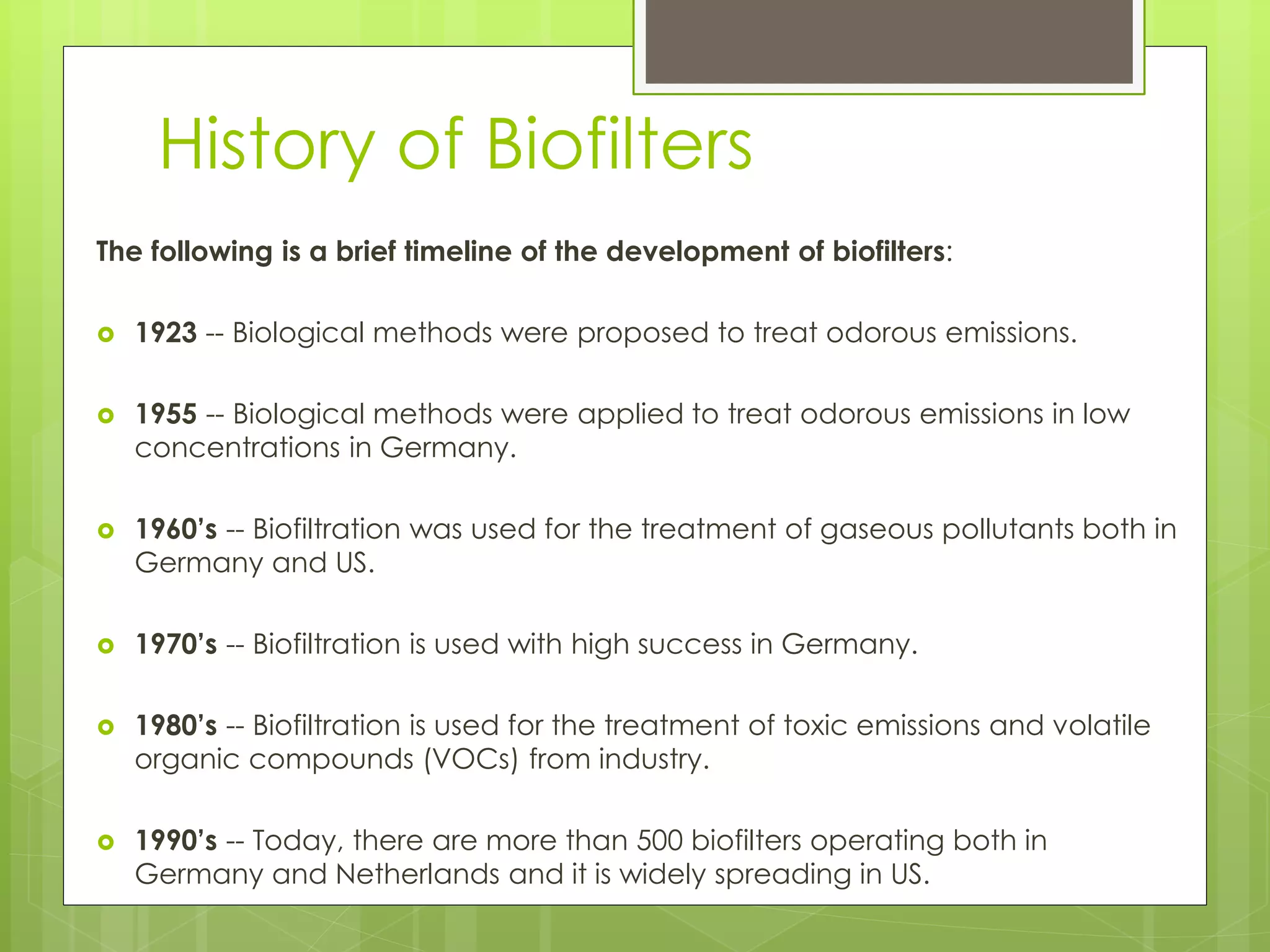
History of Biofilters
The following is a brief timeline of the development of biofilters:
 1923 -- Biological methods were proposed to treat odorous emissions.
 1955 -- Biological methods were applied to treat odorous emissions in low
concentrations in Germany.
 1960’s -- Biofiltration was used for the treatment of gaseous pollutants both in
Germany and US.
 1970’s -- Biofiltration is used with high success in Germany.
 1980’s -- Biofiltration is used for the treatment of toxic emissions and volatile
organic compounds (VOCs) from industry.
 1990’s -- Today, there are more than 500 biofilters operating both in
Germany and Netherlands and it is widely spreading in US.
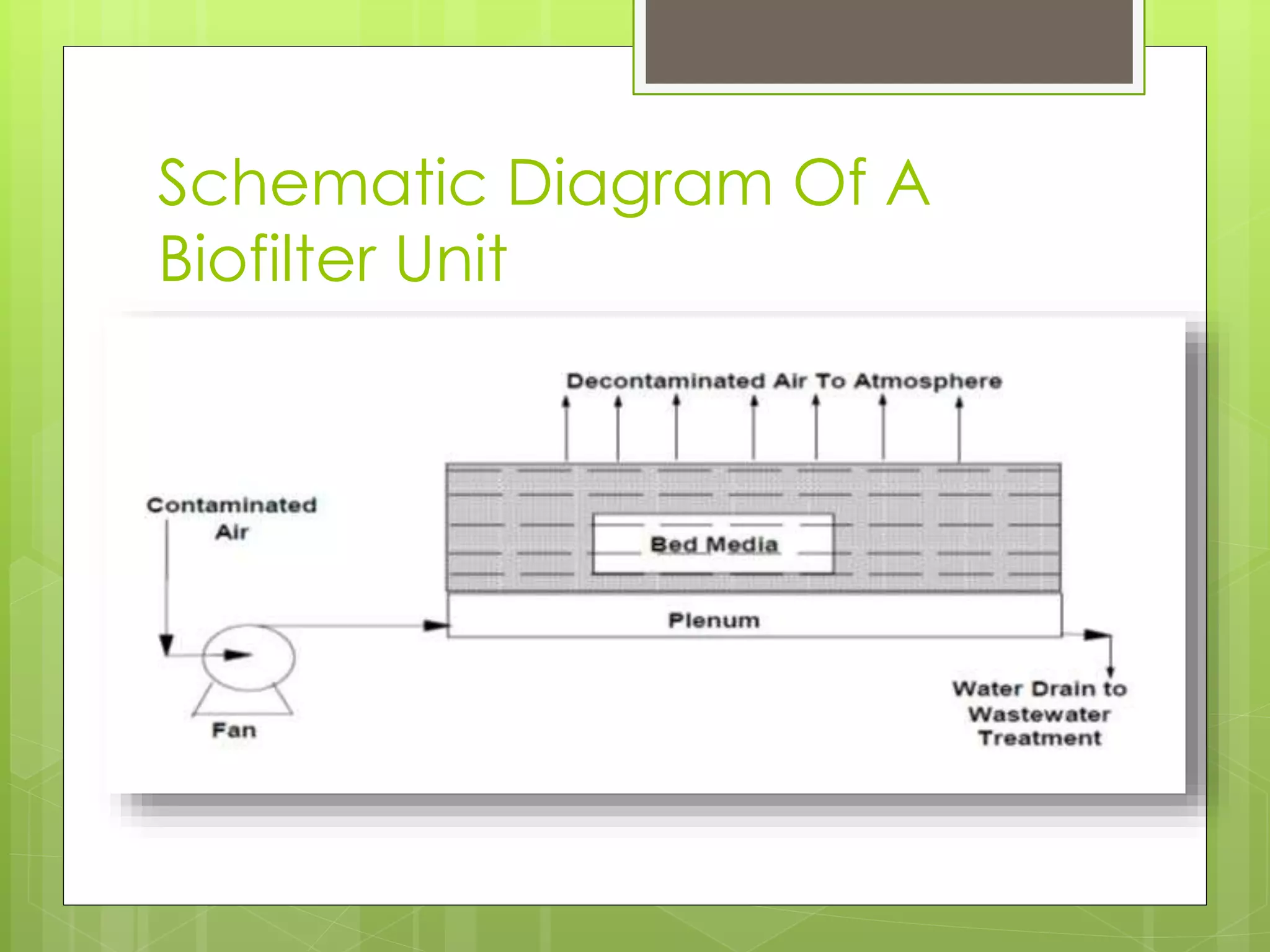
Components Of A Bio-filter Unit
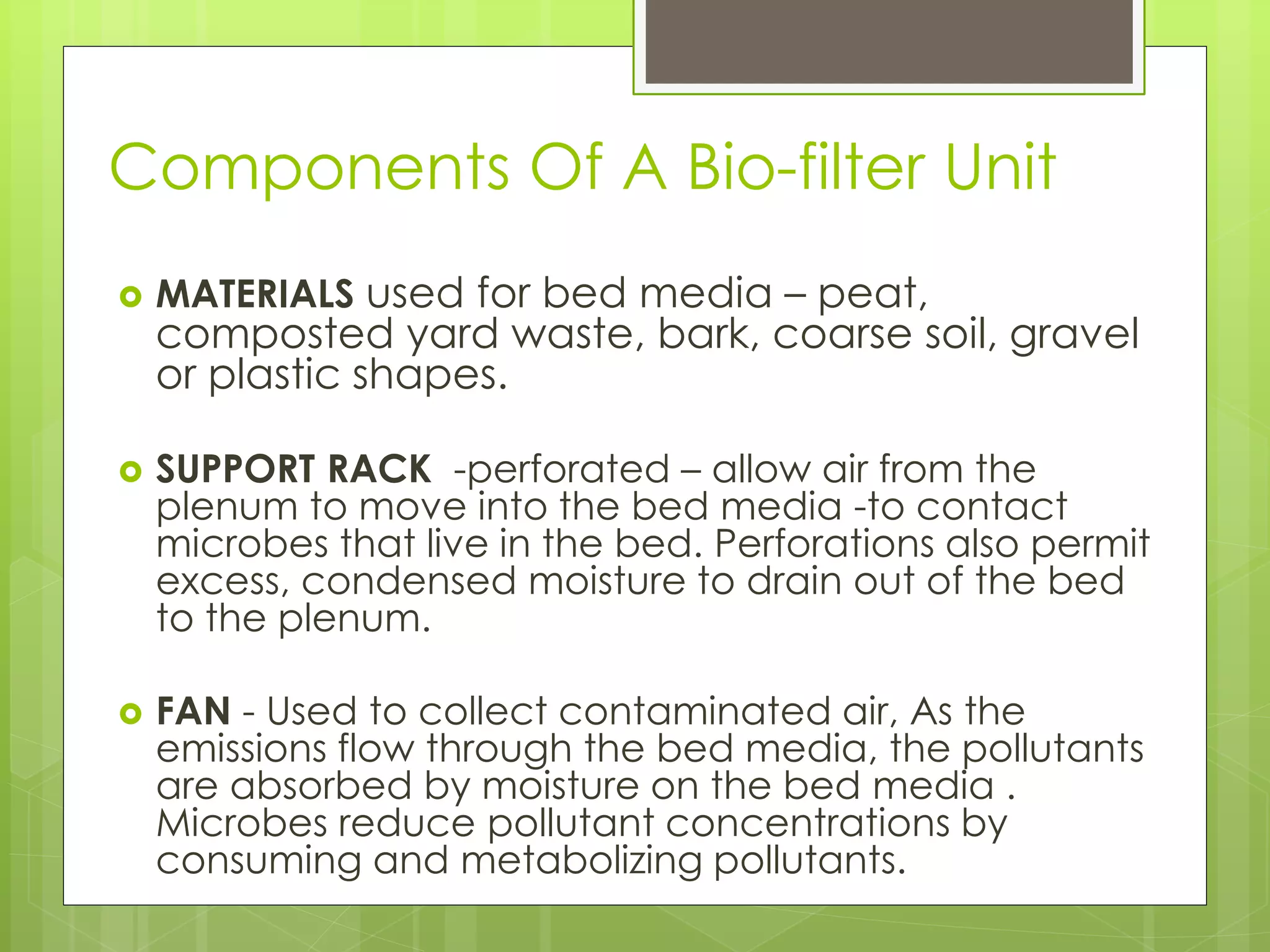
 MATERIALS used for bed media – peat,
composted yard waste, bark, coarse soil, gravel
or plastic shapes.
 SUPPORT RACK -perforated – allow air from the
plenum to move into the bed media -to contact
microbes that live in the bed. Perforations also permit
excess, condensed moisture to drain out of the bed
to the plenum.
 FAN - Used to collect contaminated air, As the
emissions flow through the bed media, the pollutants
are absorbed by moisture on the bed media .
Microbes reduce pollutant concentrations by
consuming and metabolizing pollutants.
Schematic Diagram Of A
Biofilter Unit
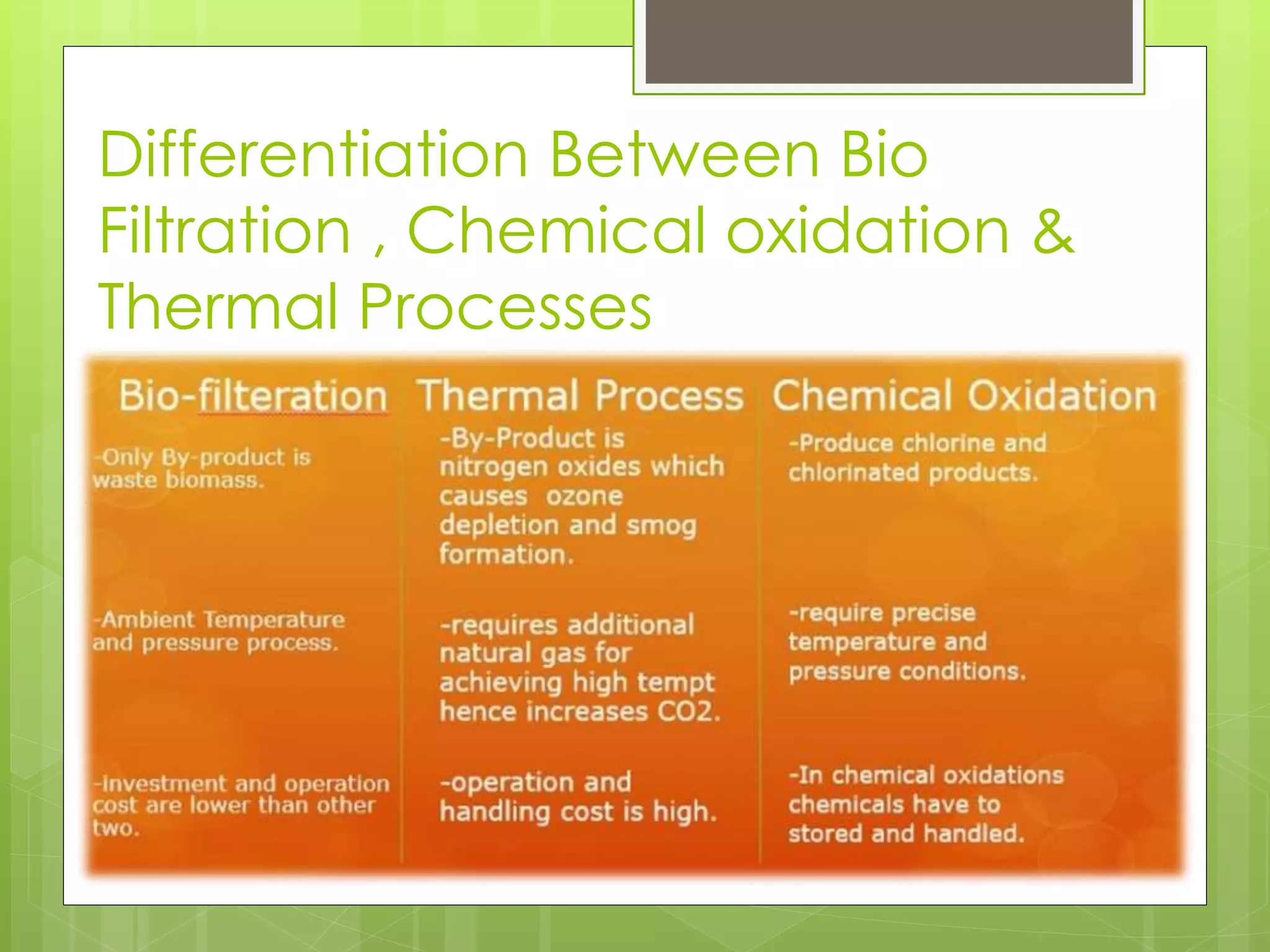
Differentiation Between Bio
Filtration , Chemical oxidation &
Thermal Processes
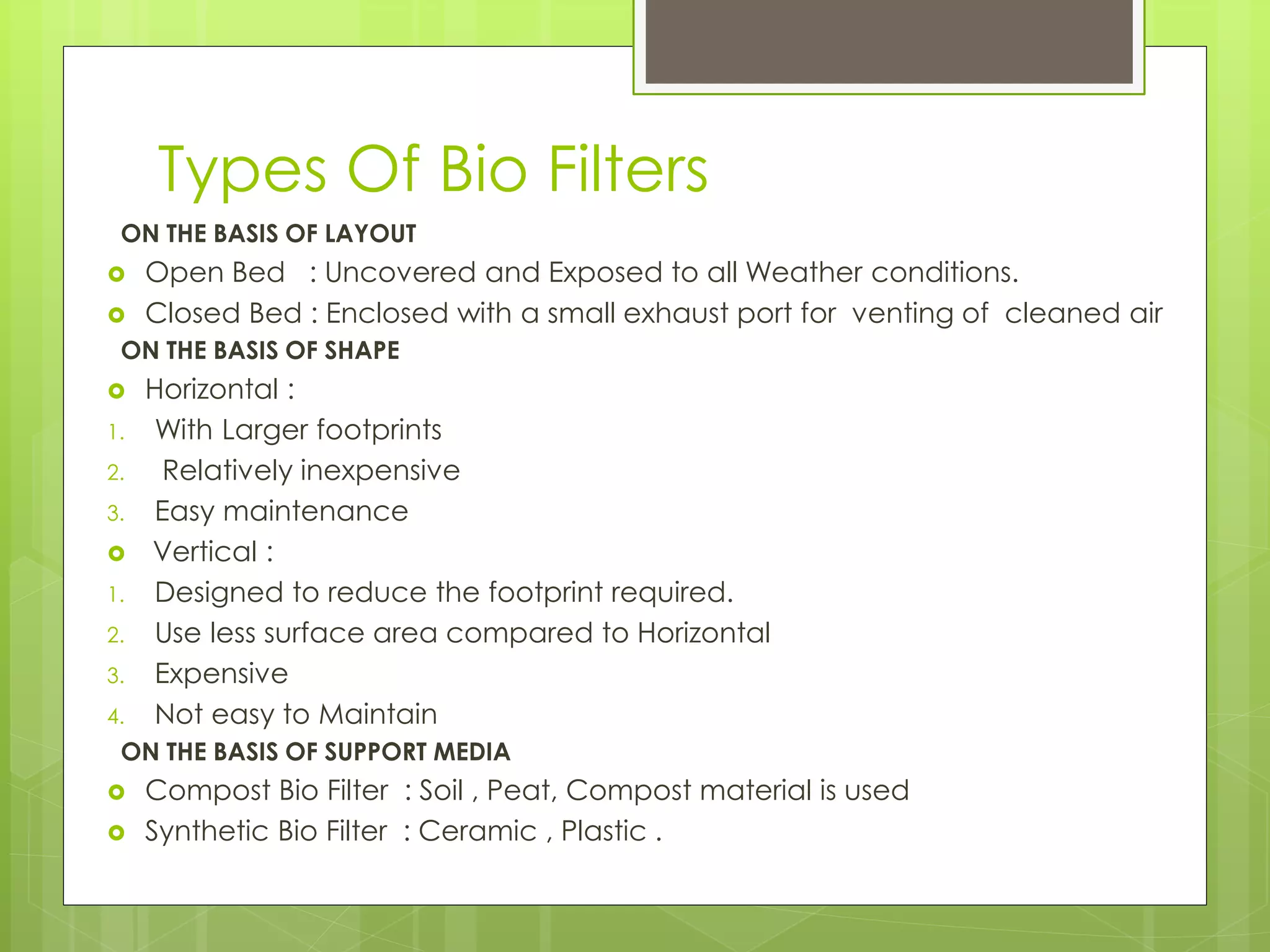
Types Of Bio Filters
ON THE BASIS OF LAYOUT
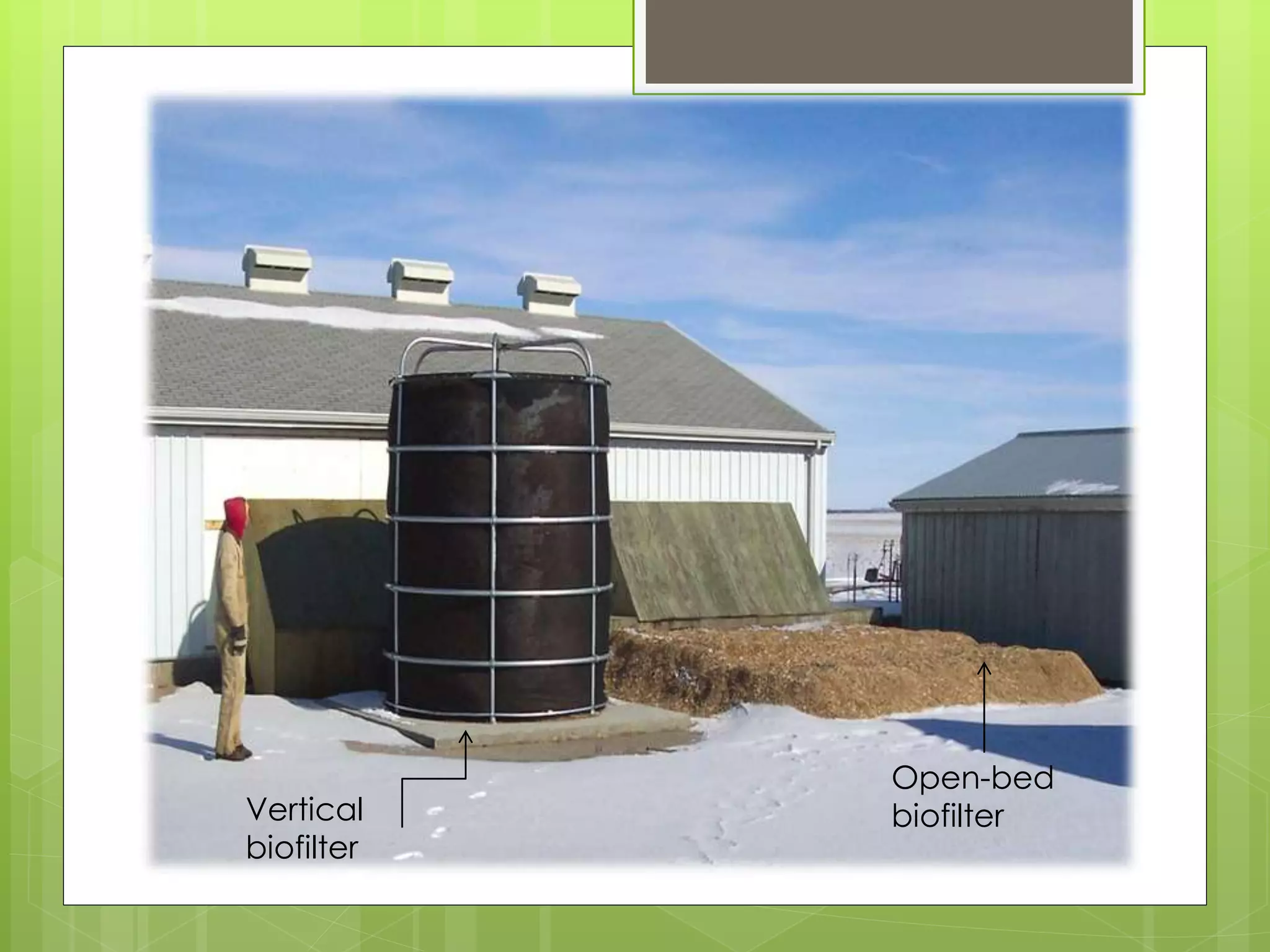
 Open Bed : Uncovered and Exposed to all Weather conditions.
 Closed Bed : Enclosed with a small exhaust port for venting of cleaned air
ON THE BASIS OF SHAPE
 Horizontal :
1. With Larger footprints
2. Relatively inexpensive
3. Easy maintenance
 Vertical :
1. Designed to reduce the footprint required.
2. Use less surface area compared to Horizontal
3. Expensive
4. Not easy to Maintain
ON THE BASIS OF SUPPORT MEDIA
 Compost Bio Filter : Soil , Peat, Compost material is used
 Synthetic Bio Filter : Ceramic , Plastic .
Vertical
biofilter
Open-bed
biofilter
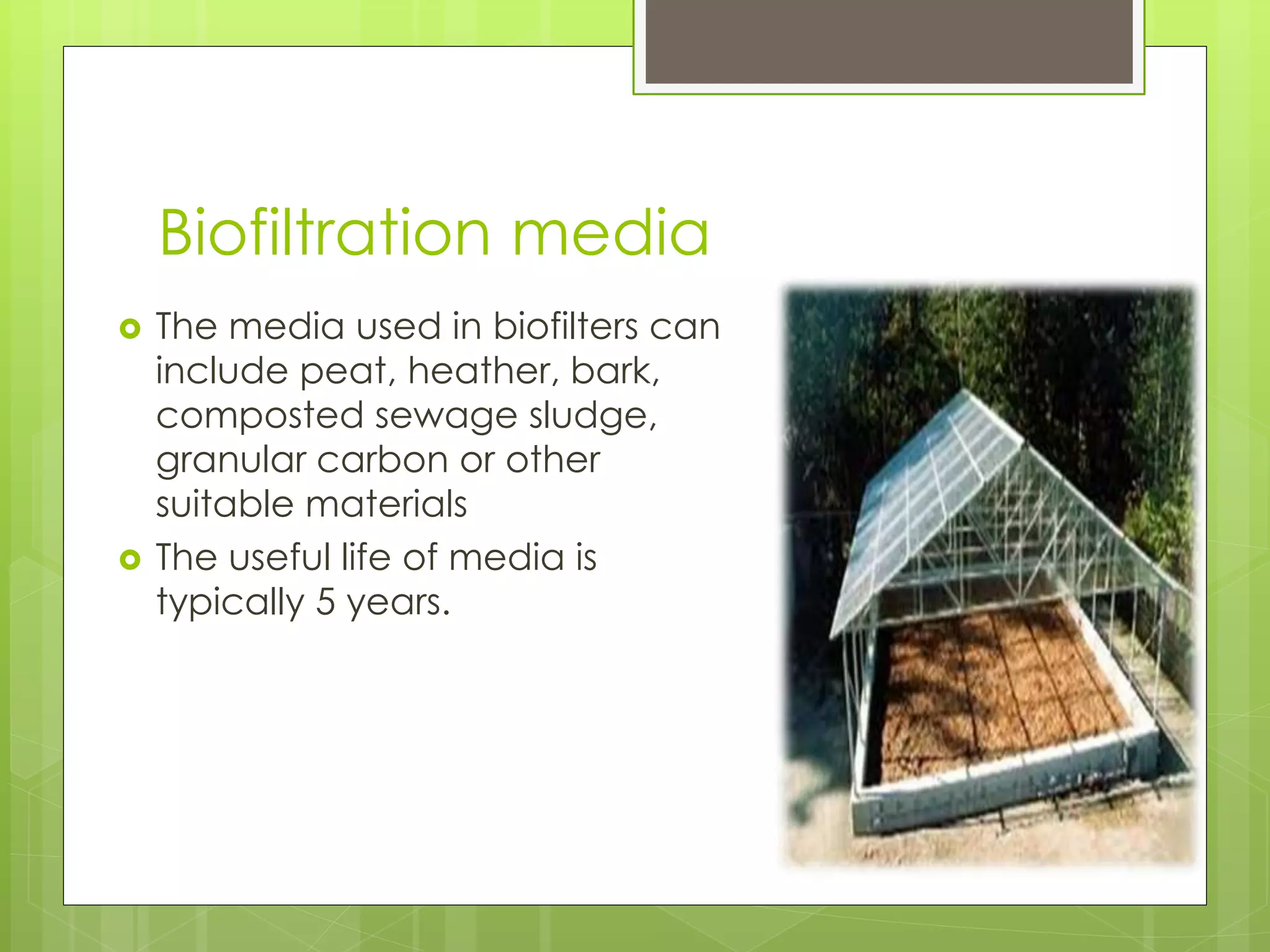
Biofiltration media
 The media used in biofilters can
include peat, heather, bark,
composted sewage sludge,
granular carbon or other
suitable materials
 The useful life of media is
typically 5 years.
Parameters that need to be
maintained
 Moisture Content –
Microorganisms need a moist environment.
Media has a tendency to dry out because of the air flow.
Optimum 20 -60%.
 Temperature – Microorganisms operate best between
30 °C and 40°C.
 Oxygen Level -Most of degradations are aerobic.
Oxygen is not used directly in the gas form but the
microorganisms use the oxygen present in dissolved
form in the media.
 pH –For better results must maintain a pH where the
microorganism are the most efficient.
 Nutrient Supply: For aerobic microorganisms, the O:N:P
ratio is estimated as 100:5:1.These are typically nitrogen,
phosphorous, and some trace metals.
Microorganisms
 Fungi, Bacteria, and Actinomycetes.
 Start up of a biofilter process requires some acclimation
time for the microorganisms to grow specific to the
compounds in the gaseous stream
 For easily degradable substances, this acclimation
period is typically around 10 days
 The biomass has been shown to be able to be viable for
shut downs of approximately 2 weeks.
 If inorganic nutrient and oxygen supplies are continued,
the biomass may be maintained for up to 2 months.
Mechanism
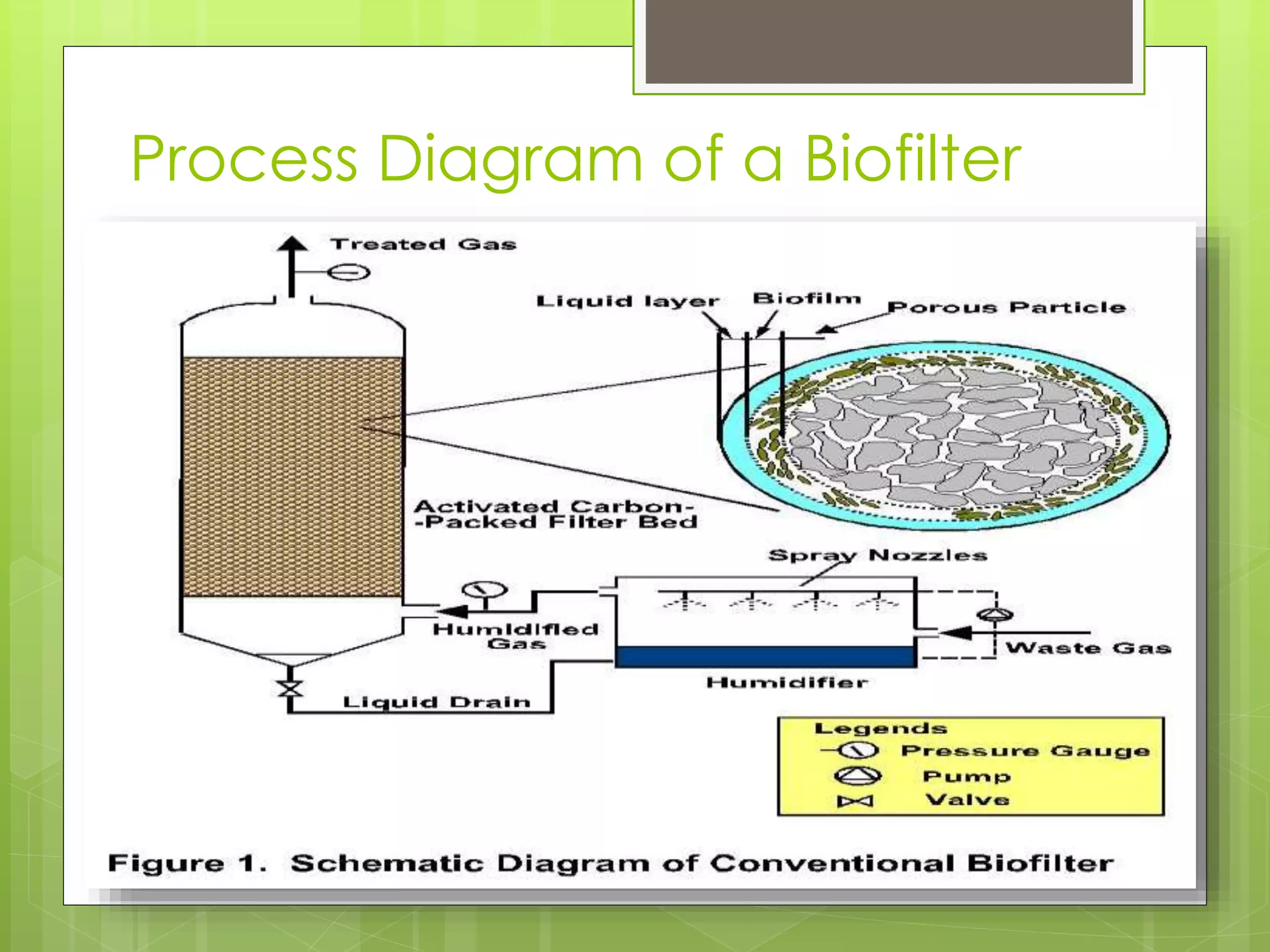
 Movement of the contaminants from the air to the
water phase occurs.
 The contaminants in the gas are either adsorbed
onto the solid particles of the media or absorbed
into the water layer that exists on the media
particles.
 Concentration of contaminants decreases from
inlet to outlet as they partitioned between various
phases.
 Wastes partition out between soil and gas, so that
the VOC remain in soil longer than in air.
Process Diagram of a Biofilter
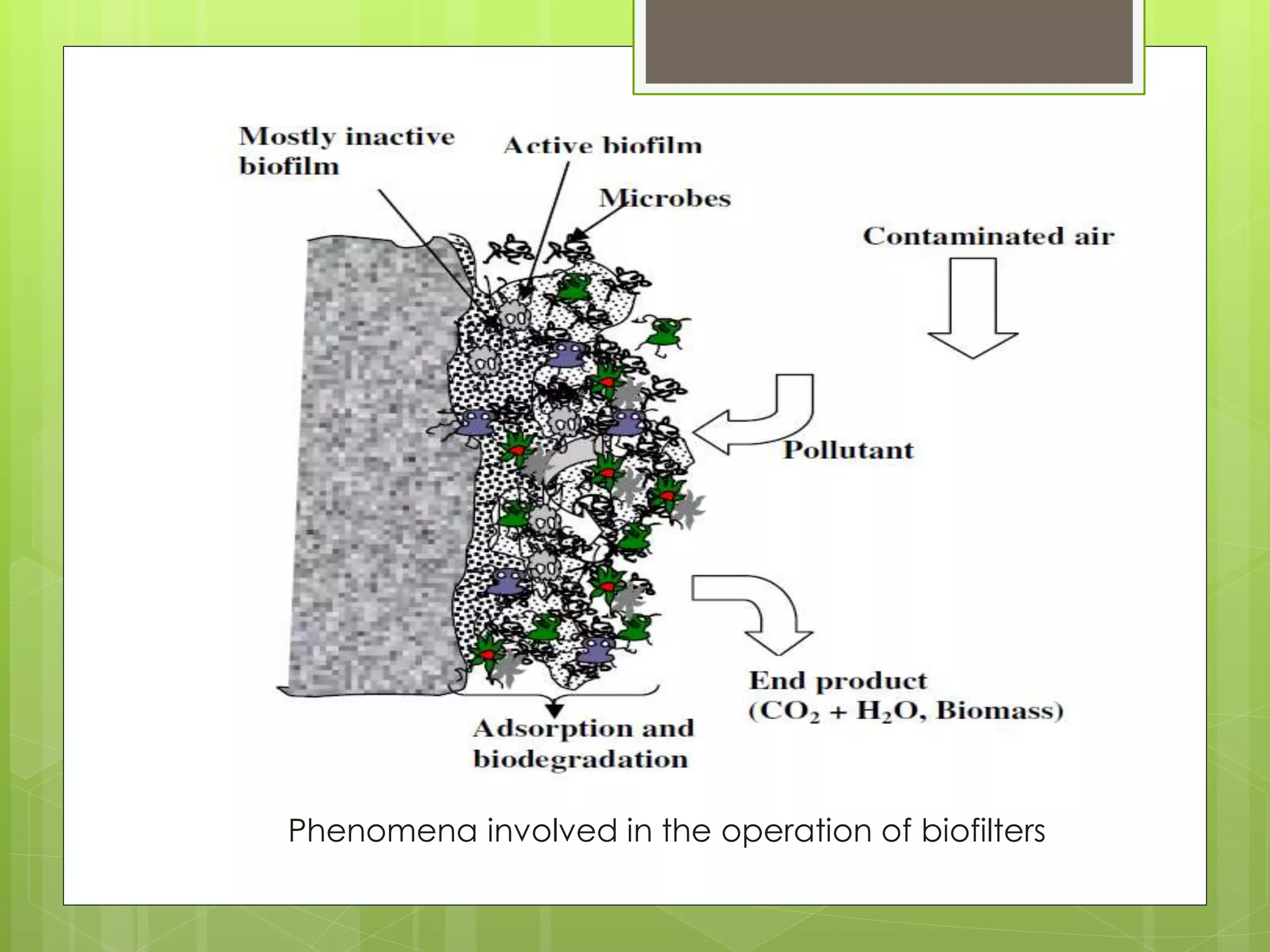
Phenomena involved in the operation of biofilters
Mechanism cont..
 Diffusion occurs through the water layer to the
microorganisms in the slime layer on the surface
of the media particles.
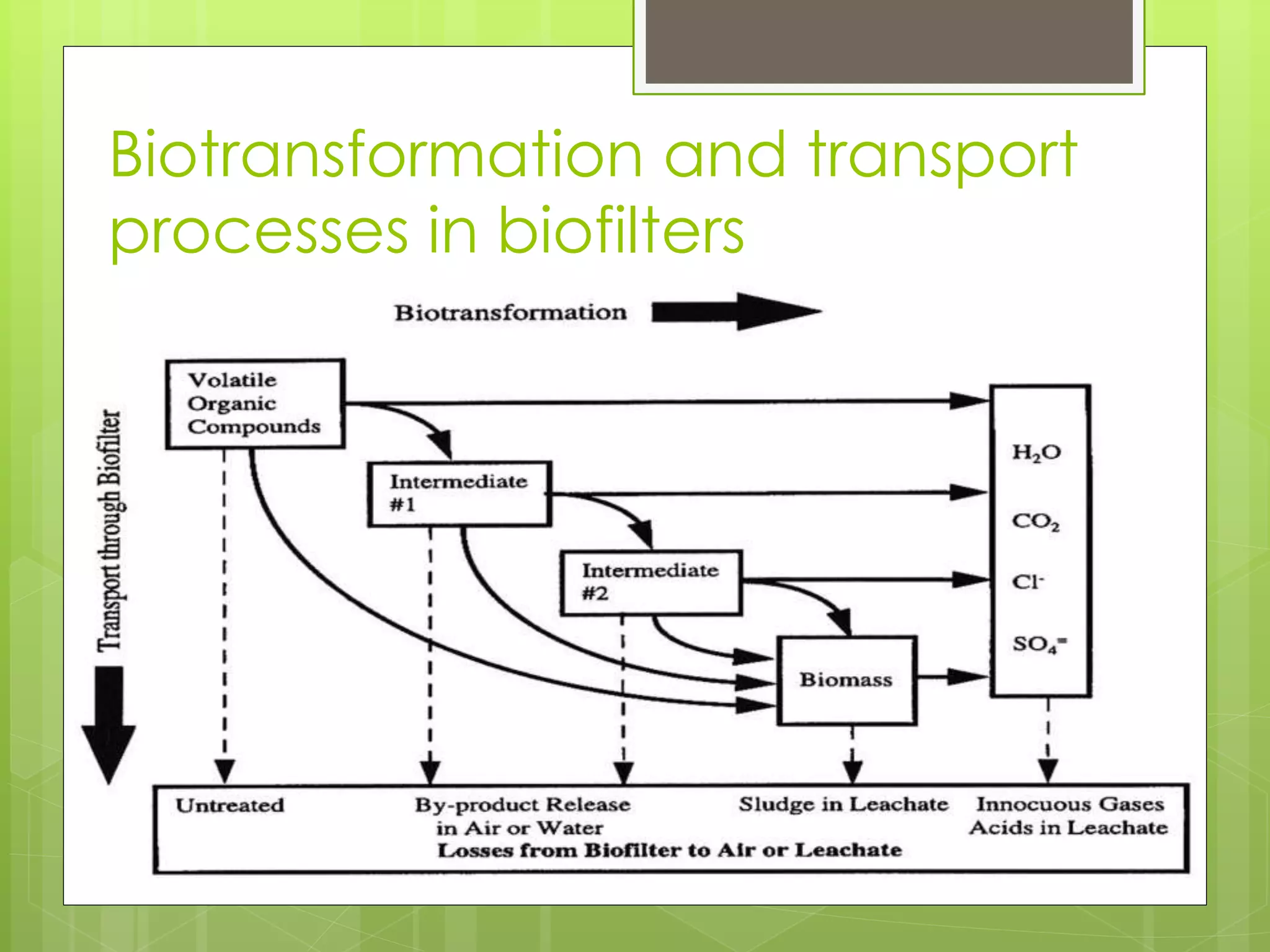
 Through biotransformation of the food source,
end products are formed, including carbon
dioxide, water, nitrogen, mineral salts, and
energy.
 Biotransformation act along with adsorption,
absorption, and diffusion to remove
contaminants from the gaseous stream.
Biotransformation and transport
processes in biofilters
Mechanism cont..
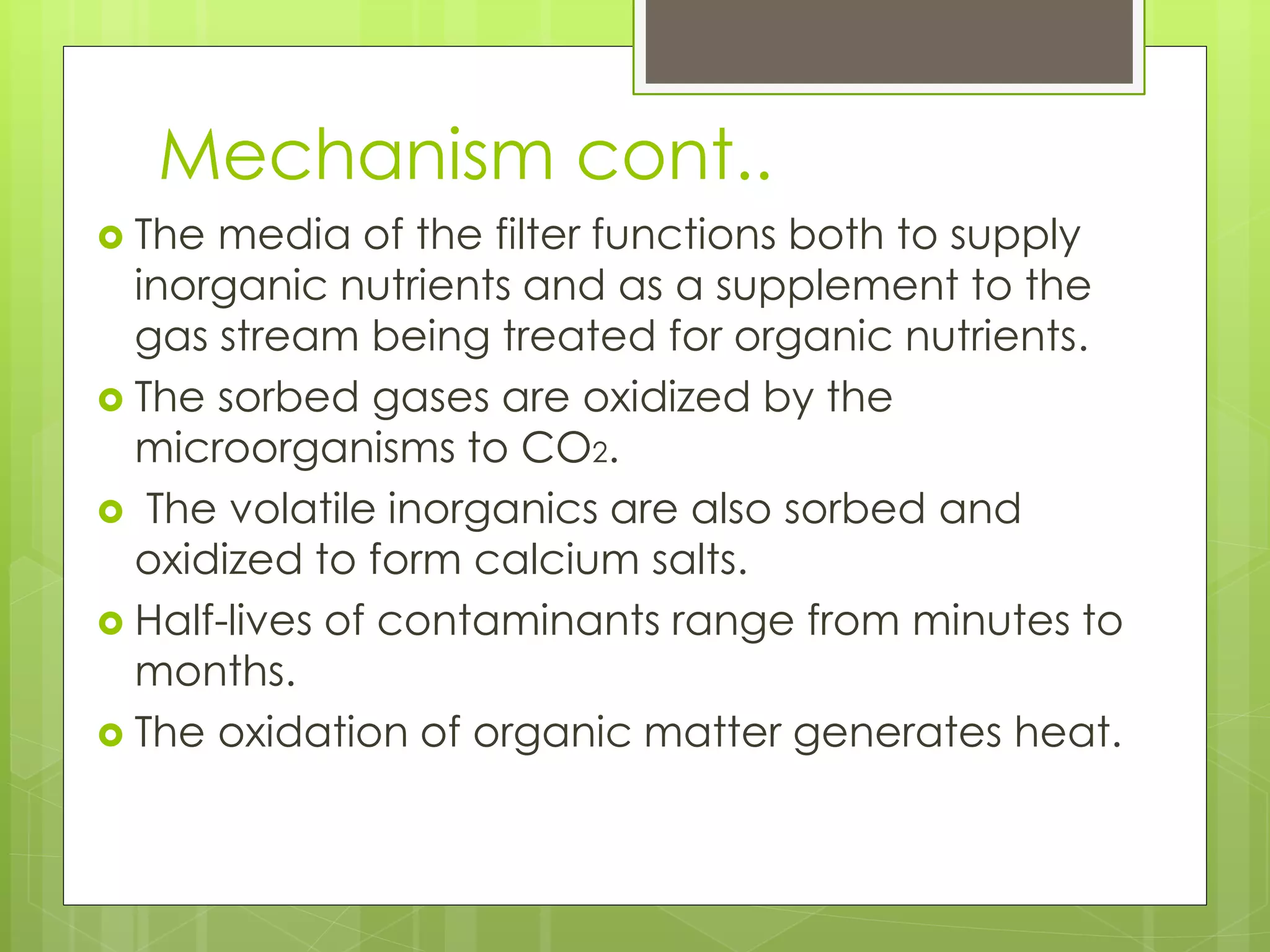
 The media of the filter functions both to supply
inorganic nutrients and as a supplement to the
gas stream being treated for organic nutrients.
 The sorbed gases are oxidized by the
microorganisms to CO2.
 The volatile inorganics are also sorbed and
oxidized to form calcium salts.
 Half-lives of contaminants range from minutes to
months.
 The oxidation of organic matter generates heat.
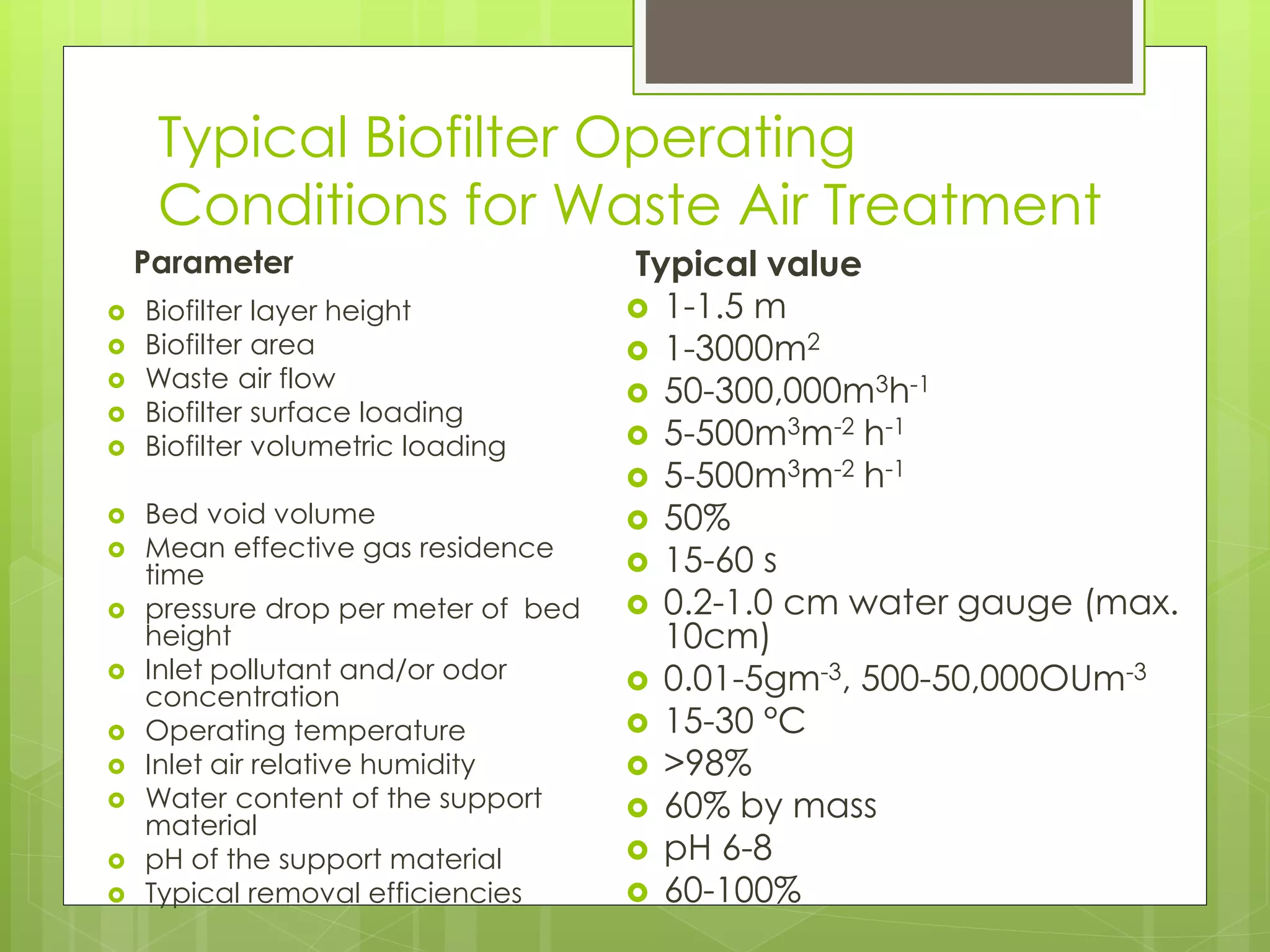
Typical Biofilter Operating
Conditions for Waste Air Treatment
Parameter
 Biofilter layer height
 Biofilter area
 Waste air flow
 Biofilter surface loading
 Biofilter volumetric loading
 Bed void volume
 Mean effective gas residence
time
 pressure drop per meter of bed
height
 Inlet pollutant and/or odor
concentration
 Operating temperature
 Inlet air relative humidity
 Water content of the support
material
 pH of the support material
 Typical removal efficiencies
Typical value
 1-1.5 m
 1-3000m2
 50-300,000m3h-1
 5-500m3m-2 h-1
 5-500m3m-2 h-1
 50%
 15-60 s
 0.2-1.0 cm water gauge (max.
10cm)
 0.01-5gm-3, 500-50,000OUm-3
 15-30 °C
 >98%
 60% by mass
 pH 6-8
 60-100%
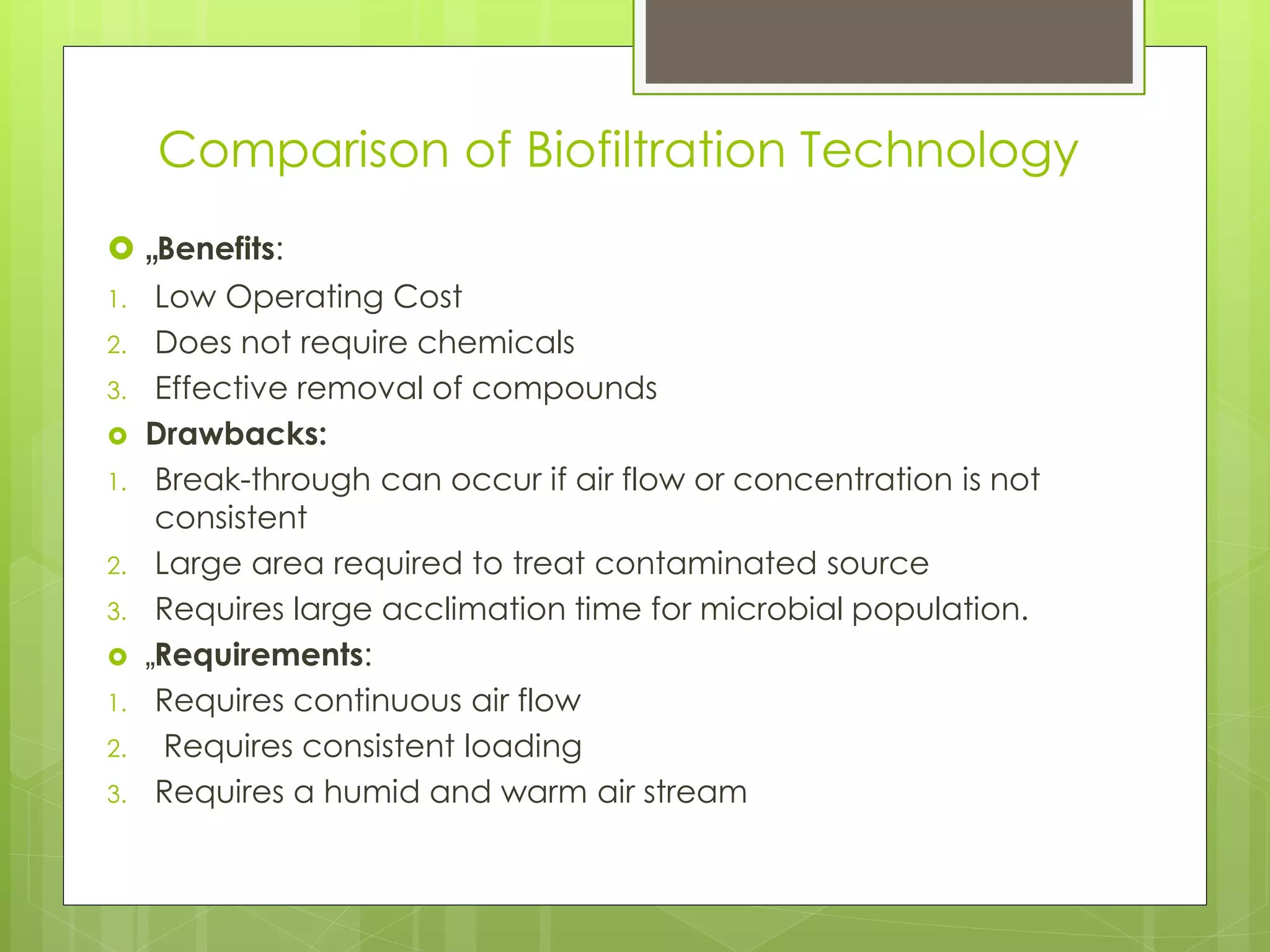
Comparison of Biofiltration Technology
 „Benefits:
1. Low Operating Cost
2. Does not require chemicals
3. Effective removal of compounds
 Drawbacks:
1. Break-through can occur if air flow or concentration is not
consistent
2. Large area required to treat contaminated source
3. Requires large acclimation time for microbial population.
 „Requirements:
1. Requires continuous air flow
2. Requires consistent loading
3. Requires a humid and warm air stream
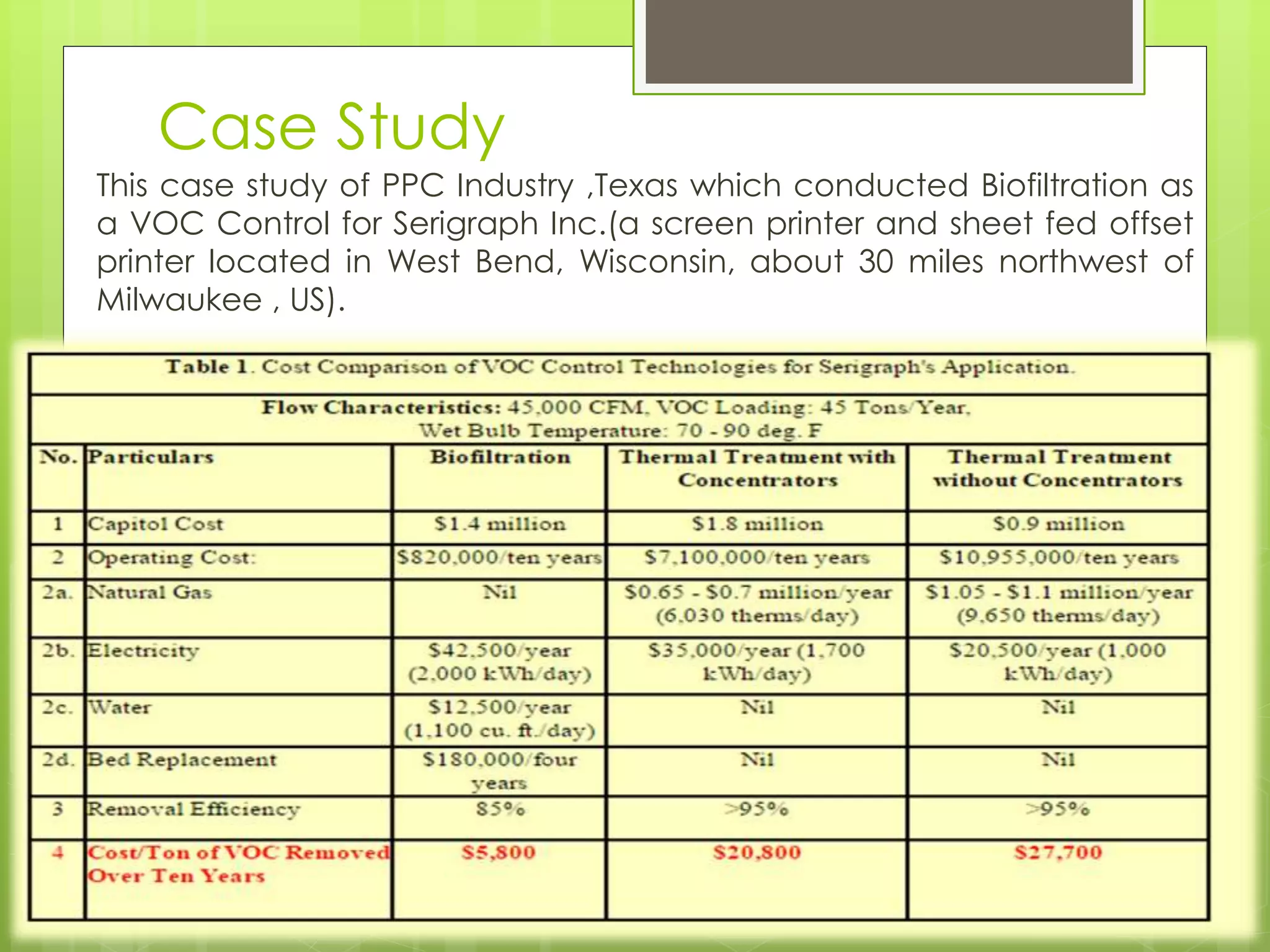
Case Study
This case study of PPC Industry ,Texas which conducted Biofiltration as
a VOC Control for Serigraph Inc.(a screen printer and sheet fed offset
printer located in West Bend, Wisconsin, about 30 miles northwest of
Milwaukee , US).
A Few Existing Bio Filters
 McMinnville, Oregon: The installation in McMinnville, Oregon perhaps
best demonstrates the capabilities as the levels of odorous compounds
to be treated were among the highest ever reported from the
wastewater treatment environment.
 Long Sault, Ontario: Although a small (1500 cfm), indoor, container-
type system, this installation demonstrates several key aspects that are
relevant to any installation.
 Sarnia, Ontario: This biofilter was installed in 2001 and treats 12,500 cfm
of air coming from a sludge liming and drying operation.
 Brookfield, P.E.I. : This biofilter was installed in 2002, at a composting
plant in P.E.I., that treats 60,000 cfm of air from the composting process.
 Toronto, Ontario: This biofilter was installed in 2002 in the north end of
Toronto at the Toronto Mixed Waste Recycling and Organics Processing
Facility.
CONCLUSION
 Biofiltration plays very important role in control
of air pollution
 Biofilter, like all systems follows laws of
conservation & mass balance
 Biofilter is successful only when microbial
ecosystem is healthy & vigorous
 The design of biofilter system requires a detailed
understanding of site , conditions , site
limitations, system components & costs
Biofilters for control of air pollution

Biofilters for control of air pollution

  • 1.
    BIOFILTRATION FOR CONTROLOF AIR POLLUTION Given by-Ashish kumar yadav M.Tech 1st year Roll No. 3140912 Department of Civil Engineering NIT Kurukhshetra
  • 2.
    Biofiltration  Biofiltration isan air pollution control technique which Involves bio degradation of contaminants under the action of microorganisms diffused in a thin layer of moisture known as “BIOFILM”, mainly used for elimination of malodorous gas emissions and low concentrations of Volatile Organic Compounds (VOCs).  The process of Bio Degradation is— Organic Pollutant + O2 CO2+ H2O + Heat + Biomass
  • 3.
    History of Biofilters Thefollowing is a brief timeline of the development of biofilters:  1923 -- Biological methods were proposed to treat odorous emissions.  1955 -- Biological methods were applied to treat odorous emissions in low concentrations in Germany.  1960’s -- Biofiltration was used for the treatment of gaseous pollutants both in Germany and US.  1970’s -- Biofiltration is used with high success in Germany.  1980’s -- Biofiltration is used for the treatment of toxic emissions and volatile organic compounds (VOCs) from industry.  1990’s -- Today, there are more than 500 biofilters operating both in Germany and Netherlands and it is widely spreading in US.
  • 4.
    Components Of ABio-filter Unit  MATERIALS used for bed media – peat, composted yard waste, bark, coarse soil, gravel or plastic shapes.  SUPPORT RACK -perforated – allow air from the plenum to move into the bed media -to contact microbes that live in the bed. Perforations also permit excess, condensed moisture to drain out of the bed to the plenum.  FAN - Used to collect contaminated air, As the emissions flow through the bed media, the pollutants are absorbed by moisture on the bed media . Microbes reduce pollutant concentrations by consuming and metabolizing pollutants.
  • 5.
    Schematic Diagram OfA Biofilter Unit
  • 6.
    Differentiation Between Bio Filtration, Chemical oxidation & Thermal Processes
  • 7.
    Types Of BioFilters ON THE BASIS OF LAYOUT  Open Bed : Uncovered and Exposed to all Weather conditions.  Closed Bed : Enclosed with a small exhaust port for venting of cleaned air ON THE BASIS OF SHAPE  Horizontal : 1. With Larger footprints 2. Relatively inexpensive 3. Easy maintenance  Vertical : 1. Designed to reduce the footprint required. 2. Use less surface area compared to Horizontal 3. Expensive 4. Not easy to Maintain ON THE BASIS OF SUPPORT MEDIA  Compost Bio Filter : Soil , Peat, Compost material is used  Synthetic Bio Filter : Ceramic , Plastic .
  • 8.
  • 9.
    Biofiltration media  Themedia used in biofilters can include peat, heather, bark, composted sewage sludge, granular carbon or other suitable materials  The useful life of media is typically 5 years.
  • 10.
    Parameters that needto be maintained  Moisture Content – Microorganisms need a moist environment. Media has a tendency to dry out because of the air flow. Optimum 20 -60%.  Temperature – Microorganisms operate best between 30 °C and 40°C.  Oxygen Level -Most of degradations are aerobic. Oxygen is not used directly in the gas form but the microorganisms use the oxygen present in dissolved form in the media.  pH –For better results must maintain a pH where the microorganism are the most efficient.  Nutrient Supply: For aerobic microorganisms, the O:N:P ratio is estimated as 100:5:1.These are typically nitrogen, phosphorous, and some trace metals.
  • 11.
    Microorganisms  Fungi, Bacteria,and Actinomycetes.  Start up of a biofilter process requires some acclimation time for the microorganisms to grow specific to the compounds in the gaseous stream  For easily degradable substances, this acclimation period is typically around 10 days  The biomass has been shown to be able to be viable for shut downs of approximately 2 weeks.  If inorganic nutrient and oxygen supplies are continued, the biomass may be maintained for up to 2 months.
  • 12.
    Mechanism  Movement ofthe contaminants from the air to the water phase occurs.  The contaminants in the gas are either adsorbed onto the solid particles of the media or absorbed into the water layer that exists on the media particles.  Concentration of contaminants decreases from inlet to outlet as they partitioned between various phases.  Wastes partition out between soil and gas, so that the VOC remain in soil longer than in air.
  • 13.
    Process Diagram ofa Biofilter
  • 14.
    Phenomena involved inthe operation of biofilters
  • 15.
    Mechanism cont..  Diffusionoccurs through the water layer to the microorganisms in the slime layer on the surface of the media particles.  Through biotransformation of the food source, end products are formed, including carbon dioxide, water, nitrogen, mineral salts, and energy.  Biotransformation act along with adsorption, absorption, and diffusion to remove contaminants from the gaseous stream.
  • 16.
  • 17.
    Mechanism cont..  Themedia of the filter functions both to supply inorganic nutrients and as a supplement to the gas stream being treated for organic nutrients.  The sorbed gases are oxidized by the microorganisms to CO2.  The volatile inorganics are also sorbed and oxidized to form calcium salts.  Half-lives of contaminants range from minutes to months.  The oxidation of organic matter generates heat.
  • 18.
    Typical Biofilter Operating Conditionsfor Waste Air Treatment Parameter  Biofilter layer height  Biofilter area  Waste air flow  Biofilter surface loading  Biofilter volumetric loading  Bed void volume  Mean effective gas residence time  pressure drop per meter of bed height  Inlet pollutant and/or odor concentration  Operating temperature  Inlet air relative humidity  Water content of the support material  pH of the support material  Typical removal efficiencies Typical value  1-1.5 m  1-3000m2  50-300,000m3h-1  5-500m3m-2 h-1  5-500m3m-2 h-1  50%  15-60 s  0.2-1.0 cm water gauge (max. 10cm)  0.01-5gm-3, 500-50,000OUm-3  15-30 °C  >98%  60% by mass  pH 6-8  60-100%
  • 19.
    Comparison of BiofiltrationTechnology  „Benefits: 1. Low Operating Cost 2. Does not require chemicals 3. Effective removal of compounds  Drawbacks: 1. Break-through can occur if air flow or concentration is not consistent 2. Large area required to treat contaminated source 3. Requires large acclimation time for microbial population.  „Requirements: 1. Requires continuous air flow 2. Requires consistent loading 3. Requires a humid and warm air stream
  • 20.
    Case Study This casestudy of PPC Industry ,Texas which conducted Biofiltration as a VOC Control for Serigraph Inc.(a screen printer and sheet fed offset printer located in West Bend, Wisconsin, about 30 miles northwest of Milwaukee , US).
  • 21.
    A Few ExistingBio Filters  McMinnville, Oregon: The installation in McMinnville, Oregon perhaps best demonstrates the capabilities as the levels of odorous compounds to be treated were among the highest ever reported from the wastewater treatment environment.  Long Sault, Ontario: Although a small (1500 cfm), indoor, container- type system, this installation demonstrates several key aspects that are relevant to any installation.  Sarnia, Ontario: This biofilter was installed in 2001 and treats 12,500 cfm of air coming from a sludge liming and drying operation.  Brookfield, P.E.I. : This biofilter was installed in 2002, at a composting plant in P.E.I., that treats 60,000 cfm of air from the composting process.  Toronto, Ontario: This biofilter was installed in 2002 in the north end of Toronto at the Toronto Mixed Waste Recycling and Organics Processing Facility.
  • 22.
    CONCLUSION  Biofiltration playsvery important role in control of air pollution  Biofilter, like all systems follows laws of conservation & mass balance  Biofilter is successful only when microbial ecosystem is healthy & vigorous  The design of biofilter system requires a detailed understanding of site , conditions , site limitations, system components & costs