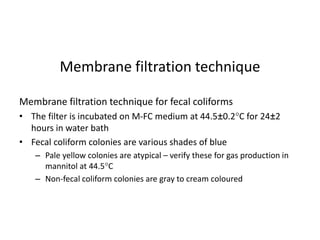
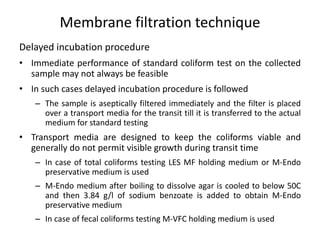
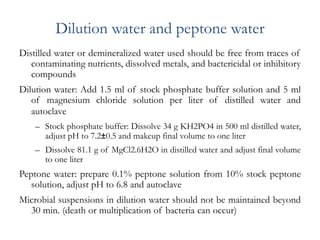
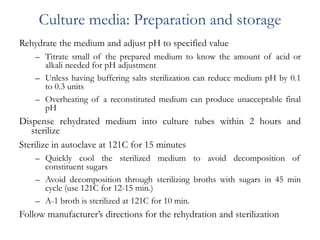
Suspended Solids
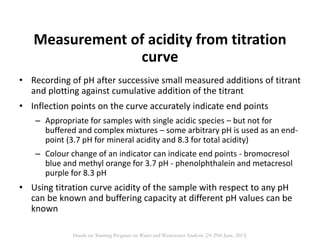
(TSS, VSS, Biodegradable VSS, SVI
and Colloidal solids )
Suspended Solids
• Total solids (TS): Material residue left behind after
evaporation of a sample and its subsequent drying in a oven
at a defined temperature to constant weight
• Total dissolved solids (TDS): Portion of the material residue of
a sample that passes through a filter
• Total suspended solids (TDS): Portion of the material residue
of a sample retained by a filter
– Settlable solids: Material settling out within a defined period
• Fixed suspended solids: Residue of TSS left after ignition for a
specified time at a specified temperature
• Volatile suspended solids: weight loss on ignition of total
suspended solids
– Biodegradable volatile suspended solids: volatile suspended
solids lost through biodegradation
• Colloidal solids: cause turbidity and measured as turbidity
(NTU or JTU)
Suspended Solids
• Regulatory limits are imposed on TSS for sewage disposal
– Water with high suspended solids may be aesthetically
unsatisfactory (for bathing!)
• Removal of TSS is one of the sewage treatment objectives
– Primary treatment is mainly concerned with it
• Sludge generation calculations in biological treatment require
the knowledge of TSS, VSS and biodegradable VSS
– All VSS is not biodegradable, and biological treatment can
hydrolyze only the biodegradable VSS
• Biological treatment involves generation of suspended solids
(biosolids)
– These biosolids are monitored as MLSS (TSS) and MLVSS (VSS)
• Maintenance of higher levels of biosolids (activated sludge) is
important in biological treatment
– MLVSS is often used as a measure of active biomass/sludge
• SVI used in the design, operation and control of secondary
clarifiers require MLSS (TSS) monitoring
Total suspended solids (TSS)
TSS and MLSS are one and the same
Two alternate ways for TSS measurement
• Filter the sample through a weighed ash free filter paper, dry
the filter paper along with the residue retained on it to
constant weight at 103-105C, and gravimetrically find the TSS
– High measurement uncertainty values – in case of low TSS larger
volumes need sampling
– In case of samples with high TDS thoroughly wash the filter
paper with TDS free water to remove the dissolved material
• Find TS and TDS for the sample and take difference of TS and
TDS as TSS
– In case of the filter paper clogging and prolonged duration of
filtration this method is followed
Often settlable solids rather than TSS is measured as an
alternative
• Centrifugation for TSS measurement?
Volatile Suspended Solids
• VSS and MLVSS are one and the same
• Weight loss on ignition of the TSS represent the VSS
• Ash free filter paper leaves no residue on ignition
• Negative error is introduced from the loss of volatile matter
during drying
• Estimation of low concentrations of volatile solids in the
presence of high fixed solids concentration can be more
erroneous
• Dried residue left on the ash less filter paper is ignited to
constant weight at 550±50C in a muffle furnace to remove
volatile matter and obtain fixed or non-volatile matter
– Difference of TSS and NVSS (fixed solids) is taken as VSS
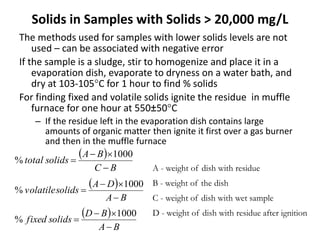
Solids in Samples with Solids > 20,000 mg/L
The methods used for samples with lower solids levels are not
used – can be associated with negative error
If the sample is a sludge, stir to homogenize and place it in a
evaporation dish, evaporate to dryness on a water bath, and
dry at 103-105C for 1 hour to find % solids
For finding fixed and volatile solids ignite the residue in muffle
furnace for one hour at 550±50C
– If the residue left in the evaporation dish contains large
amounts of organic matter then ignite it first over a gas burner
and then in the muffle furnace
 
BC
BA
solidstotal



1000
%
 
BA
DA
solidsvolatile



1000
%
 
BA
BD
solidsfixed



1000
%
A - weight of dish with residue
B - weight of the dish
C - weight of dish with wet sample
D - weight of dish with residue after ignition
Settlable Solids
• Determined on either volume (mL/L) or weight (mg/L) basis
• Measurement on volume basis requires an Imhoff cone
– Fill the cone to 1 L mark with sample and settle for 45 min.
– Gently stir sides of the cone with a rod by spinning and settle for
another 15 minutes
– Record volume of the settled solids in the Imhoff cone
• Measurement on weight basis
– Determine TSS of well mixed sample
– Pour >1-L of sample into a glass vessel of >9 cm dia. to depth
>20cm and let it stand quiescent for one hour
– Without disturbing the settled and floating material siphon out
water from the vessel center and determine TSS as non-
settlable TSS
Settlable solids = TSS – non-settlable TSS
Sludge Volume Index (SVI)
• Volume in mL occupied by 1 g of a suspension after 30 min.
settling
• Used to monitor settling characteristics of activated sludge
and other biological suspensions
– Determined for the mixed liquor of the aeration tank of the ASP
• Determine TSS concentration of a well mixed mixed-liquor
sample
• Use Imhoff cone for settling 1 L of well mixed mixed-liquor for
30 min. time and measure the settled sludge volume in mL
– Gently stir the sample during settling
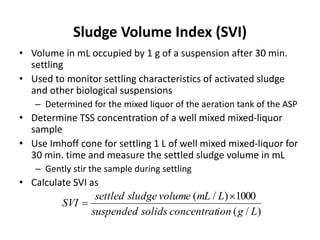
• Calculate SVI as
)/(
1000)/(
Lgionconcentratsolidssuspended
LmLvolumesludgesettled
SVI


Colloidal Solids and Turbidity
• Colloidal matter causes turbidity
• Turbidity is an optical property caused by scattering of light,
and indicates clarity of water
• Biological treatment removes colloidal solids/turbidity
through bioflocculation
• Nephelometers are used for measurement and the results are
reported in Nephalometric Turbidity Units, NTU
– Intensity of light scattered by the sample is compared with the
standard reference suspension under the same conditions
• Formazin polymer suspension is used
• A light source and a photoelectric detector are used in the
measurement
Organic Matter
Organic Matter
• TOC
• ThOD
• COD
• BOD
– DO
– BOD3 and BOD5
– BODu
• BOD kinetics
– Serial BOD test
– BOD kinetic parameters
Measurement of Organic Matter
Organic matter in wastewater is heterogeneous
– Suspended (VSS), colloidal (turbidity) and dissolved organic
matter
– Carbohydrates, proteins, fats, etc.
Organic matter is biodegradable and non-biodegradable
Single direct method for the measurement of organic matter is
not feasible – so indirect methods – these depended on
• Total organic carbon –TOC:
• Organic matter invariably has carbon, and the Organic Carbon
(OC) content is proportional to the Organic Matter (OM)
content
• Samples also have inorganic carbon (carbonates, bicarbonates,
etc.) and these interfere in the measurement of organic carbon
• Samples are first treated for the removal of inorganic carbon,
and then treated to convert organic carbon into carbon dioxide
and the amount of CO2 formed is measured
Measurement of Organic Matter
• Oxygen Demand (ThOD, COD and BOD)
– Organic matter is reduced substance and it can be completely
oxidized and transformed into inorganic end products and this
demands oxygen
– Amount of oxygen demanded is proportional to the organic
matter present – the oxygen demanded is measured and
related to organic matter
– Oxygen demand of the sample’s organic matter is measured as
• Theoretical Oxygen Demand (ThOD): If chemical formula of the
organic matter is known, oxygen demand of the sample’s organic
matter can be theoretically found through stoichiometry
• Chemical Oxygen Demand (COD): Organic matter of a sample is
chemically oxidized, and oxygen demand of the sample’s OC is
measured in terms of the amount of oxidizing agent consumed
• Biological Oxygen Demand (BOD): Microorganisms are made to
use the organic matter as food and aerobically oxidize into
inorganic end products, and oxygen utilized is measured as BOD
Theoretic Oxygen Demand
Empirical formula of organic matter present in the sample is
used and a balanced equation of oxidation is written
Amount of oxygen required (for complete oxidation of one
unit mass of organic matter) is stoichiometrically
estimated
The oxygen demand equivalent to the organic matter
presented
3222
2
3
24
3
24
cNHOH
ca
nCOO
cba
nNOHC cban 












oxygengrequireseglugofOxidation
OHCOOOHC
192cos180
666 2226126 
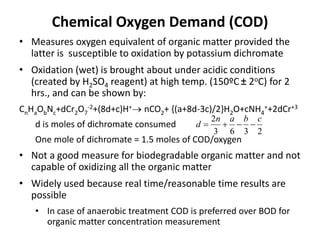
Chemical Oxygen Demand (COD)
• Measures oxygen equivalent of organic matter provided the
latter is susceptible to oxidation by potassium dichromate
• Oxidation (wet) is brought about under acidic conditions
(created by H2SO4 reagent) at high temp. (150ºC± 2oC) for 2
hrs., and can be shown by:
CnHaObNc+dCr2O7
-2+(8d+c)H+ nCO2+ {(a+8d-3c)/2}H2O+cNH4
++2dCr+3
d is moles of dichromate consumed
One mole of dichromate = 1.5 moles of COD/oxygen
• Not a good measure for biodegradable organic matter and not
capable of oxidizing all the organic matter
• Widely used because real time/reasonable time results are
possible
• In case of anaerobic treatment COD is preferred over BOD for
organic matter concentration measurement
2363
2 cban
d 
Biochemical Oxygen Demand (BOD)
• Acclimatized microorganisms are used to oxidize the organic
matter aerobically under favourable conditions of pH,
temperature, osmotic pressure and nutrients
• Sample is incubated with acclimatized microorganisms at a
specific temperature (20/27°C) for specified period (5/3 days)
• Organic matter is used by organisms as food and oxidize –
only the matter that can be consumed as food (biodegradable
fraction) can be measured
• O2 is also demand by microorganisms for the nitrification of
ammonical-N into nitrite-N and Nitrate-N (introduces positive
error in the measurement)
• COD on the other hand measures both biodegradable non-
biodegradable organic matter
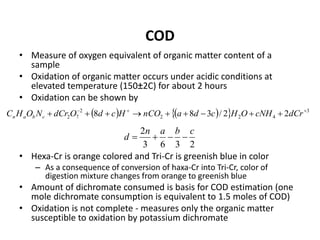
COD
• Measure of oxygen equivalent of organic matter content of a
sample
• Oxidation of organic matter occurs under acidic conditions at
elevated temperature (150±2C) for about 2 hours
• Oxidation can be shown by
• Hexa-Cr is orange colored and Tri-Cr is greenish blue in color
– As a consequence of conversion of haxa-Cr into Tri-Cr, color of
digestion mixture changes from orange to greenish blue
• Amount of dichromate consumed is basis for COD estimation (one
mole dichromate consumption is equivalent to 1.5 moles of COD)
• Oxidation is not complete - measures only the organic matter
susceptible to oxidation by potassium dichromate
     3
422
2
72 22/388 
 dCrcNHOHcdanCOHcdOdCrNOHC cban
2363
2 cban
d 
COD
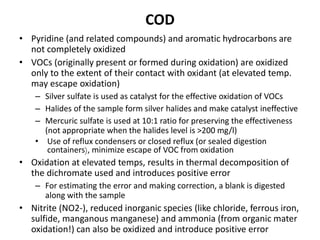
• Pyridine (and related compounds) and aromatic hydrocarbons are
not completely oxidized
• VOCs (originally present or formed during oxidation) are oxidized
only to the extent of their contact with oxidant (at elevated temp.
may escape oxidation)
– Silver sulfate is used as catalyst for the effective oxidation of VOCs
– Halides of the sample form silver halides and make catalyst ineffective
– Mercuric sulfate is used at 10:1 ratio for preserving the effectiveness
(not appropriate when the halides level is >200 mg/l)
• Use of reflux condensers or closed reflux (or sealed digestion
containers), minimize escape of VOC from oxidation
• Oxidation at elevated temps, results in thermal decomposition of
the dichromate used and introduces positive error
– For estimating the error and making correction, a blank is digested
along with the sample
• Nitrite (NO2-), reduced inorganic species (like chloride, ferrous iron,
sulfide, manganous manganese) and ammonia (from organic mater
oxidation!) can also be oxidized and introduce positive error
COD
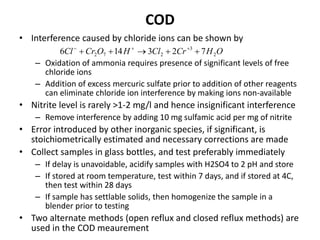
• Interference caused by chloride ions can be shown by
– Oxidation of ammonia requires presence of significant levels of free
chloride ions
– Addition of excess mercuric sulfate prior to addition of other reagents
can eliminate chloride ion interference by making ions non-available
• Nitrite level is rarely >1-2 mg/l and hence insignificant interference
– Remove interference by adding 10 mg sulfamic acid per mg of nitrite
• Error introduced by other inorganic species, if significant, is
stoichiometrically estimated and necessary corrections are made
• Collect samples in glass bottles, and test preferably immediately
– If delay is unavoidable, acidify samples with H2SO4 to 2 pH and store
– If stored at room temperature, test within 7 days, and if stored at 4C,
then test within 28 days
– If sample has settlable solids, then homogenize the sample in a
blender prior to testing
• Two alternate methods (open reflux and closed reflux methods) are
used in the COD meaurement
OHCrClHOCrCl 2
3
272 723146  
COD by Open reflux method
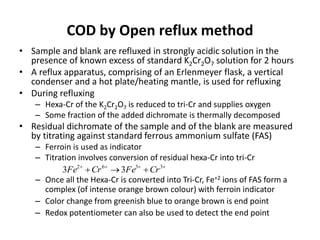
• Sample and blank are refluxed in strongly acidic solution in the
presence of known excess of standard K2Cr2O7 solution for 2 hours
• A reflux apparatus, comprising of an Erlenmeyer flask, a vertical
condenser and a hot plate/heating mantle, is used for refluxing
• During refluxing
– Hexa-Cr of the K2Cr2O7 is reduced to tri-Cr and supplies oxygen
– Some fraction of the added dichromate is thermally decomposed
• Residual dichromate of the sample and of the blank are measured
by titrating against standard ferrous ammonium sulfate (FAS)
– Ferroin is used as indicator
– Titration involves conversion of residual hexa-Cr into tri-Cr
– Once all the Hexa-Cr is converted into Tri-Cr, Fe+2 ions of FAS form a
complex (of intense orange brown colour) with ferroin indicator
– Color change from greenish blue to orange brown is end point
– Redox potentiometer can also be used to detect the end point

 3362
33 CrFeCrFe
COD by Open reflux method
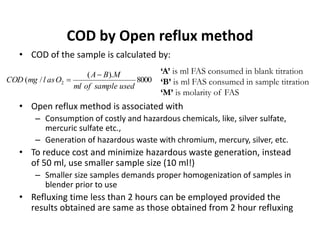
• COD of the sample is calculated by:
• Open reflux method is associated with
– Consumption of costly and hazardous chemicals, like, silver sulfate,
mercuric sulfate etc.,
– Generation of hazardous waste with chromium, mercury, silver, etc.
• To reduce cost and minimize hazardous waste generation, instead
of 50 ml, use smaller sample size (10 ml!)
– Smaller size samples demands proper homogenization of samples in
blender prior to use
• Refluxing time less than 2 hours can be employed provided the
results obtained are same as those obtained from 2 hour refluxing
8000
).(
/( 2
usedsampleofml
MBA
OaslmgCOD


‘A’ is ml FAS consumed in blank titration
‘B’ is ml FAS consumed in sample titration
‘M’ is molarity of FAS
COD by Closed reflux method
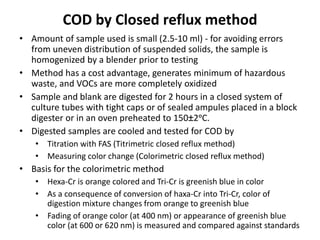
• Amount of sample used is small (2.5-10 ml) - for avoiding errors
from uneven distribution of suspended solids, the sample is
homogenized by a blender prior to testing
• Method has a cost advantage, generates minimum of hazardous
waste, and VOCs are more completely oxidized
• Sample and blank are digested for 2 hours in a closed system of
culture tubes with tight caps or of sealed ampules placed in a block
digester or in an oven preheated to 150±2ᵒC.
• Digested samples are cooled and tested for COD by
• Titration with FAS (Titrimetric closed reflux method)
• Measuring color change (Colorimetric closed reflux method)
• Basis for the colorimetric method
• Hexa-Cr is orange colored and Tri-Cr is greenish blue in color
• As a consequence of conversion of haxa-Cr into Tri-Cr, color of
digestion mixture changes from orange to greenish blue
• Fading of orange color (at 400 nm) or appearance of greenish blue
color (at 600 or 620 nm) is measured and compared against standards
COD by closed reflux method
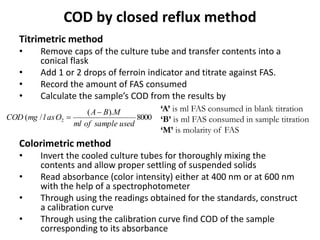
Titrimetric method
• Remove caps of the culture tube and transfer contents into a
conical flask
• Add 1 or 2 drops of ferroin indicator and titrate against FAS.
• Record the amount of FAS consumed
• Calculate the sample’s COD from the results by
Colorimetric method
• Invert the cooled culture tubes for thoroughly mixing the
contents and allow proper settling of suspended solids
• Read absorbance (color intensity) either at 400 nm or at 600 nm
with the help of a spectrophotometer
• Through using the readings obtained for the standards, construct
a calibration curve
• Through using the calibration curve find COD of the sample
corresponding to its absorbance
8000
).(
/( 2
usedsampleofml
MBA
OaslmgCOD


‘A’ is ml FAS consumed in blank titration
‘B’ is ml FAS consumed in sample titration
‘M’ is molarity of FAS
Dissolved Oxygen (DO): Winkler Method
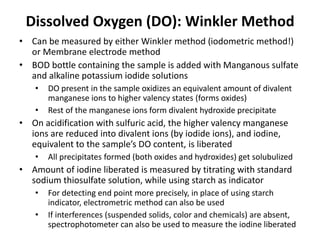
• Can be measured by either Winkler method (iodometric method!)
or Membrane electrode method
• BOD bottle containing the sample is added with Manganous sulfate
and alkaline potassium iodide solutions
• DO present in the sample oxidizes an equivalent amount of divalent
manganese ions to higher valency states (forms oxides)
• Rest of the manganese ions form divalent hydroxide precipitate
• On acidification with sulfuric acid, the higher valency manganese
ions are reduced into divalent ions (by iodide ions), and iodine,
equivalent to the sample’s DO content, is liberated
• All precipitates formed (both oxides and hydroxides) get solubulized
• Amount of iodine liberated is measured by titrating with standard
sodium thiosulfate solution, while using starch as indicator
• For detecting end point more precisely, in place of using starch
indicator, electrometric method can also be used
• If interferences (suspended solids, color and chemicals) are absent,
spectrophotometer can also be used to measure the iodine liberated
Winkler method for DO
NaIOSNaIOSNa
OHMnHOHMnb
OHMnIHIMnOa
OHMnOHMnc
OHMnOOOHMnb
OHMnOOOHMna
22.3
22)(.2
242.2
)(2.1
5.0)(.1
5.02.1
6422322
2
2
2
2
2
22
2
2222
222
2










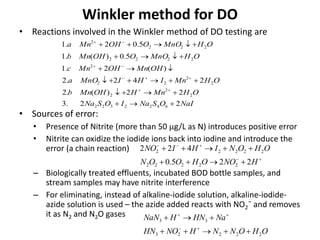
• Reactions involved in the Winkler method of DO testing are
• Sources of error:
• Presence of Nitrite (more than 50 g/L as N) introduces positive error
• Nitrite can oxidize the iodide ions back into iodine and introduce the
error (a chain reaction)
– Biologically treated effluents, incubated BOD bottle samples, and
stream samples may have nitrite interference
– For eliminating, instead of alkaline-iodide solution, alkaline-iodide-
azide solution is used – the azide added reacts with NO2¯ and removes
it as N2 and N2O gases




HNOOHOON
OHONIHINO
225.0
422
22222
22222
OHONNHNOHN
NaHNHNaN
22223
33




Winkler Method for DO
• For avoiding errors, the sample should not come in contact with air
during sampling and testing (at least till the sample’s DO is fixed)
• Samples with iodine demand can be preserved for 4-8 hours by
adding 0.7 mL conc. H2SO4 and 1.0 mL of 2% azide (NaN3) prior to
actual analysis by usual procedure
• Permanganate modification
• Permanganate modification is needed if ferrous iron level is > 1.0
mg/L
• To the sample collected add 0.7 mL conc. H2SO4, 1.0 mL KMnO4 and
1.0 ml of KF below the surface, and stopper and mix the contents
• KMnO4 addition may be increased if the resulting violet tinge do not
persist for at least 5 minutes
• Decolourize the sample by adding 0.5 to 1.0 mL of potassium oxalate
(K2C2O4) and mixing the contents
Winkler Method for DO
• Ferric iron interference can be overcome by addition of 1 ml
of KF and Azide provided titration is done immediately after
acidification
• Addition of 1.0 mL of KF solution prior to acidification is needed
for samples with 100-200 mg/L of ferric iron (acidified sample
should be immediately titrated)
• Copper sulfate-sulfamic acid flocculation modification
– Used for biological flocs having high oxygen utilization rates
– Fill aspirator bottle with the sample from the bottom by a tube
near the bottom while allowing overflow of 25-50% volume
– Add 10 ml of copper sulfate-sulfamic acid inhibitor solution to
1.0 L aspirator bottle with glass-stopper.
– Stopper the bottle, mix the contents by inverting the bottle and
allow the bottle to stand and siphon out sample into the BOD
bottle for DO measurement
Membrane Electrode Method for DO
• Membrane electrode is composed of two solid metal electrodes and an
electrolyte solution forming a bridge between them
• The electrodes and the electrolyte solution are separated from the sample
by a molecular oxygen permeable membrane
• The membrane electrode system (DO probe) is either a polarographic
system or a galvanic system
• Because of the permeable nature, a dynamic equilibrium is established
(through oxygen diffusion) between the DO of the electrolyte solution and
that of the sample
• Oxygen present in the electrolyte is reduced at the cathode and electrons
required are produced at the anode and transported to the cathode
• Current resulting from the required electron transport is proportional to
the DO concentration in the electrolyte solution (indirectly in the sample)
• Current in the circuit is measured and related with the DO of the sample
Membrane Electrode Method for DO
Calibration: Establishing relationship between DO of the sample
and current in the circuit
• Calibration of membrane electrode system involves use samples of
known DO
• Samples with known DO can be prepared by aeration, bubbling
nitrogen gas, addition of sodium sulfite and traces of cobalt chloride
• The membrane electrode (DO probe) is placed in water saturated
air, and current generated in the circuit is taken as proportional to
the DOs at that temperature and pressure
• When calibrated in saturated air, necessary compensation for altitude
(or atmospheric pressure) should be made (Manufacturer provides a
standard table for altitude correction)
• Distilled water (or unpolluted water with known conductivity/
salinity/ chlorinity) saturated with DO can also be used for calibration
• Samples with known DO can also be used for the calibration
• Winkler method is used for knowing DO with precision and accuracy
• Manufacturer of DO probe and DO meter provides a written
calibration procedure and it should be strictly followed
Membrane Electrode Method for DO
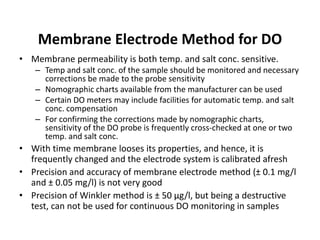
• Membrane permeability is both temp. and salt conc. sensitive.
– Temp and salt conc. of the sample should be monitored and necessary
corrections be made to the probe sensitivity
– Nomographic charts available from the manufacturer can be used
– Certain DO meters may include facilities for automatic temp. and salt
conc. compensation
– For confirming the corrections made by nomographic charts,
sensitivity of the DO probe is frequently cross-checked at one or two
temp. and salt conc.
• With time membrane looses its properties, and hence, it is
frequently changed and the electrode system is calibrated afresh
• Precision and accuracy of membrane electrode method (± 0.1 mg/l
and ± 0.05 mg/l) is not very good
• Precision of Winkler method is ± 50 µg/l, but being a destructive
test, can not be used for continuous DO monitoring in samples
BOD Bottle Method for BOD Estimation
A BOD bottle filled with diluted sample with acclimatized
seed and stoppered is incubated at constant temperature
for a fixed duration
– Dilution of the sample
– Acclimatized seed
– Favourable nutrient and osmotic conditions
– No air bubble entrainment
– known initial DO
5 days incubation at 20°C (3 days at 27°C)
– only partial oxidation of the organic matter occurs
– complete oxidation needs incubation for longer time (60 to 90
days)
Measurement of final DO
– Difference between initial and final DO is oxygen demand of the
diluted sample during the incubation period
5-day BOD Test by BOD Bottle Method
• BOD is a bioassay test used to measure biodegradable organic
matter concentration
– Amount of oxygen required to biooxidise organic matter of the sample
is measured
• Diluted sample is incubated with appropriate microbial populations
for 5 days at 20ºC
– Distilled water (or tap water or water collected from receiving water, if
having negligible BOD) is used for diluting the sample
– Water should not have bio-inhibitory substances like chlorine, heavy
metals etc.
• Aerobic bio-oxidation of biodegradable organic matter consumes
DO of the sample
• Change in DO of the incubated sample is measured and reported as
BOD5 at 20°C
• Experimental results to become acceptable
– Residual DO of the sample should be >1.0 mg/l
– DO difference between initial and final should be >2.0 mg/L
Sources of Error
Seed added is organic matter and undergoes bio-oxidation exerting
oxygen demand during incubation
– Positive error introduced is measured through incubating a blank
containing seed in dilution water but no sample
– Measured error is then subtracted from the overall oxygen demand for
obtaining oxygen demand of the sample
Oxygen demand is denoted as BODt at X°C (BOD5 at 20°C, BOD3 at
27°C, etc.)
– Units for BODt at X°C are mg/L (BODt is oxygen demand when the
sample is incubated for ‘t’ days at X°C
Testing gives oxygen demand of diluted sample - multiplication of this
with dilution factor gives sample’s oxygen demand
NH3-N added (as nutrient supplement) and NH3-N released during
incubation are prone to nitrification and introducing positive error
• To eliminate this error, either inhibit the nitrification or quantify and
subtract from the measurement
– In 5-day BOD test, use of nitrification inhibitor chemical is preferred
– In BODu test quntification and subtraction of error is preferred
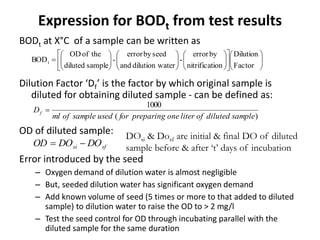
Expression for BODt from test results
BODt at X°C of a sample can be written as
Dilution Factor ‘Df’ is the factor by which original sample is
diluted for obtaining diluted sample - can be defined as:
OD of diluted sample:
Error introduced by the seed
– Oxygen demand of dilution water is almost negligible
– But, seeded dilution water has significant oxygen demand
– Add known volume of seed (5 times or more to that added to diluted
sample) to dilution water to raise the OD to > 2 mg/l
– Test the seed control for OD through incubating parallel with the
diluted sample for the same duration































Factor
Dilution
ionnitrificat
byerror
-
aterdilution wand
seedbyerror
-
samplediluted
theofOD
BODt
)(
1000
sampledilutedofliteronepreparingforusedsampleofml
Df 
sfsi DODOOD 
DOsi & Dosf are initial & final DO of diluted
sample before & after ‘t’ days of incubation
F)DO-(DOaterdilution wseededofOD cfci
preparedcontrolseedofliterperseedofml
preparedsampledilutedofliterperseedofml
F 
f
f
cfcisfsi
o
t DF
D
DODODODOCXatBOD

















1
1)()(
cfci DO-DOseedofOD  DOci & DOcf are initial & final DO of
the seed control incubated for ‘t’ days
F
D
DODOwaterdilutionseededofOD
f
cfci 








1
1)(
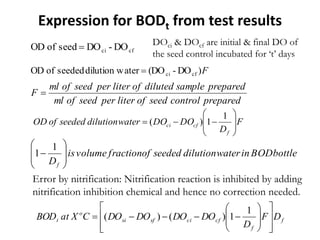
Expression for BODt from test results
bottleBODinwaterdilutionseededoffractionvolumeis
Df









1
1
Error by nitrification: Nitrification reaction is inhibited by adding
nitrification inhibition chemical and hence no correction needed.
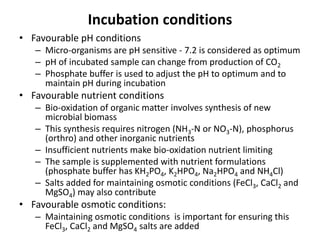
Incubation conditions
• Favourable pH conditions
– Micro-organisms are pH sensitive - 7.2 is considered as optimum
– pH of incubated sample can change from production of CO2
– Phosphate buffer is used to adjust the pH to optimum and to
maintain pH during incubation
• Favourable nutrient conditions
– Bio-oxidation of organic matter involves synthesis of new
microbial biomass
– This synthesis requires nitrogen (NH3-N or NO3-N), phosphorus
(orthro) and other inorganic nutrients
– Insufficient nutrients make bio-oxidation nutrient limiting
– The sample is supplemented with nutrient formulations
(phosphate buffer has KH2PO4, K2HPO4, Na2HPO4 and NH4Cl)
– Salts added for maintaining osmotic conditions (FeCl3, CaCl2 and
MgSO4) may also contribute
• Favourable osmotic conditions:
– Maintaining osmotic conditions is important for ensuring this
FeCl3, CaCl2 and MgSO4 salts are added
Incubation conditions: Constant
temperature throughout
• 5/3 day incubation bio-oxidizes only a fraction of organic matter
(OM)– total oxidation requires infinite time – BOD kinetics model is
used estimating the total OM by extrapolating BODt results
– BOD kinetics model involves a reaction rate constant (K) which is
temp. sensitive
– BOD kinetics model can not be applied to the results obtained from a
test where the sample is not incubated at constant temperature
• The BOD test results are always reported along with temperature
and period of incubation (BOD5 at 20°C).
• By conviction incubated for 5 days at 20C (annual average temp. of
UK and time taken by the Thames to reach the ocean) – CPCB
recommends 3 days at 27°C (annual average temp. of India!)
• 5 days incubation has an advantage - nitrogenous BOD in many
cases will not interfere with carbonaceous BOD measurement
– One can adapt any temp. within the range that will not affect the
microbial metabolic activity
– Incubation period giving BODt = 60-70% of BODu can be adapted
• For ensuring incubation at constant temp., samples are incubated
either in BOD incubators or in water baths set at desired temp.
Acclimatized seed
• For the bio-oxidation of OM, the incubated sample should
have appropriate microbial populations
• During initial period of incubation, selection among the
populations and their size increase occurs – this results in
initial lag in oxygen demand pattern and consequently
• Cumulative demand may not follow first order kinetics
• Negative error may be made in BOD5 measurement, and in the
BODu estimation
• Municipal sewage, biologically treated effluents and samples
collected from receiving water bodies are supposed to have
these populations
• Many industrial wastewaters may not have (w/w generated at
elevated temp. and w/w containing toxicants above the
threshold limits)
Acclimatized seed
• Microbes have preferences as to the OM they can bio-oxidize
• seed added may not have appropriate microbial populations in
significant size
• W/w not having appropriate microbial populations require
addition of these populations as seed
• The initial lag can be eliminated through use of acclimated
seed.
• What can be used as seed
– Settled domestic sewage, clarified and undisinfected effluents of
biological treatment units, and clear water from receiving
waters
– Effluent from the biological treatment plant, treating the
wastewater being sampled (most appropriate)
– Clear water collected from the water body, which is receiving
the wastewater in question, at a point 3 to 8 KM down stream
– Seed, specially, developed in laboratory
Aclimatized Seed
• Can be developed from
• Settled domestic sewage
• Suspension prepared from wastewater contaminated soil
• Prepared through continuously aerating for a few days and
adding small daily increments of the wastewater in question
• Preparation of acclimatized seed:
• Take mixed liquor or secondary sludge of a STP and start aeration
• While continuing aeration, gradually replace the mixed
liquor/secondary sludge with the wastewater in question over a
period of two days or more
• Settle the contents and use the supernatant as seed
Dilution factor (Df)
• Oxygen is sparingly soluble in water and depends on altitude,
temperature and salinity
Altitude (in
meter)
Saturated
DO (in
mg/l)
Temperat
ure (in
C)
Saturated
DO (in
mg/l)
Chlorini
ty
Saturated DO
(in mg/l)
sea level 9.2 0.0 14.62 0.0 9.09 (20C)
305 8.9 5.0 12.77 7.56 (30C)
610 8.6 10.0 11.29 6.41 (40C)
914 8.2 15.0 10.08 5.0 8.62 (20C)
1219 7.9 20.0 9.09 .. 7.19 (30C)
1524 7.6 25.0 8.26 .. 6.12 (40C)
1829 7.4 30.0 7.56 10.0 8.17 (20C)
2134 7.1 35.0 6.95 .. 6.85 (30C)
2438 6.8 40.0 6.41 .. 5.84 (40C)
2743 6.5 45.0 5.93 15.0 6.51 (30C)
3048 6.3 50.0 5.48 20.0 6.20 (30C)
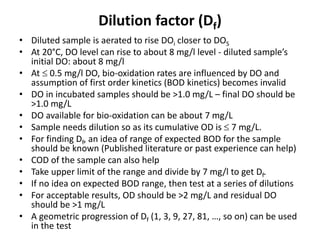
Dilution factor (Df)
• Diluted sample is aerated to rise DOi closer to DOS
• At 20°C, DO level can rise to about 8 mg/l level - diluted sample’s
initial DO: about 8 mg/l
• At  0.5 mg/l DO, bio-oxidation rates are influenced by DO and
assumption of first order kinetics (BOD kinetics) becomes invalid
• DO in incubated samples should be >1.0 mg/L – final DO should be
>1.0 mg/L
• DO available for bio-oxidation can be about 7 mg/L
• Sample needs dilution so as its cumulative OD is  7 mg/L.
• For finding Df, an idea of range of expected BOD for the sample
should be known (Published literature or past experience can help)
• COD of the sample can also help
• Take upper limit of the range and divide by 7 mg/l to get Df.
• If no idea on expected BOD range, then test at a series of dilutions
• For acceptable results, OD should be >2 mg/L and residual DO
should be >1 mg/L
• A geometric progression of Df (1, 3, 9, 27, 81, …, so on) can be used
in the test
Standard BOD Bottle Method: Limitations
• Sample dilution introduces error in measurement and affect
reproducibility
• Can not be successfully used for the measurement of BOD
contributed by suspended organic matter
– Must first undergo hydrolysis - takes time (2 to 3 days or more), BOD
exertion may not follow first order kinetics (BOD model assumption)
– Very difficult to ensure uniform distribution of the TSS among the BOD
bottles - consequence is erroneous BOD measurement.
• Testing requires long time (5 days) - results become less relevant
(for operation and control of, specially, biological treatment units)
– Attempt to reduce the time required: increase the incubation
temperature (to 27°C to reduce time to 3 days).
• Dilution of sample with nutrient rich buffer solution may not reflect
the conditions existing in the treatment processes
• Inaccuracy of BODt measurement: 15 to 50% (18% SD)
Interferences
• Secondary effluent samples and samples seeded with secondary
effluents, and polluted water samples collected from surface water
bodies show significant nitrification rates
– Nitrification inhibitor chemicals: TCMP (2-chloro, 6-trichloro methyl
pyridine)
– Whenever nitrification inhibitor chemical is used, results are reported
as CBOD5 (not as BOD5)
• Dilution water used can also introduce positive error
– Good quality dilution water exerts < 0.1 or 0.2 mg/l of oxygen demand
during 5-day incubation at 20°C.
• Sulfides and ferrous iron can be oxidized during incubation and
introduce positive error
• Residual chlorine if present can inhibit biological activity and bio-
oxidation of organic matter
– Samples with residual chlorine are first dechlorinated
– Keeping under light for 1 to 2 hours can dechlorinate the sample
– Addition of predetermined quantity of sodium sulfite can dechlorinate
– Dose of sodium sulfite required: Take 200 ml sample, add 2 ml of 1:1
acetic acid or 1:50 H2SO4 and 2 ml of 1% KI, and titrate against Na2SO3,
use starch as indicator - Na2SO3 consumed is the dose
Serial BOD test by BOD bottle method
• Needed for finding out BOD kinetics parameters
• Involves measurement of BOD1, BOD2, …, BODi, …, BODn
• Similar to 5 day or 3 day BOD test, but daily BOD is measured
• Large number of diluted sample bottles are incubated and daily 2
or 3 bottles are taken out for measuring DO and BODi estimation
• For acceptable results, the conditions, DOf >1.0 mg/L and DOi-Dof
>2.0 mg/L should be satisfied in all the cases
• For ensuring this, the sample may be incubated at different dilutions
(shorter the incubation period lesser will be the dilution)
• If X is dilution factor for 5 day BOD, the following dilution factors
may be used in the serial BOD test
– X/4 dilution factor for BOD1, and BOD2 measurement
– X/2 dilution factor for BOD2, BOD3 and BOD4 measurement
– X dilution factor for BOD4, BOD5 and BOD6 measurement
– 2X dilution factor for BOD6, BOD7 and BOD8
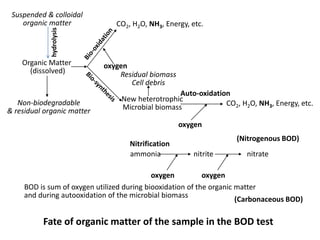
Fate of organic matter of the sample in the BOD test
Organic Matter
(dissolved)
Non-biodegradable
& residual organic matter
Suspended & colloidal
organic matter
oxygen
CO2, H2O, NH3, Energy, etc.
New heterotrophic
Microbial biomass
Auto-oxidation
CO2, H2O, NH3, Energy, etc.
ammonia
oxygen
nitrite nitrate
oxygen
(Nitrogenous BOD)
BOD is sum of oxygen utilized during biooxidation of the organic matter
and during autooxidation of the microbial biomass
(Carbonaceous BOD)
oxygen
Nitrification
Residual biomass
Cell debris
hydrolysis
Conclusions drawn from the analysis of the
fate of organic matter during BOD test
• Oxygen demand exerted is having
– Demand for biooxidation of organic matter and for autooxidation
of microbial biomass (carbonaceous BOD)
– Demand for the nitrification of the ammonia generated or already
present (nitrogenous BOD) – chemical inhibition of nitrification
– Demand of the seed and of the dilution water used
• Because of non-biodegradable organic matter, residual organic
matter, and residual biomass, BOD is always lesser than ThOD
• Unless some of the biodegradable organic matter is resistant to
chemical oxidation BOD is lesser than COD
• Complete biodegradation of organic matter needs infinite time
• BOD includes two components: Carbonaceous BOD and
Nitrogenous BOD
Ultimate BOD (BODu)
BODt is the sample’s oxygen demand when it is incubated for ‘t’ time
(3 or 5 days) at XᵒC temperature
• Higher the temperature lower will be the time
Only a portion of the biodegradable organic matter is oxidized -
oxidation of total matter requires >25 d (60-90 days)
BODu test wherein the sample is aerated at regular interval and
incubated till daily demand becomes <1 or 2% of the cumulative
demand is used for finding
• Nitrification demand of oxygen is parallelly quantified and subtracted
Incubating and waiting for that long period for the results is not
desirable but knowing ultimate BOD (BODu) is considered
important
For this the BODt results are extrapolated through using BOD kinetics
model which assumes that the BOD exertion follows first order
decreasing rate of increase
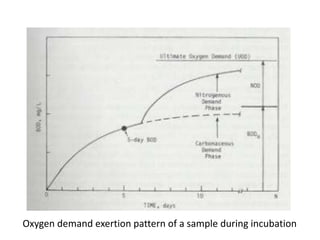
Oxygen demand exertion pattern of a sample during incubation
BOD kinetics
Oxygen demand exertion pattern is first order decreasing rate of
increase and can be shown as
ttou LBODLBOD
''

ttimegivenanyat
exp(-k.t)}-{1LBOD
BOD
ot
t

aswrittenbecan
 20
20T kk 
 T

T is temp. in °C
 is constant - taken as 1.056 for
20-30°C and as 1.135 for 4-20°C
kL-dL/dt
L0

 tt LBOD
exp(-k.t)LL ot 
dL/dt is rate of oxygen demand exertion
Lt is oxygen demand that is yet to be exerted at
after incubation time ‘t’
L0 is oxygen demand to be exerted by the sample
at incubation time ‘zero’ (also known as BODu)
k is BOD reaction rate constant (per day units)
K and L0 are known as BOD kinetics parameters
Use of BOD kinetic model requires knowledge of BOD kinetic parameters
BOD Kinetics Parameters and their
Estimation
• K and L0 are BOD kinetics parameters
• Use of BOD kinetics model requires values of these
parameters
• Results of a serial BOD test for n days can be used for
finding the BOD kinetic parameter values
• Methods used to determine BOD kinetics parameters
• Method of least squares
• Method of moments (Moore et al. 1950)
• Log difference method (Fair, 1936)
• Fugimoto method (Fujimoto, 1961)
• Daily difference method (Tsivoglou, 1958)
• Rapid ratio method (Sheehy, 1960)
• Thomas method (Thomas, 1950)
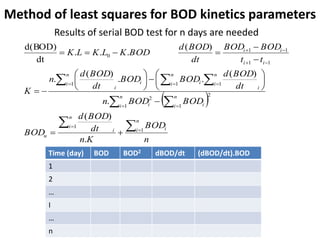
Method of least squares for BOD kinetics parameters
 
n
BOD
Kn
dt
BODd
BOD
BODBODn
dt
BODd
BODBOD
dt
BODd
n
K
tt
BODBOD
dt
BODd
BODKLKLK
n
i i
n
i
i
u
n
i i
n
i i
n
i
n
i
i
n
i ii
i
ii
ii


 



 




















1
1
2
11
2
1 11
11
11
0
.
)(
.
)(
..
)(
.
)(
...
dt
d(BOD)
Time (day) BOD BOD2 dBOD/dt (dBOD/dt).BOD
1
2
…
I
…
n
Results of serial BOD test for n days are needed
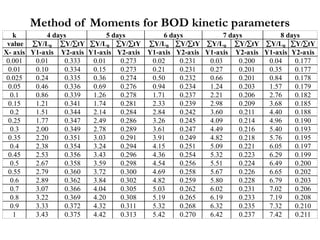
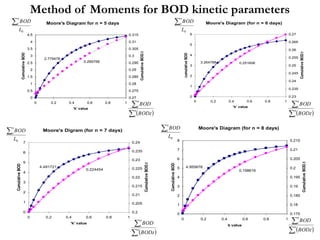
Method of Moments for BOD kinetic parameters
• Moore’s diagram (a nomograph relating K with BOD/L0 and
BOD/(BOD.t)) is needed
– Moore’s diagram is different for different n value
• Results of serial BOD test for n days are used to find BOD and
BOD/ (BOD.t)
• BOD/(BOD.t) value is used to read k value and BOD/L0 value
from the Moore’s diagram
• From BOD/L0, since BOD is known, L0 is found
• Using the following formulae Moore’s diagram can be constructed
  
 
 
  
 
  



























n Kin
K
KnK
n
n
K
KnK
n
ii
n
tBOD
BOD
n
L
BOD
1
.
1
.
1
1
.
0
1
exp.
1exp
1expexp
.
1exp
1expexp
k 4 days 5 days 6 days 7 days 8 days
value Y/L0 Y/tY Y/L0 Y/tY Y/L0 Y/tY Y/L0 Y/tY Y/L0 Y/tY
X- axis Y1-axis Y2-axis Y1-axis Y2-axis Y1-axis Y2-axis Y1-axis Y2-axis Y1-axis Y2-axis
0.001 0.01 0.333 0.01 0.273 0.02 0.231 0.03 0.200 0.04 0.177
0.01 0.10 0.334 0.15 0.273 0.21 0.231 0.27 0.201 0.35 0.177
0.025 0.24 0.335 0.36 0.274 0.50 0.232 0.66 0.201 0.84 0.178
0.05 0.46 0.336 0.69 0.276 0.94 0.234 1.24 0.203 1.57 0.179
0.1 0.86 0.339 1.26 0.278 1.71 0.237 2.21 0.206 2.76 0.182
0.15 1.21 0.341 1.74 0.281 2.33 0.239 2.98 0.209 3.68 0.185
0.2 1.51 0.344 2.14 0.284 2.84 0.242 3.60 0.211 4.40 0.188
0.25 1.77 0.347 2.49 0.286 3.26 0.245 4.09 0.214 4.96 0.190
0.3 2.00 0.349 2.78 0.289 3.61 0.247 4.49 0.216 5.40 0.193
0.35 2.20 0.351 3.03 0.291 3.91 0.249 4.82 0.218 5.76 0.195
0.4 2.38 0.354 3.24 0.294 4.15 0.251 5.09 0.221 6.05 0.197
0.45 2.53 0.356 3.43 0.296 4.36 0.254 5.32 0.223 6.29 0.199
0.5 2.67 0.358 3.59 0.298 4.54 0.256 5.51 0.224 6.49 0.200
0.55 2.79 0.360 3.72 0.300 4.69 0.258 5.67 0.226 6.65 0.202
0.6 2.89 0.362 3.84 0.302 4.82 0.259 5.80 0.228 6.79 0.203
0.7 3.07 0.366 4.04 0.305 5.03 0.262 6.02 0.231 7.02 0.206
0.8 3.22 0.369 4.20 0.308 5.19 0.265 6.19 0.233 7.19 0.208
0.9 3.33 0.372 4.32 0.311 5.32 0.268 6.32 0.235 7.32 0.210
1 3.43 0.375 4.42 0.313 5.42 0.270 6.42 0.237 7.42 0.211
Method of Moments for BOD kinetic parameters
Moore's Diagram for n = 5 days
2.779476
0.295758
0
0.5
1
1.5
2
2.5
3
3.5
4
4.5
0 0.2 0.4 0.6 0.8 1
'k' value
CumulativeBOD
0.27
0.275
0.28
0.285
0.29
0.295
0.3
0.305
0.31
0.315
CumulativeBOD.t
Moore's Diagram (for n = 8 days)
4.955678
0.198616
0
1
2
3
4
5
6
7
8
0 0.2 0.4 0.6 0.8 1
k value
CumulativeBOD
0.175
0.18
0.185
0.19
0.195
0.2
0.205
0.21
0.215
CumulativeBOD.t
Moore's Digram (for n = 7 days)
4.491721
0.224454
0
1
2
3
4
5
6
7
0 0.2 0.4 0.6 0.8 1
'k' value
CumulativeBOD
0.2
0.205
0.21
0.215
0.22
0.225
0.23
0.235
0.24
CumulativeBOD.t
Moore's Diagram (for n = 6 days)
3.264788 0.251606
0
1
2
3
4
5
6
0 0.2 0.4 0.6 0.8 1
'k' value
cumulativeBOD
0.23
0.235
0.24
0.245
0.25
0.255
0.26
0.265
0.27
CumulativeBOD.t
Method of Moments for BOD kinetic parameters
0
1
L
BOD
n

0
1
L
BOD
n

0
1
L
BOD
n

0
1
L
BOD
n

 

n
n
tBOD
BOD
1
1
.  

n
n
tBOD
BOD
1
1
.
 

n
n
tBOD
BOD
1
1
. 

n
n
tBOD
BOD
1
1
.
Methods for BOD Kinetic Parameters
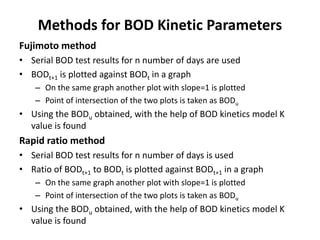
Fujimoto method
• Serial BOD test results for n number of days are used
• BODt+1 is plotted against BODt in a graph
– On the same graph another plot with slope=1 is plotted
– Point of intersection of the two plots is taken as BODu
• Using the BODu obtained, with the help of BOD kinetics model K
value is found
Rapid ratio method
• Serial BOD test results for n number of days is used
• Ratio of BODt+1 to BODt is plotted against BODt+1 in a graph
– On the same graph another plot with slope=1 is plotted
– Point of intersection of the two plots is taken as BODu
• Using the BODu obtained, with the help of BOD kinetics model K
value is found
Methods for BOD Kinetic Parameters
Thomas method
• Serial BOD test results are needed
• The kinetic parameters determination is based on the following
equation (Thomas equation)
• (t/BOD)1/3 is plotted against t
• (KL0)1/3 is obtained as intercept and K2/3/6L1/3 as slope
• Form the slope and intercept K and L are calculated
  t
L
K
LK
BOD
t
.
6
.
3
1
0
3
2
3
1
0
3
1






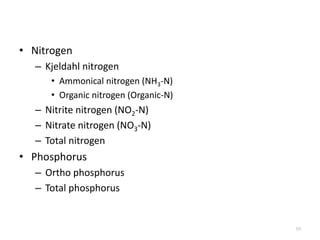
Nutrients
• Nitrogen
– Kjeldahl nitrogen
• Ammonical nitrogen (NH3-N)
• Organic nitrogen (Organic-N)
– Nitrite nitrogen (NO2-N)
– Nitrate nitrogen (NO3-N)
– Total nitrogen
• Phosphorus
– Ortho phosphorus
– Total phosphorus
59
Total Kjeldahl Nitrogen
Organic-N
• Organically bound nitrogen is in the trinegative state
• Natural materials like proteins, peptides, nucleic acids and urea, and
many synthetic organic materials have organic-N
Ammonical-N
• Deamination of organic-N and hydrolysis of urea produce
ammonical-N
• Ammonical-N encountered in waters is <10 µg (in ground waters) to
>30 mg/l (in some wastewaters)
– Groundwater has low ammonical-N (soil absorbs and does not allow
leaching)
• Ammonia is often added to water in WTPs for forming combined
residual chlorine
Analytically organic-N and ammonical-N can be determined
together and referred to as Total Kjeldahl Nitrogen (TKN)
61
Methods of Analysis
Ammonical-N can be measured by:
– Nesslerization method (sensitive to 20 µg/l and used for <5 mg/l)
– Phenate method (sensitive to 10 µg/l and used <500 µg/l)
– Titrimetric method (preferred for higher levels, >5 mg/l)
– Ammonia selective electrode method (good for 0.03 to 1400
mg/l levels)
Usually samples need preliminary distillation
– When samples are turbid or coloured or having hydroxide
precipitates of calcium and magnesium (interfere with direct
methods)
– When samples are preserved with acid
When concentration is low, drinking water or clean surface
waters or good quality nitrified wastewater samples can be
tested by direct nesslerization or direct phenate methods - Still
for greater precision preliminary distillation is required 62
Organic-N of the sample can be measured from
– The residual left after preliminary distillation of the sample for
ammonical-N measurement or
– Sample after the removal of ammonical-N from it
• Measurement of organic-N involves
– Conversion of organic-N into ammonical-N through digestion
– Estimation of ammonical-N by one of the Ammonical-N
estimation methods
• Depending on the concentration, either macro-kjeldahl or
semi-micro-kjeldahl method is used for organic-N analysis
A sample is directly tested, without the preliminary distillation,
for TKN (ammonical-N plus organic-N) measurement
Methods of Analysis
63
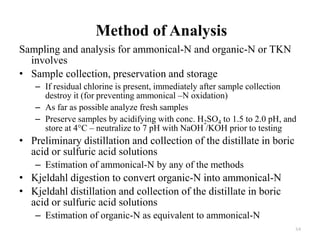
Sampling and analysis for ammonical-N and organic-N or TKN
involves
• Sample collection, preservation and storage
– If residual chlorine is present, immediately after sample collection
destroy it (for preventing ammonical –N oxidation)
– As far as possible analyze fresh samples
– Preserve samples by acidifying with conc. H2SO4 to 1.5 to 2.0 pH, and
store at 4°C – neutralize to 7 pH with NaOH /KOH prior to testing
• Preliminary distillation and collection of the distillate in boric
acid or sulfuric acid solutions
– Estimation of ammonical-N by any of the methods
• Kjeldahl digestion to convert organic-N into ammonical-N
• Kjeldahl distillation and collection of the distillate in boric
acid or sulfuric acid solutions
– Estimation of organic-N as equivalent to ammonical-N
Method of Analysis
64
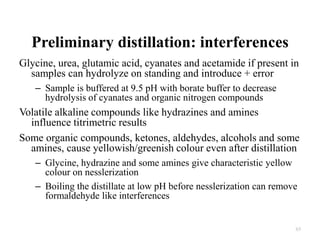
Preliminary distillation: interferences
Glycine, urea, glutamic acid, cyanates and acetamide if present in
samples can hydrolyze on standing and introduce + error
– Sample is buffered at 9.5 pH with borate buffer to decrease
hydrolysis of cyanates and organic nitrogen compounds
Volatile alkaline compounds like hydrazines and amines
influence titrimetric results
Some organic compounds, ketones, aldehydes, alcohols and some
amines, cause yellowish/greenish colour even after distillation
– Glycine, hydrazine and some amines give characteristic yellow
colour on nesslerization
– Boiling the distillate at low pH before nesslerization can remove
formaldehyde like interferences
65
66
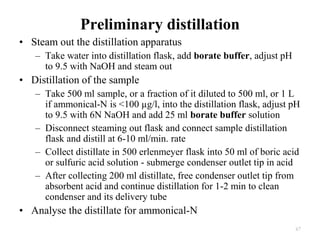
• Steam out the distillation apparatus
– Take water into distillation flask, add borate buffer, adjust pH
to 9.5 with NaOH and steam out
• Distillation of the sample
– Take 500 ml sample, or a fraction of it diluted to 500 ml, or 1 L
if ammonical-N is <100 µg/l, into the distillation flask, adjust pH
to 9.5 with 6N NaOH and add 25 ml borate buffer solution
– Disconnect steaming out flask and connect sample distillation
flask and distill at 6-10 ml/min. rate
– Collect distillate in 500 erlenmeyer flask into 50 ml of boric acid
or sulfuric acid solution - submerge condenser outlet tip in acid
– After collecting 200 ml distillate, free condenser outlet tip from
absorbent acid and continue distillation for 1-2 min to clean
condenser and its delivery tube
• Analyse the distillate for ammonical-N
Preliminary distillation
67
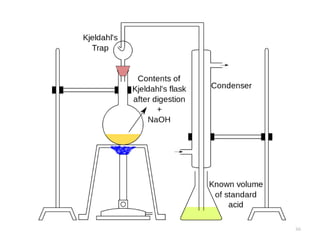
Kjeldahl digestion
Meant to convert organic-N into ammonical-N while not
affecting the other forms of nitrogen
– Fails to influence azide, azine, azo, hydrazone, nitrate, nitrite,
nitrile, nitro, nitroso, oxime and semi-carbazone nitrogens
Macro or semi micro kjeldahl digestion method is used
– Macro-kjeldahl method for samples with low organic-N
– Semi-micro-kjeldahl method for samples with high organic-N
In the presence of H2SO4, K2SO4 and (mercuric sulfate) catalyst
(all present in the digestion reagent) organic-N is converted
into ammonium sulfate
– During digestion ammonium complex is formed with mercury
and this is decomposed by sodium thiosulfate
– Even the free ammonia of the sample is converted into
ammonium sulfate
68
Hands on Training Program on Water and Wastewater Analysis (24-29th June, 2013)
Nitrate can prove both a + and a - interference
– At >10 mg/l, it can oxidize some fraction of the ammonical-N
during digestion
– In the presence of sufficient organic matter, nitrate can be
reduced to ammonical-N
The acid and the salt of the digestion reagent are meant for
producing 360-370°C temperature for digestion
– Higher salt concentration can raise the temp. to >400°C during
digestion and this can result in the pyrolytic loss of nitrogen
– Higher salt levels demand more acid for maintaining the desired
acid-salt balance (1 mL H2SO4 per gram of salt is needed)
– Too much acid can reduce digestion temp. to <360°C and this
can lead to incomplete digestion
– Higher levels of organic matter in the sample can consume more
acid – this can increase salt to acid ratio and the digestion
temperature (every 3 grams of COD requires 10 mL of acid)
Kjeldahl digestion: Interferences
69
Hands on Training Program on Water and Wastewater Analysis (24-29th June, 2013)
Digestion reagent:
• Dissolve 134 g K2SO4 in 650 ml water and 200 ml of conc. H2SO4.
• While stirring add 25 ml mercuric sulfate solution (8 g of mercuric
oxide in 100 ml of 6N H2SO4)
• Makeup the volume to one liter and keep the reagent at 20°C
– Toxicity and residues disposal are problems when mercuric sulfate is
used as a catalyst
– 10 ml of copper sulfate solution (25.115 g/L of CuSO4) per 50 ml
digestion reagent can be used in place of mercuric sulfate
– Selenium can also be a catalyst (but it is highly toxic and also acts as an
interference)
Sodium hydroxide-sodium thiosulfate reagent:
• Dissolve 500 g NaOH and 25 g Na2S2O3.5H2O in water and dilute to
one liter
Kjeldahl digestion
70
Hands on Training Program on Water and Wastewater Analysis (24-29th June, 2013)
• Take measured volume of sample in 800 ml capacity digestion
flask and diluted to 500 ml
Volume of the sample should be such that it has 0.2 to 2 mg of
TKN in it
• 500 ml when organic-N is 0.1-1 mg/l
• 250 ml when organic-N is 1-10 mg/l
• 100 ml when organic-N is 10-20 mg/l
• 50 ml when organic-N is 20-50 mg/l
• 25 ml when organic-N is 50-100 mg/l
• Take 1 L sample when organic –N is <0.1 mg/L and use bigger
Kjeldahl flask
• Remove ammonia by distillation after adding 25 ml borate
buffer and adjusting pH to 9.5 with 6N NaOH
– Distillate can be collected into boric acid or sulfuric acid for
determining ammonical-N of the sample
– Residue left behind after preliminary distillation of sample for
ammonical-N can be used for organic-N measurement
Kjeldahl digestion and distillation
71
Hands on Training Program on Water and Wastewater Analysis (24-29th June, 2013)
• Cool the sample after distillation removal of ammonical-N,
add 50 ml digestion reagent and glass beads, and mix contents
• Heat the digestion flask under hood with suitable ejection
equipment to briskly boil until the volume is reduced to 25-50
ml and release of copious white fumes
• Continue digestion for another 30 min. till the sample turns
clear or straw-coloured
• Cool the flask contents, dilute to about 300 ml, and add 50 ml
of hydroxide-thiosulfate reagent along the walls so as it forms
an alkaline layer at the flask bottom
• Connect the flask (with diluted digested sample and bottom
alkaline layer) to a steamed out distillation system
• Mix the contents and distillate (similar to the preliminary
distillation) and collect distillate into boric acid/ sulfuric acid
Run reagent blank parallel to the sample through all the steps and
apply necessary corrections to the results on the basis of the
blank results
Kjeldahl digestion and distillation
72
Hands on Training Program on Water and Wastewater Analysis (24-29th June, 2013)
Semi-micro Kjeldahl method
• Take measured volume of the sample, adjust to 50 mL, add 3
ml borate buffer and adjust pH to 9.5 with 6N NaOH
– 50 ml for 4-40 mg/l concentration
– 25 ml for 8-80 mg/l
– 10 ml for 20-200 mg/l
– 5 ml for 40-400 mg/l
• Transfer the contents to 100 mL semi-micro kjeldahl flask and
boil off 30 mL of the contents for remove the ammonical-N
• Add 10 ml digestion reagent and a few glass beads, heat till the
sample becomes clears and copious fumes come out, and
continue heating, at maximum heating, for 30 minutes more.
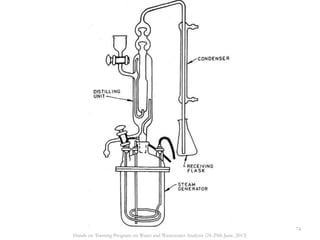
• Cool the contents and transfer into a micro-kjeldahl distillation
apparatus while ensuring the total volume <30 mL
• Add 10 mL hydroxide-thiosulfate reagent, turn on distillation,
and collect 30-40 ml distillate in 10 ml H3BO3/H2SO4 solution
73
Hands on Training Program on Water and Wastewater Analysis (24-29th June, 2013)
74
Hands on Training Program on Water and Wastewater Analysis (24-29th June, 2013)
Nesslerization method
• Undistilled samples
– Add 1 ml ZnSO4 solution (100 g ZnSO4.7H2O in 1 liter) to 100
mL of sample, mix, adjust pH to about 10.5 with 6N NaOH and
allow the sample to stand
– Clarify the supernatant by centrifuging or filtering prior to
nesslerization
• Can remove calcium, iron, magnesium, etc. (which form turbidity
on nesslerization) and suspended solids & colour
• Samples with >10 mg/l of NH3-N may loose some ammonia from
higher pH
– To 50 ml of the filtered/centrifuged (or a portion of it diluted to
50 ml) sample add a drop of EDTA reagent or 1 or 2 drops of
Rochelle salt solution, mix and then nesslerize
• Addition of EDTA or Rochelle salt solution inhibits precipitation of
calcium, iron, magnesium, etc., when nesslerized (but EDTA
demands additional nessler reagent)
75
Hands on Training Program on Water and Wastewater Analysis (24-29th June, 2013)
Nesslerization method
• Distilled samples
– Prepare standard solution (1 mL = 10 µg NH3-N) from stock
ammonium solution ((1 mL = 1 mg of NH3-N)
– Distill samples, standards and reagent blanks and collect distillate for
nesslerization
– Dilute the distillate plus boric acid solution to 500 mL volume and take
50 mL for nesslerization
• Nesslerize the sample with 2 mL Nessler reagent (if the sample
is already neutralized with NaOH use only 1 mL)
– For the reaction to occur allow at least 10 min. (when NH3-N is very
low use 30 min. reaction time)
– Keep temperature and reaction time same for samples, blanks
and standards
76
Hands on Training Program on Water and Wastewater Analysis (24-29th June, 2013)
Nesslerization method
• Measure transmittance or absorbance of samples and standards
against reagent blank by spectrophotometer
– For low NH3-N levels (0.4 to 5.0 mg/l) measure colour at 400-
425 nm and use light path of 1 cm (5 cm light path allows
measurements as low as 5-60 µg/L)
– For NH3-N levels approaching 10 mg/l use 450-500 nm
wavelength
– Measurements for standards are used for calibration
• Visual comparison against standards can be alternative to
spectrophotometer
– Temporary standards prepared from standard NH4Cl in the range
of 0-6 ml in 50 mL water and nesslerized by adding 1 ml of
Nessler reagent can be used
– Permanent standards prepared from potassium chloroplatinate
and cobaltous chloride solutions and calibrated against
temporary standards can also be used
77
Hands on Training Program on Water and Wastewater Analysis (24-29th June, 2013)
– EDTA reagent: dissolve 50 g of ethylene diamine tetra
acetate dihydrate in 60 ml water containing 10 g NaOH
(heat to dissolve if needed and cool to room temp.) and
dilute to 100 mL
– Rochelle salt solution: dissolve 50 g of potassium sodium
tartrate tetra hydrate in 100 ml water, boil out to reduce
volume to 30 ml, cool and dilute 100 ml
– Stock ammonium solution: dissolve 3.819 g anhydrous
NH4Cl (dried at 100°C) in water and adjust volume to 1
liter (1 mL = 1 mg of NH3-N)
– Nessler reagent: dissolve 160 g NaOH in water, cool,
slowly add mixer of 100 g of mercuric iodide (HgI2) and 70
g potassium iodide (KI) dissolved in water, and adjust
volume to 1 liter
Nesslerization method
78
Hands on Training Program on Water and Wastewater Analysis (24-29th June, 2013)
Titrimetric method
• Distillate collected into boric acid solution is used
– Sample size: 250 ml for 5-10 mg/l of NH3-N; 100 ml for 10-20
mg/l; 50 ml for 20-50 mg/l and 25 ml for 50-100 mg/l
– Indicating boric acid: dissolve 20 g of H3BO3 in water, add 10 ml
of mixed indicator and adjust volume to 1 liter
– Mixed indicator: dissolve 200 mg of methyl red in 100 mL of
95% ethyl or isopropyl alcohol and 100 mg of methylene blue in
50 mL of 95% ethyl or isopropyl alcohol and mix the two
• Titrate the distillate with 0.02N H2SO4 to pale lavender colour
end point (1ml titrant used = 280 µg of NH3-N)
• Run blank through all the steps and correct results
79
Hands on Training Program on Water and Wastewater Analysis (24-29th June, 2013)
Phenate method
• Method is good for 10 to 500 µg/l
• Preliminary distillation of sample and collection of distillate
• Alkalinity >500 mg/l, acidity >100 mg/l and turbidity can
interfere with direct phenate method
• Distillate is collected into 0.04N H2SO4
• Ammonia is made to react with hypochlorite and phenol in
the presence of manganous salt catalyst to form indophenol
(an intensely blue coloured compound)
• Concentration of indophenol is measured by
spectrophotometer at 630 nm at path length of 1cm
80
Hands on Training Program on Water and Wastewater Analysis (24-29th June, 2013)
Ammonia selective electrode method
Uses hydrophobic gas permeable membrane to separate sample
from an electrode internal solution (NH4Cl)
• By raising pH to 11 NH3-N is converted into gaseous form
• Gaseous NH3 diffuses through membrane and changes pH of the
internal solution
• This changes the millivolt reading of the meter proportional to NH3-
N concentration
Measurement
• 100 ml sample is taken, and ammonia selective electrode is
immersed in it
• While mixing with magnetic stirrer pH of the sample is adjusted to
11 by adding 10N NaOH
• After stabilization take millivolt reading for the sample
81
Hands on Training Program on Water and Wastewater Analysis (24-29th June, 2013)
Ammonia selective electrode method
Calibration
• Prepare standards with 1000, 100, 10, 1 and 0.1 mg/l levels
• Take millivolt reading for each of the standards in a way similar to
that of sample
• Plot readings on semi-log plot (take concentrations on the log axis
and millivolt readings on linear axis)
Method is applicable for measurement of 0.03 to 1400 mg/l
The sample does not require distillation
Interference
• High concentration of dissolved ions affect the measurement but
color and turbidity do not
• Amines introduce positive error
• Mercury & silver through complexing introduce negative error
82
Hands on Training Program on Water and Wastewater Analysis (24-29th June, 2013)
Nitrite nitrogen and Nitrate
nitrogen
Nitrite and Nitrate Nitrogen
• Oxidized Nitrogen may be present in water mainly in two
forms: nitrite and nitrate
• Nitrite
• Represents an intermediate oxidation state and present
usually in very low concentrations
• Often used as corrosion inhibitor in industrial process water
• Nitrate
• Occurs in trace quantities in surface water (however,
wastewaters of biological nitrifying treatment plants can
have upto 30 mg/L), but ground waters have higher levels
• High levels of nitrate in water can be problematic
– thought to be toxic to humans, particularly to babies –
contributes to methemoglobinemia
– oxidized nitrogen is a factor in the eutrophication of waters
• All forms of nitrogen (reduced and oxidized) can be digested
and converted into nitrate for measuring as total nitrogen 84
Hands on Training Program on Water and Wastewater Analysis (24-29th June, 2013)
Sample preservation and storage
• Samples for nitrate
– Samples should be promptly analyzed
– Store at 40C up to 2 days (24 hr.!)
– Unchlorinated samples can be preserved with 2 mL/L conc
H2SO4 and stored at 40C
• Samples for nitrite
– Analyse promptly, if not nitrite can be converted into
nitrate/ammonia by bacteria
– Freeze sample at –20°C for preservation or store at 4°C for
short-term preservation (1 to 24 hrs.)
• For acid preserved samples nitrate and nitrite can not be
determined as individual species
85
Hands on Training Program on Water and Wastewater Analysis (24-29th June, 2013)
Methods of analysis
• Nitrite
– Colorimetric method – suitable for 5 to 1000 µg/L – acid
preservation for samples should not be used
– Ion-chromatography
• Nitrate
– UV Spectrophotometric Method – used for screening
uncontaminated water low in organic matter
– Cd-reduction Method (range 0.01 – 1.0 mg/L)
– Ion Chromatography or capillary ion electrophoresis
– Nitrate electrode method (0.14 – 1400 mg/L)
• Total nitrogen
– Measured through conversion of all (reduced and oxidized)
forms of nitrogen into nitrate and estimation of nitrate
– Persulfate/UV digestion or persulfate digestion is used
• Not effective for wastes with high (suspended) organic loadings
• Recovery of some industrial nitrogen containing compounds is low86
Hands on Training Program on Water and Wastewater Analysis (24-29th June, 2013)
Nitrite -N: Colorimetric method
Good for 10 to 1000 g/L levels (light path of 5 cm allows
measurement in the 5-50 g/L range)
Nitrite forms reddish purple azo dye at 2-2.5 pH by coupling diazotized
sulfanilamide with N-1(1-naphthyl)-ethylene diamine dihydro
chloride (NED dihydrochloride)
Interferences
– NCl3 imparts false red colour
– Sb3+, Au3+,Bi3+,Fe3+,Pb2+,Hg3+,Ag3+, chloroplatinate (PtCl6
2-) and
metavanadate can precipitate under test conditions and interfere
– Cupric ion can catalyze decomposition of the diazonium salt and
introduce negative error
– Colored ions and suspended solids can also interfere
Use nitrite free water during sample analysis for nitrite
87
Hands on Training Program on Water and Wastewater Analysis (24-29th June, 2013)
Nitrite -N: Colorimetric method
• Filter the sample through 0.45 m pore membrane filter and adjust
pH to 5-9 with HCl or NH4OH
• Take 50 ml or a portion diluted to 50 ml (dilution when conc. is >1.0
mg/L) and add 2 ml colour reagent and mix
• After 10 min but before 2 hrs measure absorbance at 543 nm
• Treat standards also with colour reagent and measure absorbance
– Plot absorbance of standards against NO2
- concentration for obtaining
a standard/calibration curve
• Read sample’s nitrite concentration from the standard curve
Colour reagent: add 100 ml of 85% phosphoric acid to 800 ml water,
dissolve 10 g of sulfanilamide, then dissolve 1 g of N-(1-naphthyl)-
ethylenediamine dihydrochloride, and adjust volume to 1 liter – can
be stored upto a month in dark bottle in refrigerator
Standard stock solution : dissolve 1.232 g NaNO2 in water and dilute to
1000ml: 1 mL = 250µg Nitrite -N
88
Hands on Training Program on Water and Wastewater Analysis (24-29th June, 2013)
Nitrate: Cd reduction method
• Range: 0.01 to 1 mg/L Nitrate-N
• Nitrate-N is almost quantitatively reduced to Nitrite-N in the
presence of cadmium (Cd).
• Nitrite thus produced is diazotized with sulfanilamide and
coupled with N-(1–naphthyl)-ethylene diamine dihydro
chloride to form colored azo dye
• The colour intensity is measured spectrophotometrically
• Correction is needed for the nitrite-N originally present in the
sample
– Testing the sample for nitrite without subjecting it to nitrate
reduction step is used for the correction needed
89
Hands on Training Program on Water and Wastewater Analysis (24-29th June, 2013)
Nitrate: Cd reduction method
Handling interferences
• Turbid samples need filtering through 0.45 µm pore (nitrate
free) membrane filter
– Suspended solids will restrict sample flow so pre filtration is
needed
• EDTA is added to remove interference from iron, copper or
other metals
• Residual chlorine if present is removed by dechlorination with
sodium thiosulfate
• If oil and grease are present the sample is pre-extracted with
organic solvent.
• Chloride ions can significantly decrease the rate of reduction
90
Hands on Training Program on Water and Wastewater Analysis (24-29th June, 2013)
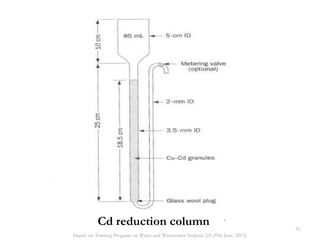
Cd reduction column 91
Hands on Training Program on Water and Wastewater Analysis (24-29th June, 2013)
Cd reduction column
Cd reduction column
• Constructed from two pieces of tubing (3.5 mm ID and 2 mm ID
tubing) joined end to end
• 3 cm ID and 10 cm long tube is fused on the top of 25 cm long and
3.5 mm ID tubing
• Stopcock arrangement is made to allow control of flow rate
Activation
• Wash the column with 200 mL dilute NH4Cl-EDTA solution
• Activate the column by passing >100 mL of a solution (of 25% 1.0
mg/L nitrate standard and 75% NH4Cl-EDTA solution) through the
column at 7 to 10 mL/min, rate.
Ammonium chloride-EDTA solution: dissolve 13 g NH4Cl and 1.7 g
disodium ethylene diamine tetra acetate (EDTA) in 900 mL water,
adjust pH to 8.5 with NH4OH and dilute to 1L.
92
Hands on Training Program on Water and Wastewater Analysis (24-29th June, 2013)
Nitrate: Cd reduction method
• Screen the sample and adjust the pH between 7 and 9.
• To 25.0 mL sample (or a portion diluted to 25.0 mL), add 75
mL NH4Cl- EDTA solution, mix and pass through the column
at 7 to 10 mL/min. rate - discard the first 25 mL, and collect
the rest in original sample flask.
• Within 15 min after reduction, add 2.0 mL color reagent to 50
mL sample and mix, and within 10 min. to 2 hours measure
absorbance at 543 nm
• From the stock solution, prepare (100 mL) standards in the
range 0.05 to 1.0 mg/L nitrate-N
• Carry out cadmium reduction of the standards exactly as has
been done for the sample.
Stock nitrate solution (1.00mL = 100µg NO3
- -N): dissolve 0.7218 g
dry potassium nitrate in water and dilute to 1000 mL – preserve the
stock solution with 2mL CHCl3 /L.
– Intermediate stock nitrate solution (of 1.0 mL = 10 µg NO3
- -N
strength) is prepared from this stock for routine use 93
Hands on Training Program on Water and Wastewater Analysis (24-29th June, 2013)
Nitrate: Ion electrode method
Interferences
• Chloride and bicarbonate ions interfere when their weight
ratios to nitrate-N are >10 and >5, respectively
• NO2–, CN–, S2–, Br–, I–, ClO3–, and ClO4– are also
potential interferences (but do not normally occur at
significant levels in potable waters)
• Electrodes function satisfactorily in buffers over 3 to 9 pH
range – but for avoiding erratic responses pH is held constant
• Since the electrode responds to nitrate activity, ionic strength
must be constant in all the samples and the standards
• A buffer solution containing
a) Ag2SO4 to remove Cl–, Br–, I–, S2–, and CN–,
b) sulfamic acid to remove NO2–,
c) a buffer at pH 3 to eliminate HCO3– and to maintain a constant
pH and ionic strength, and
d) Al2(SO4)3 to complex organic acids is used 94
Hands on Training Program on Water and Wastewater Analysis (24-29th June, 2013)
Nitrate: Ion electrode method
Preparation of calibration curve
• Transfer 10 mL of 1 mg/L nitrate -N standard to a 50-mL
beaker, add 10 mL buffer, and stir with a magnetic stirrer
– Immerse the electrode tip and record millivolt reading when
stable (after about 1 min)
– Remove the electrode, rinse, and blot dry
• Repeat this for 10 mg/L and 50 mg/L nitrate-N standards
• Plot potential measurements against nitrate -N concentration
on semilog graph paper (nitrate-N on the log axis and potential
on the linear axis)
– A straight line with a slope of +57 ±3 mV/decade at 25°C should
result
• Recalibrate electrodes several times daily (check potential
reading for 10 mg/L nitrate-N standard and adjust the
calibration control until the reading plotted on the calibration
curve is displayed again 95
Hands on Training Program on Water and Wastewater Analysis (24-29th June, 2013)
Measurement of sample:
• Transfer 10 mL sample to a 50-mL beaker, add 10 mL buffer
solution, and stir (for about 1 min) with a magnetic stirrer
• Immerse electrode tip in sample and record potential reading when
stable (after about 1 min).
• Measure standards and samples at about the same temperature.
• Read concentration from calibration curve.
The electrode responds to nitrate ion activity corresponding to
0.14 to 1400 mg/L nitrate –N
Buffer solution: Dissolve 17.32 g Al2(SO4)318H2O, 3.43 g
Ag2SO4, 1.28 g H3BO3, and 2.52 g sulfamic acid (H2NSO3H),
in 800 mL water. adjust to pH 3.0 by 0.10N NaOH, makeup
volume to 1000 mL and store in a dark glass bottle
Nitrate: Ion electrode method
96
Hands on Training Program on Water and Wastewater Analysis (24-29th June, 2013)
Nitrate: UV Spectrophotometric Method
• Used for samples having low organic matter
• Nitrate ion and organic matter absorb at 220 nm and only
organic matter absorbs at 275 nm
• Interferences
– Dissolved organic matter, surfactants and Cr6+
– Acidification with 1N HCl can prevent the interference from
hydroxide or carbonate concentration
• Procedure
• Filter the sample and add 1 mL of 1 N HCl to 50 mL sample.
• Prepare 50 mL each of NO3
- calibration standards in the range
from 0 to 7 mg/L NO3
- -N from the stock
• Read absorbance at 220 nm and 275 nm
• Construct a standard/calibration curve by plotting concentration
against corrected absorbance.
• Discard the method if correction value is more than 10% of the
reading at 220nm 97
Hands on Training Program on Water and Wastewater Analysis (24-29th June, 2013)
Sample
Standards
NO3
- -N/L
Absorbace
at 220 nm
( R )
Absorbance
at 275 nm
(S)
T = 2S U=R-T
0.2
0.4
0.8
1.4
2
7
Nitrate: UV Spectrophotometric Method
Discard the method if correction value is more than 10% of the
reading at 220nm
98
Hands on Training Program on Water and Wastewater Analysis (24-29th June, 2013)
Total nitrogen
Total Nitrogen
Chemicals
• Borate buffer solution: Dissolve 61.8 g boric acid, H3BO3, and
8.0 g NaOH in water and dilute to 1000 mL.
• Copper sulfate solution: Dissolve 2.0 g CuSO4˜5H2O in 90 mL
water and dilute to 100 mL.
• Ammonium chloride solution: Dissolve 10.0 g NH4Cl in
water, adjust to pH 8.5 by adding NaOH pellets or NaOH
solution and make up volume to 1 L (stable for 2 weeks when
refrigerated)
• Color reagent: Combine 1500 mL water, 200.0 mL conc.
H3PO4, 20.0 g sulfanilamide, and 1.0 g N-(1-naphthyl)-
ethylene diamine dihydro chloride, dilute to 2000 mL, add 2.0
mL polyoxyethylene 23 lauryl ether and store at 4°C in the
dark (stable for 6 weeks)
100
Hands on Training Program on Water and Wastewater Analysis (24-29th June, 2013)
Total Nitrogen
• Calibration standards: Prepare nitrate calibration standards
(100 mL) in 0 to 2.9 mg/L range, and treat the standards in the
same manner as samples.
• Digestion check standard: Prepare glutamic acid digestion
check standard of 2.9 mg N/L by diluting the stock, and treat
the digestion check standard in the same manner as samples.
• Blank: Carry a reagent blank through all steps of the procedure
and apply necessary corrections to the results
Stock glutamic acid solution: Dry glutamic acid,
C3H5NH2(COOH)2, in an oven at 105°C for 24 h. Dissolve
1.051 g in water and dilute to 1000 mL; 1.00 mL = 100 Pg N.
Preserve with 2 mL CHCl3/L.
– Intermediate glutamic acid solution (1.00 mL = 10.0 Pg N)
101
Hands on Training Program on Water and Wastewater Analysis (24-29th June, 2013)
Total Nitrogen
Digestion:
• Samples should not be preserved with acid for digestion
• To a culture tube (20 mm OD and 150 mm long), add 10.0 mL
sample (or a portion diluted to 10.0 mL) or standard, add 5.0 mL
digestion reagent, cap tightly, mix by inverting twice
– In case of reagent blank, 10 mL water is taken in place of sample
• Heat for 30 min in autoclave/ pressure cooker at 100 to 110°C
• Slowly cool to room temperature, add 1.0 mL borate buffer solution,
mix by inverting twice
Nitrate measurement: Determine by cadmium reduction
Digestion reagent: Dissolve 20.1 g low nitrogen (<0.001% N)
potassium persulfate, K2S2O8, and 3.0 g NaOH in water and
dilute to 1000 mL just before use
Borate buffer solution: Dissolve 61.8 g boric acid, H3BO3, and
8.0 g NaOH in water and dilute to 1000 mL.
102
Hands on Training Program on Water and Wastewater Analysis (24-29th June, 2013)
Chemicals
• Colour reagent: add 100 ml of 85% phosphoric acid to 800 ml
water, dissolve 10 g of sulfanilamide, then dissolve 1 g of N-(1-
naphthyl)-ethylenediamine dihydrochloride, and adjust volume to 1
liter – can be stored upto a month in dark bottle in refrigerator
• Standard stock solution : dissolve 1.232 g NaNO2 in water and
dilute to 1000ml: 1 mL = 250µg Nitrite -N
• Ammonium chloride-EDTA solution: dissolve 13 g NH4Cl and 1.7 g
disodium ethylene diamine tetra acetate (EDTA) in 900 mL water,
adjust pH to 8.5 with NH4OH and dilute to 1L.
• Stock nitrate solution (1.00mL = 100µg NO3
- -N): dissolve 0.7218 g
dry potassium nitrate in water and dilute to 1000 mL – preserve the
stock solution with 2mL CHCl3 /L.
– Intermediate stock nitrate solution of 1.0 mL = 10 µg NO3
- -N
strength is prepared from it used
103
Hands on Training Program on Water and Wastewater Analysis (24-29th June, 2013)
Nitrite free water
• Add a small crystal of KMnO4 and Ba(OH)2 or Ca(OH)2 to
distilled water and redistill in all borosilicate glass apparatus to
obtain nitrite free water
– Initial 50 mL of the redistillate and final distillate with permangamage
(giving red colour with DPD reagent) should be discarded
• Add 1 mL/L of conc. H2SO4 and 0.2 mL/L of MnSO4 solution
(36.4 g of MnSO4.H2O in distilled water and 1 liter final
volume), make the water pink by adding 1 to 3 ml of KMnO4
solution and redistill
104
Hands on Training Program on Water and Wastewater Analysis (24-29th June, 2013)
Phosphorus
Importance
• Used extensively in the treatment of boiler water (tri-sodium
phosphate) to control scaling
– At higher temperatures polyphosphates are hydrolyzed into
orthophosphates
• Essential for growth of organisms
– Limiting & important nutrient for primary productivity of water
bodies
– applied in agriculture as fertilizers (orthophosphates)
– microbes of wastewater treatment plants require phosphorus -
domestic effluents have enough of it
– Biological sludge is rich (1%, in case heat dried ASP sludge it is
1.5%) – has good fertilizer value
• Excess in water bodies causes eutrophication
– 0.005 mg/l of available phosphorus is critical for algal blooms to
occur
106
Hands on Training Program on Water and Wastewater Analysis (24-29th June, 2013)
Sources
Domestic waste, prior to synthetic detergents, contains 2-3 mg/l of
inorganic form and 0.5-1.0 mg/l of organic form
– Polyphosphates added to water supplies (to control corrosion), soft water (to
stabilize CaCO3) and to water (during laundering or other cleaning
processes) find their way into sewage
– Synthetic detergents use increased inorganic form by 2-3 times (have
polyphosphates as builders, 12-13% or more)
– Body wastes and food residues contribute organic form – liberated during
metabolic breakdown of proteins and comes out in urine (1.5 g/day per
capita)
Industrial effluents – mostly inorganic forms
– Boiler blowdown water is important source - at higher temperatures even the
poly forms are hydrolyzed into ortho form
Agricultural run off - fertilizer applied (orthophosphates) and organic phosphorus
are found
Poly forms of water bodies get gradually hydrolyzed into ortho forms
– high temperature and low pH increases the hydrolysis rates
– Enzymes of microorganisms also bring about hydrolysis
107
Hands on Training Program on Water and Wastewater Analysis (24-29th June, 2013)
Classification and forms
Present in water and wastewater mostly as phosphates
Classified as
– Orthophosphates – mono, di and trisodium phosphates and
diammonium phosphate
– Poly (condensed) phosphates (pyro, meta and other polyphosphates)
– sodium hexameta phosphate, sodium tripolyphosphate,
tetrasodium pyrophosphate
– Organically bound phosphates - formed primarily by biological
processes – occurs both in dissolved and suspended forms
Can be present in water as
– soluble phosphates
– particulate phosphates in particles or detritus
• precipitated inorganic forms in the bottom sediments
• incorporated into organic compounds in the biological
sludge/debris
– In the bodies of the aquatic organisms
108
Hands on Training Program on Water and Wastewater Analysis (24-29th June, 2013)
• Filtering through 0.45 m pore size membrane filter is believed to
separate dissolved form of phosphorus from suspended form
• Analytically phosphorus of a sample can be divided into three
chemical types
– Reactive phosphorus
– Acid-hydrolysable phosphorus (polyphosphates)
– Organic phosphorus
• Reactive phosphorus: Phosphorus that respond to colorimetric
tests without preliminary hydrolysis or oxidative digestion
– Can include both dissolved and suspended forms
– Largely a measure of orthophosphate
Classification and forms
109
Hands on Training Program on Water and Wastewater Analysis (24-29th June, 2013)
• Acid-hydrolysable phosphorus: phosphorus that is converted into
into dissolved orthophosphate on acid hydrolysis at boiling water
temperature
– Mostly condensed phosphate and can be both suspended and
dissolved condensed phosphate
– Some fraction of the organic phosphate can also be hydrolyzed
– Appropriate selection of acid strength, hydrolysis time and
temperature can minimize hydrolysis of organic phosphate
• Organic or organically bound phosphorus: phosphate fraction that
is converted to orthophosphate only by oxidative destruction of
organic matter
– Can be in both soluble and particulate forms
Classification and forms
110
Hands on Training Program on Water and Wastewater Analysis (24-29th June, 2013)
Phosphate estimation
Analysis involves two steps
– Conversion of the phosphorus form of interest to dissolved
orthophosphate
– Colorimetric determination of dissolved orthophosphate
Digestion should oxidize the organic matter and release phosphorus as
orthophosphate – There are three methods
– Perchloric acid method (very drastic and time consuming method – used for
difficult samples such as sediments
– Nitric acid – sulfuric acid method – recommended for most samples
– Persulfate oxidation method – simplest method – prior to adopting make
comparison with the two drastic methods
Gravimetric, volumetric and colorimetric methods can be used for
estimating ortho forms
– Gravimetric is suitable for very high concentrations
– For >50 mg/l volumetric is appropriate (boiler blowdown water and
anaerobic digester supernatant)
– For usually encountered levels colorimetric is preferred
111
Hands on Training Program on Water and Wastewater Analysis (24-29th June, 2013)
Colorimetric: After digestion the liberated orthophosphate is
determined by
– Vanadomolybdophosphoric acid colorimetric method – good for
concentration range of 1 to 20 mg/l
– Stannous chloride method – good for 0.01 to 6 mg/l
– Ascorbic acid method
Different forms of phosphorus
Poly-P = acid hydrolysable-P – ortho-P
Organic-P = digested-P – acid hydrolysable-P
Phosphate estimation
112
Hands on Training Program on Water and Wastewater Analysis (24-29th June, 2013)
Selection of method depends largely on concentration range of the
orthophosphate
– In case of lower concentrations in order to overcome interferences an
extraction step may be added
For finding different forms of phosphorus, subject the sample to
– Direct colorimetric – gives reactive phosphorus
– Acid hydrolysis and then colorimetric – gives both reactive phosphorus and
acid hydrolysable phosphorus
– Digestion and then colorimetric – gives total phosphorus (reactive, acid
hydrolysable and organic phosphorus)
For getting the dissolved fractions of different forms of phosphorus filter
the sample and test the filtrate
Phosphate estimation
113
Hands on Training Program on Water and Wastewater Analysis (24-29th June, 2013)
Sample reservation and storage and other
precautions
For preserving, freeze the sample at or below –10C
For storing the sample for longer periods add 40 mg/l of HgCl2 (a
hazardous substance) to the sample
If interest is to estimate different forms of phosphorous avoid adding acid
or CHCl3 as a preservative
In case of estimation of total phosphorus 1 ml HCl/liter of sample can be
added for preservation – in case of freezing there is no need to add any
acid
Samples with low phosphorus concentration should not be stored in plastic
bottles because walls of the bottles adsorb phosphorus
Prior to use all glass containers should be first rinsed with hot dilute HCl
Commercial detergents containing phosphorus should not be used for
cleaning
114
Hands on Training Program on Water and Wastewater Analysis (24-29th June, 2013)
Sample preparation (including digestion)
Depending on the need filter the sample through 0.45 um membrane
filter (in case of hard to filter samples filter through a glass fiber
filter)
– Before use, wash the membrane filter by soaking in distilled water
(change the distilled water at least once) or by filtering several
batches of 100 ml distilled water samples through the membrane
filter
Acid hydrolysable phosphorus:
– Taken as the difference between the phosphorus measured in the
untreated sample and that measured in acid hydrolyzed sample
– Includes condensed phosphates (pyro, tripoly and higher molecular
weight phosphates like hexametaphosphate)
– Some organo phosphate compounds natural water samples may also
get hydrolyzed and contribute
115
Hands on Training Program on Water and Wastewater Analysis (24-29th June, 2013)
Acid hydrolysis procedure
1. Acidify known volume of sample (add 1/2 drops
phenolphthalein, discharge colour by drop wise addition of
strong acid solution (SAS), and add SAS (1:100)
– Prepare strong acid solution by slowly adding concentrated 300 ml of
H2SO4 to 600 ml distilled water, cool and add 4 ml of concentrated HNO3
and then making up volume to one liter
2. Carry out hydrolysis by either of the following
– Gently boiling acidified sample for > 90 min. (do not allow sample volume
to drop below 25% of the original - add distilled water
– autoclave acidified sample at 98-137 kPa for 30 minutes
3. Cool, neutralize hydrolyzed sample with 6N NaOH to faint pink
& adjust to original volume with distilled water
Use a calibration curve constructed from the acid hydrolyzed series of
standards in the colorimetric measurement
116
Hands on Training Program on Water and Wastewater Analysis (24-29th June, 2013)
Perchloric acid digestion
Heated mixtures of HClO4 and organic matter can explode violently
– Do not add HClO4 to hot solutions containing organic matter
– Initiate digestion with HNO3 and complete digestion using mixture
of HNO3 and HClO4
– Use hoods specially constructed for HClO4 fuming (connected to a
water pump)
– Do not allow the sample to evaporate to dryness during dryness
117
Hands on Training Program on Water and Wastewater Analysis (24-29th June, 2013)
Digestion process
– Take measured volume of sample (containing desired quantity of
phosphorus) in a conical flask, acidify to methyl orange with con.
HNO3 and then add 5 ml of con. HNO3
– Evaporate acidified sample on hotplate/steam bath to 15-20 ml
volume
– Cool, add 10 ml of con. HNO3, cool and add 10 ml of HClO4
– Add few boiling chips and gently evaporate on hot plate until dense
white fumes of HClO4 appear
– if the contents are not clear cover the flask with watch glass and keep
them barely boiling till they become clear – if needed add 10 ml more
of HNO3
– Cool the contents, add phenolphthalein and neutralize to pink colour
with 6N NaOH - If needed filter the sample (wash the filter with
distilled water)
– Makeup the volume to 100 ml
Use a calibration curve constructed from the perchloric acid digested
series of standards in the colorimetric measurement
Perchloric acid digestion
118
Hands on Training Program on Water and Wastewater Analysis (24-29th June, 2013)
Sulfuric acid-nitric acid digestion
• Take measured volume of sample containing desired amount of
phosphate into micro-kjeldahl flask, and add I ml of conc. H2SO4
and 5 ml of conc. HNO3
• Digest the sample on a digestion rack with provision for fumes
withdrawal to 1 ml volume and continue till the sample becomes
colourless (HNO3 removed)
• Cool and add about 20 ml distilled water, add phenolphthalein
indicator and neutralize with 1N NaOH to pink stinge, and if
needed filter the solution to remove suspended matter and
turbidity
• Makeup the final volume to 100 ml
Use a calibration curve constructed from the sulfuric acid-nitric acid
digested series of standards in the colorimetric measurement
119
Hands on Training Program on Water and Wastewater Analysis (24-29th June, 2013)
Persulfate digestion method
Take measured volume of sample (50 ml of less), add
phenolphthalein indicator and discharge colour with drop-wise
addition of H2SO4 solution
– Prepare H2SO4 solution by slowly adding 300 ml of conc. H2SO4 to 600 ml
distilled water and then making up volume to one liter
Add additional 1 ml acid solution and 0.4 g of solid ammonium
persulfate or 0.5 g of solid potassium persulfate
Boil the sample on hotplate for 30-40 min. till volume is reduced to
10 ml (certain organophosphorus compounds may require 1.5 to 2
hours digestion) or
Autoclave the sample at 98-137 kPa for 30 minutes
Cool the digested contents, add phenolphthalein indicator and
neutralize to faint pink colour with 1 N NaOH
120
Hands on Training Program on Water and Wastewater Analysis (24-29th June, 2013)
Makeup the volume to 100 ml
do not worry if precipitate is formed – shake well if the sample is
subdivided – acidic conditions of colorimetric testing may re-dissolve
the precipitate
Use calibration curve constructed from persulfate digested series of
standards in the colorimetric measurement
Persulfate digestion method
121
Hands on Training Program on Water and Wastewater Analysis (24-29th June, 2013)
Vanadomolybdophosphoric acid
colorimetric method
Under acidic conditions sample’s orthophosphate reacts with
ammonium molybdate and forms molybdophosphoric acid
– In the presence of vanadium, molybdophosphoric acid produces
yellow colour (proportional to con. of phosphate)
– Colour intensity is measured as absorbance at 400-490 nm
Take 50 ml sample, adjust pH by discharging phenolphthalein colour
with 1:1 HCl and makeup volume to 100 ml
– HNO3 or H2SO4 or HClO4 can be substitute for HCl
– If sample is coloured shake 50 ml of the sample with 200 mg of
activated carbon for 5 min and filter to remove carbon
– Take care activated carbon itself is having any phosphate
    OHNHMoOPONHHMoONHPO 243434424
3
4 122112.2412  
122
Hands on Training Program on Water and Wastewater Analysis (24-29th June, 2013)
• Take 35 ml sample or less containing 0.05 to 1.0 mg/l of
phosphate into 50 ml volumetric flask
• Add 10 ml of vanadate-molybdate reagent and then makeup
volume to the mark with distilled water
– Dissolve 1.25 g of ammonium metavanadate, NH4VO3, in 300 ml of
distilled water by heating to boiling; cool and add 330 ml of conc.
HCl; cool and add 25 g of ammonium molybdate
(NH4)6Mo7O24.4H2O dissolved in 300 ml distilled water; and
makeup final volume to one liter
– Room temperature variations affect colour intensity
• After 10 minutes or more measure absorbance of the sample at
400-490 nm
• Maintain blank also
Vanadomolybdophosphoric acid
colorimetric method
123
Hands on Training Program on Water and Wastewater Analysis (24-29th June, 2013)
• Prepare calibration curve by using suitable volumes of standard
phosphate solutions parallel with the sample and the blank
– Prepare stock standard phosphate solution by dissolving 219.5 mg of
anhydrous KH2PO4 in one liter solution to get 1ml=0.05 mg
phosphate
– calibration curves may be constructed at various wavelengths
between 400-490 nm
Vanadomolybdophosphoric acid
colorimetric method
124
Hands on Training Program on Water and Wastewater Analysis (24-29th June, 2013)
Unless heated silica and arsenate will not cause positive interference
Arsenate, fluoride, thorium, bismuth, sulfide, thiosulfate, thiocyanate
and excess of molybdate can cause negative interferences
– Sulfide interference can be removed by oxidation with bromine water
If HNO3 is used in the test chloride concentration >75 mg/l can
cause interference
– Below 100 mg/l ferrous iron may not affect the results
– Below 1000 mg/l many ions do not cause interfere
The method is most suitable for a range 1 to 20 mg/l
– Minimum detectable concentration is 200 g/liter in 1-cm light path
of the spectrophotometer cells
Vanadomolybdophosphoric acid
colorimetric method: interferences
125
Hands on Training Program on Water and Wastewater Analysis (24-29th June, 2013)
Stannous chloride method
Under acidic conditions sample’s orthophosphate reacts with
ammonium molybdate and forms molybdophosphoric acid
– Stannous chloride reduces the molybdophosphoric acid to intensely
coloured molybdenum blue
– Colour intensity is measured as absorbance at 690 nm
Method is more sensitive – by increasing light path length
concentration as low as 0.007 mg/l can be measured
– When concentration is <0.1 mg/l an extraction step can enhance
reliability and lessen interference (with extraction step minimum
detectable limit is 0.003 mg/l)
– Concentration range for which suitable is 0.01 to 6 mg/l
126
Hands on Training Program on Water and Wastewater Analysis (24-29th June, 2013)
Take 100 ml sample and discharge phenolphthalein pink colour by
drop wise addition of strong acid solution
– When phosphorus level is >2 mg/l take sample volume with <0.2
mg of phosphorus makeup volume to 100 ml
– If strong acid solution consumed is more than 5 drops then also
dilute the sample
While keeping all the samples’ temperature in 20-30C range and
constant (all samples temperature within 2 C range) add 4 ml of
molybdate reagent, mix and then add 10 drops (0.5 ml) of
stannous chloride solution and mix
– Molybdate reagent: cautiously add 280 ml of conc. H2SO4 in 400 ml,
cool, add 25 g ammonium molybdate dissolved in 175 ml distilled
water, makeup the final volume to 1 liter
– Stannous chloride reagent: dissolve 2.5 g of stannous chloride
(SnCl2.2H2O) in 100 ml glycerol (heat in water bath for dissolution)
Stannous chloride method
127
Hands on Training Program on Water and Wastewater Analysis (24-29th June, 2013)
Measure colour after 10 min but before 12 min photometrically at
690 nm and read concentration from calibration curve and adjust
to the sample dilution made
– Chose light path length suitably (0.5 cm for 0.3 – 2 mg/l, 2 cm for
0.1 – 1.0 mg/l and 10 cm for 0.007 – 0.2 mg/l)
– The calibration curve may deviate from a straight line at higher
concentrations range (0.3 to 2 mg/l)
Always run blank (distilled water) on reagents
Prepare at least one standard with each set of samples or once a day
Stannous chloride method
128
Hands on Training Program on Water and Wastewater Analysis (24-29th June, 2013)
Needed for overcoming interferences
• Take 40 ml sample (or diluted sample) into a 125 ml separating
funnel, add 50 ml of benzene-isobutanol and 15 ml of molybdate
reagent-E
• Close the funnel immediately and shake vigorously for 15 sec.,
remove stopper and transfer 25 ml of the separated organic layer
into 50 ml volumetric flask
• Add 15-16 ml of alcoholic H2SO4, swirl, add 0.5 ml of stannous
chloride-E reagent, swirl and dilute to mark with alcoholic H2SO4
• After 10 min. but before 30 min measure colour at 625 nm against
a blank (40 ml distilled water) and read concentration from a
calibration curve
Stannous chloride method (Extraction)
129
Hands on Training Program on Water and Wastewater Analysis (24-29th June, 2013)
Reagents
– Benzene isobutanol solvent: mix equal volumes of benzene
and isobutanol (highly flammable)
– Molybdate reagent-E: dissolve 40.1 g of ammonium molybdate
in 500 ml distilled water and slowly add 396 ml of molybdate
reagent, cool and makeup final volume to 1 liter
– Alcoholic sulfuric acid solution: cautiously add 20 ml of conc.
H2SO4 to 980 ml of methyl alcohol while continuously mixing
– Stannous chloride reagent-E: mix 8 ml of stannous chloride
reagent with 50 ml of glycerol
Stannous chloride method (Extraction)
130
Hands on Training Program on Water and Wastewater Analysis (24-29th June, 2013)
Ascorbic acid method
Under acidic conditions, ammonium molybdate and potassium
antimonyl tartrate react with orthophosphate to form a
heteropoly acid-phosphomolybdic acid, and ascorbic acid reduces
the resultant acid to intensely coloured molybdenum blue
Detectable ranges are 0.3 to 2 mg/l for 0.5 cm light path length, 0.15
to 1.3 mg/l for 1 cm path and 0.01 to 0.25 mg/l for 5 cm path
Interferences include arsenates, hexavalent chromium, nitrites, sulfide
and silicate
– Arsenates: at conc. as low as 0.1 mg/l, react with molybdate to
produce blue colour similar to that formed with phosphate
– Hexavalent chromium and nitrite can introduce negative error of 3%
at 1 mg/l of phosphate conc. and 10-15% at 10 mg/l conc.
– Sulfides and silicates cause no interference at <1 mg/l and 10 mg/l
respectively
131
Hands on Training Program on Water and Wastewater Analysis (24-29th June, 2013)
Pipette out 50 ml of sample into a 125 ml dry Erlenmeyer flask and
discharge pink colour of phenolphthalein indicator by drop wise
addition of 5N H2SO4 solution
Add 8 ml combined reagent, mix thoroughly and then measure colour
at 880 nm after 10 min. but within 30 min.
In case of highly coloured or turbid waters prepare a blank by adding
all reagents except ascorbic acid and subtract its colour
measurement from that of each of the samples
Ascorbic acid method
132
Hands on Training Program on Water and Wastewater Analysis (24-29th June, 2013)
Combined reagent: mix the following reagents in the same order
in the following proportions:
– 50 ml of 5N H2SO4
– 5 ml of potassium antimonyl tartrate (dissolve 1.3715 g of potassium
antimonyl tartrate in distilled water and adjust final volume to 500
ml)
– 15 ml of ammonium molybdate (dissolve 20 g of ammonium
molybdate in 500 ml distilled water)
– 30 ml of 0.01M ascorbic acid (dissolve 1.76 g of ascorbic acid in 100
ml distilled water and store at 4C for one week
– mix after addition of each of the reagent and cool to room
temperature - if turbidity appears shake well and let the reagent stand
until it disappears
– Reagent is stable for 4 hours
Ascorbic acid method
133
Hands on Training Program on Water and Wastewater Analysis (24-29th June, 2013)
Biological Water Quality
(coliform count, MPN test)
Biological water quality testing
Interest is to know about presence of waterborne pathogens
– Too many varieties to test and not feasible for direct methods
Presence and density of indicator organisms is established
Fecal contamination of water is established through testing for the
presence and density of an indicator organism
– Fecal matter of the infected is source for pathogens
– Fecal contamination indicates higher probability of pathogen presence
Coliform bacteria (Escherichia coli), specifically fecal coliform is the
indicator organism
– It is present in water, whenever fecal contamination is there, in larger
numbers than any of the water borne pathogens
– Testing for its presence and density is cheaper, easier and faster
– Working with it does not produce serious health threats to laboratory
workers
• Actually tested for Total Coliform Count
– Since coliform can also be contributed by sources other
than fecal contamination, waters may also be tested for
Fecal Coliform Count
– Incubation temperatures are different (35C for total
coliform and 44.5C for fecal coliform)
• Two techniques are used to test waters for coliform
count
– Multiple tube fermentation technique
– Membrane filtration technique
Biological water quality testing
Sample collection,
preservation and storage
Cleaned, rinsed (final rinse with distilled water) and sterilized
(either by dry or wet heat) sampling bottles are used
For collecting samples with residual chlorine, to prevent
continued bactericidal action, sodium thiosulfate is added to
sample bottles prior to sample collection
– 100 mg/l in case of wastewater samples
– 18 mg/l in case of drinking water
For collecting samples with high copper or zinc or high heavy
metals add chetaling agent EDTA to the bottle prior to
sterilization to give 372 mg/l in the sample
Sample collection,
preservation and storage
Sample collection
– Use aseptic conditions
– Do not contaminate inner surface of stopper and bottle’s neck
and keep bottle closed untill to be filled with sample
– Fill without rinsing and replace stopper immediately
– Leave ample space (2.5 cm) to facilitate mixing by shaking
Sample collection from a tap
– Run the tap full for 2 to 3 min. to clear the pipeline, reduce
water flow to permit sample collection without splashing
– Avoid sampling from leaking taps
– Remove tap attachments (screen/splash guard!)
– If you desire clean tap tip with hypochlorite (100 mg/l), and run
it fully opened for 5-6 min prior to sample collection
Sample collection,
preservation and storage
Sample collection from other sources
• In case of hand pump, run it for 5 min. prior to sampling
• In case of a well sterilized bottle can be fitted with weight at
the base and used
– Avoid contact with bed
• Avoid taking sample too near to banks or far from water draw
off point in case of river/lake/spring/shallow well
– If collecting from boat collect from upstream side
– Hold bottle near base, plunge it below water surface with neck
downward, turn it until its neck points slightly upwards and
mouth directed towards water current and collect sample (if no
current push bottle forward to create)
– Special apparatus can be used to mechanically remove stopper
under the water surface
Start testing promptly
– If not to be started within 1 hr. ice cool the sample
Transport sample within 6 hr while holding temperature <10C
– Use ice cooler for sample storage during transport
If testing not started within 2 hrs of receipt refrigerate
– Time elapsed between collection and testing should be <24 hrs
Record time elapsed and temperature of storage for each of the
samples analysed
Sample collection,
preservation and storage
Multiple Tube Fermentation Test
Also known as MPN test (Most Probable Number)
• An estimate of mean density of coliforms - reported as MPN/100 ml
• Poisson distribution (random dispersion) of coliforms is assumed
Defintion of coliform bacteria for MPN test: All aerobic and
facultative anaerobic gram negative, non-spore forming, rod
shaped bacteria that ferment lactose with gas and acid
formation within 48 hrs at 35C
Multiple-tube fermentation technique
Conducted in 3 phases
• Presumptive test
– Serial dilutions of a sample (to extinction) are incubated in
multiple tubes of lauryl tryptose broth at 35°C for 48 hrs
– Positive results (production of gas/acid) is an indication for the
presence of coliforms
• Confirmed test
– Sample from positive tubes of presumptive test are incubated in
tubes of Brilliant Green Lactose Bile (BGLB)/MacConkey Broth at
35°C or in tubes of EC/A1 broth at 44.5°C
– Positive result confirms presence of coliforms in case of BGLB
tubes and presence of fecal coliforms in case of EC broth tubes
Multiple-tube fermentation technique
• Completed test
– Involves streaking of LES Endo agar plates with inoculum from
positive BGLB/MaCB or EC/A1 broth tubes for obtaining isolated
colonies
– Gram stain the cells from isolated colonies and examine under
microscope
– Gram negative, non-spore forming, rod shaped bacteria are
coliforms – completion test
• Calculation of MPN is
– Directly from Poisson distribution
– From the MPN tables
– By Thomas equation
Presumptive phase of MPN test
Lauryl tryptose broth or alternatively lactose broth is used as
medium
Dehydrated medium is mixed in distilled water, and heated to
dissolve the ingredients after pH adjustment
– Bromocresol purple (0.01 g/L) can be added for indicating acid
production
– Double strength medium is also required
– Quantity required depends on number of samples and number
of decimal dilutions
Presumptive phase of MPN test
Medium is dispensed into fermentation tubes with inverted vials
(Derham tubes)
– Dispense double strength medium into the tubes that will be
inoculated with 10 ml sample to avoid dilution of ingredients
below the standard medium level
– Ensure that the medium level in the tubes is sufficient to totally
submerge the inverted vials
– 9 or 10 ml medium is usually dispensed into each tube
Close fermentation tubes with heat resistant caps and sterilize in
autoclave
Presumptive phase of MPN test
Decimal dilution and inoculation of fermentation tubes
• Done in inoculation chambers aseptically and requires
– Sterilized dilution tubes each with 9 ml of dilution water
– Sterilized 1 ml and 10 ml capacity pipettes
Sterilized fermentation tubes with contamination free medium
and air bubble free inverted vials are used
– 3 or 5 fermentation tubes at each of the decimal dilutions
– One set of 3 or 5 tubes will be of double strength medium
Presumptive phase of MPN test
Thoroughly mix the sample in sample bottle and aseptically
transfer 10 ml into each of the set of fermentation tubes with
double strength medium
– transfer 1 ml of the sample into a sterilized dilution tube with 9
ml of dilution water
Thoroughly mix dilution tube contents and transfer 1 ml into
each of the 3-tube set with single strength medium
– transfer 1 ml of diluted sample from the dilution bottle into the
next dilution tube
Repeat the dilution and inoculation process till the desired level
of dilution is reached
– Dilution to extinction is the concept behind the decision
– Use a separate sterile pipette for each of the dilution
– Shake vigorously (samples & dilutions) while preparing
– Sample volumes used are 10, 1, 0.1, 0.01, 0.001, …
Presumptive phase of MPN test
Mix fermentation tube contents after inoculation (through gentle
agitation) and incubate at 35±0.5C
After 24±2 hours of incubation shake each of the tubes gently and
examine for gas in the inverted vials or acidic growth
– If no gas or no acidic growth, reincubate and reexamine at the
end of 48±3 hours for gas or acidic growth
Record results (number of positive tubes for each dilution) and submit
positive tubes for confirmation phase of the test
– From recorded results read MPN value from MPN table
– If a positive tube of presumptive test gives negative result in the
confirmation phase accordingly adjust the results
Confirmed phase of the test
Conducted on only the positive presumptive tubes
– If all tubes are positive at 2 or more dilutions, then conduct the
test on all the tubes of the highest dilution of positive reaction
and on all positive tubes of subsequent dilutions
Can be conducted simultaneously for both total coliforms and fecal
coliforms
– Fermentation tubes with Brilliant Green Lactose Bile Broth
(BGLB)/MaCB for total coliforms
– Fermentation tubes with EC/A1 medium for fecal coliforms
Inoculate one BGLB/MaCB tube (and/or one EC/A1 broth tube) from
each of the positive presumptive tubes
– Gently shake or rotate the positive tube of presumptive test to
resuspend microorganisms
– Transfer a loop full of the culture into the BGLB/MaCB and/or
EC/A1 tube with a 3 mm diameter sterile metal loop
Confirmed phase of the test
Incubate inoculated BGLB/MaCB tubes at 35±0.5°C
– Gas production within 48±3 hours of incubation is taken as
positive confirmed total coliform reaction
Incubate EC/A1 broth tubes within 30 minutes of inoculation in water
bath at 44.5±0.2°C
– Immersed in the bath till medium level in the tubes is below the
water level in the water bath
– Gas production within 24±2 hours of incubation is taken as a
positive confirmed fecal coliform reaction
Adjust recorded results of the presumptive test if any of the positive
presumptive tubes gave negative reaction
– The results adjusted on the basis of negative results with
BGLB/MaCB tubes give total coliform count
– Results adjusted on the basis of negative results with EC/A1
medium tubes give fecal coliform count
Completed test
Meant to definitively establish presence of coliform bacteria in the
positive confirmed tubes
Positive confirmed tubes of EC/A1 broth at elevated temperature do
not require completed test
– Positive confirmed tubes are taken as positive completed test
responses
Completed test involves
• Streaking one LES endo agar petriplate from each of the positive
BGLB/MaCB confirmed tube to obtain discrete colonies
Completed test
• Picking up a typical colony (or atypical colony) that is most likely
consist of coliform bacteria and transfering to
– A lauryl tryptose broth fermentation tube to check for gas
production on incubation at 35±0.5C for 24±2 hours
– A nutrient agar slant for incubating for 24 hours and obtaining
bacterial culture for Gram staining and microscopic examination
• Microscopic examination of bacterial culture of the nutrient agar
slant after gram staining
Production of gas in the lauryl tryptose broth and demonstration of
gram negative, non-spore forming rod shaped bacteria are taken as
positive results
If the result is negative accordingly adjust the results recorded during
presumptive test
Liquify sterile LES endo agar, aseptically pour into sterile petri
plates and allow the poured medium to solidify
Gently shake or rotate the positive confirmed tube to resuspend
the organisms, take a loopful of the culture and streak an LES
endo agar plate
– Avoid picking up of any scum or floating membrane by the
inoculation loop
– Do streaking in such a way that isolated colonies obtained
Incubate the streaked plates at 35±0.5C for 24±2 hours
Completed test
Bacterial colonies developed on the plate are divisible into
• Typical colonies: pink to dark red colonies with a green metallic
surface sheen (covering the entire colony, or appearing only in a
central area or on the periphery)
• Atypical colonies: pink, red, white or colourless colonies without
green metallic surface sheen
• Other colonies: non-coliform colonies
Pick up one or more typical colonies for inoculating the
secondary lauryl tryptose broth tubes and the nutrient agar
slants
– in the absence of typical colonies pick up the colonies that are likely to
contain coliforms
Completed test
• Place a loopful of dilution water in the center of microscopic slide
and add to the water drop a loopful of the bacterial culture of the
nutrient agar slant
– Also maintain separate gram positive and gram negative control
cultures on the same microscopic slide for comparison
• Spread the culture in the water drop to make uniform dispersion
over an area of the slide, and then air dry & heat fix
• Stain the heat fixed smear with ammonium oxalate – crystal violet
solution for 1 min., rinse with tap water and drain off
– Ammonium oxalate – crystal violet solution: mix 2 g of crystal violet,
in 20 ml 95% ethyl alcohol, and 0.8 g ammonium oxalate, in 80 ml
distilled water, age for 24 hrs and filter
Completed test
• Apply iodine solution for one min., rinse with tap water and allow
acetone alcohol solvent to flow across the smear till colourless
solvent starts flowing off from the slide
– Lugol’s solution (Iodine solution): Grind 1 g iodine crystals and 2 g KI in
a mortar first dry then with distilled water till solution is formed, and
rinse the solution into amber bottle with 300 ml distilled water
– Acetone-alcohol solvent: 1:1 mixer of 95% alcohol and acetone
• Counterstain the smear with safranin for 15 sec., rinse with tap
water, blot day and then examine microscopically
– Counterstain: dissolve 2.5 g safranin dye in 100 ml of 95% ethyl alcohol
and then add 10 to 100 ml distilled water
Completed test
Estimation of bacterial density
Estimated from the results of the presumptive phase of the test, after
necessary adjustments made consequent to the negative results of
confirmed phase and completed phase
Bacterial density is read from MPN index table corresponding to the
number of positive tubes for 3 consecutive dilutions
– MPN index table for 5 tubes per dilution and the table for 3 tubes per
dilution are different
– MPN index table relates the number of positive tubes at 10, 1 and 0.1
ml sample volumes to MPN/100 mL
– When dilutions considered are different from 10, 1 and 0.1 ml, for
calculating MPN (from the index table reading) use
considereddilutionlowesttheatsampleofmL
tablereadingMPN
mlMPNMPN
10
)100/(


Estimation of Bacterial Density
When tested at sample volumes beyond 10, 1 and 0.1 ml, choose the
results of highest dilution (at which all the tubes are positive) and
the next two dilutions
5/5-5/5-2/5-0/5 ..-5-2-0
5/5-4/5-2/5-0/5 5-4-2-..
Of all the dilutions tested if only one gave positive results then
consider results of that dilution and of one dilution below and one
dilution above it
0/5-0/5-1/5-0/5-0/5 ..-0-1-0-..
If positive results are obtained even at a dilution beyond the series of
dilutions considered then add that positive result to the results of
the highest dilution considered
5/5-3/5-2/5-1/5 5-3-2-..
5/5-3/5-2/5-0/5 5-3-2-..
Estimation of bacterial density
MPN index table do not include the unlikely combination of results
(the combination whose probability is <1%)
– Obtaining the unlikely combination of results usually indicates faulty
multiple tube fermentation technique
The MPN index table can also include 95% confidence limits
For estimating MPN from the unlikely combination of results and from
the results of a test where decimal dilutions are not used, use the
following (Thomas) equation:
Precision of multiple tube fermentation test is low because of random
distribution and clustering of the coliform bacteria














tubestheall
insampleofmL
tubesnegative
insampleofmL
tubespositiveofNumber
mlMPN
100
100/
MPN test for fecal coliforms
Elevated incubation temperature is used for the separation
of coliforms into those of coliform origin and those of
non-coliform origin
Two approaches can be followed
• Use of EC broth and incubation at 44.5±0.2C in the
confirmation phase of the test
• Use of a single step method with A-1 medium in place of the
three phase total coliform test
– EC medium is not recommended in place of A-1 medium – prior
enrichment in the presumptive medium is needed
– Inoculated tubes of A-1 broth need incubation first at 35±0.5C
for 3 hours and then at 44.5±0.2C for 21±2 hours in a water
both
– Gas production within 24 hours of incubation is a positive
reaction for fecal coliform
Membrane filtration technique
Alternative to multiple tube fermentation technique
More precise, relatively more rapid and highly reproducible technique
Relatively large volumes of sample can be tested and even saline
waters can be tested
Not good for waters with high turbidity and high in non-coliform
bacteria, and presence of toxic substances result in low estimates
Results from membrane filtration are lower than from multiple tube
fermentation test due built in positive statistical bias
Membrane filtration technique
Definition of coliform bacteria for membrane filtration technique
– Aerobic and facultative anaerobic, gram negative, non-spore-
forming, rod shaped bacteria
– Bacteria that develop red colonies with metallic sheen within 24
hrs of incubation at 35C on Endo-type medium with lactose
– Pure cultures produce negative cytochrome oxidase reaction
and positive -galactosidase reaction
All red, pink, blue, white or colourless colonies (atypical colonies)
lacking metallic sheen are considered as non-coliforms
Membrane filtration technique
Measured volume of sample is filtered through a membrane
filter that completely retains coliform bacteria
– Duplicate volumes or quadruplicate volumes of a sample or a few
portions of a sample each of a different volume are also often filtered
for testing
Filter with coliforms is transferred to petri plates with LES Endo
agar or M Endo agar medium and inverted plates with filter
are incubated at 35±0.5C for 24 hours
– Filter can also be transferred to the surface of the absorbent pad
saturated with liquid medium and placed in a petri plate and
incubated
– For enrichment the filter can be incubated over an absorbent pad
saturated with lauryl tryptose broth for 1.5 to 2 hours at 35±0.5C in
an atmosphere of 90% relative humidity prior to incubation on endo
medium for 20 to 22 hours
Membrane filtration technique
After 24 hours of incubation count the number of coliform colonies
developed
– An ideal sample size is supposed to give about 50 coliform colonies
and <200 colonies of all types
– More than this number of colonies demand use of lesser volume of
the sample
– Smaller number of colonies need use of larger sample volume
From the number of colonies counted coliform count for the sample is
calculated by
The correct the calculated coliform count by multiplying with positive
verification percentage
filteredsampleofmL
countedcoloniesColiform
mLcoloniesColiform
100
100/


Membrane filtration technique
Coliform verification
• Necessary because typical metallic sheen colonies can often be
produced by non-coliform bacteria
• Verify 10% of the colonies or a minimum of 5 colonies or all the
metallic sheen colonies
• Can be by inoculating a lauryl tryptose broth tube with a colony,
incubating at 35±0.5C and observing for gas production after 48
hours of incubation (gas production is a positive test)
• Can be by cytochrome oxidase (CO) reaction test and by -
galactosidase (ONPG) reaction test – coliform reactions are negative
for CO and positive for ONPG
• Based on the verification the colony count the calculated coliform
count should be corrected
Membrane filtration technique for fecal coliforms
• The filter is incubated on M-FC medium at 44.5±0.2C for 24±2
hours in water bath
• Fecal coliform colonies are various shades of blue
– Pale yellow colonies are atypical – verify these for gas production in
mannitol at 44.5C
– Non-fecal coliform colonies are gray to cream coloured
Membrane filtration technique
Delayed incubation procedure
• Immediate performance of standard coliform test on the collected
sample may not always be feasible
• In such cases delayed incubation procedure is followed
– The sample is aseptically filtered immediately and the filter is placed
over a transport media for the transit till it is transferred to the actual
medium for standard testing
• Transport media are designed to keep the coliforms viable and
generally do not permit visible growth during transit time
– In case of total coliforms testing LES MF holding medium or M-Endo
preservative medium is used
– M-Endo medium after boiling to dissolve agar is cooled to below 50C
and then 3.84 g/l of sodium benzoate is added to obtain M-Endo
preservative medium
– In case of fecal coliforms testing M-VFC holding medium is used
Membrane filtration technique
Dilution water and peptone water
Distilled water or demineralized water used should be free from traces of
contaminating nutrients, dissolved metals, and bactericidal or inhibitory
compounds
Dilution water: Add 1.5 ml of stock phosphate buffer solution and 5 ml
of magnesium chloride solution per liter of distilled water and
autoclave
– Stock phosphate buffer: Dissolve 34 g KH2PO4 in 500 ml distilled water,
adjust pH to 7.2±0.5 and makeup final volume to one liter
– Dissolve 81.1 g of MgCl2.6H2O in distilled water and adjust final volume
to one liter
Peptone water: prepare 0.1% peptone solution from 10% stock peptone
solution, adjust pH to 6.8 and autoclave
Microbial suspensions in dilution water should not be maintained beyond
30 min. (death or multiplication of bacteria can occur)
Culture media: Preparation and storage
Dehydrated media in the form of free flowing powders are available
– Medium can also be prepared from its specified base ingredients
– Associated with the non-uniformity of composition
Dehydrated media stored in tightly closed bottles in dark low humidity
atmosphere at <30C is used
– Avoid using discoloured, caked and not-freely flowing media
– Use procured media (those containing sodium azide, bile salts or
derivatives, antibiotics, amino acids with sulfur) within 1 year
– After opening the bottle consume the medium within 6 months
Culture media: Preparation and storage
Rehydrate the medium and adjust pH to specified value
– Titrate small of the prepared medium to know the amount of acid or
alkali needed for pH adjustment
– Unless having buffering salts sterilization can reduce medium pH by 0.1
to 0.3 units
– Overheating of a reconstituted medium can produce unacceptable final
pH
Dispense rehydrated medium into culture tubes within 2 hours and
sterilize
Sterilize in autoclave at 121C for 15 minutes
– Quickly cool the sterilized medium to avoid decomposition of
constituent sugars
– Avoid decomposition through sterilizing broths with sugars in 45 min
cycle (use 121C for 12-15 min.)
– A-1 broth is sterilized at 121C for 10 min.
Follow manufacturer’s directions for the rehydration and sterilization
Culture media: Preparation and storage
Use a prepared medium within one week
Do not store an unsterilized medium
• Fermentation tubes with medium can be stored at 25C
– Store out of direct sun light
– A-1 broth is stored in dark at room temp. for <7 days
– Avoid contamination and excessive evaporation (discard the tubes with
evaporation loss >1 ml)
• For storage beyond one week refrigerate
– Before use, keep refrigerated tubes overnight in incubator at 35C and
discard contaminated tubes and tubes with bubbles
• Medium in screw capped tubes can be stored for 3 months
Lauryl tryptose broth
Tryptose 20 g
Lactose 5 g
K2HPO4 2.75 g
KH2PO4 2.75 g
NaCl 5 g
Sodium lauryl sulfate 0.1 g
Volume of medium 1 liter
pH after sterilization 6.8±0.2
Brilliant green lactose bile broth
Peptone 10 g
Lactose 10 g
Oxgall 20 g
Brilliant green 0.0133 g
Volume of medium 1 liter
pH after sterilization 7.2±0.2
Base ingredients of different media used
Lactose broth
Beef extract 3 g
Lactose 5 g
Peptone 5 g
Volume of medium 1 liter
pH after sterilization 6.9±0.2
EC Medium
Tryptose or trypticase 20 g
Lactose 5 g
Bile salts mixture or
bile salt no.-3
1.5 g
K2HPO4 4 g
KH2PO4 1.5 g
NaCl 5 g
Distilled water 1 liter
pH after sterilization 6.9±0.2
Nutrient Agar
peptone 5 g
Beef extract 3 g
Agar 15 g
Volume of medium 1 liter
pH after sterilization 6.8±0.2
LES Endo agar
Yeast extract 1.2 g
Casitone or trypticase 3.7 g
Thiopeptone or
thiotone
3.7 g
Tryptose 7.5 g
K2HPO4 3.3 g
KH2PO4 1.0 g
NaCl 3.7 g
Sodium desoxycholate 0.1 g
Sodium lauryl sulfate 0.05 g
Sodium sulfite 1.6 g
Basic fuchsin 0.8 g
Agar 15 g
Volume of medium 1 liter
Base ingredients of different media used
MacConkey broth
peptone 17 g
Proteose peptone 3 g
Lactose 10 g
Bile salts 1.5 g
NaCl 5 g
Neutral red 0.03 g
Crystal violet 0.001 g
Volume of medium 1 liter
A-1 broth
Lactose 5 g
Tryptone 20 g
NaCl 5 g
Salicin 0.5 g
Polyethylene glycol
p-isooctylphenyl ether
1.0 ml
Volume of medium 1 liter
pH adjustment 6.9±0.1
Add polyethylene glycol after heat
dissolving all solid ingredients
Base ingredients of different media used
LES Endo agar
Yeast extract 1.2 g
Casitone or trypticase 3.7 g
Thiopeptone or thiotone 3.7 g
Tryptose 7.5 g
Lactose 9.4 g
K2HPO4 3.3 g
KH2PO4 1.0 g
NaCl 3.7 g
Sodium desoxycholate 0.1 g
Sodium lauryl sulfate 0.05 g
Sodium sulfite 1.6 g
Basic fuchsin 0.8 g
Agar 15 g
Volume of medium 1 liter
Distilled water with 20 ml/l of 95%
ethanol is used – controls background
growth and coliform colony size
Almost boil to dissolve agar but not
sterilize by autoclaving
Base ingredients of different media used
M- Endo agar
Tryptose and polypeptone 10 g
Casitone or trypticase 5 g
Thiopeptone or thiotone 5 g
Yeast extract 1.5 g
Sodium chloride 5 g
Lactose 12.5 g
K2HPO4 4.375 g
KH2PO4 1.375 g
Sodium desoxycholate 0.1 g
Sodium lauryl sulfate 0.05 g
Sodium sulfite 2.1 g
Basic fuchsin 1.05 g
Agar 15 g
Volume of medium 1 liter
Distilled water with 20 ml/l of 95%
ethanol is used – controls background
growth and coliform colony size
Almost boil to dissolve agar but not
sterilize by autoclaving
M-FC medium
Lactose 12.5 g
Tryptose or biosate 10 g
Proteose peptone No. 3
or polypeptone
5 g
Yeast extract 3 g
NaCl 5 g
Bile salt No. 3 or bile
salts mixture
1.5 g
Aniline blue 0.1 g
Volume 1 liter
Rehydrate in distilled water
containing 10 mL 1% rosolic acid in
0.2N NaOH.
Heat to near boiling and then
promptly cool to below 50C but do
not autoclave
M-VFC holding medium
Casitone, vitamin free 0.2 g
Sodium benzoate 4 g
sulfanilamide 0.5 g
Ethanol (95%) 10 ml
Distilled water 1 liter
Final pH 6.7
Heat dissolve the medium and sterilize by
filtration (pore size of filter 0.22µm)
LES MF holding medium
Tryptone 3 g
M-Endo broth MF 3 g
K2HPO4 3 g
Paraaminobenzoic acid 1.2 g
Agar 15 g
Distilled water 1 liter
Rehydrate in distilled water, heat to boiling to
dissolve agar and cool to 50C
Aseptically add 1 g of sodium benzoate, 1 g
of sulfanilamide and 0.5 g of cycloheximide
Base ingredients of
different media used
Inoculation chamber
• Has working space with provisions for
– Outward flow of filtered bacteria free air
– Sterilization of the working space with UV radiation
– Sufficient lighting for working
– Bunsen burner flame
• Prior to use, clean the chamber and mop it with a sterilizing agent and
leave UV lights on for 15 minutes
• Use the chamber only after switching off the UV lights and switching
on of lights
• Maintain the chamber tidy and have only the minimum required things
within
• Make all transfers and inoculations in the heat zone of the Bunsen
flame
pH, Acidity and Alkalinity
pH
Intensity factor of acidity/basicity and indicates
– hydrogen ion activity
– intensity of acidic or basic character of a solution at a given
temperature
– N/10 solution of H2SO4 and of acetic acid do not show same pH
(depends on dissociation and H+ ion release)
Most important and most frequently measured parameter
Neutralization, softening, coagulation, precipitation, disinfection,
corrosion control, etc., aspects of water supply and
wastewater treatment are pH dependent
Buffer capacity: Amount of strong acid or base needed to change
pH of 1 liter of sample by one pH unit
Hands on Training Program on Water and Wastewater Analysis (24-29th June, 2013)
pH
Ion product of water
At neutral pH
pH is defined as
pKw is constant for a given temperature
Neutral pH varies with temp. (7.5 at 0C & 6.5 at 60C)
If pH increases pOH decreases and vice-versa
Natural water pH is in the range of 4-9
Natural waters are slightly basic due carbonates and
bicarbonates
Relationships exist between pH, acidity and alkalinity
   CatKOHH w

 251001.1 14
    7
10005.1 
 OHH
14 wpKpOHpH
 
 HpH log
Hands on Training Program on Water and Wastewater Analysis (24-29th June, 2013)
pH measurement: pH meter
pH meter is used
– Involves potentiometric measurement of hydrogen ion activity
– capable of reading both pH and millivolts
– A pH meter with good electrodes measures pH with 0.1 pH units
accuracy under normal conditions
pH meter has
– A potentiometer
– A glass electrode
– A reference electrode
– A temperature compensation device
pH meters usually have two controls
– Intercept control – parallelly shifts the response curve, between emf
and pH, for giving 0 emf with pH 7 buffer
– Slope control – rotates response curve about isopotential point
Hands on Training Program on Water and Wastewater Analysis (24-29th June, 2013)
Glass electrode
– A sensor electrode
– Electro motive force (emf) produced in the glass electrode system
linearly varies with the pH of the sample
– Using buffers of known pH values emf is measured by glass electrode
system and plotted against pH for calibrating the meter
– With the calibrated meter emf produced by the sample is measured
and pH is estimated by extrapolation and interpolation
Reference electrode
– A half cell providing constant electrode potential
– Calomel electrode or silver: silver chloride electrode is used
– Has a liquid junction
– The electrode is filled by an electrolyte to proper level to ensure
proper wetting of the liquid junction
Combination electrode: both glass electrode and reference
electrode are incorporated into a single probe
pH measurement: pH meter
Hands on Training Program on Water and Wastewater Analysis (24-29th June, 2013)
Electrode storage
Keep the electrodes wet when the pH meter is not in use
– Follow manufacturer’s instructions
– Use tap water with conductivity >4000 µmhos/cm rather than distilled
water for short-term electrode storage
– pH 4 buffer is best for glass electrode storage
– Saturated KCl solution is good for glass electrodes and combination
electrodes
Before use remove electrodes from storage solution, rinse with
distilled water, and blot dry with soft tissue
– Rinsing and blotting dry are also needed for electrode transfer from
one solution to the next
Prior to use, conditioning of the electrode in a small portion of
the sample for a minute is recommended
– in case of poorly buffered samples the conditioning can be in 3 or 4
successive portions of the sample
– The conditioned electrode is not rinsed, it is only blot dried
Hands on Training Program on Water and Wastewater Analysis (24-29th June, 2013)
Calibration of pH meter
Transfer electrode(s) into a standard buffer of neutral pH and set
isopotential point on the meter (point of ‘0’ emf)
Transfer electrode(s) into 2nd standard buffer of pH within 2 units
from the sample
– Ensure same temperature for both sample and 2nd buffer
– Record temp. and adjust temp. on the meter
– Adjust meter pH to that of the buffer
Transfer electrode(s) to 3rd standard buffer of pH <10 and within
3 pH units from the sample
– Check if the meter pH is within 0.1 units of the actual - If not then the
pH meter is faulty
Calibration frequency
– needed prior to each set of pH measurements
– If pH values vary widely within a set, check with a 3rd buffer of pH
within 1 or 2 units from the sample is needed
Hands on Training Program on Water and Wastewater Analysis (24-29th June, 2013)
Standard buffer solutions of known pH are needed for pH meter
calibration
– Commercially available buffer tablets, powders or solutions can be
used
– can be prepared in the laboratory in distilled water
– 10.12 g of potassium hydrogen phthalate in 1000 ml solution made in
distilled water gives 4.004 pH at 25C
– 2.092 g of NaHCO3 and 2.64 g of NaCO3 in 1000 ml solution made in
distilled water gives 10.014 pH at 25C
– Distilled water with <2 µmhos/cm conductivity is used after boiling
and cooling (pH should be 6-7 after addition of a drop of saturated KCl
solution per 50 ml)
pH of buffer solutions change with temperature
– One can refer standard tables for pH of various buffer solutions at
different temperatures
pH measurement: Buffer solutions
Hands on Training Program on Water and Wastewater Analysis (24-29th June, 2013)
pH meter: Trouble shooting
To know whether the problem is with the meter
– Disconnect electrodes using short-circuit strap
– Connect reference electrode terminal to glass electrode terminal
– Observe pH change with calibration knob adjustment - rapid and even
response over wide range indicates no problem with the meter
– Switch to milliVolt scale – if the meter reads zero then there is no
problem with the meter
To know whether the problem is with the electrode pair
– Substitute one electrode at a time and cross check with two buffers (4
pH units apart) – deviation <0.1 pH units indicates no problem with
the electrode
Hands on Training Program on Water and Wastewater Analysis (24-29th June, 2013)
Failure of glass electrode
• Scratches, deterioration or accumulation of debris can be
responsible
• Rejuvenate the electrode by alternatively immersing 3 times
in 0.1 N NaOH and 0.1 N HCl
• If not rejuvenated then do
– immerse the electrode in KF solution for 30 seconds
– soak in PH 7 buffer overnight
– rinse and store in 7 pH buffer
– rinse in distilled water prior to use
• KF solution: 2 g of KF in 2 ml conc. H2SO4, dilute resultant
solution to 100 ml with distilled water
If protein coat is suspected on glass electrode remove it by
soaking in 10% pepsin solution adjusted to 1-2 pH
pH meter: Trouble shooting
Hands on Training Program on Water and Wastewater Analysis (24-29th June, 2013)
Checking of the reference electrode for failure
– Plug another same type of reference electrode in good condition into
glass electrode jack and shift meter to read millivolts
– Dip both electrodes first in same electrolyte and read meter
– Dip both electrodes then in the same buffer solution and read the
meter
– meter reading of 0±5 mV indicates no problem with electrode
• Checking can also be done with a different type of electrode (Ag:
AgCl electrode with calomel electrode & vice-versa)
– Meter reading of 44±5 mV indicates no problem with electrode
Clogged junction can be the cause for the problem
– Problem may be visible as increased response time and/or as drifts in
the reading
– Applying suction or boiling the electrode tip in distilled water can clear
the clog in the junction
– Clogged junction can also be replaced
pH meter: Trouble shooting
Hands on Training Program on Water and Wastewater Analysis (24-29th June, 2013)
Precautions relating to pH measurement
Use of special low sodium error electrodes is needed for
measuring pH >10, at high temperature, accurately
Liquid membrane electrodes are good for pH below 1
pH measurement can not be made accurately in non-aqueous
media, suspensions, colloids or high ionic strength solutions
Temperature can affect pH measurement by
– Changing the properties of the electrodes
– Brining in chemical equilibrium changes
Buffer solutions deteriorate from mold growth or contamination
hence replace them every 4 weeks once
Store buffer solutions and samples in polyethylene bottles
Hands on Training Program on Water and Wastewater Analysis (24-29th June, 2013)
Acidity
Acidity
Definition: Quantitative capacity of a water or wastewater sample to
react with a strong base till neutralized to a designated pH
An aggregate property contributed by strong mineral acids, weak acids
(carbonic acid, acetic acid, etc.) and hydrolyzing salts (iron and
aluminum sulfates)
– Strong acids are essentially neutralized completely at 4 pH
– Carbon dioxide will not depress pH below 4 and its neutralization is
completed at 8.5 pH
– Presence of the acidity contributed by hydrolyzing salts is indicated by
formation of precipitate during neutralization
Acids contribute to corrosiveness, influence chemical reaction rates,
chemical separation and biological processes, and reflect change in
source quality of water
Hands on Training Program on Water and Wastewater Analysis (24-29th June, 2013)
Measurement of acidity from titration
curve
• Recording of pH after successive small measured additions of titrant
and plotting against cumulative addition of the titrant
• Inflection points on the curve accurately indicate end points
– Appropriate for samples with single acidic species – but not for
buffered and complex mixtures – some arbitrary pH is used as an end-
point (3.7 pH for mineral acidity and 8.3 for total acidity)
– Colour change of an indicator can indicate end points - bromocresol
blue and methyl orange for 3.7 pH - phenolphthalein and metacresol
purple for 8.3 pH
• Using titration curve acidity of the sample with respect to any pH
can be known and buffering capacity at different pH values can be
known
Hands on Training Program on Water and Wastewater Analysis (24-29th June, 2013)
8.3 is accepted as a standard end point for titration of total acidity for
unpolluted surface water samples
– Corresponds to stoichiometric neutralization of carbonic acid into
bicarbonate
– Most of the weak acids are neutralized
– Colour change of phenolphthalein or metacresol purple indicator can
be used to indicate the end point
3.7 pH and 8.3 pH are used in standard acidity determinations for
more complex or buffered solutions
– bromocresol blue or methyl orange for 3.7 pH is used as indicators
– Acidity to pH 3.7 is methyl orange acidity (mineral acidity) and that to
pH 8.3 is phenolphthalein acidity or total acidity
Measurement of acidity – end points
Hands on Training Program on Water and Wastewater Analysis (24-29th June, 2013)
Acidity measurement: interferences
• Dissolved gases contributing acidity/alkalinity (CO2, H2S, NH3) can
be lost/gained during sampling, storage or titration
– Titrate promptly after opening the sample container
– Protect the sample from atmosphere during titration - avoid vigorous
shaking or mixing
– Do not allow the sample to become warmer than it was at the time of
collection
• Oily matter, suspended solids, precipitates and other waste matter
can coat the glass electrode and cause sluggish response
– Pause between successive titrant additions
– Clean the electrodes occasionally
Hands on Training Program on Water and Wastewater Analysis (24-29th June, 2013)
• Oxidizable or hydrolysable ions (of iron, aluminum, manganese) can
cause drifting end points
– Boil the sample at <4 pH with hydrogen peroxide for a few minutes
• Coloured or turbid samples can obscures colour change
– Avoid indicator titrations
• Free residual chlorine can bleach the indicator
– Eliminate the interference by adding a drop sodium thiosulfate
• Sodium carbonate present in sodium hydroxide can introduce errors
associated with the neutralization of carbon dioxide
– Use of sodium carbonate than sodium hydroxide as titrant
Acidity measurement: interferences
OHCONaCONaOH 23222 
32232 2NaHCOOHCOCONa 
Hands on Training Program on Water and Wastewater Analysis (24-29th June, 2013)
• Sample collection and storage
– Collect samples in polyethylene or borosilicate glass bottles
– Store samples at low temperatures to minimize microbial action and
loss/gain of CO2 and other gases
– Analyse sample within a day (if biological activity suspected analyse
within 6 hours)
• Calibrated pH meter for titration (indicators can be alternative)
– Use pH meter that can read 0.05 pH unit
– If not having temperature compensation provision then titrate at
25±5C
• Use sufficiently large titrant volume & sufficiently small sample
volume for volumetric precision & for sharp end points
– If sample’s acidity is <1000 mg/l then use sample volume with acidity
<50 mg and titrate with 0.02N NaOH
– If sample’s acidity is >1000 mg/l then use sample volume with acidity
<250 mg and titrate with 0.1N NaOH
Acidity measurement
Hands on Training Program on Water and Wastewater Analysis (24-29th June, 2013)
Hot peroxide treatment
– Required by samples containing hydrolysable metal ions (iron,
aluminum or manganese), or reduced forms of polyvalent cation (iron
pickle liquors, acidmine drainage, & other industrial wastes)
– pH of a measured volume of sample is reduced to below 4 by adding 5
ml increments of 0.02N H2SO4
– Add 5 drops of 30% H2O2 and boil for 2 to 5 minutes
– Cool sample to room temperature and titrate with standard alkali to
8.3 pH
– Make correction for the acid added for pH adjustment
Titration to end point using indicator
– If sample is suspected to have residual chlorine first add a drop of
0.1M Na2S2O3 and then add 5 drops of the indicator solution
– Titrate over a white surface to a persistent colour change
Acidity measurement
Hands on Training Program on Water and Wastewater Analysis (24-29th June, 2013)
Potentiometric titration curve
– Measure sample pH
– Add standard alkali in increments of 0.5 ml or less (change of pH with
each incremental addition should be <0.2)
– After each addition mix the sample gently with magnetic stirrer and
record pH when constant reading is obtained
– Continue incremental addition till pH 9 is reached
– Construct titration curve (pH versus cumulative titrant added)
– Determine acidity relative to a particular pH from the titration curve
Potentiometric titration to pH 3.7 or 8.3
– Titrate the sample to preselected end point pH and record the amount
of titrant added
– Report acidity as “The acidity to pH ------- = ------- mg CaCO3/L”
    
sampleofmL
DCBA
CaCOaslmginAcidity
50000
)/( 3


A is ml of NaOH
C is ml of H2SO4
B is normality of NaOH
D is normality of H2SO4
Acidity measurement
Hands on Training Program on Water and Wastewater Analysis (24-29th June, 2013)
Carbon dioxide estimation
Nomographic chart can be used
– Requires pH, alkalinity, dissolved solids and temperature of the sample
for the measurement
Can also be measured from the following expression
– If pH is not accurately measured CO2 measurement will be erroneous
(25% error in CO2 measurement for 0.1 unit error in pH measurement)
  
  1
32
3
AK
COH
HCOH


Here [H2CO3] is sum of carbonic acid and free
Carbon dioxide (99% is free CO2)
Hands on Training Program on Water and Wastewater Analysis (24-29th June, 2013)
Alkalinity
Alkalinity
• Acid neutralizing capacity of sample
• Aggregate property of water (contributed by strong and weak bases
and by salts of weak acids)
– Most of the alkalinity is contributed by hydroxides, carbonates and
bicarbonates - hydroxide and bicarbonate may not coexist
– Borates, phosphates, silicates, etc. of weak acids; salts of humic acid;
and H2S and ammonia can also contribute
• Boiler water and soft water from lime-soda process may contain
hydroxide and carbonate alkalinity
• Chemically treated waters are usually alkaline (have high pH)
• Supernatant of properly operating anaerobic digesters has high
alkalinity (2000-4000 mg/l)
• Water bodies with high algal activity can be alkaline (removal of
carbon dioxide turns water alkaline and raises pH to 9-10)
Hands on Training Program on Water and Wastewater Analysis (24-29th June, 2013)
• Is of little public health concern (highly alkaline water could
be unpalatable)
• Alkalinity contributed by alkaline earth metals makes water
not fit for irrigation
• Alkalinity (specially by salts of weak acids and strong bases)
serves as a buffer system in water bodies
• Alkalinity measurements are used in the interpretation and
control of water and wastewater treatment processes
Alkalinity
Hands on Training Program on Water and Wastewater Analysis (24-29th June, 2013)
Alkalinity measurement
• Measured titrimetrically and reported in mg/l as CaCO3
– Titrated in 2 stages (first to 8.3 pH and then to 4.5 pH) and reported
as phenolphthalein and total alkalinities respectively
– Inflection points on titration curve are used as end points
• Phenolphthalein alkalinity:
– End point of 8.3 pH corresponds to total conversion of carbonate into
bicarbonate
– Phenolphthalein (pink to colourless) or metacresol purple (sharp
colour change) as indicator
– Total of hydroxide, half of carbonate and none of bicarbonate
• Total alkalinity
– End point of 4.5 pH corresponds to total conversion of bicarbonate
into carbonic acid
– Methyl orange/bromocresol green (green end point) as indicator
– Represents total of hydroxide, carbonate and bicarbonate
Hands on Training Program on Water and Wastewater Analysis (24-29th June, 2013)
Estimation of various kinds of alkalinities
Methods of estimation
1. Estimation from phenolphthalein and total alkalinities
2. Estimation from alkalinity and pH measurements
3. Estimation from equilibrium equations
Estimation from phenolphthalein alkalinity (P) and total alkalinity
(T)
• Sample can have any of the 5 combinations of alkalinities
– only hydroxide
– only bicarbonate
– only carbonate
– hydroxide + carbonate
– carbonate + bicarbonate
   
 OHCOP 2
35.0
     
 3
2
3 HCOCOOHT
Hands on Training Program on Water and Wastewater Analysis (24-29th June, 2013)
Estimation from P and T alkalinities
• Sample’s pH is indicative of the type(s) of alkalinity it has
– Samples with hydroxide alkalinity have pH >10
– Samples with carbonate alkalinity have pH >8.3
– Samples with only bicarbonate alkalinity have pH <8.3
• Types of alkalinities are related to P and T alkalinities as
– P = 0 means Bicarb Alk. = T (and no other alkalinities)
– P < 0.5T means Carb. Alk. = 2P and Bicarb. Alk. = T-2P
– P=0.5T means Carb Alk. = 2P (and no other alkalinity)
– P>0.5T means Hydrox. Alk. = 2P-T and Carb. Alk. = 2(T-P)
– P=T means Hydrox. Alk. = T (and no other alkalinities)
Estimation of various kinds of alkalinities
Hands on Training Program on Water and Wastewater Analysis (24-29th June, 2013)
Estimation from P and T alkalinities
• Presupposes incompatibility of hydroxide and bicarbonate
alkalinities
– Carbonate alkalinity is present when P-alkalinity is present and
is less than the T-alkalinity
– Hydroxide alkalinity is present if P is >0.5 of T
– Bicarbonate alkalinity is present if P is less than half of T
• For samples with pH >9 the estimations are only
approximations
• Assumes absence of other inorganic or organic acids, such as,
silicic, phosphoric and boric acids
Estimation of various kinds of alkalinities
Hands on Training Program on Water and Wastewater Analysis (24-29th June, 2013)
Estimation from alkalinity and pH measurements
• From measured pH hydroxide alkalinity is measured by
– One mole of OH- is equivalent to 50,000 mg of CaCO3
– At 24C pKw is 14, at 0C it is 14.94 and at 40C it is 13.5
– Temperature measurement is needed to select pKw
– Nomographs can be used to read Hydrox. Alk. from pH and
temperature measurements
Carb. Alk. = 2(P – Hydrox. Alk.)
Bicarb. Alk. = T – (Carb. Alk. – Hydrox. Alk.)
• Accurate measurement of pH is needed for hydroxide alkalinity
estimation
Estimation of various kinds of
alkalinities
   


H
K
OH W )(
1050000)/.( WpKpH
lmgAlk 

Hands on Training Program on Water and Wastewater Analysis (24-29th June, 2013)
Estimation from equilibrium
equations
Measurement of pH, total alkalinity, TDS and
temperature are needed
Sum of equivalent concentrations of cations
must be equal to the sum of
equivalent concentrations of anions
From pH and temperature measurements
[H+] and [OH-] can be estimated
Carb. Alk. and Bicarb. Alk. Can be measured
by
At 20C KA2 is 4.7X10⁻¹¹
Temp. and ionic concentrations influence
the value of KA2
Nomographs can be used to know KA2 from
temp and TDS measurements
Estimation of various kinds of alkalinities
       
 OHCOHCO
Alk
H 2
32
50000
.
   WKHOH 
   
 











H
K
H
K
H
T
AlkCarb
A
W
22
1
50000
50000
..
   
 
22
1
50000
50000
..
A
W
K
H
H
K
H
T
AlkBicarb 











  
  2
3
2
3
AK
HCO
COH


Hands on Training Program on Water and Wastewater Analysis (24-29th June, 2013)
Alkalinity measurement
Sample should not be filtered, diluted, concentrated or altered
prior to alkalinity measurement
For selecting method determine acid consumption for changing
pH by 0.3 units on a sample portion
– Reduction of pH by 0.3 units corresponds to doubling of
hydrogen ion concentration
Sample size and titrant (sulfuric acid or hydrochloric acid)
strength
– Preliminary titration can help in the selection
– For low alkalinity, sample size is 200 ml and titrant strength is
0.02N H2SO4 otherwise the strength is 0.1N
Report alkalinities <20 mg/l, only if they are measured by low
alkalinity method
Hands on Training Program on Water and Wastewater Analysis (24-29th June, 2013)
Chlorides, Sulfates, Sulfides and
Phenols
216
Chloride
Chloride (Cl-)
• One of the major inorganic anionic species of water and
wastewater - sea water is very rich in chloride
• Imparts salty taste to water - imparts detectable salty taste at
> 250 mg/L level if the associated cation is Na+ - salty taste
may be absent even at 1000 mg/L level if the associated
cations are Ca2+ or Mg2+
• Corrosive in nature and can be associated with Ca2+ or Mg2+
imparting permanent hardness to water
• Water with chloride > 250 mg/L is undesirable for drinking
• Water with chloride > 2000 mg/L is not recommended for
many construction purposes
• Increase of chloride level in water indicates water pollution by
human sewage, animal manure or industrial waste - NaCl is
constituent of our diet and finds its way into the sewage
218
Methods of Measurement
Argentometric method:
• Sample containing chloride is titrated with silver nitrate solution in the
presence of chromate indicator
– Under neutral or slightly alkaline conditions silver reacts with chloride
to form silver chloride precipitate
– Once all the chloride is precipitated, silver reacts with chromate
indicator to form brick-red silver chromate precipitate (end-point of
titration)
• Suitable for clear waters when chloride content in the portion of
the sample titrated is in the range of 0.15 to 10 mg
Mercuric nitrate method:
• Sample containing chloride is titrated with mercuric nitrate solution in the
presence of indicator-acidifier reagent
– Mercuric nitrate reacts with chloride to form soluble mercuric chloride
– In the pH range 2.3 to 2.8, after all the chloride reacted, the excess
mercuric ions form purple complex with diphenycarbazone (end-point
of titration)
– The indicator-acidifier reagent contains s-diphenylcarbazone and
xylene cyanol FF in nitric acid and ethyl alcohol/isopropyl alcohol
• End point is easier to detect but involves use of highly toxic mercury
reagent
219
Methods of Measurement
Potentiometric method:
• Involves potentiometric titration titration with silver nitrate solution with
a glass and silver-silver chloride electrode system
– An electronic voltmeter is used to detect the change in potential between the two
electrodes
– The titration point at which the greatest change in voltage occurred is taken as the
end point
• Suitable for colored or turbid samples
• Samples containing ferric, chromic, phosphate, ferrous and other heavy
metal ions can be tested even without any pretreatment
Automated ferricyanide method:
• When mercuric thiocynate is added to water sample mercuric chloride is
formed and free thiocyanate ions are released
– In the presence of ferric iron, the thiocyanate ion forms highly coloured ferric
thiocyanate
– Intensity of the colour (measured at 480 nm) is proportional to chloride
concentration
• An automated technique good for 1 to 200 mg/L chloride concentration
range
Ion chromatography method and Capillary ion electrophoresis method can
also be used
220
Argentometric Method
Principle
• Sample containing chloride is titrated with silver nitrate solution
in the presence of chromate indicator
– Under neutral or slightly alkaline conditions silver reacts with
chloride to form silver chloride precipitate
– Once all the chloride is precipitated, silver reacts with
chromate indicator to form brick-red silver chromate
precipitate (end-point of titration)
Interferences
• Sulfide, thiosulfate, and sulfite ions can interfere - can be taken
care off by treatment with hydrogen peroxide
• Orthophosphate in excess of 25 mg/L can also interfere –
precipitates silver as silver phosphate.
• Iron in excess of 10 mg/L can interfere – masks the end point.
Levels of these interfering substances normally found in potable
waters however are not interfering
221
Procedure
• Collect representative sample in a clean, chemically resistant glass
or plastic bottle – no preservative is needed for the sample storage
• In case of highly coloured samples, add 3 mL of Al(OH)3 suspension,
mix, allow to settle, filter, and use the filtrate for chloride testing
• If sulfide, sulfite, or thiosulfate are present, add 1.0 mL of H2O2 solution
and stir for 1 minute to oxidize
• Take measured quantity of sample (containing 0.15 to 10 mg
chloride) in a conical flask, adjust pH to 7-10 with H2SO4/NaOH
solution, add 1.0 ml K2CrO4 indicator, titrate with standard silver
nitrate solution to end point (brick-red colour precipitate), and note
volume of silver nitrate solution used
• Parallely, titrate same quantity of distilled water (reagent) blank to
end point and note the volume of silver nitrate added
222
A is ml of AgNO3 used for sample titration
B is ml of AgNO3 used for blank titration
V is mL of sample used
N is normality of AgNO3
 
V
NBA
LmgCl

 100046.35
)/(
223
Reagents
• Potassium chromate indicator: Dissolve 50 g K2CrO4 in distilled
water, add AgNO3 solution until red precipitate is formed, allow to
stand for 12 hrs., filter, and makeup to 1 L with distilled water
• Standard silver nitrate titrant, 0.0141M (0.0141N): Dissolve 2.395 g
of AgNO3 in distilled water and makeup volume to 1 L.
– Standardize AgNO3 solution against NaCl and store in brown bottle
• Standard sodium chloride, (0.0141N): Dissolve 824.0 mg NaCl (dried
at 140°C) in distilled water and dilute to 1 L (1.0 mL = 0.5 mg Cl-)
Special reagents for interferences removal
• Aluminum hydroxide suspension: Dissolve 125 g aluminum
potassium sulfate, AlK(SO4)212H2O or aluminum ammonium sulfate,
AlNH4(SO4)212H2O, in 1 L distilled water, warm to 60°C, while
stirring add 55 mL conc. NH4OH, allow to stand for 1 h, transfer to a
large bottle, and wash the precipitate with distilled water until it
becomes free from chloride
• 30% Hydrogen peroxide, H2O2
• 1N Sodium hydroxide, NaOH, 1N Sulfuric acid, H2SO4 and
Phenolphthalein indicator solution
223
Sulfates
Sulfates and methods of measurement
May be present in natural waters in the range of a few to several
thousand mg/L
Mine drainage has the largest sulfate levels
Sodium and magnesium sulfate exert a cathartic (laxative) action
Methods:
Ion chromatographic and capillary ion electrophoresis are
suitable for samples with concentrations >0.1 mg/L
Gravimetric method suitable for >10 mg/L level
Turbidimetric method is applicable for 1 to 40 mg/L levels
Water samples should be stored at <4C to avoid reduction of
sulfate to sulfide in the presence of organic matter and
bacteria
methods of sulfates measurement
Gravimetric method
Sulfate present in the sample is precipitated as barium sulfate in
hydrochloric acid by adding barium chloride
The precipitation is carried out near the boiling temperature
After a period of digestion, the precipitate is filtered and washed
with distilled water till the water becomes free from chloride
The precipitate is then dewatered/dried/ignited and weighted
as BaSO4.
Introduction
• Sulphate is widely distributed in nature and present in water
at lvels ranging from a few to several thousands mg/L.
• Acid mine drainage contributes large amounts of sulphate
through pyrite oxidation.
• Sulfate is 2nd most abundant anion in seawater – as high to
moderate solubility salts of major cations (Na+, Mg2+, & Ca2+)
• Sulphates are of considerable concern - indirectly responsible
for odour and sewer corrosion problem result from reduction
of sulphates to hydrogen sulphide under anaerobic conditions
• The amount of sulphates in wastewater is a factor of concern
in determining the magnitude of problems that can arise from
reduction of sulphates to hydrogen sulphide.
• Water with high levels of magnesium and sodium sulfates may
prove laxative for first time consumers
• High sulfate levels affect the taste of water, form hard scales
in boilers and heat exchangers
• Recommended limit for sulfate is 250 mg/L
227
Methods for measurement
Methods of sulfate measurement or estimation
• Gravimetric methods (suitable for SO4
2– concentrations >10
mg/L) - with ignition of residue or with drying of residue
• Turbidimetric method (applicable for 1 to 40 mg SO4
2–/L)
• Ion chromatographic method and capillary ion electrophoresis
(suitable for sulfate concentrations above 0.1 mg/L)
• Automated methyl thymol blue methods - good for analyzing
large number of samples when equipment is available
228
Sulphates
Turbidimetric method
• In potable waters there are no other ions than sulfate that form
insoluble compounds with barium under strongly acid conditions
• Barium sulfates tend to precipitate in colloidal form of uniform size
– This tendency is enhanced in the presence of sodium chloride,
hydrochloric acid and glucerol
– The barium sulfate is measured spectrophotometrically at 420 nm
interferences
• Color or suspended matter in large amounts – filtration can remove
the suspended matter interference
• Silica in >500 mg/L
• Large quantities of organic material precipitation of BaSO4 may not
be satisfactorily
229
Procedure
• Formation of barium sulphate turbidity: take 100ml sample in
250ml Erlenmeyer flask, add 5 ml of conditioning reagent and while
stirring the solution add a spoon full of barium chloride crystals
• After the stirring period, pour a portion of the solution into an
absorption cell and measure absorption at 5th minute on a
photometer (turbidity reaches max. within 2 min. and remains
constant for 3-10 min.)
• Prepare standard solutions, develop barium sulfate turbidity,
measure turbidity, construct calibration curve and use it for the
sulfate concentration
Conditioning agent: Take 25 ml glycerol in a dry clean beaker, add 15
mL of conc. HCl and 50 mL of 95% isopropyl alcohol and mix well
• Dissolve 37.5 g NaCl in distilled water, mix with the above
solution and make the final volume to 250 mL with distilled
water
Standard sulphate solution (1 ml = 1.0 mg/L): Dissolve 1.479 g of
sodium chloride in distilled water and make the volume to 1 L
230
231
Sulfides
Occurrence and Significance
 Sulfide often is present in groundwater, especially in hot springs. Its common
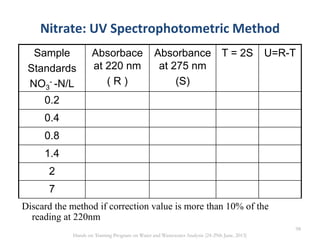
presence in wastewaters comes partly from the decomposition of organic matter,
sometimes from industrial wastes, but mostly from the bacterial reduction of
sulfate.
 Hydrogen sulfide escaping into the air from sulfide-containing wastewater causes
odor nuisances.
 The threshold odor concentration of H2S in clean water is between 0.025 and 0.25
µg/L. Gaseous H2S is very toxic and has claimed the lives of numerous workers in
sewers. At levels toxic to humans it interferes with the olfactory system, giving a
false sense of the safe absence of H2S.
 It attacks metals directly and indirectly has caused serious corrosion of concrete
sewers because it is oxidized biologically to H2SO4 on the pipe wall. Dissolved H2S
is toxic to fish and other aquatic organisms.
Categories of sulfides
• From an analytical standpoint, three categories of sulfide in water and wastewater
are distinguished.
• a. Total sulfide includes dissolved H2S and HS–, as well as acid-soluble metallic
sulfides present in suspended matter.
• The S2– is negligible, amounting to less than 0.5% of the dissolved sulfide at pH
231
232
Sulfide•
Sampling and storage
 Take samples with minimum aeration. Either analyze samples immediately
after collection or preserve for later analysis with zinc acetate solution.
 To preserve a sample for a total sulfide determination put zinc acetate and
sodium hydroxide solutions into bottle before filling it with sample.
 Use 4 drops of 2N zinc acetate soution per 100 mL sample. Increase volume of
zinc acetate solution if the sulfide concentration is expected to be greater
than 64 mg/L.
 The final pH should be at least 9. Add more NaOH if necessary. Fill bottle
completely and stopper.
• To determine the amount of sulphide present in the sample by titrimetric method
• Principle
 Sulphides often occur in ground water especially in hot springs, in wastewater and
polluted waters.
 Hydrogen sulphide escaping into the air from sulphide containing wastewater
causes odour nuisance.
 It is highly toxic and cause corrosion of sewers and pipes.
 Sulphides include H2S and HS– and acid soluble metallic sulphides present in the
suspended matter.
 Iodine reacts with sulphide in acid solution, oxidising it to sulphur; a titration
based on this reaction is an accurate method for determining sulphides at
concentration above 1mg/L if interferences are absent and if loss of H2S is232
233
Apparatus & Reagents
• Burette
• Pipette
• Erlenmeyer flask
• Hydrochloric acid
• Standard iodine solution (0.025N)
• Standard sodium thiosulphate solution (0.025N)
• Starch solution
• a.Hydrochloric acid, HCl, 6N.
• b. Standard iodine solution, 0.0250N: Dissolve 20 to 25 g KI in a
little water and add 3.2 g iodine. After iodine has dissolved, dilute
to 1000 mL and standardize against 0.0250N Na2S2O3, using starch
solution as indicator.
• C. Standard sodium thiosulfate solution, 0.0250N
• d. Starch solution
233
234
Procedure
• Measure from a burette 10mL of iodine into a 500 mL flask.
• Add distilled water and bring the volume to 20 mL.
• Add 2 mL of 6 N HCl.
• Pipette 200 mL sample into the flask, discharging the sample under the
surface of solution.
• If the iodine colour disappears, add more iodine so that the colour
remains.
• Titrate with sodium thiosulphate solution, adding a few drops of starch
solution, as the end point is approached and continuing until the blue
colour disappears.
• Calculations
– mg/L sulfide = 400 (a – b)/mL of sample
where,
a = mL 0.025 N iodine used
b = mL 0.025 N sodium thiosulphate solution used.
234
235235
PHENOLS
 Phenols, defined as hydroxy derivatives of benzene and its
condensed nuclei, may occur in
domestic and industrial wastewaters, natural waters, and potable
water supplies.
 Chlorination of such waters may produce odorous and
objectionable-tasting chlorophenols.
 Phenol removal processes in water treatment include
superchlorination, chlorine dioxide or chloramine treatment,
ozonation, and activated carbon adsorption.
236
Selection of Method
• 4-aminoantipyrine colorimetric method that determines phenol,
ortho- and meta-substituted phenols, and, under proper pH
conditions, those para-substituted phenols in which the
substitution is a carboxyl, halogen, methoxyl, or sulfonic acid
group.
• This method does not determine those para-substituted phenols
where the substitution is an alkyl, aryl, nitro, benzoyl, nitroso, or
aldehyde group.
• The 4-aminoantipyrine method is given in two forms: Method 1,
for extreme sensitivity, is adaptable for use in water samples
containing less than 1 mg phenol/L. It concentrates the color in a
nonaqueous solution
• Method 2 retains the color in the aqueous solution. Because the
relative amounts of various phenolic compounds in a given
sample are unpredictable, it is not possible to provide a237
Interferences
•Interferences such as phenol-decomposing bacteria, oxidizing and
reducing substances, and alkaline pH values are dealt with by
acidification.
•Some highly contaminated wastewaters may require specialized
techniques for eliminating interferences and for quantitative
recovery of phenolic compounds.
•Eliminate major interferences as follows :
•Oxidizing agents, such as chlorine and those detected by the
liberation of iodine on acidification in the presence of potassium
iodide (KI)—Remove immediately after sampling by adding excess
ferrous sulfate (FeSO4). If oxidizing agents are not removed, the
phenolic compounds will be oxidized partially.
•Sulfur compounds—Remove by acidifying to pH 4.0 with H3PO4
and aerating briefly by stirring. This eliminates the interference of238
Preservation and Storage of Samples
• Phenols in concentrations usually encountered in wastewaters
are subject to biological and chemical oxidation.
• Preserve and store samples at 4°C or lower unless analyzed
within 4 h after collection.
• Acidify with 2 mL conc H2SO4/L.
• Analyze preserved and stored samples within 28 d after
collection.
239
Cleanup Procedure
• Principle
• Phenols are distilled from nonvolatile impurities. Because the
volatilization of phenols is gradual, the distillate volume must
ultimately equal that of the original sample.
• 2. Apparatus
• a. Distillation apparatus, all-glass, consisting of a 1-L borosilicate
glass distilling apparatus with Graham condenser.
• b. pH meter.
240
Procedure
• Measure 500 mL sample into a beaker, adjust pH to
approximately 4.0 with H3PO4 solution using methyl orange
indicator or a pH meter, and transfer to distillation apparatus.
• Use a 500-mL graduated cylinder as a receiver. Omit adding
H3PO4 and adjust pH to 4.0 with 2.5N NaOH.
• Distill 450 mL, stop distillation and, when boiling ceases, add 50
mL warm water to distilling flask. Continue distillation until a
total of 500 mL has been collected.
• Special reagents for turbid distillates
– Sulfuric acid, H2SO4, 1N.
– Sodium chloride, NaCl.
– Chloroform, CHCl3, or methylene chloride, CH2Cl2.
– Sodium hydroxide, NaOH, 2.5N: Dilute 41.7 mL 6N NaOH to 100 mL or
dissolve 10 g NaOH pellets in 100 mL water.
241
Chloroform Extraction Method
Principle: Steam-distillable phenols react with 4-aminoantipyrine at pH
7.9 ± 0.1 in the presence of potassium ferricyanide to form a colored
antipyrine dye.
This dye is extracted from aqueous solution with CHCl3 and the
absorbance is measured at 460 nm.
This method covers the phenol concentration range from 1.0 µg/L to over
250 µg/L with a sensitivity of 1 µg/L.
Interferences
All interferences are eliminated or reduced to a minimum if the sample is
preserved, stored, and distilled in accordance with the foregoing
instructions.
Minimum detectable quantity:
The minimum detectable quantity for clean samples containing
no interferences is 0.5 µg phenol when a 25-mL CHCl3 extraction with a
5-cm cell or a 50-mL CHCl3 extraction with a 10-cm cell is used in the
photometric measurement. This quantity is equivalent to 1 µg phenol/L
in 500 mL distillate.
242
Apparatus and reagents
Apparatus
 a. Photometric equipment: A spectrophotometer for use at 460 nm equipped with absorption cells providing light
paths of 1 to 10 cm, depending on the absorbances of the colored solutions and the individual characteristics of
the photometer.
 b. Filter funnels: Buchner type with fritted disk.*#(31)
 c. Filter paper: Alternatively use an appropriate 11-cm filter paper for filtering CHCl3 extracts instead of the
Buchner-type funnels and anhydrous Na2SO4.
 d. pH meter.
 e. Separatory funnels, 1000-mL, Squibb form, with ground-glass stoppers and TFE stopcocks. At least eight are
required.
Reagents
• a. Stock phenol solution: Dissolve 100 mg phenol in freshly boiled and cooled distilled water and dilute to 100 mL.
• b. Intermediate phenol solution: Dilute 1.00 mL stock phenol solution in freshly boiled and cooled distilled water to
100 mL; 1 mL = 10.0 µg phenol. Prepare daily.
• c. Standard phenol solution: Dilute 50.0 mL intermediate phenol solution to 500 mL with freshly boiled and cooled
distilled water; 1 mL = 1.0 􀁐g phenol. Prepare within 2 h of use.
• d. Bromate-bromide solution: Dissolve 2.784 g anhydrous KBrO3 in water, add 10 g KBr crystals, dissolve, and
dilute to 1000 mL.
• e. Hydrochloric acid, HCl, conc.
• f. Standard sodium thiosulfate titrant, 0.025M
• g. Starch solution
• h. Ammonium hydroxide, NH4OH, 0.5N: Dilute 35 mL fresh, conc NH4OH to 1 L with water.
• i. Phosphate buffer solution: Dissolve 104.5 g K2HPO4 and 72.3 g KH2PO4 in water and dilute to 1 L. The pH should
be 6.8.
• j. 4-Aminoantipyrine solution: Dissolve 2.0 g 4-aminoantipyrine in water and dilute to 100 mL. Prepare daily.
• k. Potassium ferricyanide solution: Dissolve 8.0 g K3Fe(CN)6 in water and dilute to 100 mL. Filter if necessary. Store
in a brown glass bottle. Prepare fresh weekly.
• l. Chloroform, CHCl3.
• m. Sodium sulfate, anhydrous Na2SO4, granular.
• n. Potassium iodide, KI, crystals.
243
Procedure
•Place 500 mL distillate, or a suitable portion containing not more than 50 µg phenol, diluted to 500 mL, in a 1-L
beaker. Prepare a 500-mL distilled water blank and a series of 500-mL phenol standards containing 5, 10, 20, 30,
40, and 50 µg phenol.
•Treat sample, blank, and standards as follows: Add 12.0 mL 0.5N NH4OH and immediately adjust pH to 7.9 ± 0.1
with phosphate buffer. Under some circumstances, a higher pH may be required. About 10 mL phosphate buffer
are required. Transfer to a 1-L separatory funnel, add 3.0 mL aminoantipyrine solution, mix well, add 3.0 mL
K3Fe(CN)6 solution, mix well, and let color develop for 15 min. The solution should be clear and light yellow.
•Extract immediately with CHCl3, using 25 mL for 1- to 5-cm cells and 50 mL for a 10-cm cell. Shake separatory
funnel at least 10 times, let CHCl3 settle, shake again 10 times, and let CHCl3 settle again. Filter each CHCl3 extract
through filter paper or fritted glass funnels containing a 5-g layer of anhydrous Na2SO4. Collect dried extracts in
clean cells for absorbance measurements; do not add more CHCl3 or wash filter papers or funnels with CHCl3.
•Read absorbance of sample and standards against the blank at 460 nm. Plot absorbance against micrograms
phenol concentration.
•Construct a separate calibration curve for each photometer and check each curve periodically to insure
reproducibility
b. For infrequent analyses prepare only one standard phenol solution.
Prepare 500 mL standard phenol solution of a strength approximately equal to the phenolic content of that
portion of original sample used for final analysis. Also prepare a 500-mL distilled water blank.
Continue as described in above, but measure absorbances of sample and standard phenol solution against the
blank at 460 nm.
244
Calculation
where:
A =µg phenol in sample, from calibration curve, and B = mL original
sample.
For Procedure b, calculate the phenol content of the original sample:
where:
C = µg standard phenol solution,
D = absorbance reading of sample,
E = absorbance of standard phenol solution, and
B = mL original sample.
245
Precision and Bias
• Because the ‘‘phenol’’ value is based on C6H5OH, this method
yields only an approximation and represents the minimum
amount of phenols present.
• This is true because the phenolic reactivity to 4-aminoantipyrine
varies with the types of phenols present.
• In a study of 40 refinery wastewaters analyzed in duplicate at
concentrations from 0.02 to 6.4 mg/L the average relative
standard deviation was ± 12%. Data are not available for precision
at lower concentrations.
246
Direct Photometric Method
• a. Principle: Steam-distillable phenolic compounds react with 4-aminoantipyrine at pH 7.9 ± 0.1
in the presence of potassium ferricyanide to form a colored antipyrine dye.
• This dye is kept in aqueous solution and the absorbance is measured at 500 nm.
• b. Interference: Interferences are eliminated or reduced to a minimum by using the distillate
from the preliminary distillation procedure.
• c. Minimum detectable quantity: This method has less sensitivity than Method C. The minimum
detectable quantity is 10 µg phenol when a 5-cm cell and 100 mL distillate are used.
Apparatus
• a. Photometric equipment: Spectrophotometer equipped with absorption cells providing light
paths of 1 to 5 cm for use at 500 nm.
• b. pH meter.
Procedure
• Place 100 mL distillate, or a portion containing not more than 0.5 mg phenol diluted to 100
mL, in a 250-mL beaker.
• Prepare a 100-mL distilled water blank and a series of 100-mL phenol standards containing 0.1,
0.2, 0.3, 0.4, and 0.5 mg phenol.
• Treat sample, blank, and standards as follows: Add 2.5 mL 0.5N NH4OH solution and
immediately adjust to pH 7.9 ±0.1 with phosphate buffer.
• Add 1.0 mL 4-aminoantipyrine solution, mix well, add 1.0 mL K3Fe(CN)6 solution, and mix
well.
• After 15 min, transfer to cells and read absorbance of sample and standards against the blank
at 500 nm.
247

PH,acidity and alkanity

  • 1.
    Suspended Solids (TSS, VSS,Biodegradable VSS, SVI and Colloidal solids )
  • 2.
    Suspended Solids • Totalsolids (TS): Material residue left behind after evaporation of a sample and its subsequent drying in a oven at a defined temperature to constant weight • Total dissolved solids (TDS): Portion of the material residue of a sample that passes through a filter • Total suspended solids (TDS): Portion of the material residue of a sample retained by a filter – Settlable solids: Material settling out within a defined period • Fixed suspended solids: Residue of TSS left after ignition for a specified time at a specified temperature • Volatile suspended solids: weight loss on ignition of total suspended solids – Biodegradable volatile suspended solids: volatile suspended solids lost through biodegradation • Colloidal solids: cause turbidity and measured as turbidity (NTU or JTU)
  • 3.
    Suspended Solids • Regulatorylimits are imposed on TSS for sewage disposal – Water with high suspended solids may be aesthetically unsatisfactory (for bathing!) • Removal of TSS is one of the sewage treatment objectives – Primary treatment is mainly concerned with it • Sludge generation calculations in biological treatment require the knowledge of TSS, VSS and biodegradable VSS – All VSS is not biodegradable, and biological treatment can hydrolyze only the biodegradable VSS • Biological treatment involves generation of suspended solids (biosolids) – These biosolids are monitored as MLSS (TSS) and MLVSS (VSS) • Maintenance of higher levels of biosolids (activated sludge) is important in biological treatment – MLVSS is often used as a measure of active biomass/sludge • SVI used in the design, operation and control of secondary clarifiers require MLSS (TSS) monitoring
  • 4.
    Total suspended solids(TSS) TSS and MLSS are one and the same Two alternate ways for TSS measurement • Filter the sample through a weighed ash free filter paper, dry the filter paper along with the residue retained on it to constant weight at 103-105C, and gravimetrically find the TSS – High measurement uncertainty values – in case of low TSS larger volumes need sampling – In case of samples with high TDS thoroughly wash the filter paper with TDS free water to remove the dissolved material • Find TS and TDS for the sample and take difference of TS and TDS as TSS – In case of the filter paper clogging and prolonged duration of filtration this method is followed Often settlable solids rather than TSS is measured as an alternative • Centrifugation for TSS measurement?
  • 5.
    Volatile Suspended Solids •VSS and MLVSS are one and the same • Weight loss on ignition of the TSS represent the VSS • Ash free filter paper leaves no residue on ignition • Negative error is introduced from the loss of volatile matter during drying • Estimation of low concentrations of volatile solids in the presence of high fixed solids concentration can be more erroneous • Dried residue left on the ash less filter paper is ignited to constant weight at 550±50C in a muffle furnace to remove volatile matter and obtain fixed or non-volatile matter – Difference of TSS and NVSS (fixed solids) is taken as VSS
  • 6.
    Solids in Sampleswith Solids > 20,000 mg/L The methods used for samples with lower solids levels are not used – can be associated with negative error If the sample is a sludge, stir to homogenize and place it in a evaporation dish, evaporate to dryness on a water bath, and dry at 103-105C for 1 hour to find % solids For finding fixed and volatile solids ignite the residue in muffle furnace for one hour at 550±50C – If the residue left in the evaporation dish contains large amounts of organic matter then ignite it first over a gas burner and then in the muffle furnace   BC BA solidstotal    1000 %   BA DA solidsvolatile    1000 %   BA BD solidsfixed    1000 % A - weight of dish with residue B - weight of the dish C - weight of dish with wet sample D - weight of dish with residue after ignition
  • 7.
    Settlable Solids • Determinedon either volume (mL/L) or weight (mg/L) basis • Measurement on volume basis requires an Imhoff cone – Fill the cone to 1 L mark with sample and settle for 45 min. – Gently stir sides of the cone with a rod by spinning and settle for another 15 minutes – Record volume of the settled solids in the Imhoff cone • Measurement on weight basis – Determine TSS of well mixed sample – Pour >1-L of sample into a glass vessel of >9 cm dia. to depth >20cm and let it stand quiescent for one hour – Without disturbing the settled and floating material siphon out water from the vessel center and determine TSS as non- settlable TSS Settlable solids = TSS – non-settlable TSS
  • 8.
    Sludge Volume Index(SVI) • Volume in mL occupied by 1 g of a suspension after 30 min. settling • Used to monitor settling characteristics of activated sludge and other biological suspensions – Determined for the mixed liquor of the aeration tank of the ASP • Determine TSS concentration of a well mixed mixed-liquor sample • Use Imhoff cone for settling 1 L of well mixed mixed-liquor for 30 min. time and measure the settled sludge volume in mL – Gently stir the sample during settling • Calculate SVI as )/( 1000)/( Lgionconcentratsolidssuspended LmLvolumesludgesettled SVI  
  • 9.
    Colloidal Solids andTurbidity • Colloidal matter causes turbidity • Turbidity is an optical property caused by scattering of light, and indicates clarity of water • Biological treatment removes colloidal solids/turbidity through bioflocculation • Nephelometers are used for measurement and the results are reported in Nephalometric Turbidity Units, NTU – Intensity of light scattered by the sample is compared with the standard reference suspension under the same conditions • Formazin polymer suspension is used • A light source and a photoelectric detector are used in the measurement
  • 10.
  • 11.
    Organic Matter • TOC •ThOD • COD • BOD – DO – BOD3 and BOD5 – BODu • BOD kinetics – Serial BOD test – BOD kinetic parameters
  • 12.
    Measurement of OrganicMatter Organic matter in wastewater is heterogeneous – Suspended (VSS), colloidal (turbidity) and dissolved organic matter – Carbohydrates, proteins, fats, etc. Organic matter is biodegradable and non-biodegradable Single direct method for the measurement of organic matter is not feasible – so indirect methods – these depended on • Total organic carbon –TOC: • Organic matter invariably has carbon, and the Organic Carbon (OC) content is proportional to the Organic Matter (OM) content • Samples also have inorganic carbon (carbonates, bicarbonates, etc.) and these interfere in the measurement of organic carbon • Samples are first treated for the removal of inorganic carbon, and then treated to convert organic carbon into carbon dioxide and the amount of CO2 formed is measured
  • 13.
    Measurement of OrganicMatter • Oxygen Demand (ThOD, COD and BOD) – Organic matter is reduced substance and it can be completely oxidized and transformed into inorganic end products and this demands oxygen – Amount of oxygen demanded is proportional to the organic matter present – the oxygen demanded is measured and related to organic matter – Oxygen demand of the sample’s organic matter is measured as • Theoretical Oxygen Demand (ThOD): If chemical formula of the organic matter is known, oxygen demand of the sample’s organic matter can be theoretically found through stoichiometry • Chemical Oxygen Demand (COD): Organic matter of a sample is chemically oxidized, and oxygen demand of the sample’s OC is measured in terms of the amount of oxidizing agent consumed • Biological Oxygen Demand (BOD): Microorganisms are made to use the organic matter as food and aerobically oxidize into inorganic end products, and oxygen utilized is measured as BOD
  • 14.
    Theoretic Oxygen Demand Empiricalformula of organic matter present in the sample is used and a balanced equation of oxidation is written Amount of oxygen required (for complete oxidation of one unit mass of organic matter) is stoichiometrically estimated The oxygen demand equivalent to the organic matter presented 3222 2 3 24 3 24 cNHOH ca nCOO cba nNOHC cban              oxygengrequireseglugofOxidation OHCOOOHC 192cos180 666 2226126 
  • 15.
    Chemical Oxygen Demand(COD) • Measures oxygen equivalent of organic matter provided the latter is susceptible to oxidation by potassium dichromate • Oxidation (wet) is brought about under acidic conditions (created by H2SO4 reagent) at high temp. (150ºC± 2oC) for 2 hrs., and can be shown by: CnHaObNc+dCr2O7 -2+(8d+c)H+ nCO2+ {(a+8d-3c)/2}H2O+cNH4 ++2dCr+3 d is moles of dichromate consumed One mole of dichromate = 1.5 moles of COD/oxygen • Not a good measure for biodegradable organic matter and not capable of oxidizing all the organic matter • Widely used because real time/reasonable time results are possible • In case of anaerobic treatment COD is preferred over BOD for organic matter concentration measurement 2363 2 cban d 
  • 16.
    Biochemical Oxygen Demand(BOD) • Acclimatized microorganisms are used to oxidize the organic matter aerobically under favourable conditions of pH, temperature, osmotic pressure and nutrients • Sample is incubated with acclimatized microorganisms at a specific temperature (20/27°C) for specified period (5/3 days) • Organic matter is used by organisms as food and oxidize – only the matter that can be consumed as food (biodegradable fraction) can be measured • O2 is also demand by microorganisms for the nitrification of ammonical-N into nitrite-N and Nitrate-N (introduces positive error in the measurement) • COD on the other hand measures both biodegradable non- biodegradable organic matter
  • 17.
    COD • Measure ofoxygen equivalent of organic matter content of a sample • Oxidation of organic matter occurs under acidic conditions at elevated temperature (150±2C) for about 2 hours • Oxidation can be shown by • Hexa-Cr is orange colored and Tri-Cr is greenish blue in color – As a consequence of conversion of haxa-Cr into Tri-Cr, color of digestion mixture changes from orange to greenish blue • Amount of dichromate consumed is basis for COD estimation (one mole dichromate consumption is equivalent to 1.5 moles of COD) • Oxidation is not complete - measures only the organic matter susceptible to oxidation by potassium dichromate      3 422 2 72 22/388   dCrcNHOHcdanCOHcdOdCrNOHC cban 2363 2 cban d 
  • 18.
    COD • Pyridine (andrelated compounds) and aromatic hydrocarbons are not completely oxidized • VOCs (originally present or formed during oxidation) are oxidized only to the extent of their contact with oxidant (at elevated temp. may escape oxidation) – Silver sulfate is used as catalyst for the effective oxidation of VOCs – Halides of the sample form silver halides and make catalyst ineffective – Mercuric sulfate is used at 10:1 ratio for preserving the effectiveness (not appropriate when the halides level is >200 mg/l) • Use of reflux condensers or closed reflux (or sealed digestion containers), minimize escape of VOC from oxidation • Oxidation at elevated temps, results in thermal decomposition of the dichromate used and introduces positive error – For estimating the error and making correction, a blank is digested along with the sample • Nitrite (NO2-), reduced inorganic species (like chloride, ferrous iron, sulfide, manganous manganese) and ammonia (from organic mater oxidation!) can also be oxidized and introduce positive error
  • 19.
    COD • Interference causedby chloride ions can be shown by – Oxidation of ammonia requires presence of significant levels of free chloride ions – Addition of excess mercuric sulfate prior to addition of other reagents can eliminate chloride ion interference by making ions non-available • Nitrite level is rarely >1-2 mg/l and hence insignificant interference – Remove interference by adding 10 mg sulfamic acid per mg of nitrite • Error introduced by other inorganic species, if significant, is stoichiometrically estimated and necessary corrections are made • Collect samples in glass bottles, and test preferably immediately – If delay is unavoidable, acidify samples with H2SO4 to 2 pH and store – If stored at room temperature, test within 7 days, and if stored at 4C, then test within 28 days – If sample has settlable solids, then homogenize the sample in a blender prior to testing • Two alternate methods (open reflux and closed reflux methods) are used in the COD meaurement OHCrClHOCrCl 2 3 272 723146  
  • 20.
    COD by Openreflux method • Sample and blank are refluxed in strongly acidic solution in the presence of known excess of standard K2Cr2O7 solution for 2 hours • A reflux apparatus, comprising of an Erlenmeyer flask, a vertical condenser and a hot plate/heating mantle, is used for refluxing • During refluxing – Hexa-Cr of the K2Cr2O7 is reduced to tri-Cr and supplies oxygen – Some fraction of the added dichromate is thermally decomposed • Residual dichromate of the sample and of the blank are measured by titrating against standard ferrous ammonium sulfate (FAS) – Ferroin is used as indicator – Titration involves conversion of residual hexa-Cr into tri-Cr – Once all the Hexa-Cr is converted into Tri-Cr, Fe+2 ions of FAS form a complex (of intense orange brown colour) with ferroin indicator – Color change from greenish blue to orange brown is end point – Redox potentiometer can also be used to detect the end point   3362 33 CrFeCrFe
  • 21.
    COD by Openreflux method • COD of the sample is calculated by: • Open reflux method is associated with – Consumption of costly and hazardous chemicals, like, silver sulfate, mercuric sulfate etc., – Generation of hazardous waste with chromium, mercury, silver, etc. • To reduce cost and minimize hazardous waste generation, instead of 50 ml, use smaller sample size (10 ml!) – Smaller size samples demands proper homogenization of samples in blender prior to use • Refluxing time less than 2 hours can be employed provided the results obtained are same as those obtained from 2 hour refluxing 8000 ).( /( 2 usedsampleofml MBA OaslmgCOD   ‘A’ is ml FAS consumed in blank titration ‘B’ is ml FAS consumed in sample titration ‘M’ is molarity of FAS
  • 22.
    COD by Closedreflux method • Amount of sample used is small (2.5-10 ml) - for avoiding errors from uneven distribution of suspended solids, the sample is homogenized by a blender prior to testing • Method has a cost advantage, generates minimum of hazardous waste, and VOCs are more completely oxidized • Sample and blank are digested for 2 hours in a closed system of culture tubes with tight caps or of sealed ampules placed in a block digester or in an oven preheated to 150±2ᵒC. • Digested samples are cooled and tested for COD by • Titration with FAS (Titrimetric closed reflux method) • Measuring color change (Colorimetric closed reflux method) • Basis for the colorimetric method • Hexa-Cr is orange colored and Tri-Cr is greenish blue in color • As a consequence of conversion of haxa-Cr into Tri-Cr, color of digestion mixture changes from orange to greenish blue • Fading of orange color (at 400 nm) or appearance of greenish blue color (at 600 or 620 nm) is measured and compared against standards
  • 23.
    COD by closedreflux method Titrimetric method • Remove caps of the culture tube and transfer contents into a conical flask • Add 1 or 2 drops of ferroin indicator and titrate against FAS. • Record the amount of FAS consumed • Calculate the sample’s COD from the results by Colorimetric method • Invert the cooled culture tubes for thoroughly mixing the contents and allow proper settling of suspended solids • Read absorbance (color intensity) either at 400 nm or at 600 nm with the help of a spectrophotometer • Through using the readings obtained for the standards, construct a calibration curve • Through using the calibration curve find COD of the sample corresponding to its absorbance 8000 ).( /( 2 usedsampleofml MBA OaslmgCOD   ‘A’ is ml FAS consumed in blank titration ‘B’ is ml FAS consumed in sample titration ‘M’ is molarity of FAS
  • 24.
    Dissolved Oxygen (DO):Winkler Method • Can be measured by either Winkler method (iodometric method!) or Membrane electrode method • BOD bottle containing the sample is added with Manganous sulfate and alkaline potassium iodide solutions • DO present in the sample oxidizes an equivalent amount of divalent manganese ions to higher valency states (forms oxides) • Rest of the manganese ions form divalent hydroxide precipitate • On acidification with sulfuric acid, the higher valency manganese ions are reduced into divalent ions (by iodide ions), and iodine, equivalent to the sample’s DO content, is liberated • All precipitates formed (both oxides and hydroxides) get solubulized • Amount of iodine liberated is measured by titrating with standard sodium thiosulfate solution, while using starch as indicator • For detecting end point more precisely, in place of using starch indicator, electrometric method can also be used • If interferences (suspended solids, color and chemicals) are absent, spectrophotometer can also be used to measure the iodine liberated
  • 25.
    Winkler method forDO NaIOSNaIOSNa OHMnHOHMnb OHMnIHIMnOa OHMnOHMnc OHMnOOOHMnb OHMnOOOHMna 22.3 22)(.2 242.2 )(2.1 5.0)(.1 5.02.1 6422322 2 2 2 2 2 22 2 2222 222 2           • Reactions involved in the Winkler method of DO testing are • Sources of error: • Presence of Nitrite (more than 50 g/L as N) introduces positive error • Nitrite can oxidize the iodide ions back into iodine and introduce the error (a chain reaction) – Biologically treated effluents, incubated BOD bottle samples, and stream samples may have nitrite interference – For eliminating, instead of alkaline-iodide solution, alkaline-iodide- azide solution is used – the azide added reacts with NO2¯ and removes it as N2 and N2O gases     HNOOHOON OHONIHINO 225.0 422 22222 22222 OHONNHNOHN NaHNHNaN 22223 33    
  • 26.
    Winkler Method forDO • For avoiding errors, the sample should not come in contact with air during sampling and testing (at least till the sample’s DO is fixed) • Samples with iodine demand can be preserved for 4-8 hours by adding 0.7 mL conc. H2SO4 and 1.0 mL of 2% azide (NaN3) prior to actual analysis by usual procedure • Permanganate modification • Permanganate modification is needed if ferrous iron level is > 1.0 mg/L • To the sample collected add 0.7 mL conc. H2SO4, 1.0 mL KMnO4 and 1.0 ml of KF below the surface, and stopper and mix the contents • KMnO4 addition may be increased if the resulting violet tinge do not persist for at least 5 minutes • Decolourize the sample by adding 0.5 to 1.0 mL of potassium oxalate (K2C2O4) and mixing the contents
  • 27.
    Winkler Method forDO • Ferric iron interference can be overcome by addition of 1 ml of KF and Azide provided titration is done immediately after acidification • Addition of 1.0 mL of KF solution prior to acidification is needed for samples with 100-200 mg/L of ferric iron (acidified sample should be immediately titrated) • Copper sulfate-sulfamic acid flocculation modification – Used for biological flocs having high oxygen utilization rates – Fill aspirator bottle with the sample from the bottom by a tube near the bottom while allowing overflow of 25-50% volume – Add 10 ml of copper sulfate-sulfamic acid inhibitor solution to 1.0 L aspirator bottle with glass-stopper. – Stopper the bottle, mix the contents by inverting the bottle and allow the bottle to stand and siphon out sample into the BOD bottle for DO measurement
  • 28.
    Membrane Electrode Methodfor DO • Membrane electrode is composed of two solid metal electrodes and an electrolyte solution forming a bridge between them • The electrodes and the electrolyte solution are separated from the sample by a molecular oxygen permeable membrane • The membrane electrode system (DO probe) is either a polarographic system or a galvanic system • Because of the permeable nature, a dynamic equilibrium is established (through oxygen diffusion) between the DO of the electrolyte solution and that of the sample • Oxygen present in the electrolyte is reduced at the cathode and electrons required are produced at the anode and transported to the cathode • Current resulting from the required electron transport is proportional to the DO concentration in the electrolyte solution (indirectly in the sample) • Current in the circuit is measured and related with the DO of the sample
  • 29.
    Membrane Electrode Methodfor DO Calibration: Establishing relationship between DO of the sample and current in the circuit • Calibration of membrane electrode system involves use samples of known DO • Samples with known DO can be prepared by aeration, bubbling nitrogen gas, addition of sodium sulfite and traces of cobalt chloride • The membrane electrode (DO probe) is placed in water saturated air, and current generated in the circuit is taken as proportional to the DOs at that temperature and pressure • When calibrated in saturated air, necessary compensation for altitude (or atmospheric pressure) should be made (Manufacturer provides a standard table for altitude correction) • Distilled water (or unpolluted water with known conductivity/ salinity/ chlorinity) saturated with DO can also be used for calibration • Samples with known DO can also be used for the calibration • Winkler method is used for knowing DO with precision and accuracy • Manufacturer of DO probe and DO meter provides a written calibration procedure and it should be strictly followed
  • 30.
    Membrane Electrode Methodfor DO • Membrane permeability is both temp. and salt conc. sensitive. – Temp and salt conc. of the sample should be monitored and necessary corrections be made to the probe sensitivity – Nomographic charts available from the manufacturer can be used – Certain DO meters may include facilities for automatic temp. and salt conc. compensation – For confirming the corrections made by nomographic charts, sensitivity of the DO probe is frequently cross-checked at one or two temp. and salt conc. • With time membrane looses its properties, and hence, it is frequently changed and the electrode system is calibrated afresh • Precision and accuracy of membrane electrode method (± 0.1 mg/l and ± 0.05 mg/l) is not very good • Precision of Winkler method is ± 50 µg/l, but being a destructive test, can not be used for continuous DO monitoring in samples
  • 31.
    BOD Bottle Methodfor BOD Estimation A BOD bottle filled with diluted sample with acclimatized seed and stoppered is incubated at constant temperature for a fixed duration – Dilution of the sample – Acclimatized seed – Favourable nutrient and osmotic conditions – No air bubble entrainment – known initial DO 5 days incubation at 20°C (3 days at 27°C) – only partial oxidation of the organic matter occurs – complete oxidation needs incubation for longer time (60 to 90 days) Measurement of final DO – Difference between initial and final DO is oxygen demand of the diluted sample during the incubation period
  • 32.
    5-day BOD Testby BOD Bottle Method • BOD is a bioassay test used to measure biodegradable organic matter concentration – Amount of oxygen required to biooxidise organic matter of the sample is measured • Diluted sample is incubated with appropriate microbial populations for 5 days at 20ºC – Distilled water (or tap water or water collected from receiving water, if having negligible BOD) is used for diluting the sample – Water should not have bio-inhibitory substances like chlorine, heavy metals etc. • Aerobic bio-oxidation of biodegradable organic matter consumes DO of the sample • Change in DO of the incubated sample is measured and reported as BOD5 at 20°C • Experimental results to become acceptable – Residual DO of the sample should be >1.0 mg/l – DO difference between initial and final should be >2.0 mg/L
  • 33.
    Sources of Error Seedadded is organic matter and undergoes bio-oxidation exerting oxygen demand during incubation – Positive error introduced is measured through incubating a blank containing seed in dilution water but no sample – Measured error is then subtracted from the overall oxygen demand for obtaining oxygen demand of the sample Oxygen demand is denoted as BODt at X°C (BOD5 at 20°C, BOD3 at 27°C, etc.) – Units for BODt at X°C are mg/L (BODt is oxygen demand when the sample is incubated for ‘t’ days at X°C Testing gives oxygen demand of diluted sample - multiplication of this with dilution factor gives sample’s oxygen demand NH3-N added (as nutrient supplement) and NH3-N released during incubation are prone to nitrification and introducing positive error • To eliminate this error, either inhibit the nitrification or quantify and subtract from the measurement – In 5-day BOD test, use of nitrification inhibitor chemical is preferred – In BODu test quntification and subtraction of error is preferred
  • 34.
    Expression for BODtfrom test results BODt at X°C of a sample can be written as Dilution Factor ‘Df’ is the factor by which original sample is diluted for obtaining diluted sample - can be defined as: OD of diluted sample: Error introduced by the seed – Oxygen demand of dilution water is almost negligible – But, seeded dilution water has significant oxygen demand – Add known volume of seed (5 times or more to that added to diluted sample) to dilution water to raise the OD to > 2 mg/l – Test the seed control for OD through incubating parallel with the diluted sample for the same duration                                Factor Dilution ionnitrificat byerror - aterdilution wand seedbyerror - samplediluted theofOD BODt )( 1000 sampledilutedofliteronepreparingforusedsampleofml Df  sfsi DODOOD  DOsi & Dosf are initial & final DO of diluted sample before & after ‘t’ days of incubation
  • 35.
    F)DO-(DOaterdilution wseededofOD cfci preparedcontrolseedofliterperseedofml preparedsampledilutedofliterperseedofml F f f cfcisfsi o t DF D DODODODOCXatBOD                  1 1)()( cfci DO-DOseedofOD  DOci & DOcf are initial & final DO of the seed control incubated for ‘t’ days F D DODOwaterdilutionseededofOD f cfci          1 1)( Expression for BODt from test results bottleBODinwaterdilutionseededoffractionvolumeis Df          1 1 Error by nitrification: Nitrification reaction is inhibited by adding nitrification inhibition chemical and hence no correction needed.
  • 36.
    Incubation conditions • FavourablepH conditions – Micro-organisms are pH sensitive - 7.2 is considered as optimum – pH of incubated sample can change from production of CO2 – Phosphate buffer is used to adjust the pH to optimum and to maintain pH during incubation • Favourable nutrient conditions – Bio-oxidation of organic matter involves synthesis of new microbial biomass – This synthesis requires nitrogen (NH3-N or NO3-N), phosphorus (orthro) and other inorganic nutrients – Insufficient nutrients make bio-oxidation nutrient limiting – The sample is supplemented with nutrient formulations (phosphate buffer has KH2PO4, K2HPO4, Na2HPO4 and NH4Cl) – Salts added for maintaining osmotic conditions (FeCl3, CaCl2 and MgSO4) may also contribute • Favourable osmotic conditions: – Maintaining osmotic conditions is important for ensuring this FeCl3, CaCl2 and MgSO4 salts are added
  • 37.
    Incubation conditions: Constant temperaturethroughout • 5/3 day incubation bio-oxidizes only a fraction of organic matter (OM)– total oxidation requires infinite time – BOD kinetics model is used estimating the total OM by extrapolating BODt results – BOD kinetics model involves a reaction rate constant (K) which is temp. sensitive – BOD kinetics model can not be applied to the results obtained from a test where the sample is not incubated at constant temperature • The BOD test results are always reported along with temperature and period of incubation (BOD5 at 20°C). • By conviction incubated for 5 days at 20C (annual average temp. of UK and time taken by the Thames to reach the ocean) – CPCB recommends 3 days at 27°C (annual average temp. of India!) • 5 days incubation has an advantage - nitrogenous BOD in many cases will not interfere with carbonaceous BOD measurement – One can adapt any temp. within the range that will not affect the microbial metabolic activity – Incubation period giving BODt = 60-70% of BODu can be adapted • For ensuring incubation at constant temp., samples are incubated either in BOD incubators or in water baths set at desired temp.
  • 38.
    Acclimatized seed • Forthe bio-oxidation of OM, the incubated sample should have appropriate microbial populations • During initial period of incubation, selection among the populations and their size increase occurs – this results in initial lag in oxygen demand pattern and consequently • Cumulative demand may not follow first order kinetics • Negative error may be made in BOD5 measurement, and in the BODu estimation • Municipal sewage, biologically treated effluents and samples collected from receiving water bodies are supposed to have these populations • Many industrial wastewaters may not have (w/w generated at elevated temp. and w/w containing toxicants above the threshold limits)
  • 39.
    Acclimatized seed • Microbeshave preferences as to the OM they can bio-oxidize • seed added may not have appropriate microbial populations in significant size • W/w not having appropriate microbial populations require addition of these populations as seed • The initial lag can be eliminated through use of acclimated seed. • What can be used as seed – Settled domestic sewage, clarified and undisinfected effluents of biological treatment units, and clear water from receiving waters – Effluent from the biological treatment plant, treating the wastewater being sampled (most appropriate) – Clear water collected from the water body, which is receiving the wastewater in question, at a point 3 to 8 KM down stream – Seed, specially, developed in laboratory
  • 40.
    Aclimatized Seed • Canbe developed from • Settled domestic sewage • Suspension prepared from wastewater contaminated soil • Prepared through continuously aerating for a few days and adding small daily increments of the wastewater in question • Preparation of acclimatized seed: • Take mixed liquor or secondary sludge of a STP and start aeration • While continuing aeration, gradually replace the mixed liquor/secondary sludge with the wastewater in question over a period of two days or more • Settle the contents and use the supernatant as seed
  • 41.
    Dilution factor (Df) •Oxygen is sparingly soluble in water and depends on altitude, temperature and salinity Altitude (in meter) Saturated DO (in mg/l) Temperat ure (in C) Saturated DO (in mg/l) Chlorini ty Saturated DO (in mg/l) sea level 9.2 0.0 14.62 0.0 9.09 (20C) 305 8.9 5.0 12.77 7.56 (30C) 610 8.6 10.0 11.29 6.41 (40C) 914 8.2 15.0 10.08 5.0 8.62 (20C) 1219 7.9 20.0 9.09 .. 7.19 (30C) 1524 7.6 25.0 8.26 .. 6.12 (40C) 1829 7.4 30.0 7.56 10.0 8.17 (20C) 2134 7.1 35.0 6.95 .. 6.85 (30C) 2438 6.8 40.0 6.41 .. 5.84 (40C) 2743 6.5 45.0 5.93 15.0 6.51 (30C) 3048 6.3 50.0 5.48 20.0 6.20 (30C)
  • 42.
    Dilution factor (Df) •Diluted sample is aerated to rise DOi closer to DOS • At 20°C, DO level can rise to about 8 mg/l level - diluted sample’s initial DO: about 8 mg/l • At  0.5 mg/l DO, bio-oxidation rates are influenced by DO and assumption of first order kinetics (BOD kinetics) becomes invalid • DO in incubated samples should be >1.0 mg/L – final DO should be >1.0 mg/L • DO available for bio-oxidation can be about 7 mg/L • Sample needs dilution so as its cumulative OD is  7 mg/L. • For finding Df, an idea of range of expected BOD for the sample should be known (Published literature or past experience can help) • COD of the sample can also help • Take upper limit of the range and divide by 7 mg/l to get Df. • If no idea on expected BOD range, then test at a series of dilutions • For acceptable results, OD should be >2 mg/L and residual DO should be >1 mg/L • A geometric progression of Df (1, 3, 9, 27, 81, …, so on) can be used in the test
  • 43.
    Standard BOD BottleMethod: Limitations • Sample dilution introduces error in measurement and affect reproducibility • Can not be successfully used for the measurement of BOD contributed by suspended organic matter – Must first undergo hydrolysis - takes time (2 to 3 days or more), BOD exertion may not follow first order kinetics (BOD model assumption) – Very difficult to ensure uniform distribution of the TSS among the BOD bottles - consequence is erroneous BOD measurement. • Testing requires long time (5 days) - results become less relevant (for operation and control of, specially, biological treatment units) – Attempt to reduce the time required: increase the incubation temperature (to 27°C to reduce time to 3 days). • Dilution of sample with nutrient rich buffer solution may not reflect the conditions existing in the treatment processes • Inaccuracy of BODt measurement: 15 to 50% (18% SD)
  • 44.
    Interferences • Secondary effluentsamples and samples seeded with secondary effluents, and polluted water samples collected from surface water bodies show significant nitrification rates – Nitrification inhibitor chemicals: TCMP (2-chloro, 6-trichloro methyl pyridine) – Whenever nitrification inhibitor chemical is used, results are reported as CBOD5 (not as BOD5) • Dilution water used can also introduce positive error – Good quality dilution water exerts < 0.1 or 0.2 mg/l of oxygen demand during 5-day incubation at 20°C. • Sulfides and ferrous iron can be oxidized during incubation and introduce positive error • Residual chlorine if present can inhibit biological activity and bio- oxidation of organic matter – Samples with residual chlorine are first dechlorinated – Keeping under light for 1 to 2 hours can dechlorinate the sample – Addition of predetermined quantity of sodium sulfite can dechlorinate – Dose of sodium sulfite required: Take 200 ml sample, add 2 ml of 1:1 acetic acid or 1:50 H2SO4 and 2 ml of 1% KI, and titrate against Na2SO3, use starch as indicator - Na2SO3 consumed is the dose
  • 45.
    Serial BOD testby BOD bottle method • Needed for finding out BOD kinetics parameters • Involves measurement of BOD1, BOD2, …, BODi, …, BODn • Similar to 5 day or 3 day BOD test, but daily BOD is measured • Large number of diluted sample bottles are incubated and daily 2 or 3 bottles are taken out for measuring DO and BODi estimation • For acceptable results, the conditions, DOf >1.0 mg/L and DOi-Dof >2.0 mg/L should be satisfied in all the cases • For ensuring this, the sample may be incubated at different dilutions (shorter the incubation period lesser will be the dilution) • If X is dilution factor for 5 day BOD, the following dilution factors may be used in the serial BOD test – X/4 dilution factor for BOD1, and BOD2 measurement – X/2 dilution factor for BOD2, BOD3 and BOD4 measurement – X dilution factor for BOD4, BOD5 and BOD6 measurement – 2X dilution factor for BOD6, BOD7 and BOD8
  • 46.
    Fate of organicmatter of the sample in the BOD test Organic Matter (dissolved) Non-biodegradable & residual organic matter Suspended & colloidal organic matter oxygen CO2, H2O, NH3, Energy, etc. New heterotrophic Microbial biomass Auto-oxidation CO2, H2O, NH3, Energy, etc. ammonia oxygen nitrite nitrate oxygen (Nitrogenous BOD) BOD is sum of oxygen utilized during biooxidation of the organic matter and during autooxidation of the microbial biomass (Carbonaceous BOD) oxygen Nitrification Residual biomass Cell debris hydrolysis
  • 47.
    Conclusions drawn fromthe analysis of the fate of organic matter during BOD test • Oxygen demand exerted is having – Demand for biooxidation of organic matter and for autooxidation of microbial biomass (carbonaceous BOD) – Demand for the nitrification of the ammonia generated or already present (nitrogenous BOD) – chemical inhibition of nitrification – Demand of the seed and of the dilution water used • Because of non-biodegradable organic matter, residual organic matter, and residual biomass, BOD is always lesser than ThOD • Unless some of the biodegradable organic matter is resistant to chemical oxidation BOD is lesser than COD • Complete biodegradation of organic matter needs infinite time • BOD includes two components: Carbonaceous BOD and Nitrogenous BOD
  • 48.
    Ultimate BOD (BODu) BODtis the sample’s oxygen demand when it is incubated for ‘t’ time (3 or 5 days) at XᵒC temperature • Higher the temperature lower will be the time Only a portion of the biodegradable organic matter is oxidized - oxidation of total matter requires >25 d (60-90 days) BODu test wherein the sample is aerated at regular interval and incubated till daily demand becomes <1 or 2% of the cumulative demand is used for finding • Nitrification demand of oxygen is parallelly quantified and subtracted Incubating and waiting for that long period for the results is not desirable but knowing ultimate BOD (BODu) is considered important For this the BODt results are extrapolated through using BOD kinetics model which assumes that the BOD exertion follows first order decreasing rate of increase
  • 49.
    Oxygen demand exertionpattern of a sample during incubation
  • 50.
    BOD kinetics Oxygen demandexertion pattern is first order decreasing rate of increase and can be shown as ttou LBODLBOD ''  ttimegivenanyat exp(-k.t)}-{1LBOD BOD ot t  aswrittenbecan  20 20T kk   T  T is temp. in °C  is constant - taken as 1.056 for 20-30°C and as 1.135 for 4-20°C kL-dL/dt L0   tt LBOD exp(-k.t)LL ot  dL/dt is rate of oxygen demand exertion Lt is oxygen demand that is yet to be exerted at after incubation time ‘t’ L0 is oxygen demand to be exerted by the sample at incubation time ‘zero’ (also known as BODu) k is BOD reaction rate constant (per day units) K and L0 are known as BOD kinetics parameters Use of BOD kinetic model requires knowledge of BOD kinetic parameters
  • 51.
    BOD Kinetics Parametersand their Estimation • K and L0 are BOD kinetics parameters • Use of BOD kinetics model requires values of these parameters • Results of a serial BOD test for n days can be used for finding the BOD kinetic parameter values • Methods used to determine BOD kinetics parameters • Method of least squares • Method of moments (Moore et al. 1950) • Log difference method (Fair, 1936) • Fugimoto method (Fujimoto, 1961) • Daily difference method (Tsivoglou, 1958) • Rapid ratio method (Sheehy, 1960) • Thomas method (Thomas, 1950)
  • 52.
    Method of leastsquares for BOD kinetics parameters   n BOD Kn dt BODd BOD BODBODn dt BODd BODBOD dt BODd n K tt BODBOD dt BODd BODKLKLK n i i n i i u n i i n i i n i n i i n i ii i ii ii                              1 1 2 11 2 1 11 11 11 0 . )( . )( .. )( . )( ... dt d(BOD) Time (day) BOD BOD2 dBOD/dt (dBOD/dt).BOD 1 2 … I … n Results of serial BOD test for n days are needed
  • 53.
    Method of Momentsfor BOD kinetic parameters • Moore’s diagram (a nomograph relating K with BOD/L0 and BOD/(BOD.t)) is needed – Moore’s diagram is different for different n value • Results of serial BOD test for n days are used to find BOD and BOD/ (BOD.t) • BOD/(BOD.t) value is used to read k value and BOD/L0 value from the Moore’s diagram • From BOD/L0, since BOD is known, L0 is found • Using the following formulae Moore’s diagram can be constructed                                           n Kin K KnK n n K KnK n ii n tBOD BOD n L BOD 1 . 1 . 1 1 . 0 1 exp. 1exp 1expexp . 1exp 1expexp
  • 54.
    k 4 days5 days 6 days 7 days 8 days value Y/L0 Y/tY Y/L0 Y/tY Y/L0 Y/tY Y/L0 Y/tY Y/L0 Y/tY X- axis Y1-axis Y2-axis Y1-axis Y2-axis Y1-axis Y2-axis Y1-axis Y2-axis Y1-axis Y2-axis 0.001 0.01 0.333 0.01 0.273 0.02 0.231 0.03 0.200 0.04 0.177 0.01 0.10 0.334 0.15 0.273 0.21 0.231 0.27 0.201 0.35 0.177 0.025 0.24 0.335 0.36 0.274 0.50 0.232 0.66 0.201 0.84 0.178 0.05 0.46 0.336 0.69 0.276 0.94 0.234 1.24 0.203 1.57 0.179 0.1 0.86 0.339 1.26 0.278 1.71 0.237 2.21 0.206 2.76 0.182 0.15 1.21 0.341 1.74 0.281 2.33 0.239 2.98 0.209 3.68 0.185 0.2 1.51 0.344 2.14 0.284 2.84 0.242 3.60 0.211 4.40 0.188 0.25 1.77 0.347 2.49 0.286 3.26 0.245 4.09 0.214 4.96 0.190 0.3 2.00 0.349 2.78 0.289 3.61 0.247 4.49 0.216 5.40 0.193 0.35 2.20 0.351 3.03 0.291 3.91 0.249 4.82 0.218 5.76 0.195 0.4 2.38 0.354 3.24 0.294 4.15 0.251 5.09 0.221 6.05 0.197 0.45 2.53 0.356 3.43 0.296 4.36 0.254 5.32 0.223 6.29 0.199 0.5 2.67 0.358 3.59 0.298 4.54 0.256 5.51 0.224 6.49 0.200 0.55 2.79 0.360 3.72 0.300 4.69 0.258 5.67 0.226 6.65 0.202 0.6 2.89 0.362 3.84 0.302 4.82 0.259 5.80 0.228 6.79 0.203 0.7 3.07 0.366 4.04 0.305 5.03 0.262 6.02 0.231 7.02 0.206 0.8 3.22 0.369 4.20 0.308 5.19 0.265 6.19 0.233 7.19 0.208 0.9 3.33 0.372 4.32 0.311 5.32 0.268 6.32 0.235 7.32 0.210 1 3.43 0.375 4.42 0.313 5.42 0.270 6.42 0.237 7.42 0.211 Method of Moments for BOD kinetic parameters
  • 55.
    Moore's Diagram forn = 5 days 2.779476 0.295758 0 0.5 1 1.5 2 2.5 3 3.5 4 4.5 0 0.2 0.4 0.6 0.8 1 'k' value CumulativeBOD 0.27 0.275 0.28 0.285 0.29 0.295 0.3 0.305 0.31 0.315 CumulativeBOD.t Moore's Diagram (for n = 8 days) 4.955678 0.198616 0 1 2 3 4 5 6 7 8 0 0.2 0.4 0.6 0.8 1 k value CumulativeBOD 0.175 0.18 0.185 0.19 0.195 0.2 0.205 0.21 0.215 CumulativeBOD.t Moore's Digram (for n = 7 days) 4.491721 0.224454 0 1 2 3 4 5 6 7 0 0.2 0.4 0.6 0.8 1 'k' value CumulativeBOD 0.2 0.205 0.21 0.215 0.22 0.225 0.23 0.235 0.24 CumulativeBOD.t Moore's Diagram (for n = 6 days) 3.264788 0.251606 0 1 2 3 4 5 6 0 0.2 0.4 0.6 0.8 1 'k' value cumulativeBOD 0.23 0.235 0.24 0.245 0.25 0.255 0.26 0.265 0.27 CumulativeBOD.t Method of Moments for BOD kinetic parameters 0 1 L BOD n  0 1 L BOD n  0 1 L BOD n  0 1 L BOD n     n n tBOD BOD 1 1 .    n n tBOD BOD 1 1 .    n n tBOD BOD 1 1 .   n n tBOD BOD 1 1 .
  • 56.
    Methods for BODKinetic Parameters Fujimoto method • Serial BOD test results for n number of days are used • BODt+1 is plotted against BODt in a graph – On the same graph another plot with slope=1 is plotted – Point of intersection of the two plots is taken as BODu • Using the BODu obtained, with the help of BOD kinetics model K value is found Rapid ratio method • Serial BOD test results for n number of days is used • Ratio of BODt+1 to BODt is plotted against BODt+1 in a graph – On the same graph another plot with slope=1 is plotted – Point of intersection of the two plots is taken as BODu • Using the BODu obtained, with the help of BOD kinetics model K value is found
  • 57.
    Methods for BODKinetic Parameters Thomas method • Serial BOD test results are needed • The kinetic parameters determination is based on the following equation (Thomas equation) • (t/BOD)1/3 is plotted against t • (KL0)1/3 is obtained as intercept and K2/3/6L1/3 as slope • Form the slope and intercept K and L are calculated   t L K LK BOD t . 6 . 3 1 0 3 2 3 1 0 3 1      
  • 58.
  • 59.
    • Nitrogen – Kjeldahlnitrogen • Ammonical nitrogen (NH3-N) • Organic nitrogen (Organic-N) – Nitrite nitrogen (NO2-N) – Nitrate nitrogen (NO3-N) – Total nitrogen • Phosphorus – Ortho phosphorus – Total phosphorus 59
  • 60.
  • 61.
    Total Kjeldahl Nitrogen Organic-N •Organically bound nitrogen is in the trinegative state • Natural materials like proteins, peptides, nucleic acids and urea, and many synthetic organic materials have organic-N Ammonical-N • Deamination of organic-N and hydrolysis of urea produce ammonical-N • Ammonical-N encountered in waters is <10 µg (in ground waters) to >30 mg/l (in some wastewaters) – Groundwater has low ammonical-N (soil absorbs and does not allow leaching) • Ammonia is often added to water in WTPs for forming combined residual chlorine Analytically organic-N and ammonical-N can be determined together and referred to as Total Kjeldahl Nitrogen (TKN) 61
  • 62.
    Methods of Analysis Ammonical-Ncan be measured by: – Nesslerization method (sensitive to 20 µg/l and used for <5 mg/l) – Phenate method (sensitive to 10 µg/l and used <500 µg/l) – Titrimetric method (preferred for higher levels, >5 mg/l) – Ammonia selective electrode method (good for 0.03 to 1400 mg/l levels) Usually samples need preliminary distillation – When samples are turbid or coloured or having hydroxide precipitates of calcium and magnesium (interfere with direct methods) – When samples are preserved with acid When concentration is low, drinking water or clean surface waters or good quality nitrified wastewater samples can be tested by direct nesslerization or direct phenate methods - Still for greater precision preliminary distillation is required 62
  • 63.
    Organic-N of thesample can be measured from – The residual left after preliminary distillation of the sample for ammonical-N measurement or – Sample after the removal of ammonical-N from it • Measurement of organic-N involves – Conversion of organic-N into ammonical-N through digestion – Estimation of ammonical-N by one of the Ammonical-N estimation methods • Depending on the concentration, either macro-kjeldahl or semi-micro-kjeldahl method is used for organic-N analysis A sample is directly tested, without the preliminary distillation, for TKN (ammonical-N plus organic-N) measurement Methods of Analysis 63
  • 64.
    Sampling and analysisfor ammonical-N and organic-N or TKN involves • Sample collection, preservation and storage – If residual chlorine is present, immediately after sample collection destroy it (for preventing ammonical –N oxidation) – As far as possible analyze fresh samples – Preserve samples by acidifying with conc. H2SO4 to 1.5 to 2.0 pH, and store at 4°C – neutralize to 7 pH with NaOH /KOH prior to testing • Preliminary distillation and collection of the distillate in boric acid or sulfuric acid solutions – Estimation of ammonical-N by any of the methods • Kjeldahl digestion to convert organic-N into ammonical-N • Kjeldahl distillation and collection of the distillate in boric acid or sulfuric acid solutions – Estimation of organic-N as equivalent to ammonical-N Method of Analysis 64
  • 65.
    Preliminary distillation: interferences Glycine,urea, glutamic acid, cyanates and acetamide if present in samples can hydrolyze on standing and introduce + error – Sample is buffered at 9.5 pH with borate buffer to decrease hydrolysis of cyanates and organic nitrogen compounds Volatile alkaline compounds like hydrazines and amines influence titrimetric results Some organic compounds, ketones, aldehydes, alcohols and some amines, cause yellowish/greenish colour even after distillation – Glycine, hydrazine and some amines give characteristic yellow colour on nesslerization – Boiling the distillate at low pH before nesslerization can remove formaldehyde like interferences 65
  • 66.
  • 67.
    • Steam outthe distillation apparatus – Take water into distillation flask, add borate buffer, adjust pH to 9.5 with NaOH and steam out • Distillation of the sample – Take 500 ml sample, or a fraction of it diluted to 500 ml, or 1 L if ammonical-N is <100 µg/l, into the distillation flask, adjust pH to 9.5 with 6N NaOH and add 25 ml borate buffer solution – Disconnect steaming out flask and connect sample distillation flask and distill at 6-10 ml/min. rate – Collect distillate in 500 erlenmeyer flask into 50 ml of boric acid or sulfuric acid solution - submerge condenser outlet tip in acid – After collecting 200 ml distillate, free condenser outlet tip from absorbent acid and continue distillation for 1-2 min to clean condenser and its delivery tube • Analyse the distillate for ammonical-N Preliminary distillation 67
  • 68.
    Kjeldahl digestion Meant toconvert organic-N into ammonical-N while not affecting the other forms of nitrogen – Fails to influence azide, azine, azo, hydrazone, nitrate, nitrite, nitrile, nitro, nitroso, oxime and semi-carbazone nitrogens Macro or semi micro kjeldahl digestion method is used – Macro-kjeldahl method for samples with low organic-N – Semi-micro-kjeldahl method for samples with high organic-N In the presence of H2SO4, K2SO4 and (mercuric sulfate) catalyst (all present in the digestion reagent) organic-N is converted into ammonium sulfate – During digestion ammonium complex is formed with mercury and this is decomposed by sodium thiosulfate – Even the free ammonia of the sample is converted into ammonium sulfate 68 Hands on Training Program on Water and Wastewater Analysis (24-29th June, 2013)
  • 69.
    Nitrate can proveboth a + and a - interference – At >10 mg/l, it can oxidize some fraction of the ammonical-N during digestion – In the presence of sufficient organic matter, nitrate can be reduced to ammonical-N The acid and the salt of the digestion reagent are meant for producing 360-370°C temperature for digestion – Higher salt concentration can raise the temp. to >400°C during digestion and this can result in the pyrolytic loss of nitrogen – Higher salt levels demand more acid for maintaining the desired acid-salt balance (1 mL H2SO4 per gram of salt is needed) – Too much acid can reduce digestion temp. to <360°C and this can lead to incomplete digestion – Higher levels of organic matter in the sample can consume more acid – this can increase salt to acid ratio and the digestion temperature (every 3 grams of COD requires 10 mL of acid) Kjeldahl digestion: Interferences 69 Hands on Training Program on Water and Wastewater Analysis (24-29th June, 2013)
  • 70.
    Digestion reagent: • Dissolve134 g K2SO4 in 650 ml water and 200 ml of conc. H2SO4. • While stirring add 25 ml mercuric sulfate solution (8 g of mercuric oxide in 100 ml of 6N H2SO4) • Makeup the volume to one liter and keep the reagent at 20°C – Toxicity and residues disposal are problems when mercuric sulfate is used as a catalyst – 10 ml of copper sulfate solution (25.115 g/L of CuSO4) per 50 ml digestion reagent can be used in place of mercuric sulfate – Selenium can also be a catalyst (but it is highly toxic and also acts as an interference) Sodium hydroxide-sodium thiosulfate reagent: • Dissolve 500 g NaOH and 25 g Na2S2O3.5H2O in water and dilute to one liter Kjeldahl digestion 70 Hands on Training Program on Water and Wastewater Analysis (24-29th June, 2013)
  • 71.
    • Take measuredvolume of sample in 800 ml capacity digestion flask and diluted to 500 ml Volume of the sample should be such that it has 0.2 to 2 mg of TKN in it • 500 ml when organic-N is 0.1-1 mg/l • 250 ml when organic-N is 1-10 mg/l • 100 ml when organic-N is 10-20 mg/l • 50 ml when organic-N is 20-50 mg/l • 25 ml when organic-N is 50-100 mg/l • Take 1 L sample when organic –N is <0.1 mg/L and use bigger Kjeldahl flask • Remove ammonia by distillation after adding 25 ml borate buffer and adjusting pH to 9.5 with 6N NaOH – Distillate can be collected into boric acid or sulfuric acid for determining ammonical-N of the sample – Residue left behind after preliminary distillation of sample for ammonical-N can be used for organic-N measurement Kjeldahl digestion and distillation 71 Hands on Training Program on Water and Wastewater Analysis (24-29th June, 2013)
  • 72.
    • Cool thesample after distillation removal of ammonical-N, add 50 ml digestion reagent and glass beads, and mix contents • Heat the digestion flask under hood with suitable ejection equipment to briskly boil until the volume is reduced to 25-50 ml and release of copious white fumes • Continue digestion for another 30 min. till the sample turns clear or straw-coloured • Cool the flask contents, dilute to about 300 ml, and add 50 ml of hydroxide-thiosulfate reagent along the walls so as it forms an alkaline layer at the flask bottom • Connect the flask (with diluted digested sample and bottom alkaline layer) to a steamed out distillation system • Mix the contents and distillate (similar to the preliminary distillation) and collect distillate into boric acid/ sulfuric acid Run reagent blank parallel to the sample through all the steps and apply necessary corrections to the results on the basis of the blank results Kjeldahl digestion and distillation 72 Hands on Training Program on Water and Wastewater Analysis (24-29th June, 2013)
  • 73.
    Semi-micro Kjeldahl method •Take measured volume of the sample, adjust to 50 mL, add 3 ml borate buffer and adjust pH to 9.5 with 6N NaOH – 50 ml for 4-40 mg/l concentration – 25 ml for 8-80 mg/l – 10 ml for 20-200 mg/l – 5 ml for 40-400 mg/l • Transfer the contents to 100 mL semi-micro kjeldahl flask and boil off 30 mL of the contents for remove the ammonical-N • Add 10 ml digestion reagent and a few glass beads, heat till the sample becomes clears and copious fumes come out, and continue heating, at maximum heating, for 30 minutes more. • Cool the contents and transfer into a micro-kjeldahl distillation apparatus while ensuring the total volume <30 mL • Add 10 mL hydroxide-thiosulfate reagent, turn on distillation, and collect 30-40 ml distillate in 10 ml H3BO3/H2SO4 solution 73 Hands on Training Program on Water and Wastewater Analysis (24-29th June, 2013)
  • 74.
    74 Hands on TrainingProgram on Water and Wastewater Analysis (24-29th June, 2013)
  • 75.
    Nesslerization method • Undistilledsamples – Add 1 ml ZnSO4 solution (100 g ZnSO4.7H2O in 1 liter) to 100 mL of sample, mix, adjust pH to about 10.5 with 6N NaOH and allow the sample to stand – Clarify the supernatant by centrifuging or filtering prior to nesslerization • Can remove calcium, iron, magnesium, etc. (which form turbidity on nesslerization) and suspended solids & colour • Samples with >10 mg/l of NH3-N may loose some ammonia from higher pH – To 50 ml of the filtered/centrifuged (or a portion of it diluted to 50 ml) sample add a drop of EDTA reagent or 1 or 2 drops of Rochelle salt solution, mix and then nesslerize • Addition of EDTA or Rochelle salt solution inhibits precipitation of calcium, iron, magnesium, etc., when nesslerized (but EDTA demands additional nessler reagent) 75 Hands on Training Program on Water and Wastewater Analysis (24-29th June, 2013)
  • 76.
    Nesslerization method • Distilledsamples – Prepare standard solution (1 mL = 10 µg NH3-N) from stock ammonium solution ((1 mL = 1 mg of NH3-N) – Distill samples, standards and reagent blanks and collect distillate for nesslerization – Dilute the distillate plus boric acid solution to 500 mL volume and take 50 mL for nesslerization • Nesslerize the sample with 2 mL Nessler reagent (if the sample is already neutralized with NaOH use only 1 mL) – For the reaction to occur allow at least 10 min. (when NH3-N is very low use 30 min. reaction time) – Keep temperature and reaction time same for samples, blanks and standards 76 Hands on Training Program on Water and Wastewater Analysis (24-29th June, 2013)
  • 77.
    Nesslerization method • Measuretransmittance or absorbance of samples and standards against reagent blank by spectrophotometer – For low NH3-N levels (0.4 to 5.0 mg/l) measure colour at 400- 425 nm and use light path of 1 cm (5 cm light path allows measurements as low as 5-60 µg/L) – For NH3-N levels approaching 10 mg/l use 450-500 nm wavelength – Measurements for standards are used for calibration • Visual comparison against standards can be alternative to spectrophotometer – Temporary standards prepared from standard NH4Cl in the range of 0-6 ml in 50 mL water and nesslerized by adding 1 ml of Nessler reagent can be used – Permanent standards prepared from potassium chloroplatinate and cobaltous chloride solutions and calibrated against temporary standards can also be used 77 Hands on Training Program on Water and Wastewater Analysis (24-29th June, 2013)
  • 78.
    – EDTA reagent:dissolve 50 g of ethylene diamine tetra acetate dihydrate in 60 ml water containing 10 g NaOH (heat to dissolve if needed and cool to room temp.) and dilute to 100 mL – Rochelle salt solution: dissolve 50 g of potassium sodium tartrate tetra hydrate in 100 ml water, boil out to reduce volume to 30 ml, cool and dilute 100 ml – Stock ammonium solution: dissolve 3.819 g anhydrous NH4Cl (dried at 100°C) in water and adjust volume to 1 liter (1 mL = 1 mg of NH3-N) – Nessler reagent: dissolve 160 g NaOH in water, cool, slowly add mixer of 100 g of mercuric iodide (HgI2) and 70 g potassium iodide (KI) dissolved in water, and adjust volume to 1 liter Nesslerization method 78 Hands on Training Program on Water and Wastewater Analysis (24-29th June, 2013)
  • 79.
    Titrimetric method • Distillatecollected into boric acid solution is used – Sample size: 250 ml for 5-10 mg/l of NH3-N; 100 ml for 10-20 mg/l; 50 ml for 20-50 mg/l and 25 ml for 50-100 mg/l – Indicating boric acid: dissolve 20 g of H3BO3 in water, add 10 ml of mixed indicator and adjust volume to 1 liter – Mixed indicator: dissolve 200 mg of methyl red in 100 mL of 95% ethyl or isopropyl alcohol and 100 mg of methylene blue in 50 mL of 95% ethyl or isopropyl alcohol and mix the two • Titrate the distillate with 0.02N H2SO4 to pale lavender colour end point (1ml titrant used = 280 µg of NH3-N) • Run blank through all the steps and correct results 79 Hands on Training Program on Water and Wastewater Analysis (24-29th June, 2013)
  • 80.
    Phenate method • Methodis good for 10 to 500 µg/l • Preliminary distillation of sample and collection of distillate • Alkalinity >500 mg/l, acidity >100 mg/l and turbidity can interfere with direct phenate method • Distillate is collected into 0.04N H2SO4 • Ammonia is made to react with hypochlorite and phenol in the presence of manganous salt catalyst to form indophenol (an intensely blue coloured compound) • Concentration of indophenol is measured by spectrophotometer at 630 nm at path length of 1cm 80 Hands on Training Program on Water and Wastewater Analysis (24-29th June, 2013)
  • 81.
    Ammonia selective electrodemethod Uses hydrophobic gas permeable membrane to separate sample from an electrode internal solution (NH4Cl) • By raising pH to 11 NH3-N is converted into gaseous form • Gaseous NH3 diffuses through membrane and changes pH of the internal solution • This changes the millivolt reading of the meter proportional to NH3- N concentration Measurement • 100 ml sample is taken, and ammonia selective electrode is immersed in it • While mixing with magnetic stirrer pH of the sample is adjusted to 11 by adding 10N NaOH • After stabilization take millivolt reading for the sample 81 Hands on Training Program on Water and Wastewater Analysis (24-29th June, 2013)
  • 82.
    Ammonia selective electrodemethod Calibration • Prepare standards with 1000, 100, 10, 1 and 0.1 mg/l levels • Take millivolt reading for each of the standards in a way similar to that of sample • Plot readings on semi-log plot (take concentrations on the log axis and millivolt readings on linear axis) Method is applicable for measurement of 0.03 to 1400 mg/l The sample does not require distillation Interference • High concentration of dissolved ions affect the measurement but color and turbidity do not • Amines introduce positive error • Mercury & silver through complexing introduce negative error 82 Hands on Training Program on Water and Wastewater Analysis (24-29th June, 2013)
  • 83.
    Nitrite nitrogen andNitrate nitrogen
  • 84.
    Nitrite and NitrateNitrogen • Oxidized Nitrogen may be present in water mainly in two forms: nitrite and nitrate • Nitrite • Represents an intermediate oxidation state and present usually in very low concentrations • Often used as corrosion inhibitor in industrial process water • Nitrate • Occurs in trace quantities in surface water (however, wastewaters of biological nitrifying treatment plants can have upto 30 mg/L), but ground waters have higher levels • High levels of nitrate in water can be problematic – thought to be toxic to humans, particularly to babies – contributes to methemoglobinemia – oxidized nitrogen is a factor in the eutrophication of waters • All forms of nitrogen (reduced and oxidized) can be digested and converted into nitrate for measuring as total nitrogen 84 Hands on Training Program on Water and Wastewater Analysis (24-29th June, 2013)
  • 85.
    Sample preservation andstorage • Samples for nitrate – Samples should be promptly analyzed – Store at 40C up to 2 days (24 hr.!) – Unchlorinated samples can be preserved with 2 mL/L conc H2SO4 and stored at 40C • Samples for nitrite – Analyse promptly, if not nitrite can be converted into nitrate/ammonia by bacteria – Freeze sample at –20°C for preservation or store at 4°C for short-term preservation (1 to 24 hrs.) • For acid preserved samples nitrate and nitrite can not be determined as individual species 85 Hands on Training Program on Water and Wastewater Analysis (24-29th June, 2013)
  • 86.
    Methods of analysis •Nitrite – Colorimetric method – suitable for 5 to 1000 µg/L – acid preservation for samples should not be used – Ion-chromatography • Nitrate – UV Spectrophotometric Method – used for screening uncontaminated water low in organic matter – Cd-reduction Method (range 0.01 – 1.0 mg/L) – Ion Chromatography or capillary ion electrophoresis – Nitrate electrode method (0.14 – 1400 mg/L) • Total nitrogen – Measured through conversion of all (reduced and oxidized) forms of nitrogen into nitrate and estimation of nitrate – Persulfate/UV digestion or persulfate digestion is used • Not effective for wastes with high (suspended) organic loadings • Recovery of some industrial nitrogen containing compounds is low86 Hands on Training Program on Water and Wastewater Analysis (24-29th June, 2013)
  • 87.
    Nitrite -N: Colorimetricmethod Good for 10 to 1000 g/L levels (light path of 5 cm allows measurement in the 5-50 g/L range) Nitrite forms reddish purple azo dye at 2-2.5 pH by coupling diazotized sulfanilamide with N-1(1-naphthyl)-ethylene diamine dihydro chloride (NED dihydrochloride) Interferences – NCl3 imparts false red colour – Sb3+, Au3+,Bi3+,Fe3+,Pb2+,Hg3+,Ag3+, chloroplatinate (PtCl6 2-) and metavanadate can precipitate under test conditions and interfere – Cupric ion can catalyze decomposition of the diazonium salt and introduce negative error – Colored ions and suspended solids can also interfere Use nitrite free water during sample analysis for nitrite 87 Hands on Training Program on Water and Wastewater Analysis (24-29th June, 2013)
  • 88.
    Nitrite -N: Colorimetricmethod • Filter the sample through 0.45 m pore membrane filter and adjust pH to 5-9 with HCl or NH4OH • Take 50 ml or a portion diluted to 50 ml (dilution when conc. is >1.0 mg/L) and add 2 ml colour reagent and mix • After 10 min but before 2 hrs measure absorbance at 543 nm • Treat standards also with colour reagent and measure absorbance – Plot absorbance of standards against NO2 - concentration for obtaining a standard/calibration curve • Read sample’s nitrite concentration from the standard curve Colour reagent: add 100 ml of 85% phosphoric acid to 800 ml water, dissolve 10 g of sulfanilamide, then dissolve 1 g of N-(1-naphthyl)- ethylenediamine dihydrochloride, and adjust volume to 1 liter – can be stored upto a month in dark bottle in refrigerator Standard stock solution : dissolve 1.232 g NaNO2 in water and dilute to 1000ml: 1 mL = 250µg Nitrite -N 88 Hands on Training Program on Water and Wastewater Analysis (24-29th June, 2013)
  • 89.
    Nitrate: Cd reductionmethod • Range: 0.01 to 1 mg/L Nitrate-N • Nitrate-N is almost quantitatively reduced to Nitrite-N in the presence of cadmium (Cd). • Nitrite thus produced is diazotized with sulfanilamide and coupled with N-(1–naphthyl)-ethylene diamine dihydro chloride to form colored azo dye • The colour intensity is measured spectrophotometrically • Correction is needed for the nitrite-N originally present in the sample – Testing the sample for nitrite without subjecting it to nitrate reduction step is used for the correction needed 89 Hands on Training Program on Water and Wastewater Analysis (24-29th June, 2013)
  • 90.
    Nitrate: Cd reductionmethod Handling interferences • Turbid samples need filtering through 0.45 µm pore (nitrate free) membrane filter – Suspended solids will restrict sample flow so pre filtration is needed • EDTA is added to remove interference from iron, copper or other metals • Residual chlorine if present is removed by dechlorination with sodium thiosulfate • If oil and grease are present the sample is pre-extracted with organic solvent. • Chloride ions can significantly decrease the rate of reduction 90 Hands on Training Program on Water and Wastewater Analysis (24-29th June, 2013)
  • 91.
    Cd reduction column91 Hands on Training Program on Water and Wastewater Analysis (24-29th June, 2013)
  • 92.
    Cd reduction column Cdreduction column • Constructed from two pieces of tubing (3.5 mm ID and 2 mm ID tubing) joined end to end • 3 cm ID and 10 cm long tube is fused on the top of 25 cm long and 3.5 mm ID tubing • Stopcock arrangement is made to allow control of flow rate Activation • Wash the column with 200 mL dilute NH4Cl-EDTA solution • Activate the column by passing >100 mL of a solution (of 25% 1.0 mg/L nitrate standard and 75% NH4Cl-EDTA solution) through the column at 7 to 10 mL/min, rate. Ammonium chloride-EDTA solution: dissolve 13 g NH4Cl and 1.7 g disodium ethylene diamine tetra acetate (EDTA) in 900 mL water, adjust pH to 8.5 with NH4OH and dilute to 1L. 92 Hands on Training Program on Water and Wastewater Analysis (24-29th June, 2013)
  • 93.
    Nitrate: Cd reductionmethod • Screen the sample and adjust the pH between 7 and 9. • To 25.0 mL sample (or a portion diluted to 25.0 mL), add 75 mL NH4Cl- EDTA solution, mix and pass through the column at 7 to 10 mL/min. rate - discard the first 25 mL, and collect the rest in original sample flask. • Within 15 min after reduction, add 2.0 mL color reagent to 50 mL sample and mix, and within 10 min. to 2 hours measure absorbance at 543 nm • From the stock solution, prepare (100 mL) standards in the range 0.05 to 1.0 mg/L nitrate-N • Carry out cadmium reduction of the standards exactly as has been done for the sample. Stock nitrate solution (1.00mL = 100µg NO3 - -N): dissolve 0.7218 g dry potassium nitrate in water and dilute to 1000 mL – preserve the stock solution with 2mL CHCl3 /L. – Intermediate stock nitrate solution (of 1.0 mL = 10 µg NO3 - -N strength) is prepared from this stock for routine use 93 Hands on Training Program on Water and Wastewater Analysis (24-29th June, 2013)
  • 94.
    Nitrate: Ion electrodemethod Interferences • Chloride and bicarbonate ions interfere when their weight ratios to nitrate-N are >10 and >5, respectively • NO2–, CN–, S2–, Br–, I–, ClO3–, and ClO4– are also potential interferences (but do not normally occur at significant levels in potable waters) • Electrodes function satisfactorily in buffers over 3 to 9 pH range – but for avoiding erratic responses pH is held constant • Since the electrode responds to nitrate activity, ionic strength must be constant in all the samples and the standards • A buffer solution containing a) Ag2SO4 to remove Cl–, Br–, I–, S2–, and CN–, b) sulfamic acid to remove NO2–, c) a buffer at pH 3 to eliminate HCO3– and to maintain a constant pH and ionic strength, and d) Al2(SO4)3 to complex organic acids is used 94 Hands on Training Program on Water and Wastewater Analysis (24-29th June, 2013)
  • 95.
    Nitrate: Ion electrodemethod Preparation of calibration curve • Transfer 10 mL of 1 mg/L nitrate -N standard to a 50-mL beaker, add 10 mL buffer, and stir with a magnetic stirrer – Immerse the electrode tip and record millivolt reading when stable (after about 1 min) – Remove the electrode, rinse, and blot dry • Repeat this for 10 mg/L and 50 mg/L nitrate-N standards • Plot potential measurements against nitrate -N concentration on semilog graph paper (nitrate-N on the log axis and potential on the linear axis) – A straight line with a slope of +57 ±3 mV/decade at 25°C should result • Recalibrate electrodes several times daily (check potential reading for 10 mg/L nitrate-N standard and adjust the calibration control until the reading plotted on the calibration curve is displayed again 95 Hands on Training Program on Water and Wastewater Analysis (24-29th June, 2013)
  • 96.
    Measurement of sample: •Transfer 10 mL sample to a 50-mL beaker, add 10 mL buffer solution, and stir (for about 1 min) with a magnetic stirrer • Immerse electrode tip in sample and record potential reading when stable (after about 1 min). • Measure standards and samples at about the same temperature. • Read concentration from calibration curve. The electrode responds to nitrate ion activity corresponding to 0.14 to 1400 mg/L nitrate –N Buffer solution: Dissolve 17.32 g Al2(SO4)318H2O, 3.43 g Ag2SO4, 1.28 g H3BO3, and 2.52 g sulfamic acid (H2NSO3H), in 800 mL water. adjust to pH 3.0 by 0.10N NaOH, makeup volume to 1000 mL and store in a dark glass bottle Nitrate: Ion electrode method 96 Hands on Training Program on Water and Wastewater Analysis (24-29th June, 2013)
  • 97.
    Nitrate: UV SpectrophotometricMethod • Used for samples having low organic matter • Nitrate ion and organic matter absorb at 220 nm and only organic matter absorbs at 275 nm • Interferences – Dissolved organic matter, surfactants and Cr6+ – Acidification with 1N HCl can prevent the interference from hydroxide or carbonate concentration • Procedure • Filter the sample and add 1 mL of 1 N HCl to 50 mL sample. • Prepare 50 mL each of NO3 - calibration standards in the range from 0 to 7 mg/L NO3 - -N from the stock • Read absorbance at 220 nm and 275 nm • Construct a standard/calibration curve by plotting concentration against corrected absorbance. • Discard the method if correction value is more than 10% of the reading at 220nm 97 Hands on Training Program on Water and Wastewater Analysis (24-29th June, 2013)
  • 98.
    Sample Standards NO3 - -N/L Absorbace at 220nm ( R ) Absorbance at 275 nm (S) T = 2S U=R-T 0.2 0.4 0.8 1.4 2 7 Nitrate: UV Spectrophotometric Method Discard the method if correction value is more than 10% of the reading at 220nm 98 Hands on Training Program on Water and Wastewater Analysis (24-29th June, 2013)
  • 99.
  • 100.
    Total Nitrogen Chemicals • Boratebuffer solution: Dissolve 61.8 g boric acid, H3BO3, and 8.0 g NaOH in water and dilute to 1000 mL. • Copper sulfate solution: Dissolve 2.0 g CuSO4˜5H2O in 90 mL water and dilute to 100 mL. • Ammonium chloride solution: Dissolve 10.0 g NH4Cl in water, adjust to pH 8.5 by adding NaOH pellets or NaOH solution and make up volume to 1 L (stable for 2 weeks when refrigerated) • Color reagent: Combine 1500 mL water, 200.0 mL conc. H3PO4, 20.0 g sulfanilamide, and 1.0 g N-(1-naphthyl)- ethylene diamine dihydro chloride, dilute to 2000 mL, add 2.0 mL polyoxyethylene 23 lauryl ether and store at 4°C in the dark (stable for 6 weeks) 100 Hands on Training Program on Water and Wastewater Analysis (24-29th June, 2013)
  • 101.
    Total Nitrogen • Calibrationstandards: Prepare nitrate calibration standards (100 mL) in 0 to 2.9 mg/L range, and treat the standards in the same manner as samples. • Digestion check standard: Prepare glutamic acid digestion check standard of 2.9 mg N/L by diluting the stock, and treat the digestion check standard in the same manner as samples. • Blank: Carry a reagent blank through all steps of the procedure and apply necessary corrections to the results Stock glutamic acid solution: Dry glutamic acid, C3H5NH2(COOH)2, in an oven at 105°C for 24 h. Dissolve 1.051 g in water and dilute to 1000 mL; 1.00 mL = 100 Pg N. Preserve with 2 mL CHCl3/L. – Intermediate glutamic acid solution (1.00 mL = 10.0 Pg N) 101 Hands on Training Program on Water and Wastewater Analysis (24-29th June, 2013)
  • 102.
    Total Nitrogen Digestion: • Samplesshould not be preserved with acid for digestion • To a culture tube (20 mm OD and 150 mm long), add 10.0 mL sample (or a portion diluted to 10.0 mL) or standard, add 5.0 mL digestion reagent, cap tightly, mix by inverting twice – In case of reagent blank, 10 mL water is taken in place of sample • Heat for 30 min in autoclave/ pressure cooker at 100 to 110°C • Slowly cool to room temperature, add 1.0 mL borate buffer solution, mix by inverting twice Nitrate measurement: Determine by cadmium reduction Digestion reagent: Dissolve 20.1 g low nitrogen (<0.001% N) potassium persulfate, K2S2O8, and 3.0 g NaOH in water and dilute to 1000 mL just before use Borate buffer solution: Dissolve 61.8 g boric acid, H3BO3, and 8.0 g NaOH in water and dilute to 1000 mL. 102 Hands on Training Program on Water and Wastewater Analysis (24-29th June, 2013)
  • 103.
    Chemicals • Colour reagent:add 100 ml of 85% phosphoric acid to 800 ml water, dissolve 10 g of sulfanilamide, then dissolve 1 g of N-(1- naphthyl)-ethylenediamine dihydrochloride, and adjust volume to 1 liter – can be stored upto a month in dark bottle in refrigerator • Standard stock solution : dissolve 1.232 g NaNO2 in water and dilute to 1000ml: 1 mL = 250µg Nitrite -N • Ammonium chloride-EDTA solution: dissolve 13 g NH4Cl and 1.7 g disodium ethylene diamine tetra acetate (EDTA) in 900 mL water, adjust pH to 8.5 with NH4OH and dilute to 1L. • Stock nitrate solution (1.00mL = 100µg NO3 - -N): dissolve 0.7218 g dry potassium nitrate in water and dilute to 1000 mL – preserve the stock solution with 2mL CHCl3 /L. – Intermediate stock nitrate solution of 1.0 mL = 10 µg NO3 - -N strength is prepared from it used 103 Hands on Training Program on Water and Wastewater Analysis (24-29th June, 2013)
  • 104.
    Nitrite free water •Add a small crystal of KMnO4 and Ba(OH)2 or Ca(OH)2 to distilled water and redistill in all borosilicate glass apparatus to obtain nitrite free water – Initial 50 mL of the redistillate and final distillate with permangamage (giving red colour with DPD reagent) should be discarded • Add 1 mL/L of conc. H2SO4 and 0.2 mL/L of MnSO4 solution (36.4 g of MnSO4.H2O in distilled water and 1 liter final volume), make the water pink by adding 1 to 3 ml of KMnO4 solution and redistill 104 Hands on Training Program on Water and Wastewater Analysis (24-29th June, 2013)
  • 105.
  • 106.
    Importance • Used extensivelyin the treatment of boiler water (tri-sodium phosphate) to control scaling – At higher temperatures polyphosphates are hydrolyzed into orthophosphates • Essential for growth of organisms – Limiting & important nutrient for primary productivity of water bodies – applied in agriculture as fertilizers (orthophosphates) – microbes of wastewater treatment plants require phosphorus - domestic effluents have enough of it – Biological sludge is rich (1%, in case heat dried ASP sludge it is 1.5%) – has good fertilizer value • Excess in water bodies causes eutrophication – 0.005 mg/l of available phosphorus is critical for algal blooms to occur 106 Hands on Training Program on Water and Wastewater Analysis (24-29th June, 2013)
  • 107.
    Sources Domestic waste, priorto synthetic detergents, contains 2-3 mg/l of inorganic form and 0.5-1.0 mg/l of organic form – Polyphosphates added to water supplies (to control corrosion), soft water (to stabilize CaCO3) and to water (during laundering or other cleaning processes) find their way into sewage – Synthetic detergents use increased inorganic form by 2-3 times (have polyphosphates as builders, 12-13% or more) – Body wastes and food residues contribute organic form – liberated during metabolic breakdown of proteins and comes out in urine (1.5 g/day per capita) Industrial effluents – mostly inorganic forms – Boiler blowdown water is important source - at higher temperatures even the poly forms are hydrolyzed into ortho form Agricultural run off - fertilizer applied (orthophosphates) and organic phosphorus are found Poly forms of water bodies get gradually hydrolyzed into ortho forms – high temperature and low pH increases the hydrolysis rates – Enzymes of microorganisms also bring about hydrolysis 107 Hands on Training Program on Water and Wastewater Analysis (24-29th June, 2013)
  • 108.
    Classification and forms Presentin water and wastewater mostly as phosphates Classified as – Orthophosphates – mono, di and trisodium phosphates and diammonium phosphate – Poly (condensed) phosphates (pyro, meta and other polyphosphates) – sodium hexameta phosphate, sodium tripolyphosphate, tetrasodium pyrophosphate – Organically bound phosphates - formed primarily by biological processes – occurs both in dissolved and suspended forms Can be present in water as – soluble phosphates – particulate phosphates in particles or detritus • precipitated inorganic forms in the bottom sediments • incorporated into organic compounds in the biological sludge/debris – In the bodies of the aquatic organisms 108 Hands on Training Program on Water and Wastewater Analysis (24-29th June, 2013)
  • 109.
    • Filtering through0.45 m pore size membrane filter is believed to separate dissolved form of phosphorus from suspended form • Analytically phosphorus of a sample can be divided into three chemical types – Reactive phosphorus – Acid-hydrolysable phosphorus (polyphosphates) – Organic phosphorus • Reactive phosphorus: Phosphorus that respond to colorimetric tests without preliminary hydrolysis or oxidative digestion – Can include both dissolved and suspended forms – Largely a measure of orthophosphate Classification and forms 109 Hands on Training Program on Water and Wastewater Analysis (24-29th June, 2013)
  • 110.
    • Acid-hydrolysable phosphorus:phosphorus that is converted into into dissolved orthophosphate on acid hydrolysis at boiling water temperature – Mostly condensed phosphate and can be both suspended and dissolved condensed phosphate – Some fraction of the organic phosphate can also be hydrolyzed – Appropriate selection of acid strength, hydrolysis time and temperature can minimize hydrolysis of organic phosphate • Organic or organically bound phosphorus: phosphate fraction that is converted to orthophosphate only by oxidative destruction of organic matter – Can be in both soluble and particulate forms Classification and forms 110 Hands on Training Program on Water and Wastewater Analysis (24-29th June, 2013)
  • 111.
    Phosphate estimation Analysis involvestwo steps – Conversion of the phosphorus form of interest to dissolved orthophosphate – Colorimetric determination of dissolved orthophosphate Digestion should oxidize the organic matter and release phosphorus as orthophosphate – There are three methods – Perchloric acid method (very drastic and time consuming method – used for difficult samples such as sediments – Nitric acid – sulfuric acid method – recommended for most samples – Persulfate oxidation method – simplest method – prior to adopting make comparison with the two drastic methods Gravimetric, volumetric and colorimetric methods can be used for estimating ortho forms – Gravimetric is suitable for very high concentrations – For >50 mg/l volumetric is appropriate (boiler blowdown water and anaerobic digester supernatant) – For usually encountered levels colorimetric is preferred 111 Hands on Training Program on Water and Wastewater Analysis (24-29th June, 2013)
  • 112.
    Colorimetric: After digestionthe liberated orthophosphate is determined by – Vanadomolybdophosphoric acid colorimetric method – good for concentration range of 1 to 20 mg/l – Stannous chloride method – good for 0.01 to 6 mg/l – Ascorbic acid method Different forms of phosphorus Poly-P = acid hydrolysable-P – ortho-P Organic-P = digested-P – acid hydrolysable-P Phosphate estimation 112 Hands on Training Program on Water and Wastewater Analysis (24-29th June, 2013)
  • 113.
    Selection of methoddepends largely on concentration range of the orthophosphate – In case of lower concentrations in order to overcome interferences an extraction step may be added For finding different forms of phosphorus, subject the sample to – Direct colorimetric – gives reactive phosphorus – Acid hydrolysis and then colorimetric – gives both reactive phosphorus and acid hydrolysable phosphorus – Digestion and then colorimetric – gives total phosphorus (reactive, acid hydrolysable and organic phosphorus) For getting the dissolved fractions of different forms of phosphorus filter the sample and test the filtrate Phosphate estimation 113 Hands on Training Program on Water and Wastewater Analysis (24-29th June, 2013)
  • 114.
    Sample reservation andstorage and other precautions For preserving, freeze the sample at or below –10C For storing the sample for longer periods add 40 mg/l of HgCl2 (a hazardous substance) to the sample If interest is to estimate different forms of phosphorous avoid adding acid or CHCl3 as a preservative In case of estimation of total phosphorus 1 ml HCl/liter of sample can be added for preservation – in case of freezing there is no need to add any acid Samples with low phosphorus concentration should not be stored in plastic bottles because walls of the bottles adsorb phosphorus Prior to use all glass containers should be first rinsed with hot dilute HCl Commercial detergents containing phosphorus should not be used for cleaning 114 Hands on Training Program on Water and Wastewater Analysis (24-29th June, 2013)
  • 115.
    Sample preparation (includingdigestion) Depending on the need filter the sample through 0.45 um membrane filter (in case of hard to filter samples filter through a glass fiber filter) – Before use, wash the membrane filter by soaking in distilled water (change the distilled water at least once) or by filtering several batches of 100 ml distilled water samples through the membrane filter Acid hydrolysable phosphorus: – Taken as the difference between the phosphorus measured in the untreated sample and that measured in acid hydrolyzed sample – Includes condensed phosphates (pyro, tripoly and higher molecular weight phosphates like hexametaphosphate) – Some organo phosphate compounds natural water samples may also get hydrolyzed and contribute 115 Hands on Training Program on Water and Wastewater Analysis (24-29th June, 2013)
  • 116.
    Acid hydrolysis procedure 1.Acidify known volume of sample (add 1/2 drops phenolphthalein, discharge colour by drop wise addition of strong acid solution (SAS), and add SAS (1:100) – Prepare strong acid solution by slowly adding concentrated 300 ml of H2SO4 to 600 ml distilled water, cool and add 4 ml of concentrated HNO3 and then making up volume to one liter 2. Carry out hydrolysis by either of the following – Gently boiling acidified sample for > 90 min. (do not allow sample volume to drop below 25% of the original - add distilled water – autoclave acidified sample at 98-137 kPa for 30 minutes 3. Cool, neutralize hydrolyzed sample with 6N NaOH to faint pink & adjust to original volume with distilled water Use a calibration curve constructed from the acid hydrolyzed series of standards in the colorimetric measurement 116 Hands on Training Program on Water and Wastewater Analysis (24-29th June, 2013)
  • 117.
    Perchloric acid digestion Heatedmixtures of HClO4 and organic matter can explode violently – Do not add HClO4 to hot solutions containing organic matter – Initiate digestion with HNO3 and complete digestion using mixture of HNO3 and HClO4 – Use hoods specially constructed for HClO4 fuming (connected to a water pump) – Do not allow the sample to evaporate to dryness during dryness 117 Hands on Training Program on Water and Wastewater Analysis (24-29th June, 2013)
  • 118.
    Digestion process – Takemeasured volume of sample (containing desired quantity of phosphorus) in a conical flask, acidify to methyl orange with con. HNO3 and then add 5 ml of con. HNO3 – Evaporate acidified sample on hotplate/steam bath to 15-20 ml volume – Cool, add 10 ml of con. HNO3, cool and add 10 ml of HClO4 – Add few boiling chips and gently evaporate on hot plate until dense white fumes of HClO4 appear – if the contents are not clear cover the flask with watch glass and keep them barely boiling till they become clear – if needed add 10 ml more of HNO3 – Cool the contents, add phenolphthalein and neutralize to pink colour with 6N NaOH - If needed filter the sample (wash the filter with distilled water) – Makeup the volume to 100 ml Use a calibration curve constructed from the perchloric acid digested series of standards in the colorimetric measurement Perchloric acid digestion 118 Hands on Training Program on Water and Wastewater Analysis (24-29th June, 2013)
  • 119.
    Sulfuric acid-nitric aciddigestion • Take measured volume of sample containing desired amount of phosphate into micro-kjeldahl flask, and add I ml of conc. H2SO4 and 5 ml of conc. HNO3 • Digest the sample on a digestion rack with provision for fumes withdrawal to 1 ml volume and continue till the sample becomes colourless (HNO3 removed) • Cool and add about 20 ml distilled water, add phenolphthalein indicator and neutralize with 1N NaOH to pink stinge, and if needed filter the solution to remove suspended matter and turbidity • Makeup the final volume to 100 ml Use a calibration curve constructed from the sulfuric acid-nitric acid digested series of standards in the colorimetric measurement 119 Hands on Training Program on Water and Wastewater Analysis (24-29th June, 2013)
  • 120.
    Persulfate digestion method Takemeasured volume of sample (50 ml of less), add phenolphthalein indicator and discharge colour with drop-wise addition of H2SO4 solution – Prepare H2SO4 solution by slowly adding 300 ml of conc. H2SO4 to 600 ml distilled water and then making up volume to one liter Add additional 1 ml acid solution and 0.4 g of solid ammonium persulfate or 0.5 g of solid potassium persulfate Boil the sample on hotplate for 30-40 min. till volume is reduced to 10 ml (certain organophosphorus compounds may require 1.5 to 2 hours digestion) or Autoclave the sample at 98-137 kPa for 30 minutes Cool the digested contents, add phenolphthalein indicator and neutralize to faint pink colour with 1 N NaOH 120 Hands on Training Program on Water and Wastewater Analysis (24-29th June, 2013)
  • 121.
    Makeup the volumeto 100 ml do not worry if precipitate is formed – shake well if the sample is subdivided – acidic conditions of colorimetric testing may re-dissolve the precipitate Use calibration curve constructed from persulfate digested series of standards in the colorimetric measurement Persulfate digestion method 121 Hands on Training Program on Water and Wastewater Analysis (24-29th June, 2013)
  • 122.
    Vanadomolybdophosphoric acid colorimetric method Underacidic conditions sample’s orthophosphate reacts with ammonium molybdate and forms molybdophosphoric acid – In the presence of vanadium, molybdophosphoric acid produces yellow colour (proportional to con. of phosphate) – Colour intensity is measured as absorbance at 400-490 nm Take 50 ml sample, adjust pH by discharging phenolphthalein colour with 1:1 HCl and makeup volume to 100 ml – HNO3 or H2SO4 or HClO4 can be substitute for HCl – If sample is coloured shake 50 ml of the sample with 200 mg of activated carbon for 5 min and filter to remove carbon – Take care activated carbon itself is having any phosphate     OHNHMoOPONHHMoONHPO 243434424 3 4 122112.2412   122 Hands on Training Program on Water and Wastewater Analysis (24-29th June, 2013)
  • 123.
    • Take 35ml sample or less containing 0.05 to 1.0 mg/l of phosphate into 50 ml volumetric flask • Add 10 ml of vanadate-molybdate reagent and then makeup volume to the mark with distilled water – Dissolve 1.25 g of ammonium metavanadate, NH4VO3, in 300 ml of distilled water by heating to boiling; cool and add 330 ml of conc. HCl; cool and add 25 g of ammonium molybdate (NH4)6Mo7O24.4H2O dissolved in 300 ml distilled water; and makeup final volume to one liter – Room temperature variations affect colour intensity • After 10 minutes or more measure absorbance of the sample at 400-490 nm • Maintain blank also Vanadomolybdophosphoric acid colorimetric method 123 Hands on Training Program on Water and Wastewater Analysis (24-29th June, 2013)
  • 124.
    • Prepare calibrationcurve by using suitable volumes of standard phosphate solutions parallel with the sample and the blank – Prepare stock standard phosphate solution by dissolving 219.5 mg of anhydrous KH2PO4 in one liter solution to get 1ml=0.05 mg phosphate – calibration curves may be constructed at various wavelengths between 400-490 nm Vanadomolybdophosphoric acid colorimetric method 124 Hands on Training Program on Water and Wastewater Analysis (24-29th June, 2013)
  • 125.
    Unless heated silicaand arsenate will not cause positive interference Arsenate, fluoride, thorium, bismuth, sulfide, thiosulfate, thiocyanate and excess of molybdate can cause negative interferences – Sulfide interference can be removed by oxidation with bromine water If HNO3 is used in the test chloride concentration >75 mg/l can cause interference – Below 100 mg/l ferrous iron may not affect the results – Below 1000 mg/l many ions do not cause interfere The method is most suitable for a range 1 to 20 mg/l – Minimum detectable concentration is 200 g/liter in 1-cm light path of the spectrophotometer cells Vanadomolybdophosphoric acid colorimetric method: interferences 125 Hands on Training Program on Water and Wastewater Analysis (24-29th June, 2013)
  • 126.
    Stannous chloride method Underacidic conditions sample’s orthophosphate reacts with ammonium molybdate and forms molybdophosphoric acid – Stannous chloride reduces the molybdophosphoric acid to intensely coloured molybdenum blue – Colour intensity is measured as absorbance at 690 nm Method is more sensitive – by increasing light path length concentration as low as 0.007 mg/l can be measured – When concentration is <0.1 mg/l an extraction step can enhance reliability and lessen interference (with extraction step minimum detectable limit is 0.003 mg/l) – Concentration range for which suitable is 0.01 to 6 mg/l 126 Hands on Training Program on Water and Wastewater Analysis (24-29th June, 2013)
  • 127.
    Take 100 mlsample and discharge phenolphthalein pink colour by drop wise addition of strong acid solution – When phosphorus level is >2 mg/l take sample volume with <0.2 mg of phosphorus makeup volume to 100 ml – If strong acid solution consumed is more than 5 drops then also dilute the sample While keeping all the samples’ temperature in 20-30C range and constant (all samples temperature within 2 C range) add 4 ml of molybdate reagent, mix and then add 10 drops (0.5 ml) of stannous chloride solution and mix – Molybdate reagent: cautiously add 280 ml of conc. H2SO4 in 400 ml, cool, add 25 g ammonium molybdate dissolved in 175 ml distilled water, makeup the final volume to 1 liter – Stannous chloride reagent: dissolve 2.5 g of stannous chloride (SnCl2.2H2O) in 100 ml glycerol (heat in water bath for dissolution) Stannous chloride method 127 Hands on Training Program on Water and Wastewater Analysis (24-29th June, 2013)
  • 128.
    Measure colour after10 min but before 12 min photometrically at 690 nm and read concentration from calibration curve and adjust to the sample dilution made – Chose light path length suitably (0.5 cm for 0.3 – 2 mg/l, 2 cm for 0.1 – 1.0 mg/l and 10 cm for 0.007 – 0.2 mg/l) – The calibration curve may deviate from a straight line at higher concentrations range (0.3 to 2 mg/l) Always run blank (distilled water) on reagents Prepare at least one standard with each set of samples or once a day Stannous chloride method 128 Hands on Training Program on Water and Wastewater Analysis (24-29th June, 2013)
  • 129.
    Needed for overcominginterferences • Take 40 ml sample (or diluted sample) into a 125 ml separating funnel, add 50 ml of benzene-isobutanol and 15 ml of molybdate reagent-E • Close the funnel immediately and shake vigorously for 15 sec., remove stopper and transfer 25 ml of the separated organic layer into 50 ml volumetric flask • Add 15-16 ml of alcoholic H2SO4, swirl, add 0.5 ml of stannous chloride-E reagent, swirl and dilute to mark with alcoholic H2SO4 • After 10 min. but before 30 min measure colour at 625 nm against a blank (40 ml distilled water) and read concentration from a calibration curve Stannous chloride method (Extraction) 129 Hands on Training Program on Water and Wastewater Analysis (24-29th June, 2013)
  • 130.
    Reagents – Benzene isobutanolsolvent: mix equal volumes of benzene and isobutanol (highly flammable) – Molybdate reagent-E: dissolve 40.1 g of ammonium molybdate in 500 ml distilled water and slowly add 396 ml of molybdate reagent, cool and makeup final volume to 1 liter – Alcoholic sulfuric acid solution: cautiously add 20 ml of conc. H2SO4 to 980 ml of methyl alcohol while continuously mixing – Stannous chloride reagent-E: mix 8 ml of stannous chloride reagent with 50 ml of glycerol Stannous chloride method (Extraction) 130 Hands on Training Program on Water and Wastewater Analysis (24-29th June, 2013)
  • 131.
    Ascorbic acid method Underacidic conditions, ammonium molybdate and potassium antimonyl tartrate react with orthophosphate to form a heteropoly acid-phosphomolybdic acid, and ascorbic acid reduces the resultant acid to intensely coloured molybdenum blue Detectable ranges are 0.3 to 2 mg/l for 0.5 cm light path length, 0.15 to 1.3 mg/l for 1 cm path and 0.01 to 0.25 mg/l for 5 cm path Interferences include arsenates, hexavalent chromium, nitrites, sulfide and silicate – Arsenates: at conc. as low as 0.1 mg/l, react with molybdate to produce blue colour similar to that formed with phosphate – Hexavalent chromium and nitrite can introduce negative error of 3% at 1 mg/l of phosphate conc. and 10-15% at 10 mg/l conc. – Sulfides and silicates cause no interference at <1 mg/l and 10 mg/l respectively 131 Hands on Training Program on Water and Wastewater Analysis (24-29th June, 2013)
  • 132.
    Pipette out 50ml of sample into a 125 ml dry Erlenmeyer flask and discharge pink colour of phenolphthalein indicator by drop wise addition of 5N H2SO4 solution Add 8 ml combined reagent, mix thoroughly and then measure colour at 880 nm after 10 min. but within 30 min. In case of highly coloured or turbid waters prepare a blank by adding all reagents except ascorbic acid and subtract its colour measurement from that of each of the samples Ascorbic acid method 132 Hands on Training Program on Water and Wastewater Analysis (24-29th June, 2013)
  • 133.
    Combined reagent: mixthe following reagents in the same order in the following proportions: – 50 ml of 5N H2SO4 – 5 ml of potassium antimonyl tartrate (dissolve 1.3715 g of potassium antimonyl tartrate in distilled water and adjust final volume to 500 ml) – 15 ml of ammonium molybdate (dissolve 20 g of ammonium molybdate in 500 ml distilled water) – 30 ml of 0.01M ascorbic acid (dissolve 1.76 g of ascorbic acid in 100 ml distilled water and store at 4C for one week – mix after addition of each of the reagent and cool to room temperature - if turbidity appears shake well and let the reagent stand until it disappears – Reagent is stable for 4 hours Ascorbic acid method 133 Hands on Training Program on Water and Wastewater Analysis (24-29th June, 2013)
  • 134.
  • 135.
    Biological water qualitytesting Interest is to know about presence of waterborne pathogens – Too many varieties to test and not feasible for direct methods Presence and density of indicator organisms is established Fecal contamination of water is established through testing for the presence and density of an indicator organism – Fecal matter of the infected is source for pathogens – Fecal contamination indicates higher probability of pathogen presence Coliform bacteria (Escherichia coli), specifically fecal coliform is the indicator organism – It is present in water, whenever fecal contamination is there, in larger numbers than any of the water borne pathogens – Testing for its presence and density is cheaper, easier and faster – Working with it does not produce serious health threats to laboratory workers
  • 136.
    • Actually testedfor Total Coliform Count – Since coliform can also be contributed by sources other than fecal contamination, waters may also be tested for Fecal Coliform Count – Incubation temperatures are different (35C for total coliform and 44.5C for fecal coliform) • Two techniques are used to test waters for coliform count – Multiple tube fermentation technique – Membrane filtration technique Biological water quality testing
  • 137.
    Sample collection, preservation andstorage Cleaned, rinsed (final rinse with distilled water) and sterilized (either by dry or wet heat) sampling bottles are used For collecting samples with residual chlorine, to prevent continued bactericidal action, sodium thiosulfate is added to sample bottles prior to sample collection – 100 mg/l in case of wastewater samples – 18 mg/l in case of drinking water For collecting samples with high copper or zinc or high heavy metals add chetaling agent EDTA to the bottle prior to sterilization to give 372 mg/l in the sample
  • 138.
    Sample collection, preservation andstorage Sample collection – Use aseptic conditions – Do not contaminate inner surface of stopper and bottle’s neck and keep bottle closed untill to be filled with sample – Fill without rinsing and replace stopper immediately – Leave ample space (2.5 cm) to facilitate mixing by shaking Sample collection from a tap – Run the tap full for 2 to 3 min. to clear the pipeline, reduce water flow to permit sample collection without splashing – Avoid sampling from leaking taps – Remove tap attachments (screen/splash guard!) – If you desire clean tap tip with hypochlorite (100 mg/l), and run it fully opened for 5-6 min prior to sample collection
  • 139.
    Sample collection, preservation andstorage Sample collection from other sources • In case of hand pump, run it for 5 min. prior to sampling • In case of a well sterilized bottle can be fitted with weight at the base and used – Avoid contact with bed • Avoid taking sample too near to banks or far from water draw off point in case of river/lake/spring/shallow well – If collecting from boat collect from upstream side – Hold bottle near base, plunge it below water surface with neck downward, turn it until its neck points slightly upwards and mouth directed towards water current and collect sample (if no current push bottle forward to create) – Special apparatus can be used to mechanically remove stopper under the water surface
  • 140.
    Start testing promptly –If not to be started within 1 hr. ice cool the sample Transport sample within 6 hr while holding temperature <10C – Use ice cooler for sample storage during transport If testing not started within 2 hrs of receipt refrigerate – Time elapsed between collection and testing should be <24 hrs Record time elapsed and temperature of storage for each of the samples analysed Sample collection, preservation and storage
  • 141.
    Multiple Tube FermentationTest Also known as MPN test (Most Probable Number) • An estimate of mean density of coliforms - reported as MPN/100 ml • Poisson distribution (random dispersion) of coliforms is assumed Defintion of coliform bacteria for MPN test: All aerobic and facultative anaerobic gram negative, non-spore forming, rod shaped bacteria that ferment lactose with gas and acid formation within 48 hrs at 35C
  • 142.
    Multiple-tube fermentation technique Conductedin 3 phases • Presumptive test – Serial dilutions of a sample (to extinction) are incubated in multiple tubes of lauryl tryptose broth at 35°C for 48 hrs – Positive results (production of gas/acid) is an indication for the presence of coliforms • Confirmed test – Sample from positive tubes of presumptive test are incubated in tubes of Brilliant Green Lactose Bile (BGLB)/MacConkey Broth at 35°C or in tubes of EC/A1 broth at 44.5°C – Positive result confirms presence of coliforms in case of BGLB tubes and presence of fecal coliforms in case of EC broth tubes
  • 143.
    Multiple-tube fermentation technique •Completed test – Involves streaking of LES Endo agar plates with inoculum from positive BGLB/MaCB or EC/A1 broth tubes for obtaining isolated colonies – Gram stain the cells from isolated colonies and examine under microscope – Gram negative, non-spore forming, rod shaped bacteria are coliforms – completion test • Calculation of MPN is – Directly from Poisson distribution – From the MPN tables – By Thomas equation
  • 144.
    Presumptive phase ofMPN test Lauryl tryptose broth or alternatively lactose broth is used as medium Dehydrated medium is mixed in distilled water, and heated to dissolve the ingredients after pH adjustment – Bromocresol purple (0.01 g/L) can be added for indicating acid production – Double strength medium is also required – Quantity required depends on number of samples and number of decimal dilutions
  • 145.
    Presumptive phase ofMPN test Medium is dispensed into fermentation tubes with inverted vials (Derham tubes) – Dispense double strength medium into the tubes that will be inoculated with 10 ml sample to avoid dilution of ingredients below the standard medium level – Ensure that the medium level in the tubes is sufficient to totally submerge the inverted vials – 9 or 10 ml medium is usually dispensed into each tube Close fermentation tubes with heat resistant caps and sterilize in autoclave
  • 147.
    Presumptive phase ofMPN test Decimal dilution and inoculation of fermentation tubes • Done in inoculation chambers aseptically and requires – Sterilized dilution tubes each with 9 ml of dilution water – Sterilized 1 ml and 10 ml capacity pipettes Sterilized fermentation tubes with contamination free medium and air bubble free inverted vials are used – 3 or 5 fermentation tubes at each of the decimal dilutions – One set of 3 or 5 tubes will be of double strength medium
  • 148.
    Presumptive phase ofMPN test Thoroughly mix the sample in sample bottle and aseptically transfer 10 ml into each of the set of fermentation tubes with double strength medium – transfer 1 ml of the sample into a sterilized dilution tube with 9 ml of dilution water Thoroughly mix dilution tube contents and transfer 1 ml into each of the 3-tube set with single strength medium – transfer 1 ml of diluted sample from the dilution bottle into the next dilution tube Repeat the dilution and inoculation process till the desired level of dilution is reached – Dilution to extinction is the concept behind the decision – Use a separate sterile pipette for each of the dilution – Shake vigorously (samples & dilutions) while preparing – Sample volumes used are 10, 1, 0.1, 0.01, 0.001, …
  • 150.
    Presumptive phase ofMPN test Mix fermentation tube contents after inoculation (through gentle agitation) and incubate at 35±0.5C After 24±2 hours of incubation shake each of the tubes gently and examine for gas in the inverted vials or acidic growth – If no gas or no acidic growth, reincubate and reexamine at the end of 48±3 hours for gas or acidic growth Record results (number of positive tubes for each dilution) and submit positive tubes for confirmation phase of the test – From recorded results read MPN value from MPN table – If a positive tube of presumptive test gives negative result in the confirmation phase accordingly adjust the results
  • 151.
    Confirmed phase ofthe test Conducted on only the positive presumptive tubes – If all tubes are positive at 2 or more dilutions, then conduct the test on all the tubes of the highest dilution of positive reaction and on all positive tubes of subsequent dilutions Can be conducted simultaneously for both total coliforms and fecal coliforms – Fermentation tubes with Brilliant Green Lactose Bile Broth (BGLB)/MaCB for total coliforms – Fermentation tubes with EC/A1 medium for fecal coliforms Inoculate one BGLB/MaCB tube (and/or one EC/A1 broth tube) from each of the positive presumptive tubes – Gently shake or rotate the positive tube of presumptive test to resuspend microorganisms – Transfer a loop full of the culture into the BGLB/MaCB and/or EC/A1 tube with a 3 mm diameter sterile metal loop
  • 152.
    Confirmed phase ofthe test Incubate inoculated BGLB/MaCB tubes at 35±0.5°C – Gas production within 48±3 hours of incubation is taken as positive confirmed total coliform reaction Incubate EC/A1 broth tubes within 30 minutes of inoculation in water bath at 44.5±0.2°C – Immersed in the bath till medium level in the tubes is below the water level in the water bath – Gas production within 24±2 hours of incubation is taken as a positive confirmed fecal coliform reaction Adjust recorded results of the presumptive test if any of the positive presumptive tubes gave negative reaction – The results adjusted on the basis of negative results with BGLB/MaCB tubes give total coliform count – Results adjusted on the basis of negative results with EC/A1 medium tubes give fecal coliform count
  • 153.
    Completed test Meant todefinitively establish presence of coliform bacteria in the positive confirmed tubes Positive confirmed tubes of EC/A1 broth at elevated temperature do not require completed test – Positive confirmed tubes are taken as positive completed test responses Completed test involves • Streaking one LES endo agar petriplate from each of the positive BGLB/MaCB confirmed tube to obtain discrete colonies
  • 155.
    Completed test • Pickingup a typical colony (or atypical colony) that is most likely consist of coliform bacteria and transfering to – A lauryl tryptose broth fermentation tube to check for gas production on incubation at 35±0.5C for 24±2 hours – A nutrient agar slant for incubating for 24 hours and obtaining bacterial culture for Gram staining and microscopic examination • Microscopic examination of bacterial culture of the nutrient agar slant after gram staining Production of gas in the lauryl tryptose broth and demonstration of gram negative, non-spore forming rod shaped bacteria are taken as positive results If the result is negative accordingly adjust the results recorded during presumptive test
  • 156.
    Liquify sterile LESendo agar, aseptically pour into sterile petri plates and allow the poured medium to solidify Gently shake or rotate the positive confirmed tube to resuspend the organisms, take a loopful of the culture and streak an LES endo agar plate – Avoid picking up of any scum or floating membrane by the inoculation loop – Do streaking in such a way that isolated colonies obtained Incubate the streaked plates at 35±0.5C for 24±2 hours Completed test
  • 157.
    Bacterial colonies developedon the plate are divisible into • Typical colonies: pink to dark red colonies with a green metallic surface sheen (covering the entire colony, or appearing only in a central area or on the periphery) • Atypical colonies: pink, red, white or colourless colonies without green metallic surface sheen • Other colonies: non-coliform colonies Pick up one or more typical colonies for inoculating the secondary lauryl tryptose broth tubes and the nutrient agar slants – in the absence of typical colonies pick up the colonies that are likely to contain coliforms Completed test
  • 158.
    • Place aloopful of dilution water in the center of microscopic slide and add to the water drop a loopful of the bacterial culture of the nutrient agar slant – Also maintain separate gram positive and gram negative control cultures on the same microscopic slide for comparison • Spread the culture in the water drop to make uniform dispersion over an area of the slide, and then air dry & heat fix • Stain the heat fixed smear with ammonium oxalate – crystal violet solution for 1 min., rinse with tap water and drain off – Ammonium oxalate – crystal violet solution: mix 2 g of crystal violet, in 20 ml 95% ethyl alcohol, and 0.8 g ammonium oxalate, in 80 ml distilled water, age for 24 hrs and filter Completed test
  • 159.
    • Apply iodinesolution for one min., rinse with tap water and allow acetone alcohol solvent to flow across the smear till colourless solvent starts flowing off from the slide – Lugol’s solution (Iodine solution): Grind 1 g iodine crystals and 2 g KI in a mortar first dry then with distilled water till solution is formed, and rinse the solution into amber bottle with 300 ml distilled water – Acetone-alcohol solvent: 1:1 mixer of 95% alcohol and acetone • Counterstain the smear with safranin for 15 sec., rinse with tap water, blot day and then examine microscopically – Counterstain: dissolve 2.5 g safranin dye in 100 ml of 95% ethyl alcohol and then add 10 to 100 ml distilled water Completed test
  • 160.
    Estimation of bacterialdensity Estimated from the results of the presumptive phase of the test, after necessary adjustments made consequent to the negative results of confirmed phase and completed phase Bacterial density is read from MPN index table corresponding to the number of positive tubes for 3 consecutive dilutions – MPN index table for 5 tubes per dilution and the table for 3 tubes per dilution are different – MPN index table relates the number of positive tubes at 10, 1 and 0.1 ml sample volumes to MPN/100 mL – When dilutions considered are different from 10, 1 and 0.1 ml, for calculating MPN (from the index table reading) use considereddilutionlowesttheatsampleofmL tablereadingMPN mlMPNMPN 10 )100/(  
  • 161.
    Estimation of BacterialDensity When tested at sample volumes beyond 10, 1 and 0.1 ml, choose the results of highest dilution (at which all the tubes are positive) and the next two dilutions 5/5-5/5-2/5-0/5 ..-5-2-0 5/5-4/5-2/5-0/5 5-4-2-.. Of all the dilutions tested if only one gave positive results then consider results of that dilution and of one dilution below and one dilution above it 0/5-0/5-1/5-0/5-0/5 ..-0-1-0-.. If positive results are obtained even at a dilution beyond the series of dilutions considered then add that positive result to the results of the highest dilution considered 5/5-3/5-2/5-1/5 5-3-2-.. 5/5-3/5-2/5-0/5 5-3-2-..
  • 162.
    Estimation of bacterialdensity MPN index table do not include the unlikely combination of results (the combination whose probability is <1%) – Obtaining the unlikely combination of results usually indicates faulty multiple tube fermentation technique The MPN index table can also include 95% confidence limits For estimating MPN from the unlikely combination of results and from the results of a test where decimal dilutions are not used, use the following (Thomas) equation: Precision of multiple tube fermentation test is low because of random distribution and clustering of the coliform bacteria               tubestheall insampleofmL tubesnegative insampleofmL tubespositiveofNumber mlMPN 100 100/
  • 163.
    MPN test forfecal coliforms Elevated incubation temperature is used for the separation of coliforms into those of coliform origin and those of non-coliform origin Two approaches can be followed • Use of EC broth and incubation at 44.5±0.2C in the confirmation phase of the test • Use of a single step method with A-1 medium in place of the three phase total coliform test – EC medium is not recommended in place of A-1 medium – prior enrichment in the presumptive medium is needed – Inoculated tubes of A-1 broth need incubation first at 35±0.5C for 3 hours and then at 44.5±0.2C for 21±2 hours in a water both – Gas production within 24 hours of incubation is a positive reaction for fecal coliform
  • 164.
    Membrane filtration technique Alternativeto multiple tube fermentation technique More precise, relatively more rapid and highly reproducible technique Relatively large volumes of sample can be tested and even saline waters can be tested Not good for waters with high turbidity and high in non-coliform bacteria, and presence of toxic substances result in low estimates Results from membrane filtration are lower than from multiple tube fermentation test due built in positive statistical bias
  • 165.
    Membrane filtration technique Definitionof coliform bacteria for membrane filtration technique – Aerobic and facultative anaerobic, gram negative, non-spore- forming, rod shaped bacteria – Bacteria that develop red colonies with metallic sheen within 24 hrs of incubation at 35C on Endo-type medium with lactose – Pure cultures produce negative cytochrome oxidase reaction and positive -galactosidase reaction All red, pink, blue, white or colourless colonies (atypical colonies) lacking metallic sheen are considered as non-coliforms
  • 166.
    Membrane filtration technique Measuredvolume of sample is filtered through a membrane filter that completely retains coliform bacteria – Duplicate volumes or quadruplicate volumes of a sample or a few portions of a sample each of a different volume are also often filtered for testing Filter with coliforms is transferred to petri plates with LES Endo agar or M Endo agar medium and inverted plates with filter are incubated at 35±0.5C for 24 hours – Filter can also be transferred to the surface of the absorbent pad saturated with liquid medium and placed in a petri plate and incubated – For enrichment the filter can be incubated over an absorbent pad saturated with lauryl tryptose broth for 1.5 to 2 hours at 35±0.5C in an atmosphere of 90% relative humidity prior to incubation on endo medium for 20 to 22 hours
  • 168.
    Membrane filtration technique After24 hours of incubation count the number of coliform colonies developed – An ideal sample size is supposed to give about 50 coliform colonies and <200 colonies of all types – More than this number of colonies demand use of lesser volume of the sample – Smaller number of colonies need use of larger sample volume From the number of colonies counted coliform count for the sample is calculated by The correct the calculated coliform count by multiplying with positive verification percentage filteredsampleofmL countedcoloniesColiform mLcoloniesColiform 100 100/  
  • 169.
    Membrane filtration technique Coliformverification • Necessary because typical metallic sheen colonies can often be produced by non-coliform bacteria • Verify 10% of the colonies or a minimum of 5 colonies or all the metallic sheen colonies • Can be by inoculating a lauryl tryptose broth tube with a colony, incubating at 35±0.5C and observing for gas production after 48 hours of incubation (gas production is a positive test) • Can be by cytochrome oxidase (CO) reaction test and by - galactosidase (ONPG) reaction test – coliform reactions are negative for CO and positive for ONPG • Based on the verification the colony count the calculated coliform count should be corrected
  • 170.
    Membrane filtration techniquefor fecal coliforms • The filter is incubated on M-FC medium at 44.5±0.2C for 24±2 hours in water bath • Fecal coliform colonies are various shades of blue – Pale yellow colonies are atypical – verify these for gas production in mannitol at 44.5C – Non-fecal coliform colonies are gray to cream coloured Membrane filtration technique
  • 171.
    Delayed incubation procedure •Immediate performance of standard coliform test on the collected sample may not always be feasible • In such cases delayed incubation procedure is followed – The sample is aseptically filtered immediately and the filter is placed over a transport media for the transit till it is transferred to the actual medium for standard testing • Transport media are designed to keep the coliforms viable and generally do not permit visible growth during transit time – In case of total coliforms testing LES MF holding medium or M-Endo preservative medium is used – M-Endo medium after boiling to dissolve agar is cooled to below 50C and then 3.84 g/l of sodium benzoate is added to obtain M-Endo preservative medium – In case of fecal coliforms testing M-VFC holding medium is used Membrane filtration technique
  • 172.
    Dilution water andpeptone water Distilled water or demineralized water used should be free from traces of contaminating nutrients, dissolved metals, and bactericidal or inhibitory compounds Dilution water: Add 1.5 ml of stock phosphate buffer solution and 5 ml of magnesium chloride solution per liter of distilled water and autoclave – Stock phosphate buffer: Dissolve 34 g KH2PO4 in 500 ml distilled water, adjust pH to 7.2±0.5 and makeup final volume to one liter – Dissolve 81.1 g of MgCl2.6H2O in distilled water and adjust final volume to one liter Peptone water: prepare 0.1% peptone solution from 10% stock peptone solution, adjust pH to 6.8 and autoclave Microbial suspensions in dilution water should not be maintained beyond 30 min. (death or multiplication of bacteria can occur)
  • 173.
    Culture media: Preparationand storage Dehydrated media in the form of free flowing powders are available – Medium can also be prepared from its specified base ingredients – Associated with the non-uniformity of composition Dehydrated media stored in tightly closed bottles in dark low humidity atmosphere at <30C is used – Avoid using discoloured, caked and not-freely flowing media – Use procured media (those containing sodium azide, bile salts or derivatives, antibiotics, amino acids with sulfur) within 1 year – After opening the bottle consume the medium within 6 months
  • 174.
    Culture media: Preparationand storage Rehydrate the medium and adjust pH to specified value – Titrate small of the prepared medium to know the amount of acid or alkali needed for pH adjustment – Unless having buffering salts sterilization can reduce medium pH by 0.1 to 0.3 units – Overheating of a reconstituted medium can produce unacceptable final pH Dispense rehydrated medium into culture tubes within 2 hours and sterilize Sterilize in autoclave at 121C for 15 minutes – Quickly cool the sterilized medium to avoid decomposition of constituent sugars – Avoid decomposition through sterilizing broths with sugars in 45 min cycle (use 121C for 12-15 min.) – A-1 broth is sterilized at 121C for 10 min. Follow manufacturer’s directions for the rehydration and sterilization
  • 175.
    Culture media: Preparationand storage Use a prepared medium within one week Do not store an unsterilized medium • Fermentation tubes with medium can be stored at 25C – Store out of direct sun light – A-1 broth is stored in dark at room temp. for <7 days – Avoid contamination and excessive evaporation (discard the tubes with evaporation loss >1 ml) • For storage beyond one week refrigerate – Before use, keep refrigerated tubes overnight in incubator at 35C and discard contaminated tubes and tubes with bubbles • Medium in screw capped tubes can be stored for 3 months
  • 176.
    Lauryl tryptose broth Tryptose20 g Lactose 5 g K2HPO4 2.75 g KH2PO4 2.75 g NaCl 5 g Sodium lauryl sulfate 0.1 g Volume of medium 1 liter pH after sterilization 6.8±0.2 Brilliant green lactose bile broth Peptone 10 g Lactose 10 g Oxgall 20 g Brilliant green 0.0133 g Volume of medium 1 liter pH after sterilization 7.2±0.2 Base ingredients of different media used Lactose broth Beef extract 3 g Lactose 5 g Peptone 5 g Volume of medium 1 liter pH after sterilization 6.9±0.2 EC Medium Tryptose or trypticase 20 g Lactose 5 g Bile salts mixture or bile salt no.-3 1.5 g K2HPO4 4 g KH2PO4 1.5 g NaCl 5 g Distilled water 1 liter pH after sterilization 6.9±0.2
  • 177.
    Nutrient Agar peptone 5g Beef extract 3 g Agar 15 g Volume of medium 1 liter pH after sterilization 6.8±0.2 LES Endo agar Yeast extract 1.2 g Casitone or trypticase 3.7 g Thiopeptone or thiotone 3.7 g Tryptose 7.5 g K2HPO4 3.3 g KH2PO4 1.0 g NaCl 3.7 g Sodium desoxycholate 0.1 g Sodium lauryl sulfate 0.05 g Sodium sulfite 1.6 g Basic fuchsin 0.8 g Agar 15 g Volume of medium 1 liter Base ingredients of different media used
  • 178.
    MacConkey broth peptone 17g Proteose peptone 3 g Lactose 10 g Bile salts 1.5 g NaCl 5 g Neutral red 0.03 g Crystal violet 0.001 g Volume of medium 1 liter A-1 broth Lactose 5 g Tryptone 20 g NaCl 5 g Salicin 0.5 g Polyethylene glycol p-isooctylphenyl ether 1.0 ml Volume of medium 1 liter pH adjustment 6.9±0.1 Add polyethylene glycol after heat dissolving all solid ingredients Base ingredients of different media used
  • 179.
    LES Endo agar Yeastextract 1.2 g Casitone or trypticase 3.7 g Thiopeptone or thiotone 3.7 g Tryptose 7.5 g Lactose 9.4 g K2HPO4 3.3 g KH2PO4 1.0 g NaCl 3.7 g Sodium desoxycholate 0.1 g Sodium lauryl sulfate 0.05 g Sodium sulfite 1.6 g Basic fuchsin 0.8 g Agar 15 g Volume of medium 1 liter Distilled water with 20 ml/l of 95% ethanol is used – controls background growth and coliform colony size Almost boil to dissolve agar but not sterilize by autoclaving Base ingredients of different media used M- Endo agar Tryptose and polypeptone 10 g Casitone or trypticase 5 g Thiopeptone or thiotone 5 g Yeast extract 1.5 g Sodium chloride 5 g Lactose 12.5 g K2HPO4 4.375 g KH2PO4 1.375 g Sodium desoxycholate 0.1 g Sodium lauryl sulfate 0.05 g Sodium sulfite 2.1 g Basic fuchsin 1.05 g Agar 15 g Volume of medium 1 liter Distilled water with 20 ml/l of 95% ethanol is used – controls background growth and coliform colony size Almost boil to dissolve agar but not sterilize by autoclaving
  • 180.
    M-FC medium Lactose 12.5g Tryptose or biosate 10 g Proteose peptone No. 3 or polypeptone 5 g Yeast extract 3 g NaCl 5 g Bile salt No. 3 or bile salts mixture 1.5 g Aniline blue 0.1 g Volume 1 liter Rehydrate in distilled water containing 10 mL 1% rosolic acid in 0.2N NaOH. Heat to near boiling and then promptly cool to below 50C but do not autoclave M-VFC holding medium Casitone, vitamin free 0.2 g Sodium benzoate 4 g sulfanilamide 0.5 g Ethanol (95%) 10 ml Distilled water 1 liter Final pH 6.7 Heat dissolve the medium and sterilize by filtration (pore size of filter 0.22µm) LES MF holding medium Tryptone 3 g M-Endo broth MF 3 g K2HPO4 3 g Paraaminobenzoic acid 1.2 g Agar 15 g Distilled water 1 liter Rehydrate in distilled water, heat to boiling to dissolve agar and cool to 50C Aseptically add 1 g of sodium benzoate, 1 g of sulfanilamide and 0.5 g of cycloheximide Base ingredients of different media used
  • 181.
    Inoculation chamber • Hasworking space with provisions for – Outward flow of filtered bacteria free air – Sterilization of the working space with UV radiation – Sufficient lighting for working – Bunsen burner flame • Prior to use, clean the chamber and mop it with a sterilizing agent and leave UV lights on for 15 minutes • Use the chamber only after switching off the UV lights and switching on of lights • Maintain the chamber tidy and have only the minimum required things within • Make all transfers and inoculations in the heat zone of the Bunsen flame
  • 182.
    pH, Acidity andAlkalinity
  • 183.
    pH Intensity factor ofacidity/basicity and indicates – hydrogen ion activity – intensity of acidic or basic character of a solution at a given temperature – N/10 solution of H2SO4 and of acetic acid do not show same pH (depends on dissociation and H+ ion release) Most important and most frequently measured parameter Neutralization, softening, coagulation, precipitation, disinfection, corrosion control, etc., aspects of water supply and wastewater treatment are pH dependent Buffer capacity: Amount of strong acid or base needed to change pH of 1 liter of sample by one pH unit Hands on Training Program on Water and Wastewater Analysis (24-29th June, 2013)
  • 184.
    pH Ion product ofwater At neutral pH pH is defined as pKw is constant for a given temperature Neutral pH varies with temp. (7.5 at 0C & 6.5 at 60C) If pH increases pOH decreases and vice-versa Natural water pH is in the range of 4-9 Natural waters are slightly basic due carbonates and bicarbonates Relationships exist between pH, acidity and alkalinity    CatKOHH w   251001.1 14     7 10005.1   OHH 14 wpKpOHpH    HpH log Hands on Training Program on Water and Wastewater Analysis (24-29th June, 2013)
  • 185.
    pH measurement: pHmeter pH meter is used – Involves potentiometric measurement of hydrogen ion activity – capable of reading both pH and millivolts – A pH meter with good electrodes measures pH with 0.1 pH units accuracy under normal conditions pH meter has – A potentiometer – A glass electrode – A reference electrode – A temperature compensation device pH meters usually have two controls – Intercept control – parallelly shifts the response curve, between emf and pH, for giving 0 emf with pH 7 buffer – Slope control – rotates response curve about isopotential point Hands on Training Program on Water and Wastewater Analysis (24-29th June, 2013)
  • 186.
    Glass electrode – Asensor electrode – Electro motive force (emf) produced in the glass electrode system linearly varies with the pH of the sample – Using buffers of known pH values emf is measured by glass electrode system and plotted against pH for calibrating the meter – With the calibrated meter emf produced by the sample is measured and pH is estimated by extrapolation and interpolation Reference electrode – A half cell providing constant electrode potential – Calomel electrode or silver: silver chloride electrode is used – Has a liquid junction – The electrode is filled by an electrolyte to proper level to ensure proper wetting of the liquid junction Combination electrode: both glass electrode and reference electrode are incorporated into a single probe pH measurement: pH meter Hands on Training Program on Water and Wastewater Analysis (24-29th June, 2013)
  • 187.
    Electrode storage Keep theelectrodes wet when the pH meter is not in use – Follow manufacturer’s instructions – Use tap water with conductivity >4000 µmhos/cm rather than distilled water for short-term electrode storage – pH 4 buffer is best for glass electrode storage – Saturated KCl solution is good for glass electrodes and combination electrodes Before use remove electrodes from storage solution, rinse with distilled water, and blot dry with soft tissue – Rinsing and blotting dry are also needed for electrode transfer from one solution to the next Prior to use, conditioning of the electrode in a small portion of the sample for a minute is recommended – in case of poorly buffered samples the conditioning can be in 3 or 4 successive portions of the sample – The conditioned electrode is not rinsed, it is only blot dried Hands on Training Program on Water and Wastewater Analysis (24-29th June, 2013)
  • 188.
    Calibration of pHmeter Transfer electrode(s) into a standard buffer of neutral pH and set isopotential point on the meter (point of ‘0’ emf) Transfer electrode(s) into 2nd standard buffer of pH within 2 units from the sample – Ensure same temperature for both sample and 2nd buffer – Record temp. and adjust temp. on the meter – Adjust meter pH to that of the buffer Transfer electrode(s) to 3rd standard buffer of pH <10 and within 3 pH units from the sample – Check if the meter pH is within 0.1 units of the actual - If not then the pH meter is faulty Calibration frequency – needed prior to each set of pH measurements – If pH values vary widely within a set, check with a 3rd buffer of pH within 1 or 2 units from the sample is needed Hands on Training Program on Water and Wastewater Analysis (24-29th June, 2013)
  • 189.
    Standard buffer solutionsof known pH are needed for pH meter calibration – Commercially available buffer tablets, powders or solutions can be used – can be prepared in the laboratory in distilled water – 10.12 g of potassium hydrogen phthalate in 1000 ml solution made in distilled water gives 4.004 pH at 25C – 2.092 g of NaHCO3 and 2.64 g of NaCO3 in 1000 ml solution made in distilled water gives 10.014 pH at 25C – Distilled water with <2 µmhos/cm conductivity is used after boiling and cooling (pH should be 6-7 after addition of a drop of saturated KCl solution per 50 ml) pH of buffer solutions change with temperature – One can refer standard tables for pH of various buffer solutions at different temperatures pH measurement: Buffer solutions Hands on Training Program on Water and Wastewater Analysis (24-29th June, 2013)
  • 190.
    pH meter: Troubleshooting To know whether the problem is with the meter – Disconnect electrodes using short-circuit strap – Connect reference electrode terminal to glass electrode terminal – Observe pH change with calibration knob adjustment - rapid and even response over wide range indicates no problem with the meter – Switch to milliVolt scale – if the meter reads zero then there is no problem with the meter To know whether the problem is with the electrode pair – Substitute one electrode at a time and cross check with two buffers (4 pH units apart) – deviation <0.1 pH units indicates no problem with the electrode Hands on Training Program on Water and Wastewater Analysis (24-29th June, 2013)
  • 191.
    Failure of glasselectrode • Scratches, deterioration or accumulation of debris can be responsible • Rejuvenate the electrode by alternatively immersing 3 times in 0.1 N NaOH and 0.1 N HCl • If not rejuvenated then do – immerse the electrode in KF solution for 30 seconds – soak in PH 7 buffer overnight – rinse and store in 7 pH buffer – rinse in distilled water prior to use • KF solution: 2 g of KF in 2 ml conc. H2SO4, dilute resultant solution to 100 ml with distilled water If protein coat is suspected on glass electrode remove it by soaking in 10% pepsin solution adjusted to 1-2 pH pH meter: Trouble shooting Hands on Training Program on Water and Wastewater Analysis (24-29th June, 2013)
  • 192.
    Checking of thereference electrode for failure – Plug another same type of reference electrode in good condition into glass electrode jack and shift meter to read millivolts – Dip both electrodes first in same electrolyte and read meter – Dip both electrodes then in the same buffer solution and read the meter – meter reading of 0±5 mV indicates no problem with electrode • Checking can also be done with a different type of electrode (Ag: AgCl electrode with calomel electrode & vice-versa) – Meter reading of 44±5 mV indicates no problem with electrode Clogged junction can be the cause for the problem – Problem may be visible as increased response time and/or as drifts in the reading – Applying suction or boiling the electrode tip in distilled water can clear the clog in the junction – Clogged junction can also be replaced pH meter: Trouble shooting Hands on Training Program on Water and Wastewater Analysis (24-29th June, 2013)
  • 193.
    Precautions relating topH measurement Use of special low sodium error electrodes is needed for measuring pH >10, at high temperature, accurately Liquid membrane electrodes are good for pH below 1 pH measurement can not be made accurately in non-aqueous media, suspensions, colloids or high ionic strength solutions Temperature can affect pH measurement by – Changing the properties of the electrodes – Brining in chemical equilibrium changes Buffer solutions deteriorate from mold growth or contamination hence replace them every 4 weeks once Store buffer solutions and samples in polyethylene bottles Hands on Training Program on Water and Wastewater Analysis (24-29th June, 2013)
  • 194.
  • 195.
    Acidity Definition: Quantitative capacityof a water or wastewater sample to react with a strong base till neutralized to a designated pH An aggregate property contributed by strong mineral acids, weak acids (carbonic acid, acetic acid, etc.) and hydrolyzing salts (iron and aluminum sulfates) – Strong acids are essentially neutralized completely at 4 pH – Carbon dioxide will not depress pH below 4 and its neutralization is completed at 8.5 pH – Presence of the acidity contributed by hydrolyzing salts is indicated by formation of precipitate during neutralization Acids contribute to corrosiveness, influence chemical reaction rates, chemical separation and biological processes, and reflect change in source quality of water Hands on Training Program on Water and Wastewater Analysis (24-29th June, 2013)
  • 196.
    Measurement of acidityfrom titration curve • Recording of pH after successive small measured additions of titrant and plotting against cumulative addition of the titrant • Inflection points on the curve accurately indicate end points – Appropriate for samples with single acidic species – but not for buffered and complex mixtures – some arbitrary pH is used as an end- point (3.7 pH for mineral acidity and 8.3 for total acidity) – Colour change of an indicator can indicate end points - bromocresol blue and methyl orange for 3.7 pH - phenolphthalein and metacresol purple for 8.3 pH • Using titration curve acidity of the sample with respect to any pH can be known and buffering capacity at different pH values can be known Hands on Training Program on Water and Wastewater Analysis (24-29th June, 2013)
  • 197.
    8.3 is acceptedas a standard end point for titration of total acidity for unpolluted surface water samples – Corresponds to stoichiometric neutralization of carbonic acid into bicarbonate – Most of the weak acids are neutralized – Colour change of phenolphthalein or metacresol purple indicator can be used to indicate the end point 3.7 pH and 8.3 pH are used in standard acidity determinations for more complex or buffered solutions – bromocresol blue or methyl orange for 3.7 pH is used as indicators – Acidity to pH 3.7 is methyl orange acidity (mineral acidity) and that to pH 8.3 is phenolphthalein acidity or total acidity Measurement of acidity – end points Hands on Training Program on Water and Wastewater Analysis (24-29th June, 2013)
  • 198.
    Acidity measurement: interferences •Dissolved gases contributing acidity/alkalinity (CO2, H2S, NH3) can be lost/gained during sampling, storage or titration – Titrate promptly after opening the sample container – Protect the sample from atmosphere during titration - avoid vigorous shaking or mixing – Do not allow the sample to become warmer than it was at the time of collection • Oily matter, suspended solids, precipitates and other waste matter can coat the glass electrode and cause sluggish response – Pause between successive titrant additions – Clean the electrodes occasionally Hands on Training Program on Water and Wastewater Analysis (24-29th June, 2013)
  • 199.
    • Oxidizable orhydrolysable ions (of iron, aluminum, manganese) can cause drifting end points – Boil the sample at <4 pH with hydrogen peroxide for a few minutes • Coloured or turbid samples can obscures colour change – Avoid indicator titrations • Free residual chlorine can bleach the indicator – Eliminate the interference by adding a drop sodium thiosulfate • Sodium carbonate present in sodium hydroxide can introduce errors associated with the neutralization of carbon dioxide – Use of sodium carbonate than sodium hydroxide as titrant Acidity measurement: interferences OHCONaCONaOH 23222  32232 2NaHCOOHCOCONa  Hands on Training Program on Water and Wastewater Analysis (24-29th June, 2013)
  • 200.
    • Sample collectionand storage – Collect samples in polyethylene or borosilicate glass bottles – Store samples at low temperatures to minimize microbial action and loss/gain of CO2 and other gases – Analyse sample within a day (if biological activity suspected analyse within 6 hours) • Calibrated pH meter for titration (indicators can be alternative) – Use pH meter that can read 0.05 pH unit – If not having temperature compensation provision then titrate at 25±5C • Use sufficiently large titrant volume & sufficiently small sample volume for volumetric precision & for sharp end points – If sample’s acidity is <1000 mg/l then use sample volume with acidity <50 mg and titrate with 0.02N NaOH – If sample’s acidity is >1000 mg/l then use sample volume with acidity <250 mg and titrate with 0.1N NaOH Acidity measurement Hands on Training Program on Water and Wastewater Analysis (24-29th June, 2013)
  • 201.
    Hot peroxide treatment –Required by samples containing hydrolysable metal ions (iron, aluminum or manganese), or reduced forms of polyvalent cation (iron pickle liquors, acidmine drainage, & other industrial wastes) – pH of a measured volume of sample is reduced to below 4 by adding 5 ml increments of 0.02N H2SO4 – Add 5 drops of 30% H2O2 and boil for 2 to 5 minutes – Cool sample to room temperature and titrate with standard alkali to 8.3 pH – Make correction for the acid added for pH adjustment Titration to end point using indicator – If sample is suspected to have residual chlorine first add a drop of 0.1M Na2S2O3 and then add 5 drops of the indicator solution – Titrate over a white surface to a persistent colour change Acidity measurement Hands on Training Program on Water and Wastewater Analysis (24-29th June, 2013)
  • 202.
    Potentiometric titration curve –Measure sample pH – Add standard alkali in increments of 0.5 ml or less (change of pH with each incremental addition should be <0.2) – After each addition mix the sample gently with magnetic stirrer and record pH when constant reading is obtained – Continue incremental addition till pH 9 is reached – Construct titration curve (pH versus cumulative titrant added) – Determine acidity relative to a particular pH from the titration curve Potentiometric titration to pH 3.7 or 8.3 – Titrate the sample to preselected end point pH and record the amount of titrant added – Report acidity as “The acidity to pH ------- = ------- mg CaCO3/L”      sampleofmL DCBA CaCOaslmginAcidity 50000 )/( 3   A is ml of NaOH C is ml of H2SO4 B is normality of NaOH D is normality of H2SO4 Acidity measurement Hands on Training Program on Water and Wastewater Analysis (24-29th June, 2013)
  • 203.
    Carbon dioxide estimation Nomographicchart can be used – Requires pH, alkalinity, dissolved solids and temperature of the sample for the measurement Can also be measured from the following expression – If pH is not accurately measured CO2 measurement will be erroneous (25% error in CO2 measurement for 0.1 unit error in pH measurement)      1 32 3 AK COH HCOH   Here [H2CO3] is sum of carbonic acid and free Carbon dioxide (99% is free CO2) Hands on Training Program on Water and Wastewater Analysis (24-29th June, 2013)
  • 204.
  • 205.
    Alkalinity • Acid neutralizingcapacity of sample • Aggregate property of water (contributed by strong and weak bases and by salts of weak acids) – Most of the alkalinity is contributed by hydroxides, carbonates and bicarbonates - hydroxide and bicarbonate may not coexist – Borates, phosphates, silicates, etc. of weak acids; salts of humic acid; and H2S and ammonia can also contribute • Boiler water and soft water from lime-soda process may contain hydroxide and carbonate alkalinity • Chemically treated waters are usually alkaline (have high pH) • Supernatant of properly operating anaerobic digesters has high alkalinity (2000-4000 mg/l) • Water bodies with high algal activity can be alkaline (removal of carbon dioxide turns water alkaline and raises pH to 9-10) Hands on Training Program on Water and Wastewater Analysis (24-29th June, 2013)
  • 206.
    • Is oflittle public health concern (highly alkaline water could be unpalatable) • Alkalinity contributed by alkaline earth metals makes water not fit for irrigation • Alkalinity (specially by salts of weak acids and strong bases) serves as a buffer system in water bodies • Alkalinity measurements are used in the interpretation and control of water and wastewater treatment processes Alkalinity Hands on Training Program on Water and Wastewater Analysis (24-29th June, 2013)
  • 207.
    Alkalinity measurement • Measuredtitrimetrically and reported in mg/l as CaCO3 – Titrated in 2 stages (first to 8.3 pH and then to 4.5 pH) and reported as phenolphthalein and total alkalinities respectively – Inflection points on titration curve are used as end points • Phenolphthalein alkalinity: – End point of 8.3 pH corresponds to total conversion of carbonate into bicarbonate – Phenolphthalein (pink to colourless) or metacresol purple (sharp colour change) as indicator – Total of hydroxide, half of carbonate and none of bicarbonate • Total alkalinity – End point of 4.5 pH corresponds to total conversion of bicarbonate into carbonic acid – Methyl orange/bromocresol green (green end point) as indicator – Represents total of hydroxide, carbonate and bicarbonate Hands on Training Program on Water and Wastewater Analysis (24-29th June, 2013)
  • 208.
    Hands on TrainingProgram on Water and Wastewater Analysis (24-29th June, 2013)
  • 209.
    Estimation of variouskinds of alkalinities Methods of estimation 1. Estimation from phenolphthalein and total alkalinities 2. Estimation from alkalinity and pH measurements 3. Estimation from equilibrium equations Estimation from phenolphthalein alkalinity (P) and total alkalinity (T) • Sample can have any of the 5 combinations of alkalinities – only hydroxide – only bicarbonate – only carbonate – hydroxide + carbonate – carbonate + bicarbonate      OHCOP 2 35.0        3 2 3 HCOCOOHT Hands on Training Program on Water and Wastewater Analysis (24-29th June, 2013)
  • 210.
    Estimation from Pand T alkalinities • Sample’s pH is indicative of the type(s) of alkalinity it has – Samples with hydroxide alkalinity have pH >10 – Samples with carbonate alkalinity have pH >8.3 – Samples with only bicarbonate alkalinity have pH <8.3 • Types of alkalinities are related to P and T alkalinities as – P = 0 means Bicarb Alk. = T (and no other alkalinities) – P < 0.5T means Carb. Alk. = 2P and Bicarb. Alk. = T-2P – P=0.5T means Carb Alk. = 2P (and no other alkalinity) – P>0.5T means Hydrox. Alk. = 2P-T and Carb. Alk. = 2(T-P) – P=T means Hydrox. Alk. = T (and no other alkalinities) Estimation of various kinds of alkalinities Hands on Training Program on Water and Wastewater Analysis (24-29th June, 2013)
  • 211.
    Hands on TrainingProgram on Water and Wastewater Analysis (24-29th June, 2013)
  • 212.
    Estimation from Pand T alkalinities • Presupposes incompatibility of hydroxide and bicarbonate alkalinities – Carbonate alkalinity is present when P-alkalinity is present and is less than the T-alkalinity – Hydroxide alkalinity is present if P is >0.5 of T – Bicarbonate alkalinity is present if P is less than half of T • For samples with pH >9 the estimations are only approximations • Assumes absence of other inorganic or organic acids, such as, silicic, phosphoric and boric acids Estimation of various kinds of alkalinities Hands on Training Program on Water and Wastewater Analysis (24-29th June, 2013)
  • 213.
    Estimation from alkalinityand pH measurements • From measured pH hydroxide alkalinity is measured by – One mole of OH- is equivalent to 50,000 mg of CaCO3 – At 24C pKw is 14, at 0C it is 14.94 and at 40C it is 13.5 – Temperature measurement is needed to select pKw – Nomographs can be used to read Hydrox. Alk. from pH and temperature measurements Carb. Alk. = 2(P – Hydrox. Alk.) Bicarb. Alk. = T – (Carb. Alk. – Hydrox. Alk.) • Accurate measurement of pH is needed for hydroxide alkalinity estimation Estimation of various kinds of alkalinities       H K OH W )( 1050000)/.( WpKpH lmgAlk   Hands on Training Program on Water and Wastewater Analysis (24-29th June, 2013)
  • 214.
    Estimation from equilibrium equations Measurementof pH, total alkalinity, TDS and temperature are needed Sum of equivalent concentrations of cations must be equal to the sum of equivalent concentrations of anions From pH and temperature measurements [H+] and [OH-] can be estimated Carb. Alk. and Bicarb. Alk. Can be measured by At 20C KA2 is 4.7X10⁻¹¹ Temp. and ionic concentrations influence the value of KA2 Nomographs can be used to know KA2 from temp and TDS measurements Estimation of various kinds of alkalinities          OHCOHCO Alk H 2 32 50000 .    WKHOH                   H K H K H T AlkCarb A W 22 1 50000 50000 ..       22 1 50000 50000 .. A W K H H K H T AlkBicarb                  2 3 2 3 AK HCO COH   Hands on Training Program on Water and Wastewater Analysis (24-29th June, 2013)
  • 215.
    Alkalinity measurement Sample shouldnot be filtered, diluted, concentrated or altered prior to alkalinity measurement For selecting method determine acid consumption for changing pH by 0.3 units on a sample portion – Reduction of pH by 0.3 units corresponds to doubling of hydrogen ion concentration Sample size and titrant (sulfuric acid or hydrochloric acid) strength – Preliminary titration can help in the selection – For low alkalinity, sample size is 200 ml and titrant strength is 0.02N H2SO4 otherwise the strength is 0.1N Report alkalinities <20 mg/l, only if they are measured by low alkalinity method Hands on Training Program on Water and Wastewater Analysis (24-29th June, 2013)
  • 216.
  • 217.
  • 218.
    Chloride (Cl-) • Oneof the major inorganic anionic species of water and wastewater - sea water is very rich in chloride • Imparts salty taste to water - imparts detectable salty taste at > 250 mg/L level if the associated cation is Na+ - salty taste may be absent even at 1000 mg/L level if the associated cations are Ca2+ or Mg2+ • Corrosive in nature and can be associated with Ca2+ or Mg2+ imparting permanent hardness to water • Water with chloride > 250 mg/L is undesirable for drinking • Water with chloride > 2000 mg/L is not recommended for many construction purposes • Increase of chloride level in water indicates water pollution by human sewage, animal manure or industrial waste - NaCl is constituent of our diet and finds its way into the sewage 218
  • 219.
    Methods of Measurement Argentometricmethod: • Sample containing chloride is titrated with silver nitrate solution in the presence of chromate indicator – Under neutral or slightly alkaline conditions silver reacts with chloride to form silver chloride precipitate – Once all the chloride is precipitated, silver reacts with chromate indicator to form brick-red silver chromate precipitate (end-point of titration) • Suitable for clear waters when chloride content in the portion of the sample titrated is in the range of 0.15 to 10 mg Mercuric nitrate method: • Sample containing chloride is titrated with mercuric nitrate solution in the presence of indicator-acidifier reagent – Mercuric nitrate reacts with chloride to form soluble mercuric chloride – In the pH range 2.3 to 2.8, after all the chloride reacted, the excess mercuric ions form purple complex with diphenycarbazone (end-point of titration) – The indicator-acidifier reagent contains s-diphenylcarbazone and xylene cyanol FF in nitric acid and ethyl alcohol/isopropyl alcohol • End point is easier to detect but involves use of highly toxic mercury reagent 219
  • 220.
    Methods of Measurement Potentiometricmethod: • Involves potentiometric titration titration with silver nitrate solution with a glass and silver-silver chloride electrode system – An electronic voltmeter is used to detect the change in potential between the two electrodes – The titration point at which the greatest change in voltage occurred is taken as the end point • Suitable for colored or turbid samples • Samples containing ferric, chromic, phosphate, ferrous and other heavy metal ions can be tested even without any pretreatment Automated ferricyanide method: • When mercuric thiocynate is added to water sample mercuric chloride is formed and free thiocyanate ions are released – In the presence of ferric iron, the thiocyanate ion forms highly coloured ferric thiocyanate – Intensity of the colour (measured at 480 nm) is proportional to chloride concentration • An automated technique good for 1 to 200 mg/L chloride concentration range Ion chromatography method and Capillary ion electrophoresis method can also be used 220
  • 221.
    Argentometric Method Principle • Samplecontaining chloride is titrated with silver nitrate solution in the presence of chromate indicator – Under neutral or slightly alkaline conditions silver reacts with chloride to form silver chloride precipitate – Once all the chloride is precipitated, silver reacts with chromate indicator to form brick-red silver chromate precipitate (end-point of titration) Interferences • Sulfide, thiosulfate, and sulfite ions can interfere - can be taken care off by treatment with hydrogen peroxide • Orthophosphate in excess of 25 mg/L can also interfere – precipitates silver as silver phosphate. • Iron in excess of 10 mg/L can interfere – masks the end point. Levels of these interfering substances normally found in potable waters however are not interfering 221
  • 222.
    Procedure • Collect representativesample in a clean, chemically resistant glass or plastic bottle – no preservative is needed for the sample storage • In case of highly coloured samples, add 3 mL of Al(OH)3 suspension, mix, allow to settle, filter, and use the filtrate for chloride testing • If sulfide, sulfite, or thiosulfate are present, add 1.0 mL of H2O2 solution and stir for 1 minute to oxidize • Take measured quantity of sample (containing 0.15 to 10 mg chloride) in a conical flask, adjust pH to 7-10 with H2SO4/NaOH solution, add 1.0 ml K2CrO4 indicator, titrate with standard silver nitrate solution to end point (brick-red colour precipitate), and note volume of silver nitrate solution used • Parallely, titrate same quantity of distilled water (reagent) blank to end point and note the volume of silver nitrate added 222 A is ml of AgNO3 used for sample titration B is ml of AgNO3 used for blank titration V is mL of sample used N is normality of AgNO3   V NBA LmgCl   100046.35 )/(
  • 223.
    223 Reagents • Potassium chromateindicator: Dissolve 50 g K2CrO4 in distilled water, add AgNO3 solution until red precipitate is formed, allow to stand for 12 hrs., filter, and makeup to 1 L with distilled water • Standard silver nitrate titrant, 0.0141M (0.0141N): Dissolve 2.395 g of AgNO3 in distilled water and makeup volume to 1 L. – Standardize AgNO3 solution against NaCl and store in brown bottle • Standard sodium chloride, (0.0141N): Dissolve 824.0 mg NaCl (dried at 140°C) in distilled water and dilute to 1 L (1.0 mL = 0.5 mg Cl-) Special reagents for interferences removal • Aluminum hydroxide suspension: Dissolve 125 g aluminum potassium sulfate, AlK(SO4)212H2O or aluminum ammonium sulfate, AlNH4(SO4)212H2O, in 1 L distilled water, warm to 60°C, while stirring add 55 mL conc. NH4OH, allow to stand for 1 h, transfer to a large bottle, and wash the precipitate with distilled water until it becomes free from chloride • 30% Hydrogen peroxide, H2O2 • 1N Sodium hydroxide, NaOH, 1N Sulfuric acid, H2SO4 and Phenolphthalein indicator solution 223
  • 224.
  • 225.
    Sulfates and methodsof measurement May be present in natural waters in the range of a few to several thousand mg/L Mine drainage has the largest sulfate levels Sodium and magnesium sulfate exert a cathartic (laxative) action Methods: Ion chromatographic and capillary ion electrophoresis are suitable for samples with concentrations >0.1 mg/L Gravimetric method suitable for >10 mg/L level Turbidimetric method is applicable for 1 to 40 mg/L levels Water samples should be stored at <4C to avoid reduction of sulfate to sulfide in the presence of organic matter and bacteria
  • 226.
    methods of sulfatesmeasurement Gravimetric method Sulfate present in the sample is precipitated as barium sulfate in hydrochloric acid by adding barium chloride The precipitation is carried out near the boiling temperature After a period of digestion, the precipitate is filtered and washed with distilled water till the water becomes free from chloride The precipitate is then dewatered/dried/ignited and weighted as BaSO4.
  • 227.
    Introduction • Sulphate iswidely distributed in nature and present in water at lvels ranging from a few to several thousands mg/L. • Acid mine drainage contributes large amounts of sulphate through pyrite oxidation. • Sulfate is 2nd most abundant anion in seawater – as high to moderate solubility salts of major cations (Na+, Mg2+, & Ca2+) • Sulphates are of considerable concern - indirectly responsible for odour and sewer corrosion problem result from reduction of sulphates to hydrogen sulphide under anaerobic conditions • The amount of sulphates in wastewater is a factor of concern in determining the magnitude of problems that can arise from reduction of sulphates to hydrogen sulphide. • Water with high levels of magnesium and sodium sulfates may prove laxative for first time consumers • High sulfate levels affect the taste of water, form hard scales in boilers and heat exchangers • Recommended limit for sulfate is 250 mg/L 227
  • 228.
    Methods for measurement Methodsof sulfate measurement or estimation • Gravimetric methods (suitable for SO4 2– concentrations >10 mg/L) - with ignition of residue or with drying of residue • Turbidimetric method (applicable for 1 to 40 mg SO4 2–/L) • Ion chromatographic method and capillary ion electrophoresis (suitable for sulfate concentrations above 0.1 mg/L) • Automated methyl thymol blue methods - good for analyzing large number of samples when equipment is available 228
  • 229.
    Sulphates Turbidimetric method • Inpotable waters there are no other ions than sulfate that form insoluble compounds with barium under strongly acid conditions • Barium sulfates tend to precipitate in colloidal form of uniform size – This tendency is enhanced in the presence of sodium chloride, hydrochloric acid and glucerol – The barium sulfate is measured spectrophotometrically at 420 nm interferences • Color or suspended matter in large amounts – filtration can remove the suspended matter interference • Silica in >500 mg/L • Large quantities of organic material precipitation of BaSO4 may not be satisfactorily 229
  • 230.
    Procedure • Formation ofbarium sulphate turbidity: take 100ml sample in 250ml Erlenmeyer flask, add 5 ml of conditioning reagent and while stirring the solution add a spoon full of barium chloride crystals • After the stirring period, pour a portion of the solution into an absorption cell and measure absorption at 5th minute on a photometer (turbidity reaches max. within 2 min. and remains constant for 3-10 min.) • Prepare standard solutions, develop barium sulfate turbidity, measure turbidity, construct calibration curve and use it for the sulfate concentration Conditioning agent: Take 25 ml glycerol in a dry clean beaker, add 15 mL of conc. HCl and 50 mL of 95% isopropyl alcohol and mix well • Dissolve 37.5 g NaCl in distilled water, mix with the above solution and make the final volume to 250 mL with distilled water Standard sulphate solution (1 ml = 1.0 mg/L): Dissolve 1.479 g of sodium chloride in distilled water and make the volume to 1 L 230
  • 231.
    231 Sulfides Occurrence and Significance Sulfide often is present in groundwater, especially in hot springs. Its common presence in wastewaters comes partly from the decomposition of organic matter, sometimes from industrial wastes, but mostly from the bacterial reduction of sulfate.  Hydrogen sulfide escaping into the air from sulfide-containing wastewater causes odor nuisances.  The threshold odor concentration of H2S in clean water is between 0.025 and 0.25 µg/L. Gaseous H2S is very toxic and has claimed the lives of numerous workers in sewers. At levels toxic to humans it interferes with the olfactory system, giving a false sense of the safe absence of H2S.  It attacks metals directly and indirectly has caused serious corrosion of concrete sewers because it is oxidized biologically to H2SO4 on the pipe wall. Dissolved H2S is toxic to fish and other aquatic organisms. Categories of sulfides • From an analytical standpoint, three categories of sulfide in water and wastewater are distinguished. • a. Total sulfide includes dissolved H2S and HS–, as well as acid-soluble metallic sulfides present in suspended matter. • The S2– is negligible, amounting to less than 0.5% of the dissolved sulfide at pH 231
  • 232.
    232 Sulfide• Sampling and storage Take samples with minimum aeration. Either analyze samples immediately after collection or preserve for later analysis with zinc acetate solution.  To preserve a sample for a total sulfide determination put zinc acetate and sodium hydroxide solutions into bottle before filling it with sample.  Use 4 drops of 2N zinc acetate soution per 100 mL sample. Increase volume of zinc acetate solution if the sulfide concentration is expected to be greater than 64 mg/L.  The final pH should be at least 9. Add more NaOH if necessary. Fill bottle completely and stopper. • To determine the amount of sulphide present in the sample by titrimetric method • Principle  Sulphides often occur in ground water especially in hot springs, in wastewater and polluted waters.  Hydrogen sulphide escaping into the air from sulphide containing wastewater causes odour nuisance.  It is highly toxic and cause corrosion of sewers and pipes.  Sulphides include H2S and HS– and acid soluble metallic sulphides present in the suspended matter.  Iodine reacts with sulphide in acid solution, oxidising it to sulphur; a titration based on this reaction is an accurate method for determining sulphides at concentration above 1mg/L if interferences are absent and if loss of H2S is232
  • 233.
    233 Apparatus & Reagents •Burette • Pipette • Erlenmeyer flask • Hydrochloric acid • Standard iodine solution (0.025N) • Standard sodium thiosulphate solution (0.025N) • Starch solution • a.Hydrochloric acid, HCl, 6N. • b. Standard iodine solution, 0.0250N: Dissolve 20 to 25 g KI in a little water and add 3.2 g iodine. After iodine has dissolved, dilute to 1000 mL and standardize against 0.0250N Na2S2O3, using starch solution as indicator. • C. Standard sodium thiosulfate solution, 0.0250N • d. Starch solution 233
  • 234.
    234 Procedure • Measure froma burette 10mL of iodine into a 500 mL flask. • Add distilled water and bring the volume to 20 mL. • Add 2 mL of 6 N HCl. • Pipette 200 mL sample into the flask, discharging the sample under the surface of solution. • If the iodine colour disappears, add more iodine so that the colour remains. • Titrate with sodium thiosulphate solution, adding a few drops of starch solution, as the end point is approached and continuing until the blue colour disappears. • Calculations – mg/L sulfide = 400 (a – b)/mL of sample where, a = mL 0.025 N iodine used b = mL 0.025 N sodium thiosulphate solution used. 234
  • 235.
  • 236.
    PHENOLS  Phenols, definedas hydroxy derivatives of benzene and its condensed nuclei, may occur in domestic and industrial wastewaters, natural waters, and potable water supplies.  Chlorination of such waters may produce odorous and objectionable-tasting chlorophenols.  Phenol removal processes in water treatment include superchlorination, chlorine dioxide or chloramine treatment, ozonation, and activated carbon adsorption. 236
  • 237.
    Selection of Method •4-aminoantipyrine colorimetric method that determines phenol, ortho- and meta-substituted phenols, and, under proper pH conditions, those para-substituted phenols in which the substitution is a carboxyl, halogen, methoxyl, or sulfonic acid group. • This method does not determine those para-substituted phenols where the substitution is an alkyl, aryl, nitro, benzoyl, nitroso, or aldehyde group. • The 4-aminoantipyrine method is given in two forms: Method 1, for extreme sensitivity, is adaptable for use in water samples containing less than 1 mg phenol/L. It concentrates the color in a nonaqueous solution • Method 2 retains the color in the aqueous solution. Because the relative amounts of various phenolic compounds in a given sample are unpredictable, it is not possible to provide a237
  • 238.
    Interferences •Interferences such asphenol-decomposing bacteria, oxidizing and reducing substances, and alkaline pH values are dealt with by acidification. •Some highly contaminated wastewaters may require specialized techniques for eliminating interferences and for quantitative recovery of phenolic compounds. •Eliminate major interferences as follows : •Oxidizing agents, such as chlorine and those detected by the liberation of iodine on acidification in the presence of potassium iodide (KI)—Remove immediately after sampling by adding excess ferrous sulfate (FeSO4). If oxidizing agents are not removed, the phenolic compounds will be oxidized partially. •Sulfur compounds—Remove by acidifying to pH 4.0 with H3PO4 and aerating briefly by stirring. This eliminates the interference of238
  • 239.
    Preservation and Storageof Samples • Phenols in concentrations usually encountered in wastewaters are subject to biological and chemical oxidation. • Preserve and store samples at 4°C or lower unless analyzed within 4 h after collection. • Acidify with 2 mL conc H2SO4/L. • Analyze preserved and stored samples within 28 d after collection. 239
  • 240.
    Cleanup Procedure • Principle •Phenols are distilled from nonvolatile impurities. Because the volatilization of phenols is gradual, the distillate volume must ultimately equal that of the original sample. • 2. Apparatus • a. Distillation apparatus, all-glass, consisting of a 1-L borosilicate glass distilling apparatus with Graham condenser. • b. pH meter. 240
  • 241.
    Procedure • Measure 500mL sample into a beaker, adjust pH to approximately 4.0 with H3PO4 solution using methyl orange indicator or a pH meter, and transfer to distillation apparatus. • Use a 500-mL graduated cylinder as a receiver. Omit adding H3PO4 and adjust pH to 4.0 with 2.5N NaOH. • Distill 450 mL, stop distillation and, when boiling ceases, add 50 mL warm water to distilling flask. Continue distillation until a total of 500 mL has been collected. • Special reagents for turbid distillates – Sulfuric acid, H2SO4, 1N. – Sodium chloride, NaCl. – Chloroform, CHCl3, or methylene chloride, CH2Cl2. – Sodium hydroxide, NaOH, 2.5N: Dilute 41.7 mL 6N NaOH to 100 mL or dissolve 10 g NaOH pellets in 100 mL water. 241
  • 242.
    Chloroform Extraction Method Principle:Steam-distillable phenols react with 4-aminoantipyrine at pH 7.9 ± 0.1 in the presence of potassium ferricyanide to form a colored antipyrine dye. This dye is extracted from aqueous solution with CHCl3 and the absorbance is measured at 460 nm. This method covers the phenol concentration range from 1.0 µg/L to over 250 µg/L with a sensitivity of 1 µg/L. Interferences All interferences are eliminated or reduced to a minimum if the sample is preserved, stored, and distilled in accordance with the foregoing instructions. Minimum detectable quantity: The minimum detectable quantity for clean samples containing no interferences is 0.5 µg phenol when a 25-mL CHCl3 extraction with a 5-cm cell or a 50-mL CHCl3 extraction with a 10-cm cell is used in the photometric measurement. This quantity is equivalent to 1 µg phenol/L in 500 mL distillate. 242
  • 243.
    Apparatus and reagents Apparatus a. Photometric equipment: A spectrophotometer for use at 460 nm equipped with absorption cells providing light paths of 1 to 10 cm, depending on the absorbances of the colored solutions and the individual characteristics of the photometer.  b. Filter funnels: Buchner type with fritted disk.*#(31)  c. Filter paper: Alternatively use an appropriate 11-cm filter paper for filtering CHCl3 extracts instead of the Buchner-type funnels and anhydrous Na2SO4.  d. pH meter.  e. Separatory funnels, 1000-mL, Squibb form, with ground-glass stoppers and TFE stopcocks. At least eight are required. Reagents • a. Stock phenol solution: Dissolve 100 mg phenol in freshly boiled and cooled distilled water and dilute to 100 mL. • b. Intermediate phenol solution: Dilute 1.00 mL stock phenol solution in freshly boiled and cooled distilled water to 100 mL; 1 mL = 10.0 µg phenol. Prepare daily. • c. Standard phenol solution: Dilute 50.0 mL intermediate phenol solution to 500 mL with freshly boiled and cooled distilled water; 1 mL = 1.0 􀁐g phenol. Prepare within 2 h of use. • d. Bromate-bromide solution: Dissolve 2.784 g anhydrous KBrO3 in water, add 10 g KBr crystals, dissolve, and dilute to 1000 mL. • e. Hydrochloric acid, HCl, conc. • f. Standard sodium thiosulfate titrant, 0.025M • g. Starch solution • h. Ammonium hydroxide, NH4OH, 0.5N: Dilute 35 mL fresh, conc NH4OH to 1 L with water. • i. Phosphate buffer solution: Dissolve 104.5 g K2HPO4 and 72.3 g KH2PO4 in water and dilute to 1 L. The pH should be 6.8. • j. 4-Aminoantipyrine solution: Dissolve 2.0 g 4-aminoantipyrine in water and dilute to 100 mL. Prepare daily. • k. Potassium ferricyanide solution: Dissolve 8.0 g K3Fe(CN)6 in water and dilute to 100 mL. Filter if necessary. Store in a brown glass bottle. Prepare fresh weekly. • l. Chloroform, CHCl3. • m. Sodium sulfate, anhydrous Na2SO4, granular. • n. Potassium iodide, KI, crystals. 243
  • 244.
    Procedure •Place 500 mLdistillate, or a suitable portion containing not more than 50 µg phenol, diluted to 500 mL, in a 1-L beaker. Prepare a 500-mL distilled water blank and a series of 500-mL phenol standards containing 5, 10, 20, 30, 40, and 50 µg phenol. •Treat sample, blank, and standards as follows: Add 12.0 mL 0.5N NH4OH and immediately adjust pH to 7.9 ± 0.1 with phosphate buffer. Under some circumstances, a higher pH may be required. About 10 mL phosphate buffer are required. Transfer to a 1-L separatory funnel, add 3.0 mL aminoantipyrine solution, mix well, add 3.0 mL K3Fe(CN)6 solution, mix well, and let color develop for 15 min. The solution should be clear and light yellow. •Extract immediately with CHCl3, using 25 mL for 1- to 5-cm cells and 50 mL for a 10-cm cell. Shake separatory funnel at least 10 times, let CHCl3 settle, shake again 10 times, and let CHCl3 settle again. Filter each CHCl3 extract through filter paper or fritted glass funnels containing a 5-g layer of anhydrous Na2SO4. Collect dried extracts in clean cells for absorbance measurements; do not add more CHCl3 or wash filter papers or funnels with CHCl3. •Read absorbance of sample and standards against the blank at 460 nm. Plot absorbance against micrograms phenol concentration. •Construct a separate calibration curve for each photometer and check each curve periodically to insure reproducibility b. For infrequent analyses prepare only one standard phenol solution. Prepare 500 mL standard phenol solution of a strength approximately equal to the phenolic content of that portion of original sample used for final analysis. Also prepare a 500-mL distilled water blank. Continue as described in above, but measure absorbances of sample and standard phenol solution against the blank at 460 nm. 244
  • 245.
    Calculation where: A =µg phenolin sample, from calibration curve, and B = mL original sample. For Procedure b, calculate the phenol content of the original sample: where: C = µg standard phenol solution, D = absorbance reading of sample, E = absorbance of standard phenol solution, and B = mL original sample. 245
  • 246.
    Precision and Bias •Because the ‘‘phenol’’ value is based on C6H5OH, this method yields only an approximation and represents the minimum amount of phenols present. • This is true because the phenolic reactivity to 4-aminoantipyrine varies with the types of phenols present. • In a study of 40 refinery wastewaters analyzed in duplicate at concentrations from 0.02 to 6.4 mg/L the average relative standard deviation was ± 12%. Data are not available for precision at lower concentrations. 246
  • 247.
    Direct Photometric Method •a. Principle: Steam-distillable phenolic compounds react with 4-aminoantipyrine at pH 7.9 ± 0.1 in the presence of potassium ferricyanide to form a colored antipyrine dye. • This dye is kept in aqueous solution and the absorbance is measured at 500 nm. • b. Interference: Interferences are eliminated or reduced to a minimum by using the distillate from the preliminary distillation procedure. • c. Minimum detectable quantity: This method has less sensitivity than Method C. The minimum detectable quantity is 10 µg phenol when a 5-cm cell and 100 mL distillate are used. Apparatus • a. Photometric equipment: Spectrophotometer equipped with absorption cells providing light paths of 1 to 5 cm for use at 500 nm. • b. pH meter. Procedure • Place 100 mL distillate, or a portion containing not more than 0.5 mg phenol diluted to 100 mL, in a 250-mL beaker. • Prepare a 100-mL distilled water blank and a series of 100-mL phenol standards containing 0.1, 0.2, 0.3, 0.4, and 0.5 mg phenol. • Treat sample, blank, and standards as follows: Add 2.5 mL 0.5N NH4OH solution and immediately adjust to pH 7.9 ±0.1 with phosphate buffer. • Add 1.0 mL 4-aminoantipyrine solution, mix well, add 1.0 mL K3Fe(CN)6 solution, and mix well. • After 15 min, transfer to cells and read absorbance of sample and standards against the blank at 500 nm. 247